Collaboration for Leadership in Applied Health Research and Care East of England at Cambridgeshire and Peterborough NHS
Foundation Trust.
This report presents independent research funded by the National Institute for Health Research (NIHR). The views expressed are those of the authors and
not necessarily those of the NHS, the NIHR or the Department of Health.
RESULTS
• Distinct categories of complex neuropsychological service users can be identified
• Early identification and support for those with young age of injury, low self-esteem or emerging mental health
problems needed
• Innovative conceptual frameworks for understanding potentially complex longer term outcomes are required to
enable development of tools for triaging, prediction of needs and efficient allocation of service resources
Full paper: Gracey, F., Malley, D., Wagner, A. and Clare, I. C. H. (2014) Soc. Care. Neurodis. 5(1), 16-28. DOI: 10.1108/SCN-09-2013-0034
METHODS
Characterising comprehensive day programme rehabilitation service
users for service design
Needs of people after acquired brain injury (ABI) vary over their life-course presenting challenges for community
services, especially for those with ‘hidden’ neuropsychological needs. Characterisation of subtypes of
rehabilitation service user may help improve service design towards optimal targeting of resources. This
exploratory study sought to characterise a neuropsychologically complex group of adults with ABI.
Data came from 35 participants accepted for a holistic neuropsychological rehabilitation programme. Utilising cluster
analysis, the existence of sub-groups in those with full data (N=24) was explored based on 5 self-rated variables covering
mental health (Hospital Anxiety and Depression Scale; Robson and Rosenberg self-esteem scales); executive function
(Dysexecutive Questionnaire) and brain injury symptoms (European Brain Injury Questionnaire). Using the Kruskal-
Wallis test, the resulting sub-groups were compared in terms of demographic and clinical variables (sig results shown).
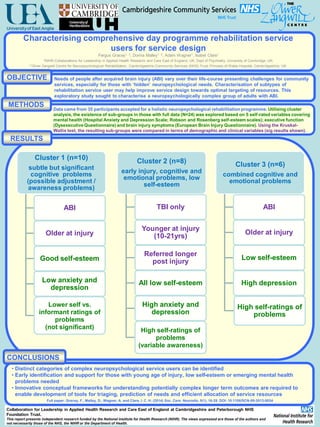
Cluster 1 (n=10)
subtle but significant
cognitive problems
(possible adjustment /
awareness problems)
ABI
Older at injury
Good self-esteem
Low anxiety and
depression
Lower self vs.
informant ratings of
problems
(not significant)
Cluster 2 (n=8)
early injury, cognitive and
emotional problems, low
self-esteem
TBI only
Younger at injury
(10-21yrs)
Referred longer
post injury
All low self-esteem
High anxiety and
depression
High self-ratings of
problems
(variable awareness)
Cluster 3 (n=6)
combined cognitive and
emotional problems
ABI
Older at injury
Low self-esteem
High depression
High self-ratings of
problems
Fergus Gracey1, 2, Donna Malley1, 2, Adam Wagner1, Isabel Clare1
1NIHR-Collaborations for Leadership in Applied Health Research and Care East of England, UK; Dept of Psychiatry, University of Cambridge, UK;
2 Oliver Zangwill Centre for Neuropsychological Rehabilitation, Cambridgeshire Community Services (NHS) Trust, Princess of Wales Hospital, Cambridgeshire, UK.
OBJECTIVE
CONCLUSIONS

Cluster analysis poster by Gracey and Malley

  • 1.
    Collaboration for Leadershipin Applied Health Research and Care East of England at Cambridgeshire and Peterborough NHS Foundation Trust. This report presents independent research funded by the National Institute for Health Research (NIHR). The views expressed are those of the authors and not necessarily those of the NHS, the NIHR or the Department of Health. RESULTS • Distinct categories of complex neuropsychological service users can be identified • Early identification and support for those with young age of injury, low self-esteem or emerging mental health problems needed • Innovative conceptual frameworks for understanding potentially complex longer term outcomes are required to enable development of tools for triaging, prediction of needs and efficient allocation of service resources Full paper: Gracey, F., Malley, D., Wagner, A. and Clare, I. C. H. (2014) Soc. Care. Neurodis. 5(1), 16-28. DOI: 10.1108/SCN-09-2013-0034 METHODS Characterising comprehensive day programme rehabilitation service users for service design Needs of people after acquired brain injury (ABI) vary over their life-course presenting challenges for community services, especially for those with ‘hidden’ neuropsychological needs. Characterisation of subtypes of rehabilitation service user may help improve service design towards optimal targeting of resources. This exploratory study sought to characterise a neuropsychologically complex group of adults with ABI. Data came from 35 participants accepted for a holistic neuropsychological rehabilitation programme. Utilising cluster analysis, the existence of sub-groups in those with full data (N=24) was explored based on 5 self-rated variables covering mental health (Hospital Anxiety and Depression Scale; Robson and Rosenberg self-esteem scales); executive function (Dysexecutive Questionnaire) and brain injury symptoms (European Brain Injury Questionnaire). Using the Kruskal- Wallis test, the resulting sub-groups were compared in terms of demographic and clinical variables (sig results shown). Cluster 1 (n=10) subtle but significant cognitive problems (possible adjustment / awareness problems) ABI Older at injury Good self-esteem Low anxiety and depression Lower self vs. informant ratings of problems (not significant) Cluster 2 (n=8) early injury, cognitive and emotional problems, low self-esteem TBI only Younger at injury (10-21yrs) Referred longer post injury All low self-esteem High anxiety and depression High self-ratings of problems (variable awareness) Cluster 3 (n=6) combined cognitive and emotional problems ABI Older at injury Low self-esteem High depression High self-ratings of problems Fergus Gracey1, 2, Donna Malley1, 2, Adam Wagner1, Isabel Clare1 1NIHR-Collaborations for Leadership in Applied Health Research and Care East of England, UK; Dept of Psychiatry, University of Cambridge, UK; 2 Oliver Zangwill Centre for Neuropsychological Rehabilitation, Cambridgeshire Community Services (NHS) Trust, Princess of Wales Hospital, Cambridgeshire, UK. OBJECTIVE CONCLUSIONS