Cloud Computing
Agenda
● Definition
● Cloud Service Models
● Key Characteristics
● Cloud Testing
- Functional testing
- Load testing
- Performance and Benchmark testing
- Network resting
- Interoperability and Compatibility testing
● Conclusion
● A Glimpse into the Future
Copyright © by QA InfoTech.
All rights reserved.
What is cloud computing?
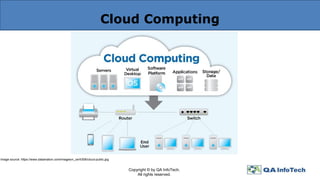
Definition: Cloud computing refers to a centralized delivery
system of computing services, be it information, resources or software
over the “cloud”, i.e., the Internet. Storing and accessing data over the
network rather than a computer is what cloud computing essentially
means.
Copyright © by QA InfoTech.
All rights reserved.
Cloud Computing
Copyright © by QA InfoTech.
All rights reserved.
Image source: https://www.datamation.com/imagesvr_ce/4308/cloud-public.jpg
Cloud Service Models
Copyright © by QA InfoTech.
All rights reserved.
Image source: https://cdn-hightechdad.netdna-ssl.com/wp-content/uploads/2012/01/gogrid_cloud_pyramid1.png
Description
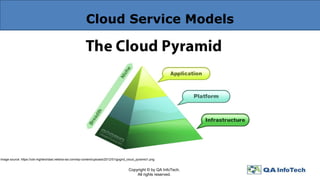
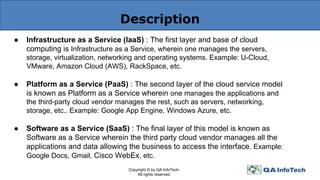
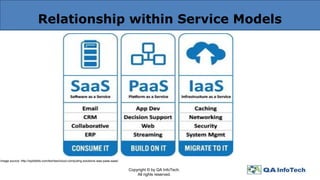
● Infrastructure as a Service (IaaS) : The first layer and base of cloud
computing is Infrastructure as a Service, wherein one manages the servers,
storage, virtualization, networking and operating systems. Example: U-Cloud,
VMware, Amazon Cloud (AWS), RackSpace, etc.
● Platform as a Service (PaaS) : The second layer of the cloud service model
is known as Platform as a Service wherein one manages the applications and
the third-party cloud vendor manages the rest, such as servers, networking,
storage, etc.. Example: Google App Engine, Windows Azure, etc.
● Software as a Service (SaaS) : The final layer of this model is known as
Software as a Service wherein the third party cloud vendor manages all the
applications and data allowing the business to access the interface. Example:
Google Docs, Gmail, Cisco WebEx, etc.
Copyright © by QA InfoTech.
All rights reserved.
Relationship within Service Models
Copyright © by QA InfoTech.
All rights reserved.
Image source: http://wptidbits.com/techies/cloud-computing-solutions-iaas-paas-saas/
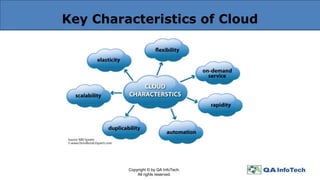
Key Characteristics of Cloud
Copyright © by QA InfoTech.
All rights reserved.
Cloud Testing
Cloud testing becomes ubiquitous wherein resources such as the software,
hardware, etc., are checked in a thorough testing effort.
Due to certain challenges like:
● High costs
● Restrictive budget
● Numerous test cases
● Various users across the globe, etc.,
Effective testing becomes essential wherein availability of flexible and scalable
infrastructure, distributed test environment or unlimited storage helps in saving
time as well as the cost.
Copyright © by QA InfoTech.
All rights reserved.
Copyright © by QA InfoTech.
All rights reserved.
Image source: http://www.professionalqa.com/assets/images/cloud-testing.png
Common Testing performed on Cloud
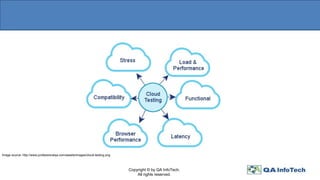
● Functional testing – To verify the basic functionalities with respect to the valid input
that should match the expected output such as user login, shutdown of system,
etc.
● Load testing – To ensure stability with a number of users accessing the cloud. With
scaling-in/scaling-out, load testing is conducted to handle variable load.
● Performance and Benchmark testing – To establish certain yardsticks considering
the performance of the application such as consistency across devices.
● Network security testing – Testing in terms of network connectivity, maintenance of
data integrity, protocol, etc., becomes imperative to ensure a secure environment.
● Interoperability and Compatibility testing – To test seamless functionality across
browsers and platforms.
Copyright © by QA InfoTech.
All rights reserved.
Conclusion
Cloud computing becomes an effective way to-
● Create surplus
● Lower the costs
● Help small businesses and startups wherein they don’t have to bear the initial
infrastructure expenses
● Build, operate and use IT business systems
However, it does pose certain challenges with respect to security, reliability, interoperability,
etc., which need to be taken into consideration.
Copyright © by QA InfoTech.
All rights reserved.
A Glimpse into the Future
● Focus on multi-cloud management
● Development in domain-specific cloud services
● Growth in application migration
● Increased focus on areas such as performance and security
● Change in healthcare, local businesses, real estate and many more
Copyright © by QA InfoTech.
All rights reserved.
Thank You
info@qainfotech.com
www.qainfotech.com

Cloud Testing : An Overview

  • 1.
  • 2.
    Agenda ● Definition ● CloudService Models ● Key Characteristics ● Cloud Testing - Functional testing - Load testing - Performance and Benchmark testing - Network resting - Interoperability and Compatibility testing ● Conclusion ● A Glimpse into the Future Copyright © by QA InfoTech. All rights reserved.
  • 3.
    What is cloudcomputing? Definition: Cloud computing refers to a centralized delivery system of computing services, be it information, resources or software over the “cloud”, i.e., the Internet. Storing and accessing data over the network rather than a computer is what cloud computing essentially means. Copyright © by QA InfoTech. All rights reserved.
  • 4.
    Cloud Computing Copyright ©by QA InfoTech. All rights reserved. Image source: https://www.datamation.com/imagesvr_ce/4308/cloud-public.jpg
  • 5.
    Cloud Service Models Copyright© by QA InfoTech. All rights reserved. Image source: https://cdn-hightechdad.netdna-ssl.com/wp-content/uploads/2012/01/gogrid_cloud_pyramid1.png
  • 6.
    Description ● Infrastructure asa Service (IaaS) : The first layer and base of cloud computing is Infrastructure as a Service, wherein one manages the servers, storage, virtualization, networking and operating systems. Example: U-Cloud, VMware, Amazon Cloud (AWS), RackSpace, etc. ● Platform as a Service (PaaS) : The second layer of the cloud service model is known as Platform as a Service wherein one manages the applications and the third-party cloud vendor manages the rest, such as servers, networking, storage, etc.. Example: Google App Engine, Windows Azure, etc. ● Software as a Service (SaaS) : The final layer of this model is known as Software as a Service wherein the third party cloud vendor manages all the applications and data allowing the business to access the interface. Example: Google Docs, Gmail, Cisco WebEx, etc. Copyright © by QA InfoTech. All rights reserved.
  • 7.
    Relationship within ServiceModels Copyright © by QA InfoTech. All rights reserved. Image source: http://wptidbits.com/techies/cloud-computing-solutions-iaas-paas-saas/
  • 8.
    Key Characteristics ofCloud Copyright © by QA InfoTech. All rights reserved.
  • 9.
    Cloud Testing Cloud testingbecomes ubiquitous wherein resources such as the software, hardware, etc., are checked in a thorough testing effort. Due to certain challenges like: ● High costs ● Restrictive budget ● Numerous test cases ● Various users across the globe, etc., Effective testing becomes essential wherein availability of flexible and scalable infrastructure, distributed test environment or unlimited storage helps in saving time as well as the cost. Copyright © by QA InfoTech. All rights reserved.
  • 10.
    Copyright © byQA InfoTech. All rights reserved. Image source: http://www.professionalqa.com/assets/images/cloud-testing.png
  • 11.
    Common Testing performedon Cloud ● Functional testing – To verify the basic functionalities with respect to the valid input that should match the expected output such as user login, shutdown of system, etc. ● Load testing – To ensure stability with a number of users accessing the cloud. With scaling-in/scaling-out, load testing is conducted to handle variable load. ● Performance and Benchmark testing – To establish certain yardsticks considering the performance of the application such as consistency across devices. ● Network security testing – Testing in terms of network connectivity, maintenance of data integrity, protocol, etc., becomes imperative to ensure a secure environment. ● Interoperability and Compatibility testing – To test seamless functionality across browsers and platforms. Copyright © by QA InfoTech. All rights reserved.
  • 12.
    Conclusion Cloud computing becomesan effective way to- ● Create surplus ● Lower the costs ● Help small businesses and startups wherein they don’t have to bear the initial infrastructure expenses ● Build, operate and use IT business systems However, it does pose certain challenges with respect to security, reliability, interoperability, etc., which need to be taken into consideration. Copyright © by QA InfoTech. All rights reserved.
  • 13.
    A Glimpse intothe Future ● Focus on multi-cloud management ● Development in domain-specific cloud services ● Growth in application migration ● Increased focus on areas such as performance and security ● Change in healthcare, local businesses, real estate and many more Copyright © by QA InfoTech. All rights reserved.
  • 14.