Cloud
AnyAsASAnything As A Service
(The basis)
Nicolas Foata
Public
http://www.anyasas.com
customer-service@anyasas.com
1
 I) Introduction
 Definitions
 Properties & characteristics
 Who are interested in and why ?
 II) Cloud classifications
 According the access
 According the service
 III) Discussion & Conclusions
 An example of architecture
 Useful technologies for cloud
 Conclusions
Plan
Public
http://www.anyasas.com
customer-service@anyasas.com
2
Introduction
Public
3
http://www.anyasas.com
customer-service@anyasas.com
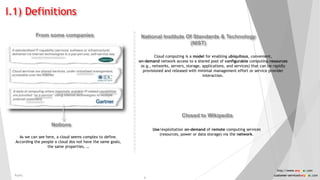
Cloud computing is a model for enabling ubiquitous, convenient,
on-demand network access to a shared pool of configurable computing resources
(e.g., networks, servers, storage, applications, and services) that can be rapidly
provisioned and released with minimal management effort or service provider
interaction.
Use/exploitation on-demand of remote computing services
(resources, power or data storage) via the network.
From some companies
Closed to Wikipedia
Notions
As we can see here, a cloud seems complex to define.
According the people a cloud dos not have the same goals,
the same properties, …
National Institute Of Standards & Technology
(NIST)
I.1) Definitions
Public
4
http://www.anyasas.com
customer-service@anyasas.com
I.2) Properties & characteristics
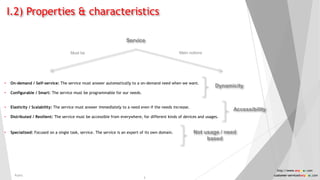
• On-demand / Self-service: The service must answer automatically to a on-demand need when we want.
• Configurable / Smart: The service must be programmable for our needs.
• Elasticity / Scalability: The service must answer immediately to a need even if the needs increase.
• Distributed / Resilient: The service must be accessible from everywhere, for different kinds of devices and usages.
• Specialized: Focused on a single task, service. The service is an expert of its own domain.
Dynamicity
Accessibility
Not usage / need
based
Service
Main notionsMust be
Public
5
http://www.anyasas.com
customer-service@anyasas.com
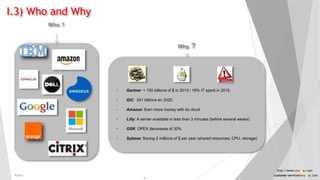
Who ?
Why ?
• Gartner: + 150 billions of $ in 2013 / 19% IT spent in 2015.
• IDC: 241 billions en 2020.
• Amazon: Earn more money with its cloud
• Lilly: A server available in less than 3 minutes (before several weeks)
• GSK: OPEX decreases of 30%
• Sybase: Saving 2 millions of $ per year (shared resources, CPU, storage)
I.3) Who and Why
Public
6
http://www.anyasas.com
customer-service@anyasas.com
Cloud classifications
Public
7
http://www.anyasas.com
customer-service@anyasas.com
II.I) According the access
8
24 August
2017
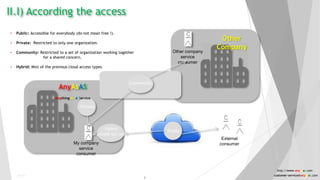
• Public: Accessible for everybody (do not mean free !).
• Private: Restricted to only one organization.
• Community: Restricted to a set of organization working together
for a shared concern.
• Hybrid: Mixt of the previous cloud access types.
My company
service
consumer
Private
Community
Other company
service
consumer
Public
External
consumer
Hybrid
private but use
Public
8
http://www.anyasas.com
customer-service@anyasas.com
AnyAsAS
Anything As A Service
Other
Company
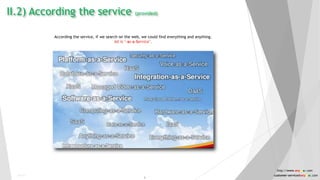
According the service, if we search on the web, we could find everything and anything.
All is ‘-as-a-Service’.
II.2) According the service (provided)
Public
9
http://www.anyasas.com
customer-service@anyasas.com
II.2) According the service (provided)
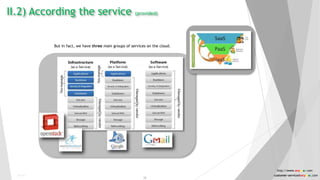
But in fact, we have three main groups of services on the cloud.
Public
10
http://www.anyasas.com
customer-service@anyasas.com
Discussion
&
Conclusions
Public
11
http://www.anyasas.com
customer-service@anyasas.com
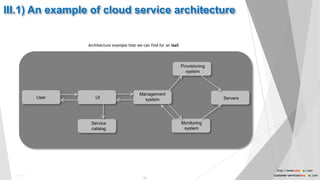
User UI
Management
system
Service
catalog
Monitoring
system
Servers
Provisioning
system
Architecture example that we can find for an IaaS
III.1) An example of cloud service architecture
Public
12
http://www.anyasas.com
customer-service@anyasas.com
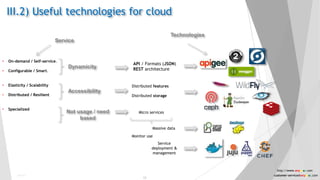
• On-demand / Self-service.
• Configurable / Smart.
• Elasticity / Scalability
• Distributed / Resilient
• Specialized
Dynamicity
Accessibility
Not usage / need
based
Service
Technologies
API / Formats (JSON)
REST architecture
Distributed features
Distributed storage
Micro services
Massive data
Service
deployment &
management
Monitor use
III.2) Useful technologies for cloud
Public
13
http://www.anyasas.com
customer-service@anyasas.com
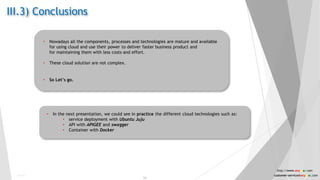
• Nowadays all the components, processes and technologies are mature and available
for using cloud and use their power to deliver faster business product and
for maintaining them with less costs and effort.
• These cloud solution are not complex.
• So Let’s go.
• In the next presentation, we could see in practice the different cloud technologies such as:
• service deployment with Ubuntu Juju
• API with APIGEE and swagger
• Container with Docker
III.3) Conclusions
Public
14
http://www.anyasas.com
customer-service@anyasas.com
Thank you
http://www.anyasas.com
customer-service@anyasas.com
25
Public

Cloud Side : A quick introduction

  • 1.
    Cloud AnyAsASAnything As AService (The basis) Nicolas Foata Public http://www.anyasas.com customer-service@anyasas.com 1
  • 2.
     I) Introduction Definitions  Properties & characteristics  Who are interested in and why ?  II) Cloud classifications  According the access  According the service  III) Discussion & Conclusions  An example of architecture  Useful technologies for cloud  Conclusions Plan Public http://www.anyasas.com customer-service@anyasas.com 2
  • 3.
  • 4.
    Cloud computing isa model for enabling ubiquitous, convenient, on-demand network access to a shared pool of configurable computing resources (e.g., networks, servers, storage, applications, and services) that can be rapidly provisioned and released with minimal management effort or service provider interaction. Use/exploitation on-demand of remote computing services (resources, power or data storage) via the network. From some companies Closed to Wikipedia Notions As we can see here, a cloud seems complex to define. According the people a cloud dos not have the same goals, the same properties, … National Institute Of Standards & Technology (NIST) I.1) Definitions Public 4 http://www.anyasas.com customer-service@anyasas.com
  • 5.
    I.2) Properties &characteristics • On-demand / Self-service: The service must answer automatically to a on-demand need when we want. • Configurable / Smart: The service must be programmable for our needs. • Elasticity / Scalability: The service must answer immediately to a need even if the needs increase. • Distributed / Resilient: The service must be accessible from everywhere, for different kinds of devices and usages. • Specialized: Focused on a single task, service. The service is an expert of its own domain. Dynamicity Accessibility Not usage / need based Service Main notionsMust be Public 5 http://www.anyasas.com customer-service@anyasas.com
  • 6.
    Who ? Why ? •Gartner: + 150 billions of $ in 2013 / 19% IT spent in 2015. • IDC: 241 billions en 2020. • Amazon: Earn more money with its cloud • Lilly: A server available in less than 3 minutes (before several weeks) • GSK: OPEX decreases of 30% • Sybase: Saving 2 millions of $ per year (shared resources, CPU, storage) I.3) Who and Why Public 6 http://www.anyasas.com customer-service@anyasas.com
  • 7.
  • 8.
    II.I) According theaccess 8 24 August 2017 • Public: Accessible for everybody (do not mean free !). • Private: Restricted to only one organization. • Community: Restricted to a set of organization working together for a shared concern. • Hybrid: Mixt of the previous cloud access types. My company service consumer Private Community Other company service consumer Public External consumer Hybrid private but use Public 8 http://www.anyasas.com customer-service@anyasas.com AnyAsAS Anything As A Service Other Company
  • 9.
    According the service,if we search on the web, we could find everything and anything. All is ‘-as-a-Service’. II.2) According the service (provided) Public 9 http://www.anyasas.com customer-service@anyasas.com
  • 10.
    II.2) According theservice (provided) But in fact, we have three main groups of services on the cloud. Public 10 http://www.anyasas.com customer-service@anyasas.com
  • 11.
  • 12.
    User UI Management system Service catalog Monitoring system Servers Provisioning system Architecture examplethat we can find for an IaaS III.1) An example of cloud service architecture Public 12 http://www.anyasas.com customer-service@anyasas.com
  • 13.
    • On-demand /Self-service. • Configurable / Smart. • Elasticity / Scalability • Distributed / Resilient • Specialized Dynamicity Accessibility Not usage / need based Service Technologies API / Formats (JSON) REST architecture Distributed features Distributed storage Micro services Massive data Service deployment & management Monitor use III.2) Useful technologies for cloud Public 13 http://www.anyasas.com customer-service@anyasas.com
  • 14.
    • Nowadays allthe components, processes and technologies are mature and available for using cloud and use their power to deliver faster business product and for maintaining them with less costs and effort. • These cloud solution are not complex. • So Let’s go. • In the next presentation, we could see in practice the different cloud technologies such as: • service deployment with Ubuntu Juju • API with APIGEE and swagger • Container with Docker III.3) Conclusions Public 14 http://www.anyasas.com customer-service@anyasas.com
  • 15.