Cloud Databases
and Big Data
Transforming Business through Scalable
and Advanced Data Solutions
Agenda
• Introduction
• What are Cloud Databases?
• Advantages of Cloud Databases
• Major Cloud Database Providers
• AWS Cloud Databases
• Azure Cloud Databases
• Google Cloud Databases
• Introduction to Big Data
• Big Data Technologie
• Impact of Big Data on Business
• Conclusion
2
Introduction
Cloud databases and big data are transformative technologies
reshaping the landscape of data management and analytics.
Cloud databases offer scalable, cost-effective, and accessible
solutions for storing and managing vast amounts of data,
leveraging the power of cloud computing to provide high
availability and advanced security. Big data, characterized by its
volume, velocity, variety, and veracity, enables organizations to
derive valuable insights from diverse and large-scale datasets.
Together, these technologies empower businesses to make data-
driven decisions, optimize operations, and innovate by uncovering
patterns and trends that were previously hidden in massive
datasets.
3
What are Cloud Databases?
Cloud databases are databases that run on cloud computing
platforms, offering scalable, on-demand access to database
resources without the need for physical hardware
management. Key characteristics of cloud databases include
scalability, allowing seamless adjustment of resources based
on demand; cost efficiency, with pay-as-you-go pricing models
reducing capital expenditure; accessibility, providing global
access to data from anywhere; performance, ensuring high
availability and disaster recovery; and advanced security, with
robust encryption and compliance features to protect sensitive
data.
Advantages
of Cloud
Databases
Scalability:
• On-demand resources
• Auto-scaling capabilities
Cost Efficiency:
• Pay-as-you-go pricing
• Reduced infrastructure costs
Accessibility:
• Global access
• Remote work support
Performance:
• High availability
• Disaster recovery
Security:
• Advanced security features
• Compliance with regulations
Major Cloud Database Providers
Amazon Web Services (AWS) Microsoft Azure Google Cloud Platform (GCP)
RDS, Aurora, DynamoDB SQL Database, Cosmos DB Cloud SQL, Bigtable, Firestore
AWS Cloud
Databases
AWS's Cloud Database Offerings
Amazon Web Services (AWS) provides a
comprehensive suite of cloud databases solutions
designed to meet diverse data management needs.
• Amazon RDS: Managed relational database
service with automated tasks.
• Amazon Aurora: High-performance, MySQL and
PostgreSQL-compatible relational database.
• Amazon DynamoDB: NoSQL database service for
key-value and document data.
Features: Scalability, high performance, and advanced
security.
Azure
Cloud
Databases
Azure's Cloud Database Offerings
Microsoft Azure offers a robust portfolio of cloud
database services tailored to various data
requirements.
• Azure SQL Database: Managed relational
database with built-in intelligence.
• Azure Cosmos DB: Globally distributed, multi-
model database service.
Features: Global distribution, multi-model support, and
integrated AI capabilities.
Google
Cloud
Databases
Google's Cloud Database Offerings
Google Cloud Platform (GCP) delivers a versatile
range of database services designed to support
diverse data workloads.
• Cloud SQL: Managed relational database service
for MySQL, PostgreSQL, and SQL Server.
• Bigtable: Fully managed, scalable NoSQL
database for large analytical and operational
workloads.
• Firestore: Flexible, scalable database for mobile,
web, and server development.
Features: High availability, scalability, and real-time
updates.
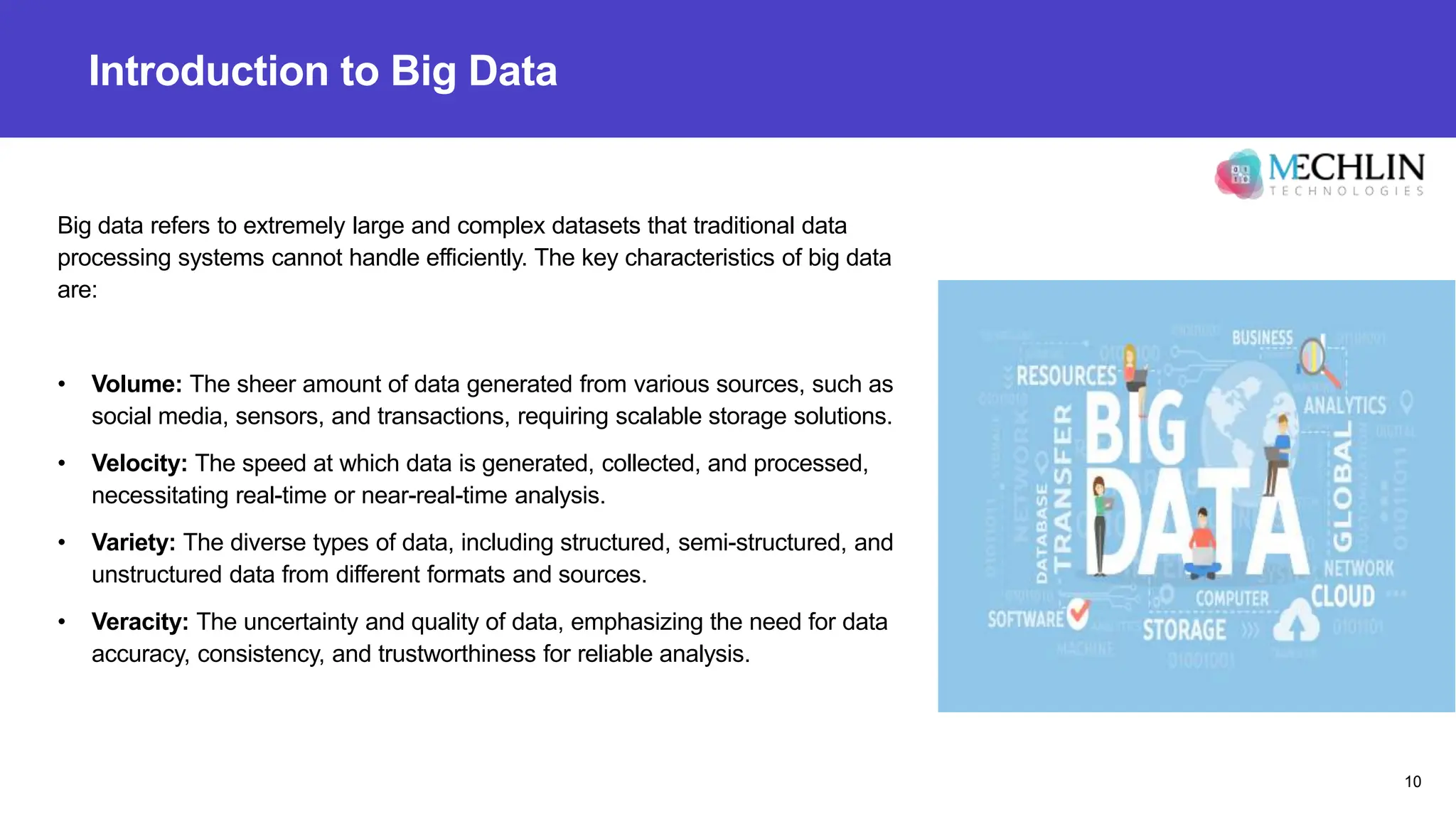
Introduction to Big Data
Big data refers to extremely large and complex datasets that traditional data
processing systems cannot handle efficiently. The key characteristics of big data
are:
• Volume: The sheer amount of data generated from various sources, such as
social media, sensors, and transactions, requiring scalable storage solutions.
• Velocity: The speed at which data is generated, collected, and processed,
necessitating real-time or near-real-time analysis.
• Variety: The diverse types of data, including structured, semi-structured, and
unstructured data from different formats and sources.
• Veracity: The uncertainty and quality of data, emphasizing the need for data
accuracy, consistency, and trustworthiness for reliable analysis.
10
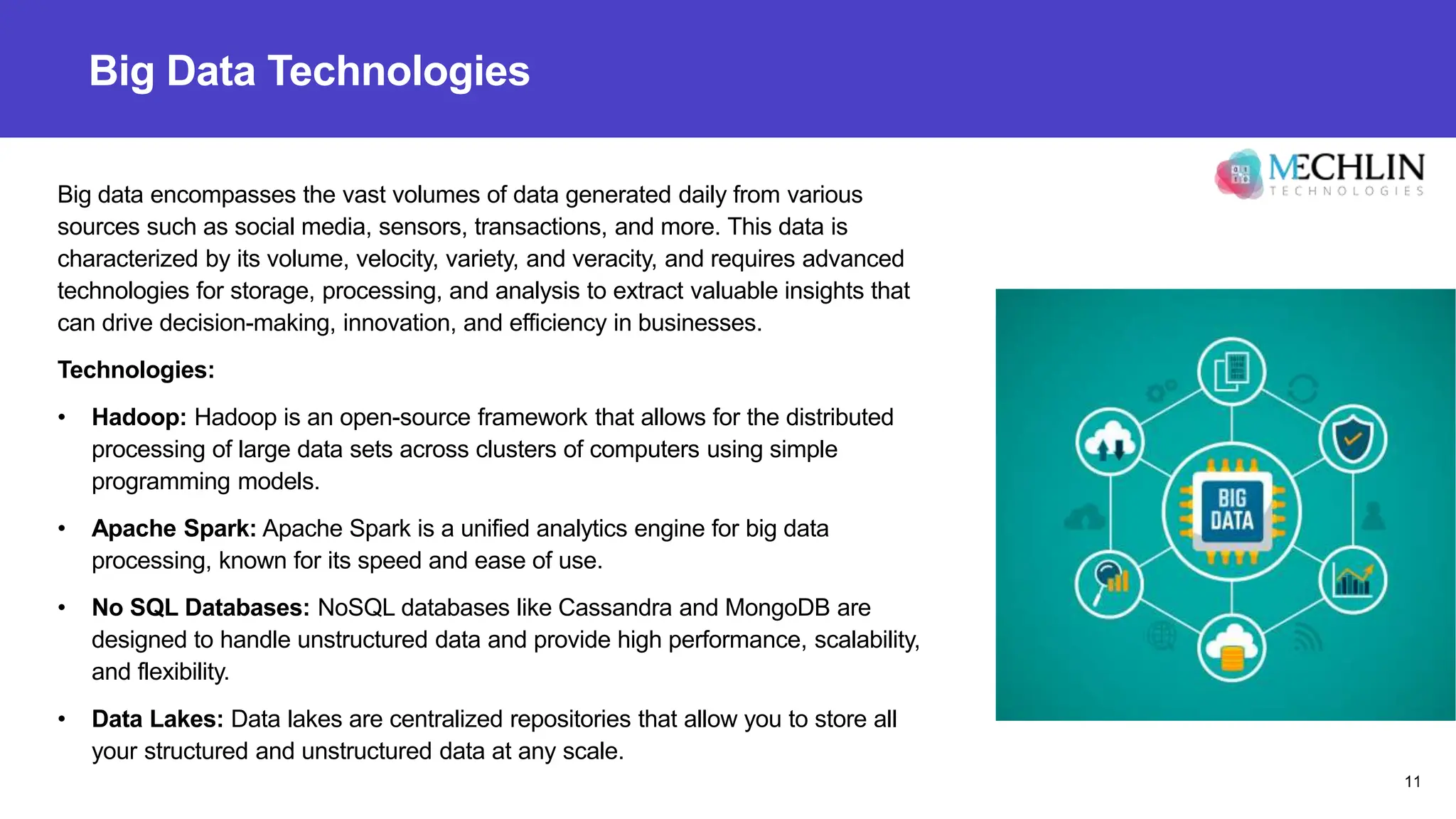
Big Data Technologies
Big data encompasses the vast volumes of data generated daily from various
sources such as social media, sensors, transactions, and more. This data is
characterized by its volume, velocity, variety, and veracity, and requires advanced
technologies for storage, processing, and analysis to extract valuable insights that
can drive decision-making, innovation, and efficiency in businesses.
Technologies:
• Hadoop: Hadoop is an open-source framework that allows for the distributed
processing of large data sets across clusters of computers using simple
programming models.
• Apache Spark: Apache Spark is a unified analytics engine for big data
processing, known for its speed and ease of use.
• No SQL Databases: NoSQL databases like Cassandra and MongoDB are
designed to handle unstructured data and provide high performance, scalability,
and flexibility.
• Data Lakes: Data lakes are centralized repositories that allow you to store all
your structured and unstructured data at any scale.
11
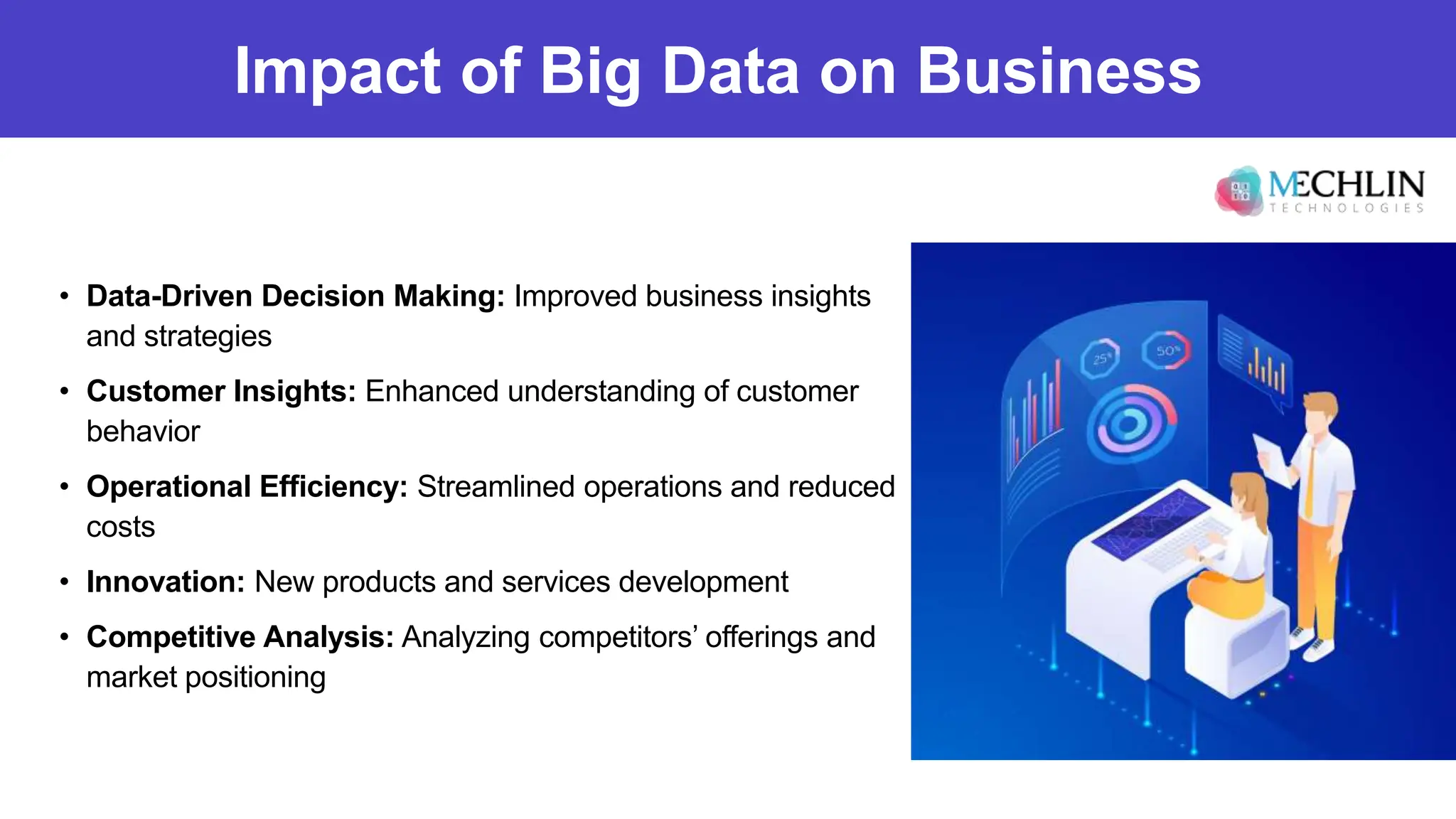
Impact of Big Data on Business
• Data-Driven Decision Making: Improved business insights
and strategies
• Customer Insights: Enhanced understanding of customer
behavior
• Operational Efficiency: Streamlined operations and reduced
costs
• Innovation: New products and services development
• Competitive Analysis: Analyzing competitors’ offerings and
market positioning
Summary
Cloud databases and big data are transformative
technologies that enhance data management and
analysis capabilities. Cloud databases provide
scalable, cost-effective solutions for storing and
managing data with high availability and advanced
security features. Meanwhile, big data technologies
enable the processing and analysis of massive,
diverse datasets, revealing insights that drive strategic
decision-making and innovation. Together, these
technologies empower organizations to harness the
power of their data, improving operational efficiency,
customer understanding, and the development of new
products and services.
Thank you
Mechlin Technologies
• +1 (805) 776-3451
• sales@mechlintech.com
• www.mechlintech.com
14

Cloud Databases and Big Data - Mechlin.pptx

  • 1.
    Cloud Databases and BigData Transforming Business through Scalable and Advanced Data Solutions
  • 2.
    Agenda • Introduction • Whatare Cloud Databases? • Advantages of Cloud Databases • Major Cloud Database Providers • AWS Cloud Databases • Azure Cloud Databases • Google Cloud Databases • Introduction to Big Data • Big Data Technologie • Impact of Big Data on Business • Conclusion 2
  • 3.
    Introduction Cloud databases andbig data are transformative technologies reshaping the landscape of data management and analytics. Cloud databases offer scalable, cost-effective, and accessible solutions for storing and managing vast amounts of data, leveraging the power of cloud computing to provide high availability and advanced security. Big data, characterized by its volume, velocity, variety, and veracity, enables organizations to derive valuable insights from diverse and large-scale datasets. Together, these technologies empower businesses to make data- driven decisions, optimize operations, and innovate by uncovering patterns and trends that were previously hidden in massive datasets. 3
  • 4.
    What are CloudDatabases? Cloud databases are databases that run on cloud computing platforms, offering scalable, on-demand access to database resources without the need for physical hardware management. Key characteristics of cloud databases include scalability, allowing seamless adjustment of resources based on demand; cost efficiency, with pay-as-you-go pricing models reducing capital expenditure; accessibility, providing global access to data from anywhere; performance, ensuring high availability and disaster recovery; and advanced security, with robust encryption and compliance features to protect sensitive data.
  • 5.
    Advantages of Cloud Databases Scalability: • On-demandresources • Auto-scaling capabilities Cost Efficiency: • Pay-as-you-go pricing • Reduced infrastructure costs Accessibility: • Global access • Remote work support Performance: • High availability • Disaster recovery Security: • Advanced security features • Compliance with regulations
  • 6.
    Major Cloud DatabaseProviders Amazon Web Services (AWS) Microsoft Azure Google Cloud Platform (GCP) RDS, Aurora, DynamoDB SQL Database, Cosmos DB Cloud SQL, Bigtable, Firestore
  • 7.
    AWS Cloud Databases AWS's CloudDatabase Offerings Amazon Web Services (AWS) provides a comprehensive suite of cloud databases solutions designed to meet diverse data management needs. • Amazon RDS: Managed relational database service with automated tasks. • Amazon Aurora: High-performance, MySQL and PostgreSQL-compatible relational database. • Amazon DynamoDB: NoSQL database service for key-value and document data. Features: Scalability, high performance, and advanced security.
  • 8.
    Azure Cloud Databases Azure's Cloud DatabaseOfferings Microsoft Azure offers a robust portfolio of cloud database services tailored to various data requirements. • Azure SQL Database: Managed relational database with built-in intelligence. • Azure Cosmos DB: Globally distributed, multi- model database service. Features: Global distribution, multi-model support, and integrated AI capabilities.
  • 9.
    Google Cloud Databases Google's Cloud DatabaseOfferings Google Cloud Platform (GCP) delivers a versatile range of database services designed to support diverse data workloads. • Cloud SQL: Managed relational database service for MySQL, PostgreSQL, and SQL Server. • Bigtable: Fully managed, scalable NoSQL database for large analytical and operational workloads. • Firestore: Flexible, scalable database for mobile, web, and server development. Features: High availability, scalability, and real-time updates.
  • 10.
    Introduction to BigData Big data refers to extremely large and complex datasets that traditional data processing systems cannot handle efficiently. The key characteristics of big data are: • Volume: The sheer amount of data generated from various sources, such as social media, sensors, and transactions, requiring scalable storage solutions. • Velocity: The speed at which data is generated, collected, and processed, necessitating real-time or near-real-time analysis. • Variety: The diverse types of data, including structured, semi-structured, and unstructured data from different formats and sources. • Veracity: The uncertainty and quality of data, emphasizing the need for data accuracy, consistency, and trustworthiness for reliable analysis. 10
  • 11.
    Big Data Technologies Bigdata encompasses the vast volumes of data generated daily from various sources such as social media, sensors, transactions, and more. This data is characterized by its volume, velocity, variety, and veracity, and requires advanced technologies for storage, processing, and analysis to extract valuable insights that can drive decision-making, innovation, and efficiency in businesses. Technologies: • Hadoop: Hadoop is an open-source framework that allows for the distributed processing of large data sets across clusters of computers using simple programming models. • Apache Spark: Apache Spark is a unified analytics engine for big data processing, known for its speed and ease of use. • No SQL Databases: NoSQL databases like Cassandra and MongoDB are designed to handle unstructured data and provide high performance, scalability, and flexibility. • Data Lakes: Data lakes are centralized repositories that allow you to store all your structured and unstructured data at any scale. 11
  • 12.
    Impact of BigData on Business • Data-Driven Decision Making: Improved business insights and strategies • Customer Insights: Enhanced understanding of customer behavior • Operational Efficiency: Streamlined operations and reduced costs • Innovation: New products and services development • Competitive Analysis: Analyzing competitors’ offerings and market positioning
  • 13.
    Summary Cloud databases andbig data are transformative technologies that enhance data management and analysis capabilities. Cloud databases provide scalable, cost-effective solutions for storing and managing data with high availability and advanced security features. Meanwhile, big data technologies enable the processing and analysis of massive, diverse datasets, revealing insights that drive strategic decision-making and innovation. Together, these technologies empower organizations to harness the power of their data, improving operational efficiency, customer understanding, and the development of new products and services.
  • 14.
    Thank you Mechlin Technologies •+1 (805) 776-3451 • sales@mechlintech.com • www.mechlintech.com 14