International Research Journal of Engineering and Technology (IRJET) e-ISSN: 2395-0056
Volume: 04 Issue: 07 | July -2017 www.irjet.net p-ISSN: 2395-0072
© 2017, IRJET | Impact Factor value: 5.181 | ISO 9001:2008 Certified Journal | Page 1828
Cloud Armor: An Overview of Trusty Supporting Reputation Based
management for Cloud Services
Anand1, Anitha G2
1 PG Student, University BDT college of Engineering, Visveswaraya Technological University,
Hadadi Road, Davangere, Karnataka, India
2Associate Professor Dept CS &E, University BDT college of Engineering, Hadadi Road, Davangere,
Karnataka,India,
-----------------------------------------------------------------------------***----------------------------------------------------------------------------
Abstract - Trust management is one of the most challenging
issues for the adoption and growth of cloud computing. The
highly dynamic, distributed, and non-transparent nature of
cloud services introduces several challenging issues such as
privacy, security, and availability. Preserving consumers’
privacy is not an easy task due to the sensitive information
involved in the interactions between consumers and the
trust management service. Protecting cloud servicesagainst
their malicious users (e.g., such users might give misleading
feedback to disadvantage a particular cloud service) is a
difficult problem. Guaranteeing the availability of the trust
management serviceisanothersignificantchallengebecause
of the dynamic nature of cloud environments. In this article,
we describe the design and implementation of CloudArmor,
a reputation-based trust management framework that
provides a set of functionalities to deliver Trust as a Service
(TaaS), which includes i) a novel protocol to prove the
credibility of trust feedbacks and preserve users’ privacy, ii)
an adaptive and robust credibility model for measuring the
credibility of trust feedbacks to protect cloud services from
malicious users and to compare the trustworthinessofcloud
services, and iii) an availability model to manage the
availability of the decentralized implementation of the trust
management service.
Key Words: Trust as a Service (TaaS), Level Agreements
(SLAs), Compliance Level Agreements (CLAs).
1. INTRODUCTION
The significantly intense, flowed and not apparent cloud
nature of organizations made the trust organizationincloud
conditions an enormous test. Asdemonstrated byexaminers
at Berkeleys, belief and assurance are situated the oneoften
obstacles of fundamental for the gathering of dispersed
figuring. Without a doubt, Benefit Level Understandings
(service level arguments) single are missing to set up
assurance between cloud purchasers and providers in
perspective of its foggy andclashingstipulations.Customers'
feedback is a good source to assess the general reliability of
cloud organizations. A couple of examiners have seen the
significance of trust organization and proposed answers for
assess and manage confide in perspective of reactions
assembled from individuals. When in doubt, itisnotunusual
that a cloud advantage experiences vindictivepractices(e.g.,
plot or Sybil strikes) from their customers.itwanderfocuses
by improving trust organization in cloud conditions by
proposing different ways to deal with certification the
legitimacy of assurance reactions. In particular, we perceive
the going with fundamental problems of the assurance
organization in cloud circumstances.
2. Literature Survey
[1] S. M. Khan and K. W. Hamlen, “Hatman: Intra-Cloud
Trust Management for Hadoop,” in Proc. CLOUD’12,
2012.
Enormous progress in hardware, networking, middleware,
and virtual machine technologies have led to an emergence
of new, globally distributed computing platforms that
provide computation facilities and storage as services
accessible from anywhere via the Internet. At the fore ofthis
movement, cloud computing has been widely heralded as a
new, promising platform for delivering information
infrastructure and resources as IT services . Customers can
access these services in a pay-as-you go fashionwhilesaving
huge capital investment in theirownITinfrastructure.Thus,
cloud computing is now a pervasive presence of enormous
importance to the future of e-commerce.
Data integrity and privacy have emerged as major concerns
for prospective users of clouds. A survey byFujitsuResearch
Institute reveals that 88% of prospective customers are
worried about who has access to their data in the cloud and
demand more trustworthiness. Such surveys reveal an
urgent need to meaningfully addresstheseconcernsforreal-
world cloud systems
[2] S. Pearson, “Privacy, Security and Trust in Cloud
Computing,” in Privacy and Security for Cloud
Computing, ser. Computer Communications and
Networks, 2013, pp. 3–42.
The telecommunication industry has been successful in
turning the Internet into a mobile service and stimulating
the creation of a new set of networked, remote services.
Most of these services are currently supported by or run in
cloud computing platforms. Cloud computing represents a
threat to the status quo of the telecommunication industry
International Research Journal of Engineering and Technology (IRJET) e-ISSN: 2395-0056
Volume: 04 Issue: 07 | July -2017 www.irjet.net p-ISSN: 2395-0072
© 2017, IRJET | Impact Factor value: 5.181 | ISO 9001:2008 Certified Journal | Page 1829
and, at the same time, a unique opportunity to deliver new
high value-added services. On the onehand,thethreat isthat
cloud computing platforms may reduce telecommunication
providers to delivering commodity “dumb” pipes that just
forward data from customers to cloud computing providers,
which then offer services with highvalue-added.Theincome
from services represents an important share of the total
revenue of telecommunication providers and service
provision is usually more profitable than packetforwarding.
On the other hand, the telecommunication industry’sunique
position offers an opportunity for integration and
development of new cloud-based services that take into
consideration knowledge of thenetwork status,theability to
redirect and prioritize data traffic, and knowledge about its
customers. Such advantages have the potential to
dramatically boost the revenues of telecommunication
providers.
3. System Design
Cloudiorganization customers' input is better than average
resource to evaluate the normal dependability of cloud
organizations. Here our project has shown a good systems
which helps with perceiving reputation base ambushes and
empowering customers to satisfactorily recognize tried and
true cloud organizations. We introduce an acceptability
display that not simply perceives misleading assurance
reactions from plot ambushes moreover recognizes Sybil
strikes paying little heed to these attacks occur in a long or
brief time allotment (i.e., major or incidental ambushes
exclusively). We in like manner develop an availability
demonstrate that keeps up the trust organization advantage
at a desired level. We moreover develop anavailabilityshow
that keeps up the assured organization advantage at a pined
for stage.
The Proposed structure enables the customer and cloud to
specialist organization to conquer the issues utilizing
straightforward strategies. The input of the cloud benefit
shoppers is a positive root to gauge the honesty of entire
cloud benefit. A portion of the books approach that backings
in distinguishing the dependability based interruptions and
allowing customers to satisfactorily perceive validate cloud
administrations. The false trust criticisms are distinguished
from Tricky assaults utilizing validityshowandfurthermore
identifies the Sybil assault. The trust organization benefit at
the coveted level is kept up utilizing accessibility
demonstrate.
3.1 THE TRUST MAINFRAME SERVICE FRAMEWORK
The Trust Centralized server Administration structure is
settled as an Internet utilityknownasCloudProtectivelayer,
built to build up an easy to use cloud condition for both
cloud shopper and for cloud providers.Thisstructureisbuilt
up on the administration situated engineering (SOA), which
pass on administration as a trust (TaaS). The trust
administration engineering spreadsdifferentscatteredhubs
that set up compound with the goal that customers can give
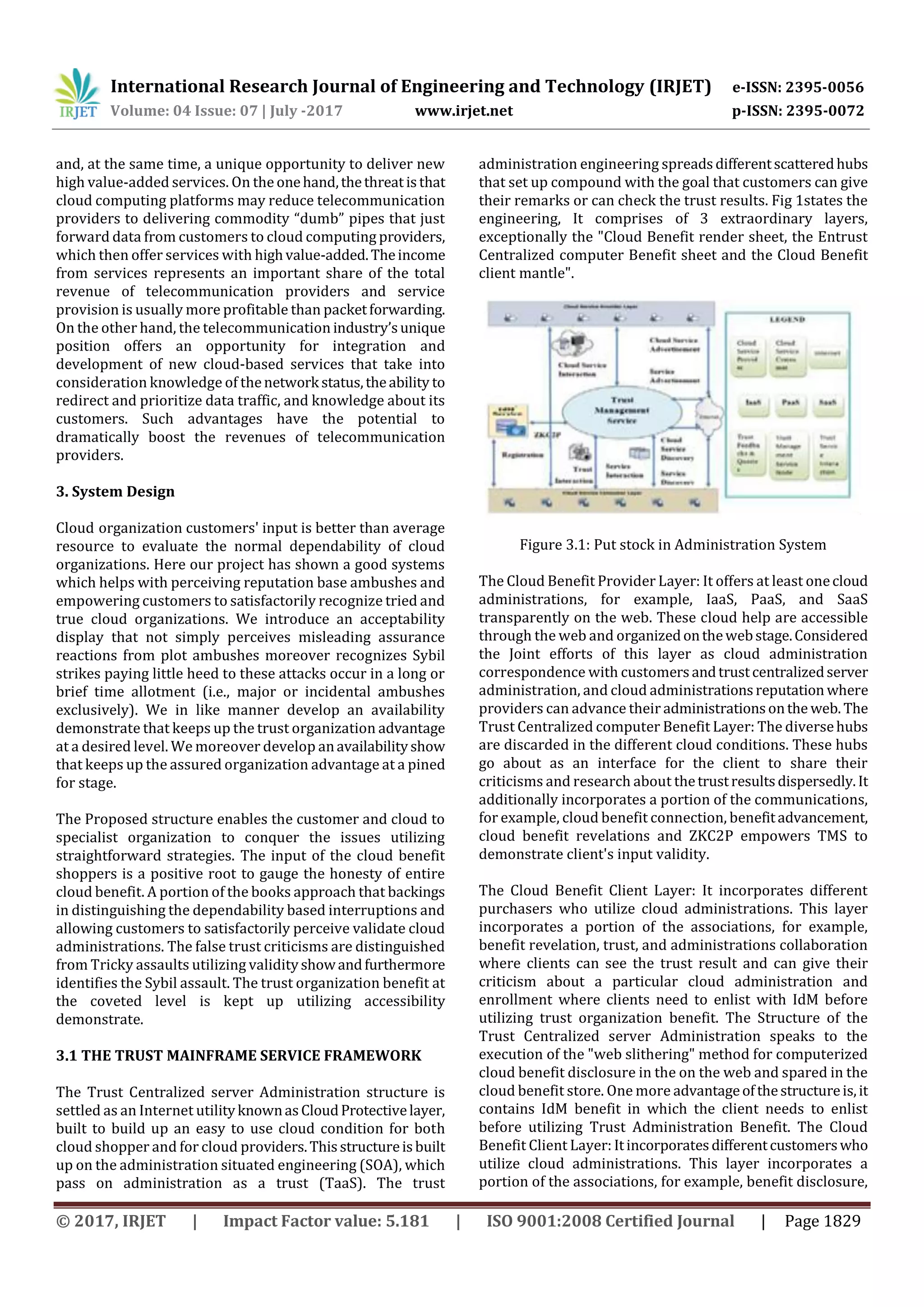
their remarks or can check the trust results. Fig 1states the
engineering, It comprises of 3 extraordinary layers,
exceptionally the "Cloud Benefit render sheet, the Entrust
Centralized computer Benefit sheet and theiCloud Benefit
client mantle".
Figure 3.1: Put stock in Administration System
The Cloud Benefit Provider Layer: It offers at least onecloud
administrations, for example, IaaS, PaaS, and SaaS
transparently on the web. These cloud help are accessible
through the web and organizedonthewebstage.Considered
the Joint efforts of this layer as cloud administration
correspondence with customersandtrustcentralizedserver
administration, and cloud administrationsreputation where
providers can advance their administrationsonthe web. The
Trust Centralized computer Benefit Layer: The diversehubs
are discarded in the different cloud conditions. These hubs
go about as an interface for the client to share their
criticisms and research about thetrustresultsdispersedly.It
additionally incorporates a portion of the communications,
for example, cloud benefit connection, benefitadvancement,
cloud benefit revelations and ZKC2P empowers TMS to
demonstrate client's input validity.
The Cloud Benefit Client Layer: It incorporates different
purchasers who utilize cloud administrations. This layer
incorporates a portion of the associations, for example,
benefit revelation, trust, and administrations collaboration
where clients can see the trust result and can give their
criticism about a particular cloud administration and
enrollment where clients need to enlist with IdM before
utilizing trust organization benefit. The Structure of the
Trust Centralized server Administration speaks to the
execution of the "web slithering" method for computerized
cloud benefit disclosure in the on the web and spared in the
cloud benefit store. One more advantageofthestructureis,it
contains IdM benefit in which the client needs to enlist
before utilizing Trust Administration Benefit. The Cloud
Benefit Client Layer: Itincorporatesdifferentcustomerswho
utilize cloud administrations. This layer incorporates a
portion of the associations, for example, benefit disclosure,
International Research Journal of Engineering and Technology (IRJET) e-ISSN: 2395-0056
Volume: 04 Issue: 07 | July -2017 www.irjet.net p-ISSN: 2395-0072
© 2017, IRJET | Impact Factor value: 5.181 | ISO 9001:2008 Certified Journal | Page 1830
trust, and administrations connection where clients can see
the trust result and can give their input about a particular
cloud administration and enrollment where clients need to
enlist with IdM before utilizing trust organization benefit.
The Structure of the Trust Centralized computer
Administration speaks to the execution of the "web
creeping" procedureformechanizedcloudbenefitrevelation
in the on the web and spared in the cloudbenefitstorehouse.
One more advantage of the structure is it contains IdM
benefit in which the client needs to enroll before utilizing
Trust Administration Benefit.
4. Propsed System:
Framework configuration is a demonstratingprocedure.Itis
an approach to manage make another structure. It can be
described as a move from customer's point of view to
programming architectsordatabaseperson'sviewpoint. The
arrangement organize goes organize.
4.1 Design Graph
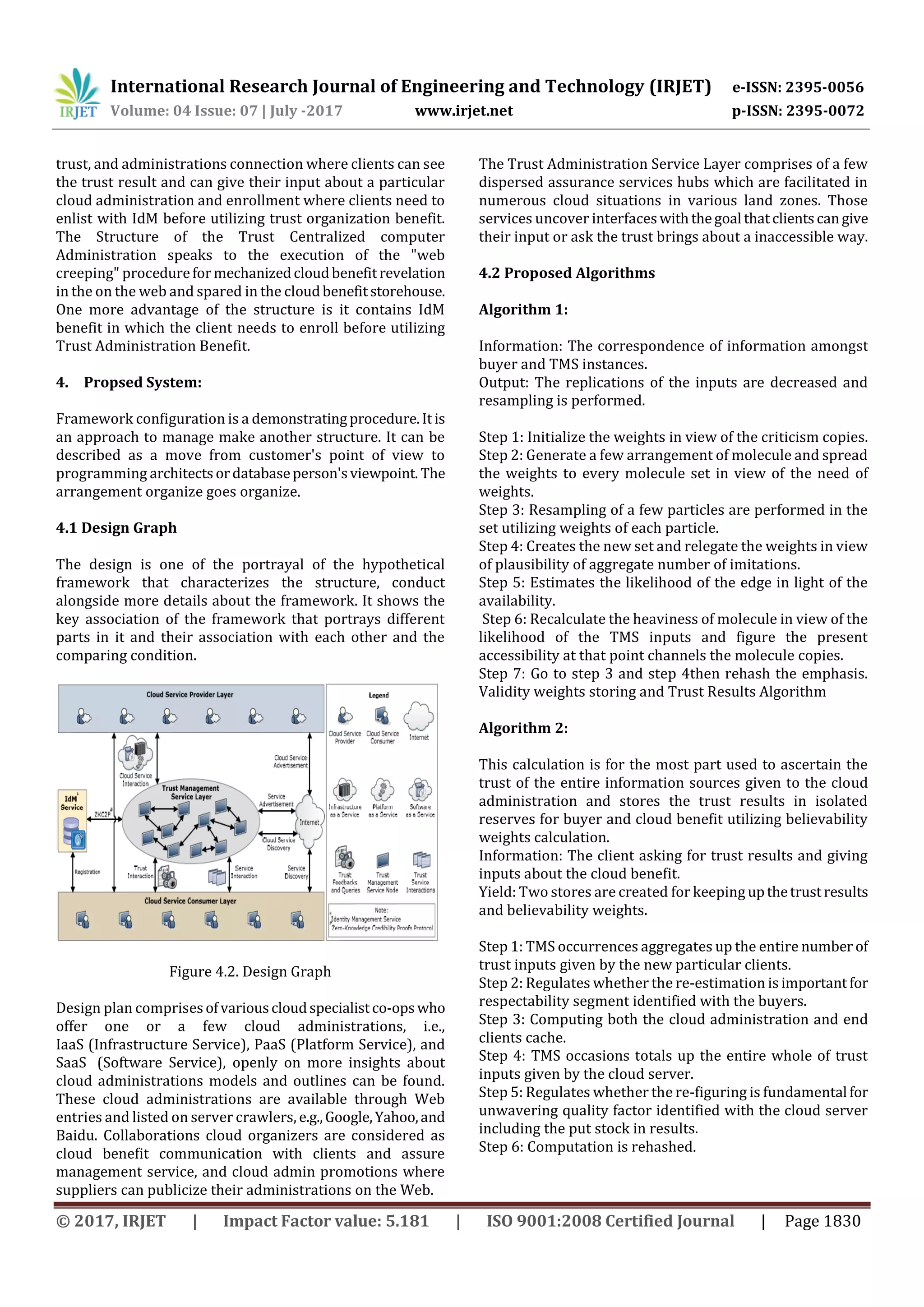
The design is one of the portrayal of the hypothetical
framework that characterizes the structure, conduct
alongside more details about the framework. It shows the
key association of the framework that portrays different
parts in it and their association with each other and the
comparing condition.
Figure 4.2. Design Graph
Design plan comprisesofvariouscloudspecialistco-opswho
offer one or a few cloud administrations, i.e.,
IaaSi(Infrastructure Service), PaaSi(Platform Service), and
SaaSi (Software Service), openly on more insights about
cloud administrations models and outlines can be found.
These cloud administrations are available through Web
entries and listed on server crawlers, e.g.,Google,Yahoo,and
Baidu. Collaborations cloud organizers are considered as
cloud benefit communication with clients and assure
management service, and cloud admin promotions where
suppliers can publicize their administrations on the Web.
The Trust Administration Service Layer comprises of a few
dispersed assurance services hubs which are facilitated in
numerous cloud situations in various land zones. Those
services uncover interfaceswiththegoal thatclientscangive
their input or ask the trust brings about a inaccessible way.
4.2 Proposed Algorithms
Algorithm 1:
Information: The correspondence of information amongst
buyer and TMS instances.
Output: The replications of the inputs are decreased and
resampling is performed.
Step 1: Initialize the weights in view of the criticism copies.
Step 2: Generate a few arrangement of molecule and spread
the weights to every molecule set in view of the need of
weights.
Step 3: Resampling of a few particles are performed in the
set utilizing weights of each particle.
Step 4: Creates the new set and relegate the weights in view
of plausibility of aggregate number of imitations.
Step 5: Estimates the likelihood of the edge in light of the
availability.
Step 6: Recalculate the heaviness of molecule in view of the
likelihood of the TMS inputs and figure the present
accessibility at that point channels the molecule copies.
Step 7: Go to step 3 and step 4then rehash the emphasis.
Validity weights storing and Trust Results Algorithm
Algorithm 2:
This calculation is for the most part used to ascertain the
trust of the entire information sources given to the cloud
administration and stores the trust results in isolated
reserves for buyer and cloud benefit utilizing believability
weights calculation.
Information: The client asking for trust results and giving
inputs about the cloud benefit.
Yield: Two stores are created for keeping upthetrustresults
and believability weights.
Step 1: TMS occurrences aggregates up the entire number of
trust inputs given by the new particular clients.
Step 2: Regulates whether the re-estimation is important for
respectability segment identified with the buyers.
Step 3: Computing both the cloud administration and end
clients cache.
Step 4: TMS occasions totals up the entire whole of trust
inputs given by the cloud server.
Step 5: Regulates whether the re-figuring is fundamental for
unwavering quality factor identified with the cloud server
including the put stock in results.
Step 6: Computation is rehashed.
International Research Journal of Engineering and Technology (IRJET) e-ISSN: 2395-0056
Volume: 04 Issue: 07 | July -2017 www.irjet.net p-ISSN: 2395-0072
© 2017, IRJET | Impact Factor value: 5.181 | ISO 9001:2008 Certified Journal | Page 1831
5. Conclusion
Weghave presented different methods thatxhelp with
recognizing reputationxbased strikes and empowering
customers to enough perceive reliable cloudxorganizations.
In particular, wexdisplay a credibilityxdemonstratethatlnot
simply recognizes misleading trustxreactions fromxplot
attacks also distinguishes Sybildambushes paying little
attention to these strikes happen in a long or brief time
period (i.e., crucialxor coincidentalxattacks exclusively).
Wexfurthermore develop an availabilityxdisplaythatxkeeps
upythe trustzorganization advantage at a pined forxlevel.
Wethave gathered an expensive numberlof customers
trustgreactions givenlon realicloud organizations (i.e.,more
than 10,000frecords)xto assess ourxproposed
procedures.iThe exploratory outcomes exhibitithe
appropriateness ofxour approachianddemonstratetheilimit
ofxperceiving such pernicious practices. Therevare two or
three headingsxfor ourdfutureywork. Wexplan to combine
various trustiorganization systems, for instance,ireputation
and proposal tozextend thestrust happens
exactness.jExecution headway of the trustqorganization
isxanother centralization ofvour futurexresearchtwork.
References
[1] S. M. Khan and K. W. Hamlen, “Hatman: Intra-Cloud
Trust Management for Hadoop,” in Proc. CLOUD’12, 2012.
[2] S. Pearson, “Privacy, Security and Trust in Cloud
Computing,” in Privacy andSecurityforCloudComputing,
ser. Computer Communications and Networks, 2013, pp. 3–
42.
[3] J. Huang and D. M. Nicol, “Trust Mechanisms for Cloud
Computing,”Journal of Cloud Computing, vol. 2, no. 1, pp. 1–
14, 2013.
[4] K. Hwang and D. Li, “Trusted Cloud Computing with
Secure Resources and Data Coloring,” IEEE Internet
Computing, vol. 14,no. 5, pp. 14–22, 2010.
[5] M. Armbrust, A. Fox, R. Griffith, A. Joseph, R. Katz, A.
Konwinski, G. Lee, D. Patterson, A. Rabkin, I. Stoica, and M.
Zaharia, “A View of Cloud Computing,” ommunications of the
ACM, vol. 53,no. 4, pp. 50–58, 2010.
[6] S. Habib, S. Ries, and M. Muhlhauser, “Towards a Trust
Management System for Cloud Computing,” in Proc. of
TrustCom’11, 2011.
[7] I. Brandic, S. Dustdar, T. Anstett, D. Schumm, F. Leymann,
and R. Konrad, “Compliant Cloud Computing (C3):
Architecture and Language Support for User-Driven
Compliance Management in Clouds,” in Proc. Of CLOUD’10,
2010.
[8] W. Conner, A. Iyengar, T. Mikalsen, I. Rouvellou, and K.
Nahrstedt,“A Trust Management Framework for Service-
Oriented Environments,” in Proc. of WWW’09, 2009.
[9] T. H. Noor, Q. Z. Sheng, and A. Alfazi, “Reputation Attacks
Detection for Effective Trust Assessment of Cloud Services,”
in Proc. of TrustCom’13, 2013. [10] T. H. Noor, Q. Z.
Sheng, S. Zeadally, and J. Yu, “Trust Management of Services
in Cloud Environments: Obstacles and Solutions,” ACM
Computing Surveys, vol. 46, no. 1, pp. 12:1–12:30, 2013.

Cloud Armor: An Overview of Trusty Supporting Reputation based Management for Cloud Services

  • 1.
    International Research Journalof Engineering and Technology (IRJET) e-ISSN: 2395-0056 Volume: 04 Issue: 07 | July -2017 www.irjet.net p-ISSN: 2395-0072 © 2017, IRJET | Impact Factor value: 5.181 | ISO 9001:2008 Certified Journal | Page 1828 Cloud Armor: An Overview of Trusty Supporting Reputation Based management for Cloud Services Anand1, Anitha G2 1 PG Student, University BDT college of Engineering, Visveswaraya Technological University, Hadadi Road, Davangere, Karnataka, India 2Associate Professor Dept CS &E, University BDT college of Engineering, Hadadi Road, Davangere, Karnataka,India, -----------------------------------------------------------------------------***---------------------------------------------------------------------------- Abstract - Trust management is one of the most challenging issues for the adoption and growth of cloud computing. The highly dynamic, distributed, and non-transparent nature of cloud services introduces several challenging issues such as privacy, security, and availability. Preserving consumers’ privacy is not an easy task due to the sensitive information involved in the interactions between consumers and the trust management service. Protecting cloud servicesagainst their malicious users (e.g., such users might give misleading feedback to disadvantage a particular cloud service) is a difficult problem. Guaranteeing the availability of the trust management serviceisanothersignificantchallengebecause of the dynamic nature of cloud environments. In this article, we describe the design and implementation of CloudArmor, a reputation-based trust management framework that provides a set of functionalities to deliver Trust as a Service (TaaS), which includes i) a novel protocol to prove the credibility of trust feedbacks and preserve users’ privacy, ii) an adaptive and robust credibility model for measuring the credibility of trust feedbacks to protect cloud services from malicious users and to compare the trustworthinessofcloud services, and iii) an availability model to manage the availability of the decentralized implementation of the trust management service. Key Words: Trust as a Service (TaaS), Level Agreements (SLAs), Compliance Level Agreements (CLAs). 1. INTRODUCTION The significantly intense, flowed and not apparent cloud nature of organizations made the trust organizationincloud conditions an enormous test. Asdemonstrated byexaminers at Berkeleys, belief and assurance are situated the oneoften obstacles of fundamental for the gathering of dispersed figuring. Without a doubt, Benefit Level Understandings (service level arguments) single are missing to set up assurance between cloud purchasers and providers in perspective of its foggy andclashingstipulations.Customers' feedback is a good source to assess the general reliability of cloud organizations. A couple of examiners have seen the significance of trust organization and proposed answers for assess and manage confide in perspective of reactions assembled from individuals. When in doubt, itisnotunusual that a cloud advantage experiences vindictivepractices(e.g., plot or Sybil strikes) from their customers.itwanderfocuses by improving trust organization in cloud conditions by proposing different ways to deal with certification the legitimacy of assurance reactions. In particular, we perceive the going with fundamental problems of the assurance organization in cloud circumstances. 2. Literature Survey [1] S. M. Khan and K. W. Hamlen, “Hatman: Intra-Cloud Trust Management for Hadoop,” in Proc. CLOUD’12, 2012. Enormous progress in hardware, networking, middleware, and virtual machine technologies have led to an emergence of new, globally distributed computing platforms that provide computation facilities and storage as services accessible from anywhere via the Internet. At the fore ofthis movement, cloud computing has been widely heralded as a new, promising platform for delivering information infrastructure and resources as IT services . Customers can access these services in a pay-as-you go fashionwhilesaving huge capital investment in theirownITinfrastructure.Thus, cloud computing is now a pervasive presence of enormous importance to the future of e-commerce. Data integrity and privacy have emerged as major concerns for prospective users of clouds. A survey byFujitsuResearch Institute reveals that 88% of prospective customers are worried about who has access to their data in the cloud and demand more trustworthiness. Such surveys reveal an urgent need to meaningfully addresstheseconcernsforreal- world cloud systems [2] S. Pearson, “Privacy, Security and Trust in Cloud Computing,” in Privacy and Security for Cloud Computing, ser. Computer Communications and Networks, 2013, pp. 3–42. The telecommunication industry has been successful in turning the Internet into a mobile service and stimulating the creation of a new set of networked, remote services. Most of these services are currently supported by or run in cloud computing platforms. Cloud computing represents a threat to the status quo of the telecommunication industry
  • 2.
    International Research Journalof Engineering and Technology (IRJET) e-ISSN: 2395-0056 Volume: 04 Issue: 07 | July -2017 www.irjet.net p-ISSN: 2395-0072 © 2017, IRJET | Impact Factor value: 5.181 | ISO 9001:2008 Certified Journal | Page 1829 and, at the same time, a unique opportunity to deliver new high value-added services. On the onehand,thethreat isthat cloud computing platforms may reduce telecommunication providers to delivering commodity “dumb” pipes that just forward data from customers to cloud computing providers, which then offer services with highvalue-added.Theincome from services represents an important share of the total revenue of telecommunication providers and service provision is usually more profitable than packetforwarding. On the other hand, the telecommunication industry’sunique position offers an opportunity for integration and development of new cloud-based services that take into consideration knowledge of thenetwork status,theability to redirect and prioritize data traffic, and knowledge about its customers. Such advantages have the potential to dramatically boost the revenues of telecommunication providers. 3. System Design Cloudiorganization customers' input is better than average resource to evaluate the normal dependability of cloud organizations. Here our project has shown a good systems which helps with perceiving reputation base ambushes and empowering customers to satisfactorily recognize tried and true cloud organizations. We introduce an acceptability display that not simply perceives misleading assurance reactions from plot ambushes moreover recognizes Sybil strikes paying little heed to these attacks occur in a long or brief time allotment (i.e., major or incidental ambushes exclusively). We in like manner develop an availability demonstrate that keeps up the trust organization advantage at a desired level. We moreover develop anavailabilityshow that keeps up the assured organization advantage at a pined for stage. The Proposed structure enables the customer and cloud to specialist organization to conquer the issues utilizing straightforward strategies. The input of the cloud benefit shoppers is a positive root to gauge the honesty of entire cloud benefit. A portion of the books approach that backings in distinguishing the dependability based interruptions and allowing customers to satisfactorily perceive validate cloud administrations. The false trust criticisms are distinguished from Tricky assaults utilizing validityshowandfurthermore identifies the Sybil assault. The trust organization benefit at the coveted level is kept up utilizing accessibility demonstrate. 3.1 THE TRUST MAINFRAME SERVICE FRAMEWORK The Trust Centralized server Administration structure is settled as an Internet utilityknownasCloudProtectivelayer, built to build up an easy to use cloud condition for both cloud shopper and for cloud providers.Thisstructureisbuilt up on the administration situated engineering (SOA), which pass on administration as a trust (TaaS). The trust administration engineering spreadsdifferentscatteredhubs that set up compound with the goal that customers can give their remarks or can check the trust results. Fig 1states the engineering, It comprises of 3 extraordinary layers, exceptionally the "Cloud Benefit render sheet, the Entrust Centralized computer Benefit sheet and theiCloud Benefit client mantle". Figure 3.1: Put stock in Administration System The Cloud Benefit Provider Layer: It offers at least onecloud administrations, for example, IaaS, PaaS, and SaaS transparently on the web. These cloud help are accessible through the web and organizedonthewebstage.Considered the Joint efforts of this layer as cloud administration correspondence with customersandtrustcentralizedserver administration, and cloud administrationsreputation where providers can advance their administrationsonthe web. The Trust Centralized computer Benefit Layer: The diversehubs are discarded in the different cloud conditions. These hubs go about as an interface for the client to share their criticisms and research about thetrustresultsdispersedly.It additionally incorporates a portion of the communications, for example, cloud benefit connection, benefitadvancement, cloud benefit revelations and ZKC2P empowers TMS to demonstrate client's input validity. The Cloud Benefit Client Layer: It incorporates different purchasers who utilize cloud administrations. This layer incorporates a portion of the associations, for example, benefit revelation, trust, and administrations collaboration where clients can see the trust result and can give their criticism about a particular cloud administration and enrollment where clients need to enlist with IdM before utilizing trust organization benefit. The Structure of the Trust Centralized server Administration speaks to the execution of the "web slithering" method for computerized cloud benefit disclosure in the on the web and spared in the cloud benefit store. One more advantageofthestructureis,it contains IdM benefit in which the client needs to enlist before utilizing Trust Administration Benefit. The Cloud Benefit Client Layer: Itincorporatesdifferentcustomerswho utilize cloud administrations. This layer incorporates a portion of the associations, for example, benefit disclosure,
  • 3.
    International Research Journalof Engineering and Technology (IRJET) e-ISSN: 2395-0056 Volume: 04 Issue: 07 | July -2017 www.irjet.net p-ISSN: 2395-0072 © 2017, IRJET | Impact Factor value: 5.181 | ISO 9001:2008 Certified Journal | Page 1830 trust, and administrations connection where clients can see the trust result and can give their input about a particular cloud administration and enrollment where clients need to enlist with IdM before utilizing trust organization benefit. The Structure of the Trust Centralized computer Administration speaks to the execution of the "web creeping" procedureformechanizedcloudbenefitrevelation in the on the web and spared in the cloudbenefitstorehouse. One more advantage of the structure is it contains IdM benefit in which the client needs to enroll before utilizing Trust Administration Benefit. 4. Propsed System: Framework configuration is a demonstratingprocedure.Itis an approach to manage make another structure. It can be described as a move from customer's point of view to programming architectsordatabaseperson'sviewpoint. The arrangement organize goes organize. 4.1 Design Graph The design is one of the portrayal of the hypothetical framework that characterizes the structure, conduct alongside more details about the framework. It shows the key association of the framework that portrays different parts in it and their association with each other and the comparing condition. Figure 4.2. Design Graph Design plan comprisesofvariouscloudspecialistco-opswho offer one or a few cloud administrations, i.e., IaaSi(Infrastructure Service), PaaSi(Platform Service), and SaaSi (Software Service), openly on more insights about cloud administrations models and outlines can be found. These cloud administrations are available through Web entries and listed on server crawlers, e.g.,Google,Yahoo,and Baidu. Collaborations cloud organizers are considered as cloud benefit communication with clients and assure management service, and cloud admin promotions where suppliers can publicize their administrations on the Web. The Trust Administration Service Layer comprises of a few dispersed assurance services hubs which are facilitated in numerous cloud situations in various land zones. Those services uncover interfaceswiththegoal thatclientscangive their input or ask the trust brings about a inaccessible way. 4.2 Proposed Algorithms Algorithm 1: Information: The correspondence of information amongst buyer and TMS instances. Output: The replications of the inputs are decreased and resampling is performed. Step 1: Initialize the weights in view of the criticism copies. Step 2: Generate a few arrangement of molecule and spread the weights to every molecule set in view of the need of weights. Step 3: Resampling of a few particles are performed in the set utilizing weights of each particle. Step 4: Creates the new set and relegate the weights in view of plausibility of aggregate number of imitations. Step 5: Estimates the likelihood of the edge in light of the availability. Step 6: Recalculate the heaviness of molecule in view of the likelihood of the TMS inputs and figure the present accessibility at that point channels the molecule copies. Step 7: Go to step 3 and step 4then rehash the emphasis. Validity weights storing and Trust Results Algorithm Algorithm 2: This calculation is for the most part used to ascertain the trust of the entire information sources given to the cloud administration and stores the trust results in isolated reserves for buyer and cloud benefit utilizing believability weights calculation. Information: The client asking for trust results and giving inputs about the cloud benefit. Yield: Two stores are created for keeping upthetrustresults and believability weights. Step 1: TMS occurrences aggregates up the entire number of trust inputs given by the new particular clients. Step 2: Regulates whether the re-estimation is important for respectability segment identified with the buyers. Step 3: Computing both the cloud administration and end clients cache. Step 4: TMS occasions totals up the entire whole of trust inputs given by the cloud server. Step 5: Regulates whether the re-figuring is fundamental for unwavering quality factor identified with the cloud server including the put stock in results. Step 6: Computation is rehashed.
  • 4.
    International Research Journalof Engineering and Technology (IRJET) e-ISSN: 2395-0056 Volume: 04 Issue: 07 | July -2017 www.irjet.net p-ISSN: 2395-0072 © 2017, IRJET | Impact Factor value: 5.181 | ISO 9001:2008 Certified Journal | Page 1831 5. Conclusion Weghave presented different methods thatxhelp with recognizing reputationxbased strikes and empowering customers to enough perceive reliable cloudxorganizations. In particular, wexdisplay a credibilityxdemonstratethatlnot simply recognizes misleading trustxreactions fromxplot attacks also distinguishes Sybildambushes paying little attention to these strikes happen in a long or brief time period (i.e., crucialxor coincidentalxattacks exclusively). Wexfurthermore develop an availabilityxdisplaythatxkeeps upythe trustzorganization advantage at a pined forxlevel. Wethave gathered an expensive numberlof customers trustgreactions givenlon realicloud organizations (i.e.,more than 10,000frecords)xto assess ourxproposed procedures.iThe exploratory outcomes exhibitithe appropriateness ofxour approachianddemonstratetheilimit ofxperceiving such pernicious practices. Therevare two or three headingsxfor ourdfutureywork. Wexplan to combine various trustiorganization systems, for instance,ireputation and proposal tozextend thestrust happens exactness.jExecution headway of the trustqorganization isxanother centralization ofvour futurexresearchtwork. References [1] S. M. Khan and K. W. Hamlen, “Hatman: Intra-Cloud Trust Management for Hadoop,” in Proc. CLOUD’12, 2012. [2] S. Pearson, “Privacy, Security and Trust in Cloud Computing,” in Privacy andSecurityforCloudComputing, ser. Computer Communications and Networks, 2013, pp. 3– 42. [3] J. Huang and D. M. Nicol, “Trust Mechanisms for Cloud Computing,”Journal of Cloud Computing, vol. 2, no. 1, pp. 1– 14, 2013. [4] K. Hwang and D. Li, “Trusted Cloud Computing with Secure Resources and Data Coloring,” IEEE Internet Computing, vol. 14,no. 5, pp. 14–22, 2010. [5] M. Armbrust, A. Fox, R. Griffith, A. Joseph, R. Katz, A. Konwinski, G. Lee, D. Patterson, A. Rabkin, I. Stoica, and M. Zaharia, “A View of Cloud Computing,” ommunications of the ACM, vol. 53,no. 4, pp. 50–58, 2010. [6] S. Habib, S. Ries, and M. Muhlhauser, “Towards a Trust Management System for Cloud Computing,” in Proc. of TrustCom’11, 2011. [7] I. Brandic, S. Dustdar, T. Anstett, D. Schumm, F. Leymann, and R. Konrad, “Compliant Cloud Computing (C3): Architecture and Language Support for User-Driven Compliance Management in Clouds,” in Proc. Of CLOUD’10, 2010. [8] W. Conner, A. Iyengar, T. Mikalsen, I. Rouvellou, and K. Nahrstedt,“A Trust Management Framework for Service- Oriented Environments,” in Proc. of WWW’09, 2009. [9] T. H. Noor, Q. Z. Sheng, and A. Alfazi, “Reputation Attacks Detection for Effective Trust Assessment of Cloud Services,” in Proc. of TrustCom’13, 2013. [10] T. H. Noor, Q. Z. Sheng, S. Zeadally, and J. Yu, “Trust Management of Services in Cloud Environments: Obstacles and Solutions,” ACM Computing Surveys, vol. 46, no. 1, pp. 12:1–12:30, 2013.