Introduction to CloudComputing
• Cloud computing is the delivery of computing services like servers, storage,
databases, networking, software, and analytics over the internet.
3.
Types of CloudComputing
• 1. Public Cloud: Shared resources over the internet.
• 2. Private Cloud: Dedicated infrastructure for one
organization.
• 3. Hybrid Cloud: Mix of public and private cloud.
• 4. Community Cloud: Shared infrastructure for a specific
group.
• [Add an Image Here]
4.
Cloud Service Models
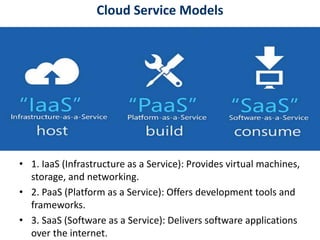
•1. IaaS (Infrastructure as a Service): Provides virtual machines,
storage, and networking.
• 2. PaaS (Platform as a Service): Offers development tools and
frameworks.
• 3. SaaS (Software as a Service): Delivers software applications
over the internet.
5.
Advantages of CloudComputing
• • Cost-effective: No need for on-premise infrastructure.
• • Scalable and flexible: Pay as you use.
• • Automatic updates: Cloud providers manage maintenance.
• • Disaster recovery: Data is backed up automatically.
• • Accessibility: Access data from anywhere.
6.
Disadvantages of CloudComputing
• • Security risks: Data stored online can be vulnerable.
• • Internet dependency: Needs a stable internet connection.
• • Limited control: Users rely on cloud providers.
• • Data privacy: Sensitive information is at risk.
7.
Use Cases &Future Trends
• • Cloud storage (Google Drive, Dropbox, OneDrive)
• • AI & Machine Learning on cloud platforms
• • Edge computing for faster processing
• • Hybrid cloud adoption in enterprises

![Types of Cloud Computing
• 1. Public Cloud: Shared resources over the internet.
• 2. Private Cloud: Dedicated infrastructure for one
organization.
• 3. Hybrid Cloud: Mix of public and private cloud.
• 4. Community Cloud: Shared infrastructure for a specific
group.
• [Add an Image Here]](https://image.slidesharecdn.com/cloudcomputingpresentation1-250405045530-881307be/85/cloud-computing-presentation-pdf-3-320.jpg)