Introduction to Rust
Rustis a systems programming language designed for safety, speed,
and concurrency. It's sponsored by Mozilla Research and has a
growing community. It's well-suited for modern challenges.
by Anand Kumar
AK
2.
Key Features: MemorySafety
Ownership System
Rust prevents data races at compile time using an
ownership system.
Borrow Checker
It enforces memory safety rules with the borrow
checker.
Rust eliminates null pointer exceptions. There is no garbage collection, reducing manual memory management errors.
3.
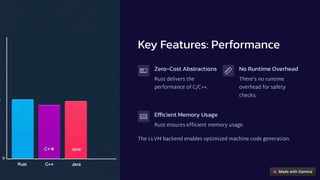
Key Features: Performance
Zero-CostAbstractions
Rust delivers the
performance of C/C++.
No Runtime Overhead
There's no runtime
overhead for safety
checks.
Efficient Memory Usage
Rust ensures efficient memory usage.
The LLVM backend enables optimized machine code generation.
4.
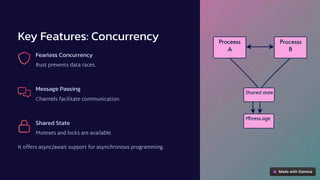
Key Features: Concurrency
FearlessConcurrency
Rust prevents data races.
Message Passing
Channels facilitate communication.
Shared State
Mutexes and locks are available.
It offers async/await support for asynchronous programming.
5.
Use Cases: SystemsProgramming
Operating Systems
Rust is used in operating systems
like Redox OS.
Embedded Systems
It provides low-level control for
embedded systems.
Game Development
Rust enables high-performance
rendering for game development.
Command-line tools benefit from Rust's speed and reliability.
6.
Use Cases: WebDevelopment
1
WebAssembly
Rust supports high-performance web
applications.
2 Server-Side Applications
Actix web framework is used.
3
Network Programming
Tokio asynchronous runtime is used.
It compiles to JavaScript and integrates with existing web ecosystems.
7.
Rust Ecosystem
1
Cargo
Package managerand build system.
2
Crates.io
Package registry.
3
Rust Analyzer
LSP implementation.
Strong community support and documentation are available.
8.
Conclusion: Why Rust?
Reliability
Memorysafety and
concurrency features.
Performance
Speed and efficiency.
Community
Supportive and growing
ecosystem.
It is designed for today's challenges.