Introduction to CloudComputing
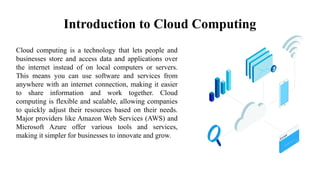
Cloud computing is a technology that lets people and
businesses store and access data and applications over
the internet instead of on local computers or servers.
This means you can use software and services from
anywhere with an internet connection, making it easier
to share information and work together. Cloud
computing is flexible and scalable, allowing companies
to quickly adjust their resources based on their needs.
Major providers like Amazon Web Services (AWS) and
Microsoft Azure offer various tools and services,
making it simpler for businesses to innovate and grow.
4.
Benefits of CloudComputing
❖ Cost Savings: Reduces the need for expensive hardware and maintenance.
❖ Scalability: Easily adjusts resources to meet changing demands.
❖ Accessibility: Access data and services from anywhere with an internet connection.
❖ Security and Backup: Strong security measures and automatic backups for data
protection.
5.
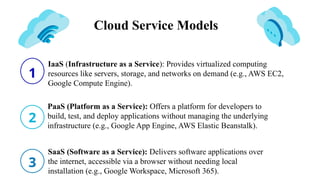
Cloud Service Models
1
2
3
IaaS(Infrastructure as a Service): Provides virtualized computing
resources like servers, storage, and networks on demand (e.g., AWS EC2,
Google Compute Engine).
PaaS (Platform as a Service): Offers a platform for developers to
build, test, and deploy applications without managing the underlying
infrastructure (e.g., Google App Engine, AWS Elastic Beanstalk).
SaaS (Software as a Service): Delivers software applications over
the internet, accessible via a browser without needing local
installation (e.g., Google Workspace, Microsoft 365).
6.
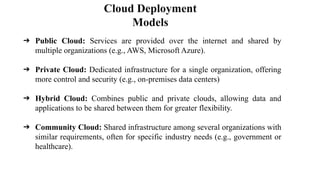
Cloud Deployment
Models
➔ PublicCloud: Services are provided over the internet and shared by
multiple organizations (e.g., AWS, Microsoft Azure).
➔ Private Cloud: Dedicated infrastructure for a single organization, offering
more control and security (e.g., on-premises data centers)
➔ Hybrid Cloud: Combines public and private clouds, allowing data and
applications to be shared between them for greater flexibility.
➔ Community Cloud: Shared infrastructure among several organizations with
similar requirements, often for specific industry needs (e.g., government or
healthcare).
7.
AWS Overview
● AWS(Amazon Web Services) is a leading cloud platform offering a wide
range of services for computing, storage, and networking.
● It provides scalable, reliable, and cost-effective
cloud solutions used by businesses worldwide.
● Popular services include
EC2, S3, RDS, and
Lambda.
8.
Elastic Compute Cloud(EC2)
❏ EC2 provides scalable virtual servers in the
cloud.
❏ You can easily launch, configure, and
manage virtual machines on demand.
❏ Offers flexibility in selecting instance types,
storage, and networking options.
9.
Simple Storage Service(S3)
0
2
0
1
0
3
S3 is a cloud storage service for storing and retrieving data anytime, anywhere
It’s known for high scalability, security, and data durability.
S3 supports various use cases like backup, archiving, and hosting static websites.
10.
Cloud Security
Mercury
Cloud securityfocuses on protecting data, applications, and
infrastructure in the cloud. AWS provides various security
features such as encryption, firewalls, and Identity and
Access Management (IAM) to ensure safe access and usage.
Compliance with industry standards like ISO and GDPR
adds extra layers of protection. AWS also offers continuous
monitoring and automated backups to safeguard against
threats. However, cloud security is a shared responsibility
between AWS and users, with each having roles in securing
the environment.
11.
Future of CloudComputing
● The future of cloud computing includes
advancements in AI, machine learning, and
edge computing.
● Increased adoption of hybrid and multi-
cloud environments.
● Cloud-native applications and serverless
architectures will drive innovation.
Conclusion
Cloud computing, withservices like AWS, is
transforming how businesses operate by offering
scalable, secure, and cost-effective solutions. Key
services like EC2, S3, and robust security measures
ensure that organizations can innovate and grow while
protecting their data. As cloud technology continues to
evolve, with advancements in areas like AI and
serverless computing, the future holds exciting
opportunities for further adoption and integration.
Embracing cloud solutions is crucial for staying
competitive in the digital age.