Part-1
Cloud Computing provides us means of accessing the
applications as utilities over the Internet. It
allows us to create, configure, and customize the
applications online.
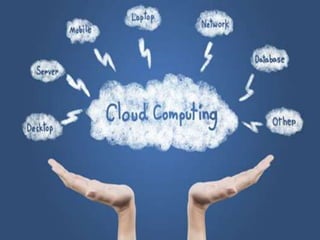
The term Cloud refers to a Network or Internet. In other words, we
can say that Cloud is
something, which is present at remote location. Cloud can provide
services over public and private
networks, i.e., WAN, LAN or VPN.
Applications such as e-mail, web conferencing, customer relationship
management CRM execute
on cloud.
Cloud Computing refers to manipulating, configuring, and accessing the
hardware and
software resources remotely. It offers online data storage, infrastructure, and
application.
Cloud computing offers platform independency, as the software is not
required to be installed
locally on the PC. Hence, the Cloud Computing is making our business
applications mobile and collaborative
There are certain services and models working behind the scene
making the cloud computing
feasible and accessible to end users. Following are the working models
for cloud computing:
1. Deployment Models
2. Service Models
 Public Cloud
 Private Cloud
 Hybrid Cloud
 Community Cloud
1.Public Cloud:-
The public cloud allows systems and services to be easily
accessible to the general public. Public
cloud may be less secure because of its openness.
2.Private Cloud
The private cloud allows systems and services to be accessible
within an organization. It is more secured because of its private
nature
3.Community Cloud
The community cloud allows systems and services to be
accessible by a group of organizations.
4.Hybrid Cloud
The hybrid cloud is a mixture of public and private cloud, in
which the critical activities are
performed using private cloud while the non-critical activities
are performed using public cloud.
Cloud computing is based on service models. These are categorized into three
basic service
models which are -
 Infrastructure-as–a-Service IaaS
 Platform-as-a-Service PaaS
 Software-as-a-Service SaaS
Anything-as-a-Service XaaS is yet another service model, which includes
Network-as-a-Service,
Business-as-a-Service, Identity-as-a-Service, Database-as-a-Service or Strategy-
as-a-Service.
The Infrastructure-as-a-Service IaaS is the most basic level of service. Each of
the service
models inherit the security and management mechanism from the underlying
model
The concept of Cloud Computing came into existence in
the year 1950 with implementation of
mainframe computers, accessible via thin/static clients.
Since then, cloud computing has been
evolved from static clients to dynamic ones and from
software to services.
 Flexibility. ...
 Disaster recovery. ...
 Automatic software updates. ...
 Capital-expenditure Free. ...
 Increased collaboration. ...
 Work from anywhere. ...
 Document control. ...
 Security.
 Competitiveness
 Environmentally friendly
 Downtime
 Security
 Vendor Lock-In
 Limited Control
:-Prabhat Kumar Sahu

Cloud computing ( by prabhat kumar sahu)

  • 1.
  • 3.
    Cloud Computing providesus means of accessing the applications as utilities over the Internet. It allows us to create, configure, and customize the applications online.
  • 4.
    The term Cloudrefers to a Network or Internet. In other words, we can say that Cloud is something, which is present at remote location. Cloud can provide services over public and private networks, i.e., WAN, LAN or VPN. Applications such as e-mail, web conferencing, customer relationship management CRM execute on cloud.
  • 5.
    Cloud Computing refersto manipulating, configuring, and accessing the hardware and software resources remotely. It offers online data storage, infrastructure, and application. Cloud computing offers platform independency, as the software is not required to be installed locally on the PC. Hence, the Cloud Computing is making our business applications mobile and collaborative
  • 6.
    There are certainservices and models working behind the scene making the cloud computing feasible and accessible to end users. Following are the working models for cloud computing: 1. Deployment Models 2. Service Models
  • 7.
     Public Cloud Private Cloud  Hybrid Cloud  Community Cloud
  • 8.
    1.Public Cloud:- The publiccloud allows systems and services to be easily accessible to the general public. Public cloud may be less secure because of its openness. 2.Private Cloud The private cloud allows systems and services to be accessible within an organization. It is more secured because of its private nature 3.Community Cloud The community cloud allows systems and services to be accessible by a group of organizations. 4.Hybrid Cloud The hybrid cloud is a mixture of public and private cloud, in which the critical activities are performed using private cloud while the non-critical activities are performed using public cloud.
  • 9.
    Cloud computing isbased on service models. These are categorized into three basic service models which are -  Infrastructure-as–a-Service IaaS  Platform-as-a-Service PaaS  Software-as-a-Service SaaS Anything-as-a-Service XaaS is yet another service model, which includes Network-as-a-Service, Business-as-a-Service, Identity-as-a-Service, Database-as-a-Service or Strategy- as-a-Service. The Infrastructure-as-a-Service IaaS is the most basic level of service. Each of the service models inherit the security and management mechanism from the underlying model
  • 10.
    The concept ofCloud Computing came into existence in the year 1950 with implementation of mainframe computers, accessible via thin/static clients. Since then, cloud computing has been evolved from static clients to dynamic ones and from software to services.
  • 11.
     Flexibility. ... Disaster recovery. ...  Automatic software updates. ...  Capital-expenditure Free. ...  Increased collaboration. ...  Work from anywhere. ...  Document control. ...  Security.  Competitiveness  Environmentally friendly
  • 13.
     Downtime  Security Vendor Lock-In  Limited Control
  • 15.

Editor's Notes

  • #7 Deployment Models Deployment models define the type of access to the cloud, i.e., how the cloud is located? Cloud can have any of the four types of access: Public, Private, Hybrid, and Community.
  • #10 Infrastructure-as-a-Service IaaS IaaS provides access to fundamental resources such as physical machines, virtual machines, virtual storage, etc. Platform-as-a-Service PaaS PaaS provides the runtime environment for applications, development and deployment tools, etc. Software-as-a-Service SaaS SaaS model allows to use software applications as a service to end-users.
  • #12 Cloud Computing has numerous advantages. Some of them are listed below - 1.One can access applications as utilities, over the Internet. 2.One can manipulate and configure the applications online at any time. 3.It does not require to install a software to access or manipulate cloud application. 4.Cloud Computing offers online development and deployment tools, programming runtime 5.environment through PaaS model. 6.Cloud resources are available over the network in a manner that provide platform 7.independent access to any type of clients. 8Cloud Computing offers on-demand self-service. The resources can be used without interaction with cloud service provider. 9.Cloud Computing is highly cost effective because it operates at high efficiency with optimum utilization. It just requires an Internet connection 10.Cloud Computing offers load balancing that makes it more reliable.