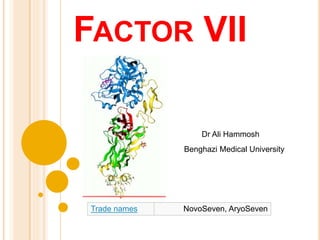

FACTOR VII
Trade names NovoSeven, AryoSeven
Dr Ali Hammosh
Benghazi Medical University
IS ONE OF THE PROTEINS THAT
CAUSES BLOOD TO CLOT IN
THE COAGULATION CASCADE
This treatment results in
activation of the extrinsic
pathway of blood coagulation
THE GENE FOR FACTOR VII IS LOCATED
ON CHROMOSOME 13 (13Q34)
Deficiency is rare (congenital proconvertin deficiency)
and inherits recessively. Factor VII deficiency
presents as a hemophilia-like bleeding disorder
MEDICAL USES
hemophilia(with Factor VIII or IX deficiency)-
- It has also been used in the setting of uncontrollable
treatment and prevention from bleeding episodes in those
undergoing
surgery or invasive procedures in the following patients:
• In patients with congenital haemophilia
• In patients with congenital haemophilia who are expected to have a
high anamnestic response to factor VIII or factor IX administration
• In patients with acquired haemophilia
• In patients with congenital FVII deficiency
• In patients with Glanzmann’s thrombasthenia with antibodies to GP
IIb - IIIa and/or HLA, and with past
or present refractoriness to platelet transfusionshemorrhage
Glanzmann's thrombasthenia-
ROUTE OF ADMINISTRATION
ADMINISTERED INTRAVENOUSLY (IV) UNDER
PHYSICIAN SUPERVISION.
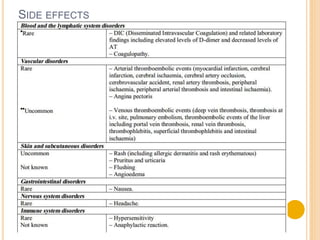
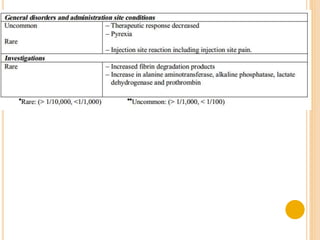
SIDE EFFECTS
THANX

Clotting Factor vii

  • 1.
    FACTOR VII Trade namesNovoSeven, AryoSeven Dr Ali Hammosh Benghazi Medical University
  • 2.
    IS ONE OFTHE PROTEINS THAT CAUSES BLOOD TO CLOT IN THE COAGULATION CASCADE This treatment results in activation of the extrinsic pathway of blood coagulation
  • 3.
    THE GENE FORFACTOR VII IS LOCATED ON CHROMOSOME 13 (13Q34) Deficiency is rare (congenital proconvertin deficiency) and inherits recessively. Factor VII deficiency presents as a hemophilia-like bleeding disorder
  • 4.
    MEDICAL USES hemophilia(with FactorVIII or IX deficiency)- - It has also been used in the setting of uncontrollable treatment and prevention from bleeding episodes in those undergoing surgery or invasive procedures in the following patients: • In patients with congenital haemophilia • In patients with congenital haemophilia who are expected to have a high anamnestic response to factor VIII or factor IX administration • In patients with acquired haemophilia • In patients with congenital FVII deficiency • In patients with Glanzmann’s thrombasthenia with antibodies to GP IIb - IIIa and/or HLA, and with past or present refractoriness to platelet transfusionshemorrhage Glanzmann's thrombasthenia-
  • 5.
    ROUTE OF ADMINISTRATION ADMINISTEREDINTRAVENOUSLY (IV) UNDER PHYSICIAN SUPERVISION.
  • 6.
  • 8.