Closing the	loop
Performance	Days
April	21,	2016
1
Closing	the	loop	
Ongoing	research	in	recycling	is	bringing	us	closer	to	
closing	the	loop	in	the	textile	and	garment	industries.	
Many	challenges	remain	at	all	levels	of	the	supply	
chain,	from	product	design	to	end	of	life,	to	make	
progress	on	the	road	to	a	circular	economy.	
The	speakers	of	this	panel	discussion	will	be	sharing	
their	first	hand	experience	in	this	ambitious	goal.
2
Closing the	loop
Speakers
Roberto	Lucchetti
Sales	Manager	Tessile
Fiorentina
Peter	Bos
Chairman	Texperium
VirginieWittmer
Sales	Manager	Sofileta
Sophie	Bramel
Moderator
3
The	end	of	life	of	garments:	
the	numbers
l On	average	consumers	use	only	a	third	of	their	clothes	on	an	
annual	basis
l Women	throw	away	30	kg	of	clothing	every	year	in	the	UK,	
about	as	much	as	they	buy,	says	Lucy	Siegle
l Extending	the	use	of	clothes	by	an	extra	9	months	reduces	
carbon,	water	and	waste	footprints	by	20-30%	says	WRAP
l 80%	of	the	clothes	we	throw	away	still	have	75%	of	their	
lifetime	left
l 95%	of	all	clothing	is	said	to	be	recyclable
4
Recycling data
l Worldwide	13.1	million	tonnes	of	textiles	are	thrown	away	
each	year	and	only	2	million	tonnes	are	recycled	(source	EPA	– USA)	
l Around	50%	of	garments	collected	are	reused	(source	WRAP	- UK)
l Collecting	&	recycling	(source	I:CO	- Puma,	The	North	Face	&	Columbia	Sportswear	
have	partnered	with	I:CO)
¡ 52%	“re-worn”
¡ 33%	recycled
¡ 9%	reused
¡ 6%	waste
5
Getting	the	(right)	message	across
6
recycled
reclaimed
closed loop
regenerated
regained
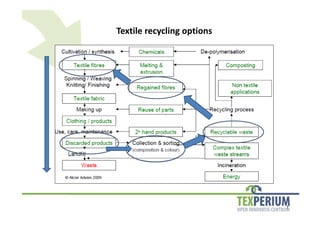
Textile recycling options
7
Closing the	loop,	today
l Mud	Jeans	leases	out	jeans	since	2013	and	is	now	having	3,000	jeans	
recycled	into	fibre	to	make	new	jeans	containing	20%	recycled	material,	
the	highest	percentage	 attainable.
l Patagonia	Common	Threads	 with	Teijin	(since	2005):	over	50	tonnes	of	
clothing	collected	in	store	bins	in	the	past	ten	years.
l H&M	has	collected	some	22,000	tonnes	of	garments	(since	2013).	In	2015,	
the	retailer	had	1.3	million	pieces	made	with	“closed	loop”	material.	
l Gore	Balance	Project	(1993)	abandoned	for	lack	of	jackets	collected	for	
recycling	(less	than	30	per	year)
8
Recycling:	
a	challenge	and	an	opportunity
32 WSA March/April 2016
WSA Sustainability: Fast fashion will lose in a circular world
C
ircular manufacturing is going to
happen and is going to happen soon,
according to supply chain expert
Professor Steve Evans of the University
of Cambridge. In the world of textiles
and apparel, circular manufacturing means a
system that retains and continues to use each
molecule, fibre or square-metre of fabric for as
long as these keep adding value.
He’s aware of examples that exist in the
outdoor industry already, Patagonia’s ‘Common
Threads’ programme being considered the most
famous. But he visits large numbers of
manufacturing companies across all sectors and
says the circular manufacturing “signal” is
growing, even it’s still small. Almost all factories
are still “enormously wasteful”, he insists. Supply
chain experts are famous for identifying waste
and demanding its elimination, like illicit-
substance-seeking sniffer dogs in an airport
terminal. Professor Evans, who is director of
research in industrial sustainability at the
university’s Institute for Manufacturing, bemoans
companies’ fixation with low labour costs. “In the
UK at least,” he says, “labour costs account for
only 10% of the total cost of production, whereas
materials, energy, water and so on account for
40%. And still management teams keeping
putting all their efforts into reducing labour costs.”
Deeper understanding
He explains that the manufacturing
companies that are implementing circular
manufacturing seem to him to have a deeper
understanding of their own products than most
of their competitors and are now taking that
Fast fashion will lose
in a circular world
A Zara pilot store. The
clothing retailer is a fast
fashion success story,
but Professor Steve
Evans regards fast
fashion as “the most
dangerous challenge of
our time”.
Inditex
There are exceptions, but most factories around the world are still, in the opinion of
Professor Steve Evans, director of research in industrial sustainability at Cambridge
University’s Institute for Manufacturing, “enormously wasteful”. At the same time, he says
consumers buying clothes they neither need nor really want are part of a “fast fashion
system”. All of this is unsustainable, he argues.
SUSTAI NAB I LITY: CI RCU LAR MAN U FACTU RI NG
C
O
PYR
IG
H
T
knowledge and turning it into value. “The
recycling industry loves opacity,” he says.
“Recycling companies make money because
manufacturers have no idea what their waste is
worth, and they do know. But the manufacturers
can make better use of that waste than the
recyclers can if they focus on total value and not
total cost, if they are willing to experiment and
learn quickly.”
Fibres and fabrics will run out
At a consumer level, the current system of
buying clothes we never use, or use for only a
few weeks, cannot be sustained, the professor
argues, not least because if we keep
accumulating clothing in the “hedonistic” way
of the western world today, it will only be a
matter of time before we run out of fibres and
fabrics with which to make it all, which would
represent what he calls “a stupid end-point”. He
goes further, referring to fast fashion as “the
most dangerous challenge of our time”
because consumers are spending money they
do not have to “buy into a fast fashion system”,
building up credit card debt. “We have carried
out a lot of analysis on this,” he says of his
research team at Cambridge; one of the pieces
of information this research has gleaned is that
the average consumer in the UK has 147 items
in his or her wardrobe, “and most just want a
bigger wardrobe”.
He urges all sports and outdoor brands, and
indeed all manufacturers, to find waste and turn
it into money. “Companies that lead the way are
already generating value, making money, from
waste, often with projects that are capital-cheap
but take brain-power and confidence,” he
explains. “And using waste to generate value is a
great way to get rich.”
Patagonia’s proof
His assessment of the ‘Common Threads’
programme is that it represents proof that
Patagonia knows it cannot sustain the old model.
‘Common Threads’ is a recycling scheme that
the outdoor brand launched in 2005, at first for
its 100% polyester Capilene baselayer garments,
but now including all types of garments. In the
first ten years of the programme, customers
deposited a collective total of well over 50
tonnes of clothing in special ‘Common Threads’
bins in Patagonia stores. He also expresses
admiration for other Patagonia initiatives such as
its commitment to repairing damaged jackets for
free and its famous Black Friday 2011 full-page
advertisement in the New York Times showing a
blue Patagonia jacket but urging consumers not
to buy it. All are part of a strategy that will
generate value for the company, Professor Evans
believes, through generating high volumes of
positive publicity and love of the brand, not least
on social media, rather than merely through
repeat sales. (Patagonia founder, Yvon
Chouinard, is on the record as saying that the
Black Friday 2011 jacket ended up being a
bestseller in any case).
Professor Steve Evans, leading in-depth
discussions on the future of apparel
manufacturing at the WFSGI Manufacturers’
Forum in December 2015 in Hong Kong.
World Federation of Sporting Goods Industry
33WSA March/April 2016
WSA Sustainability: Fast fashion will lose in a circular world
H&M, another clothing
retail success story,
created by demand for
fast fashion.
Hennes & Mauritz
C
O
PYR
IG
H
T
9
World	Sports	Activewear March/April	2016
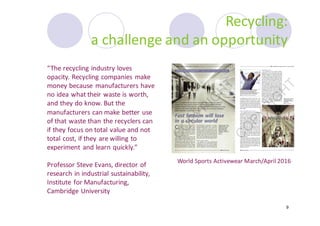
“The	recycling	industry	loves	
opacity.	Recycling	companies	make	
money	because	manufacturers	have	
no	idea	what	their	waste	is	worth,	
and	they	do	know.	But	the	
manufacturers	can	make	better	use	
of	that	waste	than	the	recyclers	can	
if	they	focus	on	total	value	and	not	
total	cost,	if	they	are	willing	to	
experiment	and	learn	quickly.”
Professor	Steve	Evans,	director	of	
research	in	industrial	sustainability,	
Institute	for	Manufacturing,	
Cambridge	University
Thank you
for	your attention
10
The
Circular Economy
in the
Asia Pacific Region
www.circularecconomyasia.org

Closing The Loop

  • 1.
  • 2.
  • 3.
  • 4.
    The end of life of garments: the numbers l On average consumers use only a third of their clothes on an annual basis l Women throw away 30 kg of clothing every year in the UK, about as much as they buy, says Lucy Siegle lExtending the use of clothes by an extra 9 months reduces carbon, water and waste footprints by 20-30% says WRAP l 80% of the clothes we throw away still have 75% of their lifetime left l 95% of all clothing is said to be recyclable 4
  • 5.
    Recycling data l Worldwide 13.1 million tonnes of textiles are thrown away each year and only 2 million tonnes are recycled (source EPA –USA) l Around 50% of garments collected are reused (source WRAP - UK) l Collecting & recycling (source I:CO - Puma, The North Face & Columbia Sportswear have partnered with I:CO) ¡ 52% “re-worn” ¡ 33% recycled ¡ 9% reused ¡ 6% waste 5
  • 6.
  • 7.
  • 8.
    Closing the loop, today l Mud Jeans leases out jeans since 2013 and is now having 3,000 jeans recycled into fibre to make new jeans containing 20% recycled material, the highest percentage attainable. l Patagonia Common Threads with Teijin (since 2005): over 50 tonnes of clothing collected in store bins in the past ten years. l H&M has collected some 22,000 tonnes of garments (since 2013). In 2015, the retailer had 1.3 million pieces made with “closed loop” material. l Gore Balance Project (1993) abandoned for lack of jackets collected for recycling (less than 30 per year) 8
  • 9.
    Recycling: a challenge and an opportunity 32 WSA March/April2016 WSA Sustainability: Fast fashion will lose in a circular world C ircular manufacturing is going to happen and is going to happen soon, according to supply chain expert Professor Steve Evans of the University of Cambridge. In the world of textiles and apparel, circular manufacturing means a system that retains and continues to use each molecule, fibre or square-metre of fabric for as long as these keep adding value. He’s aware of examples that exist in the outdoor industry already, Patagonia’s ‘Common Threads’ programme being considered the most famous. But he visits large numbers of manufacturing companies across all sectors and says the circular manufacturing “signal” is growing, even it’s still small. Almost all factories are still “enormously wasteful”, he insists. Supply chain experts are famous for identifying waste and demanding its elimination, like illicit- substance-seeking sniffer dogs in an airport terminal. Professor Evans, who is director of research in industrial sustainability at the university’s Institute for Manufacturing, bemoans companies’ fixation with low labour costs. “In the UK at least,” he says, “labour costs account for only 10% of the total cost of production, whereas materials, energy, water and so on account for 40%. And still management teams keeping putting all their efforts into reducing labour costs.” Deeper understanding He explains that the manufacturing companies that are implementing circular manufacturing seem to him to have a deeper understanding of their own products than most of their competitors and are now taking that Fast fashion will lose in a circular world A Zara pilot store. The clothing retailer is a fast fashion success story, but Professor Steve Evans regards fast fashion as “the most dangerous challenge of our time”. Inditex There are exceptions, but most factories around the world are still, in the opinion of Professor Steve Evans, director of research in industrial sustainability at Cambridge University’s Institute for Manufacturing, “enormously wasteful”. At the same time, he says consumers buying clothes they neither need nor really want are part of a “fast fashion system”. All of this is unsustainable, he argues. SUSTAI NAB I LITY: CI RCU LAR MAN U FACTU RI NG C O PYR IG H T knowledge and turning it into value. “The recycling industry loves opacity,” he says. “Recycling companies make money because manufacturers have no idea what their waste is worth, and they do know. But the manufacturers can make better use of that waste than the recyclers can if they focus on total value and not total cost, if they are willing to experiment and learn quickly.” Fibres and fabrics will run out At a consumer level, the current system of buying clothes we never use, or use for only a few weeks, cannot be sustained, the professor argues, not least because if we keep accumulating clothing in the “hedonistic” way of the western world today, it will only be a matter of time before we run out of fibres and fabrics with which to make it all, which would represent what he calls “a stupid end-point”. He goes further, referring to fast fashion as “the most dangerous challenge of our time” because consumers are spending money they do not have to “buy into a fast fashion system”, building up credit card debt. “We have carried out a lot of analysis on this,” he says of his research team at Cambridge; one of the pieces of information this research has gleaned is that the average consumer in the UK has 147 items in his or her wardrobe, “and most just want a bigger wardrobe”. He urges all sports and outdoor brands, and indeed all manufacturers, to find waste and turn it into money. “Companies that lead the way are already generating value, making money, from waste, often with projects that are capital-cheap but take brain-power and confidence,” he explains. “And using waste to generate value is a great way to get rich.” Patagonia’s proof His assessment of the ‘Common Threads’ programme is that it represents proof that Patagonia knows it cannot sustain the old model. ‘Common Threads’ is a recycling scheme that the outdoor brand launched in 2005, at first for its 100% polyester Capilene baselayer garments, but now including all types of garments. In the first ten years of the programme, customers deposited a collective total of well over 50 tonnes of clothing in special ‘Common Threads’ bins in Patagonia stores. He also expresses admiration for other Patagonia initiatives such as its commitment to repairing damaged jackets for free and its famous Black Friday 2011 full-page advertisement in the New York Times showing a blue Patagonia jacket but urging consumers not to buy it. All are part of a strategy that will generate value for the company, Professor Evans believes, through generating high volumes of positive publicity and love of the brand, not least on social media, rather than merely through repeat sales. (Patagonia founder, Yvon Chouinard, is on the record as saying that the Black Friday 2011 jacket ended up being a bestseller in any case). Professor Steve Evans, leading in-depth discussions on the future of apparel manufacturing at the WFSGI Manufacturers’ Forum in December 2015 in Hong Kong. World Federation of Sporting Goods Industry 33WSA March/April 2016 WSA Sustainability: Fast fashion will lose in a circular world H&M, another clothing retail success story, created by demand for fast fashion. Hennes & Mauritz C O PYR IG H T 9 World Sports Activewear March/April 2016 “The recycling industry loves opacity. Recycling companies make money because manufacturers have no idea what their waste is worth, and they do know. But the manufacturers can make better use of that waste than the recyclers can if they focus on total value and not total cost, if they are willing to experiment and learn quickly.” Professor Steve Evans, director of research in industrial sustainability, Institute for Manufacturing, Cambridge University
  • 10.
  • 11.
    The Circular Economy in the AsiaPacific Region www.circularecconomyasia.org