Paradigms 
of 
core.async 
Clojure 
Conj 
Washington 
Nov 
2014 
Julian 
Gamble 
@juliansgamble
Paradigms 
of 
core.async 
Clojure 
Conj 
Washington 
Nov 
2014 
Julian 
Gamble 
@juliansgamble
Paradigms 
of 
core.async 
Clojure 
Conj 
Washington 
Nov 
2014 
Julian 
Gamble 
@juliansgamble
Core.async is about:
Core.async is about: 
• queues in your application
Core.async is about: 
• queues in your application 
• making your application simpler to reason 
about
Benefits 
In this talk you will gain an understanding of: 
• go blocks and how they do concurrency 
• core.async queues
Benefits 
In this talk you will gain an understanding of: 
• go blocks and how they do concurrency 
• core.async queues 
• go block timers 
• alts! macro and how it enables reading multiple queues
Benefits 
In this talk you will gain an understanding of: 
• go blocks and how they do concurrency 
• core.async queues 
• go block timers 
• alts! functions and how it enables reading multiple queues 
• how core.async processes work in ClojureScript 
• the visual impacts of how the core.async function enables 
simple ‘process-level’ pauses 
• how to use core.async to separate out the calculation and 
display parts of your code
Benefits 
In this talk you will gain an understanding of: 
• converting a Clojure code-base to ClojureScript 
• some tips for optimising ClojureScript
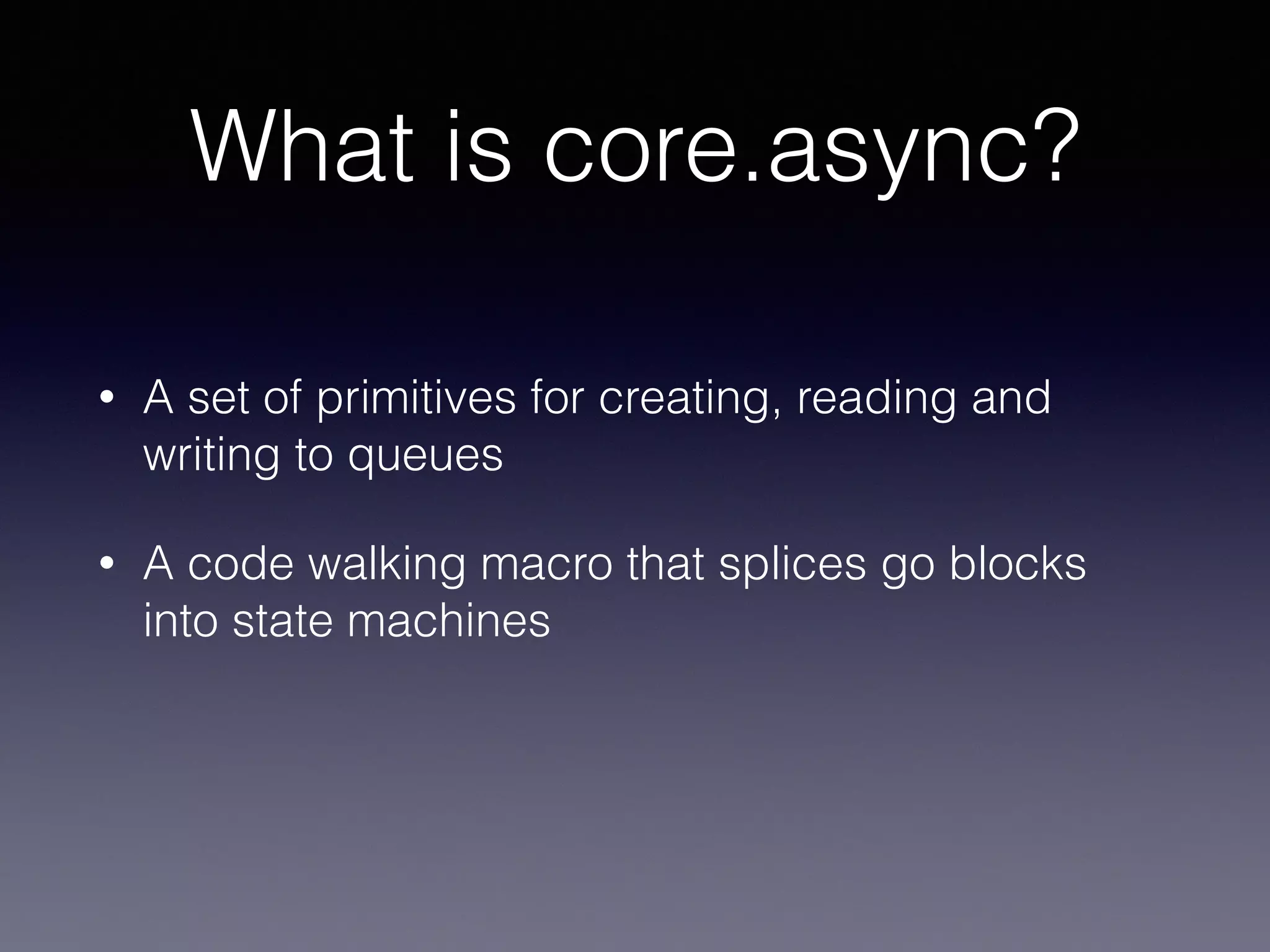
What is core.async?
What is core.async? 
• A set of primitives for creating, reading and 
writing to queues 
• A code walking macro that splices go blocks 
into state machines
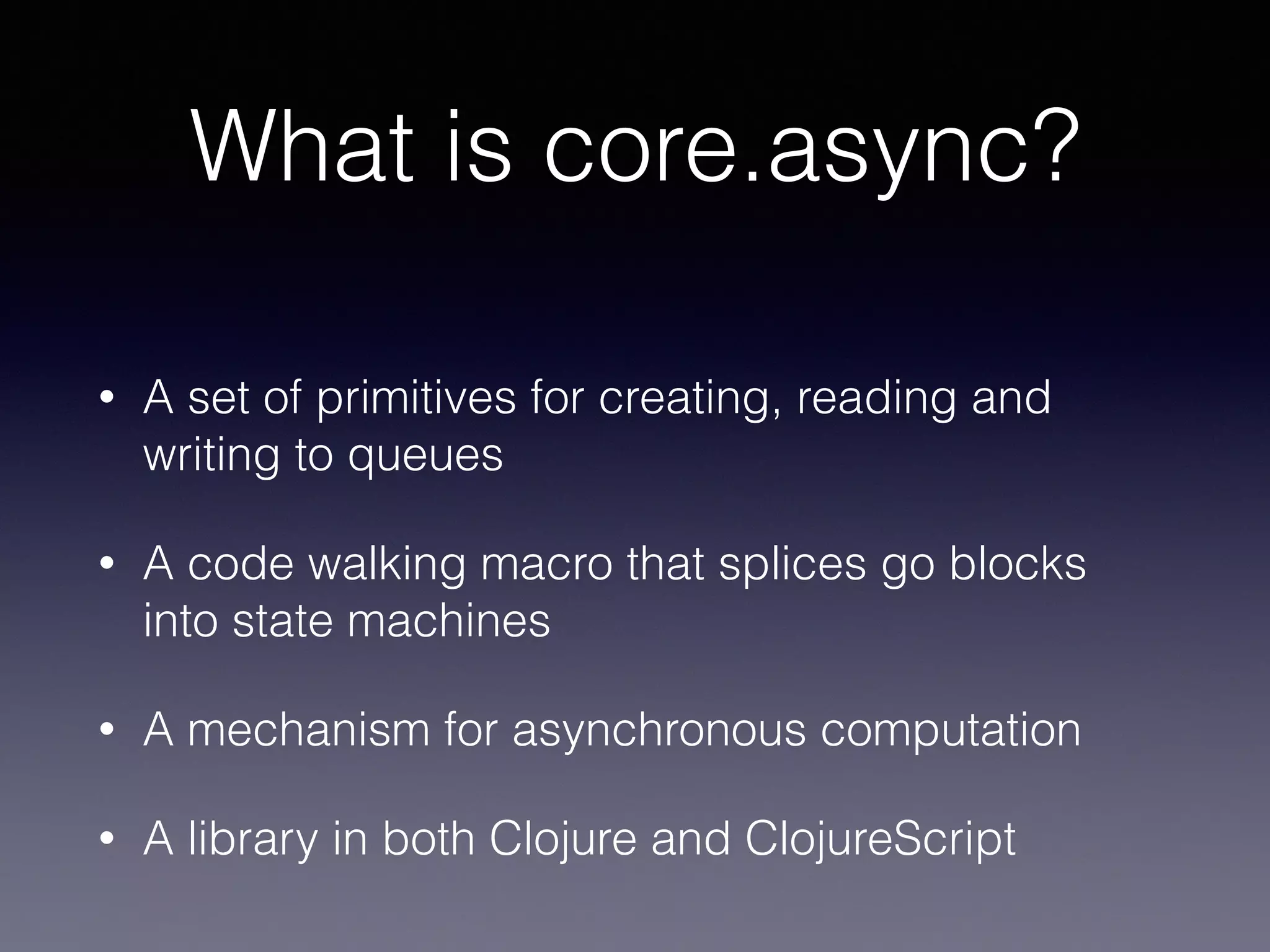
What is core.async? 
• A set of primitives for creating, reading and 
writing to queues 
• A code walking macro that splices go blocks 
into state machines 
• A mechanism for asynchronous computation 
• A library in both Clojure and ClojureScript
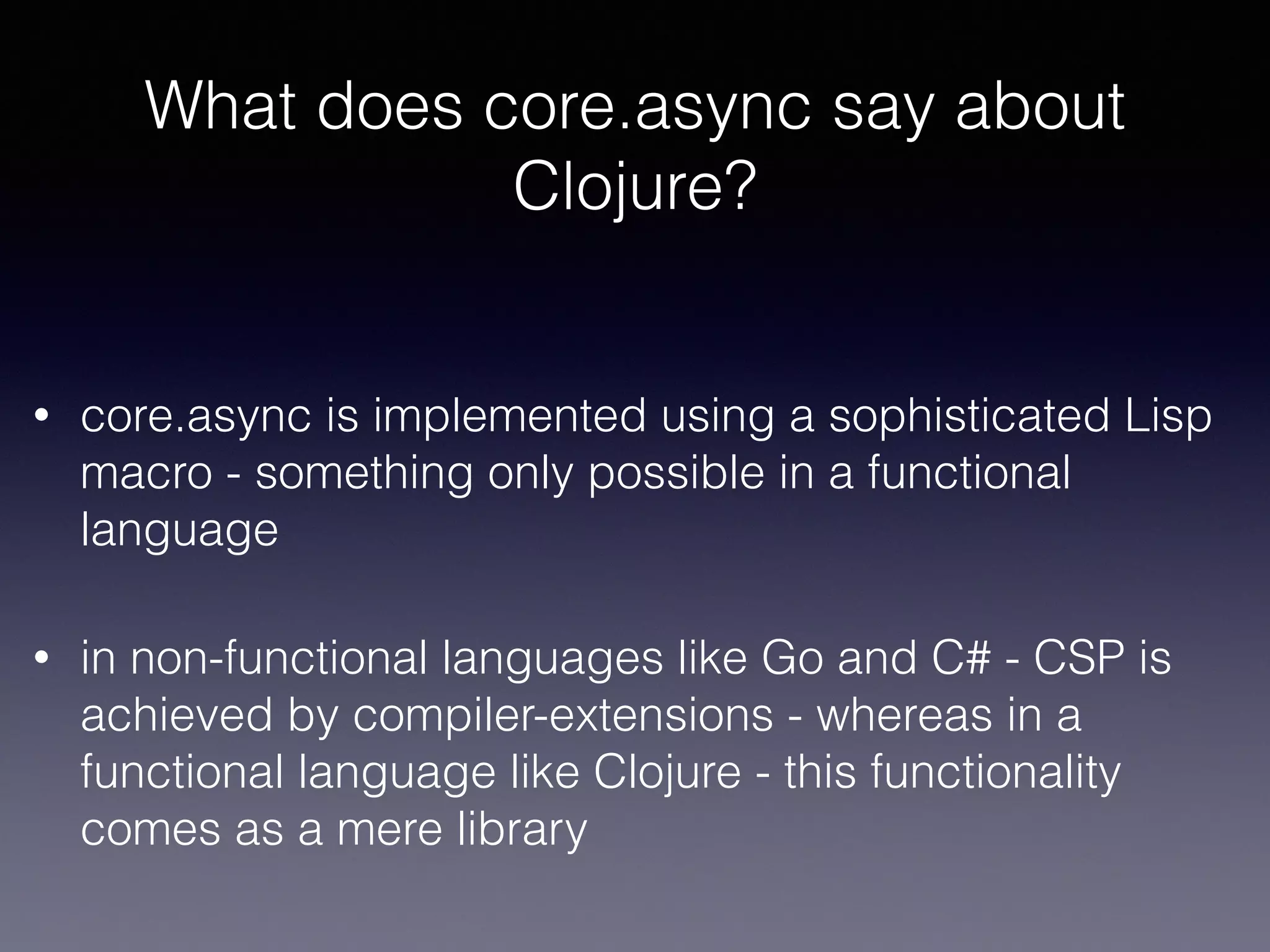
What does core.async say about 
Clojure? 
• core.async is implemented using a sophisticated Lisp 
macro - something only possible in a functional 
language 
• in non-functional languages like Go and C# - CSP is 
achieved by compiler-extensions - whereas in a 
functional language like Clojure - this functionality 
comes as a mere library
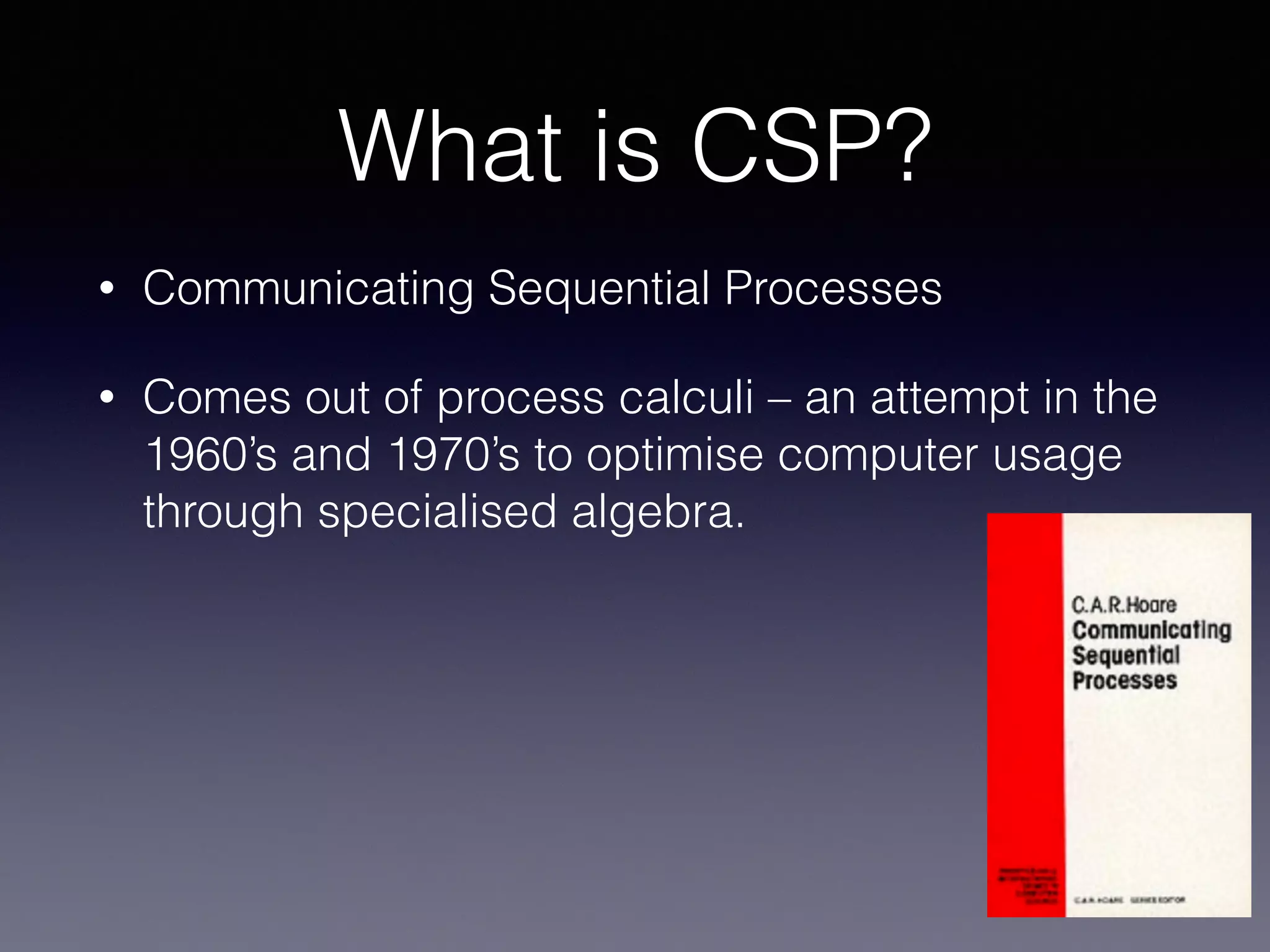
What is CSP? 
• Communicating Sequential Processes 
• Comes out of process calculi – an attempt in the 
1960’s and 1970’s to optimise computer usage 
through specialised algebra.
What is CSP? 
• Communicating Sequential Processes 
• Comes out of process calculi – an attempt in the 
1960’s and 1970’s to optimise computer usage 
through specialised algebra. 
• Based on message passing via 
channels 
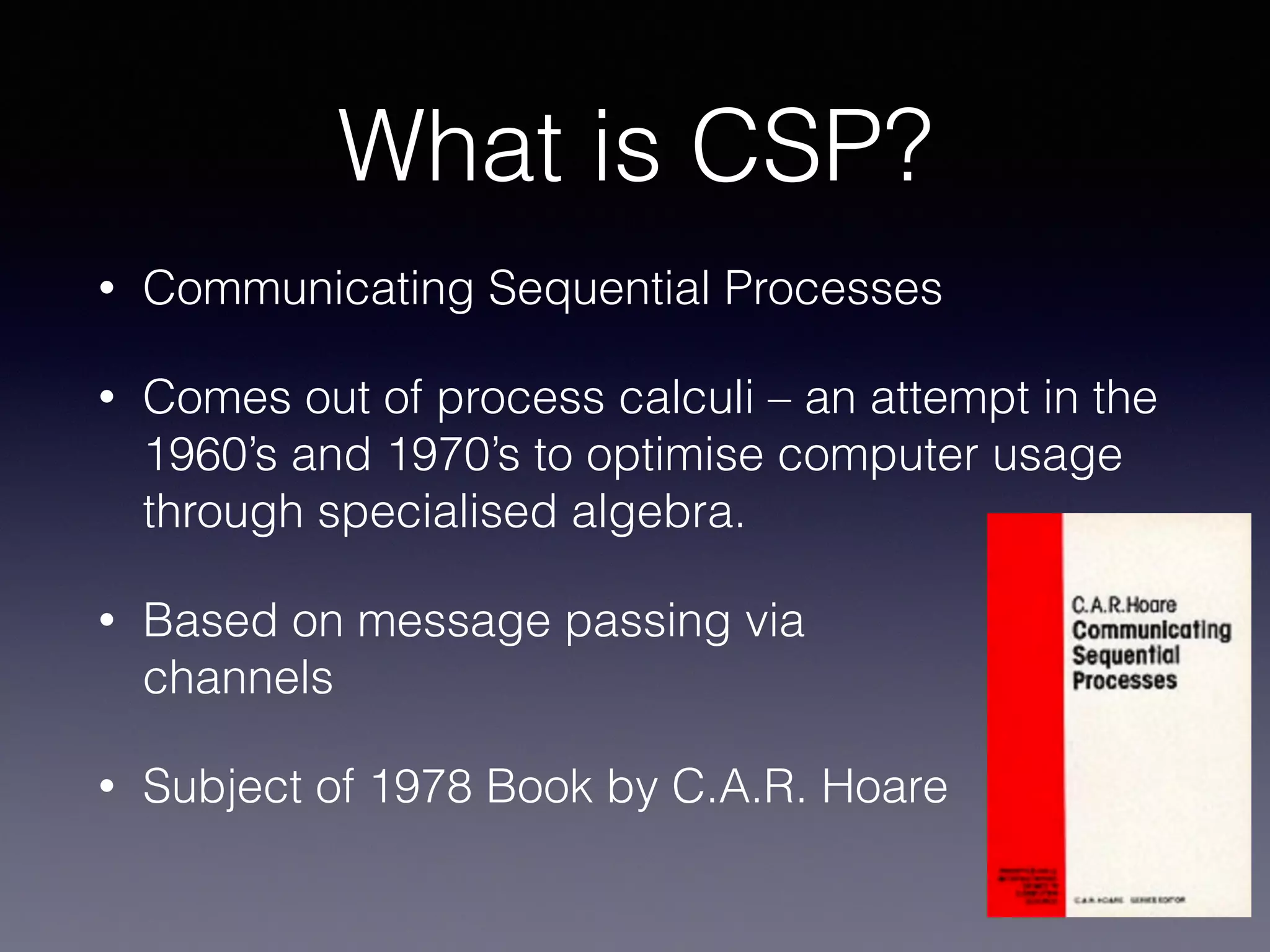
• Subject of 1978 Book by C.A.R. Hoare
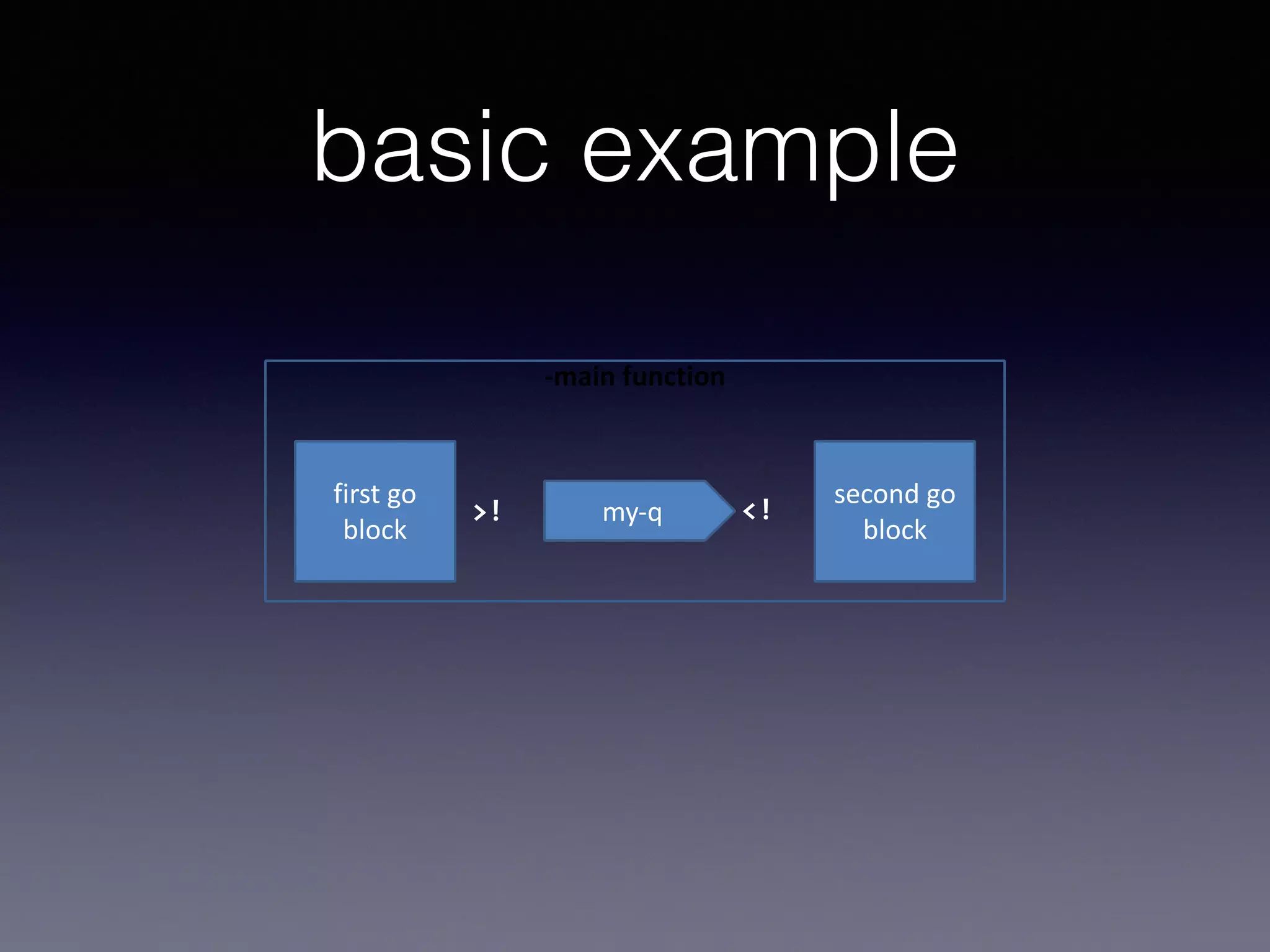
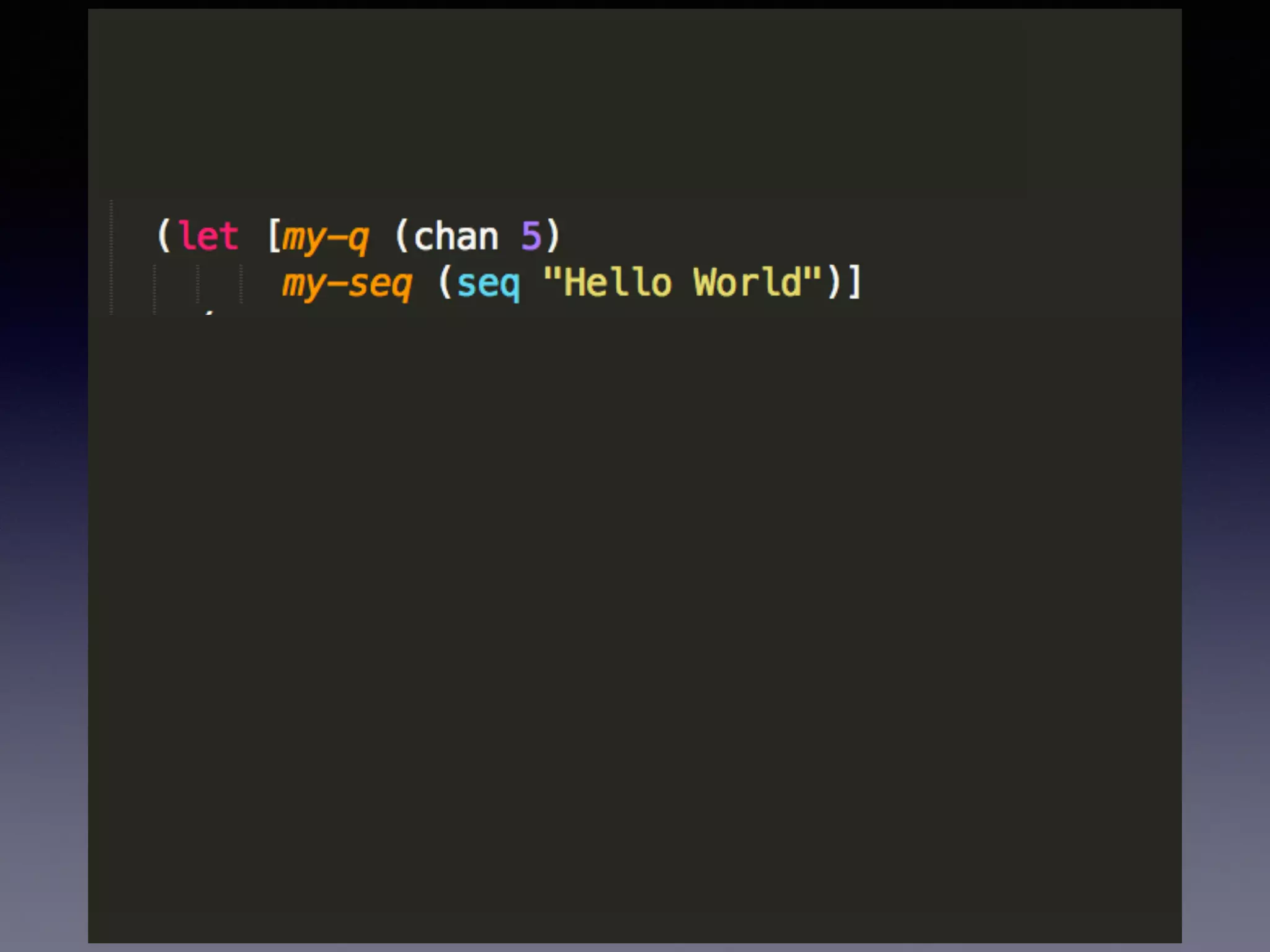
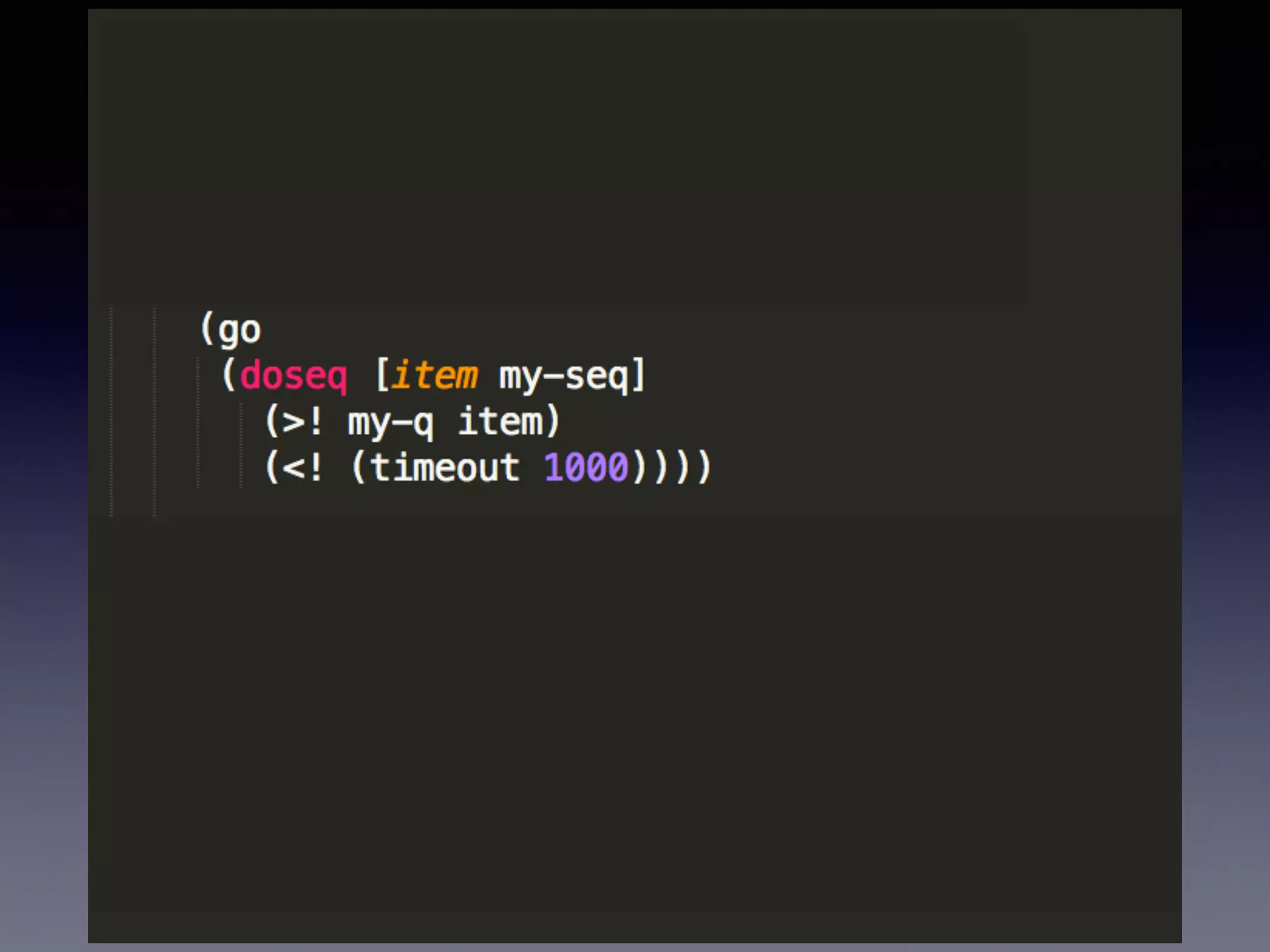
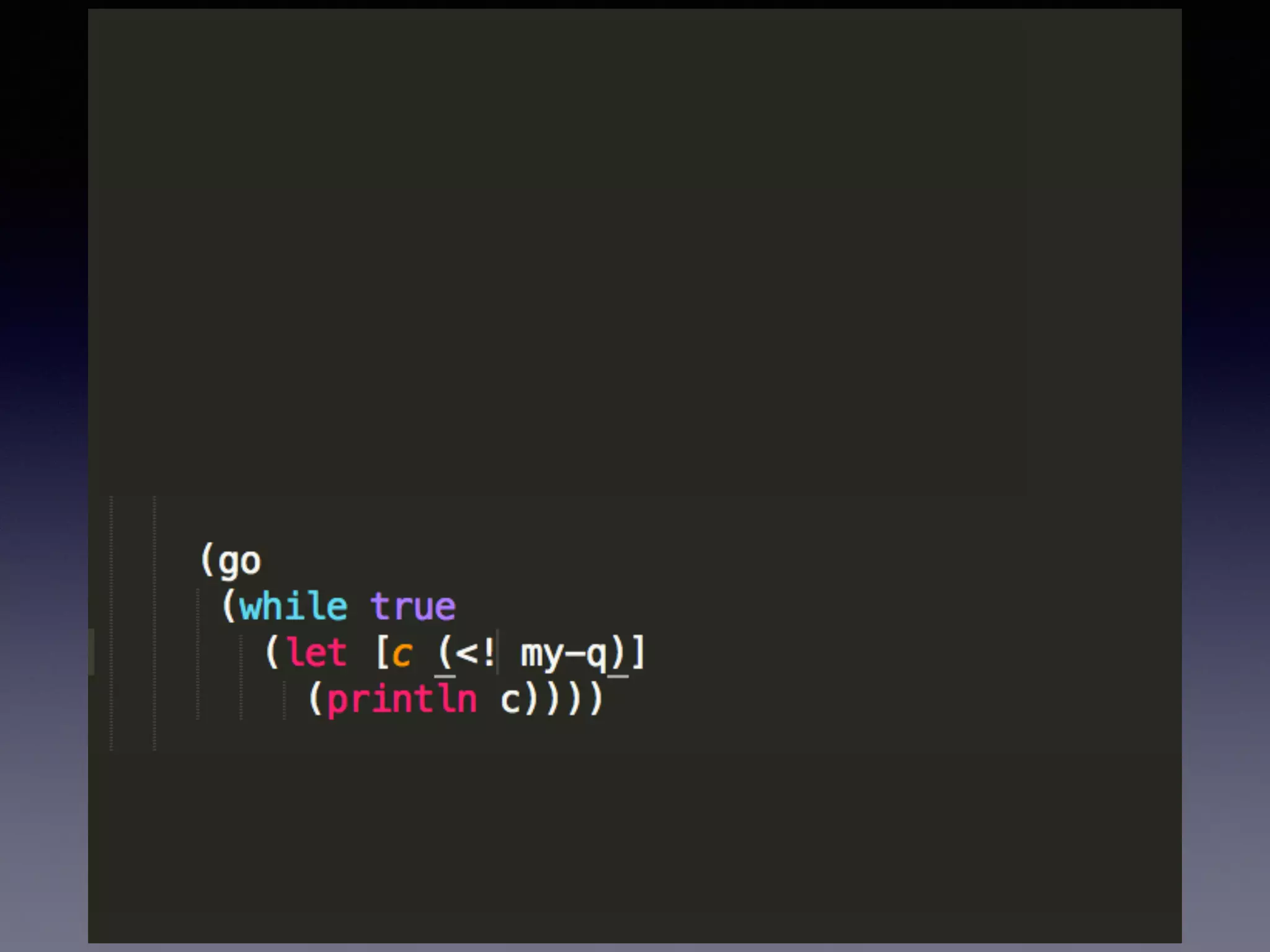
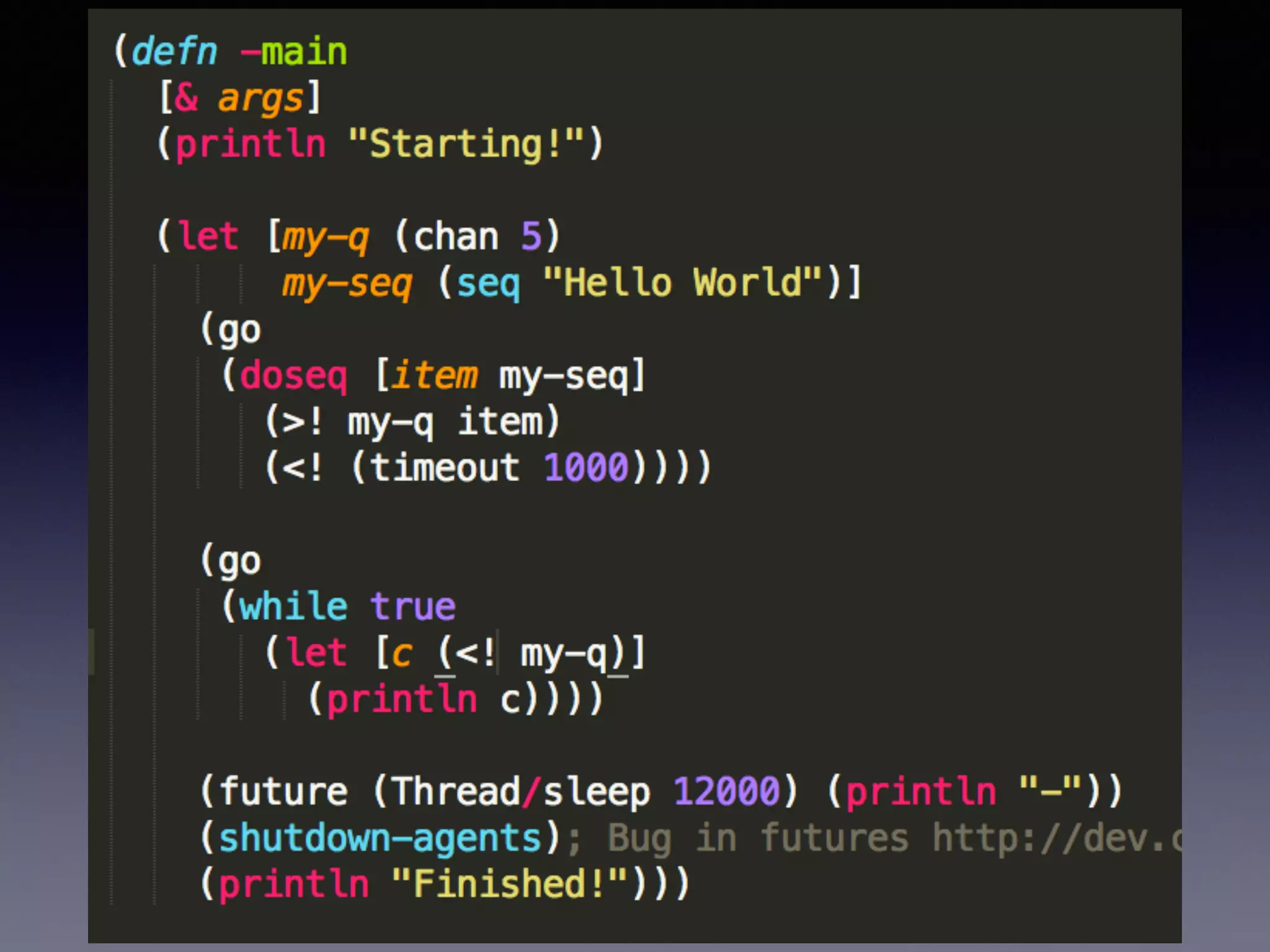
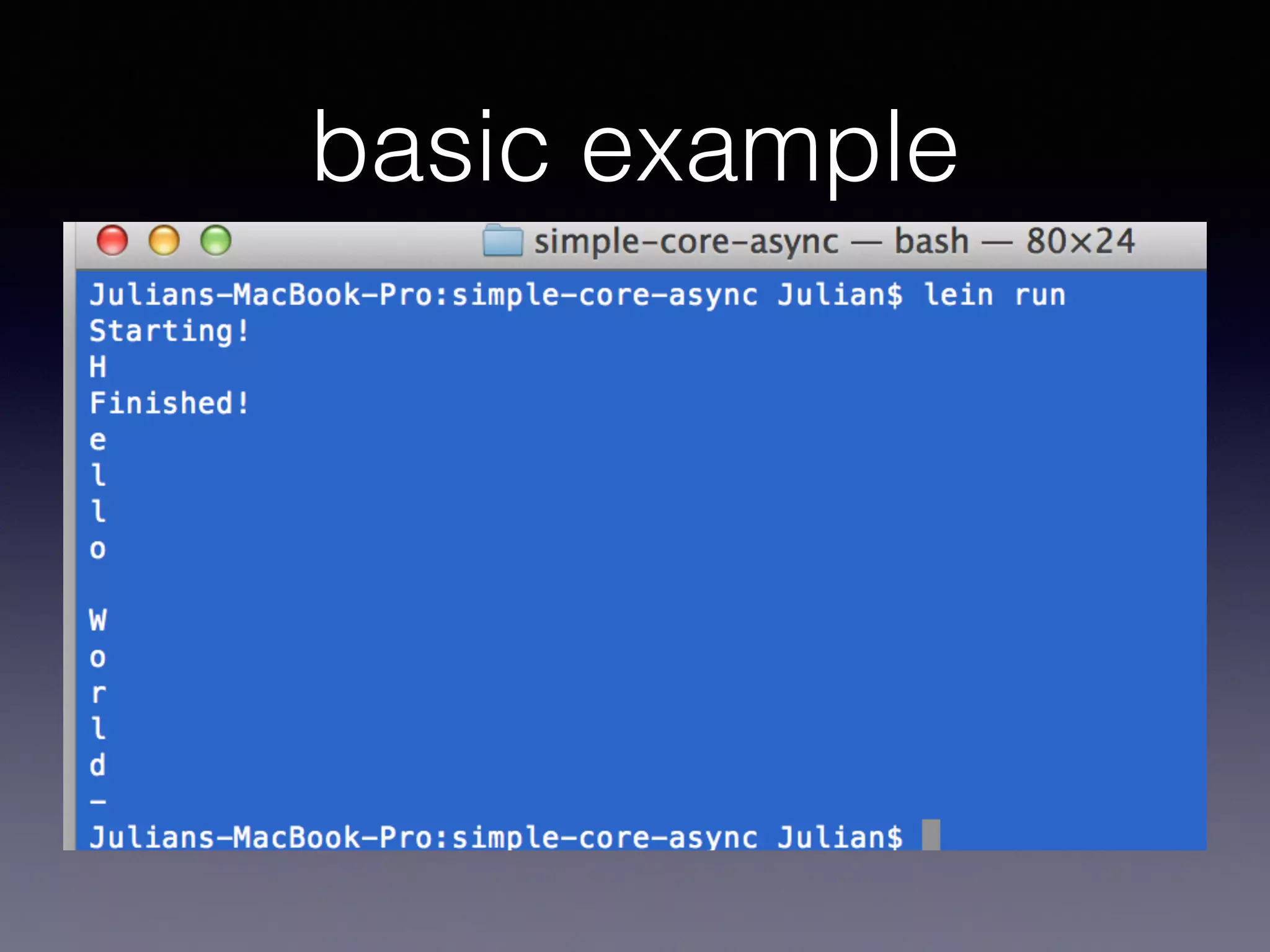
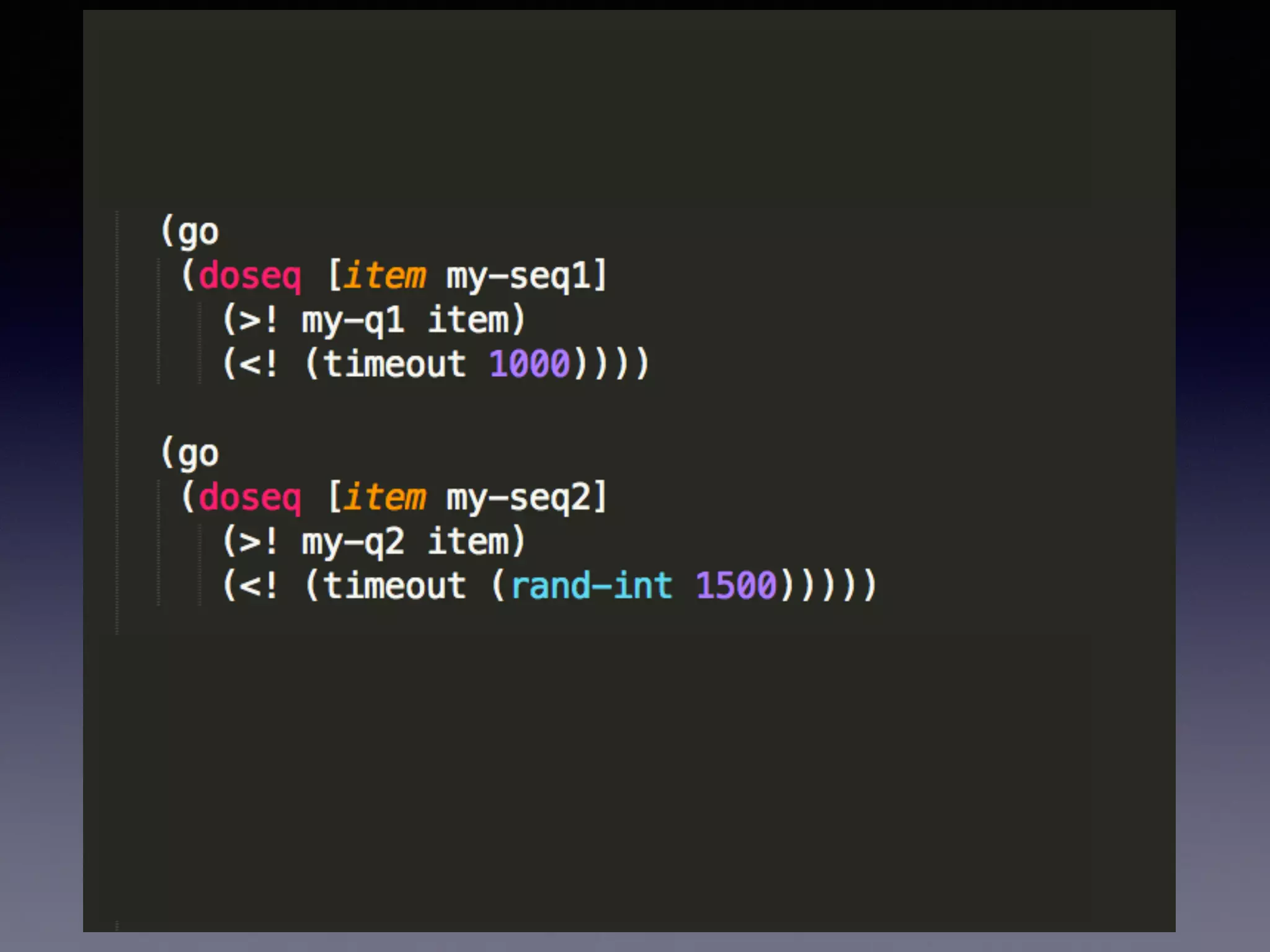
basic example 
-­‐main 
function 
first 
go 
block 
second 
go 
>! my-­‐q block <!
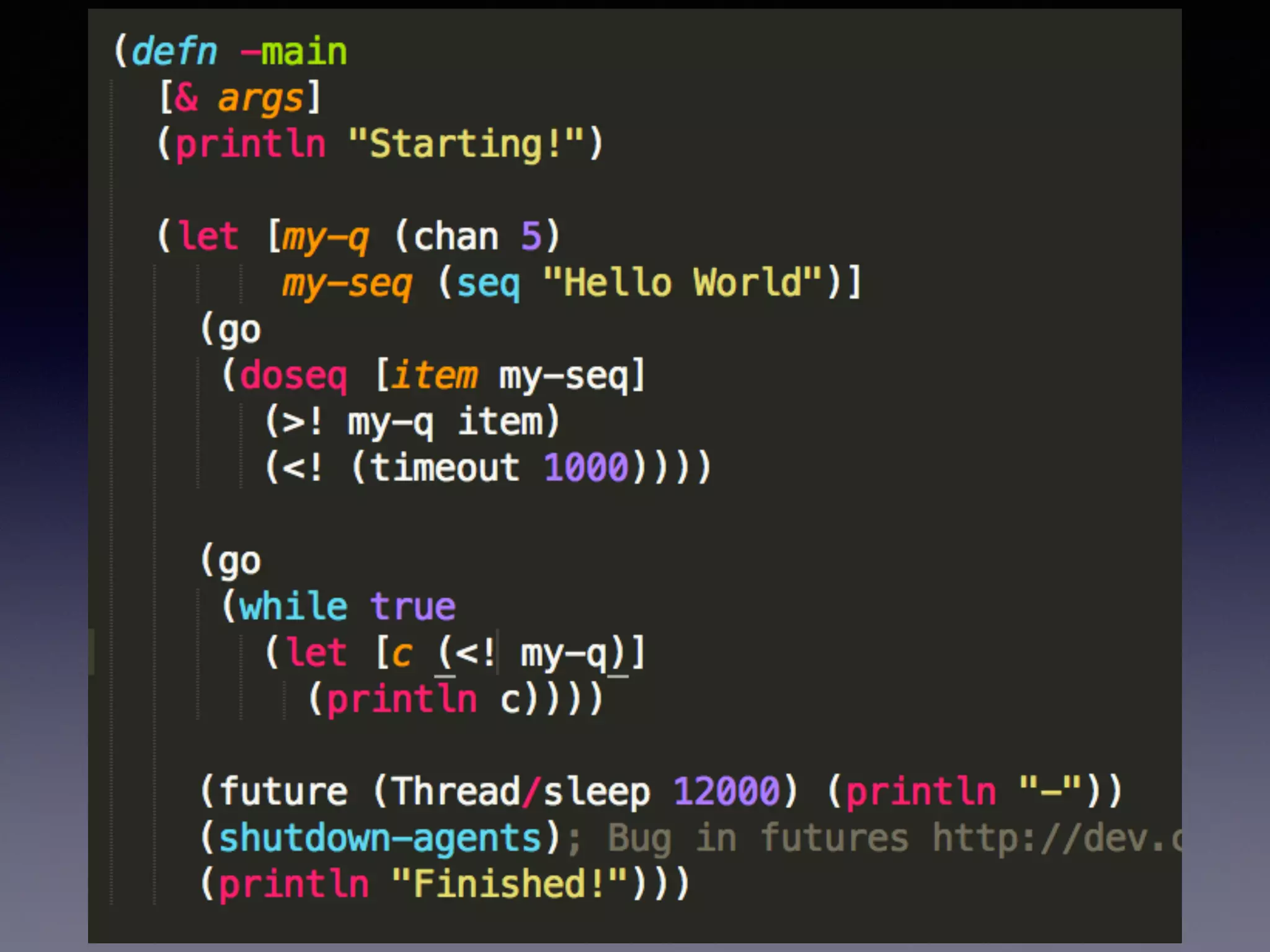
2-basic-example
2-basic-example
2-basic-example
2-basic-example
2-basic-example
basic example 
[Demo]
basic example
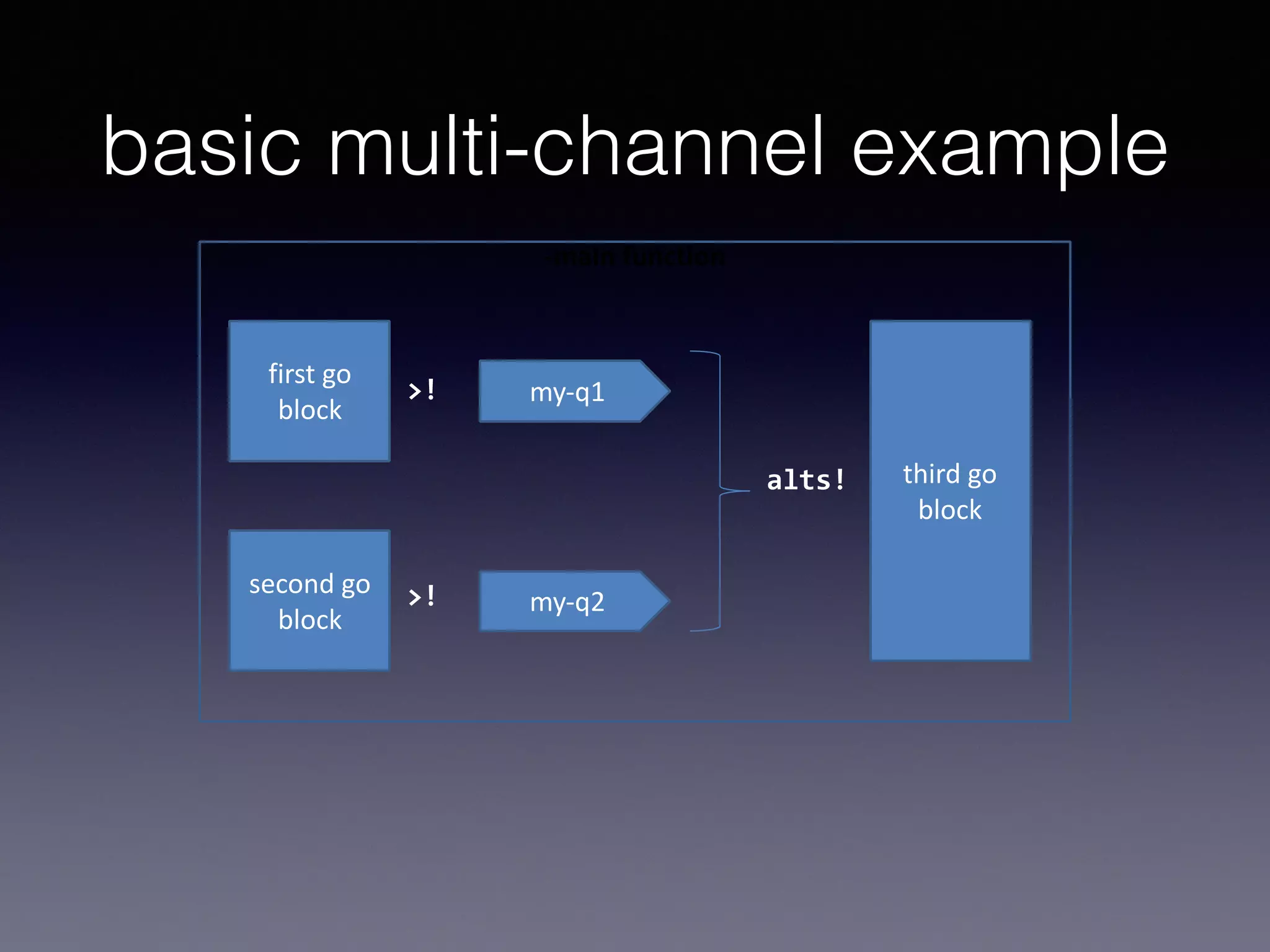
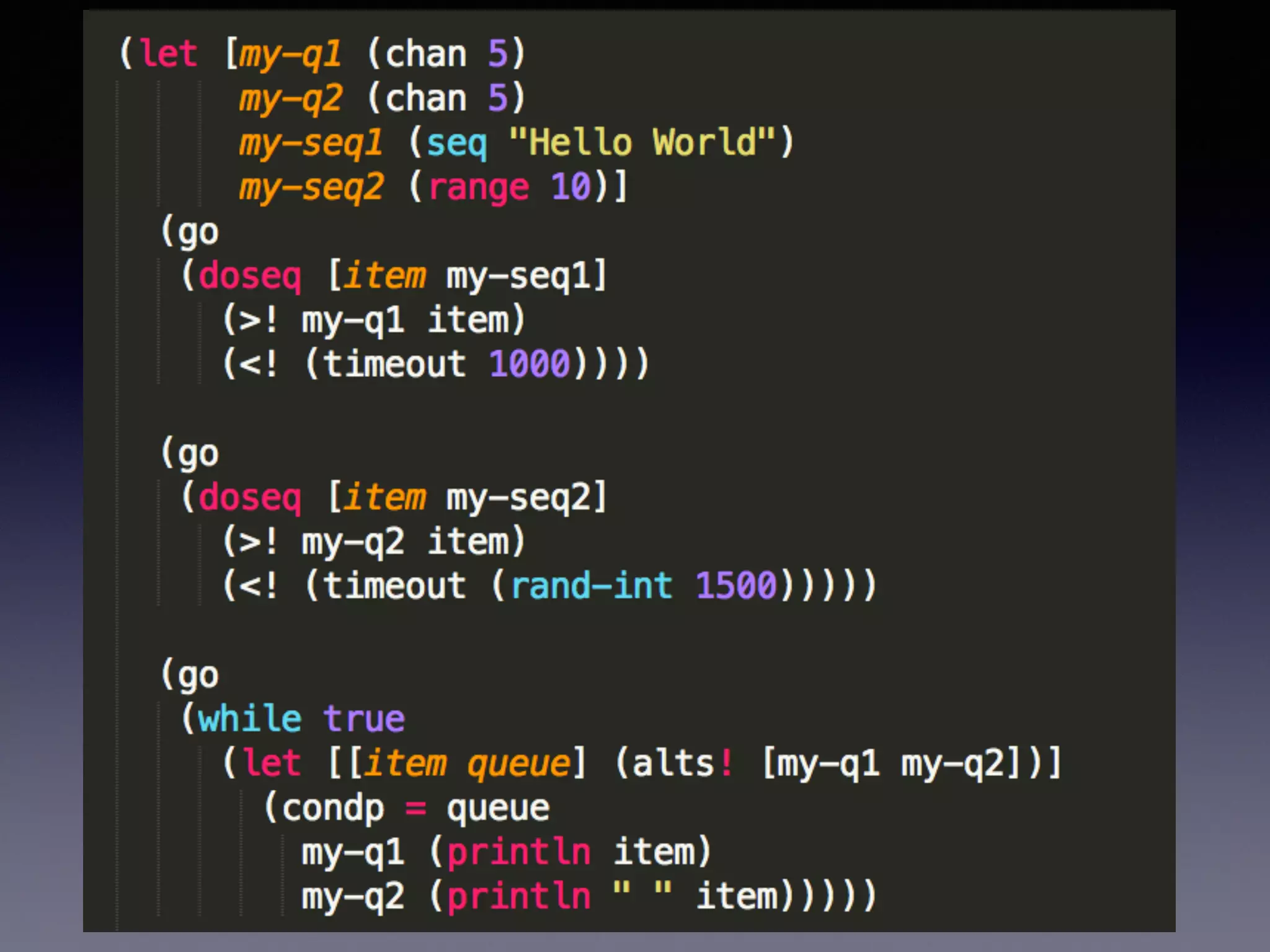
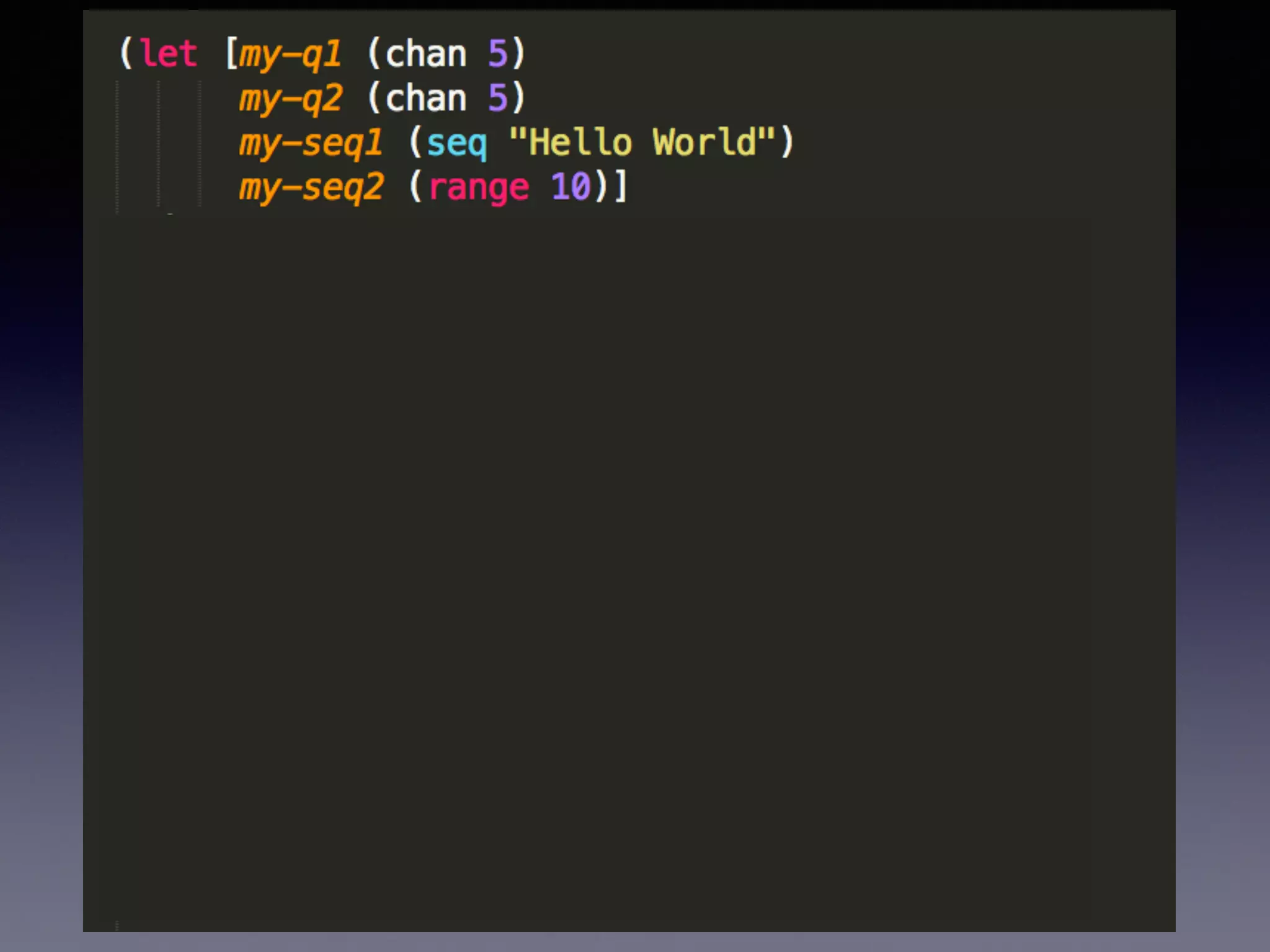
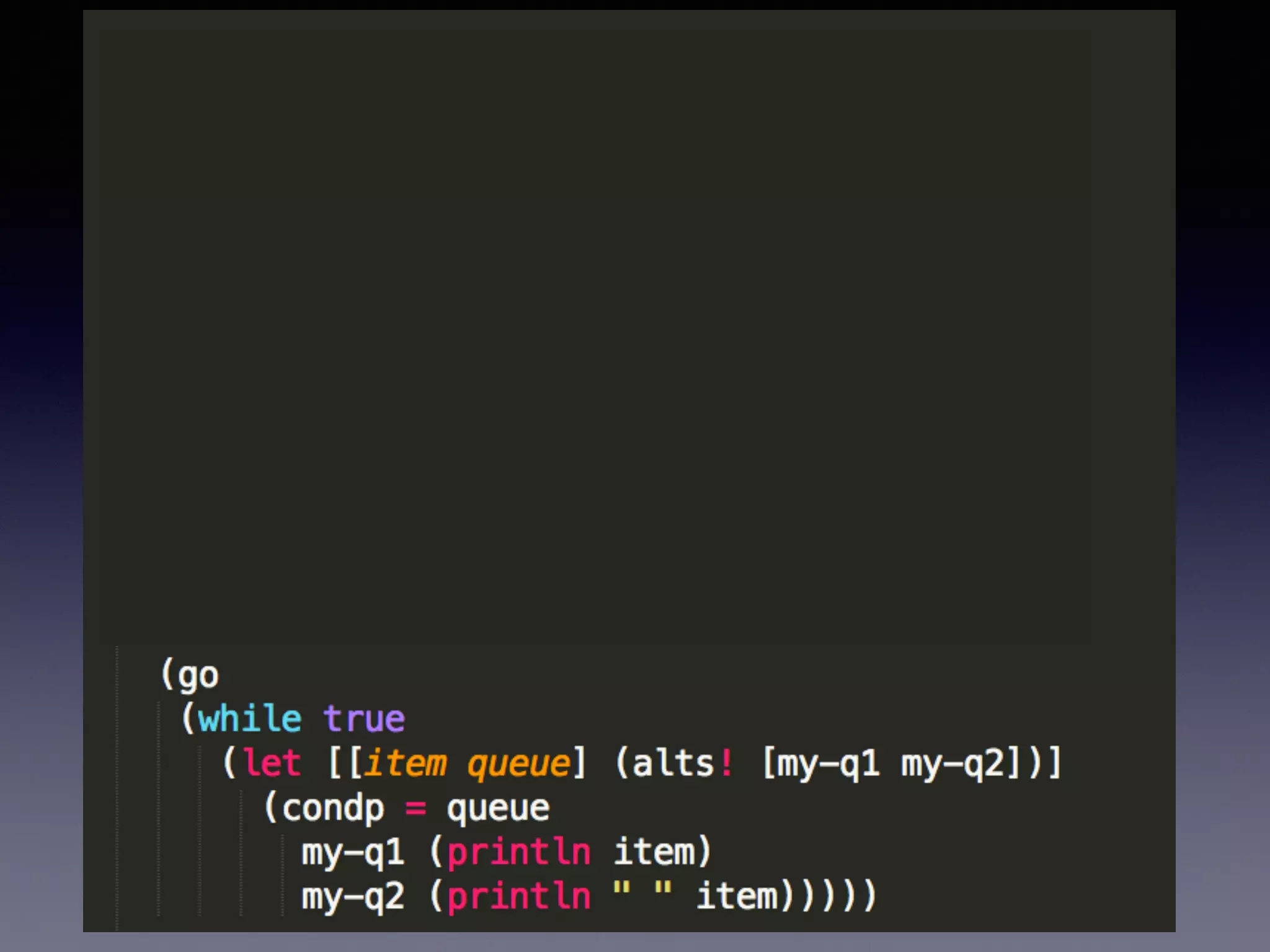
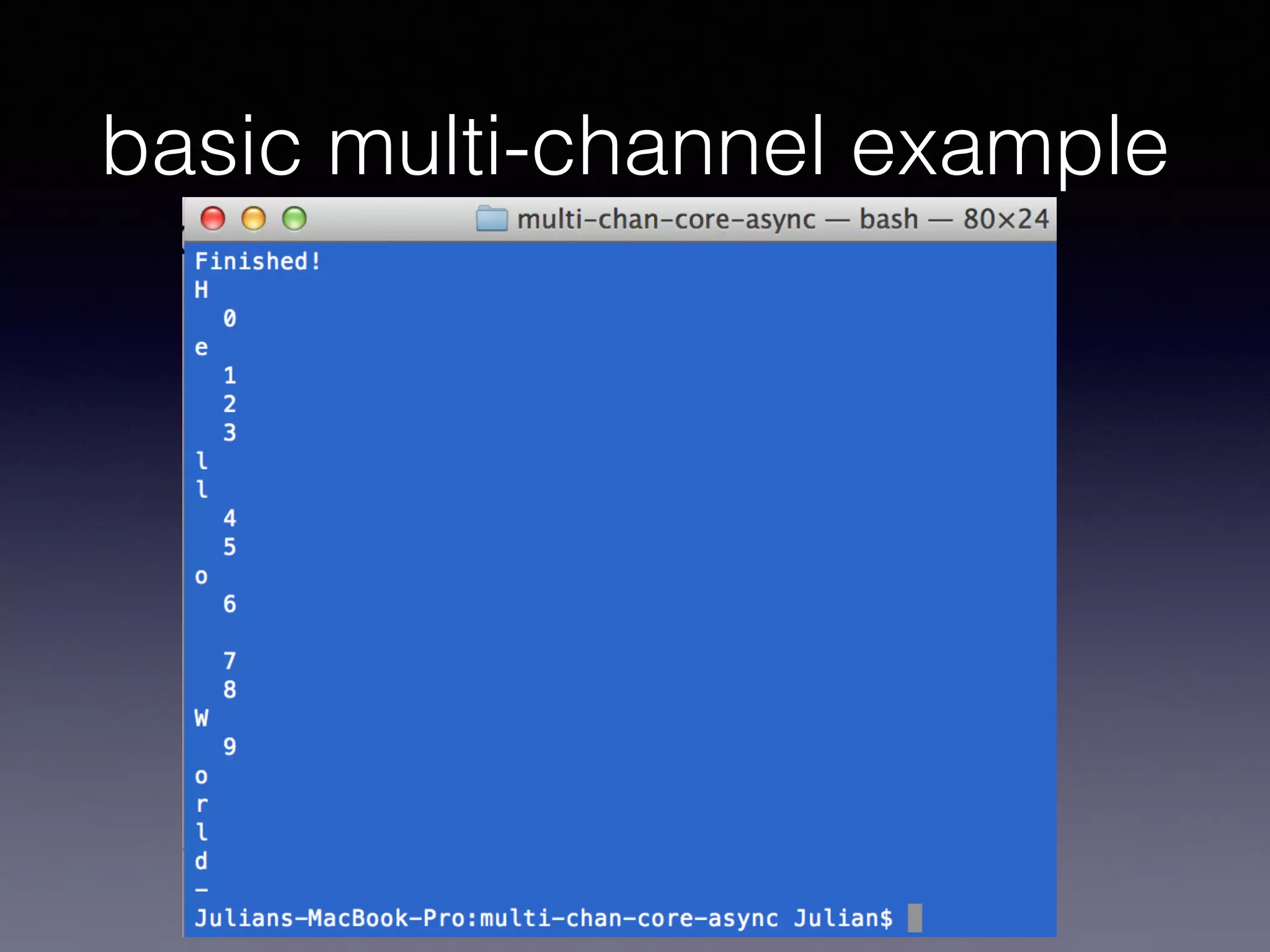
basic multi-channel example 
-­‐main 
function 
first 
go 
block 
third 
go 
block 
>! my-­‐q1 
alts! 
second 
go 
block my-­‐q2 >!
basic multi-channel example 
[DEMO]
basic multi-channel example
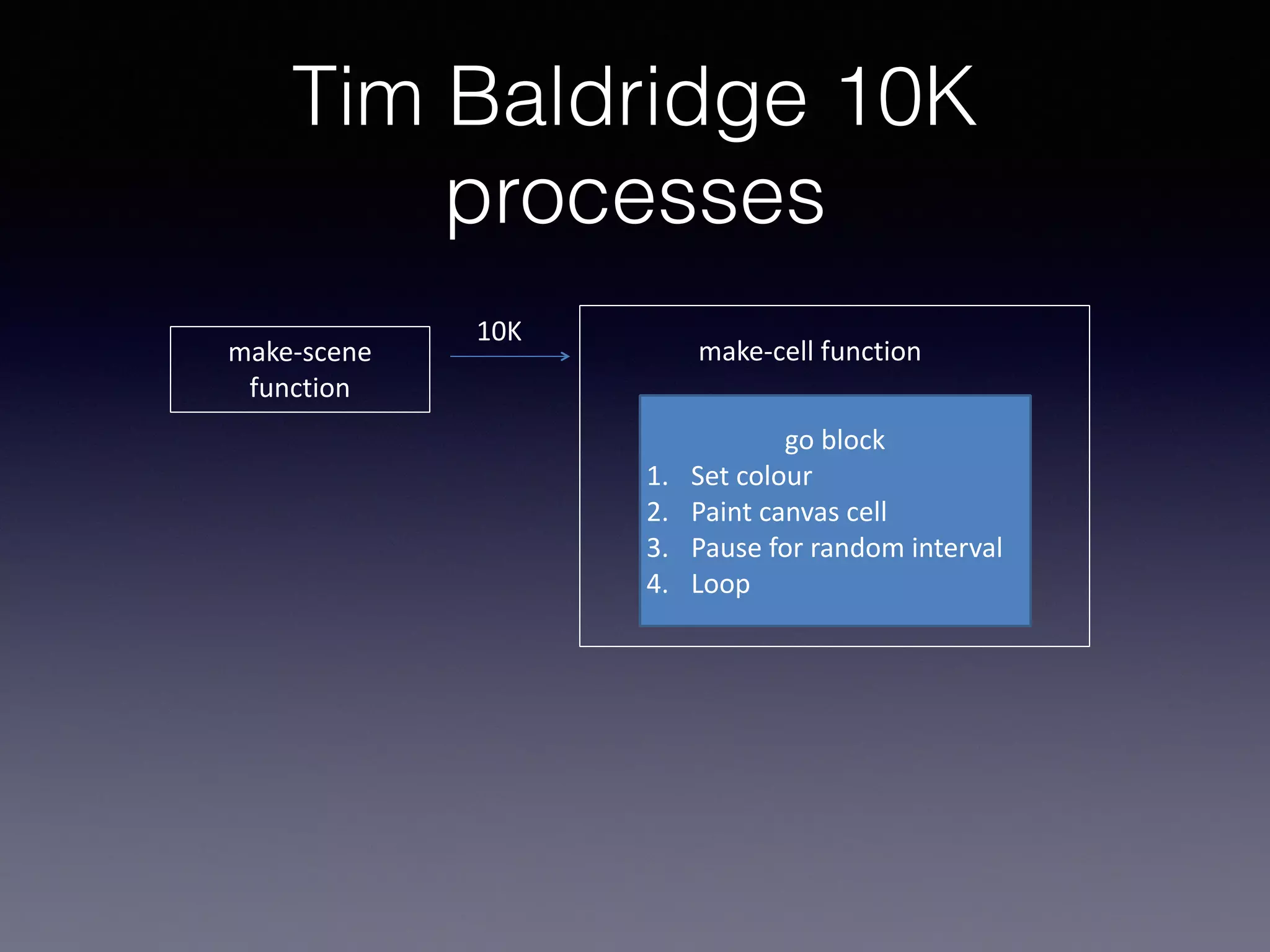
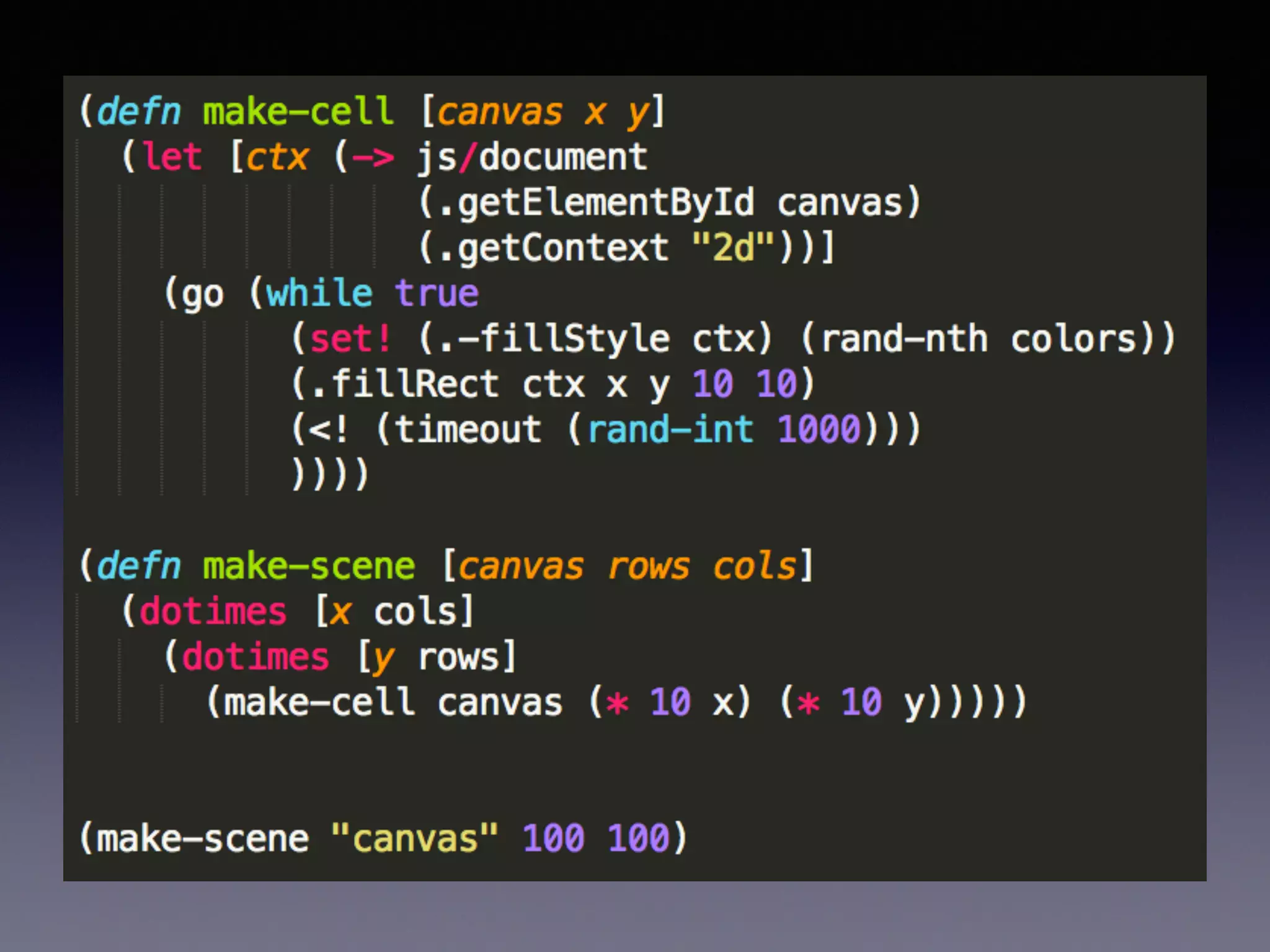
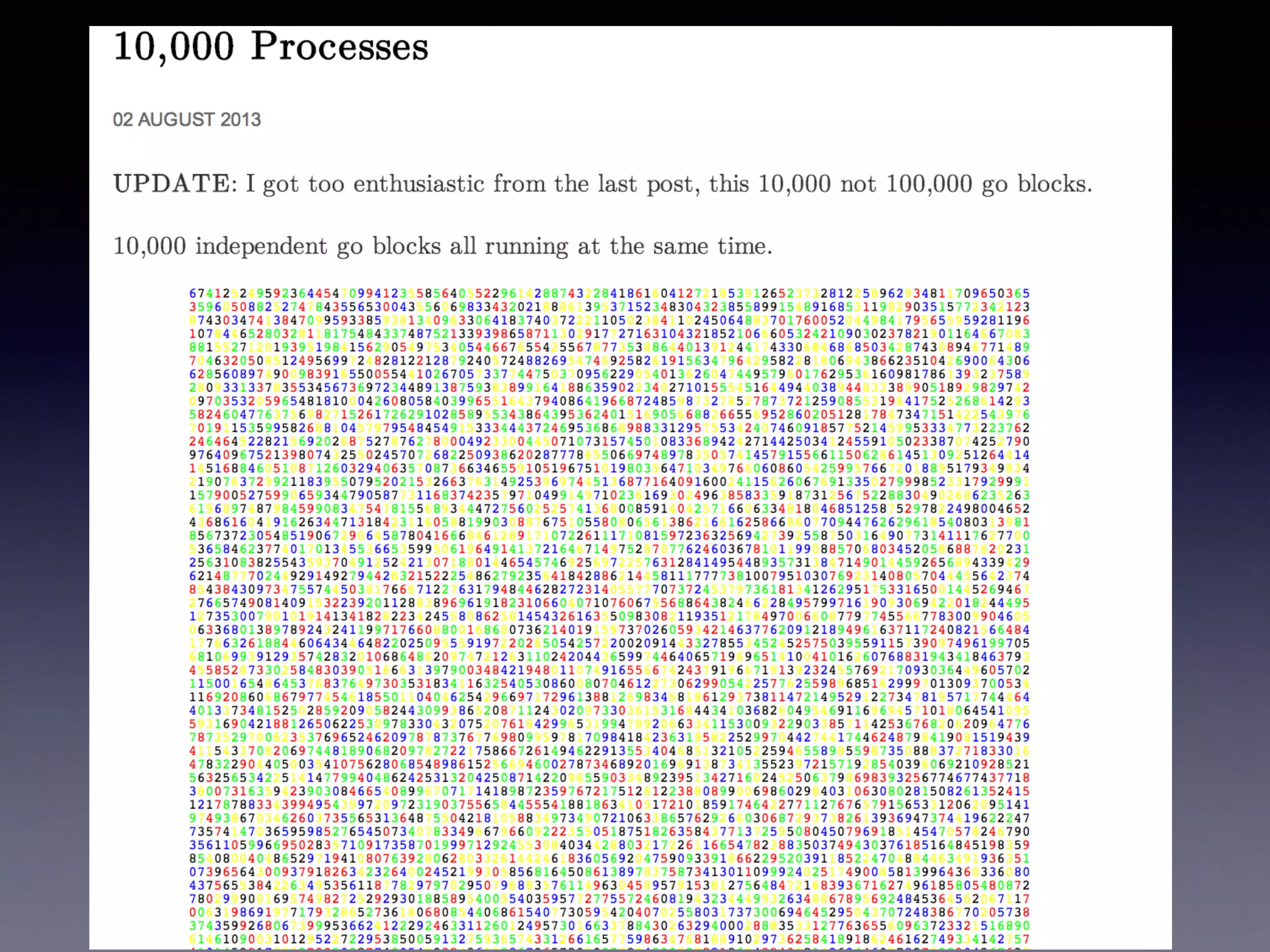
Tim Baldridge 10K 
processes 
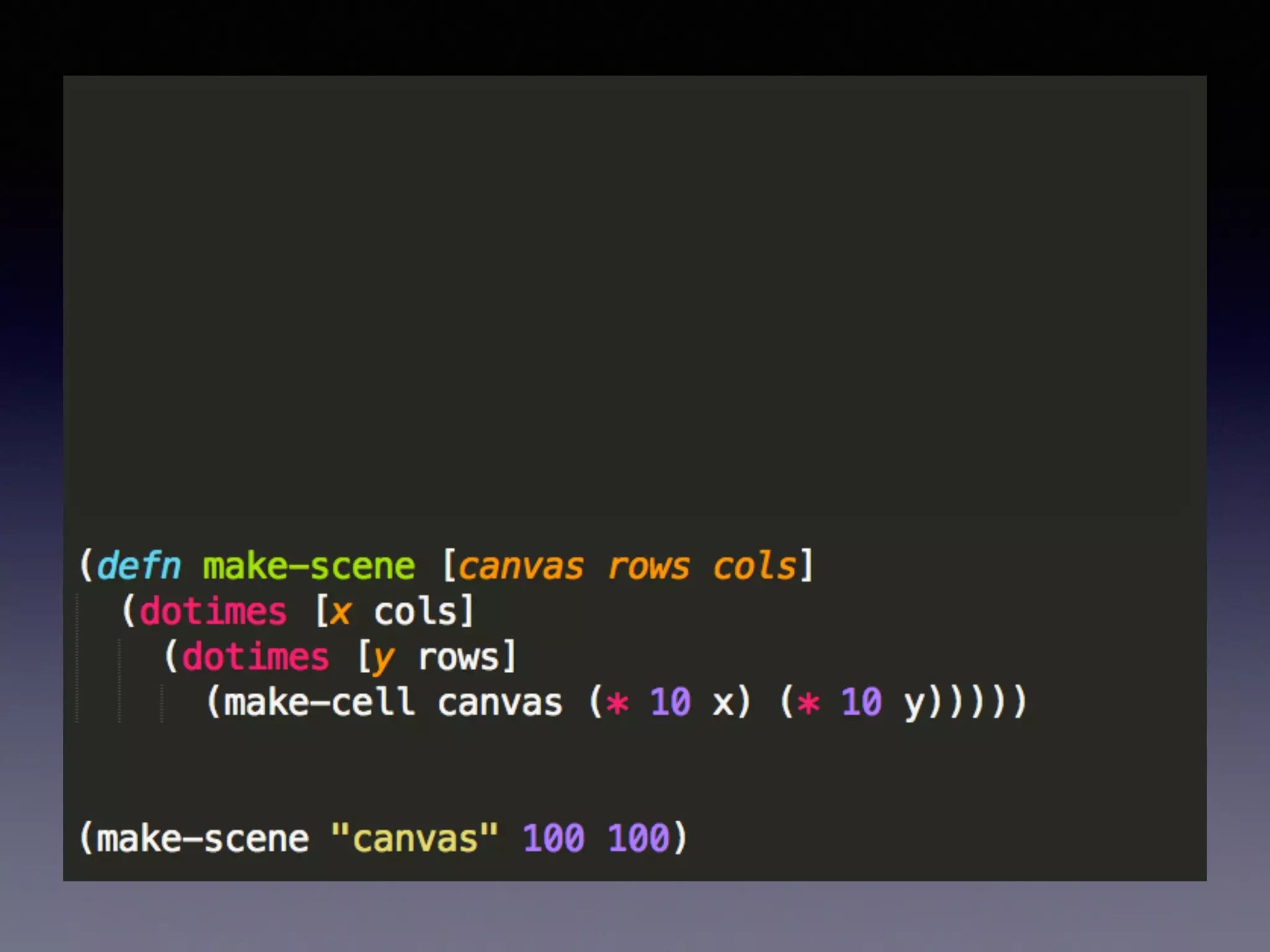
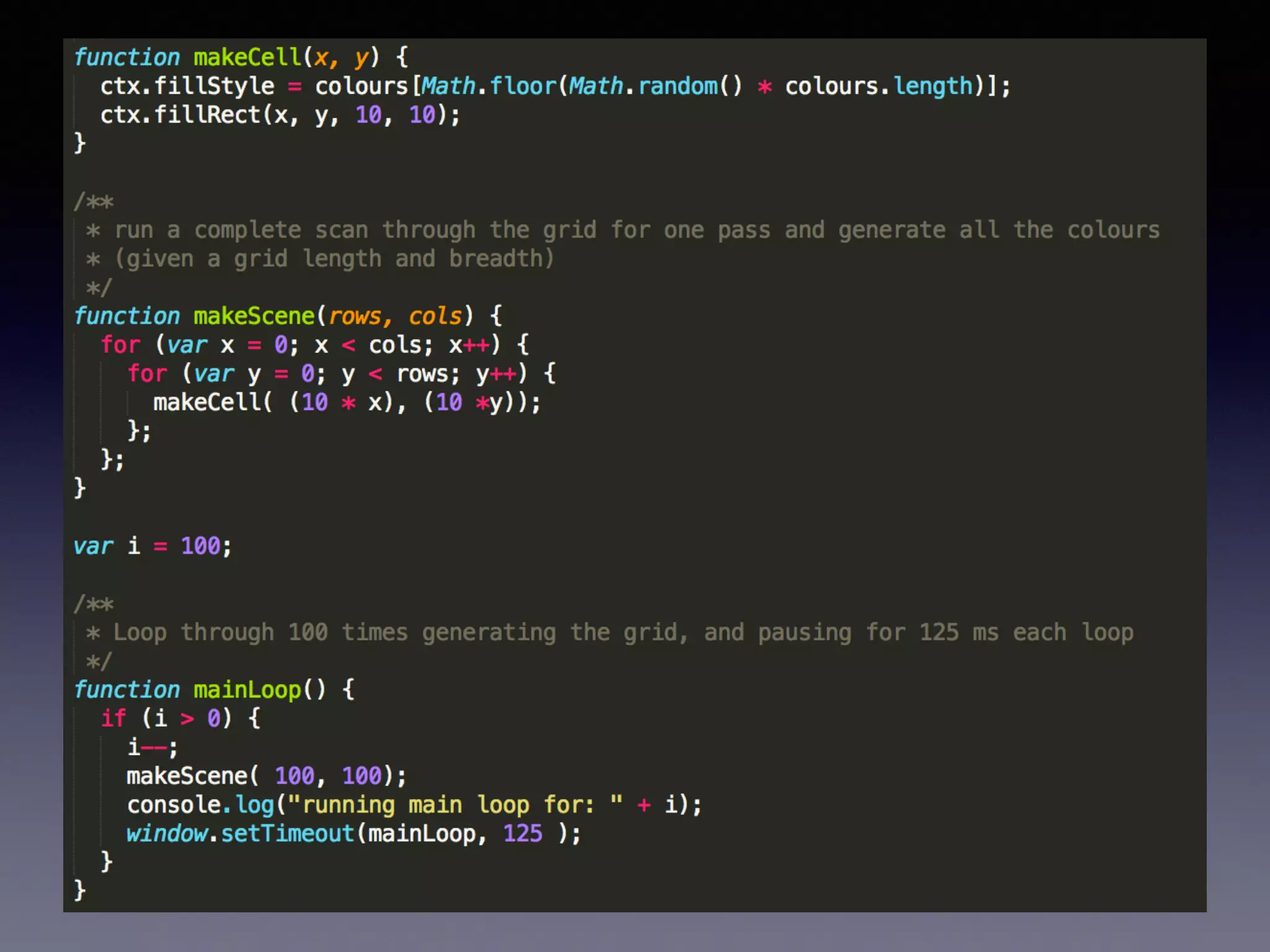
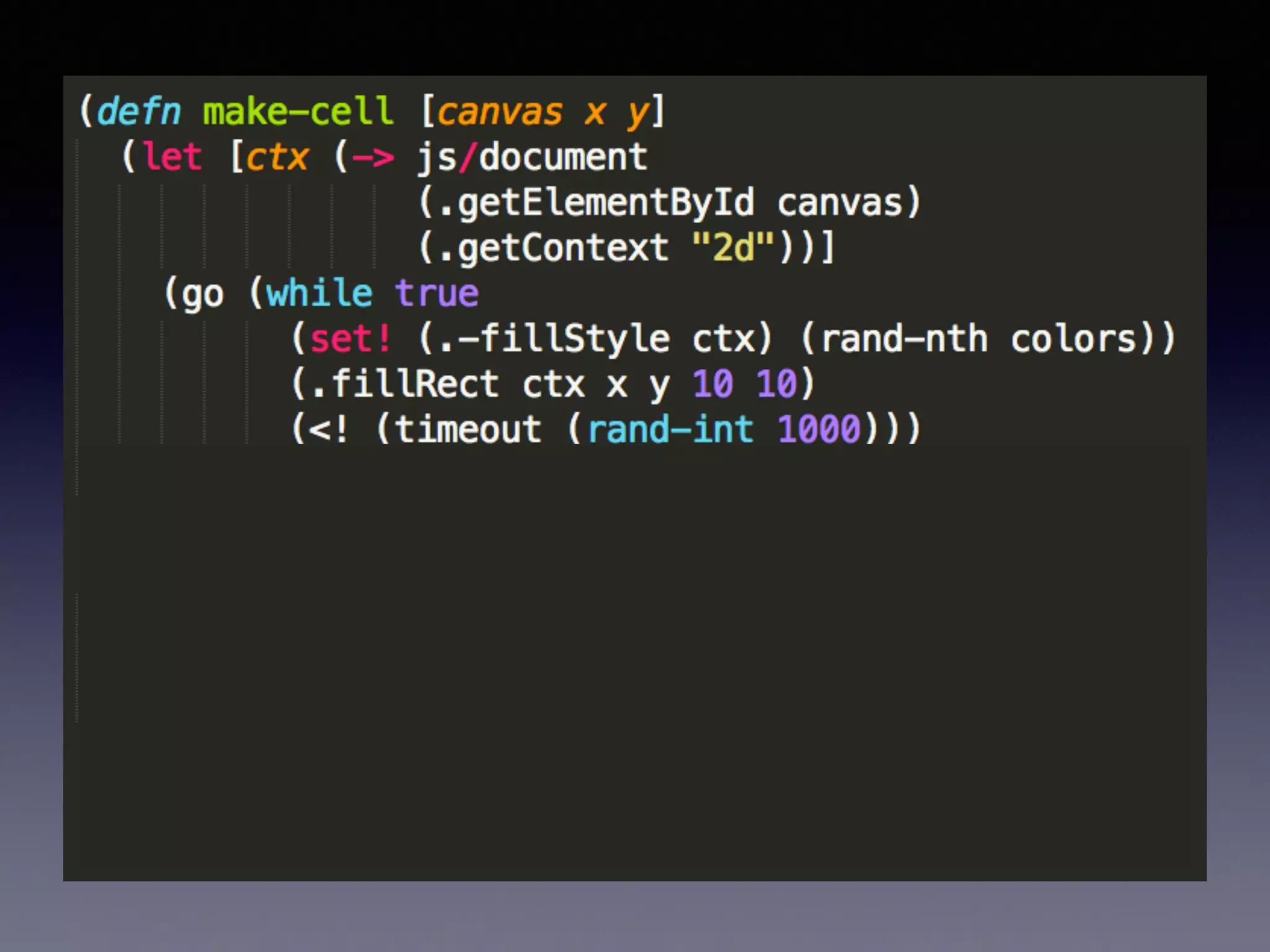
make-­‐scene 
function 
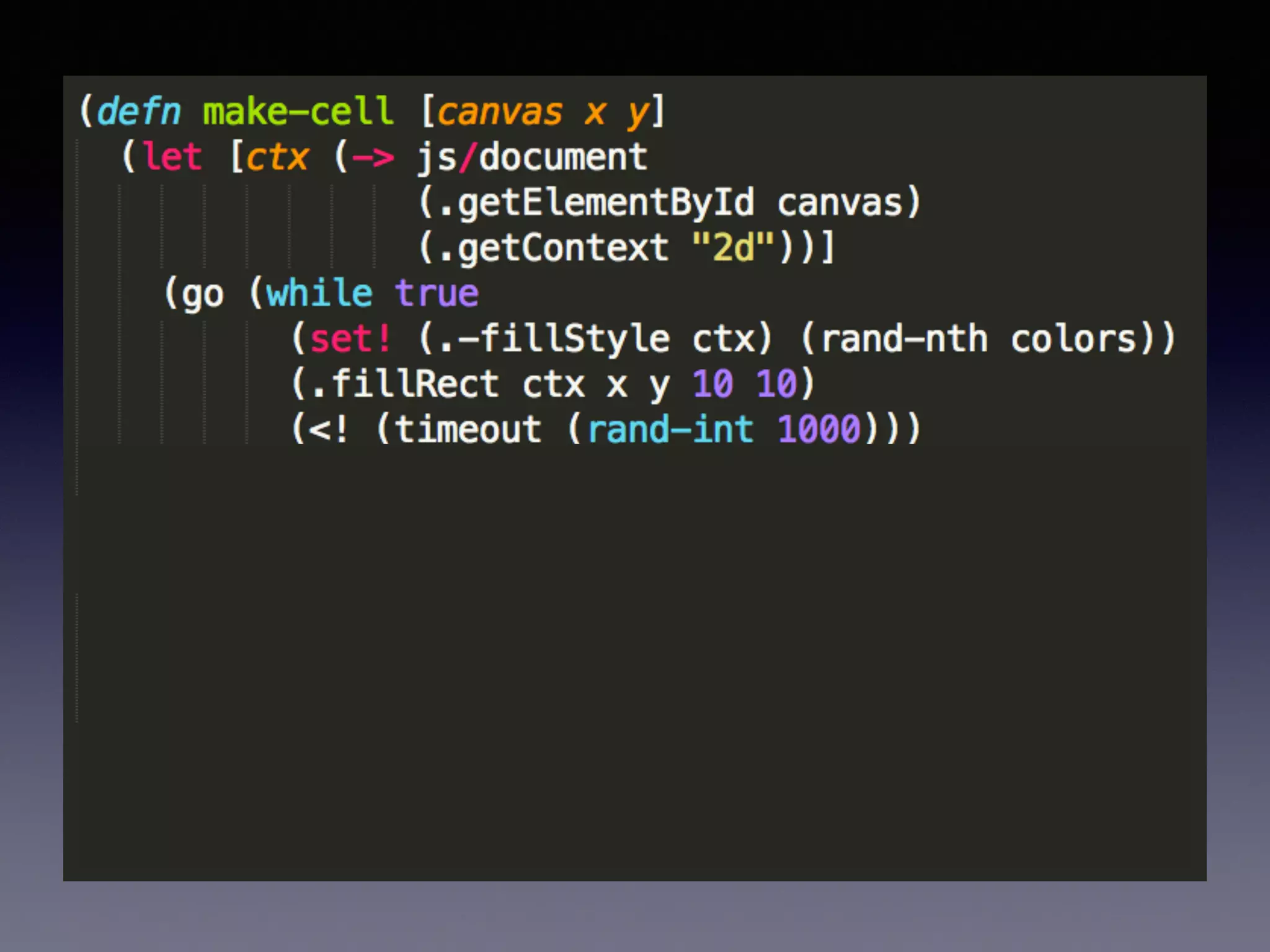
make-­‐cell 
function 
10K 
go 
block 
1. Set 
colour 
2. Paint 
canvas 
cell 
3. Pause 
for 
random 
interval 
4. Loop
[DEMO]
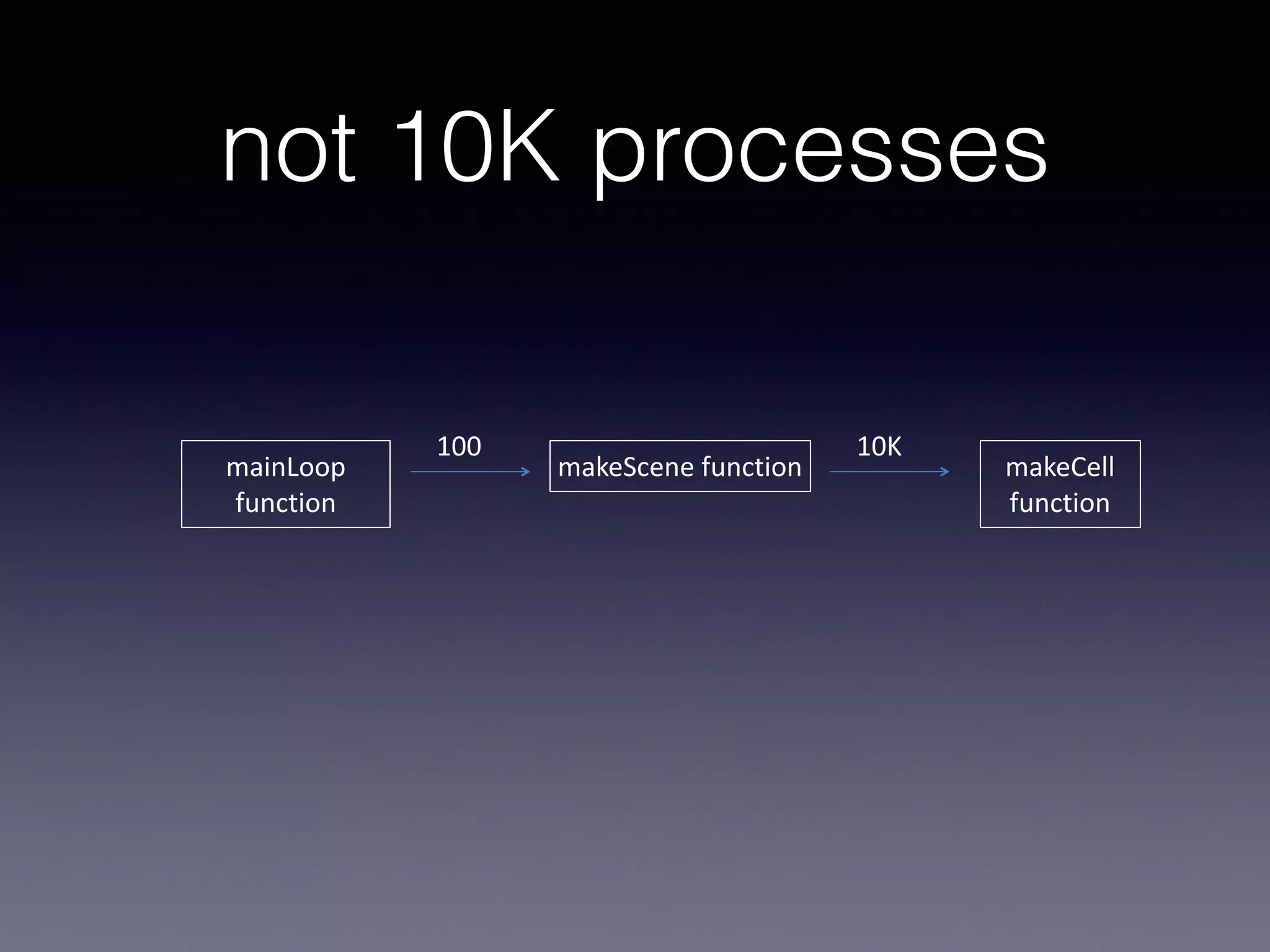
not 10K processes 
makeScene 
function 
10K 
makeCell 
function 
mainLoop 
function 
100
[DEMO]
[DEMO]
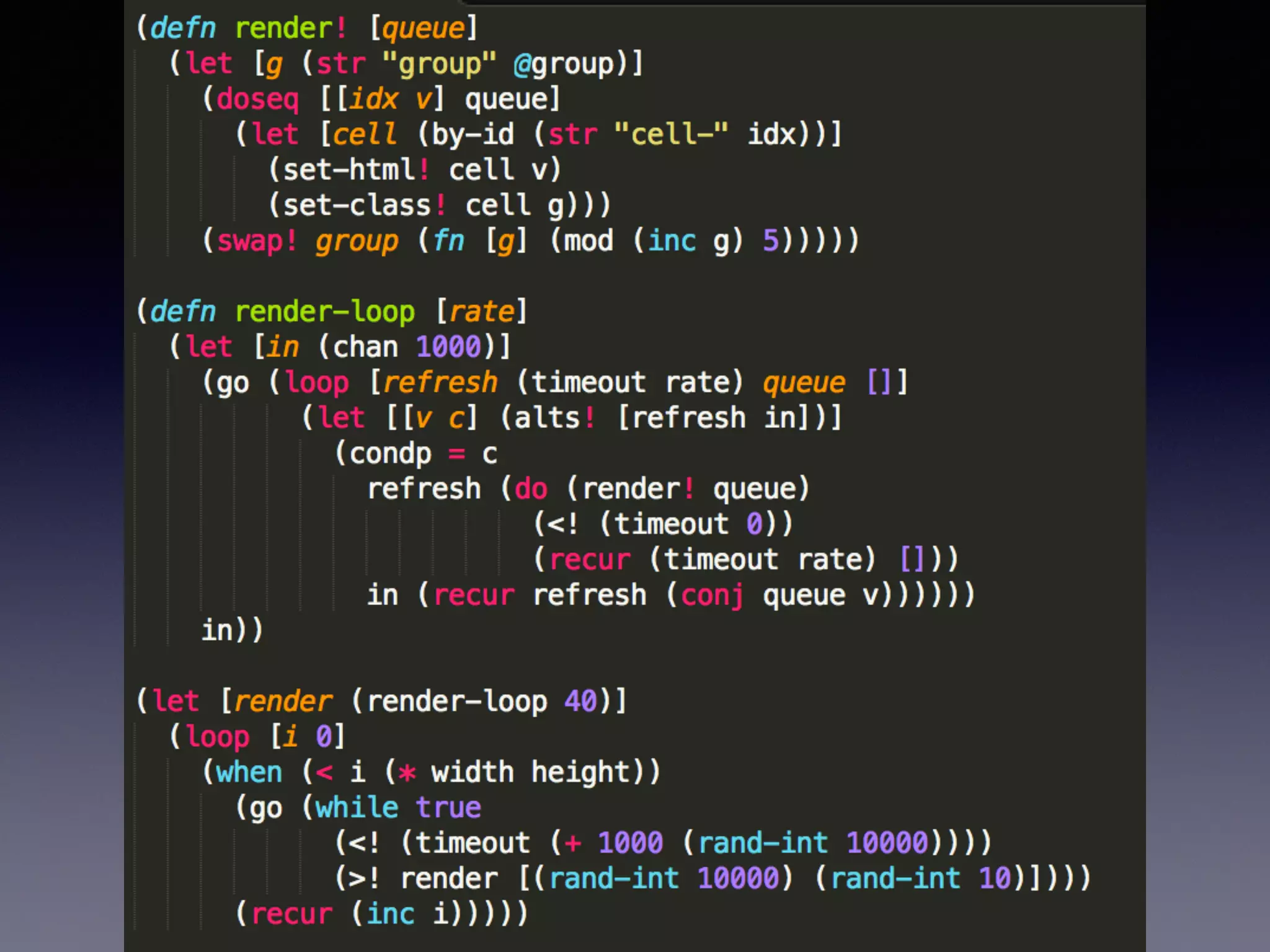
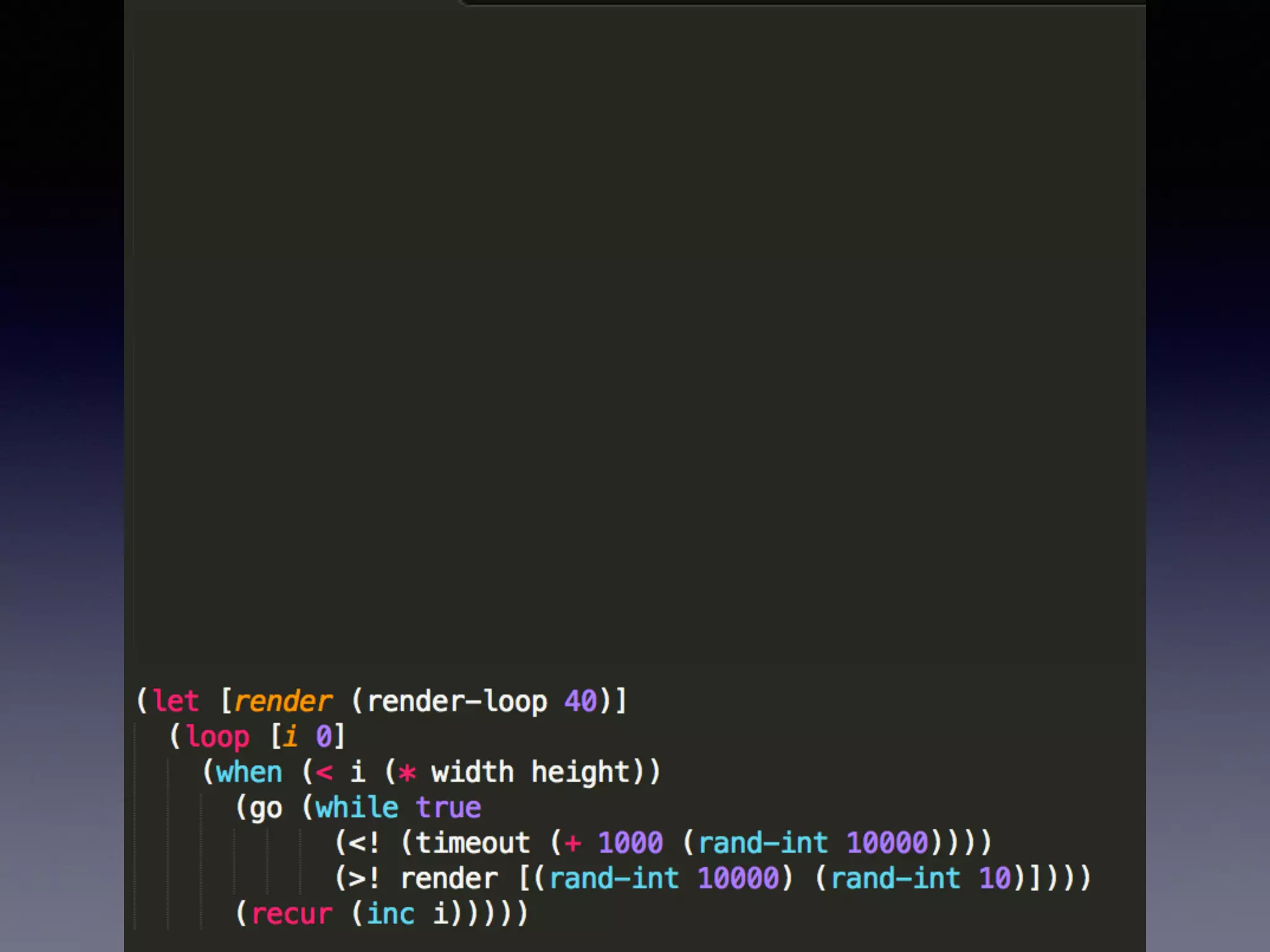
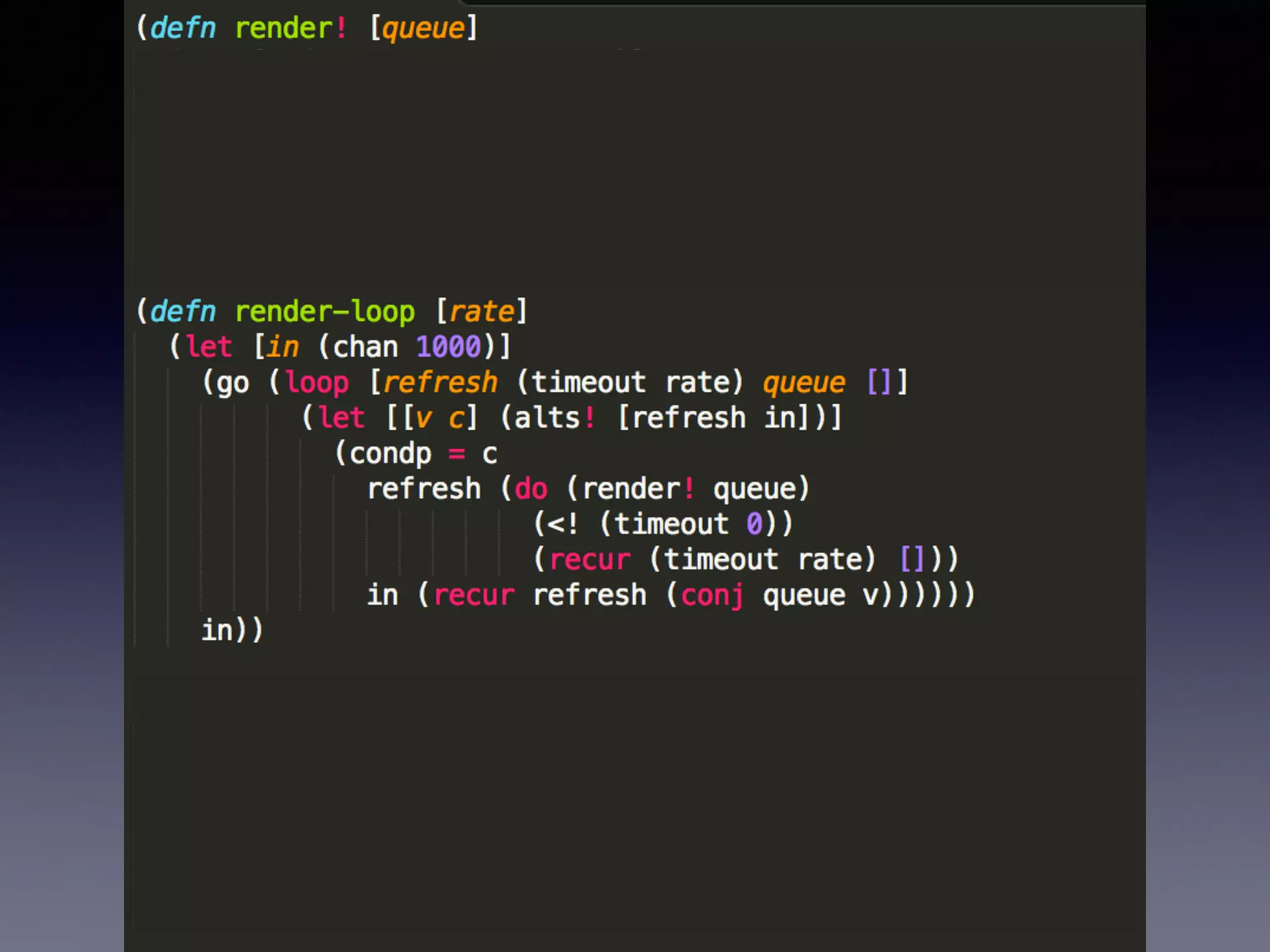
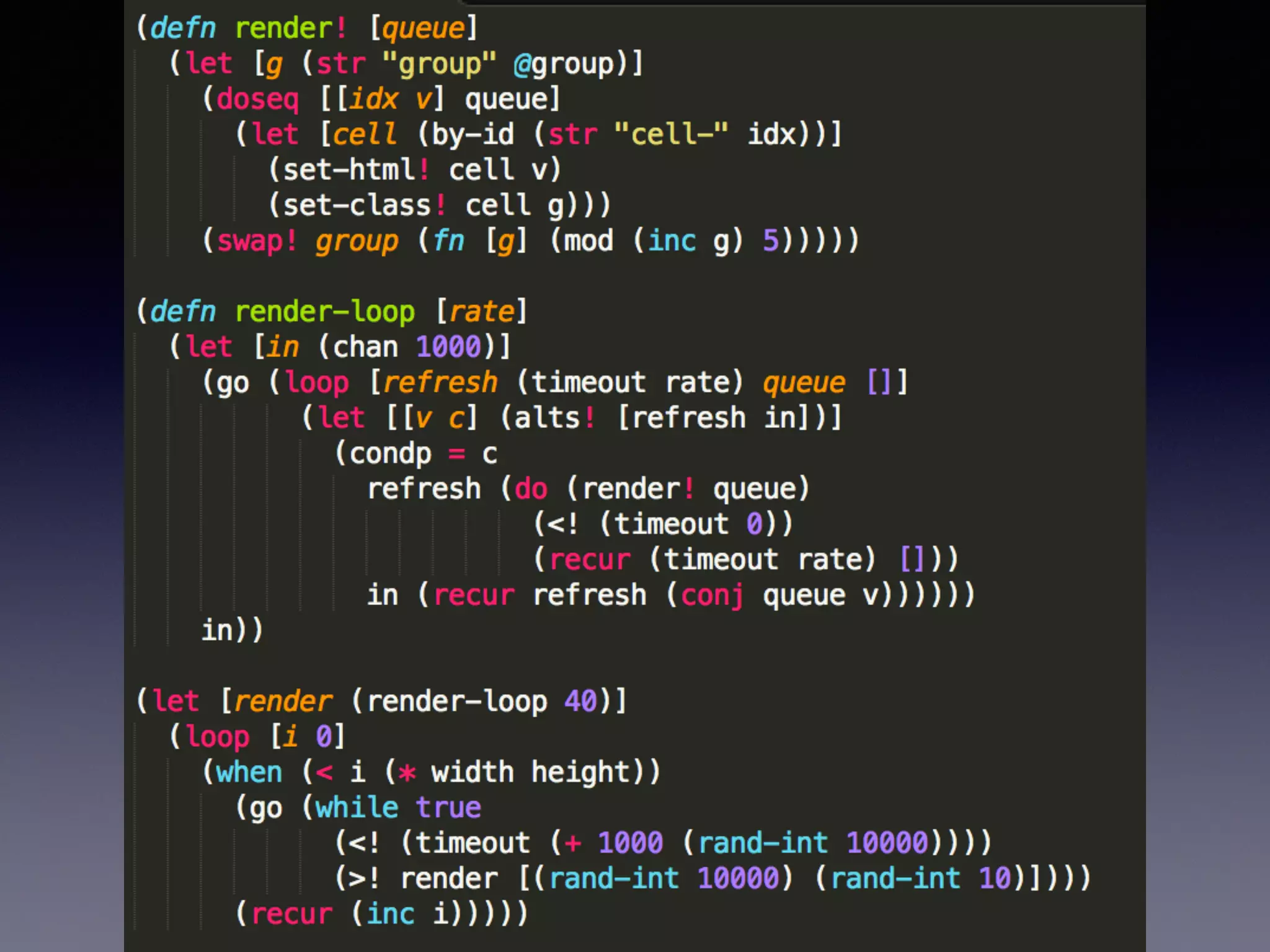
swanodette 10K processes 
[go 
block] 
let 
block 
[idx 
v] [idx 
v] 
[go 
block] 
render-­‐loop ‘render’ ‘queue’ render! 
core.async 
channel parameter 
passed 
in 
during 
function 
call
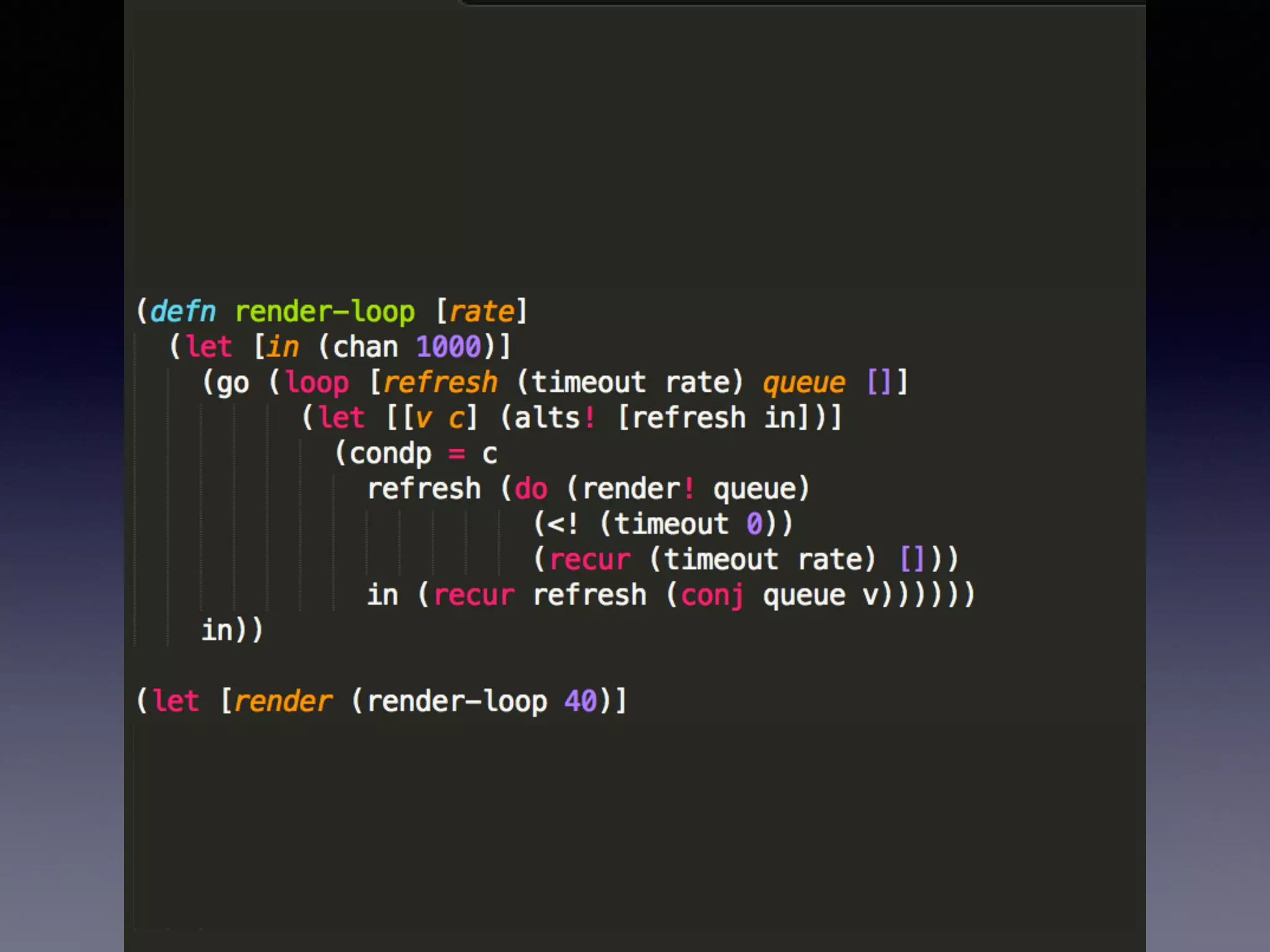
swanodette 10K processes 
[go 
block] 
let 
block 
[idx 
v] [idx 
v] 
[go 
block] 
render-­‐loop ‘render’ ‘queue’ render! 
core.async 
channel parameter 
passed 
in 
during 
function 
call 
No 
more 
than 
1024 
pending 
puts 
are 
allowed 
on 
a 
single 
channel.
[DEMO]
Events with core.async 
-­‐main 
function 
listen 
to 
DOM 
event 
and 
return 
channel 
[go 
block] 
print 
queue 
message 
put! out/clicks <!
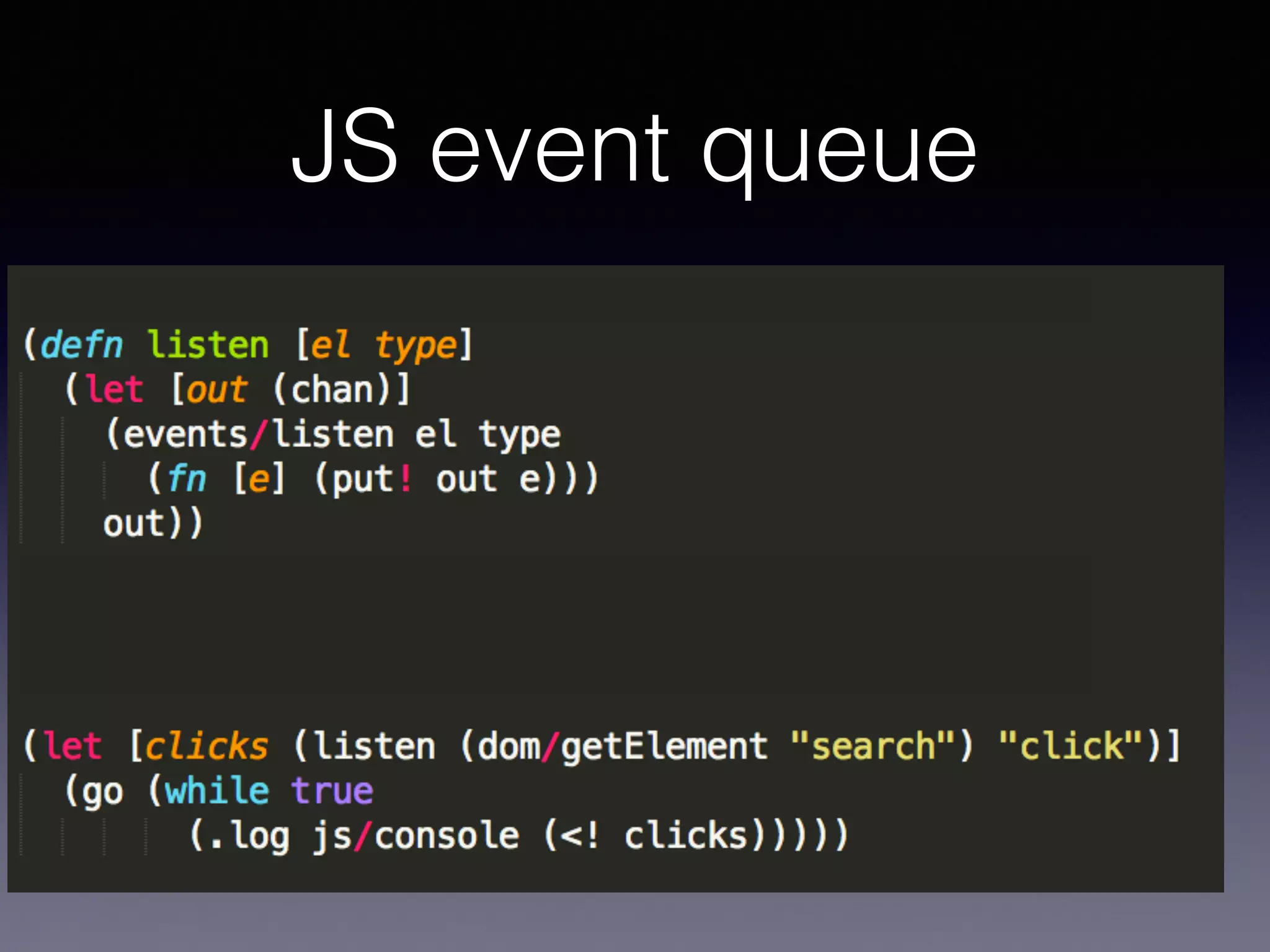
JS event queue
Parallelism is not 
Concurrency 
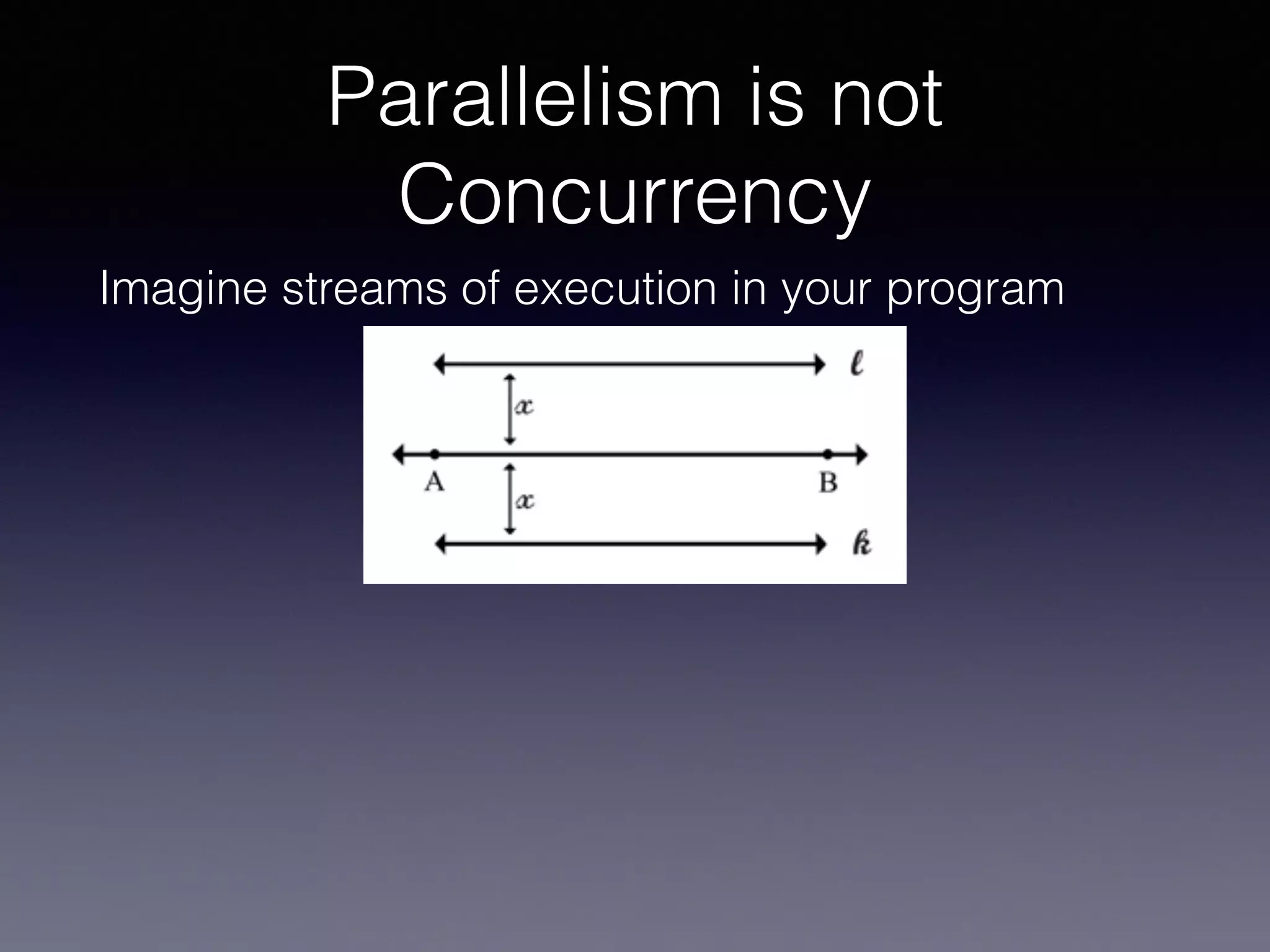
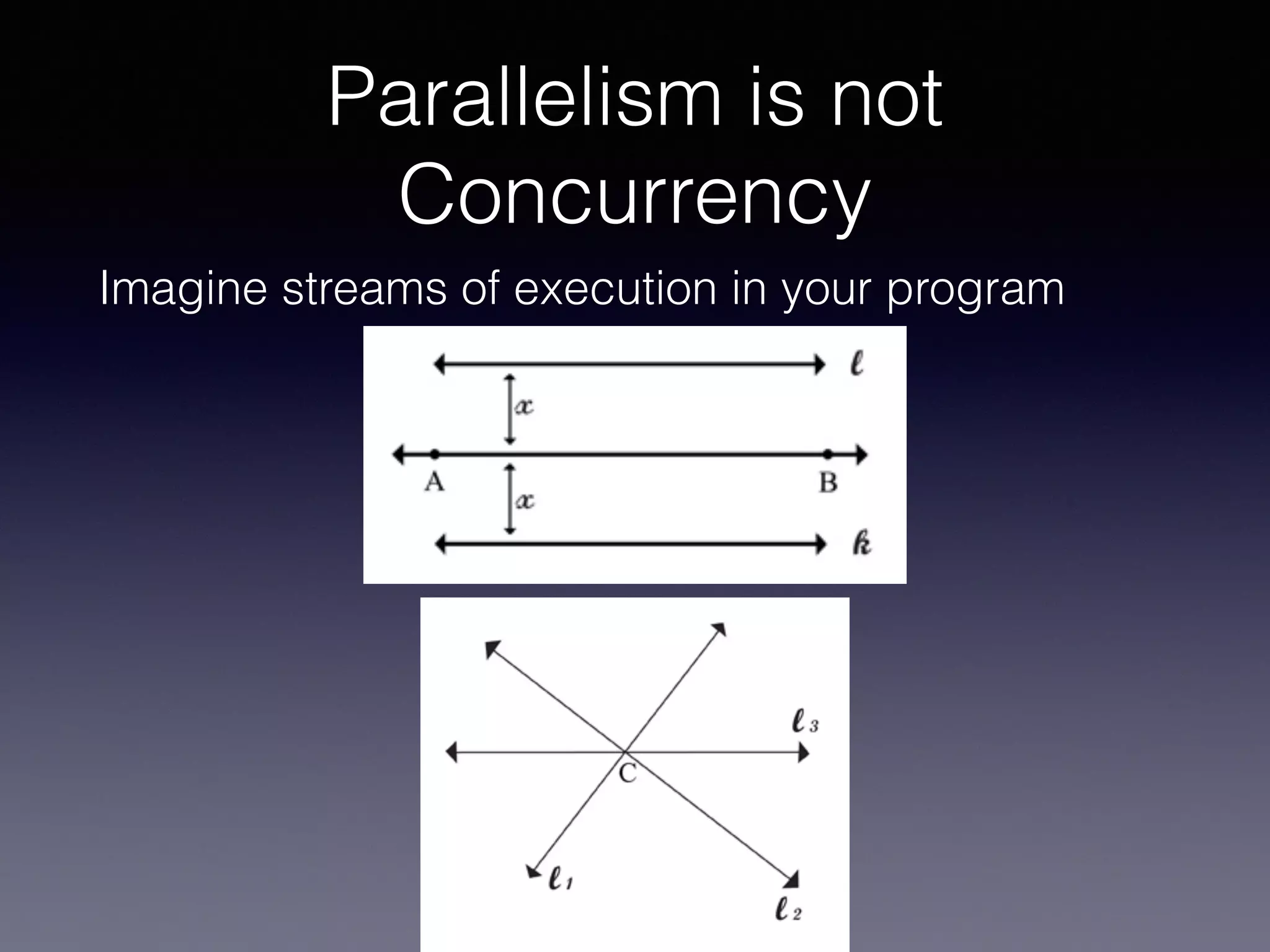
Imagine streams of execution in your program
Parallelism is not 
Concurrency 
Imagine streams of execution in your program
Parallelism is not 
Concurrency 
Imagine streams of execution in your program
Parallelism 
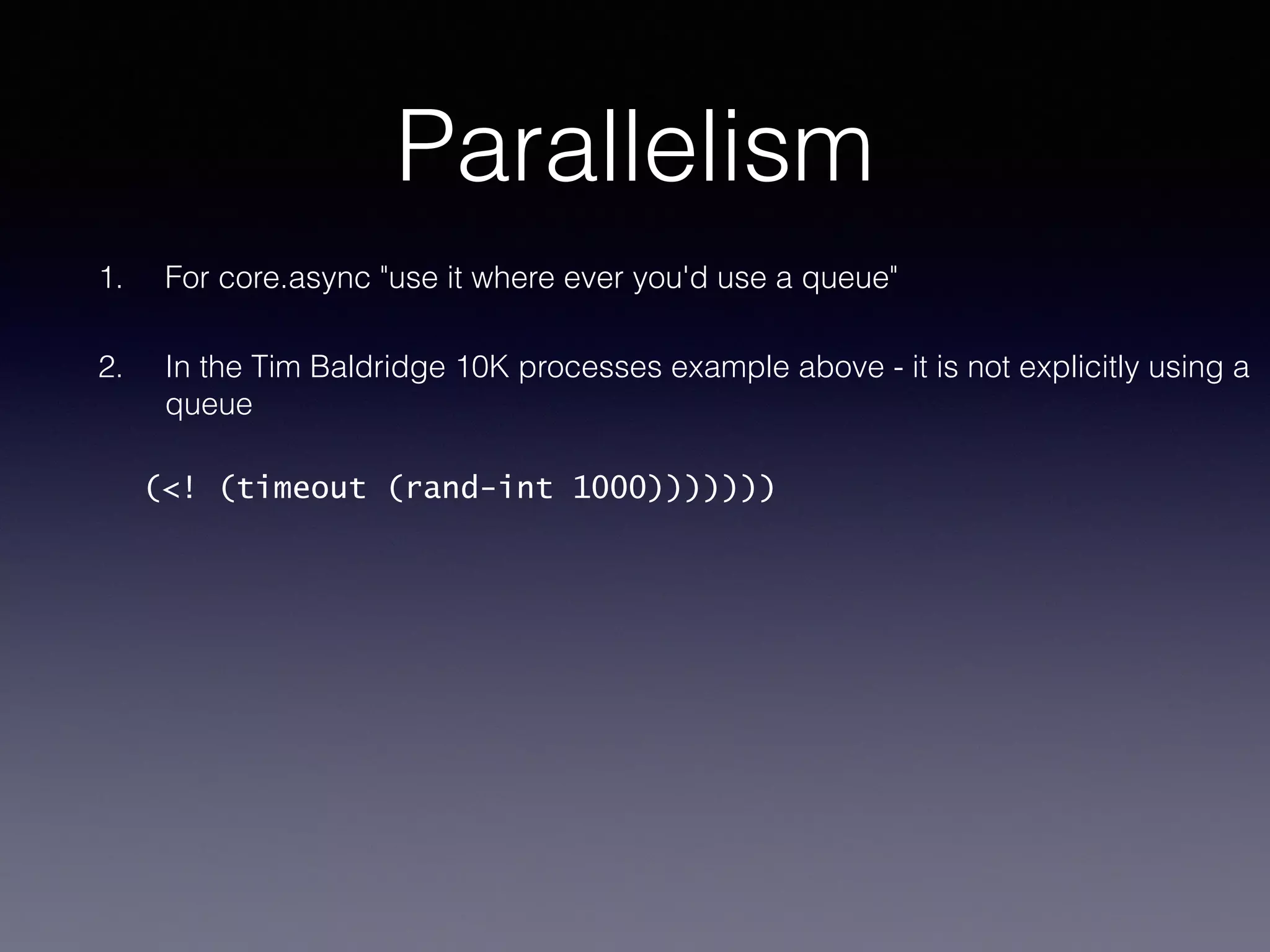
1. For core.async "use it where ever you'd use a queue" 
2. In the Tim Baldridge 10K processes example above - it is not explicitly using a 
queue 
(<! (timeout (rand-int 1000)))))))
Parallelism 
1. For core.async "use it where ever you'd use a queue" 
2. In the Tim Baldridge 10K processes example above - it is not explicitly using a 
queue 
(<! (timeout (rand-int 1000))))))) 
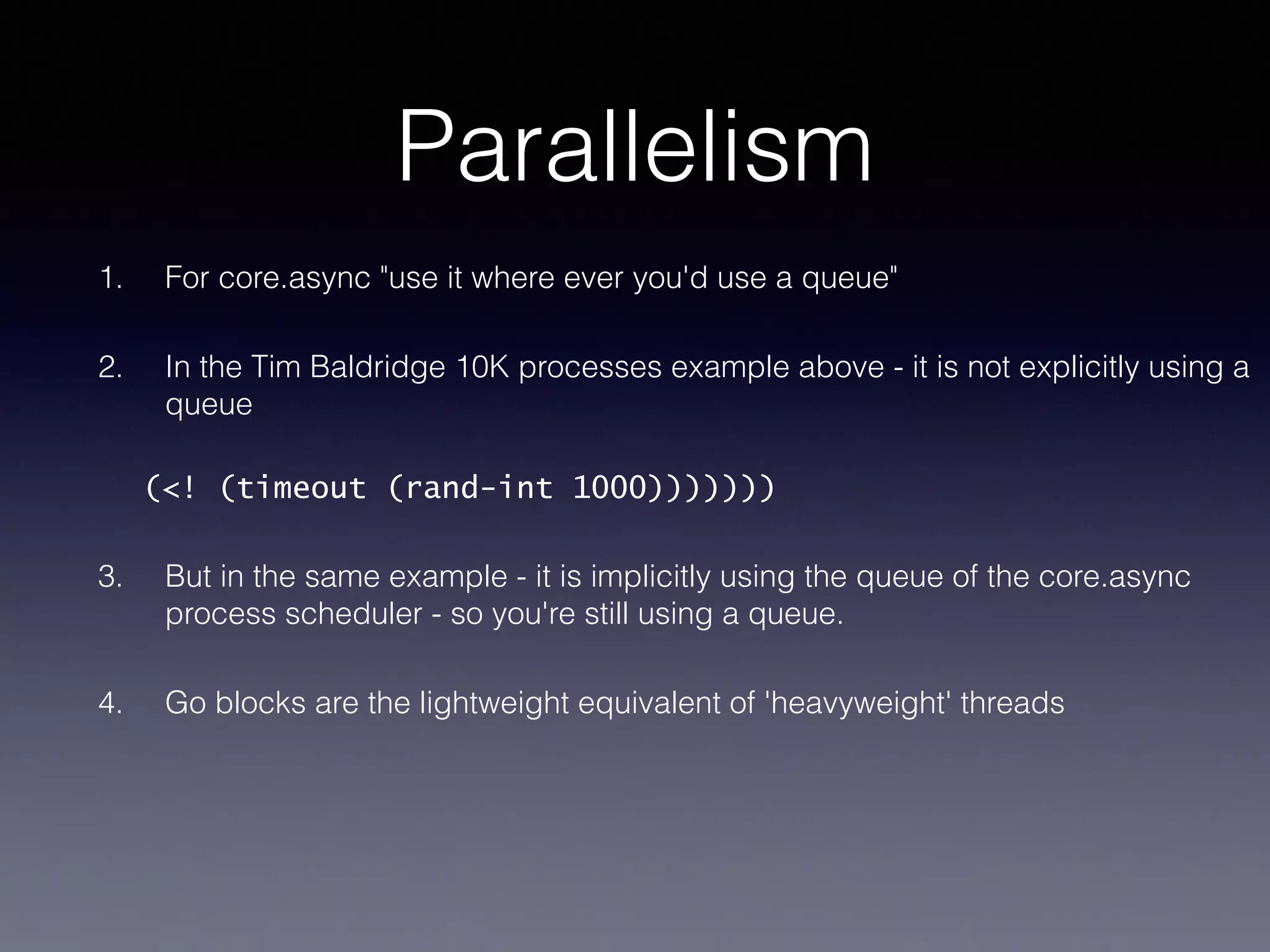
3. But in the same example - it is implicitly using the queue of the core.async 
process scheduler - so you're still using a queue. 
4. Go blocks are the lightweight equivalent of 'heavyweight' threads
Parallelism 
1. For core.async "use it where ever you'd use a queue" 
2. In the Tim Baldridge 10K processes example above - it is not explicitly using a 
queue 
(<! (timeout (rand-int 1000))))))) 
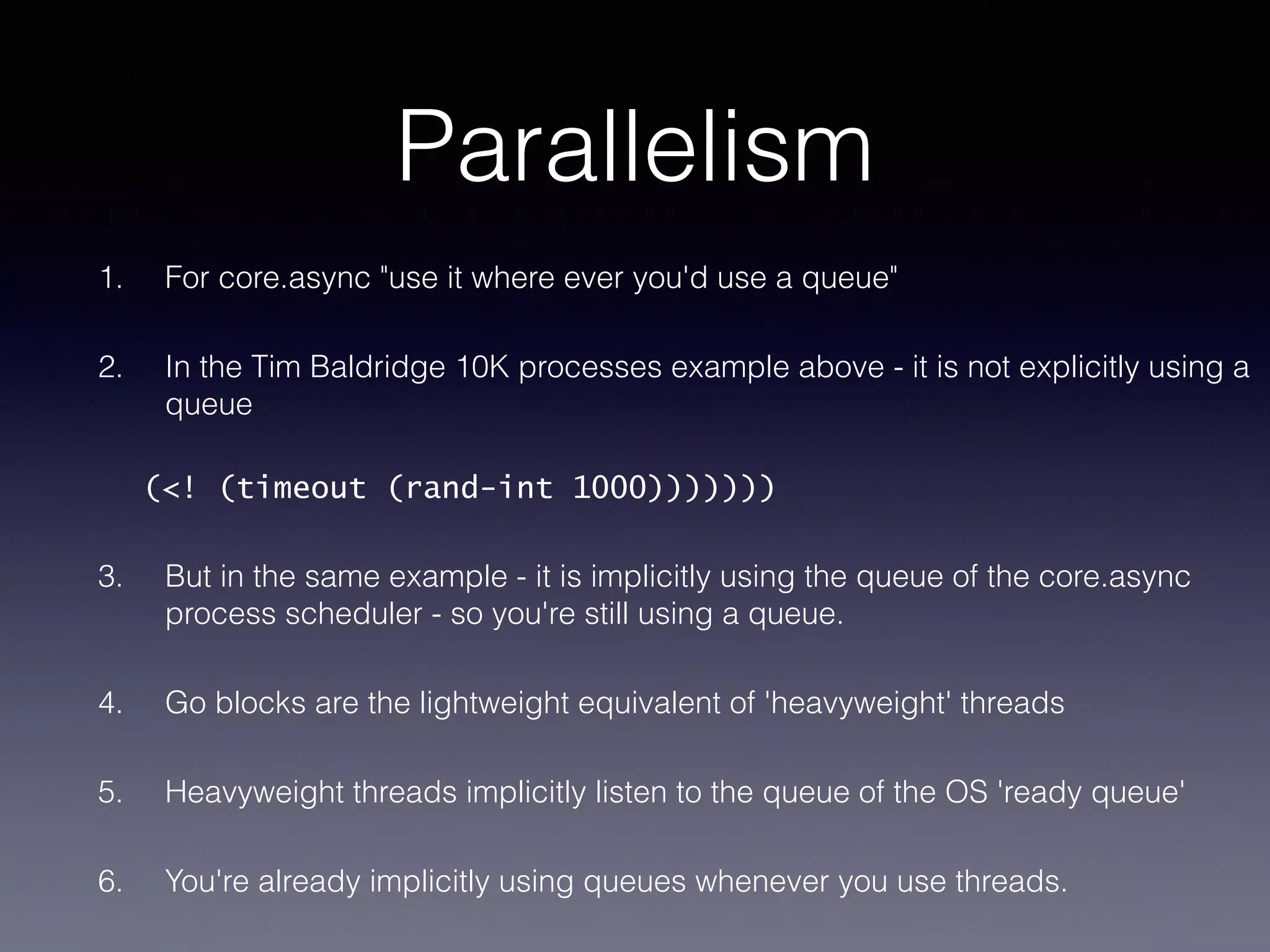
3. But in the same example - it is implicitly using the queue of the core.async 
process scheduler - so you're still using a queue. 
4. Go blocks are the lightweight equivalent of 'heavyweight' threads 
5. Heavyweight threads implicitly listen to the queue of the OS 'ready queue' 
6. You're already implicitly using queues whenever you use threads.
Quick recap 
• core.async is all about queues
Quick recap 
• core.async is all about queues 
• queues can used in your application for: 
• parallelism 
• separating the calculation from the display 
logic 
• event handling
[DEMO]
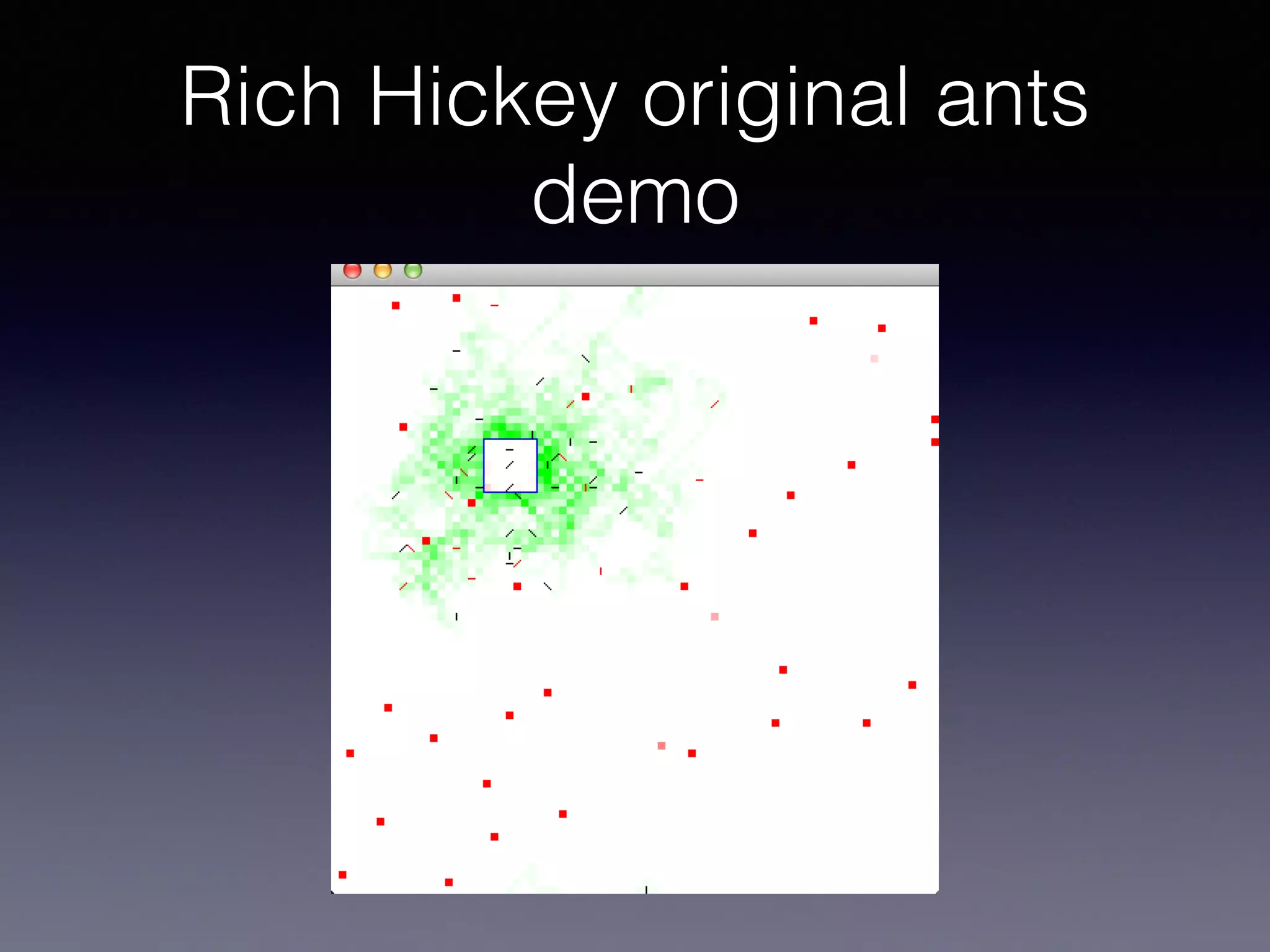
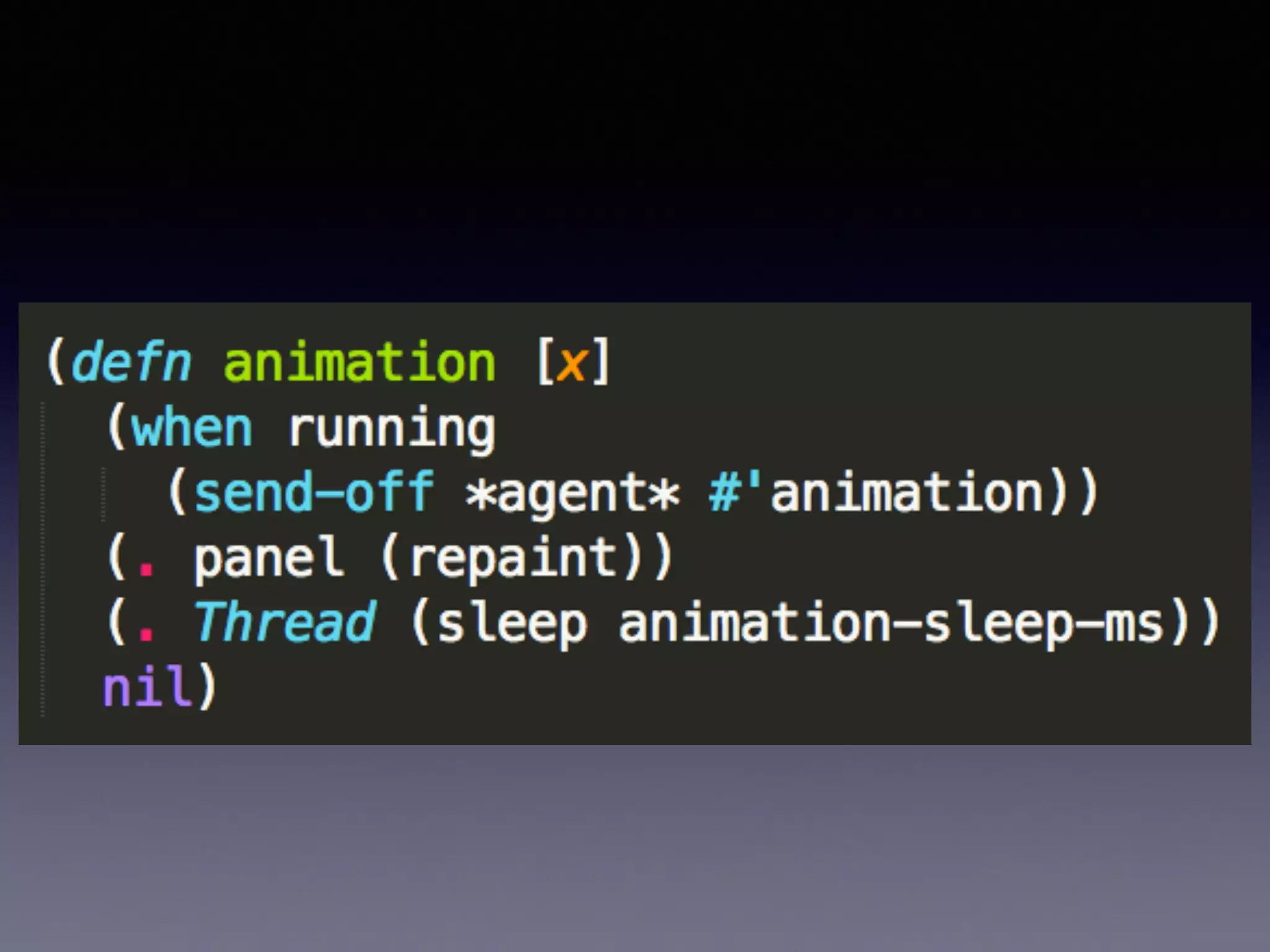
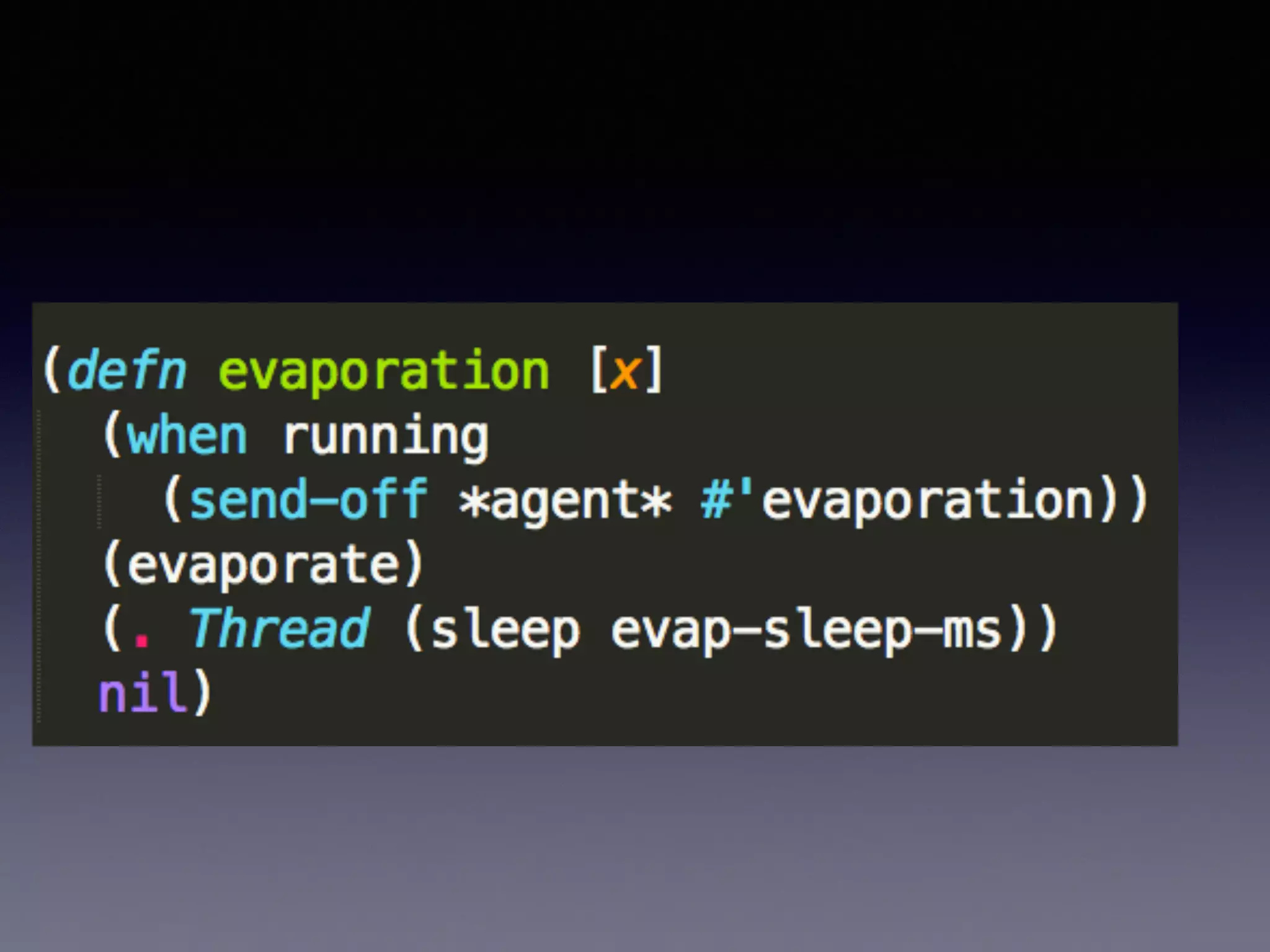
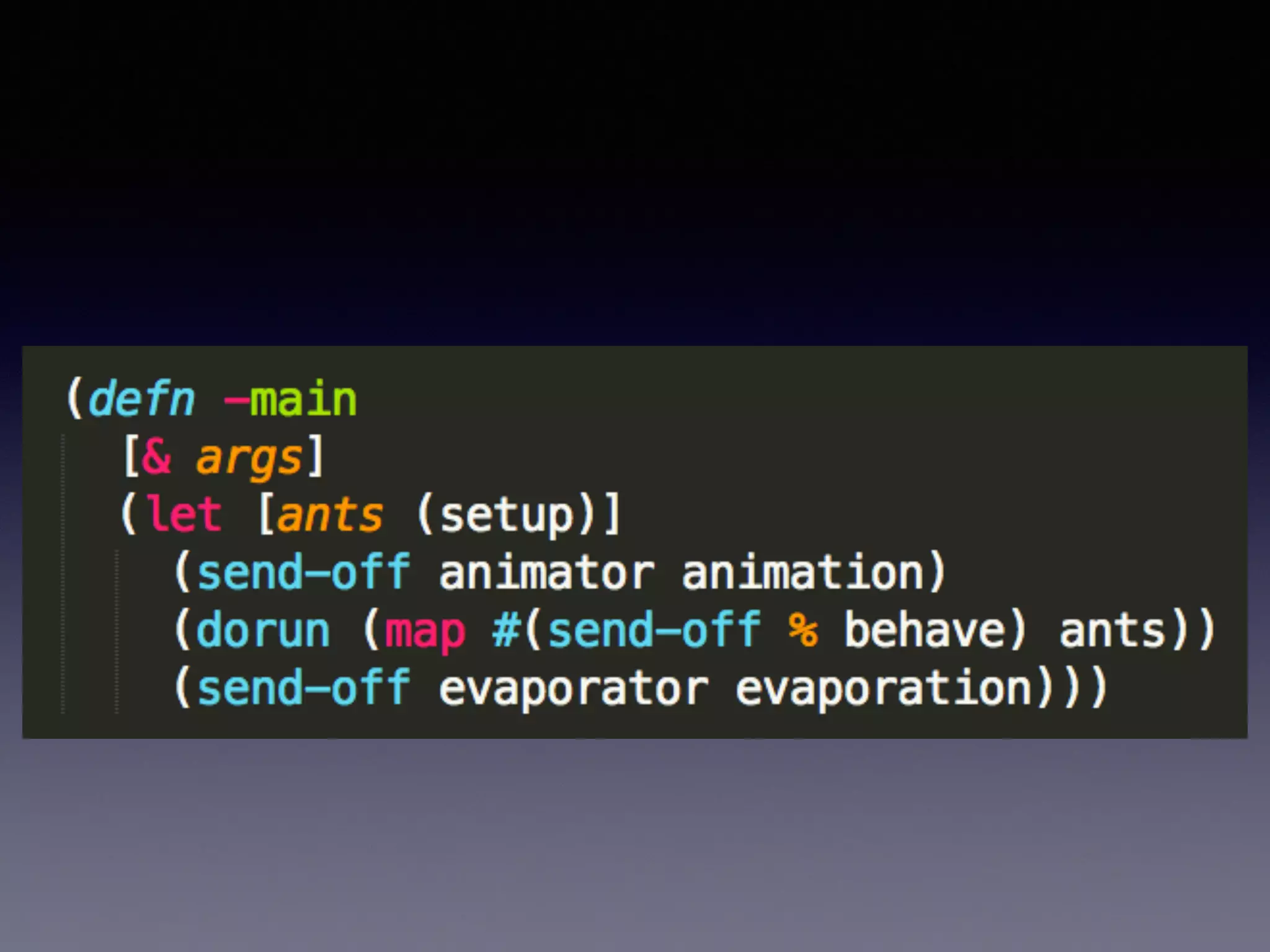
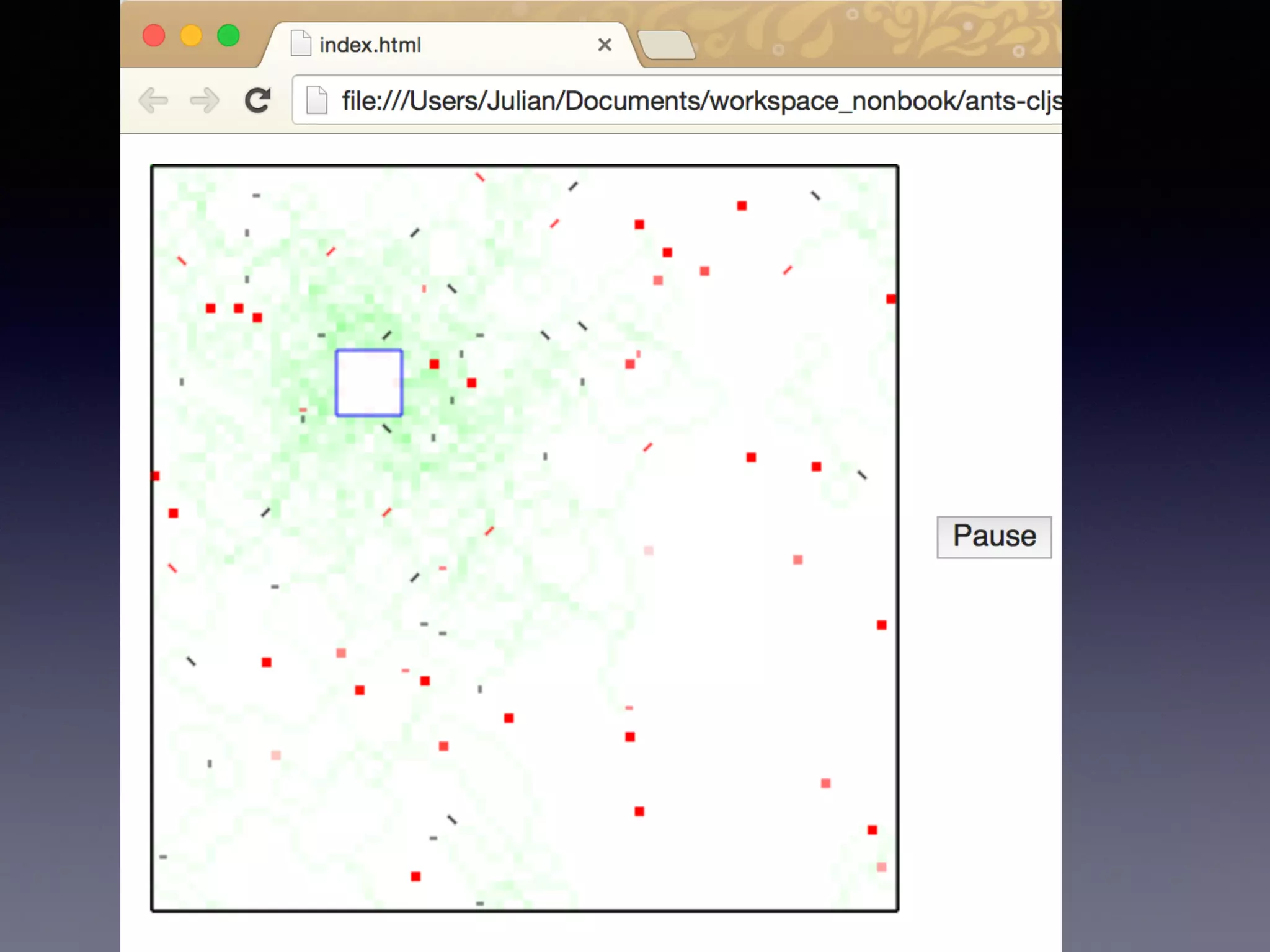
Rich Hickey original ants 
demo
Rich Hickey original ants 
demo 
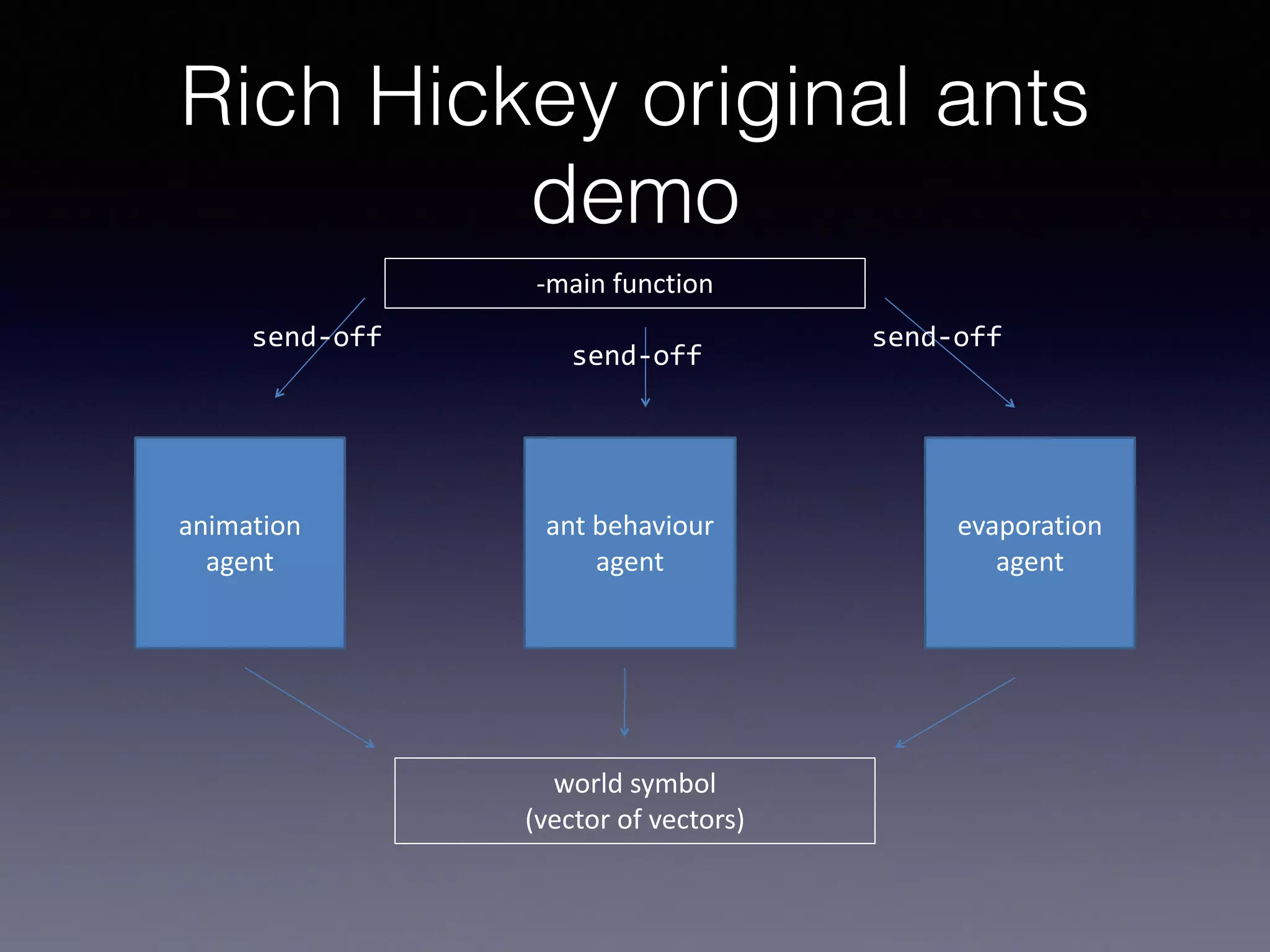
-­‐main 
function 
send-­‐off send-­‐off send-­‐off 
animation 
agent 
ant 
behaviour 
agent 
evaporation 
agent 
world 
symbol 
(vector 
of 
vectors)
Converting to ClojureScript 
Missing functions in ClojureScript:
Converting to ClojureScript 
Missing functions in ClojureScript: 
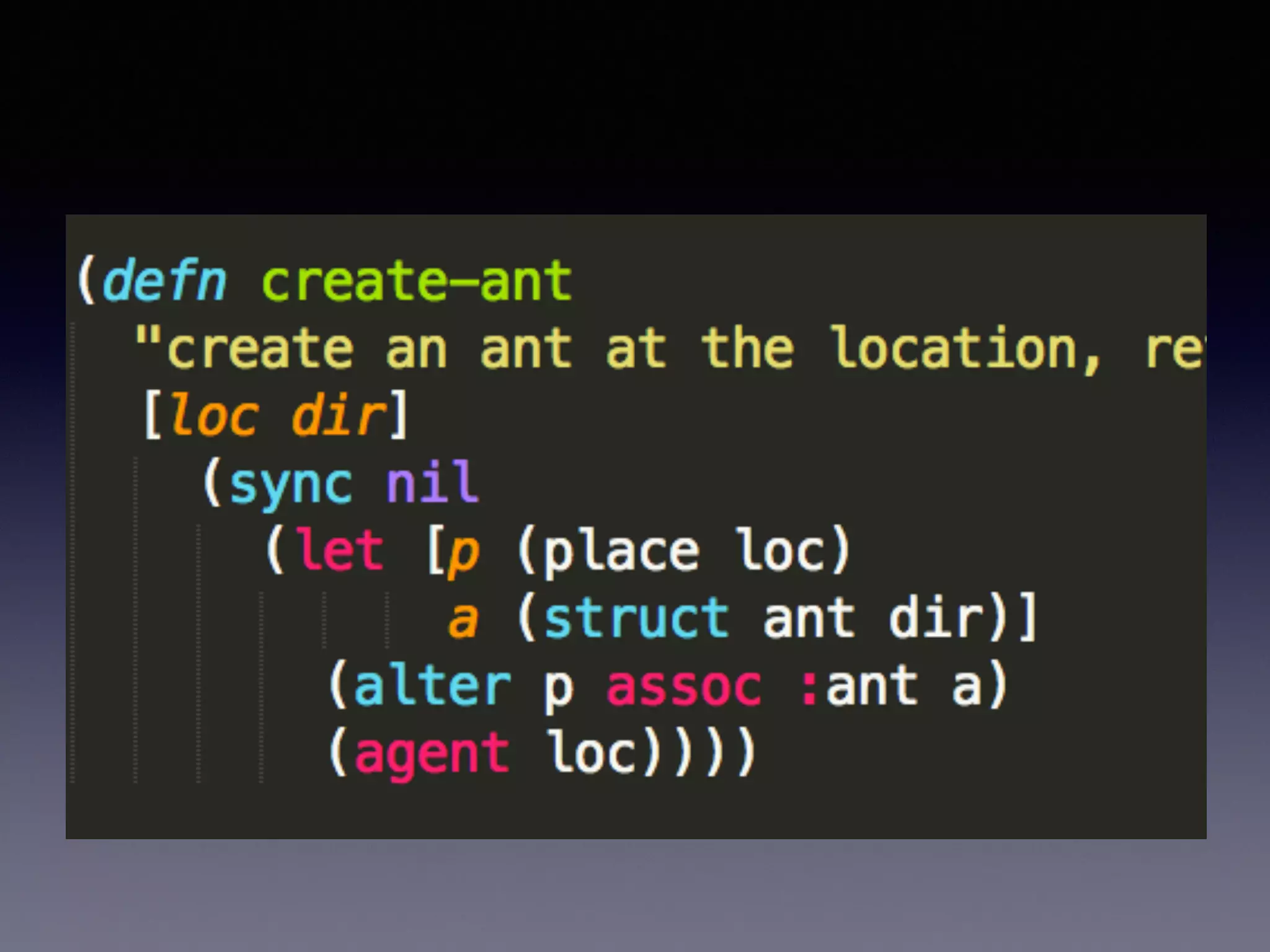
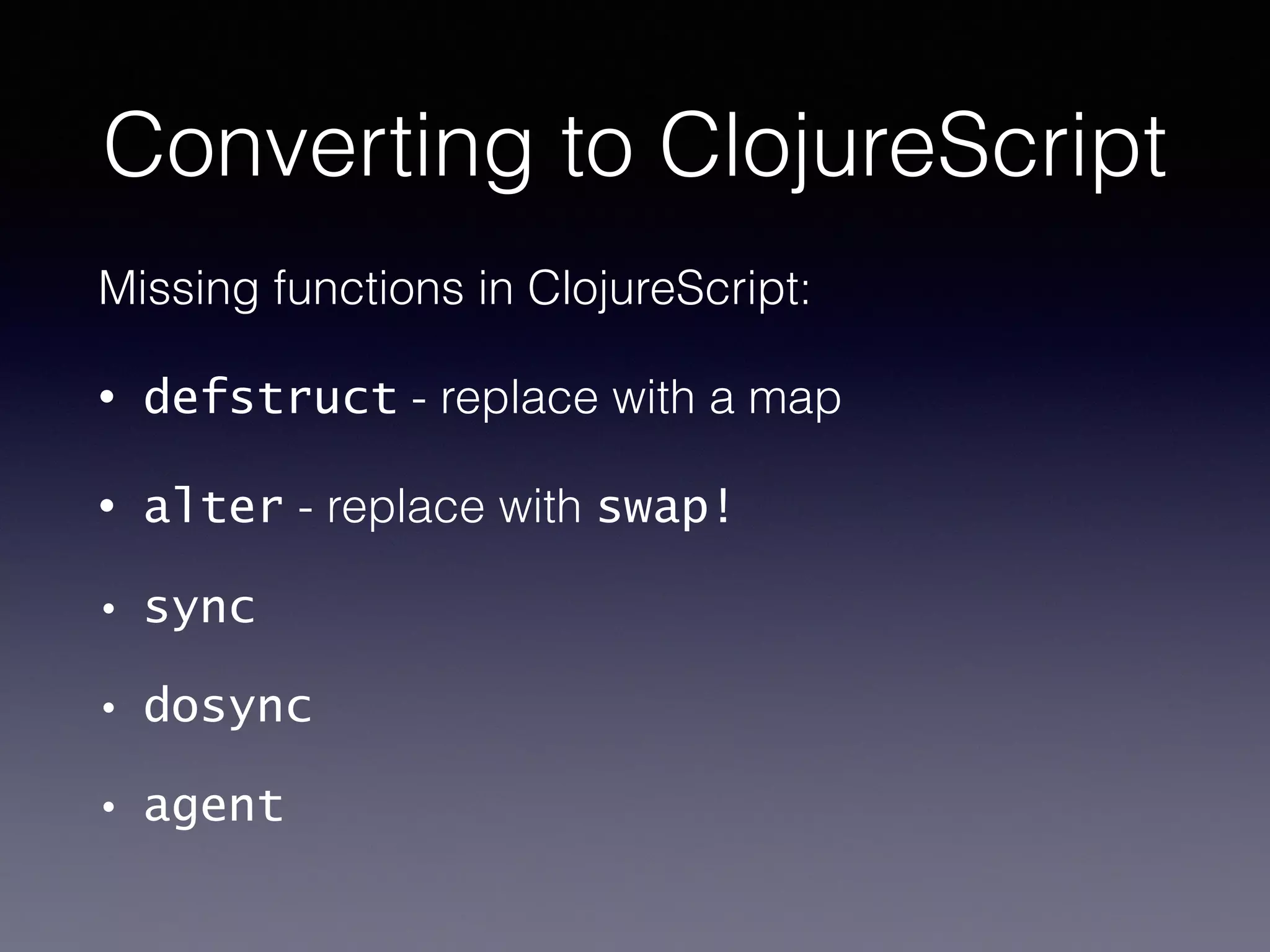
• defstruct - replace with a map 
• alter - replace with swap!
Converting to ClojureScript 
Missing functions in ClojureScript: 
• defstruct - replace with a map 
• alter - replace with swap! 
• sync 
• dosync 
• agent
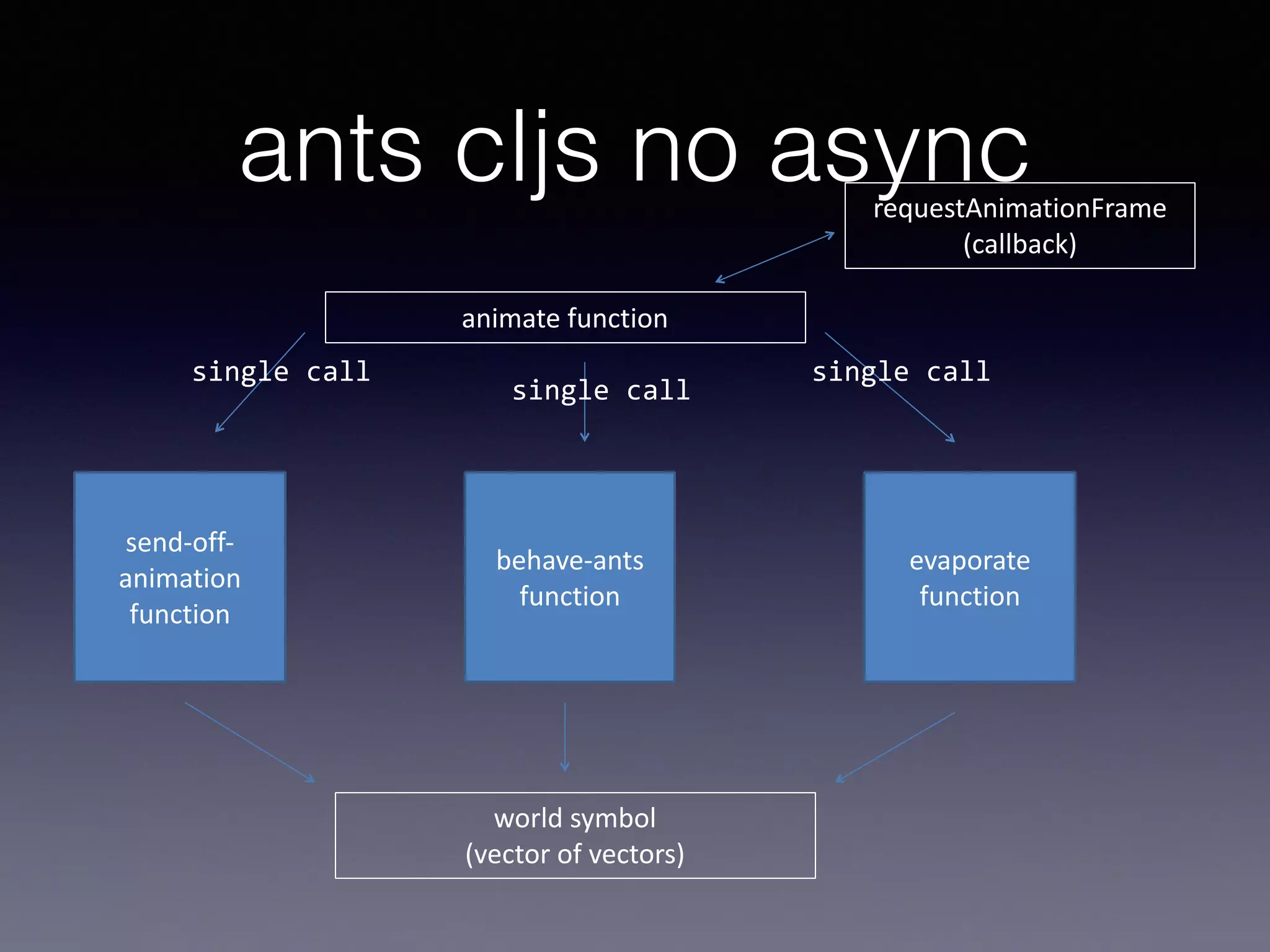
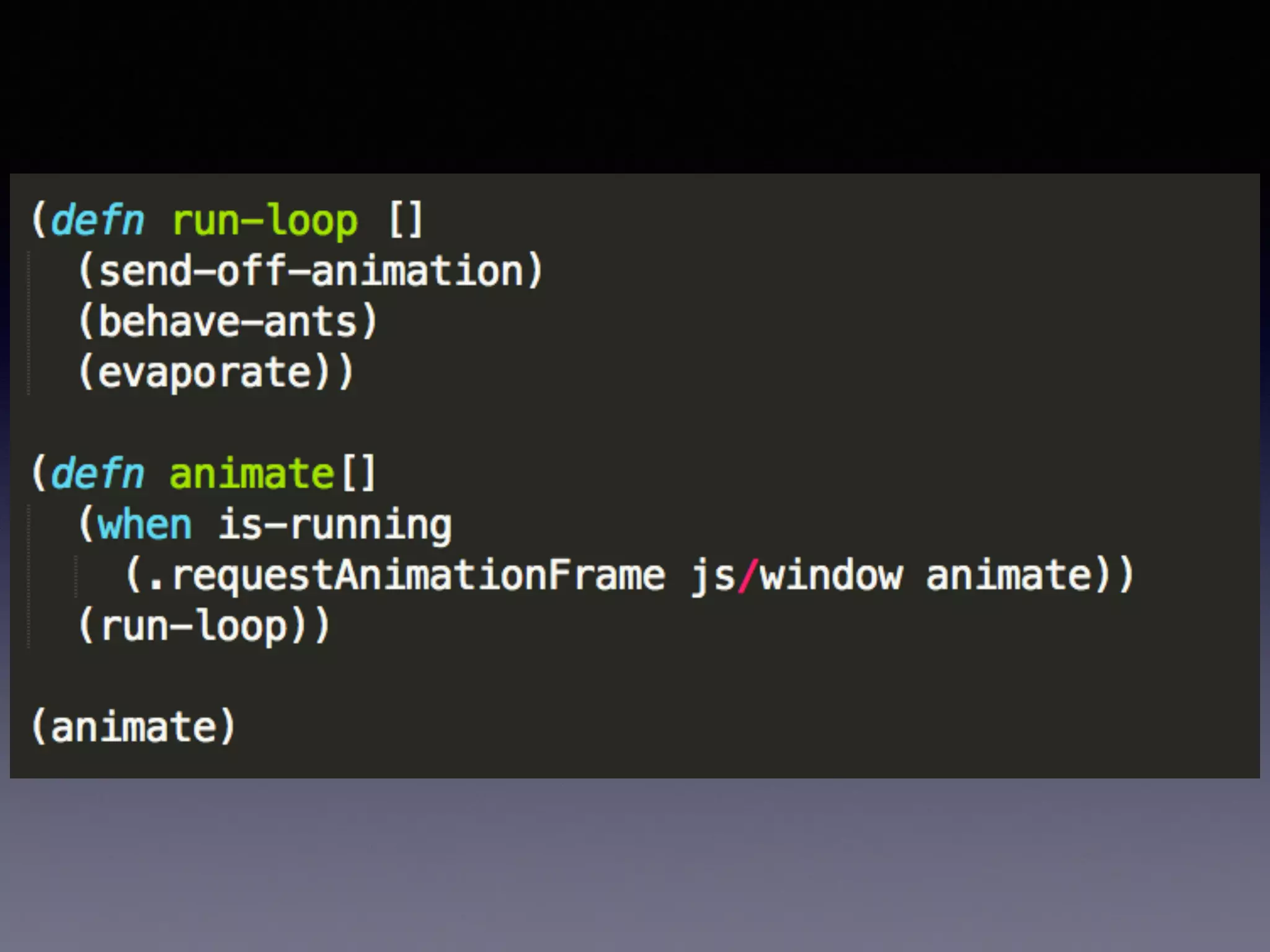
ants cljs no async 
animate 
function 
requestAnimationFrame 
single 
call single 
call single 
send-­‐off-­‐ 
animation 
function 
behave-­‐ants 
function 
(callback) 
evaporate 
function 
world 
symbol 
(vector 
of 
vectors) 
call
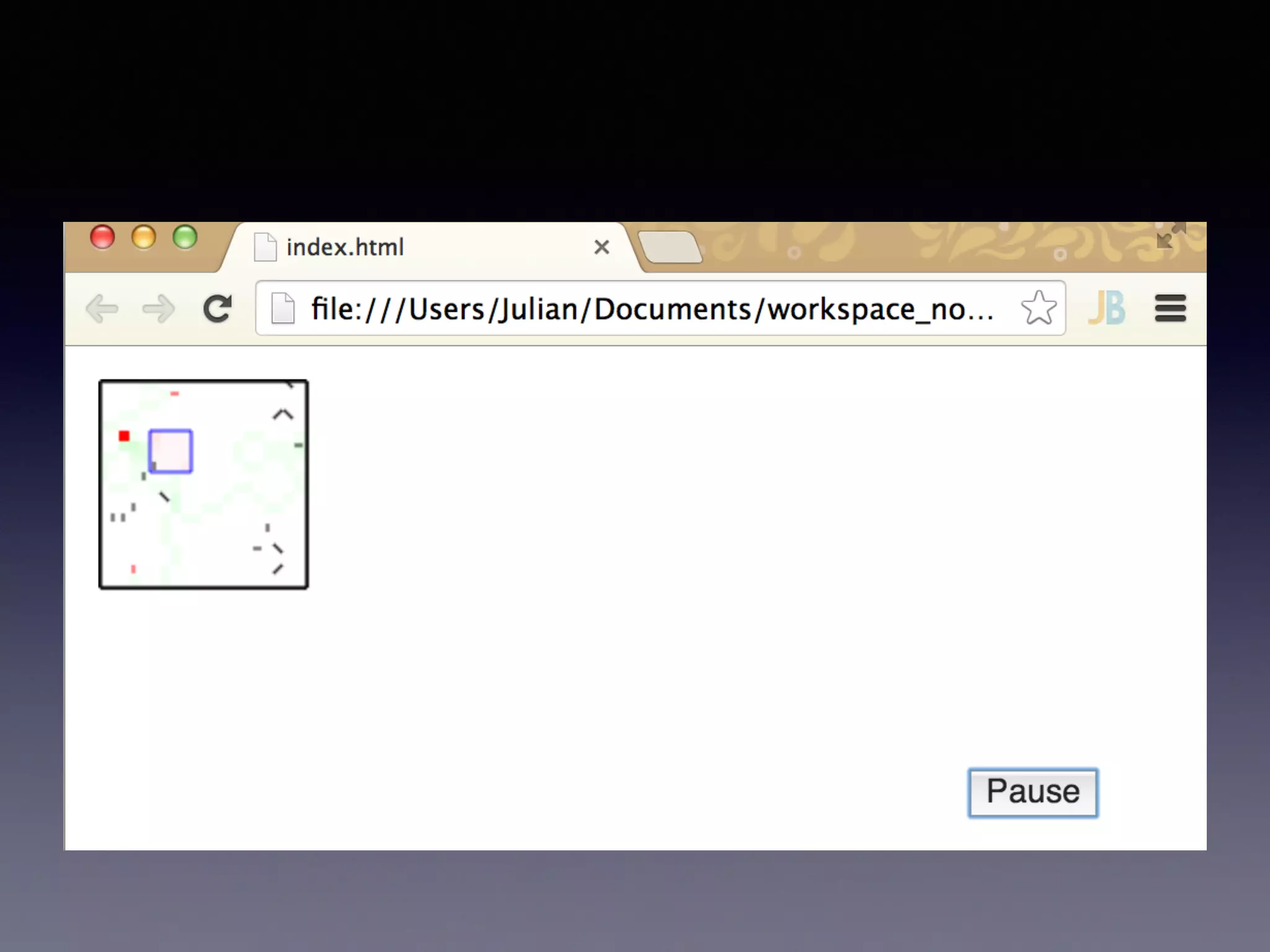
[DEMO]
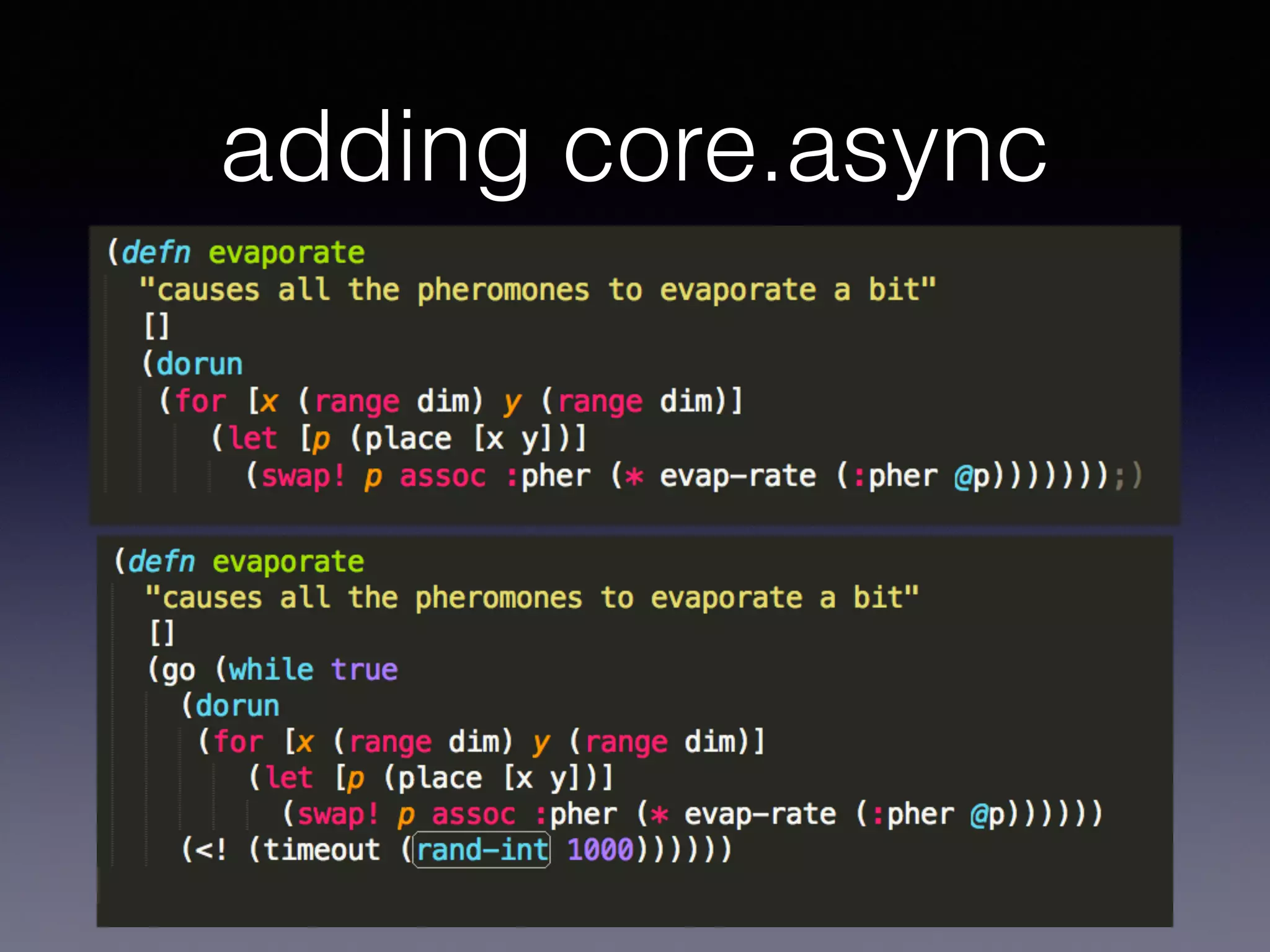
Adding core.async
Adding core.async 
• You can use a go block with a timeout queue in 
the same way you’d use a thread with a sleep 
function
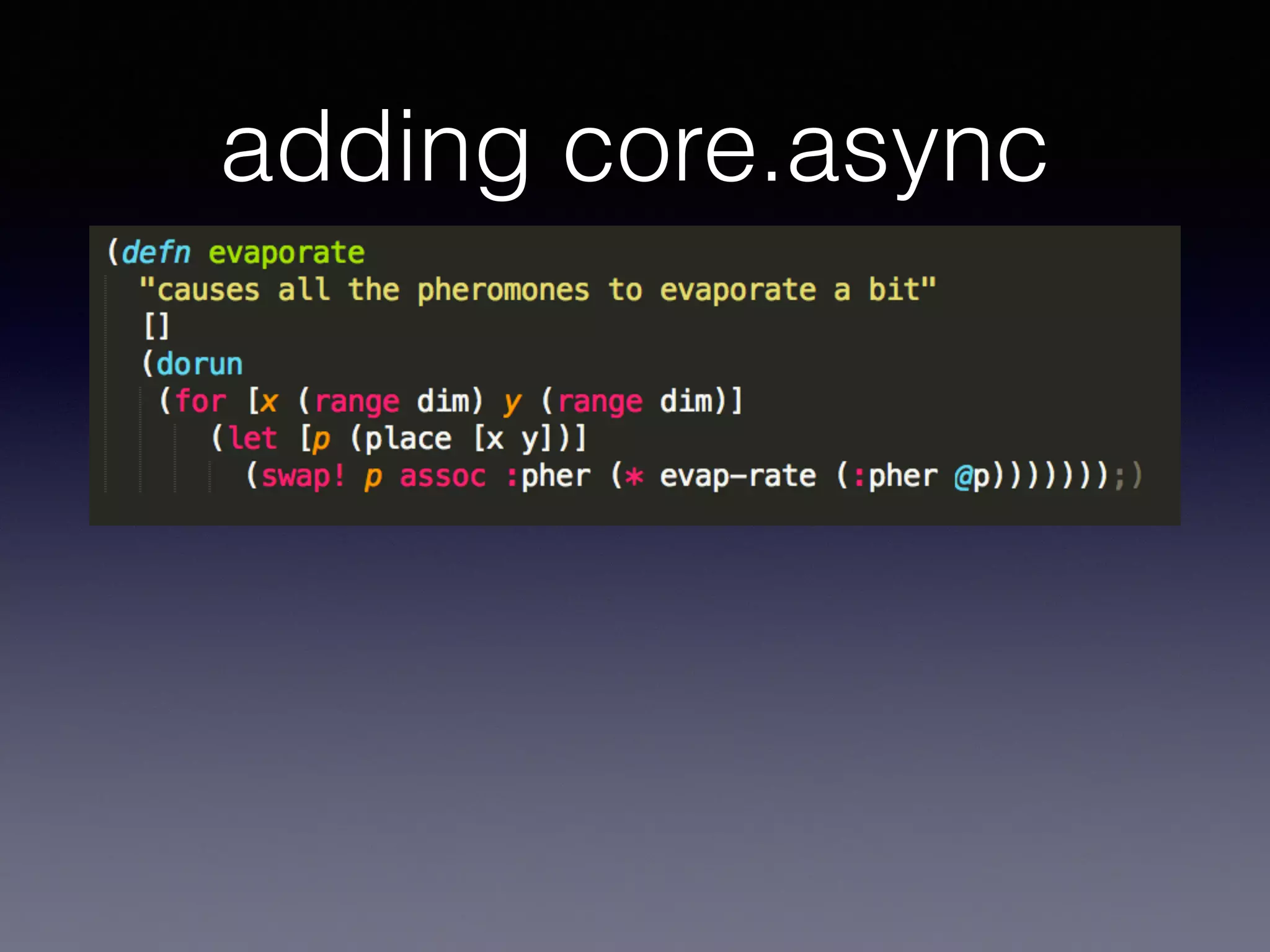
adding core.async
adding core.async
[DEMO]
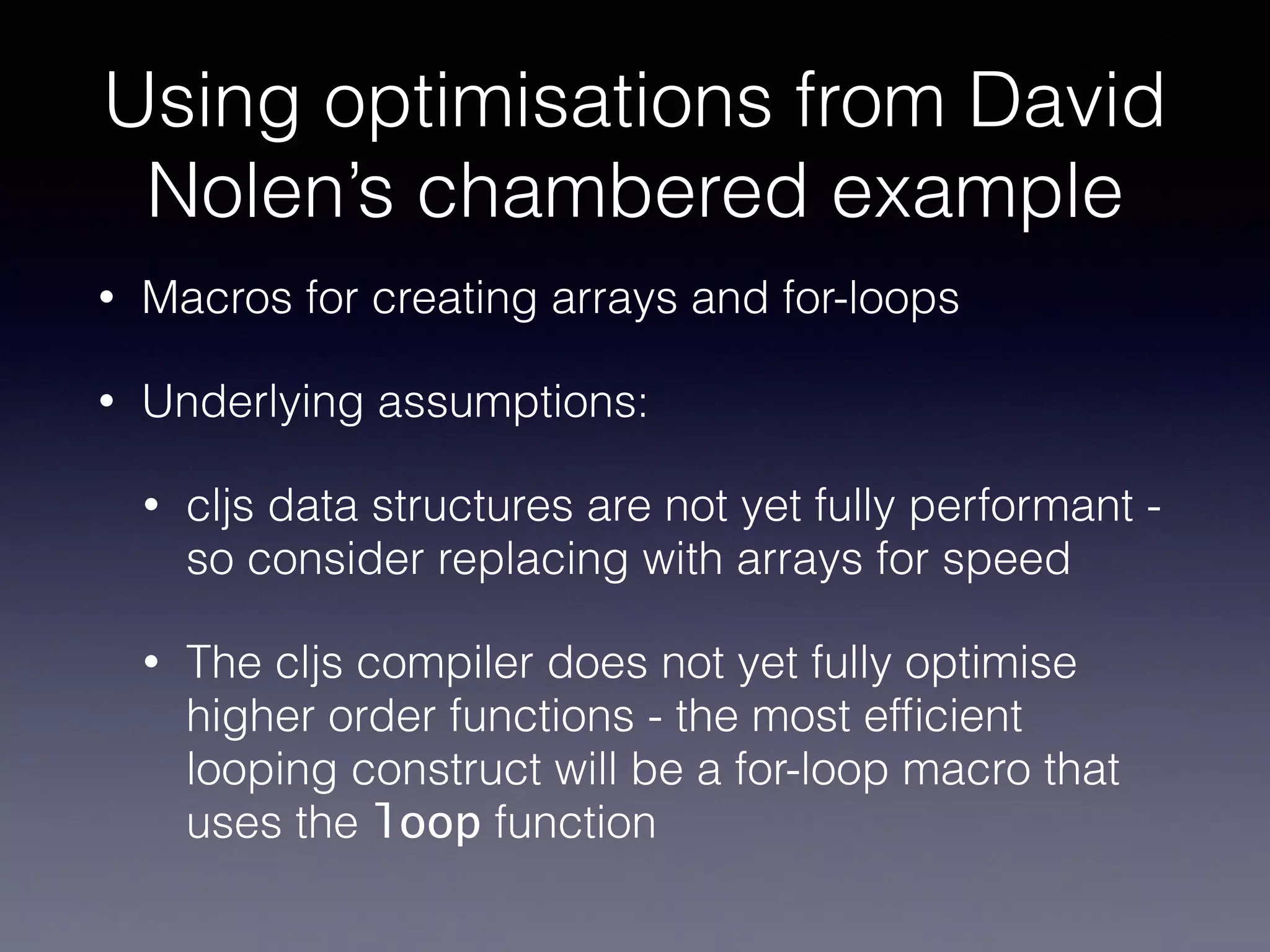
Using optimisations from David 
Nolen’s chambered example 
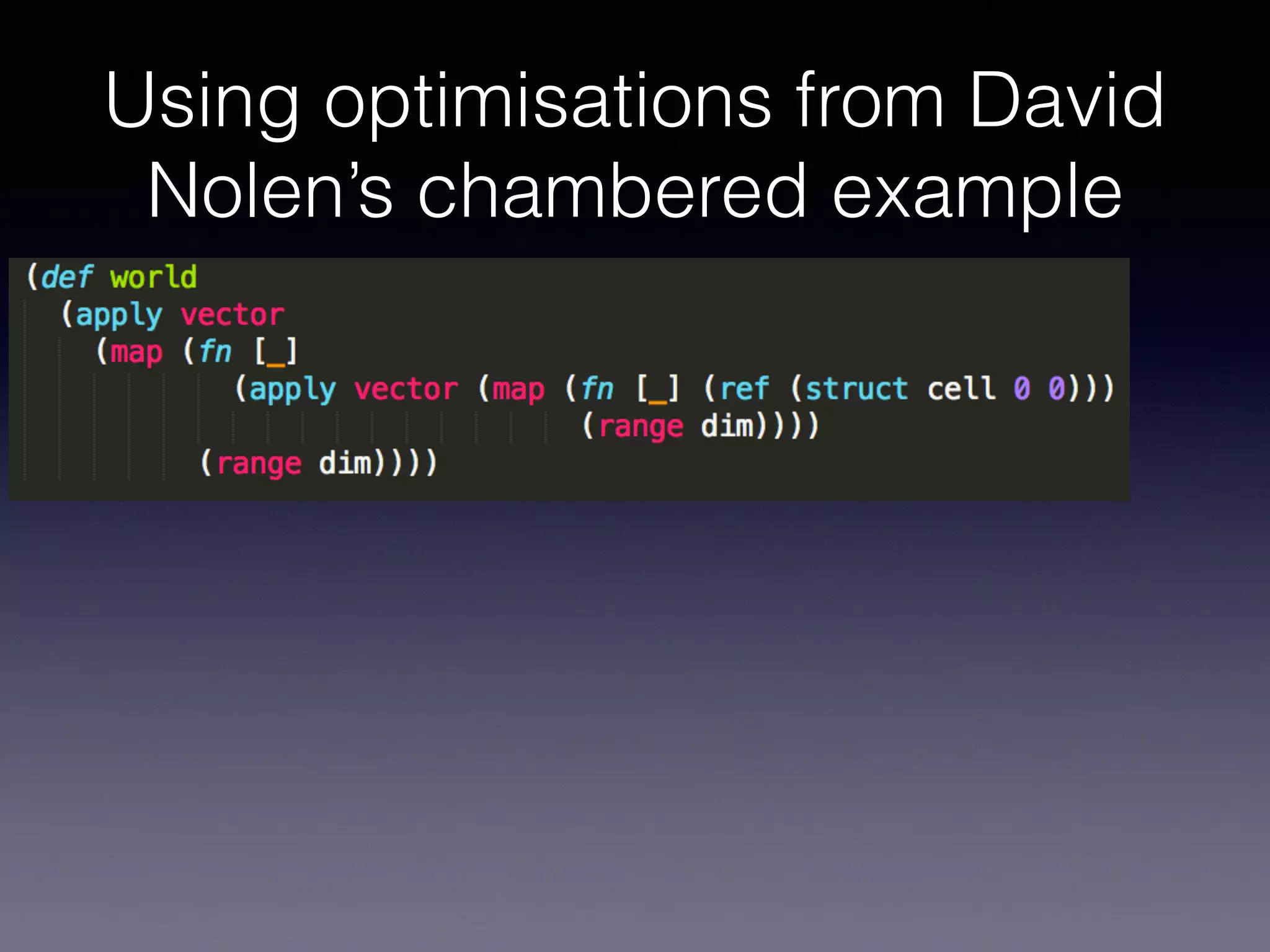
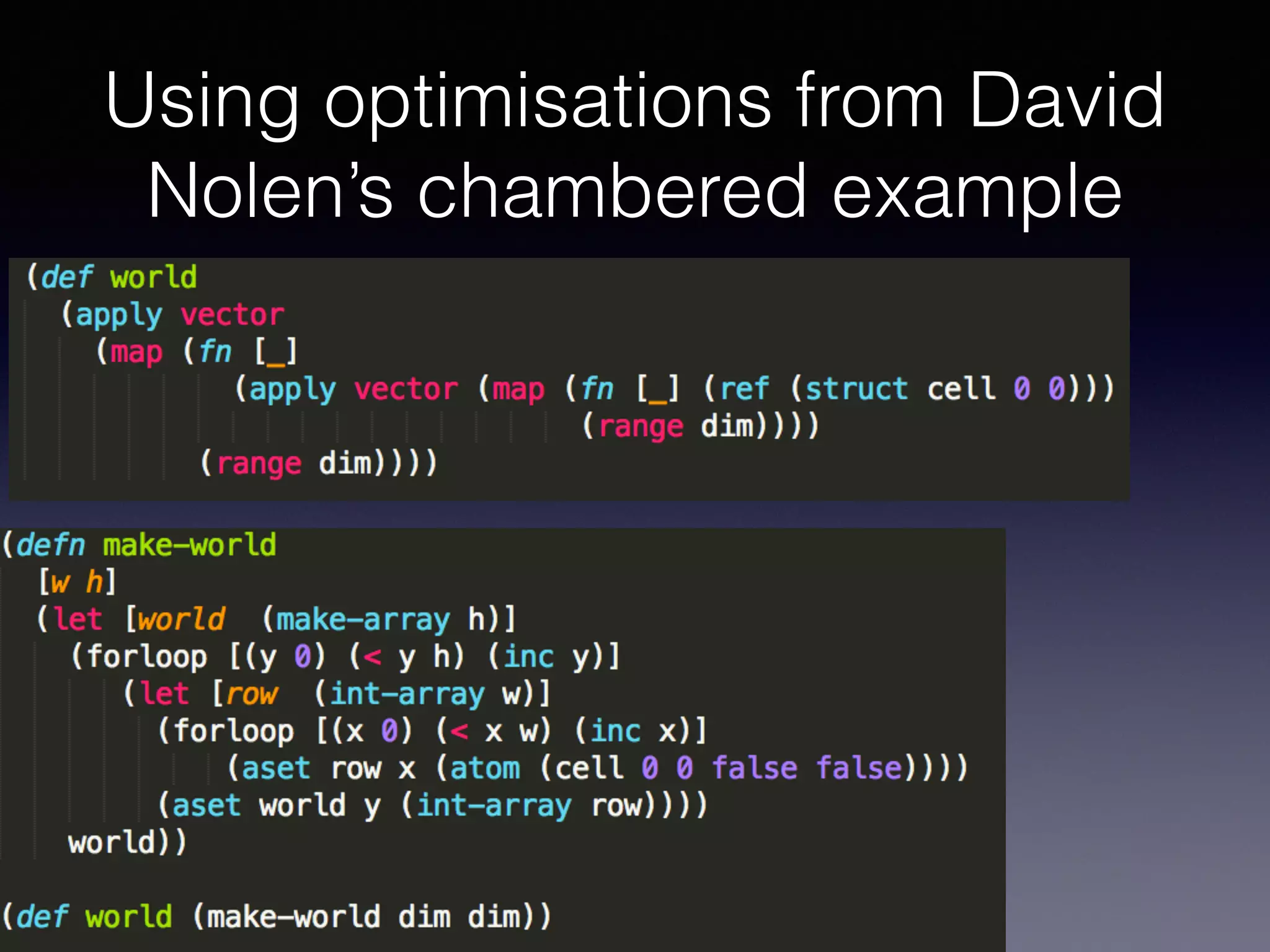
• Macros for creating arrays and for-loops 
• Underlying assumptions: 
• cljs data structures are not yet fully performant - 
so consider replacing with arrays for speed 
• The cljs compiler does not yet fully optimise 
higher order functions - the most efficient 
looping construct will be a for-loop macro that 
uses the loop function
Using optimisations from David 
Nolen’s chambered example
Using optimisations from David 
Nolen’s chambered example
[DEMO]
Back to The Italian Job 
• Who or what was the hero of the story?
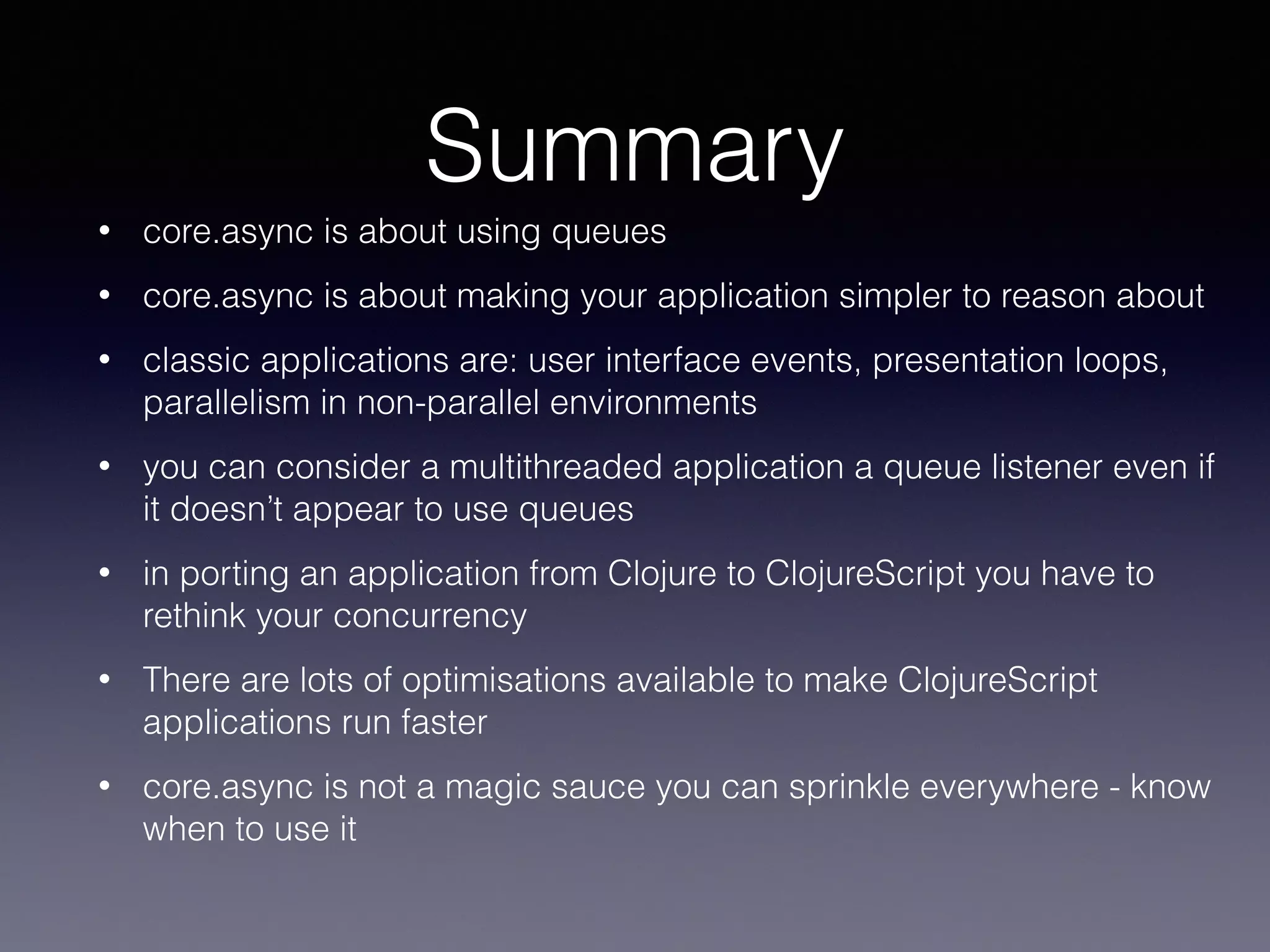
Summary 
• core.async is about using queues 
• core.async is about making your application simpler to reason about
Summary 
• core.async is about using queues 
• core.async is about making your application simpler to reason about 
• classic applications are: user interface events, presentation loops, 
parallelism in non-parallel environments 
• you can consider a multithreaded application a queue listener even if 
it doesn’t appear to use queues
Summary 
• core.async is about using queues 
• core.async is about making your application simpler to reason about 
• classic applications are: user interface events, presentation loops, 
parallelism in non-parallel environments 
• you can consider a multithreaded application a queue listener even if 
it doesn’t appear to use queues 
• in porting an application from Clojure to ClojureScript you have to 
rethink your concurrency 
• There are lots of optimisations available to make ClojureScript 
applications run faster 
• core.async is not a magic sauce you can sprinkle everywhere - know 
when to use it
Questions? 
Clojure 
Conj 
Nov 
2014 
Julian 
Gamble 
@juliansgamble 
github.com/juliangamble/clojure-­‐conj-­‐2014-­‐paradigms-­‐of-­‐core-­‐async

Clojure Conj 2014 - Paradigms of core.async - Julian Gamble

  • 1.
    Paradigms of core.async Clojure Conj Washington Nov 2014 Julian Gamble @juliansgamble
  • 2.
    Paradigms of core.async Clojure Conj Washington Nov 2014 Julian Gamble @juliansgamble
  • 3.
    Paradigms of core.async Clojure Conj Washington Nov 2014 Julian Gamble @juliansgamble
  • 4.
  • 5.
    Core.async is about: • queues in your application
  • 6.
    Core.async is about: • queues in your application • making your application simpler to reason about
  • 7.
    Benefits In thistalk you will gain an understanding of: • go blocks and how they do concurrency • core.async queues
  • 8.
    Benefits In thistalk you will gain an understanding of: • go blocks and how they do concurrency • core.async queues • go block timers • alts! macro and how it enables reading multiple queues
  • 9.
    Benefits In thistalk you will gain an understanding of: • go blocks and how they do concurrency • core.async queues • go block timers • alts! functions and how it enables reading multiple queues • how core.async processes work in ClojureScript • the visual impacts of how the core.async function enables simple ‘process-level’ pauses • how to use core.async to separate out the calculation and display parts of your code
  • 10.
    Benefits In thistalk you will gain an understanding of: • converting a Clojure code-base to ClojureScript • some tips for optimising ClojureScript
  • 11.
  • 12.
    What is core.async? • A set of primitives for creating, reading and writing to queues • A code walking macro that splices go blocks into state machines
  • 13.
    What is core.async? • A set of primitives for creating, reading and writing to queues • A code walking macro that splices go blocks into state machines • A mechanism for asynchronous computation • A library in both Clojure and ClojureScript
  • 14.
    What does core.asyncsay about Clojure? • core.async is implemented using a sophisticated Lisp macro - something only possible in a functional language • in non-functional languages like Go and C# - CSP is achieved by compiler-extensions - whereas in a functional language like Clojure - this functionality comes as a mere library
  • 15.
    What is CSP? • Communicating Sequential Processes • Comes out of process calculi – an attempt in the 1960’s and 1970’s to optimise computer usage through specialised algebra.
  • 16.
    What is CSP? • Communicating Sequential Processes • Comes out of process calculi – an attempt in the 1960’s and 1970’s to optimise computer usage through specialised algebra. • Based on message passing via channels • Subject of 1978 Book by C.A.R. Hoare
  • 18.
    basic example -­‐main function first go block second go >! my-­‐q block <!
  • 19.
  • 20.
  • 21.
  • 22.
  • 23.
  • 24.
  • 25.
  • 26.
    basic multi-channel example -­‐main function first go block third go block >! my-­‐q1 alts! second go block my-­‐q2 >!
  • 31.
  • 32.
  • 33.
    Tim Baldridge 10K processes make-­‐scene function make-­‐cell function 10K go block 1. Set colour 2. Paint canvas cell 3. Pause for random interval 4. Loop
  • 37.
  • 39.
    not 10K processes makeScene function 10K makeCell function mainLoop function 100
  • 41.
  • 44.
  • 45.
    swanodette 10K processes [go block] let block [idx v] [idx v] [go block] render-­‐loop ‘render’ ‘queue’ render! core.async channel parameter passed in during function call
  • 46.
    swanodette 10K processes [go block] let block [idx v] [idx v] [go block] render-­‐loop ‘render’ ‘queue’ render! core.async channel parameter passed in during function call No more than 1024 pending puts are allowed on a single channel.
  • 52.
  • 54.
    Events with core.async -­‐main function listen to DOM event and return channel [go block] print queue message put! out/clicks <!
  • 55.
  • 57.
    Parallelism is not Concurrency Imagine streams of execution in your program
  • 58.
    Parallelism is not Concurrency Imagine streams of execution in your program
  • 59.
    Parallelism is not Concurrency Imagine streams of execution in your program
  • 60.
    Parallelism 1. Forcore.async "use it where ever you'd use a queue" 2. In the Tim Baldridge 10K processes example above - it is not explicitly using a queue (<! (timeout (rand-int 1000)))))))
  • 61.
    Parallelism 1. Forcore.async "use it where ever you'd use a queue" 2. In the Tim Baldridge 10K processes example above - it is not explicitly using a queue (<! (timeout (rand-int 1000))))))) 3. But in the same example - it is implicitly using the queue of the core.async process scheduler - so you're still using a queue. 4. Go blocks are the lightweight equivalent of 'heavyweight' threads
  • 62.
    Parallelism 1. Forcore.async "use it where ever you'd use a queue" 2. In the Tim Baldridge 10K processes example above - it is not explicitly using a queue (<! (timeout (rand-int 1000))))))) 3. But in the same example - it is implicitly using the queue of the core.async process scheduler - so you're still using a queue. 4. Go blocks are the lightweight equivalent of 'heavyweight' threads 5. Heavyweight threads implicitly listen to the queue of the OS 'ready queue' 6. You're already implicitly using queues whenever you use threads.
  • 63.
    Quick recap •core.async is all about queues
  • 64.
    Quick recap •core.async is all about queues • queues can used in your application for: • parallelism • separating the calculation from the display logic • event handling
  • 65.
  • 66.
  • 67.
    Rich Hickey originalants demo -­‐main function send-­‐off send-­‐off send-­‐off animation agent ant behaviour agent evaporation agent world symbol (vector of vectors)
  • 72.
    Converting to ClojureScript Missing functions in ClojureScript:
  • 73.
    Converting to ClojureScript Missing functions in ClojureScript: • defstruct - replace with a map • alter - replace with swap!
  • 74.
    Converting to ClojureScript Missing functions in ClojureScript: • defstruct - replace with a map • alter - replace with swap! • sync • dosync • agent
  • 75.
    ants cljs noasync animate function requestAnimationFrame single call single call single send-­‐off-­‐ animation function behave-­‐ants function (callback) evaporate function world symbol (vector of vectors) call
  • 77.
  • 79.
  • 80.
    Adding core.async •You can use a go block with a timeout queue in the same way you’d use a thread with a sleep function
  • 81.
  • 82.
  • 83.
  • 84.
    Using optimisations fromDavid Nolen’s chambered example • Macros for creating arrays and for-loops • Underlying assumptions: • cljs data structures are not yet fully performant - so consider replacing with arrays for speed • The cljs compiler does not yet fully optimise higher order functions - the most efficient looping construct will be a for-loop macro that uses the loop function
  • 85.
    Using optimisations fromDavid Nolen’s chambered example
  • 86.
    Using optimisations fromDavid Nolen’s chambered example
  • 87.
  • 89.
    Back to TheItalian Job • Who or what was the hero of the story?
  • 90.
    Summary • core.asyncis about using queues • core.async is about making your application simpler to reason about
  • 91.
    Summary • core.asyncis about using queues • core.async is about making your application simpler to reason about • classic applications are: user interface events, presentation loops, parallelism in non-parallel environments • you can consider a multithreaded application a queue listener even if it doesn’t appear to use queues
  • 92.
    Summary • core.asyncis about using queues • core.async is about making your application simpler to reason about • classic applications are: user interface events, presentation loops, parallelism in non-parallel environments • you can consider a multithreaded application a queue listener even if it doesn’t appear to use queues • in porting an application from Clojure to ClojureScript you have to rethink your concurrency • There are lots of optimisations available to make ClojureScript applications run faster • core.async is not a magic sauce you can sprinkle everywhere - know when to use it
  • 93.
    Questions? Clojure Conj Nov 2014 Julian Gamble @juliansgamble github.com/juliangamble/clojure-­‐conj-­‐2014-­‐paradigms-­‐of-­‐core-­‐async