Ruby is dying
What languages are cool now?
Michał Konarski
u2i.com
Seriously, is Ruby dying?
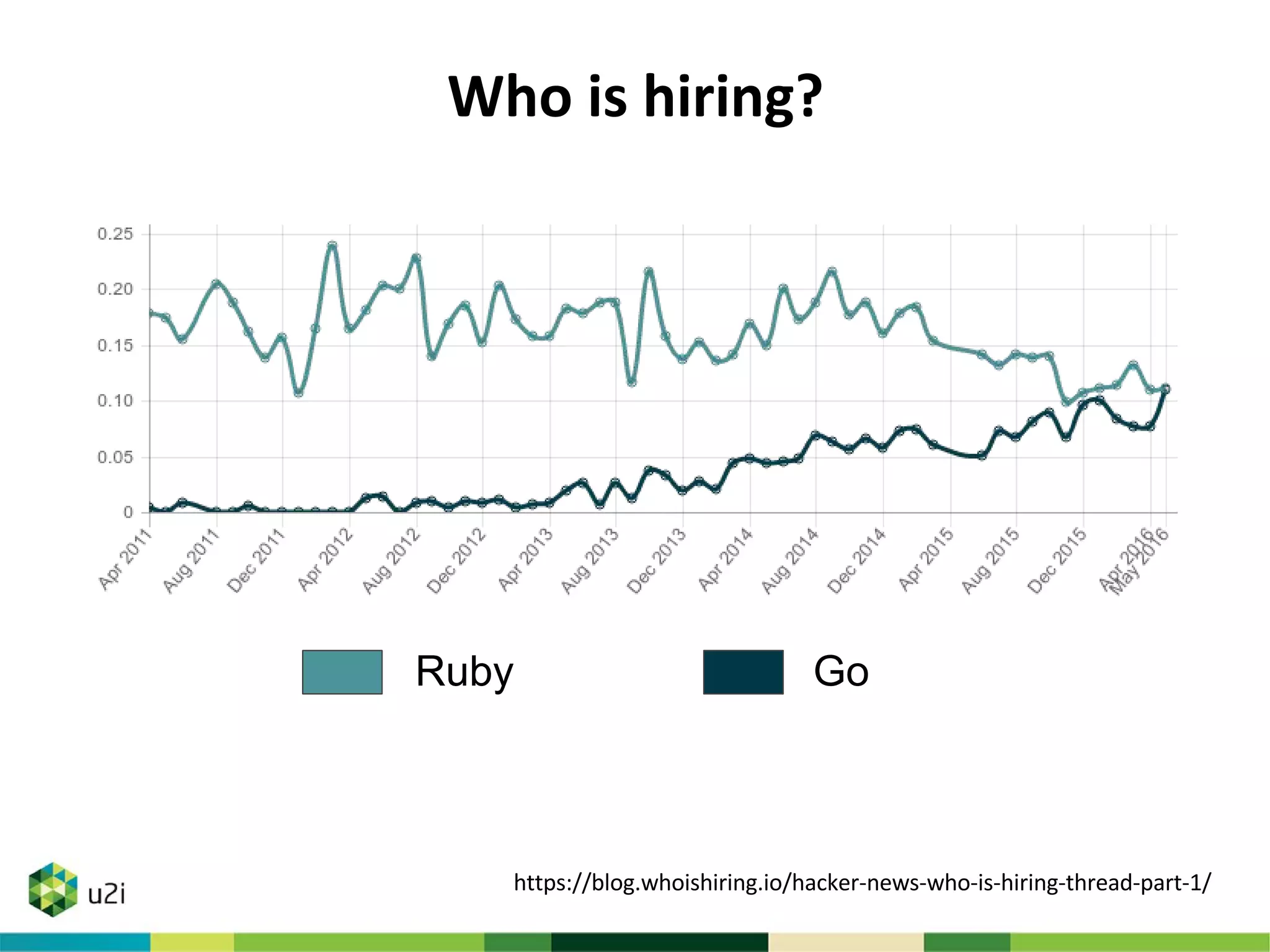
Ruby Go
https://blog.whoishiring.io/hacker-news-who-is-hiring-thread-part-1/
Who is hiring?
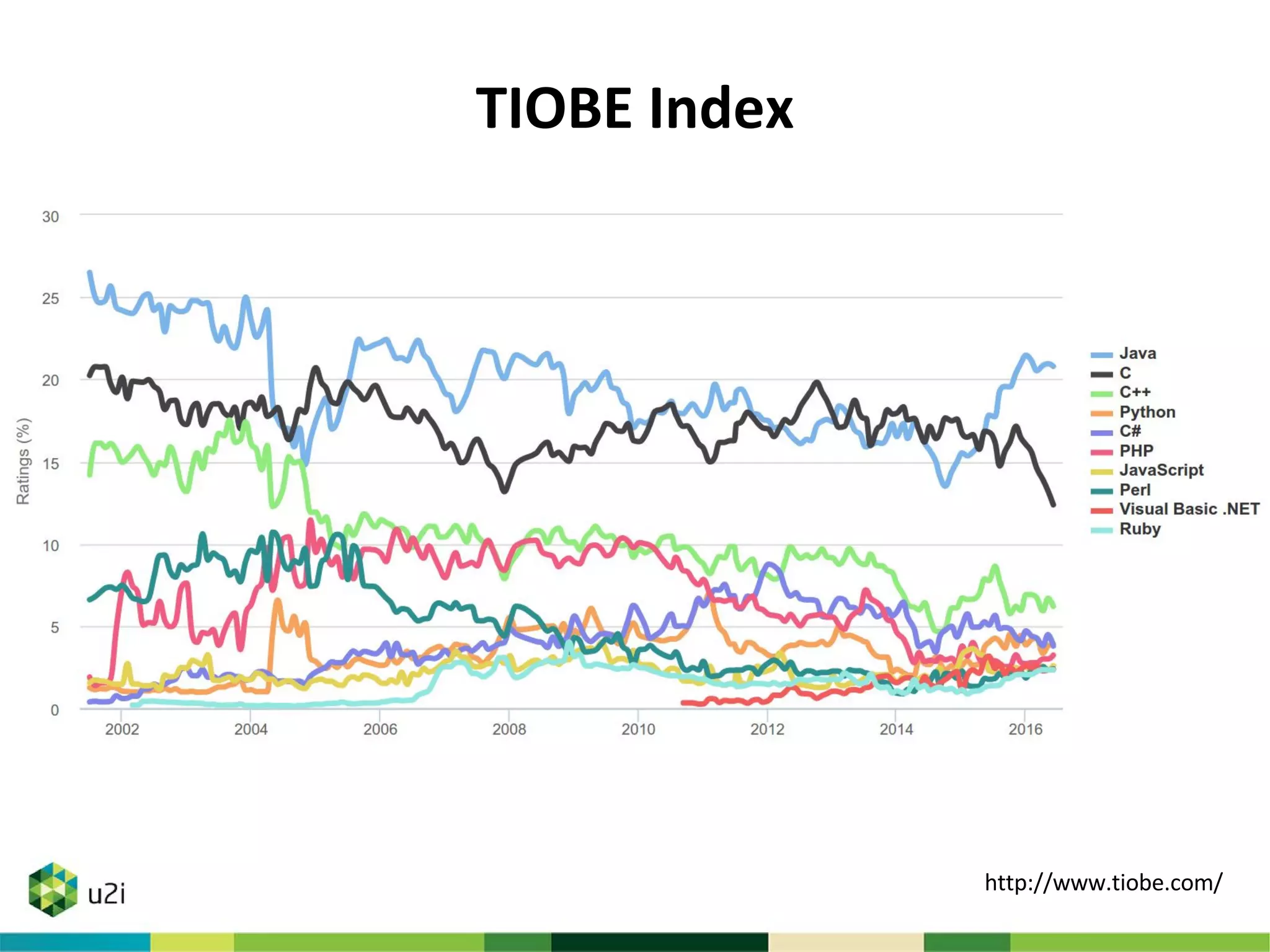
But let’s look from a different angle...
http://www.tiobe.com/
TIOBE Index
Well, not exactly.
But what languages are cool now?
Let’s look at six of them
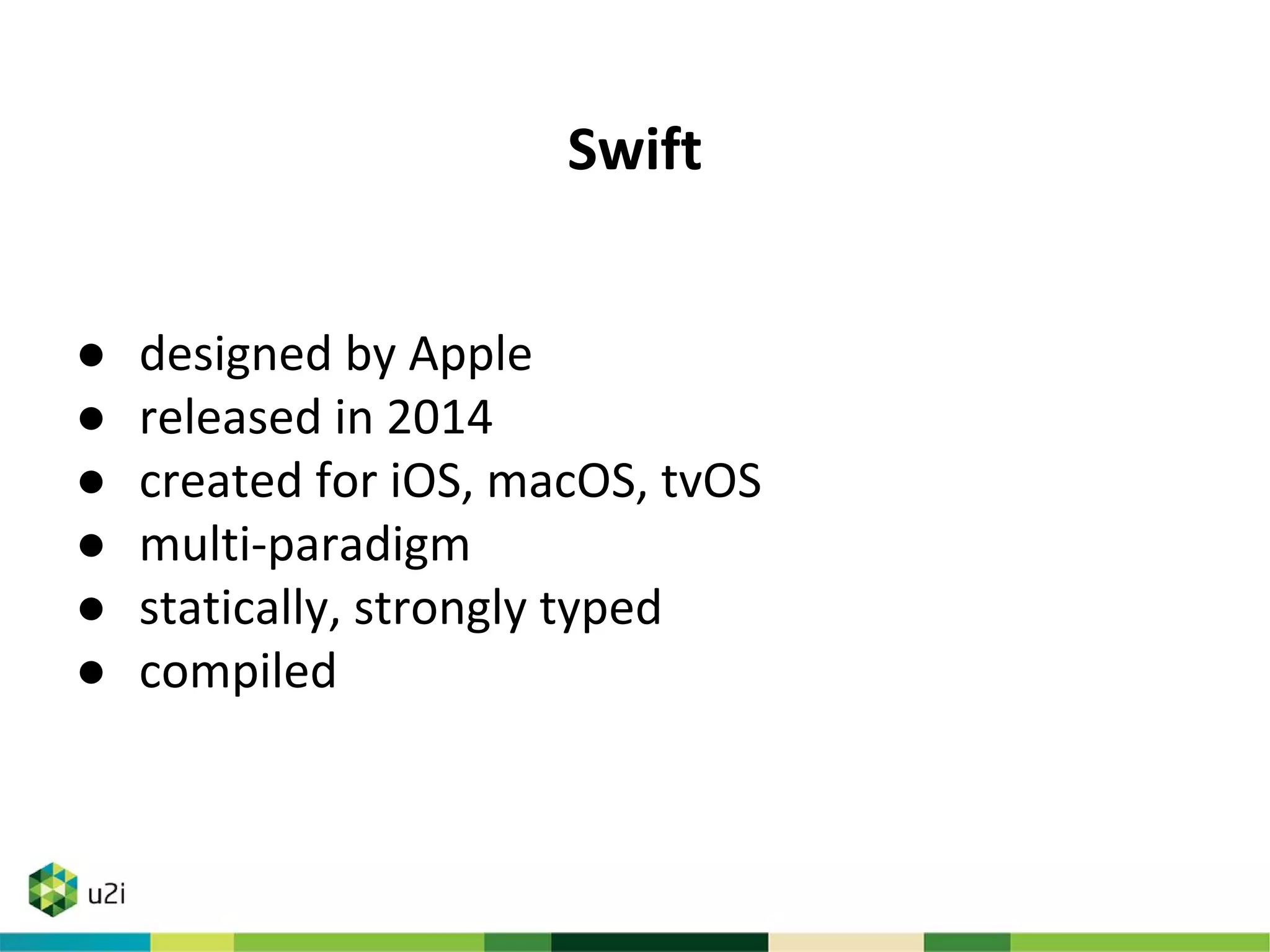
Swift
Swift
● designed by Apple
● released in 2014
● created for iOS, macOS, tvOS
● multi-paradigm
● statically, strongly typed
● compiled
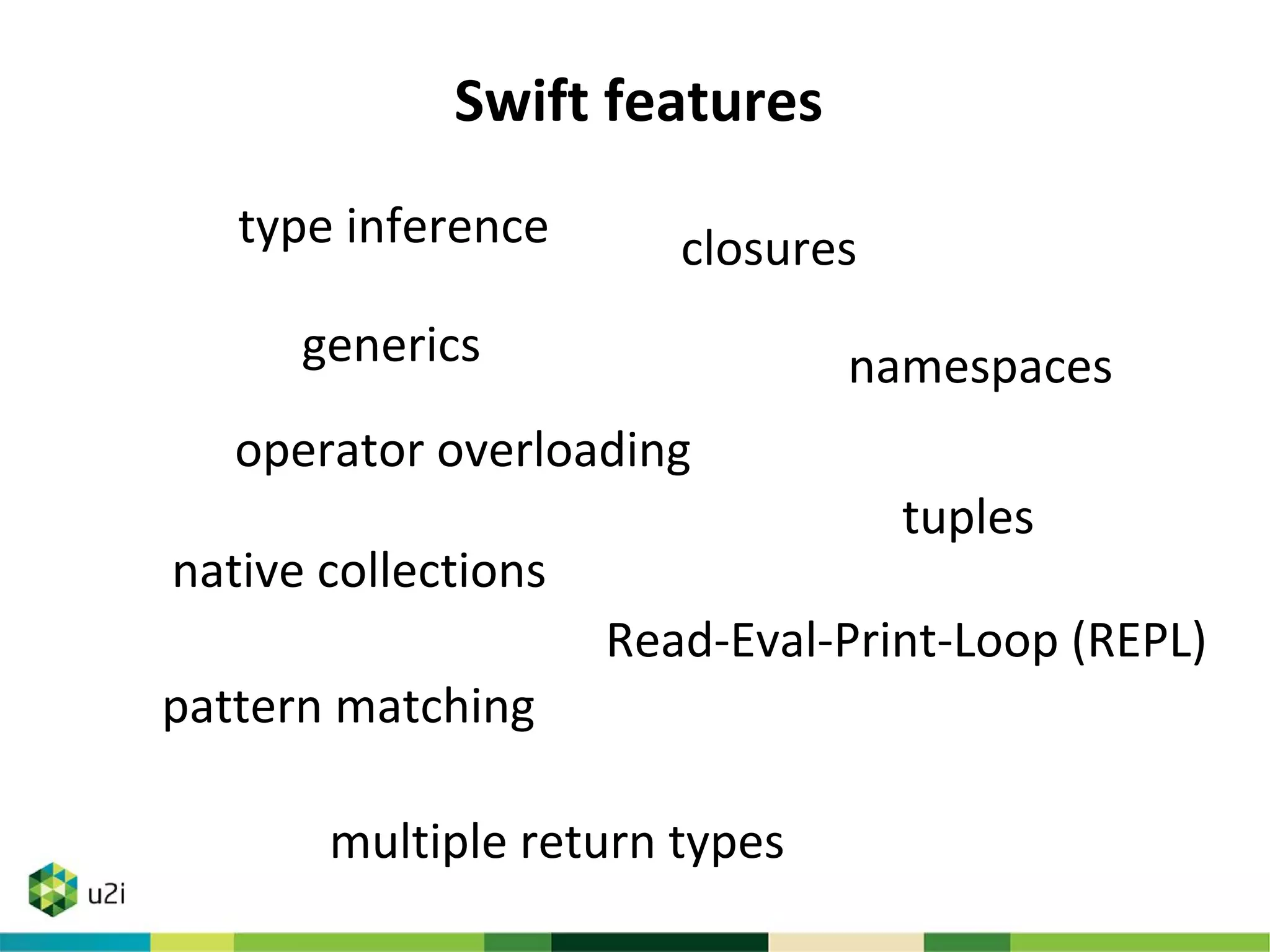
namespacesgenerics
closures
tuples
operator overloading
native collections
type inference
pattern matching
multiple return types
Read-Eval-Print-Loop (REPL)
Swift features
Nothing really outstanding.
So, what’s the story behind Swift?
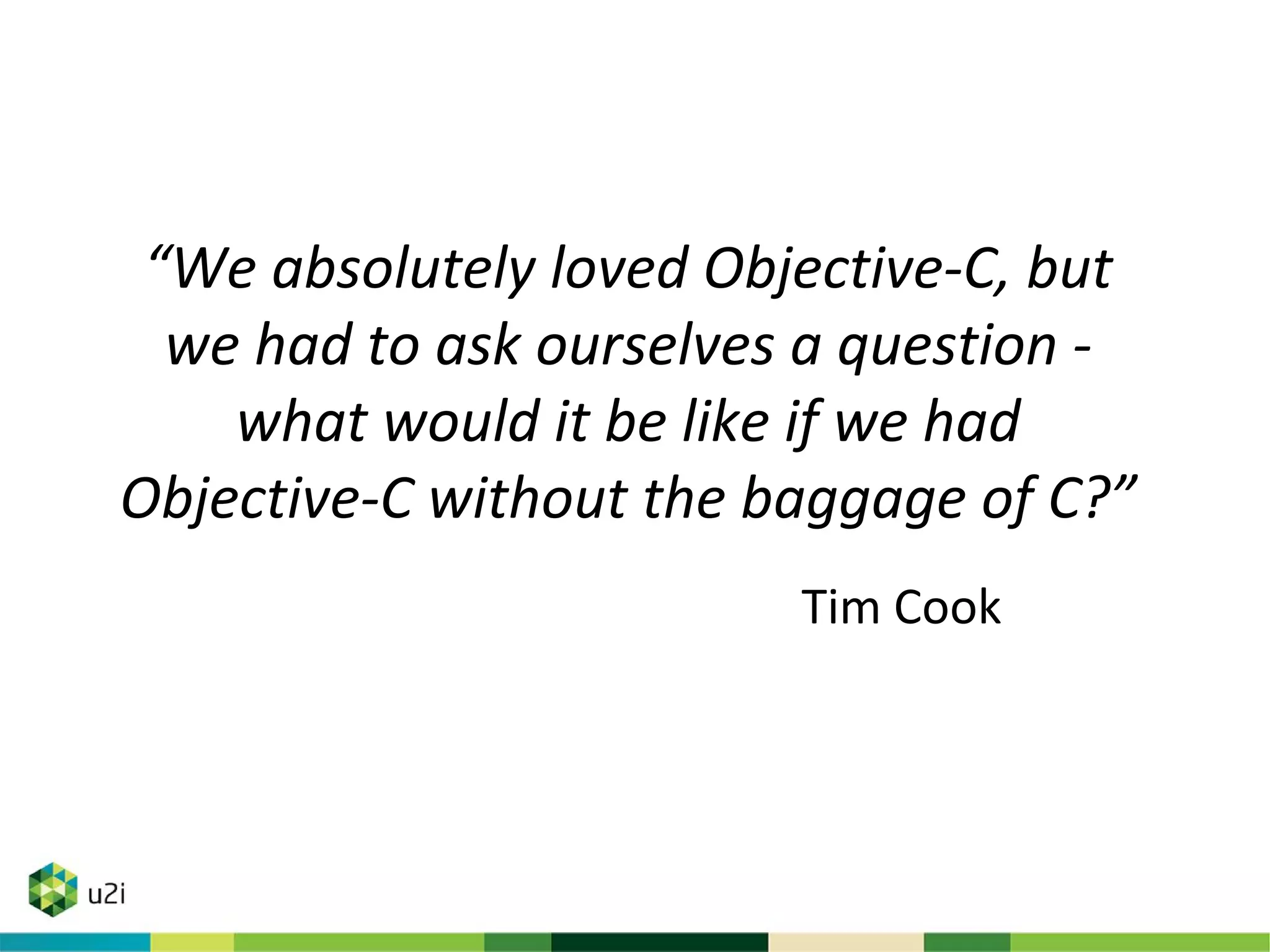
“We absolutely loved Objective-C, but
we had to ask ourselves a question -
what would it be like if we had
Objective-C without the baggage of C?”
Tim Cook
It’s mainly because Objective-C is bad.
And they had nothing else.
@interface Foo : NSObject
@property (readonly) int bar;
- (instancetype)initWithBar:(int)bar;
+ (instancetype)fooWithBar:(int)bar;
@end
@implementation Foo
- (instancetype)initWithBar:(int)bar {
self = [super init];
if (self) {
_bar = bar;
}
return self;
}
+ (instancetype)fooWithBar:(int)bar {
return [[self alloc] initWithBar:bar];
}
@end
How bad is Objective-C?
http://www.antonzherdev.com/post/70064588471/top-13-worst-things-about-objective-c
Swift is easier to read
Objective-C
if (myDelegate != nil) {
if ([myDelegate respondsToSelector:
@selector(scrollViewDidScroll:)]) {
[myDelegate scrollViewDidScroll:myScrollView]
}
}
Swift
myDelegate?.scrollViewDidScroll?(myScrollView)
Why also Swift is better?
● no need to have two separate files (code and headers)
● it’s safer (runtime crash on null pointer)
● it has automatic ARC (Automatic Reference Counting)
● it’s faster
● it requires less code
● it has namespaces
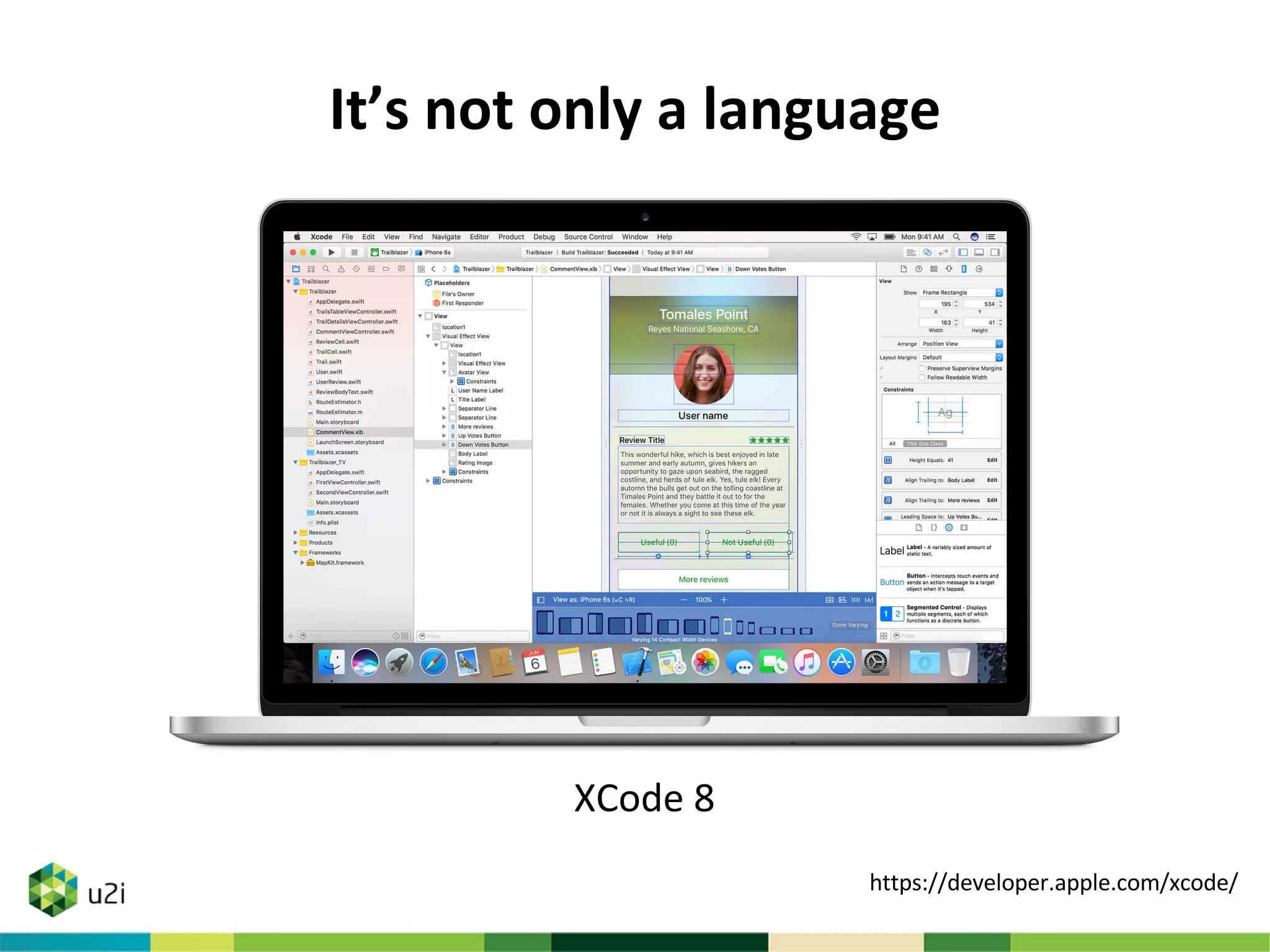
It’s not only a language
XCode 8
https://developer.apple.com/xcode/
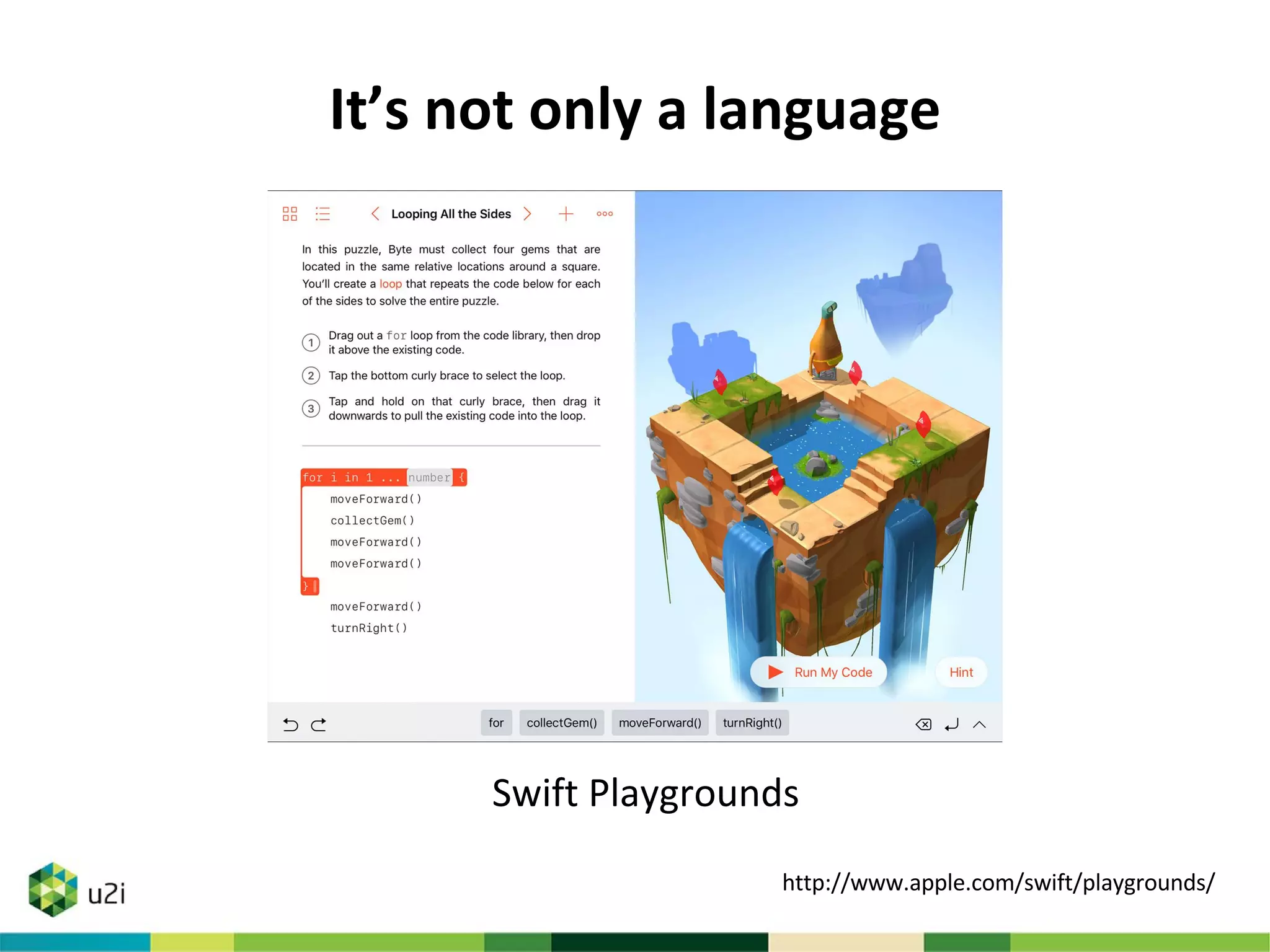
It’s not only a language
Swift Playgrounds
http://www.apple.com/swift/playgrounds/
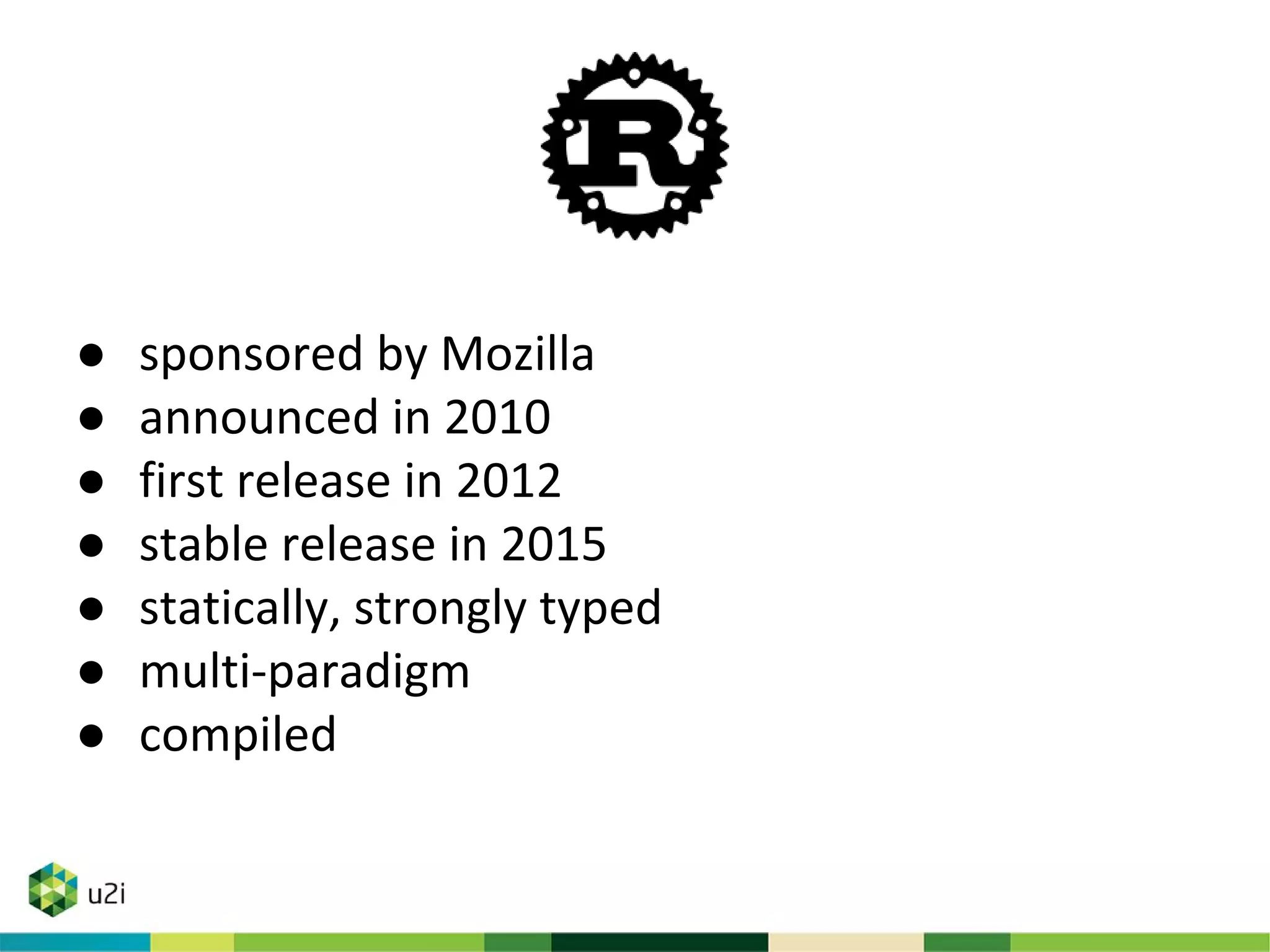
● sponsored by Mozilla
● announced in 2010
● first release in 2012
● stable release in 2015
● statically, strongly typed
● multi-paradigm
● compiled
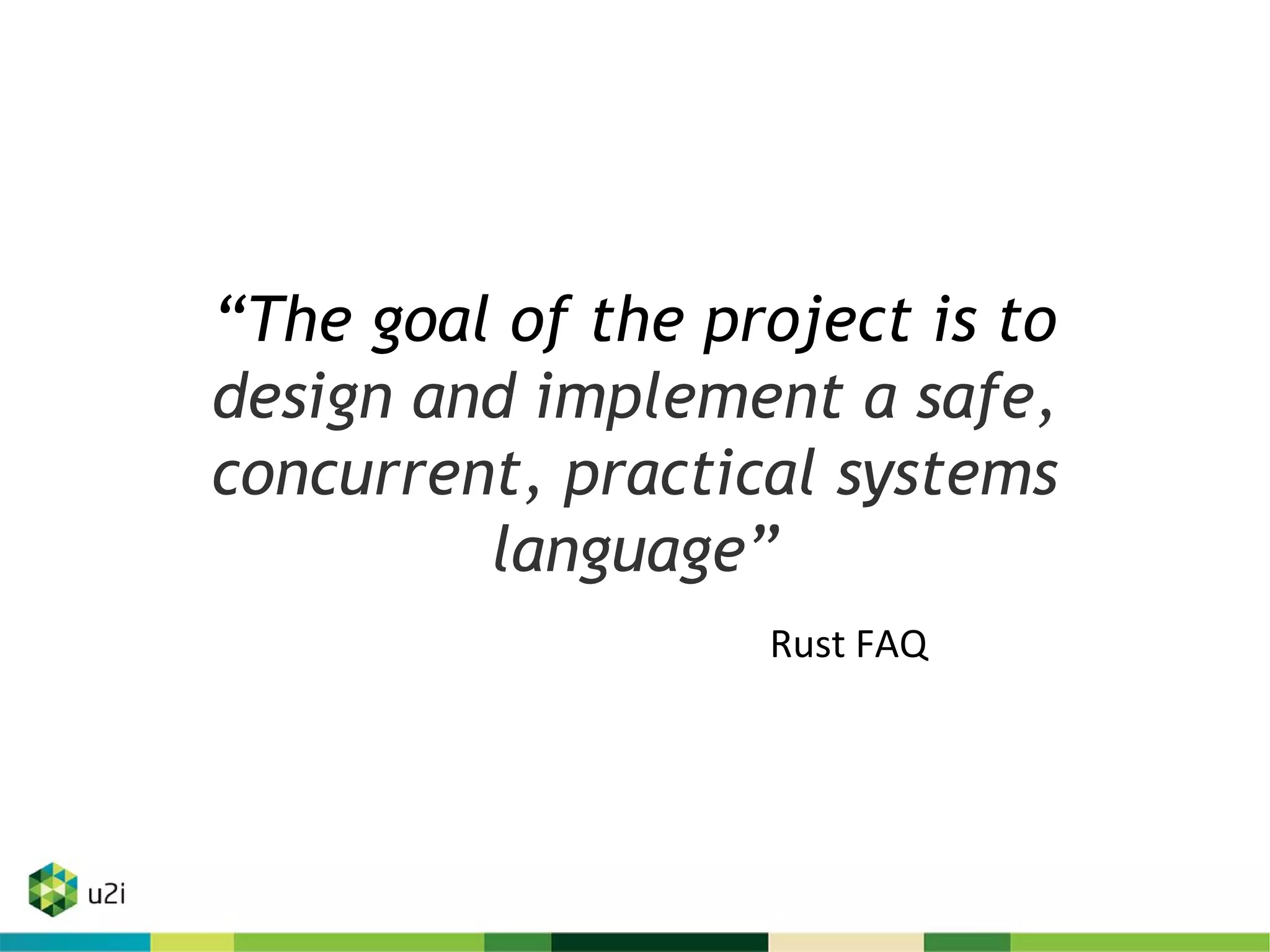
“The goal of the project is to
design and implement a safe,
concurrent, practical systems
language”
Rust FAQ
There are not such languages?
Apparently not.
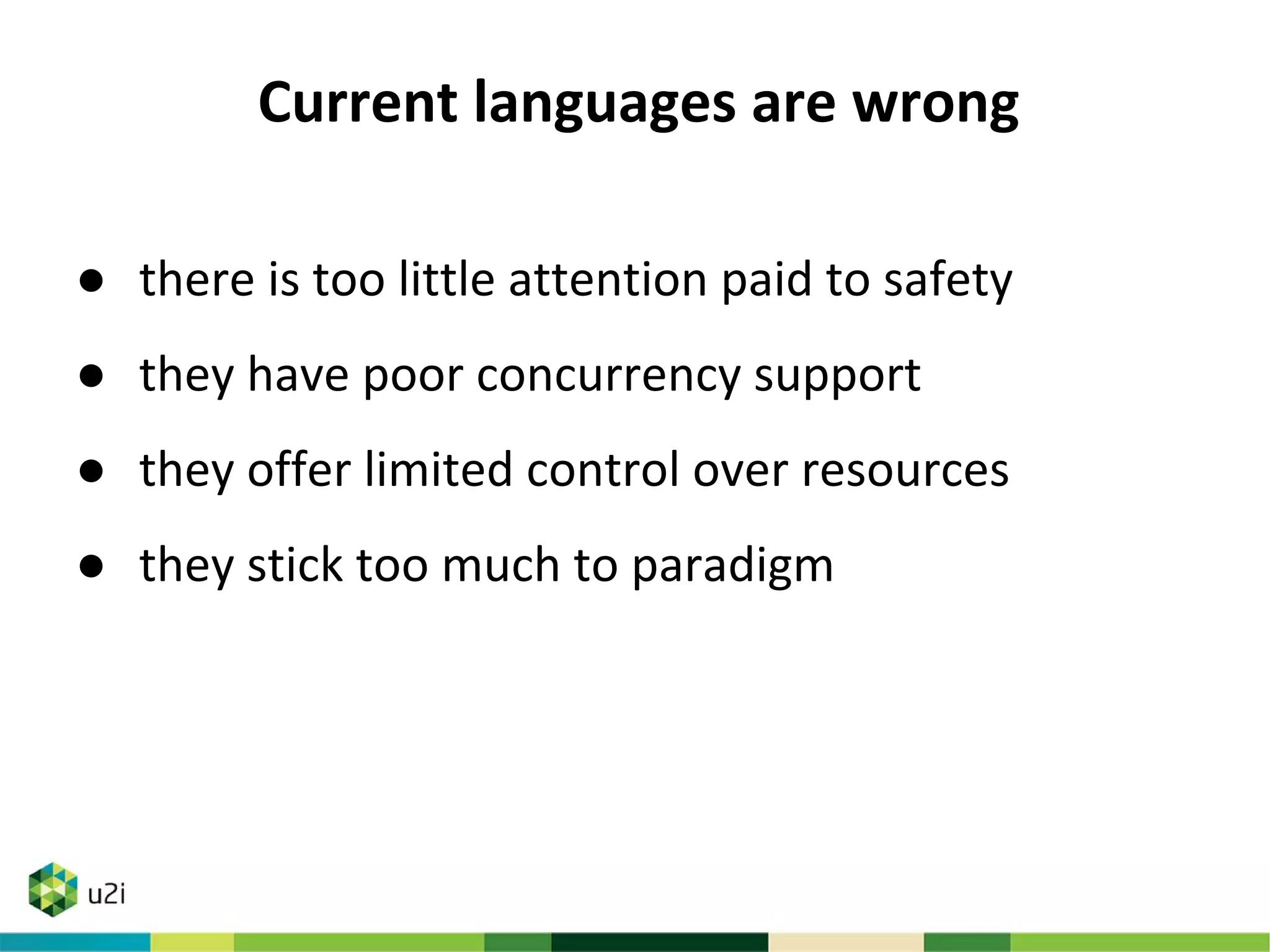
Current languages are wrong
● there is too little attention paid to safety
● they have poor concurrency support
● they offer limited control over resources
● they stick too much to paradigm
So let’s create a new high-low level
language!
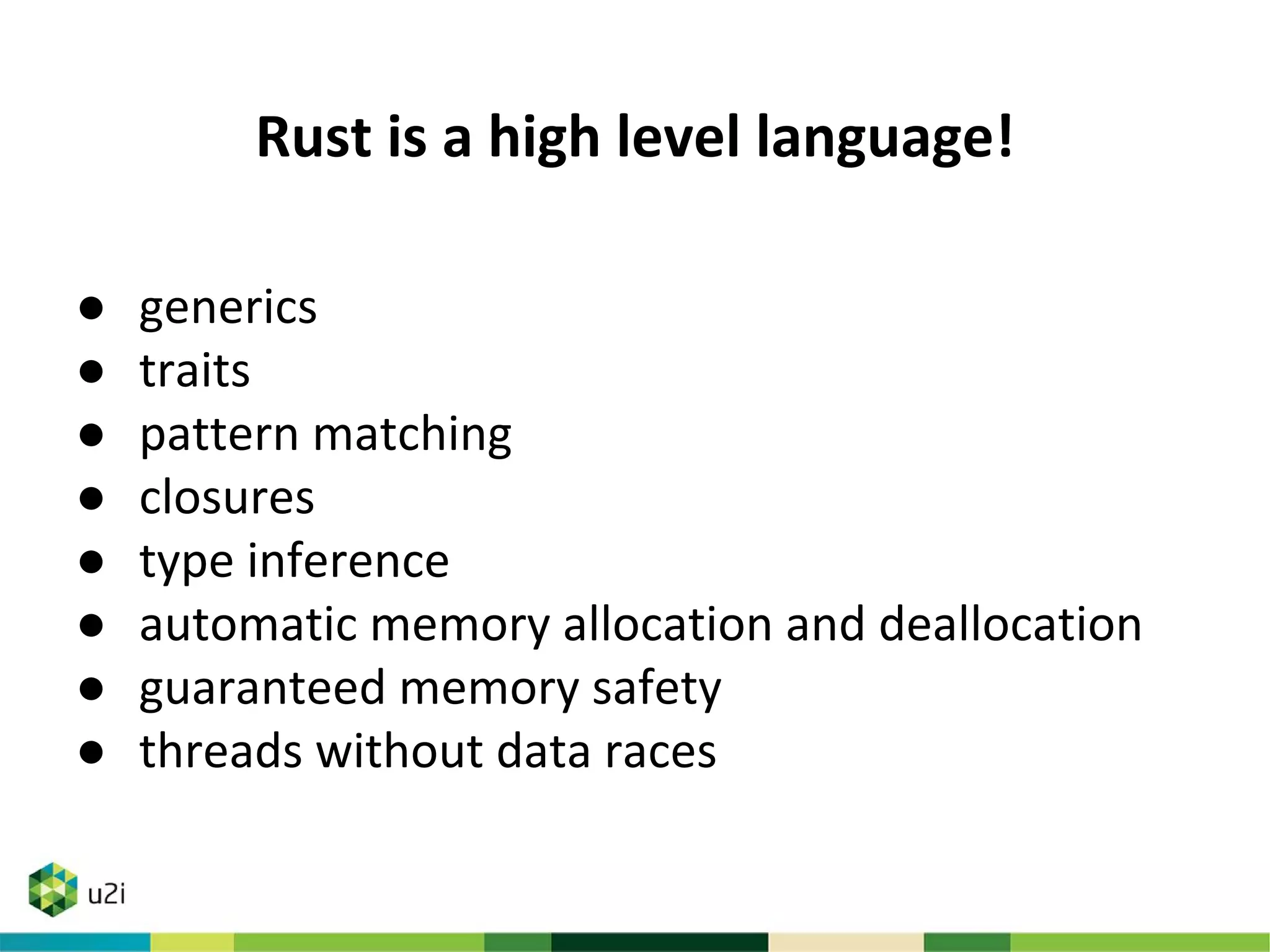
Rust is a high level language!
● generics
● traits
● pattern matching
● closures
● type inference
● automatic memory allocation and deallocation
● guaranteed memory safety
● threads without data races
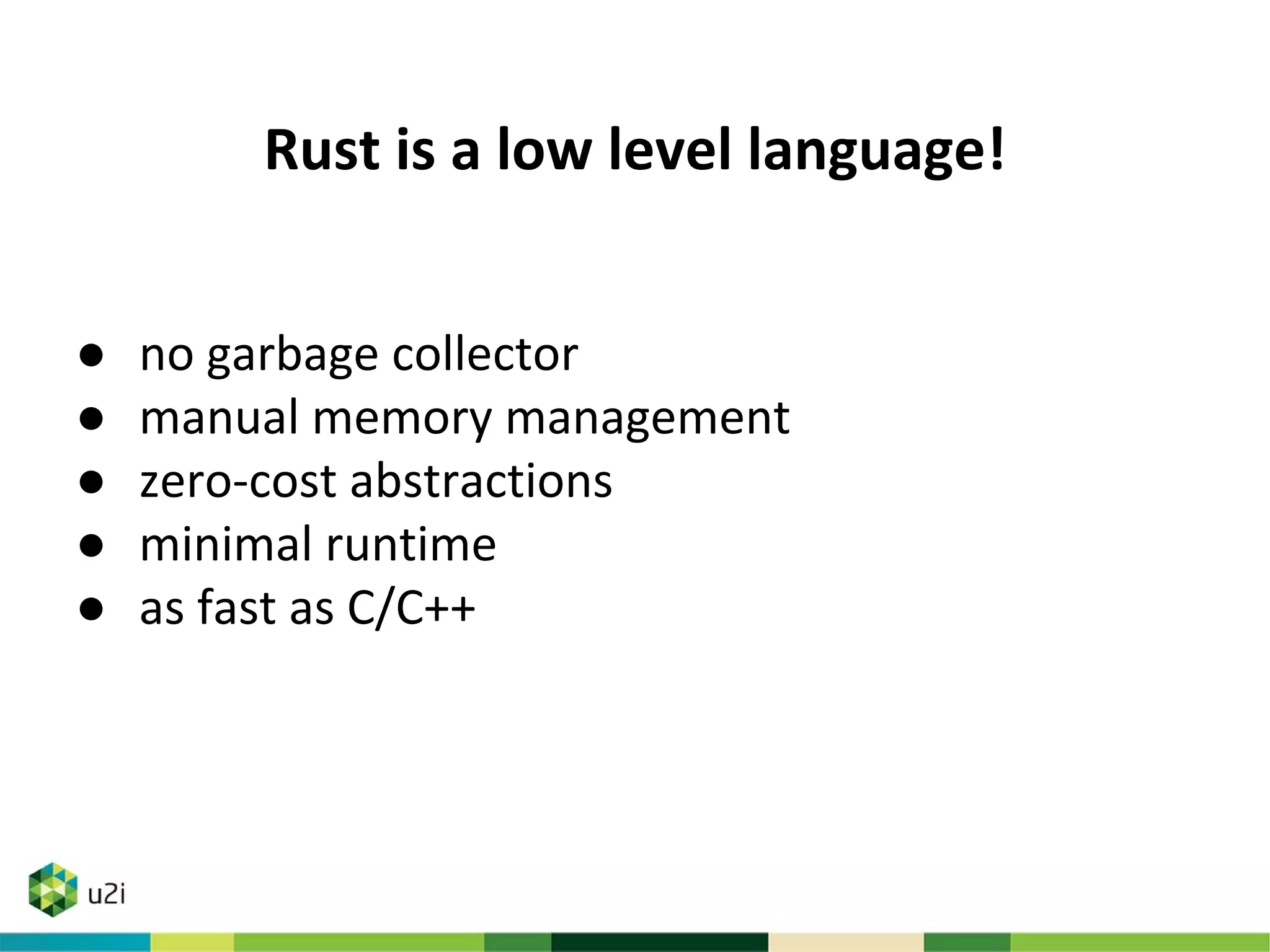
Rust is a low level language!
● no garbage collector
● manual memory management
● zero-cost abstractions
● minimal runtime
● as fast as C/C++
Guaranteed memory safety? How?
Ownership
fn foo() {
let v1 = vec![1, 2, 3];
let v2 = v1;
println!("v1[0] is: {}", v1[0]);
}
error: use of moved value: `v
You can’t have two references to the
same object!
Ownership
stack heap
[1, 2, 3]
v1
v2
There are more such mechanisms.
Future of Rust
● currently two big projects: servo and rust
● other smaller projects: redox, cgmath, Iron, rust-doom
● it changes very quickly
● it has a good opinion in the community
● it will be hard to replace C/C++
● It has a steep learning curve
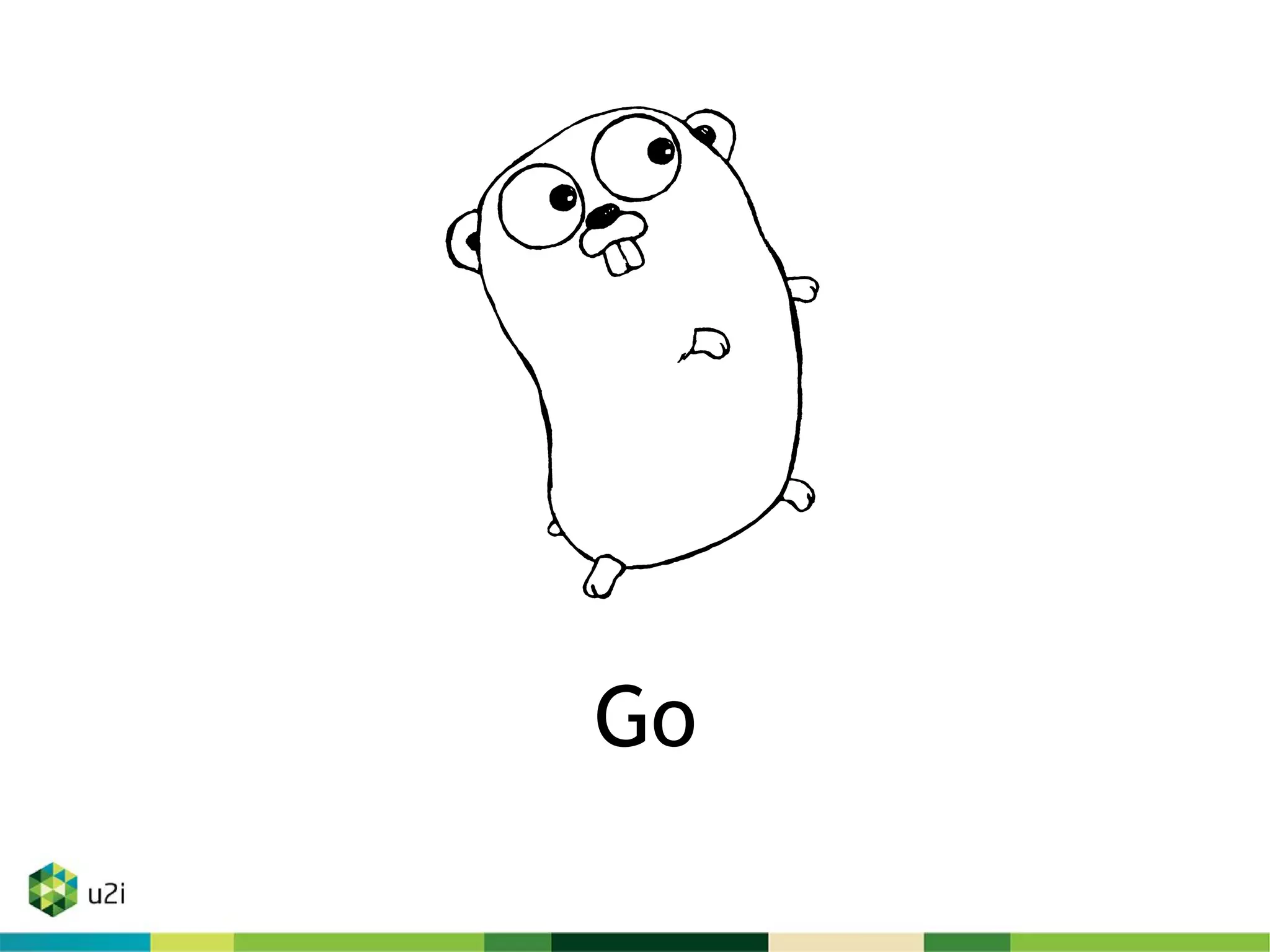
Go
Go
● designed in Google in 2007
● first release in 2009
● stable release in 2016
● statically, strongly typed
● multi-paradigm, concurrent
● compiled
Standard languages (Java, C++)
● are very strong: type-safe, effective, efficient
● great in hands of experts
● used to build huge systems and companies
Standard languages (Java, C++)
● hard to use
● compilers are slow
● binaries are huge
● desperately need language-aware tools
● poorly adapt to clouds, multicore CPUs
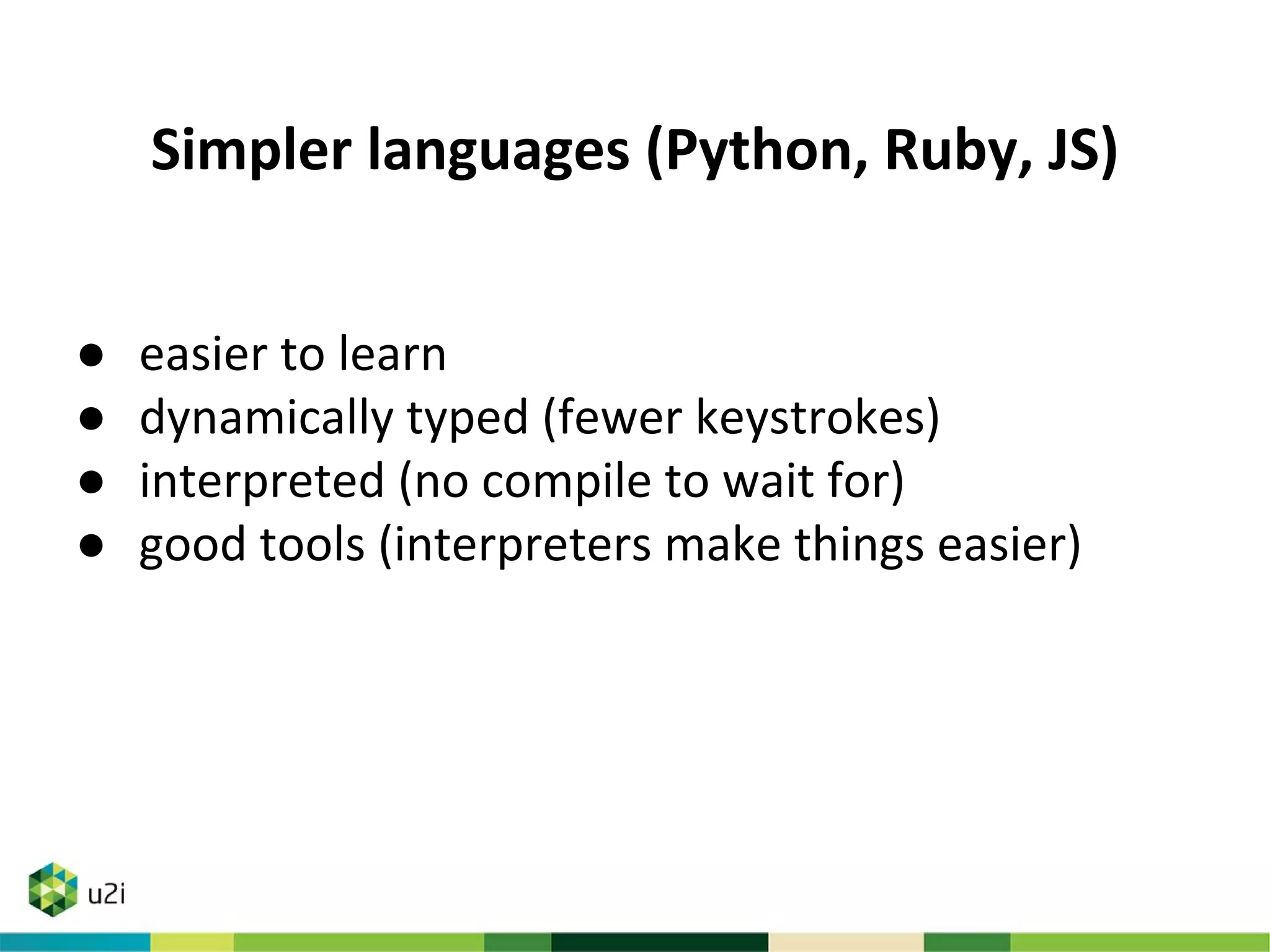
Simpler languages (Python, Ruby, JS)
● easier to learn
● dynamically typed (fewer keystrokes)
● interpreted (no compiler to wait for)
● good tools (interpreters make things easier)
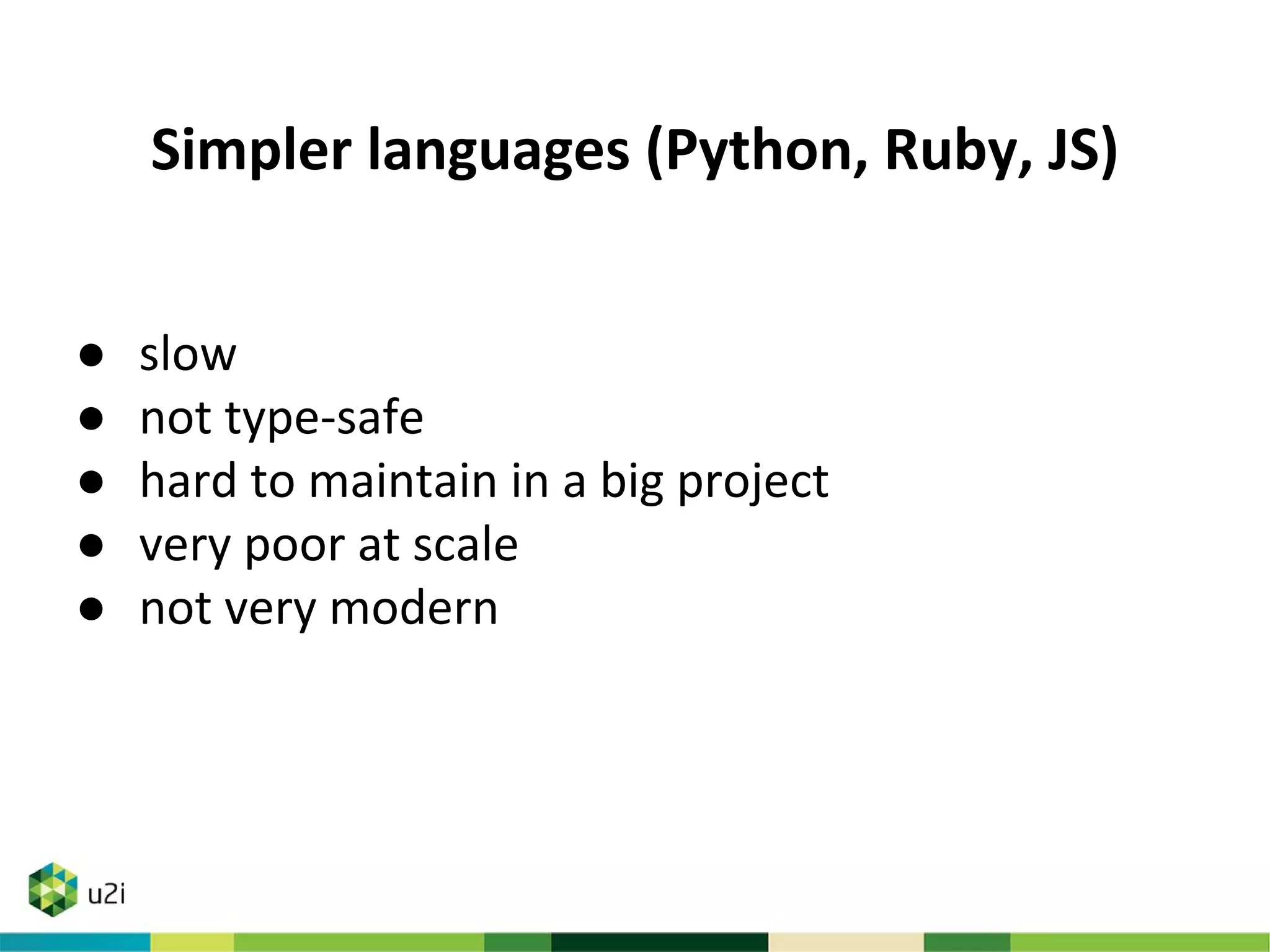
Simpler languages (Python, Ruby, JS)
● slow
● not type-safe
● hard to maintain in a big project
● very poor at scale
● not very modern
What if we had a static language with
dynamic-like syntax?
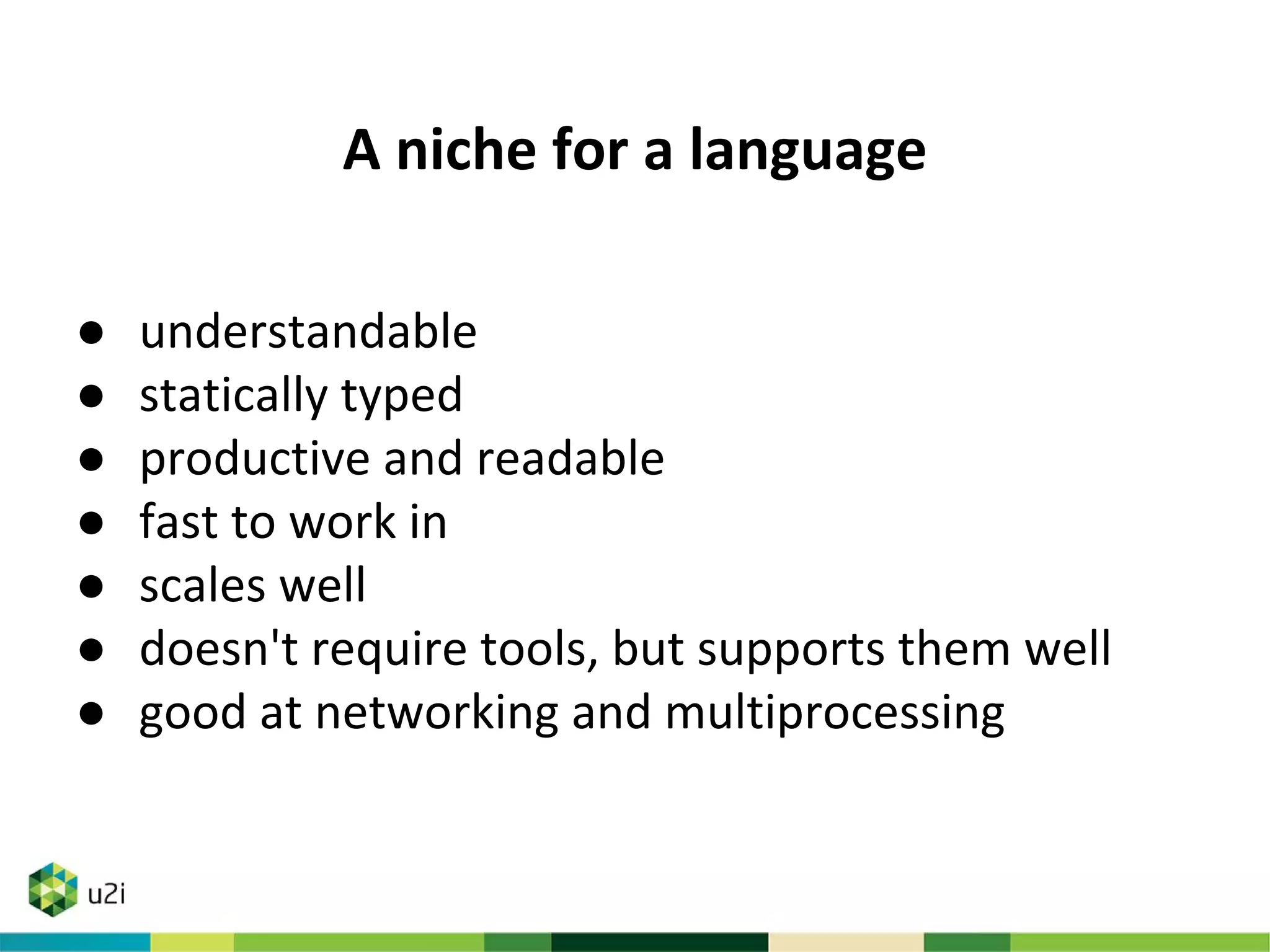
A niche for a language
● understandable
● statically typed
● productive and readable
● fast to work in
● scales well
● doesn't require tools, but supports them well
● good at networking and multiprocessing
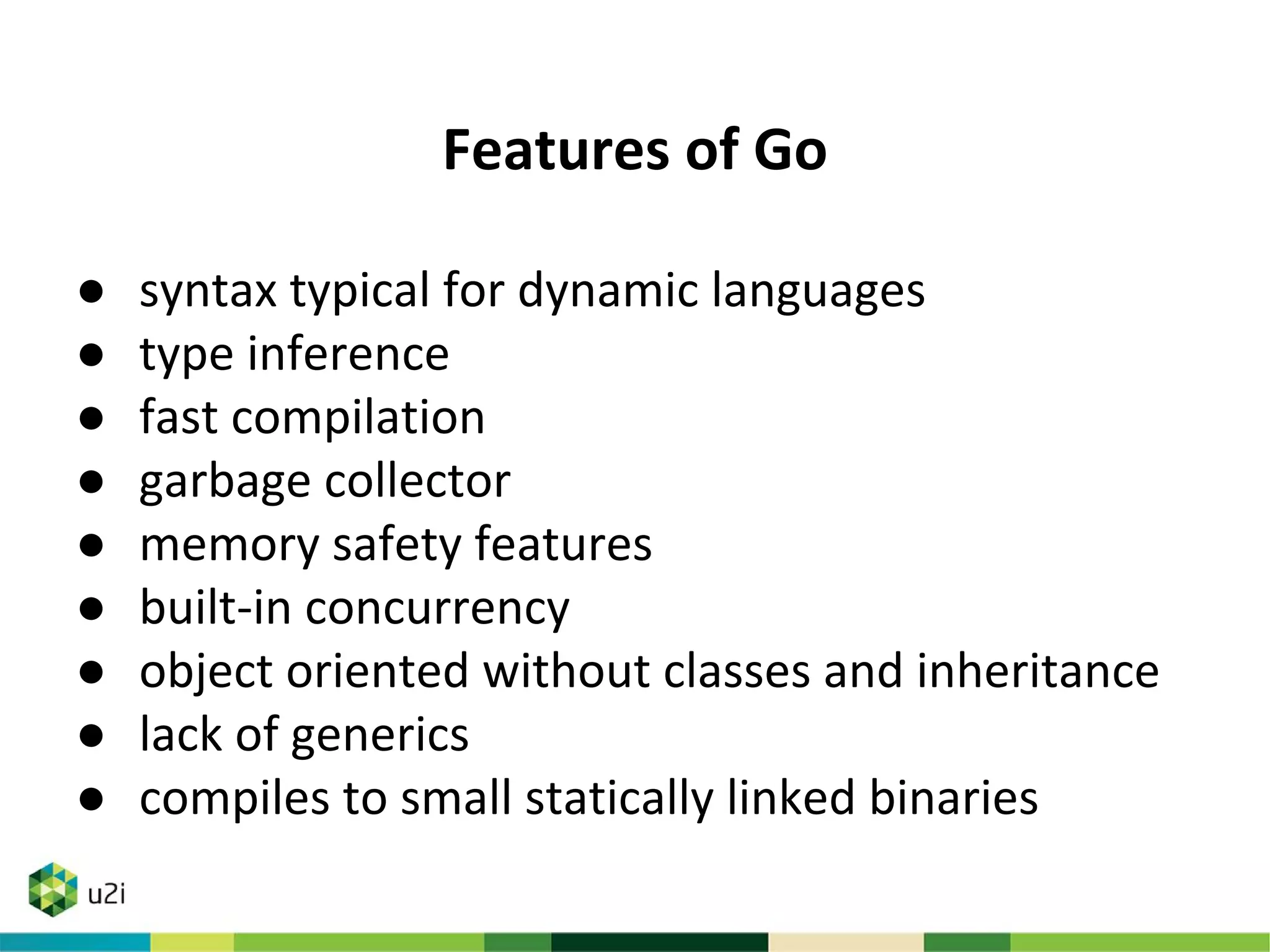
Features of Go
● syntax typical for dynamic languages
● type inference
● fast compilation
● garbage collector
● memory safety features
● built-in concurrency
● object oriented without classes and inheritance
● lack of generics
● compiles to small statically linked binaries
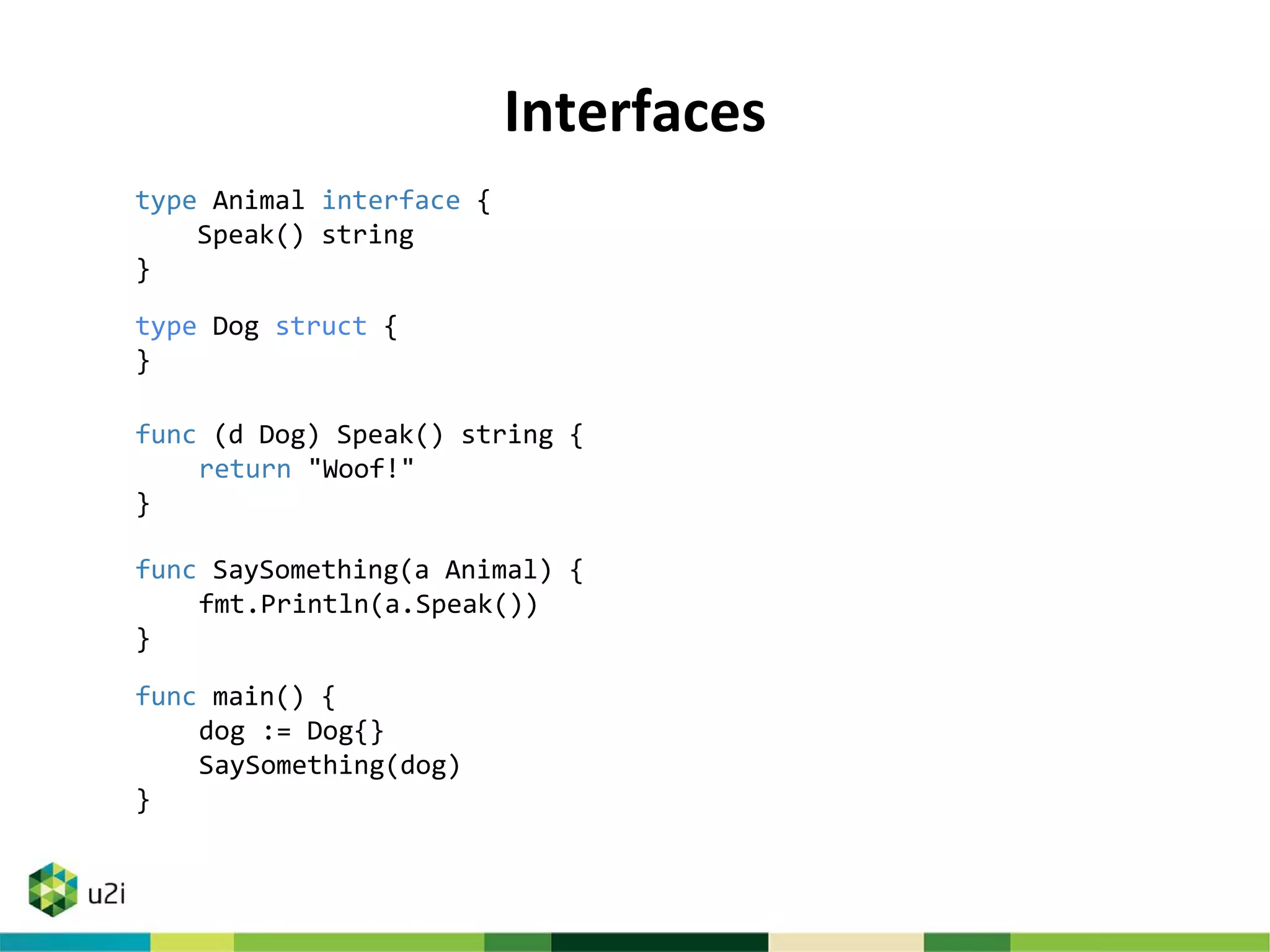
Interfaces
type Animal interface {
Speak() string
}
type Dog struct {
}
func (d Dog) Speak() string {
return "Woof!"
}
func SaySomething(a Animal) {
fmt.Println(a.Speak())
}
func main() {
dog := Dog{}
SaySomething(dog)
}
Built-in concurrency!
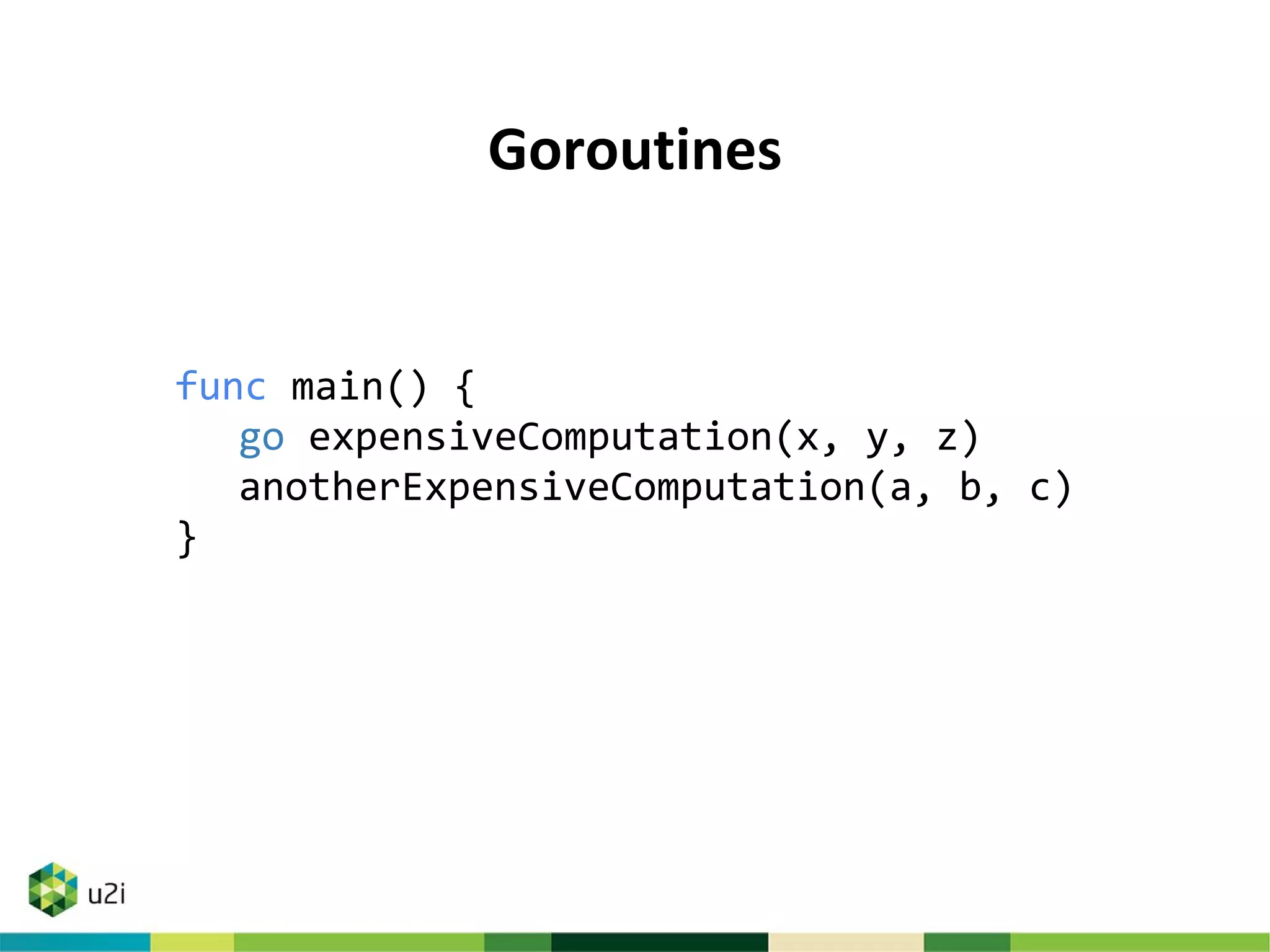
Goroutines
func main() {
go expensiveComputation(x, y, z)
anotherExpensiveComputation(a, b, c)
}
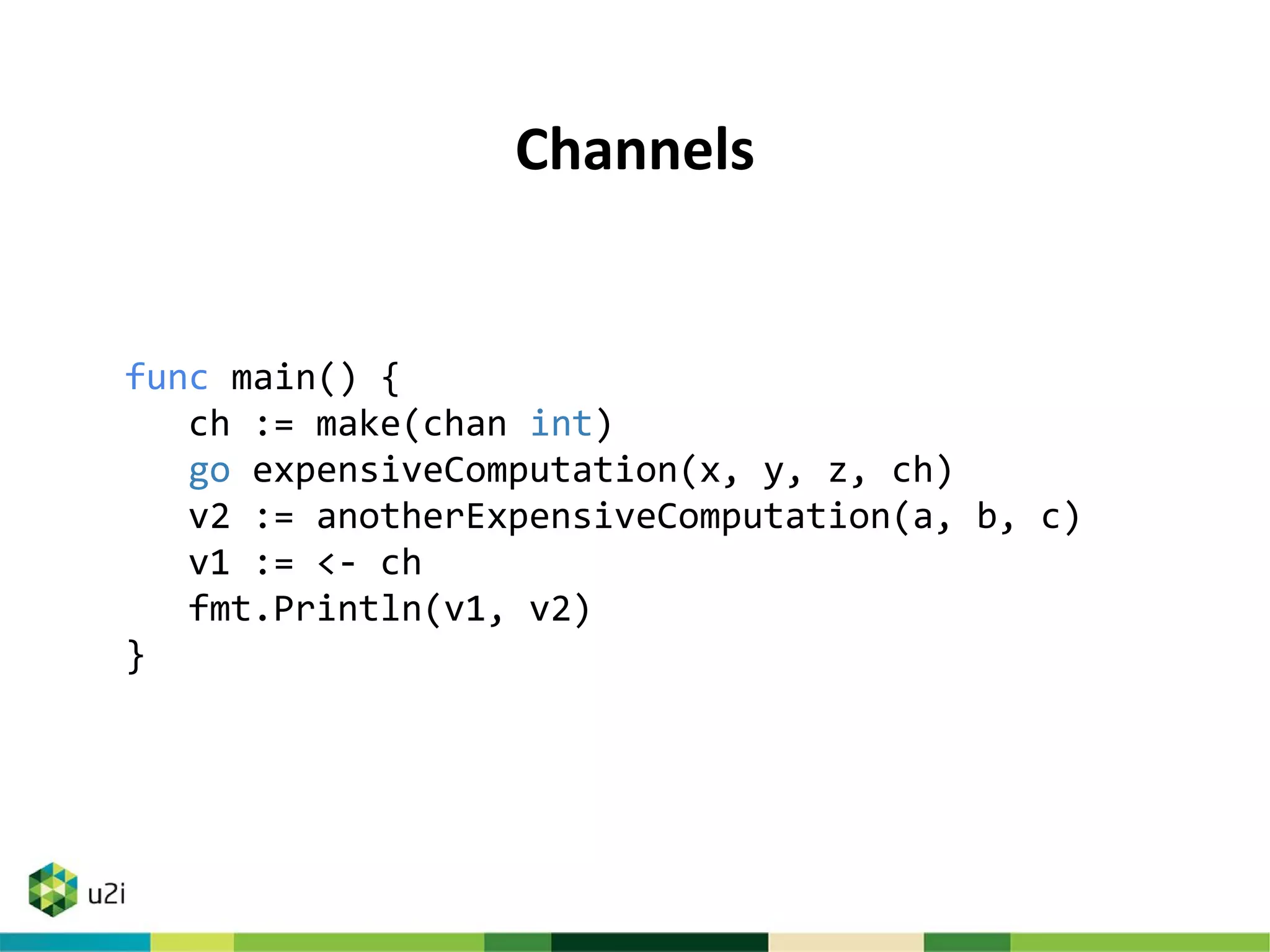
Channels
func main() {
ch := make(chan int)
go expensiveComputation(x, y, z, ch)
v2 := anotherExpensiveComputation(a, b, c)
v1 := <- ch
fmt.Println(v1, v2)
}
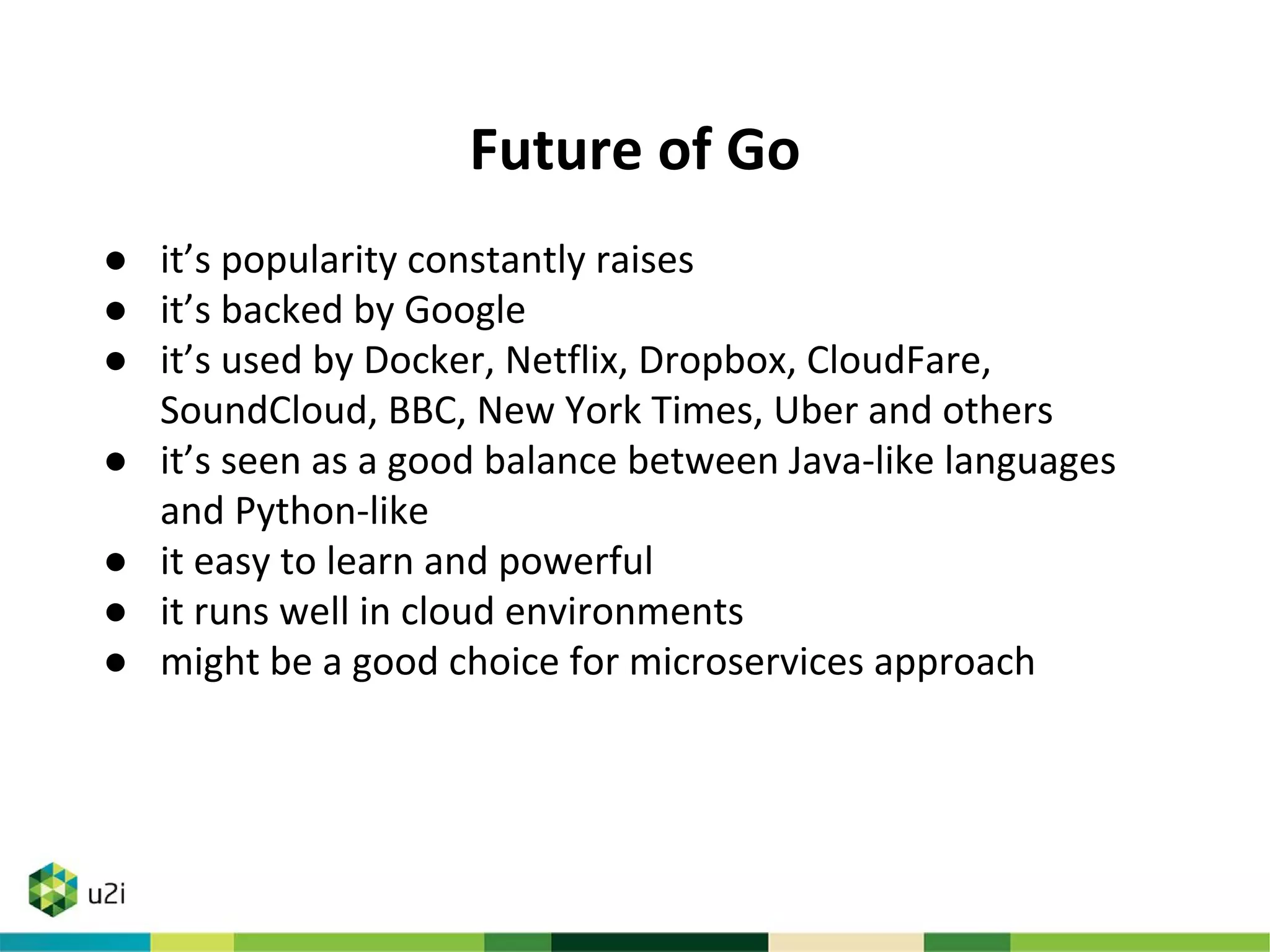
Future of Go
● it’s popularity constantly raises
● it’s backed by Google
● it’s used by Docker, Netflix, Dropbox, CloudFare,
SoundCloud, BBC, New York Times, Uber and others
● it’s seen as a good balance between Java-like languages
and Python-like
● it easy to learn and powerful
● it runs well in cloud environments
● might be a good choice for microservices approach
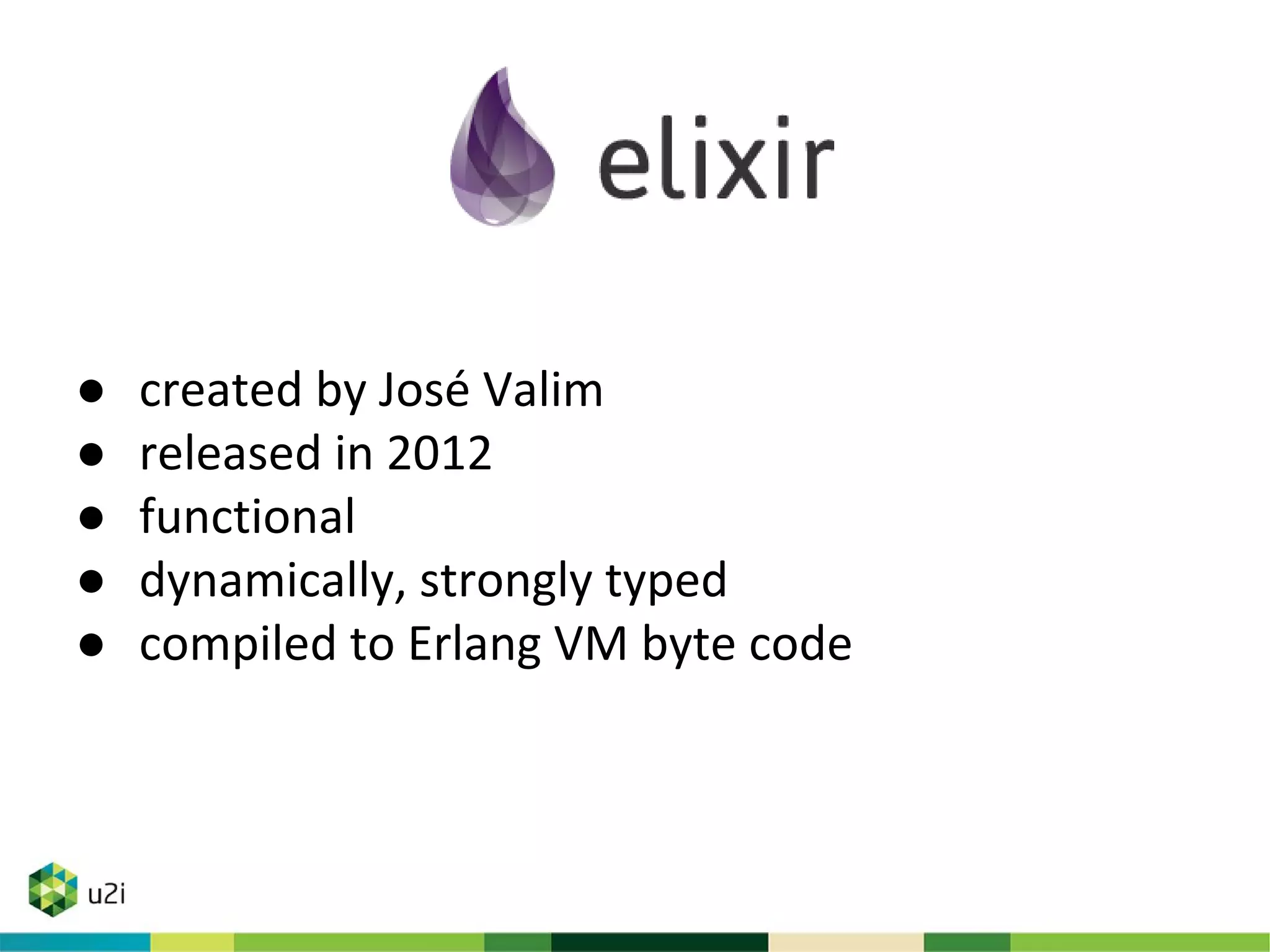
● created by José Valim
● released in 2012
● functional
● dynamically, strongly typed
● compiled to Erlang VM byte code
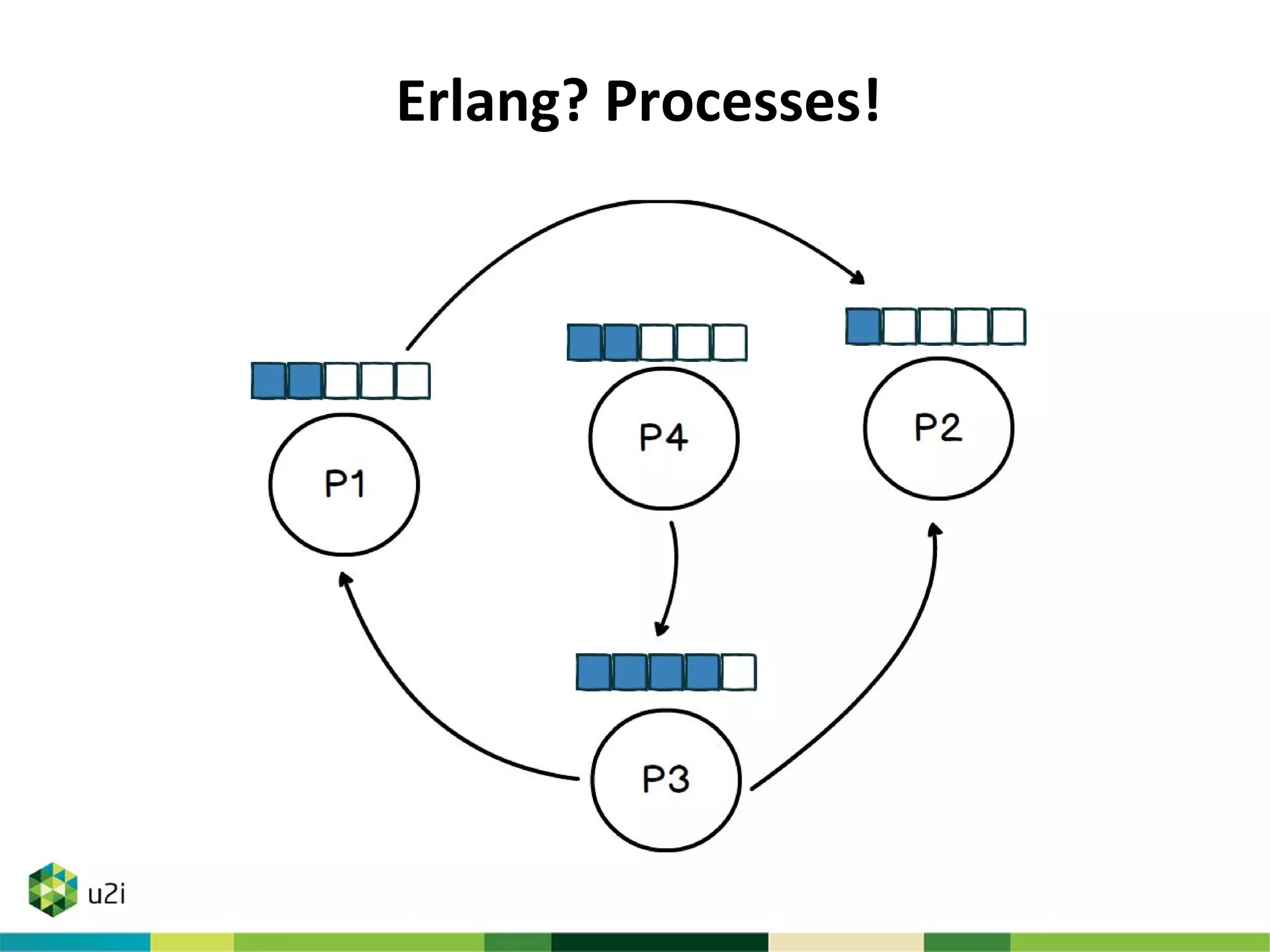
Erlang? Processes!
Elixir = Erlang with Ruby syntax
Elixir features
● massively concurrent
● scalable
● fault-tolerant
● great performance
● functional, but practical
● nice Ruby-like syntax
● metaprogramming via macros
Ruby has Rails.
Elixir has Phoenix.
Controllers in Rails
class PagesController < ApplicationController
def index
@title = params[:title]
@members = [
{name: "Chris McCord"},
{name: "Matt Sears"},
{name: "David Stump"},
{name: "Ricardo Thompson"}
]
render "index"
end
end
http://www.littlelines.com/blog/2014/07/08/elixir-vs-ruby-showdown-phoenix-vs-rails/
Controllers in Phoenix
defmodule Benchmarker.Controllers.Pages do
use Phoenix.Controller
def index(conn, %{"title" => title}) do
render conn, "index", title: title, members: [
%{name: "Chris McCord"},
%{name: "Matt Sears"},
%{name: "David Stump"},
%{name: "Ricardo Thompson"}
]
end
end
http://www.littlelines.com/blog/2014/07/08/elixir-vs-ruby-showdown-phoenix-vs-rails/
Future of Elixir
● new Erlang for the masses
● fits highly concurrent niche
● attracts Ruby developers
● no big company behind
● used by Pinterest
● will fly on the wings of Phoenix?
● created by data scientists
● released in 2012
● dynamically, strongly typed
● compiled
Compiled one for fast stuff.
Interpreted one for visualisation.
Data scientists’ two languages problem:
Julia features
● solves scientists’ two language problem
● familiar syntax
● extensive scientific library
● user-defined types
● multiple dispatch
● built-in parallelism
● good performance (comparing to C)
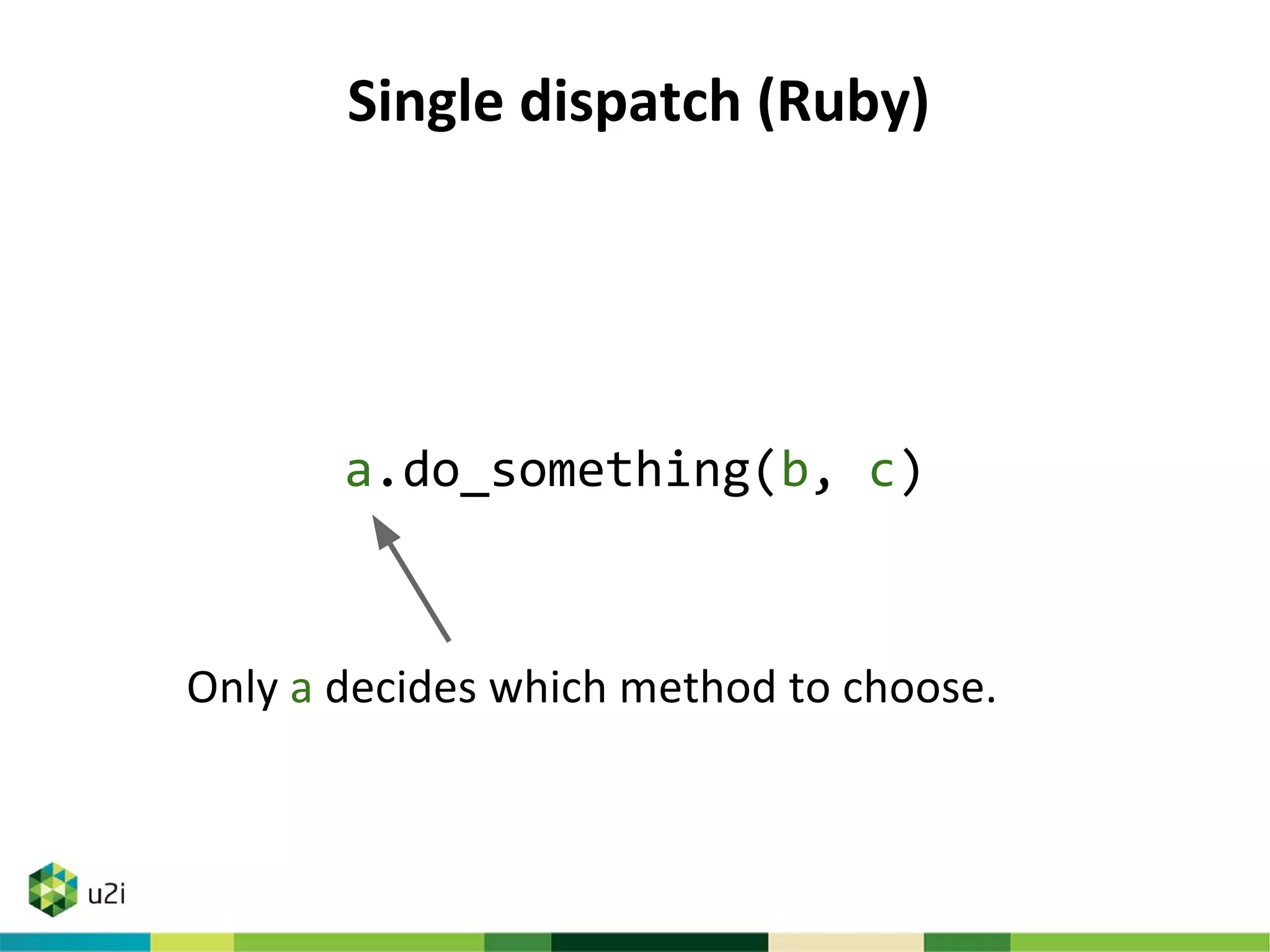
Single dispatch (Ruby)
a.do_something(b, c)
Only a decides which method to choose.
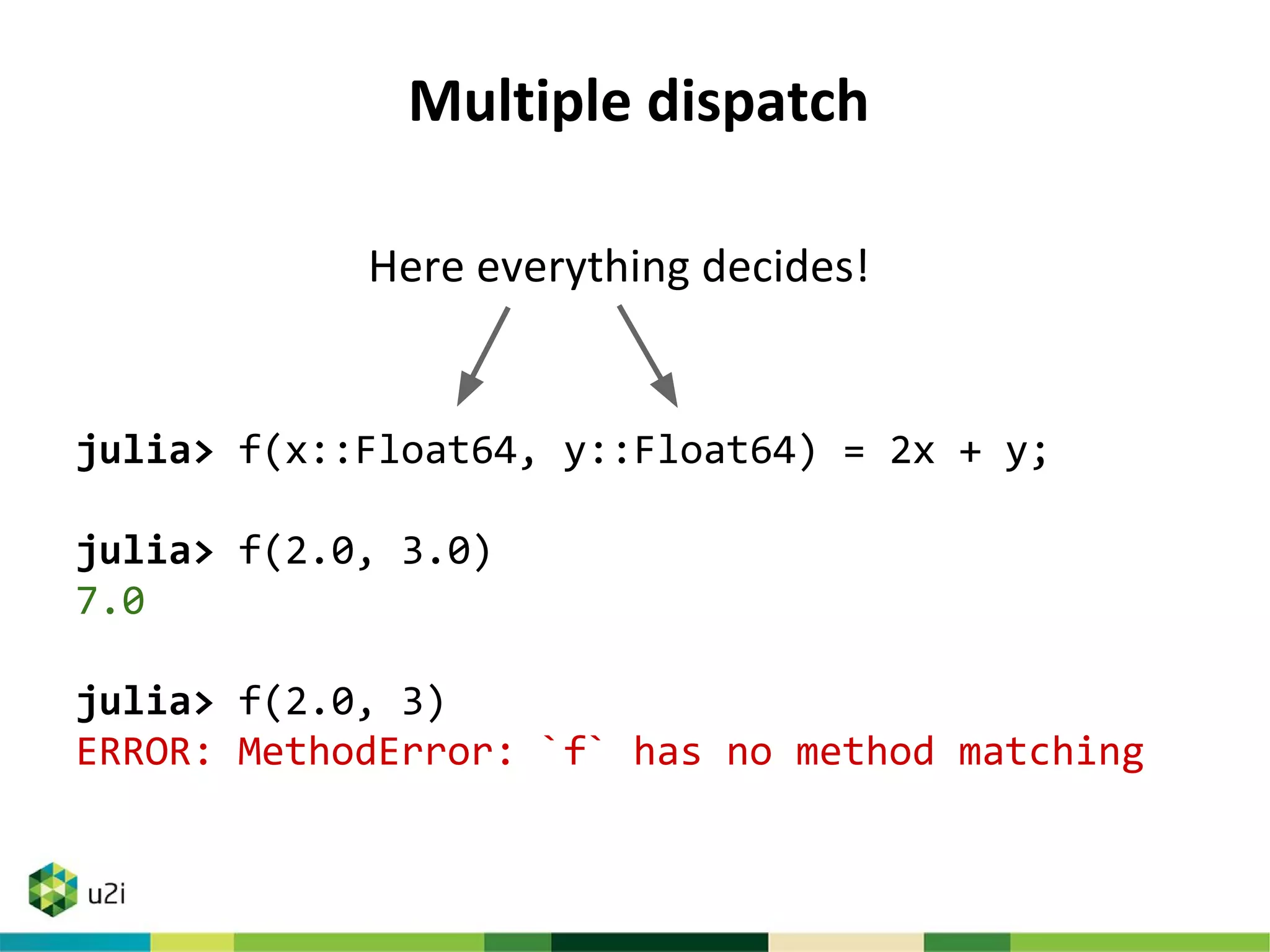
Multiple dispatch
julia> f(x::Float64, y::Float64) = 2x + y;
julia> f(2.0, 3.0)
7.0
julia> f(2.0, 3)
ERROR: MethodError: `f` has no method matching
Here everything decides!
Future of Julia
● R, MATLAB and C competitor
● unifies scientific software stack
● not mature enough yet
● small, but growing number of libraries
● created by Google
● released in 2011
● optionally typed
● interpreted
● translated to JavaScript
Let’s replace JavaScript!
Dart vs JavaScript
● class-based (not prototype-based)
● normal foreach
● named parameters
● operator overriding
● string interpolation
● optional typing
● false is false
● easy DOM operations
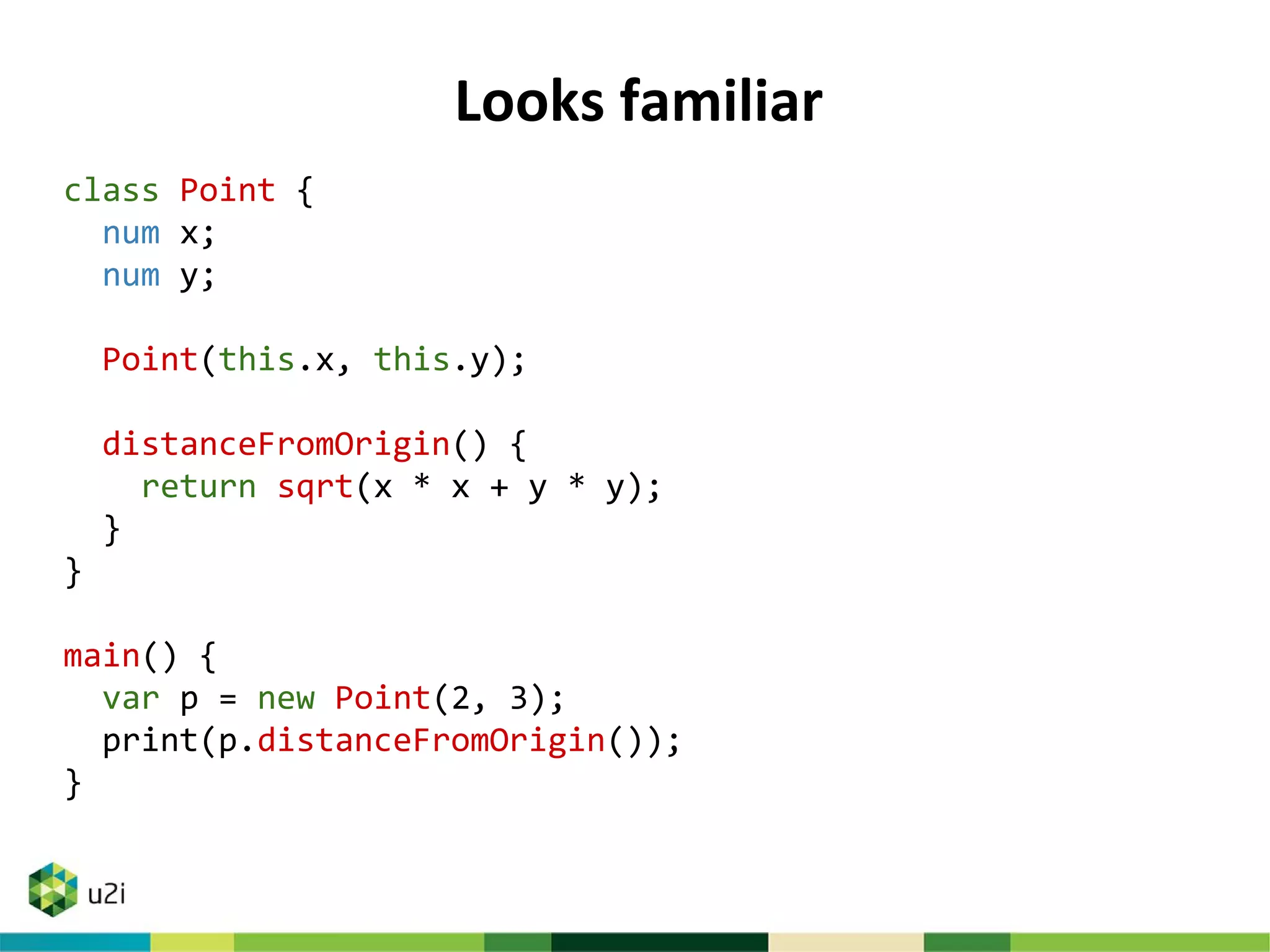
Looks familiar
class Point {
num x;
num y;
Point(this.x, this.y);
distanceFromOrigin() {
return sqrt(x * x + y * y);
}
}
main() {
var p = new Point(2, 3);
print(p.distanceFromOrigin());
}
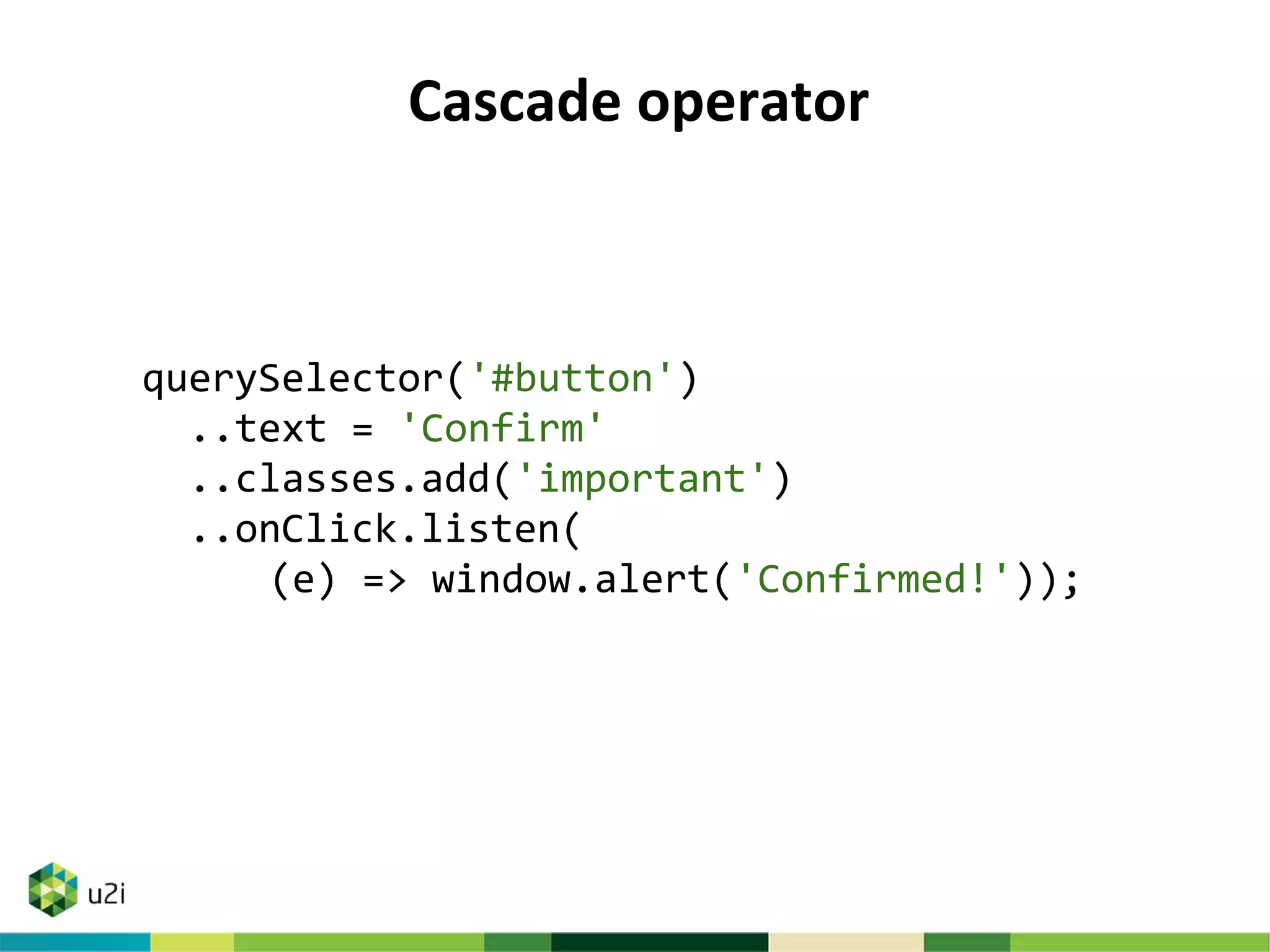
Cascade operator
querySelector('#button')
..text = 'Confirm'
..classes.add('important')
..onClick.listen(
(e) => window.alert('Confirmed!'));
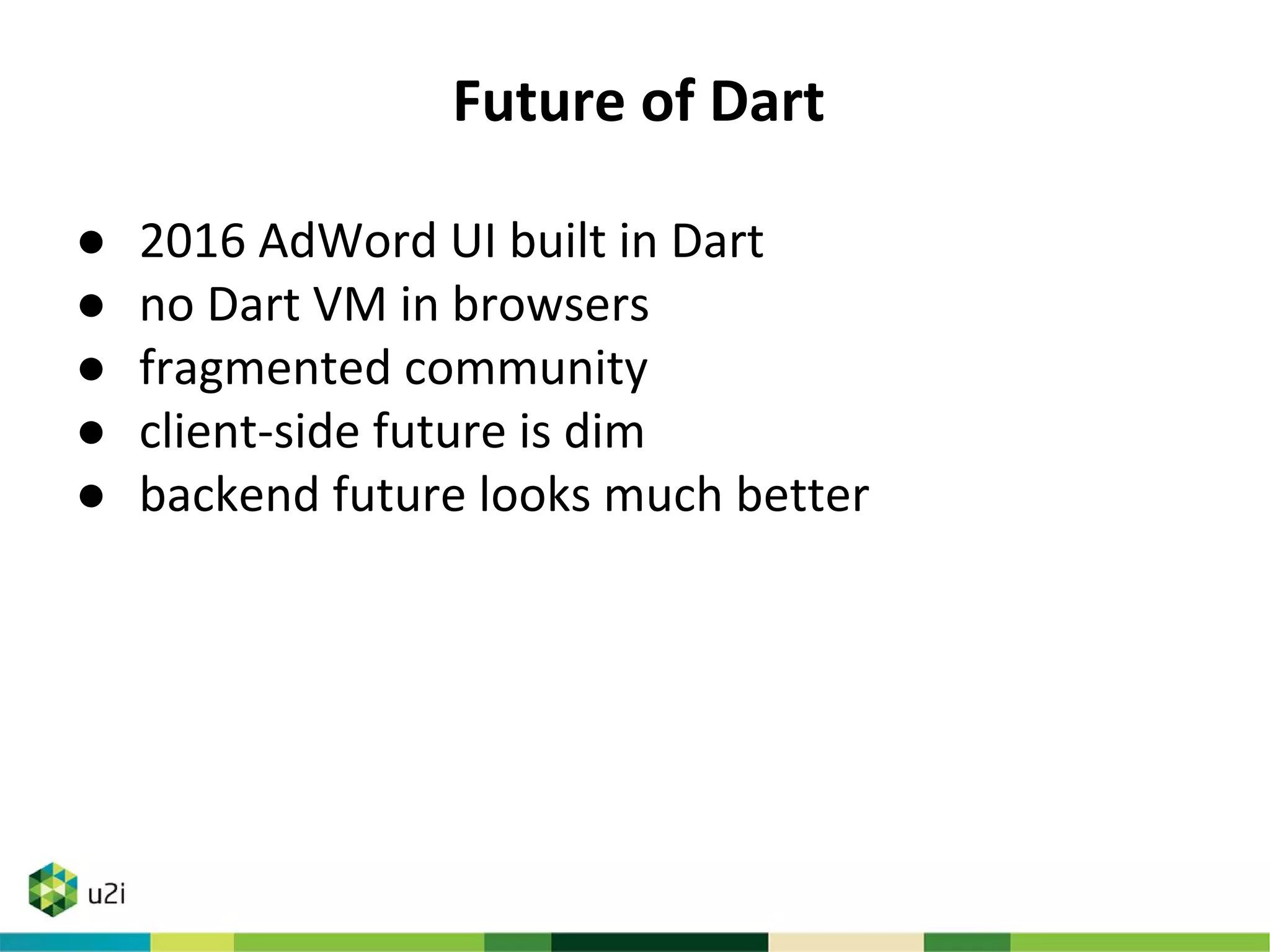
Future of Dart
● 2016 AdWord UI built in Dart
● no Dart VM in browsers
● fragmented community
● client-side future is dim
● backend future looks much better
Sources
● developer.apple.com/swift
● rust-lang.org
● golang.org
● elixir-lang.org
● julialang.org
● dartlang.org
Any questions?
@mjkonarski
michalkonarski
michal.konarski@u2i.com

Ruby is dying. What languages are cool now?

  • 1.
    Ruby is dying Whatlanguages are cool now? Michał Konarski u2i.com
  • 2.
  • 3.
  • 4.
    But let’s lookfrom a different angle...
  • 5.
  • 6.
    Well, not exactly. Butwhat languages are cool now?
  • 7.
    Let’s look atsix of them
  • 8.
  • 9.
    Swift ● designed byApple ● released in 2014 ● created for iOS, macOS, tvOS ● multi-paradigm ● statically, strongly typed ● compiled
  • 10.
    namespacesgenerics closures tuples operator overloading native collections typeinference pattern matching multiple return types Read-Eval-Print-Loop (REPL) Swift features
  • 11.
    Nothing really outstanding. So,what’s the story behind Swift?
  • 12.
    “We absolutely lovedObjective-C, but we had to ask ourselves a question - what would it be like if we had Objective-C without the baggage of C?” Tim Cook
  • 13.
    It’s mainly becauseObjective-C is bad. And they had nothing else.
  • 14.
    @interface Foo :NSObject @property (readonly) int bar; - (instancetype)initWithBar:(int)bar; + (instancetype)fooWithBar:(int)bar; @end @implementation Foo - (instancetype)initWithBar:(int)bar { self = [super init]; if (self) { _bar = bar; } return self; } + (instancetype)fooWithBar:(int)bar { return [[self alloc] initWithBar:bar]; } @end How bad is Objective-C? http://www.antonzherdev.com/post/70064588471/top-13-worst-things-about-objective-c
  • 15.
    Swift is easierto read Objective-C if (myDelegate != nil) { if ([myDelegate respondsToSelector: @selector(scrollViewDidScroll:)]) { [myDelegate scrollViewDidScroll:myScrollView] } } Swift myDelegate?.scrollViewDidScroll?(myScrollView)
  • 16.
    Why also Swiftis better? ● no need to have two separate files (code and headers) ● it’s safer (runtime crash on null pointer) ● it has automatic ARC (Automatic Reference Counting) ● it’s faster ● it requires less code ● it has namespaces
  • 17.
    It’s not onlya language XCode 8 https://developer.apple.com/xcode/
  • 18.
    It’s not onlya language Swift Playgrounds http://www.apple.com/swift/playgrounds/
  • 20.
    ● sponsored byMozilla ● announced in 2010 ● first release in 2012 ● stable release in 2015 ● statically, strongly typed ● multi-paradigm ● compiled
  • 21.
    “The goal ofthe project is to design and implement a safe, concurrent, practical systems language” Rust FAQ
  • 22.
    There are notsuch languages? Apparently not.
  • 23.
    Current languages arewrong ● there is too little attention paid to safety ● they have poor concurrency support ● they offer limited control over resources ● they stick too much to paradigm
  • 24.
    So let’s createa new high-low level language!
  • 25.
    Rust is ahigh level language! ● generics ● traits ● pattern matching ● closures ● type inference ● automatic memory allocation and deallocation ● guaranteed memory safety ● threads without data races
  • 26.
    Rust is alow level language! ● no garbage collector ● manual memory management ● zero-cost abstractions ● minimal runtime ● as fast as C/C++
  • 27.
  • 28.
    Ownership fn foo() { letv1 = vec![1, 2, 3]; let v2 = v1; println!("v1[0] is: {}", v1[0]); } error: use of moved value: `v
  • 29.
    You can’t havetwo references to the same object!
  • 30.
  • 31.
    There are moresuch mechanisms.
  • 32.
    Future of Rust ●currently two big projects: servo and rust ● other smaller projects: redox, cgmath, Iron, rust-doom ● it changes very quickly ● it has a good opinion in the community ● it will be hard to replace C/C++ ● It has a steep learning curve
  • 33.
  • 34.
    Go ● designed inGoogle in 2007 ● first release in 2009 ● stable release in 2016 ● statically, strongly typed ● multi-paradigm, concurrent ● compiled
  • 35.
    Standard languages (Java,C++) ● are very strong: type-safe, effective, efficient ● great in hands of experts ● used to build huge systems and companies
  • 36.
    Standard languages (Java,C++) ● hard to use ● compilers are slow ● binaries are huge ● desperately need language-aware tools ● poorly adapt to clouds, multicore CPUs
  • 37.
    Simpler languages (Python,Ruby, JS) ● easier to learn ● dynamically typed (fewer keystrokes) ● interpreted (no compiler to wait for) ● good tools (interpreters make things easier)
  • 38.
    Simpler languages (Python,Ruby, JS) ● slow ● not type-safe ● hard to maintain in a big project ● very poor at scale ● not very modern
  • 39.
    What if wehad a static language with dynamic-like syntax?
  • 40.
    A niche fora language ● understandable ● statically typed ● productive and readable ● fast to work in ● scales well ● doesn't require tools, but supports them well ● good at networking and multiprocessing
  • 41.
    Features of Go ●syntax typical for dynamic languages ● type inference ● fast compilation ● garbage collector ● memory safety features ● built-in concurrency ● object oriented without classes and inheritance ● lack of generics ● compiles to small statically linked binaries
  • 42.
    Interfaces type Animal interface{ Speak() string } type Dog struct { } func (d Dog) Speak() string { return "Woof!" } func SaySomething(a Animal) { fmt.Println(a.Speak()) } func main() { dog := Dog{} SaySomething(dog) }
  • 43.
  • 44.
    Goroutines func main() { goexpensiveComputation(x, y, z) anotherExpensiveComputation(a, b, c) }
  • 45.
    Channels func main() { ch:= make(chan int) go expensiveComputation(x, y, z, ch) v2 := anotherExpensiveComputation(a, b, c) v1 := <- ch fmt.Println(v1, v2) }
  • 46.
    Future of Go ●it’s popularity constantly raises ● it’s backed by Google ● it’s used by Docker, Netflix, Dropbox, CloudFare, SoundCloud, BBC, New York Times, Uber and others ● it’s seen as a good balance between Java-like languages and Python-like ● it easy to learn and powerful ● it runs well in cloud environments ● might be a good choice for microservices approach
  • 48.
    ● created byJosé Valim ● released in 2012 ● functional ● dynamically, strongly typed ● compiled to Erlang VM byte code
  • 49.
  • 50.
    Elixir = Erlangwith Ruby syntax
  • 51.
    Elixir features ● massivelyconcurrent ● scalable ● fault-tolerant ● great performance ● functional, but practical ● nice Ruby-like syntax ● metaprogramming via macros
  • 52.
  • 53.
  • 54.
    Controllers in Rails classPagesController < ApplicationController def index @title = params[:title] @members = [ {name: "Chris McCord"}, {name: "Matt Sears"}, {name: "David Stump"}, {name: "Ricardo Thompson"} ] render "index" end end http://www.littlelines.com/blog/2014/07/08/elixir-vs-ruby-showdown-phoenix-vs-rails/
  • 55.
    Controllers in Phoenix defmoduleBenchmarker.Controllers.Pages do use Phoenix.Controller def index(conn, %{"title" => title}) do render conn, "index", title: title, members: [ %{name: "Chris McCord"}, %{name: "Matt Sears"}, %{name: "David Stump"}, %{name: "Ricardo Thompson"} ] end end http://www.littlelines.com/blog/2014/07/08/elixir-vs-ruby-showdown-phoenix-vs-rails/
  • 56.
    Future of Elixir ●new Erlang for the masses ● fits highly concurrent niche ● attracts Ruby developers ● no big company behind ● used by Pinterest ● will fly on the wings of Phoenix?
  • 58.
    ● created bydata scientists ● released in 2012 ● dynamically, strongly typed ● compiled
  • 59.
    Compiled one forfast stuff. Interpreted one for visualisation. Data scientists’ two languages problem:
  • 60.
    Julia features ● solvesscientists’ two language problem ● familiar syntax ● extensive scientific library ● user-defined types ● multiple dispatch ● built-in parallelism ● good performance (comparing to C)
  • 61.
    Single dispatch (Ruby) a.do_something(b,c) Only a decides which method to choose.
  • 62.
    Multiple dispatch julia> f(x::Float64,y::Float64) = 2x + y; julia> f(2.0, 3.0) 7.0 julia> f(2.0, 3) ERROR: MethodError: `f` has no method matching Here everything decides!
  • 63.
    Future of Julia ●R, MATLAB and C competitor ● unifies scientific software stack ● not mature enough yet ● small, but growing number of libraries
  • 65.
    ● created byGoogle ● released in 2011 ● optionally typed ● interpreted ● translated to JavaScript
  • 66.
  • 67.
    Dart vs JavaScript ●class-based (not prototype-based) ● normal foreach ● named parameters ● operator overriding ● string interpolation ● optional typing ● false is false ● easy DOM operations
  • 68.
    Looks familiar class Point{ num x; num y; Point(this.x, this.y); distanceFromOrigin() { return sqrt(x * x + y * y); } } main() { var p = new Point(2, 3); print(p.distanceFromOrigin()); }
  • 69.
    Cascade operator querySelector('#button') ..text ='Confirm' ..classes.add('important') ..onClick.listen( (e) => window.alert('Confirmed!'));
  • 70.
    Future of Dart ●2016 AdWord UI built in Dart ● no Dart VM in browsers ● fragmented community ● client-side future is dim ● backend future looks much better
  • 72.
    Sources ● developer.apple.com/swift ● rust-lang.org ●golang.org ● elixir-lang.org ● julialang.org ● dartlang.org
  • 73.