A Comprehensive Overview
Clinical Trials
Name:- Takshal Shah
Subject:- Biotechnology
Roll no.:- 21
Pre-clinical trials
Clinical Trials Phases I - IV
Regulations and Guidelines
Summary
References
CONTENTS
PART
ONE
Pre-clinical trials
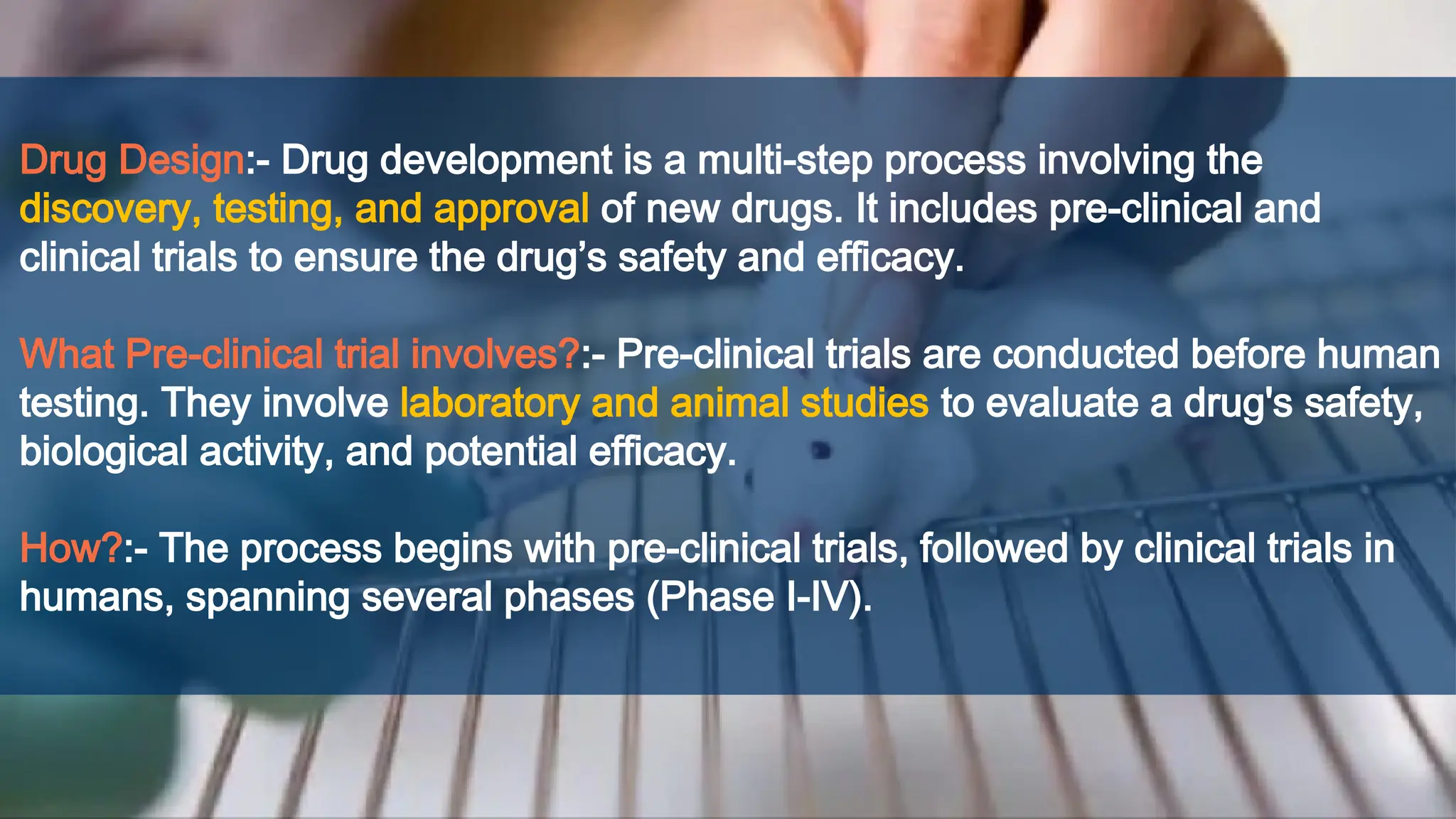
Drug Design:- Drug development is a multi-step process involving the
discovery, testing, and approval of new drugs. It includes pre-clinical and
clinical trials to ensure the drug’s safety and efficacy.
What Pre-clinical trial involves?:- Pre-clinical trials are conducted before human
testing. They involve laboratory and animal studies to evaluate a drug's safety,
biological activity, and potential efficacy.
How?:- The process begins with pre-clinical trials, followed by clinical trials in
humans, spanning several phases (Phase I-IV).
Methods:
▪ In vitro studies are performed using cell cultures or tissue samples.
▪ These studies assess the drug’s effects on cellular processes, receptor binding, and
enzyme activity.
▪ Common assays include cell viability assays, reporter gene assays, and enzyme
inhibition studies.
Importance: These studies help in understanding the drug's mechanism of action and
its potential effectiveness before moving to animal studies.
In-Vitro Studies
Animal Models:
▪ In vivo studies involve testing in animal models, such as rodents, rabbits, and
primates.
▪ These studies evaluate the drug's pharmacokinetics (ADMET) and
pharmacodynamics(effects).
▪ Animal studies help predict how the drug will behave in humans, providing insights
into dosing, safety, and potential efficacy.
Regulatory Guidelines:
▪ Guidelines for animal testing are established by organizations like the International
Council for Harmonisation (ICH) and local regulatory bodies.
▪ These guidelines ensure humane treatment of animals and scientifically valid
results.
In-Vivo Studies
Pharmacokinetics (ADMET):
▪ These studies focus on how the drug is absorbed, distributed, metabolized,
excreted and toxicity in the body.
▪ The results help in determining the appropriate dosing regimen and
frequency for further studies.
Pharmacodynamics:
▪ This involves studying the drug's biological effects and it’s mechanism of
action.
▪ It helps in understanding the relationship between the drug’s concentration
and its therapeutic effect.
Pharmacokinetics and Pharmacodynamics
PART
TWO
Clinical Trial Phases
Before a drug can move from pre-
clinical to clinical trials, it must receive
approval from regulatory bodies, which
review the pre-clinical data to ensure
the drug's safety for initial human
testing.
REGULATORY APPROVAL:
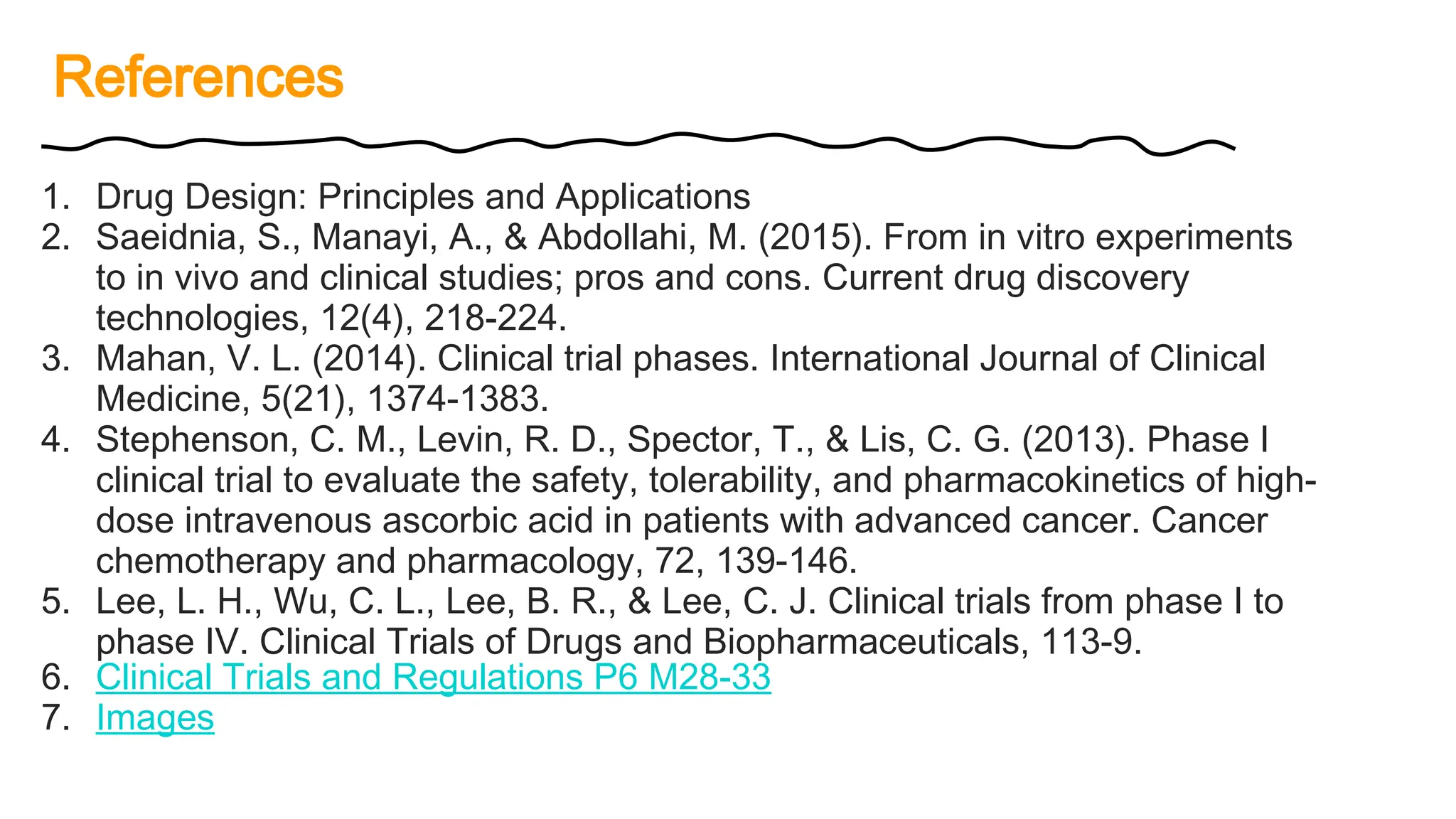
Clinical trials are conducted in
several phases (Phase I-IV),
each with specific objectives to
further assess the drug’s safety,
efficacy, and optimal use.
CLINICAL TRIALS PHASES:
Transition to Human Trials
DEFINITION AND PURPOSE
Definition:
Clinical trials are systematic studies in humans designed to
evaluate the safety, efficacy, and optimal use of new drugs
or treatments.
Purpose:
These trials are essential for ensuring that new treatments
are safe and effective before they are made available to the
general public.
PHASE I CLINICAL TRIALS
Objectives:
▪ The primary goal is to
evaluate the safety and
tolerability of the drug.
▪ Phase I trials also
assess the drug’s
pharmacokinetics in
humans.
Participants:
▪ Typically involve
20-100 healthy
volunteers or
patients.
Procedures:
▪ Participants are given
escalating doses to
determine the maximum
tolerated dose (MTD).
▪ Side effects and adverse
reactions are carefully
monitored to establish the
drug's safety profile
Objectives:
▪ The main objective is to evaluate the drug's efficacy in treating the target
disease or condition.
▪ Phase II trials continue to assess safety and side effects.
Participants:
▪ Involve 100-300 patients with the target disease.
Procedures:
▪ The trials help determine the optimal therapeutic dose and monitor for
adverse effects.
▪ Efficacy is measured using clinical endpoints, such as symptom improvement
or disease progression.
Phase II Clinical Trials
PHASE III CLINICAL TRIALS
Objectives:
▪ Phase III trials are
designed to confirm the
drug’s efficacy in a large,
diverse population.
▪ They also aim to
monitor side effects and
collect more
comprehensive safety
data.
Participants:
▪Typically involve
1,000-3,000
participants across
multiple sites.
Procedures:
▪ These trials are often
randomized and controlled,
with participants receiving the
new drug, a standard
treatment, or a placebo.
▪ The trials are usually
double-blinded, ensuring
unbiased results.
▪ The data from these trials
are used for regulatory
approval submissions.
Objectives:
▪ Phase IV trials occur after the drug has been approved and marketed.
▪ They monitor long-term effects and rare adverse effects not detected in
earlier phases as well as effects of drug on childrens and pregnant ladies.
Participants:
▪ These studies involve large patient populations in real-world settings.
Procedures:
▪ Phase IV studies provide additional data on the drug’s effectiveness and
safety during routine use.
▪ The results may lead to labeling changes, usage guidelines, or even
withdrawal of the drug if necessary.
Phase IV Clinical Trials
PART
Three
Regulations and Guidelines
GCP Guidelines:
▪ Good Clinical Practice (GCP) is an international standard for conducting clinical trials
ethically.
▪ GCP ensures that the rights, safety, and well-being of trial participants are protected.
Informed Consent:
▪ Participants must be fully informed about the trial, including potential risks and
benefits, and provide consent before participating.
▪ Informed consent is a critical process in clinical trials, safeguarding participant rights.
Regulatory Bodies in India:
▪ The Central Drugs Standard Control Organization (CDSCO) regulates clinical trials in
India to ensure compliance with national and international standards.
Good Clinical Practice (GCP)
▪ The Clinical Trials Rules, 2019, govern the conduct of clinical trials in India.
▪ The Drug and Cosmetics Act of 1940 regulates the approval, manufacture,
distribution, and sale of drugs in India.
▪ This act ensures that drugs available in the market are safe, effective, and of high
quality.
Regulations and Guidelines in
India
▪ The Drug Controller General of India (DCGI) is responsible for approving new drugs
and overseeing clinical trials in India.
▪ The office ensures that all drugs meet required safety and efficacy standards before
entering the market.
▪ The DCGI also plays a key role in formulating policies and guidelines related to drug
regulation in India.
▪ Ethics Committees (ECs) and Institutional Review Boards (IRBs) are independent
bodies that review and approve clinical trial protocols.
▪ They ensure that the rights, safety, and well-being of participants are protected.
▪ ECs/IRBs review the scientific, ethical, and legal aspects of the clinical trial before it
begins and monitor its progress.
Role of DCGI, Ethics Committee and IRBs
▪ GCRI is one of the leading cancer research institutions in India, located in
Ahmedabad, Gujarat.
▪ It is a major center for conducting clinical trials, particularly in oncology.
▪ GCRI collaborates with various national and international pharmaceutical companies
to test new cancer treatments.
▪ B.J. Medical College in Ahmedabad is renowned for its clinical research activities.
▪ The college conducts a wide range of clinical trials in various therapeutic areas,
including infectious diseases, cardiology, and more.
▪ It has well-established infrastructure and experienced faculty for conducting high-
quality clinical research.
Clinical Trials in Gujarat
Summary:
TAKE AWAYS
SYSTEMATIC STUDIES IN HUMANS TO EVALUATE SAFETY,
EFFICACY, AND OPTIMAL USE OF NEW
DRUGS/TREATMENTS.
I II
IV III
Tests safety, tolerability, and
pharmacokinetics with 20-100
participants.
Post-approval monitoring of long
-term effects and effect on
Childrens and Pregnant females.
Regulations: Governed by Good Clinical Practice (GCP), Drug and Cosmetics Act (1940),
and Clinical Trials Rules (2019). Overseen by the DCGI and ethics committees.
Assesses efficacy and optimal
dose in 100-300 patients.
Confirms efficacy in 1,000-3,000
participants for regulatory
approval.
1. Drug Design: Principles and Applications
2. Saeidnia, S., Manayi, A., & Abdollahi, M. (2015). From in vitro experiments
to in vivo and clinical studies; pros and cons. Current drug discovery
technologies, 12(4), 218-224.
3. Mahan, V. L. (2014). Clinical trial phases. International Journal of Clinical
Medicine, 5(21), 1374-1383.
4. Stephenson, C. M., Levin, R. D., Spector, T., & Lis, C. G. (2013). Phase I
clinical trial to evaluate the safety, tolerability, and pharmacokinetics of high-
dose intravenous ascorbic acid in patients with advanced cancer. Cancer
chemotherapy and pharmacology, 72, 139-146.
5. Lee, L. H., Wu, C. L., Lee, B. R., & Lee, C. J. Clinical trials from phase I to
phase IV. Clinical Trials of Drugs and Biopharmaceuticals, 113-9.
6. Clinical Trials and Regulations P6 M28-33
7. Images
References
THANK YOU
From:-
Takshal Shah

Clinical Trials- Phases, Preclinical trials and Regulations in India.

  • 1.
    A Comprehensive Overview ClinicalTrials Name:- Takshal Shah Subject:- Biotechnology Roll no.:- 21
  • 2.
    Pre-clinical trials Clinical TrialsPhases I - IV Regulations and Guidelines Summary References CONTENTS
  • 3.
  • 4.
    Drug Design:- Drugdevelopment is a multi-step process involving the discovery, testing, and approval of new drugs. It includes pre-clinical and clinical trials to ensure the drug’s safety and efficacy. What Pre-clinical trial involves?:- Pre-clinical trials are conducted before human testing. They involve laboratory and animal studies to evaluate a drug's safety, biological activity, and potential efficacy. How?:- The process begins with pre-clinical trials, followed by clinical trials in humans, spanning several phases (Phase I-IV).
  • 5.
    Methods: ▪ In vitrostudies are performed using cell cultures or tissue samples. ▪ These studies assess the drug’s effects on cellular processes, receptor binding, and enzyme activity. ▪ Common assays include cell viability assays, reporter gene assays, and enzyme inhibition studies. Importance: These studies help in understanding the drug's mechanism of action and its potential effectiveness before moving to animal studies. In-Vitro Studies
  • 6.
    Animal Models: ▪ Invivo studies involve testing in animal models, such as rodents, rabbits, and primates. ▪ These studies evaluate the drug's pharmacokinetics (ADMET) and pharmacodynamics(effects). ▪ Animal studies help predict how the drug will behave in humans, providing insights into dosing, safety, and potential efficacy. Regulatory Guidelines: ▪ Guidelines for animal testing are established by organizations like the International Council for Harmonisation (ICH) and local regulatory bodies. ▪ These guidelines ensure humane treatment of animals and scientifically valid results. In-Vivo Studies
  • 7.
    Pharmacokinetics (ADMET): ▪ Thesestudies focus on how the drug is absorbed, distributed, metabolized, excreted and toxicity in the body. ▪ The results help in determining the appropriate dosing regimen and frequency for further studies. Pharmacodynamics: ▪ This involves studying the drug's biological effects and it’s mechanism of action. ▪ It helps in understanding the relationship between the drug’s concentration and its therapeutic effect. Pharmacokinetics and Pharmacodynamics
  • 8.
  • 9.
    Before a drugcan move from pre- clinical to clinical trials, it must receive approval from regulatory bodies, which review the pre-clinical data to ensure the drug's safety for initial human testing. REGULATORY APPROVAL: Clinical trials are conducted in several phases (Phase I-IV), each with specific objectives to further assess the drug’s safety, efficacy, and optimal use. CLINICAL TRIALS PHASES: Transition to Human Trials
  • 10.
    DEFINITION AND PURPOSE Definition: Clinicaltrials are systematic studies in humans designed to evaluate the safety, efficacy, and optimal use of new drugs or treatments. Purpose: These trials are essential for ensuring that new treatments are safe and effective before they are made available to the general public.
  • 11.
    PHASE I CLINICALTRIALS Objectives: ▪ The primary goal is to evaluate the safety and tolerability of the drug. ▪ Phase I trials also assess the drug’s pharmacokinetics in humans. Participants: ▪ Typically involve 20-100 healthy volunteers or patients. Procedures: ▪ Participants are given escalating doses to determine the maximum tolerated dose (MTD). ▪ Side effects and adverse reactions are carefully monitored to establish the drug's safety profile
  • 12.
    Objectives: ▪ The mainobjective is to evaluate the drug's efficacy in treating the target disease or condition. ▪ Phase II trials continue to assess safety and side effects. Participants: ▪ Involve 100-300 patients with the target disease. Procedures: ▪ The trials help determine the optimal therapeutic dose and monitor for adverse effects. ▪ Efficacy is measured using clinical endpoints, such as symptom improvement or disease progression. Phase II Clinical Trials
  • 13.
    PHASE III CLINICALTRIALS Objectives: ▪ Phase III trials are designed to confirm the drug’s efficacy in a large, diverse population. ▪ They also aim to monitor side effects and collect more comprehensive safety data. Participants: ▪Typically involve 1,000-3,000 participants across multiple sites. Procedures: ▪ These trials are often randomized and controlled, with participants receiving the new drug, a standard treatment, or a placebo. ▪ The trials are usually double-blinded, ensuring unbiased results. ▪ The data from these trials are used for regulatory approval submissions.
  • 14.
    Objectives: ▪ Phase IVtrials occur after the drug has been approved and marketed. ▪ They monitor long-term effects and rare adverse effects not detected in earlier phases as well as effects of drug on childrens and pregnant ladies. Participants: ▪ These studies involve large patient populations in real-world settings. Procedures: ▪ Phase IV studies provide additional data on the drug’s effectiveness and safety during routine use. ▪ The results may lead to labeling changes, usage guidelines, or even withdrawal of the drug if necessary. Phase IV Clinical Trials
  • 15.
  • 16.
    GCP Guidelines: ▪ GoodClinical Practice (GCP) is an international standard for conducting clinical trials ethically. ▪ GCP ensures that the rights, safety, and well-being of trial participants are protected. Informed Consent: ▪ Participants must be fully informed about the trial, including potential risks and benefits, and provide consent before participating. ▪ Informed consent is a critical process in clinical trials, safeguarding participant rights. Regulatory Bodies in India: ▪ The Central Drugs Standard Control Organization (CDSCO) regulates clinical trials in India to ensure compliance with national and international standards. Good Clinical Practice (GCP)
  • 17.
    ▪ The ClinicalTrials Rules, 2019, govern the conduct of clinical trials in India. ▪ The Drug and Cosmetics Act of 1940 regulates the approval, manufacture, distribution, and sale of drugs in India. ▪ This act ensures that drugs available in the market are safe, effective, and of high quality. Regulations and Guidelines in India
  • 18.
    ▪ The DrugController General of India (DCGI) is responsible for approving new drugs and overseeing clinical trials in India. ▪ The office ensures that all drugs meet required safety and efficacy standards before entering the market. ▪ The DCGI also plays a key role in formulating policies and guidelines related to drug regulation in India. ▪ Ethics Committees (ECs) and Institutional Review Boards (IRBs) are independent bodies that review and approve clinical trial protocols. ▪ They ensure that the rights, safety, and well-being of participants are protected. ▪ ECs/IRBs review the scientific, ethical, and legal aspects of the clinical trial before it begins and monitor its progress. Role of DCGI, Ethics Committee and IRBs
  • 19.
    ▪ GCRI isone of the leading cancer research institutions in India, located in Ahmedabad, Gujarat. ▪ It is a major center for conducting clinical trials, particularly in oncology. ▪ GCRI collaborates with various national and international pharmaceutical companies to test new cancer treatments. ▪ B.J. Medical College in Ahmedabad is renowned for its clinical research activities. ▪ The college conducts a wide range of clinical trials in various therapeutic areas, including infectious diseases, cardiology, and more. ▪ It has well-established infrastructure and experienced faculty for conducting high- quality clinical research. Clinical Trials in Gujarat
  • 20.
  • 21.
    TAKE AWAYS SYSTEMATIC STUDIESIN HUMANS TO EVALUATE SAFETY, EFFICACY, AND OPTIMAL USE OF NEW DRUGS/TREATMENTS. I II IV III Tests safety, tolerability, and pharmacokinetics with 20-100 participants. Post-approval monitoring of long -term effects and effect on Childrens and Pregnant females. Regulations: Governed by Good Clinical Practice (GCP), Drug and Cosmetics Act (1940), and Clinical Trials Rules (2019). Overseen by the DCGI and ethics committees. Assesses efficacy and optimal dose in 100-300 patients. Confirms efficacy in 1,000-3,000 participants for regulatory approval.
  • 22.
    1. Drug Design:Principles and Applications 2. Saeidnia, S., Manayi, A., & Abdollahi, M. (2015). From in vitro experiments to in vivo and clinical studies; pros and cons. Current drug discovery technologies, 12(4), 218-224. 3. Mahan, V. L. (2014). Clinical trial phases. International Journal of Clinical Medicine, 5(21), 1374-1383. 4. Stephenson, C. M., Levin, R. D., Spector, T., & Lis, C. G. (2013). Phase I clinical trial to evaluate the safety, tolerability, and pharmacokinetics of high- dose intravenous ascorbic acid in patients with advanced cancer. Cancer chemotherapy and pharmacology, 72, 139-146. 5. Lee, L. H., Wu, C. L., Lee, B. R., & Lee, C. J. Clinical trials from phase I to phase IV. Clinical Trials of Drugs and Biopharmaceuticals, 113-9. 6. Clinical Trials and Regulations P6 M28-33 7. Images References
  • 23.