SEMINAR ON
Clinical study research designs
Name:
Dharnish GS
M. Pharm I year
Department of Pharmacy Practice
JSS College of Pharmacy, Mysuru
JSS COLLEGE OF PHARMACY. MYSURU
AGENDA
• Introduction
• OBSERVATIONAL STUDY DESIGN
• EXPERIMENTAL STUDY DESIGN
• CONCLUSION
• REFERENCE
JSS COLLEGE OF PHARMACY. MYSURU
Introduction
• A study design is a scientific method that a researcher follows to assess the
association between an exposure and an outcome.
• It depends on the subjects that are selected, observed followed and studied.
• In clinical research, there are two broad categories of study designs, mainly
observational and experimental.
.
JSS COLLEGE OF PHARMACY. MYSURU
Descriptive studies
the main objective of the research is to describe the main features of the population. There are
different types of descriptive studies, mainly Case reports, Case series, and Cross-sectional study.
Case report
It is a report that documents unusual medical occurrences that can represent the first clue in the
identification of new diseases or adverse effects of exposures (based on one patient). It includes a
summary of the disease, such as the presentation signs, symptoms, diagnostic studies, treatment
course, and outcome.
JSS COLLEGE OF PHARMACY. MYSURU
Case series.
It is a collection of different case reports, thus based on more than one patient.
Cross-sectional study
It is a study in which data is collected at one point in time and which reflects
information on prevalence of outcomes.
JSS COLLEGE OF PHARMACY. MYSURU
Analytical studies•
These are studies designed for research with the main C objective being beyond
description, and where a specific association is assessed. The main types of analytical
studies are Case-control study Cohort study
Case-control study
It is a study where participants are recruited based on their outcome status; a group
having the disease and another who are disease-free. Information on past exposure is
collected and compared between the two groups
JSS COLLEGE OF PHARMACY. MYSURU
Cohort study It is a study where participants are recruited pased on their exposure
status; a group having the exposure under study, and another group who are exposure-
free, The subjects are followed in time to observe the occurrence of the outcome in
both groups.
JSS COLLEGE OF PHARMACY. MYSURU
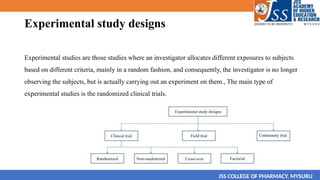
Experimental study designs
Experimental studies are those studies where an investigator allocates different exposures to subjects
based on different criteria, mainly in a random fashion, and consequently, the investigator is no longer
observing the subjects, but is actually carrying out an experiment on them., The main type of
experimental studies is the randomized clinical trials.
JSS COLLEGE OF PHARMACY. MYSURU
Randomized clinical trail
RCTs are quantitative, comparative, controlled experiments in which investigators study two or
more interventions in a series of individuals who receive them in random order. The RCT is one of
the simplest and most powerful tools in clinical research.
JSS COLLEGE OF PHARMACY. MYSURU
TYPES OF RANDOMIZATION
1. RANDOM ASSIGNMENT:
Flip a coin"Heads"-T x A
"Tails“ T x B
‣ Roll a six-sided dice
Even number T x A
Odd number- Tx B
JSS COLLEGE OF PHARMACY. MYSURU
2. BLOCK RANDOMIZATION:
• Subjects are divided into blocks' and randomization is carried out in each blocks.
• Ex; for two treatments and a block size of four, two of every four consecutive patients
would receive the experimental therapy and the other two would receive control therapy.
EECC,ECEC, ECCE, CCEE, CECE.
STRATIFIED RANDOMIZATION:• It may be important to ensure that the treatment
and control groups are balanced on important prognostic factors that can influence the
study outcome (e.g., gender, ethnicity, age, socioeconomic status). • Before doing the
trial, the investigator decides which strata are important and how many stratification
variables can be considered given the proposed sample size.
JSS COLLEGE OF PHARMACY. MYSURU
Clinical trial
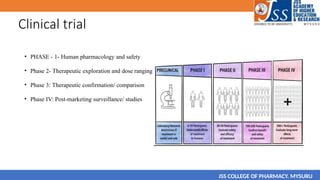
• PHASE - 1- Human pharmacology and safety
• Phase 2- Therapeutic exploration and dose ranging
• Phase 3: Therapeutic confirmation/ comparison
• Phase IV: Post-marketing surveillance/ studies
JSS COLLEGE OF PHARMACY. MYSURU
THANK YOU!
JSS COLLEGE OF PHARMACY. MYSURU

clinical research study designs overview.pptx

  • 1.
    SEMINAR ON Clinical studyresearch designs Name: Dharnish GS M. Pharm I year Department of Pharmacy Practice JSS College of Pharmacy, Mysuru JSS COLLEGE OF PHARMACY. MYSURU
  • 2.
    AGENDA • Introduction • OBSERVATIONALSTUDY DESIGN • EXPERIMENTAL STUDY DESIGN • CONCLUSION • REFERENCE JSS COLLEGE OF PHARMACY. MYSURU
  • 3.
    Introduction • A studydesign is a scientific method that a researcher follows to assess the association between an exposure and an outcome. • It depends on the subjects that are selected, observed followed and studied. • In clinical research, there are two broad categories of study designs, mainly observational and experimental. . JSS COLLEGE OF PHARMACY. MYSURU
  • 4.
    Descriptive studies the mainobjective of the research is to describe the main features of the population. There are different types of descriptive studies, mainly Case reports, Case series, and Cross-sectional study. Case report It is a report that documents unusual medical occurrences that can represent the first clue in the identification of new diseases or adverse effects of exposures (based on one patient). It includes a summary of the disease, such as the presentation signs, symptoms, diagnostic studies, treatment course, and outcome. JSS COLLEGE OF PHARMACY. MYSURU
  • 5.
    Case series. It isa collection of different case reports, thus based on more than one patient. Cross-sectional study It is a study in which data is collected at one point in time and which reflects information on prevalence of outcomes. JSS COLLEGE OF PHARMACY. MYSURU
  • 6.
    Analytical studies• These arestudies designed for research with the main C objective being beyond description, and where a specific association is assessed. The main types of analytical studies are Case-control study Cohort study Case-control study It is a study where participants are recruited based on their outcome status; a group having the disease and another who are disease-free. Information on past exposure is collected and compared between the two groups JSS COLLEGE OF PHARMACY. MYSURU
  • 7.
    Cohort study Itis a study where participants are recruited pased on their exposure status; a group having the exposure under study, and another group who are exposure- free, The subjects are followed in time to observe the occurrence of the outcome in both groups. JSS COLLEGE OF PHARMACY. MYSURU
  • 8.
    Experimental study designs Experimentalstudies are those studies where an investigator allocates different exposures to subjects based on different criteria, mainly in a random fashion, and consequently, the investigator is no longer observing the subjects, but is actually carrying out an experiment on them., The main type of experimental studies is the randomized clinical trials. JSS COLLEGE OF PHARMACY. MYSURU
  • 9.
    Randomized clinical trail RCTsare quantitative, comparative, controlled experiments in which investigators study two or more interventions in a series of individuals who receive them in random order. The RCT is one of the simplest and most powerful tools in clinical research. JSS COLLEGE OF PHARMACY. MYSURU
  • 10.
    TYPES OF RANDOMIZATION 1.RANDOM ASSIGNMENT: Flip a coin"Heads"-T x A "Tails“ T x B ‣ Roll a six-sided dice Even number T x A Odd number- Tx B JSS COLLEGE OF PHARMACY. MYSURU
  • 11.
    2. BLOCK RANDOMIZATION: •Subjects are divided into blocks' and randomization is carried out in each blocks. • Ex; for two treatments and a block size of four, two of every four consecutive patients would receive the experimental therapy and the other two would receive control therapy. EECC,ECEC, ECCE, CCEE, CECE. STRATIFIED RANDOMIZATION:• It may be important to ensure that the treatment and control groups are balanced on important prognostic factors that can influence the study outcome (e.g., gender, ethnicity, age, socioeconomic status). • Before doing the trial, the investigator decides which strata are important and how many stratification variables can be considered given the proposed sample size. JSS COLLEGE OF PHARMACY. MYSURU
  • 12.
    Clinical trial • PHASE- 1- Human pharmacology and safety • Phase 2- Therapeutic exploration and dose ranging • Phase 3: Therapeutic confirmation/ comparison • Phase IV: Post-marketing surveillance/ studies JSS COLLEGE OF PHARMACY. MYSURU
  • 13.
    THANK YOU! JSS COLLEGEOF PHARMACY. MYSURU