CLINICAL PHARMACY CASE STUDIES
CASE STUDIES 01-03CASE STUDIES 01-03
ON DEMAND LECTURE
FACILITATOR:
MUHAMMAD SAQUIB QURESHI
PHARMACIST BY EDUCATION & PROFESSION
YOU HAVING SEMESTER EXAMS OF PHARM-D?
FACING DIFFICULTY TO LEARN TOPICS?
WE ARE HERE FOR YOU!
SEND US YOUR TOPIC NAME @ 0333-2243031
WE WILL EXPLAIN SIMPLY VIA VIDEO LECTURES
CLINICAL PHARMACY CASE # 01
A 39-year-old male taking varenicline for smoking cessation
reports that he has been suffering from vivid dreams and has
become increasingly aggressive towards his family. Last night he
had a major argument with his wife. His wife mentioned he
hadn't been the same since he started the varenicline and he
would like to know if this was a possible cause.
LECTUREON
DEM
AND
Question # 01.
Is varenicline a possible cause of his vivid dreams and aggression?
Question # 02.
Is this a reportable adverse drug reaction?
CLINICAL PHARMACY CASE # 01
LECTUREON
DEM
AND
ANSWER # 01
Prescribers have been warned that such reactions have been
reported. Assessing the cause of this reaction is difficult, since
smoking cessation itself is associated with exacerbations of
underlying psychiatric illness and the risk of symptoms of
depression.
Varenicline has been associated with neuropsychiatric ADRs,
including depression, suicidal thoughts, suicidal behaviour and
aggression. Vivid dreams and other sleep disorders have also
been reported.
As varenicline dosing starts 1–2 weeks before stopping smoking, a
key question is how long the patient has been taking the drug,
and if the symptoms appeared before the smoking cessation date.
ANSWER # 02
Only a suspicion is necessary to report a reaction, not proven
causality. In the case of intensively monitored medicines
(identified by an inverted black triangle in the BNF), any reaction,
no matter how trivial should be reported.
If a health professional considers that a patient's symptoms are a
possible ADR to a newer drug, then they should be reported to
regulatory authorities (in the UK, this would be through the
MHRA's Yellow Card Scheme).
Patients can also report directly to regulatory authorities in some
countries, including the UK. Neuropsychiatric reactions such as
this are commonly reported by patients.
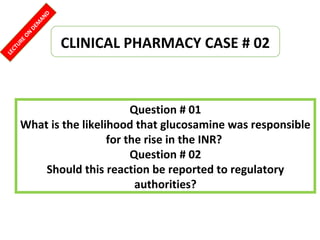
CLINICAL PHARMACY CASE # 02
A 55-year-old woman attending a warfarin out-
patient clinic has a raised INR. On questioning it
is discovered that she has recently started taking
glucosamine for muscle aches for the last 2
weeks.
LECTUREON
DEM
AND
Question # 01
What is the likelihood that glucosamine was responsible
for the rise in the INR?
Question # 02
Should this reaction be reported to regulatory
authorities?
CLINICAL PHARMACY CASE # 02
LECTUREON
DEM
AND
ANSWER # 01
While there is no known mechanism and no formal interaction
studies, the published cases and spontaneous reports are
sufficient evidence to suggest a potential interaction.
Glucosamine is a popular supplement purchased for ‘joint
health’. It is commonly used by older patients. Spontaneous
reports of interactions between warfarin and glucosamine have
been submitted to UK, Australian and US regulators. Additional
cases have been reported in the literature.
Given the wide use of glucosamine, the interaction may be rare,
although under-reporting is common. Assessment of this
individual case requires further questioning to eliminate other
confounding factors such as changes in diet or adherence issues
ANSWER # 02
Collation of such reports allows regulators to gather
further information on the suspected reaction, and any
susceptibilities that may in time provide useful
information to other users
Interactions with, or adverse reactions to,
complementary and alternative remedies can be
reported to spontaneous reporting schemes, such as the
Yellow Card Scheme.
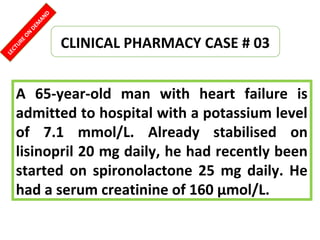
CLINICAL PHARMACY CASE # 03
A 65-year-old man with heart failure is
admitted to hospital with a potassium level
of 7.1 mmol/L. Already stabilised on
lisinopril 20 mg daily, he had recently been
started on spironolactone 25 mg daily. He
had a serum creatinine of 160 μmol/L.
LECTUREON
DEM
AND
Question # 01
What is the mechanism of any possible adverse
drug reaction?
Question # 02
How should future episodes of hyperkalaemia be
avoided?
CLINICAL PHARMACY CASE # 03
LECTUREON
DEM
AND
ANSWER # 01
However, spironolactone can increase potassium serum levels
due to its effect on aldosterone. When used in combination with
ACE inhibitors, serious hyperkalaemia can occur.
Spironolactone, an aldosterone receptor antagonist, has a
beneficial effect on mortality and hospital admission in patients
with heart failure.
Although clinical trials of spironolactone showed no risk, cases
have been reported in the literature and other epidemiological
studies have indicated that in real-world clinical situations, the
incidence of hyperkalaemia is increased
ANSWER # 02
Those with mildly increased serum potassium should have a
reduced dose of spironolactone.
Care should be taken when prescribing spironolactone outside of
trial criteria, particularly with regard to renal function. Other
susceptibilities for the development of hyperkalaemia include
diabetes and the elderly due to reduced aldosterone production.
Changes in other therapy should be monitored, as well as
episodes of acute illness.
More intensive monitoring of potassium levels at the
commencement of therapy might be useful, although the
hyperkalaemia can occur months after initiation.
Clinical Pharmacy Case Studies - Lecture # 01

Clinical Pharmacy Case Studies - Lecture # 01

  • 1.
    CLINICAL PHARMACY CASESTUDIES CASE STUDIES 01-03CASE STUDIES 01-03 ON DEMAND LECTURE FACILITATOR: MUHAMMAD SAQUIB QURESHI PHARMACIST BY EDUCATION & PROFESSION
  • 2.
    YOU HAVING SEMESTEREXAMS OF PHARM-D? FACING DIFFICULTY TO LEARN TOPICS? WE ARE HERE FOR YOU! SEND US YOUR TOPIC NAME @ 0333-2243031 WE WILL EXPLAIN SIMPLY VIA VIDEO LECTURES
  • 3.
    CLINICAL PHARMACY CASE# 01 A 39-year-old male taking varenicline for smoking cessation reports that he has been suffering from vivid dreams and has become increasingly aggressive towards his family. Last night he had a major argument with his wife. His wife mentioned he hadn't been the same since he started the varenicline and he would like to know if this was a possible cause. LECTUREON DEM AND
  • 4.
    Question # 01. Isvarenicline a possible cause of his vivid dreams and aggression? Question # 02. Is this a reportable adverse drug reaction? CLINICAL PHARMACY CASE # 01 LECTUREON DEM AND
  • 5.
    ANSWER # 01 Prescribershave been warned that such reactions have been reported. Assessing the cause of this reaction is difficult, since smoking cessation itself is associated with exacerbations of underlying psychiatric illness and the risk of symptoms of depression. Varenicline has been associated with neuropsychiatric ADRs, including depression, suicidal thoughts, suicidal behaviour and aggression. Vivid dreams and other sleep disorders have also been reported. As varenicline dosing starts 1–2 weeks before stopping smoking, a key question is how long the patient has been taking the drug, and if the symptoms appeared before the smoking cessation date.
  • 6.
    ANSWER # 02 Onlya suspicion is necessary to report a reaction, not proven causality. In the case of intensively monitored medicines (identified by an inverted black triangle in the BNF), any reaction, no matter how trivial should be reported. If a health professional considers that a patient's symptoms are a possible ADR to a newer drug, then they should be reported to regulatory authorities (in the UK, this would be through the MHRA's Yellow Card Scheme). Patients can also report directly to regulatory authorities in some countries, including the UK. Neuropsychiatric reactions such as this are commonly reported by patients.
  • 7.
    CLINICAL PHARMACY CASE# 02 A 55-year-old woman attending a warfarin out- patient clinic has a raised INR. On questioning it is discovered that she has recently started taking glucosamine for muscle aches for the last 2 weeks. LECTUREON DEM AND
  • 8.
    Question # 01 Whatis the likelihood that glucosamine was responsible for the rise in the INR? Question # 02 Should this reaction be reported to regulatory authorities? CLINICAL PHARMACY CASE # 02 LECTUREON DEM AND
  • 9.
    ANSWER # 01 Whilethere is no known mechanism and no formal interaction studies, the published cases and spontaneous reports are sufficient evidence to suggest a potential interaction. Glucosamine is a popular supplement purchased for ‘joint health’. It is commonly used by older patients. Spontaneous reports of interactions between warfarin and glucosamine have been submitted to UK, Australian and US regulators. Additional cases have been reported in the literature. Given the wide use of glucosamine, the interaction may be rare, although under-reporting is common. Assessment of this individual case requires further questioning to eliminate other confounding factors such as changes in diet or adherence issues
  • 10.
    ANSWER # 02 Collationof such reports allows regulators to gather further information on the suspected reaction, and any susceptibilities that may in time provide useful information to other users Interactions with, or adverse reactions to, complementary and alternative remedies can be reported to spontaneous reporting schemes, such as the Yellow Card Scheme.
  • 11.
    CLINICAL PHARMACY CASE# 03 A 65-year-old man with heart failure is admitted to hospital with a potassium level of 7.1 mmol/L. Already stabilised on lisinopril 20 mg daily, he had recently been started on spironolactone 25 mg daily. He had a serum creatinine of 160 μmol/L. LECTUREON DEM AND
  • 12.
    Question # 01 Whatis the mechanism of any possible adverse drug reaction? Question # 02 How should future episodes of hyperkalaemia be avoided? CLINICAL PHARMACY CASE # 03 LECTUREON DEM AND
  • 13.
    ANSWER # 01 However,spironolactone can increase potassium serum levels due to its effect on aldosterone. When used in combination with ACE inhibitors, serious hyperkalaemia can occur. Spironolactone, an aldosterone receptor antagonist, has a beneficial effect on mortality and hospital admission in patients with heart failure. Although clinical trials of spironolactone showed no risk, cases have been reported in the literature and other epidemiological studies have indicated that in real-world clinical situations, the incidence of hyperkalaemia is increased
  • 14.
    ANSWER # 02 Thosewith mildly increased serum potassium should have a reduced dose of spironolactone. Care should be taken when prescribing spironolactone outside of trial criteria, particularly with regard to renal function. Other susceptibilities for the development of hyperkalaemia include diabetes and the elderly due to reduced aldosterone production. Changes in other therapy should be monitored, as well as episodes of acute illness. More intensive monitoring of potassium levels at the commencement of therapy might be useful, although the hyperkalaemia can occur months after initiation.