Adverse drug reactions
and drug interactions
By Dr. RIMA ABOSETTA
CONTENTS
2 Introduction to ADRs
Classifi cation of ADRs
Adverse reactions: drug or
disease?
Helping patients understand the
risk of ADRs
Reporting ADRs
Drug interactions
Managing drug interactions
Adverse drug reactions (ADRs), also known as ‘side effects’, ‘adverse drug events’, or ‘drug
misadventures’, are a frequent cause of morbidity in hospital and the community. They have a
signifi cant cost both fi nancially and in terms of quality of life. Few studies of ADRs have been
carried out in the community so the effect on primary care is harder to assess, but studies in the
hospital environment have shown the following.
• ADRs occur in 10–20 % of patients in hospital.
• ADRs are responsible for 5 % of admissions to hospital.
• ADRs might be responsible for 1 in 1000 deaths in medical wards.
• ADRs are the most common cause of iatrogenic injury in hospital patients.
The World Health Organization (WHO) defi nes an ADR as follows:
‘ a drug-related event that is noxious and unintended and occurs at doses used in humans for
prophylaxis, diagnosis or therapy of disease or for the modifi cation of physiological function .’
However, this defi nition does not take into account the following scenarios, all of which can also
cause ADRs:
• overdose (including prescribing or administration errors)
• therapeutic failure
• drug interactions
• drug withdrawal.
Pharmacists have an important role in identifying, reporting, and preventing
Classifi cation of ADRs
A number of classifi cation systems exist, but the most widely accepted is to group ADRs as either type
A (predictable) or type B (unpredict- able) reactions. This system is not ideal because some types of
reaction
(e.g. teratogenic effects) do not fi t easily into either category. However,
it is a useful system in most cases because immediate management of the ADR and future drug choices
can be guided by the ADR type.
type A reactions :
An exaggerated, but otherwise normal, pharmacological action. Type A
reactions have the following characteristics:
• largely predictable
• usually dose-dependent
• incidence and morbidity high
• mortality low.
Examples of type A reactions include respiratory depression with opioid analgesia, cough
with angiotensin-coverting enzyme (ACE) inhibitors, and withdrawal effects with
benzodiazepines or alcohol.
Type B reactions :
Idiosyncratic, aberrant, or bizarre drug effects that are
unrelated to the
pharmacology of the drug. Type B reactions have the following
charac-
teristics:
• usually unpredictable
• might not be picked up by toxicological screening
• not necessarily dose-related
• incidence and morbidity low
• mortality high.
Type B reactions are most commonly immunological (e.g.
penicillin allergy
Adverse reactions: drug or
disease?
Determining whether or not a symptom is an ADR can be diffi cult, especially if the patient has multiple pathologies. Experience has shown that
pharmacists tend to blame the drug and doctors to blame the disease.
Questions to ask are as follows.
• Is there another explanation for the symptom (e.g. disease-related)?
• Is this a previously reported side effect of this drug? How common is it?
This is harder to assess for new drugs because there is less information available.
• Is the timing right? Most ADRs occur soon after starting a drug, although some ADRs (e.g. hepatotoxicity) might be delayed. The onset of some
hypersensitivity reactions (e.g. penicillin rash) can be delayed
for up to 10 days after starting the drug. This can cause confusion,
especially if the antibiotic course has been completed before the rash appears.
• Is the dose excessive? Check serum levels if available. Check renal function — was the dose too high if renal function is impaired? If the symptom
can be explained as a type A reaction and the dose is high for whatever reason, it is more probable that the reaction is drug-induced.
• Does the symptom resolve on stopping the drug or reducing the dose (de-challenge)? Type A reactions are usually dose-dependent and so will
worsen on dose increase, but rapidly resolve or improve on dose reduction or drug withdrawal. Type B reactions are dose-independent
and will rarely resolve with dose reduction. Drug withdrawal is necessary, but if symptoms are caused by immunological effects
(rather than direct drug action) it could take some days or weeks for symptoms to resolve.
• Does the symptom recur on restarting the drug (re-challenge)? Remember that re-challenge can be especially hazardous for type B reactions and
is usually not advised. If the answer to the fi rst question is ‘no’ and the answer to (most of) the other questions is ‘yes’, it is highly probable that
the event is an ADR.
factors predisposing to ADRs
Factors that predispose to ADRs are many and varied, and some are related only
to specifi c disease–drug interactions, such as rash with amox- cillin in patients
with glandular fever. However, the following factors are generally considered to
i patient risk:
• age
• renal impairment
• hepatic impairment
• ‘frailty’
• polypharmacy
• 5
• previous history of ADRs
• genetics.
The first four factors predispose to type A reactions because they are
determinants of drug toxicity, but the remaining factors predispose to type A or
type B reactions
70% 80%
Subtitle
Lorem ipsum dolor sit amet,
consectetuer adipiscing elit.
Aenean commodo ligula
eget dolor.
Subtitle
Lorem ipsum dolor sit amet,
consectetuer adipiscing elit.
Aenean commodo ligula
eget dolor.
Helping patients understand the risk of ADRs :
Terms such as ‘common’ and ‘uncommon’ are used to describe levels of risk of ADRs in pat
information leafl ets and summaries of product characteristics. The terms are standardized by
European Union according to the reported frequency found in clinical trials for example, but patie
routinely overestimate the level of risk that these terms are intended to imply.
The following strategies should help in communicating risk to patients.
• Avoid using verbal descriptors such as ‘common’.
• Use frequencies rather than percentages — e.g. 1 person in every 1000
rather than 0.1 % .
• Use the same denominator throughout — i.e. 1 in 1000 and 10 in 1000 rather than 1 in 1000 and
100.
• Give both positive and negative information — e.g. 95 out 100 patients did not get the side eff
and 5 patients did.
• Give information about baseline risk — e.g.
• The risk of deep vein thrombosis (DVT) in non-pregnant women who are not taking the combi
oral contraceptive (COC) is 5 cases per 100 000 women per year.
• The risk of DVT in pregnancy is 60 cases per 100 000 pregnancies.
• The risk of DVT in women taking the COC is 15–25 cases per 100 000 per year.
SUMMARY
REPORT
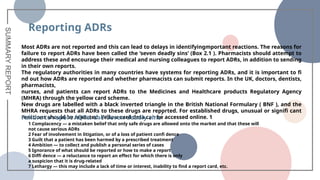
Reporting ADRs
Most ADRs are not reported and this can lead to delays in identifyingmportant reactions. The reasons for
failure to report ADRs have been called the ‘seven deadly sins’ (Box 2.1 ). Pharmacists should attempt to
address these and encourage their medical and nursing colleagues to report ADRs, in addition to sending
in their own reports.
The regulatory authorities in many countries have systems for reporting ADRs, and it is important to fi
nd out how ADRs are reported and whether pharmacists can submit reports. In the UK, doctors, dentists,
pharmacists,
nurses, and patients can report ADRs to the Medicines and Healthcare products Regulatory Agency
(MHRA) through the yellow card scheme.
New drugs are labelled with a black inverted triangle in the British National Formulary ( BNF ), and the
MHRA requests that all ADRs to these drugs are reported. For established drugs, unusual or signifi cant
reactions should be reported. Yellow card data can be accessed online. 1
1 Complacency — a mistaken belief that only safe drugs are allowed onto the market and that these will
not cause serious ADRs
2 Fear of involvement in litigation, or of a loss of patient confi dence
3 Guilt that a patient has been harmed by a prescribed treatment
4 Ambition — to collect and publish a personal series of cases
5 Ignorance of what should be reported or how to make a report
6 Diffi dence — a reluctance to report an effect for which there is only
a suspicion that it is drug-related
7 Lethargy — this may include a lack of time or interest, inability to find a report card, etc.
Failure to report ADRs: the ‘seven deadly sins’
Drug interactions
Drug interactions occur when the effect of a drug is altered by the co-
administration of any of the following:
• another drug.
• food.
• drink.
The outcome of this is as follows:
• frequently clinically insignificant
• sometimes beneficial
• occasionally potentially harmful.
Mechanisms of drug interactions
Interactions can be caused by pharmacokinetic mechanisms (i.e. the han-dling
of the drug in the body is affected) or pharmacodynamic mechanisms (i.e.
related to the pharmacology of the drug). Sometimes the interaction can be
caused by more than one mechanism, although usually one mechanism is
more signifi cant. The majority of interactions are caused by the following
mechanisms.
Pharmacokinetic mechanisms
Absorption
One drug will i or d the absorption of another. This is most frequently due to one drug or compound
interacting with another — by adsorption, chelation or complexing — to form a product that is poorly
absorbed.
This can be benefi cial (e.g. activated charcoal adsorbs certain poisons) or problematic (e.g. antacids and
tetracyclines).
Changes in gastric pH affect the absorption of certain drugs — e.g. ketoconazole and itraconazole require an
acidic environment to be absorbed; thus proton pump inhibitors can d absorption and an acidic drink such
as fruit juice or soft drinks (especially Coca Cola ® ) will i absorption.
Most drugs are absorbed from the upper part of the small intestine.
Thus changes in gut motility potentially affect absorption. Usually the total amount absorbed is unaffected,
but the rate of absorption might be altered. This effect is used in some combination migraine products —
e.g. including metoclopramide (an antiemetic) speeds up the rate of absorption of the analgesic.
Distribution
Some drugs are bound to proteins in the serum. Only free (unbound) drug is active. Protein binding is a
competitive effect, so one drug can displace the other from protein binding sites. This interaction is only an
issue with highly protein bound drugs and is only signifi cant if most of the drug remains in the plasma
rather than being distributed into tissues (i.e. a low volume of distribution). Displacement of drug from
protein binding sites often only causes a small ‘blip’ in drug levels before equilib-rium is restored (because
the free drug is also now available for metabolism and excretion), but it could be signifi cant for drugs with a
narrow therapeutic index (e.g. warfarin)
Metabolism
Accounts for the majority of clinically signifi cant pharmacokinetic interactions.
Induction or inhibition of the cytochrome P450 (CYP450) system leads to changes in
drug levels. CYP450 represents a large group of isoenzymes; drugs are rarely
metabolized by a single enzyme, although one usually predominates. Equally, drugs can
induce or inhibit several enzymes and some drugs can induce some enzymes and
inhibit others (e.g. efavirenz).
In addition, some (but not all) enzyme inhibitors or inducers can induce or inhibit their
own metabolism.
When only two drugs are involved, the effect is fairly easy to predict,
even if each drug is likely to affect the metabolism of the other. However, if three or
more drugs, all of which are inducers or inhibitors, are involved, the effect is almost
impossible to predict, and this type of combination should be avoided if possible.
The full effects of enzyme induction and inhibition do not occur immediately.
• Enzyme induction takes about 2–3wks to develop and wear off.
• Enzyme inhibition takes only a few days.
Thus, it might be necessary to delay dose adjustment or TDM until a few days
(inhibition) or at least a week (induction) after starting or stopping the offending
drug(s).
An emerging area of study is drug interactions involving induction or inhibition of p-
glycoprotein. This probably includes interactions involving i in bioavailability because it
Excretion
Some drugs interfere with excretion (usually renal) of other drugs. If both drugs are excreted by the
same active transport system in the kidney tubule, the excretion of each drug is d by the other. This
might be used
m as a beneficial effect — e.g. probenecid has been used to prolong the half- life of penicillin — or be
problematic — e.g. methotrexate and non-steroidal
anti-infl ammatory drugs (NSAIDs).
Pharmacodynamic interactions
These occur if the pharmacological effects of two drugs are additive or opposing.
• Additive — the desired or adverse effects of the two drugs are the same. This can be benefi cial or
potentially harmful (e.g. i sedation with alcohol plus hypnotics).
• Synergism — which is a form of additive effect. In this instance the combination of the two drugs has a
greater effect than just an additive effect (e.g. ethambutol i the effectiveness of other anti-tubercular
drugs).
• Antagonism — at receptor level (e.g. a B-blocker should be prescribed with caution to an asthmatic
patient who uses a B-agonist inhaler) or because of opposing effects (e.g. the desired effects of diuretics
could be, at least partly, opposed by fl uid retention caused by NSAIDs
Predicting drug interactions
• Are the desired or adverse effects of the two drugs similar or opposing?
• If there is no information available for the drugs in question, are there reports
of drug interactions for other drugs in the same class?
• Are both drugs metabolizedt by the liver and, if so, by which enzymes?
Information on which drugs are metabolized by which CYP450 enzymes might be
listed in the summary of product characteristics and
can also be found on the following websites:
• www.hiv-druginteractions.org
• medicine.iupui.edu/fl ockhart/
• Drugs that are predominantly renally cleared are unlikely to interact with
enzyme inducers and inhibitors
Managing drug interactions
• Check whether or not the drug combination is new.
• If the patient has already been taking the drug combination, have they tolerated it? If yes, there is probably no n
to change therapy, although monitoring might be required.
• Is the interaction potentially serious (e.g. signifi cant risk of toxicity or d drug effect) — in which case s
alternatives.
• Is the interaction potentially of low to moderate signifi cance — in which case it might only be necessary to mon
side effects and therapeutic effect, or arrange TDM.
• Remember that some drugs in the same class can have different potentials to cause interactions (e.g. ranitidine ve
cimetidine).
• Remember that not only do interactions occur when a drug is started,
but unwanted effects can also occur when a drug is stopped.
• The elderly are at greater risk of drug interactions, because of polypharmacy and impaired metabolism and excret
Additive side effects can be a particular problem.
• Be aware of high-risk drugs and always check for potential interactions with these drugs:
• enzyme inhibitors and inducers (e.g. erythromycin, rifampicin, phenytoin, and protease inhibitors)
• drugs with a narrow therapeutic index (e.g. warfarin, digoxin, lithium, phenytoin, theophylline, and gentamicin).
• Remember that interactions can occur with non-prescription drugs, which the patient might not tell you about:
• herbal or traditional medicines
• over-the-counter medicines
• recreational drugs, including alcohol, tobacco, and drugs obtained by other means, such as sildenafi l purchased
the internet
Thank you

adverse drug reactions & interactions .pptx

  • 1.
    Adverse drug reactions anddrug interactions By Dr. RIMA ABOSETTA
  • 2.
    CONTENTS 2 Introduction toADRs Classifi cation of ADRs Adverse reactions: drug or disease? Helping patients understand the risk of ADRs Reporting ADRs Drug interactions Managing drug interactions
  • 3.
    Adverse drug reactions(ADRs), also known as ‘side effects’, ‘adverse drug events’, or ‘drug misadventures’, are a frequent cause of morbidity in hospital and the community. They have a signifi cant cost both fi nancially and in terms of quality of life. Few studies of ADRs have been carried out in the community so the effect on primary care is harder to assess, but studies in the hospital environment have shown the following. • ADRs occur in 10–20 % of patients in hospital. • ADRs are responsible for 5 % of admissions to hospital. • ADRs might be responsible for 1 in 1000 deaths in medical wards. • ADRs are the most common cause of iatrogenic injury in hospital patients. The World Health Organization (WHO) defi nes an ADR as follows: ‘ a drug-related event that is noxious and unintended and occurs at doses used in humans for prophylaxis, diagnosis or therapy of disease or for the modifi cation of physiological function .’ However, this defi nition does not take into account the following scenarios, all of which can also cause ADRs: • overdose (including prescribing or administration errors) • therapeutic failure • drug interactions • drug withdrawal. Pharmacists have an important role in identifying, reporting, and preventing
  • 4.
    Classifi cation ofADRs A number of classifi cation systems exist, but the most widely accepted is to group ADRs as either type A (predictable) or type B (unpredict- able) reactions. This system is not ideal because some types of reaction (e.g. teratogenic effects) do not fi t easily into either category. However, it is a useful system in most cases because immediate management of the ADR and future drug choices can be guided by the ADR type. type A reactions : An exaggerated, but otherwise normal, pharmacological action. Type A reactions have the following characteristics: • largely predictable • usually dose-dependent • incidence and morbidity high • mortality low. Examples of type A reactions include respiratory depression with opioid analgesia, cough with angiotensin-coverting enzyme (ACE) inhibitors, and withdrawal effects with benzodiazepines or alcohol.
  • 5.
    Type B reactions: Idiosyncratic, aberrant, or bizarre drug effects that are unrelated to the pharmacology of the drug. Type B reactions have the following charac- teristics: • usually unpredictable • might not be picked up by toxicological screening • not necessarily dose-related • incidence and morbidity low • mortality high. Type B reactions are most commonly immunological (e.g. penicillin allergy
  • 6.
    Adverse reactions: drugor disease? Determining whether or not a symptom is an ADR can be diffi cult, especially if the patient has multiple pathologies. Experience has shown that pharmacists tend to blame the drug and doctors to blame the disease. Questions to ask are as follows. • Is there another explanation for the symptom (e.g. disease-related)? • Is this a previously reported side effect of this drug? How common is it? This is harder to assess for new drugs because there is less information available. • Is the timing right? Most ADRs occur soon after starting a drug, although some ADRs (e.g. hepatotoxicity) might be delayed. The onset of some hypersensitivity reactions (e.g. penicillin rash) can be delayed for up to 10 days after starting the drug. This can cause confusion, especially if the antibiotic course has been completed before the rash appears. • Is the dose excessive? Check serum levels if available. Check renal function — was the dose too high if renal function is impaired? If the symptom can be explained as a type A reaction and the dose is high for whatever reason, it is more probable that the reaction is drug-induced. • Does the symptom resolve on stopping the drug or reducing the dose (de-challenge)? Type A reactions are usually dose-dependent and so will worsen on dose increase, but rapidly resolve or improve on dose reduction or drug withdrawal. Type B reactions are dose-independent and will rarely resolve with dose reduction. Drug withdrawal is necessary, but if symptoms are caused by immunological effects (rather than direct drug action) it could take some days or weeks for symptoms to resolve. • Does the symptom recur on restarting the drug (re-challenge)? Remember that re-challenge can be especially hazardous for type B reactions and is usually not advised. If the answer to the fi rst question is ‘no’ and the answer to (most of) the other questions is ‘yes’, it is highly probable that the event is an ADR.
  • 7.
    factors predisposing toADRs Factors that predispose to ADRs are many and varied, and some are related only to specifi c disease–drug interactions, such as rash with amox- cillin in patients with glandular fever. However, the following factors are generally considered to i patient risk: • age • renal impairment • hepatic impairment • ‘frailty’ • polypharmacy • 5 • previous history of ADRs • genetics. The first four factors predispose to type A reactions because they are determinants of drug toxicity, but the remaining factors predispose to type A or type B reactions
  • 8.
    70% 80% Subtitle Lorem ipsumdolor sit amet, consectetuer adipiscing elit. Aenean commodo ligula eget dolor. Subtitle Lorem ipsum dolor sit amet, consectetuer adipiscing elit. Aenean commodo ligula eget dolor. Helping patients understand the risk of ADRs : Terms such as ‘common’ and ‘uncommon’ are used to describe levels of risk of ADRs in pat information leafl ets and summaries of product characteristics. The terms are standardized by European Union according to the reported frequency found in clinical trials for example, but patie routinely overestimate the level of risk that these terms are intended to imply. The following strategies should help in communicating risk to patients. • Avoid using verbal descriptors such as ‘common’. • Use frequencies rather than percentages — e.g. 1 person in every 1000 rather than 0.1 % . • Use the same denominator throughout — i.e. 1 in 1000 and 10 in 1000 rather than 1 in 1000 and 100. • Give both positive and negative information — e.g. 95 out 100 patients did not get the side eff and 5 patients did. • Give information about baseline risk — e.g. • The risk of deep vein thrombosis (DVT) in non-pregnant women who are not taking the combi oral contraceptive (COC) is 5 cases per 100 000 women per year. • The risk of DVT in pregnancy is 60 cases per 100 000 pregnancies. • The risk of DVT in women taking the COC is 15–25 cases per 100 000 per year.
  • 9.
    SUMMARY REPORT Reporting ADRs Most ADRsare not reported and this can lead to delays in identifyingmportant reactions. The reasons for failure to report ADRs have been called the ‘seven deadly sins’ (Box 2.1 ). Pharmacists should attempt to address these and encourage their medical and nursing colleagues to report ADRs, in addition to sending in their own reports. The regulatory authorities in many countries have systems for reporting ADRs, and it is important to fi nd out how ADRs are reported and whether pharmacists can submit reports. In the UK, doctors, dentists, pharmacists, nurses, and patients can report ADRs to the Medicines and Healthcare products Regulatory Agency (MHRA) through the yellow card scheme. New drugs are labelled with a black inverted triangle in the British National Formulary ( BNF ), and the MHRA requests that all ADRs to these drugs are reported. For established drugs, unusual or signifi cant reactions should be reported. Yellow card data can be accessed online. 1 1 Complacency — a mistaken belief that only safe drugs are allowed onto the market and that these will not cause serious ADRs 2 Fear of involvement in litigation, or of a loss of patient confi dence 3 Guilt that a patient has been harmed by a prescribed treatment 4 Ambition — to collect and publish a personal series of cases 5 Ignorance of what should be reported or how to make a report 6 Diffi dence — a reluctance to report an effect for which there is only a suspicion that it is drug-related 7 Lethargy — this may include a lack of time or interest, inability to find a report card, etc. Failure to report ADRs: the ‘seven deadly sins’
  • 10.
    Drug interactions Drug interactionsoccur when the effect of a drug is altered by the co- administration of any of the following: • another drug. • food. • drink. The outcome of this is as follows: • frequently clinically insignificant • sometimes beneficial • occasionally potentially harmful. Mechanisms of drug interactions Interactions can be caused by pharmacokinetic mechanisms (i.e. the han-dling of the drug in the body is affected) or pharmacodynamic mechanisms (i.e. related to the pharmacology of the drug). Sometimes the interaction can be caused by more than one mechanism, although usually one mechanism is more signifi cant. The majority of interactions are caused by the following mechanisms.
  • 11.
    Pharmacokinetic mechanisms Absorption One drugwill i or d the absorption of another. This is most frequently due to one drug or compound interacting with another — by adsorption, chelation or complexing — to form a product that is poorly absorbed. This can be benefi cial (e.g. activated charcoal adsorbs certain poisons) or problematic (e.g. antacids and tetracyclines). Changes in gastric pH affect the absorption of certain drugs — e.g. ketoconazole and itraconazole require an acidic environment to be absorbed; thus proton pump inhibitors can d absorption and an acidic drink such as fruit juice or soft drinks (especially Coca Cola ® ) will i absorption. Most drugs are absorbed from the upper part of the small intestine. Thus changes in gut motility potentially affect absorption. Usually the total amount absorbed is unaffected, but the rate of absorption might be altered. This effect is used in some combination migraine products — e.g. including metoclopramide (an antiemetic) speeds up the rate of absorption of the analgesic. Distribution Some drugs are bound to proteins in the serum. Only free (unbound) drug is active. Protein binding is a competitive effect, so one drug can displace the other from protein binding sites. This interaction is only an issue with highly protein bound drugs and is only signifi cant if most of the drug remains in the plasma rather than being distributed into tissues (i.e. a low volume of distribution). Displacement of drug from protein binding sites often only causes a small ‘blip’ in drug levels before equilib-rium is restored (because the free drug is also now available for metabolism and excretion), but it could be signifi cant for drugs with a narrow therapeutic index (e.g. warfarin)
  • 12.
    Metabolism Accounts for themajority of clinically signifi cant pharmacokinetic interactions. Induction or inhibition of the cytochrome P450 (CYP450) system leads to changes in drug levels. CYP450 represents a large group of isoenzymes; drugs are rarely metabolized by a single enzyme, although one usually predominates. Equally, drugs can induce or inhibit several enzymes and some drugs can induce some enzymes and inhibit others (e.g. efavirenz). In addition, some (but not all) enzyme inhibitors or inducers can induce or inhibit their own metabolism. When only two drugs are involved, the effect is fairly easy to predict, even if each drug is likely to affect the metabolism of the other. However, if three or more drugs, all of which are inducers or inhibitors, are involved, the effect is almost impossible to predict, and this type of combination should be avoided if possible. The full effects of enzyme induction and inhibition do not occur immediately. • Enzyme induction takes about 2–3wks to develop and wear off. • Enzyme inhibition takes only a few days. Thus, it might be necessary to delay dose adjustment or TDM until a few days (inhibition) or at least a week (induction) after starting or stopping the offending drug(s). An emerging area of study is drug interactions involving induction or inhibition of p- glycoprotein. This probably includes interactions involving i in bioavailability because it
  • 13.
    Excretion Some drugs interferewith excretion (usually renal) of other drugs. If both drugs are excreted by the same active transport system in the kidney tubule, the excretion of each drug is d by the other. This might be used m as a beneficial effect — e.g. probenecid has been used to prolong the half- life of penicillin — or be problematic — e.g. methotrexate and non-steroidal anti-infl ammatory drugs (NSAIDs). Pharmacodynamic interactions These occur if the pharmacological effects of two drugs are additive or opposing. • Additive — the desired or adverse effects of the two drugs are the same. This can be benefi cial or potentially harmful (e.g. i sedation with alcohol plus hypnotics). • Synergism — which is a form of additive effect. In this instance the combination of the two drugs has a greater effect than just an additive effect (e.g. ethambutol i the effectiveness of other anti-tubercular drugs). • Antagonism — at receptor level (e.g. a B-blocker should be prescribed with caution to an asthmatic patient who uses a B-agonist inhaler) or because of opposing effects (e.g. the desired effects of diuretics could be, at least partly, opposed by fl uid retention caused by NSAIDs
  • 14.
    Predicting drug interactions •Are the desired or adverse effects of the two drugs similar or opposing? • If there is no information available for the drugs in question, are there reports of drug interactions for other drugs in the same class? • Are both drugs metabolizedt by the liver and, if so, by which enzymes? Information on which drugs are metabolized by which CYP450 enzymes might be listed in the summary of product characteristics and can also be found on the following websites: • www.hiv-druginteractions.org • medicine.iupui.edu/fl ockhart/ • Drugs that are predominantly renally cleared are unlikely to interact with enzyme inducers and inhibitors
  • 15.
    Managing drug interactions •Check whether or not the drug combination is new. • If the patient has already been taking the drug combination, have they tolerated it? If yes, there is probably no n to change therapy, although monitoring might be required. • Is the interaction potentially serious (e.g. signifi cant risk of toxicity or d drug effect) — in which case s alternatives. • Is the interaction potentially of low to moderate signifi cance — in which case it might only be necessary to mon side effects and therapeutic effect, or arrange TDM. • Remember that some drugs in the same class can have different potentials to cause interactions (e.g. ranitidine ve cimetidine). • Remember that not only do interactions occur when a drug is started, but unwanted effects can also occur when a drug is stopped. • The elderly are at greater risk of drug interactions, because of polypharmacy and impaired metabolism and excret Additive side effects can be a particular problem. • Be aware of high-risk drugs and always check for potential interactions with these drugs: • enzyme inhibitors and inducers (e.g. erythromycin, rifampicin, phenytoin, and protease inhibitors) • drugs with a narrow therapeutic index (e.g. warfarin, digoxin, lithium, phenytoin, theophylline, and gentamicin). • Remember that interactions can occur with non-prescription drugs, which the patient might not tell you about: • herbal or traditional medicines • over-the-counter medicines • recreational drugs, including alcohol, tobacco, and drugs obtained by other means, such as sildenafi l purchased the internet
  • 16.