OUR CLIMATE
PROMISE
A MENU FOR CHANGE
2021 ­
– 2022
CLIMATE
IMPACT
REPORT
OUR ROLE PROGRESS CHALLENGES WHAT NEXT APPENDICES
STRATEGY 2
What's inside?
A critical decade
(Foreword: Robin Mills)
Objectives of this report
Impact at scale
Action on all fronts
(Message of support:
Sir Charles Godfray)
Impact to date
Timeline
Carbon
Biodiversity
Waste
The need to rebaseline
Sharp focus in 2023
Difficulty must never
become a deterrent
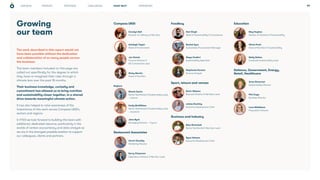
Growing our team
The need for pace
Where we started
What we’ve done
Our Roadmap
Six focus areas
Clear prioritisation
16 key partners
Compensation
& Neutralisation
Deforestation
Plastics & Packaging
Water Stewardship
Methodology
Endnotes
04
05
06
07
08
09
20
24
27
38
39
40
41
42
12
13
14
15
16
17
18
31
33
35
43
46
ONE
OUR ROLE
03
TWO
STRATEGY
11
THREE
PROGRESS
19
FIVE
WHAT NEXT
37
SIX
APPENDICES
42
FOUR
CHALLENGES
30
OUR ROLE PROGRESS CHALLENGES WHAT NEXT APPENDICES
STRATEGY 3
OUR ROLE
OUR ROLE PROGRESS CHALLENGES WHAT NEXT APPENDICES
STRATEGY 4
A critical decade
Compass UK&I is a family of different businesses.
Over the past few years we have all had to dig deep.
Faced by unprecedented challenges, we have never
been more aware of the wellbeing of the people we
serve, from infancy through to old age.
To be healthy, happy and productive, we need a
stable climate and a rich diversity of life. Yet we’re
on a path that will take us to a 3-4˚C world in just
three generations.
The “not too hot, not too cold” Goldilocks Zone that
civilisation has thrived in for thousands of years is
shifting and, for each 1˚C rise, millions of people will
be forced to live in uninhabitable conditions1
.
This human emergency is why we launched our
Climate Promise last year, committing to reach
Climate Net Zero by 2030.
We are now 18 months on.
The motivation, creativity and persistence across
our communities and clients is growing and the
results we have already seen are a credit to so
many people within our organisation and across
the global industry.
But we must move faster.
Food unites us all and we have an extraordinary
opportunity to come together and reduce the
impact of our diets at scale.
I could not be more proud of the foundation and
determination to drive lasting change that’s laid
down in these pages.
There is still so much more work we can do and I
remain committed to what we will, and we must,
achieve together.
Robin Mills
Managing Director, Compass UK&I
OUR ROLE PROGRESS CHALLENGES WHAT NEXT APPENDICES
STRATEGY 5
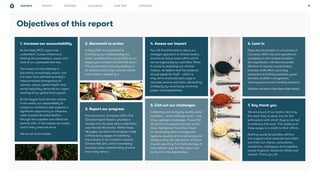
Objectives of this report
1. Increase our accountability
As the latest IPCC report has
underlined2
, human influence is
heating the atmosphere, ocean and
land at an unprecedented rate.
The impact of that heating is
becoming increasingly severe, and
it is clear that addressing today’s
interconnected emergencies of
climate, nature, global health and
social inequality demands an urgent
rewiring of our global food system.
As the largest food services caterer
in the world, our responsibility to
reduce our emissions also presents a
significant opportunity to influence
wider societal decarbonisation –
through the suppliers and clients we
partner with, in the recipes we create,
and in every meal we serve.
We are all accountable.
2. Recommit to action
In May 2021 we committed to
translating our understanding into
action, publicly announcing 2030 as our
target year to reach Climate Net Zero.
This goal remains industry-leading in
its ambition and scope and we remain
committed to delivering it.
5. Call out our challenges
Collecting and analysing quality data
has been – and continues to be – one
of our greatest challenges. These first
18 months of targeted climate action
have highlighted the critical need
for developing data management
systems capable of strengthening and
safeguarding the robustness of future
impact reporting. Full methodology of
calculations used for this report can
be found in the Appendices.
4. Assess our impact
You will find information about our
strategic approach to climate action,
and the six focus areas within which
we are organising our activities. When
it comes to assessing our climate
impact, we believe that the evidence
should speak for itself – which is
why we’ve anchored each page in
concrete actions and data, eliminating
ambiguity by consciously removing
jargon and superlatives.
3. Report our progress
This document, Compass UK&I’s first
Climate Impact Report, provides a
window into the work we’ve undertaken
over the last 18 months. Within these
48 pages, we share the progress made
in these early stages of mobilising
the business in its transition towards
Climate Net Zero, and in increasing
business-wide understanding of what
that really means.
6. Lean in
Deep decarbonisation in a business of
Compass UK&I's size and operational
complexity is the hardest transition
the organisation will ever encounter.
We know it requires concentrated,
business-wide effort, spanning
restaurant and dining expertise, guest
services, facilities management,
cleaning services and vending solutions.
We know we have a Herculean task ahead.
7. Say thank you
We are proud of our teams. Not only
the work they’ve done, but for the
enthusiasm with which they’ve started
to embrace this work. The evidence in
these pages is a credit to their efforts.
Nothing would be possible without
the support we’ve received from them
and from our clients, consultants,
academics, colleagues and suppliers
across England, Scotland, Wales and
Ireland. Thank you all.
OUR ROLE PROGRESS CHALLENGES WHAT NEXT APPENDICES
STRATEGY 6
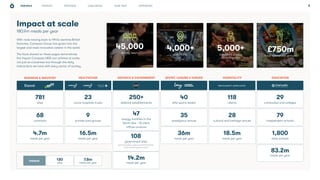
With roots tracing back to 1940s wartime British
factories, Compass Group has grown into the
largest and most innovative caterer in the world.
The facts shared on these pages demonstrate
the impact Compass UK&I can achieve at scale;
not just as a business but through the daily
interactions we have with every sector of society.
Impact at scale
4,000+
locations
5,000+
suppliers across
70 categories
£750m
food spend per annum
BUSINESS & INDUSTRY HEALTHCARE DEFENCE & GOVERNMENT
250+
defence establishments
23
acute hospitals trusts
781
sites
9
private care groups
68
contracts
4.7m
meals per year
130
sites
7.8m
meals per year
16.5m
meals per year
14.2m
meals per year
47
energy facilities in the
North Sea - 15 client
offices onshore
108
government sites
across police, secure environments
and central government
45,000
strong team
EDUCATION
HOSPITALITY
SPORT, LEISURE & VENUES
29
universities and colleges
118
clients
40
elite sports stadia
79
independent schools
28
cultural and heritage venues
35
prestigious venues
1,800
state schools
18.5m
meals per year
36m
meals per year
83.2m
meals per year
Ireland
180.9m meals per year
OUR ROLE PROGRESS CHALLENGES WHAT NEXT APPENDICES
STRATEGY 7
Action on all fronts
The world’s food systems are facing
unprecedented challenges. Global demand for
food is increasing as the world’s population grows,
and people are becoming wealthier – drawn to
diets that take more resources to produce.
In addition to these social shifts, farming and food
production is increasingly being affected by a
changing climate as well as by geopolitical shocks
such as Russia’s terrible aggression in Ukraine.
And the food system itself, directly and indirectly,
is responsible for around a third of greenhouse gas
emissions globally3
.
The takeaway is clear: we shall never achieve
Climate Net Zero without radical changes in
the way we produce and consume food.
On the one hand, these challenges seem
overwhelming – how can we possibly craft a new
food system that provides healthy, sustainable
food for all, when national and international food
systems are so complex and so intertwined?
But on the other hand, the challenges are
straightforward and simple. We need action
on all fronts: we must produce more food more
sustainably; we must change our diets so they do
less harm to us and the planet; we must bear down
on food waste in all its forms; and we need to think
about better food system governance. No single
approach will be sufficient.
Creating a better food system absolutely requires
buy-in and action from the private sector, ideally
supported by an enabling regulatory framework.
In the 12 months I’ve been working with Compass
UK&I, I have been hugely impressed by the passion
with which the company is trying to make a
difference. This includes everything from setting
stretching targets to reduce emissions to the chefs
developing new recipes that are both healthy and
environmentally friendly (and, of course, very tasty).
These are early days in making our food system
more sustainable. We are all on a journey where the
destination is clear but the route uncertain. We will
make mistakes along the way, but this is inevitable
and part of the do-learn-do process. What I am
certain of is that Compass UK&I can make a real
difference, and show that substantive change is
both possible and achievable in the food service
sector and beyond. These are exciting times.
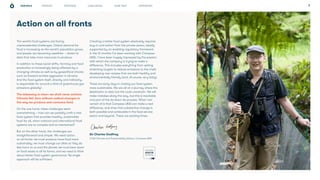
Sir Charles Godfray
Chief Climate and Sustainability Advisor, Compass UK&I
OUR ROLE PROGRESS CHALLENGES WHAT NEXT APPENDICES
STRATEGY 8
Impact to date
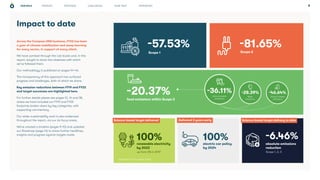
Across the Compass UK&I business, FY22 has been
a year of climate mobilisation and steep learning
for every sector, in support of every client.
We have combed through the rule books and, in this
report, sought to share the closeness with which
we've followed them.
Our methodology is published on pages 44-46.
The transparency of this approach has surfaced
progress and challenges, both of which we share.
Key emission reductions between FY19 and FY22
and target successes are highlighted here.
For further details please see pages 12, 16 and 38,
where we have included our FY19 and FY22
footprints broken down by key categories, with
supporting commentary.
Our wider sustainability work is also evidenced
throughout the report, via our six focus areas.
We’ve created a timeline (pages 9-10) and updated
our Roadmap (page 14) to share further headlines,
insights and progress against targets made.
-57.53% -81.65%
100% 100% -6.46%
-20.37%
Scope 1
Validated Science-based Target
up from 2% in 2019 Scope 1, 2, 3
renewable electricity
by 2022
electric car policy
by 2024
absolute emissions
reduction
Scope 2
food emissions within Scope 3
Delivered 3 years early
-46.64%
-28.39%
-36.11%
Science-based target delivered Science-based target delivery to date
Animal protein
emissions
Meat
emissions
Dairy & cheese
emissions
OUR ROLE PROGRESS CHALLENGES WHAT NEXT APPENDICES
STRATEGY 9
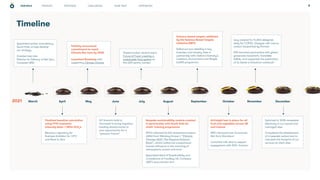
Timeline
Appointed carbon consultancy,
South Pole, to help develop
our strategy
Created new role:
Director for Delivery of Net Zero,
Compass UK&I
Publicly announced
commitment to reach
Climate Net Zero by 2030
Launched Roadmap with
supporting Climate Charter
Hosted carbon neutral event,
Future of Food: creating a
sustainable food system at
the QEII centre, London
Science-based targets validated
by the Science Based Targets
initiative (SBTi)
Rolled out eco-labelling in key
business and industry sites in
partnership with Oxford University’s
Livestock, Environment and People
(LEAP) programme
Levy catered for 14,000 delegates
daily for COP26, Glasgow with menus
carbon footprinted by Klimato
ESS launched partnership with global
grassroots movement, Incredible
Edible, and supported the publication
of its Seeds to Solutions cookbook4
March
2021 August
June October
April May September
July November December
Finalised baseline calculation
using FY19 economic
intensity data: 1.189m tCO2
e
Became a signatory for
Business Ambition for 1.5°C
and Race to Zero
G7 Summit held in
Cornwall to bring together
leading democracies in
new agreements for a
“greener future”
Bespoke sustainability module created
in partnership with South Pole for
chefs’ training programme
IPCC released its 6th assessment report
(AR6) from Working Group I, “Climate
Change 2021: The Physical Science
Basis”, which called out unequivocal
human influence in the warming of
atmosphere, ocean and land
Appointed Head of Sustainability and
Compliance at Foodbuy UK, Compass
UK&I's procurement arm
Airfreight ban in place for all
fruit and vegtables across UK
and Ireland
SBTi released new Corporate
Net Zero Standard
Launched milk pilot to support
engagement with 500+ farmers
Switched to 100% renewable
electricity in our owned and
managed sites
Completed the development
of a bespoke carbon tool to
calculate the footprint of our
services at client sites
OUR ROLE PROGRESS CHALLENGES WHAT NEXT APPENDICES
STRATEGY 10
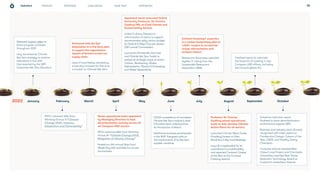
Partnered with the Soil
Association in a five-farm pilot
to support the regenerative
impact of farmers across our
supply chain
Level 2 Food Safety mandatory
e-learning included for first time
a module on Climate Net Zero
Appointed world-renowned Oxford
University Professor, Sir Charles
Godfray FRS, as Chief Climate and
Sustainability Advisor
United Culinary Directors in
reformulation of menus to support
recommended daily carbon budget
for food of 2.45kg CO2
e per person
(EAT-Lancet Commission)
Launched Climate Net Zero Hub
and Climate Net Zero Toolkit to
embed six strategic areas of action:
Carbon, Biodiversity, Waste,
Deforestation, Plastics & Packaging,
and Water Stewardship
Released impact video to
share progress achieved
throughout 2021
Levy launched its Climate
Net Zero strategy to achieve
reductions in line with
that required by the SBTi
Corporate Net Zero Standard
January June
April August
February March July
May September October
IPCC released AR6 from
Working Group II:"Climate
Change 2022, Impacts,
Adaptation and Vulnerability"
Senior operational leads appointed
by Managing Directors to lead
decarbonisation activity across all
six Compass UK&I sectors
IPCC released AR6 from Working
Group III: "Climate Change 2022:
Mitigation of Climate Change"
Hosted our 6th annual Stop Food
Waste Day with activities run across
the business
Enlisted Foodsteps’ expertise
in a carbon footprinting pilot of
1,000+ recipes to accelerate
recipe reformulation and
analyse impact
Restaurant Associates awarded
highest 3* rating from the
Sustainable Restaurant
Association (SRA)
Finalised report to calculate
the footprint of catering in two
Compass UK&I offices, including
the Group’s global HQ
2022
Professor Sir Charles
Godfray joined operational
leads to help develop Climate
Action Plans for all sectors
Launched Circular Menu Guide
(Foodbuy) based on Ellen
MacArthur’s Big Food Redesign
Levy UK is applauded for its
commitment to sustainability
and awarded Contract Caterer
of the Year at the Contract
Catering Awards
10,500 completions of mandated
Climate Net Zero module in level
2 frontline team catering since
its introduction in March
Healthcare business participated
in the NHS’ Evergreen pilot on
the requirements of its Net Zero
supplier roadmap
Emissions reduction report
finalised to show decarbonisation
performance against SBTs
Business and industry team (Eurest)
recognised with triple award at
Foodservice Cateys: Caterer of the
Year, CSER, and Healthy Eating
Champion
Compass Ireland awarded Best
Closed Loop Project and Chartwells
Universities awarded Best Waste
Reduction Technology Award at
Footprint’s waste2zero Awards
PROGRESS CHALLENGES WHAT NEXT APPENDICES 11
STRATEGY
STRATEGY
OUR ROLE
PROGRESS CHALLENGES WHAT NEXT APPENDICES 12
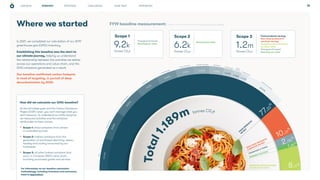
In 2021, we completed our calculation of our 2019
greenhouse gas (GHG) inventory.
Establishing this baseline was the start to
our climate journey, helping us understand
the relationship between the activities we deliver
across our operations and value chain, and the
GHG emissions generated as a result.
Our baseline reaffirmed carbon hotspots
in need of targeting, in pursuit of deep
decarbonisation by 2030.
Where we started
How did we calculate our GHG baseline?
As the old adage goes and the Carbon Disclosure
Project (CDP) notes1
, you can’t manage what you
don’t measure. To understand our GHG footprint,
we measured activities and the emissions
attributable to them, across:
• Scope 1: direct emissions from owned
or controlled sources
• Scope 2: indirect emissions from the
generation of purchased electricity, steam,
heating and cooling consumed by our
businesses
• Scope 3: all other indirect emissions that
occur in Compass UK&I's value chain,
including purchased goods and services
For information on our baseline calculation
methodology, including inclusions and exclusions,
head to Appendices
M
e
a
t
D
a
i
r
y
&
c
h
e
e
s
e
F
r
u
i
t
&
v
e
g
e
t
a
b
l
e
s
Dry foods
Cold beverages
Savoury Products
Alcoholic beverages Sandwiches
Hot beverages products
Confectionary
Remaining
categories
1
0
.
4
1
%
8
.
9
2
%
8
.
5
7
%
7.40%
6.22%
5.51%
5.00% 4.09% 3.09% 2.48%
2.37%
13.14%
T
o
t
a
l
1
.
189m tonnes C02
e
Sweet
FO
O
D
PRO
DUCTS
W
E
BUY
NON-FOOD PRODUCTS
& SERVICES WE BUY
TRANSPORT & TRAVEL
RUNNING OUR SITES
77.22
%
10.31
%
2.55
%
1.81
%
8.11%
EMISSIONS FROM KITCHENS
AT OUR CLIENT SITES
Scope 1
9.2k
Tonnes C02
e
Scope 3
1.2m
Tonnes C02
e
Transport & travel
Running our sites
Running our sites
Food products we buy
Non-food products &
services we buy
Emissions from kitchens
at client sites
Transport & travel
Running our sites
6.2k
Tonnes C02
e
Scope 2
STRATEGY
OUR ROLE
FY19 baseline measurement: For further FY19 and FY22 data please see The needs to rebaseline, page 38
PROGRESS CHALLENGES WHAT NEXT APPENDICES 13
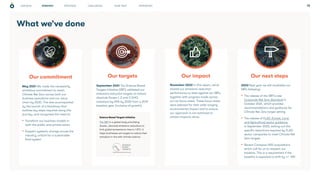
What we’ve done
May 2021 We made the necessarily
ambitious commitment to reach
Climate Net Zero across both our
business operations and our value
chain by 2030. This was accompanied
by the launch of a Roadmap that
outlines key steps required along this
journey, and recognises the need to:
• Transform our business models in
both the public and private sector
• Support systemic change across the
industry; critical for a sustainable
food system
September 2021 The Science Based
Targets initiative (SBTi) validated our
emissions reduction targets to reduce
absolute Scope 1, 2 and 3 GHG
emissions by 69% by 2030 from a 2019
baseline year (inclusive of growth).
November 2022 In this report, we’ve
shared our emissions reduction
performance to date against our SBTs,
together with progress made across
our six focus areas. These focus areas
were selected for their wide-ranging
environmental impact and to ensure
our approach is not restricted to
carbon impacts alone.
2023 Next year we will revalidate our
SBTs following:
• The release of the SBTi's new
Corporate Net Zero Standard in
October 2021, which provides
recommendations and guidance for
Climate Net Zero target setting
• The release of FLAG (Forest, Land
and Agriculture) sector guidance
in September 2022, setting out the
specific reductions required by FLAG
sector companies to meet Climate Net
Zero targets
• Recent Compass UK&I acquisitions
which call for us to reassert our
baseline. This is a requirement if the
baseline is expected to shift by +/- 5%2
Science Based Targets initiative
The SBTi is a global body prioritising
drastic, absolute emissions reductions to
limit global temperature rises to 1.5°C. It
helps businesses set targets to reduce their
emissions in line with climate science.
Our commitment Our targets Our impact Our next steps
STRATEGY
OUR ROLE
PROGRESS CHALLENGES WHAT NEXT APPENDICES 14
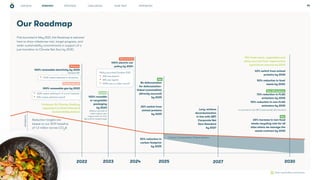
Our Roadmap
2025 2030
2023 2027
2024
2022
70% fresh meat, vegetables and
dairy sourced from regenerative
agriculture sources by 2030
40% switch from animal
proteins by 2030
50% reduction in food
waste by 2030
72% reduction in FLAG
emissions by 2030
90% reduction in non-FLAG
emissions by 2030
65% increase in non-food
waste recycling rate for all
sites where we manage the
waste contract by 2030
Levy: achieve
decarbonisation
in line with SBTi
Corporate Net
Zero Standard
by 2027
No deforestation
for deforestation-
linked commodities
(directly sourced)
by 2025
25% switch from
animal proteins
by 2025
55% reduction in
carbon footprint
by 2025
100% electric car
policy by 2024
100% reusable
or recyclable
packaging
by 2023
Reduction targets are
based on our 2019 baseline
of 1.2 million tonnes CO2
e
100% renewable electricity by 2022
100% renewable gas by 2022
Professor Sir Charles Godfray
appointed as Chief Climate &
Sustainability Advisor
Carbon Compensation & Neutralisation
In accordance with SBTi Corporate Net Zero Standard
Validated SBT
Inflation and cost of
switch options saw
impact north of ~£1m
See p.33 for revised target
Other sustainability commitments
• 100% meters switched in all sectors
• 100% meters switched in 5 out of 6 sectors
• 93% meters switched overall
Policy launched October 2021
• 33% now electric
• 18% now hybrid
• 100% cars on order now EV
Partially delivered
Revised
Delivered Early
Delivered
New
New: SBTi guidance
New
emissions
STRATEGY
First launched in May 2021, this Roadmap is reshared
here to show milestones met, target progress, and
wider sustainability commitments in support of a
just transition to Climate Net Zero by 2030.
OUR ROLE
PROGRESS CHALLENGES WHAT NEXT APPENDICES 15
Six focus
areas
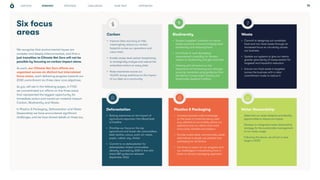
We recognise that environmental issues are
complex and deeply interconnected, and that a
just transition to Climate Net Zero will not be
possible by focusing on carbon impact alone.
As such, our Climate Net Zero efforts are
organised across six distinct but interrelated
focus areas, each delivering progress towards our
2030 commitment via three clear core objectives.
As you will see in the following pages, in FY22
we concentrated our efforts on the three areas
that represented the biggest opportunity for
immediate action and maximum material impact:
Carbon, Biodiversity and Waste.
In Plastics & Packaging, Deforestation and Water
Stewardship we have encountered significant
challenges, and we have shared details on these too.
Carbon
• Improve data accuracy to help
meaningfully reduce our carbon
footprint across our operations and
value chain
• Enable recipe-level carbon footprinting
to strategically analyse and reduce the
embodied carbon on every plate
• Raise awareness across our
45,000-strong workforce on the impact
of our diets as a community
Deforestation
• Raising awareness on the impact of
agricultural expansion from Board level
to frontline
• Prioritise our focus on the top
agricultural and forest-risk commodities:
beef, leather, cocoa, palm oil, maize,
paper, rubber, soy, timber
• Commit to no deforestation for
deforestation-linked commodities
(directly sourced) by 2025 in line with
latest SBTi guidance released
September 2022
Water Stewardship
• Determine our water footprint and identify
opportunities to reduce our impact
• Develop an integrated water stewardship
strategy for the sustainable management
of our water usage
• Following the above, we will set a clear
target in 2023
Biodiversity
• Support suppliers’ transition to nature-
based solutions; aimed at bringing back
biodiversity and reducing harm
• Contribute to work developing
measurement capability for farmers’
impact on biodiversity (net gain and loss)
• Working with all sectors on the
importance of introducing ever-stronger
sourcing mandates using guidance from
the Marine Conservation Society and
Sustainable Seafood Coalition
Waste
• Commit to designing out avoidable
food and non-food waste through an
increased focus on circularity across
our business
• Update our systems to give our teams
greater granularity of measurement for
targeted and impactful reduction
• Ensure non-food waste is targeted
across the business with a clear
commitment made to reduce it
STRATEGY
Plastics & Packaging
• Increase business-wide knowledge
on the class of materials being used
(e.g. plastics) to accurately advise our
operators and our clients and avoid
inaccurate, blanket assumptions
• Provide sustainable, commercially viable
alternatives to single-use plastics and
packaging for all sectors
• Continue to report on our progress and
our challenges in transitioning from a
linear to circular packaging approach
OUR ROLE
PROGRESS CHALLENGES WHAT NEXT APPENDICES 16
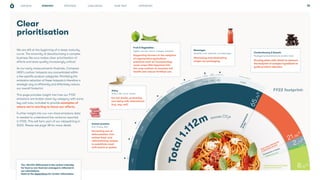
We are still at the beginning of a steep maturity
curve. The enormity of decarbonising a complex
business like ours makes clear prioritisation of
efforts and data quality increasingly critical.
As our early measurements illustrate, Compass
UK&I’s carbon hotspots are concentrated within
a few specific product categories. Prioritising the
emissions reduction of these hotspots is therefore a
strategic way to efficiently and effectively reduce
our overall footprint.
This page provides insight into how our FY22
emissions are broken down by category with some
key call outs, included to provide examples of
where we're starting to focus our efforts.
Further insight into our non-food emissions data
is needed to understand the variance reported
in FY22. This will form part of our rebaselining in
2023. Please see page 38 for more detail.
Running pilots with clients to measure
the footprint of complex ingredients to
guide product selection
Confectionary & Snacks
Packaged convenience and comfort food
Minimising and eliminating
single-use packaging
Beverages
Alcoholic, non-alcoholic, hot beverages
Increasing use of
deforestation-free
animal feed, and
reformulating recipes
to substitute meat
with beans or pulses
Animal proteins
Pork, Poultry, Beef
Clear
prioritisation
STRATEGY
OUR ROLE
Supporting farmers in the adoption
of regenerative agriculture
practices such as incorporating
cover crops (like legumes) into
the crop rotation to increase soil
health and reduce fertiliser use
Fruit & Vegetables
Apples, carrots, onions, oranges, potatoes
For hot drinks, promoting
non-dairy milk alternatives
(e.g. soy, oat)
Dairy
Butter, milk, cream, cheese
M
e
a
t
D
a
ir
y
&
c
h
e
e
s
e
F
r
u
i
t
&
v
e
g
e
t
a
b
l
e
s
D
r
y
f
o
o
d
s
C
old
beverages
Savoury Products
Alcoholic beverages
Sandwiches beverages products Confectionary
Remaining categories
7
.
9
7
%
5
.
0
9
%
5
.
9
5
%
5
.
5
7
%
5.15%
4.98%
5.37%
3.04% 2.14% 2.76% 1.72%
15.98%
T
o
t
a
l
1
.
112m tonnes C02
e
Sweet
Hot
F
O
O
D
P
R
O
D
U
C
T
S
W
E
B
U
Y
NON-FOOD PRODUCTS
& SERVICES WE BUY
TRANSPORT & TRAVEL
RUNNING OUR SITES
6
5
.
7
4
%
21.86
%
2.73
%
1.00
%
8.67%
EMISSIONS FROM KITCHENS
AT OUR CLIENT SITES
FY22 footprint:
The +30.43% differential in the carbon intensity
for food vs non-food (on average) is reflected in
our calculations.
Head to the Appendices for further information.
PROGRESS CHALLENGES WHAT NEXT APPENDICES 17
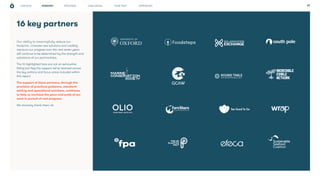
Our ability to meaningfully reduce our
footprint, innovate new solutions and credibly
measure our progress over the next seven years
will continue to be determined by the strength and
substance of our partnerships.
The 16 highlighted here are not an exhaustive
listing but flag the support we’ve received across
the key actions and focus areas included within
this report.
The support of these partners, through the
provision of practical guidance, standard-
setting and operational solutions, continues
to help us increase the pace and scale of our
work in pursuit of real progress.
We sincerely thank them all.
16 key partners
STRATEGY
OUR ROLE
PROGRESS CHALLENGES WHAT NEXT APPENDICES 18
Compensation
& Neutralisation
STRATEGY
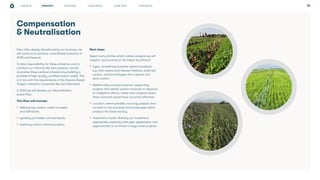
Even after deeply decarbonising our business, we
will continue to produce unavoidable emissions in
2030 and beyond.
To take responsibility for these emissions and to
maintain our Climate Net Zero position, we will
neutralise these residual emissions by building a
portfolio of high-quality, certified carbon credits. This
is in line with the requirements of the Science Based
Targets initiative's Corporate Net Zero Standard.
In 2023 we will develop our Neutralisation
Action Plan.
This Plan will include:
• defining key carbon credit concepts
and definitions
• agreeing principles and standards
• exploring carbon removal projects
Next steps
Select and prioritise which carbon projects we will
support, by focusing on the below key factors:
• Type: considering business-relevant projects,
e.g. that restore and reforest habitats, build soil
carbon, and technologies that capture and
store carbon
• Additionality and permanence: supporting
projects that deliver carbon removals in response
to mitigation efforts, rather than projects where
these removals would have occurred otherwise
• Location: where possible, sourcing projects that
connect to the countries and landscapes which
produce the foods we buy
• Investment model: diversify our investment
approaches, exploring multi-year agreements, and
opportunities to co-invest in large-scale projects
OUR ROLE
CHALLENGES WHAT NEXT APPENDICES
STRATEGY 19
PROGRESS
PROGRESS
OUR ROLE
CHALLENGES WHAT NEXT APPENDICES
STRATEGY 20
What we’re doing
• Improving data accuracy to help meaningfully
reduce our carbon footprint across our
operations and value chain
• Enabling recipe-level carbon footprinting to
strategically analyse and reduce the embodied
carbon on every plate
• Raising awareness across our 45,000-strong
workforce on the impact of our diets as
a community
Working with clients
The emissions generated through the services we
deliver to our clients form part of their Scope 3
footprint. Increasing understanding across our
operational teams that the more we reduce our
emissions, the more our clients do too, has been a
key focus this year.
By identifying carbon hotspots in our operations
and supply chains, we continue to highlight areas
of reduction for both parties. Decarbonising the
recipes we develop and the food we purchase to
create them have been our top two starting points
for strategic, targeted emissions reduction.
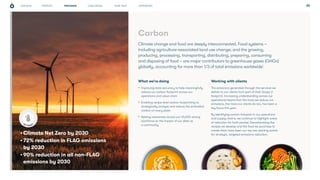
• Climate Net Zero by 2030
• 72% reduction in FLAG emissions
by 2030
• 90% reduction in all non-FLAG
emissions by 2030
Carbon
Climate change and food are deeply interconnected. Food systems –
including agriculture-associated land use change; and the growing,
producing, processing, transporting, distributing, preparing, consuming
and disposing of food – are major contributors to greenhouse gases (GHGs)
globally, accounting for more than 1/3 of total emissions worldwide1
.
PROGRESS
KEY TARGET
OUR ROLE
CHALLENGES WHAT NEXT APPENDICES
STRATEGY 21
We are privileged to work with subject
matter experts from academia, business
and government, who together strengthen
our ability to provide the commercial
environments and know-how required to
develop, implement and scale effective
climate solutions across our value chain.
• Professor Sir Charles Godfray, Chief
Climate and Sustainability Advisor2
• Carbon accountancy and climate
strategy support from South Pole
• Academic support for eco-labelling,
from Oxford University’s LEAP and
HESTIA programmes3
• Dr Vincent Walsh, Circular &
Regenerative System Designer
• COP26 recipe carbon footprinting
from Klimato4
via our Levy business
• Scope 3 deep decarbonisation support
with Foodsteps5
Transitioning to low-carbon recipes is
critical in driving deep decarbonisation
across the business, so we’ve called on the
creativity of our 4,020 chefs to reformulate
our extensive recipe library.
Successful reformulations have seen an
increased focus on local, seasonal, and
plant-based ingredients, in pursuit of a 25%
switch from animal to plant-based proteins
by 2025, and a 40% switch by 2030.
Key results to date include:
• Reduction of meat by 40% across the
top 12 best-selling dishes in our business
and industry sector
• The redesign of a beef wellington using
mushroom to reduce its carbon footprint
to <1kg CO2
e
• The successful “50:50” burger in our
sports and leisure sector, containing 50%
less animal protein
Given the importance of low-carbon
menus in achieving our 2030 goals, it’s
essential that we inspire, educate and
empower those responsible for them – our
current and future chefs – to reimagine
their roles and work through a climate lens.
In 2021, we worked with South Pole to create
a training module for our chefs that explores
climate impacts associated with procurement,
kitchen management, preparation and
serving; and deep-dives on the relationship
between sustainability and nutrition.
This module forms part of our broader
apprenticeship training, which we will
continue to develop to include a greater
focus on climate literacy in a food-
specific context. Increasing this internal
knowledge is a key focus in FY23, as
we look to accelerate a cultural shift
throughout the organisation.
Each of our six sectors has its own unique
service and product offerings, value
chains, challenges and opportunities to
take climate action.
In recognition of this, operational leads
were appointed in each sector to work
on the development of sector-specific
Climate Action Plans.
These plans are being supported by
the specialist expertise listed on the first
column of this page, and are starting to
see us work increasingly with our clients
in the development of their own action
plans, too.
Key actions
Carbon
Enlisted specialist expertise
to guide our climate journey
A menu for a change Launched dedicated sustainability
module in chef training
Developing sector-specific
Climate Action Plans
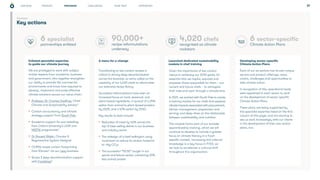
4,020 chefs
recognised as climate
rockstars
6 specialist
partnerships enlisted
6 sector-specific
Climate Action Plans
90,000+
recipe reformulations
underway
PROGRESS
OUR ROLE
CHALLENGES WHAT NEXT APPENDICES
STRATEGY 22
Getting our house in order
What we did
To help us calculate the emissions of the services we
deliver at client sites – and to propose solutions to
mitigate them – we’ve been working with South Pole
to develop a site-specific carbon footprinting tool.
How the tool works
The tool, which measures emissions across Scopes
1,2 and 3, was applied to two pilot sites: Compass
Group’s Global HQ in Chertsey, and our Parklands
office, in Birmingham.
Using FY19 activity data, we estimated the
emissions footprint of each site. We then applied
scenarios to model the reduction potential of
changes applied to menus and at site level. These
findings provide insights for site operators, serving
as a decision-support tool towards climate action.
Key findings
• In both sites, over 75% of emissions were found
to be associated with purchased products;
23% of which (Chertsey) and 33% of which
(Parklands) are attributable to products
containing animal proteins (meat, dairy and
cheese, and seafood)
• At each site, our tool estimated the potential
emission reductions of replacing the existing
menus with lower carbon menus
• The reconfigured menus were found to be
~72% less carbon intensive than the existing;
representing the potential to achieve an overall
reduction between the range of -24% (moderate
scenario) and -50% (ambitious scenario)
The models found a clear distinction in reduction
performance across the two sites:
• When the interventions (e.g. those that
reduce animal proteins) were applied to
Parklands’ baseline footprint, they delivered a
comparatively lower reduction to when applied
to Chertsey
• This is due to the difference in offer. Parklands’
FY19 sales mix included more retail products
(e.g. dry foods, hot beverages and confectionery
products) while Chertsey’s included more meat,
dairy, fruit and vegetables.
Looking forward
With the long-term vision of calculating the
footprint of all 4,000+ sites we cater for in the
UK&I, we will be focused on the following in FY23:
• Identifying more interventions to address the
material retail categories of each site
• Working with key partners to develop a
digitalised tool
• Producing client site reports to support the
creation of carbon action plans to 2030
PROGRESS
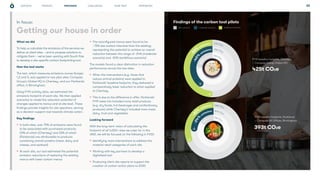
In focus:
-
5
0%
emissions 215t CO
2 e
-
4
0
%
emissions 256t CO
2 e
-
2
0
%
emissions 340t CO
2 e
-
3
2%
emissions 268t CO
2 e
-
2
4
%
emissions 300t CO
2 e
-
1
2%
emissions 348t CO
2 e
Findings of the carbon tool pilots
425t CO2e
393t CO2e
FY19 baseline footprint, Chertsey
– Compass Group Global HQ
FY19 baseline footprint, Parklands
– Compass UK Offices, Birmingham
ambitious scenario
moderate scenario
BAU scenario
OUR ROLE
CHALLENGES WHAT NEXT APPENDICES
STRATEGY 23
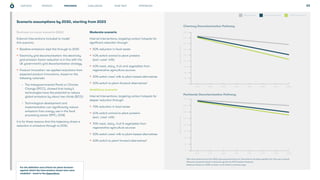
Business as usual scenario (BAU)
External interventions included to model
this scenario:
• Baseline emissions: kept flat through to 2030
• Electricity grid decarbonisation: the electricity
grid emission factor reduction is in line with the
UK government’s grid decarbonisation strategy
• Product innovation: we applied reductions from
expected product innovations, based on the
following rationale:
ͯ The Intergovernmental Panel on Climate
Change (IPCC), showed that today’s
technologies have the potential to reduce
global emissions by about two-thirds (BCG)
ͯ Technological development and
implementation can significantly reduce
emissions from energy use in the food
processing sector (IPPC, 2018)
It is for these reasons that this trajectory shows a
reduction in emissions through to 2030.
Moderate scenario
Internal interventions, targeting carbon hotspots for
significant reduction through:
• 50% reduction in food waste
• 40% switch animal to plant proteins
(excl. cows’ milk)
• 40% meat, dairy, fruit and vegetables from
regenerative agriculture sources
• 30% switch cows’ milk to plant-based alternatives
• 30% switch to plant-forward alternatives6
Ambitious scenario
Internal interventions, targeting carbon hotspots for
deeper reduction through:
• 75% reduction in food waste
• 60% switch animal to plant proteins
(excl. cows’ milk)
• 70% meat, dairy, fruit & vegetables from
regenerative agriculture sources
• 50% switch cows’ milk to plant-based alternatives
• 60% switch to plant forward alternatives6
PROGRESS
200
200
250
250
300
300
350
350
400
400
0
0
50
50
2023
2023
2024
2024
2025
2025
2026
2026
2027
2027
2028
2028
2029
2029
2030
2030
100
100
150
150
Scenario assumptions by 2030, starting from 2023
Chertsey Decarbonisation Pathway
Parklands Decarbonisation Pathway
Both show performance from 2023, because performance of interventions are being applied from that year onwards
Reduction potential stated is measured against the 2019 baseline footprints
Residual emissions in 2030 as shown in the wheel on previous page
ambitious scenario
moderate scenario
BAU scenario
For the definition and criteria for plant-forward -
against which the interventions shown here were
modelled – head to the Appendices.
OUR ROLE
CHALLENGES WHAT NEXT APPENDICES
STRATEGY 24
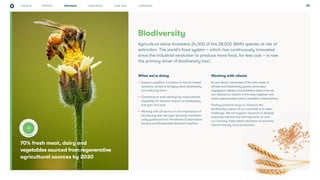
70% fresh meat, dairy and
vegetables sourced from regenerative
agricultural sources by 2030
Biodiversity
What we’re doing
• Support suppliers’ transition to nature-based
solutions; aimed at bringing back biodiversity
and reducing harm
• Contribute to work developing measurement
capability for farmers’ impact on biodiversity
(net gain and loss)
• Working with all sectors on the importance of
introducing ever-stronger sourcing mandates
using guidance from the Marine Conservation
Society and Sustainable Seafood Coalition
Working with clients
As our clients’ awareness of the twin crises of
climate and biodiversity grows, we’ve been
engaging in deeper conversations about how we
can reduce our impact in this area together and
where opportunities exist to establish collaborations.
Finding practical ways to measure the
biodiversity impact of our activities is a major
challenge. We will support research to develop
improved metrics that will help both us and
our industry make better decisions to promote
nature-friendly food production.
Agriculture alone threatens 24,000 of the 28,000 (86%) species at risk of
extinction. The world’s food system – which has continuously innovated
since the industrial revolution to produce more food, for less cost – is now
the primary driver of biodiversity loss7
.
PROGRESS
KEY TARGET
OUR ROLE
CHALLENGES WHAT NEXT APPENDICES
STRATEGY 25
There is an urgent need to help our
farmers transition from a reductionist
approach to regenerative practices in
support of climate, nature, animal welfare
and community dynamics.
Recognising this, in 2022 we joined the
Soil Association Exchange (SAX) alongside
other major UK food purchasers.
The programme is designed to enable
Compass UK&I's supply chain to work more
closely with farmers to measure, track and
improve their ecological footprint, and to
build and access financial incentives.
Compass UK&I's sports and leisure sector,
Levy, has sponsored the development
of a 92-acre plot into an innovative
demonstrator farm.
The objective of the project is threefold:
1. Help educate chefs and farmers on
sustainable farming practices
2. Grow ingredients that can be directly
incorporated into menus across
Levy’s venues
3. Support the sector in its sustainability
strategy, in pursuit of its accelerated
climate commitments
Known as the Biohub at Ings Farm, the
project has been launched in collaboration
with specialist regenerative agriculture
consultancy RegenFarmCo, Yorkshire
Water and Quorn Professionals.
The planet's oceans play a critical role in
managing the climate: generating 50%
of the oxygen we need, absorbing 25% of
CO2
emissions; and capturing 90% of the
excess heat generated by those emissions8
.
That Compass UK&I spends £16m+ on
seafood a year highlights the responsibility
we have to ensure our sourcing is
sustainable, and underlines our role in
proactively communicating with clients on
the issues relating to this topic.
This is why we’ve introduced a new
sourcing mandate: to only source
seafood from categories 1-3 of the Marine
Conservation Society’s (MCS) Good
Fish Guide. This has been supported by
the Managing Directors in all six of our
sectors, and is intended as a step change
to tightening this further still in 2023; to
only source from categories 1-2.
Palm oil is the world's most produced,
consumed and traded vegetable oil.
However, irresponsible land clearing for
plantations has led to widespread rainforest
destruction and biodiversity loss9
.
In recognition of this, the purchasing
of sustainable palm oil products
through credible global standards is a
priority within Compass UK&I's climate
commitments; one supported by The
Roundtable on Sustainable Palm Oil
(RSPO). Our supply chain currently has
a mix of certified (95% certified mass
balance) and non-certified volumes and
we see RSPO certification as a first step to
addressing this.
This work is also vital in pursuit of our
deforestation target, made this year
to take heed of FLAG sector guidance
released by the SBTi in September 2022.
Key actions
Shaping the future of
sustainable farming
Breaking ground at the Biohub
Sustainable seafood sourcing First big step towards deforestation-
free palm oil procurement
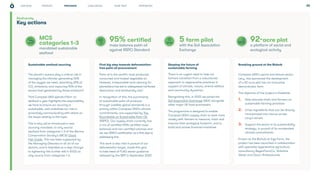
92-acre plot
a platform of social and
ecological activity
5 farm pilot
with the Soil Association
Exchange
95% certified
mass balance palm oil
against RSPO Standard
MCS
categories 1-3
mandated sustainable
seafood
PROGRESS
Biodiversity
OUR ROLE
CHALLENGES WHAT NEXT APPENDICES
STRATEGY 26
Supporting
improved ecological
measurement and
impact
To reverse the damage the food sector is having
on the planet’s biodiversity, we need to radically
transform the way in which food is produced and
change the food we eat.
This is why in 2022, we joined the Soil Association
Exchange (SAX) alongside other UK businesses
including M&S and Arla. The Soil Association is a
charity with 75 years of experience in supporting
farmers to be not just profitable, but sustainable, too.
In partnership with SAX, we’re now
undertaking a detailed baseline of
the ecological health of five of our
supplying farms. These will then be
benchmarked against hundreds of farms
across the UK to share knowledge and unite
learnings across the industry.
Each farm will receive an action plan to decrease
their ecological footprint based on regenerative
agriculture, recognising that farmers need to be
financially rewarded for their progress, for this to
happen at pace and scale.
In focus:
PROGRESS
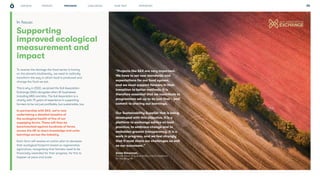
“Projects like SAX are very important.
We have to set new standards and
expectations for our food system,
and we must support farmers in their
transition to better methods. It is
therefore essential that we contribute to
programmes set up to do just that – and
commit to sharing our learnings.
Our Sustainability Supplier Hub is being
developed with this objective. It is a
platform to exchange advice on best
practice, to embrace change and to
embolden greater transparency. It is a
work in progress, and we feel strongly
that it must share our challenges as well
as our successes.”
Anne Simonnet,
Former Head of Sustainability and Compliance
for Foodbuy UK
OUR ROLE
CHALLENGES WHAT NEXT APPENDICES
STRATEGY 27
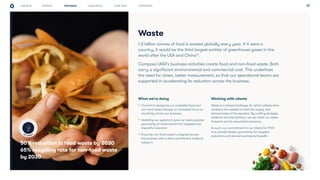
50% reduction in food waste by 2030
65% recycling rate for non-food waste
by 2030
Waste
What we’re doing
• Commit to designing out avoidable food and
non-food waste through an increased focus on
circularity across our business
• Updating our systems to give our teams greater
granularity of measurement for targeted and
impactful reduction
• Ensuring non-food waste is targeted across
the business with a clear commitment made to
reduce it
Working with clients
Waste is a shared challenge, for which collaborative
solutions are needed on both the supply and
demand sides of the equation. By crafting strategic,
evidence-led interventions, we can slash our waste
footprint and its associated emissions.
As such, our commitment to our clients for FY23
is to provide deeper granularity for targeted
reductions and shared commercial benefit.
1.3 billion tonnes of food is wasted globally every year. If it were a
country, it would be the third largest emitter of greenhouse gases in the
world after the USA and China10
.
Compass UK&I's business activities create food and non-food waste. Both
carry a significant environmental and commercial cost. This underlines
the need for closer, better measurement; so that our operational teams are
supported in accelerating its reduction across the business.
PROGRESS
KEY TARGET
OUR ROLE
CHALLENGES WHAT NEXT APPENDICES
STRATEGY 28
Food waste is often ‘lumped’ together
making targeted reduction impossible.
To support our operators and our clients’
understanding of which stages of service
produce the most waste, we’ve updated
our internal menu planning system. All
units can now measure and report on
food waste across five categories: out
of date; plate; post-production; pre-
production; and retail.
This new data will allow us to identify
specific, strategic intervention opportunities
to reduce food waste and to report on the
results of implementing them.
In FY23 we will develop this capability
further to bring together food waste,
emissions reduction and commercial
impact data.
Non-food waste is a priority for Compass
UK&I. We have achieved a 100% diversion
from landfill, yet ~70% of our municipal waste
is sent for waste-to-energy incineration.
To create a truly circular economy, we
know we must improve the ways we reduce,
reuse and recycle.
This is why in 2022 we have introduced a
new target to our Roadmap: to increase
our non-food waste recycling rate to 65%
by 2030 for all sites where we manage the
waste contract.
In the UK, an estimated 6.65 million tonnes
of edible food goes to waste every year11
.
At the same time, almost 10 million people
in the UK are living with food insecurity12
.
Thanks to our charity partners OLIO,
FareShare and Too Good To Go, we are
able to tackle both issues simultaneously.
Through these partners, we donated
256,994 meals in FY22.
In June 2022, we also joined a coalition
of UK businesses including Tesco, Pret a
Manger and Planet Organic to rescue
and redistribute 200 million meals in 12
months – giving a practical hand to those
struggling with the escalating cost of living.
As of November 2022, 35 million meals had
been distributed through the initiative13
.
In FY22 we continued working with our
partner Olleco, to convert used cooking
oil into renewable, low carbon biodiesel
– capable of reducing vehicle carbon
emissions by 88%.
Olleco’s biorefinery is the UK’s largest
processing plant dedicated solely to the
task. They also used the filtered food
waste scraps from the oil to fuel an onsite
anaerobic digestor.
Key actions
Increased data points within
internal waste tracking system
Added non-food waste target
to our 2030 Roadmap
Providing a practical hand
to families in need
Giving old cooking oil a new life
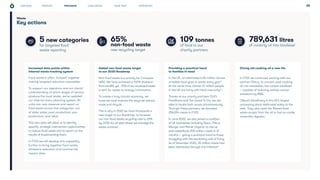
5 new categories
for targeted food
waste reporting
109 tonnes
of food to our
charity partners
789,631 litres
of cooking oil into biodiesel
65%
non-food waste
new recycling target
PROGRESS
Waste
OUR ROLE
CHALLENGES WHAT NEXT APPENDICES
STRATEGY 29
Deeper granularity for more
targeted reduction
In focus:
PROGRESS
In FY23 we are mandating the roll-out of an
updated in-house reporting system with the
capability to track and reduce food waste across
Compass UK&I in five categories: out of date;
plate; post-production pre-production; and retail.
This will benefit our operational teams and our
clients by:
• Giving greater granularity with the inclusion of
additional data points (10+)
• Providing the ability to translate waste into
financial impact
• Creating commercial savings by minimising
over-purchasing and disposal costs
• Allowing sector-by-sector performance
comparison, and identifying ongoing areas for
improvement within each
To support this roll-out, we have developed
educational tools for frontline teams to ensure
practical change is embedded at site level. The
governing objective, clearly defined across every
tool, is to encourage purposeful waste prevention
and advanced planning.
The four main tools are:
• Completion of the mandatory Climate Net Zero
Toolkit with a range of tasks designed to support
the reduction of food waste across our operations
• Mandatory e-learning of a Climate Net Zero
module, created specifically for our frontline
catering teams
• Annual Stop Food Waste Day communication
and campaign material to encourage early,
proactive engagement
• Food waste team briefing notes, to be tailored at
site level
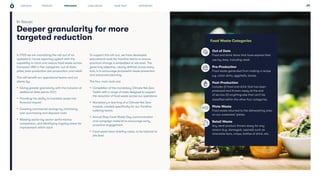
Out of Date
Food and drink items that have expired their
use-by date, including retail.
Pre-Production
Food waste generated from making a recipe
e.g. onion skins, eggshells, bones.
Post-Production
Includes (i) food and drink that has been
produced and thrown away at the end
of service (ii) anything else that can’t be
classified within the other four categories.
Plate Waste
Food waste returned to the dishwashing area
on our customers’ plates.
Retail Waste
Any retail product thrown away for any
reason (e.g. damaged, opened) such as
chocolate bars, crisps, bottles of drink, etc.
Food Waste Categories
OUR ROLE
PROGRESS WHAT NEXT APPENDICES
STRATEGY 30
CHALLENGES
CHALLENGES
OUR ROLE
PROGRESS WHAT NEXT APPENDICES
STRATEGY 31
No deforestation for deforestation-
linked commodities (directly sourced)
by 2025
Deforestation
What we’re doing
• Raising awareness on the impact of agricultural
expansion from Board level to frontline
• Prioritising our focus on the top agricultural and
forest-risk commodities: beef, leather, cocoa,
palm oil, maize, paper, rubber, soy, timber
• Commit to no deforestation for deforestation-
linked commodities (directly sourced) by 20253
in line with latest SBTi guidance released
September 2022
Working with clients
Deforestation remains one of the least requested
areas of information asked of us, or of our clients.
This is something we agree needs to change to
increase positive pressure on the industry as a whole.
Working with Foodsteps and Sir Charles Godfray,
we are committed to leaning into our supply chain
complexity with a Data Charter to ensure we are:
• targeting suppliers and categories in order of
their materiality
• asking the right questions in tenders so correct
detail is captured as a fundamental part of
every decision and contract agreement
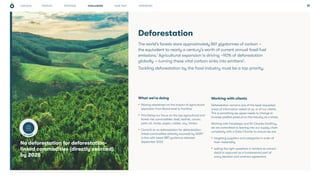
The world’s forests store approximately 861 gigatonnes of carbon –
the equivalent to nearly a century’s worth of current annual fossil fuel
emissions.1
Agricultural expansion is driving ~90% of deforestation
globally – turning these vital carbon sinks into emitters2
.
Tackling deforestation by the food industry must be a top priority.
CHALLENGES
KEY TARGET
OUR ROLE
PROGRESS WHAT NEXT APPENDICES
STRATEGY 32
Challenges and opportunities
Between 2016 and 2018 alone, an area
equivalent to 88% of the UK’s total land area was
required to supply the country’s demand for just
seven agricultural and forest commodities: beef
and leather, cocoa, palm oil, pulp and paper,
rubber, soy, and timber4
.
Compass UK&I use all of these products in our
supply chain, so we recognise we have a
duty to procure them responsibly – which
is why we are committing to achieving
no deforestation for deforestation-linked
commodities (directly sourced) by 2025.
We will achieve this by:
• Increasing our procurement of Fairtrade
and Rainforest Alliance certified coffee and
cocoa products
• Ensuring all palm oil contained in food
products is RSPO-certified
• Ensuring all soya in the supply chain is
verified deforestation-free5
. We will continue
to purchase Responsible Soy (RTRS) credits
for our entire footprint in the meantime
To date, we have achieved:
• 14% of cocoa is certified Rainforest Alliance
and/or Fairtrade, and 32% is covered by a
manufacturer-own 2025 no deforestation
commitment (e.g. Barry Callebaut, Nestle, Mars)
• 62% of coffee is certified Rainforest Alliance
and/or Fairtrade, and 13% is covered by
a manfacturer-own 2025 no deforestation
commitment
• 95% of palm oil contained in food products is
covered by RSPO certificates
• 100% of our soy footprint is either
deforestation-free (20%) or covered by RTRS
credits (80%)
• 100% of our fresh beef is UK sourced, 89%
frozen beef is UK/ EU sourced
• 77% of paper is either 100% recycled or third-
party certified. We are still working to track
and report timber volumes
All data is representative of our purchases for the first
half of FY22.
CHALLENGES
Deforestation
In 2020 we set the following target for the sourcing of
sustainable palm oil. We missed that target and have
now revised it.
• Original target: 100% sustainable palm oil in food
by the end of 2021
• Revised target: 100% sustainable palm oil in food
by the end of 2023
What’s changed
The target year. As of the first half of FY22, 95% of
our palm oil sourced for food was sustainable.
Why
Geopolitical conflict has placed pressure on global
oil supply due to the disruption of sunflower oil
exports from Ukraine.
Market uncertainty following Indonesia’s temporary
ban on palm oil exports in June 2022 coincided
with the contract renewal for one of our remaining
suppliers using uncertified palm oil. The new target
deadline is dictated by this contract’s end date.
Target revision – Palm oil
OUR ROLE
PROGRESS WHAT NEXT APPENDICES
STRATEGY 33
100% reusable, recyclable or fibre-based
compostable foodservice packaging by
end of 2023
Plastics & Packaging
What we’re doing
• Increase business-wide knowledge on the
class of materials being used (e.g. plastics) to
accurately advise our operators and our clients
and avoid inaccurate, blanket assumptions
• Providing sustainable, commercially viable
alternatives to single-use plastics and packaging
for all sectors
• Continue to report on our progress and our
challenges in transitioning from a linear to
circular packaging approach
Working with clients
How we package our food plays a critical role in
every stage of service: preserving, reducing waste,
and offering ‘on the go’ convenience; a factor that
remains king. The packaging options we choose
need to cater for all these priorities, while being
commercially viable.
We have greatly appreciated the growing maturity
of knowledge in this space and the opportunity
to talk – and crucially, to test – new packaging
options in client sites as they come to market.
We will continue to do this as products improve
and innovations emerge, and are committed to
working with our suppliers on the complex task of
transitioning a business of Compass UK&I's size to
a circular approach.
The cumulative volume of greenhouse gases from plastic production
and usage is forecast to reach over 56 gigatons by 2050, based on its
current growth trajectory. That’s 10-13% of the world’s entire remaining
carbon budget6
.
These facts are (rightly) raising the profile of plastic, but with it there is growing evidence of
misinformation; underlining the need for a packaging strategy that’s based on truthful impact –
environmental and commercial.
CHALLENGES
K
E
Y
TARGET REVI
S
E
D
OUR ROLE
PROGRESS WHAT NEXT APPENDICES
STRATEGY 34
Challenges and opportunities
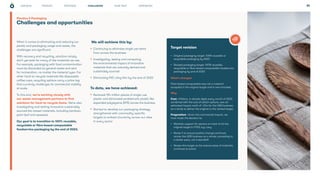
When it comes to eliminating and reducing our
plastic and packaging usage and waste, the
challenges are significant.
With recovery and recycling, solutions simply
don’t yet exist for many of the materials we use.
For example, packaging with food contamination
must be discarded as general waste and sent
for incineration, no matter the material type. For
other hard-to-recycle materials like disposable
coffee cups, recycling options carry a price tag
that currently challenges its commercial viability
at scale.
To this end, we’re working closely with
our waste management partners to find
solutions for hard-to-recycle items. We’re also
investigating and testing innovative sustainably
sourced bio-based materials, including bamboo,
palm leaf and seaweed.
Our goal is to transition to 100% reusable,
recyclable or fibre based compostable
foodservice packaging by the end of 2023.
We will achieve this by:
• Continuing to eliminate single use items
from across the business
• Investigating, testing and comparing
the environmental impact of innovative
materials that are naturally derived and
sustainably sourced
• Eliminating PVC cling film by the end of 2022
To date, we have achieved:
• Removed 154 million pieces of single-use
plastic and eliminated problematic plastic like
expanded polystyrene (EPS) across the business
• Started to develop our packaging strategy
strengthened with commodity-specific
targets to embed circularity across our sites
in every sector
CHALLENGES
Plastics & Packaging
• Original packaging target: 100% reusable or
recyclable packaging by 2023
• Revised packaging target: 100% reusable,
recyclable or fibre-based compostable foodservice
packaging by end of 2023
What’s changed
Fibre-based compostable was not a material
accepted in the original target and is now included.
Why
Cost. Inflation, in double digits every month of 2022,
combined with the cost of switch options, saw an
estimated impact north of ~£1m for the UK&I business
as a whole to deliver the original vs the revised target.
Pragmatism. Given this commercial impact, we
have made the decision to:
• Maintain support for sectors on track to hit the
original target in FY23; e.g. Levy
• Revise it to ensure positive change continues
across the UK&I business as a whole; conceding to
a slower pace, not a standstill
• Review this target as the science base of materials
continues to evolve
Target revision
OUR ROLE
PROGRESS WHAT NEXT APPENDICES
STRATEGY 35
On determining our water footprint
we will set a clear target in 2023
Water Stewardship
What we’re doing
• Determine our water footprint and identify
opportunities to reduce our impact
• Develop an integrated water stewardship
strategy for the sustainable management of
our water usage
• Following the above, we will set a clear target
in 2023
Working with clients
We’re at the start of our journey in understanding
and mitigating our water impacts and
acknowledge there is much to do.
We know that our use of water in our operations
and at client sites – especially through our
cleaning services – generates significant quantities
of wastewater.
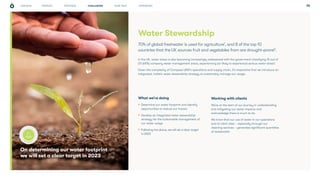
70% of global freshwater is used for agriculture7
, and 8 of the top 10
countries that the UK sources fruit and vegetables from are drought-prone8
.
In the UK, water stress is also becoming increasingly widespread with the government classifying 15 out of
23 (65%) company water management areas, experiencing (or likely to experience) serious water stress9
.
Given the complexity of Compass UK&I's operations and supply chain, it’s imperative that we introduce an
integrated, holistic water stewardship strategy to sustainably manage our usage.
CHALLENGES
KEY TARGET
OUR ROLE
PROGRESS WHAT NEXT APPENDICES
STRATEGY 36
Challenges and opportunities
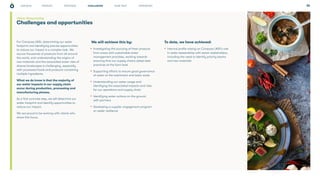
For Compass UK&I, determining our water
footprint and identifying precise opportunities
to reduce our impact is a complex task. We
source thousands of products from all around
the world, and understanding the origins of
raw materials and the associated water risks of
diverse landscapes is challenging, especially
with processed foods and products containing
multiple ingredients.
What we do know is that the majority of
our water impacts in our supply chain
occur during production, processing and
manufacturing phases.
As a first concrete step, we will determine our
water footprint and identify opportunities to
reduce our impact.
We are proud to be working with clients who
share this focus.
We will achieve this by:
• Investigating the sourcing of fresh produce
from areas with sustainable water
management practises, working towards
ensuring that our supply chains adopt best
practices at the farm level
• Supporting efforts to ensure good governance
of water at the catchment and basin scale
• Understanding our water usage and
identifying the associated impacts and risks
for our operations and supply chain
• Identifying water actions on the ground
with partners
• Developing a supplier engagement program
on water resilience
To date, we have achieved:
• Internal profile raising on Compass UK&I's role
in water stewardship with senior stakeholders,
including the need to identify priority basins
and raw materials
CHALLENGES
Water Stewardship
OUR ROLE
PROGRESS CHALLENGES APPENDICES
STRATEGY 37
WHAT NEXT
WHAT NEXT
OUR ROLE
PROGRESS CHALLENGES APPENDICES
STRATEGY 38
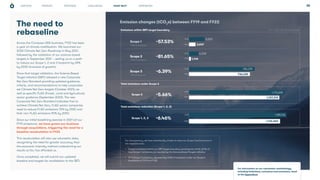
The need to
rebaseline
Across the Compass UK&I business, FY22 has been
a year of climate mobilisation. We launched our
2030 Climate Net Zero Roadmap in May 2021,
followed by the validation of our science-based
targets in September 2021 – setting us on a path
to reduce our Scope 1, 2 and 3 footprint by 69%
by 2030 (inclusive of growth).
Since that target validation, the Science Based
Target initiative (SBTi) released a new Corporate
Net Zero Standard providing updated guidance,
criteria, and recommendations to help corporates
set Climate Net Zero targets (October 2021); as
well as specific FLAG (Forest, Land and Agriculture)
sector guidance (September 2022). The new
Corporate Net Zero Standard indicates that to
achieve Climate Net Zero, FLAG sector companies
need to reduce FLAG emissions 72% by 2050 and
their non-FLAG emissions 90% by 2050.
Since our initial baselining exercise in 2021 (of our
FY19 emissions), we have grown our business
through acquisitions, triggering the need for a
baseline recalculation in FY23.
This recalculation will also use volumetric data,
recognising the need for greater accuracy than
the economic intensity method underpinning our
results so far, has afforded us.
Once completed, we will submit our updated
baseline and targets for revalidation to the SBTi.
Emission changes (tCO2
e) between FY19 and FY22
Scope 1 -57.53%
Scope 2 -81.65%
Scope 3 -6.39%
786,378
9,200
6,238
736,128
3,907
1,145
Units = tCO2
e Bar charts are not to scale
100% of emissions
100% of emissions
67% of emissions
Scope 3 -5.66%
Emissions within SBTi target boundary
Total emissions under Scope 3
Total emissions reduction (Scope 1, 2, 3)
1,173,698
1,107,210
FY19
FY19
FY19
FY19
FY22
FY22
FY22
FY22
For information on our calculation methodology,
including limitations, inclusions and exclusions, head
to the Appendices
For transparency, we have intentionally chosen to show our Scope 3 performance in
two separate bars:
• Scope 3 emissions within our SBTi target boundary covering two-thirds (67%) of
total Scope 3 emissions, as required by the Science Based Targets initiative
• Total Scope 3 emissions, representing 100% of emissions under our Scope 3
inventories in FY19 and FY22
WHAT NEXT
OUR ROLE
1,189,136
FY19
FY22 1,112,262
Scope 1, 2, 3 -6.46%
PROGRESS CHALLENGES APPENDICES
STRATEGY 39
Sharp focus
in 2023
WHAT NEXT
Where our focus has to be at its very sharpest
next year is now clear.
We must double down on our three biggest
impact enablers and recognise that one
dominant ingredient will determine the successful
delivery of them all.
This ingredient is Compass UK&I’s reporting
capability: the robustness of our data, the strength
of our analytical insight, and the efficacy with
which we then use it for maximum material impact
– commercial, environmental and cultural.
Developing this capability is now at the heart
of our strategic conversations.
Carbon
Priority action: recipe-level
footprinting and Scope 3 carbon
accountancy (volume baseline)
Objective: ability to reduce
embodied carbon on every plate
and measure collective impact
Method: strategic partnership
with Foodsteps, supported by
The University of Oxford, to map a
decarbonisation pathway focused
on three levers: ingredients, sales
mix, and suppliers
Waste
Priority action: mandate roll out
of updated tracking system, report
quarterly and incentivise reduction
Objective: achieve greater
granularity of measurement and hit
UK stretch targets
Method: integrate food waste
reporting into wider suite of
analytics and link performance
with remuneration so action is
incentivised and accelerated
Cultural shift
Priority action: recognise
knowledge gaps as blockers to
business-wide action
Objective: improve learning
opportunities so every job can be
increasingly understood through a
wider climate and sustainability lens
Method: raise awareness across
our 45,000-strong workforce on the
impact of our diets as a community
by partnering with sustainability
tech start-up, giki
Three biggest impact enablers for FY23
OUR ROLE
PROGRESS CHALLENGES APPENDICES
STRATEGY 40
Difficulty must never
become a deterrent
The 27th United Nations Climate Change
conference (COP27) in Sharm El Sheikh, Egypt
provided us all with further evidence of two things:
• The food system is increasingly and publicly at
the centre of the world’s greatest crises
• The gap that exists between average and
extreme degrees of climate action is growing
Because of this, an urgent need exists for a specific
type of leadership – a mix of ruthless pragmatism,
and human drive to democratise sustainable food
for the many.
It is a role Compass UK&I can, and wants to lead,
alongside businesses that are equally passionate
about doing the same.
Over the past 18 months we’ve had a front-
row seat to understanding the nature, level and
complexity of change required to revolutionise
our industry – one of the most complicated to
decarbonise on earth.
We developed this Report to transparently
share the progress made and challenges
encountered by our business since announcing
our Climate Net Zero commitment.
As you read through, you will have seen that we
intentionally reported on both the areas in which
we have delivered action, and those we have not.
This was driven by our belief that virtue-signalling
wastes time we do not have, and honours
our commitment to transparently share our
achievements and learnings equally.
We are keenly aware of both our strengths and
where we must do better; and that we’re only at
the start of a long and complex road.
To reach our goals, incremental shifts to the status
quo will never be enough – systemic change and
radical transformation is required at the heart of
our operating model itself.
As this knowledge continues to grow within our
teams, our clients, suppliers and partners, we are
starting to see it motivate a gear shift across our
entire value chain.
There is a long way to go and no shortcuts to get
there, but our responsibility and opportunity to act is
as clear as it is compelling. That this is immeasurably
difficult must never become a deterrent to action, or
a reason to dilute our ambition.
On the contrary, we cannot afford to do anything
other than lean in ever further. It’s a privilege to
work with a growing community of people who feel
the same.
We’re also reminded of the fact that our most
valuable climate action is achieved when we
join forces with our clients, consultants, and
partners. It’s clearer than ever that the successful
application of climate solutions – at pace and at
scale – will only be possible by collaborating.
Carolyn Ball
Director for Delivery of Net Zero
WHAT NEXT
OUR ROLE
PROGRESS CHALLENGES APPENDICES
STRATEGY 41
Growing
our team
The work described in this report would not
have been possible without the dedication
and collaboration of so many people across
the business.
The team members included on this page are
called out specifically for the degree to which
they have re-imagined their roles through a
climate lens over the past 18 months.
Their business knowledge, curiosity and
commitment has allowed us to bring nutrition
and sustainability closer together, in a shared
drive towards meaningful climate action.
It has also helped to raise awareness of the
importance of this work across Compass UK&I’s
sectors and regions.
In FY23 we look forward to building this team with
additional, dedicated resource, particularly in the
worlds of carbon accountancy and data analysis so
we are in the strongest possible position to support
our colleagues, clients and partners.
Compass UK&I
Carolyn Ball
Director for Delivery of Net Zero
Ashleigh Taylor
Head of Environment
Jon Scholz
Finance Director &
NZ Commercial Lead
Nicky Martin
Head of Nutrition
Regions
Niamh Quinn
Senior Nutritionist & Sustainability Lead
– Ireland
Emily McWilliam
Senior Nutritionist & Sustainability Lead
– Scotland
Jane Byrd
Managing Director – Cymru
Restaurant Associates
Gavin Gooddy
Marketing Director
Kerry Chapman
Operations Director & Net Zero Lead
Foodbuy
Hari Singh
Head of Sustainability & Compliance
Rachel Eyre
Sustainable Procurement Manager
Maya Gadhvi
Sustainability Specialist
Stephanie Pereira
Finance Analyst
Sport, leisure and venues
Kevin Watson
Business Director & Net Nero Lead
James Buckley
Executive Development Chef
Business and industry
Rees Bramwell
Senior Nutritionist & Net Zero Lead
Ryan Holmes
Executive Development Chef
Education
Meg Hughes
Director of Nutrition & Sustainability
Olivia Pratt
Head of Nutrition & Sustainability
Molly Bolton
Graduate Sustainability Lead
Defence, Government, Energy,
Retail, Healthcare
Anne Simonnet
Sustainability Director
Phil Cage
Business Director
Lone Middleton
Proposition Director
WHAT NEXT
OUR ROLE
PROGRESS CHALLENGES APPENDICES
STRATEGY 42
The need for pace
Since March 2021, South Pole has been working closely
with Compass UK&I as they forge a path towards Climate
Net Zero. As a purpose-led organisation ourselves, it is
important for us to work with businesses that want to take
meaningful action against climate change. This has been
our experience of Compass UK&I from day one.
For Compass UK&I, mitigating and adapting to climate
change is going to be a challenging undertaking, requiring
sweeping action throughout their value chain. For this
reason, articulating and acting on six key sustainability
focus areas has been vital to avoiding climate tunnel
vision and ensuring a holistic approach – one that draws
on every available lever to reduce carbon and other
environmental impacts simultaneously.
Working with Compass UK&I has afforded us
the privilege to see first-hand the pace at which
organisational transformation is possible, given the
right leadership and spirit.
Mark Day
South Pole Compass Lead
WHAT NEXT
OUR ROLE
PROGRESS CHALLENGES WHAT NEXT
STRATEGY 43
APPENDICES
APPENDICES
OUR ROLE
PROGRESS CHALLENGES WHAT NEXT
STRATEGY 44
Calculating our baseline emissions
• Our Scope 3 footprint is calculated according to
the Greenhouse Gas Protocol Corporate Standard
• The Protocol breaks Scope 3 inventories
down into 15 categories (8 upstream and
7 downstream)
• Upstream categories (categories 1-8) involve all
activities used to produce the product
• Downstream categories (categories 9-15) involve
all activities used to consume the product
• When business activities of Compass UK&I
and our subsidiaries were reviewed in 2019,
downstream categories were deemed not
relevant. See "categories and reasons for
exclusions" section
• Emissions from all greenhouse gas sources
were accounted for e.g. carbon dioxide (CO2
),
methane ( CH4
), nitrous oxide ( N2
O)
• The largest share of our Scope 3 footprint is
attributable to category 1: purchased goods and
services, accounting for 87.46% of our total FY19
baseline emissions. This was calculated on an
economic intensity basis. This method contains
built-in volatility, because the product emission
factors assume a carbon impact per GBP, which
are subject to price fluctuations
• To calculate our FY22 emissions, we identified and
removed inflation from the price of goods, in an
attempt to permit a more like-for-like comparison
• During our FY22 impact reporting process we
identified a 0.5% discrepancy in the reported
figures for Scope 3 in our 2019 baseline year.
This is referenced in our Carbon Reduction Plan
to comply with PPN 06/21
Scope 1 and 2:
• Our Scope 1 emissions are calculated by
multiplying activity data (e.g. fuel used in
company-owned vehicles), with a representative
emission factor
• Our Scope 2 emissions from purchased
electricity are calculated using a market-
based approach, to reflect the average energy
intensity occurring in the UK
• Using a market-based approach means we are
measuring emissions from electricity sources
that Compass UK&I has purposefully chosen, i.e.
renewable in line with our SBT
• To calculate emissions for Scope 1 and Scope
2 we used conversion factors from the UK
government’s BEIS database. These figures have
been audited and submitted to Compass Group
PLC as part of its annual reporting
Scope 3: categories 1-8 (upstream)
• Category 1 (973,484 CO2
e FY22): Purchased
goods and services emissions, from products
with a short lifespan (e.g. food, packaging, etc),
were calculated by multiplying spend data by
economy intensity emission factors to estimate
emissions. Databases used: Comprehensive
Environmental Data Archive (CEDA)
• Category 2 (886t CO2
e FY22): Capital goods
emissions, from products with an extended
lifespan (e.g. furniture, equipment, etc), were
calculated in the same way as category 1
• Category 3 (2,108t CO2
e FY22): Fuel- and
energy-related activity emissions, from the
extraction, production, and transportation of
purchased fuels and electricity, were calculated
based on Scope 1 consumption data
• Category 4 (8,566t CO2
e FY22): Upstream
Transport and Distribution emissions, from
transport of products between Compass
UK&I’s tier 1 suppliers and own operations, were
calculated based on a sample of supplier data
• Category 5 (3,956t CO2
e FY22): Waste
generated in operations emissions were
calculated using a sample of site data
• Category 6 (3,313t CO2
e FY22): Business travel
emissions were calculated using Compass UK&I
data on work-related flights
• Category 7 (18,482t CO2
e): Employee
commuting emissions were calculated using a
sample of Compass UK&I's data
• Category 8 (96,415t CO2
e): Upstream leased
assets emissions, generated by energy use at
client sites, were calculated based on a sample
of site data
Categories and reasons for
exclusions are as follows:
• Category 9 Downstream transportation
and distribution: Assumed sold products are
consumed at point of purchase, therefore no
transportation of the sold product
• Category 10 Processing of sold products:
Compass UK&I does not sell intermediate
products that require further processing after
point of sale
• Category 11 Use of sold products: Emissions of
sold products are accounted for in purchased
goods and services
• Category 12 End of life treatment of sold
products: All waste generated by Compass
UK&I's Operations is in category 5
• Category 13 Downstream leased assets:
Compass UK&I does not own and lease assets to
other entities
Compass UK&I GHG Accounting Methodology
APPENDICES
OUR ROLE
PROGRESS CHALLENGES WHAT NEXT
STRATEGY 45
• Category 14 Franchises: Compass UK&I has
franchise sites, but at the time of calculation,
these were deemed to be minor relative to
other operations
• Category 15 Investments: Compass UK&I does
not operate investments
Since setting our baseline, we have acquired 5
new businesses, the size of our franchise business
has grown, and we need to calculate a more
precise baseline for purchased goods and services.
To do this we are prioritising the capture of
comprehensive volumetric data in FY23 ahead of
the recalculation of our baseline footprint.
Baseline emissions – descriptions
• Food products we buy: Agricultural emissions
(key emissions sources include meat, dairy
and cheese, fruit and vegetables), product
manufacturing, packaging materials
• Non-food products and services we buy:
Emissions from mined raw materials entering
non-food products, product manufacturing,
plastic packaging and disposables, fuel- and
energy-related production emissions, the
production of fixed assets with an extended
lifespan (e.g. plant, property or equipment)
• Transport and Travel: Supplier transport,
owned vehicle fleet emissions, business travel,
employee commuting
• Running our sites: HVAC and refrigerants, purchased
electricity, waste generated in our operations
• Emissions from kitchens at our client sites:
HVAC and refrigerants, natural gas,
purchased electricity
Conditions triggering a baseline recalculation
We recognise that a rebaselining is not required
when organic growth is achieved against existing
business activities, as our absolute reduction
targets will deliver reductions against both our
baseline plus any new growth-related emissions.
However, the following activities have triggered the
need to recalculate our baseline in 2023:
• Acquisition of new businesses that add +5%
emissions to our existing footprint
• The need to change the GHG accounting
methodology by moving from spend to volume
of product
APPENDICES
OUR ROLE
PROGRESS CHALLENGES WHAT NEXT
STRATEGY 46
APPENDICES
Limitations
Our purchased goods and services GHG baseline
was calculated following an economic intensity
approach, which relies on the price of products
to estimate emissions. We followed this approach
instead of applying a volumetric approach,
because of insufficient supply chain data.
This approach carries limitations, because
product price fluctuates based on market price
adjustments and other factors. As such, it is
not as stable as the weight of a product would
be and also means we are currently unable to
accurately track the direct correlation between
emission reductions driven by interventions
(performance) versus those resulting from price
changes. Therefore, our baseline and calculations
for FY22 are likely to include cases of under and/or
over-estimations of the impact of products.
In FY23, we will need to recalculate our baseline
footprint using volumetric data.
Our exercise to remove inflation from the FY22
pricing is based on market intelligence, however
there were assumptions made in determining these
price changes.
Once we move over to a baseline calculated using
volumetric data, we will be better able to attribute
interventions made, with emission reduction
performance achieved.
Measuring progress
Setting Science Based Targets (SBTs)
The process for setting an SBTs has been as follows:
• Include all Scope 1 and 2 emissions and set a
target boundary of 67% for Scope 3
• Submit our targets for validation with the
Science Based Targets initiative (SBTi) and
answer questions
• Receive target validation and a report from the
SBTi confirming this decision
Note: We will update our SBTs next year to reflect
our recalculated baseline and to align with the
SBTi Corporate Net Zero Standard and Forest,
Land and Agriculture (FLAG) Guidance.
Calculating performance against our SBTs
SBTi Validated Targets Methodology for calculating performance
Compass Group UK and Ireland Limited commits to reduce
absolute Scope 1 and 2 GHG emissions 69% by 2030
(inclusive of growth) from a 2019 base year.
We calculated emissions of our FY22 Scope 1 and 2 activities
against BEIS conversion factors and compared these against
our FY19 Scope 1 and 2 data.
Compass Group UK and Ireland Limited commits to reduce
absolute Scope 3 GHG emissions from purchased goods
and services 69% by 2030 (inclusive of growth) from a 2019
base year.
The same economic intensity method used to calculate our
FY19 baseline was used to calculate our FY22 performance.
The breakdown detail included on page 16 is shared for
transparency, ahead of reasserting our baseline in FY23 using
volumetric data.
As called out, while there is an increase to our non-food
category this does not translate with the same materiality that
it would for our food products.
The reason for this is the 30.43% differential (on average)
in carbon intensity reflected in the calculations for food
vs non-food.
Using the economic intensity method this is evidenced by the
following calculation:
• 0.64 kg CO2e/£ non-food
• 0.92 kg CO2e/£ food
Before calculating emissions, we identified and removed
inflation from the price of goods, in an attempt to permit
a more like-for-like comparison. We calculated our FY22
emissions for purchased goods and services (the emissions
in Scope of our target boundary) at a subcategory level
(e.g. beef), multiplying the same emission factors as used to
calculate our FY19 baseline inventory.
Compass Group UK and Ireland Limited commits to increase
annual sourcing of renewable electricity from 2% in 2019 to
100% by 2022.
We compared our purchased electricity consumption for
FY19 and FY22 and the % of our FY22 supply coming from
renewable electricity.
OUR ROLE
PROGRESS CHALLENGES WHAT NEXT
STRATEGY 47
Endnotes
APPENDICES
Our role
1. Rockström, J, 2020, 10 years to transform the future of humanity -- or
destabilize the planet, accessed 28 October 2022
2. IPCC, 2022, IPCC Sixth Assessment Report Impacts, Adaptation and
Vulnerability: Summary for Policymakers Headline Statements, accessed
28 October 2022
3. United Nations, (no date), Food and Climate Change: Healthy diets for
a healthier planet, accessed 28 October 2022
4. Compass Group UK, 2021, ESS Announces Partnership with
Incredible Edible, accessed 28 October 2022
Strategy
1. Carbon Disclosure Project (CDP), (no date), What we do, accessed 28
October 2022
2. World Resources Institute and World Business Council for Sustainable
Development, 2004, The Greenhouse Gas Protocol: A Corporate
Accounting and Reporting Standard, Revised Edition, accessed 28
October 2022
Progress
1. United Nations, (no date), Food and Climate Change: Healthy diets for
a healthier planet, accessed 28 October 2022
2. Compass Group UK, 2022, Compass appoints Chief Climate and
Sustainability Advisor, accessed 28 October 2022
3. Compass Group UK, 2021, Compass Group UK & Ireland to Roll Out Eco-
Labels Across Business & Industry Estate, accessed 28 October 2022
4. Levy, (no date), We’re calling for a food revolution, accessed 28 October 2022
5. Foodsteps, 2022, Integrate sustainability seamlessly into your food
business, accessed 28 October 2022
6. Definition and criteria for plant-forward against which the interventions
were modelled on page 23
• Plant forward moderate adoption scenario: 30% plant forward
recipes by 2030, which translates into a reduction in purchased
volume of 30% for Meat category products, and increase in 30%
of volume for Groceries Ambient, Savoury Products and Fruit &
Vegetables categories
• Plant forward ambitious adoption scenario: 60% plant forward
recipes by 2030, which translates into a reduction in purchased
volume of 60% for Meat category products, and increase in 60%
of volume for Groceries Ambient, Savoury Products and Fruit &
Vegetables categories
7. UNEP, 2021, Our global food system is the primary driver of biodiversity
loss, accessed 28 October 2022
8. UN Climate Action, (no date), The ocean – the world’s greatest ally
against climate change, accessed 28 October 2022
9. WWF, (no date), Palm Oil, accessed 28 OCtober 2022
10. FAO, 2013, Food wastage footprint: impacts on natural resources,
accessed 28 October 2022
11. WRAP UK, 2021, Food surplus and waste in the UK – key facts, accessed
28 October 2022
12. The Food Foundation, (no date), Food Insecurity Tracking, accessed 28
October 2022
13. Olio, Fareshare, (no date), Help us rescue 200 million meals, accessed
28 October 2022
Challenges
1. World Resources Institute, (no date), Forest Carbon Stocks, accessed 28
october 2022
2. FAO, 2021, COP26: Agricultural expansion drives almost 90 percent of
global deforestation, accessed 28 October 2022
3. 100% of our beef, soy, paper & timber, maize/ corn, rubber, coffee
and cocoa raw materials to be certified against a responsible
sourcing standard or 3rd-party audited company-own schemes (e.g.
Fairtrade, Rainforest Alliance, RTRS, ProTerra) by 2025. For palm oil
contained within food ingredients, 100% will be certified Roundtable for
Sustainable Palm Oil by 2025.
We define responsible sourcing in accordance with the SEDEX definition:
'responsible sourcing is an approach to sourcing and supply chains. It’s
when an organisation actively and consciously sources and procures
products and services for their operations in an ethical, sustainable
and socially conscious way.' In addition, Compass UK&I requires that
the standards and company-own schemes against which suppliers are
certified must prohibit deforestation from taking place. For company-
own schemes, these need to have a cut-off of 2025 at the latest
4. WWF UK, RSPB, 2020, Riskier Business: The UK’s overseas land
footprint, accessed 28 October 2022
5. In the case of soy, deforestation-free signifies originating from a region
commonly accepted as no deforestation risk (US/Europe) or third party
certified sustainable
6. CIEL, 2019, Plastic & Climate: The Hidden Costs of a Plastic Planet,
accessed 28 October 2022
7. UNESCO, 2022, UN World Water Development Report 2022: Agriculture,
accessed 28 October 2022
8. WRAP, (no date), Food and drink: transforming the food system,
accessed 28 October 2022
9. Serious water stress is defined in the Water Industry Regulations 1999 as
where ‘the current household demand for water is a high proportion of
the current effective rainfall which is available to meet that demand; or
the future household demand for water is likely to be a high proportion
of the effective rainfall which is likely to be available to meet demand
(UK Government, 2021)
OUR ROLE
OUR CLIMATE
PROMISE
A MENU FOR CHANGE

Climate Impact Report

  • 1.
    OUR CLIMATE PROMISE A MENUFOR CHANGE 2021 ­ – 2022 CLIMATE IMPACT REPORT
  • 2.
    OUR ROLE PROGRESSCHALLENGES WHAT NEXT APPENDICES STRATEGY 2 What's inside? A critical decade (Foreword: Robin Mills) Objectives of this report Impact at scale Action on all fronts (Message of support: Sir Charles Godfray) Impact to date Timeline Carbon Biodiversity Waste The need to rebaseline Sharp focus in 2023 Difficulty must never become a deterrent Growing our team The need for pace Where we started What we’ve done Our Roadmap Six focus areas Clear prioritisation 16 key partners Compensation & Neutralisation Deforestation Plastics & Packaging Water Stewardship Methodology Endnotes 04 05 06 07 08 09 20 24 27 38 39 40 41 42 12 13 14 15 16 17 18 31 33 35 43 46 ONE OUR ROLE 03 TWO STRATEGY 11 THREE PROGRESS 19 FIVE WHAT NEXT 37 SIX APPENDICES 42 FOUR CHALLENGES 30
  • 3.
    OUR ROLE PROGRESSCHALLENGES WHAT NEXT APPENDICES STRATEGY 3 OUR ROLE
  • 4.
    OUR ROLE PROGRESSCHALLENGES WHAT NEXT APPENDICES STRATEGY 4 A critical decade Compass UK&I is a family of different businesses. Over the past few years we have all had to dig deep. Faced by unprecedented challenges, we have never been more aware of the wellbeing of the people we serve, from infancy through to old age. To be healthy, happy and productive, we need a stable climate and a rich diversity of life. Yet we’re on a path that will take us to a 3-4˚C world in just three generations. The “not too hot, not too cold” Goldilocks Zone that civilisation has thrived in for thousands of years is shifting and, for each 1˚C rise, millions of people will be forced to live in uninhabitable conditions1 . This human emergency is why we launched our Climate Promise last year, committing to reach Climate Net Zero by 2030. We are now 18 months on. The motivation, creativity and persistence across our communities and clients is growing and the results we have already seen are a credit to so many people within our organisation and across the global industry. But we must move faster. Food unites us all and we have an extraordinary opportunity to come together and reduce the impact of our diets at scale. I could not be more proud of the foundation and determination to drive lasting change that’s laid down in these pages. There is still so much more work we can do and I remain committed to what we will, and we must, achieve together. Robin Mills Managing Director, Compass UK&I
  • 5.
    OUR ROLE PROGRESSCHALLENGES WHAT NEXT APPENDICES STRATEGY 5 Objectives of this report 1. Increase our accountability As the latest IPCC report has underlined2 , human influence is heating the atmosphere, ocean and land at an unprecedented rate. The impact of that heating is becoming increasingly severe, and it is clear that addressing today’s interconnected emergencies of climate, nature, global health and social inequality demands an urgent rewiring of our global food system. As the largest food services caterer in the world, our responsibility to reduce our emissions also presents a significant opportunity to influence wider societal decarbonisation – through the suppliers and clients we partner with, in the recipes we create, and in every meal we serve. We are all accountable. 2. Recommit to action In May 2021 we committed to translating our understanding into action, publicly announcing 2030 as our target year to reach Climate Net Zero. This goal remains industry-leading in its ambition and scope and we remain committed to delivering it. 5. Call out our challenges Collecting and analysing quality data has been – and continues to be – one of our greatest challenges. These first 18 months of targeted climate action have highlighted the critical need for developing data management systems capable of strengthening and safeguarding the robustness of future impact reporting. Full methodology of calculations used for this report can be found in the Appendices. 4. Assess our impact You will find information about our strategic approach to climate action, and the six focus areas within which we are organising our activities. When it comes to assessing our climate impact, we believe that the evidence should speak for itself – which is why we’ve anchored each page in concrete actions and data, eliminating ambiguity by consciously removing jargon and superlatives. 3. Report our progress This document, Compass UK&I’s first Climate Impact Report, provides a window into the work we’ve undertaken over the last 18 months. Within these 48 pages, we share the progress made in these early stages of mobilising the business in its transition towards Climate Net Zero, and in increasing business-wide understanding of what that really means. 6. Lean in Deep decarbonisation in a business of Compass UK&I's size and operational complexity is the hardest transition the organisation will ever encounter. We know it requires concentrated, business-wide effort, spanning restaurant and dining expertise, guest services, facilities management, cleaning services and vending solutions. We know we have a Herculean task ahead. 7. Say thank you We are proud of our teams. Not only the work they’ve done, but for the enthusiasm with which they’ve started to embrace this work. The evidence in these pages is a credit to their efforts. Nothing would be possible without the support we’ve received from them and from our clients, consultants, academics, colleagues and suppliers across England, Scotland, Wales and Ireland. Thank you all.
  • 6.
    OUR ROLE PROGRESSCHALLENGES WHAT NEXT APPENDICES STRATEGY 6 With roots tracing back to 1940s wartime British factories, Compass Group has grown into the largest and most innovative caterer in the world. The facts shared on these pages demonstrate the impact Compass UK&I can achieve at scale; not just as a business but through the daily interactions we have with every sector of society. Impact at scale 4,000+ locations 5,000+ suppliers across 70 categories £750m food spend per annum BUSINESS & INDUSTRY HEALTHCARE DEFENCE & GOVERNMENT 250+ defence establishments 23 acute hospitals trusts 781 sites 9 private care groups 68 contracts 4.7m meals per year 130 sites 7.8m meals per year 16.5m meals per year 14.2m meals per year 47 energy facilities in the North Sea - 15 client offices onshore 108 government sites across police, secure environments and central government 45,000 strong team EDUCATION HOSPITALITY SPORT, LEISURE & VENUES 29 universities and colleges 118 clients 40 elite sports stadia 79 independent schools 28 cultural and heritage venues 35 prestigious venues 1,800 state schools 18.5m meals per year 36m meals per year 83.2m meals per year Ireland 180.9m meals per year
  • 7.
    OUR ROLE PROGRESSCHALLENGES WHAT NEXT APPENDICES STRATEGY 7 Action on all fronts The world’s food systems are facing unprecedented challenges. Global demand for food is increasing as the world’s population grows, and people are becoming wealthier – drawn to diets that take more resources to produce. In addition to these social shifts, farming and food production is increasingly being affected by a changing climate as well as by geopolitical shocks such as Russia’s terrible aggression in Ukraine. And the food system itself, directly and indirectly, is responsible for around a third of greenhouse gas emissions globally3 . The takeaway is clear: we shall never achieve Climate Net Zero without radical changes in the way we produce and consume food. On the one hand, these challenges seem overwhelming – how can we possibly craft a new food system that provides healthy, sustainable food for all, when national and international food systems are so complex and so intertwined? But on the other hand, the challenges are straightforward and simple. We need action on all fronts: we must produce more food more sustainably; we must change our diets so they do less harm to us and the planet; we must bear down on food waste in all its forms; and we need to think about better food system governance. No single approach will be sufficient. Creating a better food system absolutely requires buy-in and action from the private sector, ideally supported by an enabling regulatory framework. In the 12 months I’ve been working with Compass UK&I, I have been hugely impressed by the passion with which the company is trying to make a difference. This includes everything from setting stretching targets to reduce emissions to the chefs developing new recipes that are both healthy and environmentally friendly (and, of course, very tasty). These are early days in making our food system more sustainable. We are all on a journey where the destination is clear but the route uncertain. We will make mistakes along the way, but this is inevitable and part of the do-learn-do process. What I am certain of is that Compass UK&I can make a real difference, and show that substantive change is both possible and achievable in the food service sector and beyond. These are exciting times. Sir Charles Godfray Chief Climate and Sustainability Advisor, Compass UK&I
  • 8.
    OUR ROLE PROGRESSCHALLENGES WHAT NEXT APPENDICES STRATEGY 8 Impact to date Across the Compass UK&I business, FY22 has been a year of climate mobilisation and steep learning for every sector, in support of every client. We have combed through the rule books and, in this report, sought to share the closeness with which we've followed them. Our methodology is published on pages 44-46. The transparency of this approach has surfaced progress and challenges, both of which we share. Key emission reductions between FY19 and FY22 and target successes are highlighted here. For further details please see pages 12, 16 and 38, where we have included our FY19 and FY22 footprints broken down by key categories, with supporting commentary. Our wider sustainability work is also evidenced throughout the report, via our six focus areas. We’ve created a timeline (pages 9-10) and updated our Roadmap (page 14) to share further headlines, insights and progress against targets made. -57.53% -81.65% 100% 100% -6.46% -20.37% Scope 1 Validated Science-based Target up from 2% in 2019 Scope 1, 2, 3 renewable electricity by 2022 electric car policy by 2024 absolute emissions reduction Scope 2 food emissions within Scope 3 Delivered 3 years early -46.64% -28.39% -36.11% Science-based target delivered Science-based target delivery to date Animal protein emissions Meat emissions Dairy & cheese emissions
  • 9.
    OUR ROLE PROGRESSCHALLENGES WHAT NEXT APPENDICES STRATEGY 9 Timeline Appointed carbon consultancy, South Pole, to help develop our strategy Created new role: Director for Delivery of Net Zero, Compass UK&I Publicly announced commitment to reach Climate Net Zero by 2030 Launched Roadmap with supporting Climate Charter Hosted carbon neutral event, Future of Food: creating a sustainable food system at the QEII centre, London Science-based targets validated by the Science Based Targets initiative (SBTi) Rolled out eco-labelling in key business and industry sites in partnership with Oxford University’s Livestock, Environment and People (LEAP) programme Levy catered for 14,000 delegates daily for COP26, Glasgow with menus carbon footprinted by Klimato ESS launched partnership with global grassroots movement, Incredible Edible, and supported the publication of its Seeds to Solutions cookbook4 March 2021 August June October April May September July November December Finalised baseline calculation using FY19 economic intensity data: 1.189m tCO2 e Became a signatory for Business Ambition for 1.5°C and Race to Zero G7 Summit held in Cornwall to bring together leading democracies in new agreements for a “greener future” Bespoke sustainability module created in partnership with South Pole for chefs’ training programme IPCC released its 6th assessment report (AR6) from Working Group I, “Climate Change 2021: The Physical Science Basis”, which called out unequivocal human influence in the warming of atmosphere, ocean and land Appointed Head of Sustainability and Compliance at Foodbuy UK, Compass UK&I's procurement arm Airfreight ban in place for all fruit and vegtables across UK and Ireland SBTi released new Corporate Net Zero Standard Launched milk pilot to support engagement with 500+ farmers Switched to 100% renewable electricity in our owned and managed sites Completed the development of a bespoke carbon tool to calculate the footprint of our services at client sites
  • 10.
    OUR ROLE PROGRESSCHALLENGES WHAT NEXT APPENDICES STRATEGY 10 Partnered with the Soil Association in a five-farm pilot to support the regenerative impact of farmers across our supply chain Level 2 Food Safety mandatory e-learning included for first time a module on Climate Net Zero Appointed world-renowned Oxford University Professor, Sir Charles Godfray FRS, as Chief Climate and Sustainability Advisor United Culinary Directors in reformulation of menus to support recommended daily carbon budget for food of 2.45kg CO2 e per person (EAT-Lancet Commission) Launched Climate Net Zero Hub and Climate Net Zero Toolkit to embed six strategic areas of action: Carbon, Biodiversity, Waste, Deforestation, Plastics & Packaging, and Water Stewardship Released impact video to share progress achieved throughout 2021 Levy launched its Climate Net Zero strategy to achieve reductions in line with that required by the SBTi Corporate Net Zero Standard January June April August February March July May September October IPCC released AR6 from Working Group II:"Climate Change 2022, Impacts, Adaptation and Vulnerability" Senior operational leads appointed by Managing Directors to lead decarbonisation activity across all six Compass UK&I sectors IPCC released AR6 from Working Group III: "Climate Change 2022: Mitigation of Climate Change" Hosted our 6th annual Stop Food Waste Day with activities run across the business Enlisted Foodsteps’ expertise in a carbon footprinting pilot of 1,000+ recipes to accelerate recipe reformulation and analyse impact Restaurant Associates awarded highest 3* rating from the Sustainable Restaurant Association (SRA) Finalised report to calculate the footprint of catering in two Compass UK&I offices, including the Group’s global HQ 2022 Professor Sir Charles Godfray joined operational leads to help develop Climate Action Plans for all sectors Launched Circular Menu Guide (Foodbuy) based on Ellen MacArthur’s Big Food Redesign Levy UK is applauded for its commitment to sustainability and awarded Contract Caterer of the Year at the Contract Catering Awards 10,500 completions of mandated Climate Net Zero module in level 2 frontline team catering since its introduction in March Healthcare business participated in the NHS’ Evergreen pilot on the requirements of its Net Zero supplier roadmap Emissions reduction report finalised to show decarbonisation performance against SBTs Business and industry team (Eurest) recognised with triple award at Foodservice Cateys: Caterer of the Year, CSER, and Healthy Eating Champion Compass Ireland awarded Best Closed Loop Project and Chartwells Universities awarded Best Waste Reduction Technology Award at Footprint’s waste2zero Awards
  • 11.
    PROGRESS CHALLENGES WHATNEXT APPENDICES 11 STRATEGY STRATEGY OUR ROLE
  • 12.
    PROGRESS CHALLENGES WHATNEXT APPENDICES 12 In 2021, we completed our calculation of our 2019 greenhouse gas (GHG) inventory. Establishing this baseline was the start to our climate journey, helping us understand the relationship between the activities we deliver across our operations and value chain, and the GHG emissions generated as a result. Our baseline reaffirmed carbon hotspots in need of targeting, in pursuit of deep decarbonisation by 2030. Where we started How did we calculate our GHG baseline? As the old adage goes and the Carbon Disclosure Project (CDP) notes1 , you can’t manage what you don’t measure. To understand our GHG footprint, we measured activities and the emissions attributable to them, across: • Scope 1: direct emissions from owned or controlled sources • Scope 2: indirect emissions from the generation of purchased electricity, steam, heating and cooling consumed by our businesses • Scope 3: all other indirect emissions that occur in Compass UK&I's value chain, including purchased goods and services For information on our baseline calculation methodology, including inclusions and exclusions, head to Appendices M e a t D a i r y & c h e e s e F r u i t & v e g e t a b l e s Dry foods Cold beverages Savoury Products Alcoholic beverages Sandwiches Hot beverages products Confectionary Remaining categories 1 0 . 4 1 % 8 . 9 2 % 8 . 5 7 % 7.40% 6.22% 5.51% 5.00% 4.09% 3.09% 2.48% 2.37% 13.14% T o t a l 1 . 189m tonnes C02 e Sweet FO O D PRO DUCTS W E BUY NON-FOOD PRODUCTS & SERVICES WE BUY TRANSPORT & TRAVEL RUNNING OUR SITES 77.22 % 10.31 % 2.55 % 1.81 % 8.11% EMISSIONS FROM KITCHENS AT OUR CLIENT SITES Scope 1 9.2k Tonnes C02 e Scope 3 1.2m Tonnes C02 e Transport & travel Running our sites Running our sites Food products we buy Non-food products & services we buy Emissions from kitchens at client sites Transport & travel Running our sites 6.2k Tonnes C02 e Scope 2 STRATEGY OUR ROLE FY19 baseline measurement: For further FY19 and FY22 data please see The needs to rebaseline, page 38
  • 13.
    PROGRESS CHALLENGES WHATNEXT APPENDICES 13 What we’ve done May 2021 We made the necessarily ambitious commitment to reach Climate Net Zero across both our business operations and our value chain by 2030. This was accompanied by the launch of a Roadmap that outlines key steps required along this journey, and recognises the need to: • Transform our business models in both the public and private sector • Support systemic change across the industry; critical for a sustainable food system September 2021 The Science Based Targets initiative (SBTi) validated our emissions reduction targets to reduce absolute Scope 1, 2 and 3 GHG emissions by 69% by 2030 from a 2019 baseline year (inclusive of growth). November 2022 In this report, we’ve shared our emissions reduction performance to date against our SBTs, together with progress made across our six focus areas. These focus areas were selected for their wide-ranging environmental impact and to ensure our approach is not restricted to carbon impacts alone. 2023 Next year we will revalidate our SBTs following: • The release of the SBTi's new Corporate Net Zero Standard in October 2021, which provides recommendations and guidance for Climate Net Zero target setting • The release of FLAG (Forest, Land and Agriculture) sector guidance in September 2022, setting out the specific reductions required by FLAG sector companies to meet Climate Net Zero targets • Recent Compass UK&I acquisitions which call for us to reassert our baseline. This is a requirement if the baseline is expected to shift by +/- 5%2 Science Based Targets initiative The SBTi is a global body prioritising drastic, absolute emissions reductions to limit global temperature rises to 1.5°C. It helps businesses set targets to reduce their emissions in line with climate science. Our commitment Our targets Our impact Our next steps STRATEGY OUR ROLE
  • 14.
    PROGRESS CHALLENGES WHATNEXT APPENDICES 14 Our Roadmap 2025 2030 2023 2027 2024 2022 70% fresh meat, vegetables and dairy sourced from regenerative agriculture sources by 2030 40% switch from animal proteins by 2030 50% reduction in food waste by 2030 72% reduction in FLAG emissions by 2030 90% reduction in non-FLAG emissions by 2030 65% increase in non-food waste recycling rate for all sites where we manage the waste contract by 2030 Levy: achieve decarbonisation in line with SBTi Corporate Net Zero Standard by 2027 No deforestation for deforestation- linked commodities (directly sourced) by 2025 25% switch from animal proteins by 2025 55% reduction in carbon footprint by 2025 100% electric car policy by 2024 100% reusable or recyclable packaging by 2023 Reduction targets are based on our 2019 baseline of 1.2 million tonnes CO2 e 100% renewable electricity by 2022 100% renewable gas by 2022 Professor Sir Charles Godfray appointed as Chief Climate & Sustainability Advisor Carbon Compensation & Neutralisation In accordance with SBTi Corporate Net Zero Standard Validated SBT Inflation and cost of switch options saw impact north of ~£1m See p.33 for revised target Other sustainability commitments • 100% meters switched in all sectors • 100% meters switched in 5 out of 6 sectors • 93% meters switched overall Policy launched October 2021 • 33% now electric • 18% now hybrid • 100% cars on order now EV Partially delivered Revised Delivered Early Delivered New New: SBTi guidance New emissions STRATEGY First launched in May 2021, this Roadmap is reshared here to show milestones met, target progress, and wider sustainability commitments in support of a just transition to Climate Net Zero by 2030. OUR ROLE
  • 15.
    PROGRESS CHALLENGES WHATNEXT APPENDICES 15 Six focus areas We recognise that environmental issues are complex and deeply interconnected, and that a just transition to Climate Net Zero will not be possible by focusing on carbon impact alone. As such, our Climate Net Zero efforts are organised across six distinct but interrelated focus areas, each delivering progress towards our 2030 commitment via three clear core objectives. As you will see in the following pages, in FY22 we concentrated our efforts on the three areas that represented the biggest opportunity for immediate action and maximum material impact: Carbon, Biodiversity and Waste. In Plastics & Packaging, Deforestation and Water Stewardship we have encountered significant challenges, and we have shared details on these too. Carbon • Improve data accuracy to help meaningfully reduce our carbon footprint across our operations and value chain • Enable recipe-level carbon footprinting to strategically analyse and reduce the embodied carbon on every plate • Raise awareness across our 45,000-strong workforce on the impact of our diets as a community Deforestation • Raising awareness on the impact of agricultural expansion from Board level to frontline • Prioritise our focus on the top agricultural and forest-risk commodities: beef, leather, cocoa, palm oil, maize, paper, rubber, soy, timber • Commit to no deforestation for deforestation-linked commodities (directly sourced) by 2025 in line with latest SBTi guidance released September 2022 Water Stewardship • Determine our water footprint and identify opportunities to reduce our impact • Develop an integrated water stewardship strategy for the sustainable management of our water usage • Following the above, we will set a clear target in 2023 Biodiversity • Support suppliers’ transition to nature- based solutions; aimed at bringing back biodiversity and reducing harm • Contribute to work developing measurement capability for farmers’ impact on biodiversity (net gain and loss) • Working with all sectors on the importance of introducing ever-stronger sourcing mandates using guidance from the Marine Conservation Society and Sustainable Seafood Coalition Waste • Commit to designing out avoidable food and non-food waste through an increased focus on circularity across our business • Update our systems to give our teams greater granularity of measurement for targeted and impactful reduction • Ensure non-food waste is targeted across the business with a clear commitment made to reduce it STRATEGY Plastics & Packaging • Increase business-wide knowledge on the class of materials being used (e.g. plastics) to accurately advise our operators and our clients and avoid inaccurate, blanket assumptions • Provide sustainable, commercially viable alternatives to single-use plastics and packaging for all sectors • Continue to report on our progress and our challenges in transitioning from a linear to circular packaging approach OUR ROLE
  • 16.
    PROGRESS CHALLENGES WHATNEXT APPENDICES 16 We are still at the beginning of a steep maturity curve. The enormity of decarbonising a complex business like ours makes clear prioritisation of efforts and data quality increasingly critical. As our early measurements illustrate, Compass UK&I’s carbon hotspots are concentrated within a few specific product categories. Prioritising the emissions reduction of these hotspots is therefore a strategic way to efficiently and effectively reduce our overall footprint. This page provides insight into how our FY22 emissions are broken down by category with some key call outs, included to provide examples of where we're starting to focus our efforts. Further insight into our non-food emissions data is needed to understand the variance reported in FY22. This will form part of our rebaselining in 2023. Please see page 38 for more detail. Running pilots with clients to measure the footprint of complex ingredients to guide product selection Confectionary & Snacks Packaged convenience and comfort food Minimising and eliminating single-use packaging Beverages Alcoholic, non-alcoholic, hot beverages Increasing use of deforestation-free animal feed, and reformulating recipes to substitute meat with beans or pulses Animal proteins Pork, Poultry, Beef Clear prioritisation STRATEGY OUR ROLE Supporting farmers in the adoption of regenerative agriculture practices such as incorporating cover crops (like legumes) into the crop rotation to increase soil health and reduce fertiliser use Fruit & Vegetables Apples, carrots, onions, oranges, potatoes For hot drinks, promoting non-dairy milk alternatives (e.g. soy, oat) Dairy Butter, milk, cream, cheese M e a t D a ir y & c h e e s e F r u i t & v e g e t a b l e s D r y f o o d s C old beverages Savoury Products Alcoholic beverages Sandwiches beverages products Confectionary Remaining categories 7 . 9 7 % 5 . 0 9 % 5 . 9 5 % 5 . 5 7 % 5.15% 4.98% 5.37% 3.04% 2.14% 2.76% 1.72% 15.98% T o t a l 1 . 112m tonnes C02 e Sweet Hot F O O D P R O D U C T S W E B U Y NON-FOOD PRODUCTS & SERVICES WE BUY TRANSPORT & TRAVEL RUNNING OUR SITES 6 5 . 7 4 % 21.86 % 2.73 % 1.00 % 8.67% EMISSIONS FROM KITCHENS AT OUR CLIENT SITES FY22 footprint: The +30.43% differential in the carbon intensity for food vs non-food (on average) is reflected in our calculations. Head to the Appendices for further information.
  • 17.
    PROGRESS CHALLENGES WHATNEXT APPENDICES 17 Our ability to meaningfully reduce our footprint, innovate new solutions and credibly measure our progress over the next seven years will continue to be determined by the strength and substance of our partnerships. The 16 highlighted here are not an exhaustive listing but flag the support we’ve received across the key actions and focus areas included within this report. The support of these partners, through the provision of practical guidance, standard- setting and operational solutions, continues to help us increase the pace and scale of our work in pursuit of real progress. We sincerely thank them all. 16 key partners STRATEGY OUR ROLE
  • 18.
    PROGRESS CHALLENGES WHATNEXT APPENDICES 18 Compensation & Neutralisation STRATEGY Even after deeply decarbonising our business, we will continue to produce unavoidable emissions in 2030 and beyond. To take responsibility for these emissions and to maintain our Climate Net Zero position, we will neutralise these residual emissions by building a portfolio of high-quality, certified carbon credits. This is in line with the requirements of the Science Based Targets initiative's Corporate Net Zero Standard. In 2023 we will develop our Neutralisation Action Plan. This Plan will include: • defining key carbon credit concepts and definitions • agreeing principles and standards • exploring carbon removal projects Next steps Select and prioritise which carbon projects we will support, by focusing on the below key factors: • Type: considering business-relevant projects, e.g. that restore and reforest habitats, build soil carbon, and technologies that capture and store carbon • Additionality and permanence: supporting projects that deliver carbon removals in response to mitigation efforts, rather than projects where these removals would have occurred otherwise • Location: where possible, sourcing projects that connect to the countries and landscapes which produce the foods we buy • Investment model: diversify our investment approaches, exploring multi-year agreements, and opportunities to co-invest in large-scale projects OUR ROLE
  • 19.
    CHALLENGES WHAT NEXTAPPENDICES STRATEGY 19 PROGRESS PROGRESS OUR ROLE
  • 20.
    CHALLENGES WHAT NEXTAPPENDICES STRATEGY 20 What we’re doing • Improving data accuracy to help meaningfully reduce our carbon footprint across our operations and value chain • Enabling recipe-level carbon footprinting to strategically analyse and reduce the embodied carbon on every plate • Raising awareness across our 45,000-strong workforce on the impact of our diets as a community Working with clients The emissions generated through the services we deliver to our clients form part of their Scope 3 footprint. Increasing understanding across our operational teams that the more we reduce our emissions, the more our clients do too, has been a key focus this year. By identifying carbon hotspots in our operations and supply chains, we continue to highlight areas of reduction for both parties. Decarbonising the recipes we develop and the food we purchase to create them have been our top two starting points for strategic, targeted emissions reduction. • Climate Net Zero by 2030 • 72% reduction in FLAG emissions by 2030 • 90% reduction in all non-FLAG emissions by 2030 Carbon Climate change and food are deeply interconnected. Food systems – including agriculture-associated land use change; and the growing, producing, processing, transporting, distributing, preparing, consuming and disposing of food – are major contributors to greenhouse gases (GHGs) globally, accounting for more than 1/3 of total emissions worldwide1 . PROGRESS KEY TARGET OUR ROLE
  • 21.
    CHALLENGES WHAT NEXTAPPENDICES STRATEGY 21 We are privileged to work with subject matter experts from academia, business and government, who together strengthen our ability to provide the commercial environments and know-how required to develop, implement and scale effective climate solutions across our value chain. • Professor Sir Charles Godfray, Chief Climate and Sustainability Advisor2 • Carbon accountancy and climate strategy support from South Pole • Academic support for eco-labelling, from Oxford University’s LEAP and HESTIA programmes3 • Dr Vincent Walsh, Circular & Regenerative System Designer • COP26 recipe carbon footprinting from Klimato4 via our Levy business • Scope 3 deep decarbonisation support with Foodsteps5 Transitioning to low-carbon recipes is critical in driving deep decarbonisation across the business, so we’ve called on the creativity of our 4,020 chefs to reformulate our extensive recipe library. Successful reformulations have seen an increased focus on local, seasonal, and plant-based ingredients, in pursuit of a 25% switch from animal to plant-based proteins by 2025, and a 40% switch by 2030. Key results to date include: • Reduction of meat by 40% across the top 12 best-selling dishes in our business and industry sector • The redesign of a beef wellington using mushroom to reduce its carbon footprint to <1kg CO2 e • The successful “50:50” burger in our sports and leisure sector, containing 50% less animal protein Given the importance of low-carbon menus in achieving our 2030 goals, it’s essential that we inspire, educate and empower those responsible for them – our current and future chefs – to reimagine their roles and work through a climate lens. In 2021, we worked with South Pole to create a training module for our chefs that explores climate impacts associated with procurement, kitchen management, preparation and serving; and deep-dives on the relationship between sustainability and nutrition. This module forms part of our broader apprenticeship training, which we will continue to develop to include a greater focus on climate literacy in a food- specific context. Increasing this internal knowledge is a key focus in FY23, as we look to accelerate a cultural shift throughout the organisation. Each of our six sectors has its own unique service and product offerings, value chains, challenges and opportunities to take climate action. In recognition of this, operational leads were appointed in each sector to work on the development of sector-specific Climate Action Plans. These plans are being supported by the specialist expertise listed on the first column of this page, and are starting to see us work increasingly with our clients in the development of their own action plans, too. Key actions Carbon Enlisted specialist expertise to guide our climate journey A menu for a change Launched dedicated sustainability module in chef training Developing sector-specific Climate Action Plans 4,020 chefs recognised as climate rockstars 6 specialist partnerships enlisted 6 sector-specific Climate Action Plans 90,000+ recipe reformulations underway PROGRESS OUR ROLE
  • 22.
    CHALLENGES WHAT NEXTAPPENDICES STRATEGY 22 Getting our house in order What we did To help us calculate the emissions of the services we deliver at client sites – and to propose solutions to mitigate them – we’ve been working with South Pole to develop a site-specific carbon footprinting tool. How the tool works The tool, which measures emissions across Scopes 1,2 and 3, was applied to two pilot sites: Compass Group’s Global HQ in Chertsey, and our Parklands office, in Birmingham. Using FY19 activity data, we estimated the emissions footprint of each site. We then applied scenarios to model the reduction potential of changes applied to menus and at site level. These findings provide insights for site operators, serving as a decision-support tool towards climate action. Key findings • In both sites, over 75% of emissions were found to be associated with purchased products; 23% of which (Chertsey) and 33% of which (Parklands) are attributable to products containing animal proteins (meat, dairy and cheese, and seafood) • At each site, our tool estimated the potential emission reductions of replacing the existing menus with lower carbon menus • The reconfigured menus were found to be ~72% less carbon intensive than the existing; representing the potential to achieve an overall reduction between the range of -24% (moderate scenario) and -50% (ambitious scenario) The models found a clear distinction in reduction performance across the two sites: • When the interventions (e.g. those that reduce animal proteins) were applied to Parklands’ baseline footprint, they delivered a comparatively lower reduction to when applied to Chertsey • This is due to the difference in offer. Parklands’ FY19 sales mix included more retail products (e.g. dry foods, hot beverages and confectionery products) while Chertsey’s included more meat, dairy, fruit and vegetables. Looking forward With the long-term vision of calculating the footprint of all 4,000+ sites we cater for in the UK&I, we will be focused on the following in FY23: • Identifying more interventions to address the material retail categories of each site • Working with key partners to develop a digitalised tool • Producing client site reports to support the creation of carbon action plans to 2030 PROGRESS In focus: - 5 0% emissions 215t CO 2 e - 4 0 % emissions 256t CO 2 e - 2 0 % emissions 340t CO 2 e - 3 2% emissions 268t CO 2 e - 2 4 % emissions 300t CO 2 e - 1 2% emissions 348t CO 2 e Findings of the carbon tool pilots 425t CO2e 393t CO2e FY19 baseline footprint, Chertsey – Compass Group Global HQ FY19 baseline footprint, Parklands – Compass UK Offices, Birmingham ambitious scenario moderate scenario BAU scenario OUR ROLE
  • 23.
    CHALLENGES WHAT NEXTAPPENDICES STRATEGY 23 Business as usual scenario (BAU) External interventions included to model this scenario: • Baseline emissions: kept flat through to 2030 • Electricity grid decarbonisation: the electricity grid emission factor reduction is in line with the UK government’s grid decarbonisation strategy • Product innovation: we applied reductions from expected product innovations, based on the following rationale: ͯ The Intergovernmental Panel on Climate Change (IPCC), showed that today’s technologies have the potential to reduce global emissions by about two-thirds (BCG) ͯ Technological development and implementation can significantly reduce emissions from energy use in the food processing sector (IPPC, 2018) It is for these reasons that this trajectory shows a reduction in emissions through to 2030. Moderate scenario Internal interventions, targeting carbon hotspots for significant reduction through: • 50% reduction in food waste • 40% switch animal to plant proteins (excl. cows’ milk) • 40% meat, dairy, fruit and vegetables from regenerative agriculture sources • 30% switch cows’ milk to plant-based alternatives • 30% switch to plant-forward alternatives6 Ambitious scenario Internal interventions, targeting carbon hotspots for deeper reduction through: • 75% reduction in food waste • 60% switch animal to plant proteins (excl. cows’ milk) • 70% meat, dairy, fruit & vegetables from regenerative agriculture sources • 50% switch cows’ milk to plant-based alternatives • 60% switch to plant forward alternatives6 PROGRESS 200 200 250 250 300 300 350 350 400 400 0 0 50 50 2023 2023 2024 2024 2025 2025 2026 2026 2027 2027 2028 2028 2029 2029 2030 2030 100 100 150 150 Scenario assumptions by 2030, starting from 2023 Chertsey Decarbonisation Pathway Parklands Decarbonisation Pathway Both show performance from 2023, because performance of interventions are being applied from that year onwards Reduction potential stated is measured against the 2019 baseline footprints Residual emissions in 2030 as shown in the wheel on previous page ambitious scenario moderate scenario BAU scenario For the definition and criteria for plant-forward - against which the interventions shown here were modelled – head to the Appendices. OUR ROLE
  • 24.
    CHALLENGES WHAT NEXTAPPENDICES STRATEGY 24 70% fresh meat, dairy and vegetables sourced from regenerative agricultural sources by 2030 Biodiversity What we’re doing • Support suppliers’ transition to nature-based solutions; aimed at bringing back biodiversity and reducing harm • Contribute to work developing measurement capability for farmers’ impact on biodiversity (net gain and loss) • Working with all sectors on the importance of introducing ever-stronger sourcing mandates using guidance from the Marine Conservation Society and Sustainable Seafood Coalition Working with clients As our clients’ awareness of the twin crises of climate and biodiversity grows, we’ve been engaging in deeper conversations about how we can reduce our impact in this area together and where opportunities exist to establish collaborations. Finding practical ways to measure the biodiversity impact of our activities is a major challenge. We will support research to develop improved metrics that will help both us and our industry make better decisions to promote nature-friendly food production. Agriculture alone threatens 24,000 of the 28,000 (86%) species at risk of extinction. The world’s food system – which has continuously innovated since the industrial revolution to produce more food, for less cost – is now the primary driver of biodiversity loss7 . PROGRESS KEY TARGET OUR ROLE
  • 25.
    CHALLENGES WHAT NEXTAPPENDICES STRATEGY 25 There is an urgent need to help our farmers transition from a reductionist approach to regenerative practices in support of climate, nature, animal welfare and community dynamics. Recognising this, in 2022 we joined the Soil Association Exchange (SAX) alongside other major UK food purchasers. The programme is designed to enable Compass UK&I's supply chain to work more closely with farmers to measure, track and improve their ecological footprint, and to build and access financial incentives. Compass UK&I's sports and leisure sector, Levy, has sponsored the development of a 92-acre plot into an innovative demonstrator farm. The objective of the project is threefold: 1. Help educate chefs and farmers on sustainable farming practices 2. Grow ingredients that can be directly incorporated into menus across Levy’s venues 3. Support the sector in its sustainability strategy, in pursuit of its accelerated climate commitments Known as the Biohub at Ings Farm, the project has been launched in collaboration with specialist regenerative agriculture consultancy RegenFarmCo, Yorkshire Water and Quorn Professionals. The planet's oceans play a critical role in managing the climate: generating 50% of the oxygen we need, absorbing 25% of CO2 emissions; and capturing 90% of the excess heat generated by those emissions8 . That Compass UK&I spends £16m+ on seafood a year highlights the responsibility we have to ensure our sourcing is sustainable, and underlines our role in proactively communicating with clients on the issues relating to this topic. This is why we’ve introduced a new sourcing mandate: to only source seafood from categories 1-3 of the Marine Conservation Society’s (MCS) Good Fish Guide. This has been supported by the Managing Directors in all six of our sectors, and is intended as a step change to tightening this further still in 2023; to only source from categories 1-2. Palm oil is the world's most produced, consumed and traded vegetable oil. However, irresponsible land clearing for plantations has led to widespread rainforest destruction and biodiversity loss9 . In recognition of this, the purchasing of sustainable palm oil products through credible global standards is a priority within Compass UK&I's climate commitments; one supported by The Roundtable on Sustainable Palm Oil (RSPO). Our supply chain currently has a mix of certified (95% certified mass balance) and non-certified volumes and we see RSPO certification as a first step to addressing this. This work is also vital in pursuit of our deforestation target, made this year to take heed of FLAG sector guidance released by the SBTi in September 2022. Key actions Shaping the future of sustainable farming Breaking ground at the Biohub Sustainable seafood sourcing First big step towards deforestation- free palm oil procurement 92-acre plot a platform of social and ecological activity 5 farm pilot with the Soil Association Exchange 95% certified mass balance palm oil against RSPO Standard MCS categories 1-3 mandated sustainable seafood PROGRESS Biodiversity OUR ROLE
  • 26.
    CHALLENGES WHAT NEXTAPPENDICES STRATEGY 26 Supporting improved ecological measurement and impact To reverse the damage the food sector is having on the planet’s biodiversity, we need to radically transform the way in which food is produced and change the food we eat. This is why in 2022, we joined the Soil Association Exchange (SAX) alongside other UK businesses including M&S and Arla. The Soil Association is a charity with 75 years of experience in supporting farmers to be not just profitable, but sustainable, too. In partnership with SAX, we’re now undertaking a detailed baseline of the ecological health of five of our supplying farms. These will then be benchmarked against hundreds of farms across the UK to share knowledge and unite learnings across the industry. Each farm will receive an action plan to decrease their ecological footprint based on regenerative agriculture, recognising that farmers need to be financially rewarded for their progress, for this to happen at pace and scale. In focus: PROGRESS “Projects like SAX are very important. We have to set new standards and expectations for our food system, and we must support farmers in their transition to better methods. It is therefore essential that we contribute to programmes set up to do just that – and commit to sharing our learnings. Our Sustainability Supplier Hub is being developed with this objective. It is a platform to exchange advice on best practice, to embrace change and to embolden greater transparency. It is a work in progress, and we feel strongly that it must share our challenges as well as our successes.” Anne Simonnet, Former Head of Sustainability and Compliance for Foodbuy UK OUR ROLE
  • 27.
    CHALLENGES WHAT NEXTAPPENDICES STRATEGY 27 50% reduction in food waste by 2030 65% recycling rate for non-food waste by 2030 Waste What we’re doing • Commit to designing out avoidable food and non-food waste through an increased focus on circularity across our business • Updating our systems to give our teams greater granularity of measurement for targeted and impactful reduction • Ensuring non-food waste is targeted across the business with a clear commitment made to reduce it Working with clients Waste is a shared challenge, for which collaborative solutions are needed on both the supply and demand sides of the equation. By crafting strategic, evidence-led interventions, we can slash our waste footprint and its associated emissions. As such, our commitment to our clients for FY23 is to provide deeper granularity for targeted reductions and shared commercial benefit. 1.3 billion tonnes of food is wasted globally every year. If it were a country, it would be the third largest emitter of greenhouse gases in the world after the USA and China10 . Compass UK&I's business activities create food and non-food waste. Both carry a significant environmental and commercial cost. This underlines the need for closer, better measurement; so that our operational teams are supported in accelerating its reduction across the business. PROGRESS KEY TARGET OUR ROLE
  • 28.
    CHALLENGES WHAT NEXTAPPENDICES STRATEGY 28 Food waste is often ‘lumped’ together making targeted reduction impossible. To support our operators and our clients’ understanding of which stages of service produce the most waste, we’ve updated our internal menu planning system. All units can now measure and report on food waste across five categories: out of date; plate; post-production; pre- production; and retail. This new data will allow us to identify specific, strategic intervention opportunities to reduce food waste and to report on the results of implementing them. In FY23 we will develop this capability further to bring together food waste, emissions reduction and commercial impact data. Non-food waste is a priority for Compass UK&I. We have achieved a 100% diversion from landfill, yet ~70% of our municipal waste is sent for waste-to-energy incineration. To create a truly circular economy, we know we must improve the ways we reduce, reuse and recycle. This is why in 2022 we have introduced a new target to our Roadmap: to increase our non-food waste recycling rate to 65% by 2030 for all sites where we manage the waste contract. In the UK, an estimated 6.65 million tonnes of edible food goes to waste every year11 . At the same time, almost 10 million people in the UK are living with food insecurity12 . Thanks to our charity partners OLIO, FareShare and Too Good To Go, we are able to tackle both issues simultaneously. Through these partners, we donated 256,994 meals in FY22. In June 2022, we also joined a coalition of UK businesses including Tesco, Pret a Manger and Planet Organic to rescue and redistribute 200 million meals in 12 months – giving a practical hand to those struggling with the escalating cost of living. As of November 2022, 35 million meals had been distributed through the initiative13 . In FY22 we continued working with our partner Olleco, to convert used cooking oil into renewable, low carbon biodiesel – capable of reducing vehicle carbon emissions by 88%. Olleco’s biorefinery is the UK’s largest processing plant dedicated solely to the task. They also used the filtered food waste scraps from the oil to fuel an onsite anaerobic digestor. Key actions Increased data points within internal waste tracking system Added non-food waste target to our 2030 Roadmap Providing a practical hand to families in need Giving old cooking oil a new life 5 new categories for targeted food waste reporting 109 tonnes of food to our charity partners 789,631 litres of cooking oil into biodiesel 65% non-food waste new recycling target PROGRESS Waste OUR ROLE
  • 29.
    CHALLENGES WHAT NEXTAPPENDICES STRATEGY 29 Deeper granularity for more targeted reduction In focus: PROGRESS In FY23 we are mandating the roll-out of an updated in-house reporting system with the capability to track and reduce food waste across Compass UK&I in five categories: out of date; plate; post-production pre-production; and retail. This will benefit our operational teams and our clients by: • Giving greater granularity with the inclusion of additional data points (10+) • Providing the ability to translate waste into financial impact • Creating commercial savings by minimising over-purchasing and disposal costs • Allowing sector-by-sector performance comparison, and identifying ongoing areas for improvement within each To support this roll-out, we have developed educational tools for frontline teams to ensure practical change is embedded at site level. The governing objective, clearly defined across every tool, is to encourage purposeful waste prevention and advanced planning. The four main tools are: • Completion of the mandatory Climate Net Zero Toolkit with a range of tasks designed to support the reduction of food waste across our operations • Mandatory e-learning of a Climate Net Zero module, created specifically for our frontline catering teams • Annual Stop Food Waste Day communication and campaign material to encourage early, proactive engagement • Food waste team briefing notes, to be tailored at site level Out of Date Food and drink items that have expired their use-by date, including retail. Pre-Production Food waste generated from making a recipe e.g. onion skins, eggshells, bones. Post-Production Includes (i) food and drink that has been produced and thrown away at the end of service (ii) anything else that can’t be classified within the other four categories. Plate Waste Food waste returned to the dishwashing area on our customers’ plates. Retail Waste Any retail product thrown away for any reason (e.g. damaged, opened) such as chocolate bars, crisps, bottles of drink, etc. Food Waste Categories OUR ROLE
  • 30.
    PROGRESS WHAT NEXTAPPENDICES STRATEGY 30 CHALLENGES CHALLENGES OUR ROLE
  • 31.
    PROGRESS WHAT NEXTAPPENDICES STRATEGY 31 No deforestation for deforestation- linked commodities (directly sourced) by 2025 Deforestation What we’re doing • Raising awareness on the impact of agricultural expansion from Board level to frontline • Prioritising our focus on the top agricultural and forest-risk commodities: beef, leather, cocoa, palm oil, maize, paper, rubber, soy, timber • Commit to no deforestation for deforestation- linked commodities (directly sourced) by 20253 in line with latest SBTi guidance released September 2022 Working with clients Deforestation remains one of the least requested areas of information asked of us, or of our clients. This is something we agree needs to change to increase positive pressure on the industry as a whole. Working with Foodsteps and Sir Charles Godfray, we are committed to leaning into our supply chain complexity with a Data Charter to ensure we are: • targeting suppliers and categories in order of their materiality • asking the right questions in tenders so correct detail is captured as a fundamental part of every decision and contract agreement The world’s forests store approximately 861 gigatonnes of carbon – the equivalent to nearly a century’s worth of current annual fossil fuel emissions.1 Agricultural expansion is driving ~90% of deforestation globally – turning these vital carbon sinks into emitters2 . Tackling deforestation by the food industry must be a top priority. CHALLENGES KEY TARGET OUR ROLE
  • 32.
    PROGRESS WHAT NEXTAPPENDICES STRATEGY 32 Challenges and opportunities Between 2016 and 2018 alone, an area equivalent to 88% of the UK’s total land area was required to supply the country’s demand for just seven agricultural and forest commodities: beef and leather, cocoa, palm oil, pulp and paper, rubber, soy, and timber4 . Compass UK&I use all of these products in our supply chain, so we recognise we have a duty to procure them responsibly – which is why we are committing to achieving no deforestation for deforestation-linked commodities (directly sourced) by 2025. We will achieve this by: • Increasing our procurement of Fairtrade and Rainforest Alliance certified coffee and cocoa products • Ensuring all palm oil contained in food products is RSPO-certified • Ensuring all soya in the supply chain is verified deforestation-free5 . We will continue to purchase Responsible Soy (RTRS) credits for our entire footprint in the meantime To date, we have achieved: • 14% of cocoa is certified Rainforest Alliance and/or Fairtrade, and 32% is covered by a manufacturer-own 2025 no deforestation commitment (e.g. Barry Callebaut, Nestle, Mars) • 62% of coffee is certified Rainforest Alliance and/or Fairtrade, and 13% is covered by a manfacturer-own 2025 no deforestation commitment • 95% of palm oil contained in food products is covered by RSPO certificates • 100% of our soy footprint is either deforestation-free (20%) or covered by RTRS credits (80%) • 100% of our fresh beef is UK sourced, 89% frozen beef is UK/ EU sourced • 77% of paper is either 100% recycled or third- party certified. We are still working to track and report timber volumes All data is representative of our purchases for the first half of FY22. CHALLENGES Deforestation In 2020 we set the following target for the sourcing of sustainable palm oil. We missed that target and have now revised it. • Original target: 100% sustainable palm oil in food by the end of 2021 • Revised target: 100% sustainable palm oil in food by the end of 2023 What’s changed The target year. As of the first half of FY22, 95% of our palm oil sourced for food was sustainable. Why Geopolitical conflict has placed pressure on global oil supply due to the disruption of sunflower oil exports from Ukraine. Market uncertainty following Indonesia’s temporary ban on palm oil exports in June 2022 coincided with the contract renewal for one of our remaining suppliers using uncertified palm oil. The new target deadline is dictated by this contract’s end date. Target revision – Palm oil OUR ROLE
  • 33.
    PROGRESS WHAT NEXTAPPENDICES STRATEGY 33 100% reusable, recyclable or fibre-based compostable foodservice packaging by end of 2023 Plastics & Packaging What we’re doing • Increase business-wide knowledge on the class of materials being used (e.g. plastics) to accurately advise our operators and our clients and avoid inaccurate, blanket assumptions • Providing sustainable, commercially viable alternatives to single-use plastics and packaging for all sectors • Continue to report on our progress and our challenges in transitioning from a linear to circular packaging approach Working with clients How we package our food plays a critical role in every stage of service: preserving, reducing waste, and offering ‘on the go’ convenience; a factor that remains king. The packaging options we choose need to cater for all these priorities, while being commercially viable. We have greatly appreciated the growing maturity of knowledge in this space and the opportunity to talk – and crucially, to test – new packaging options in client sites as they come to market. We will continue to do this as products improve and innovations emerge, and are committed to working with our suppliers on the complex task of transitioning a business of Compass UK&I's size to a circular approach. The cumulative volume of greenhouse gases from plastic production and usage is forecast to reach over 56 gigatons by 2050, based on its current growth trajectory. That’s 10-13% of the world’s entire remaining carbon budget6 . These facts are (rightly) raising the profile of plastic, but with it there is growing evidence of misinformation; underlining the need for a packaging strategy that’s based on truthful impact – environmental and commercial. CHALLENGES K E Y TARGET REVI S E D OUR ROLE
  • 34.
    PROGRESS WHAT NEXTAPPENDICES STRATEGY 34 Challenges and opportunities When it comes to eliminating and reducing our plastic and packaging usage and waste, the challenges are significant. With recovery and recycling, solutions simply don’t yet exist for many of the materials we use. For example, packaging with food contamination must be discarded as general waste and sent for incineration, no matter the material type. For other hard-to-recycle materials like disposable coffee cups, recycling options carry a price tag that currently challenges its commercial viability at scale. To this end, we’re working closely with our waste management partners to find solutions for hard-to-recycle items. We’re also investigating and testing innovative sustainably sourced bio-based materials, including bamboo, palm leaf and seaweed. Our goal is to transition to 100% reusable, recyclable or fibre based compostable foodservice packaging by the end of 2023. We will achieve this by: • Continuing to eliminate single use items from across the business • Investigating, testing and comparing the environmental impact of innovative materials that are naturally derived and sustainably sourced • Eliminating PVC cling film by the end of 2022 To date, we have achieved: • Removed 154 million pieces of single-use plastic and eliminated problematic plastic like expanded polystyrene (EPS) across the business • Started to develop our packaging strategy strengthened with commodity-specific targets to embed circularity across our sites in every sector CHALLENGES Plastics & Packaging • Original packaging target: 100% reusable or recyclable packaging by 2023 • Revised packaging target: 100% reusable, recyclable or fibre-based compostable foodservice packaging by end of 2023 What’s changed Fibre-based compostable was not a material accepted in the original target and is now included. Why Cost. Inflation, in double digits every month of 2022, combined with the cost of switch options, saw an estimated impact north of ~£1m for the UK&I business as a whole to deliver the original vs the revised target. Pragmatism. Given this commercial impact, we have made the decision to: • Maintain support for sectors on track to hit the original target in FY23; e.g. Levy • Revise it to ensure positive change continues across the UK&I business as a whole; conceding to a slower pace, not a standstill • Review this target as the science base of materials continues to evolve Target revision OUR ROLE
  • 35.
    PROGRESS WHAT NEXTAPPENDICES STRATEGY 35 On determining our water footprint we will set a clear target in 2023 Water Stewardship What we’re doing • Determine our water footprint and identify opportunities to reduce our impact • Develop an integrated water stewardship strategy for the sustainable management of our water usage • Following the above, we will set a clear target in 2023 Working with clients We’re at the start of our journey in understanding and mitigating our water impacts and acknowledge there is much to do. We know that our use of water in our operations and at client sites – especially through our cleaning services – generates significant quantities of wastewater. 70% of global freshwater is used for agriculture7 , and 8 of the top 10 countries that the UK sources fruit and vegetables from are drought-prone8 . In the UK, water stress is also becoming increasingly widespread with the government classifying 15 out of 23 (65%) company water management areas, experiencing (or likely to experience) serious water stress9 . Given the complexity of Compass UK&I's operations and supply chain, it’s imperative that we introduce an integrated, holistic water stewardship strategy to sustainably manage our usage. CHALLENGES KEY TARGET OUR ROLE
  • 36.
    PROGRESS WHAT NEXTAPPENDICES STRATEGY 36 Challenges and opportunities For Compass UK&I, determining our water footprint and identifying precise opportunities to reduce our impact is a complex task. We source thousands of products from all around the world, and understanding the origins of raw materials and the associated water risks of diverse landscapes is challenging, especially with processed foods and products containing multiple ingredients. What we do know is that the majority of our water impacts in our supply chain occur during production, processing and manufacturing phases. As a first concrete step, we will determine our water footprint and identify opportunities to reduce our impact. We are proud to be working with clients who share this focus. We will achieve this by: • Investigating the sourcing of fresh produce from areas with sustainable water management practises, working towards ensuring that our supply chains adopt best practices at the farm level • Supporting efforts to ensure good governance of water at the catchment and basin scale • Understanding our water usage and identifying the associated impacts and risks for our operations and supply chain • Identifying water actions on the ground with partners • Developing a supplier engagement program on water resilience To date, we have achieved: • Internal profile raising on Compass UK&I's role in water stewardship with senior stakeholders, including the need to identify priority basins and raw materials CHALLENGES Water Stewardship OUR ROLE
  • 37.
    PROGRESS CHALLENGES APPENDICES STRATEGY37 WHAT NEXT WHAT NEXT OUR ROLE
  • 38.
    PROGRESS CHALLENGES APPENDICES STRATEGY38 The need to rebaseline Across the Compass UK&I business, FY22 has been a year of climate mobilisation. We launched our 2030 Climate Net Zero Roadmap in May 2021, followed by the validation of our science-based targets in September 2021 – setting us on a path to reduce our Scope 1, 2 and 3 footprint by 69% by 2030 (inclusive of growth). Since that target validation, the Science Based Target initiative (SBTi) released a new Corporate Net Zero Standard providing updated guidance, criteria, and recommendations to help corporates set Climate Net Zero targets (October 2021); as well as specific FLAG (Forest, Land and Agriculture) sector guidance (September 2022). The new Corporate Net Zero Standard indicates that to achieve Climate Net Zero, FLAG sector companies need to reduce FLAG emissions 72% by 2050 and their non-FLAG emissions 90% by 2050. Since our initial baselining exercise in 2021 (of our FY19 emissions), we have grown our business through acquisitions, triggering the need for a baseline recalculation in FY23. This recalculation will also use volumetric data, recognising the need for greater accuracy than the economic intensity method underpinning our results so far, has afforded us. Once completed, we will submit our updated baseline and targets for revalidation to the SBTi. Emission changes (tCO2 e) between FY19 and FY22 Scope 1 -57.53% Scope 2 -81.65% Scope 3 -6.39% 786,378 9,200 6,238 736,128 3,907 1,145 Units = tCO2 e Bar charts are not to scale 100% of emissions 100% of emissions 67% of emissions Scope 3 -5.66% Emissions within SBTi target boundary Total emissions under Scope 3 Total emissions reduction (Scope 1, 2, 3) 1,173,698 1,107,210 FY19 FY19 FY19 FY19 FY22 FY22 FY22 FY22 For information on our calculation methodology, including limitations, inclusions and exclusions, head to the Appendices For transparency, we have intentionally chosen to show our Scope 3 performance in two separate bars: • Scope 3 emissions within our SBTi target boundary covering two-thirds (67%) of total Scope 3 emissions, as required by the Science Based Targets initiative • Total Scope 3 emissions, representing 100% of emissions under our Scope 3 inventories in FY19 and FY22 WHAT NEXT OUR ROLE 1,189,136 FY19 FY22 1,112,262 Scope 1, 2, 3 -6.46%
  • 39.
    PROGRESS CHALLENGES APPENDICES STRATEGY39 Sharp focus in 2023 WHAT NEXT Where our focus has to be at its very sharpest next year is now clear. We must double down on our three biggest impact enablers and recognise that one dominant ingredient will determine the successful delivery of them all. This ingredient is Compass UK&I’s reporting capability: the robustness of our data, the strength of our analytical insight, and the efficacy with which we then use it for maximum material impact – commercial, environmental and cultural. Developing this capability is now at the heart of our strategic conversations. Carbon Priority action: recipe-level footprinting and Scope 3 carbon accountancy (volume baseline) Objective: ability to reduce embodied carbon on every plate and measure collective impact Method: strategic partnership with Foodsteps, supported by The University of Oxford, to map a decarbonisation pathway focused on three levers: ingredients, sales mix, and suppliers Waste Priority action: mandate roll out of updated tracking system, report quarterly and incentivise reduction Objective: achieve greater granularity of measurement and hit UK stretch targets Method: integrate food waste reporting into wider suite of analytics and link performance with remuneration so action is incentivised and accelerated Cultural shift Priority action: recognise knowledge gaps as blockers to business-wide action Objective: improve learning opportunities so every job can be increasingly understood through a wider climate and sustainability lens Method: raise awareness across our 45,000-strong workforce on the impact of our diets as a community by partnering with sustainability tech start-up, giki Three biggest impact enablers for FY23 OUR ROLE
  • 40.
    PROGRESS CHALLENGES APPENDICES STRATEGY40 Difficulty must never become a deterrent The 27th United Nations Climate Change conference (COP27) in Sharm El Sheikh, Egypt provided us all with further evidence of two things: • The food system is increasingly and publicly at the centre of the world’s greatest crises • The gap that exists between average and extreme degrees of climate action is growing Because of this, an urgent need exists for a specific type of leadership – a mix of ruthless pragmatism, and human drive to democratise sustainable food for the many. It is a role Compass UK&I can, and wants to lead, alongside businesses that are equally passionate about doing the same. Over the past 18 months we’ve had a front- row seat to understanding the nature, level and complexity of change required to revolutionise our industry – one of the most complicated to decarbonise on earth. We developed this Report to transparently share the progress made and challenges encountered by our business since announcing our Climate Net Zero commitment. As you read through, you will have seen that we intentionally reported on both the areas in which we have delivered action, and those we have not. This was driven by our belief that virtue-signalling wastes time we do not have, and honours our commitment to transparently share our achievements and learnings equally. We are keenly aware of both our strengths and where we must do better; and that we’re only at the start of a long and complex road. To reach our goals, incremental shifts to the status quo will never be enough – systemic change and radical transformation is required at the heart of our operating model itself. As this knowledge continues to grow within our teams, our clients, suppliers and partners, we are starting to see it motivate a gear shift across our entire value chain. There is a long way to go and no shortcuts to get there, but our responsibility and opportunity to act is as clear as it is compelling. That this is immeasurably difficult must never become a deterrent to action, or a reason to dilute our ambition. On the contrary, we cannot afford to do anything other than lean in ever further. It’s a privilege to work with a growing community of people who feel the same. We’re also reminded of the fact that our most valuable climate action is achieved when we join forces with our clients, consultants, and partners. It’s clearer than ever that the successful application of climate solutions – at pace and at scale – will only be possible by collaborating. Carolyn Ball Director for Delivery of Net Zero WHAT NEXT OUR ROLE
  • 41.
    PROGRESS CHALLENGES APPENDICES STRATEGY41 Growing our team The work described in this report would not have been possible without the dedication and collaboration of so many people across the business. The team members included on this page are called out specifically for the degree to which they have re-imagined their roles through a climate lens over the past 18 months. Their business knowledge, curiosity and commitment has allowed us to bring nutrition and sustainability closer together, in a shared drive towards meaningful climate action. It has also helped to raise awareness of the importance of this work across Compass UK&I’s sectors and regions. In FY23 we look forward to building this team with additional, dedicated resource, particularly in the worlds of carbon accountancy and data analysis so we are in the strongest possible position to support our colleagues, clients and partners. Compass UK&I Carolyn Ball Director for Delivery of Net Zero Ashleigh Taylor Head of Environment Jon Scholz Finance Director & NZ Commercial Lead Nicky Martin Head of Nutrition Regions Niamh Quinn Senior Nutritionist & Sustainability Lead – Ireland Emily McWilliam Senior Nutritionist & Sustainability Lead – Scotland Jane Byrd Managing Director – Cymru Restaurant Associates Gavin Gooddy Marketing Director Kerry Chapman Operations Director & Net Zero Lead Foodbuy Hari Singh Head of Sustainability & Compliance Rachel Eyre Sustainable Procurement Manager Maya Gadhvi Sustainability Specialist Stephanie Pereira Finance Analyst Sport, leisure and venues Kevin Watson Business Director & Net Nero Lead James Buckley Executive Development Chef Business and industry Rees Bramwell Senior Nutritionist & Net Zero Lead Ryan Holmes Executive Development Chef Education Meg Hughes Director of Nutrition & Sustainability Olivia Pratt Head of Nutrition & Sustainability Molly Bolton Graduate Sustainability Lead Defence, Government, Energy, Retail, Healthcare Anne Simonnet Sustainability Director Phil Cage Business Director Lone Middleton Proposition Director WHAT NEXT OUR ROLE
  • 42.
    PROGRESS CHALLENGES APPENDICES STRATEGY42 The need for pace Since March 2021, South Pole has been working closely with Compass UK&I as they forge a path towards Climate Net Zero. As a purpose-led organisation ourselves, it is important for us to work with businesses that want to take meaningful action against climate change. This has been our experience of Compass UK&I from day one. For Compass UK&I, mitigating and adapting to climate change is going to be a challenging undertaking, requiring sweeping action throughout their value chain. For this reason, articulating and acting on six key sustainability focus areas has been vital to avoiding climate tunnel vision and ensuring a holistic approach – one that draws on every available lever to reduce carbon and other environmental impacts simultaneously. Working with Compass UK&I has afforded us the privilege to see first-hand the pace at which organisational transformation is possible, given the right leadership and spirit. Mark Day South Pole Compass Lead WHAT NEXT OUR ROLE
  • 43.
    PROGRESS CHALLENGES WHATNEXT STRATEGY 43 APPENDICES APPENDICES OUR ROLE
  • 44.
    PROGRESS CHALLENGES WHATNEXT STRATEGY 44 Calculating our baseline emissions • Our Scope 3 footprint is calculated according to the Greenhouse Gas Protocol Corporate Standard • The Protocol breaks Scope 3 inventories down into 15 categories (8 upstream and 7 downstream) • Upstream categories (categories 1-8) involve all activities used to produce the product • Downstream categories (categories 9-15) involve all activities used to consume the product • When business activities of Compass UK&I and our subsidiaries were reviewed in 2019, downstream categories were deemed not relevant. See "categories and reasons for exclusions" section • Emissions from all greenhouse gas sources were accounted for e.g. carbon dioxide (CO2 ), methane ( CH4 ), nitrous oxide ( N2 O) • The largest share of our Scope 3 footprint is attributable to category 1: purchased goods and services, accounting for 87.46% of our total FY19 baseline emissions. This was calculated on an economic intensity basis. This method contains built-in volatility, because the product emission factors assume a carbon impact per GBP, which are subject to price fluctuations • To calculate our FY22 emissions, we identified and removed inflation from the price of goods, in an attempt to permit a more like-for-like comparison • During our FY22 impact reporting process we identified a 0.5% discrepancy in the reported figures for Scope 3 in our 2019 baseline year. This is referenced in our Carbon Reduction Plan to comply with PPN 06/21 Scope 1 and 2: • Our Scope 1 emissions are calculated by multiplying activity data (e.g. fuel used in company-owned vehicles), with a representative emission factor • Our Scope 2 emissions from purchased electricity are calculated using a market- based approach, to reflect the average energy intensity occurring in the UK • Using a market-based approach means we are measuring emissions from electricity sources that Compass UK&I has purposefully chosen, i.e. renewable in line with our SBT • To calculate emissions for Scope 1 and Scope 2 we used conversion factors from the UK government’s BEIS database. These figures have been audited and submitted to Compass Group PLC as part of its annual reporting Scope 3: categories 1-8 (upstream) • Category 1 (973,484 CO2 e FY22): Purchased goods and services emissions, from products with a short lifespan (e.g. food, packaging, etc), were calculated by multiplying spend data by economy intensity emission factors to estimate emissions. Databases used: Comprehensive Environmental Data Archive (CEDA) • Category 2 (886t CO2 e FY22): Capital goods emissions, from products with an extended lifespan (e.g. furniture, equipment, etc), were calculated in the same way as category 1 • Category 3 (2,108t CO2 e FY22): Fuel- and energy-related activity emissions, from the extraction, production, and transportation of purchased fuels and electricity, were calculated based on Scope 1 consumption data • Category 4 (8,566t CO2 e FY22): Upstream Transport and Distribution emissions, from transport of products between Compass UK&I’s tier 1 suppliers and own operations, were calculated based on a sample of supplier data • Category 5 (3,956t CO2 e FY22): Waste generated in operations emissions were calculated using a sample of site data • Category 6 (3,313t CO2 e FY22): Business travel emissions were calculated using Compass UK&I data on work-related flights • Category 7 (18,482t CO2 e): Employee commuting emissions were calculated using a sample of Compass UK&I's data • Category 8 (96,415t CO2 e): Upstream leased assets emissions, generated by energy use at client sites, were calculated based on a sample of site data Categories and reasons for exclusions are as follows: • Category 9 Downstream transportation and distribution: Assumed sold products are consumed at point of purchase, therefore no transportation of the sold product • Category 10 Processing of sold products: Compass UK&I does not sell intermediate products that require further processing after point of sale • Category 11 Use of sold products: Emissions of sold products are accounted for in purchased goods and services • Category 12 End of life treatment of sold products: All waste generated by Compass UK&I's Operations is in category 5 • Category 13 Downstream leased assets: Compass UK&I does not own and lease assets to other entities Compass UK&I GHG Accounting Methodology APPENDICES OUR ROLE
  • 45.
    PROGRESS CHALLENGES WHATNEXT STRATEGY 45 • Category 14 Franchises: Compass UK&I has franchise sites, but at the time of calculation, these were deemed to be minor relative to other operations • Category 15 Investments: Compass UK&I does not operate investments Since setting our baseline, we have acquired 5 new businesses, the size of our franchise business has grown, and we need to calculate a more precise baseline for purchased goods and services. To do this we are prioritising the capture of comprehensive volumetric data in FY23 ahead of the recalculation of our baseline footprint. Baseline emissions – descriptions • Food products we buy: Agricultural emissions (key emissions sources include meat, dairy and cheese, fruit and vegetables), product manufacturing, packaging materials • Non-food products and services we buy: Emissions from mined raw materials entering non-food products, product manufacturing, plastic packaging and disposables, fuel- and energy-related production emissions, the production of fixed assets with an extended lifespan (e.g. plant, property or equipment) • Transport and Travel: Supplier transport, owned vehicle fleet emissions, business travel, employee commuting • Running our sites: HVAC and refrigerants, purchased electricity, waste generated in our operations • Emissions from kitchens at our client sites: HVAC and refrigerants, natural gas, purchased electricity Conditions triggering a baseline recalculation We recognise that a rebaselining is not required when organic growth is achieved against existing business activities, as our absolute reduction targets will deliver reductions against both our baseline plus any new growth-related emissions. However, the following activities have triggered the need to recalculate our baseline in 2023: • Acquisition of new businesses that add +5% emissions to our existing footprint • The need to change the GHG accounting methodology by moving from spend to volume of product APPENDICES OUR ROLE
  • 46.
    PROGRESS CHALLENGES WHATNEXT STRATEGY 46 APPENDICES Limitations Our purchased goods and services GHG baseline was calculated following an economic intensity approach, which relies on the price of products to estimate emissions. We followed this approach instead of applying a volumetric approach, because of insufficient supply chain data. This approach carries limitations, because product price fluctuates based on market price adjustments and other factors. As such, it is not as stable as the weight of a product would be and also means we are currently unable to accurately track the direct correlation between emission reductions driven by interventions (performance) versus those resulting from price changes. Therefore, our baseline and calculations for FY22 are likely to include cases of under and/or over-estimations of the impact of products. In FY23, we will need to recalculate our baseline footprint using volumetric data. Our exercise to remove inflation from the FY22 pricing is based on market intelligence, however there were assumptions made in determining these price changes. Once we move over to a baseline calculated using volumetric data, we will be better able to attribute interventions made, with emission reduction performance achieved. Measuring progress Setting Science Based Targets (SBTs) The process for setting an SBTs has been as follows: • Include all Scope 1 and 2 emissions and set a target boundary of 67% for Scope 3 • Submit our targets for validation with the Science Based Targets initiative (SBTi) and answer questions • Receive target validation and a report from the SBTi confirming this decision Note: We will update our SBTs next year to reflect our recalculated baseline and to align with the SBTi Corporate Net Zero Standard and Forest, Land and Agriculture (FLAG) Guidance. Calculating performance against our SBTs SBTi Validated Targets Methodology for calculating performance Compass Group UK and Ireland Limited commits to reduce absolute Scope 1 and 2 GHG emissions 69% by 2030 (inclusive of growth) from a 2019 base year. We calculated emissions of our FY22 Scope 1 and 2 activities against BEIS conversion factors and compared these against our FY19 Scope 1 and 2 data. Compass Group UK and Ireland Limited commits to reduce absolute Scope 3 GHG emissions from purchased goods and services 69% by 2030 (inclusive of growth) from a 2019 base year. The same economic intensity method used to calculate our FY19 baseline was used to calculate our FY22 performance. The breakdown detail included on page 16 is shared for transparency, ahead of reasserting our baseline in FY23 using volumetric data. As called out, while there is an increase to our non-food category this does not translate with the same materiality that it would for our food products. The reason for this is the 30.43% differential (on average) in carbon intensity reflected in the calculations for food vs non-food. Using the economic intensity method this is evidenced by the following calculation: • 0.64 kg CO2e/£ non-food • 0.92 kg CO2e/£ food Before calculating emissions, we identified and removed inflation from the price of goods, in an attempt to permit a more like-for-like comparison. We calculated our FY22 emissions for purchased goods and services (the emissions in Scope of our target boundary) at a subcategory level (e.g. beef), multiplying the same emission factors as used to calculate our FY19 baseline inventory. Compass Group UK and Ireland Limited commits to increase annual sourcing of renewable electricity from 2% in 2019 to 100% by 2022. We compared our purchased electricity consumption for FY19 and FY22 and the % of our FY22 supply coming from renewable electricity. OUR ROLE
  • 47.
    PROGRESS CHALLENGES WHATNEXT STRATEGY 47 Endnotes APPENDICES Our role 1. Rockström, J, 2020, 10 years to transform the future of humanity -- or destabilize the planet, accessed 28 October 2022 2. IPCC, 2022, IPCC Sixth Assessment Report Impacts, Adaptation and Vulnerability: Summary for Policymakers Headline Statements, accessed 28 October 2022 3. United Nations, (no date), Food and Climate Change: Healthy diets for a healthier planet, accessed 28 October 2022 4. Compass Group UK, 2021, ESS Announces Partnership with Incredible Edible, accessed 28 October 2022 Strategy 1. Carbon Disclosure Project (CDP), (no date), What we do, accessed 28 October 2022 2. World Resources Institute and World Business Council for Sustainable Development, 2004, The Greenhouse Gas Protocol: A Corporate Accounting and Reporting Standard, Revised Edition, accessed 28 October 2022 Progress 1. United Nations, (no date), Food and Climate Change: Healthy diets for a healthier planet, accessed 28 October 2022 2. Compass Group UK, 2022, Compass appoints Chief Climate and Sustainability Advisor, accessed 28 October 2022 3. Compass Group UK, 2021, Compass Group UK & Ireland to Roll Out Eco- Labels Across Business & Industry Estate, accessed 28 October 2022 4. Levy, (no date), We’re calling for a food revolution, accessed 28 October 2022 5. Foodsteps, 2022, Integrate sustainability seamlessly into your food business, accessed 28 October 2022 6. Definition and criteria for plant-forward against which the interventions were modelled on page 23 • Plant forward moderate adoption scenario: 30% plant forward recipes by 2030, which translates into a reduction in purchased volume of 30% for Meat category products, and increase in 30% of volume for Groceries Ambient, Savoury Products and Fruit & Vegetables categories • Plant forward ambitious adoption scenario: 60% plant forward recipes by 2030, which translates into a reduction in purchased volume of 60% for Meat category products, and increase in 60% of volume for Groceries Ambient, Savoury Products and Fruit & Vegetables categories 7. UNEP, 2021, Our global food system is the primary driver of biodiversity loss, accessed 28 October 2022 8. UN Climate Action, (no date), The ocean – the world’s greatest ally against climate change, accessed 28 October 2022 9. WWF, (no date), Palm Oil, accessed 28 OCtober 2022 10. FAO, 2013, Food wastage footprint: impacts on natural resources, accessed 28 October 2022 11. WRAP UK, 2021, Food surplus and waste in the UK – key facts, accessed 28 October 2022 12. The Food Foundation, (no date), Food Insecurity Tracking, accessed 28 October 2022 13. Olio, Fareshare, (no date), Help us rescue 200 million meals, accessed 28 October 2022 Challenges 1. World Resources Institute, (no date), Forest Carbon Stocks, accessed 28 october 2022 2. FAO, 2021, COP26: Agricultural expansion drives almost 90 percent of global deforestation, accessed 28 October 2022 3. 100% of our beef, soy, paper & timber, maize/ corn, rubber, coffee and cocoa raw materials to be certified against a responsible sourcing standard or 3rd-party audited company-own schemes (e.g. Fairtrade, Rainforest Alliance, RTRS, ProTerra) by 2025. For palm oil contained within food ingredients, 100% will be certified Roundtable for Sustainable Palm Oil by 2025. We define responsible sourcing in accordance with the SEDEX definition: 'responsible sourcing is an approach to sourcing and supply chains. It’s when an organisation actively and consciously sources and procures products and services for their operations in an ethical, sustainable and socially conscious way.' In addition, Compass UK&I requires that the standards and company-own schemes against which suppliers are certified must prohibit deforestation from taking place. For company- own schemes, these need to have a cut-off of 2025 at the latest 4. WWF UK, RSPB, 2020, Riskier Business: The UK’s overseas land footprint, accessed 28 October 2022 5. In the case of soy, deforestation-free signifies originating from a region commonly accepted as no deforestation risk (US/Europe) or third party certified sustainable 6. CIEL, 2019, Plastic & Climate: The Hidden Costs of a Plastic Planet, accessed 28 October 2022 7. UNESCO, 2022, UN World Water Development Report 2022: Agriculture, accessed 28 October 2022 8. WRAP, (no date), Food and drink: transforming the food system, accessed 28 October 2022 9. Serious water stress is defined in the Water Industry Regulations 1999 as where ‘the current household demand for water is a high proportion of the current effective rainfall which is available to meet that demand; or the future household demand for water is likely to be a high proportion of the effective rainfall which is likely to be available to meet demand (UK Government, 2021) OUR ROLE
  • 48.