


Navigating the AI Frontier:
A Primer on the Evolution and
Impact of AI Agents
W H I T E P A P E R
D E C E M B E R 2 0 2 4
In collaboration with
Capgemini
Images: Getty Images
Disclaimer
This document is published by the
World Economic Forum as a contribution
to a project, insight area or interaction.
The findings, interpretations and
conclusions expressed herein are a result
of a collaborative process facilitated and
endorsed by the World Economic Forum
but whose results do not necessarily
represent the views of the World Economic
Forum, nor the entirety of its Members,
Partners or other stakeholders.
© 2024 World Economic Forum. All rights
reserved. No part of this publication may
be reproduced or transmitted in any form
or by any means, including photocopying
and recording, or by any information
storage and retrieval system.
Contents
Foreword		 3
Executive summary 4
Introduction 5
1 Definition of an AI agent 6
2 The evolution of AI agents 8
2.1. Key technological trends 9
2.2. Types of AI agents 10
2.3. Advanced AI agents 12
2.4. AI agent system 13
2.5. The future of AI agents: Towards multi-agent systems 14
3 Looking ahead 17
3.1. Key benefits 18
3.2. Examples of risks and challenges 18
3.3. Addressing the risk and challenges 20
Conclusion 22
Contributors 23
Endnotes		 26
Navigating the AI Frontier: A Primer on the Evolution and Impact of AI Agents 2
Foreword
Fernando Alvarez
Chief Strategy and
Development Officer,
Capgemini
Jeremy Jurgens
Managing Director, World
Economic Forum
Navigating the AI Frontier: A Primer on the
Evolution and Impact of AI Agents
December 2024
In the contemporary world, where technology is
rapidly reshaping every aspect of our lives,
AI agents are emerging as transformative tools
that are redefining human interactions and the
operation of our society. These agents, which
began as simple computer programs, have
evolved into sophisticated systems with the
capability for autonomous decision-making.
This evolution signifies a major shift, positioning
AI agents as active participants in crucial sectors
such as healthcare, education, financial services
and beyond.
The advancement of AI agents brings with it a
wealth of exciting possibilities and transformative
potential. Their ability to manage complex tasks
with minimal human intervention offers the promise
of significantly increased efficiency and productivity.
However, as we step into this AI-driven era, it
is essential to not only harness the immense
benefits these technologies offer, but also to
address the challenges they present. Issues
such as ethical considerations require careful
attention and proactive management. Ensuring
that AI development aligns with societal values
and aspirations is paramount to its successful
integration into daily life. The aim of these
innovations is to amplify human ingenuity – not to
replace it – within our economy.
This comprehensive overview serves as an
important resource for those involved in shaping the
future of AI technology. By exploring the capabilities
and implications of AI agents, stakeholders can
better understand how to leverage the power of
these systems to drive meaningful progress across
various sectors. It is through this understanding
that we can ensure AI technologies are developed
responsibly and used in ways that enhance human
well-being. With careful stewardship, AI agents can
become invaluable allies in fostering innovation and
improving quality of life worldwide.
In partnership, the World Economic Forum and
Capgemini have joined forces through the AI
Governance Alliance to advance this critical topic in
collaboration with the AI community.
Navigating the AI Frontier: A Primer on the Evolution and Impact of AI Agents 3
Executive summary
This paper examines the development and
functionality of AI agents – and the implications
of their use – amid rapid advances in large
language and multimodal models.
Defined as autonomous systems that sense and act
upon their environment to achieve goals, artificial
intelligence (AI) agents are being deployed in a wide
range of roles in different industries. This requires
the adaptation of governance frameworks to ensure
responsible adoption.
AI agents, comprising components such as
sensors and effectors, have evolved from rule-
based systems to advanced models capable
of complex decision-making and independent
operation. Enabled by breakthroughs in deep
learning, reinforcement learning and the transformer
architecture,1
AI agents span applications from
workflow automation to personal assistants. This
progression now encompasses more sophisticated
utility-based AI agents that incorporate memory,
planning and tool integration, broadening their
capabilities and relevance.
The benefits of AI agents include productivity gains,
specialized support and improved efficiency in
sectors such as healthcare, customer service
and education. However, AI agents also present
novel risks, including potential misalignment,2
along with ethical concerns about transparency
and accountability.
Future advances in the area are likely to involve
multi-agent systems (MAS), where AI agents
collaborate to address complex challenges such as
urban traffic management. More advanced systems
introduce new demands for interoperability and
communication standards to function effectively,
while these protocols still need to be debated and
agreed upon by a wider community.
This paper highlights the need for robust
governance, ethical guidelines and a cross-sectoral
consensus to integrate AI agents safely into society.
As more advanced AI agents continue to proliferate,
it is imperative that their transformative potential
remains balanced with essential safety, security and
governance considerations.
Navigating the AI Frontier: A Primer on the Evolution and Impact of AI Agents 4
Introduction
AI agents are becoming more advanced, with
significant implications for decision-making,
accountability and oversight.
As artificial intelligence (AI) continues to advance
and integrate into various sectors of the economy
and society, understanding the role of AI agents,
their capabilities and likely impact is crucial
for business leaders, policy-makers and other
stakeholders involved in shaping the future of AI
development, implementation and governance.
The concept of an agent – an entity that perceives
its environment through sensors and acts on it
through effectors – has been constantly evolving
since the beginning of task automation.3
With
recent advances in large language models (LLM –
AI models that process natural language) and large
multimodal models (LMM – AI models that process
natural language, images, video and/or audio), the
concept of AI agents is moving into a new phase of
rapid development and experimentation. This phase
is currently seeing the emergence of a range of
novel use cases from coding assistants to workflow
automation, personal assistants and many more
areas of application.
As AI agents continue to advance, society is
gradually progressing towards the development
of innovative systems with increased autonomy,
capable of completing tasks with minimal human
involvement or guidance. This heralds a new era of
AI-driven innovation and efficiency with the potential
to affect every sector of the global economy. Given
this far-reaching prospect, it is crucial to consider
safety and governance measures to guide the
responsible development and implementation of
advanced AI agents.4
This paper first defines the concept of AI agents
before outlining different types of agents and their
evolution over time. The last section looks ahead
and summarizes examples of emerging technical
and the socioeconomic implications of deploying
AI agents – along with possible measures to
mitigate risks.
Navigating the AI Frontier: A Primer on the Evolution and Impact of AI Agents 5
Definition of an AI agent
1
An AI agent responds autonomously to
inputs and its reading of its environment
to make complex decisions and change
the environment.
Navigating the AI Frontier: A Primer on the Evolution and Impact of AI Agents 6
Based on the definition of the International
Organization for Standardization,5
an AI agent
can be broadly defined as an entity that senses
percepts (sound, text, image, pressure etc.)
using sensors and responds (using effectors)
to its environment. AI agents generally have
the autonomy (defined as the ability to operate
independently and make decisions without
constant human intervention) and authority
(defined as the granted permissions and
access rights to perform specific actions within
defined boundaries) to take actions to achieve
a set of specified goals, thereby modifying
their environment.
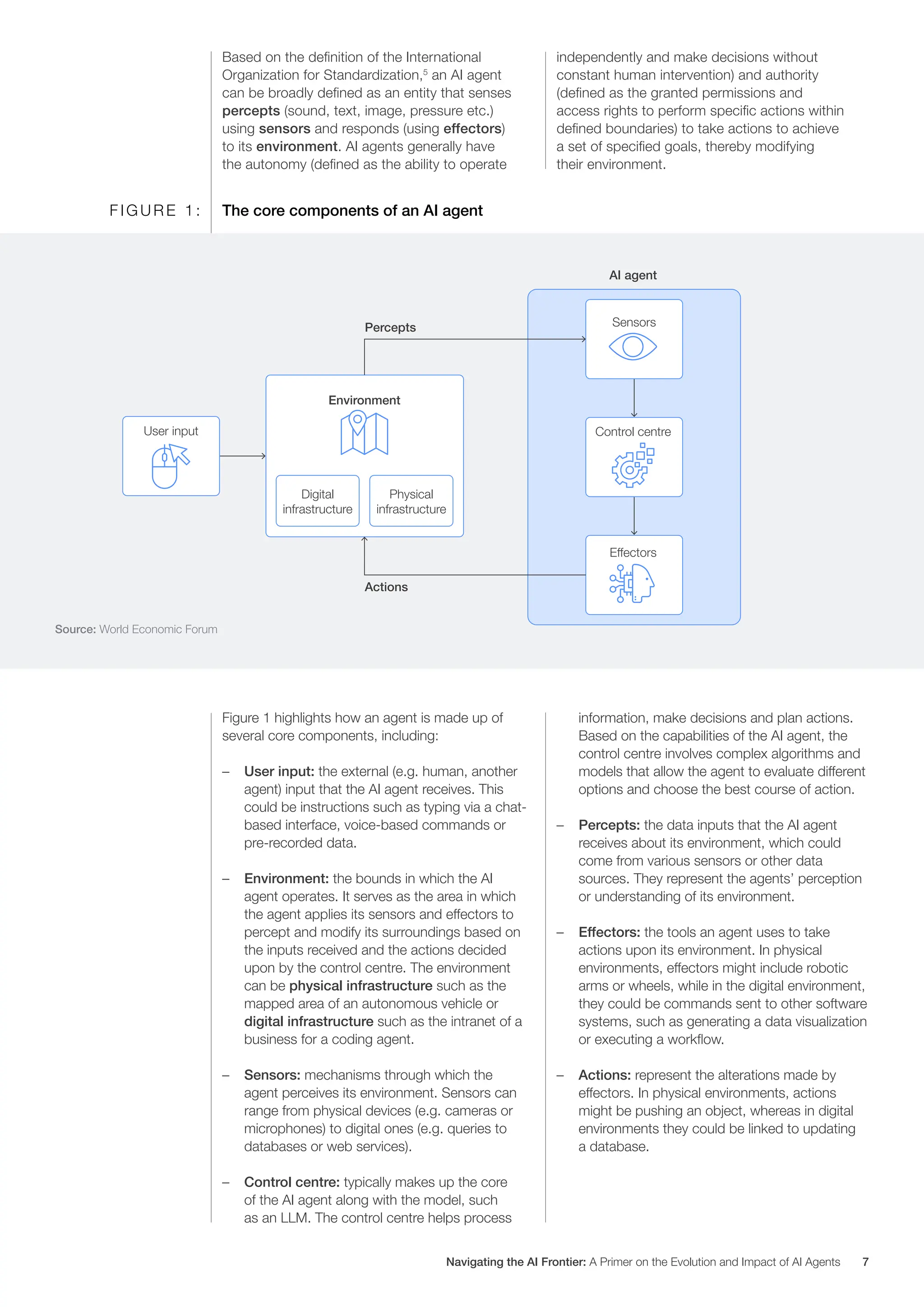
The core components of an AI agent
F I G U R E 1 :
Figure 1 highlights how an agent is made up of
several core components, including:
– User input: the external (e.g. human, another
agent) input that the AI agent receives. This
could be instructions such as typing via a chat-
based interface, voice-based commands or
pre-recorded data.
– Environment: the bounds in which the AI
agent operates. It serves as the area in which
the agent applies its sensors and effectors to
percept and modify its surroundings based on
the inputs received and the actions decided
upon by the control centre. The environment
can be physical infrastructure such as the
mapped area of an autonomous vehicle or
digital infrastructure such as the intranet of a
business for a coding agent.
– Sensors: mechanisms through which the
agent perceives its environment. Sensors can
range from physical devices (e.g. cameras or
microphones) to digital ones (e.g. queries to
databases or web services).
– Control centre: typically makes up the core
of the AI agent along with the model, such
as an LLM. The control centre helps process
information, make decisions and plan actions.
Based on the capabilities of the AI agent, the
control centre involves complex algorithms and
models that allow the agent to evaluate different
options and choose the best course of action.
– Percepts: the data inputs that the AI agent
receives about its environment, which could
come from various sensors or other data
sources. They represent the agents’ perception
or understanding of its environment.
– Effectors: the tools an agent uses to take
actions upon its environment. In physical
environments, effectors might include robotic
arms or wheels, while in the digital environment,
they could be commands sent to other software
systems, such as generating a data visualization
or executing a workflow.
– Actions: represent the alterations made by
effectors. In physical environments, actions
might be pushing an object, whereas in digital
environments they could be linked to updating
a database.
AI agent
Percepts
Environment
Actions
Sensors
Control centre
Effectors
Digital
infrastructure
User input
Physical
infrastructure
Source: World Economic Forum
Navigating the AI Frontier: A Primer on the Evolution and Impact of AI Agents 7
The evolution of
AI agents
2
Developers have transformed AI from rule-based
systems to active agents capable of learning
and adapting while engaged in a task.
Navigating the AI Frontier: A Primer on the Evolution and Impact of AI Agents 8
The development of AI agents began in the
1950s,6
and since then they have evolved from
simple rule-based systems to sophisticated
autonomous entities capable of complex
decision-making. Early AI was characterized by
deterministic behaviour, relying on fixed rules and
logic that made these systems predictable but
unable to learn or adapt from new experiences.
Advances in AI research introduced systems
that could handle larger datasets and manage
uncertainty, leading to probabilistic outcomes and
non-deterministic behaviour. This shift enabled
more flexible and dynamic decision-making,
moving beyond rigid frameworks.
The 1990s marked a significant turning point, as
machine learning applications became
more widespread. AI systems began to learn
from data, adapt over time and improve
performance. The introduction of neural
networks during this period laid the foundation
for deep learning, which has since become
essential to modern AI.
Since 2017, the rise of LLMs has transformed
AI’s capabilities in natural language understanding
and generation. These models use vast amounts
of data to produce human-like text and engage in
complex language-based tasks.
Today’s AI agents use various learning
techniques, including reinforcement learning, or
transfer learning, allowing them to continuously
refine their abilities, adapt to new environments
and make more informed decisions.
Key technological trends
2.1
Over the past 25 years, the increase in computing
capacity, the availability of large quantities
of data on the internet and novel algorithmic
breakthroughs have enabled significant
developments in the base technologies behind
recent advances in the capabilities of AI agents.
These are briefly described below.
Large models
Large language models (LLM) and large multimodal
models (LMM) have revolutionized the capabilities
of AI agents, particularly in natural language
processing and the generation of text, image, audio
and video.
The emergence of large models has been driven
by several technological advances and by the
transformer architecture, which has paved the way
for a deeper understanding of context and word
relationships, considerably improving the efficiency
and performance of natural language processing
tasks.7
In summary, advanced AI models have
enabled better understanding, generation and
engagement with natural language.
Machine learning and deep
learning techniques
A range of techniques have greatly improved AI
models through increased efficiency and greater
specialization. Some examples of machine- and
deep-learning techniques include:
1. Supervised learning: facilitates learning from
labelled datasets, so the model can accurately
predict or classify new, previously unseen data.8
2. Reinforcement learning: enables agents
to learn optimal behaviours through trial and
error in dynamic environments. Agents can
continuously update their knowledge base
without needing periodic retraining.9
3. Reinforcement learning with human
feedback: enables agents to adapt and
improve through human feedback, specifically
focusing on aligning AI behaviour with human
values and preferences.10
4. Transfer learning: involves taking a pretrained
model, typically trained on a large dataset (e.g.
to recognize cars) and adapting it to a new but
related problem (e.g. to recognize trucks).11
5. Fine-tuning: involves taking a pretrained model
and further training it on a smaller, task-specific
dataset. This process allows the model to retain
its foundational knowledge while improving its
performance on specialized tasks.12
These and other learning paradigms are often used
in combination and have dramatically expanded the
problem-solving capabilities of AI agents in various
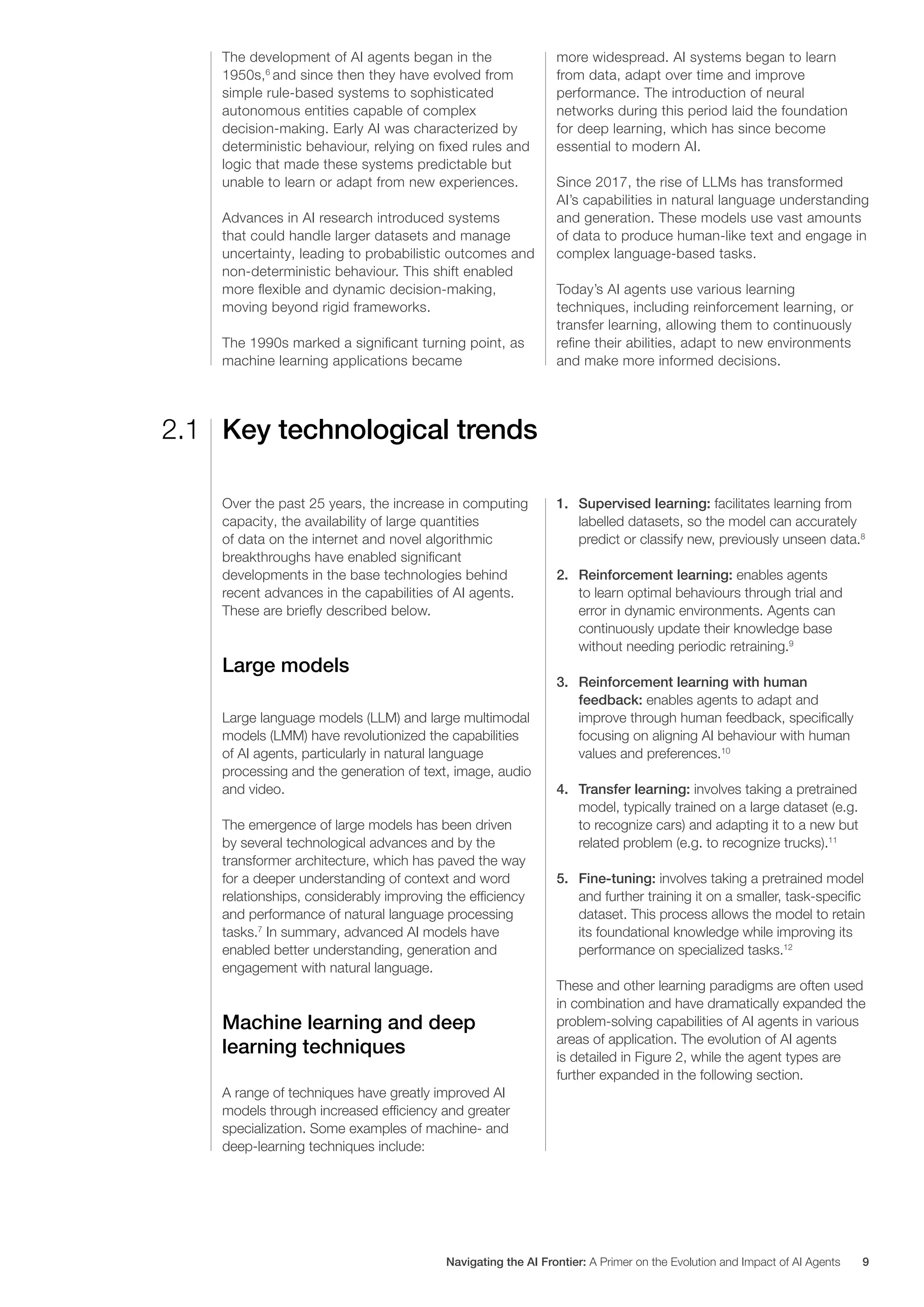
areas of application. The evolution of AI agents
is detailed in Figure 2, while the agent types are
further expanded in the following section.
Navigating the AI Frontier: A Primer on the Evolution and Impact of AI Agents 9
Evolution of AI agents’ capabilities
F I G U R E 2 :
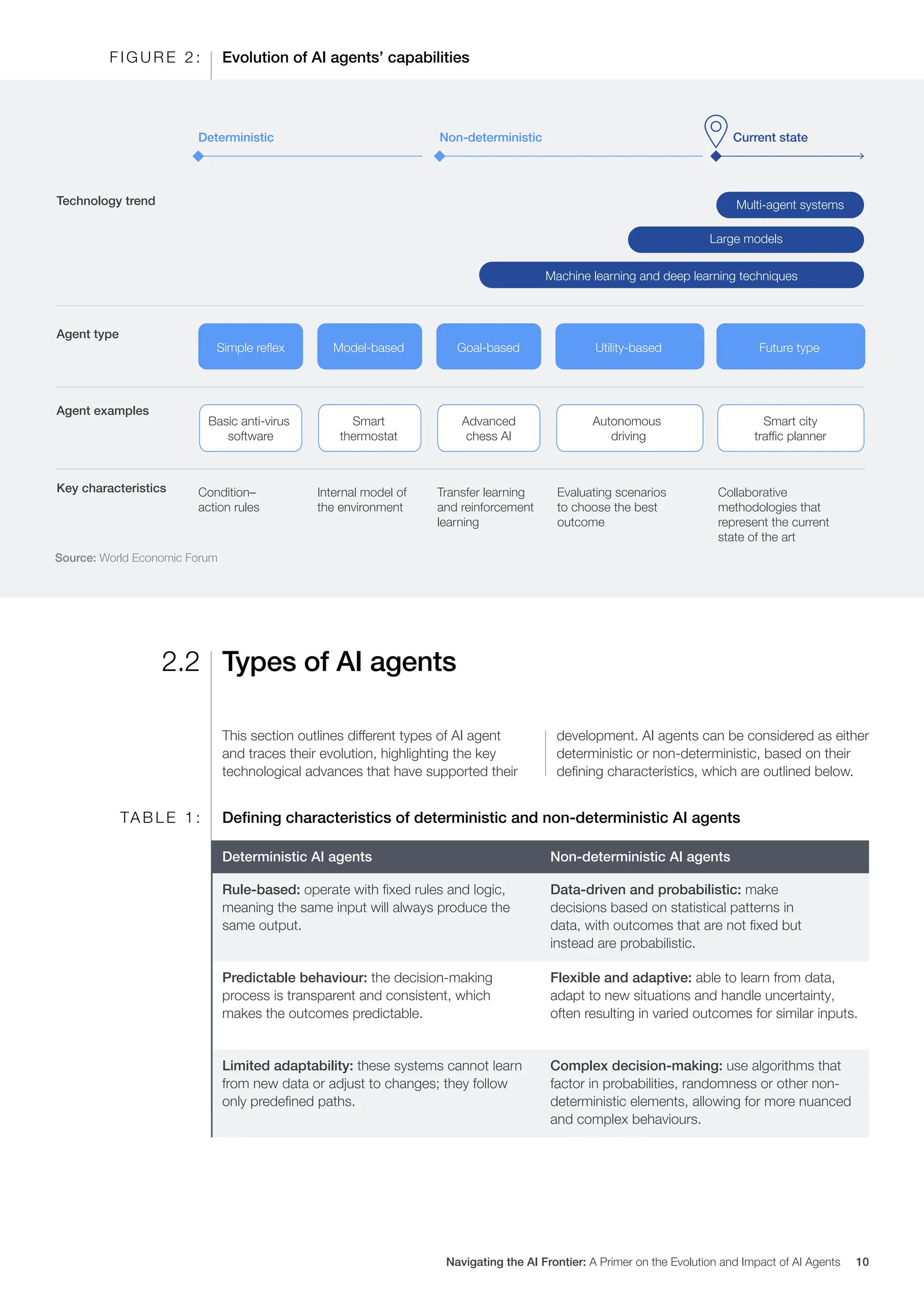
TA B L E 1 :
Technology trend
Deterministic Non-deterministic Current state
Agent type
Simple reflex
Condition–
action rules
Internal model of
the environment
Transfer learning
and reinforcement
learning
Evaluating scenarios
to choose the best
outcome
Collaborative
methodologies that
represent the current
state of the art
Basic anti-virus
software
Smart
thermostat
Advanced
chess AI
Autonomous
driving
Smart city
traffic planner
Model-based Goal-based Utility-based
Machine learning and deep learning techniques
Large models
Multi-agent systems
Future type
Agent examples
Key characteristics
Source: World Economic Forum
Types of AI agents
2.2
This section outlines different types of AI agent
and traces their evolution, highlighting the key
technological advances that have supported their
development. AI agents can be considered as either
deterministic or non-deterministic, based on their
defining characteristics, which are outlined below.
Defining characteristics of deterministic and non-deterministic AI agents
Deterministic AI agents Non-deterministic AI agents
Rule-based: operate with fixed rules and logic,
meaning the same input will always produce the
same output.
Data-driven and probabilistic: make
decisions based on statistical patterns in
data, with outcomes that are not fixed but
instead are probabilistic.
Predictable behaviour: the decision-making
process is transparent and consistent, which
makes the outcomes predictable.
Flexible and adaptive: able to learn from data,
adapt to new situations and handle uncertainty,
often resulting in varied outcomes for similar inputs.
Limited adaptability: these systems cannot learn
from new data or adjust to changes; they follow
only predefined paths.
Complex decision-making: use algorithms that
factor in probabilities, randomness or other non-
deterministic elements, allowing for more nuanced
and complex behaviours.
Navigating the AI Frontier: A Primer on the Evolution and Impact of AI Agents 10
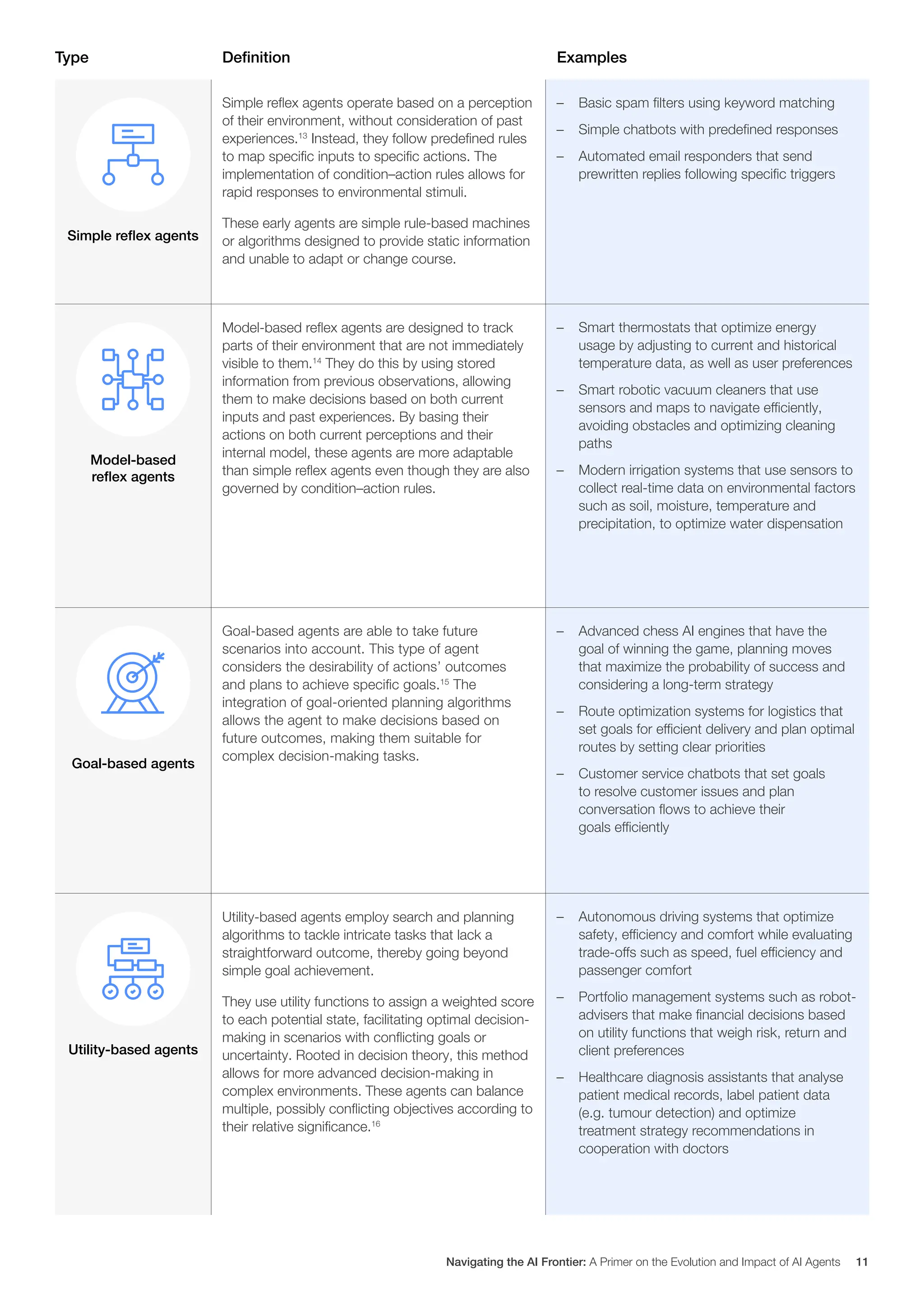
Simple reflex agents operate based on a perception
of their environment, without consideration of past
experiences.13
Instead, they follow predefined rules
to map specific inputs to specific actions. The
implementation of condition–action rules allows for
rapid responses to environmental stimuli.
These early agents are simple rule-based machines
or algorithms designed to provide static information
and unable to adapt or change course.
– Basic spam filters using keyword matching
– Simple chatbots with predefined responses
– Automated email responders that send
prewritten replies following specific triggers
Model-based reflex agents are designed to track
parts of their environment that are not immediately
visible to them.14
They do this by using stored
information from previous observations, allowing
them to make decisions based on both current
inputs and past experiences. By basing their
actions on both current perceptions and their
internal model, these agents are more adaptable
than simple reflex agents even though they are also
governed by condition–action rules.
Simple reflex agents
Model-based
reflex agents
Goal-based agents
Utility-based agents
– Smart thermostats that optimize energy
usage by adjusting to current and historical
temperature data, as well as user preferences
– Smart robotic vacuum cleaners that use
sensors and maps to navigate efficiently,
avoiding obstacles and optimizing cleaning
paths
– Modern irrigation systems that use sensors to
collect real-time data on environmental factors
such as soil, moisture, temperature and
precipitation, to optimize water dispensation
Goal-based agents are able to take future
scenarios into account. This type of agent
considers the desirability of actions’ outcomes
and plans to achieve specific goals.15
The
integration of goal-oriented planning algorithms
allows the agent to make decisions based on
future outcomes, making them suitable for
complex decision-making tasks.
– Advanced chess AI engines that have the
goal of winning the game, planning moves
that maximize the probability of success and
considering a long-term strategy
– Route optimization systems for logistics that
set goals for efficient delivery and plan optimal
routes by setting clear priorities
– Customer service chatbots that set goals
to resolve customer issues and plan
conversation flows to achieve their
goals efficiently
Utility-based agents employ search and planning
algorithms to tackle intricate tasks that lack a
straightforward outcome, thereby going beyond
simple goal achievement.
They use utility functions to assign a weighted score
to each potential state, facilitating optimal decision-
making in scenarios with conflicting goals or
uncertainty. Rooted in decision theory, this method
allows for more advanced decision-making in
complex environments. These agents can balance
multiple, possibly conflicting objectives according to
their relative significance.16
– Autonomous driving systems that optimize
safety, efficiency and comfort while evaluating
trade-offs such as speed, fuel efficiency and
passenger comfort
– Portfolio management systems such as robot-
advisers that make financial decisions based
on utility functions that weigh risk, return and
client preferences
– Healthcare diagnosis assistants that analyse
patient medical records, label patient data
(e.g. tumour detection) and optimize
treatment strategy recommendations in
cooperation with doctors
Type Definition Examples
Navigating the AI Frontier: A Primer on the Evolution and Impact of AI Agents 11
Advanced AI agents
2.3
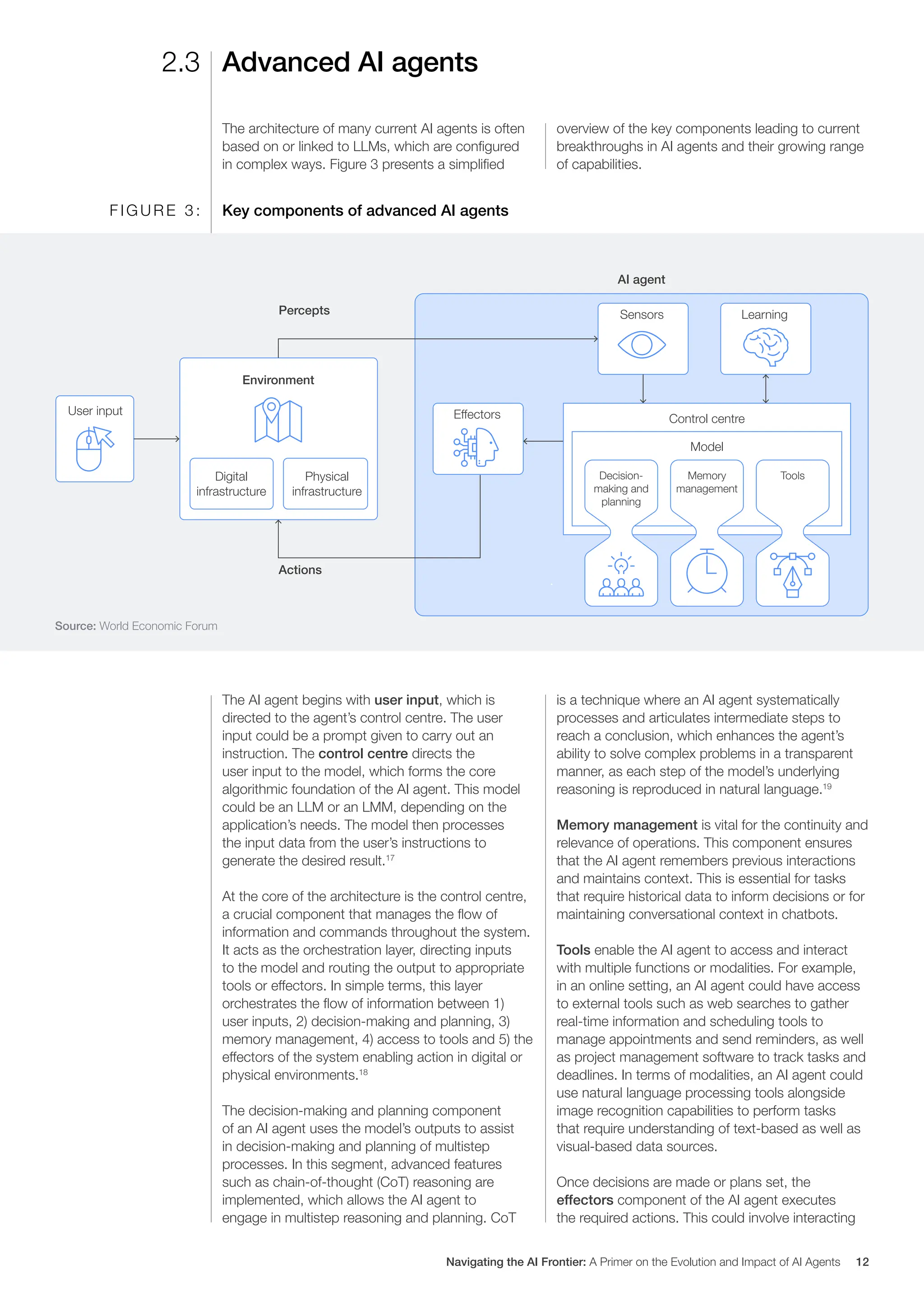
The architecture of many current AI agents is often
based on or linked to LLMs, which are configured
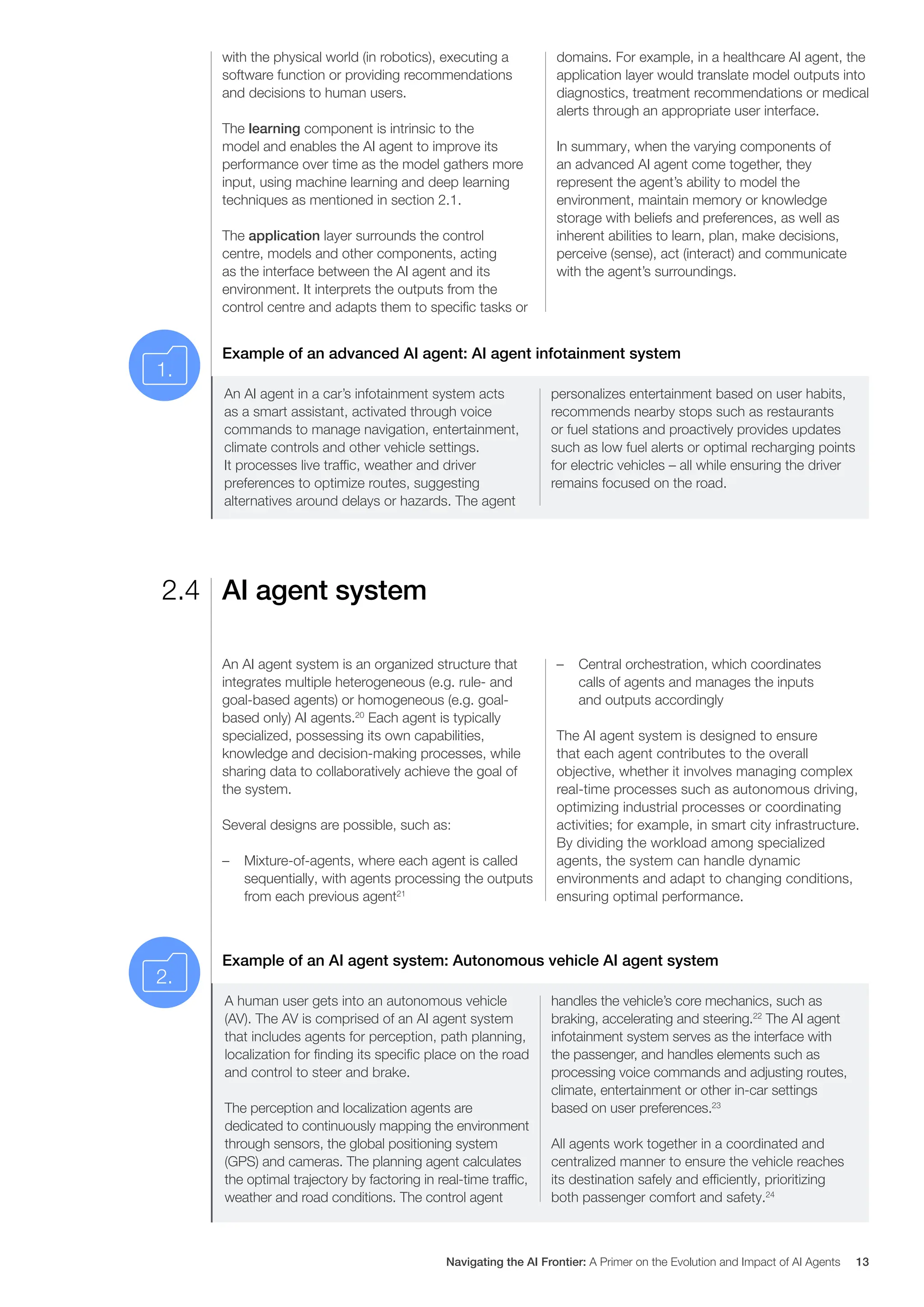
in complex ways. Figure 3 presents a simplified
overview of the key components leading to current
breakthroughs in AI agents and their growing range
of capabilities.
Key components of advanced AI agents
F I G U R E 3 :
The AI agent begins with user input, which is
directed to the agent’s control centre. The user
input could be a prompt given to carry out an
instruction. The control centre directs the
user input to the model, which forms the core
algorithmic foundation of the AI agent. This model
could be an LLM or an LMM, depending on the
application’s needs. The model then processes
the input data from the user’s instructions to
generate the desired result.17
At the core of the architecture is the control centre,
a crucial component that manages the flow of
information and commands throughout the system.
It acts as the orchestration layer, directing inputs
to the model and routing the output to appropriate
tools or effectors. In simple terms, this layer
orchestrates the flow of information between 1)
user inputs, 2) decision-making and planning, 3)
memory management, 4) access to tools and 5) the
effectors of the system enabling action in digital or
physical environments.18
The decision-making and planning component
of an AI agent uses the model’s outputs to assist
in decision-making and planning of multistep
processes. In this segment, advanced features
such as chain-of-thought (CoT) reasoning are
implemented, which allows the AI agent to
engage in multistep reasoning and planning. CoT
is a technique where an AI agent systematically
processes and articulates intermediate steps to
reach a conclusion, which enhances the agent’s
ability to solve complex problems in a transparent
manner, as each step of the model’s underlying
reasoning is reproduced in natural language.19
Memory management is vital for the continuity and
relevance of operations. This component ensures
that the AI agent remembers previous interactions
and maintains context. This is essential for tasks
that require historical data to inform decisions or for
maintaining conversational context in chatbots.
Tools enable the AI agent to access and interact
with multiple functions or modalities. For example,
in an online setting, an AI agent could have access
to external tools such as web searches to gather
real-time information and scheduling tools to
manage appointments and send reminders, as well
as project management software to track tasks and
deadlines. In terms of modalities, an AI agent could
use natural language processing tools alongside
image recognition capabilities to perform tasks
that require understanding of text-based as well as
visual-based data sources.
Once decisions are made or plans set, the
effectors component of the AI agent executes
the required actions. This could involve interacting
AI agent
Percepts
Environment
Actions
Sensors Learning
Digital
infrastructure
User input
Physical
infrastructure
Effectors Control centre
Model
Decision-
making and
planning
Memory
management
Tools
Source: World Economic Forum
Navigating the AI Frontier: A Primer on the Evolution and Impact of AI Agents 12
with the physical world (in robotics), executing a
software function or providing recommendations
and decisions to human users.
The learning component is intrinsic to the
model and enables the AI agent to improve its
performance over time as the model gathers more
input, using machine learning and deep learning
techniques as mentioned in section 2.1.
The application layer surrounds the control
centre, models and other components, acting
as the interface between the AI agent and its
environment. It interprets the outputs from the
control centre and adapts them to specific tasks or
domains. For example, in a healthcare AI agent, the
application layer would translate model outputs into
diagnostics, treatment recommendations or medical
alerts through an appropriate user interface.
In summary, when the varying components of
an advanced AI agent come together, they
represent the agent’s ability to model the
environment, maintain memory or knowledge
storage with beliefs and preferences, as well as
inherent abilities to learn, plan, make decisions,
perceive (sense), act (interact) and communicate
with the agent’s surroundings.
Example of an advanced AI agent: AI agent infotainment system
An AI agent in a car’s infotainment system acts
as a smart assistant, activated through voice
commands to manage navigation, entertainment,
climate controls and other vehicle settings.
It processes live traffic, weather and driver
preferences to optimize routes, suggesting
alternatives around delays or hazards. The agent
personalizes entertainment based on user habits,
recommends nearby stops such as restaurants
or fuel stations and proactively provides updates
such as low fuel alerts or optimal recharging points
for electric vehicles – all while ensuring the driver
remains focused on the road.
AI agent system
2.4
An AI agent system is an organized structure that
integrates multiple heterogeneous (e.g. rule- and
goal-based agents) or homogeneous (e.g. goal-
based only) AI agents.20
Each agent is typically
specialized, possessing its own capabilities,
knowledge and decision-making processes, while
sharing data to collaboratively achieve the goal of
the system.
Several designs are possible, such as:
– Mixture-of-agents, where each agent is called
sequentially, with agents processing the outputs
from each previous agent21
– Central orchestration, which coordinates
calls of agents and manages the inputs
and outputs accordingly
The AI agent system is designed to ensure
that each agent contributes to the overall
objective, whether it involves managing complex
real-time processes such as autonomous driving,
optimizing industrial processes or coordinating
activities; for example, in smart city infrastructure.
By dividing the workload among specialized
agents, the system can handle dynamic
environments and adapt to changing conditions,
ensuring optimal performance.
Example of an AI agent system: Autonomous vehicle AI agent system
A human user gets into an autonomous vehicle
(AV). The AV is comprised of an AI agent system
that includes agents for perception, path planning,
localization for finding its specific place on the road
and control to steer and brake.
The perception and localization agents are
dedicated to continuously mapping the environment
through sensors, the global positioning system
(GPS) and cameras. The planning agent calculates
the optimal trajectory by factoring in real-time traffic,
weather and road conditions. The control agent
handles the vehicle’s core mechanics, such as
braking, accelerating and steering.22
The AI agent
infotainment system serves as the interface with
the passenger, and handles elements such as
processing voice commands and adjusting routes,
climate, entertainment or other in-car settings
based on user preferences.23
All agents work together in a coordinated and
centralized manner to ensure the vehicle reaches
its destination safely and efficiently, prioritizing
both passenger comfort and safety.24
1.
2.
Navigating the AI Frontier: A Primer on the Evolution and Impact of AI Agents 13
Network architecture Supervised architecture
AI agent
AI agent
superivsor
AI agent
system
AI agent
system
AI agent
AI agent
AI agent
system
AI agent
system
The future of AI agents: Towards
multi-agent systems
2.5
Multi-agent systems (MAS) consist of multiple
independent AI agents as well as AI agent systems
that collaborate, compete or negotiate to achieve
collective tasks and goals.25
These agents can be
autonomous entities, such as software programs
or robots, each typically specialized with its own
set of capabilities, knowledge and decision-making
processes. This allows agents to perform tasks in
parallel, communicate with one another and adapt
to changes in complex environments.
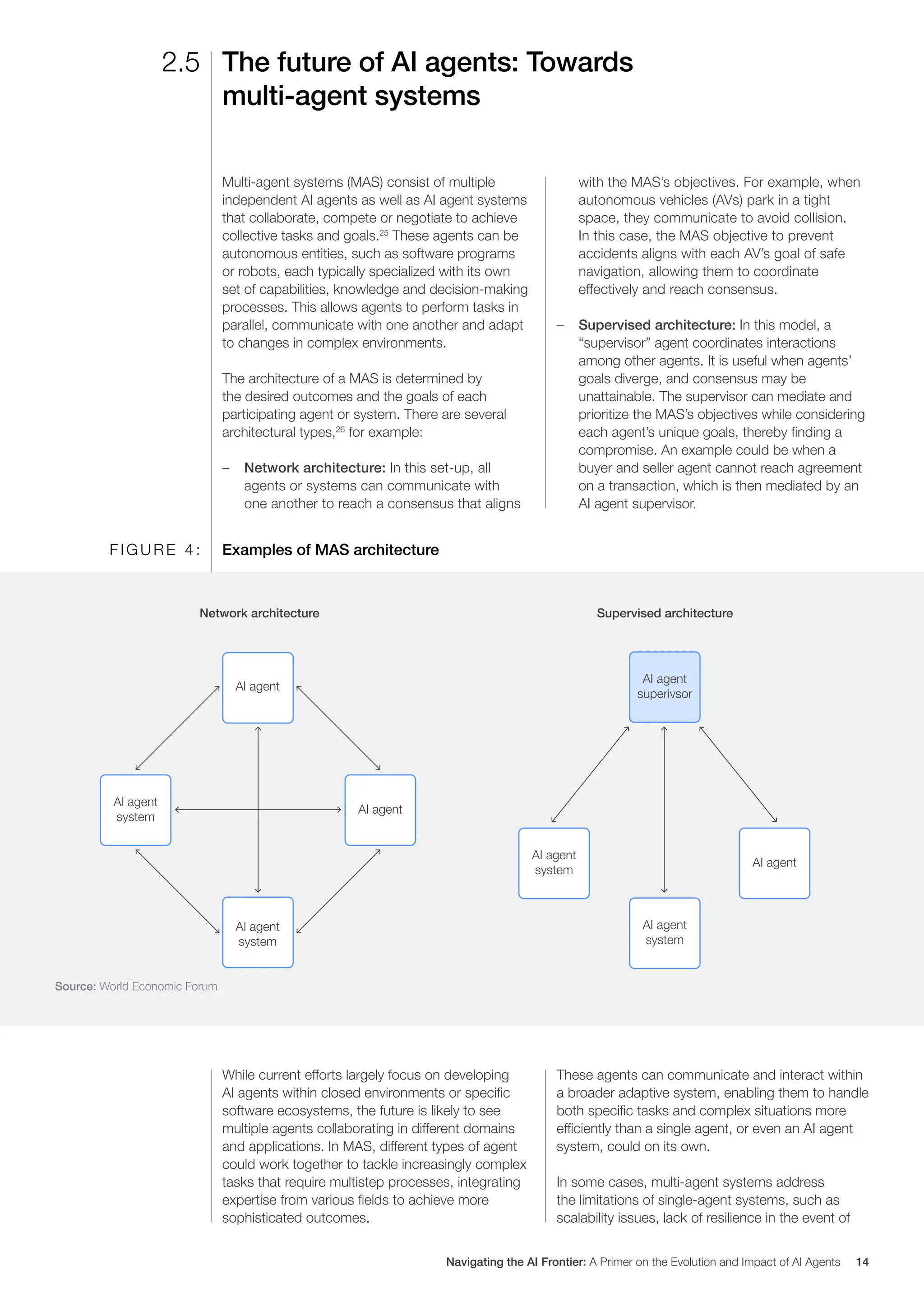
The architecture of a MAS is determined by
the desired outcomes and the goals of each
participating agent or system. There are several
architectural types,26
for example:
– Network architecture: In this set-up, all
agents or systems can communicate with
one another to reach a consensus that aligns
with the MAS’s objectives. For example, when
autonomous vehicles (AVs) park in a tight
space, they communicate to avoid collision.
In this case, the MAS objective to prevent
accidents aligns with each AV’s goal of safe
navigation, allowing them to coordinate
effectively and reach consensus.
– Supervised architecture: In this model, a
“supervisor” agent coordinates interactions
among other agents. It is useful when agents’
goals diverge, and consensus may be
unattainable. The supervisor can mediate and
prioritize the MAS’s objectives while considering
each agent’s unique goals, thereby finding a
compromise. An example could be when a
buyer and seller agent cannot reach agreement
on a transaction, which is then mediated by an
AI agent supervisor.
Examples of MAS architecture
F I G U R E 4 :
While current efforts largely focus on developing
AI agents within closed environments or specific
software ecosystems, the future is likely to see
multiple agents collaborating in different domains
and applications. In MAS, different types of agent
could work together to tackle increasingly complex
tasks that require multistep processes, integrating
expertise from various fields to achieve more
sophisticated outcomes.
These agents can communicate and interact within
a broader adaptive system, enabling them to handle
both specific tasks and complex situations more
efficiently than a single agent, or even an AI agent
system, could on its own.
In some cases, multi-agent systems address
the limitations of single-agent systems, such as
scalability issues, lack of resilience in the event of
Source: World Economic Forum
Navigating the AI Frontier: A Primer on the Evolution and Impact of AI Agents 14
failure or errors and limited skill sets. By distributing
tasks among multiple agents, MAS could increase
both efficiency and capability.
In theory, multi-agent systems are highly adaptable,
as agents can be dynamically added or removed,
allowing the system to respond to changing
environments and requirements. This scalability is
crucial for applications that need to grow or evolve
over time without extensive re-engineering.
In many ways, multi-agent systems can be
considered as a future type of system that could
coordinate agent actions among multiple users
or organizations through human-comprehensible
language or to-be-determined AI agent protocols.
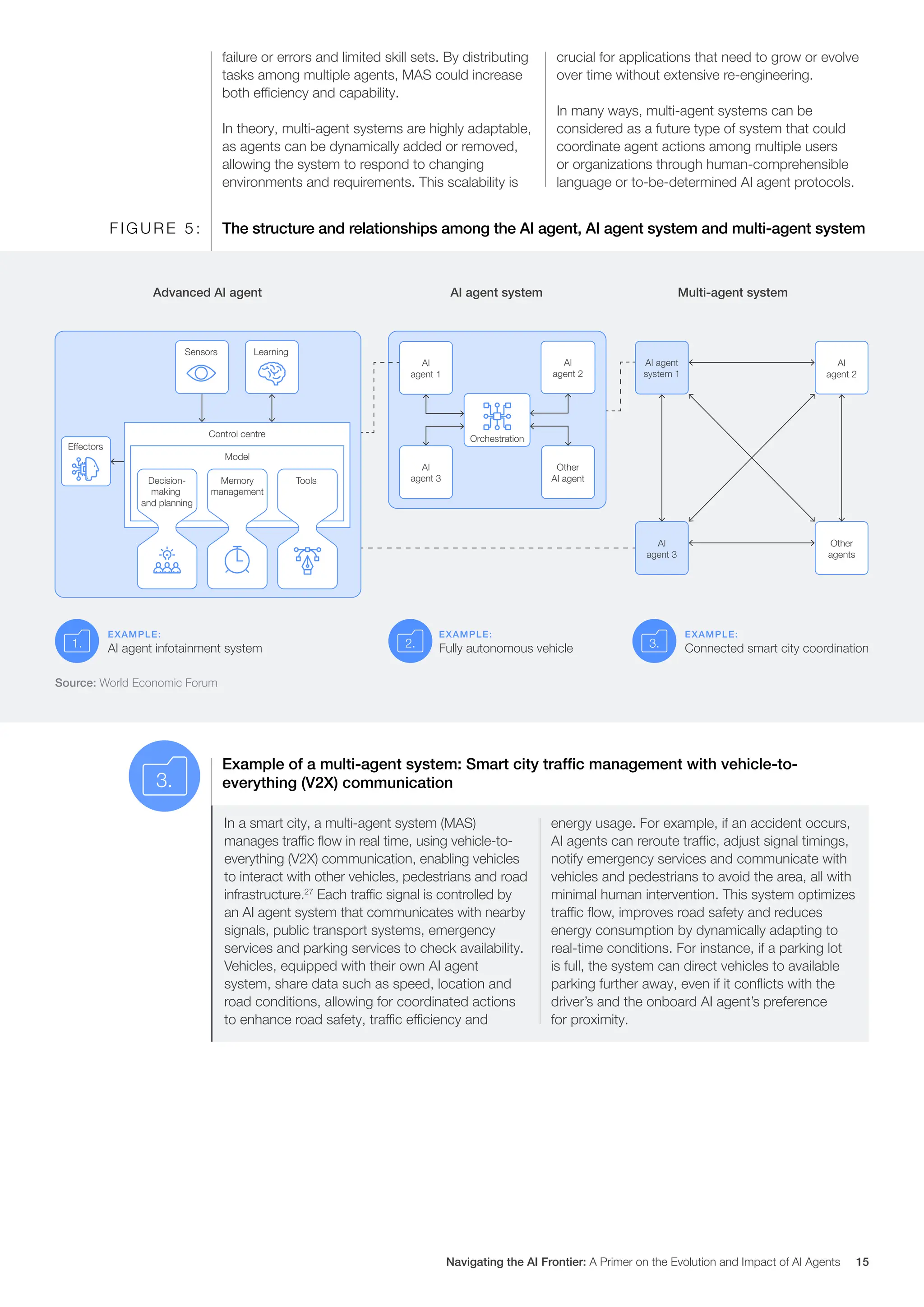
F I G U R E 5 : The structure and relationships among the AI agent, AI agent system and multi-agent system
Advanced AI agent
EXAMPLE:
AI agent infotainment system
EXAMPLE:
Fully autonomous vehicle
EXAMPLE:
Connected smart city coordination
AI agent system Multi-agent system
Sensors Learning
AI
agent 1
Orchestration
AI
agent 3
Other
AI agent
AI
agent 2
AI agent
system 1
AI
agent 2
AI
agent 3
Other
agents
Effectors
Control centre
Model
Decision-
making
and planning
Memory
management
Tools
1. 2. 3.
Example of a multi-agent system: Smart city traffic management with vehicle-to-
everything (V2X) communication
Source: World Economic Forum
In a smart city, a multi-agent system (MAS)
manages traffic flow in real time, using vehicle-to-
everything (V2X) communication, enabling vehicles
to interact with other vehicles, pedestrians and road
infrastructure.27
Each traffic signal is controlled by
an AI agent system that communicates with nearby
signals, public transport systems, emergency
services and parking services to check availability.
Vehicles, equipped with their own AI agent
system, share data such as speed, location and
road conditions, allowing for coordinated actions
to enhance road safety, traffic efficiency and
energy usage. For example, if an accident occurs,
AI agents can reroute traffic, adjust signal timings,
notify emergency services and communicate with
vehicles and pedestrians to avoid the area, all with
minimal human intervention. This system optimizes
traffic flow, improves road safety and reduces
energy consumption by dynamically adapting to
real-time conditions. For instance, if a parking lot
is full, the system can direct vehicles to available
parking further away, even if it conflicts with the
driver’s and the onboard AI agent’s preference
for proximity.
3.
Navigating the AI Frontier: A Primer on the Evolution and Impact of AI Agents 15
Interoperability of multi-agent
systems
One technical challenge in multi-agent systems
is associated with enabling effective
communication between different AI agents
and AI agent systems.28
In some cases,
interactions are limited by the boundaries of
native application environments, restricting the
potential of AI agents to narrower and more
specialized subdomains, where control is more
easily retained.
The interoperability of AI agents relies on common
communication protocols, which are the rules and
standards governing how AI agents exchange
information. These protocols can generally be
categorized in two types:
– Predefined protocols: these are based on
established agent communication languages
and ontologies. Since they are predefined,
the communication patterns are predictable
and consistent; however, they may not adapt
well to dynamic environments where new
communication needs arise.29
– Emergent protocols: these allow agents to
learn how to communicate effectively based
on their experiences, often using reinforcement
learning techniques. This enables agents
to adapt their communication strategies
to changing environments and tasks.30
However, decoding and understanding
emergent communication remains an ongoing
research challenge.31
A good understanding of the messages
exchanged between AI agents is essential,
otherwise it could affect the overall reliability of
multi-agent systems. This inconsistency could
lead to misunderstandings or misaligned actions
when agents collaborate, especially in complex
environments requiring precise coordination.
To enhance the transparency of multi-agent
interaction, the information exchanged needs to
be easily accessible and interpretable by humans.
Navigating the AI Frontier: A Primer on the Evolution and Impact of AI Agents 16
Looking ahead
3
AI agents have the potential to tackle challenging
tasks with great efficiency. But they carry
associated risks such as malfunction, malicious
use and unwanted socioeconomic effects.
Navigating the AI Frontier: A Primer on the Evolution and Impact of AI Agents 17
Key benefits
3.1
By scaffolding capabilities such as reasoning,
planning and self-checking on top of LLMs, more
capable AI agents emerge that hold the potential
to dramatically increase users’ productivity and
absolve them from certain tasks. This could
involve completing tasks beyond users’ skill sets,
such as specialized coding, or partially or fully
offloading tedious tasks that can be done more
cheaply, quickly and at a greater scale than before.
Additionally, the application of AI agents can play
a crucial role in addressing the shortfall of skills in
various industries, filling the gaps in areas where
human expertise is lacking or in high demand.
Key characteristics of greater autonomy increasingly
allow AI agents to tackle open-ended, real-world
challenges that at one time were beyond them
– for example, helping in scientific discovery,
improving the efficiency of complex systems such
as supply chains or electrical grids, managing
rare and unusual scenarios in processes that are
too infrequent to justify traditional automation,
or enabling physical robots that can manipulate
objects and navigate physical environments.32
Software development
AI agents can help generate, run and check code and other artefacts needed, allowing
software developers to focus on higher value-added activities.
Examples of the benefits of applications of AI agents include:
Healthcare
AI agents could improve diagnostics and personalized treatment, reducing hospital
stays and costs through data analysis and decision-making support. For example, in
under-resourced areas, AI agents could help alleviate the workload of clinical specialists
by assisting doctors in developing tailored treatment plans.33
Enhanced customer experience
AI agent-based chatbots or virtual assistants can offer personalized, round-the-
clock support, increasing customer satisfaction. They have the potential to provide
consistently accurate responses, helping businesses maintain communication quality
and resolve customer issues efficiently.34
Education
AI agents could help personalize learning experiences by adapting content to each
student’s needs, offering real-time feedback and supporting teachers with grading and
administrative tasks. This allows educators to focus more on creative and interactive
learning experiences.
Finance
AI agents could help enhance fraud detection, optimize trading strategies and offer
personalized financial advice. They can analyse large datasets to identify patterns and
trends, providing faster and more accurate insights for decision-making.
Navigating the AI Frontier: A Primer on the Evolution and Impact of AI Agents 18
While AI agents have the potential to offer numerous
benefits, they also come with inherent risks, as
well as novel safety and security implications. For
example, an AI system independently pursuing
misaligned objectives could cause immense
harm, especially in scenarios where the AI agents’
level of autonomy increases while the level of
human oversight decreases. AI agents learning
to deceive human operators, pursuing power-
seeking instrumental goals or colluding with other
misaligned agents in unexpected ways could pose
entirely novel risks.35
Agent-specific risks can be both technical and
normative. Challenges associated with AI agents
stem from technical limitations, ethical concerns
and broader societal impacts often associated
with a system’s level of autonomy and the overall
potential of its use when humans are removed
from the loop. Without a human in the loop at
appropriate steps, agents may take multiple
consequential actions in rapid succession, which
could have significant consequences before a
person notices what is happening.36
AI agents can also amplify known risks associated
with the domain of AI and could introduce entirely
new risks that can be broadly categorized into
technical, socioeconomic and ethical risks.
Technical risks
Examples of technical risks include:
– Risks from malfunctions due to AI agent
failures: AI agents can amplify the risks from
malfunctions by introducing new classes of
failure modes. LLMs, for example, can enable
agents to produce highly plausible but incorrect
outputs, presenting risks in ways that were
not possible with earlier technologies. These
emerging failure modes add to traditional issues
such as inaccurate sensors or effectors and
encompass capability- and goal-related failures,
as well as increased security vulnerabilities that
could lead to malfunctions.37
Capability failures occur when an AI agent fails
to perform the tasks it was designed for, due to
limitations in its ability to understand, process
or execute the required actions. Goal-related
failures occur when a system is highly capable
but nevertheless pursues the wrong goal. These
issues can be caused by:
– Specification gaming: When AI agents
exploit loopholes or unintended shortcuts
in their programming to achieve their
objectives, rather than fulfilling their goals.38
– Goal misgeneralization: When AI agents
apply their learned goals inappropriately to
new or unforeseen situations.39
– Deceptive alignment: When AI agents
appear to be aligned with the intended goals
during training or testing, but their internal
objectives differ from what is intended.40
– Malicious use and security vulnerabilities: AI
agents can amplify the risk of fraud and scams
increasing both in volume and sophistication.
More capable AI agents can facilitate the
generation of scam content at greater speeds
and scale than previously possible, and AI
agents can facilitate the creation of more
convincing and personalized scam content.
For example, AI systems could help criminals
evade security software by correcting language
errors and improving the fluency of messages
that might otherwise be caught by spam
filters.41
More capable AI agents could automate
complex end-to-end tasks that would lower the
point of entry for engaging in harmful activities.
Some forms of cyberattacks could, for example,
be automated, allowing individuals with little
domain knowledge or technical expertise to
execute large-scale attacks.42
– Challenges in validating and testing complex
AI agents: The lack of transparency and non-
deterministic behaviour of some AI agents
creates significant challenges for validation
and verification. In safety-critical applications,
this unpredictability complicates efforts to
assure system safety, as it becomes difficult
to demonstrate reliable performance in all
scenarios.43
While failures in agent-based
systems are expected, the varied ways in which
they can fail adds further complexity to safety
assurance. Failsafe mechanisms are essential
but could be harder to design due to uncertainty
on potential failure modes.44
Socioeconomic risks
Examples of socioeconomic risks include:
– Over-reliance and disempowerment:
Increasing autonomy of AI agents could reduce
human oversight and increase the reliance on AI
agents to carry out complex tasks, even in high-
stakes situations. Malfunctions of the AI agents
due to design flaws or adversarial attacks may
not be immediately apparent if humans are not
in the loop. Additionally, disabling an agent
could be difficult if a user lacks the required
expertise or domain knowledge.45
Pervasive interaction with intelligent AI agents
could also have long-term impacts on individual
3.2 Examples of risks and challenges
Navigating the AI Frontier: A Primer on the Evolution and Impact of AI Agents 19
and collective cognitive capabilities. For
example, increased reliance on AI agents for
social interactions, such as virtual assistants, AI
agent companions, therapists and so on could
contribute to social isolation and possibly affect
mental well-being over time.
– Societal resistance: Resistance to the
employment of AI agents could hamper their
adoption in some sectors or use cases.
– Employment implications: The use of AI
agents is likely to transform a variety of jobs by
automating many tasks, increasing productivity
and altering the skills required in the workforce,
thus causing partial job displacement.
Such displacement could primarily affect
sectors reliant on routine and repetitive
tasks, in industries such as manufacturing or
administrative services.
– Financial implications: Organizations
could face higher costs associated with the
deployment of AI agents, such as expenses for
securing software systems against cyberthreats
and managing associated operational risks.
Ethical risks
Examples of ethical risks include:
– Ethical dilemmas in AI decision-making:
The autonomous nature of AI agents raises
ethical questions about their decision-making
capabilities in critical situations.
– Challenges in ensuring AI transparency
and explainability: Many AI models operate
as “black boxes”, making decisions based
on complex and opaque processes, thereby
making it difficult for users to understand
or interpret how decisions are made.46
A
lack of transparency could lead to concerns
about potential errors or biases in the AI
agent’s decision-making capabilities, which
would hinder trust and raise issues of moral
responsibility and legal accountability for
decisions made by the AI agent.
Addressing the risk and challenges
3.3
To enable the autonomy of AI agents for cases
where it would greatly improve outcomes,
several challenges must be addressed. These
challenges include safety and security-related
assurance, regulation, moral responsibility and legal
accountability, data equity considerations, data
governance and interoperability, skills, culture and
perceptions.47
Addressing these challenges requires
a comprehensive approach throughout the stages
of design, development, deployment and use of
AI agents as well as changes across policy and
regulation. As advanced AI agents and multi-agent
systems continue to evolve and integrate
into various aspects of digital infrastructure,
associated governance frameworks that take
increasingly complex scenarios into consideration
need to be established.
In assessing and mitigating the risks of potential
harm from AI agents, it is essential to understand
the specific application and environment of the AI
agent (including stakeholders that may be affected).
The risks of potential harm from an AI agent stem
largely from the context in which it is deployed.48
In high-stakes environments such as healthcare or
autonomous driving, even small errors or biases can
lead to significant consequences for the users of
such systems. Conversely, in low-stakes contexts,
such as customer service, the same AI agent might
pose minimal risks, as mistakes are less likely to
cause serious harm.
Within the context of a specific application
and environment, it is important to adopt a
risk analysis methodology that systematically
identifies, categorizes and assesses all of the
risks associated with the AI agent. Such an
approach helps ensure that appropriate and
effective mitigation mechanisms and strategies
can be implemented by relevant stakeholders
at the technical, socioeconomic and ethical levels.
Technical risk measures
Examples of technical risk measures:
– Improving information transparency: Where,
why, how, and by whom information is used
is critical for understanding how a system
operates and why certain decisions are made
by the agent. Measures can be implemented
to improve the transparency of AI agents such
as the integration of behavioural monitoring
and implementation of thresholds, triggers and
alerts that involve continuous observation and
analysis of the agent’s actions and decisions.
Implementing behavioural monitoring helps to
ensure that failures are better understood and
properly mitigated when they occur.49
Navigating the AI Frontier: A Primer on the Evolution and Impact of AI Agents 20
Socioeconomic risk measures
Examples of socioeconomic risk measures:
– Public education and awareness: Developing
and executing strategies to inform and engage
the public are essential to mitigate the risks of
over-reliance and disempowerment in social
interactions with AI agents. These efforts
should aim to equip individuals with a solid
understanding of the capabilities and limitations
of AI agents, allowing for more informed
interactions, along with healthy integrations.
– A forum to collect public concerns:
Acceptance and involvement, trust and
psychological safety are crucial to tackle
societal resistance and for the proper adoption
and integration of AI agents into various
processes. Without sufficient human “buy-in”,
the implementation of AI agents would face
significant challenges. In addressing societal
resistance and creating wider trust in AI agents
and autonomous systems, it is important that
public concerns are heard and addressed
throughout the design and deployment of
advanced AI agents.50
– Thoughtful strategies for deployment:
Organizations can embrace deliberate
strategies around increased efficiency and task
augmentation rather than focusing on outright
worker replacement efforts. By prioritizing
proactive measures such as retraining
programmes, workers can be supported in
transitioning to new or changed roles.
Ethical risk measures
Examples of ethical risk measures:
– Clear ethical guidelines: Prioritizing human
rights, privacy and accountability are essential
measures to ensure that AI agents make
decisions that are aligned with human and
societal values.51
– Behavioural monitoring: Implementing
measures that allow users to trace and
understand the underlying reasoning
behind an AI agent’s decisions is necessary
to mitigate transparency challenges.52
Behavioural monitoring can make system
behaviour and decisions visible and
interpretable, which enhances overall user
understanding of interactions. This approach
also strengthens the governance structure
surrounding AI agents and helps increase
stakeholder accountability.53
As the adoption of AI agents increases, critical
trade-offs need to be made. Given the complex
nature of many advanced AI agents, safety should
be regarded as a critical factor alongside other
considerations such as cost and performance,
intellectual property, accuracy, and transparency,
as well as implied social trade-offs when it comes
to deployment.
The level of autonomy of advanced AI agents is
likely to continue to increase due to ever more
capable models and reasoning capabilities.54
The
complexities of more advanced systems call for
a multidisciplinary approach that includes diverse
stakeholders, from scientists and researchers to
psychologists, developers, system and service
integrators, operators, maintainers, users and
regulators, all of whom are needed to establish
appropriate risk management frameworks and
governance protocols for the deployment of more
sophisticated AI agent systems.
This white paper has taken a first step in outlining
the landscape of frontier AI agents, but further
research is needed to provide more details on the
safety, security and socioeconomic implications as
well as the novel governance measures required to
address them.
Navigating the AI Frontier: A Primer on the Evolution and Impact of AI Agents 21
Conclusion
AI agents are becoming more autonomous in
their operation and decision-making, bringing
potential benefits and risks.
The development of AI agents has been marked
by significant milestones, from the early days of
simple reflex agents to sophisticated multi-agent
systems. Recent advances in LLMs and LMMs
have resulted in the next evolution of AI agents,
which have moved from basic systems that react
to immediate stimuli to complex entities capable of
planning, learning and making decisions based on a
comprehensive understanding of their environment
and user needs.
The ongoing development of AI agents is
fundamentally linked to increased autonomy,
improved learning capabilities, enhanced decision-
making abilities and multi-agent collaboration. As
the architecture and emerging use cases for AI
agents continue to proliferate, the shift towards
multi-agent systems that can collaborate in
increasingly complex environments is likely
to continue.
Increased autonomy plays an important part
in the evolution of AI agents and creates novel
opportunities for new applications while also
presenting unique risks to society. The introduction
of AI agents will likely reduce the need for human
involvement and oversight in some areas, bringing a
more efficient approach to tedious tasks. However, a
reduction in human oversight could also increase the
risk of accidents. Furthermore, increased automation
of workflows could be a way for malicious actors to
exploit novel vulnerabilities, while also exacerbating
socioeconomic and ethical risks.
The rapid advance of AI agent capabilities is set to
be followed by a wave of innovation in AI agents,
which could have the ability to transform the global
economy and the roles of human labour in new and
significant ways.
Further research is necessary to explore the
safety, security and societal impacts of AI agents
and multi-agent systems, emphasizing both
technical solutions and organizational governance
frameworks. These efforts are critical for mitigating
risks associated with the ongoing development,
deployment and increasing use of more
sophisticated AI agents in a range of domains.
At this point, it is vital for stakeholders to come
together throughout technical, civil society,
applied and governance-facing communities to
research, discuss and build consensus on novel
governance mechanisms.
This white paper has offered an initial exploration of
the rapidly evolving landscape of AI agents, aiming
to promote deeper understanding of this emerging
field and spark conversation on responsible
adoption and diffusion practices. Through equitable
development, deployment and governance, the
growing presence of advanced AI agents holds the
promise of driving positive societal transformation
for many years to come.
Navigating the AI Frontier: A Primer on the Evolution and Impact of AI Agents 22
Contributors
The World Economic Forum’s AI Governance Alliance Safe Systems and Technologies working group
convenes chief science officers and AI producers to advance thought leadership surrounding AI agents,
from their architecture to applications, social implications, guardrails and governance structures. This
initiative promotes the development of safety mechanisms and encourages collaboration on best practices
for AI system design and implementation.55
World Economic Forum
Benjamin Larsen
Lead, Artificial Intelligence and Machine Learning
Cathy Li
Head, AI, Data and Metaverse; Member of the
Executive Committee
Stephanie Teeuwen
Specialist, Data Policy and AI
Capgemini
Olivier Denti
Data Architect, AI, Capgemini Invent
Jason DePerro
AI UX Design Lead, Capgemini Invent
Efi Raili
Safety Authority, Technology and Innovation,
Capgemini Engineering
Acknowledgements
Animashree (Anima) Anandkumar
Bren Professor of Computing and Mathematical
Sciences, California Institute of Technology (Caltech)
Nebahat Arslan
Director, Group General Counsel and Partnership
Officer, Women in AI
Ricardo Baeza-Yates
Director of Research, Institute for Experiential AI,
Northeastern University
Austin Baik
Responsible AI/AI Governance, TikTok
Amir Banifatemi
Co-Founder and Director, AI Commons
William Bartholomew
Director of Public Policy, Responsible AI, Microsoft
Pete Bernard
Executive Director, tinyML Foundation
Stella Biderman
Executive Director, EleutherAI
Francis Bilodeau
Associate Deputy Minister, Innovation, Science and
Economic Development Canada
Davor Bonaci
Executive Vice-President and Chief Technology
Officer, Datastax
Matt Boulos
Head, Policy and Safety, Imbue
Fabio Casati
Lead, AI Trust and Governance Lab, ServiceNow
Jennifer Chayes
Dean of the College of Computing, Data Science,
and Society, University of California, Berkeley
Kevin Chung
Chief Operating Officer, Writer AI
Jeff Clune
Associate Professor, Department of Computer
Science, Faculty of Science, Vector Institute
Cathy Cobey
Global Responsible AI Co-Lead, EY
Claudionor Coelho
Chief AI Officer, Zscaler
Sakyasingha Dasgupta
Founder and Chief Executive Officer, EdgeCortix
Umeshwar Dayal
Senior Fellow and Senior Vice-President, Hitachi
America; Corporate Chief Scientist, Hitachi
Mona Diab
Director of Language Technologies Institute,
Carnegie Mellon University
Navigating the AI Frontier: A Primer on the Evolution and Impact of AI Agents 23
Yawen Duan
Technical Program Manager, Concordia AI
Mennatallah El-Assady
Professor, ETH Zurich
Gilles Fayad
Advisor, Institute of Electrical and Electronics
Engineers (IEEE)
Erica Finkle
AI Policy Director, Meta
Lan Guan
Global Data and AI Lead, Senior Managing Director,
Accenture
Tom Gruber
Founder, Humanistic AI
Marvin Gumprecht
AI Organizational Design Expert, Volkswagen Group
Gillian Hadfield
Professor, School of Government and Policy;
Research Professor, Computer Science, Whiting
School of Engineering, Johns Hopkins University
Peter Hallinan
Leader, Responsible AI, Amazon Web Services
Or Hiltch
Chief Data and AI Architect, JLL
Marius Hobbhahn
Director and Co-Founder, Apollo Research
Babak Hodjat
Chief Technology Officer AI, Cognizant
Sara Hooker
Vice-President, Research, Cohere
Jenia Jitsev
Scientific Lead; Founder, LAION
David Kanter
Founder and Executive Director, MLCommons
Vijay Karunamurthy
Head of Engineering / Vice-President Engineering,
Scale AI
Sean Kask
Chief AI Strategy Officer, SAP
Robert Katz
Vice-President, Responsible AI and Tech,
Salesforce
Michael Kearns
Founding Director, Warren Center for Network and
Data Sciences, University of Pennsylvania
Steven Kelly
Chief Trust Officer, Institute for Security and
Technology
Prince Kohli
Chief Technology Officer, Automation Anywhere
Jin Ku
Chief Technology Officer, Sendbird
Sophie Lebrecht
Chief of Operations and Strategy, Allen Institute for
AI
Aiden Lee
Co-Founder and Chief Technology Officer, Twelve
Labs
Stefan Leichenauer
Vice-President, Engineering, SandboxAQ
Tze Yun Leong
Professor of Computer Science, National University
of Singapore
Scott Likens
Global AI and Innovation Technology Lead,
PricewaterhouseCoopers
Shane Luke
Vice-President of Product and Engineering,
Workday
Richard Mallah
Principal AI Safety Strategist, Future of Life Institute
Pilar Manchón
Senior Director, Engineering, Google
Darko Matovski
Founder and Chief Executive Officer, causaLens
Mao Matsumoto
Head of NEC Fellow Office, NEC
Michael May
Head of Data Analytics and Artificial Intelligence,
Siemens
Stefan Mesken
Vice-President Research, DeepL
Risto Miikkulainen
Professor of Computer Science, University of Texas
at Austin
Satwik Mishra
Executive Director, Centre for Trustworthy
Technology (CTT)
Lama Nachman
Intel Fellow, Director of Human and AI Systems
Research Lab
Navigating the AI Frontier: A Primer on the Evolution and Impact of AI Agents 24
Nisha
Lead Consultant Responsible AI Office, Infosys
Mark Nitzberg
Executive Director, Center for Human-Compatible
AI, University of California, Berkeley
Henrik Ohlsson
Vice-President; Chief Data Scientist, C3.ai
Vijoy Pandey
Senior Vice-President, Outshift by Cisco
Maria Pocovi
Senior Director, Research and Development
Emotion AI, Uniphore
Naveen Rao
Vice-President, Generative AI, Databricks
Victor Riparbelli
Co-Founder and Chief Executive Officer, Synthesia
Jason Ruger
Chief Information Security Officer, Lenovo
Daniela Rus
Director, Computer Science and Artificial Intelligence
Laboratory, Massachusetts Institute of Technology
(MIT)
Jun Seita
Team Leader (Principal Investigator), Medical Data
Deep Learning Team, RIKEN
Paul Shaw
Group Security Officer, Dentsu
Norihiro Suzuki
Chairman of the Board, Hitachi Research Institute,
Hitachi
Fabian Theis
Science Director, Helmholtz Association
Li Tieyan
Chief AI Security Scientist, Huawei Technologies
Anna Tumadóttir
Chief Executive Officer, Creative Commons
Chris Van Pelt
Co-Founder and Chief Information Security Officer,
Weights & Biases
Kush Varshney
IBM Fellow, IBM
Anthony Vetro
President, Chief Executive Officer, IEEE Fellow,
Mitsubishi Electric Research Laboratories
Lauren Woodman
Chief Executive Officer, DataKind
Yuan Xiaohui
Senior Expert, Tencent Holdings
Grace Yee
Director, Ethical Innovation, AI Ethics, Adobe
Michael Young
Vice-President, Products, Private AI
Leonid Zhukov
Vice-President of Data Science, BCGX; Director of
BCG Global AI Institute, Boston Consulting Group
(BCG)
World Economic Forum
Hannah Rosenfeld
Specialist, Artificial Intelligence and Machine
Learning
Stephanie Smittkamp
Coordinator, Artificial Intelligence and Data
Karla Yee Amezaga
Lead, Data Policy and AI
Navigating the AI Frontier: A Primer on the Evolution and Impact of AI Agents 25
Endnotes
1 Vaswani, A., et al. (2023). Attention is all you need. https://arxiv.org/abs/1706.03762
2 World Economic Forum. (2024). AI value alignment: Guiding artificial intelligence towards shared human goals.
https://www.weforum.org/publications/ai-value-alignment-guiding-artificial-intelligence-towards-shared-human-goals/
3 Russell, S., & Norvig, P. (2021) Artificial intelligence: A modern approach (4th ed.). Prentice Hall.
4 Anglen, J. (n.d.). What are AI agents? Artificial Intelligence agents capabilities. Rapid Innovation. Retrieved November 1,
2024, from https://www.rapidinnovation.io/post/what-are-ai-agents-agents-in-artificial-intelligence-explained
5 International Organization for Standardization/International Electrotechnical Commission. (2022). ISO/IEC 22989:2023:
Information technology – artificial intelligence – artificial intelligence concepts and terminology. https://www.iso.org/
standard/74296.html
6 Russell, S., & Norvig, P. (2021). Artificial intelligence: A modern approach (4th ed.). Prentice Hall.
7 Vaswani, A., et al. (2023). Attention is all you need. https://arxiv.org/abs/1706.03762
8 Sodhani, S., et al. (2022). An introduction to lifelong supervised learning. https://arxiv.org/abs/2207.04354
9 Buffet, O., Pietquin, O., & Weng, P. (2020). Reinforcement learning. https://arxiv.org/pdf/2005.14419
10 Kaufmann, T., Wenig, P., Bengs, V., & Hüllermeier, E. (2024). A survey of reinforcement learning from human feedback.
https://arxiv.org/abs/2312.14925
11 Neyshabur, B., Sedghi, H., & Zhang, C. (2021). What is being transferred in transfer learning? https://arxiv.org/
abs/2008.11687
12 Farahani, A., Pourshojae, B., Rasheed, K., & Arabnia, H. (2021). A concise review of transfer learning. https://arxiv.org/
abs/2104.02144
13 Russell, S., & Norvig, P. (2021) Artificial intelligence: A modern approach (4th ed.). Prentice Hall.
14 Ibid.
15 Ibid.
16 Ibid.
17 World Economic Forum. (2023). Data equity: Foundational concepts for generative AI. https://www.weforum.org/
publications/data-equity-foundational-concepts-for-generative-ai/
18 Zhao, P., Jin, Z., & Cheng, N. (2023). An in-depth survey of large language model-based artificial intelligence agents.
https://arxiv.org/abs/2309.14365
19 Wei, J., et al. (2023). Chain-of-thought prompting elicits reasoning in large language models. https://arxiv.org/
abs/2201.11903
20 Simankov, V., Onishchenko, S., Buchatskiy, P., & Teploukhov, S. (2023). An approach to the definition of system
intelligence in the management of complex systems. IEEE Xplore. https://ieeexplore.ieee.org/document/10159122
21 Wang, J., et al. (2024). Mixture-of-agents enhances large language model capabilities. https://arxiv.org/abs/2406.04692
22 Pendleton, S. D. et al. (2017). Perception, planning, control, and coordination for autonomous vehicles. Machines, 5(1).
MDPI. https://www.mdpi.com/2075-1702/5/1/6#:~:text=Perception%20refers%20to%20the%20ability,by%20the%20
higher%20level%20processes
23 Mahela, O., et al. (2022). Comprehensive overview of multi-agent systems for controlling smart grids. CSEE Journal of
power and energy systems, 8(1). SciOpen.
24 Ibid.
25 Ibid.
26 LangGraph. (n.d.). Conceptual guide for multi-agent systems. Retrieved November 1, 2024, from
https://langchain-ai.github.io/langgraph/concepts/multi_agent/
27 US Department of Transportation (2019). Vehicle-to-everything (V2X) communications.
https://www.transportation.gov/v2x
28 Han, S., et al. (2024). LLM multi-agent systems: Challenges and open problems. https://arxiv.org/abs/2402.03578
29 Saha, H., Venkataraman, V., Speranzon, A., & Sarkar, S. (2019). A perspective on multi-agent communication for
information fusion. https://arxiv.org/abs/1911.03743v1
30 Zhu, C., Dastani, M., & Wang, S. (2024). A survey of multi-agent reinforcement learning with communication.
https://arxiv.org/abs/2203.08975
31 Baroni, M., Dessi, R., & Lazaridou, A. (2022). Emergent language-based coordination in deep multi-agent systems. ACL
Anthology. https://aclanthology.org/2022.emnlp-tutorials.3/
Navigating the AI Frontier: A Primer on the Evolution and Impact of AI Agents 26
32 Agentic AI Safety Experts Focus Group. (2024). Guidelines for agentic AI safety: Volume 1. https://e-space.
mmu.ac.uk/635454/1/Safer%2BAgentic%2BAI%2BFoundations%2BPublicationDraft%2BI1D1Jly24.
docx%2B%5BIssue%2B2%5D%20%281%29.pdf
33 Royal Academy of Engineering, National Engineering Policy Centre. (2023). Towards autonomous systems in healthcare.
https://nepc.raeng.org.uk/media/mmfbmnp0/towards-autonomous-systems-in-healthcare_-jul-2023-update.pdf
34 World Economic Forum. (2022). Earning digital trust: Decision-making for trustworthy technologies. https://www3.
weforum.org/docs/WEF_Earning_Digital_Trust_2022.pdf
35 Agentic AI Safety Experts Focus Group. (2024). Guidelines for agentic AI safety: Volume 1. https://e-space.
mmu.ac.uk/635454/1/Safer%2BAgentic%2BAI%2BFoundations%2BPublicationDraft%2BI1D1Jly24.
docx%2B%5BIssue%2B2%5D%20%281%29.pdf
36 Chan, A., et al. (2024). Visibility into AI agents. https://arxiv.org/abs/2401.13138
37 Gabriel, I., et al. (2024). The ethics of advanced AI assistants. https://arxiv.org/abs/2404.16244
38 Ibid.
39 Ibid.
40 Ibid.
41 AI Seoul Summit (2024). International scientific report on the safety of advanced AI: Interim report. https://assets.
publishing.service.gov.uk/media/6716673b96def6d27a4c9b24/international_scientific_report_on_the_safety_of_
advanced_ai_interim_report.pdf
42 Chan, A., et al. (2024), Visibility into AI agents. https://arxiv.org/abs/2401.13138
43 Royal Academy of Engineering/ National Engineering Policy Centre. (2023). Autonomous systems: A workshop on cross-
cutting governance. https://nepc.raeng.org.uk/media/2hsh552k/as-workshop-report-v4.pdf
44 Ibid.
45 Chan, A., et al. (2024), Visibility into AI agents. https://arxiv.org/abs/2401.13138
46 AI Seoul Summit (2024). International scientific report on the safety of advanced AI: Interim report. https://assets.
publishing.service.gov.uk/media/6716673b96def6d27a4c9b24/international_scientific_report_on_the_safety_of_
advanced_ai_interim_report.pdf
47 World Economic Forum. (2024). Advancing data equity: An action-oriented framework. https://www.weforum.org/
publications/advancing-data-equity-an-action-oriented-framework/
48 Risk is defined as the combination of the probability of an occurrence of harm and the severity of that harm if it
occurs. See: International Organization for Standardization/International Electrotechnical Commission. (2022). ISO/IEC
22989:2023: Information technology – artificial intelligence – artificial intelligence concepts and terminology. https://www.
iso.org/standard/74296.html
49 Chan, A., et al. (2024), Visibility into AI agents. https://arxiv.org/abs/2401.13138
50 Royal Academy of Engineering/ National Engineering Policy Centre (2020). Safety and ethics of autonomous systems:
Project overview. https://nepc.raeng.org.uk/media/nqnhktgq/nepc-safety-and-ethics-of-autonomous-systems.pdf
51 World Economic Forum. (2024). AI value alignment: Guiding artificial intelligence towards shared human goals. https://
www.weforum.org/publications/ai-value-alignment-guiding-artificial-intelligence-towards-shared-human-goals/
52 Doshi-Velez, F., & Kim, B. (2017). Towards a rigorous science of interpretable machine learning. https://arxiv.org/
abs/1702.08608.
53 Chan, A., et al. (2024). Visibility into AI agents. https://arxiv.org/abs/2401.13138
54 Royal Academy of Engineering, National Engineering Policy Centre. (2023). Towards autonomous systems in healthcare.
https://nepc.raeng.org.uk/media/mmfbmnp0/towards-autonomous-systems-in-healthcare_-jul-2023-update.pdf
55 World Economic Forum. (n.d.). Safe systems and technologies. AI Governance Alliance. Retrieved October 4, 2024, from
https://initiatives.weforum.org/ai-governance-alliance/safesystems
Navigating the AI Frontier: A Primer on the Evolution and Impact of AI Agents 27
World Economic Forum
91–93 route de la Capite
CH-1223 Cologny/Geneva
Switzerland
Tel.: +41 (0) 22 869 1212
Fax: +41 (0) 22 786 2744
contact@weforum.org
www.weforum.org
The World Economic Forum,
committed to improving
the state of the world, is the
International Organization for
Public-Private Cooperation.
The Forum engages the
foremost political, business
and other leaders of society
to shape global, regional
and industry agendas.

WEF on AI discussing agentic AI and more

  • 1.
    Navigating the AIFrontier: A Primer on the Evolution and Impact of AI Agents W H I T E P A P E R D E C E M B E R 2 0 2 4 In collaboration with Capgemini
  • 2.
    Images: Getty Images Disclaimer Thisdocument is published by the World Economic Forum as a contribution to a project, insight area or interaction. The findings, interpretations and conclusions expressed herein are a result of a collaborative process facilitated and endorsed by the World Economic Forum but whose results do not necessarily represent the views of the World Economic Forum, nor the entirety of its Members, Partners or other stakeholders. © 2024 World Economic Forum. All rights reserved. No part of this publication may be reproduced or transmitted in any form or by any means, including photocopying and recording, or by any information storage and retrieval system. Contents Foreword 3 Executive summary 4 Introduction 5 1 Definition of an AI agent 6 2 The evolution of AI agents 8 2.1. Key technological trends 9 2.2. Types of AI agents 10 2.3. Advanced AI agents 12 2.4. AI agent system 13 2.5. The future of AI agents: Towards multi-agent systems 14 3 Looking ahead 17 3.1. Key benefits 18 3.2. Examples of risks and challenges 18 3.3. Addressing the risk and challenges 20 Conclusion 22 Contributors 23 Endnotes 26 Navigating the AI Frontier: A Primer on the Evolution and Impact of AI Agents 2
  • 3.
    Foreword Fernando Alvarez Chief Strategyand Development Officer, Capgemini Jeremy Jurgens Managing Director, World Economic Forum Navigating the AI Frontier: A Primer on the Evolution and Impact of AI Agents December 2024 In the contemporary world, where technology is rapidly reshaping every aspect of our lives, AI agents are emerging as transformative tools that are redefining human interactions and the operation of our society. These agents, which began as simple computer programs, have evolved into sophisticated systems with the capability for autonomous decision-making. This evolution signifies a major shift, positioning AI agents as active participants in crucial sectors such as healthcare, education, financial services and beyond. The advancement of AI agents brings with it a wealth of exciting possibilities and transformative potential. Their ability to manage complex tasks with minimal human intervention offers the promise of significantly increased efficiency and productivity. However, as we step into this AI-driven era, it is essential to not only harness the immense benefits these technologies offer, but also to address the challenges they present. Issues such as ethical considerations require careful attention and proactive management. Ensuring that AI development aligns with societal values and aspirations is paramount to its successful integration into daily life. The aim of these innovations is to amplify human ingenuity – not to replace it – within our economy. This comprehensive overview serves as an important resource for those involved in shaping the future of AI technology. By exploring the capabilities and implications of AI agents, stakeholders can better understand how to leverage the power of these systems to drive meaningful progress across various sectors. It is through this understanding that we can ensure AI technologies are developed responsibly and used in ways that enhance human well-being. With careful stewardship, AI agents can become invaluable allies in fostering innovation and improving quality of life worldwide. In partnership, the World Economic Forum and Capgemini have joined forces through the AI Governance Alliance to advance this critical topic in collaboration with the AI community. Navigating the AI Frontier: A Primer on the Evolution and Impact of AI Agents 3
  • 4.
    Executive summary This paperexamines the development and functionality of AI agents – and the implications of their use – amid rapid advances in large language and multimodal models. Defined as autonomous systems that sense and act upon their environment to achieve goals, artificial intelligence (AI) agents are being deployed in a wide range of roles in different industries. This requires the adaptation of governance frameworks to ensure responsible adoption. AI agents, comprising components such as sensors and effectors, have evolved from rule- based systems to advanced models capable of complex decision-making and independent operation. Enabled by breakthroughs in deep learning, reinforcement learning and the transformer architecture,1 AI agents span applications from workflow automation to personal assistants. This progression now encompasses more sophisticated utility-based AI agents that incorporate memory, planning and tool integration, broadening their capabilities and relevance. The benefits of AI agents include productivity gains, specialized support and improved efficiency in sectors such as healthcare, customer service and education. However, AI agents also present novel risks, including potential misalignment,2 along with ethical concerns about transparency and accountability. Future advances in the area are likely to involve multi-agent systems (MAS), where AI agents collaborate to address complex challenges such as urban traffic management. More advanced systems introduce new demands for interoperability and communication standards to function effectively, while these protocols still need to be debated and agreed upon by a wider community. This paper highlights the need for robust governance, ethical guidelines and a cross-sectoral consensus to integrate AI agents safely into society. As more advanced AI agents continue to proliferate, it is imperative that their transformative potential remains balanced with essential safety, security and governance considerations. Navigating the AI Frontier: A Primer on the Evolution and Impact of AI Agents 4
  • 5.
    Introduction AI agents arebecoming more advanced, with significant implications for decision-making, accountability and oversight. As artificial intelligence (AI) continues to advance and integrate into various sectors of the economy and society, understanding the role of AI agents, their capabilities and likely impact is crucial for business leaders, policy-makers and other stakeholders involved in shaping the future of AI development, implementation and governance. The concept of an agent – an entity that perceives its environment through sensors and acts on it through effectors – has been constantly evolving since the beginning of task automation.3 With recent advances in large language models (LLM – AI models that process natural language) and large multimodal models (LMM – AI models that process natural language, images, video and/or audio), the concept of AI agents is moving into a new phase of rapid development and experimentation. This phase is currently seeing the emergence of a range of novel use cases from coding assistants to workflow automation, personal assistants and many more areas of application. As AI agents continue to advance, society is gradually progressing towards the development of innovative systems with increased autonomy, capable of completing tasks with minimal human involvement or guidance. This heralds a new era of AI-driven innovation and efficiency with the potential to affect every sector of the global economy. Given this far-reaching prospect, it is crucial to consider safety and governance measures to guide the responsible development and implementation of advanced AI agents.4 This paper first defines the concept of AI agents before outlining different types of agents and their evolution over time. The last section looks ahead and summarizes examples of emerging technical and the socioeconomic implications of deploying AI agents – along with possible measures to mitigate risks. Navigating the AI Frontier: A Primer on the Evolution and Impact of AI Agents 5
  • 6.
    Definition of anAI agent 1 An AI agent responds autonomously to inputs and its reading of its environment to make complex decisions and change the environment. Navigating the AI Frontier: A Primer on the Evolution and Impact of AI Agents 6
  • 7.
    Based on thedefinition of the International Organization for Standardization,5 an AI agent can be broadly defined as an entity that senses percepts (sound, text, image, pressure etc.) using sensors and responds (using effectors) to its environment. AI agents generally have the autonomy (defined as the ability to operate independently and make decisions without constant human intervention) and authority (defined as the granted permissions and access rights to perform specific actions within defined boundaries) to take actions to achieve a set of specified goals, thereby modifying their environment. The core components of an AI agent F I G U R E 1 : Figure 1 highlights how an agent is made up of several core components, including: – User input: the external (e.g. human, another agent) input that the AI agent receives. This could be instructions such as typing via a chat- based interface, voice-based commands or pre-recorded data. – Environment: the bounds in which the AI agent operates. It serves as the area in which the agent applies its sensors and effectors to percept and modify its surroundings based on the inputs received and the actions decided upon by the control centre. The environment can be physical infrastructure such as the mapped area of an autonomous vehicle or digital infrastructure such as the intranet of a business for a coding agent. – Sensors: mechanisms through which the agent perceives its environment. Sensors can range from physical devices (e.g. cameras or microphones) to digital ones (e.g. queries to databases or web services). – Control centre: typically makes up the core of the AI agent along with the model, such as an LLM. The control centre helps process information, make decisions and plan actions. Based on the capabilities of the AI agent, the control centre involves complex algorithms and models that allow the agent to evaluate different options and choose the best course of action. – Percepts: the data inputs that the AI agent receives about its environment, which could come from various sensors or other data sources. They represent the agents’ perception or understanding of its environment. – Effectors: the tools an agent uses to take actions upon its environment. In physical environments, effectors might include robotic arms or wheels, while in the digital environment, they could be commands sent to other software systems, such as generating a data visualization or executing a workflow. – Actions: represent the alterations made by effectors. In physical environments, actions might be pushing an object, whereas in digital environments they could be linked to updating a database. AI agent Percepts Environment Actions Sensors Control centre Effectors Digital infrastructure User input Physical infrastructure Source: World Economic Forum Navigating the AI Frontier: A Primer on the Evolution and Impact of AI Agents 7
  • 8.
    The evolution of AIagents 2 Developers have transformed AI from rule-based systems to active agents capable of learning and adapting while engaged in a task. Navigating the AI Frontier: A Primer on the Evolution and Impact of AI Agents 8
  • 9.
    The development ofAI agents began in the 1950s,6 and since then they have evolved from simple rule-based systems to sophisticated autonomous entities capable of complex decision-making. Early AI was characterized by deterministic behaviour, relying on fixed rules and logic that made these systems predictable but unable to learn or adapt from new experiences. Advances in AI research introduced systems that could handle larger datasets and manage uncertainty, leading to probabilistic outcomes and non-deterministic behaviour. This shift enabled more flexible and dynamic decision-making, moving beyond rigid frameworks. The 1990s marked a significant turning point, as machine learning applications became more widespread. AI systems began to learn from data, adapt over time and improve performance. The introduction of neural networks during this period laid the foundation for deep learning, which has since become essential to modern AI. Since 2017, the rise of LLMs has transformed AI’s capabilities in natural language understanding and generation. These models use vast amounts of data to produce human-like text and engage in complex language-based tasks. Today’s AI agents use various learning techniques, including reinforcement learning, or transfer learning, allowing them to continuously refine their abilities, adapt to new environments and make more informed decisions. Key technological trends 2.1 Over the past 25 years, the increase in computing capacity, the availability of large quantities of data on the internet and novel algorithmic breakthroughs have enabled significant developments in the base technologies behind recent advances in the capabilities of AI agents. These are briefly described below. Large models Large language models (LLM) and large multimodal models (LMM) have revolutionized the capabilities of AI agents, particularly in natural language processing and the generation of text, image, audio and video. The emergence of large models has been driven by several technological advances and by the transformer architecture, which has paved the way for a deeper understanding of context and word relationships, considerably improving the efficiency and performance of natural language processing tasks.7 In summary, advanced AI models have enabled better understanding, generation and engagement with natural language. Machine learning and deep learning techniques A range of techniques have greatly improved AI models through increased efficiency and greater specialization. Some examples of machine- and deep-learning techniques include: 1. Supervised learning: facilitates learning from labelled datasets, so the model can accurately predict or classify new, previously unseen data.8 2. Reinforcement learning: enables agents to learn optimal behaviours through trial and error in dynamic environments. Agents can continuously update their knowledge base without needing periodic retraining.9 3. Reinforcement learning with human feedback: enables agents to adapt and improve through human feedback, specifically focusing on aligning AI behaviour with human values and preferences.10 4. Transfer learning: involves taking a pretrained model, typically trained on a large dataset (e.g. to recognize cars) and adapting it to a new but related problem (e.g. to recognize trucks).11 5. Fine-tuning: involves taking a pretrained model and further training it on a smaller, task-specific dataset. This process allows the model to retain its foundational knowledge while improving its performance on specialized tasks.12 These and other learning paradigms are often used in combination and have dramatically expanded the problem-solving capabilities of AI agents in various areas of application. The evolution of AI agents is detailed in Figure 2, while the agent types are further expanded in the following section. Navigating the AI Frontier: A Primer on the Evolution and Impact of AI Agents 9
  • 10.
    Evolution of AIagents’ capabilities F I G U R E 2 : TA B L E 1 : Technology trend Deterministic Non-deterministic Current state Agent type Simple reflex Condition– action rules Internal model of the environment Transfer learning and reinforcement learning Evaluating scenarios to choose the best outcome Collaborative methodologies that represent the current state of the art Basic anti-virus software Smart thermostat Advanced chess AI Autonomous driving Smart city traffic planner Model-based Goal-based Utility-based Machine learning and deep learning techniques Large models Multi-agent systems Future type Agent examples Key characteristics Source: World Economic Forum Types of AI agents 2.2 This section outlines different types of AI agent and traces their evolution, highlighting the key technological advances that have supported their development. AI agents can be considered as either deterministic or non-deterministic, based on their defining characteristics, which are outlined below. Defining characteristics of deterministic and non-deterministic AI agents Deterministic AI agents Non-deterministic AI agents Rule-based: operate with fixed rules and logic, meaning the same input will always produce the same output. Data-driven and probabilistic: make decisions based on statistical patterns in data, with outcomes that are not fixed but instead are probabilistic. Predictable behaviour: the decision-making process is transparent and consistent, which makes the outcomes predictable. Flexible and adaptive: able to learn from data, adapt to new situations and handle uncertainty, often resulting in varied outcomes for similar inputs. Limited adaptability: these systems cannot learn from new data or adjust to changes; they follow only predefined paths. Complex decision-making: use algorithms that factor in probabilities, randomness or other non- deterministic elements, allowing for more nuanced and complex behaviours. Navigating the AI Frontier: A Primer on the Evolution and Impact of AI Agents 10
  • 11.
    Simple reflex agentsoperate based on a perception of their environment, without consideration of past experiences.13 Instead, they follow predefined rules to map specific inputs to specific actions. The implementation of condition–action rules allows for rapid responses to environmental stimuli. These early agents are simple rule-based machines or algorithms designed to provide static information and unable to adapt or change course. – Basic spam filters using keyword matching – Simple chatbots with predefined responses – Automated email responders that send prewritten replies following specific triggers Model-based reflex agents are designed to track parts of their environment that are not immediately visible to them.14 They do this by using stored information from previous observations, allowing them to make decisions based on both current inputs and past experiences. By basing their actions on both current perceptions and their internal model, these agents are more adaptable than simple reflex agents even though they are also governed by condition–action rules. Simple reflex agents Model-based reflex agents Goal-based agents Utility-based agents – Smart thermostats that optimize energy usage by adjusting to current and historical temperature data, as well as user preferences – Smart robotic vacuum cleaners that use sensors and maps to navigate efficiently, avoiding obstacles and optimizing cleaning paths – Modern irrigation systems that use sensors to collect real-time data on environmental factors such as soil, moisture, temperature and precipitation, to optimize water dispensation Goal-based agents are able to take future scenarios into account. This type of agent considers the desirability of actions’ outcomes and plans to achieve specific goals.15 The integration of goal-oriented planning algorithms allows the agent to make decisions based on future outcomes, making them suitable for complex decision-making tasks. – Advanced chess AI engines that have the goal of winning the game, planning moves that maximize the probability of success and considering a long-term strategy – Route optimization systems for logistics that set goals for efficient delivery and plan optimal routes by setting clear priorities – Customer service chatbots that set goals to resolve customer issues and plan conversation flows to achieve their goals efficiently Utility-based agents employ search and planning algorithms to tackle intricate tasks that lack a straightforward outcome, thereby going beyond simple goal achievement. They use utility functions to assign a weighted score to each potential state, facilitating optimal decision- making in scenarios with conflicting goals or uncertainty. Rooted in decision theory, this method allows for more advanced decision-making in complex environments. These agents can balance multiple, possibly conflicting objectives according to their relative significance.16 – Autonomous driving systems that optimize safety, efficiency and comfort while evaluating trade-offs such as speed, fuel efficiency and passenger comfort – Portfolio management systems such as robot- advisers that make financial decisions based on utility functions that weigh risk, return and client preferences – Healthcare diagnosis assistants that analyse patient medical records, label patient data (e.g. tumour detection) and optimize treatment strategy recommendations in cooperation with doctors Type Definition Examples Navigating the AI Frontier: A Primer on the Evolution and Impact of AI Agents 11
  • 12.
    Advanced AI agents 2.3 Thearchitecture of many current AI agents is often based on or linked to LLMs, which are configured in complex ways. Figure 3 presents a simplified overview of the key components leading to current breakthroughs in AI agents and their growing range of capabilities. Key components of advanced AI agents F I G U R E 3 : The AI agent begins with user input, which is directed to the agent’s control centre. The user input could be a prompt given to carry out an instruction. The control centre directs the user input to the model, which forms the core algorithmic foundation of the AI agent. This model could be an LLM or an LMM, depending on the application’s needs. The model then processes the input data from the user’s instructions to generate the desired result.17 At the core of the architecture is the control centre, a crucial component that manages the flow of information and commands throughout the system. It acts as the orchestration layer, directing inputs to the model and routing the output to appropriate tools or effectors. In simple terms, this layer orchestrates the flow of information between 1) user inputs, 2) decision-making and planning, 3) memory management, 4) access to tools and 5) the effectors of the system enabling action in digital or physical environments.18 The decision-making and planning component of an AI agent uses the model’s outputs to assist in decision-making and planning of multistep processes. In this segment, advanced features such as chain-of-thought (CoT) reasoning are implemented, which allows the AI agent to engage in multistep reasoning and planning. CoT is a technique where an AI agent systematically processes and articulates intermediate steps to reach a conclusion, which enhances the agent’s ability to solve complex problems in a transparent manner, as each step of the model’s underlying reasoning is reproduced in natural language.19 Memory management is vital for the continuity and relevance of operations. This component ensures that the AI agent remembers previous interactions and maintains context. This is essential for tasks that require historical data to inform decisions or for maintaining conversational context in chatbots. Tools enable the AI agent to access and interact with multiple functions or modalities. For example, in an online setting, an AI agent could have access to external tools such as web searches to gather real-time information and scheduling tools to manage appointments and send reminders, as well as project management software to track tasks and deadlines. In terms of modalities, an AI agent could use natural language processing tools alongside image recognition capabilities to perform tasks that require understanding of text-based as well as visual-based data sources. Once decisions are made or plans set, the effectors component of the AI agent executes the required actions. This could involve interacting AI agent Percepts Environment Actions Sensors Learning Digital infrastructure User input Physical infrastructure Effectors Control centre Model Decision- making and planning Memory management Tools Source: World Economic Forum Navigating the AI Frontier: A Primer on the Evolution and Impact of AI Agents 12
  • 13.
    with the physicalworld (in robotics), executing a software function or providing recommendations and decisions to human users. The learning component is intrinsic to the model and enables the AI agent to improve its performance over time as the model gathers more input, using machine learning and deep learning techniques as mentioned in section 2.1. The application layer surrounds the control centre, models and other components, acting as the interface between the AI agent and its environment. It interprets the outputs from the control centre and adapts them to specific tasks or domains. For example, in a healthcare AI agent, the application layer would translate model outputs into diagnostics, treatment recommendations or medical alerts through an appropriate user interface. In summary, when the varying components of an advanced AI agent come together, they represent the agent’s ability to model the environment, maintain memory or knowledge storage with beliefs and preferences, as well as inherent abilities to learn, plan, make decisions, perceive (sense), act (interact) and communicate with the agent’s surroundings. Example of an advanced AI agent: AI agent infotainment system An AI agent in a car’s infotainment system acts as a smart assistant, activated through voice commands to manage navigation, entertainment, climate controls and other vehicle settings. It processes live traffic, weather and driver preferences to optimize routes, suggesting alternatives around delays or hazards. The agent personalizes entertainment based on user habits, recommends nearby stops such as restaurants or fuel stations and proactively provides updates such as low fuel alerts or optimal recharging points for electric vehicles – all while ensuring the driver remains focused on the road. AI agent system 2.4 An AI agent system is an organized structure that integrates multiple heterogeneous (e.g. rule- and goal-based agents) or homogeneous (e.g. goal- based only) AI agents.20 Each agent is typically specialized, possessing its own capabilities, knowledge and decision-making processes, while sharing data to collaboratively achieve the goal of the system. Several designs are possible, such as: – Mixture-of-agents, where each agent is called sequentially, with agents processing the outputs from each previous agent21 – Central orchestration, which coordinates calls of agents and manages the inputs and outputs accordingly The AI agent system is designed to ensure that each agent contributes to the overall objective, whether it involves managing complex real-time processes such as autonomous driving, optimizing industrial processes or coordinating activities; for example, in smart city infrastructure. By dividing the workload among specialized agents, the system can handle dynamic environments and adapt to changing conditions, ensuring optimal performance. Example of an AI agent system: Autonomous vehicle AI agent system A human user gets into an autonomous vehicle (AV). The AV is comprised of an AI agent system that includes agents for perception, path planning, localization for finding its specific place on the road and control to steer and brake. The perception and localization agents are dedicated to continuously mapping the environment through sensors, the global positioning system (GPS) and cameras. The planning agent calculates the optimal trajectory by factoring in real-time traffic, weather and road conditions. The control agent handles the vehicle’s core mechanics, such as braking, accelerating and steering.22 The AI agent infotainment system serves as the interface with the passenger, and handles elements such as processing voice commands and adjusting routes, climate, entertainment or other in-car settings based on user preferences.23 All agents work together in a coordinated and centralized manner to ensure the vehicle reaches its destination safely and efficiently, prioritizing both passenger comfort and safety.24 1. 2. Navigating the AI Frontier: A Primer on the Evolution and Impact of AI Agents 13
  • 14.
    Network architecture Supervisedarchitecture AI agent AI agent superivsor AI agent system AI agent system AI agent AI agent AI agent system AI agent system The future of AI agents: Towards multi-agent systems 2.5 Multi-agent systems (MAS) consist of multiple independent AI agents as well as AI agent systems that collaborate, compete or negotiate to achieve collective tasks and goals.25 These agents can be autonomous entities, such as software programs or robots, each typically specialized with its own set of capabilities, knowledge and decision-making processes. This allows agents to perform tasks in parallel, communicate with one another and adapt to changes in complex environments. The architecture of a MAS is determined by the desired outcomes and the goals of each participating agent or system. There are several architectural types,26 for example: – Network architecture: In this set-up, all agents or systems can communicate with one another to reach a consensus that aligns with the MAS’s objectives. For example, when autonomous vehicles (AVs) park in a tight space, they communicate to avoid collision. In this case, the MAS objective to prevent accidents aligns with each AV’s goal of safe navigation, allowing them to coordinate effectively and reach consensus. – Supervised architecture: In this model, a “supervisor” agent coordinates interactions among other agents. It is useful when agents’ goals diverge, and consensus may be unattainable. The supervisor can mediate and prioritize the MAS’s objectives while considering each agent’s unique goals, thereby finding a compromise. An example could be when a buyer and seller agent cannot reach agreement on a transaction, which is then mediated by an AI agent supervisor. Examples of MAS architecture F I G U R E 4 : While current efforts largely focus on developing AI agents within closed environments or specific software ecosystems, the future is likely to see multiple agents collaborating in different domains and applications. In MAS, different types of agent could work together to tackle increasingly complex tasks that require multistep processes, integrating expertise from various fields to achieve more sophisticated outcomes. These agents can communicate and interact within a broader adaptive system, enabling them to handle both specific tasks and complex situations more efficiently than a single agent, or even an AI agent system, could on its own. In some cases, multi-agent systems address the limitations of single-agent systems, such as scalability issues, lack of resilience in the event of Source: World Economic Forum Navigating the AI Frontier: A Primer on the Evolution and Impact of AI Agents 14
  • 15.
    failure or errorsand limited skill sets. By distributing tasks among multiple agents, MAS could increase both efficiency and capability. In theory, multi-agent systems are highly adaptable, as agents can be dynamically added or removed, allowing the system to respond to changing environments and requirements. This scalability is crucial for applications that need to grow or evolve over time without extensive re-engineering. In many ways, multi-agent systems can be considered as a future type of system that could coordinate agent actions among multiple users or organizations through human-comprehensible language or to-be-determined AI agent protocols. F I G U R E 5 : The structure and relationships among the AI agent, AI agent system and multi-agent system Advanced AI agent EXAMPLE: AI agent infotainment system EXAMPLE: Fully autonomous vehicle EXAMPLE: Connected smart city coordination AI agent system Multi-agent system Sensors Learning AI agent 1 Orchestration AI agent 3 Other AI agent AI agent 2 AI agent system 1 AI agent 2 AI agent 3 Other agents Effectors Control centre Model Decision- making and planning Memory management Tools 1. 2. 3. Example of a multi-agent system: Smart city traffic management with vehicle-to- everything (V2X) communication Source: World Economic Forum In a smart city, a multi-agent system (MAS) manages traffic flow in real time, using vehicle-to- everything (V2X) communication, enabling vehicles to interact with other vehicles, pedestrians and road infrastructure.27 Each traffic signal is controlled by an AI agent system that communicates with nearby signals, public transport systems, emergency services and parking services to check availability. Vehicles, equipped with their own AI agent system, share data such as speed, location and road conditions, allowing for coordinated actions to enhance road safety, traffic efficiency and energy usage. For example, if an accident occurs, AI agents can reroute traffic, adjust signal timings, notify emergency services and communicate with vehicles and pedestrians to avoid the area, all with minimal human intervention. This system optimizes traffic flow, improves road safety and reduces energy consumption by dynamically adapting to real-time conditions. For instance, if a parking lot is full, the system can direct vehicles to available parking further away, even if it conflicts with the driver’s and the onboard AI agent’s preference for proximity. 3. Navigating the AI Frontier: A Primer on the Evolution and Impact of AI Agents 15
  • 16.
    Interoperability of multi-agent systems Onetechnical challenge in multi-agent systems is associated with enabling effective communication between different AI agents and AI agent systems.28 In some cases, interactions are limited by the boundaries of native application environments, restricting the potential of AI agents to narrower and more specialized subdomains, where control is more easily retained. The interoperability of AI agents relies on common communication protocols, which are the rules and standards governing how AI agents exchange information. These protocols can generally be categorized in two types: – Predefined protocols: these are based on established agent communication languages and ontologies. Since they are predefined, the communication patterns are predictable and consistent; however, they may not adapt well to dynamic environments where new communication needs arise.29 – Emergent protocols: these allow agents to learn how to communicate effectively based on their experiences, often using reinforcement learning techniques. This enables agents to adapt their communication strategies to changing environments and tasks.30 However, decoding and understanding emergent communication remains an ongoing research challenge.31 A good understanding of the messages exchanged between AI agents is essential, otherwise it could affect the overall reliability of multi-agent systems. This inconsistency could lead to misunderstandings or misaligned actions when agents collaborate, especially in complex environments requiring precise coordination. To enhance the transparency of multi-agent interaction, the information exchanged needs to be easily accessible and interpretable by humans. Navigating the AI Frontier: A Primer on the Evolution and Impact of AI Agents 16
  • 17.
    Looking ahead 3 AI agentshave the potential to tackle challenging tasks with great efficiency. But they carry associated risks such as malfunction, malicious use and unwanted socioeconomic effects. Navigating the AI Frontier: A Primer on the Evolution and Impact of AI Agents 17
  • 18.
    Key benefits 3.1 By scaffoldingcapabilities such as reasoning, planning and self-checking on top of LLMs, more capable AI agents emerge that hold the potential to dramatically increase users’ productivity and absolve them from certain tasks. This could involve completing tasks beyond users’ skill sets, such as specialized coding, or partially or fully offloading tedious tasks that can be done more cheaply, quickly and at a greater scale than before. Additionally, the application of AI agents can play a crucial role in addressing the shortfall of skills in various industries, filling the gaps in areas where human expertise is lacking or in high demand. Key characteristics of greater autonomy increasingly allow AI agents to tackle open-ended, real-world challenges that at one time were beyond them – for example, helping in scientific discovery, improving the efficiency of complex systems such as supply chains or electrical grids, managing rare and unusual scenarios in processes that are too infrequent to justify traditional automation, or enabling physical robots that can manipulate objects and navigate physical environments.32 Software development AI agents can help generate, run and check code and other artefacts needed, allowing software developers to focus on higher value-added activities. Examples of the benefits of applications of AI agents include: Healthcare AI agents could improve diagnostics and personalized treatment, reducing hospital stays and costs through data analysis and decision-making support. For example, in under-resourced areas, AI agents could help alleviate the workload of clinical specialists by assisting doctors in developing tailored treatment plans.33 Enhanced customer experience AI agent-based chatbots or virtual assistants can offer personalized, round-the- clock support, increasing customer satisfaction. They have the potential to provide consistently accurate responses, helping businesses maintain communication quality and resolve customer issues efficiently.34 Education AI agents could help personalize learning experiences by adapting content to each student’s needs, offering real-time feedback and supporting teachers with grading and administrative tasks. This allows educators to focus more on creative and interactive learning experiences. Finance AI agents could help enhance fraud detection, optimize trading strategies and offer personalized financial advice. They can analyse large datasets to identify patterns and trends, providing faster and more accurate insights for decision-making. Navigating the AI Frontier: A Primer on the Evolution and Impact of AI Agents 18
  • 19.
    While AI agentshave the potential to offer numerous benefits, they also come with inherent risks, as well as novel safety and security implications. For example, an AI system independently pursuing misaligned objectives could cause immense harm, especially in scenarios where the AI agents’ level of autonomy increases while the level of human oversight decreases. AI agents learning to deceive human operators, pursuing power- seeking instrumental goals or colluding with other misaligned agents in unexpected ways could pose entirely novel risks.35 Agent-specific risks can be both technical and normative. Challenges associated with AI agents stem from technical limitations, ethical concerns and broader societal impacts often associated with a system’s level of autonomy and the overall potential of its use when humans are removed from the loop. Without a human in the loop at appropriate steps, agents may take multiple consequential actions in rapid succession, which could have significant consequences before a person notices what is happening.36 AI agents can also amplify known risks associated with the domain of AI and could introduce entirely new risks that can be broadly categorized into technical, socioeconomic and ethical risks. Technical risks Examples of technical risks include: – Risks from malfunctions due to AI agent failures: AI agents can amplify the risks from malfunctions by introducing new classes of failure modes. LLMs, for example, can enable agents to produce highly plausible but incorrect outputs, presenting risks in ways that were not possible with earlier technologies. These emerging failure modes add to traditional issues such as inaccurate sensors or effectors and encompass capability- and goal-related failures, as well as increased security vulnerabilities that could lead to malfunctions.37 Capability failures occur when an AI agent fails to perform the tasks it was designed for, due to limitations in its ability to understand, process or execute the required actions. Goal-related failures occur when a system is highly capable but nevertheless pursues the wrong goal. These issues can be caused by: – Specification gaming: When AI agents exploit loopholes or unintended shortcuts in their programming to achieve their objectives, rather than fulfilling their goals.38 – Goal misgeneralization: When AI agents apply their learned goals inappropriately to new or unforeseen situations.39 – Deceptive alignment: When AI agents appear to be aligned with the intended goals during training or testing, but their internal objectives differ from what is intended.40 – Malicious use and security vulnerabilities: AI agents can amplify the risk of fraud and scams increasing both in volume and sophistication. More capable AI agents can facilitate the generation of scam content at greater speeds and scale than previously possible, and AI agents can facilitate the creation of more convincing and personalized scam content. For example, AI systems could help criminals evade security software by correcting language errors and improving the fluency of messages that might otherwise be caught by spam filters.41 More capable AI agents could automate complex end-to-end tasks that would lower the point of entry for engaging in harmful activities. Some forms of cyberattacks could, for example, be automated, allowing individuals with little domain knowledge or technical expertise to execute large-scale attacks.42 – Challenges in validating and testing complex AI agents: The lack of transparency and non- deterministic behaviour of some AI agents creates significant challenges for validation and verification. In safety-critical applications, this unpredictability complicates efforts to assure system safety, as it becomes difficult to demonstrate reliable performance in all scenarios.43 While failures in agent-based systems are expected, the varied ways in which they can fail adds further complexity to safety assurance. Failsafe mechanisms are essential but could be harder to design due to uncertainty on potential failure modes.44 Socioeconomic risks Examples of socioeconomic risks include: – Over-reliance and disempowerment: Increasing autonomy of AI agents could reduce human oversight and increase the reliance on AI agents to carry out complex tasks, even in high- stakes situations. Malfunctions of the AI agents due to design flaws or adversarial attacks may not be immediately apparent if humans are not in the loop. Additionally, disabling an agent could be difficult if a user lacks the required expertise or domain knowledge.45 Pervasive interaction with intelligent AI agents could also have long-term impacts on individual 3.2 Examples of risks and challenges Navigating the AI Frontier: A Primer on the Evolution and Impact of AI Agents 19
  • 20.
    and collective cognitivecapabilities. For example, increased reliance on AI agents for social interactions, such as virtual assistants, AI agent companions, therapists and so on could contribute to social isolation and possibly affect mental well-being over time. – Societal resistance: Resistance to the employment of AI agents could hamper their adoption in some sectors or use cases. – Employment implications: The use of AI agents is likely to transform a variety of jobs by automating many tasks, increasing productivity and altering the skills required in the workforce, thus causing partial job displacement. Such displacement could primarily affect sectors reliant on routine and repetitive tasks, in industries such as manufacturing or administrative services. – Financial implications: Organizations could face higher costs associated with the deployment of AI agents, such as expenses for securing software systems against cyberthreats and managing associated operational risks. Ethical risks Examples of ethical risks include: – Ethical dilemmas in AI decision-making: The autonomous nature of AI agents raises ethical questions about their decision-making capabilities in critical situations. – Challenges in ensuring AI transparency and explainability: Many AI models operate as “black boxes”, making decisions based on complex and opaque processes, thereby making it difficult for users to understand or interpret how decisions are made.46 A lack of transparency could lead to concerns about potential errors or biases in the AI agent’s decision-making capabilities, which would hinder trust and raise issues of moral responsibility and legal accountability for decisions made by the AI agent. Addressing the risk and challenges 3.3 To enable the autonomy of AI agents for cases where it would greatly improve outcomes, several challenges must be addressed. These challenges include safety and security-related assurance, regulation, moral responsibility and legal accountability, data equity considerations, data governance and interoperability, skills, culture and perceptions.47 Addressing these challenges requires a comprehensive approach throughout the stages of design, development, deployment and use of AI agents as well as changes across policy and regulation. As advanced AI agents and multi-agent systems continue to evolve and integrate into various aspects of digital infrastructure, associated governance frameworks that take increasingly complex scenarios into consideration need to be established. In assessing and mitigating the risks of potential harm from AI agents, it is essential to understand the specific application and environment of the AI agent (including stakeholders that may be affected). The risks of potential harm from an AI agent stem largely from the context in which it is deployed.48 In high-stakes environments such as healthcare or autonomous driving, even small errors or biases can lead to significant consequences for the users of such systems. Conversely, in low-stakes contexts, such as customer service, the same AI agent might pose minimal risks, as mistakes are less likely to cause serious harm. Within the context of a specific application and environment, it is important to adopt a risk analysis methodology that systematically identifies, categorizes and assesses all of the risks associated with the AI agent. Such an approach helps ensure that appropriate and effective mitigation mechanisms and strategies can be implemented by relevant stakeholders at the technical, socioeconomic and ethical levels. Technical risk measures Examples of technical risk measures: – Improving information transparency: Where, why, how, and by whom information is used is critical for understanding how a system operates and why certain decisions are made by the agent. Measures can be implemented to improve the transparency of AI agents such as the integration of behavioural monitoring and implementation of thresholds, triggers and alerts that involve continuous observation and analysis of the agent’s actions and decisions. Implementing behavioural monitoring helps to ensure that failures are better understood and properly mitigated when they occur.49 Navigating the AI Frontier: A Primer on the Evolution and Impact of AI Agents 20
  • 21.
    Socioeconomic risk measures Examplesof socioeconomic risk measures: – Public education and awareness: Developing and executing strategies to inform and engage the public are essential to mitigate the risks of over-reliance and disempowerment in social interactions with AI agents. These efforts should aim to equip individuals with a solid understanding of the capabilities and limitations of AI agents, allowing for more informed interactions, along with healthy integrations. – A forum to collect public concerns: Acceptance and involvement, trust and psychological safety are crucial to tackle societal resistance and for the proper adoption and integration of AI agents into various processes. Without sufficient human “buy-in”, the implementation of AI agents would face significant challenges. In addressing societal resistance and creating wider trust in AI agents and autonomous systems, it is important that public concerns are heard and addressed throughout the design and deployment of advanced AI agents.50 – Thoughtful strategies for deployment: Organizations can embrace deliberate strategies around increased efficiency and task augmentation rather than focusing on outright worker replacement efforts. By prioritizing proactive measures such as retraining programmes, workers can be supported in transitioning to new or changed roles. Ethical risk measures Examples of ethical risk measures: – Clear ethical guidelines: Prioritizing human rights, privacy and accountability are essential measures to ensure that AI agents make decisions that are aligned with human and societal values.51 – Behavioural monitoring: Implementing measures that allow users to trace and understand the underlying reasoning behind an AI agent’s decisions is necessary to mitigate transparency challenges.52 Behavioural monitoring can make system behaviour and decisions visible and interpretable, which enhances overall user understanding of interactions. This approach also strengthens the governance structure surrounding AI agents and helps increase stakeholder accountability.53 As the adoption of AI agents increases, critical trade-offs need to be made. Given the complex nature of many advanced AI agents, safety should be regarded as a critical factor alongside other considerations such as cost and performance, intellectual property, accuracy, and transparency, as well as implied social trade-offs when it comes to deployment. The level of autonomy of advanced AI agents is likely to continue to increase due to ever more capable models and reasoning capabilities.54 The complexities of more advanced systems call for a multidisciplinary approach that includes diverse stakeholders, from scientists and researchers to psychologists, developers, system and service integrators, operators, maintainers, users and regulators, all of whom are needed to establish appropriate risk management frameworks and governance protocols for the deployment of more sophisticated AI agent systems. This white paper has taken a first step in outlining the landscape of frontier AI agents, but further research is needed to provide more details on the safety, security and socioeconomic implications as well as the novel governance measures required to address them. Navigating the AI Frontier: A Primer on the Evolution and Impact of AI Agents 21
  • 22.
    Conclusion AI agents arebecoming more autonomous in their operation and decision-making, bringing potential benefits and risks. The development of AI agents has been marked by significant milestones, from the early days of simple reflex agents to sophisticated multi-agent systems. Recent advances in LLMs and LMMs have resulted in the next evolution of AI agents, which have moved from basic systems that react to immediate stimuli to complex entities capable of planning, learning and making decisions based on a comprehensive understanding of their environment and user needs. The ongoing development of AI agents is fundamentally linked to increased autonomy, improved learning capabilities, enhanced decision- making abilities and multi-agent collaboration. As the architecture and emerging use cases for AI agents continue to proliferate, the shift towards multi-agent systems that can collaborate in increasingly complex environments is likely to continue. Increased autonomy plays an important part in the evolution of AI agents and creates novel opportunities for new applications while also presenting unique risks to society. The introduction of AI agents will likely reduce the need for human involvement and oversight in some areas, bringing a more efficient approach to tedious tasks. However, a reduction in human oversight could also increase the risk of accidents. Furthermore, increased automation of workflows could be a way for malicious actors to exploit novel vulnerabilities, while also exacerbating socioeconomic and ethical risks. The rapid advance of AI agent capabilities is set to be followed by a wave of innovation in AI agents, which could have the ability to transform the global economy and the roles of human labour in new and significant ways. Further research is necessary to explore the safety, security and societal impacts of AI agents and multi-agent systems, emphasizing both technical solutions and organizational governance frameworks. These efforts are critical for mitigating risks associated with the ongoing development, deployment and increasing use of more sophisticated AI agents in a range of domains. At this point, it is vital for stakeholders to come together throughout technical, civil society, applied and governance-facing communities to research, discuss and build consensus on novel governance mechanisms. This white paper has offered an initial exploration of the rapidly evolving landscape of AI agents, aiming to promote deeper understanding of this emerging field and spark conversation on responsible adoption and diffusion practices. Through equitable development, deployment and governance, the growing presence of advanced AI agents holds the promise of driving positive societal transformation for many years to come. Navigating the AI Frontier: A Primer on the Evolution and Impact of AI Agents 22
  • 23.
    Contributors The World EconomicForum’s AI Governance Alliance Safe Systems and Technologies working group convenes chief science officers and AI producers to advance thought leadership surrounding AI agents, from their architecture to applications, social implications, guardrails and governance structures. This initiative promotes the development of safety mechanisms and encourages collaboration on best practices for AI system design and implementation.55 World Economic Forum Benjamin Larsen Lead, Artificial Intelligence and Machine Learning Cathy Li Head, AI, Data and Metaverse; Member of the Executive Committee Stephanie Teeuwen Specialist, Data Policy and AI Capgemini Olivier Denti Data Architect, AI, Capgemini Invent Jason DePerro AI UX Design Lead, Capgemini Invent Efi Raili Safety Authority, Technology and Innovation, Capgemini Engineering Acknowledgements Animashree (Anima) Anandkumar Bren Professor of Computing and Mathematical Sciences, California Institute of Technology (Caltech) Nebahat Arslan Director, Group General Counsel and Partnership Officer, Women in AI Ricardo Baeza-Yates Director of Research, Institute for Experiential AI, Northeastern University Austin Baik Responsible AI/AI Governance, TikTok Amir Banifatemi Co-Founder and Director, AI Commons William Bartholomew Director of Public Policy, Responsible AI, Microsoft Pete Bernard Executive Director, tinyML Foundation Stella Biderman Executive Director, EleutherAI Francis Bilodeau Associate Deputy Minister, Innovation, Science and Economic Development Canada Davor Bonaci Executive Vice-President and Chief Technology Officer, Datastax Matt Boulos Head, Policy and Safety, Imbue Fabio Casati Lead, AI Trust and Governance Lab, ServiceNow Jennifer Chayes Dean of the College of Computing, Data Science, and Society, University of California, Berkeley Kevin Chung Chief Operating Officer, Writer AI Jeff Clune Associate Professor, Department of Computer Science, Faculty of Science, Vector Institute Cathy Cobey Global Responsible AI Co-Lead, EY Claudionor Coelho Chief AI Officer, Zscaler Sakyasingha Dasgupta Founder and Chief Executive Officer, EdgeCortix Umeshwar Dayal Senior Fellow and Senior Vice-President, Hitachi America; Corporate Chief Scientist, Hitachi Mona Diab Director of Language Technologies Institute, Carnegie Mellon University Navigating the AI Frontier: A Primer on the Evolution and Impact of AI Agents 23
  • 24.
    Yawen Duan Technical ProgramManager, Concordia AI Mennatallah El-Assady Professor, ETH Zurich Gilles Fayad Advisor, Institute of Electrical and Electronics Engineers (IEEE) Erica Finkle AI Policy Director, Meta Lan Guan Global Data and AI Lead, Senior Managing Director, Accenture Tom Gruber Founder, Humanistic AI Marvin Gumprecht AI Organizational Design Expert, Volkswagen Group Gillian Hadfield Professor, School of Government and Policy; Research Professor, Computer Science, Whiting School of Engineering, Johns Hopkins University Peter Hallinan Leader, Responsible AI, Amazon Web Services Or Hiltch Chief Data and AI Architect, JLL Marius Hobbhahn Director and Co-Founder, Apollo Research Babak Hodjat Chief Technology Officer AI, Cognizant Sara Hooker Vice-President, Research, Cohere Jenia Jitsev Scientific Lead; Founder, LAION David Kanter Founder and Executive Director, MLCommons Vijay Karunamurthy Head of Engineering / Vice-President Engineering, Scale AI Sean Kask Chief AI Strategy Officer, SAP Robert Katz Vice-President, Responsible AI and Tech, Salesforce Michael Kearns Founding Director, Warren Center for Network and Data Sciences, University of Pennsylvania Steven Kelly Chief Trust Officer, Institute for Security and Technology Prince Kohli Chief Technology Officer, Automation Anywhere Jin Ku Chief Technology Officer, Sendbird Sophie Lebrecht Chief of Operations and Strategy, Allen Institute for AI Aiden Lee Co-Founder and Chief Technology Officer, Twelve Labs Stefan Leichenauer Vice-President, Engineering, SandboxAQ Tze Yun Leong Professor of Computer Science, National University of Singapore Scott Likens Global AI and Innovation Technology Lead, PricewaterhouseCoopers Shane Luke Vice-President of Product and Engineering, Workday Richard Mallah Principal AI Safety Strategist, Future of Life Institute Pilar Manchón Senior Director, Engineering, Google Darko Matovski Founder and Chief Executive Officer, causaLens Mao Matsumoto Head of NEC Fellow Office, NEC Michael May Head of Data Analytics and Artificial Intelligence, Siemens Stefan Mesken Vice-President Research, DeepL Risto Miikkulainen Professor of Computer Science, University of Texas at Austin Satwik Mishra Executive Director, Centre for Trustworthy Technology (CTT) Lama Nachman Intel Fellow, Director of Human and AI Systems Research Lab Navigating the AI Frontier: A Primer on the Evolution and Impact of AI Agents 24
  • 25.
    Nisha Lead Consultant ResponsibleAI Office, Infosys Mark Nitzberg Executive Director, Center for Human-Compatible AI, University of California, Berkeley Henrik Ohlsson Vice-President; Chief Data Scientist, C3.ai Vijoy Pandey Senior Vice-President, Outshift by Cisco Maria Pocovi Senior Director, Research and Development Emotion AI, Uniphore Naveen Rao Vice-President, Generative AI, Databricks Victor Riparbelli Co-Founder and Chief Executive Officer, Synthesia Jason Ruger Chief Information Security Officer, Lenovo Daniela Rus Director, Computer Science and Artificial Intelligence Laboratory, Massachusetts Institute of Technology (MIT) Jun Seita Team Leader (Principal Investigator), Medical Data Deep Learning Team, RIKEN Paul Shaw Group Security Officer, Dentsu Norihiro Suzuki Chairman of the Board, Hitachi Research Institute, Hitachi Fabian Theis Science Director, Helmholtz Association Li Tieyan Chief AI Security Scientist, Huawei Technologies Anna Tumadóttir Chief Executive Officer, Creative Commons Chris Van Pelt Co-Founder and Chief Information Security Officer, Weights & Biases Kush Varshney IBM Fellow, IBM Anthony Vetro President, Chief Executive Officer, IEEE Fellow, Mitsubishi Electric Research Laboratories Lauren Woodman Chief Executive Officer, DataKind Yuan Xiaohui Senior Expert, Tencent Holdings Grace Yee Director, Ethical Innovation, AI Ethics, Adobe Michael Young Vice-President, Products, Private AI Leonid Zhukov Vice-President of Data Science, BCGX; Director of BCG Global AI Institute, Boston Consulting Group (BCG) World Economic Forum Hannah Rosenfeld Specialist, Artificial Intelligence and Machine Learning Stephanie Smittkamp Coordinator, Artificial Intelligence and Data Karla Yee Amezaga Lead, Data Policy and AI Navigating the AI Frontier: A Primer on the Evolution and Impact of AI Agents 25
  • 26.
    Endnotes 1 Vaswani, A.,et al. (2023). Attention is all you need. https://arxiv.org/abs/1706.03762 2 World Economic Forum. (2024). AI value alignment: Guiding artificial intelligence towards shared human goals. https://www.weforum.org/publications/ai-value-alignment-guiding-artificial-intelligence-towards-shared-human-goals/ 3 Russell, S., & Norvig, P. (2021) Artificial intelligence: A modern approach (4th ed.). Prentice Hall. 4 Anglen, J. (n.d.). What are AI agents? Artificial Intelligence agents capabilities. Rapid Innovation. Retrieved November 1, 2024, from https://www.rapidinnovation.io/post/what-are-ai-agents-agents-in-artificial-intelligence-explained 5 International Organization for Standardization/International Electrotechnical Commission. (2022). ISO/IEC 22989:2023: Information technology – artificial intelligence – artificial intelligence concepts and terminology. https://www.iso.org/ standard/74296.html 6 Russell, S., & Norvig, P. (2021). Artificial intelligence: A modern approach (4th ed.). Prentice Hall. 7 Vaswani, A., et al. (2023). Attention is all you need. https://arxiv.org/abs/1706.03762 8 Sodhani, S., et al. (2022). An introduction to lifelong supervised learning. https://arxiv.org/abs/2207.04354 9 Buffet, O., Pietquin, O., & Weng, P. (2020). Reinforcement learning. https://arxiv.org/pdf/2005.14419 10 Kaufmann, T., Wenig, P., Bengs, V., & Hüllermeier, E. (2024). A survey of reinforcement learning from human feedback. https://arxiv.org/abs/2312.14925 11 Neyshabur, B., Sedghi, H., & Zhang, C. (2021). What is being transferred in transfer learning? https://arxiv.org/ abs/2008.11687 12 Farahani, A., Pourshojae, B., Rasheed, K., & Arabnia, H. (2021). A concise review of transfer learning. https://arxiv.org/ abs/2104.02144 13 Russell, S., & Norvig, P. (2021) Artificial intelligence: A modern approach (4th ed.). Prentice Hall. 14 Ibid. 15 Ibid. 16 Ibid. 17 World Economic Forum. (2023). Data equity: Foundational concepts for generative AI. https://www.weforum.org/ publications/data-equity-foundational-concepts-for-generative-ai/ 18 Zhao, P., Jin, Z., & Cheng, N. (2023). An in-depth survey of large language model-based artificial intelligence agents. https://arxiv.org/abs/2309.14365 19 Wei, J., et al. (2023). Chain-of-thought prompting elicits reasoning in large language models. https://arxiv.org/ abs/2201.11903 20 Simankov, V., Onishchenko, S., Buchatskiy, P., & Teploukhov, S. (2023). An approach to the definition of system intelligence in the management of complex systems. IEEE Xplore. https://ieeexplore.ieee.org/document/10159122 21 Wang, J., et al. (2024). Mixture-of-agents enhances large language model capabilities. https://arxiv.org/abs/2406.04692 22 Pendleton, S. D. et al. (2017). Perception, planning, control, and coordination for autonomous vehicles. Machines, 5(1). MDPI. https://www.mdpi.com/2075-1702/5/1/6#:~:text=Perception%20refers%20to%20the%20ability,by%20the%20 higher%20level%20processes 23 Mahela, O., et al. (2022). Comprehensive overview of multi-agent systems for controlling smart grids. CSEE Journal of power and energy systems, 8(1). SciOpen. 24 Ibid. 25 Ibid. 26 LangGraph. (n.d.). Conceptual guide for multi-agent systems. Retrieved November 1, 2024, from https://langchain-ai.github.io/langgraph/concepts/multi_agent/ 27 US Department of Transportation (2019). Vehicle-to-everything (V2X) communications. https://www.transportation.gov/v2x 28 Han, S., et al. (2024). LLM multi-agent systems: Challenges and open problems. https://arxiv.org/abs/2402.03578 29 Saha, H., Venkataraman, V., Speranzon, A., & Sarkar, S. (2019). A perspective on multi-agent communication for information fusion. https://arxiv.org/abs/1911.03743v1 30 Zhu, C., Dastani, M., & Wang, S. (2024). A survey of multi-agent reinforcement learning with communication. https://arxiv.org/abs/2203.08975 31 Baroni, M., Dessi, R., & Lazaridou, A. (2022). Emergent language-based coordination in deep multi-agent systems. ACL Anthology. https://aclanthology.org/2022.emnlp-tutorials.3/ Navigating the AI Frontier: A Primer on the Evolution and Impact of AI Agents 26
  • 27.
    32 Agentic AISafety Experts Focus Group. (2024). Guidelines for agentic AI safety: Volume 1. https://e-space. mmu.ac.uk/635454/1/Safer%2BAgentic%2BAI%2BFoundations%2BPublicationDraft%2BI1D1Jly24. docx%2B%5BIssue%2B2%5D%20%281%29.pdf 33 Royal Academy of Engineering, National Engineering Policy Centre. (2023). Towards autonomous systems in healthcare. https://nepc.raeng.org.uk/media/mmfbmnp0/towards-autonomous-systems-in-healthcare_-jul-2023-update.pdf 34 World Economic Forum. (2022). Earning digital trust: Decision-making for trustworthy technologies. https://www3. weforum.org/docs/WEF_Earning_Digital_Trust_2022.pdf 35 Agentic AI Safety Experts Focus Group. (2024). Guidelines for agentic AI safety: Volume 1. https://e-space. mmu.ac.uk/635454/1/Safer%2BAgentic%2BAI%2BFoundations%2BPublicationDraft%2BI1D1Jly24. docx%2B%5BIssue%2B2%5D%20%281%29.pdf 36 Chan, A., et al. (2024). Visibility into AI agents. https://arxiv.org/abs/2401.13138 37 Gabriel, I., et al. (2024). The ethics of advanced AI assistants. https://arxiv.org/abs/2404.16244 38 Ibid. 39 Ibid. 40 Ibid. 41 AI Seoul Summit (2024). International scientific report on the safety of advanced AI: Interim report. https://assets. publishing.service.gov.uk/media/6716673b96def6d27a4c9b24/international_scientific_report_on_the_safety_of_ advanced_ai_interim_report.pdf 42 Chan, A., et al. (2024), Visibility into AI agents. https://arxiv.org/abs/2401.13138 43 Royal Academy of Engineering/ National Engineering Policy Centre. (2023). Autonomous systems: A workshop on cross- cutting governance. https://nepc.raeng.org.uk/media/2hsh552k/as-workshop-report-v4.pdf 44 Ibid. 45 Chan, A., et al. (2024), Visibility into AI agents. https://arxiv.org/abs/2401.13138 46 AI Seoul Summit (2024). International scientific report on the safety of advanced AI: Interim report. https://assets. publishing.service.gov.uk/media/6716673b96def6d27a4c9b24/international_scientific_report_on_the_safety_of_ advanced_ai_interim_report.pdf 47 World Economic Forum. (2024). Advancing data equity: An action-oriented framework. https://www.weforum.org/ publications/advancing-data-equity-an-action-oriented-framework/ 48 Risk is defined as the combination of the probability of an occurrence of harm and the severity of that harm if it occurs. See: International Organization for Standardization/International Electrotechnical Commission. (2022). ISO/IEC 22989:2023: Information technology – artificial intelligence – artificial intelligence concepts and terminology. https://www. iso.org/standard/74296.html 49 Chan, A., et al. (2024), Visibility into AI agents. https://arxiv.org/abs/2401.13138 50 Royal Academy of Engineering/ National Engineering Policy Centre (2020). Safety and ethics of autonomous systems: Project overview. https://nepc.raeng.org.uk/media/nqnhktgq/nepc-safety-and-ethics-of-autonomous-systems.pdf 51 World Economic Forum. (2024). AI value alignment: Guiding artificial intelligence towards shared human goals. https:// www.weforum.org/publications/ai-value-alignment-guiding-artificial-intelligence-towards-shared-human-goals/ 52 Doshi-Velez, F., & Kim, B. (2017). Towards a rigorous science of interpretable machine learning. https://arxiv.org/ abs/1702.08608. 53 Chan, A., et al. (2024). Visibility into AI agents. https://arxiv.org/abs/2401.13138 54 Royal Academy of Engineering, National Engineering Policy Centre. (2023). Towards autonomous systems in healthcare. https://nepc.raeng.org.uk/media/mmfbmnp0/towards-autonomous-systems-in-healthcare_-jul-2023-update.pdf 55 World Economic Forum. (n.d.). Safe systems and technologies. AI Governance Alliance. Retrieved October 4, 2024, from https://initiatives.weforum.org/ai-governance-alliance/safesystems Navigating the AI Frontier: A Primer on the Evolution and Impact of AI Agents 27
  • 28.
    World Economic Forum 91–93route de la Capite CH-1223 Cologny/Geneva Switzerland Tel.: +41 (0) 22 869 1212 Fax: +41 (0) 22 786 2744 contact@weforum.org www.weforum.org The World Economic Forum, committed to improving the state of the world, is the International Organization for Public-Private Cooperation. The Forum engages the foremost political, business and other leaders of society to shape global, regional and industry agendas.