The Garo tribe
GAR
O
TRIB
E
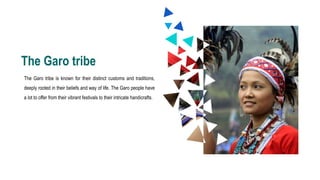
The Garo tribe
The Garo tribe is known for their distinct customs and traditions,
deeply rooted in their beliefs and way of life. The Garo people have
a lot to offer from their vibrant festivals to their intricate handicrafts.
Origins of the Garo Tribe
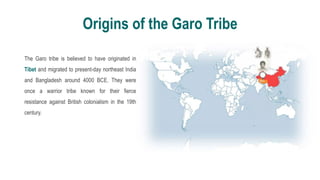
The Garo tribe is believed to have originated in
Tibet and migrated to present-day northeast India
and Bangladesh around 4000 BCE. They were
once a warrior tribe known for their fierce
resistance against British colonialism in the 19th
century.
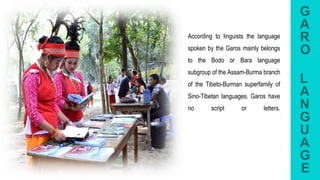
According to linguists the language
spoken by the Garos mainly belongs
to the Bodo or Bara language
subgroup of the Assam-Burma branch
of the Tibeto-Burman superfamily of
Sino-Tibetan languages. Garos have
no script or letters.
G
A
R
O
L
A
N
G
U
A
G
E
House Form
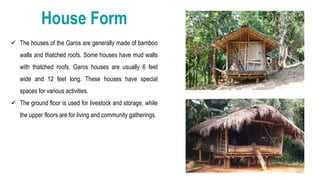
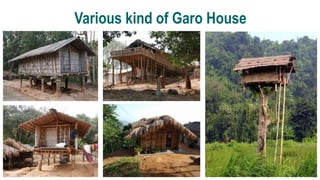
 The houses of the Garos are generally made of bamboo
walls and thatched roofs. Some houses have mud walls
with thatched roofs. Garos houses are usually 6 feet
wide and 12 feet long. These houses have special
spaces for various activities.
 The ground floor is used for livestock and storage, while
the upper floors are for living and community gatherings.
Various kind of Garo House
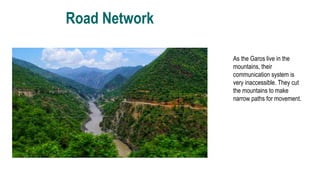
Road Network
As the Garos live in the
mountains, their
communication system is
very inaccessible. They cut
the mountains to make
narrow paths for movement.
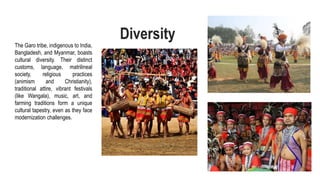
Diversity
The Garo tribe, indigenous to India,
Bangladesh, and Myanmar, boasts
cultural diversity. Their distinct
customs, language, matrilineal
society, religious practices
(animism and Christianity),
traditional attire, vibrant festivals
(like Wangala), music, art, and
farming traditions form a unique
cultural tapestry, even as they face
modernization challenges.
Thank You All
For Being Patients
Feel free to ask any question

Garo Tribe

  • 1.
  • 2.
    The Garo tribe TheGaro tribe is known for their distinct customs and traditions, deeply rooted in their beliefs and way of life. The Garo people have a lot to offer from their vibrant festivals to their intricate handicrafts.
  • 3.
    Origins of theGaro Tribe The Garo tribe is believed to have originated in Tibet and migrated to present-day northeast India and Bangladesh around 4000 BCE. They were once a warrior tribe known for their fierce resistance against British colonialism in the 19th century.
  • 4.
    According to linguiststhe language spoken by the Garos mainly belongs to the Bodo or Bara language subgroup of the Assam-Burma branch of the Tibeto-Burman superfamily of Sino-Tibetan languages. Garos have no script or letters. G A R O L A N G U A G E
  • 5.
    House Form  Thehouses of the Garos are generally made of bamboo walls and thatched roofs. Some houses have mud walls with thatched roofs. Garos houses are usually 6 feet wide and 12 feet long. These houses have special spaces for various activities.  The ground floor is used for livestock and storage, while the upper floors are for living and community gatherings.
  • 6.
    Various kind ofGaro House
  • 7.
    Road Network As theGaros live in the mountains, their communication system is very inaccessible. They cut the mountains to make narrow paths for movement.
  • 8.
    Diversity The Garo tribe,indigenous to India, Bangladesh, and Myanmar, boasts cultural diversity. Their distinct customs, language, matrilineal society, religious practices (animism and Christianity), traditional attire, vibrant festivals (like Wangala), music, art, and farming traditions form a unique cultural tapestry, even as they face modernization challenges.
  • 9.
    Thank You All ForBeing Patients Feel free to ask any question