Lecture 01:
Sustainable City
Contemporary cities are in a range of essential ways different to those of
earlier pre-industrial cities. Those cities were smaller, less numerous,
less focused on production than those that emerged through the
industrial revolutions of the 18th, 19th and 20th centuries (Clark,
2015; Yoffee, 2015).
Concept of contemporary city
The Industrial Revolution contributed to the rise of factories, creating a
demand for workers in urban areas. Over the next century, millions of
people in the United States and England moved from farms to cities. As
other parts of the world industrialized, they, too, became more urban.
Concept of contemporary city
The first cities appeared during the Neolithic Period when
the development of agricultural techniques assured
surplus crop yields large enough to sustain a permanent
population.
Development of contemporary city
 Infrastructure
 Economy
 Facility
 Technology
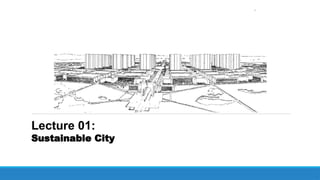
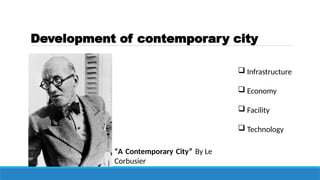
“A Contemporary City” By Le
Corbusier
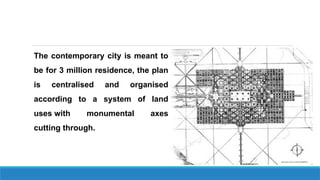
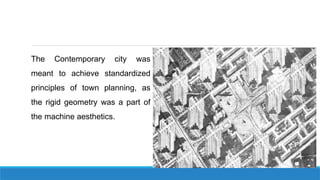
The contemporary city is meant to
be for 3 million residence, the plan
is centralised and organised
according to a system of land
uses with monumental axes
cutting through.
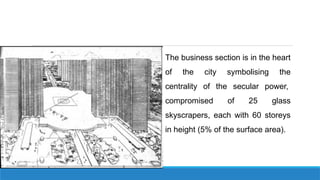
The business section is in the heart
of the city symbolising the
centrality of the secular power,
compromised of 25 glass
skyscrapers, each with 60 storeys
in height (5% of the surface area).
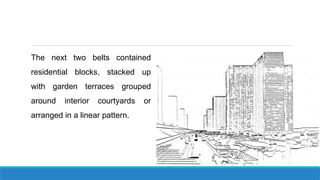
The next two belts contained
residential blocks, stacked up
with garden terraces grouped
around interior courtyards or
arranged in a linear pattern.
The Contemporary city was
meant to achieve standardized
principles of town planning, as
the rigid geometry was a part of
the machine aesthetics.
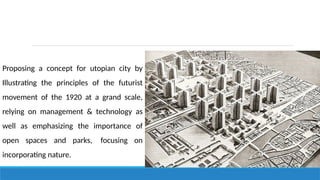
Proposing a concept for utopian city by
Illustrating the principles of the futurist
movement of the 1920 at a grand scale,
relying on management & technology as
well as emphasizing the importance of
open spaces and parks, focusing on
incorporating nature.
Concept of Sustainable City
A sustainable city reduces
environmental impacts through its
activities and promotes sustainable
consumption and production
patterns in accordance with its own
territorial, geographical, social,
economic and cultural conditions.
Characteristics of sustainable cities
1. Environmentally conscious inhabitants
A sustainable city thrives when its inhabitants adopt environmentally
conscious habits, promoting recycling, investing in energy, and
technologies.
These environmentally conscious citizens are committed to adopting
environmentally friendly lifestyles, contributing to the overall sustainability
of the city.
Characteristics of sustainable cities
2. Regenerating and preserving natural spaces
Urban planning should incorporate green spaces into public spaces,
promoting a sustainable city with larger, comfortable, and integrated
green spaces, reducing pollution levels for citizens.
‍
Characteristics of sustainable cities
3. Mainly local city economy
Sustainable cities promote local purchasing, environmentally friendly
networks, and job creation, strengthening the economy and reducing
CO2 emissions by ensuring access to resources and a fulfilling life.
Characteristics of sustainable cities
4. Renewable energy techniques
Technological advancements enable the use of renewable energy
sources and electric vehicles, providing cleaner, less polluting
alternatives to traditional energy sources.
Encouraging large companies and individuals to adopt these alternative
energies is crucial.
Characteristics of sustainable cities
5. The three R’s: reduce, reuse, recycle
Promoting recycling and responsible consumption is crucial for avoiding
resource abuse. Citizens, including themselves, can contribute to
implementing these actions, leading to sustainable, cleaner, and
environmentally friendly cities.

Sustainable city..........................

  • 1.
  • 2.
    Contemporary cities arein a range of essential ways different to those of earlier pre-industrial cities. Those cities were smaller, less numerous, less focused on production than those that emerged through the industrial revolutions of the 18th, 19th and 20th centuries (Clark, 2015; Yoffee, 2015). Concept of contemporary city
  • 3.
    Concept of contemporarycity The Industrial Revolution contributed to the rise of factories, creating a demand for workers in urban areas. Over the next century, millions of people in the United States and England moved from farms to cities. As other parts of the world industrialized, they, too, became more urban.
  • 4.
    Concept of contemporarycity The first cities appeared during the Neolithic Period when the development of agricultural techniques assured surplus crop yields large enough to sustain a permanent population.
  • 5.
    Development of contemporarycity  Infrastructure  Economy  Facility  Technology “A Contemporary City” By Le Corbusier
  • 6.
    The contemporary cityis meant to be for 3 million residence, the plan is centralised and organised according to a system of land uses with monumental axes cutting through.
  • 7.
    The business sectionis in the heart of the city symbolising the centrality of the secular power, compromised of 25 glass skyscrapers, each with 60 storeys in height (5% of the surface area).
  • 8.
    The next twobelts contained residential blocks, stacked up with garden terraces grouped around interior courtyards or arranged in a linear pattern.
  • 9.
    The Contemporary citywas meant to achieve standardized principles of town planning, as the rigid geometry was a part of the machine aesthetics.
  • 10.
    Proposing a conceptfor utopian city by Illustrating the principles of the futurist movement of the 1920 at a grand scale, relying on management & technology as well as emphasizing the importance of open spaces and parks, focusing on incorporating nature.
  • 11.
    Concept of SustainableCity A sustainable city reduces environmental impacts through its activities and promotes sustainable consumption and production patterns in accordance with its own territorial, geographical, social, economic and cultural conditions.
  • 12.
    Characteristics of sustainablecities 1. Environmentally conscious inhabitants A sustainable city thrives when its inhabitants adopt environmentally conscious habits, promoting recycling, investing in energy, and technologies. These environmentally conscious citizens are committed to adopting environmentally friendly lifestyles, contributing to the overall sustainability of the city.
  • 13.
    Characteristics of sustainablecities 2. Regenerating and preserving natural spaces Urban planning should incorporate green spaces into public spaces, promoting a sustainable city with larger, comfortable, and integrated green spaces, reducing pollution levels for citizens. ‍
  • 14.
    Characteristics of sustainablecities 3. Mainly local city economy Sustainable cities promote local purchasing, environmentally friendly networks, and job creation, strengthening the economy and reducing CO2 emissions by ensuring access to resources and a fulfilling life.
  • 15.
    Characteristics of sustainablecities 4. Renewable energy techniques Technological advancements enable the use of renewable energy sources and electric vehicles, providing cleaner, less polluting alternatives to traditional energy sources. Encouraging large companies and individuals to adopt these alternative energies is crucial.
  • 16.
    Characteristics of sustainablecities 5. The three R’s: reduce, reuse, recycle Promoting recycling and responsible consumption is crucial for avoiding resource abuse. Citizens, including themselves, can contribute to implementing these actions, leading to sustainable, cleaner, and environmentally friendly cities.