Module 4
Climate change and Renewable
Energy
Energy and resources
• Energy is required for doing any type of work in life.
• It is required for
• cooking,
• heating,
• cooling,
• lighting, etc in our homes.
• It is required to run machines and other mechanical equipment in industries.
• It is required to run locomotives for transportation.
• So much so that the amount consumption of energy by a nation is usually considered
as an index of its development.
• This is because of the fact that almost all our developmental activities are directly or
indirectly dependent upon the energy consumption. That is why, there exists wide
disparities between the energy consumption of the developed and non-developed
countries.
Sources of energy
• An energy source may be defined as the one that
can provide us with adequate amount of energy
in a usable form over long periods of time.
These sources can be divided into the following
major types:
• (i) Renewable energy sources
• (ii) Non-renewable energy sources
• (iii) Sustainable energy source
Renewable energy sources
• These are those energy sources which are
perpetually available in nature such as
• Heat of the sun,
• Power of winds,
• Power of tidal sea waves,
• Thermal energy of the oceans,
• Heat persistent under the earth’s crust etc)
• They are all generated continuously in nature
Non- renewable energy sources
• These are those energy sources which have accumulated in nature
over a long span of time (millions of years) and can not be
replenished in hundreds of years.
• These sources are finite in quantity and cannot be
reproduced.
• They are, thus, sure to be exhausted after some years.
• These energy sources include fossil fuels such as
• coal,
• petroleum
• natural gas
• nuclear fuels like Uranium-235.
Sustainable energy source
Sustainable energy is a term sometimes
applied to nuclear power.
The supplies are not exactly renewable but
they will last for a very long time because a
great deal of electricity is produced from a
small amount of radioactive material
Sources of energy
• Renewable energies:
• (1) Solar energy
• (2) Wind energy
• (3) Tidal energy
• (4) Ocean thermal energy
• (5) Geothermal energy
• (6) Hydro-power
• Non-renewable energies:
• (7) Biomass energy
• (8) Thermal power
• (9) Nuclear power.
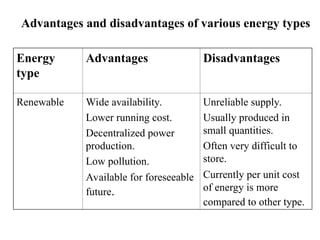
Advantages and disadvantages of various energy types
Energy
type
Advantages Disadvantages
Renewable Wide availability.
Lower running cost.
Decentralized power
production.
Low pollution.
Available for foreseeable
future.
Unreliable supply.
Usually produced in
small quantities.
Often very difficult to
store.
Currently per unit cost
of energy is more
compared to other type.
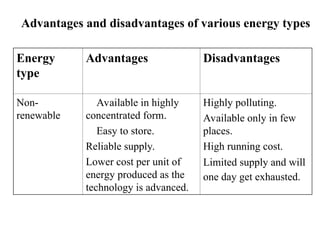
Advantages and disadvantages of various energy types
Energy
type
Advantages Disadvantages
Non-
renewable
Available in highly
concentrated form.
Easy to store.
Reliable supply.
Lower cost per unit of
energy produced as the
technology is advanced.
Highly polluting.
Available only in few
places.
High running cost.
Limited supply and will
one day get exhausted.
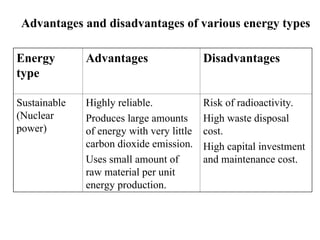
Advantages and disadvantages of various energy types
Energy
type
Advantages Disadvantages
Sustainable
(Nuclear
power)
Highly reliable.
Produces large amounts
of energy with very little
carbon dioxide emission.
Uses small amount of
raw material per unit
energy production.
Risk of radioactivity.
High waste disposal
cost.
High capital investment
and maintenance cost.
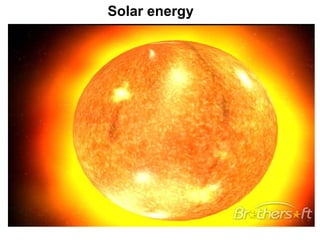
Solar energy
Solar energy
Solar energy
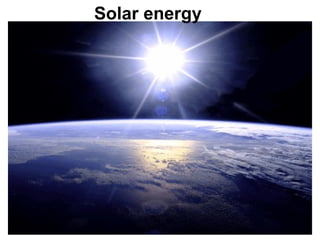
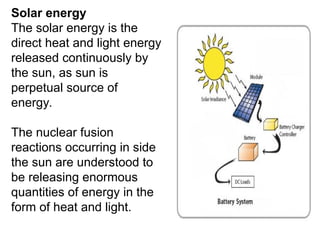
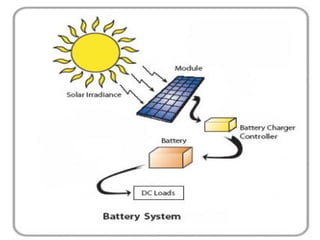
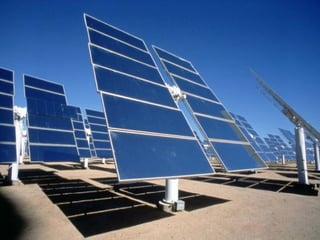
The solar energy is the
direct heat and light energy
released continuously by
the sun, as sun is
perpetual source of
energy.
The nuclear fusion
reactions occurring in side
the sun are understood to
be releasing enormous
quantities of energy in the
form of heat and light.
Solar energy
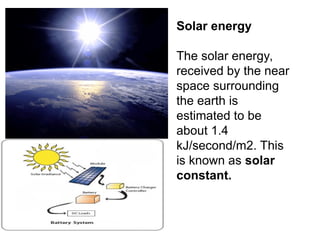
The solar energy,
received by the near
space surrounding
the earth is
estimated to be
about 1.4
kJ/second/m2. This
is known as solar
constant.
Solar energy
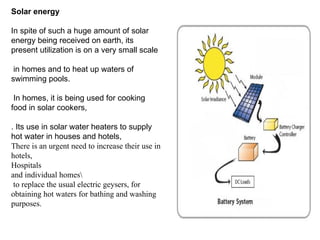
In spite of such a huge amount of solar
energy being received on earth, its
present utilization is on a very small scale
in homes and to heat up waters of
swimming pools.
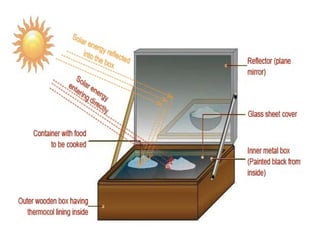
In homes, it is being used for cooking
food in solar cookers,
. Its use in solar water heaters to supply
hot water in houses and hotels,
There is an urgent need to increase their use in
hotels,
Hospitals
and individual homes
to replace the usual electric geysers, for
obtaining hot waters for bathing and washing
purposes.
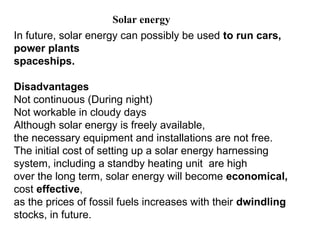
In future, solar energy can possibly be used to run cars,
power plants
spaceships.
Disadvantages
Not continuous (During night)
Not workable in cloudy days
Although solar energy is freely available,
the necessary equipment and installations are not free.
The initial cost of setting up a solar energy harnessing
system, including a standby heating unit are high
over the long term, solar energy will become economical,
cost effective,
as the prices of fossil fuels increases with their dwindling
stocks, in future.
Solar energy
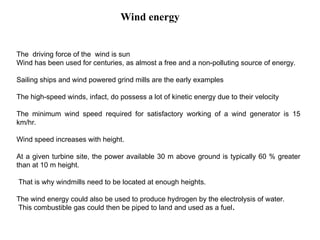
The driving force of the wind is sun
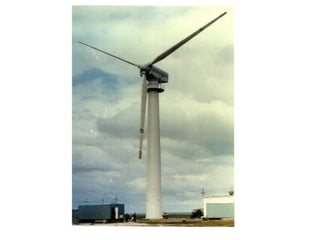
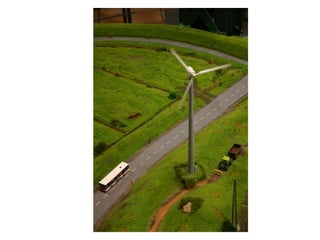
Wind has been used for centuries, as almost a free and a non-polluting source of energy.
Sailing ships and wind powered grind mills are the early examples
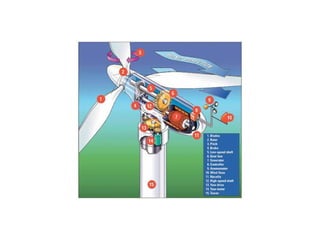
The high-speed winds, infact, do possess a lot of kinetic energy due to their velocity
The minimum wind speed required for satisfactory working of a wind generator is 15
km/hr.
Wind speed increases with height.
At a given turbine site, the power available 30 m above ground is typically 60 % greater
than at 10 m height.
That is why windmills need to be located at enough heights.
The wind energy could also be used to produce hydrogen by the electrolysis of water.
This combustible gas could then be piped to land and used as a fuel.
Wind energy
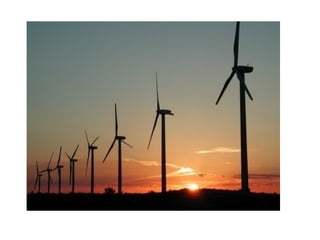
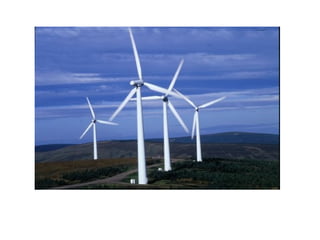
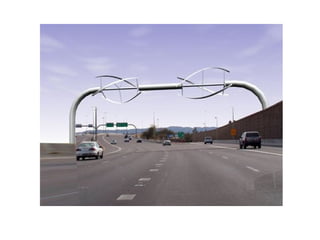
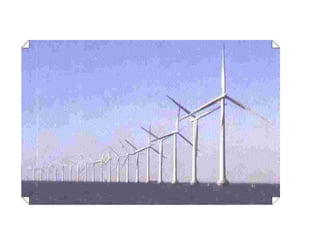
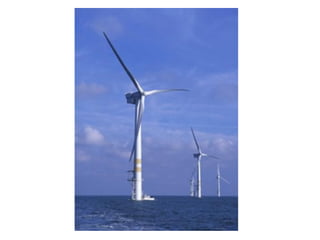
A large number of windmills are installed in clusters of
hundred s of units, called wind farms, which generate
power and feed it to the nearest power grid for
distribution.
These forms are ideally located in
coastal areas,
open grasslands,
hilly regions,
mountain passes and ridges,
where the winds are usually strong and steady.
Wind energy
Wind speed increases with height.
At a given turbine site, the power available 30 m
above ground is typically 60 % greater than at 10
m height. That is why windmills need to be
located at enough heights.
The wind energy could also be used to produce
hydrogen by the electrolysis of water.
This combustible gas could then be piped to land
and used as a fuel.
Wind energy
Disadvantages
Wind is an intermittent source,
Intermittency of wind depends on the geographic distribution of wind.
Wind, therefore, generally cannot be used as the sole source of electricity in
an area,
Requires some other backup or standby source of electricity.
noise pollution
Kills bird
interference with TV reception
aesthetic objections to the shear number of wind turbines
Wind energy
The water level in a sea rises and falls during tides,
caused by the attraction of moon and to a lesser extent of
the sun.
The rise of sea water level is known as the high tide
The fall of sea water level is known as the low tide
The difference in water level during high tide and low tide
is known as the tidal range.
The potential energy developed by the water head created during
high tide can be used to run turbines to generate electricity.
Tidal energy….
Tidal energy….
• Tidal power is harnessed by constructing a dam or a barrage
across the mouth of a bay or an estuary in a coastal area
having a large tidal range.
• The narrow opening between the bay and the open sea
magnifies the variations in the water levels that occur as the
tide rise and fall.
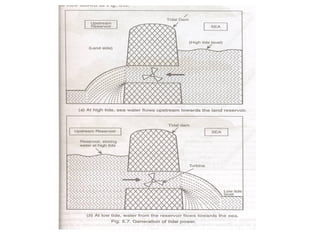
• During high tide, the seawater flows upstream towards the
land reservoir through the openings in the dam or barge, and
turns the turbines, generating electricity (Fig. a).
• During the low tide, as the sea water level falls, the water from
the upstream reservoir flows towards the downstream in
seaward direction, again turning the turbine blades, to generate
electricity (Fig.b).
Disadvantages
The tidal power stations bring about major
ecological changes in the sensitive ecosystem of the coastal regions.
A tidal plant can destroy the habitats and the nestling places of water birds
and interfere with the fisheries.
A tidal power plant located at the mouth of bay, blocks the flow of polluted
water into the sea, thereby creating pollution and health hazards in the
estuary.
The offshore energy devices may pose navigational hazards.
The residual rift current could also affect the spawning of some fish,
whose larvae would be carried away from the spawning grounds.
They may also affect the migratory patterns of surface swimming fish.
Tidal energy….
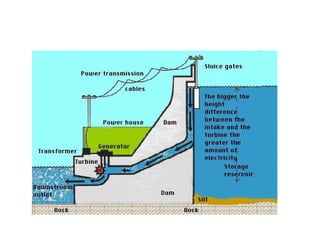
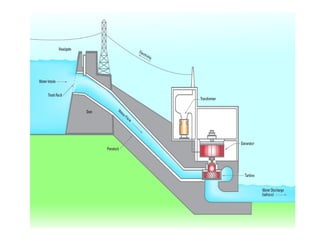
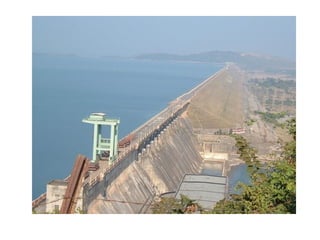
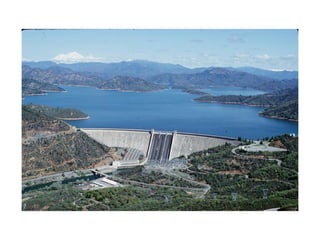
Hydroelectric energy:
In hydroelectric power generation, water is stored up to a certain height and
then allowed to flow to a lower level.
The potential energy of the stored water will thus be converted to kinetic
energy and the velocity of flow at the lower level
(will be governed by the head difference between the two water levels)
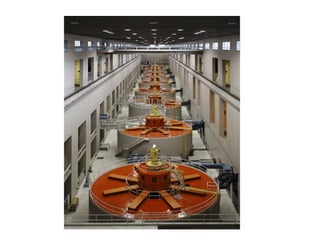
This flow velocity is used to rotate the blades of the turbines.
The electric power so produced is hence, called
hydroelectric power.
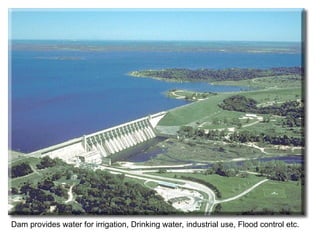
Dam provides water for irrigation, Drinking water, industrial use, Flood control etc.
Advantages:
(1)It is clean and renewable source of energy.
•The water (natural energy) is stored in the high level reservoir and
used when ever necessary.
•Transportation of raw energy is natural by gravity.
•The operating cost of hydroelectric power plants is low.
•The energy resource occurs free of cost
•Hydroelectric power plants have operational flexibility
•Hydro reservoirs are multipurpose, provides water for irrigation
facilities, drinking water, industries etc.
Disadvantages:
(1)The dam sites submerge large forest and agricultural areas.
(2) Storages of water cause water logging and siltation.
(3) It causes loss of biodiversity and aquatic organisms.
(4) Submergence displaces local people and creates problems of rehabilitation
and socio economic problems.
(5) Large volume of water storage increases the seismicity of the area.
(6) Initial capital cost is high and construction periods are long
•Additional investments are necessary for transmission of bulk power from large
remote hydroelectric power plants.
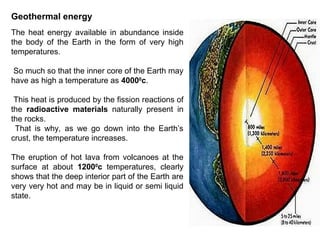
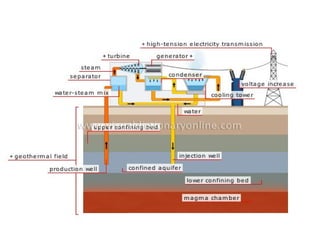
Geothermal energy
The heat energy available in abundance inside
the body of the Earth in the form of very high
temperatures.
So much so that the inner core of the Earth may
have as high a temperature as 40000
c.
This heat is produced by the fission reactions of
the radioactive materials naturally present in
the rocks.
That is why, as we go down into the Earth’s
crust, the temperature increases.
The eruption of hot lava from volcanoes at the
surface at about 12000
c temperatures, clearly
shows that the deep interior part of the Earth are
very very hot and may be in liquid or semi liquid
state.
It is further understood that from the extremely hot interior of the Earth, a
continuous upward current of heat flows towards the upper crust of the Earth.
Due to such currents, the upper 3 km portion of the Earth’s crust, also contains
a huge amount of heat energy, which if removed is liable to be replaced again
by the new heat coming from the heat currents from the interior portion of the
Earth. That is why, this source heat energy is considered as a renewable energy
source.
The already stored energy in the upper 3 km portion of the Earth’s crust has
been estimated to be of the order of 43x1024
Joules.
Theoretically, this amount of energy would be enough to meet the energy
demand of the world’s population in the coming 1-lakh years.
Such calculations are fictitious, but they certainly indicate that very large
quantities of heat energy can be extracted from the stored component of the
geothermal energy from the permeable rocks of the upper 3 km portion of the
Earth’s crust.
Water is transporting the Geothermal heat from the depth (inside the Earth) to
the surface, where it is utilized for human needs.
In the natural geothermal areas, water-circulating systems are continuously
transporting the heat energy to the surface and this is observed as natural hot
springs, called natural geysers or fumaroles.
These natural eruptions of hot waters with temperatures reaching up to 3500
c,
may occur through the cracks existing the crystal rocks.
Such geysers are usually found in Newzeland, USA, etc.
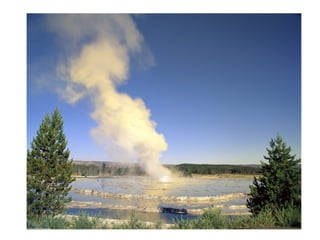
The best example is, however, provide by a natural geyser, called ‘old faithful’
existing in Yellow Stone National park of USA.
This geyser gushes out water after
every 66 minutes interval,
which rises to heights up to 46 meters or so.
Mild capacity natural geysers are also found in hilly regions of India such as the
one found at Manikaran in Himachal pradesh near Kullu, one at Tattapani
near Shimla in Himachal pradesh and one near Sohna in Haryana.
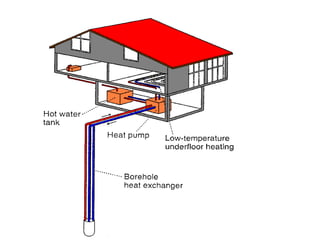
The most favorable utilization of geothermal energy can, therefore, be made
by drilling holes or wells into these natural circulation systems and to tap the
geothermal fluids through these wells.
The naturally erupting geysers can also be utilized for these purposes.
These hot fluids (water + steam) can either be used for generation of
electricity, or for direct heating purposes.
The hot geothermal resources (fluids) can infact, be divided into the following
two types:
(i)High temperature resources with temperatures of geothermal fluids above
1500
c They are mainly used for generation of electricity. The high temperature
resources are generally restricted to the volcanic and geothermal zones of the
Earth.
(ii) Low temperature resources with temperatures of geothermal fluids below
1500
cThey are mainly used for direct heating purposes.
The low temperature resources are found in almost every country of the world.
Ocean thermal energy
The ocean cover a little more than 70 % of
the Earth’s surface.
This makes them the largest solar
energy collector and energy storage
system.
On an average daily basis,
6000Mha(60Mkm2
) of tropical seas absorb
an amount of solar radiation equal in heat
content of about 250 Billion barrels of
crude oil.
If less than 1/1000th
part of this solar energy
could be converted into electrical energy, it
would be 20 times the total amount of
electricity consumed in the United states on
any given day.
The technology that is used to convert this heat energy contained in the upper
layers of the ocean into electrical energy is known as OTEC (Ocean Thermal
Energy Conversion).
This technology makes use of the ocean’s natural thermal gradient, caused due
to warm upper layers and cold lower layers of water.
As long as the temperature difference between the warm surface water and the
cold deeper water of an ocean differs by about 200
c, an OTEC system can
produce significant amount of power.
The ocean can, thus, prove to be vast resources of renewable power.
The potential is estimated to be of the order of 10000 GW of base load power
generation.
The cold deep-sea water in the OTEC plant is also rich in nutrients and can be
used to culture both marine organism and plant life near the shore or on the land.
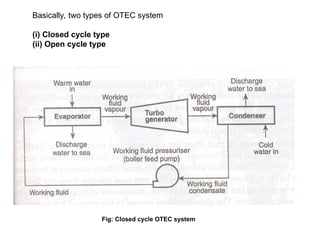
Basically, two types of OTEC system
(i) Closed cycle type
(ii) Open cycle type
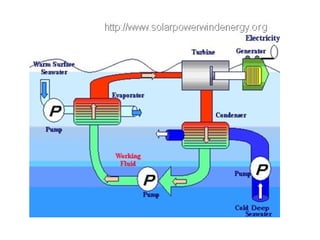
Fig: Closed cycle OTEC system
Working of closed cycle OTEC system
Warm sea water vaporizes a working fluid (such as ammonia) flowing through a
heat exchanger (evaporator)
This fluid vaporizes at lower temperatures (warm temperatures) and expands at
lower pressures to run the turbines coupled to a generator that produces
electricity.
The vapour of the working fluid, after coming out from the turbine, is then
condensed in another heat exchanger (condenser) using cold seawater pumped
from the ocean’s depths though a cold water pipe.
The condensed working fluid is repumped to the evaporator to repeat the cycle.
The working fluid remains in a closed system and circulates continuously.
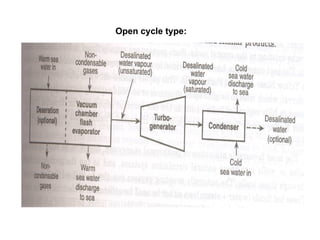
Open cycle type:
Working of open cycle OTEC system
warm seawater is used as the working fluid.
The warm seawater is flash evaporated in a vacuum chamber to produce
steam at an absolute pressure of 2.4 kilopascal (kpa).
The steam expands through a low-pressure turbine coupled to a generator,
producing electricity.
The steam coming out of the turbine is condensed by cold seawater,
pumped from deeper ocean through a cold water pipe.
The liquid water is again discharged to the ocean or can be recycled and
used in stages, in multiflash systems.
If a surface condenser is used for cooling the steam coming-out of the
turbine, then the condensed steam provides desalinated water,
The electricity produced by the system can be delivered to a utility grid or
Used to manufacture methanol, hydrogen, refined metals, ammonia and
similar products.
Infact, have many applications and uses for example,
OTEC can be used to
•Generate electricity,
•Desalinate sea water,
•Support deep water mariculture,
•Provide refrigeration and air conditioning,
•Aid in crop growth and mineral extraction from sea water.
These complimentary products may make the OTEC system quite attractive to the
industry and island communities, even if the prices of fossil fuel remain low.
OTEC can also be used to produce
methanol,
ammonia,
hydrogen,
aluminum,
chlorine and
other chemicals.
In spite of such multipurpose benefits, installations of OTEC plants have not attracted
much financing, primarily because,
it involves high-tech installations
Electricity generation is not found economical at present, in comparison to other modes
of power like thermal, hydro, nuclear and geothermal powers.
In any case, OTEC is highly promising as an alternative energy resource, especially for
tropical communities that rely heavily on imported fossil fuels (like oil, etc) for generation
of thermal power.
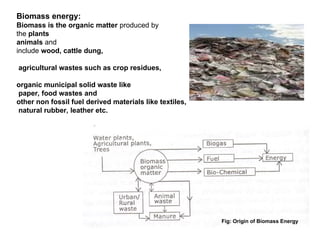
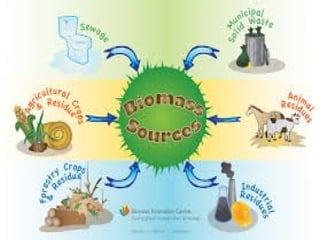
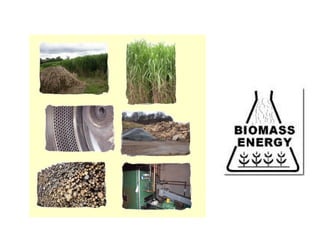
Biomass energy:
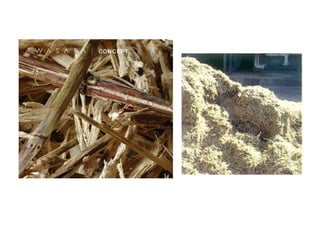
Biomass is the organic matter produced by
the plants
animals and
include wood, cattle dung,
agricultural wastes such as crop residues,
organic municipal solid waste like
paper, food wastes and
other non fossil fuel derived materials like textiles,
natural rubber, leather etc.
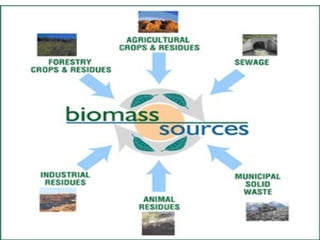
Fig: Origin of Biomass Energy
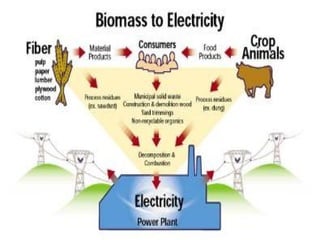
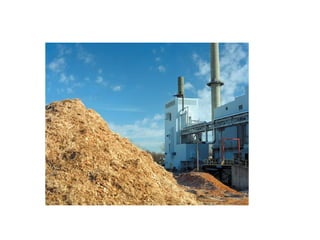
Biomass is used on a large scale to obtain energy either by directly
burning the same or by converting it into more convenient form of
solid fuels like manure, dung cakes etc
liquid fuels like ethanol,
biodiesel etc or
gas fuels like biogas etc.
Biomass has infact, provided a major source of energy to human
beings, since the early days of human civilization.
The firewood is the best known and most widely used biomass
fuel in the world.
Wood alone is being used as a primary source of energy, even
in these modern days.
In India dung cakes are made from cattle dung and burnt for
cooking.
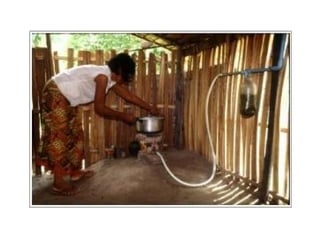
The vegetation matter, cow dung and other organic municipal wastes (biomass) can
also be converted into gas fuels, like biogas, which can be used as a clean source
of energy, for cooking or for producing electricity on a small scale to light the
individual homes or group housing flats or even street lights.
Since the direct burning of biomass produces air pollutants like CO2
, SO2
, NOx etc,
it is always preferable to convert the biomass into a cleaner gas fuel (biogas).
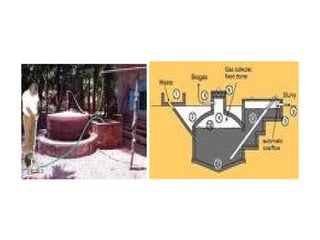
Production of Biogas and gobar gas from biomass:
Biogas is produced from
animal dung,
kitchen wastes,
plants like hyacinth, etc and
organic wastes from households and
industries like fish processing, diaries etc.
In India, the biogas is primarily being produced from cattle dung (gobar), and hence
this biogas is called the ‘Gobar gas’.
The vegetation matter (biomass), besides being used as a fuel for direct burning
to produce heat or electricity, can also be converted into liquid fuels, called
biofuels.
These biofuels can some day replace the fossil fuels (i.e. diesel and petrol) to run
our locomotives.
The two most common types of biofuels produced from biomass are
ethanol and biodiesel.
Ethanol is an alcohol made by fermenting any biomass high in carbohydrates
(i.e. sugars, starches, cellulose etc).
Ethanol is at present, is mostly used as a fuel additive to cut down a vehicle’s
carbon monoxide and other smog causing emissions.
But flexible fuel vehicles, which would run on mixtures of gasoline and up to 85%
ethanol, have been developed in Japan.
Thus, technology is already underway to replace diesel and petrol with such
biofuels.
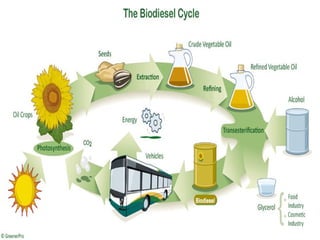
Biodiesels is made by combining
alcohol (usually methanol) with vegetable oil, animal fat etc.
Biodiesel can be used as an additive to reduce vehicle’s emissions (typically by
20%) or in pure form, as a renewable alternative fuel for diesel engines.
Researchers are also developing algae that produce oils, which can be
converted to biodiesel.
New ways have also been found to produce ethanol from grasses, trees, barks,
sawdust, paper and farming wastes.
The fibrous waste of sugar industry is world’s largest potential source of
biomass energy.
Ethanol produced from sugarcane molasses is a good automobile fuel.
Another liquid fuel, called the pyrolysis oil, can also be produced from the
biomass, through a process called pyrolysis.
Pyrolysis occurs when biomass, is heated in absence of oxygen.
The biomass then turns into liquid, called pyrolysis oil, which can be
burnt like petroleum to generate electricity.
Biogas primarily contains
methane-CH4
(60-79%) and
carbon dioxide-CO2
(30-35%),
small quantities of nitrogen-N2
(5%) and
oxygen-O2
(0 - 0.1%).
The hydrogen sulphide-H2
S gas may also sometimes be present, though rarely.
In this mixture of gases, methane burns easily and hence this biogas can be easily used
for cooking,
heating and
for producing electricity.
It has been estimated that from 1 tonne (1000 kg) of food waste, one can produce 85 m3
of biogas.
Once the biogas is produced from the waste biomass, some residue is left, which can be
used as an agricultural fertilizers (manure).
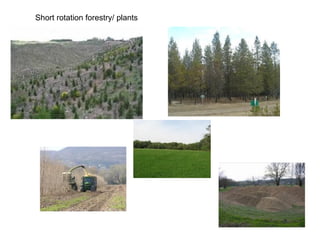
Short rotation forestry/ plants
Hydrogen as an alternate source of energy:
The fossil fuels (coal, petroleum and natural gas) based energy sources are
getting depleted rapidly and their availability is not promising.
At present petroleum fuels are contributing to the 80% of energy
requirement.
Hydrogen has been identified as alternative promising energy source.
Hydrogen can be produced in unlimited quantities from abundant, universally
distributed and inexhaustible energy sources.
The primary energy sources may be
water,
coal,
biomass,
natural gas,
petroleum etc.
Hydrogen is an intermediate secondary energy source.
Using Hydrogen fuel in transportation sector is presently in planning
and development stage only.
Hydrogen can be used economically and commercially around 2020.
It has been established that hydrogen can meet all the energy needs of
world in the coming years.
Advantages
The merits of hydrogen as an alternative future fuel are
(1)It can be produced by several alternative methods.
(2) It can be produced from fossil fuels, water, biomass etc.
(3) Hydrogen is a renewable energy source.
(4) Hydrogen has high energy density as compared to fossil fuels.
(5) Hydrogen is an environmentally friendly and clean fuel. The end product is
water
(6) Hydrogen can be transported by pipeline, just like natural gas.
Hydrogen is used in
synthesis of ammonia (NH3
),
methanol (CH3
OH),
urea
as reducing agent in metallurgy etc.
It is used as high thrust fuel in rockets.
In future, hydrogen will be an intermediate fuel for transportation.
Hydrogen can be produced commercially by
electrolysis of water,
steam reforming of hydrocarbons,
liquefaction of natural gas,
cracking of ammonia,
by reaction of coal at high temperatures.
Hydrogen can be produced without pollution by electrolysis of water,
Water electrolysis would be a major hydrogen production of the future.
The limitations
The limitation is that hydrogen is a gas at normal temperature and
pressure, hence it is difficult to store and transport.
Hydrogen is an explosive gas and care is necessary against leakage and
explosion.
Thermal power
• Thermal power plants develop electricity by using
the heat energy produced by burning of the fossil
fuels like coal, oil and natural gas.
• The heat produced by burning of such a fuel is used
to heat up and boil water to produce steam, which in
turn, is moved in pipes to turn the turbines, coupled
with generators to produce electricity.
• These fuels are non-renewable and their supply shall
last only for a finite period.
• The power generated from the use of these fuels is,
hence known as non-renewable energy.
Environmental impacts of thermal
power plants
• 1. Use of coal in thermal power production causes
generation of huge quantities of flyash waste.
• 2. The burning of coal emits air pollutants like
particulate matter and gases like sulphur dioxide,
oxides of nitrogen carbon dioxide etc.
• 3. Drilling and extraction of oil may cause leaks
and accidental fires causing severe pollution of the
land, sea and air.
• 4. During refining of crude oil, several solid
wastes like grease are produced which damages
the environment.
Environmental impacts of thermal
power plants
• 5. The high-ash fuels used makes flue-gas dust control a
difficult problem.
• 6. The hot water disposed into the river cause an increase in
the temperature of a river which leads to Oxygen depletion
of the river water. Oxygen deficiency can be seriously
detrimental to aquatic life.
• 7. Thermal power plants can have impacts on soil and
groundwater. The soil quality, can be adversely affected by
dust sediment, particularly in the near vicinity of the plant.
The seriousness of ground-level pollution depends on the
heavy-metal content of the dust. The chemistry of the soil
can be altered by acidic precipitation (acid rain)
characterized mainly by the acid formers SO2 and NOx.
Under unfavorable conditions, acidification can pass from
the soil to both the groundwater and surface waters.
Environmental impacts of thermal
power plants
• 8. Adverse effects of thermal power plants on
human health can derive from the direct impact of
noxious gases on the organism and/or their
indirect impact via the food chain and changes in
the environment. Especially in connection with
high levels of fine particulates, noxious gases like
SO2 and NOx can lead to respiratory diseases.
• 9. The personnel working in power plants are
exposed to substantial noise nuisance.
• 10. The landscape is affected by construction of
the roads needed for delivering operating media
and disposing of residues.
Energy conservation
• Energy conservation means to reduce the quantity of
energy that is used for different purposes.
• This practice may result in increase of financial capital,
enevironmental value, national and personal security, and
human comfort.
• Individuals and organizations that are direct consumers of
energy may want to conserve energy in order to reduce
energy costs and promote economic, political and
environmental sustainability.
• Industrial and commercial users may want to increase
efficiency and thus maximize profit.
Energy conservation
• On a larger scale, energy conservation is an important
element of energy policy. In general, energy
conservation reduces the energy consumption and
energy demand per capita. This reduces the rise in
energy costs, and can reduce the need for new power
plants, and energy imports. The reduced energy demand
can provide more flexibility in choosing the most
preferred methods of energy production.
• By reducing emissions, energy conservation is an
important method to prevent climate change. Energy
conservation makes it easier to replace non-renewable
resources with renewable energy. Energy conservation
is often the most economical solution to energy
shortages.
Tips to save energy
• Turning the lights off whenever you leave a room.
• Using energy saving light bulbs in rooms.
• Turning the heating down or off in rooms that are
not being used regularly.
• Ensuring the window and door seals are in good
condition in air conditioned rooms.
• Using sun light to dry clothes in the summer rather
than mechanical cloth drier.
• Choosing low energy rating appliances for cooking,
washing and refrigerating.
• Making sure that hot water boilers and pipes are
well insulated.
108
THANK YOU

climate change and --renewable energy.ppt

  • 1.
    Module 4 Climate changeand Renewable Energy
  • 7.
    Energy and resources •Energy is required for doing any type of work in life. • It is required for • cooking, • heating, • cooling, • lighting, etc in our homes. • It is required to run machines and other mechanical equipment in industries. • It is required to run locomotives for transportation. • So much so that the amount consumption of energy by a nation is usually considered as an index of its development. • This is because of the fact that almost all our developmental activities are directly or indirectly dependent upon the energy consumption. That is why, there exists wide disparities between the energy consumption of the developed and non-developed countries.
  • 8.
    Sources of energy •An energy source may be defined as the one that can provide us with adequate amount of energy in a usable form over long periods of time. These sources can be divided into the following major types: • (i) Renewable energy sources • (ii) Non-renewable energy sources • (iii) Sustainable energy source
  • 9.
    Renewable energy sources •These are those energy sources which are perpetually available in nature such as • Heat of the sun, • Power of winds, • Power of tidal sea waves, • Thermal energy of the oceans, • Heat persistent under the earth’s crust etc) • They are all generated continuously in nature
  • 10.
    Non- renewable energysources • These are those energy sources which have accumulated in nature over a long span of time (millions of years) and can not be replenished in hundreds of years. • These sources are finite in quantity and cannot be reproduced. • They are, thus, sure to be exhausted after some years. • These energy sources include fossil fuels such as • coal, • petroleum • natural gas • nuclear fuels like Uranium-235.
  • 11.
    Sustainable energy source Sustainableenergy is a term sometimes applied to nuclear power. The supplies are not exactly renewable but they will last for a very long time because a great deal of electricity is produced from a small amount of radioactive material
  • 12.
    Sources of energy •Renewable energies: • (1) Solar energy • (2) Wind energy • (3) Tidal energy • (4) Ocean thermal energy • (5) Geothermal energy • (6) Hydro-power • Non-renewable energies: • (7) Biomass energy • (8) Thermal power • (9) Nuclear power.
  • 13.
    Advantages and disadvantagesof various energy types Energy type Advantages Disadvantages Renewable Wide availability. Lower running cost. Decentralized power production. Low pollution. Available for foreseeable future. Unreliable supply. Usually produced in small quantities. Often very difficult to store. Currently per unit cost of energy is more compared to other type.
  • 14.
    Advantages and disadvantagesof various energy types Energy type Advantages Disadvantages Non- renewable Available in highly concentrated form. Easy to store. Reliable supply. Lower cost per unit of energy produced as the technology is advanced. Highly polluting. Available only in few places. High running cost. Limited supply and will one day get exhausted.
  • 15.
    Advantages and disadvantagesof various energy types Energy type Advantages Disadvantages Sustainable (Nuclear power) Highly reliable. Produces large amounts of energy with very little carbon dioxide emission. Uses small amount of raw material per unit energy production. Risk of radioactivity. High waste disposal cost. High capital investment and maintenance cost.
  • 16.
  • 17.
  • 18.
    Solar energy The solarenergy is the direct heat and light energy released continuously by the sun, as sun is perpetual source of energy. The nuclear fusion reactions occurring in side the sun are understood to be releasing enormous quantities of energy in the form of heat and light.
  • 20.
    Solar energy The solarenergy, received by the near space surrounding the earth is estimated to be about 1.4 kJ/second/m2. This is known as solar constant.
  • 21.
    Solar energy In spiteof such a huge amount of solar energy being received on earth, its present utilization is on a very small scale in homes and to heat up waters of swimming pools. In homes, it is being used for cooking food in solar cookers, . Its use in solar water heaters to supply hot water in houses and hotels, There is an urgent need to increase their use in hotels, Hospitals and individual homes to replace the usual electric geysers, for obtaining hot waters for bathing and washing purposes.
  • 22.
    In future, solarenergy can possibly be used to run cars, power plants spaceships. Disadvantages Not continuous (During night) Not workable in cloudy days Although solar energy is freely available, the necessary equipment and installations are not free. The initial cost of setting up a solar energy harnessing system, including a standby heating unit are high over the long term, solar energy will become economical, cost effective, as the prices of fossil fuels increases with their dwindling stocks, in future. Solar energy
  • 26.
    The driving forceof the wind is sun Wind has been used for centuries, as almost a free and a non-polluting source of energy. Sailing ships and wind powered grind mills are the early examples The high-speed winds, infact, do possess a lot of kinetic energy due to their velocity The minimum wind speed required for satisfactory working of a wind generator is 15 km/hr. Wind speed increases with height. At a given turbine site, the power available 30 m above ground is typically 60 % greater than at 10 m height. That is why windmills need to be located at enough heights. The wind energy could also be used to produce hydrogen by the electrolysis of water. This combustible gas could then be piped to land and used as a fuel. Wind energy
  • 38.
    A large numberof windmills are installed in clusters of hundred s of units, called wind farms, which generate power and feed it to the nearest power grid for distribution. These forms are ideally located in coastal areas, open grasslands, hilly regions, mountain passes and ridges, where the winds are usually strong and steady. Wind energy
  • 39.
    Wind speed increaseswith height. At a given turbine site, the power available 30 m above ground is typically 60 % greater than at 10 m height. That is why windmills need to be located at enough heights. The wind energy could also be used to produce hydrogen by the electrolysis of water. This combustible gas could then be piped to land and used as a fuel. Wind energy
  • 40.
    Disadvantages Wind is anintermittent source, Intermittency of wind depends on the geographic distribution of wind. Wind, therefore, generally cannot be used as the sole source of electricity in an area, Requires some other backup or standby source of electricity. noise pollution Kills bird interference with TV reception aesthetic objections to the shear number of wind turbines Wind energy
  • 41.
    The water levelin a sea rises and falls during tides, caused by the attraction of moon and to a lesser extent of the sun. The rise of sea water level is known as the high tide The fall of sea water level is known as the low tide The difference in water level during high tide and low tide is known as the tidal range. The potential energy developed by the water head created during high tide can be used to run turbines to generate electricity. Tidal energy….
  • 42.
    Tidal energy…. • Tidalpower is harnessed by constructing a dam or a barrage across the mouth of a bay or an estuary in a coastal area having a large tidal range. • The narrow opening between the bay and the open sea magnifies the variations in the water levels that occur as the tide rise and fall. • During high tide, the seawater flows upstream towards the land reservoir through the openings in the dam or barge, and turns the turbines, generating electricity (Fig. a). • During the low tide, as the sea water level falls, the water from the upstream reservoir flows towards the downstream in seaward direction, again turning the turbine blades, to generate electricity (Fig.b).
  • 44.
    Disadvantages The tidal powerstations bring about major ecological changes in the sensitive ecosystem of the coastal regions. A tidal plant can destroy the habitats and the nestling places of water birds and interfere with the fisheries. A tidal power plant located at the mouth of bay, blocks the flow of polluted water into the sea, thereby creating pollution and health hazards in the estuary. The offshore energy devices may pose navigational hazards. The residual rift current could also affect the spawning of some fish, whose larvae would be carried away from the spawning grounds. They may also affect the migratory patterns of surface swimming fish. Tidal energy….
  • 45.
    Hydroelectric energy: In hydroelectricpower generation, water is stored up to a certain height and then allowed to flow to a lower level. The potential energy of the stored water will thus be converted to kinetic energy and the velocity of flow at the lower level (will be governed by the head difference between the two water levels) This flow velocity is used to rotate the blades of the turbines. The electric power so produced is hence, called hydroelectric power.
  • 46.
    Dam provides waterfor irrigation, Drinking water, industrial use, Flood control etc.
  • 58.
    Advantages: (1)It is cleanand renewable source of energy. •The water (natural energy) is stored in the high level reservoir and used when ever necessary. •Transportation of raw energy is natural by gravity. •The operating cost of hydroelectric power plants is low. •The energy resource occurs free of cost •Hydroelectric power plants have operational flexibility •Hydro reservoirs are multipurpose, provides water for irrigation facilities, drinking water, industries etc.
  • 59.
    Disadvantages: (1)The dam sitessubmerge large forest and agricultural areas. (2) Storages of water cause water logging and siltation. (3) It causes loss of biodiversity and aquatic organisms. (4) Submergence displaces local people and creates problems of rehabilitation and socio economic problems. (5) Large volume of water storage increases the seismicity of the area. (6) Initial capital cost is high and construction periods are long •Additional investments are necessary for transmission of bulk power from large remote hydroelectric power plants.
  • 62.
    Geothermal energy The heatenergy available in abundance inside the body of the Earth in the form of very high temperatures. So much so that the inner core of the Earth may have as high a temperature as 40000 c. This heat is produced by the fission reactions of the radioactive materials naturally present in the rocks. That is why, as we go down into the Earth’s crust, the temperature increases. The eruption of hot lava from volcanoes at the surface at about 12000 c temperatures, clearly shows that the deep interior part of the Earth are very very hot and may be in liquid or semi liquid state.
  • 63.
    It is furtherunderstood that from the extremely hot interior of the Earth, a continuous upward current of heat flows towards the upper crust of the Earth. Due to such currents, the upper 3 km portion of the Earth’s crust, also contains a huge amount of heat energy, which if removed is liable to be replaced again by the new heat coming from the heat currents from the interior portion of the Earth. That is why, this source heat energy is considered as a renewable energy source. The already stored energy in the upper 3 km portion of the Earth’s crust has been estimated to be of the order of 43x1024 Joules. Theoretically, this amount of energy would be enough to meet the energy demand of the world’s population in the coming 1-lakh years. Such calculations are fictitious, but they certainly indicate that very large quantities of heat energy can be extracted from the stored component of the geothermal energy from the permeable rocks of the upper 3 km portion of the Earth’s crust.
  • 64.
    Water is transportingthe Geothermal heat from the depth (inside the Earth) to the surface, where it is utilized for human needs. In the natural geothermal areas, water-circulating systems are continuously transporting the heat energy to the surface and this is observed as natural hot springs, called natural geysers or fumaroles. These natural eruptions of hot waters with temperatures reaching up to 3500 c, may occur through the cracks existing the crystal rocks. Such geysers are usually found in Newzeland, USA, etc. The best example is, however, provide by a natural geyser, called ‘old faithful’ existing in Yellow Stone National park of USA. This geyser gushes out water after every 66 minutes interval, which rises to heights up to 46 meters or so. Mild capacity natural geysers are also found in hilly regions of India such as the one found at Manikaran in Himachal pradesh near Kullu, one at Tattapani near Shimla in Himachal pradesh and one near Sohna in Haryana.
  • 65.
    The most favorableutilization of geothermal energy can, therefore, be made by drilling holes or wells into these natural circulation systems and to tap the geothermal fluids through these wells. The naturally erupting geysers can also be utilized for these purposes. These hot fluids (water + steam) can either be used for generation of electricity, or for direct heating purposes. The hot geothermal resources (fluids) can infact, be divided into the following two types: (i)High temperature resources with temperatures of geothermal fluids above 1500 c They are mainly used for generation of electricity. The high temperature resources are generally restricted to the volcanic and geothermal zones of the Earth. (ii) Low temperature resources with temperatures of geothermal fluids below 1500 cThey are mainly used for direct heating purposes. The low temperature resources are found in almost every country of the world.
  • 69.
    Ocean thermal energy Theocean cover a little more than 70 % of the Earth’s surface. This makes them the largest solar energy collector and energy storage system. On an average daily basis, 6000Mha(60Mkm2 ) of tropical seas absorb an amount of solar radiation equal in heat content of about 250 Billion barrels of crude oil. If less than 1/1000th part of this solar energy could be converted into electrical energy, it would be 20 times the total amount of electricity consumed in the United states on any given day.
  • 70.
    The technology thatis used to convert this heat energy contained in the upper layers of the ocean into electrical energy is known as OTEC (Ocean Thermal Energy Conversion). This technology makes use of the ocean’s natural thermal gradient, caused due to warm upper layers and cold lower layers of water. As long as the temperature difference between the warm surface water and the cold deeper water of an ocean differs by about 200 c, an OTEC system can produce significant amount of power. The ocean can, thus, prove to be vast resources of renewable power. The potential is estimated to be of the order of 10000 GW of base load power generation. The cold deep-sea water in the OTEC plant is also rich in nutrients and can be used to culture both marine organism and plant life near the shore or on the land.
  • 72.
    Basically, two typesof OTEC system (i) Closed cycle type (ii) Open cycle type Fig: Closed cycle OTEC system
  • 73.
    Working of closedcycle OTEC system Warm sea water vaporizes a working fluid (such as ammonia) flowing through a heat exchanger (evaporator) This fluid vaporizes at lower temperatures (warm temperatures) and expands at lower pressures to run the turbines coupled to a generator that produces electricity. The vapour of the working fluid, after coming out from the turbine, is then condensed in another heat exchanger (condenser) using cold seawater pumped from the ocean’s depths though a cold water pipe. The condensed working fluid is repumped to the evaporator to repeat the cycle. The working fluid remains in a closed system and circulates continuously.
  • 74.
  • 75.
    Working of opencycle OTEC system warm seawater is used as the working fluid. The warm seawater is flash evaporated in a vacuum chamber to produce steam at an absolute pressure of 2.4 kilopascal (kpa). The steam expands through a low-pressure turbine coupled to a generator, producing electricity. The steam coming out of the turbine is condensed by cold seawater, pumped from deeper ocean through a cold water pipe. The liquid water is again discharged to the ocean or can be recycled and used in stages, in multiflash systems. If a surface condenser is used for cooling the steam coming-out of the turbine, then the condensed steam provides desalinated water, The electricity produced by the system can be delivered to a utility grid or Used to manufacture methanol, hydrogen, refined metals, ammonia and similar products.
  • 76.
    Infact, have manyapplications and uses for example, OTEC can be used to •Generate electricity, •Desalinate sea water, •Support deep water mariculture, •Provide refrigeration and air conditioning, •Aid in crop growth and mineral extraction from sea water.
  • 77.
    These complimentary productsmay make the OTEC system quite attractive to the industry and island communities, even if the prices of fossil fuel remain low. OTEC can also be used to produce methanol, ammonia, hydrogen, aluminum, chlorine and other chemicals. In spite of such multipurpose benefits, installations of OTEC plants have not attracted much financing, primarily because, it involves high-tech installations Electricity generation is not found economical at present, in comparison to other modes of power like thermal, hydro, nuclear and geothermal powers. In any case, OTEC is highly promising as an alternative energy resource, especially for tropical communities that rely heavily on imported fossil fuels (like oil, etc) for generation of thermal power.
  • 78.
    Biomass energy: Biomass isthe organic matter produced by the plants animals and include wood, cattle dung, agricultural wastes such as crop residues, organic municipal solid waste like paper, food wastes and other non fossil fuel derived materials like textiles, natural rubber, leather etc. Fig: Origin of Biomass Energy
  • 79.
    Biomass is usedon a large scale to obtain energy either by directly burning the same or by converting it into more convenient form of solid fuels like manure, dung cakes etc liquid fuels like ethanol, biodiesel etc or gas fuels like biogas etc. Biomass has infact, provided a major source of energy to human beings, since the early days of human civilization. The firewood is the best known and most widely used biomass fuel in the world. Wood alone is being used as a primary source of energy, even in these modern days. In India dung cakes are made from cattle dung and burnt for cooking.
  • 80.
    The vegetation matter,cow dung and other organic municipal wastes (biomass) can also be converted into gas fuels, like biogas, which can be used as a clean source of energy, for cooking or for producing electricity on a small scale to light the individual homes or group housing flats or even street lights. Since the direct burning of biomass produces air pollutants like CO2 , SO2 , NOx etc, it is always preferable to convert the biomass into a cleaner gas fuel (biogas). Production of Biogas and gobar gas from biomass: Biogas is produced from animal dung, kitchen wastes, plants like hyacinth, etc and organic wastes from households and industries like fish processing, diaries etc. In India, the biogas is primarily being produced from cattle dung (gobar), and hence this biogas is called the ‘Gobar gas’.
  • 81.
    The vegetation matter(biomass), besides being used as a fuel for direct burning to produce heat or electricity, can also be converted into liquid fuels, called biofuels. These biofuels can some day replace the fossil fuels (i.e. diesel and petrol) to run our locomotives. The two most common types of biofuels produced from biomass are ethanol and biodiesel. Ethanol is an alcohol made by fermenting any biomass high in carbohydrates (i.e. sugars, starches, cellulose etc). Ethanol is at present, is mostly used as a fuel additive to cut down a vehicle’s carbon monoxide and other smog causing emissions. But flexible fuel vehicles, which would run on mixtures of gasoline and up to 85% ethanol, have been developed in Japan. Thus, technology is already underway to replace diesel and petrol with such biofuels.
  • 82.
    Biodiesels is madeby combining alcohol (usually methanol) with vegetable oil, animal fat etc. Biodiesel can be used as an additive to reduce vehicle’s emissions (typically by 20%) or in pure form, as a renewable alternative fuel for diesel engines. Researchers are also developing algae that produce oils, which can be converted to biodiesel. New ways have also been found to produce ethanol from grasses, trees, barks, sawdust, paper and farming wastes. The fibrous waste of sugar industry is world’s largest potential source of biomass energy. Ethanol produced from sugarcane molasses is a good automobile fuel. Another liquid fuel, called the pyrolysis oil, can also be produced from the biomass, through a process called pyrolysis. Pyrolysis occurs when biomass, is heated in absence of oxygen. The biomass then turns into liquid, called pyrolysis oil, which can be burnt like petroleum to generate electricity.
  • 83.
    Biogas primarily contains methane-CH4 (60-79%)and carbon dioxide-CO2 (30-35%), small quantities of nitrogen-N2 (5%) and oxygen-O2 (0 - 0.1%). The hydrogen sulphide-H2 S gas may also sometimes be present, though rarely. In this mixture of gases, methane burns easily and hence this biogas can be easily used for cooking, heating and for producing electricity. It has been estimated that from 1 tonne (1000 kg) of food waste, one can produce 85 m3 of biogas. Once the biogas is produced from the waste biomass, some residue is left, which can be used as an agricultural fertilizers (manure).
  • 91.
  • 96.
    Hydrogen as analternate source of energy: The fossil fuels (coal, petroleum and natural gas) based energy sources are getting depleted rapidly and their availability is not promising. At present petroleum fuels are contributing to the 80% of energy requirement. Hydrogen has been identified as alternative promising energy source. Hydrogen can be produced in unlimited quantities from abundant, universally distributed and inexhaustible energy sources.
  • 97.
    The primary energysources may be water, coal, biomass, natural gas, petroleum etc. Hydrogen is an intermediate secondary energy source. Using Hydrogen fuel in transportation sector is presently in planning and development stage only. Hydrogen can be used economically and commercially around 2020. It has been established that hydrogen can meet all the energy needs of world in the coming years.
  • 98.
    Advantages The merits ofhydrogen as an alternative future fuel are (1)It can be produced by several alternative methods. (2) It can be produced from fossil fuels, water, biomass etc. (3) Hydrogen is a renewable energy source. (4) Hydrogen has high energy density as compared to fossil fuels. (5) Hydrogen is an environmentally friendly and clean fuel. The end product is water (6) Hydrogen can be transported by pipeline, just like natural gas.
  • 99.
    Hydrogen is usedin synthesis of ammonia (NH3 ), methanol (CH3 OH), urea as reducing agent in metallurgy etc. It is used as high thrust fuel in rockets. In future, hydrogen will be an intermediate fuel for transportation. Hydrogen can be produced commercially by electrolysis of water, steam reforming of hydrocarbons, liquefaction of natural gas, cracking of ammonia, by reaction of coal at high temperatures. Hydrogen can be produced without pollution by electrolysis of water, Water electrolysis would be a major hydrogen production of the future.
  • 100.
    The limitations The limitationis that hydrogen is a gas at normal temperature and pressure, hence it is difficult to store and transport. Hydrogen is an explosive gas and care is necessary against leakage and explosion.
  • 101.
    Thermal power • Thermalpower plants develop electricity by using the heat energy produced by burning of the fossil fuels like coal, oil and natural gas. • The heat produced by burning of such a fuel is used to heat up and boil water to produce steam, which in turn, is moved in pipes to turn the turbines, coupled with generators to produce electricity. • These fuels are non-renewable and their supply shall last only for a finite period. • The power generated from the use of these fuels is, hence known as non-renewable energy.
  • 102.
    Environmental impacts ofthermal power plants • 1. Use of coal in thermal power production causes generation of huge quantities of flyash waste. • 2. The burning of coal emits air pollutants like particulate matter and gases like sulphur dioxide, oxides of nitrogen carbon dioxide etc. • 3. Drilling and extraction of oil may cause leaks and accidental fires causing severe pollution of the land, sea and air. • 4. During refining of crude oil, several solid wastes like grease are produced which damages the environment.
  • 103.
    Environmental impacts ofthermal power plants • 5. The high-ash fuels used makes flue-gas dust control a difficult problem. • 6. The hot water disposed into the river cause an increase in the temperature of a river which leads to Oxygen depletion of the river water. Oxygen deficiency can be seriously detrimental to aquatic life. • 7. Thermal power plants can have impacts on soil and groundwater. The soil quality, can be adversely affected by dust sediment, particularly in the near vicinity of the plant. The seriousness of ground-level pollution depends on the heavy-metal content of the dust. The chemistry of the soil can be altered by acidic precipitation (acid rain) characterized mainly by the acid formers SO2 and NOx. Under unfavorable conditions, acidification can pass from the soil to both the groundwater and surface waters.
  • 104.
    Environmental impacts ofthermal power plants • 8. Adverse effects of thermal power plants on human health can derive from the direct impact of noxious gases on the organism and/or their indirect impact via the food chain and changes in the environment. Especially in connection with high levels of fine particulates, noxious gases like SO2 and NOx can lead to respiratory diseases. • 9. The personnel working in power plants are exposed to substantial noise nuisance. • 10. The landscape is affected by construction of the roads needed for delivering operating media and disposing of residues.
  • 105.
    Energy conservation • Energyconservation means to reduce the quantity of energy that is used for different purposes. • This practice may result in increase of financial capital, enevironmental value, national and personal security, and human comfort. • Individuals and organizations that are direct consumers of energy may want to conserve energy in order to reduce energy costs and promote economic, political and environmental sustainability. • Industrial and commercial users may want to increase efficiency and thus maximize profit.
  • 106.
    Energy conservation • Ona larger scale, energy conservation is an important element of energy policy. In general, energy conservation reduces the energy consumption and energy demand per capita. This reduces the rise in energy costs, and can reduce the need for new power plants, and energy imports. The reduced energy demand can provide more flexibility in choosing the most preferred methods of energy production. • By reducing emissions, energy conservation is an important method to prevent climate change. Energy conservation makes it easier to replace non-renewable resources with renewable energy. Energy conservation is often the most economical solution to energy shortages.
  • 107.
    Tips to saveenergy • Turning the lights off whenever you leave a room. • Using energy saving light bulbs in rooms. • Turning the heating down or off in rooms that are not being used regularly. • Ensuring the window and door seals are in good condition in air conditioned rooms. • Using sun light to dry clothes in the summer rather than mechanical cloth drier. • Choosing low energy rating appliances for cooking, washing and refrigerating. • Making sure that hot water boilers and pipes are well insulated.
  • 108.