Dr AMBEDKAR INSTITUTE OF TECHNOLOGY
DEPARTMENT OF
ELECTRONICS AND INSTRUMENTATION ENGINEERING
ANUSHA 1DA22EI004
GANAVI CM 1DA22EI012
CHETHANA S 1DA22EI008
DARSHAN 1DA22EI009
BHAGYASHREE PATIL 1DA22EI006
PALLAVI M 1DA22EI024
DIMPLE N SHETTY 1DA22EI011
AMBARISH N 1DA23EI400
P REDDY 1DA23EI407
DARSHAN KUMAR G 1DA23EI402
PRESENTED BY:
 TOPICS
 Biodiversity and its conservations.
 Endangered species protection.
 Urban wate management & recycling practices.
 Waste treatment and disposal techniques.
BIODIVERSITY AND ITS CONSERVATION
BIODIVERSITY
 Bio means “life” and diversity means “variety”. Hence biodiversity refers wide variety of life
on earth.
 Biodiversity is defined as the variety and the variability among all groups of living organisms
and the ecosystem In which they live.
SIGNIFICANCE
 Biodiversity protects the fresh air, clean water and productive Land.
 It is very important for human life as we depend on plants, micro-organisms, earth’s animals
for our food, medicine and industrial products.
 Loss of biodiversity has impacted an serious economic and social crisis for any country.
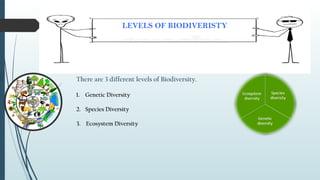
LEVELS OF BIODIVERISTY
There are 3 different levels of Biodiversity.
1. Genetic Diversity
2. Species Diversity
3. Ecosystem Diversity
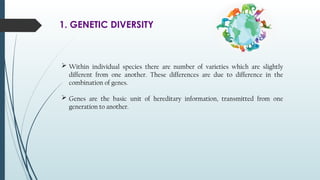
1. GENETIC DIVERSITY
 Within individual species there are number of varieties which are slightly
different from one another. These differences are due to difference in the
combination of genes.
 Genes are the basic unit of hereditary information, transmitted from one
generation to another.
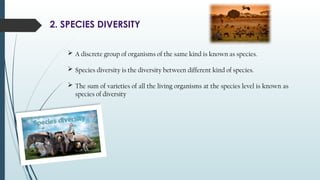
2. SPECIES DIVERSITY
 A discrete group of organisms of the same kind is known as species.
 Species diversity is the diversity between different kind of species.
 The sum of varieties of all the living organisms at the species level is known as
species of diversity
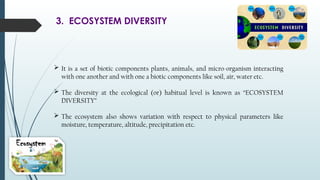
3. ECOSYSTEM DIVERSITY
 It is a set of biotic components plants, animals, and micro-organism interacting
with one another and with one a biotic components like soil, air, water etc.
 The diversity at the ecological (or) habitual level is known as “ECOSYSTEM
DIVERSITY”
 The ecosystem also shows variation with respect to physical parameters like
moisture, temperature, altitude, precipitation etc.
CONSERVATION OF BIODIVERSITY
Conservation refers to management of human activities in the
environment. So, that it does not lead to habitual destruction and
loss of biodiversity.
 To preserve and protect the species of their habitat.
 To maintain essential ecological process. So that there is no
ecological imbalance created.
 To use the species and ecosystem sustainably without
exploiting them.
 The creation of natural parks, sanctuaries biosphere reserves
etc., to preserve flora and fauna.
 Conservation of genetic biodiversity by establishing zoo’s,
botanical gardens, nurseries etc.
 Proper planning of land use and other natural resources
affecting the biodiversity.
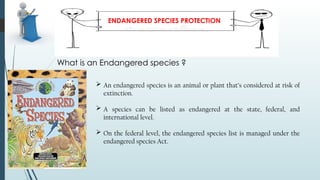
ENDANGERED SPECIES PROTECTION
What is an Endangered species ?
 An endangered species is an animal or plant that’s considered at risk of
extinction.
 A species can be listed as endangered at the state, federal, and
international level.
 On the federal level, the endangered species list is managed under the
endangered species Act.
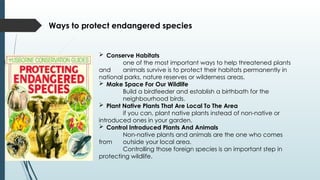
Ways to protect endangered species
 Conserve Habitats
one of the most important ways to help threatened plants
and animals survive is to protect their habitats permanently in
national parks, nature reserves or wilderness areas.
 Make Space For Our Wildlife
Build a birdfeeder and establish a birthbath for the
neighbourhood birds.
 Plant Native Plants That Are Local To The Area
if you can, plant native plants instead of non-native or
introduced ones in your garden.
 Control Introduced Plants And Animals
Non-native plants and animals are the one who comes
from outside your local area.
Controlling those foreign species is an important step in
protecting wildlife.
WASTE
MANAGEMENT & RECCYCLING PRACTICES.
INTRODUCTION
 Waste Management is all those activities and action required to
manage waste from its inception to its final disposal.
 This includes amongst other things, collection, transport, treatment
and disposal of waste together with monitoring and regulation.
 It also encompasses the legal and regulatory framework the relates
to waste management encompassing guidance on recycling etc.
EFFECTS OF WASTE
 ENVIRONMENTAL EFFECTS:
 Surface water contamination
 Ground Water contamination
 Soil contamination
 Air contamination
 ECONOMIC EFFECTS:
 Municipal wellbeing
 Recycling revenue
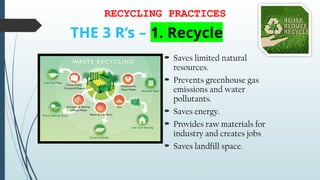
THE 3 R’s – 1. Recycle
 Saves limited natural
resources.
 Prevents greenhouse gas
emissions and water
pollutants.
 Saves energy.
 Provides raw materials for
industry and creates jobs
 Saves landfill space.
RECYCLING PRACTICES
THE 3 R’S – 2. WASTE REDUCTION
 Make double sided copies.
 Circulate memos, documents and periodicals.
 Use durable cups and silverware.
 Proof-read documents on the computer screen.
 Purchase merchandise with minimal packaging or order in
bulk.
 Read periodicals online.
 Send e-cards.
 Reduce your junk mail by writing to the Direct Marketing
Association at Mail Preference Service, PO Box 9008,
Farmingdale, NY 11735-9008.
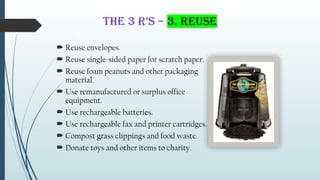
THE 3 R’s – 3. Reuse
 Reuse envelopes.
 Reuse single-sided paper for scratch paper.
 Reuse foam peanuts and other packaging
material.
 Use remanufactured or surplus office
equipment.
 Use rechargeable batteries.
 Use rechargeable fax and printer cartridges.
 Compost grass clippings and food waste.
 Donate toys and other items to charity.
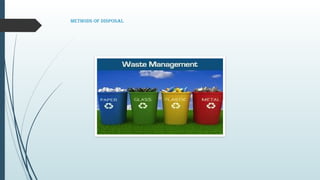
Methods of disposal
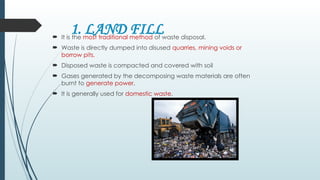
1. LAND FILL
 It is the most traditional method of waste disposal.
 Waste is directly dumped into disused quarries, mining voids or
borrow pits.
 Disposed waste is compacted and covered with soil
 Gases generated by the decomposing waste materials are often
burnt to generate power.
 It is generally used for domestic waste.
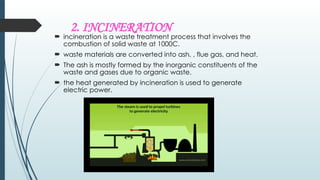
2. INCINERATION
 incineration is a waste treatment process that involves the
combustion of solid waste at 1000C.
 waste materials are converted into ash. , flue gas, and heat.
 The ash is mostly formed by the inorganic constituents of the
waste and gases due to organic waste.
 the heat generated by incineration is used to generate
electric power.
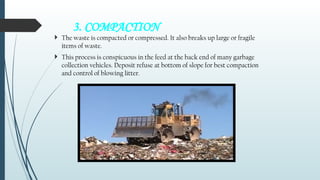
3. COMPACTION
 The waste is compacted or compressed. It also breaks up large or fragile
items of waste.
 This process is conspicuous in the feed at the back end of many garbage
collection vehicles. Deposit refuse at bottom of slope for best compaction
and control of blowing litter.
THANK YOU

detailed_presentation_on_EVS-PPT(GROUP 5).pptx

  • 1.
    Dr AMBEDKAR INSTITUTEOF TECHNOLOGY DEPARTMENT OF ELECTRONICS AND INSTRUMENTATION ENGINEERING ANUSHA 1DA22EI004 GANAVI CM 1DA22EI012 CHETHANA S 1DA22EI008 DARSHAN 1DA22EI009 BHAGYASHREE PATIL 1DA22EI006 PALLAVI M 1DA22EI024 DIMPLE N SHETTY 1DA22EI011 AMBARISH N 1DA23EI400 P REDDY 1DA23EI407 DARSHAN KUMAR G 1DA23EI402 PRESENTED BY:
  • 2.
     TOPICS  Biodiversityand its conservations.  Endangered species protection.  Urban wate management & recycling practices.  Waste treatment and disposal techniques.
  • 3.
    BIODIVERSITY AND ITSCONSERVATION BIODIVERSITY  Bio means “life” and diversity means “variety”. Hence biodiversity refers wide variety of life on earth.  Biodiversity is defined as the variety and the variability among all groups of living organisms and the ecosystem In which they live. SIGNIFICANCE  Biodiversity protects the fresh air, clean water and productive Land.  It is very important for human life as we depend on plants, micro-organisms, earth’s animals for our food, medicine and industrial products.  Loss of biodiversity has impacted an serious economic and social crisis for any country.
  • 4.
    LEVELS OF BIODIVERISTY Thereare 3 different levels of Biodiversity. 1. Genetic Diversity 2. Species Diversity 3. Ecosystem Diversity
  • 5.
    1. GENETIC DIVERSITY Within individual species there are number of varieties which are slightly different from one another. These differences are due to difference in the combination of genes.  Genes are the basic unit of hereditary information, transmitted from one generation to another.
  • 6.
    2. SPECIES DIVERSITY A discrete group of organisms of the same kind is known as species.  Species diversity is the diversity between different kind of species.  The sum of varieties of all the living organisms at the species level is known as species of diversity
  • 7.
    3. ECOSYSTEM DIVERSITY It is a set of biotic components plants, animals, and micro-organism interacting with one another and with one a biotic components like soil, air, water etc.  The diversity at the ecological (or) habitual level is known as “ECOSYSTEM DIVERSITY”  The ecosystem also shows variation with respect to physical parameters like moisture, temperature, altitude, precipitation etc.
  • 8.
    CONSERVATION OF BIODIVERSITY Conservationrefers to management of human activities in the environment. So, that it does not lead to habitual destruction and loss of biodiversity.  To preserve and protect the species of their habitat.  To maintain essential ecological process. So that there is no ecological imbalance created.  To use the species and ecosystem sustainably without exploiting them.  The creation of natural parks, sanctuaries biosphere reserves etc., to preserve flora and fauna.  Conservation of genetic biodiversity by establishing zoo’s, botanical gardens, nurseries etc.  Proper planning of land use and other natural resources affecting the biodiversity.
  • 9.
    ENDANGERED SPECIES PROTECTION Whatis an Endangered species ?  An endangered species is an animal or plant that’s considered at risk of extinction.  A species can be listed as endangered at the state, federal, and international level.  On the federal level, the endangered species list is managed under the endangered species Act.
  • 10.
    Ways to protectendangered species  Conserve Habitats one of the most important ways to help threatened plants and animals survive is to protect their habitats permanently in national parks, nature reserves or wilderness areas.  Make Space For Our Wildlife Build a birdfeeder and establish a birthbath for the neighbourhood birds.  Plant Native Plants That Are Local To The Area if you can, plant native plants instead of non-native or introduced ones in your garden.  Control Introduced Plants And Animals Non-native plants and animals are the one who comes from outside your local area. Controlling those foreign species is an important step in protecting wildlife.
  • 11.
  • 12.
    INTRODUCTION  Waste Managementis all those activities and action required to manage waste from its inception to its final disposal.  This includes amongst other things, collection, transport, treatment and disposal of waste together with monitoring and regulation.  It also encompasses the legal and regulatory framework the relates to waste management encompassing guidance on recycling etc.
  • 13.
    EFFECTS OF WASTE ENVIRONMENTAL EFFECTS:  Surface water contamination  Ground Water contamination  Soil contamination  Air contamination  ECONOMIC EFFECTS:  Municipal wellbeing  Recycling revenue
  • 14.
    THE 3 R’s– 1. Recycle  Saves limited natural resources.  Prevents greenhouse gas emissions and water pollutants.  Saves energy.  Provides raw materials for industry and creates jobs  Saves landfill space. RECYCLING PRACTICES
  • 15.
    THE 3 R’S– 2. WASTE REDUCTION  Make double sided copies.  Circulate memos, documents and periodicals.  Use durable cups and silverware.  Proof-read documents on the computer screen.  Purchase merchandise with minimal packaging or order in bulk.  Read periodicals online.  Send e-cards.  Reduce your junk mail by writing to the Direct Marketing Association at Mail Preference Service, PO Box 9008, Farmingdale, NY 11735-9008.
  • 16.
    THE 3 R’s– 3. Reuse  Reuse envelopes.  Reuse single-sided paper for scratch paper.  Reuse foam peanuts and other packaging material.  Use remanufactured or surplus office equipment.  Use rechargeable batteries.  Use rechargeable fax and printer cartridges.  Compost grass clippings and food waste.  Donate toys and other items to charity.
  • 17.
  • 18.
    1. LAND FILL It is the most traditional method of waste disposal.  Waste is directly dumped into disused quarries, mining voids or borrow pits.  Disposed waste is compacted and covered with soil  Gases generated by the decomposing waste materials are often burnt to generate power.  It is generally used for domestic waste.
  • 19.
    2. INCINERATION  incinerationis a waste treatment process that involves the combustion of solid waste at 1000C.  waste materials are converted into ash. , flue gas, and heat.  The ash is mostly formed by the inorganic constituents of the waste and gases due to organic waste.  the heat generated by incineration is used to generate electric power.
  • 20.
    3. COMPACTION  Thewaste is compacted or compressed. It also breaks up large or fragile items of waste.  This process is conspicuous in the feed at the back end of many garbage collection vehicles. Deposit refuse at bottom of slope for best compaction and control of blowing litter.
  • 21.