CLIMATE ACTION PLANNING for UVM LABS
                                                                                                                                      A Project of UVM Office of Sustainability1, UVM Environmental Safety2,
                                                                                                                                 UVM Capital Planning and Management3, UVM Office of the Vice President for Research


 Background                                                                                                                           University of Vermont Greenhouse Gas (GHG) Emissions                                                                                                                     Saving Energy in UVM Lab Buildings
                                                                                                                                                                                                                                                                                                       3
                                                                                                                                                                                                                        University of Vermont GHG
•Posner, S. , Stuart, R. , Thompson, G. , Smith, M.
            a                                       b                                 a                         c


                                                                                                                                                                                                                        Emissions by Sector, 2009
                                                                                                                                                                                                                              Solid Waste
                                                                                                                                                                                                                                                                                                           What you can do today
                                                                                                                                                                                                                                  <1%
                                                                                                                                                                                                                                                    Line Losses -
                                                                                                                                                                                                                                                     Composting
                                                                                                                                                                                                                                                                                          -- Scope 1
                                                                                                                                                                                                                                                                                                           1. Promptly report any building or facilities issues, such as ventilation problems, overheating,
                                                                                                                                                                                                                                 Faculty/Staff
                                                                                                                                                                                                                                 Commuters
                                                                                                                                                                                                                                                         4%                               -- Scope 2          or overcooling, to UVM Physical Plant Department. Call 656-2560 and press #1.
                                                                                                                                                                                                                                     7%

  • President Daniel Mark Fogel signed the Climate Commitment in 2007,
                                                                                                                                                                                                                                                                                          --Scope 3
                                                                                                                                                                                                                     Student Commuters


  making The University of Vermont a charter signatory. There are now
                                                                                                                                                                                                                             2%
                                                                                                                                                                                                                                                                                                           2. Use your equipment with energy in mind
  more than 660 signatories nationwide                                                                                                                                                                                                                                                                        • Whenever possible, close your lab’s fume hood sash
                                                                                                                                                                                                                                                                        Heating
                                                                                                                                                                                                                                                                         45%                                  • Turn off lab equipment, such as biosafety cabinets, and
  • Institutions commit to tracking and eliminating climate-changing                                                                                                                                                                  Purchased
                                                                                                                                                                                                                                                                                                                lights when they are not in use
                                                                                                                                                                                                                                      Electricity
  greenhouse gas emissions from specified campus operations. This                                                                                                                                                                       38%
                                                                                                                                                                                                                                                                                  Fleet                       • Use sleep mode on computers
                                                                                                                                                                                                                                                                                   2%
  primarily means managing energy use by buildings.
                                                                                                                                                                                                                          Biogenic Emissions

  • Commitment also means managing academic aspects of the university,
                                                                                                                                                                                                                                 <1%                      Agriculture
                                                                                                                                                                                                                                                              2%                                           3. Consider energy when you buy new equipment
  to “promote the research and educational efforts of higher education to                                                                                                                                                                                                                                     • Review energy requirements of new equipment and inquire whether more efficient,
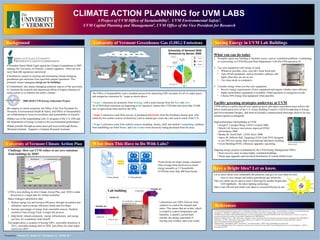
  equip society to re-stabilize the earth’s climate”                                                                                 The Office of Sustainability used a standard protocol for measuring GHG accounts for all six major gases,                                                                  higher performance equipment is available. Email questions to energy@uvm.edu
                                                                                                                                     and categorizes emissions by “scope as shown above:                                                                                                                      • Choose EPA Energy Star equipment when possible

                                           2009-2010 UVM Energy Education Project
                                                                                                                                     • Scope 1 emissions are primarily from Heating, with a small amount from the fleet and cows.                                                                          Facility greening strategies underway at UVM
                                                                                                                                     As of 2010 these emissions are beginning to be regulated: entities like UVM that emit more than 25,000                                                                UVM enforces a policy that all new capital projects and major renovations must achieve the
  •In support of carbon neutrality, the Office of the Vice President for                                                             tons of equivalents must report to the EPA.                                                                                                                           Silver certification level of the U.S. Green Building Council’s LEED (Leadership in Energy
  Research, Environmental Health & Safety, and Office of Sustainability                                                                                                                                                                                                                                                                  7
                                                                                                                                                                                                                                                                                                           and Environmental Design) , and must be formally commissioned (thorough check to be sure
  are collaborating to focus on excellence and sustainability in research.                                                           • Scope 2 emissions result from our use of purchased Electricity from the Northeast electric grid, with                                                               systems operate as designed).
  •Makes use of the longstanding Labs-21 program of the U.S. EPA and                                                                 relatively low-carbon sources of electricity such as natural gas versus the coal used in much of the U.S.
  the Department of Energy to improve the environmental performance.1                                                                                                                                                                                                                                      High performance lab buildings at UVM:
                                                                                                                                     • Scope 3 emissions come from indirect sources including faculty, staff, and student Commuting; methane                                                                  • Joseph E. Carrigan Wing: LEED Certified 2006
  •Made possible through an anonymous gift received through Rocky
                                                                                                                                     from landfilling our Solid Waste; and Line Losses from electricity being purchased from far away.                                                                        • Marsh Life Science renovations improved HVAC
  Mountain Institute . Supports a Graduate Research Assistant.
                                                                                                                                                                                                                                                                                                                performance 2006
                                                                                                                                                                                                                                                                                                              • Bertha M. Terrill Hall: LEED Silver 2008
                                                                                                                                                                                                                                                                                                              • James M. Jeffords Hall: Targeting LEED Gold 2010, designed
                                                                                                                                                                                                                                                                                                                to use 29% less energy than a conventional laboratory building
                                                                                                                                                                                                                                                                                                                                                                                                                                   Heat Enthalpy Wheel for
 University of Vermont Climate Action Plan                                                                                            What Does This Have to Do With Labs?                                                                                                                                    • Given Building HVAC efficiency upgrades: upcoming                                                                  heat recovery


   Challenge: How can UVM reduce to net zero emissions                                                                                                                                                                                                                                                     Ongoing energy projects coordinated by the UVM Energy Management Office:
   from buildings by 2020?                                                                                                                                                                                                                                                                                   • Heat recovery units in many highly ventilated buildings
                                                                                                                                                                                                          5
                                       100000                                                                                                                                                                                                                                                                • Steam pipe upgrades and increased distribution of central chilled water
                                        90000                 Past Emissions                     Projected Emissions

                                        80000                                                                                                                                                                 •Fume hoods are major energy consumers
                UVM Emissions (CO2e)


                                        70000
                                                        Other
                                                                                                                                                                                                              •One average fume hood uses as much
                                        60000

                                        50000
                                                    Commuting
                                                                                                                                                                                                              energy annually as 3.5 households                                                            Have a Bright Idea? Let us know.
                                                                                                                                                                                                              •UVM has more than 400 fume hoods
                                        40000       Electricity

                                        30000
                                                                                                                                                                                                                                                                                                           Let us know about your sustainable lab practices, and give us your ideas for new
                                        20000                      Agriculture
                                                                                                                                                      1 Fume Hood       =       3.5 Households                                                                                                                   ways to save energy and reduce greenhouse gas emissions.
                                        10000       Heating                                                                                                                                                                                                                                                Take our online survey-quiz to enter a drawing for another bright idea:
                                            0                                                                                                                                                                                                                                                                    LED lightbulbs , the latest lighting technology
                                             1990       1995       2000        2005   2010          2015     2020       2025
                                                                                                                                                                                                                                                                                                           Take a tear-off card and email your ideas to sustainability@uvm.edu
                                                                                                                                                                                                      Outside air
   UVM is now drafting its first Climate Action Plan, and 2020 is under                                                                                Lab building         6
                                                                                                                                                                                        Exhaust fan

     discussion as a target date for climate neutrality.
                                                                                                                                                         Inside air
   Major strategies identified to date:
                                                                                                                                                                       Air inside lab is exhausted
   1. Reduce energy use and increase efficiency through investment and                                                                                                 through fume hood
                                                                                                                                                                                                               Laboratories use 100% fresh air from
      education, such as energy efficiency bonds and Eco-Reps.                                                                          Outside air                                                            outdoors to control fire hazards and                                                            References
   2. Increase percentage of energy from renewable sources. Students                                                                                                                                           odors. This means that air in labs, which
                                                                                                                                                                                                                                                                                                           1 U.S. Environmental Protection Agency and U.S. Department of Energy. 2010. Labs for the 21st century. Accessed January 11, 2010 at: www.labs21century.gov
      created a Clean Energy Fund to begin this process.                                                                                                                                                       is treated to control temperature and                                                       2 Thompson, G. and Mika, A. Forthcoming. University of Vermont Climate Action Plan. Available online at www.uvm.edu/sustainability

                                                                                                                                                                                                               humidity, is quickly carried back                                                           3 World Resources Institute (WRI) and World Business Council for Sustainable Development (WBCSD). 2004. The Greenhouse Gas Protocol: A corporate

   3. Help build related community energy infrastructure and energy                                                                      Intake fan                                                                                                                                                        accounting and reporting standard, revised edition. Washington, DC: WRI/WBCSD.
                                                                                                                                                                                                               outside: the energy equivalent of                                                           4 Fransen, T., Bhatia, P., Hsu, A. 2007. Measuring to Manage: A guide to designing GHG accounting and reporting programs. Washington, DC: WRI/WBCSD.
      services, for community-wide benefit                                                                                                              Heat or cool                                                                                                                                       5 Borchardt, J. K. 2009. Achieving Laboratory Energy Efficiency. Los Angeles: UCLA Institute of the Environment. Accessed December 9, 2009 at:
                                                                                                                                                                                                               leaving your window open year round.                                                        www.ioe.ucla.edu/news/article.asp?parentid=3910
   This graph shows a scenario of buying 100% renewable electricity in                                                                                                                                                                                                                                     6 Image based on “Sustainability at MIT: Fume Hoods.” Accessed December 7, 2009 at: http://sustainability.mit.edu/node/34
                                                                                                                                                                                                                                                                                                           7 U.S. Green Building Council. 2010. Leadership in Energy and Environmental Design (LEED) Green Building Rating System. Accessed January 11, 2010 at:
      2015, renewable heating fuels in 2020, and offsets for other major
   Posner, S. , Stuart, R. , Thompson, G. , Smith, M.
                                 a                        b                                  a                      c
                                                                                                                                                                                                                                                                                                           www.usgbc.org/LEED
      sources by 2025.

Presented by: Posner, S.1, Stuart, R.2, Thompson, G. 1, Smith, M. 3

Climate Action Uvm Labs 1 26 10

  • 1.
    CLIMATE ACTION PLANNINGfor UVM LABS A Project of UVM Office of Sustainability1, UVM Environmental Safety2, UVM Capital Planning and Management3, UVM Office of the Vice President for Research Background University of Vermont Greenhouse Gas (GHG) Emissions Saving Energy in UVM Lab Buildings 3 University of Vermont GHG •Posner, S. , Stuart, R. , Thompson, G. , Smith, M. a b a c Emissions by Sector, 2009 Solid Waste What you can do today <1% Line Losses - Composting -- Scope 1 1. Promptly report any building or facilities issues, such as ventilation problems, overheating, Faculty/Staff Commuters 4% -- Scope 2 or overcooling, to UVM Physical Plant Department. Call 656-2560 and press #1. 7% • President Daniel Mark Fogel signed the Climate Commitment in 2007, --Scope 3 Student Commuters making The University of Vermont a charter signatory. There are now 2% 2. Use your equipment with energy in mind more than 660 signatories nationwide • Whenever possible, close your lab’s fume hood sash Heating 45% • Turn off lab equipment, such as biosafety cabinets, and • Institutions commit to tracking and eliminating climate-changing Purchased lights when they are not in use Electricity greenhouse gas emissions from specified campus operations. This 38% Fleet • Use sleep mode on computers 2% primarily means managing energy use by buildings. Biogenic Emissions • Commitment also means managing academic aspects of the university, <1% Agriculture 2% 3. Consider energy when you buy new equipment to “promote the research and educational efforts of higher education to • Review energy requirements of new equipment and inquire whether more efficient, equip society to re-stabilize the earth’s climate” The Office of Sustainability used a standard protocol for measuring GHG accounts for all six major gases, higher performance equipment is available. Email questions to energy@uvm.edu and categorizes emissions by “scope as shown above: • Choose EPA Energy Star equipment when possible 2009-2010 UVM Energy Education Project • Scope 1 emissions are primarily from Heating, with a small amount from the fleet and cows. Facility greening strategies underway at UVM As of 2010 these emissions are beginning to be regulated: entities like UVM that emit more than 25,000 UVM enforces a policy that all new capital projects and major renovations must achieve the •In support of carbon neutrality, the Office of the Vice President for tons of equivalents must report to the EPA. Silver certification level of the U.S. Green Building Council’s LEED (Leadership in Energy Research, Environmental Health & Safety, and Office of Sustainability 7 and Environmental Design) , and must be formally commissioned (thorough check to be sure are collaborating to focus on excellence and sustainability in research. • Scope 2 emissions result from our use of purchased Electricity from the Northeast electric grid, with systems operate as designed). •Makes use of the longstanding Labs-21 program of the U.S. EPA and relatively low-carbon sources of electricity such as natural gas versus the coal used in much of the U.S. the Department of Energy to improve the environmental performance.1 High performance lab buildings at UVM: • Scope 3 emissions come from indirect sources including faculty, staff, and student Commuting; methane • Joseph E. Carrigan Wing: LEED Certified 2006 •Made possible through an anonymous gift received through Rocky from landfilling our Solid Waste; and Line Losses from electricity being purchased from far away. • Marsh Life Science renovations improved HVAC Mountain Institute . Supports a Graduate Research Assistant. performance 2006 • Bertha M. Terrill Hall: LEED Silver 2008 • James M. Jeffords Hall: Targeting LEED Gold 2010, designed to use 29% less energy than a conventional laboratory building Heat Enthalpy Wheel for University of Vermont Climate Action Plan What Does This Have to Do With Labs? • Given Building HVAC efficiency upgrades: upcoming heat recovery Challenge: How can UVM reduce to net zero emissions Ongoing energy projects coordinated by the UVM Energy Management Office: from buildings by 2020? • Heat recovery units in many highly ventilated buildings 5 100000 • Steam pipe upgrades and increased distribution of central chilled water 90000 Past Emissions Projected Emissions 80000 •Fume hoods are major energy consumers UVM Emissions (CO2e) 70000 Other •One average fume hood uses as much 60000 50000 Commuting energy annually as 3.5 households Have a Bright Idea? Let us know. •UVM has more than 400 fume hoods 40000 Electricity 30000 Let us know about your sustainable lab practices, and give us your ideas for new 20000 Agriculture 1 Fume Hood = 3.5 Households ways to save energy and reduce greenhouse gas emissions. 10000 Heating Take our online survey-quiz to enter a drawing for another bright idea: 0 LED lightbulbs , the latest lighting technology 1990 1995 2000 2005 2010 2015 2020 2025 Take a tear-off card and email your ideas to sustainability@uvm.edu Outside air UVM is now drafting its first Climate Action Plan, and 2020 is under Lab building 6 Exhaust fan discussion as a target date for climate neutrality. Inside air Major strategies identified to date: Air inside lab is exhausted 1. Reduce energy use and increase efficiency through investment and through fume hood Laboratories use 100% fresh air from education, such as energy efficiency bonds and Eco-Reps. Outside air outdoors to control fire hazards and References 2. Increase percentage of energy from renewable sources. Students odors. This means that air in labs, which 1 U.S. Environmental Protection Agency and U.S. Department of Energy. 2010. Labs for the 21st century. Accessed January 11, 2010 at: www.labs21century.gov created a Clean Energy Fund to begin this process. is treated to control temperature and 2 Thompson, G. and Mika, A. Forthcoming. University of Vermont Climate Action Plan. Available online at www.uvm.edu/sustainability humidity, is quickly carried back 3 World Resources Institute (WRI) and World Business Council for Sustainable Development (WBCSD). 2004. The Greenhouse Gas Protocol: A corporate 3. Help build related community energy infrastructure and energy Intake fan accounting and reporting standard, revised edition. Washington, DC: WRI/WBCSD. outside: the energy equivalent of 4 Fransen, T., Bhatia, P., Hsu, A. 2007. Measuring to Manage: A guide to designing GHG accounting and reporting programs. Washington, DC: WRI/WBCSD. services, for community-wide benefit Heat or cool 5 Borchardt, J. K. 2009. Achieving Laboratory Energy Efficiency. Los Angeles: UCLA Institute of the Environment. Accessed December 9, 2009 at: leaving your window open year round. www.ioe.ucla.edu/news/article.asp?parentid=3910 This graph shows a scenario of buying 100% renewable electricity in 6 Image based on “Sustainability at MIT: Fume Hoods.” Accessed December 7, 2009 at: http://sustainability.mit.edu/node/34 7 U.S. Green Building Council. 2010. Leadership in Energy and Environmental Design (LEED) Green Building Rating System. Accessed January 11, 2010 at: 2015, renewable heating fuels in 2020, and offsets for other major Posner, S. , Stuart, R. , Thompson, G. , Smith, M. a b a c www.usgbc.org/LEED sources by 2025. Presented by: Posner, S.1, Stuart, R.2, Thompson, G. 1, Smith, M. 3