Will Dobud
Charles Sturt University
Consumer-Driven,
Recovery-Oriented Practice:
Using Feedback-Informed Treatment
to Improve Consumer Participation
8th	Australian	Rural	&	Remote	Mental	Health	Symposium	
www.anzmh.asn.au/rrmh
8th	Australian	Rural	&	Remote	Mental	Health	Symposium	
www.anzmh.asn.au/rrmh
8th	Australian	Rural	&	Remote	Mental	Health	Symposium	
www.anzmh.asn.au/rrmh	
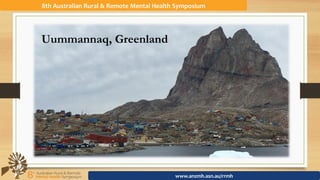
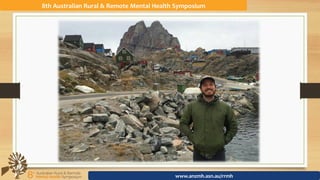
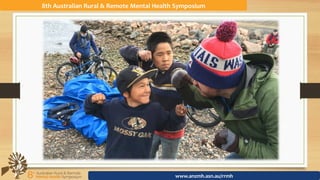
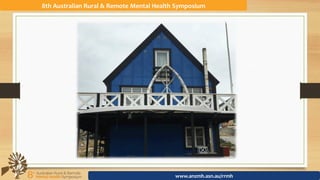
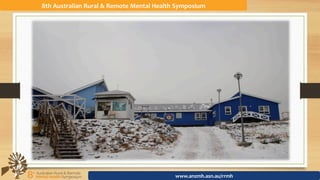
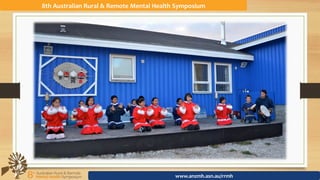
Uummannaq, Greenland
8th	Australian	Rural	&	Remote	Mental	Health	Symposium	
www.anzmh.asn.au/rrmh
8th	Australian	Rural	&	Remote	Mental	Health	Symposium	
www.anzmh.asn.au/rrmh
8th	Australian	Rural	&	Remote	Mental	Health	Symposium	
www.anzmh.asn.au/rrmh
8th	Australian	Rural	&	Remote	Mental	Health	Symposium	
www.anzmh.asn.au/rrmh
8th	Australian	Rural	&	Remote	Mental	Health	Symposium	
www.anzmh.asn.au/rrmh
8th	Australian	Rural	&	Remote	Mental	Health	Symposium	
www.anzmh.asn.au/rrmh
8th	Australian	Rural	&	Remote	Mental	Health	Symposium	
www.anzmh.asn.au/rrmh
8th	Australian	Rural	&	Remote	Mental	Health	Symposium	
www.anzmh.asn.au/rrmh
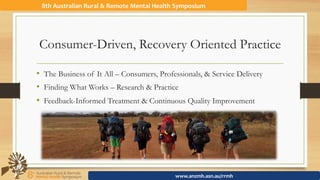
Consumer-Driven, Recovery Oriented Practice
•  The Business of It All – Consumers, Professionals, & Service Delivery
•  Finding What Works – Research & Practice
•  Feedback-Informed Treatment & Continuous Quality Improvement
8th	Australian	Rural	&	Remote	Mental	Health	Symposium	
www.anzmh.asn.au/rrmh
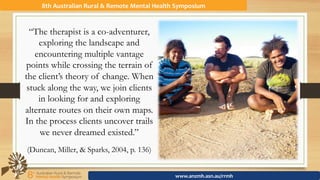
“The therapist is a co-adventurer,
exploring the landscape and
encountering multiple vantage
points while crossing the terrain of
the client’s theory of change. When
stuck along the way, we join clients
in looking for and exploring
alternate routes on their own maps.
In the process clients uncover trails
we never dreamed existed.”
(Duncan, Miller, & Sparks, 2004, p. 136)
8th	Australian	Rural	&	Remote	Mental	Health	Symposium	
www.anzmh.asn.au/rrmh
My Name is Will & I’m a Social Worker
Education
BSW - University of Maryland – Baltimore County
MSW[AP] - Charles Sturt University
v
Run a small adventure therapy program in SA
Awarded Australian Postgraduate Award by CSU
Australian Association for Bush Adventure Therapy
8th	Australian	Rural	&	Remote	Mental	Health	Symposium	
www.anzmh.asn.au/rrmh
Business, Mental Health & Wellbeing
•  Our services are purchased services
•  We’re worth investing in: We’re well trained and our services are effective
•  Those who do engage are better off than 80% who do not
•  Our services are cost effective (i.e. Reduction in Hospital Stays)
•  Depression is the leading cause of disability in western countries
8th	Australian	Rural	&	Remote	Mental	Health	Symposium	
www.anzmh.asn.au/rrmh
Who has confidence in our services?
•  Behind cost and insurance, lack of confidence is #3 reason for not engaging
•  Stigma does not break the Top 10
•  More money is spent on stigma in mental health then improving public confidence
•  Dropouts are an issue: Adults = 47% Children/Adolescents = 25% to 85%
8th	Australian	Rural	&	Remote	Mental	Health	Symposium	
www.anzmh.asn.au/rrmh
Table 1
Factor Loadings for Varimax Six-Factor Solution
Factor and item
Factor,
loading Eigenvalue
%
Variance
Mean factor
score
Factor 1: Therapeutic Relationship Problems 6.46 15.72 .27
33. The therapist didn’t seem to be doing the right things. .90
31. The therapist didn’t seem to understand. .83
30. The therapist didn’t talk about the right problems. .77
35. My child’s treatment was not clearly explained to me. .73
32. My child or I didn’t like the therapist. .70
34. The therapist didn’t seem to be helping. .69
36. One or more of the staff members did not seem
competent. .65
28. There was something we did not like about one or
more of the staff members. .55
40. I felt that the therapist or staff did not spend enough
time with my child alone. .55
41. I felt that the therapist or staff did not spend enough
time with my child and other family members
together. .54
39. I felt that the therapist or staff did not spend enough
time with me alone. .54
16. I decided that going to the clinic would not help my
child. .51
29. There was something about the clinic that my child or
I did not like. .45
37. We waited too long at appointments. .45
38. No one would see us at our appointments. .42
Factor 2: Family and Clinic Practical Problems 2.96 7.22 .13
26. We had family problems that prevented us from
going. .59
2. Someone in the family got sick. .47
38. No one would see us at our appointments. .46
21. We moved away from the area. .42
41. Therapist didn’t spend enough time with the family. .41
37. We waited too long at appointments. .41
39. The therapist didn’t spend enough time with us alone. .37
4. We didn’t know how to get to the clinic. .37
18. We had transportation problems. .35
22. It was too hard to make babysitting arrangements for
my other children. .35
Factor 3: Staff and Appointment Problems 2.44 5.96 .26
14. The staff member I talked to on the phone did not
seem very nice, or did not seem interested in helping. .80
15. The staff member I talked to on the phone did not
seem very competent. .72
28. There was something we did not like about one or
more of the staff members. .43
5. The appointment they gave us was too far in the
future. .42
13. I found another counselor or clinic to help my child. .39
7. The appointment they gave us interfered with my
work schedule. .36
6. The appointment they gave us interfered with my
child’s school. .36
Factor 4: Time and Effort Concerns 1.94 4.74 .19
24. We didn’t have enough time. .79
3. I felt that too much travel time was involved. .66
23. It took too much effort to go. .57
7. The appointment interfered with my work schedule. .35
Factor 5: Treatment Not Needed 1.79 4.38 .30
25. We decided that things were ok after all—that my
child didn’t really need to change. .74
10. I felt that help was no longer necessary because my
child got better. .63
12. I didn’t really feel that my child had a problem. .58
Factor 6: Money Issues 1.38 3.38 .17
27. I had a misunderstanding with the clinic over the
payment of fees. .75
17. The services cost too much. .49
441BRIEF REPORTS
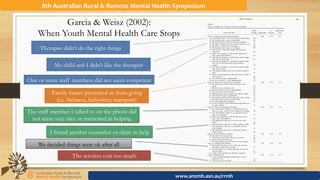
Garcia & Weisz (2002):
When Youth Mental Health Care Stops
Therapist didn’t do the right things
My child and I didn’t like the therapist
One or more staff members did not seem competent
Family Issues prevented us from going
(i.e. Sickness, babysitter, transport)
The staff member I talked to on the phone did
not seem very nice or interested in helping
I found another counselor or clinic to help
The services cost too much
We decided things were ok after all
8th	Australian	Rural	&	Remote	Mental	Health	Symposium	
www.anzmh.asn.au/rrmh
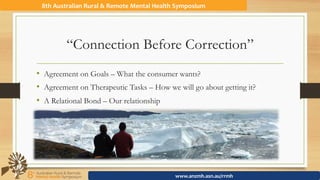
“Connection Before Correction”
•  Agreement on Goals – What the consumer wants?
•  Agreement on Therapeutic Tasks – How we will go about getting it?
•  A Relational Bond – Our relationship
8th	Australian	Rural	&	Remote	Mental	Health	Symposium	
www.anzmh.asn.au/rrmh
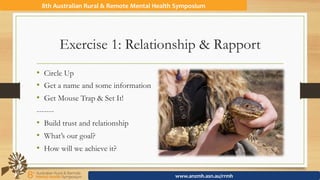
Exercise 1: Relationship & Rapport
•  Circle Up
•  Get a name and some information
•  Get Mouse Trap & Set It!
-------
•  Build trust and relationship
•  What’s our goal?
•  How will we achieve it?
8th	Australian	Rural	&	Remote	Mental	Health	Symposium	
www.anzmh.asn.au/rrmh
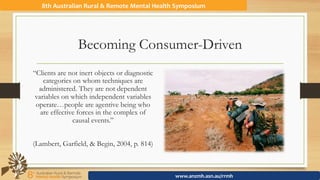
Becoming Consumer-Driven
“Clients are not inert objects or diagnostic
categories on whom techniques are
administered. They are not dependent
variables on which independent variables
operate…people are agentive being who
are effective forces in the complex of
causal events.”
(Lambert, Garfield, & Begin, 2004, p. 814)
8th	Australian	Rural	&	Remote	Mental	Health	Symposium	
www.anzmh.asn.au/rrmh
Process-Oriented
Proper Diagnosis + Prescriptive Intervention = Effective Treatment
Targeted Diagnostic Groups + Evidenced Based Treatments = Symptom Reduction
8th	Australian	Rural	&	Remote	Mental	Health	Symposium	
www.anzmh.asn.au/rrmh
First Step: The Killer D’s
•  Most mental illnesses in the DSM have no boundaries (i.e. Depression)
•  They’re Socially Constructed: The Story of Homosexuality
•  Attribution Creep – Rosenhan Experiment (1973) 'On Being Sane in Insane Places’
•  Project MATCH - $33 million dollar study, no differences in approach
8th	Australian	Rural	&	Remote	Mental	Health	Symposium	
www.anzmh.asn.au/rrmh
Next: Empirically-Supported Treatments
•  How do we find the best treatments?
•  Treatment vs. Control or TAU
•  Human Affairs International Study
•  What all therapies have in common?
•  Why are some therapists better?
8th	Australian	Rural	&	Remote	Mental	Health	Symposium	
www.anzmh.asn.au/rrmh
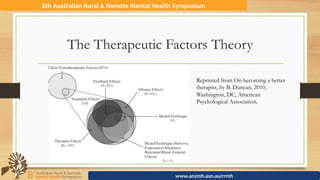
The Therapeutic Factors Theory
8th	Australian	Rural	&	Remote	Mental	Health	Symposium	
www.anzmh.asn.au/rrmh	
Reprinted from On becoming a better
therapist, by B. Duncan, 2010,
Washington, DC, American
Psychological Association.
The New Equation
8th	Australian	Rural	&	Remote	Mental	Health	Symposium	
www.anzmh.asn.au/rrmh	
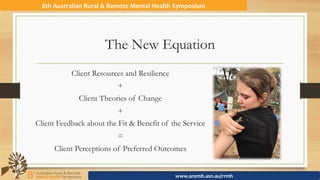
Client Resources and Resilience
+
Client Theories of Change
+
Client Feedback about the Fit & Benefit of the Service
=
Client Perceptions of Preferred Outcomes
Feedback Factors
8th	Australian	Rural	&	Remote	Mental	Health	Symposium	
www.anzmh.asn.au/rrmh	
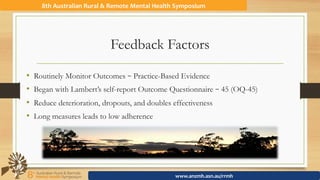
•  Routinely Monitor Outcomes – Practice-Based Evidence
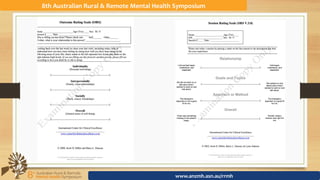
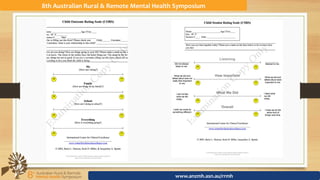
•  Began with Lambert’s self-report Outcome Questionnaire – 45 (OQ-45)
•  Reduce deterioration, dropouts, and doubles effectiveness
•  Long measures leads to low adherence
8th	Australian	Rural	&	Remote	Mental	Health	Symposium	
www.anzmh.asn.au/rrmh
8th	Australian	Rural	&	Remote	Mental	Health	Symposium	
www.anzmh.asn.au/rrmh
8th	Australian	Rural	&	Remote	Mental	Health	Symposium	
www.anzmh.asn.au/rrmh
8th	Australian	Rural	&	Remote	Mental	Health	Symposium	
www.anzmh.asn.au/rrmh
8th	Australian	Rural	&	Remote	Mental	Health	Symposium	
www.anzmh.asn.au/rrmh	
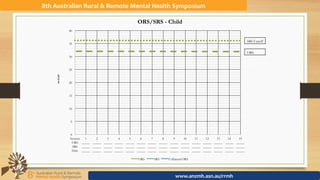
0
5
10
15
20
25
30
35
40
Session
ORS
SRS
Date
1
_____
_____
_____
2
_____
_____
_____
3
_____
_____
_____
4
_____
_____
_____
5
_____
_____
_____
6
_____
_____
_____
7
_____
_____
_____
8
_____
_____
_____
9
_____
_____
_____
10
_____
_____
_____
11
_____
_____
_____
12
_____
_____
_____
13
_____
_____
_____
14
_____
_____
_____
15
_____
_____
_____
Sc
o
re
ORS/SRS - Adult
ORS SRS Collateral ORS
SRS
Cutoff
ORS
Cutoff
8th	Australian	Rural	&	Remote	Mental	Health	Symposium	
www.anzmh.asn.au/rrmh	
0
5
10
15
20
25
30
35
40
Session
ORS
SRS
Date
1
_____
_____
_____
2
_____
_____
_____
3
_____
_____
_____
4
_____
_____
_____
5
_____
_____
_____
6
_____
_____
_____
7
_____
_____
_____
8
_____
_____
_____
9
_____
_____
_____
10
_____
_____
_____
11
_____
_____
_____
12
_____
_____
_____
13
_____
_____
_____
14
_____
_____
_____
15
_____
_____
_____
Sc
o
re
ORS/SRS - Youth
ORS SRS Collateral ORS
SRS Cutoff
ORS
Cutoff
8th	Australian	Rural	&	Remote	Mental	Health	Symposium	
www.anzmh.asn.au/rrmh	
0
5
10
15
20
25
30
35
40
Session
ORS
SRS
Date
1
_____
_____
_____
2
_____
_____
_____
3
_____
_____
_____
4
_____
_____
_____
5
_____
_____
_____
6
_____
_____
_____
7
_____
_____
_____
8
_____
_____
_____
9
_____
_____
_____
10
_____
_____
_____
11
_____
_____
_____
12
_____
_____
_____
13
_____
_____
_____
14
_____
_____
_____
15
_____
_____
_____
Sc
o
re
ORS/SRS - Child
ORS SRS Collateral ORS
SRS Cutoff
ORS
Cutoff
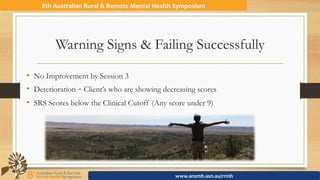
Warning Signs & Failing Successfully
8th	Australian	Rural	&	Remote	Mental	Health	Symposium	
www.anzmh.asn.au/rrmh	
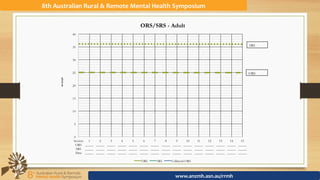
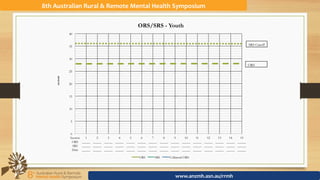
•  No Improvement by Session 3
•  Deterioration – Client’s who are showing decreasing scores
•  SRS Scores below the Clinical Cutoff (Any score under 9)
Clinical Excellence & Quality Development
8th	Australian	Rural	&	Remote	Mental	Health	Symposium	
www.anzmh.asn.au/rrmh	
•  Who are the Supershrinks?
•  What do the highest achieving therapists do to achieve their outcomes?
•  More time completing “Deliberate Practice”
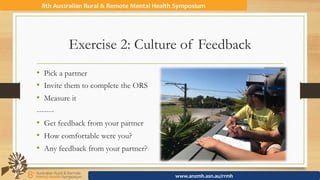
Exercise 2: Culture of Feedback
•  Pick a partner
•  Invite them to complete the ORS
•  Measure it
-------
•  Get feedback from your partner
•  How comfortable were you?
•  Any feedback from your partner?
8th	Australian	Rural	&	Remote	Mental	Health	Symposium	
www.anzmh.asn.au/rrmh
8th	Australian	Rural	&	Remote	Mental	Health	Symposium	
www.anzmh.asn.au/rrmh	
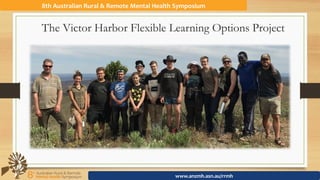
The Victor Harbor Flexible Learning Options Project
8th	Australian	Rural	&	Remote	Mental	Health	Symposium	
www.anzmh.asn.au/rrmh	
Initial Meetings & Program Structure
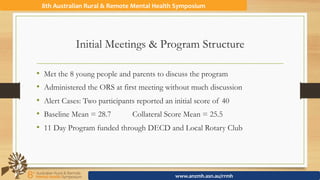
•  Met the 8 young people and parents to discuss the program
•  Administered the ORS at first meeting without much discussion
•  Alert Cases: Two participants reported an initial score of 40
•  Baseline Mean = 28.7 Collateral Score Mean = 25.5
•  11 Day Program funded through DECD and Local Rotary Club
8th	Australian	Rural	&	Remote	Mental	Health	Symposium	
www.anzmh.asn.au/rrmh	
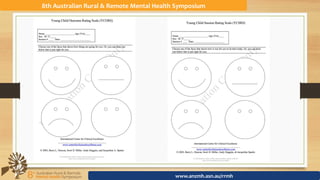
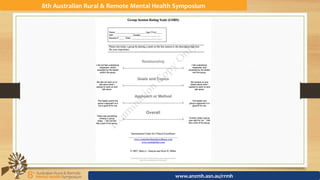
Implementing FIT Practice
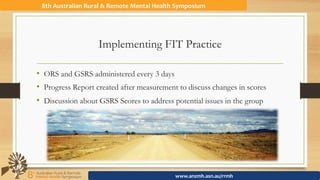
•  ORS and GSRS administered every 3 days
•  Progress Report created after measurement to discuss changes in scores
•  Discussion about GSRS Scores to address potential issues in the group
8th	Australian	Rural	&	Remote	Mental	Health	Symposium	
www.anzmh.asn.au/rrmh	
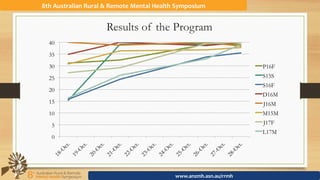
Results of the Program
0
5
10
15
20
25
30
35
40
P16F
S15S
S16F
D16M
J16M
M15M
J17F
L17M
8th	Australian	Rural	&	Remote	Mental	Health	Symposium	
www.anzmh.asn.au/rrmh	
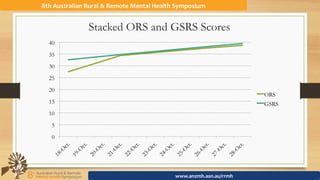
Stacked ORS and GSRS Scores
0
5
10
15
20
25
30
35
40
ORS
GSRS
8th	Australian	Rural	&	Remote	Mental	Health	Symposium	
www.anzmh.asn.au/rrmh	
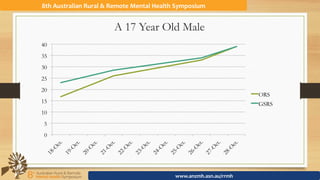
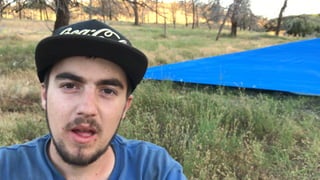
A 17 Year Old Male
0
5
10
15
20
25
30
35
40
ORS
GSRS
8th	Australian	Rural	&	Remote	Mental	Health	Symposium	
www.anzmh.asn.au/rrmh
8th	Australian	Rural	&	Remote	Mental	Health	Symposium	
www.anzmh.asn.au/rrmh
8th	Australian	Rural	&	Remote	Mental	Health	Symposium	
www.anzmh.asn.au/rrmh
8th	Australian	Rural	&	Remote	Mental	Health	Symposium	
www.anzmh.asn.au/rrmh

Client-Directed, Recovery-Oriented Practice: Feedback-Informed Treatment to Improve Consumer Participation