Clicker Questions for Wave unit
I gave these clicker questions after
the activity was completed except for
the Wave interference demonstration
day.
Waves on a String
A
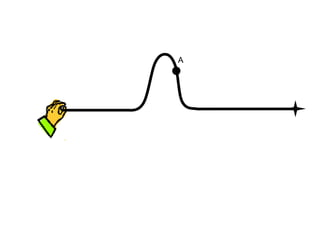
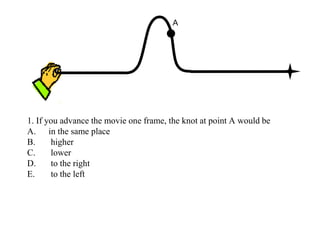
1. If you advance the movie one frame, the knot at point A would be
A. in the same place
B. higher
C. lower
D. to the right
E. to the left
A
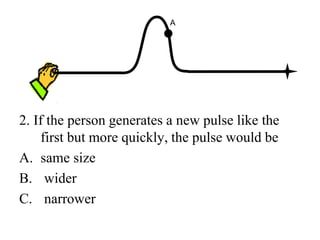
2. If the person generates a new pulse like the
first but more quickly, the pulse would be
A. same size
B. wider
C. narrower
A
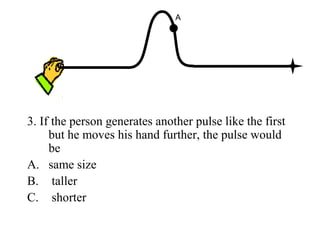
3. If the person generates another pulse like the first
but he moves his hand further, the pulse would
be
A. same size
B. taller
C. shorter
A
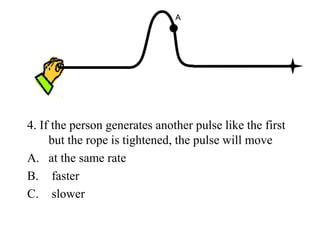
4. If the person generates another pulse like the first
but the rope is tightened, the pulse will move
A. at the same rate
B. faster
C. slower
A
A
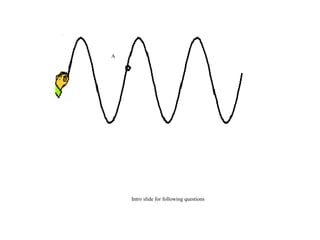
Intro slide for following questions
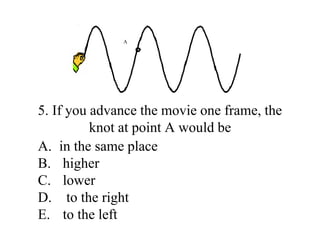
5. If you advance the movie one frame, the
knot at point A would be
A. in the same place
B. higher
C. lower
D. to the right
E. to the left
A
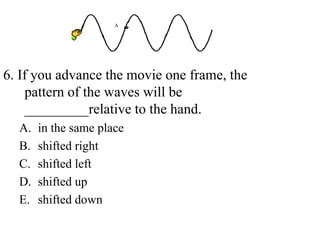
6. If you advance the movie one frame, the
pattern of the waves will be
_________relative to the hand.
A. in the same place
B. shifted right
C. shifted left
D. shifted up
E. shifted down
A
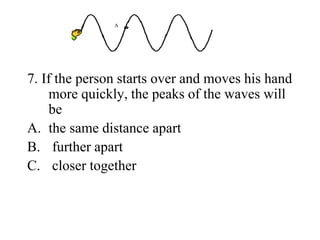
7. If the person starts over and moves his hand
more quickly, the peaks of the waves will
be
A. the same distance apart
B. further apart
C. closer together
A
A.lower its speed.
B.increase its wavelength.
C.lower its amplitude.
D.shorten its period.
8.If you lower the frequency of
a wave on a string you will
Fourier clicker questions
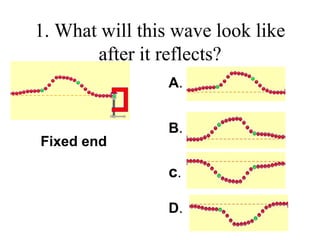
1. What will this wave look like
after it reflects?
A.
B.
c.
D.
Fixed end
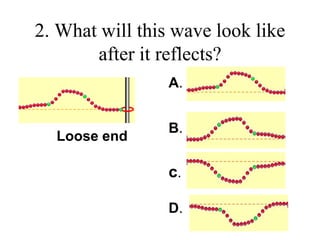
2. What will this wave look like
after it reflects?
Loose end
A.
B.
c.
D.
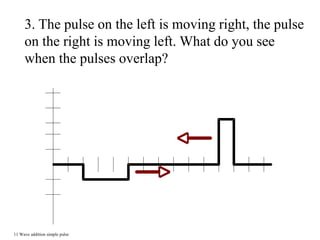
11 Wave addition simple pulse
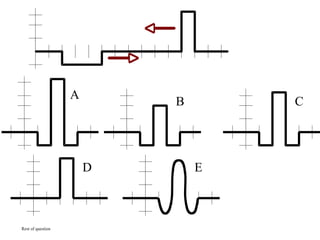
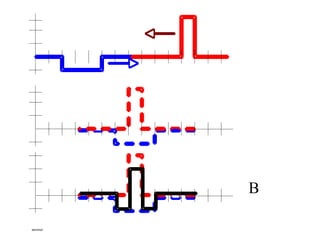
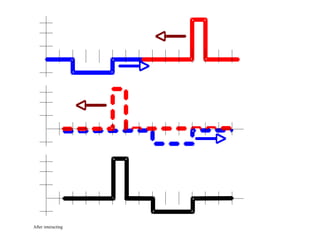
3. The pulse on the left is moving right, the pulse
on the right is moving left. What do you see
when the pulses overlap?
Rest of question
C
A
B
D E
answer
B
After interacting
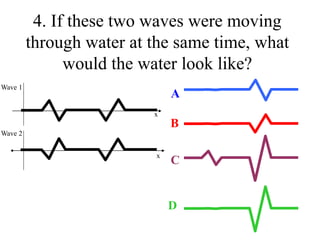
4. If these two waves were moving
through water at the same time, what
would the water look like?
A
B
C
D
x
x
Wave 1
Wave 2
Wave Interference
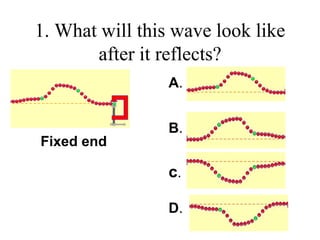
1. What will this wave look like
after it reflects?
A.
B.
c.
D.
Fixed end
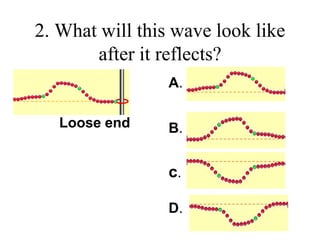
2. What will this wave look like
after it reflects?
Loose end
A.
B.
c.
D.
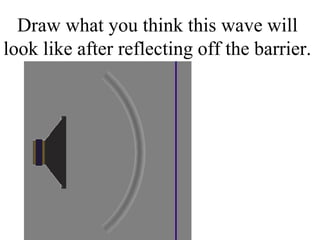
Draw what you think this wave will
look like after reflecting off the barrier.
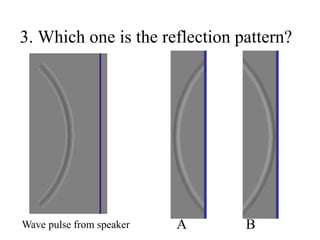
3. Which one is the reflection pattern?
Wave pulse from speaker A B
“Sound waves are three
dimensional.”
Talk to your partner:
• What evidence you have that
supports this.
• How the wave could be
represented
• How would reflection change?
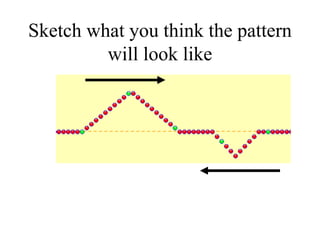
Sketch what you think the pattern
will look like
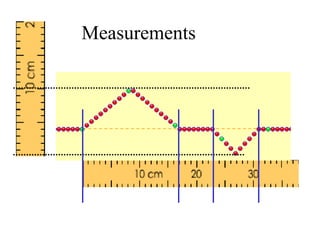
Measurements
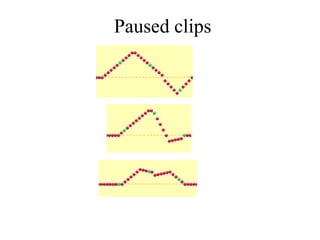
Paused clips
Sound activity
I used questions 1-8 with the sound activity
and the rest on the next day.
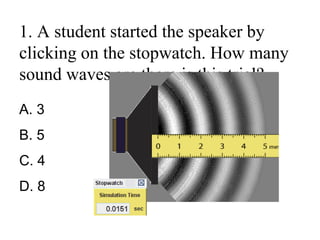
1. A student started the speaker by
clicking on the stopwatch. How many
sound waves are there is this trial?
A. 3
B. 5
C. 4
D. 8
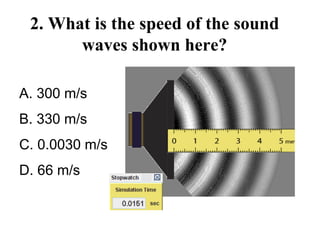
2. What is the speed of the sound
waves shown here?
A. 300 m/s
B. 330 m/s
C. 0.0030 m/s
D. 66 m/s
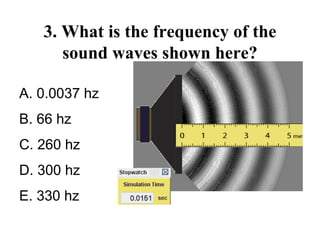
3. What is the frequency of the
sound waves shown here?
A. 0.0037 hz
B. 66 hz
C. 260 hz
D. 300 hz
E. 330 hz
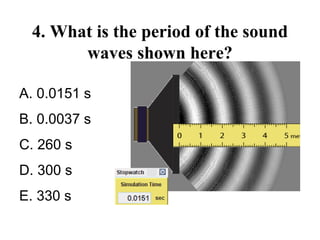
4. What is the period of the sound
waves shown here?
A. 0.0151 s
B. 0.0037 s
C. 260 s
D. 300 s
E. 330 s
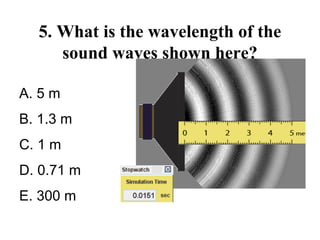
5. What is the wavelength of the
sound waves shown here?
A. 5 m
B. 1.3 m
C. 1 m
D. 0.71 m
E. 300 m
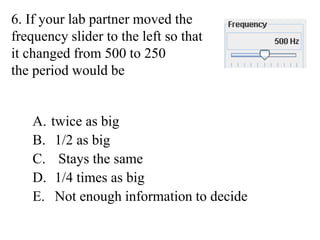
6. If your lab partner moved the
frequency slider to the left so that
it changed from 500 to 250
the period would be
A. twice as big
B. 1/2 as big
C. Stays the same
D. 1/4 times as big
E. Not enough information to decide
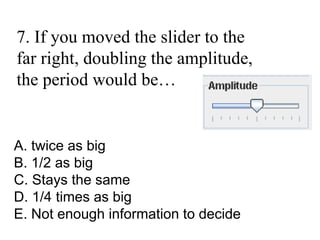
7. If you moved the slider to the
far right, doubling the amplitude,
the period would be…
A. twice as big
B. 1/2 as big
C. Stays the same
D. 1/4 times as big
E. Not enough information to decide
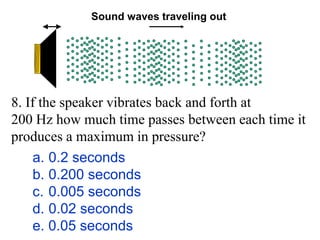
a. 0.2 seconds
b. 0.200 seconds
c. 0.005 seconds
d. 0.02 seconds
e. 0.05 seconds
Sound waves traveling out
8. If the speaker vibrates back and forth at
200 Hz how much time passes between each time it
produces a maximum in pressure?
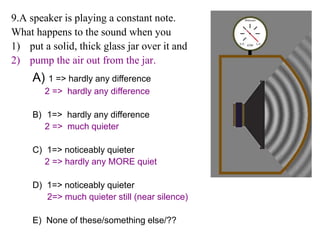
9.A speaker is playing a constant note.
What happens to the sound when you
1) put a solid, thick glass jar over it and
2) pump the air out from the jar.
A) 1 => hardly any difference
2 => hardly any difference
B) 1=> hardly any difference
2 => much quieter
C) 1=> noticeably quieter
2 => hardly any MORE quiet
D) 1=> noticeably quieter
2=> much quieter still (near silence)
E) None of these/something else/??
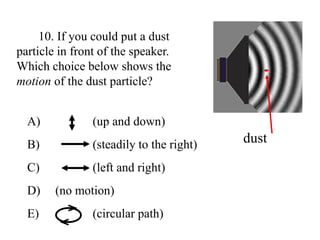
10. If you could put a dust
particle in front of the speaker.
Which choice below shows the
motion of the dust particle?
dust
A) (up and down)
B) (steadily to the right)
C) (left and right)
D) (no motion)
E) (circular path)
Fundamentals of waves
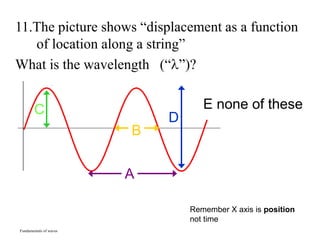
11.The picture shows “displacement as a function
of location along a string”
What is the wavelength (“”)?
A
B
C
D
E none of these
Remember X axis is position
not time
Fundamentals of waves
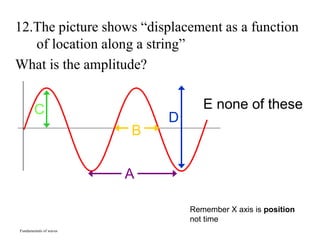
12.The picture shows “displacement as a function
of location along a string”
What is the amplitude?
Remember X axis is position
not time
A
B
C
D
E none of these
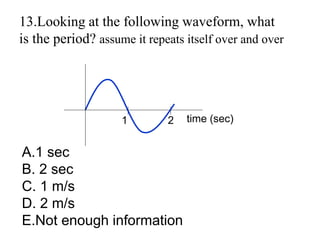
13.Looking at the following waveform, what
is the period? assume it repeats itself over and over
time (sec)
1 2
A.1 sec
B. 2 sec
C. 1 m/s
D. 2 m/s
E.Not enough information
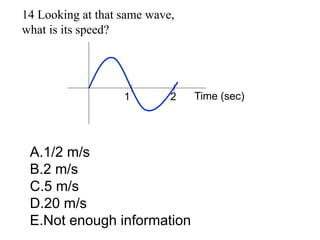
14 Looking at that same wave,
what is its speed?
Time (sec)
1 2
A.1/2 m/s
B.2 m/s
C.5 m/s
D.20 m/s
E.Not enough information
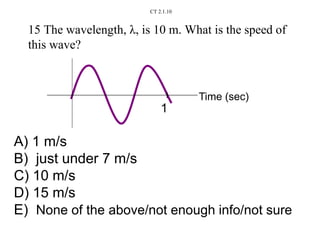
15 The wavelength, λ, is 10 m. What is the speed of
this wave?
CT 2.1.10
1
Time (sec)
A) 1 m/s
B) just under 7 m/s
C) 10 m/s
D) 15 m/s
E) None of the above/not enough info/not sure
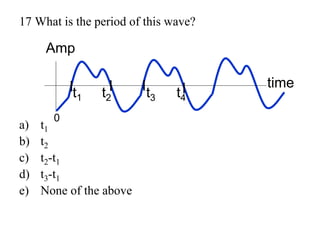
17 What is the period of this wave?
a) t1
b) t2
c) t2-t1
d) t3-t1
e) None of the above
t1 t2 t3
Amp
time
0
t4
18 Which one of the following is most likely to
be impossible?
A. Transverse waves in a gas
B. Longitudinal waves in a gas
C. Transverse waves in a solid
D. Longitudinal waves in a solid
E. They all seem perfectly possible
Reflection and Lenses
Plane mirrors only
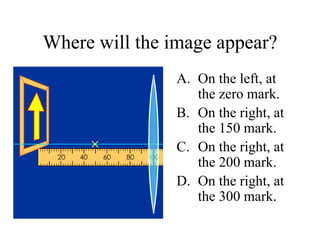
Where will the image appear?
A. On the left, at
the zero mark.
B. On the right, at
the 150 mark.
C. On the right, at
the 200 mark.
D. On the right, at
the 300 mark.
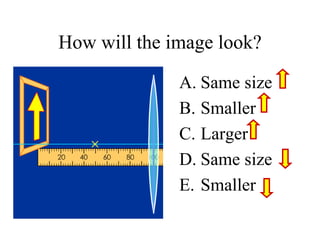
How will the image look?
A. Same size
B. Smaller
C. Larger
D. Same size
E. Smaller
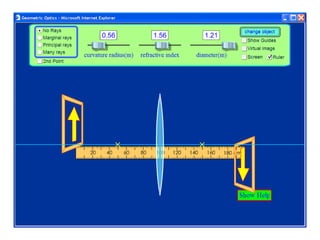
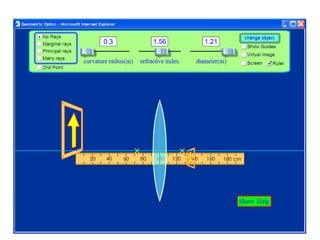
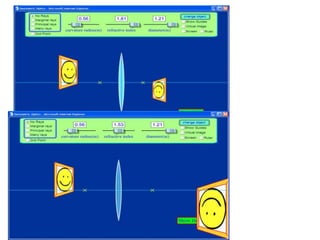
Simulation results
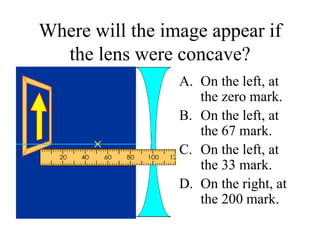
Where will the image appear if
the lens were concave?
A. On the left, at
the zero mark.
B. On the left, at
the 67 mark.
C. On the left, at
the 33 mark.
D. On the right, at
the 200 mark.
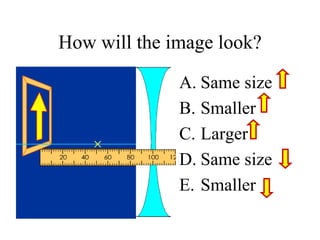
How will the image look?
A. Same size
B. Smaller
C. Larger
D. Same size
E. Smaller
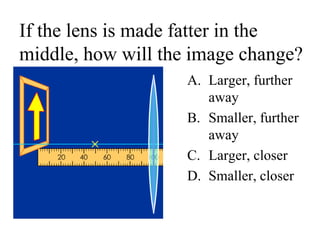
If the lens is made fatter in the
middle, how will the image change?
A. Larger, further
away
B. Smaller, further
away
C. Larger, closer
D. Smaller, closer
Answer: closer and smaller
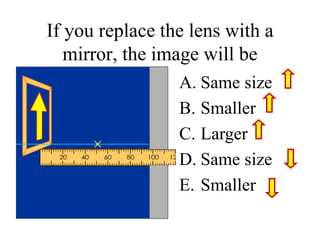
If you replace the lens with a
mirror, the image will be
A. Same size
B. Smaller
C. Larger
D. Same size
E. Smaller
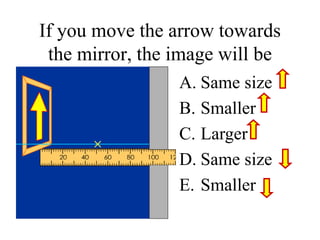
If you move the arrow towards
the mirror, the image will be
A. Same size
B. Smaller
C. Larger
D. Same size
E. Smaller
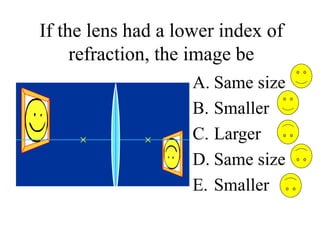
If the lens had a lower index of
refraction, the image be
A. Same size
B. Smaller
C. Larger
D. Same size
E. Smaller
answer
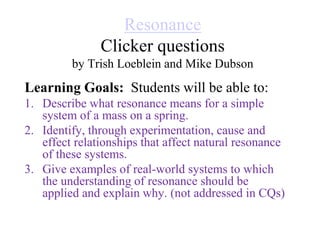
Resonance
Clicker questions
by Trish Loeblein and Mike Dubson
Learning Goals: Students will be able to:
1. Describe what resonance means for a simple
system of a mass on a spring.
2. Identify, through experimentation, cause and
effect relationships that affect natural resonance
of these systems.
3. Give examples of real-world systems to which
the understanding of resonance should be
applied and explain why. (not addressed in CQs)
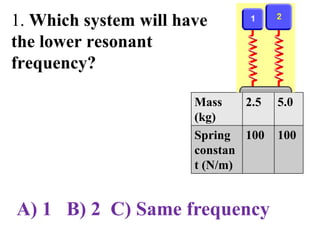
1. Which system will have
the lower resonant
frequency?
Mass
(kg)
2.5 5.0
Spring
constan
t (N/m)
100 100
A) 1 B) 2 C) Same frequency
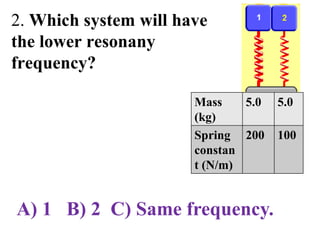
2. Which system will have
the lower resonany
frequency?
Mass
(kg)
5.0 5.0
Spring
constan
t (N/m)
200 100
A) 1 B) 2 C) Same frequency.
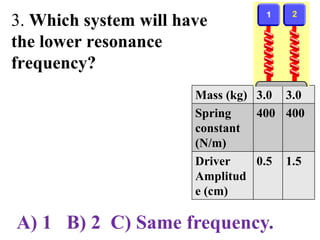
3. Which system will have
the lower resonance
frequency?
Mass (kg) 3.0 3.0
Spring
constant
(N/m)
400 400
Driver
Amplitud
e (cm)
0.5 1.5
A) 1 B) 2 C) Same frequency.
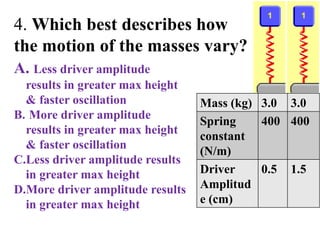
4. Which best describes how
the motion of the masses vary?
Mass (kg) 3.0 3.0
Spring
constant
(N/m)
400 400
Driver
Amplitud
e (cm)
0.5 1.5
A. Less driver amplitude
results in greater max height
& faster oscillation
B. More driver amplitude
results in greater max height
& faster oscillation
C.Less driver amplitude results
in greater max height
D.More driver amplitude results
in greater max height
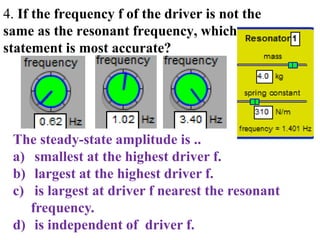
The steady-state amplitude is ..
a) smallest at the highest driver f.
b) largest at the highest driver f.
c) is largest at driver f nearest the resonant
frequency.
d) is independent of driver f.
4. If the frequency f of the driver is not the
same as the resonant frequency, which
statement is most accurate?

Clicker Questions for Wave unit2013.pptx

  • 1.
    Clicker Questions forWave unit I gave these clicker questions after the activity was completed except for the Wave interference demonstration day.
  • 2.
    Waves on aString
  • 3.
  • 4.
    1. If youadvance the movie one frame, the knot at point A would be A. in the same place B. higher C. lower D. to the right E. to the left A
  • 5.
    2. If theperson generates a new pulse like the first but more quickly, the pulse would be A. same size B. wider C. narrower A
  • 6.
    3. If theperson generates another pulse like the first but he moves his hand further, the pulse would be A. same size B. taller C. shorter A
  • 7.
    4. If theperson generates another pulse like the first but the rope is tightened, the pulse will move A. at the same rate B. faster C. slower A
  • 8.
    A Intro slide forfollowing questions
  • 9.
    5. If youadvance the movie one frame, the knot at point A would be A. in the same place B. higher C. lower D. to the right E. to the left A
  • 10.
    6. If youadvance the movie one frame, the pattern of the waves will be _________relative to the hand. A. in the same place B. shifted right C. shifted left D. shifted up E. shifted down A
  • 11.
    7. If theperson starts over and moves his hand more quickly, the peaks of the waves will be A. the same distance apart B. further apart C. closer together A
  • 12.
    A.lower its speed. B.increaseits wavelength. C.lower its amplitude. D.shorten its period. 8.If you lower the frequency of a wave on a string you will
  • 13.
  • 14.
    1. What willthis wave look like after it reflects? A. B. c. D. Fixed end
  • 15.
    2. What willthis wave look like after it reflects? Loose end A. B. c. D.
  • 16.
    11 Wave additionsimple pulse 3. The pulse on the left is moving right, the pulse on the right is moving left. What do you see when the pulses overlap?
  • 17.
  • 18.
  • 19.
  • 20.
    4. If thesetwo waves were moving through water at the same time, what would the water look like? A B C D x x Wave 1 Wave 2
  • 21.
  • 22.
    1. What willthis wave look like after it reflects? A. B. c. D. Fixed end
  • 23.
    2. What willthis wave look like after it reflects? Loose end A. B. c. D.
  • 24.
    Draw what youthink this wave will look like after reflecting off the barrier.
  • 25.
    3. Which oneis the reflection pattern? Wave pulse from speaker A B
  • 26.
    “Sound waves arethree dimensional.” Talk to your partner: • What evidence you have that supports this. • How the wave could be represented • How would reflection change?
  • 27.
    Sketch what youthink the pattern will look like
  • 28.
  • 29.
  • 30.
    Sound activity I usedquestions 1-8 with the sound activity and the rest on the next day.
  • 31.
    1. A studentstarted the speaker by clicking on the stopwatch. How many sound waves are there is this trial? A. 3 B. 5 C. 4 D. 8
  • 32.
    2. What isthe speed of the sound waves shown here? A. 300 m/s B. 330 m/s C. 0.0030 m/s D. 66 m/s
  • 33.
    3. What isthe frequency of the sound waves shown here? A. 0.0037 hz B. 66 hz C. 260 hz D. 300 hz E. 330 hz
  • 34.
    4. What isthe period of the sound waves shown here? A. 0.0151 s B. 0.0037 s C. 260 s D. 300 s E. 330 s
  • 35.
    5. What isthe wavelength of the sound waves shown here? A. 5 m B. 1.3 m C. 1 m D. 0.71 m E. 300 m
  • 36.
    6. If yourlab partner moved the frequency slider to the left so that it changed from 500 to 250 the period would be A. twice as big B. 1/2 as big C. Stays the same D. 1/4 times as big E. Not enough information to decide
  • 37.
    7. If youmoved the slider to the far right, doubling the amplitude, the period would be… A. twice as big B. 1/2 as big C. Stays the same D. 1/4 times as big E. Not enough information to decide
  • 38.
    a. 0.2 seconds b.0.200 seconds c. 0.005 seconds d. 0.02 seconds e. 0.05 seconds Sound waves traveling out 8. If the speaker vibrates back and forth at 200 Hz how much time passes between each time it produces a maximum in pressure?
  • 39.
    9.A speaker isplaying a constant note. What happens to the sound when you 1) put a solid, thick glass jar over it and 2) pump the air out from the jar. A) 1 => hardly any difference 2 => hardly any difference B) 1=> hardly any difference 2 => much quieter C) 1=> noticeably quieter 2 => hardly any MORE quiet D) 1=> noticeably quieter 2=> much quieter still (near silence) E) None of these/something else/??
  • 40.
    10. If youcould put a dust particle in front of the speaker. Which choice below shows the motion of the dust particle? dust A) (up and down) B) (steadily to the right) C) (left and right) D) (no motion) E) (circular path)
  • 41.
    Fundamentals of waves 11.Thepicture shows “displacement as a function of location along a string” What is the wavelength (“”)? A B C D E none of these Remember X axis is position not time
  • 42.
    Fundamentals of waves 12.Thepicture shows “displacement as a function of location along a string” What is the amplitude? Remember X axis is position not time A B C D E none of these
  • 43.
    13.Looking at thefollowing waveform, what is the period? assume it repeats itself over and over time (sec) 1 2 A.1 sec B. 2 sec C. 1 m/s D. 2 m/s E.Not enough information
  • 44.
    14 Looking atthat same wave, what is its speed? Time (sec) 1 2 A.1/2 m/s B.2 m/s C.5 m/s D.20 m/s E.Not enough information
  • 45.
    15 The wavelength,λ, is 10 m. What is the speed of this wave? CT 2.1.10 1 Time (sec) A) 1 m/s B) just under 7 m/s C) 10 m/s D) 15 m/s E) None of the above/not enough info/not sure
  • 46.
    17 What isthe period of this wave? a) t1 b) t2 c) t2-t1 d) t3-t1 e) None of the above t1 t2 t3 Amp time 0 t4
  • 47.
    18 Which oneof the following is most likely to be impossible? A. Transverse waves in a gas B. Longitudinal waves in a gas C. Transverse waves in a solid D. Longitudinal waves in a solid E. They all seem perfectly possible
  • 48.
  • 49.
    Where will theimage appear? A. On the left, at the zero mark. B. On the right, at the 150 mark. C. On the right, at the 200 mark. D. On the right, at the 300 mark.
  • 50.
    How will theimage look? A. Same size B. Smaller C. Larger D. Same size E. Smaller
  • 51.
  • 52.
    Where will theimage appear if the lens were concave? A. On the left, at the zero mark. B. On the left, at the 67 mark. C. On the left, at the 33 mark. D. On the right, at the 200 mark.
  • 53.
    How will theimage look? A. Same size B. Smaller C. Larger D. Same size E. Smaller
  • 54.
    If the lensis made fatter in the middle, how will the image change? A. Larger, further away B. Smaller, further away C. Larger, closer D. Smaller, closer
  • 55.
  • 56.
    If you replacethe lens with a mirror, the image will be A. Same size B. Smaller C. Larger D. Same size E. Smaller
  • 57.
    If you movethe arrow towards the mirror, the image will be A. Same size B. Smaller C. Larger D. Same size E. Smaller
  • 58.
    If the lenshad a lower index of refraction, the image be A. Same size B. Smaller C. Larger D. Same size E. Smaller
  • 59.
  • 60.
    Resonance Clicker questions by TrishLoeblein and Mike Dubson Learning Goals: Students will be able to: 1. Describe what resonance means for a simple system of a mass on a spring. 2. Identify, through experimentation, cause and effect relationships that affect natural resonance of these systems. 3. Give examples of real-world systems to which the understanding of resonance should be applied and explain why. (not addressed in CQs)
  • 61.
    1. Which systemwill have the lower resonant frequency? Mass (kg) 2.5 5.0 Spring constan t (N/m) 100 100 A) 1 B) 2 C) Same frequency
  • 62.
    2. Which systemwill have the lower resonany frequency? Mass (kg) 5.0 5.0 Spring constan t (N/m) 200 100 A) 1 B) 2 C) Same frequency.
  • 63.
    3. Which systemwill have the lower resonance frequency? Mass (kg) 3.0 3.0 Spring constant (N/m) 400 400 Driver Amplitud e (cm) 0.5 1.5 A) 1 B) 2 C) Same frequency.
  • 64.
    4. Which bestdescribes how the motion of the masses vary? Mass (kg) 3.0 3.0 Spring constant (N/m) 400 400 Driver Amplitud e (cm) 0.5 1.5 A. Less driver amplitude results in greater max height & faster oscillation B. More driver amplitude results in greater max height & faster oscillation C.Less driver amplitude results in greater max height D.More driver amplitude results in greater max height
  • 65.
    The steady-state amplitudeis .. a) smallest at the highest driver f. b) largest at the highest driver f. c) is largest at driver f nearest the resonant frequency. d) is independent of driver f. 4. If the frequency f of the driver is not the same as the resonant frequency, which statement is most accurate?