CLEARING THE 
UNDERBRUSH 
Lincolnwood Chamber of 
Commerce 
August 22, 2014 
Speaker: William A. Price, 
Attorney At Law
I. GETTING SICK 
The Obamacare Dilemma: Individual Market 
Providers More Expensive, Smaller Networks 
The Business Dilemma: Key Employee and 
Insider Relationships Depend on Good 
Benefits 
The Business Dilemma II: Obamacare 
Mandates, Adverse Selection, and Small 
Business Market Premiums All Increasing
SOME HEALTH CARE OPTIONS 
Self-Insurance: Businesses That Self-Insure not 
subject to specific Obamacare coverage mandates, 
just must provide “adequate” insurance 
Variations: Private Health Insurance Trust, Association 
Captives, Individual Company Captive Insurance Entity 
Common Theme: Carry and manage or hire 
management of claims to high deductible, then buy 
reinsurance for amounts above deductible amounts – 
much cheaper than primary coverage insurance
II. GETTING SUED 
Cook County experiences more than 2/3 of the 
litigation in Illinois, with only 40% of the population 
 More than half of all doctors trained here move 
elsewhere, in part because of our adverse litigation 
climate 
Your business or profession probably is experiencing 
premium increases, since stock market and other 
asset returns are down, so both loss experience and 
investment income produce pressures for cost 
increases to insured persons and entities.
RISK MANAGEMENT OPTIONS 
 Separation of Family Assets From Operating Businesses: 
Once high litigation risk business profits are earned, US (not 
international, those have tax risks) asset protection entities like 
Alaska or Delaware trusts with more than individual 
owner/professional ownership designed for family estate 
planning may be appropriate to reduce jurisdictional, 
bankruptcy, and litigation risks. 
 Separation Of Asset Holding Entities: Real estate and key 
equipment ownership entities can operate at “arms length” 
from high litigation businesses. Economically separate 
businesses (e.g. low risk cattle vs high risk hotel/resort on 
ranch) can be separate entities.
III. GETTING SUNK 
 Cash Flow troubles, not lack of profitability, are what kill most 
businesses. 
 Typical Sources Of Cash Flow Problems: 
a. The Infernal Revenue Service, with tax collection 
process powers (or Ill. Dept. of Revenue, or cities) 
b. Disappointed Creditors, who sue and freeze 
accounts, or, if banks, cut off financing 
c. Greedy Life Or Business Partners 
d. Deadbeat Customers, Like The State of Illinois
CASH FLOW SOLUTIONS 
 1. Get paid in advance: The Dell business model 
 2. Pay The D—n Taxes, Especially Those Your 
Employees Owe. Estimated taxes and other late pay 
periods for income, property, and sales taxes look like a 
cheap loan, but they can shut you down, and hurt your 
credit. 
 3. Partner With Vendors And Customers For Longer 
Payment Terms, Reduction Of Middlemen You Have To 
Pay Off 
 4. Refinance To Take Advantage Long Term Of Current 
Low Prime Rates
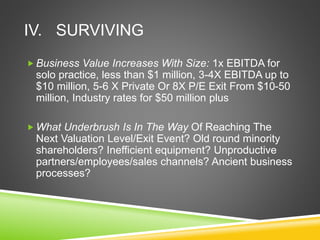
IV. SURVIVING 
Business Value Increases With Size: 1x EBITDA for 
solo practice, less than $1 million, 3-4X EBITDA up to 
$10 million, 5-6 X Private Or 8X P/E Exit From $10-50 
million, Industry rates for $50 million plus 
What Underbrush Is In The Way Of Reaching The 
Next Valuation Level/Exit Event? Old round minority 
shareholders? Inefficient equipment? Unproductive 
partners/employees/sales channels? Ancient business 
processes?
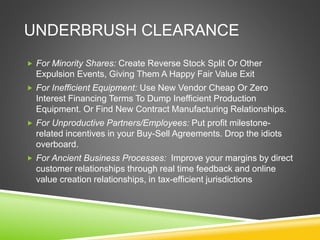
UNDERBRUSH CLEARANCE 
 For Minority Shares: Create Reverse Stock Split Or Other 
Expulsion Events, Giving Them A Happy Fair Value Exit 
 For Inefficient Equipment: Use New Vendor Cheap Or Zero 
Interest Financing Terms To Dump Inefficient Production 
Equipment. Or Find New Contract Manufacturing Relationships. 
 For Unproductive Partners/Employees: Put profit milestone-related 
incentives in your Buy-Sell Agreements. Drop the idiots 
overboard. 
 For Ancient Business Processes: Improve your margins by direct 
customer relationships through real time feedback and online 
value creation relationships, in tax-efficient jurisdictions
QUESTIONS? 
William A. Price 
Attorney at Law 
www.growthlaw.com 
P.O. Box 1425 
Warrenville, IL 60555 
Tel/Fax 1-800-630-4780 
Email: wprice@growthlaw.com

Clearing the underbrush

  • 1.
    CLEARING THE UNDERBRUSH Lincolnwood Chamber of Commerce August 22, 2014 Speaker: William A. Price, Attorney At Law
  • 2.
    I. GETTING SICK The Obamacare Dilemma: Individual Market Providers More Expensive, Smaller Networks The Business Dilemma: Key Employee and Insider Relationships Depend on Good Benefits The Business Dilemma II: Obamacare Mandates, Adverse Selection, and Small Business Market Premiums All Increasing
  • 3.
    SOME HEALTH CAREOPTIONS Self-Insurance: Businesses That Self-Insure not subject to specific Obamacare coverage mandates, just must provide “adequate” insurance Variations: Private Health Insurance Trust, Association Captives, Individual Company Captive Insurance Entity Common Theme: Carry and manage or hire management of claims to high deductible, then buy reinsurance for amounts above deductible amounts – much cheaper than primary coverage insurance
  • 4.
    II. GETTING SUED Cook County experiences more than 2/3 of the litigation in Illinois, with only 40% of the population  More than half of all doctors trained here move elsewhere, in part because of our adverse litigation climate Your business or profession probably is experiencing premium increases, since stock market and other asset returns are down, so both loss experience and investment income produce pressures for cost increases to insured persons and entities.
  • 5.
    RISK MANAGEMENT OPTIONS  Separation of Family Assets From Operating Businesses: Once high litigation risk business profits are earned, US (not international, those have tax risks) asset protection entities like Alaska or Delaware trusts with more than individual owner/professional ownership designed for family estate planning may be appropriate to reduce jurisdictional, bankruptcy, and litigation risks.  Separation Of Asset Holding Entities: Real estate and key equipment ownership entities can operate at “arms length” from high litigation businesses. Economically separate businesses (e.g. low risk cattle vs high risk hotel/resort on ranch) can be separate entities.
  • 6.
    III. GETTING SUNK  Cash Flow troubles, not lack of profitability, are what kill most businesses.  Typical Sources Of Cash Flow Problems: a. The Infernal Revenue Service, with tax collection process powers (or Ill. Dept. of Revenue, or cities) b. Disappointed Creditors, who sue and freeze accounts, or, if banks, cut off financing c. Greedy Life Or Business Partners d. Deadbeat Customers, Like The State of Illinois
  • 7.
    CASH FLOW SOLUTIONS  1. Get paid in advance: The Dell business model  2. Pay The D—n Taxes, Especially Those Your Employees Owe. Estimated taxes and other late pay periods for income, property, and sales taxes look like a cheap loan, but they can shut you down, and hurt your credit.  3. Partner With Vendors And Customers For Longer Payment Terms, Reduction Of Middlemen You Have To Pay Off  4. Refinance To Take Advantage Long Term Of Current Low Prime Rates
  • 8.
    IV. SURVIVING BusinessValue Increases With Size: 1x EBITDA for solo practice, less than $1 million, 3-4X EBITDA up to $10 million, 5-6 X Private Or 8X P/E Exit From $10-50 million, Industry rates for $50 million plus What Underbrush Is In The Way Of Reaching The Next Valuation Level/Exit Event? Old round minority shareholders? Inefficient equipment? Unproductive partners/employees/sales channels? Ancient business processes?
  • 9.
    UNDERBRUSH CLEARANCE For Minority Shares: Create Reverse Stock Split Or Other Expulsion Events, Giving Them A Happy Fair Value Exit  For Inefficient Equipment: Use New Vendor Cheap Or Zero Interest Financing Terms To Dump Inefficient Production Equipment. Or Find New Contract Manufacturing Relationships.  For Unproductive Partners/Employees: Put profit milestone-related incentives in your Buy-Sell Agreements. Drop the idiots overboard.  For Ancient Business Processes: Improve your margins by direct customer relationships through real time feedback and online value creation relationships, in tax-efficient jurisdictions
  • 10.
    QUESTIONS? William A.Price Attorney at Law www.growthlaw.com P.O. Box 1425 Warrenville, IL 60555 Tel/Fax 1-800-630-4780 Email: wprice@growthlaw.com