Clayton Valley Charter High School General Information and Possibilities…
Charter Facts Charter schools are  public  schools. Charter schools  cannot charge tuition . Charter schools are open to  all who want to enroll , and cannot ‘cherry-pick’ or use performance as a basis for admission. Charter schools must be of  choice  for both students and teachers.  Charter schools must be  nonsectarian . Charter schools must hire  credentialed teachers . Charter schools must  allow unions . Charter schools must  meet academic standards . Charter schools must  administer all statewide performance tests . Charter schools  cannot discriminate  based upon disability, ethnicity, national origin, age or gender.
Why Were Charters Established? The  Charter School Act of 1992  was created to improve public education by encouraging the development of  charter schools that will: Improved student learning  and  increased opportunities for all. Develop  innovative teaching methods  and  learning environments Give  teachers & parents a stronger voice  in school decisions Create and train more  highly-skilled teachers Expand  parents  & students choice  within public education Create  more accountability  and  measurable student outcomes  Create  competition within the public school system,  improving   all public schools.
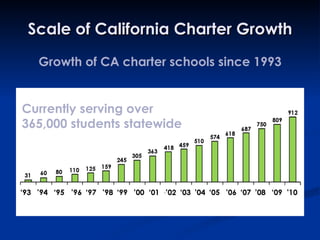
Scale of California Charter Growth Growth of CA charter schools since 1993 Currently serving over  365,000 students statewide
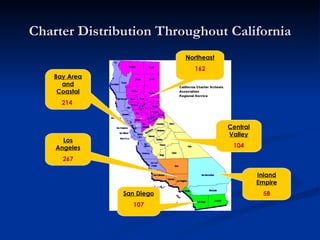
Charter Distribution Throughout California Bay Area and Coastal 214  Los Angeles 267 San Diego 107 Inland Empire 58 Central Valley 104 Northeast 162
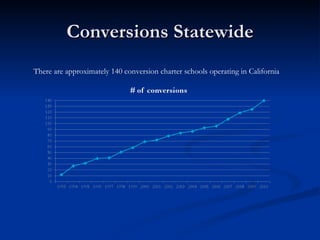
Conversions Statewide There are approximately 140 conversion charter schools operating in California
Growth by Year
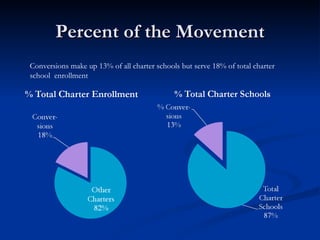
Percent of the Movement Conversions make up 13% of all charter schools but serve 18% of total charter school  enrollment
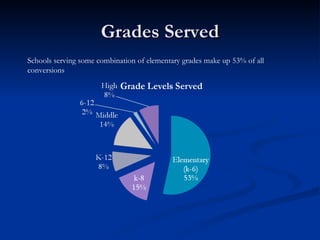
Grades Served Schools serving some combination of elementary grades make up 53% of all conversions
Why Choose Charters?  Teachers/Administrators Curriculum flexibility Operational autonomy Ability to tailor programs to student needs Ability to pursue specialized programs – dual immersion,  IB, Core Knowledge, SPED-focus - with greater autonomy Ability to craft a professional culture with full autonomy – and accountability Parents Individualized learning Specialized programs Innovation and accountability Smaller, safer campuses Opportunity to build true community of learning Shared governance Stronger academic results
Example: Granada Hills Charter High School (GHCHS) Converted to Independent Charter in 2003 4157 9th – 12th graders 182 certificated staff 118 classified staff
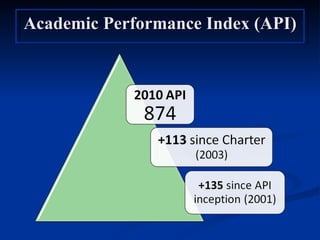
GHCHS SUCCESSES 99%   Graduation Rate 98%   of Graduates were Admitted to a two or four Year College 98%   Attendance   Rate 96%   CAHSEE Pass Rate Top API   –  874 2011 Distinguished School
Academic Performance Index (API)
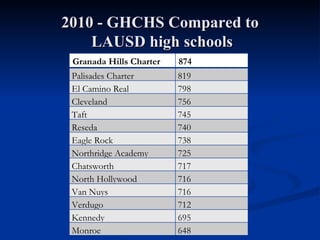
2010 - GHCHS Compared to  LAUSD high schools Granada Hills Charter 874 Palisades Charter 819 El Camino Real 798 Cleveland 756 Taft 745 Reseda 740 Eagle Rock 738 Northridge Academy 725 Chatsworth 717 North Hollywood 716 Van Nuys 716 Verdugo 712 Kennedy 695 Monroe 648
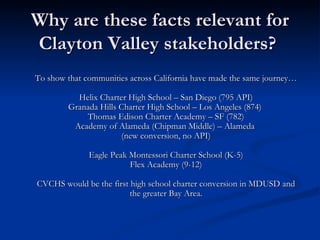
Why are these facts relevant for Clayton Valley stakeholders?  To show that communities across California have made the same journey… Helix Charter High School – San Diego (795 API) Granada Hills Charter High School – Los Angeles (874)  Thomas Edison Charter Academy – SF (782) Academy of Alameda (Chipman Middle) – Alameda  (new conversion, no API) Eagle Peak Montessori Charter School (K-5) Flex Academy (9-12) CVCHS would be the first high school charter conversion in MDUSD and the greater Bay Area.
What are the possibilities for… TODAY Clayton Valley  High School TOMORROW Clayton Valley Charter High School
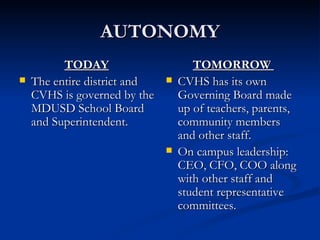
AUTONOMY TODAY The entire district and CVHS is governed by the MDUSD School Board and Superintendent. TOMORROW  CVHS has its own Governing Board made up of teachers, parents, community members and other staff. On campus leadership: CEO, CFO, COO along with other staff and student representative committees.
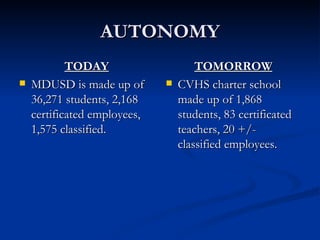
AUTONOMY TODAY MDUSD is made up of 36,271 students, 2,168 certificated employees, 1,575 classified. TOMORROW CVHS charter school made up of 1,868 students, 83 certificated teachers, 20 +/- classified employees.
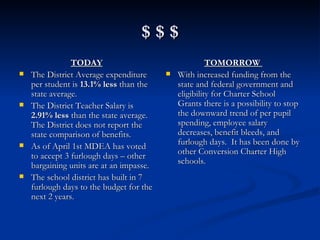
$ $ $ TODAY The District Average expenditure per student is  13.1% less  than the state average. The District Teacher Salary is  2.91% less  than the state average.  The District does not report the state comparison of benefits. As of April 1st MDEA has voted to accept 3 furlough days – other bargaining units are at an impasse. The school district has built in 7 furlough days to the budget for the next 2 years. TOMORROW  With increased funding from the state and federal government and eligibility for Charter School Grants there is a possibility to stop the downward trend of per pupil spending, employee salary decreases, benefit bleeds, and furlough days.  It has been done by other Conversion Charter High schools.
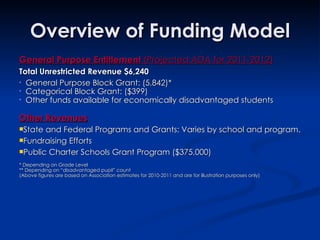
General Purpose Entitlement  (Projected ADA for 2011-2012) Total Unrestricted Revenue $6,240  General Purpose Block Grant: (5,842)* Categorical Block Grant: ($399)  Other funds available for economically disadvantaged students   Other Revenues State and Federal Programs and Grants: Varies by school and program. Fundraising Efforts Public Charter Schools Grant Program ($375,000) * Depending on Grade Level ** Depending on “disadvantaged pupil” count (Above figures are based on Association estimates for 2010-2011 and are for illustration purposes only) Overview of Funding Model
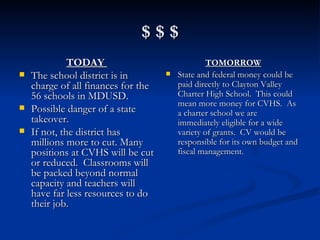
$ $ $ TODAY  The school district is in charge of all finances for the 56 schools in MDUSD.  Possible danger of a state takeover.  If not, the district has millions more to cut. Many positions at CVHS will be cut or reduced.  Classrooms will be packed beyond normal capacity and teachers will have far less resources to do their job. TOMORROW State and federal money could be paid directly to Clayton Valley Charter High School.  This could mean more money for CVHS.  As a charter school we are immediately eligible for a wide variety of grants.  CV would be responsible for its own budget and fiscal management.
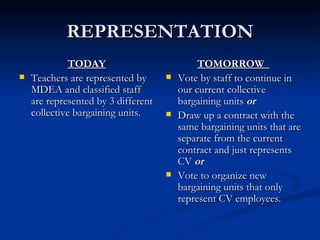
REPRESENTATION TODAY Teachers are represented by MDEA and classified staff are represented by 3 different collective bargaining units. TOMORROW  Vote by staff to continue in our current collective bargaining units  or Draw up a contract with the same bargaining units that are separate from the current contract and just represents CV  or Vote to organize new bargaining units that only represent CV employees.
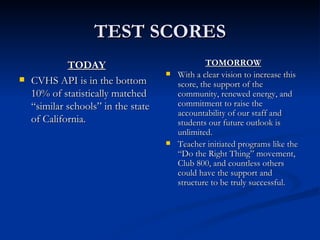
TEST SCORES TODAY CVHS API is in the bottom 10% of statistically matched “similar schools” in the state of California.  TOMORROW With a clear vision to increase this score, the support of the community, renewed energy, and commitment to raise the accountability of our staff and students our future outlook is unlimited. Teacher initiated programs like the “Do the Right Thing” movement, Club 800, and countless others could have the support and structure to be truly successful.
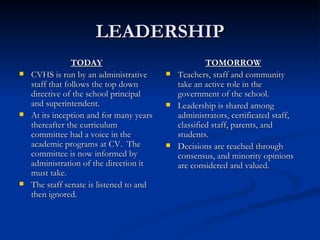
LEADERSHIP TODAY CVHS is run by an administrative staff that follows the top down directive of the school principal and superintendent.  At its inception and for many years thereafter the curriculum committee had a voice in the academic programs at CV.  The committee is now informed by administration of the direction it must take.  The staff senate is listened to and then ignored.  TOMORROW Teachers, staff and community take an active role in the government of the school. Leadership is shared among administrators, certificated staff, classified staff, parents, and students.  Decisions are reached through consensus, and minority opinions are considered and valued.
FRESHMEN TODAY 9th graders have a half day Orientation to CVHS thus leaving them completely unprepared for the rigors, standards or culture of the high school student.  TOMORROW Freshmen could have a mandatory summer transition program to prepare them for high school. This could be for 1-4 weeks with classes for evaluation, remediation and enrichment. CVCHS culture can be shared in a structured setting.  Important information on behavior expectations, scholastic goal setting, extra-curricular opportunities, etc. are frontloaded for optimum application. Small learning communities designed for freshmen support can be implemented.
CALENDAR TODAY The School year calendar is dictated by the MDUSD school board. TOMORROW The school calendar can be altered to better meet the academic needs of our students.  School could start earlier in August with the first semester concluding by winter break. Winter break could be extended a week to offer students intensive, accelerated study programs or remedial intervention.  Our version of summer school could be reinstated just for CVCHS students.  The offerings would be at our discretion and in accordance with the needs of our students.
ACCOUNTABILITY TODAY Example: The bell rings and it’s time for class, but what are all the students doing in the halls?  They are tardy - every single day - by the hundreds.  Between every single class. The campus supervisors fight a battle that can’t be won and they get tired.  Really, really tired.  TOMORROW The tardy policy can become part of a behavior contract that students and parents sign at the beginning of the year. Rules can be stricter and students and teachers held more accountable.  Rules could be the same in every classroom, making them universal across campus.  Expectations would be reinforced at mandatory freshmen summer program.
CONNECTIONS TODAY The bell rings at three o’clock and students scatter in different directions, many forgetting school until the bell rings at eight the next morning.  TOMORROW A structured afternoon (7 th  period) presents opportunities for academics and extra-curriculars. Sports, drama, clubs, etc. Remediation and tutoring College course offerings on the CVCHS campus Career experience Students continue to feel connected to CVCHS outside regular school hours.  Learning and enrichment is not dictated by the school bell but is an ongoing part of our community culture.
STUDENT IMAGE TODAY Dress codes are ignored and student attire is increasingly inappropriate and distracting. Teachers and staff try to fight this negative trend on an individual basis but standards are lost without strong leadership or a shared vision. TOMORROW The dress code is spelled out in the behavior contract that parents and students sign before school begins.  School-wide, objective standards become the norm. Students arrive in uniforms and this problem is gone.  Stereotyping, gang affiliations, economic status all begin to fade.
SCHOOL IMAGE TODAY Disrespect for teachers and other students is rampant on campus.  Standards for behavior continue to drop.  Teachers get burned out.  Students lose opportunities to learn.  What happened to no tolerance?  Teachers and families decide to leave.  Brain Drain.  TOMORROW CVCHS could build a school environment that attracts both teachers and students. A place where respect is expected, standards are held high, and people feel safe and welcome.
CAMPUS The CVHS school report card states that we have a clean and safe campus.  This is obviously not the reality. We have the option to contract with private resources that could dramatically cut costs and raise the standard of cleanliness on this campus. This is merely one example of simple and logical choices that can have large impacts.
CAMPUS Our school report card also states that our campus is in need of NO improvements. As a charter we are instantly eligible for state funded facility maintenance and construction grants that could enable us to build a functional 21 st  century library, a theater, or make the necessary improvements to keep our campus functional and safe.
In order to get a charter approved, developers will need to: Organize the support of the community Mobilize your parents and educators that are supporting your school to generate additional community outreach and support  Before submitting to the district, circulate your petition among trusted and qualified members of the community for review and comments Get letters from elected officials and community stakeholders and organizations stating their support for the proposed charter school If the district is amenable to review, submit a draft petition to the authorizing district for preliminary review Creating Your School
These are simply a few hypothetical scenarios.  The possibilities and the potential results are as diverse and as plentiful as our own creativity… 800+ API Distinguished School Drop out rate plummets Increase in per pupil spending On-line course offerings Increase in enrollment Attract highly qualified staff Accountability A close-knit school community CV Pride A culture of respect RIGOR RELEVANCE  RELATIONSHIPS more…
STAY INFORMED… Facebook page Search “Clayton Valley Charter High School” Website https:// sites.google.com/site/claytonvalleycharterhighschool /

Clayton Valley: Today v. Tomorrow

  • 1.
    Clayton Valley CharterHigh School General Information and Possibilities…
  • 2.
    Charter Facts Charterschools are public schools. Charter schools cannot charge tuition . Charter schools are open to all who want to enroll , and cannot ‘cherry-pick’ or use performance as a basis for admission. Charter schools must be of choice for both students and teachers. Charter schools must be nonsectarian . Charter schools must hire credentialed teachers . Charter schools must allow unions . Charter schools must meet academic standards . Charter schools must administer all statewide performance tests . Charter schools cannot discriminate based upon disability, ethnicity, national origin, age or gender.
  • 3.
    Why Were ChartersEstablished? The Charter School Act of 1992 was created to improve public education by encouraging the development of charter schools that will: Improved student learning and increased opportunities for all. Develop innovative teaching methods and learning environments Give teachers & parents a stronger voice in school decisions Create and train more highly-skilled teachers Expand parents & students choice within public education Create more accountability and measurable student outcomes Create competition within the public school system, improving all public schools.
  • 4.
    Scale of CaliforniaCharter Growth Growth of CA charter schools since 1993 Currently serving over 365,000 students statewide
  • 5.
    Charter Distribution ThroughoutCalifornia Bay Area and Coastal 214 Los Angeles 267 San Diego 107 Inland Empire 58 Central Valley 104 Northeast 162
  • 6.
    Conversions Statewide Thereare approximately 140 conversion charter schools operating in California
  • 7.
  • 8.
    Percent of theMovement Conversions make up 13% of all charter schools but serve 18% of total charter school enrollment
  • 9.
    Grades Served Schoolsserving some combination of elementary grades make up 53% of all conversions
  • 10.
    Why Choose Charters? Teachers/Administrators Curriculum flexibility Operational autonomy Ability to tailor programs to student needs Ability to pursue specialized programs – dual immersion, IB, Core Knowledge, SPED-focus - with greater autonomy Ability to craft a professional culture with full autonomy – and accountability Parents Individualized learning Specialized programs Innovation and accountability Smaller, safer campuses Opportunity to build true community of learning Shared governance Stronger academic results
  • 11.
    Example: Granada HillsCharter High School (GHCHS) Converted to Independent Charter in 2003 4157 9th – 12th graders 182 certificated staff 118 classified staff
  • 12.
    GHCHS SUCCESSES 99% Graduation Rate 98% of Graduates were Admitted to a two or four Year College 98% Attendance Rate 96% CAHSEE Pass Rate Top API – 874 2011 Distinguished School
  • 13.
  • 14.
    2010 - GHCHSCompared to LAUSD high schools Granada Hills Charter 874 Palisades Charter 819 El Camino Real 798 Cleveland 756 Taft 745 Reseda 740 Eagle Rock 738 Northridge Academy 725 Chatsworth 717 North Hollywood 716 Van Nuys 716 Verdugo 712 Kennedy 695 Monroe 648
  • 15.
    Why are thesefacts relevant for Clayton Valley stakeholders? To show that communities across California have made the same journey… Helix Charter High School – San Diego (795 API) Granada Hills Charter High School – Los Angeles (874) Thomas Edison Charter Academy – SF (782) Academy of Alameda (Chipman Middle) – Alameda (new conversion, no API) Eagle Peak Montessori Charter School (K-5) Flex Academy (9-12) CVCHS would be the first high school charter conversion in MDUSD and the greater Bay Area.
  • 16.
    What are thepossibilities for… TODAY Clayton Valley High School TOMORROW Clayton Valley Charter High School
  • 17.
    AUTONOMY TODAY Theentire district and CVHS is governed by the MDUSD School Board and Superintendent. TOMORROW CVHS has its own Governing Board made up of teachers, parents, community members and other staff. On campus leadership: CEO, CFO, COO along with other staff and student representative committees.
  • 18.
    AUTONOMY TODAY MDUSDis made up of 36,271 students, 2,168 certificated employees, 1,575 classified. TOMORROW CVHS charter school made up of 1,868 students, 83 certificated teachers, 20 +/- classified employees.
  • 19.
    $ $ $TODAY The District Average expenditure per student is 13.1% less than the state average. The District Teacher Salary is 2.91% less than the state average. The District does not report the state comparison of benefits. As of April 1st MDEA has voted to accept 3 furlough days – other bargaining units are at an impasse. The school district has built in 7 furlough days to the budget for the next 2 years. TOMORROW With increased funding from the state and federal government and eligibility for Charter School Grants there is a possibility to stop the downward trend of per pupil spending, employee salary decreases, benefit bleeds, and furlough days. It has been done by other Conversion Charter High schools.
  • 20.
    General Purpose Entitlement (Projected ADA for 2011-2012) Total Unrestricted Revenue $6,240 General Purpose Block Grant: (5,842)* Categorical Block Grant: ($399) Other funds available for economically disadvantaged students Other Revenues State and Federal Programs and Grants: Varies by school and program. Fundraising Efforts Public Charter Schools Grant Program ($375,000) * Depending on Grade Level ** Depending on “disadvantaged pupil” count (Above figures are based on Association estimates for 2010-2011 and are for illustration purposes only) Overview of Funding Model
  • 21.
    $ $ $TODAY The school district is in charge of all finances for the 56 schools in MDUSD. Possible danger of a state takeover. If not, the district has millions more to cut. Many positions at CVHS will be cut or reduced. Classrooms will be packed beyond normal capacity and teachers will have far less resources to do their job. TOMORROW State and federal money could be paid directly to Clayton Valley Charter High School. This could mean more money for CVHS. As a charter school we are immediately eligible for a wide variety of grants. CV would be responsible for its own budget and fiscal management.
  • 22.
    REPRESENTATION TODAY Teachersare represented by MDEA and classified staff are represented by 3 different collective bargaining units. TOMORROW Vote by staff to continue in our current collective bargaining units or Draw up a contract with the same bargaining units that are separate from the current contract and just represents CV or Vote to organize new bargaining units that only represent CV employees.
  • 23.
    TEST SCORES TODAYCVHS API is in the bottom 10% of statistically matched “similar schools” in the state of California. TOMORROW With a clear vision to increase this score, the support of the community, renewed energy, and commitment to raise the accountability of our staff and students our future outlook is unlimited. Teacher initiated programs like the “Do the Right Thing” movement, Club 800, and countless others could have the support and structure to be truly successful.
  • 24.
    LEADERSHIP TODAY CVHSis run by an administrative staff that follows the top down directive of the school principal and superintendent. At its inception and for many years thereafter the curriculum committee had a voice in the academic programs at CV. The committee is now informed by administration of the direction it must take. The staff senate is listened to and then ignored. TOMORROW Teachers, staff and community take an active role in the government of the school. Leadership is shared among administrators, certificated staff, classified staff, parents, and students. Decisions are reached through consensus, and minority opinions are considered and valued.
  • 25.
    FRESHMEN TODAY 9thgraders have a half day Orientation to CVHS thus leaving them completely unprepared for the rigors, standards or culture of the high school student. TOMORROW Freshmen could have a mandatory summer transition program to prepare them for high school. This could be for 1-4 weeks with classes for evaluation, remediation and enrichment. CVCHS culture can be shared in a structured setting. Important information on behavior expectations, scholastic goal setting, extra-curricular opportunities, etc. are frontloaded for optimum application. Small learning communities designed for freshmen support can be implemented.
  • 26.
    CALENDAR TODAY TheSchool year calendar is dictated by the MDUSD school board. TOMORROW The school calendar can be altered to better meet the academic needs of our students. School could start earlier in August with the first semester concluding by winter break. Winter break could be extended a week to offer students intensive, accelerated study programs or remedial intervention. Our version of summer school could be reinstated just for CVCHS students. The offerings would be at our discretion and in accordance with the needs of our students.
  • 27.
    ACCOUNTABILITY TODAY Example:The bell rings and it’s time for class, but what are all the students doing in the halls? They are tardy - every single day - by the hundreds. Between every single class. The campus supervisors fight a battle that can’t be won and they get tired. Really, really tired. TOMORROW The tardy policy can become part of a behavior contract that students and parents sign at the beginning of the year. Rules can be stricter and students and teachers held more accountable. Rules could be the same in every classroom, making them universal across campus. Expectations would be reinforced at mandatory freshmen summer program.
  • 28.
    CONNECTIONS TODAY Thebell rings at three o’clock and students scatter in different directions, many forgetting school until the bell rings at eight the next morning. TOMORROW A structured afternoon (7 th period) presents opportunities for academics and extra-curriculars. Sports, drama, clubs, etc. Remediation and tutoring College course offerings on the CVCHS campus Career experience Students continue to feel connected to CVCHS outside regular school hours. Learning and enrichment is not dictated by the school bell but is an ongoing part of our community culture.
  • 29.
    STUDENT IMAGE TODAYDress codes are ignored and student attire is increasingly inappropriate and distracting. Teachers and staff try to fight this negative trend on an individual basis but standards are lost without strong leadership or a shared vision. TOMORROW The dress code is spelled out in the behavior contract that parents and students sign before school begins. School-wide, objective standards become the norm. Students arrive in uniforms and this problem is gone. Stereotyping, gang affiliations, economic status all begin to fade.
  • 30.
    SCHOOL IMAGE TODAYDisrespect for teachers and other students is rampant on campus. Standards for behavior continue to drop. Teachers get burned out. Students lose opportunities to learn. What happened to no tolerance? Teachers and families decide to leave. Brain Drain. TOMORROW CVCHS could build a school environment that attracts both teachers and students. A place where respect is expected, standards are held high, and people feel safe and welcome.
  • 31.
    CAMPUS The CVHSschool report card states that we have a clean and safe campus. This is obviously not the reality. We have the option to contract with private resources that could dramatically cut costs and raise the standard of cleanliness on this campus. This is merely one example of simple and logical choices that can have large impacts.
  • 32.
    CAMPUS Our schoolreport card also states that our campus is in need of NO improvements. As a charter we are instantly eligible for state funded facility maintenance and construction grants that could enable us to build a functional 21 st century library, a theater, or make the necessary improvements to keep our campus functional and safe.
  • 33.
    In order toget a charter approved, developers will need to: Organize the support of the community Mobilize your parents and educators that are supporting your school to generate additional community outreach and support Before submitting to the district, circulate your petition among trusted and qualified members of the community for review and comments Get letters from elected officials and community stakeholders and organizations stating their support for the proposed charter school If the district is amenable to review, submit a draft petition to the authorizing district for preliminary review Creating Your School
  • 34.
    These are simplya few hypothetical scenarios. The possibilities and the potential results are as diverse and as plentiful as our own creativity… 800+ API Distinguished School Drop out rate plummets Increase in per pupil spending On-line course offerings Increase in enrollment Attract highly qualified staff Accountability A close-knit school community CV Pride A culture of respect RIGOR RELEVANCE RELATIONSHIPS more…
  • 35.
    STAY INFORMED… Facebookpage Search “Clayton Valley Charter High School” Website https:// sites.google.com/site/claytonvalleycharterhighschool /

Editor's Notes

  • #5 California’s Charter movement is in a state of unprecedented, probably unparalleled, increasing momentum and strength. Evidence of this is in terms of the sheer Scale of the movement. California’s charter schools serve an estimated 180,000 students. That’s equivalent to the second largest district in the State, and would qualify as one of the 10 largest districts in the country (National Center for Education Statistics, 2001.) Our charters employ an estimated 8,000 teachers. We’ve got over 500 social entrepreneurs leading 512 charter schools in 152 school districts or county offices. In September 2004 alone, we opened 78 new charter schools. That’s more charter schools than exist in 30 states, including New Jersey (52) and New York (51) and Massachusetts (50).