DATA EXPEDITION
Data Expeditions are quests to map uncharted territory, discover hidden
stories and solve unsolved mysteries in the Land of Data. As part of a
team you’ll tackle a problem, answer a question or work on a project.
We help you to get started and it’s up to you to decide where you go
DATA EXPEDITION:
WHAT WILL WE DO?
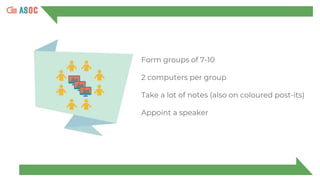
Form groups of 7-10
2 computers per group
Take a lot of notes (also on coloured post-its)
Appoint a speaker
Following the next slides, in 90 minutes you will:
1. Identify questions and problems to learn more about in your territory
2. Find a related project on your national website (EU Cohesion Policy funded projects)
3. Learn to browse and read what’s on your national website
4.Find other helpful data sources and develop the selected topic
5. Describe the details of the research you want to bring forward by filling out the Canvas on the
next slide
6. Using the Canvas, present your project in front of the class and CONVINCE THE OTHERS IT’S
THE BEST
7. Select the project that the whole class will bring forward
8. Form a definitive working group and assign yourselves to roles to organise the work of the
coming weeks
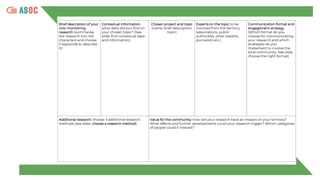
Brief description of your
civic monitoring
research (summarise
the research into 140
characters and choose
5 keywords to describe
it)
Contextual information:
what data did you find on
your chosen topic? (See
slide: find contextual data
and information)
Chosen project and topic
(name, brief description,
topic)
Experts on the topic to be
involved from the territory
(associations, public
authorities, other experts,
journalists etc.)
Communication format and
engagement strategy
(Which format do you
choose for communicating
your research and which
strategies do you
implement to involve the
local community. See slide:
choose the right format)
Additional research: choose 3 additional research
methods (see slide: choose a research method)
Value for the community: how will your research have an impact on your territory?
What effects and further developments could your research trigger? Which categories
of people could it interest?
YOUR TERRITORY
10 minutes
IDENTIFY SIGNIFICANT TOPICS TO INVESTIGATE
IN YOUR TERRITORY IN 10 MINUTES
AND WRITE DOWN 5 KEY WORDS.
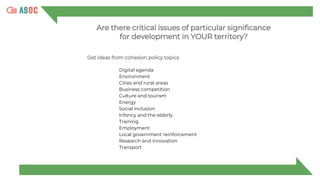
Are there critical issues of particular significance
for development in YOUR territory?
Get ideas from cohesion policy topics
Digital agenda
Environment
Cities and rural areas
Business competition
Culture and tourism
Energy
Social inclusion
Infancy and the elderly
Training
Employment
Local government reinforcement
Research and innovation
Transport
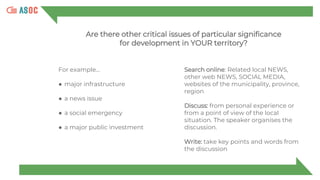
For example…
● major infrastructure
● a news issue
● a social emergency
● a major public investment
Search online: Related local NEWS,
other web NEWS, SOCIAL MEDIA,
websites of the municipality, province,
region
Discuss: from personal experience or
from a point of view of the local
situation. The speaker organises the
discussion.
Write: take key points and words from
the discussion
Are there other critical issues of particular significance
for development in YOUR territory?
YOUR TERRITORY
20 minutes
EXPLORE YOUR TERRITORY ON YOUR WEBISTE
IN 20 MINUTES
AND TAKE NOTES OF YOUR FINDINGS
Follow the suggestions of the next 2 slides
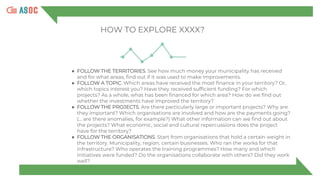
HOW TO EXPLORE XXXX?
● FOLLOW THE TERRITORIES. See how much money your municipality has received
and for what areas, find out if it was used to make improvements.
● FOLLOW A TOPIC. Which areas have received the most finance in your territory? Or,
which topics interest you? Have they received sufficient funding? For which
projects? As a whole, what has been financed for which area? How do we find out
whether the investments have improved the territory?
● FOLLOW THE PROJECTS. Are there particularly large or important projects? Why are
they important? Which organisations are involved and how are the payments going?
(… are there anomalies, for example?) What other information can we find out about
the projects? What economic, social and cultural repercussions does the project
have for the territory?
● FOLLOW THE ORGANISATIONS. Start from organisations that hold a certain weight in
the territory. Municipality, region, certain businesses. Who ran the works for that
infrastructure? Who operates the training programmes? How many and which
initiatives were funded? Do the organisations collaborate with others? Did they work
well?
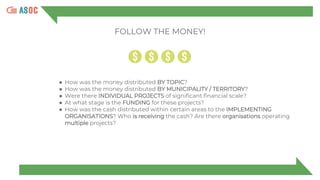
● How was the money distributed BY TOPIC?
● How was the money distributed BY MUNICIPALITY / TERRITORY?
● Were there INDIVIDUAL PROJECTS of significant financial scale?
● At what stage is the FUNDING for these projects?
● How was the cash distributed within certain areas to the IMPLEMENTING
ORGANISATIONS? Who is receiving the cash? Are there organisations operating
multiple projects?
FOLLOW THE MONEY!
ADDITIONAL RESEARCH
10 minutes
PREPARE A LIST OF OTHER DATA AND
INFORMATION HELPFUL FOR UNDERSTANDING
THE RESEARCH IN 10 MINUTES
Follow the suggestions of the next 2 slides
FIND CONTEXTUAL DATA AND INFORMATION
● NATIONAL INSTITUTIONAL WEBSITES (Ministries, Parliament, European Union)
● LOCAL INSTITUTIONAL WEBSITES (Municipality, Province, Region)
● RESEARCH INSTITUTE WEBSITES (example: Istat [Italian National Institute of
Statistics])
● SPECIFIC NATIONAL OR LOCAL PORTALS
● ONLINE NEWSPAPERS (national, local)
● Research other secondary data (official documents, academic journals, magazines, bylaws of
organisations, official press releases, websites)
● Questionnaires (questionnaires distributed to users of services, online forms, closed or open questions)
● Interviews (structured, semistructured, unstructured)
● Focus groups (group interviews, with questions and interaction between participants)
● Quantitative analysis (analysis of different variables, crossed datasets for understanding correlation
between phenomena)
● Diaries & reportage (measure actions, document with photos and videos)
● Longitudinal analyses of a case study (in-depth case study, applying various techniques)
● Online research methods (network analysis, digital ethnography, scraping and various techniques for
extracting online data and metrics)
● Content analysis (systematic analysis of text corpora for understanding recurring themes)
CHOOSE AN ADDITIONAL RESEARCH METHOD
INVOLVE
YOUR COMMUNITY
IN THE RESEARCH
10 minutes
In 10 MINUTES, CHOOSE THE TARGET FOR THE
RESEARCH AND THINK ABOUT HOW TO INVOLVE IT
Follow the suggestions of the next 2 slides
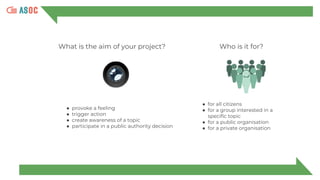
What is the aim of your project?
● provoke a feeling
● trigger action
● create awareness of a topic
● participate in a public authority decision
● for all citizens
● for a group interested in a
specific topic
● for a public organisation
● for a private organisation
Who is it for?
Based on the choice made in the previous slide,
identify the most suitable format for involving the community in the
research:
● a website
● video
● infographics
● comicstrip
● timeline
● animation
● song
● radio
● speak at city council meetings
● public conference
● special newspaper insertion
● videoclip
● performance
● school display
FINAL PITCH
15 minutes
IN 15 MINUTES PUT ALL OF YOUR NOTES TOGETHER
ON THE CANVAS YOU RECEIVED AT THE BEGINNING
Follow the suggestions of the next 2 slides
3 minutes
EACH GROUP PRESENTS THEIR PROJECT IN 3 MINUTES
IN FRONT OF THE TEACHER AND THE REST OF THE CLASS.
THE BEST PROJECT WILL BE CHOSEN FOR THE ENTIRE
CLASS TO WORK ON
Choose the name of your TEAM based on the selected project
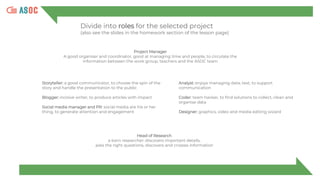
Divide into roles for the selected project
(also see the slides in the homework section of the lesson page)
Project Manager
A good organiser and coordinator, good at managing time and people, to circulate the
information between the work group, teachers and the ASOC team
Storyteller: a good communicator, to choose the spin of the
story and handle the presentation to the public
Blogger: incisive writer, to produce articles with impact
Social media manager and PR: social media are his or her
thing, to generate attention and engagement
Analyst: enjoys managing data, text, to support
communication
Coder: team hacker, to find solutions to collect, clean and
organise data
Designer: graphics, video and media editing wizard
Head of Research
a born researcher: discovers important details,
asks the right questions, discovers and crosses information
DATA EXPEDITION

Classroom Exercise 1: Data Expedition - ASOC2324_EN

  • 1.
  • 2.
    Data Expeditions arequests to map uncharted territory, discover hidden stories and solve unsolved mysteries in the Land of Data. As part of a team you’ll tackle a problem, answer a question or work on a project. We help you to get started and it’s up to you to decide where you go
  • 3.
  • 4.
    Form groups of7-10 2 computers per group Take a lot of notes (also on coloured post-its) Appoint a speaker
  • 5.
    Following the nextslides, in 90 minutes you will: 1. Identify questions and problems to learn more about in your territory 2. Find a related project on your national website (EU Cohesion Policy funded projects) 3. Learn to browse and read what’s on your national website 4.Find other helpful data sources and develop the selected topic 5. Describe the details of the research you want to bring forward by filling out the Canvas on the next slide 6. Using the Canvas, present your project in front of the class and CONVINCE THE OTHERS IT’S THE BEST 7. Select the project that the whole class will bring forward 8. Form a definitive working group and assign yourselves to roles to organise the work of the coming weeks
  • 6.
    Brief description ofyour civic monitoring research (summarise the research into 140 characters and choose 5 keywords to describe it) Contextual information: what data did you find on your chosen topic? (See slide: find contextual data and information) Chosen project and topic (name, brief description, topic) Experts on the topic to be involved from the territory (associations, public authorities, other experts, journalists etc.) Communication format and engagement strategy (Which format do you choose for communicating your research and which strategies do you implement to involve the local community. See slide: choose the right format) Additional research: choose 3 additional research methods (see slide: choose a research method) Value for the community: how will your research have an impact on your territory? What effects and further developments could your research trigger? Which categories of people could it interest?
  • 7.
  • 8.
    10 minutes IDENTIFY SIGNIFICANTTOPICS TO INVESTIGATE IN YOUR TERRITORY IN 10 MINUTES AND WRITE DOWN 5 KEY WORDS.
  • 9.
    Are there criticalissues of particular significance for development in YOUR territory? Get ideas from cohesion policy topics Digital agenda Environment Cities and rural areas Business competition Culture and tourism Energy Social inclusion Infancy and the elderly Training Employment Local government reinforcement Research and innovation Transport
  • 10.
    For example… ● majorinfrastructure ● a news issue ● a social emergency ● a major public investment Search online: Related local NEWS, other web NEWS, SOCIAL MEDIA, websites of the municipality, province, region Discuss: from personal experience or from a point of view of the local situation. The speaker organises the discussion. Write: take key points and words from the discussion Are there other critical issues of particular significance for development in YOUR territory?
  • 11.
  • 12.
    20 minutes EXPLORE YOURTERRITORY ON YOUR WEBISTE IN 20 MINUTES AND TAKE NOTES OF YOUR FINDINGS Follow the suggestions of the next 2 slides
  • 13.
    HOW TO EXPLOREXXXX? ● FOLLOW THE TERRITORIES. See how much money your municipality has received and for what areas, find out if it was used to make improvements. ● FOLLOW A TOPIC. Which areas have received the most finance in your territory? Or, which topics interest you? Have they received sufficient funding? For which projects? As a whole, what has been financed for which area? How do we find out whether the investments have improved the territory? ● FOLLOW THE PROJECTS. Are there particularly large or important projects? Why are they important? Which organisations are involved and how are the payments going? (… are there anomalies, for example?) What other information can we find out about the projects? What economic, social and cultural repercussions does the project have for the territory? ● FOLLOW THE ORGANISATIONS. Start from organisations that hold a certain weight in the territory. Municipality, region, certain businesses. Who ran the works for that infrastructure? Who operates the training programmes? How many and which initiatives were funded? Do the organisations collaborate with others? Did they work well?
  • 14.
    ● How wasthe money distributed BY TOPIC? ● How was the money distributed BY MUNICIPALITY / TERRITORY? ● Were there INDIVIDUAL PROJECTS of significant financial scale? ● At what stage is the FUNDING for these projects? ● How was the cash distributed within certain areas to the IMPLEMENTING ORGANISATIONS? Who is receiving the cash? Are there organisations operating multiple projects? FOLLOW THE MONEY!
  • 15.
  • 16.
    10 minutes PREPARE ALIST OF OTHER DATA AND INFORMATION HELPFUL FOR UNDERSTANDING THE RESEARCH IN 10 MINUTES Follow the suggestions of the next 2 slides
  • 17.
    FIND CONTEXTUAL DATAAND INFORMATION ● NATIONAL INSTITUTIONAL WEBSITES (Ministries, Parliament, European Union) ● LOCAL INSTITUTIONAL WEBSITES (Municipality, Province, Region) ● RESEARCH INSTITUTE WEBSITES (example: Istat [Italian National Institute of Statistics]) ● SPECIFIC NATIONAL OR LOCAL PORTALS ● ONLINE NEWSPAPERS (national, local)
  • 18.
    ● Research othersecondary data (official documents, academic journals, magazines, bylaws of organisations, official press releases, websites) ● Questionnaires (questionnaires distributed to users of services, online forms, closed or open questions) ● Interviews (structured, semistructured, unstructured) ● Focus groups (group interviews, with questions and interaction between participants) ● Quantitative analysis (analysis of different variables, crossed datasets for understanding correlation between phenomena) ● Diaries & reportage (measure actions, document with photos and videos) ● Longitudinal analyses of a case study (in-depth case study, applying various techniques) ● Online research methods (network analysis, digital ethnography, scraping and various techniques for extracting online data and metrics) ● Content analysis (systematic analysis of text corpora for understanding recurring themes) CHOOSE AN ADDITIONAL RESEARCH METHOD
  • 19.
  • 20.
    10 minutes In 10MINUTES, CHOOSE THE TARGET FOR THE RESEARCH AND THINK ABOUT HOW TO INVOLVE IT Follow the suggestions of the next 2 slides
  • 21.
    What is theaim of your project? ● provoke a feeling ● trigger action ● create awareness of a topic ● participate in a public authority decision ● for all citizens ● for a group interested in a specific topic ● for a public organisation ● for a private organisation Who is it for?
  • 22.
    Based on thechoice made in the previous slide, identify the most suitable format for involving the community in the research: ● a website ● video ● infographics ● comicstrip ● timeline ● animation ● song ● radio ● speak at city council meetings ● public conference ● special newspaper insertion ● videoclip ● performance ● school display
  • 23.
  • 24.
    15 minutes IN 15MINUTES PUT ALL OF YOUR NOTES TOGETHER ON THE CANVAS YOU RECEIVED AT THE BEGINNING Follow the suggestions of the next 2 slides
  • 25.
    3 minutes EACH GROUPPRESENTS THEIR PROJECT IN 3 MINUTES IN FRONT OF THE TEACHER AND THE REST OF THE CLASS. THE BEST PROJECT WILL BE CHOSEN FOR THE ENTIRE CLASS TO WORK ON
  • 26.
    Choose the nameof your TEAM based on the selected project
  • 27.
    Divide into rolesfor the selected project (also see the slides in the homework section of the lesson page) Project Manager A good organiser and coordinator, good at managing time and people, to circulate the information between the work group, teachers and the ASOC team Storyteller: a good communicator, to choose the spin of the story and handle the presentation to the public Blogger: incisive writer, to produce articles with impact Social media manager and PR: social media are his or her thing, to generate attention and engagement Analyst: enjoys managing data, text, to support communication Coder: team hacker, to find solutions to collect, clean and organise data Designer: graphics, video and media editing wizard Head of Research a born researcher: discovers important details, asks the right questions, discovers and crosses information
  • 28.