Technology
&
Livelihood Education
7
Are you familiar with the
different tools and
equipment in your kitchen?
Different materials used
in making the Kitchen
tools and equipment.
1. Stainless steel
most popular material for tools and
equipment
more expensive than aluminum
easier to clean, lasts longer than aluminum
stainless steel with copper, aluminum or
laminated steel bottoms spread heat evenly
may be bought from light to heavy gauges
2. Aluminum
best for all-around use
most popular, light weight, attractive and
cheaper than stainless steel
gives even heat distribution
soft metal, lighter gauges dent and scratch
easily
Alkali, like potatoes, beets and carrots,
turn the aluminum dark
tomatoes will make the aluminum shinier
3. Cast Iron
sturdy
rub oil or shortening inside
and out to avoid rust
wash with soap, not
detergent before using.
4. Glass
good for baking but not
recommended for top-of-the
stove cooking
great care is needed for longer
serviceability
5. Non- stick surface
a special coating applied inside
aluminum or steel pots and pans
prevents food from sticking to the pan
when washing, avoid scratching the
non-stick coating with sharp objects
like a knife or fork. Use wooden or
plastic spatula to handle food.
6. Ceramic and heat- proof glass
used especially for baking
dishes, casseroles and
measuring cups
if decorated, can go from oven
to the dining table.
7. Plastic and hard rubber
used for cutting and chopping
boards, table tops, bowls, trays,
garbage pails and canisters
more sanitary than wood
less dulling to knives than metal
durable and cheap but may not
last long

A. MEASURING CUPS FOR
DRY INGREDIENTS
Used to measure solids and dry
ingredients such as flour and
sugar
Commonly made of aluminum,
stainless steel or plastic in ¼, ½,
1/3, 1/8 and 1 c.
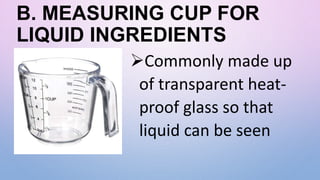
B. MEASURING CUP FOR
LIQUID INGREDIENTS
Commonly made up
of transparent heat-
proof glass so that
liquid can be seen
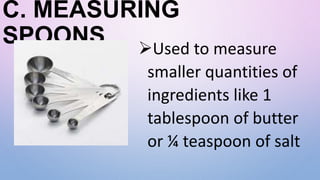
C. MEASURING
SPOONS Used to measure
smaller quantities of
ingredients like 1
tablespoon of butter
or ¼ teaspoon of salt
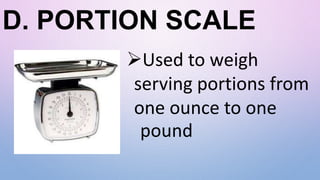
D. PORTION SCALE
Used to weigh
serving portions from
one ounce to one
pound
E. SCOOPS OR
DIPPERS
Used to measure
serving of soft foods
such as fillings, ice
cream or mashed potato
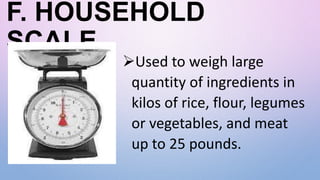
F. HOUSEHOLD
SCALE
Used to weigh large
quantity of ingredients in
kilos of rice, flour, legumes
or vegetables, and meat
up to 25 pounds.
MIXING, STRAINING AND
PREPARATION TOOLS
A. MIXING BOWLS
Come in different sizes,
used for mixing
ingredients
B. WOODEN SPOON
Used for
creaming, stirring,
and mixing; made
of hard wood
C. COLANDER
Used for cleaning
vegetables, straining
pasta or the contents
of tin cans
D. SPATULA
Used to level off
ingredients and
to spread
frostings
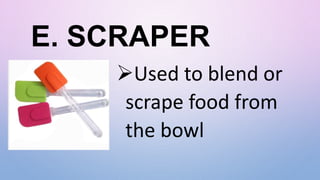
E. SCRAPER
Used to blend or
scrape food from
the bowl
F. ROTARY
EGGBEATER
Used for beating
small quantities of
eggs or batter
G. STRAINER
Used in removing
lumps and foreign
materials in dry
ingredients
H. WIRE WHIP
Used for general
mixing,beating and
stirring
I. CAN AND BOTTLE
OPENER
Used to open tin cans
and bottles; preferably
with comfortable grip
and turning knob
J. CHOPPING
BOARD A wooden or
plastic board where
meats and
vegetables are cut
or chopped
K. GARLIC
PRESS
Used for pulping
garlic for cooking
L. GRATERS
Used to grate, slice
and separate foods
such as carrots,
cabbage and cheese
M. POTATO MASHER
Used for mashing
cooked potatoes,
turnips, carrots or
other soft cooked
vegetables
CUTTING
TOOLS
A. BUTCHER KNIFE
Used to section
raw meat, poultry
and fish
B. FRENCH KNIFE
Used to chop,
dice or mince
food
C. ROAST BEEF SLICER
Used to slice
roasts meat, ham,
and thick solid
cuts of meats
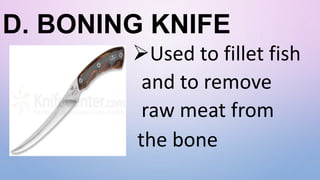
D. BONING KNIFE
Used to fillet fish
and to remove
raw meat from
the bone
E. FRUITS AND SALAD
KNIFE
used to prepare
salad greens,
vegetables and
fruits
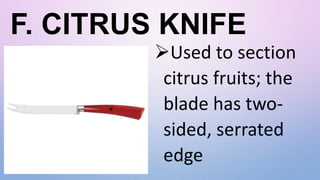
F. CITRUS KNIFE
Used to section
citrus fruits; the
blade has two-
sided, serrated
edge
G. PAIRING KNIFE
Used to core,
peel and
section fruits
and vegetables
H. VEGETABLE
PEELER
Used to scrape
vegetables, such as
carrots and
potatoes and to
pare fruits
I. KITCHEN SHEARS
Used for opening food
packages, cutting tapes
or strings of packaged
foods or simply to
remove labels or tags
from items.
COOKING
TOOLS
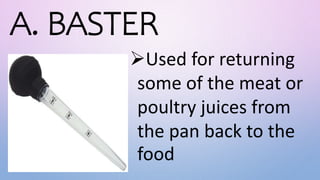
A. BASTER
Used for returning
some of the meat or
poultry juices from
the pan back to the
food
B.DOUBLE BOILER
Used for preparing
sauces which easily
get scorched when
cooked directly
over fire
C. RICE COOKER
Used for
cooking rice
easier and
faster
D. CARAJAY
Used for
frying and
sautéing
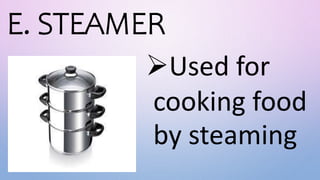
E. STEAMER
Used for
cooking food
by steaming
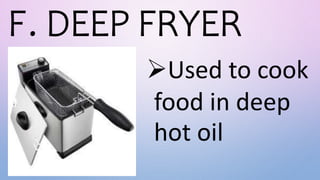
F. DEEP FRYER
Used to cook
food in deep
hot oil
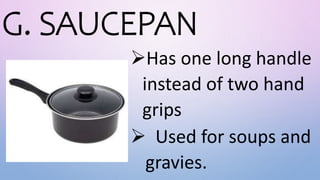
G. SAUCEPAN
Has one long handle
instead of two hand
grips
 Used for soups and
gravies.
H. SAUCEPOT
Used for soups
and sauces; with
two handles or
hand grips
opposite each
I. FLIPPER
Used for
turning
hamburger and
other food
J. HANDY POULTRY AND
ROASTING TOOL
Used to lift a hot
roasted turkey from
the roaster to serving
platter without it
falling.
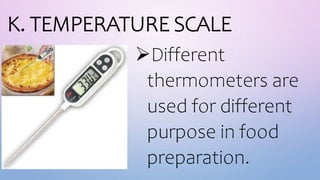
K. TEMPERATURE SCALE
Different
thermometers are
used for different
purpose in food
preparation.
SERVING
TOOLS
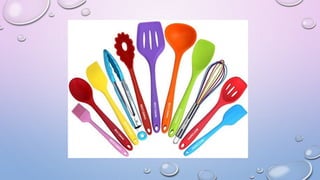
A. PASTA SPOON OR
SERVER
Used to
transfer cooked
pasta to a plate
B. SEAFOOD SERVING
TOOL
Used to grab and
transfer larger food
items of meat and
poultry to serving
platter
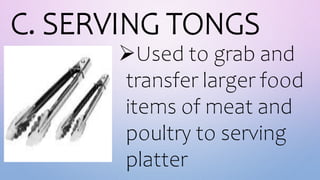
C. SERVING TONGS
Used to grab and
transfer larger food
items of meat and
poultry to serving
platter
D. SOUP LADLE
Used for serving soups or
stews, gravy, and dessert
sauces
Used to remove or skin
off fat from soups and
EQUIPMENT
Important equipment that are
recommended for the kitchen or in
any food establishment include the
following:
1. Refrigerator/ Freezer
– Used to prevent
bacterial growth in
foods
2. Four- burner gas range
with oven
-Used for
baking/
cooking
3. Electric mixer
– Used to blend
ingredients
faster
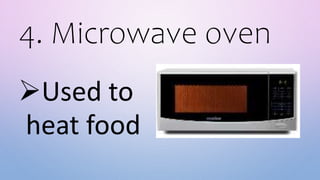
4. Microwave oven
Used to
heat food
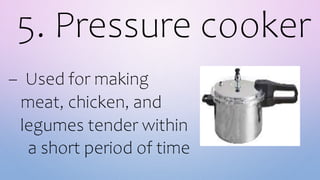
5. Pressure cooker
– Used for making
meat, chicken, and
legumes tender within
a short period of time
6. Blender
-Used to mix,
puree, and
liquefy foods
Classification-of-Kitchen-Utensils-and-their-uses.pptx

Classification-of-Kitchen-Utensils-and-their-uses.pptx