Classification of Minerals in
Mineral Processing
Understanding Polar and Nonpolar
Minerals, Surface Characteristics, and
Surface Energy
Overview of Mineral Classification:
Polar vs. Nonpolar
• Minerals are classified into two types based on their surface
characteristics:
• - **Nonpolar Minerals:** Characterized by weak molecular bonds,
composed of covalent molecules held by van der Waals forces.
• - **Polar Minerals:** Characterized by strong covalent or ionic surface
bonding, interacting strongly with water molecules.
• This classification impacts their behavior in flotation processes,
particularly in terms of hydrophobicity and hydrophilicity.
Nonpolar Minerals: Characteristics
and Examples
• Nonpolar minerals have surfaces characterized by relatively weak
molecular bonds. These minerals are inherently hydrophobic, with contact
angles between 60° and 90°.
• Examples include:
• - Graphite
• - Sulfur
• - Molybdenite
• - Diamond
• - Coal
• - Talc
• These minerals have high natural floatabilities and can be floated without
the aid of chemical agents, although their hydrophobicity can be
enhanced using hydrocarbon oils.
Hydrophobicity and Floatability of
Nonpolar Minerals
• Nonpolar minerals are naturally hydrophobic due to their surface
characteristics. Hydrophobicity is crucial for their floatability in flotation
processes.
• To enhance floatability, hydrocarbon oils like fuel oil are often used. This is
especially common in the flotation of coal, where increased
hydrophobicity improves the separation process.
• Layered minerals such as molybdenite and talc break to reveal polar edges
and largely nonpolar faces. While generally hydrophobic, they tend to
become less hydrophobic as particle size reduces, affecting their overall
floatability.
Polar Minerals: Characteristics and
Examples
• Polar minerals have strong covalent or ionic surface bonding, making them
naturally hydrophilic. This hydrophilicity is associated with high solid
surface energy.
• Examples of polar minerals include:
• - Silicates
• - Carbonates
• - Sulfates
• - Halites
• - Phosphates
• - Oxides and Hydroxides
• - Quartz
• These minerals have higher polarity and surface energy, making them less
floatable without chemical modification.
Hydrophilicity and Surface Energy
in Polar Minerals
• The hydrophilicity of polar minerals is directly related to their high surface
energy, which is high relative to the surface energy of water.
• Solid surface energy can be measured using inverse gas chromatography, a
technique used to characterize the mineral surface in flotation systems.
These measurements reveal that mineral surfaces are heterogeneous,
with a distribution of energy sites.
• This understanding of surface energy is essential for modifying the surface
properties of polar minerals to improve their floatability.
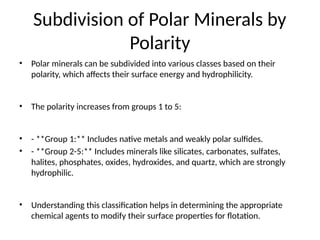
Subdivision of Polar Minerals by
Polarity
• Polar minerals can be subdivided into various classes based on their
polarity, which affects their surface energy and hydrophilicity.
• The polarity increases from groups 1 to 5:
• - **Group 1:** Includes native metals and weakly polar sulfides.
• - **Group 2-5:** Includes minerals like silicates, carbonates, sulfates,
halites, phosphates, oxides, hydroxides, and quartz, which are strongly
hydrophilic.
• Understanding this classification helps in determining the appropriate
chemical agents to modify their surface properties for flotation.
Relationship Between Surface
Energy and Mineral Behavior
• Surface energy plays a crucial role in determining whether a mineral is
hydrophobic or hydrophilic.
• - **High Surface Energy:** Leads to hydrophilicity, making the mineral
water-attractive.
• - **Low Surface Energy:** Leads to hydrophobicity, making the mineral
water-repellent.
• This relationship is fundamental in flotation, where the goal is often to
increase hydrophobicity for better separation.
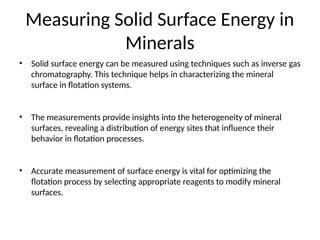
Measuring Solid Surface Energy in
Minerals
• Solid surface energy can be measured using techniques such as inverse gas
chromatography. This technique helps in characterizing the mineral
surface in flotation systems.
• The measurements provide insights into the heterogeneity of mineral
surfaces, revealing a distribution of energy sites that influence their
behavior in flotation processes.
• Accurate measurement of surface energy is vital for optimizing the
flotation process by selecting appropriate reagents to modify mineral
surfaces.
Conclusion and Key Takeaways
• Understanding the classification of minerals into polar and nonpolar types
is essential for effective flotation processes.
• Key Points:
• - Nonpolar minerals are inherently hydrophobic and easily floatable.
• - Polar minerals are hydrophilic, requiring chemical modification for
flotation.
• - Surface energy plays a critical role in determining mineral behavior in
flotation.
• Effective management of these properties is crucial for optimizing mineral
processing operations.

Classification_of_Minerals_Presentation-2.pptx

  • 1.
    Classification of Mineralsin Mineral Processing Understanding Polar and Nonpolar Minerals, Surface Characteristics, and Surface Energy
  • 2.
    Overview of MineralClassification: Polar vs. Nonpolar • Minerals are classified into two types based on their surface characteristics: • - **Nonpolar Minerals:** Characterized by weak molecular bonds, composed of covalent molecules held by van der Waals forces. • - **Polar Minerals:** Characterized by strong covalent or ionic surface bonding, interacting strongly with water molecules. • This classification impacts their behavior in flotation processes, particularly in terms of hydrophobicity and hydrophilicity.
  • 3.
    Nonpolar Minerals: Characteristics andExamples • Nonpolar minerals have surfaces characterized by relatively weak molecular bonds. These minerals are inherently hydrophobic, with contact angles between 60° and 90°. • Examples include: • - Graphite • - Sulfur • - Molybdenite • - Diamond • - Coal • - Talc • These minerals have high natural floatabilities and can be floated without the aid of chemical agents, although their hydrophobicity can be enhanced using hydrocarbon oils.
  • 4.
    Hydrophobicity and Floatabilityof Nonpolar Minerals • Nonpolar minerals are naturally hydrophobic due to their surface characteristics. Hydrophobicity is crucial for their floatability in flotation processes. • To enhance floatability, hydrocarbon oils like fuel oil are often used. This is especially common in the flotation of coal, where increased hydrophobicity improves the separation process. • Layered minerals such as molybdenite and talc break to reveal polar edges and largely nonpolar faces. While generally hydrophobic, they tend to become less hydrophobic as particle size reduces, affecting their overall floatability.
  • 5.
    Polar Minerals: Characteristicsand Examples • Polar minerals have strong covalent or ionic surface bonding, making them naturally hydrophilic. This hydrophilicity is associated with high solid surface energy. • Examples of polar minerals include: • - Silicates • - Carbonates • - Sulfates • - Halites • - Phosphates • - Oxides and Hydroxides • - Quartz • These minerals have higher polarity and surface energy, making them less floatable without chemical modification.
  • 6.
    Hydrophilicity and SurfaceEnergy in Polar Minerals • The hydrophilicity of polar minerals is directly related to their high surface energy, which is high relative to the surface energy of water. • Solid surface energy can be measured using inverse gas chromatography, a technique used to characterize the mineral surface in flotation systems. These measurements reveal that mineral surfaces are heterogeneous, with a distribution of energy sites. • This understanding of surface energy is essential for modifying the surface properties of polar minerals to improve their floatability.
  • 7.
    Subdivision of PolarMinerals by Polarity • Polar minerals can be subdivided into various classes based on their polarity, which affects their surface energy and hydrophilicity. • The polarity increases from groups 1 to 5: • - **Group 1:** Includes native metals and weakly polar sulfides. • - **Group 2-5:** Includes minerals like silicates, carbonates, sulfates, halites, phosphates, oxides, hydroxides, and quartz, which are strongly hydrophilic. • Understanding this classification helps in determining the appropriate chemical agents to modify their surface properties for flotation.
  • 8.
    Relationship Between Surface Energyand Mineral Behavior • Surface energy plays a crucial role in determining whether a mineral is hydrophobic or hydrophilic. • - **High Surface Energy:** Leads to hydrophilicity, making the mineral water-attractive. • - **Low Surface Energy:** Leads to hydrophobicity, making the mineral water-repellent. • This relationship is fundamental in flotation, where the goal is often to increase hydrophobicity for better separation.
  • 9.
    Measuring Solid SurfaceEnergy in Minerals • Solid surface energy can be measured using techniques such as inverse gas chromatography. This technique helps in characterizing the mineral surface in flotation systems. • The measurements provide insights into the heterogeneity of mineral surfaces, revealing a distribution of energy sites that influence their behavior in flotation processes. • Accurate measurement of surface energy is vital for optimizing the flotation process by selecting appropriate reagents to modify mineral surfaces.
  • 10.
    Conclusion and KeyTakeaways • Understanding the classification of minerals into polar and nonpolar types is essential for effective flotation processes. • Key Points: • - Nonpolar minerals are inherently hydrophobic and easily floatable. • - Polar minerals are hydrophilic, requiring chemical modification for flotation. • - Surface energy plays a critical role in determining mineral behavior in flotation. • Effective management of these properties is crucial for optimizing mineral processing operations.