Froth flotation is:
Separation of two minerals based on difference in
their wettability.
The hydrophobic particles with attached air bubbles
are then carried to the surface and removed
While the hydrophilic particles that remain
completely wetted stay in the liquid phase .
It is useful for processing fine-grained ores that
are not enable to conventional gravity
concentration.
The flotation process is depend On Hydrophobicity
???????????????
Hydrophobicity
The basis of froth flotation is the difference in wettabilities of different
minerals. Particles range from those are easily wettable by water
(hydrophilic) to those are water-repellent (hydrophobic).
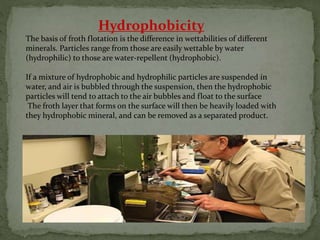
If a mixture of hydrophobic and hydrophilic particles are suspended in
water, and air is bubbled through the suspension, then the hydrophobic
particles will tend to attach to the air bubbles and float to the surface
The froth layer that forms on the surface will then be heavily loaded with
they hydrophobic mineral, and can be removed as a separated product.
The hydrophilic particles will have much
less tendency to attach to air bubbles, and so
it will remain in suspension and be sinked.
(Whelan and Brown, 1956).
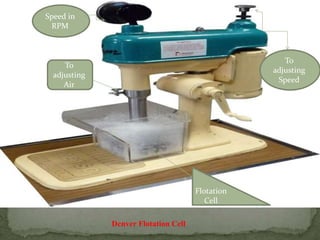
Denver Flotation Cell
Speed in
RPM
To
adjusting
Air
Flotation
Cell
To
adjusting
Speed
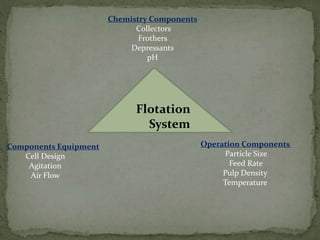
Chemistry Components
Collectors
Frothers
Depressants
pH
Flotation
System
Components Equipment
Cell Design
Agitation
Air Flow
Operation Components
Particle Size
Feed Rate
Pulp Density
Temperature
Collectors:
Collectors are reagents that are used to selectively adsorb onto the surfaces
of particles. They form a monolayer on the particle surface that essentially
makes a thin film of non-polar hydrophobic hydrocarbons. Collectors can
be generally classed depending on their ionic charge: they can be
nonionic, anionic, or cationic, as shown in Figure 6.
The nonionic collectors are simple hydrocarbon oils,
while the anionic and cationic collectors consist of a polar part that
selectively attaches to the mineral surfaces,
and a non-polar part that projects out into the solution and makes the
surface hydrophobic.
Collectors can either chemically bond to the mineral surface
(chemisorption), or be held on the surface by physical forces (physical
adsorption).
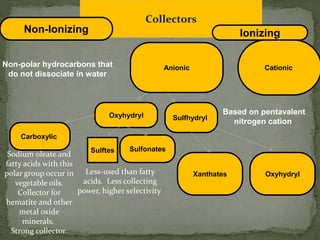
Chemistry Components
Collectors
Non-Ionizing Ionizing
Cationic
Anionic
Oxyhydryl
Non-polar hydrocarbons that
do not dissociate in water
Based on pentavalent
nitrogen cation
Sulfhydryl
Sulfonates
Xanthates
Sulftes
Oxyhydryl
Carboxylic
Sodium oleate and
fatty acids with this
polar group occur in
vegetable oils.
Collector for
hematite and other
metal oxide
minerals.
Strong collector.
Less-used than fatty
acids. Less collecting
power, higher selectivity

Froth flotation and Denver Flotation Cell

  • 1.
    Froth flotation is: Separationof two minerals based on difference in their wettability. The hydrophobic particles with attached air bubbles are then carried to the surface and removed While the hydrophilic particles that remain completely wetted stay in the liquid phase .
  • 2.
    It is usefulfor processing fine-grained ores that are not enable to conventional gravity concentration. The flotation process is depend On Hydrophobicity ???????????????
  • 3.
    Hydrophobicity The basis offroth flotation is the difference in wettabilities of different minerals. Particles range from those are easily wettable by water (hydrophilic) to those are water-repellent (hydrophobic). If a mixture of hydrophobic and hydrophilic particles are suspended in water, and air is bubbled through the suspension, then the hydrophobic particles will tend to attach to the air bubbles and float to the surface The froth layer that forms on the surface will then be heavily loaded with they hydrophobic mineral, and can be removed as a separated product.
  • 4.
    The hydrophilic particleswill have much less tendency to attach to air bubbles, and so it will remain in suspension and be sinked. (Whelan and Brown, 1956).
  • 5.
    Denver Flotation Cell Speedin RPM To adjusting Air Flotation Cell To adjusting Speed
  • 6.
    Chemistry Components Collectors Frothers Depressants pH Flotation System Components Equipment CellDesign Agitation Air Flow Operation Components Particle Size Feed Rate Pulp Density Temperature
  • 7.
    Collectors: Collectors are reagentsthat are used to selectively adsorb onto the surfaces of particles. They form a monolayer on the particle surface that essentially makes a thin film of non-polar hydrophobic hydrocarbons. Collectors can be generally classed depending on their ionic charge: they can be nonionic, anionic, or cationic, as shown in Figure 6. The nonionic collectors are simple hydrocarbon oils, while the anionic and cationic collectors consist of a polar part that selectively attaches to the mineral surfaces, and a non-polar part that projects out into the solution and makes the surface hydrophobic. Collectors can either chemically bond to the mineral surface (chemisorption), or be held on the surface by physical forces (physical adsorption). Chemistry Components
  • 8.
    Collectors Non-Ionizing Ionizing Cationic Anionic Oxyhydryl Non-polar hydrocarbonsthat do not dissociate in water Based on pentavalent nitrogen cation Sulfhydryl Sulfonates Xanthates Sulftes Oxyhydryl Carboxylic Sodium oleate and fatty acids with this polar group occur in vegetable oils. Collector for hematite and other metal oxide minerals. Strong collector. Less-used than fatty acids. Less collecting power, higher selectivity