More Related Content

PPTX
Important Classification and Regression Metrics.pptx 
PPTX
Machine learning and linear regression programming 
PPTX
measures pptekejwjejejeeisjsjsjdjdjdjjddjdj 
PPTX
Linear Regression Complete Guide maths and examples.pptx 
PPTX
Machine learning session4(linear regression) ![PERFORMANCE_PREDICTION__PARAMETERS[1].pptx](https://cdn.slidesharecdn.com/ss_thumbnails/performancepredictionparameters1-240130171305-9f984922-thumbnail.jpg?width=640&height=640&fit=bounds)
PPTX
PERFORMANCE_PREDICTION__PARAMETERS[1].pptx 
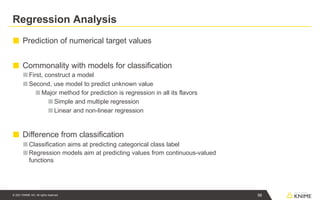
PPTX
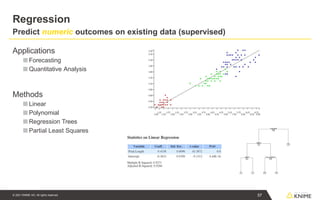
All PERFORMANCE PREDICTION PARAMETERS.pptx 
PPTX
Accuracy & Performance in Machine Learning (1).pptx Similar to Classification Models Machine Learning.pptx

PPTX
Confusion Matrix and Sampling in ML.pptx 
PDF

PDF
L2. Evaluating Machine Learning Algorithms I 
PDF
Cheatsheet machine-learning-tips-and-tricks 
PPTX
012-Performance Metrics of ML Algorithm.pptx 
PPTX

PPTX
FBA-PPTs-sssion-17-20 .pptx 
PPTX
ML-ChapterFour-ModelEvaluation.pptx 
PDF
Data Science Interview Questions PDF By ScholarHat 
PDF

PDF
Introduction to Artificial Intelligence_ Lec 10 
PDF
W2M3_Linear_Regression in machine learning 
PDF
Data Science Cheatsheet.pdf 
PPTX
ML2_ML (1) concepts explained in details.pptx 
PPTX
Performance Measurement for Machine Leaning.pptx 
PPTX
Day17.pptx department of computer science and eng 
PPTX
linear regression for machine learning methods 
PPTX
UNIT IV MODEL EVALUATION and sequences.pptx 
PDF

PPT
2.8 accuracy and ensemble methods Recently uploaded

PDF
MoD_2.pptx solid rockets of the rocket.pdf 
PDF
(en/zhTW) Heterogeneous System Architecture: Design & Performance 
PPTX
A professional presentation on Cosmos Bank Heist 
PPTX
DIFFERENT TYPES OF SRTUCTURAL SYSTEM ANALYSIS 
PPTX
traffic safety section seven (Traffic Control and Management) of Act 
PDF
Highway Curves in Transportation Engineering.pdf ![[Deck] What's New in Spark-Iceberg Integration via DSV2.pptx](https://cdn.slidesharecdn.com/ss_thumbnails/deckwhatsnewinspark-icebergintegrationviadsv2-260210005337-25955b12-thumbnail.jpg?width=640&height=640&fit=bounds)
PPTX
[Deck] What's New in Spark-Iceberg Integration via DSV2.pptx 
PPTX
This Bearing Didn’t Fail Suddenly — How Vibration Data Predicts Failure Month... 
PPTX
Why TPM Succeeds in Some Plants and Struggles in Others | MaintWiz 
PDF
Creating a Multi-Agent Flow: Orchestrate multiple specialized agents into a p... 
PPTX
Why Most SAP PM Implementations Fail — And How High-Reliability Plants Fix It 
PPTX
Batch-1(End Semester) Student Of Shree Durga Tech. PPT.pptx 
PPTX
Optimizing the ELBO Objective: A Comparative Study of RNN, LSTM, and GRU Arch... 
PDF
Plasticity and Structure of Soil/Atterberg Limits.pdf 
PDF
AWS Re:Invent 2025 Recap by FivexL - Guilherme, Vladimir, Andrey 
PDF
Applications of AI in Civil Engineering - Dr. Rohan Dasgupta 
PDF
PROBLEM SLOVING AND PYTHON PROGRAMMING UNIT 3.pdf 
PDF
Weak Incentives (WINK): The Agent Definition Layer 
PPTX
ME3592 - Metrology and Measurements - Unit - 1 - Lecture Notes 
PPTX
INTEGRATED COMMUNICATION AND SENSING Presentation.pptx Classification Models Machine Learning.pptx
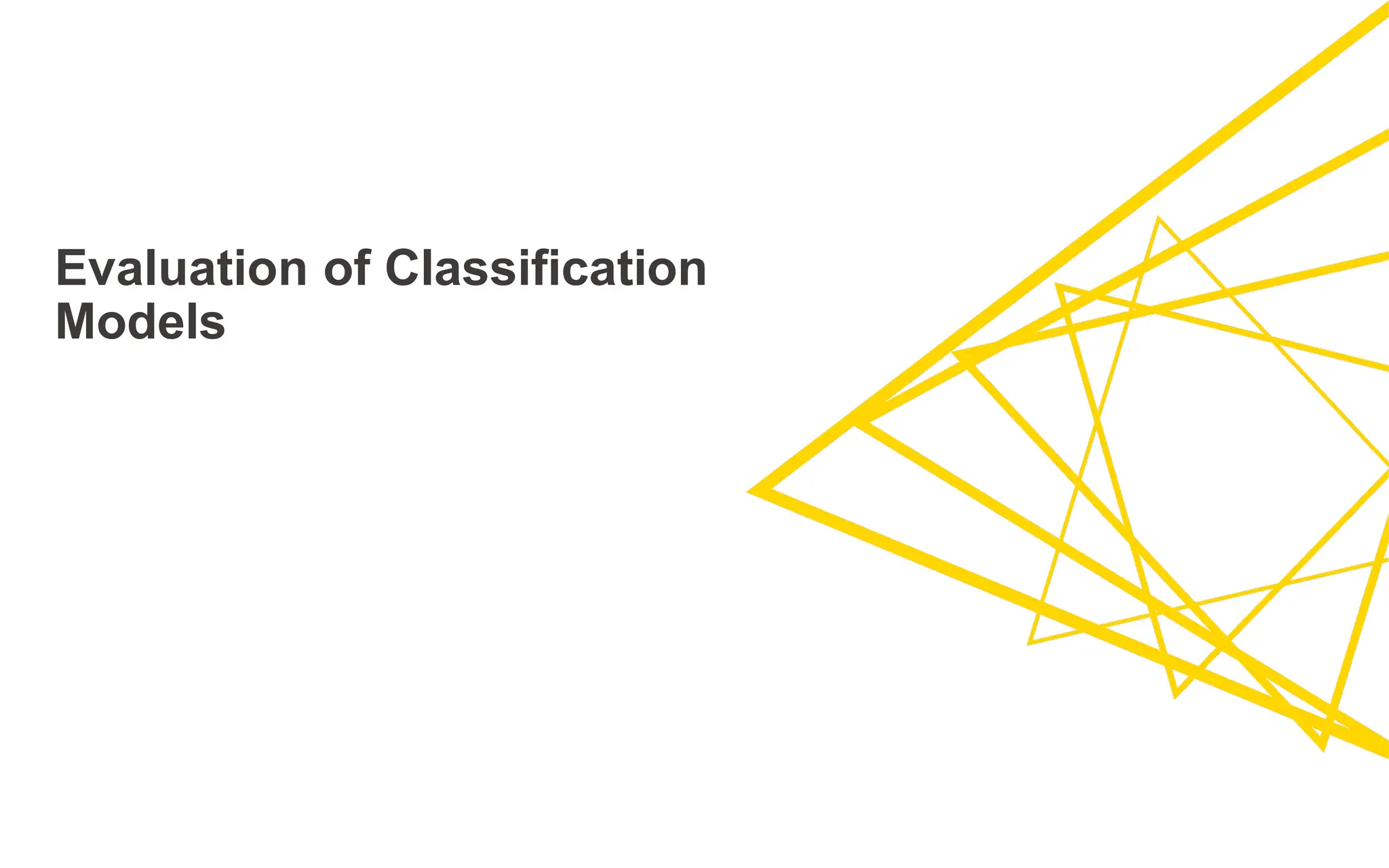
- 1.
- 2.
Evaluation Metrics
■ Whyevaluation metrics?
■ Quantify the power of a model
■ Compare model configurations and/or models, and select the best performing
one
■ Obtain the expected performance of the model for new data
■ Different model evaluation techniques are available for
■ Classification/regression models
■ Imbalanced/balanced target class distributions
45
© 2021 KNIME AG. All rights reserved.
- 3.
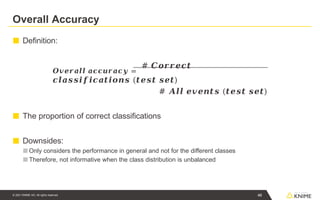
Overall Accuracy
■ Definition:
𝑶𝒗𝒆𝒓𝒂𝒍𝒍𝒂𝒄𝒄𝒖𝒓𝒂𝒄𝒚 =
# 𝑪𝒐𝒓𝒓𝒆𝒄𝒕
𝒄𝒍𝒂𝒔𝒔𝒊𝒇𝒊𝒄𝒂𝒕𝒊𝒐𝒏𝒔 (𝒕𝒆𝒔𝒕 𝒔𝒆𝒕)
# 𝑨𝒍𝒍 𝒆𝒗𝒆𝒏𝒕𝒔 (𝒕𝒆𝒔𝒕 𝒔𝒆𝒕)
■ The proportion of correct classifications
■ Downsides:
■ Only considers the performance in general and not for the different classes
■ Therefore, not informative when the class distribution is unbalanced
46
© 2021 KNIME AG. All rights reserved.
- 4.
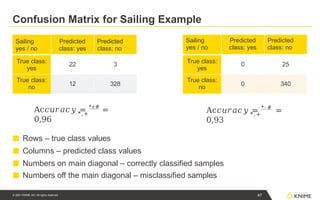
Confusion Matrix forSailing Example
47
© 2021 KNIME AG. All rights reserved.
■ Rows – true class values
■ Columns – predicted class values
■ Numbers on main diagonal – correctly classified samples
■ Numbers off the main diagonal – misclassified samples
Sailing
yes / no
Predicted
class: yes
Predicted
class: no
True class:
yes
22 3
True class:
no
12 328
Sailing
yes / no
Predicted
class: yes
Predicted
class: no
True class:
yes
0 25
True class:
no
0 340
*,+
Ac𝑐𝑢𝑟𝑎𝑐𝑦 = *+#
=
0,96
*,+
Ac𝑐𝑢𝑟𝑎𝑐𝑦 = * - #
=
0,93
- 5.
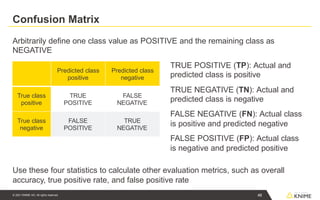
Confusion Matrix
48
© 2021KNIME AG. All rights reserved.
Arbitrarily define one class value as POSITIVE and the remaining class as
NEGATIVE
TRUE POSITIVE (TP): Actual and
predicted class is positive
TRUE NEGATIVE (TN): Actual and
predicted class is negative
FALSE NEGATIVE (FN): Actual class
is positive and predicted negative
FALSE POSITIVE (FP): Actual class
is negative and predicted positive
Use these four statistics to calculate other evaluation metrics, such as overall
accuracy, true positive rate, and false positive rate
Predicted class
positive
Predicted class
negative
True class
positive
TRUE
POSITIVE
FALSE
NEGATIVE
True class
negative
FALSE
POSITIVE
TRUE
NEGATIVE
- 6.
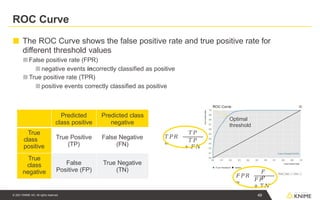
ROC Curve
■ TheROC Curve shows the false positive rate and true positive rate for
different threshold values
■ False positive rate (FPR)
■ negative events incorrectly classified as positive
■ True positive rate (TPR)
■ positive events correctly classified as positive
Optimal
threshold
Predicted
class positive
Predicted class
negative
True
class
positive
True Positive
(TP)
False Negative
(FN)
True
class
negative
False
Positive (FP)
True Negative
(TN)
𝑇𝑃𝑅
=
𝑇𝑃
𝑇𝑃
+ 𝐹𝑁
𝐹𝑃𝑅
=
𝐹
𝑃
𝐹𝑃
+ 𝑇𝑁
49
© 2021 KNIME AG. All rights reserved.
- 7.
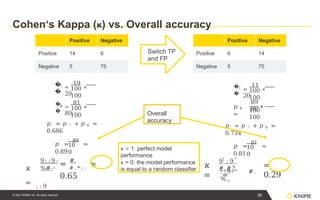
Cohen‘s Kappa (κ)vs. Overall accuracy
Overall
accuracy
�
�
' ! =
19
×
20
100
100
�
�
' $ =
81
×
80
100
100
𝑝' = 𝑝' ! + 𝑝' $ =
0.686
-
10
0
𝑝 =
89
=
0.89
𝜅
= ; : 9
"
9 ! : 9 " #.
%#-
= # . * ; -
≈
0.65
�
�
' ! =
11
×
20
100
100
𝑝' $
=
×
89
80
100
100
𝑝' = 𝑝' ! + 𝑝' $ =
0.734
-
10
0
𝑝 =
81
=
0.81
𝜅
=
! "
=
9 : 9
#.#?,
; : 9 " #.
%,,
=
0.29
Switch TP
and FP
κ = 1: perfect model
performance
κ = 0: the model performance
is equal to a random classifier
50
© 2021 KNIME AG. All rights reserved.
Positive Negative
Positive 14 6
Negative 5 75
Positive Negative
Positive 6 14
Negative 5 75
- 8.
Exercise: 01_Training_a_Decision_Tree_Model
51
© 2021KNIME AG. All rights reserved.
■ Dataset: Sales data of individual residential properties in Ames, Iowa from 2006
to 2010.
■ One of the columns is the overall condition ranking, with values between 1 and
10.
■ Goal: train a binary classification model, which can predict whether the overall
condition is high or low.
You can download the training workflows from the KNIME
Hub:
https://hub.knime.com/knime/spaces/Education/latest/Courses/
- 9.
Exercise Session 1
1.Right click on
LOCAL and
select
Import KNIME
Workflow….
■ Import the course material to KNIME Analytics Platform
2. Click on Browse and
select downloaded .knar
file
3. Click on Finish
52
© 2021 KNIME AG. All rights reserved.
- 10.
- 11.
- 12.
- 13.
Regression Analysis
56
© 2021KNIME AG. All rights reserved.
■ Prediction of numerical target values
■ Commonality with models for classification
■ First, construct a model
■ Second, use model to predict unknown value
■ Major method for prediction is regression in all its flavors
■ Simple and multiple regression
■ Linear and non-linear regression
■ Difference from classification
■ Classification aims at predicting categorical class label
■ Regression models aim at predicting values from continuous-valued
functions
- 14.
Regression
Predict numeric outcomeson existing data (supervised)
Applications
■ Forecasting
■ Quantitative Analysis
Methods
■ Linear
■ Polynomial
■ Regression Trees
■ Partial Least Squares
57
© 2021 KNIME AG. All rights reserved.
- 15.
- 16.
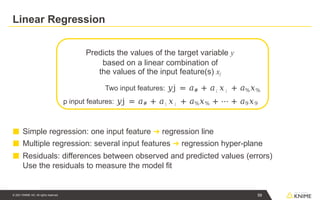
Linear Regression
Predicts thevalues of the target variable y
based on a linear combination of
the values of the input feature(s) xj
Two input features: 𝑦j = 𝑎# + 𝑎; 𝑥; + 𝑎%𝑥%
p input features: 𝑦j = 𝑎# + 𝑎; 𝑥; + 𝑎%𝑥% + ⋯ + 𝑎9𝑥9
■ Simple regression: one input feature ➔ regression line
■ Multiple regression: several input features ➔ regression hyper-plane
■ Residuals: differences between observed and predicted values (errors)
Use the residuals to measure the model fit
59
© 2021 KNIME AG. All rights reserved.
- 17.
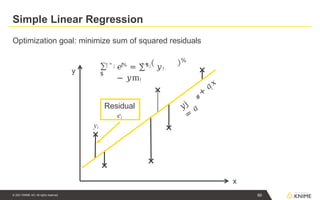
Simple Linear Regression
Optimizationgoal: minimize sum of squared residuals
x
y
𝑦j
=
𝑎
#
+
𝑎;
𝑥
Residual
ei
∑
$
! " ; ! ! " ;
𝑒%
= ∑$
𝑦!
− 𝑦m!
60
© 2021 KNIME AG. All rights reserved.
%
yi
- 18.
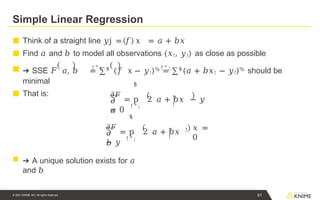
Simple Linear Regression
!" ; ! " ;
■ Think of a straight line 𝑦j = 𝑓 𝑥 = 𝑎 + 𝑏𝑥
■ Find 𝑎 and 𝑏 to model all observations (𝑥!, 𝑦!) as close as possible
■ ➔ SSE 𝐹 𝑎, 𝑏 = ∑$
(𝑓 𝑥 − 𝑦!)% = ∑$
(𝑎 + 𝑏𝑥! − 𝑦!)% should be
minimal
■ That is:
𝜕
𝑎
! " ;
$
!
!
𝜕𝐹
= p 2 𝑎 + 𝑏𝑥 − 𝑦
= 0
𝜕
𝑏
! " ;
$
𝜕𝐹
= p 2 𝑎 + 𝑏𝑥
− 𝑦
61
© 2021 KNIME AG. All rights reserved.
! !
!
𝑥 =
0
■ ➔ A unique solution exists for 𝑎
and 𝑏
- 19.
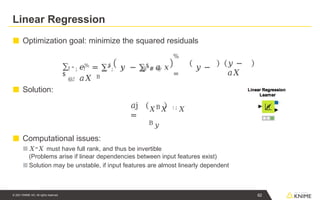
Linear Regression
■ Optimizationgoal: minimize the squared residuals
■ Solution:
■ Computational issues:
■ 𝑋=𝑋 must have full rank, and thus be invertible
(Problems arise if linear dependencies between input features exist)
■ Solution may be unstable, if input features are almost linearly dependent
∑
$
! " ; ! ! " ; ! @"# @
@,!
%
=
𝑒% = ∑$
𝑦 − ∑$
𝑎 𝑥 𝑦 −
𝑎𝑋 B
𝑦 −
𝑎𝑋
𝑎j
=
𝑋B𝑋 : ; 𝑋
B 𝑦
62
© 2021 KNIME AG. All rights reserved.
- 20.
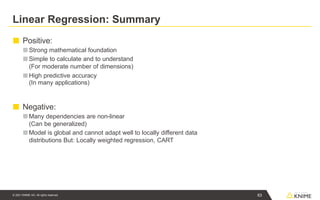
Linear Regression: Summary
63
©2021 KNIME AG. All rights reserved.
■ Positive:
■ Strong mathematical foundation
■Simple to calculate and to understand
(For moderate number of dimensions)
■High predictive accuracy
(In many applications)
■ Negative:
■Many dependencies are non-linear
(Can be generalized)
■Model is global and cannot adapt well to locally different data
distributions But: Locally weighted regression, CART
- 21.
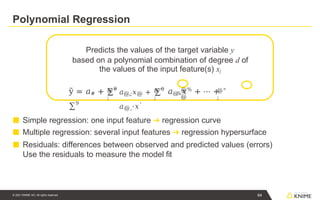
Polynomial Regression
Predicts thevalues of the target variable y
based on a polynomial combination of degree d of
the values of the input feature(s) xj
■ Simple regression: one input feature ➔ regression curve
■ Multiple regression: several input features ➔ regression hypersurface
■ Residuals: differences between observed and predicted values (errors)
Use the residuals to measure the model fit
@"
;
@"
;
@"
;
ỹ = 𝑎# + ∑9
𝑎@
,
%𝑥%
+ ⋯ +
∑9
@
@
𝑎@,;𝑥@ + ∑9
𝑎@,'𝑥'
64
© 2021 KNIME AG. All rights reserved.
- 22.
- 23.
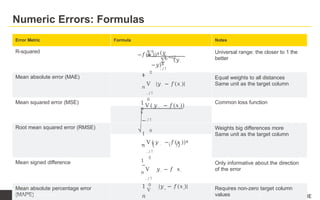
Numeric Errors: Formulas
ErrorMetric Formula Notes
R-squared ∑0
(𝑦.
−𝑓(𝑥.))$
1 −
. / !
∑0 (𝑦.
−𝑦)$
. / !
Universal range: the closer to 1 the
better
Mean absolute error (MAE) 1
0
𝑛
V |𝑦. − 𝑓(𝑥.)|
. / !
Equal weights to all distances
Same unit as the target column
Mean squared error (MSE)
0
1
𝑛
V ( 𝑦 . − 𝑓(𝑥.))
$
. / !
Common loss function
Root mean squared error (RMSE)
1
0
𝑛
V ( 𝑦 . − 𝑓(𝑥.))$
. / !
Weights big differences more
Same unit as the target column
Mean signed difference 1
0
𝑛
V 𝑦. − 𝑓 𝑥.
. / !
Only informative about the direction
of the error
Mean absolute percentage error
(MAPE)
0
1
V
|𝑦. − 𝑓(𝑥.)|
𝑛
Requires non-zero target column
values 67
© 2021 KNIME AG. All rights reserved.
- 24.
MAE (Mean AbsoluteError) vs. RMSE (Root Mean Squared Error)
MAE RMSE
Easy to interpret – mean absolute error Cannot be directly interpreted as the average error
All errors are equally weighted Larger errors are weighted more
Generally smaller than RMSE Ideal when large deviations need to be avoided
MAE RMSE
Case 1 2.25 2.29
Case 2 3.25 3.64
Example:
Actual values = [2,4,5,8],
Case 1: Predicted Values = [4, 6, 8, 10]
Case 2: Predicted Values = [4, 6, 8, 14]
68
© 2021 KNIME AG. All rights reserved.
- 25.
R-squared vs. RMSE
R-squaredRMSE
Relative measure:
Proportion of variability explained by the model
Absolute measure:
How much deviation at each point
Range: Usually between 0 and 1.
0 = no variability explained
1 = all variability explained
Same scale as the target
R-sq RMSE
Case 1 0.96 1.12
Case 2 0.65 1.32
Example:
Actual values = [2,4,5,8],
Case 1: Predicted Values = [3, 4, 5, 6]
Case 2: Predicted Values = [3, 3, 7, 7]
69
© 2021 KNIME AG. All rights reserved.
- 26.
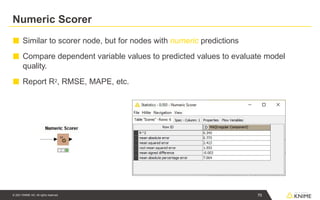
Numeric Scorer
■ Similarto scorer node, but for nodes with numeric predictions
■ Compare dependent variable values to predicted values to evaluate model
quality.
■ Report R2, RMSE, MAPE, etc.
70
© 2021 KNIME AG. All rights reserved.





![MAE (Mean Absolute Error) vs. RMSE (Root Mean Squared Error)
MAE RMSE
Easy to interpret – mean absolute error Cannot be directly interpreted as the average error
All errors are equally weighted Larger errors are weighted more
Generally smaller than RMSE Ideal when large deviations need to be avoided
MAE RMSE
Case 1 2.25 2.29
Case 2 3.25 3.64
Example:
Actual values = [2,4,5,8],
Case 1: Predicted Values = [4, 6, 8, 10]
Case 2: Predicted Values = [4, 6, 8, 14]
68
© 2021 KNIME AG. All rights reserved.](https://image.slidesharecdn.com/classificationmodels-260204060454-1283269b/85/Classification-Models-Machine-Learning-pptx-24-320.jpg)
![R-squared vs. RMSE
R-squared RMSE
Relative measure:
Proportion of variability explained by the model
Absolute measure:
How much deviation at each point
Range: Usually between 0 and 1.
0 = no variability explained
1 = all variability explained
Same scale as the target
R-sq RMSE
Case 1 0.96 1.12
Case 2 0.65 1.32
Example:
Actual values = [2,4,5,8],
Case 1: Predicted Values = [3, 4, 5, 6]
Case 2: Predicted Values = [3, 3, 7, 7]
69
© 2021 KNIME AG. All rights reserved.](https://image.slidesharecdn.com/classificationmodels-260204060454-1283269b/85/Classification-Models-Machine-Learning-pptx-25-320.jpg)