Class 9 – Review of motion in 2D and 3D
Chapter 4 - Monday September 13th
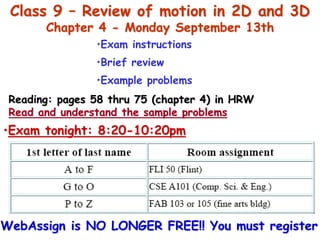
•Exam instructions
•Brief review
•Example problems
Reading: pages 58 thru 75 (chapter 4) in HRW
Read and understand the sample problems
•Exam tonight: 8:20-10:20pm
WebAssign is NO LONGER FREE!! You must register
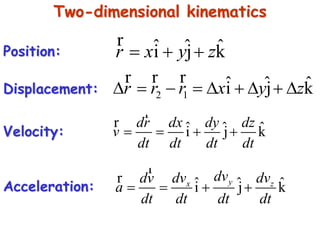
ˆ ˆ ˆi j kr x y z  
r
2 1
ˆ ˆ ˆi j kr r r x y z        
r r r
ˆ ˆ ˆi j k
dr dx dy dz
v
dt dt dt dt
   
r
r
ˆ ˆ ˆi j kyx z
dvdv dv dv
a
dt dt dt dt
   
r
r
Two-dimensional kinematics
Acceleration:
Position:
Displacement:
Velocity:
 
 
   
0 0 0
0 0
21
0 0 0 2
0 0
22
0 0 0
cos 4 21
cos
sin 4 22
sin 4 23
sin 2 4 24
x
y
y
x x v t
v v
y y v t gt
v v gt
v v g y y





  

   
  
   
Projectile motion
Uniform circular motion
•Although v does not change, the
direction of the motion does, i.e.
the velocity (a vector) changes.
•Thus, there is an acceleration
associated with the motion.
•We call this a centripetal
acceleration.
2
2
Acceleration: Period:
1 1
Frequency : ; 2
2
v r
a T
r v
v v
f f
T r r

 

 
   
•Since v does not change, the acceleration must be
perpendicular to the velocity.
cos sin
ˆ ˆi j
p p
p p
x r y r
r x y
  
 
r
Analyzing the motion
 2 2
t
f t t
T
     
Uniform motion:
Note: 180 2 radianso
  
cos sinp px r t y r t  
sin cos
sin cos
ˆ ˆi j
x y
x y
x y
v r t v r t
v v t v v t
v v v
   
 
  
  
 
r
Analyzing the motion
cos sinp px r t y r t  
p p
x y
dx dy
v v
dt dt
 
[remember, ]
v
v r
r
  
Acceleration
ˆ ˆi j
ˆ ˆ= i j
yx
x y
dvdvdv
a
dt dt dt
a a
  
     
   

r
r
   
2 2
2 22 2
cos sinx y
v v
a a a v
r r
       
sin cos
cos sin
x y
x y
v v t v v t
a v t a v t
 
   
  
   
recall : cos sinp px r t y r t    
2 2
cos sinx y
v v
a t a t
r r
    
v
r
  
Relative motion
PA PB BAr r r 
r r r
Position:
PA PB BA
PA PB BA PB R
dr dr dr
v v v v v
dt dt dt
      
r r r
r r r r r
Velocity:
PA PB R
PA PB
dv dv dv
a a
dt dt dt
   
r r r
r r
Acceleration (if frame B is “inertial”):

Class9

  • 1.
    Class 9 –Review of motion in 2D and 3D Chapter 4 - Monday September 13th •Exam instructions •Brief review •Example problems Reading: pages 58 thru 75 (chapter 4) in HRW Read and understand the sample problems •Exam tonight: 8:20-10:20pm WebAssign is NO LONGER FREE!! You must register
  • 2.
    ˆ ˆ ˆij kr x y z   r 2 1 ˆ ˆ ˆi j kr r r x y z         r r r ˆ ˆ ˆi j k dr dx dy dz v dt dt dt dt     r r ˆ ˆ ˆi j kyx z dvdv dv dv a dt dt dt dt     r r Two-dimensional kinematics Acceleration: Position: Displacement: Velocity:
  • 3.
           0 0 0 0 0 21 0 0 0 2 0 0 22 0 0 0 cos 4 21 cos sin 4 22 sin 4 23 sin 2 4 24 x y y x x v t v v y y v t gt v v gt v v g y y                     Projectile motion
  • 4.
    Uniform circular motion •Althoughv does not change, the direction of the motion does, i.e. the velocity (a vector) changes. •Thus, there is an acceleration associated with the motion. •We call this a centripetal acceleration. 2 2 Acceleration: Period: 1 1 Frequency : ; 2 2 v r a T r v v v f f T r r           •Since v does not change, the acceleration must be perpendicular to the velocity.
  • 5.
    cos sin ˆ ˆij p p p p x r y r r x y      r Analyzing the motion  2 2 t f t t T       Uniform motion: Note: 180 2 radianso    cos sinp px r t y r t  
  • 6.
    sin cos sin cos ˆˆi j x y x y x y v r t v r t v v t v v t v v v               r Analyzing the motion cos sinp px r t y r t   p p x y dx dy v v dt dt   [remember, ] v v r r   
  • 7.
    Acceleration ˆ ˆi j ˆˆ= i j yx x y dvdvdv a dt dt dt a a               r r     2 2 2 22 2 cos sinx y v v a a a v r r         sin cos cos sin x y x y v v t v v t a v t a v t              recall : cos sinp px r t y r t     2 2 cos sinx y v v a t a t r r      v r   
  • 8.
    Relative motion PA PBBAr r r  r r r Position: PA PB BA PA PB BA PB R dr dr dr v v v v v dt dt dt        r r r r r r r r Velocity: PA PB R PA PB dv dv dv a a dt dt dt     r r r r r Acceleration (if frame B is “inertial”):