BY
Prof.K.GOBINATH
 C programming is a general-purpose,
procedural, imperative computer
programming language developed in 1972 by
Dennis M. Ritchie at the Bell Telephone
Laboratories to develop the UNIX operating
system.
 C is the most widely used computer
language.
C programming language is a MUST for
students and working professionals to
become a great Software Engineer specially
when they are working in Software
Development Domain.
 Easy to learn
 Structured language
 It produces efficient programs
 It can handle low-level activities
 It can be compiled on a variety of computer
platforms
 C was invented to write an operating system
called UNIX.
 C is a successor of B language which was
introduced around the early 1970s.
 The language was formalized in 1988 by the
American National Standard Institute (ANSI).
 The UNIX OS was totally written in C.
 Today C is the most widely used and popular
System Programming Language.
 Most of the state-of-the-art software have
been implemented using C.
 C language is used for creating computer
applications
 Used in writing Embedded softwares Firmware for
various electronics, industrial and communications
products which use micro-controllers.
 It is also used in developing verification software, test
code, simulators etc. for various applications and
hardware products.
 For Creating Compiles of different Languages which
can take input from other language and convert it
into lower level machine dependent language.
 C is used to implement different Operating System
Operations.
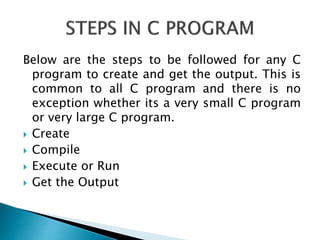
Below are the steps to be followed for any C
program to create and get the output. This is
common to all C program and there is no
exception whether its a very small C program
or very large C program.
 Create
 Compile
 Execute or Run
 Get the Output
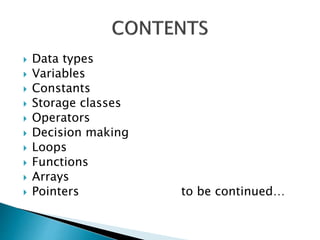
 Data types
 Variables
 Constants
 Storage classes
 Operators
 Decision making
 Loops
 Functions
 Arrays
 Pointers to be continued…
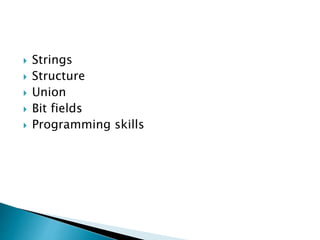
 Strings
 Structure
 Union
 Bit fields
 Programming skills
 Flexible timing
 Screen sharing method of teaching
 Daily simple task will be given
 Doubt clearing at any time through phone call
 Within 30 classes syllabus will be covered
 Reasonable amount of fees
INTRO.pptx

INTRO.pptx

  • 1.
  • 2.
     C programmingis a general-purpose, procedural, imperative computer programming language developed in 1972 by Dennis M. Ritchie at the Bell Telephone Laboratories to develop the UNIX operating system.  C is the most widely used computer language.
  • 3.
    C programming languageis a MUST for students and working professionals to become a great Software Engineer specially when they are working in Software Development Domain.
  • 4.
     Easy tolearn  Structured language  It produces efficient programs  It can handle low-level activities  It can be compiled on a variety of computer platforms
  • 5.
     C wasinvented to write an operating system called UNIX.  C is a successor of B language which was introduced around the early 1970s.  The language was formalized in 1988 by the American National Standard Institute (ANSI).  The UNIX OS was totally written in C.  Today C is the most widely used and popular System Programming Language.  Most of the state-of-the-art software have been implemented using C.
  • 6.
     C languageis used for creating computer applications  Used in writing Embedded softwares Firmware for various electronics, industrial and communications products which use micro-controllers.  It is also used in developing verification software, test code, simulators etc. for various applications and hardware products.  For Creating Compiles of different Languages which can take input from other language and convert it into lower level machine dependent language.  C is used to implement different Operating System Operations.
  • 8.
    Below are thesteps to be followed for any C program to create and get the output. This is common to all C program and there is no exception whether its a very small C program or very large C program.  Create  Compile  Execute or Run  Get the Output
  • 10.
     Data types Variables  Constants  Storage classes  Operators  Decision making  Loops  Functions  Arrays  Pointers to be continued…
  • 11.
     Strings  Structure Union  Bit fields  Programming skills
  • 12.
     Flexible timing Screen sharing method of teaching  Daily simple task will be given  Doubt clearing at any time through phone call  Within 30 classes syllabus will be covered  Reasonable amount of fees