EDUCATION
LOANS- Praveen Kumar & ManavShah
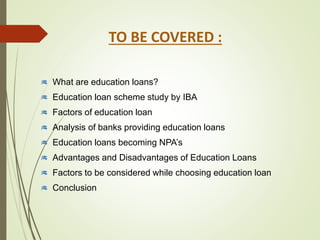
TO BE COVERED :
What are education loans?
Education loan scheme study by IBA
Factors of education loan
Analysis of banks providing education loans
Education loans becoming NPA’s
Advantages and Disadvantages of Education Loans
Factors to be considered while choosing education loan
Conclusion
WHAT ARE EDUCATION LOANS?
Education is central to the Human Resources Development and
empowerment in any country.
The scope of education has widened both in India and abroad
covering new courses in diversified areas.
Development of human capital is a national priority and it should be
the endeavor of all that no deserving student is denied opportunity
to pursue higher education for want of financial support.
An education loan is a type of loan designed to help students pay
for post-secondary education and the associated fees, such
as tuition, books and supplies, and living expenses.
It came into existence in 1995 started by SBI Bank and after that
many banks started offering student loan.
Education loan scheme study by IBA
The Finance Minister in a meeting with the Chief Executives of the
public sector banks on 13 June 2000 had highlighted the role of
commercial banks in facilitating pursuit of higher education by poor,
but meritorious students.
In pursuance thereof, the Indian Banks’Association constituted a
Study Group under the chairmanship of Shri R. J. Kamath, Chairman
& Managing Director of Canara Bank to examine the issue in detail.
Based on the recommendations of the Study Group, a
comprehensive model educational loan scheme was prepared by the
Indian Banks’Association for adoption by all banks.
The Scheme aims at providing financial support from the banking
system to meritorious students for pursuing higher education.
The scheme was announced in the Union Budget for 2001-2002 &
discussed in the meeting the Finance Minister had with the Chief
Executives of banks on 7 April 2001.
FACTORS OF
EDUCATION LOAN
Should be an Indian National Secured admission to professional/
technical courses through Entrance Test/ Selection process.
Secured admission to foreign university/ Institutions.
Should have scored minimum 60% (50% for SC/STs) in the
qualifying examination for admission to graduation courses.
ELIGIBILITY CRITERIA:
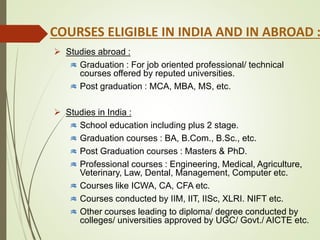
COURSES ELIGIBLE IN INDIA AND IN ABROAD :
 Studies abroad :
Graduation : For job oriented professional/ technical
courses offered by reputed universities.
Post graduation : MCA, MBA, MS, etc.
 Studies in India :
School education including plus 2 stage.
Graduation courses : BA, B.Com., B.Sc., etc.
Post Graduation courses : Masters & PhD.
Professional courses : Engineering, Medical, Agriculture,
Veterinary, Law, Dental, Management, Computer etc.
Courses like ICWA, CA, CFA etc.
Courses conducted by IIM, IIT, IISc, XLRI. NIFT etc.
Other courses leading to diploma/ degree conducted by
colleges/ universities approved by UGC/ Govt./ AICTE etc.
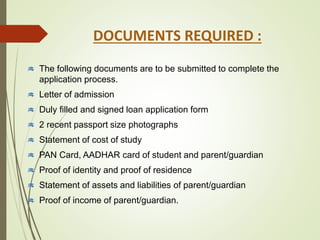
The following documents are to be submitted to complete the
application process.
Letter of admission
Duly filled and signed loan application form
2 recent passport size photographs
Statement of cost of study
PAN Card, AADHAR card of student and parent/guardian
Proof of identity and proof of residence
Statement of assets and liabilities of parent/guardian
Proof of income of parent/guardian.
DOCUMENTS REQUIRED :
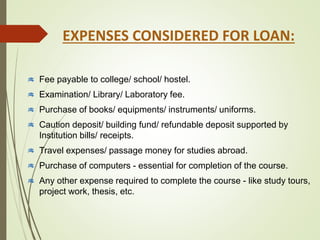
Fee payable to college/ school/ hostel.
Examination/ Library/ Laboratory fee.
Purchase of books/ equipments/ instruments/ uniforms.
Caution deposit/ building fund/ refundable deposit supported by
Institution bills/ receipts.
Travel expenses/ passage money for studies abroad.
Purchase of computers - essential for completion of the course.
Any other expense required to complete the course - like study tours,
project work, thesis, etc.
EXPENSES CONSIDERED FOR LOAN:
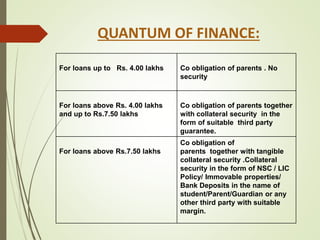
For loans up to Rs. 4.00 lakhs Co obligation of parents . No
security
For loans above Rs. 4.00 lakhs
and up to Rs.7.50 lakhs
Co obligation of parents together
with collateral security in the
form of suitable third party
guarantee.
For loans above Rs.7.50 lakhs
Co obligation of
parents together with tangible
collateral security .Collateral
security in the form of NSC / LIC
Policy/ Immovable properties/
Bank Deposits in the name of
student/Parent/Guardian or any
other third party with suitable
margin.
QUANTUM OF FINANCE:
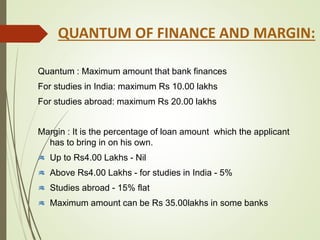
Quantum : Maximum amount that bank finances
For studies in India: maximum Rs 10.00 lakhs
For studies abroad: maximum Rs 20.00 lakhs
Margin : It is the percentage of loan amount which the applicant
has to bring in on his own.
Up to Rs4.00 Lakhs - Nil
Above Rs4.00 Lakhs - for studies in India - 5%
Studies abroad - 15% flat
Maximum amount can be Rs 35.00lakhs in some banks
QUANTUM OF FINANCE AND MARGIN:
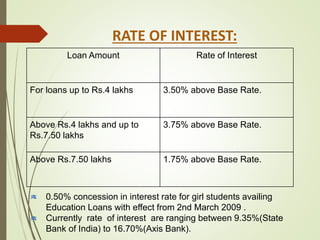
Loan Amount Rate of Interest
For loans up to Rs.4 lakhs 3.50% above Base Rate.
Above Rs.4 lakhs and up to
Rs.7.50 lakhs
3.75% above Base Rate.
Above Rs.7.50 lakhs 1.75% above Base Rate.
0.50% concession in interest rate for girl students availing
Education Loans with effect from 2nd March 2009 .
Currently rate of interest are ranging between 9.35%(State
Bank of India) to 16.70%(Axis Bank).
RATE OF INTEREST:
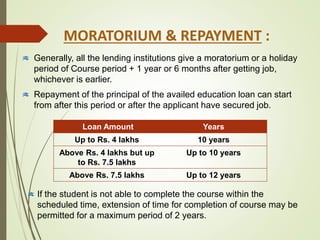
Generally, all the lending institutions give a moratorium or a holiday
period of Course period + 1 year or 6 months after getting job,
whichever is earlier.
Repayment of the principal of the availed education loan can start
from after this period or after the applicant have secured job.
MORATORIUM & REPAYMENT :
Loan Amount Years
Up to Rs. 4 lakhs 10 years
Above Rs. 4 lakhs but up
to Rs. 7.5 lakhs
Up to 10 years
Above Rs. 7.5 lakhs Up to 12 years
If the student is not able to complete the course within the
scheduled time, extension of time for completion of course may be
permitted for a maximum period of 2 years.
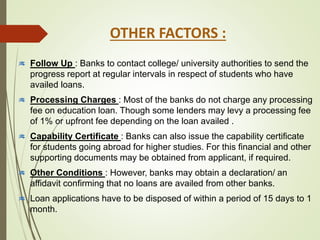
Follow Up : Banks to contact college/ university authorities to send the
progress report at regular intervals in respect of students who have
availed loans.
Processing Charges : Most of the banks do not charge any processing
fee on education loan. Though some lenders may levy a processing fee
of 1% or upfront fee depending on the loan availed .
Capability Certificate : Banks can also issue the capability certificate
for students going abroad for higher studies. For this financial and other
supporting documents may be obtained from applicant, if required.
Other Conditions : However, banks may obtain a declaration/ an
affidavit confirming that no loans are availed from other banks.
Loan applications have to be disposed of within a period of 15 days to 1
month.
OTHER FACTORS :
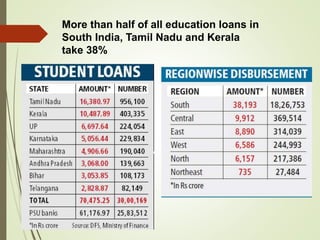
More than half of all education loans in
South India, Tamil Nadu and Kerala
take 38%
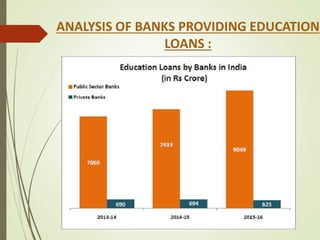
ANALYSIS OF BANKS PROVIDING EDUCATION
LOANS :
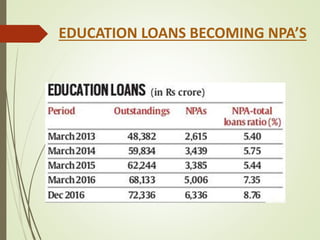
EDUCATION LOANS BECOMING NPA’S
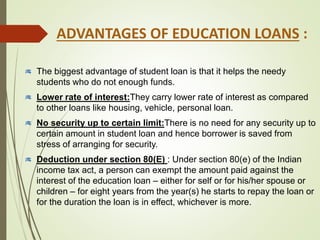
ADVANTAGES OF EDUCATION LOANS :
The biggest advantage of student loan is that it helps the needy
students who do not enough funds.
Lower rate of interest:They carry lower rate of interest as compared
to other loans like housing, vehicle, personal loan.
No security up to certain limit:There is no need for any security up to
certain amount in student loan and hence borrower is saved from
stress of arranging for security.
Deduction under section 80(E) : Under section 80(e) of the Indian
income tax act, a person can exempt the amount paid against the
interest of the education loan – either for self or for his/her spouse or
children – for eight years from the year(s) he starts to repay the loan or
for the duration the loan is in effect, whichever is more.
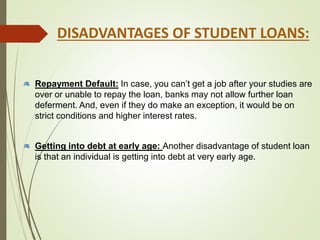
Repayment Default: In case, you can’t get a job after your studies are
over or unable to repay the loan, banks may not allow further loan
deferment. And, even if they do make an exception, it would be on
strict conditions and higher interest rates.
Getting into debt at early age: Another disadvantage of student loan
is that an individual is getting into debt at very early age.
DISADVANTAGES OF STUDENT LOANS:
FACTORS TO BE CONSIDERED WHILE
CHOOSING EDUCATION LOAN :
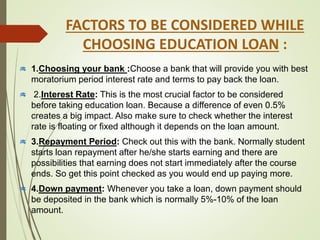
1.Choosing your bank :Choose a bank that will provide you with best
moratorium period interest rate and terms to pay back the loan.
2.Interest Rate: This is the most crucial factor to be considered
before taking education loan. Because a difference of even 0.5%
creates a big impact. Also make sure to check whether the interest
rate is floating or fixed although it depends on the loan amount.
3.Repayment Period: Check out this with the bank. Normally student
starts loan repayment after he/she starts earning and there are
possibilities that earning does not start immediately after the course
ends. So get this point checked as you would end up paying more.
4.Down payment: Whenever you take a loan, down payment should
be deposited in the bank which is normally 5%-10% of the loan
amount.
FACTORS TO BE CONSIDERED WHILE
CHOOSING EDUCATION LOAN :
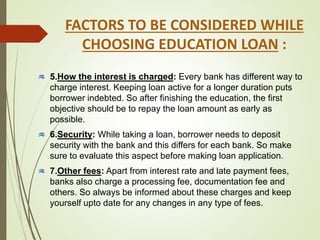
5.How the interest is charged: Every bank has different way to
charge interest. Keeping loan active for a longer duration puts
borrower indebted. So after finishing the education, the first
objective should be to repay the loan amount as early as
possible.
6.Security: While taking a loan, borrower needs to deposit
security with the bank and this differs for each bank. So make
sure to evaluate this aspect before making loan application.
7.Other fees: Apart from interest rate and late payment fees,
banks also charge a processing fee, documentation fee and
others. So always be informed about these charges and keep
yourself upto date for any changes in any type of fees.
CONCLUSION :
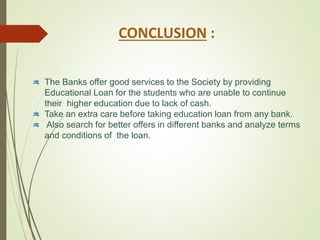
The Banks offer good services to the Society by providing
Educational Loan for the students who are unable to continue
their higher education due to lack of cash.
Take an extra care before taking education loan from any bank.
Also search for better offers in different banks and analyze terms
and conditions of the loan.

education loan

  • 1.
  • 2.
    TO BE COVERED: What are education loans? Education loan scheme study by IBA Factors of education loan Analysis of banks providing education loans Education loans becoming NPA’s Advantages and Disadvantages of Education Loans Factors to be considered while choosing education loan Conclusion
  • 3.
    WHAT ARE EDUCATIONLOANS? Education is central to the Human Resources Development and empowerment in any country. The scope of education has widened both in India and abroad covering new courses in diversified areas. Development of human capital is a national priority and it should be the endeavor of all that no deserving student is denied opportunity to pursue higher education for want of financial support. An education loan is a type of loan designed to help students pay for post-secondary education and the associated fees, such as tuition, books and supplies, and living expenses. It came into existence in 1995 started by SBI Bank and after that many banks started offering student loan.
  • 4.
    Education loan schemestudy by IBA The Finance Minister in a meeting with the Chief Executives of the public sector banks on 13 June 2000 had highlighted the role of commercial banks in facilitating pursuit of higher education by poor, but meritorious students. In pursuance thereof, the Indian Banks’Association constituted a Study Group under the chairmanship of Shri R. J. Kamath, Chairman & Managing Director of Canara Bank to examine the issue in detail. Based on the recommendations of the Study Group, a comprehensive model educational loan scheme was prepared by the Indian Banks’Association for adoption by all banks. The Scheme aims at providing financial support from the banking system to meritorious students for pursuing higher education. The scheme was announced in the Union Budget for 2001-2002 & discussed in the meeting the Finance Minister had with the Chief Executives of banks on 7 April 2001.
  • 5.
  • 6.
    Should be anIndian National Secured admission to professional/ technical courses through Entrance Test/ Selection process. Secured admission to foreign university/ Institutions. Should have scored minimum 60% (50% for SC/STs) in the qualifying examination for admission to graduation courses. ELIGIBILITY CRITERIA:
  • 7.
    COURSES ELIGIBLE ININDIA AND IN ABROAD :  Studies abroad : Graduation : For job oriented professional/ technical courses offered by reputed universities. Post graduation : MCA, MBA, MS, etc.  Studies in India : School education including plus 2 stage. Graduation courses : BA, B.Com., B.Sc., etc. Post Graduation courses : Masters & PhD. Professional courses : Engineering, Medical, Agriculture, Veterinary, Law, Dental, Management, Computer etc. Courses like ICWA, CA, CFA etc. Courses conducted by IIM, IIT, IISc, XLRI. NIFT etc. Other courses leading to diploma/ degree conducted by colleges/ universities approved by UGC/ Govt./ AICTE etc.
  • 8.
    The following documentsare to be submitted to complete the application process. Letter of admission Duly filled and signed loan application form 2 recent passport size photographs Statement of cost of study PAN Card, AADHAR card of student and parent/guardian Proof of identity and proof of residence Statement of assets and liabilities of parent/guardian Proof of income of parent/guardian. DOCUMENTS REQUIRED :
  • 9.
    Fee payable tocollege/ school/ hostel. Examination/ Library/ Laboratory fee. Purchase of books/ equipments/ instruments/ uniforms. Caution deposit/ building fund/ refundable deposit supported by Institution bills/ receipts. Travel expenses/ passage money for studies abroad. Purchase of computers - essential for completion of the course. Any other expense required to complete the course - like study tours, project work, thesis, etc. EXPENSES CONSIDERED FOR LOAN:
  • 10.
    For loans upto Rs. 4.00 lakhs Co obligation of parents . No security For loans above Rs. 4.00 lakhs and up to Rs.7.50 lakhs Co obligation of parents together with collateral security in the form of suitable third party guarantee. For loans above Rs.7.50 lakhs Co obligation of parents together with tangible collateral security .Collateral security in the form of NSC / LIC Policy/ Immovable properties/ Bank Deposits in the name of student/Parent/Guardian or any other third party with suitable margin. QUANTUM OF FINANCE:
  • 11.
    Quantum : Maximumamount that bank finances For studies in India: maximum Rs 10.00 lakhs For studies abroad: maximum Rs 20.00 lakhs Margin : It is the percentage of loan amount which the applicant has to bring in on his own. Up to Rs4.00 Lakhs - Nil Above Rs4.00 Lakhs - for studies in India - 5% Studies abroad - 15% flat Maximum amount can be Rs 35.00lakhs in some banks QUANTUM OF FINANCE AND MARGIN:
  • 12.
    Loan Amount Rateof Interest For loans up to Rs.4 lakhs 3.50% above Base Rate. Above Rs.4 lakhs and up to Rs.7.50 lakhs 3.75% above Base Rate. Above Rs.7.50 lakhs 1.75% above Base Rate. 0.50% concession in interest rate for girl students availing Education Loans with effect from 2nd March 2009 . Currently rate of interest are ranging between 9.35%(State Bank of India) to 16.70%(Axis Bank). RATE OF INTEREST:
  • 13.
    Generally, all thelending institutions give a moratorium or a holiday period of Course period + 1 year or 6 months after getting job, whichever is earlier. Repayment of the principal of the availed education loan can start from after this period or after the applicant have secured job. MORATORIUM & REPAYMENT : Loan Amount Years Up to Rs. 4 lakhs 10 years Above Rs. 4 lakhs but up to Rs. 7.5 lakhs Up to 10 years Above Rs. 7.5 lakhs Up to 12 years If the student is not able to complete the course within the scheduled time, extension of time for completion of course may be permitted for a maximum period of 2 years.
  • 14.
    Follow Up :Banks to contact college/ university authorities to send the progress report at regular intervals in respect of students who have availed loans. Processing Charges : Most of the banks do not charge any processing fee on education loan. Though some lenders may levy a processing fee of 1% or upfront fee depending on the loan availed . Capability Certificate : Banks can also issue the capability certificate for students going abroad for higher studies. For this financial and other supporting documents may be obtained from applicant, if required. Other Conditions : However, banks may obtain a declaration/ an affidavit confirming that no loans are availed from other banks. Loan applications have to be disposed of within a period of 15 days to 1 month. OTHER FACTORS :
  • 15.
    More than halfof all education loans in South India, Tamil Nadu and Kerala take 38%
  • 16.
    ANALYSIS OF BANKSPROVIDING EDUCATION LOANS :
  • 17.
  • 18.
    ADVANTAGES OF EDUCATIONLOANS : The biggest advantage of student loan is that it helps the needy students who do not enough funds. Lower rate of interest:They carry lower rate of interest as compared to other loans like housing, vehicle, personal loan. No security up to certain limit:There is no need for any security up to certain amount in student loan and hence borrower is saved from stress of arranging for security. Deduction under section 80(E) : Under section 80(e) of the Indian income tax act, a person can exempt the amount paid against the interest of the education loan – either for self or for his/her spouse or children – for eight years from the year(s) he starts to repay the loan or for the duration the loan is in effect, whichever is more.
  • 19.
    Repayment Default: Incase, you can’t get a job after your studies are over or unable to repay the loan, banks may not allow further loan deferment. And, even if they do make an exception, it would be on strict conditions and higher interest rates. Getting into debt at early age: Another disadvantage of student loan is that an individual is getting into debt at very early age. DISADVANTAGES OF STUDENT LOANS:
  • 20.
    FACTORS TO BECONSIDERED WHILE CHOOSING EDUCATION LOAN : 1.Choosing your bank :Choose a bank that will provide you with best moratorium period interest rate and terms to pay back the loan. 2.Interest Rate: This is the most crucial factor to be considered before taking education loan. Because a difference of even 0.5% creates a big impact. Also make sure to check whether the interest rate is floating or fixed although it depends on the loan amount. 3.Repayment Period: Check out this with the bank. Normally student starts loan repayment after he/she starts earning and there are possibilities that earning does not start immediately after the course ends. So get this point checked as you would end up paying more. 4.Down payment: Whenever you take a loan, down payment should be deposited in the bank which is normally 5%-10% of the loan amount.
  • 21.
    FACTORS TO BECONSIDERED WHILE CHOOSING EDUCATION LOAN : 5.How the interest is charged: Every bank has different way to charge interest. Keeping loan active for a longer duration puts borrower indebted. So after finishing the education, the first objective should be to repay the loan amount as early as possible. 6.Security: While taking a loan, borrower needs to deposit security with the bank and this differs for each bank. So make sure to evaluate this aspect before making loan application. 7.Other fees: Apart from interest rate and late payment fees, banks also charge a processing fee, documentation fee and others. So always be informed about these charges and keep yourself upto date for any changes in any type of fees.
  • 22.
    CONCLUSION : The Banksoffer good services to the Society by providing Educational Loan for the students who are unable to continue their higher education due to lack of cash. Take an extra care before taking education loan from any bank. Also search for better offers in different banks and analyze terms and conditions of the loan.