Maths Learning Centre, Jalandhar
Complete
Video
Lectures
are
available
at
https://www.youtube.com/@MathematicsOnlineLectures Class IX: Areas of Parallelograms and Triangles Mathematics
MULTIPLE CHOICE QUESTIONS
LEVEL - I
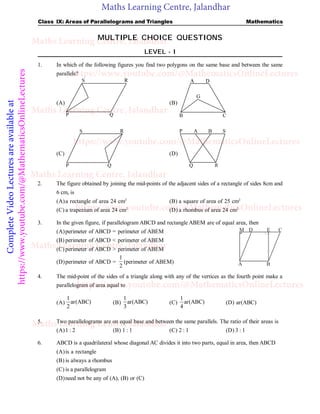
1. In which of the following figures you find two polygons on the same base and between the same
parallels?
(A) (B)
(C) (D)
2. The figure obtained by joining the mid-points of the adjacent sides of a rectangle of sides 8cm and
6 cm, is
(A)a rectangle of area 24 cm2
(B) a square of area of 25 cm2
(C) a trapezium of area 24 cm2
(D) a rhombus of area 24 cm2
3. In the given figure, if parallelogram ABCD and rectangle ABEM are of equal area, then
(A)perimeter of ABCD = perimeter of ABEM M D E C
A B
(B) perimeter of ABCD < perimeter of ABEM
(C) perimeter of ABCD > perimeter of ABEM
(D)perimeter of ABCD =
1
2
(perimeter of ABEM)
4. The mid-point of the sides of a triangle along with any of the vertices as the fourth point make a
parallelogram of area equal to
(A)
1
ar(ABC)
2
(B)
1
ar(ABC)
3
(C)
1
ar(ABC)
4
(D) ar(ABC)
5. Two parallelograms are on equal base and between the same parallels. The ratio of their areas is
(A)1 : 2 (B) 1 : 1 (C) 2 : 1 (D) 3 : 1
6. ABCD is a quadrilateral whose diagonal AC divides it into two parts, equal in area, then ABCD
(A)is a rectangle
(B) is always a rhombus
(C) is a parallelogram
(D)need not be any of (A), (B) or (C)
Maths Learning Centre, Jalandhar
https://www.youtube.com/@MathematicsOnlineLectures
Maths Learning Centre, Jalandhar
Complete
Video
Lectures
are
available
at
https://www.youtube.com/@MathematicsOnlineLectures Class IX: Areas of Parallelograms and Triangles Mathematics
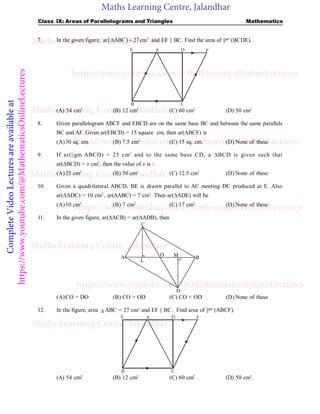
7. In the given figure,   2
ar ABC 27cm
  and EF || BC. Find the area of ||gm
(BCDE).
A
B C
D
E F
(A) 54 cm2
(B) 12 cm2
(C) 60 cm2
(D) 50 cm2
8. Given parallelogram ABCF and EBCD are on the same base BC and between the same parallels
BC and AF. Given ar(EBCD) = 15 square cm, then ar(ABCF) is
(A)30 sq. cm. (B) 7.5 cm2
(C) 15 sq. cm. (D) None of these
9. If ar(||gm ABCD) = 25 cm2
and to the same base CD, a BCD is given such that
ar(BCD) = x cm2
, then the value of x is :
(A)25 cm2
(B) 50 cm2
(C) 12.5 cm2
(D) None of these
10. Given a quadrilateral ABCD, BE is drawn parallel to AC meeting DC produced at E. Also
ar(ADC) = 10 cm2,
, ar(ABC) = 7 cm2
. Then ar(ADE) will be
(A)10 cm2
(B) 7 cm2
(C) 17 cm2
(D) None of these
11. In the given figure, ar(ACB) = ar(ADB), then
(A)CO = DO (B) CO > OD (C) CO < OD (D) None of these
12. In the figure, area  ABC = 27 cm2
and EF || BC. Find area of ||gm
(ABCF).
A
B C
D
E F
(A) 54 cm2
(B) 12 cm2
(C) 60 cm2
(D) 50 cm2
.
Maths Learning Centre, Jalandhar
https://www.youtube.com/@MathematicsOnlineLectures
Maths Learning Centre, Jalandhar
Complete
Video
Lectures
are
available
at
https://www.youtube.com/@MathematicsOnlineLectures Class IX: Areas of Parallelograms and Triangles Mathematics
13. Given a triangle ABC and E is mid-point of median AD of ABC. If ar(BED) = 20 cm2
. Then
ar(ABC) is
(A)10 cm2
(B) 5 cm2
(C) 60 cm2
(D) 80 cm2
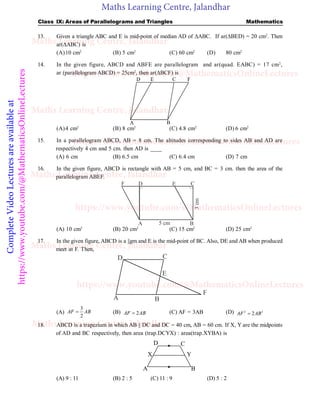
14. In the given figure, ABCD and ABFE are parallelogram and ar(quad. EABC) = 17 cm2
,
ar (parallelogram ABCD) = 25cm2
, then ar(BCF) is
(A)4 cm2
(B) 8 cm2
(C) 4.8 cm2
(D) 6 cm2
15. In a parallelogram ABCD, AB = 8 cm. The altitudes corresponding to sides AB and AD are
respectively 4 cm and 5 cm. then AD is ____
(A) 6 cm (B) 6.5 cm (C) 6.4 cm (D) 7 cm
16. In the given figure, ABCD is rectangle with AB = 5 cm, and BC = 3 cm. then the area of the
parallelogram ABEF.
F D E C
B
A 5 cm
3
cm
(A) 10 cm2
(B) 20 cm2
(C) 15 cm2
(D) 25 cm2
17. In the given figure, ABCD is a ||gm and E is the mid-point of BC. Also, DE and AB when produced
meet at F. Then,
D C
B
A
E
F
(A)
3
2
AF AB
 (B) 2
AF AB
 (C) AF = 3AB (D) 2 2
2
AF AB

18. ABCD is a trapezium in which AB || DC and DC = 40 cm, AB = 60 cm. If X, Y are the midpoints
of AD and BC respectively, then area (trap.DCYX) : area(trap.XYBA) is
D
A B
C
X Y
(A) 9 : 11 (B) 2 : 5 (C) 11 : 9 (D) 5 : 2
Maths Learning Centre, Jalandhar
https://www.youtube.com/@MathematicsOnlineLectures
Maths Learning Centre, Jalandhar
Complete
Video
Lectures
are
available
at
https://www.youtube.com/@MathematicsOnlineLectures Class IX: Areas of Parallelograms and Triangles Mathematics
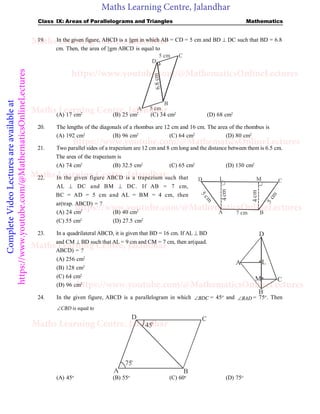
19. In the given figure, ABCD is a ||gm in which AB = CD = 5 cm and BD  DC such that BD = 6.8
cm. Then, the area of ||gm ABCD is equal to
5 cm
A
B
D
C
5 cm
6.
8
cm
(A) 17 cm2
(B) 25 cm2
(C) 34 cm2
(D) 68 cm2
20. The lengths of the diagonals of a rhombus are 12 cm and 16 cm. The area of the rhombus is
(A) 192 cm2
(B) 96 cm2
(C) 64 cm2
(D) 80 cm2
21. Two parallel sides of a trapezium are 12 cm and 8 cm long and the distance between them is 6.5 cm.
The area of the trapezium is
(A) 74 cm2
(B) 32.5 cm2
(C) 65 cm2
(D) 130 cm2
22. In the given figure ABCD is a trapezium such that
A B
C
L M
D
5
c
m
5
c
m
4
cm
4
cm
7 cm
AL  DC and BM  DC. If AB = 7 cm,
BC = AD = 5 cm and AL = BM = 4 cm, then
ar(trap. ABCD) = ?
(A) 24 cm2
(B) 40 cm2
(C) 55 cm2
(D) 27.5 cm2
23. In a quadrilateral ABCD, it is given that BD = 16 cm. If AL  BD
and CM  BD such that AL = 9 cm and CM = 7 cm, then ar(quad.
ABCD) = ?
(A) 256 cm2
L
M
D
A
B
C
(B) 128 cm2
(C) 64 cm2
(D) 96 cm2
24. In the given figure, ABCD is a parallelogram in which BDC
 = 45o
and BAD
 = 75o
. Then
is equal to
CBD

D C
B
A
75o
45o
(A) 45o
(B) 55o
(C) 60o
(D) 75o
Maths Learning Centre, Jalandhar
https://www.youtube.com/@MathematicsOnlineLectures
Maths Learning Centre, Jalandhar
Complete
Video
Lectures
are
available
at
https://www.youtube.com/@MathematicsOnlineLectures Class IX: Areas of Parallelograms and Triangles Mathematics
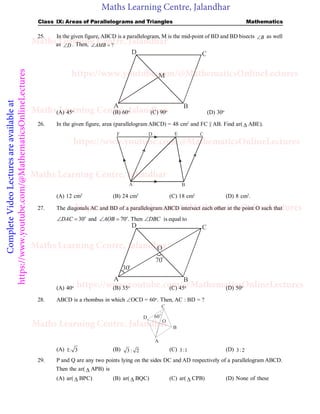
25. In the given figure, ABCD is a parallelogram, M is the mid-point of BD and BD bisects B
 as well
as D
 . Then, ?
AMB
 
D C
B
M
A
(A) 45o
(B) 60o
(C) 90o
(D) 30o
26. In the given figure, area (parallelogram ABCD) = 48 cm2
and FC || AB. Find ar(  ABE).
A B
C
D E
F
(A) 12 cm2
(B) 24 cm2
(C) 18 cm2
(D) 8 cm2
.
27. The diagonals AC and BD of a parallelogram ABCD intersect each other at the point O such that
30 and 70 . Then is equal to
o o
DAC AOB DBC
    
D C
B
O
A
30o
70
o
(A) 40o
(B) 35o
(C) 45o
(D) 50o
28. ABCD is a rhombus in which OCD = 60o
. Then, AC : BD = ?
A
B
C
D 60
o
O
(A) 1: 3 (B) 3 : 2 (C) 3:1 (D) 3: 2
29. P and Q are any two points lying on the sides DC and AD respectively of a parallelogram ABCD.
Then the ar(  APB) is
(A) ar(  BPC) (B) ar(  BQC) (C) ar(  CPB) (D) None of these
Maths Learning Centre, Jalandhar
https://www.youtube.com/@MathematicsOnlineLectures
Maths Learning Centre, Jalandhar
Complete
Video
Lectures
are
available
at
https://www.youtube.com/@MathematicsOnlineLectures Class IX: Areas of Parallelograms and Triangles Mathematics
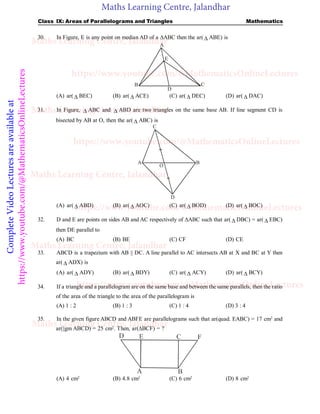
30. In Figure, E is any point on median AD of a ABC then the ar(  ABE) is
D
C
B
A
Fig.2
E
(A) ar(  BEC) (B) ar(  ACE) (C) ar(  DEC) (D) ar(  DAC)
31. In Figure,  ABC and  ABD are two triangles on the same base AB. If line segment CD is
bisected by AB at O, then the ar(  ABC) is
A B
D
C
O
Fig.3
(A) ar(  ABD) (B) ar(  AOC) (C) ar(  BOD) (D) ar(  BOC)
32. D and E are points on sides AB and AC respectively of ABC such that ar(  DBC) = ar(  EBC)
then DE parallel to
(A) BC (B) BE (C) CF (D) CE
33. ABCD is a trapezium with AB || DC. A line parallel to AC intersects AB at X and BC at Y then
ar(  ADX) is
(A) ar(  ADY) (B) ar(  BDY) (C) ar(  ACY) (D) ar(  BCY)
34. If a triangle and a parallelogram are on the same base and between the same parallels, then the ratio
of the area of the triangle to the area of the parallelogram is
(A) 1 : 2 (B) 1 : 3 (C) 1 : 4 (D) 3 : 4
35. In the given figure ABCD and ABFE are parallelograms such that ar(quad. EABC) = 17 cm2
and
ar(||gm ABCD) = 25 cm2
. Then, ar(BCF) = ?
B
A
E
D F
C
(A) 4 cm2
(B) 4.8 cm2
(C) 6 cm2
(D) 8 cm2
Maths Learning Centre, Jalandhar
https://www.youtube.com/@MathematicsOnlineLectures
Maths Learning Centre, Jalandhar
Complete
Video
Lectures
are
available
at
https://www.youtube.com/@MathematicsOnlineLectures Class IX: Areas of Parallelograms and Triangles Mathematics
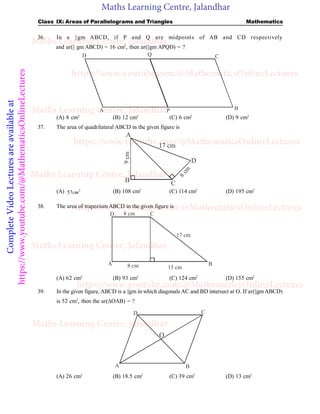
36. In a ||gm ABCD, if P and Q are midpoints of AB and CD respectively
and ar(|| gm ABCD) = 16 cm2
, then ar(||gm APQD) = ?
A P B
C
Q
D
(A) 8 cm2
(B) 12 cm2
(C) 6 cm2
(D) 9 cm2
37. The area of quadrilateral ABCD in the given figure is
B C
D
A
17 cm
9
cm
8
c
m
(A) 2
57cm (B) 108 cm2
(C) 114 cm2
(D) 195 cm2
38. The area of trapezium ABCD in the given figure is
D
A 8 cm
8 cm
17 cm
15 cm
B
C
(A) 62 cm2
(B) 93 cm2
(C) 124 cm2
(D) 155 cm2
39. In the given figure, ABCD is a ||gm in which diagonals AC and BD intersect at O. If ar(||gmABCD)
is 52 cm2
, then the ar(OAB) = ?
A B
C
D
O
(A) 26 cm2
(B) 18.5 cm2
(C) 39 cm2
(D) 13 cm2
Maths Learning Centre, Jalandhar
https://www.youtube.com/@MathematicsOnlineLectures
Maths Learning Centre, Jalandhar
Complete
Video
Lectures
are
available
at
https://www.youtube.com/@MathematicsOnlineLectures Class IX: Areas of Parallelograms and Triangles Mathematics
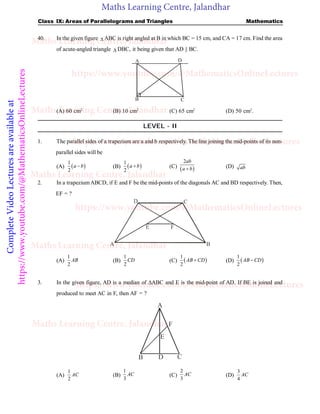
40. In the given figure  ABC is right angled at B in which BC = 15 cm, and CA = 17 cm. Find the area
of acute-angled triangle  DBC, it being given that AD || BC.
A
B C
D
(A) 60 cm2
(B) 10 cm2
(C) 65 cm2
(D) 50 cm2
.
LEVEL - II
1. The parallel sides of a trapezium are a and b respectively. The line joining the mid-points of its non-
parallel sides will be
(A)  
1
2
a b
 (B)  
1
2
a b
 (C)  
2ab
a b
 (D) ab
2. In a trapeziumABCD, if E and F be the mid-points of the diagonals AC and BD respectively. Then,
EF = ?
E
A B
C
D
F
(A)
1
2
AB (B)
1
2
CD (C)  
1
2
AB CD
 (D)  
1
2
AB CD

3. In the given figure, AD is a median of ABC and E is the mid-point of AD. If BE is joined and
produced to meet AC in F, then AF = ?
A
D
B C
F
E
(A)
1
2
AC (B)
1
3
AC (C)
2
3
AC (D)
3
4
AC
Maths Learning Centre, Jalandhar
https://www.youtube.com/@MathematicsOnlineLectures
Maths Learning Centre, Jalandhar
Complete
Video
Lectures
are
available
at
https://www.youtube.com/@MathematicsOnlineLectures Class IX: Areas of Parallelograms and Triangles Mathematics
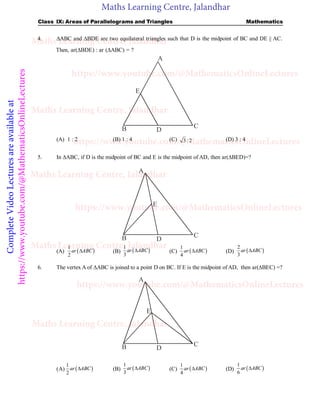
4. ABC and BDE are two equilateral triangles such that D is the midpoint of BC and DE || AC.
Then, ar(BDE) : ar (ABC) = ?
D
C
E
B
A
(A) 1 : 2 (B) 1 : 4 (C) 3 : 2 (D) 3 : 4
5. In ABC, if D is the midpoint of BC and E is the midpoint of AD, then ar(BED)=?
D
C
E
B
A
(A)  
1
2
ar ABC
 (B)  
1
3
ar ABC
 (C)  
1
4
ar ABC
 (D)  
2
3
ar ABC

6. The vertex A of ABC is joined to a point D on BC. If E is the midpoint of AD, then ar(BEC) =?
D
C
E
B
A
(A)  
1
2
ar ABC
 (B)  
1
3
ar ABC
 (C)  
1
4
ar ABC
 (D)  
1
6
ar ABC

Maths Learning Centre, Jalandhar
https://www.youtube.com/@MathematicsOnlineLectures
Maths Learning Centre, Jalandhar
Complete
Video
Lectures
are
available
at
https://www.youtube.com/@MathematicsOnlineLectures Class IX: Areas of Parallelograms and Triangles Mathematics
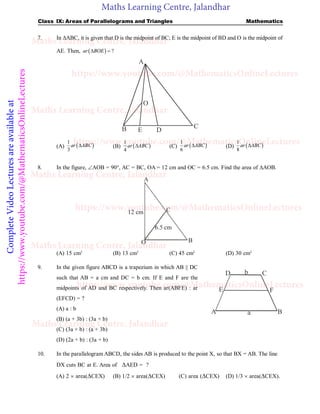
7. In ABC, it is given that D is the midpoint of BC; E is the midpoint of BD and O is the midpoint of
AE. Then,   ?
ar BOE
 
D
C
O
B
A
E
(A)  
1
3
ar ABC
 (B)  
1
4
ar ABC
 (C)  
1
6
ar ABC
 (D)  
1
8
ar ABC

8. In the figure, AOB = 90°, AC = BC, OA = 12 cm and OC = 6.5 cm. Find the area of AOB.
A
B
O
C
6.5 cm
12 cm
(A) 15 cm2
(B) 13 cm2
(C) 45 cm2
(D) 30 cm2
9. In the given figure ABCD is a trapezium in which AB || DC
such that AB = a cm and DC = b cm. If E and F are the
midpoints of AD and BC respectively. Then ar(ABFE) : ar
(EFCD) = ?
(A) a : b
A B
C
D
E F
a
b
(B) (a + 3b) : (3a + b)
(C) (3a + b) : (a + 3b)
(D) (2a + b) : (3a + b)
10. In the parallelogram ABCD, the sides AB is produced to the point X, so that BX = AB. The line
DX cuts BC at E. Area of AED = ?
(A) 2  area(CEX) (B) 1/2  area(CEX) (C) area (CEX) (D) 1/3  area(CEX).
Maths Learning Centre, Jalandhar
https://www.youtube.com/@MathematicsOnlineLectures
Maths Learning Centre, Jalandhar
Complete
Video
Lectures
are
available
at
https://www.youtube.com/@MathematicsOnlineLectures Class IX: Areas of Parallelograms and Triangles Mathematics
11. In ABC, D is the mid-point of AB. P is any point of BC. CQ || PD meets AB in Q. Then area
of (BPQ) is equal to
(A) 3/2 area of (ABC) (B) 1/2 area of (ABC)
(C) 5/2 area of (ABC) (D) 1/4 area of (ABC)
ONE OR MORE THAN ONE CORRECT
This section contains multiple choice questions. Each question has 4 choices (A), (B), (C), (D), out
of which ONE or MORE is correct. Choose the correct options.
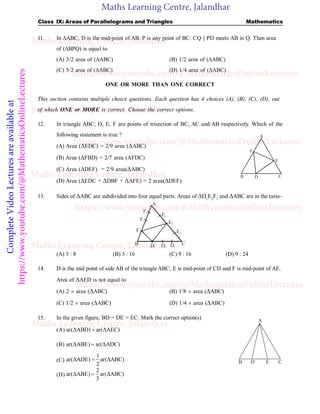
12. In triangle ABC; D, E, F are points of trisection of BC, AC and AB respectively. Which of the
following statement is true ?
(A) Area (EDC) = 2/9 area (ABC)
A
B C
D
E
F
(B) Area (FBD) = 2/7 area (AFDC)
(C) Area (DEF) = 2/9 area(ABC)
(D) Area (EDC + DBF + AFE) = 2 area(DEF).
13. Sides of ABC are subdivided into four equal parts. Areas of D1
E2
F3
and ABC are in the ratio–
A
B C
F1
F2
F3
E1
E2
E3
D1 D2 D3
(A) 3 : 8 (B) 3 : 16 (C) 9 : 16 (D) 9 : 24
14. D is the mid point of side AB of the triangle ABC, E is mid-point of CD and F is mid-point of AE.
Area of AED is not equal to
(A) 2  area (ABC) (B) 1/8  area (ABC)
(C) 1/2  area (ABC) (D) 1/4  area (ABC)
15. In the given figure, BD = DE = EC. Mark the correct option(s)
(A) ar(ΔABD) ar(ΔAEC)

B D E C
A
(B) ar(ΔABE) ar(ΔADC)

(C)
1
ar(ΔADE) ar(ΔABC)
2

(D)
2
ar(ΔABE) ar(ΔABC)
3

Maths Learning Centre, Jalandhar
https://www.youtube.com/@MathematicsOnlineLectures
Maths Learning Centre, Jalandhar
Complete
Video
Lectures
are
available
at
https://www.youtube.com/@MathematicsOnlineLectures Class IX: Areas of Parallelograms and Triangles Mathematics
MATRIX MATCHING TYPE QUESTIONS
Question contains statements given in two columns, which have to be matched. The statements in Column I are
labeled A, B, C and D, while the statements in Column II are labeled p, q, r, s and t. Any given statement in Column
I can have correct matching with ONE OR MORE statements(s) in Column II.
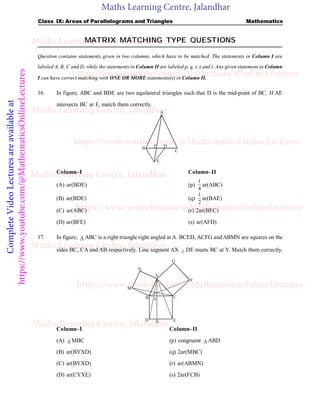
16. In figure, ABC and BDE are two equilateral triangles such that D is the mid-point of BC. If AE
intersects BC at F, match them correctly.
A
B
C
D
E
F
Column–I Column–II
(A) ar(BDE) (p)
1
4
ar(ABC)
(B) ar(BDE) (q)
1
2
ar(BAE)
(C) ar(ABC) (r) 2ar(BEC)
(D) ar(BFE) (s) ar(AFD)
17. In figure,  ABC is a right triangle right angled at A. BCED, ACFG and ABMN are squares on the
sides BC, CA and AB respectively. Line segment AX  DE meets BC at Y. Match them correctly.
.
A
B C
D E
F
G
Y
N
M
X
Column–I Column–II
(A)  MBC (p) congruent  ABD
(B) ar(BYXD) (q) 2ar(MBC)
(C) ar(BYXD) (r) ar(ABMN)
(D) ar(CYXE) (s) 2ar(FCB)
Maths Learning Centre, Jalandhar
https://www.youtube.com/@MathematicsOnlineLectures
Maths Learning Centre, Jalandhar
Complete
Video
Lectures
are
available
at
https://www.youtube.com/@MathematicsOnlineLectures Class IX: Areas of Parallelograms and Triangles Mathematics
INTEGER TYPE QUESTIONS
The answer to each of the questions is a single-digit integer, ranging from 0 to 9.
18. X and Y are respectively two points on the sides DC and AD of the parallelogram ABCD. The
area of  ABX is equal to k times area of BYC. Find the value of k.
19. In a ABC, E is the mid-point of median AD. Then area of (BED) is equal to k/4 times area of
ABC. Find the value of k.
Maths Learning Centre, Jalandhar
https://www.youtube.com/@MathematicsOnlineLectures

#Class 9 #MCQ #Chapter_9 #area_of_paralleograms_and_triangles

  • 1.
    Maths Learning Centre,Jalandhar Complete Video Lectures are available at https://www.youtube.com/@MathematicsOnlineLectures Class IX: Areas of Parallelograms and Triangles Mathematics MULTIPLE CHOICE QUESTIONS LEVEL - I 1. In which of the following figures you find two polygons on the same base and between the same parallels? (A) (B) (C) (D) 2. The figure obtained by joining the mid-points of the adjacent sides of a rectangle of sides 8cm and 6 cm, is (A)a rectangle of area 24 cm2 (B) a square of area of 25 cm2 (C) a trapezium of area 24 cm2 (D) a rhombus of area 24 cm2 3. In the given figure, if parallelogram ABCD and rectangle ABEM are of equal area, then (A)perimeter of ABCD = perimeter of ABEM M D E C A B (B) perimeter of ABCD < perimeter of ABEM (C) perimeter of ABCD > perimeter of ABEM (D)perimeter of ABCD = 1 2 (perimeter of ABEM) 4. The mid-point of the sides of a triangle along with any of the vertices as the fourth point make a parallelogram of area equal to (A) 1 ar(ABC) 2 (B) 1 ar(ABC) 3 (C) 1 ar(ABC) 4 (D) ar(ABC) 5. Two parallelograms are on equal base and between the same parallels. The ratio of their areas is (A)1 : 2 (B) 1 : 1 (C) 2 : 1 (D) 3 : 1 6. ABCD is a quadrilateral whose diagonal AC divides it into two parts, equal in area, then ABCD (A)is a rectangle (B) is always a rhombus (C) is a parallelogram (D)need not be any of (A), (B) or (C) Maths Learning Centre, Jalandhar Maths Learning Centre, Jalandhar Maths Learning Centre, Jalandhar Maths Learning Centre, Jalandhar Maths Learning Centre, Jalandhar https://www.youtube.com/@MathematicsOnlineLectures https://www.youtube.com/@MathematicsOnlineLectures https://www.youtube.com/@MathematicsOnlineLectures https://www.youtube.com/@MathematicsOnlineLectures
  • 2.
    Maths Learning Centre,Jalandhar Complete Video Lectures are available at https://www.youtube.com/@MathematicsOnlineLectures Class IX: Areas of Parallelograms and Triangles Mathematics 7. In the given figure,   2 ar ABC 27cm   and EF || BC. Find the area of ||gm (BCDE). A B C D E F (A) 54 cm2 (B) 12 cm2 (C) 60 cm2 (D) 50 cm2 8. Given parallelogram ABCF and EBCD are on the same base BC and between the same parallels BC and AF. Given ar(EBCD) = 15 square cm, then ar(ABCF) is (A)30 sq. cm. (B) 7.5 cm2 (C) 15 sq. cm. (D) None of these 9. If ar(||gm ABCD) = 25 cm2 and to the same base CD, a BCD is given such that ar(BCD) = x cm2 , then the value of x is : (A)25 cm2 (B) 50 cm2 (C) 12.5 cm2 (D) None of these 10. Given a quadrilateral ABCD, BE is drawn parallel to AC meeting DC produced at E. Also ar(ADC) = 10 cm2, , ar(ABC) = 7 cm2 . Then ar(ADE) will be (A)10 cm2 (B) 7 cm2 (C) 17 cm2 (D) None of these 11. In the given figure, ar(ACB) = ar(ADB), then (A)CO = DO (B) CO > OD (C) CO < OD (D) None of these 12. In the figure, area  ABC = 27 cm2 and EF || BC. Find area of ||gm (ABCF). A B C D E F (A) 54 cm2 (B) 12 cm2 (C) 60 cm2 (D) 50 cm2 . Maths Learning Centre, Jalandhar Maths Learning Centre, Jalandhar Maths Learning Centre, Jalandhar Maths Learning Centre, Jalandhar Maths Learning Centre, Jalandhar https://www.youtube.com/@MathematicsOnlineLectures https://www.youtube.com/@MathematicsOnlineLectures https://www.youtube.com/@MathematicsOnlineLectures https://www.youtube.com/@MathematicsOnlineLectures
  • 3.
    Maths Learning Centre,Jalandhar Complete Video Lectures are available at https://www.youtube.com/@MathematicsOnlineLectures Class IX: Areas of Parallelograms and Triangles Mathematics 13. Given a triangle ABC and E is mid-point of median AD of ABC. If ar(BED) = 20 cm2 . Then ar(ABC) is (A)10 cm2 (B) 5 cm2 (C) 60 cm2 (D) 80 cm2 14. In the given figure, ABCD and ABFE are parallelogram and ar(quad. EABC) = 17 cm2 , ar (parallelogram ABCD) = 25cm2 , then ar(BCF) is (A)4 cm2 (B) 8 cm2 (C) 4.8 cm2 (D) 6 cm2 15. In a parallelogram ABCD, AB = 8 cm. The altitudes corresponding to sides AB and AD are respectively 4 cm and 5 cm. then AD is ____ (A) 6 cm (B) 6.5 cm (C) 6.4 cm (D) 7 cm 16. In the given figure, ABCD is rectangle with AB = 5 cm, and BC = 3 cm. then the area of the parallelogram ABEF. F D E C B A 5 cm 3 cm (A) 10 cm2 (B) 20 cm2 (C) 15 cm2 (D) 25 cm2 17. In the given figure, ABCD is a ||gm and E is the mid-point of BC. Also, DE and AB when produced meet at F. Then, D C B A E F (A) 3 2 AF AB  (B) 2 AF AB  (C) AF = 3AB (D) 2 2 2 AF AB  18. ABCD is a trapezium in which AB || DC and DC = 40 cm, AB = 60 cm. If X, Y are the midpoints of AD and BC respectively, then area (trap.DCYX) : area(trap.XYBA) is D A B C X Y (A) 9 : 11 (B) 2 : 5 (C) 11 : 9 (D) 5 : 2 Maths Learning Centre, Jalandhar Maths Learning Centre, Jalandhar Maths Learning Centre, Jalandhar Maths Learning Centre, Jalandhar Maths Learning Centre, Jalandhar https://www.youtube.com/@MathematicsOnlineLectures https://www.youtube.com/@MathematicsOnlineLectures https://www.youtube.com/@MathematicsOnlineLectures https://www.youtube.com/@MathematicsOnlineLectures
  • 4.
    Maths Learning Centre,Jalandhar Complete Video Lectures are available at https://www.youtube.com/@MathematicsOnlineLectures Class IX: Areas of Parallelograms and Triangles Mathematics 19. In the given figure, ABCD is a ||gm in which AB = CD = 5 cm and BD  DC such that BD = 6.8 cm. Then, the area of ||gm ABCD is equal to 5 cm A B D C 5 cm 6. 8 cm (A) 17 cm2 (B) 25 cm2 (C) 34 cm2 (D) 68 cm2 20. The lengths of the diagonals of a rhombus are 12 cm and 16 cm. The area of the rhombus is (A) 192 cm2 (B) 96 cm2 (C) 64 cm2 (D) 80 cm2 21. Two parallel sides of a trapezium are 12 cm and 8 cm long and the distance between them is 6.5 cm. The area of the trapezium is (A) 74 cm2 (B) 32.5 cm2 (C) 65 cm2 (D) 130 cm2 22. In the given figure ABCD is a trapezium such that A B C L M D 5 c m 5 c m 4 cm 4 cm 7 cm AL  DC and BM  DC. If AB = 7 cm, BC = AD = 5 cm and AL = BM = 4 cm, then ar(trap. ABCD) = ? (A) 24 cm2 (B) 40 cm2 (C) 55 cm2 (D) 27.5 cm2 23. In a quadrilateral ABCD, it is given that BD = 16 cm. If AL  BD and CM  BD such that AL = 9 cm and CM = 7 cm, then ar(quad. ABCD) = ? (A) 256 cm2 L M D A B C (B) 128 cm2 (C) 64 cm2 (D) 96 cm2 24. In the given figure, ABCD is a parallelogram in which BDC  = 45o and BAD  = 75o . Then is equal to CBD  D C B A 75o 45o (A) 45o (B) 55o (C) 60o (D) 75o Maths Learning Centre, Jalandhar Maths Learning Centre, Jalandhar Maths Learning Centre, Jalandhar Maths Learning Centre, Jalandhar Maths Learning Centre, Jalandhar https://www.youtube.com/@MathematicsOnlineLectures https://www.youtube.com/@MathematicsOnlineLectures https://www.youtube.com/@MathematicsOnlineLectures https://www.youtube.com/@MathematicsOnlineLectures
  • 5.
    Maths Learning Centre,Jalandhar Complete Video Lectures are available at https://www.youtube.com/@MathematicsOnlineLectures Class IX: Areas of Parallelograms and Triangles Mathematics 25. In the given figure, ABCD is a parallelogram, M is the mid-point of BD and BD bisects B  as well as D  . Then, ? AMB   D C B M A (A) 45o (B) 60o (C) 90o (D) 30o 26. In the given figure, area (parallelogram ABCD) = 48 cm2 and FC || AB. Find ar(  ABE). A B C D E F (A) 12 cm2 (B) 24 cm2 (C) 18 cm2 (D) 8 cm2 . 27. The diagonals AC and BD of a parallelogram ABCD intersect each other at the point O such that 30 and 70 . Then is equal to o o DAC AOB DBC      D C B O A 30o 70 o (A) 40o (B) 35o (C) 45o (D) 50o 28. ABCD is a rhombus in which OCD = 60o . Then, AC : BD = ? A B C D 60 o O (A) 1: 3 (B) 3 : 2 (C) 3:1 (D) 3: 2 29. P and Q are any two points lying on the sides DC and AD respectively of a parallelogram ABCD. Then the ar(  APB) is (A) ar(  BPC) (B) ar(  BQC) (C) ar(  CPB) (D) None of these Maths Learning Centre, Jalandhar Maths Learning Centre, Jalandhar Maths Learning Centre, Jalandhar Maths Learning Centre, Jalandhar Maths Learning Centre, Jalandhar https://www.youtube.com/@MathematicsOnlineLectures https://www.youtube.com/@MathematicsOnlineLectures https://www.youtube.com/@MathematicsOnlineLectures https://www.youtube.com/@MathematicsOnlineLectures
  • 6.
    Maths Learning Centre,Jalandhar Complete Video Lectures are available at https://www.youtube.com/@MathematicsOnlineLectures Class IX: Areas of Parallelograms and Triangles Mathematics 30. In Figure, E is any point on median AD of a ABC then the ar(  ABE) is D C B A Fig.2 E (A) ar(  BEC) (B) ar(  ACE) (C) ar(  DEC) (D) ar(  DAC) 31. In Figure,  ABC and  ABD are two triangles on the same base AB. If line segment CD is bisected by AB at O, then the ar(  ABC) is A B D C O Fig.3 (A) ar(  ABD) (B) ar(  AOC) (C) ar(  BOD) (D) ar(  BOC) 32. D and E are points on sides AB and AC respectively of ABC such that ar(  DBC) = ar(  EBC) then DE parallel to (A) BC (B) BE (C) CF (D) CE 33. ABCD is a trapezium with AB || DC. A line parallel to AC intersects AB at X and BC at Y then ar(  ADX) is (A) ar(  ADY) (B) ar(  BDY) (C) ar(  ACY) (D) ar(  BCY) 34. If a triangle and a parallelogram are on the same base and between the same parallels, then the ratio of the area of the triangle to the area of the parallelogram is (A) 1 : 2 (B) 1 : 3 (C) 1 : 4 (D) 3 : 4 35. In the given figure ABCD and ABFE are parallelograms such that ar(quad. EABC) = 17 cm2 and ar(||gm ABCD) = 25 cm2 . Then, ar(BCF) = ? B A E D F C (A) 4 cm2 (B) 4.8 cm2 (C) 6 cm2 (D) 8 cm2 Maths Learning Centre, Jalandhar Maths Learning Centre, Jalandhar Maths Learning Centre, Jalandhar Maths Learning Centre, Jalandhar Maths Learning Centre, Jalandhar https://www.youtube.com/@MathematicsOnlineLectures https://www.youtube.com/@MathematicsOnlineLectures https://www.youtube.com/@MathematicsOnlineLectures https://www.youtube.com/@MathematicsOnlineLectures
  • 7.
    Maths Learning Centre,Jalandhar Complete Video Lectures are available at https://www.youtube.com/@MathematicsOnlineLectures Class IX: Areas of Parallelograms and Triangles Mathematics 36. In a ||gm ABCD, if P and Q are midpoints of AB and CD respectively and ar(|| gm ABCD) = 16 cm2 , then ar(||gm APQD) = ? A P B C Q D (A) 8 cm2 (B) 12 cm2 (C) 6 cm2 (D) 9 cm2 37. The area of quadrilateral ABCD in the given figure is B C D A 17 cm 9 cm 8 c m (A) 2 57cm (B) 108 cm2 (C) 114 cm2 (D) 195 cm2 38. The area of trapezium ABCD in the given figure is D A 8 cm 8 cm 17 cm 15 cm B C (A) 62 cm2 (B) 93 cm2 (C) 124 cm2 (D) 155 cm2 39. In the given figure, ABCD is a ||gm in which diagonals AC and BD intersect at O. If ar(||gmABCD) is 52 cm2 , then the ar(OAB) = ? A B C D O (A) 26 cm2 (B) 18.5 cm2 (C) 39 cm2 (D) 13 cm2 Maths Learning Centre, Jalandhar Maths Learning Centre, Jalandhar Maths Learning Centre, Jalandhar Maths Learning Centre, Jalandhar Maths Learning Centre, Jalandhar https://www.youtube.com/@MathematicsOnlineLectures https://www.youtube.com/@MathematicsOnlineLectures https://www.youtube.com/@MathematicsOnlineLectures https://www.youtube.com/@MathematicsOnlineLectures
  • 8.
    Maths Learning Centre,Jalandhar Complete Video Lectures are available at https://www.youtube.com/@MathematicsOnlineLectures Class IX: Areas of Parallelograms and Triangles Mathematics 40. In the given figure  ABC is right angled at B in which BC = 15 cm, and CA = 17 cm. Find the area of acute-angled triangle  DBC, it being given that AD || BC. A B C D (A) 60 cm2 (B) 10 cm2 (C) 65 cm2 (D) 50 cm2 . LEVEL - II 1. The parallel sides of a trapezium are a and b respectively. The line joining the mid-points of its non- parallel sides will be (A)   1 2 a b  (B)   1 2 a b  (C)   2ab a b  (D) ab 2. In a trapeziumABCD, if E and F be the mid-points of the diagonals AC and BD respectively. Then, EF = ? E A B C D F (A) 1 2 AB (B) 1 2 CD (C)   1 2 AB CD  (D)   1 2 AB CD  3. In the given figure, AD is a median of ABC and E is the mid-point of AD. If BE is joined and produced to meet AC in F, then AF = ? A D B C F E (A) 1 2 AC (B) 1 3 AC (C) 2 3 AC (D) 3 4 AC Maths Learning Centre, Jalandhar Maths Learning Centre, Jalandhar Maths Learning Centre, Jalandhar Maths Learning Centre, Jalandhar Maths Learning Centre, Jalandhar https://www.youtube.com/@MathematicsOnlineLectures https://www.youtube.com/@MathematicsOnlineLectures https://www.youtube.com/@MathematicsOnlineLectures https://www.youtube.com/@MathematicsOnlineLectures
  • 9.
    Maths Learning Centre,Jalandhar Complete Video Lectures are available at https://www.youtube.com/@MathematicsOnlineLectures Class IX: Areas of Parallelograms and Triangles Mathematics 4. ABC and BDE are two equilateral triangles such that D is the midpoint of BC and DE || AC. Then, ar(BDE) : ar (ABC) = ? D C E B A (A) 1 : 2 (B) 1 : 4 (C) 3 : 2 (D) 3 : 4 5. In ABC, if D is the midpoint of BC and E is the midpoint of AD, then ar(BED)=? D C E B A (A)   1 2 ar ABC  (B)   1 3 ar ABC  (C)   1 4 ar ABC  (D)   2 3 ar ABC  6. The vertex A of ABC is joined to a point D on BC. If E is the midpoint of AD, then ar(BEC) =? D C E B A (A)   1 2 ar ABC  (B)   1 3 ar ABC  (C)   1 4 ar ABC  (D)   1 6 ar ABC  Maths Learning Centre, Jalandhar Maths Learning Centre, Jalandhar Maths Learning Centre, Jalandhar Maths Learning Centre, Jalandhar Maths Learning Centre, Jalandhar https://www.youtube.com/@MathematicsOnlineLectures https://www.youtube.com/@MathematicsOnlineLectures https://www.youtube.com/@MathematicsOnlineLectures https://www.youtube.com/@MathematicsOnlineLectures
  • 10.
    Maths Learning Centre,Jalandhar Complete Video Lectures are available at https://www.youtube.com/@MathematicsOnlineLectures Class IX: Areas of Parallelograms and Triangles Mathematics 7. In ABC, it is given that D is the midpoint of BC; E is the midpoint of BD and O is the midpoint of AE. Then,   ? ar BOE   D C O B A E (A)   1 3 ar ABC  (B)   1 4 ar ABC  (C)   1 6 ar ABC  (D)   1 8 ar ABC  8. In the figure, AOB = 90°, AC = BC, OA = 12 cm and OC = 6.5 cm. Find the area of AOB. A B O C 6.5 cm 12 cm (A) 15 cm2 (B) 13 cm2 (C) 45 cm2 (D) 30 cm2 9. In the given figure ABCD is a trapezium in which AB || DC such that AB = a cm and DC = b cm. If E and F are the midpoints of AD and BC respectively. Then ar(ABFE) : ar (EFCD) = ? (A) a : b A B C D E F a b (B) (a + 3b) : (3a + b) (C) (3a + b) : (a + 3b) (D) (2a + b) : (3a + b) 10. In the parallelogram ABCD, the sides AB is produced to the point X, so that BX = AB. The line DX cuts BC at E. Area of AED = ? (A) 2  area(CEX) (B) 1/2  area(CEX) (C) area (CEX) (D) 1/3  area(CEX). Maths Learning Centre, Jalandhar Maths Learning Centre, Jalandhar Maths Learning Centre, Jalandhar Maths Learning Centre, Jalandhar Maths Learning Centre, Jalandhar https://www.youtube.com/@MathematicsOnlineLectures https://www.youtube.com/@MathematicsOnlineLectures https://www.youtube.com/@MathematicsOnlineLectures https://www.youtube.com/@MathematicsOnlineLectures
  • 11.
    Maths Learning Centre,Jalandhar Complete Video Lectures are available at https://www.youtube.com/@MathematicsOnlineLectures Class IX: Areas of Parallelograms and Triangles Mathematics 11. In ABC, D is the mid-point of AB. P is any point of BC. CQ || PD meets AB in Q. Then area of (BPQ) is equal to (A) 3/2 area of (ABC) (B) 1/2 area of (ABC) (C) 5/2 area of (ABC) (D) 1/4 area of (ABC) ONE OR MORE THAN ONE CORRECT This section contains multiple choice questions. Each question has 4 choices (A), (B), (C), (D), out of which ONE or MORE is correct. Choose the correct options. 12. In triangle ABC; D, E, F are points of trisection of BC, AC and AB respectively. Which of the following statement is true ? (A) Area (EDC) = 2/9 area (ABC) A B C D E F (B) Area (FBD) = 2/7 area (AFDC) (C) Area (DEF) = 2/9 area(ABC) (D) Area (EDC + DBF + AFE) = 2 area(DEF). 13. Sides of ABC are subdivided into four equal parts. Areas of D1 E2 F3 and ABC are in the ratio– A B C F1 F2 F3 E1 E2 E3 D1 D2 D3 (A) 3 : 8 (B) 3 : 16 (C) 9 : 16 (D) 9 : 24 14. D is the mid point of side AB of the triangle ABC, E is mid-point of CD and F is mid-point of AE. Area of AED is not equal to (A) 2  area (ABC) (B) 1/8  area (ABC) (C) 1/2  area (ABC) (D) 1/4  area (ABC) 15. In the given figure, BD = DE = EC. Mark the correct option(s) (A) ar(ΔABD) ar(ΔAEC)  B D E C A (B) ar(ΔABE) ar(ΔADC)  (C) 1 ar(ΔADE) ar(ΔABC) 2  (D) 2 ar(ΔABE) ar(ΔABC) 3  Maths Learning Centre, Jalandhar Maths Learning Centre, Jalandhar Maths Learning Centre, Jalandhar Maths Learning Centre, Jalandhar Maths Learning Centre, Jalandhar https://www.youtube.com/@MathematicsOnlineLectures https://www.youtube.com/@MathematicsOnlineLectures https://www.youtube.com/@MathematicsOnlineLectures https://www.youtube.com/@MathematicsOnlineLectures
  • 12.
    Maths Learning Centre,Jalandhar Complete Video Lectures are available at https://www.youtube.com/@MathematicsOnlineLectures Class IX: Areas of Parallelograms and Triangles Mathematics MATRIX MATCHING TYPE QUESTIONS Question contains statements given in two columns, which have to be matched. The statements in Column I are labeled A, B, C and D, while the statements in Column II are labeled p, q, r, s and t. Any given statement in Column I can have correct matching with ONE OR MORE statements(s) in Column II. 16. In figure, ABC and BDE are two equilateral triangles such that D is the mid-point of BC. If AE intersects BC at F, match them correctly. A B C D E F Column–I Column–II (A) ar(BDE) (p) 1 4 ar(ABC) (B) ar(BDE) (q) 1 2 ar(BAE) (C) ar(ABC) (r) 2ar(BEC) (D) ar(BFE) (s) ar(AFD) 17. In figure,  ABC is a right triangle right angled at A. BCED, ACFG and ABMN are squares on the sides BC, CA and AB respectively. Line segment AX  DE meets BC at Y. Match them correctly. . A B C D E F G Y N M X Column–I Column–II (A)  MBC (p) congruent  ABD (B) ar(BYXD) (q) 2ar(MBC) (C) ar(BYXD) (r) ar(ABMN) (D) ar(CYXE) (s) 2ar(FCB) Maths Learning Centre, Jalandhar Maths Learning Centre, Jalandhar Maths Learning Centre, Jalandhar Maths Learning Centre, Jalandhar Maths Learning Centre, Jalandhar https://www.youtube.com/@MathematicsOnlineLectures https://www.youtube.com/@MathematicsOnlineLectures https://www.youtube.com/@MathematicsOnlineLectures https://www.youtube.com/@MathematicsOnlineLectures
  • 13.
    Maths Learning Centre,Jalandhar Complete Video Lectures are available at https://www.youtube.com/@MathematicsOnlineLectures Class IX: Areas of Parallelograms and Triangles Mathematics INTEGER TYPE QUESTIONS The answer to each of the questions is a single-digit integer, ranging from 0 to 9. 18. X and Y are respectively two points on the sides DC and AD of the parallelogram ABCD. The area of  ABX is equal to k times area of BYC. Find the value of k. 19. In a ABC, E is the mid-point of median AD. Then area of (BED) is equal to k/4 times area of ABC. Find the value of k. Maths Learning Centre, Jalandhar Maths Learning Centre, Jalandhar Maths Learning Centre, Jalandhar Maths Learning Centre, Jalandhar Maths Learning Centre, Jalandhar https://www.youtube.com/@MathematicsOnlineLectures https://www.youtube.com/@MathematicsOnlineLectures https://www.youtube.com/@MathematicsOnlineLectures https://www.youtube.com/@MathematicsOnlineLectures