Subject-Mathematics
Class-III
CHAPTER 1: LET US REVISE
SYLLABUS :
 Place value and Face value
 Numbers on Abacus
 Expanded form and Standard form
 Before – Between – After
 Comparing Numbers
 Increasing and Decreasing order
 Odd and Even numbers
 Ordinal and Cardinal Numbers
 Addition ,Subtraction , Multiplication & Division
Recapitulation
Do you remember numbers
up to 999 ?
NUMBERS AND ITS NUMBER NAMES :
 Some examples for writing three-digit numbers in numerals
and words:
 (i) 255 - Two hundred fifty five
 (ii) 309 - Three hundred nine
 (iii) 476 - Four hundred seventy six
 (iv) 507 - Five hundred seven
 (v) 684 – Six hundred eighty four
 (vi) 799 – Seven hundred ninety nine
 (vi) 813 – Eight hundred thirteen
 (vi) 845 – Eight hundred forty five
 (vi) 973 – Nine hundred seventy three
 (vi) 999 – Nine hundred ninety nine
 ASSIGNMENT 1 : Solve PZ 1.
PLACE, PLACE VALUE AND FACE
VALUE :
 A number is formed by grouping the digits together.
 Each digit has a fixed position called its place.
 Each digit has a value depending on its place called the
place value of the digit.
 The face value of a digit for any place in the given number is
the value of the digit itself
 Place value of a digit = (face value of the digit) × (value of
the place)
FOR EXAMPLE:
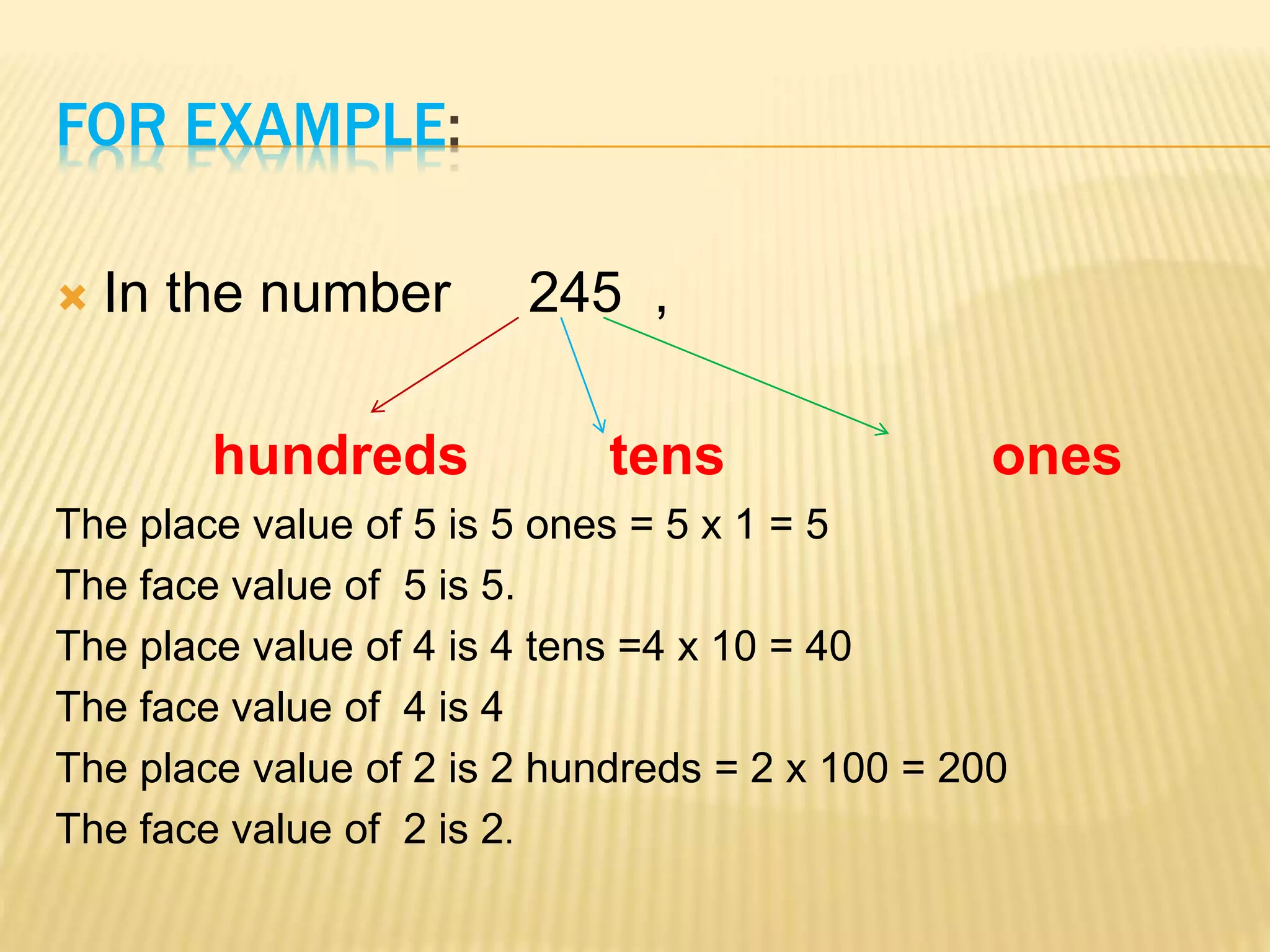
 In the number 245 ,
hundreds tens ones
The place value of 5 is 5 ones = 5 x 1 = 5
The face value of 5 is 5.
The place value of 4 is 4 tens =4 x 10 = 40
The face value of 4 is 4
The place value of 2 is 2 hundreds = 2 x 100 = 200
The face value of 2 is 2.
FOR EXAMPLE:
In a number 129 :
The place value of 9 is 9 × 1 = 9 as 9 is
at one’s or unit’s place.
The face value of 9 is 9.
The place value of 2 is 2 × 10 = 20 as 2 is at ten’s place.
The face value of 2 is 2.
the place value of 1 is 1 × 100 = 100 as 1 is
at hundred’s place.
The face value of 1 is 1.
ASSIGNMENT 2 : solve PZ2.
NUMBERS ON ABACUS:
 What is an abacus ?
 An abacus is an instrument with which we can
count numbers and understand the place value of
each digit in a number.
 An abacus has spikes depending upon number of
digits in a number.
 To count 3 digit number , we use 3 spike abacus .
 The spike on left most side is ones place , the
second left spike denotes tens place and right most
spike denotes hundreds place.
EXAMPLES SHOWING 3 DIGIT NUMBER ON
SPIKE ABACUS:
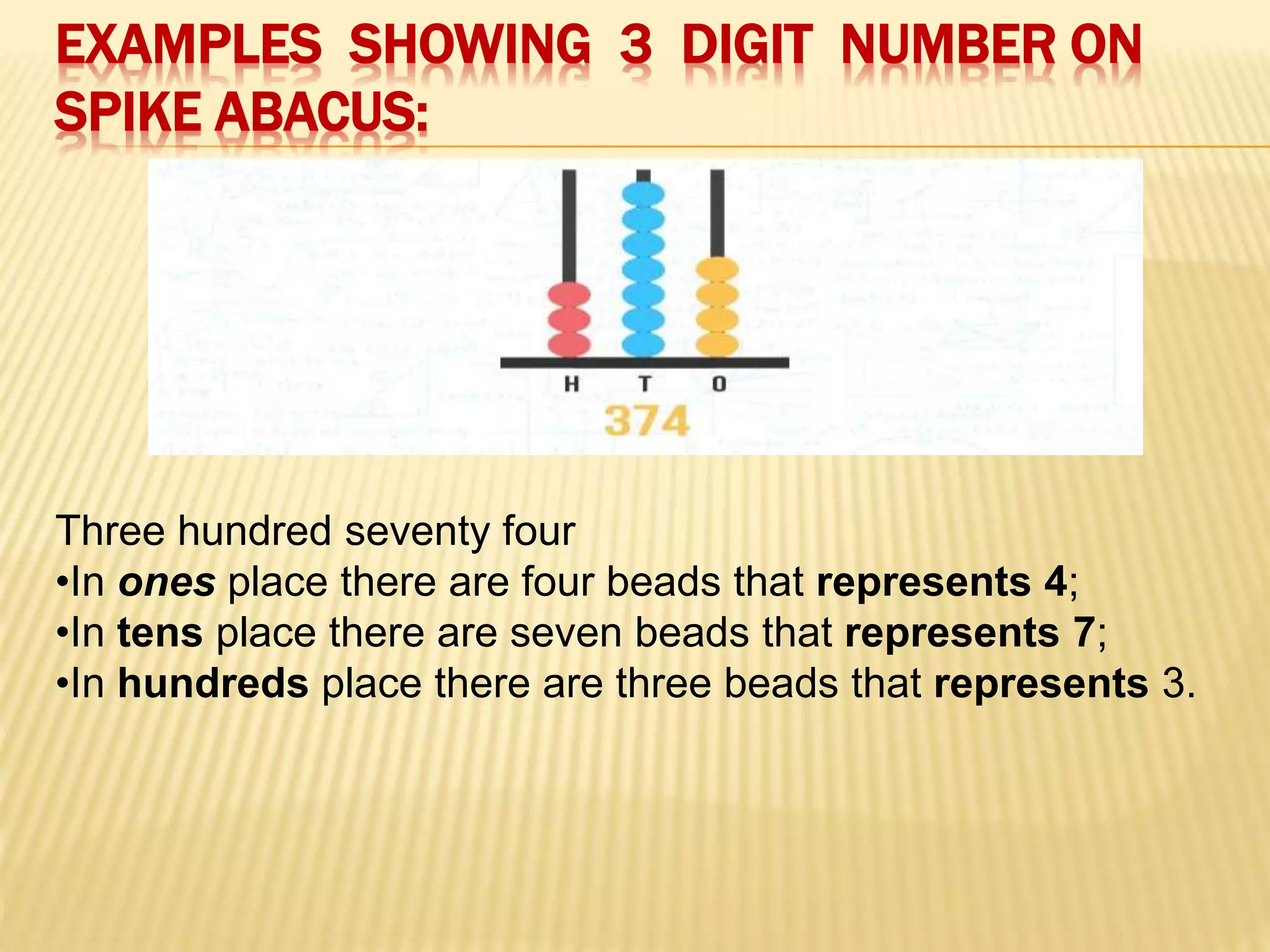
Three hundred seventy four
•In ones place there are four beads that represents 4;
•In tens place there are seven beads that represents 7;
•In hundreds place there are three beads that represents 3.
NOTE :
 To represent any number on abacus , we use
beads on spike on abacus .
 To show ‘0’ on the abacus , we do not place
any beads on the spike .
ASSIGNMENT 3 : solve PZ 3.
EXPANDED FORM OF A NUMBER :
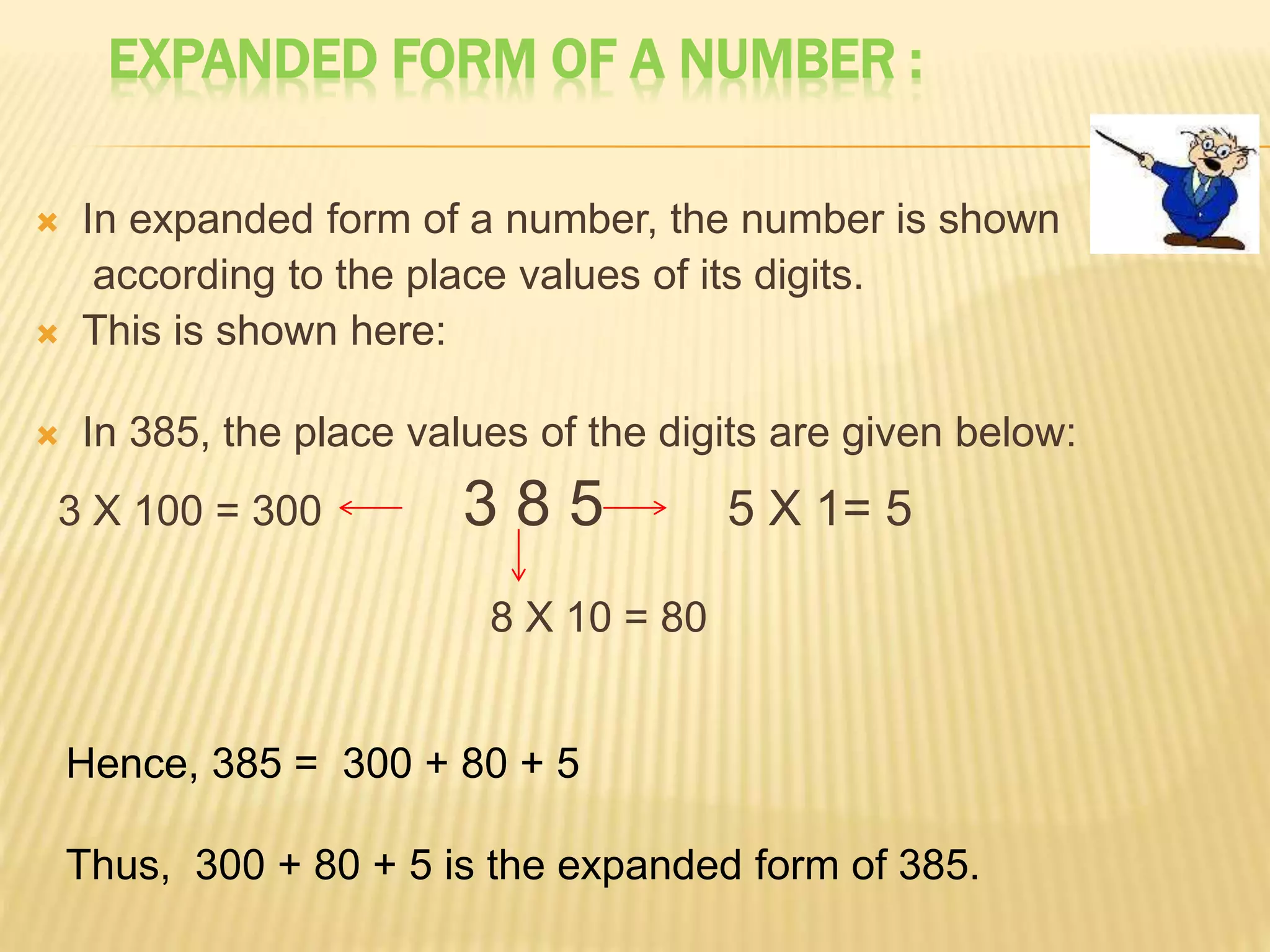
 In expanded form of a number, the number is shown
according to the place values of its digits.
 This is shown here:
 In 385, the place values of the digits are given below:
3 X 100 = 300 3 8 5 5 X 1= 5
8 X 10 = 80
Hence, 385 = 300 + 80 + 5
Thus, 300 + 80 + 5 is the expanded form of 385.
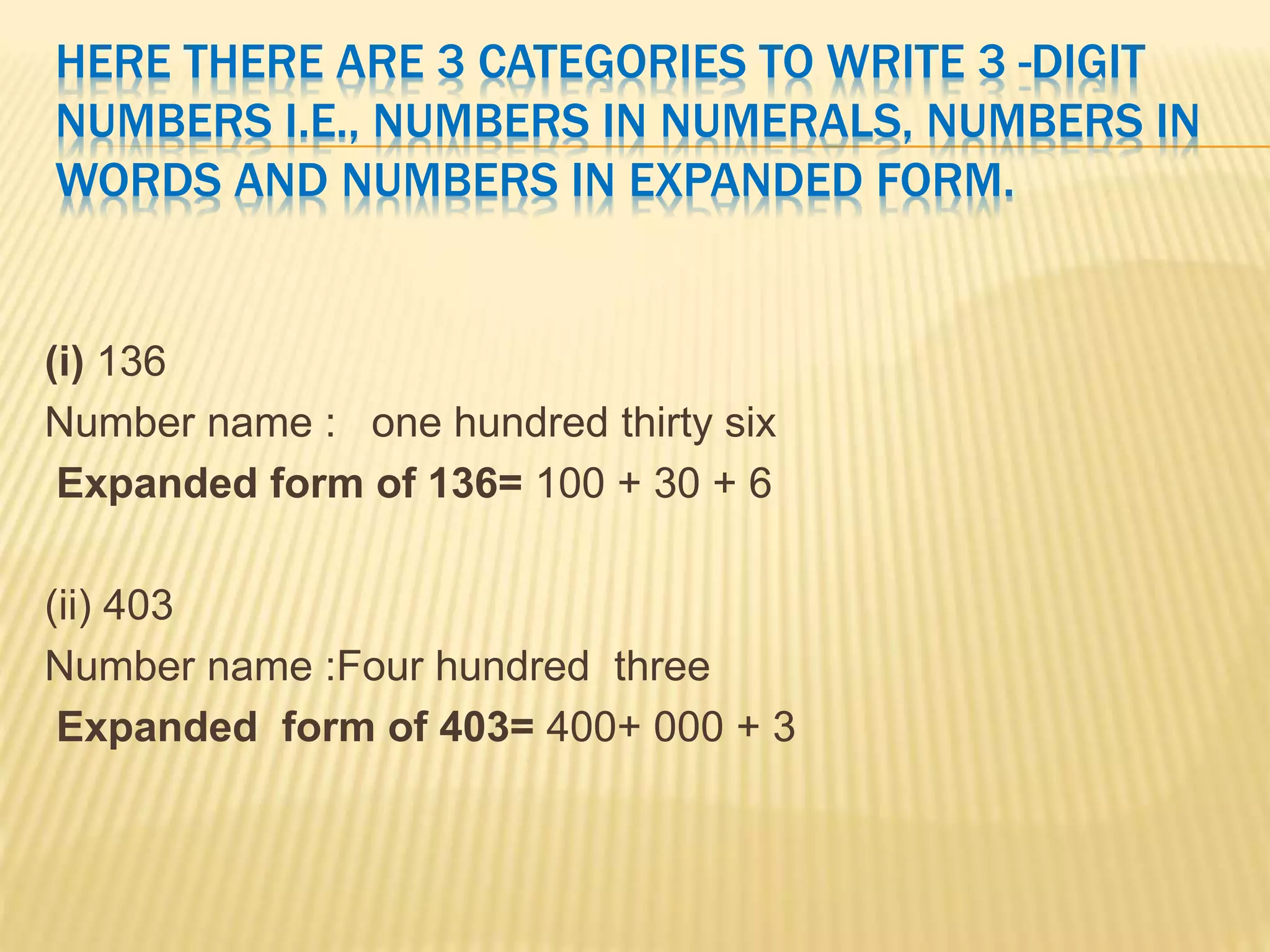
HERE THERE ARE 3 CATEGORIES TO WRITE 3 -DIGIT
NUMBERS I.E., NUMBERS IN NUMERALS, NUMBERS IN
WORDS AND NUMBERS IN EXPANDED FORM.
(i) 136
Number name : one hundred thirty six
Expanded form of 136= 100 + 30 + 6
(ii) 403
Number name :Four hundred three
Expanded form of 403= 400+ 000 + 3
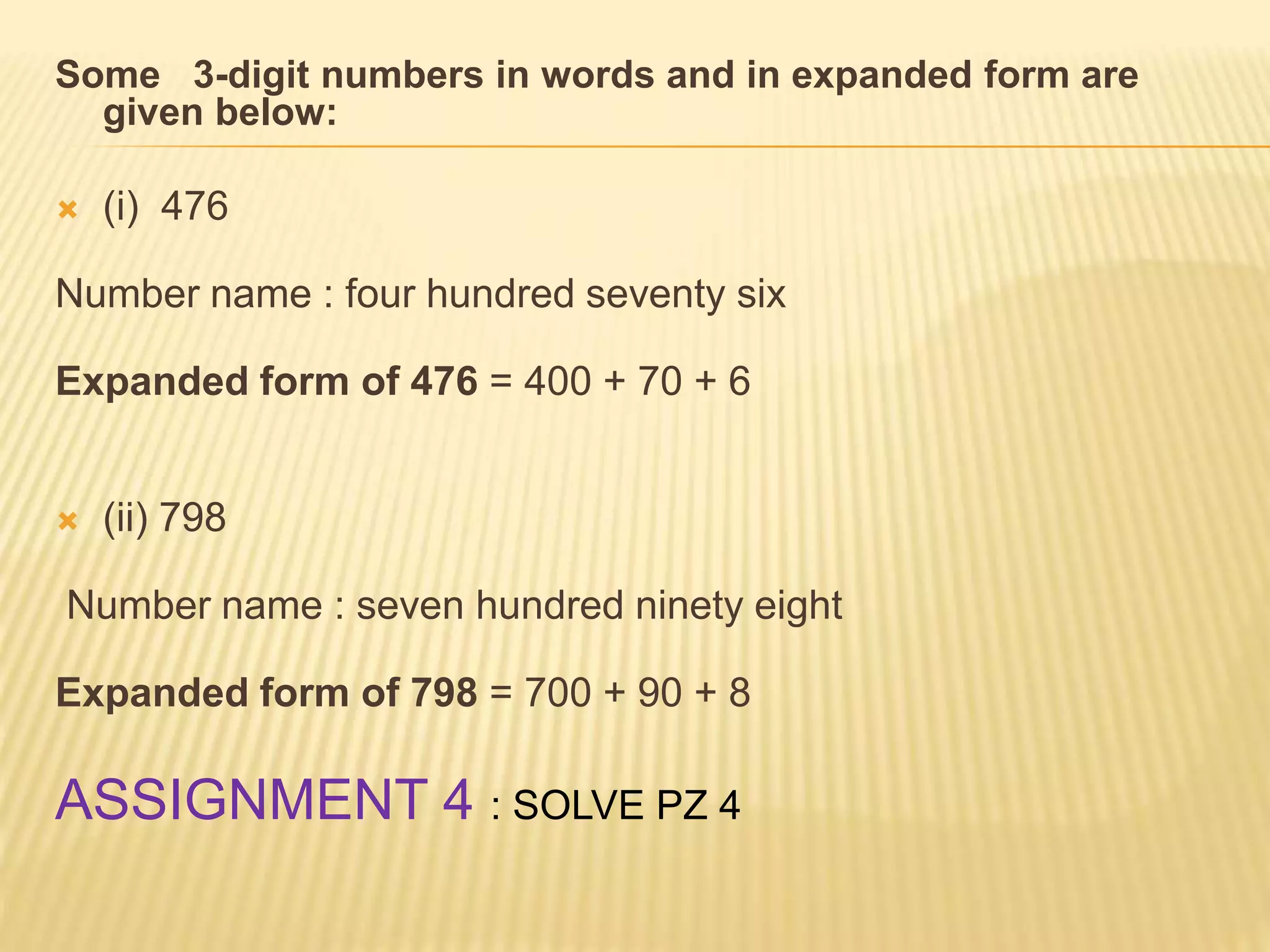
Some 3-digit numbers in words and in expanded form are
given below:
 (i) 476
Number name : four hundred seventy six
Expanded form of 476 = 400 + 70 + 6
 (ii) 798
Number name : seven hundred ninety eight
Expanded form of 798 = 700 + 90 + 8
ASSIGNMENT 4 : SOLVE PZ 4
BEFORE –BETWEEN – AFTER :
Do you remember what we mean by before-between - after
numbers?
 When we count backward from given number, we get the
numbers- before ..
 When we count forward from given number, we get the numbers-
after...
 For example: Which number comes before 180?
 Ans : 179 comes before 180.
 Which number comes after 180?
 Ans : 181 comes after 180.
 NOTE : 1. The number that comes before is called predecessor.
 2.The number that comes after is called successor.
 Between number : the number that comes in
between any two numbers is called between
number.
 For example :which number comes between 222
and 224?
 Ans: 223 is in between 222 and 224.
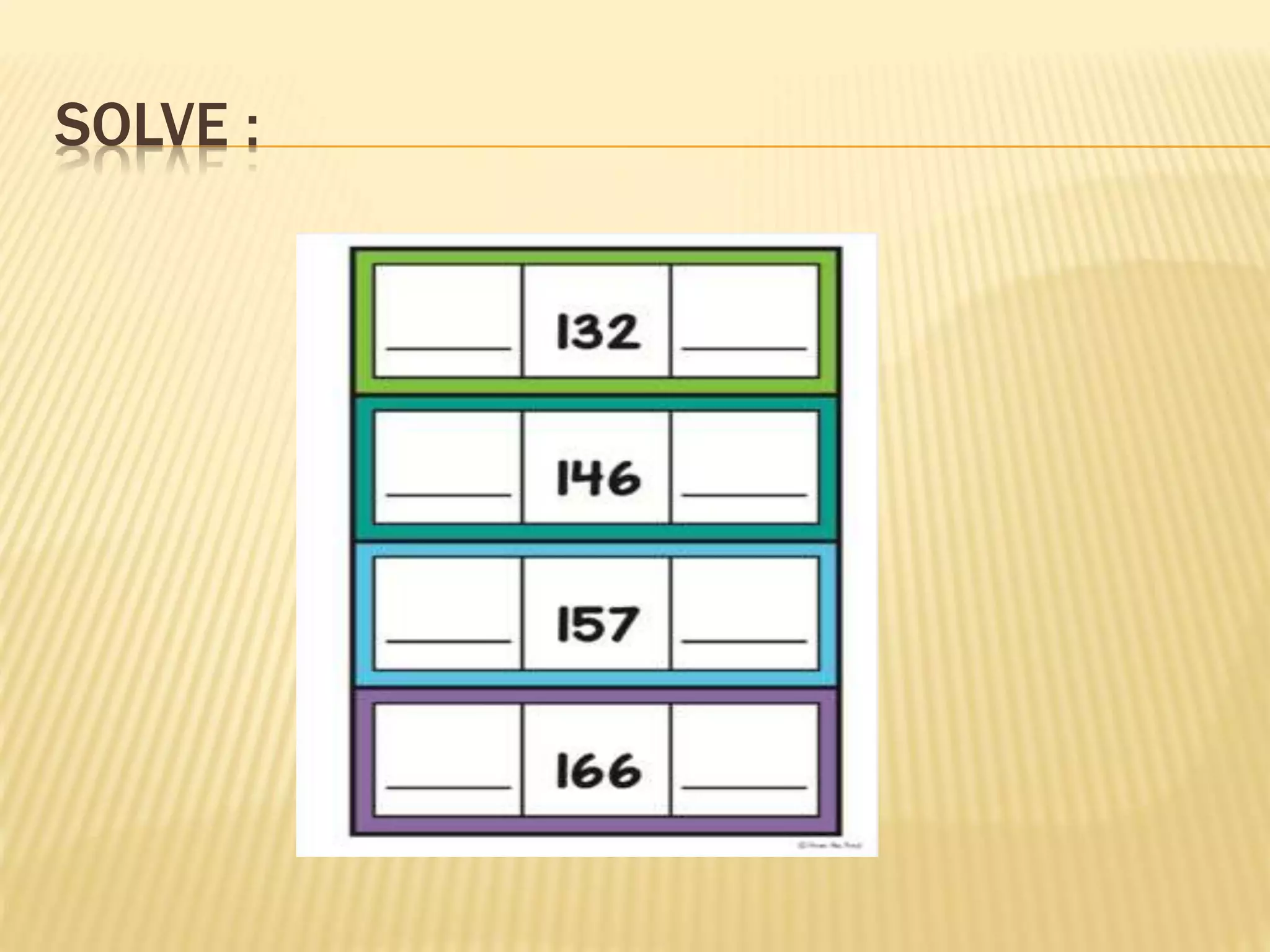
ASSIGNMENT 5 : solve PZ5
SOLVE :
COMPARISON OF NUMBERS :
 Rule (i) The number with more digits is greater than the number with
lesser digits.
 100 > 99 , 100 > 9
 Rule (ii) If both the numbers have the same numbers (three) of digits,
then the digits on the extreme left are compared.
 Case (a) If the third digit from the right (Hundred-place digit) of a number
is greater than the third digit from the right (Hundred-place digit) of the
other number then the number having the greater third digit from the
right, is the greater one.Thus, the number having the greater digit to its
extreme left, is the greater one,
 913 > 899 , 749 > 698 , 576 > 425
 Case (b) If the numbers have the same third digits from the right, then
the digits at ten’s place are compared and rules to compare two-digit
numbers are considered.
 958 > 949 , 876 > 867 , 564 > 559
 Case (c) If digits at Hundred-place and ten’s place are equal, the rules
to compare single digit numbers are considered.
 958 > 956 , 876 > 875 , 634 > 630
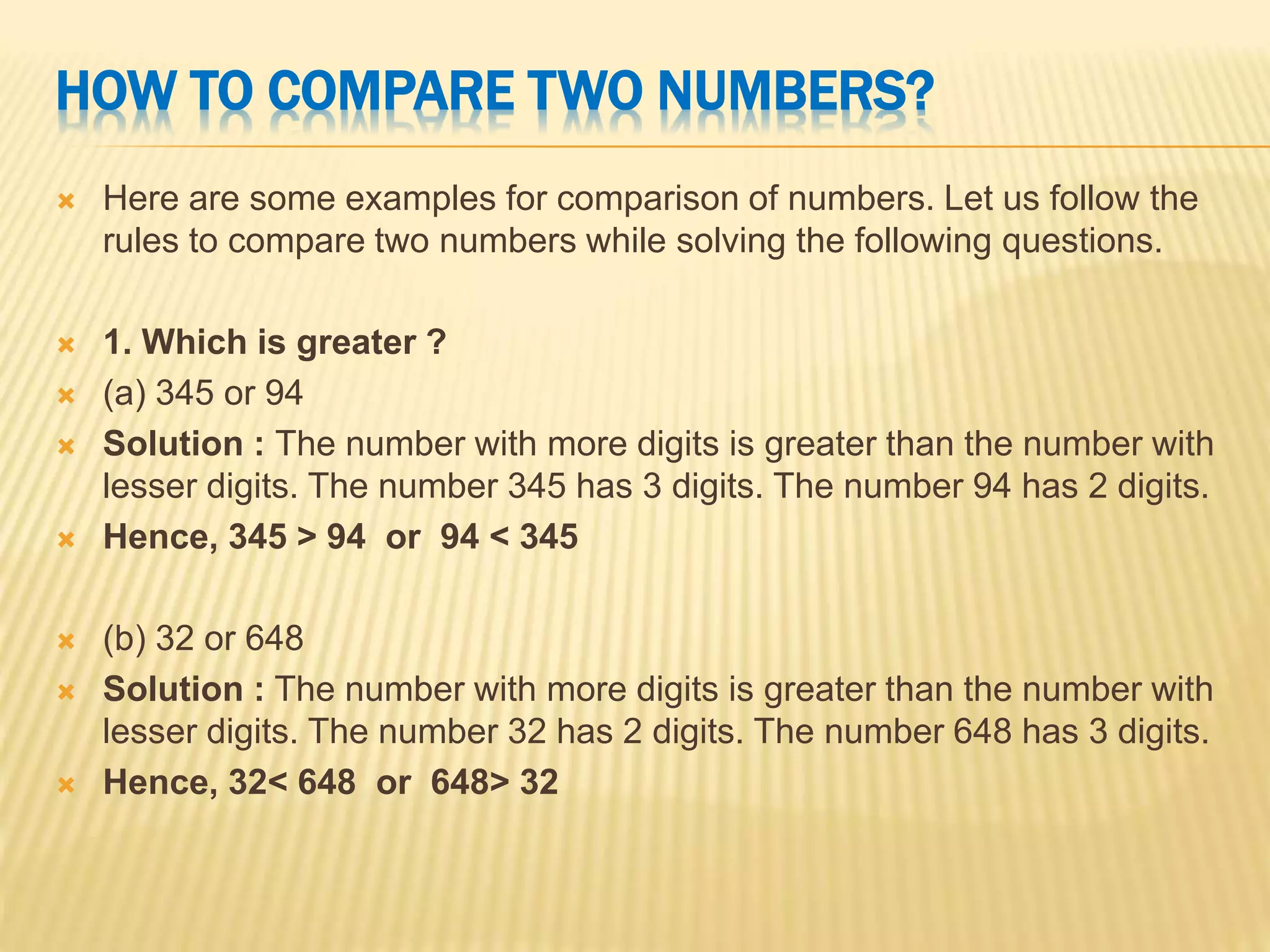
HOW TO COMPARE TWO NUMBERS?
 Here are some examples for comparison of numbers. Let us follow the
rules to compare two numbers while solving the following questions.
 1. Which is greater ?
 (a) 345 or 94
 Solution : The number with more digits is greater than the number with
lesser digits. The number 345 has 3 digits. The number 94 has 2 digits.
 Hence, 345 > 94 or 94 < 345
 (b) 32 or 648
 Solution : The number with more digits is greater than the number with
lesser digits. The number 32 has 2 digits. The number 648 has 3 digits.
 Hence, 32< 648 or 648> 32
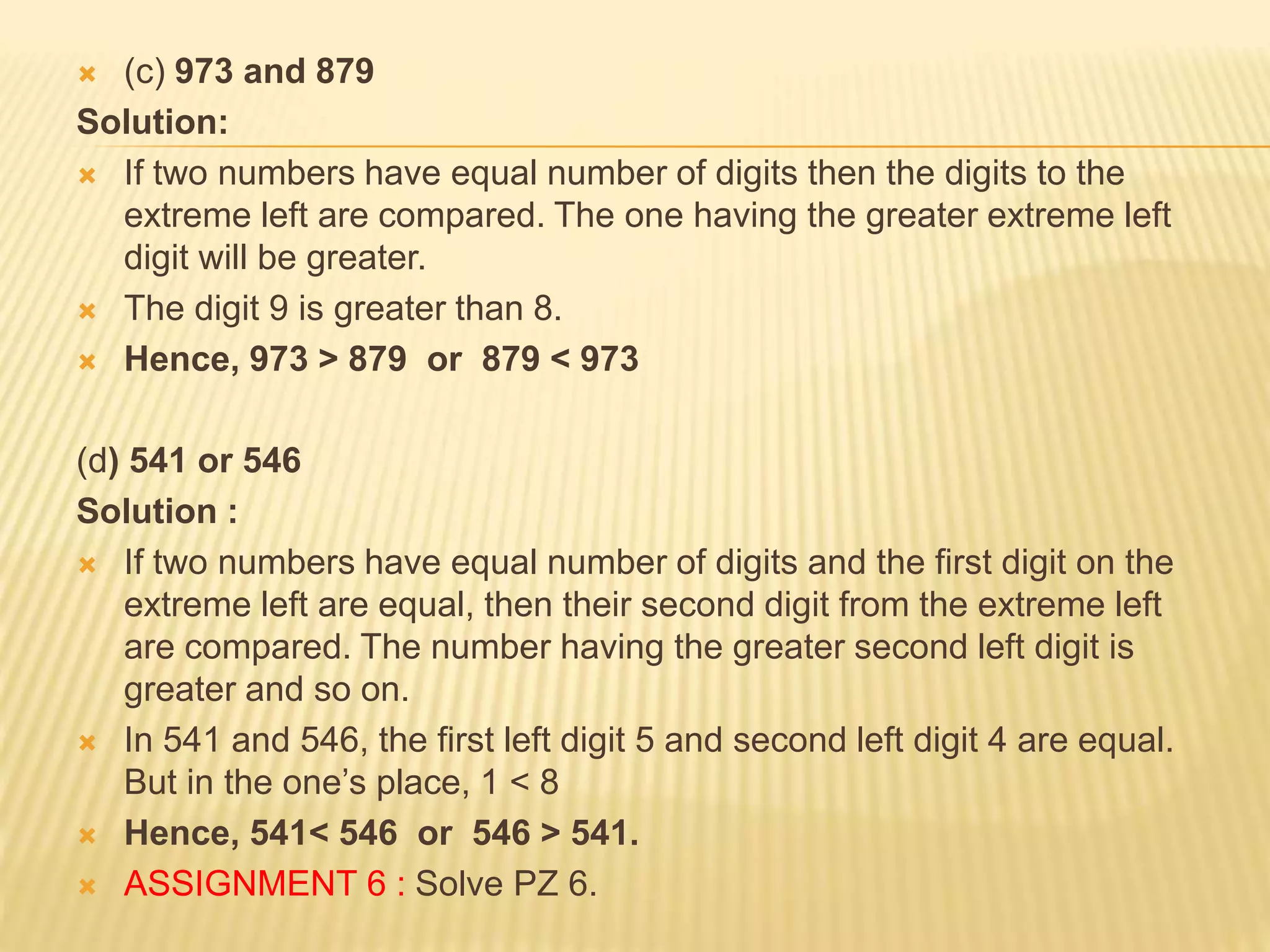
 (c) 973 and 879
Solution:
 If two numbers have equal number of digits then the digits to the
extreme left are compared. The one having the greater extreme left
digit will be greater.
 The digit 9 is greater than 8.
 Hence, 973 > 879 or 879 < 973
(d) 541 or 546
Solution :
 If two numbers have equal number of digits and the first digit on the
extreme left are equal, then their second digit from the extreme left
are compared. The number having the greater second left digit is
greater and so on.
 In 541 and 546, the first left digit 5 and second left digit 4 are equal.
But in the one’s place, 1 < 8
 Hence, 541< 546 or 546 > 541.
 ASSIGNMENT 6 : Solve PZ 6.
INCREASING AND DESCENDING ORDER :
When we arrange numbers from the smallest number to
the largest number, then the numbers are arranged in
ascending order OR INCREASING ORDER .
while arranging numbers from the largest number to the
smallest number then the numbers are arranged in
descending order. OR DECREASING ORDER.
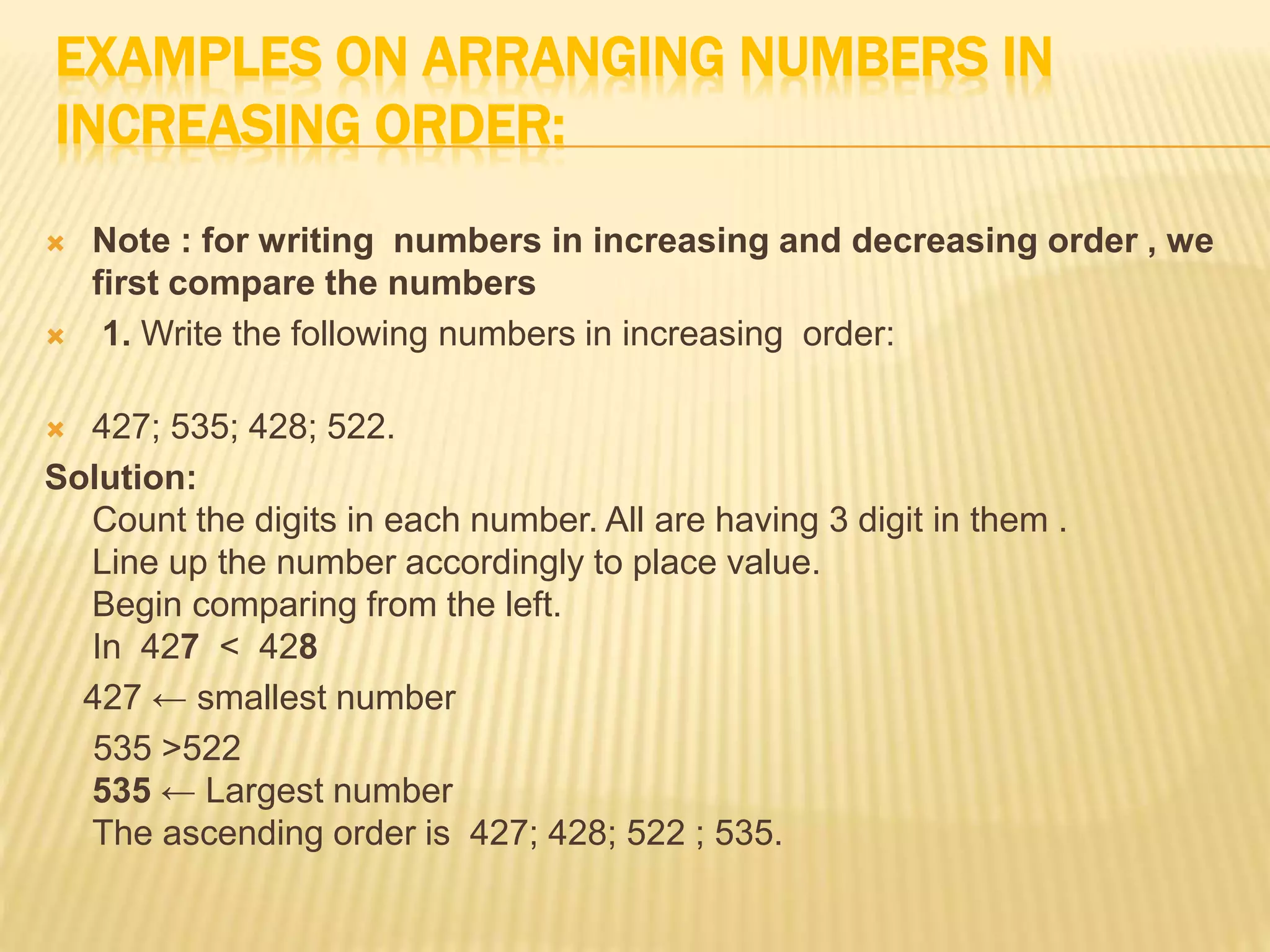
EXAMPLES ON ARRANGING NUMBERS IN
INCREASING ORDER:
 Note : for writing numbers in increasing and decreasing order , we
first compare the numbers
 1. Write the following numbers in increasing order:
 427; 535; 428; 522.
Solution:
Count the digits in each number. All are having 3 digit in them .
Line up the number accordingly to place value.
Begin comparing from the left.
In 427 < 428
427 ← smallest number
535 >522
535 ← Largest number
The ascending order is 427; 428; 522 ; 535.
 2. Arranging numbers in increasing order:
 367; 354; 379; 353
Solution:
 The digit in the hundreds place in each number is 3.
 On comparing the tens place; 367; 354; 379; 353
 We find: 379 to be the greatest and 353 to be
smallest.
 So, the increasing order is 353< 354 < 367 < 379.
EXAMPLE ON ARRANGING NUMBERS IN
DECREASING ORDER:
3. Write in decreasing order:
 325; 605; 285; 571
Solution:
Compare digits according to place value.
 Decreasing order means arranging numbers from the largest
number to the smallest number;
 605 > 571 > 325 > 285
 ASSIGNMENT 7 : Solve PZ 7.
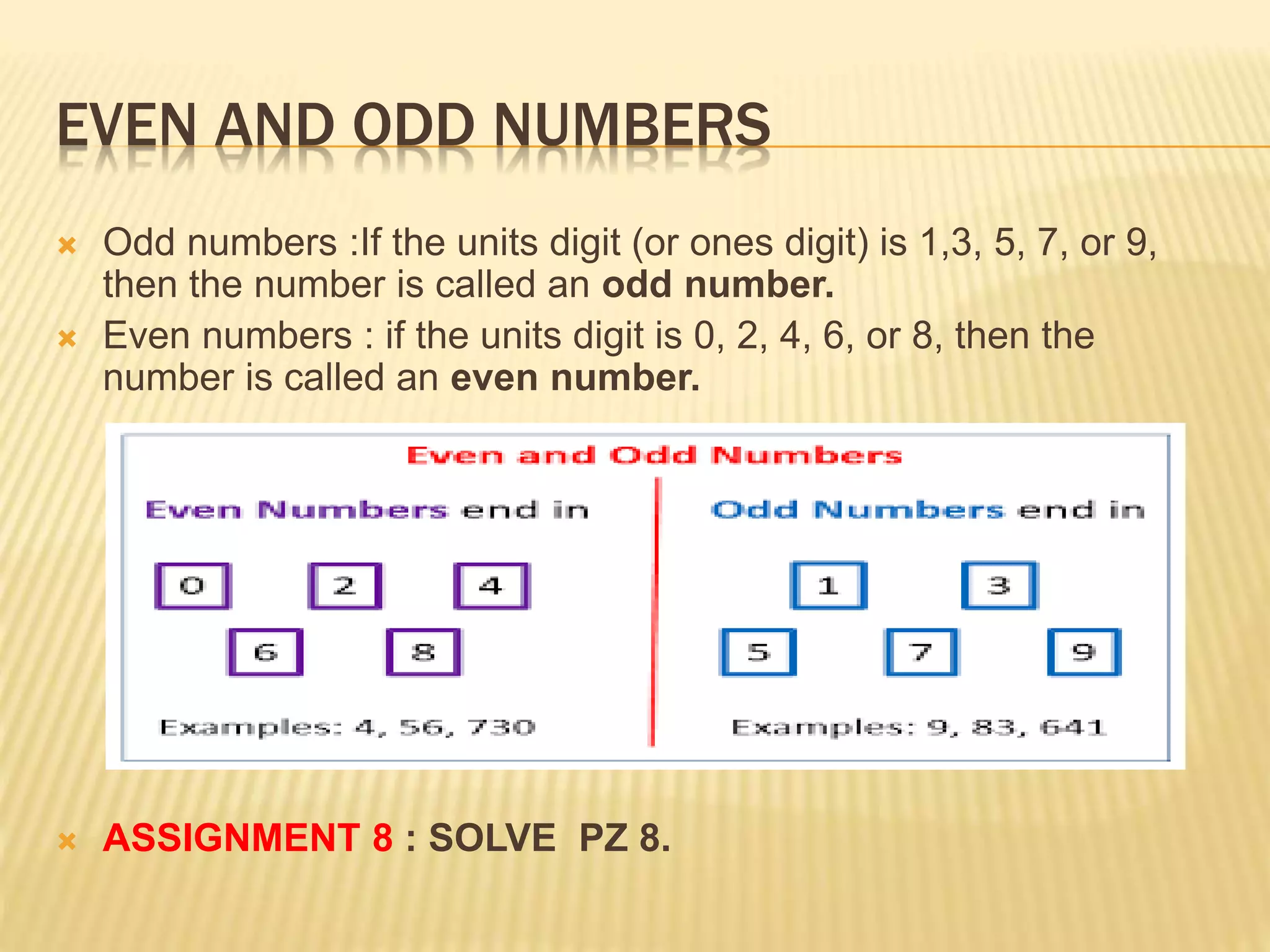
EVEN AND ODD NUMBERS
 Odd numbers :If the units digit (or ones digit) is 1,3, 5, 7, or 9,
then the number is called an odd number.
 Even numbers : if the units digit is 0, 2, 4, 6, or 8, then the
number is called an even number.
 ASSIGNMENT 8 : SOLVE PZ 8.
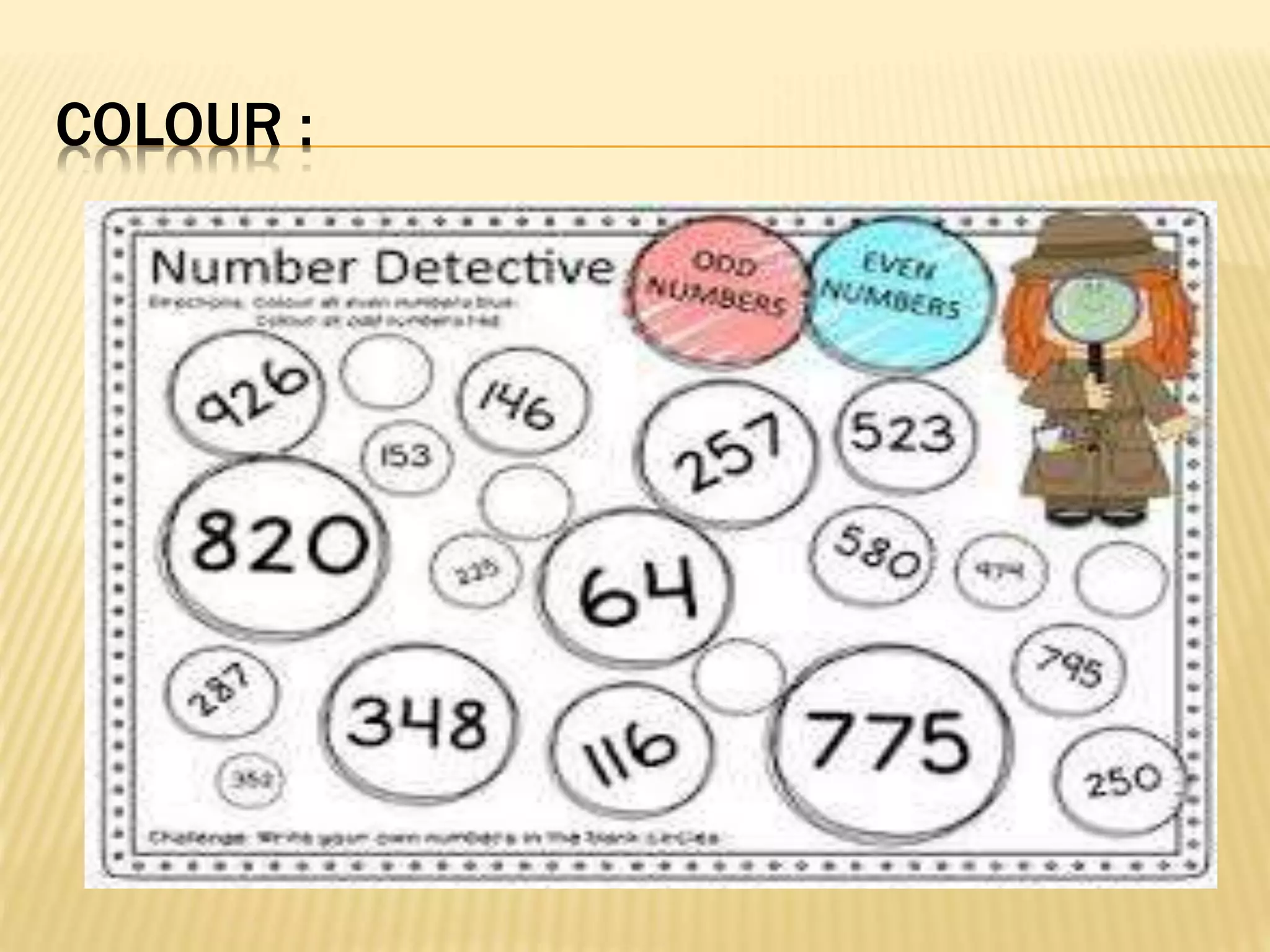
COLOUR :
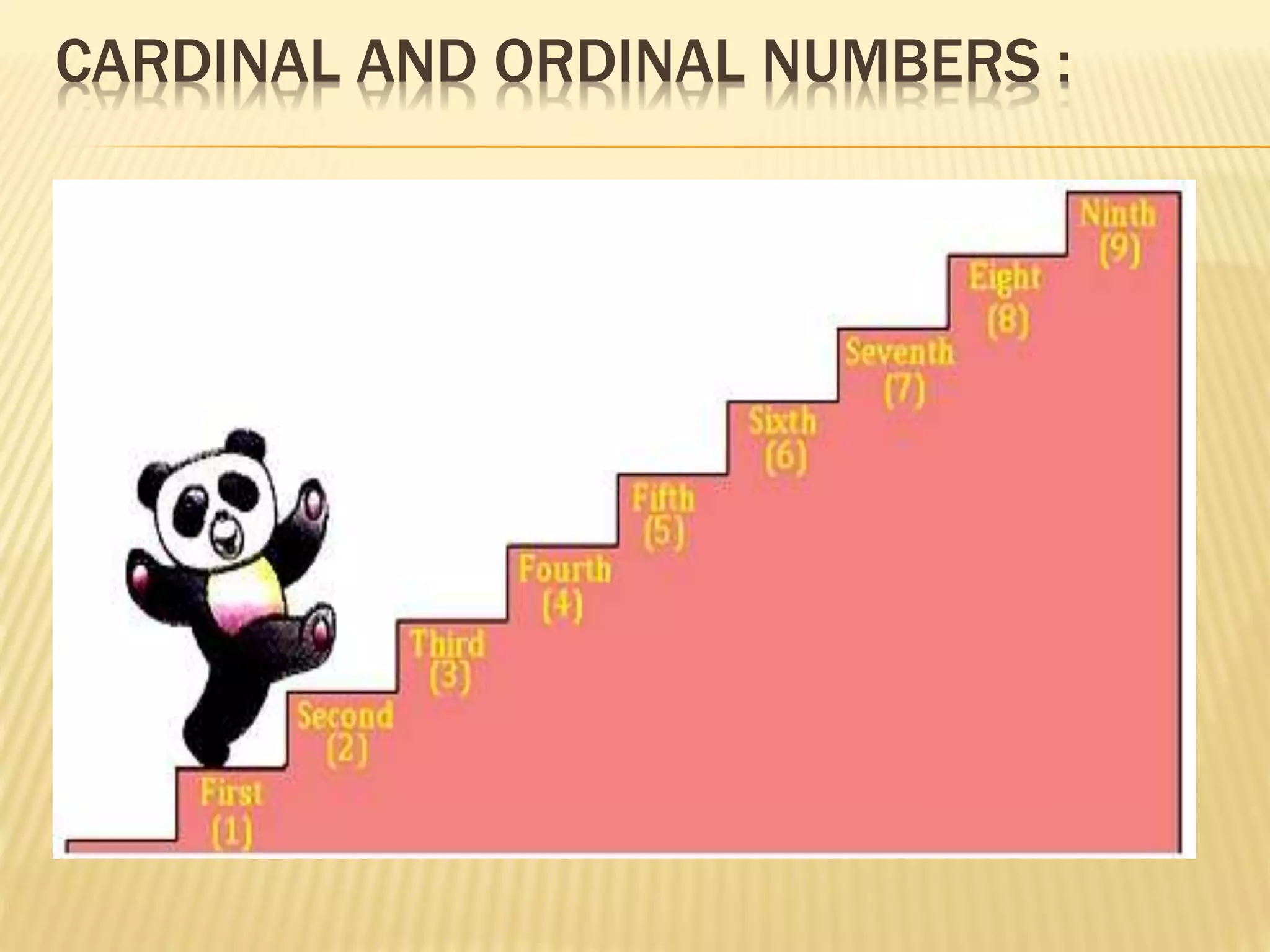
CARDINAL AND ORDINAL NUMBERS :
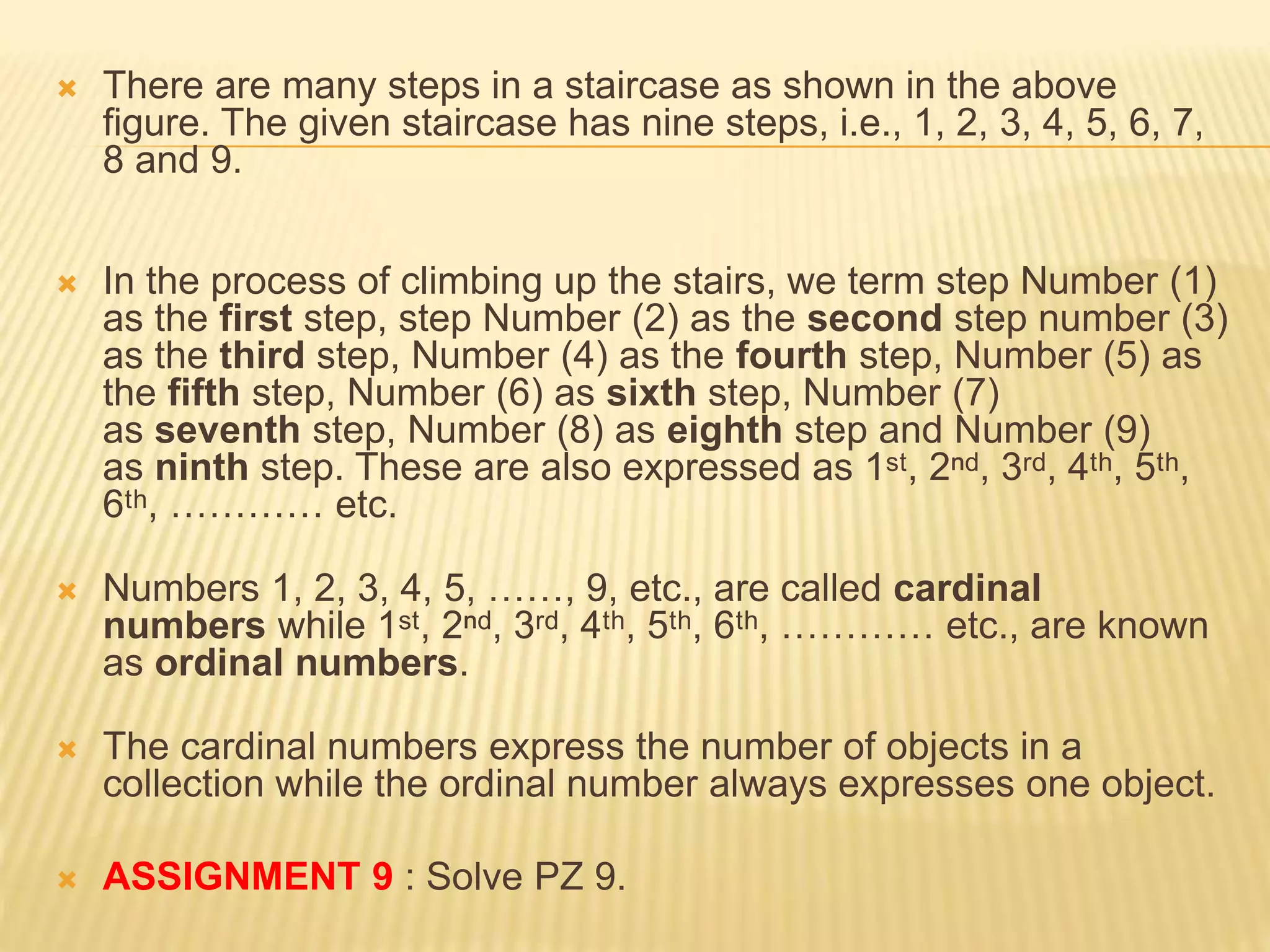
 There are many steps in a staircase as shown in the above
figure. The given staircase has nine steps, i.e., 1, 2, 3, 4, 5, 6, 7,
8 and 9.
 In the process of climbing up the stairs, we term step Number (1)
as the first step, step Number (2) as the second step number (3)
as the third step, Number (4) as the fourth step, Number (5) as
the fifth step, Number (6) as sixth step, Number (7)
as seventh step, Number (8) as eighth step and Number (9)
as ninth step. These are also expressed as 1ˢᵗ, 2ⁿᵈ, 3ʳᵈ, 4ᵗʰ, 5ᵗʰ,
6ᵗʰ, ………… etc.
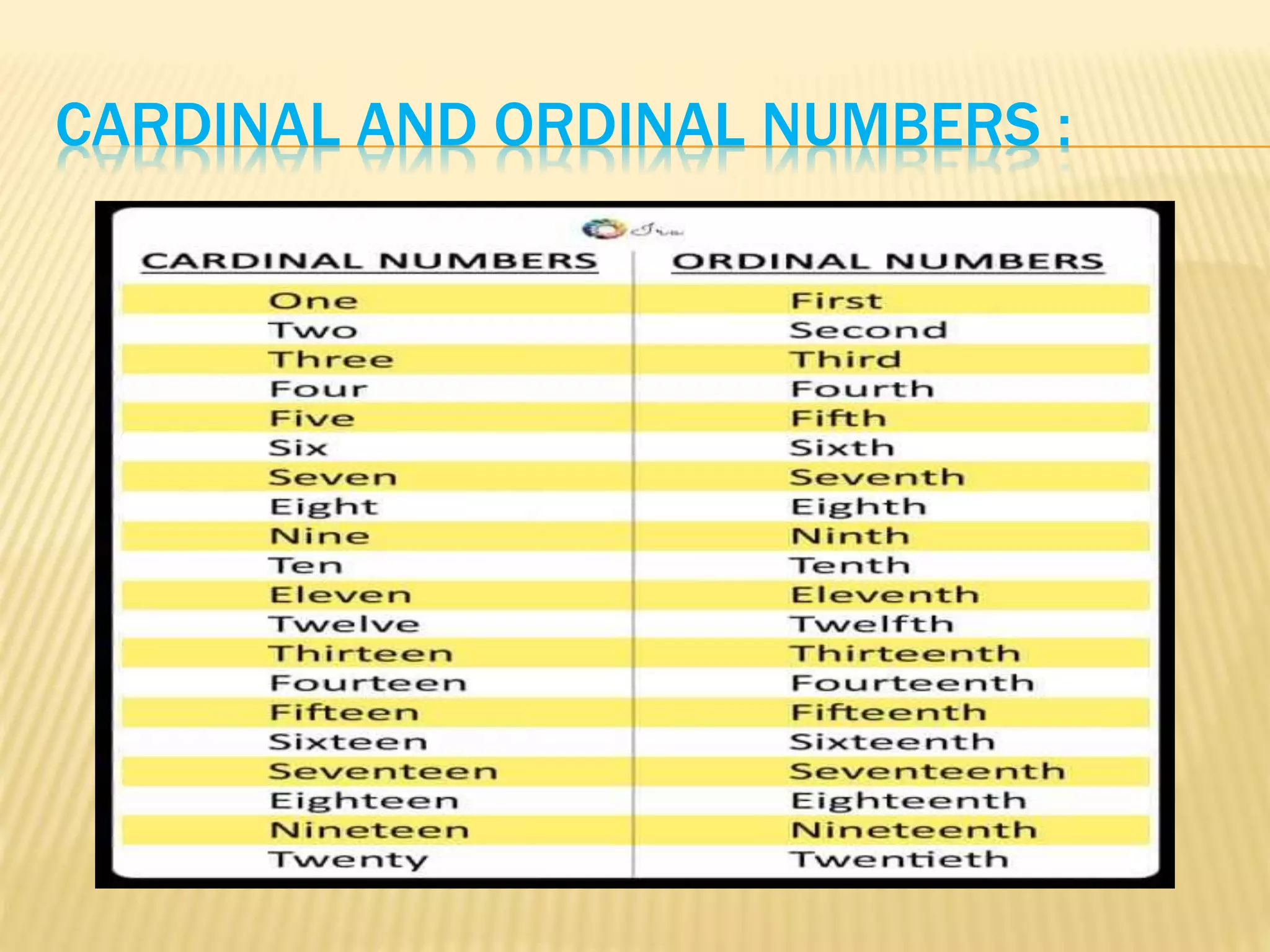
 Numbers 1, 2, 3, 4, 5, ……, 9, etc., are called cardinal
numbers while 1ˢᵗ, 2ⁿᵈ, 3ʳᵈ, 4ᵗʰ, 5ᵗʰ, 6ᵗʰ, ………… etc., are known
as ordinal numbers.
 The cardinal numbers express the number of objects in a
collection while the ordinal number always expresses one object.
 ASSIGNMENT 9 : Solve PZ 9.
CARDINAL AND ORDINAL NUMBERS :
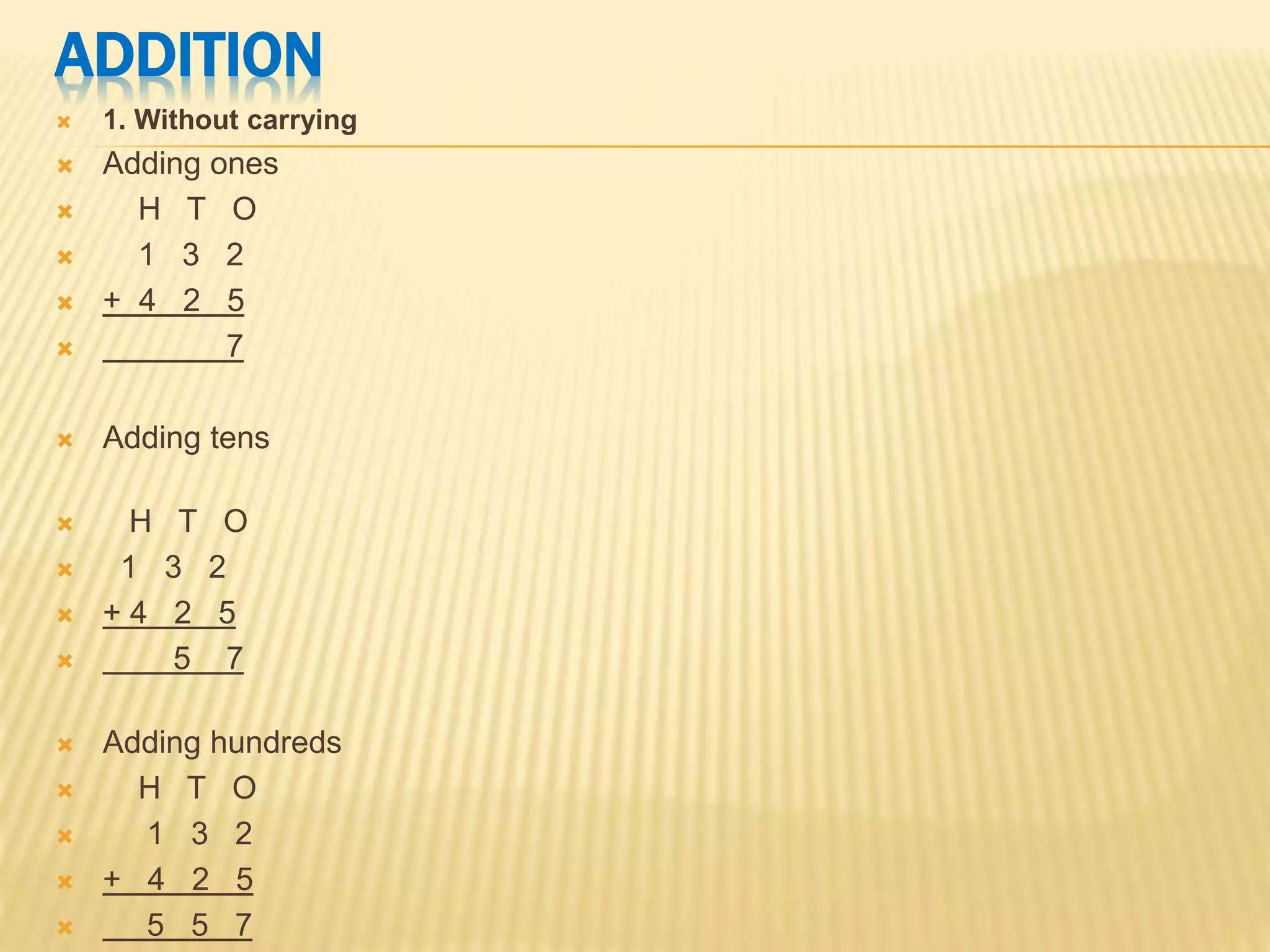
ADDITION
 1. Without carrying
 Adding ones
 H T O
 1 3 2
 + 4 2 5
 7
 Adding tens
 H T O
 1 3 2
 + 4 2 5
 5 7
 Adding hundreds
 H T O
 1 3 2
 + 4 2 5
 5 5 7
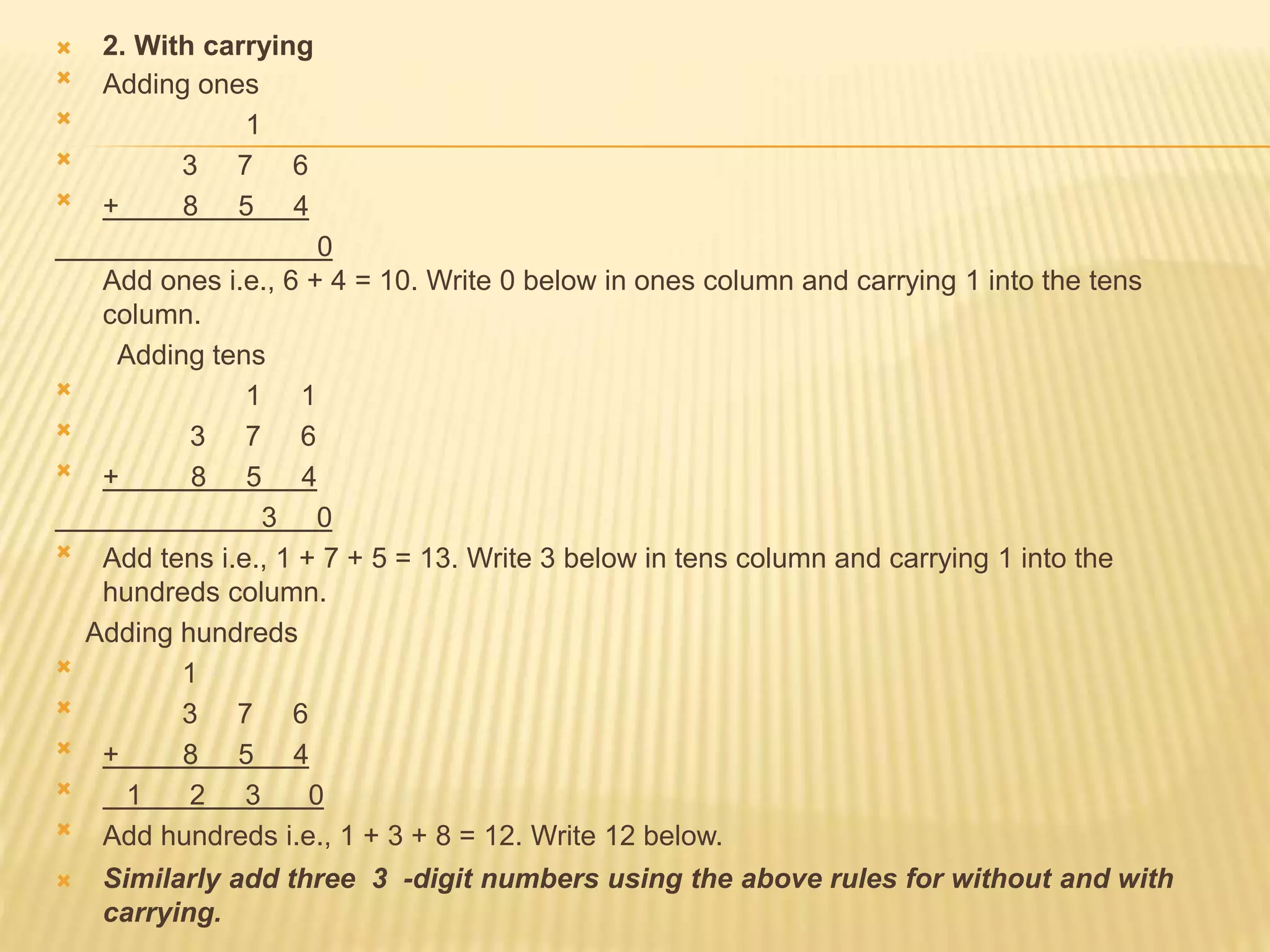
 2. With carrying
 Adding ones
 1
 3 7 6
 + 8 5 4
0
Add ones i.e., 6 + 4 = 10. Write 0 below in ones column and carrying 1 into the tens
column.
Adding tens
 1 1
 3 7 6
 + 8 5 4
3 0
 Add tens i.e., 1 + 7 + 5 = 13. Write 3 below in tens column and carrying 1 into the
hundreds column.
Adding hundreds
 1
 3 7 6
 + 8 5 4
 1 2 3 0
 Add hundreds i.e., 1 + 3 + 8 = 12. Write 12 below.
 Similarly add three 3 -digit numbers using the above rules for without and with
carrying.
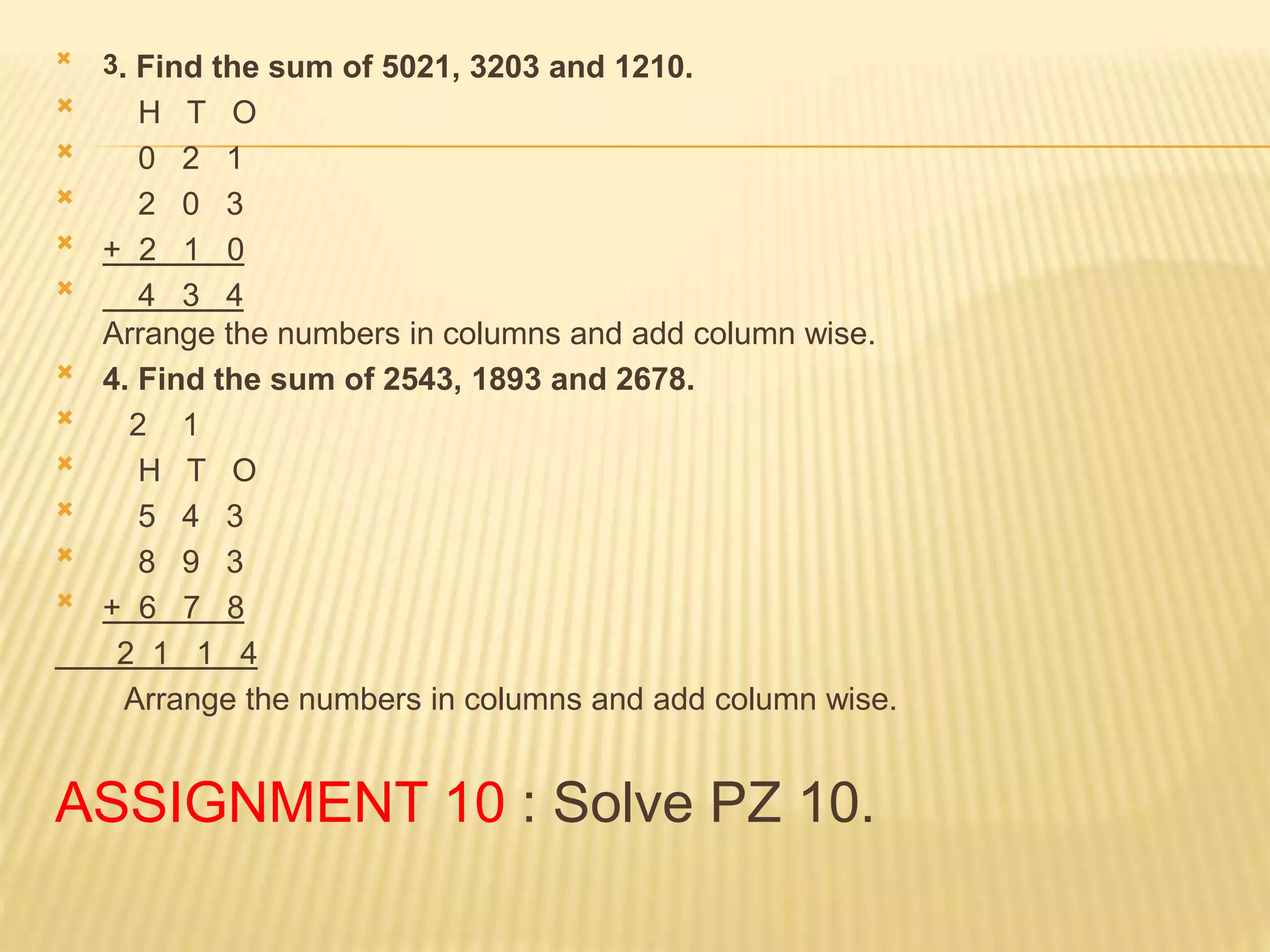
 3. Find the sum of 5021, 3203 and 1210.
 H T O
 0 2 1
 2 0 3
 + 2 1 0
 4 3 4
Arrange the numbers in columns and add column wise.
 4. Find the sum of 2543, 1893 and 2678.
 2 1
 H T O
 5 4 3
 8 9 3
 + 6 7 8
2 1 1 4
Arrange the numbers in columns and add column wise.
ASSIGNMENT 10 : Solve PZ 10.
SUBTRACTION
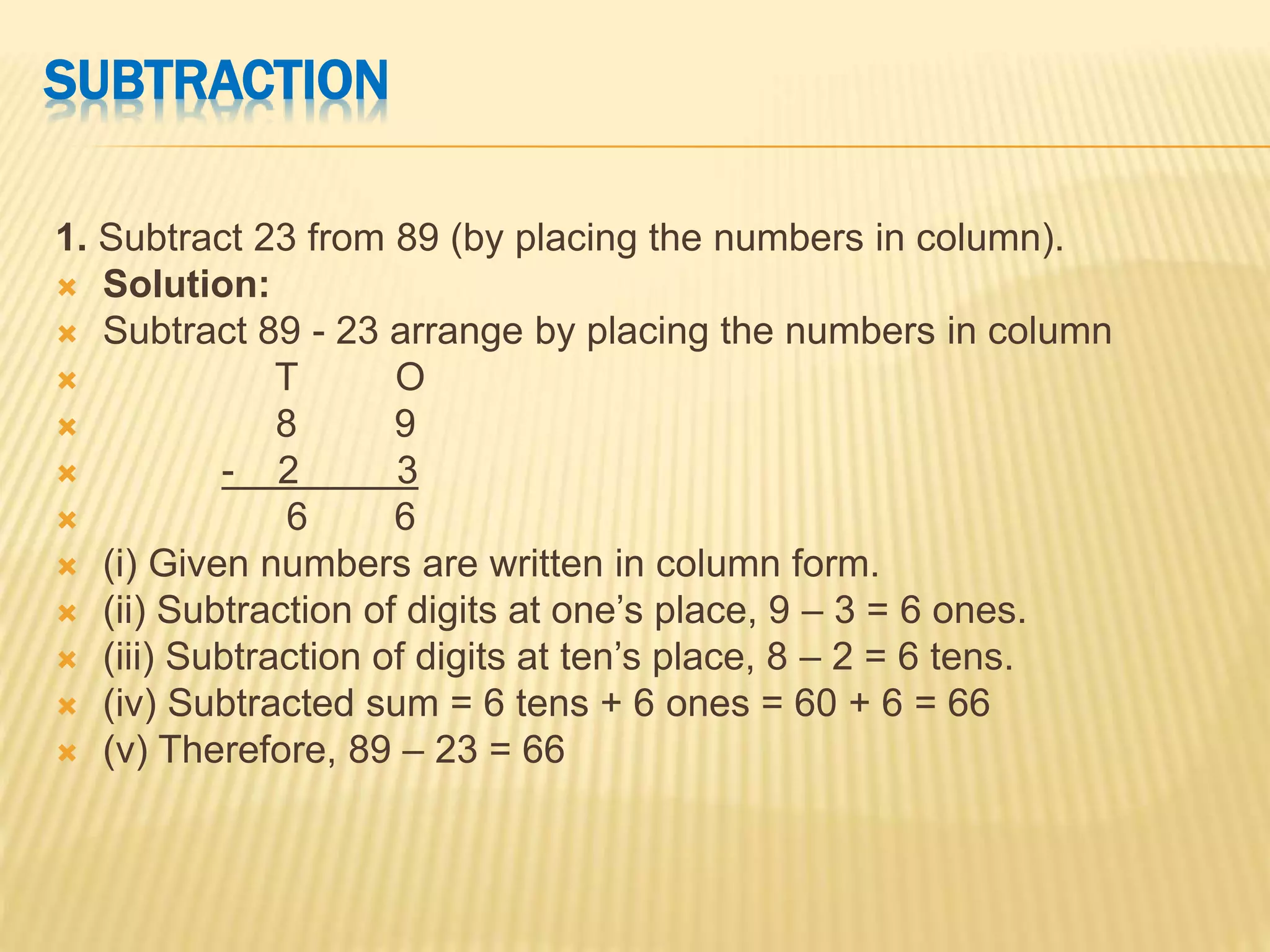
1. Subtract 23 from 89 (by placing the numbers in column).
 Solution:
 Subtract 89 - 23 arrange by placing the numbers in column
 T O
 8 9
 - 2 3
 6 6
 (i) Given numbers are written in column form.
 (ii) Subtraction of digits at one’s place, 9 – 3 = 6 ones.
 (iii) Subtraction of digits at ten’s place, 8 – 2 = 6 tens.
 (iv) Subtracted sum = 6 tens + 6 ones = 60 + 6 = 66
 (v) Therefore, 89 – 23 = 66
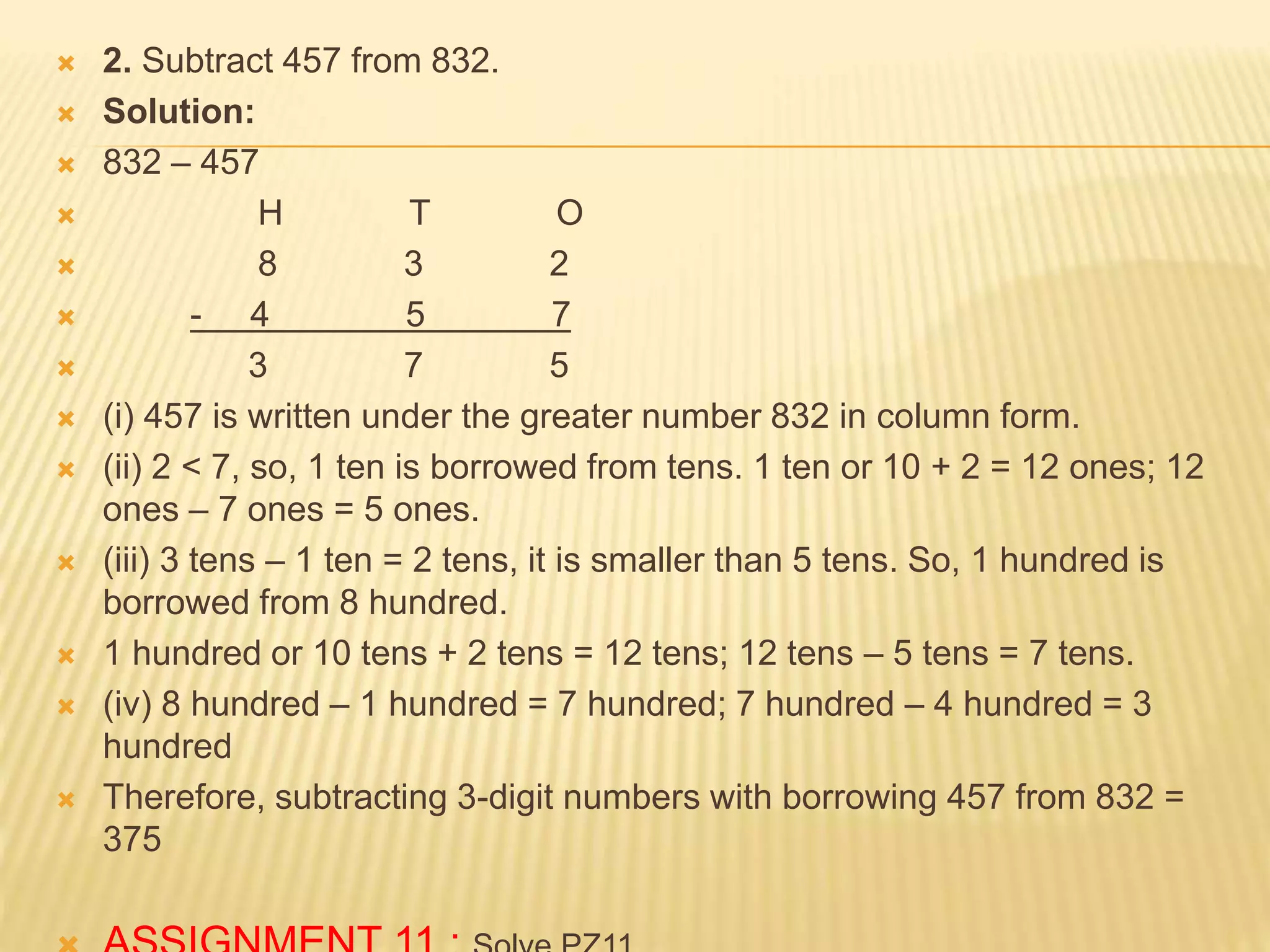
 2. Subtract 457 from 832.
 Solution:
 832 – 457
 H T O
 8 3 2
 - 4 5 7
 3 7 5
 (i) 457 is written under the greater number 832 in column form.
 (ii) 2 < 7, so, 1 ten is borrowed from tens. 1 ten or 10 + 2 = 12 ones; 12
ones – 7 ones = 5 ones.
 (iii) 3 tens – 1 ten = 2 tens, it is smaller than 5 tens. So, 1 hundred is
borrowed from 8 hundred.
 1 hundred or 10 tens + 2 tens = 12 tens; 12 tens – 5 tens = 7 tens.
 (iv) 8 hundred – 1 hundred = 7 hundred; 7 hundred – 4 hundred = 3
hundred
 Therefore, subtracting 3-digit numbers with borrowing 457 from 832 =
375
MULTIPLICATION
 In multiplication, the number being multiplied is called the
multiplicand and the number by which it is being multiplied
is called the multiplier.
 Examples of multiplying one-digit numbers:
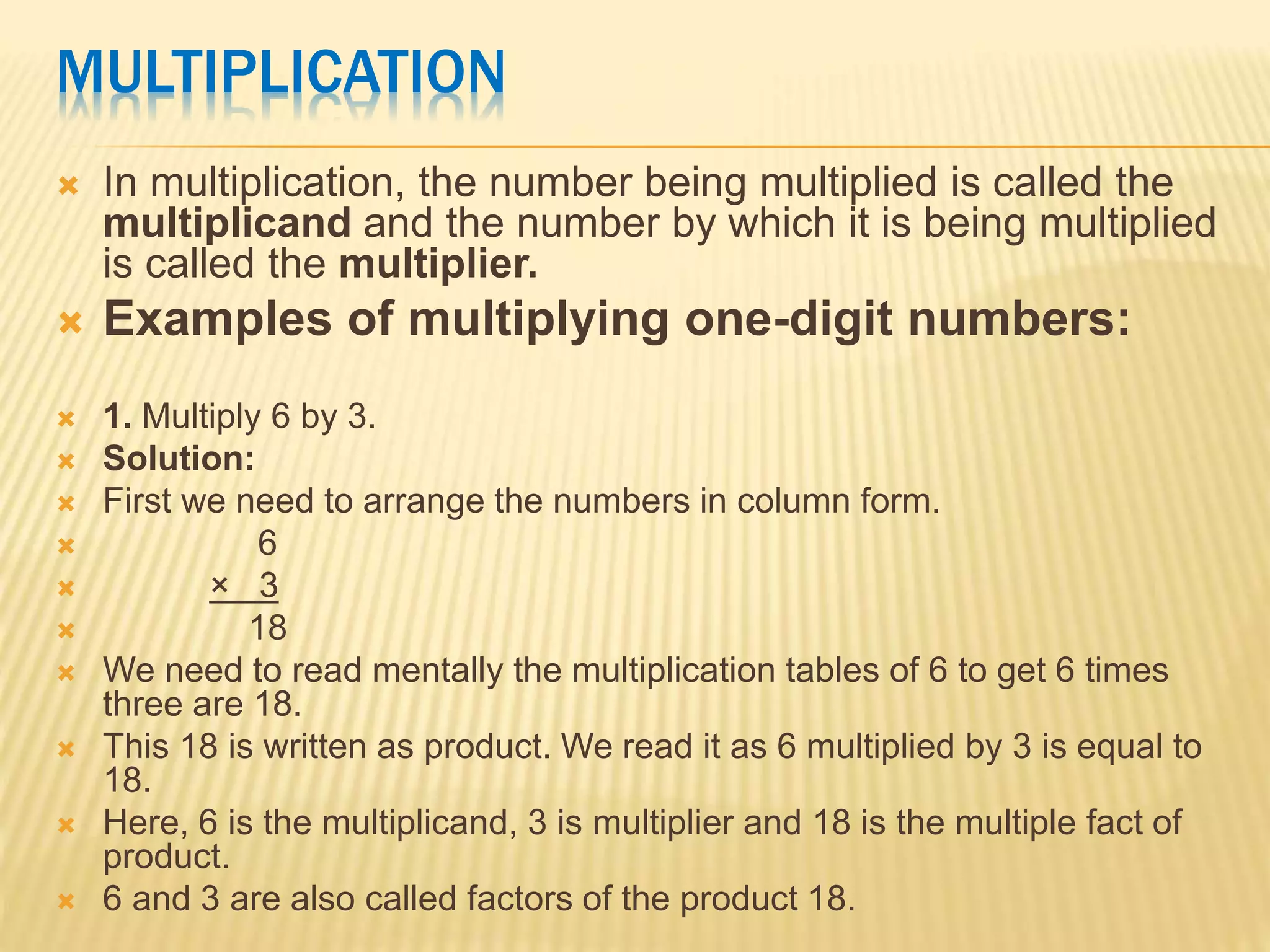
 1. Multiply 6 by 3.
 Solution:
 First we need to arrange the numbers in column form.
 6
 × 3
 18
 We need to read mentally the multiplication tables of 6 to get 6 times
three are 18.
 This 18 is written as product. We read it as 6 multiplied by 3 is equal to
18.
 Here, 6 is the multiplicand, 3 is multiplier and 18 is the multiple fact of
product.
 6 and 3 are also called factors of the product 18.
 Examples of multiplying 2-digit number by 1-digit
number:
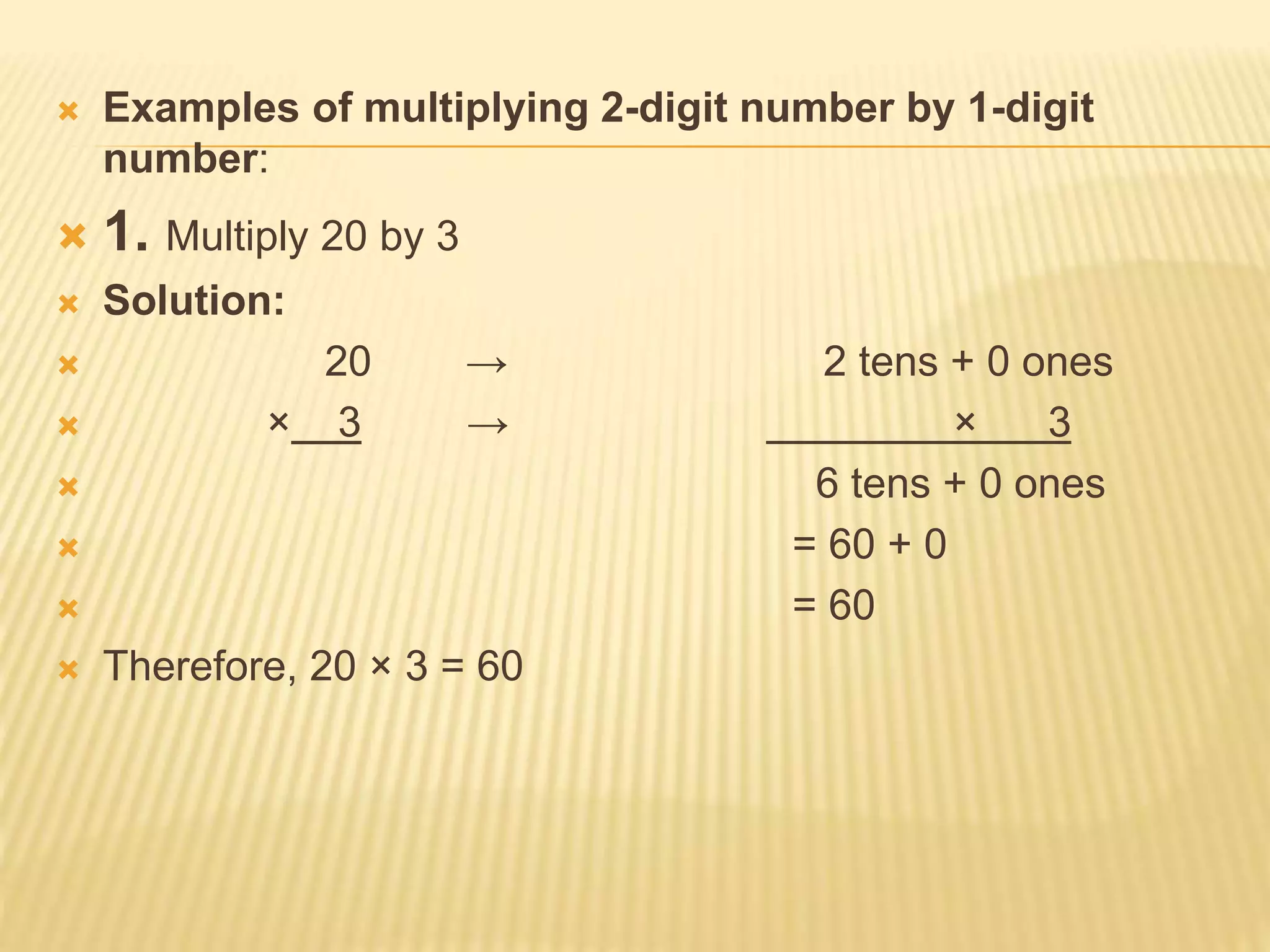
 1. Multiply 20 by 3
 Solution:
 20 → 2 tens + 0 ones
 × 3 → × 3
 6 tens + 0 ones
 = 60 + 0
 = 60
 Therefore, 20 × 3 = 60
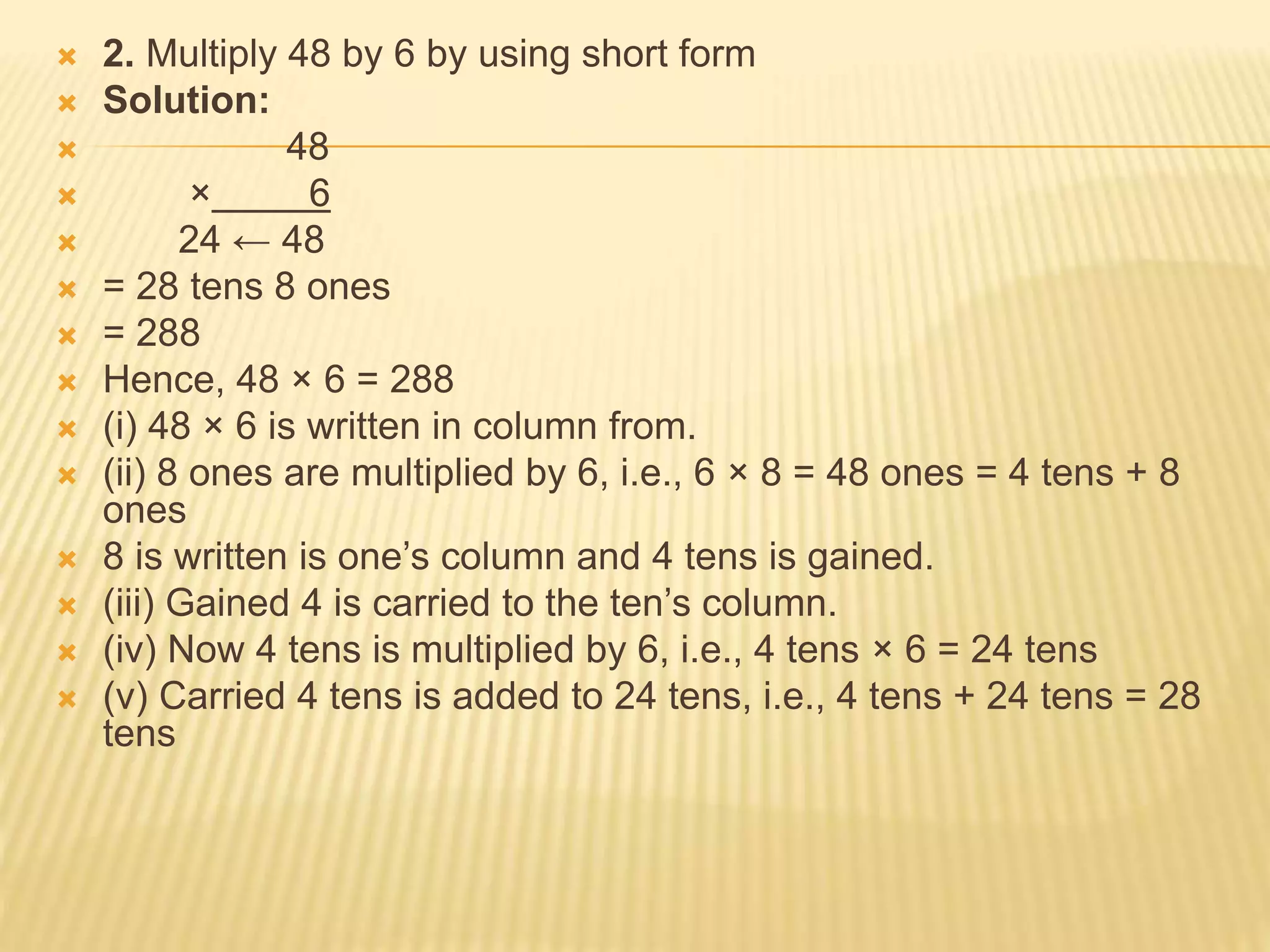
 2. Multiply 48 by 6 by using short form
 Solution:
 48
 × 6
 24 ← 48
 = 28 tens 8 ones
 = 288
 Hence, 48 × 6 = 288
 (i) 48 × 6 is written in column from.
 (ii) 8 ones are multiplied by 6, i.e., 6 × 8 = 48 ones = 4 tens + 8
ones
 8 is written is one’s column and 4 tens is gained.
 (iii) Gained 4 is carried to the ten’s column.
 (iv) Now 4 tens is multiplied by 6, i.e., 4 tens × 6 = 24 tens
 (v) Carried 4 tens is added to 24 tens, i.e., 4 tens + 24 tens = 28
tens
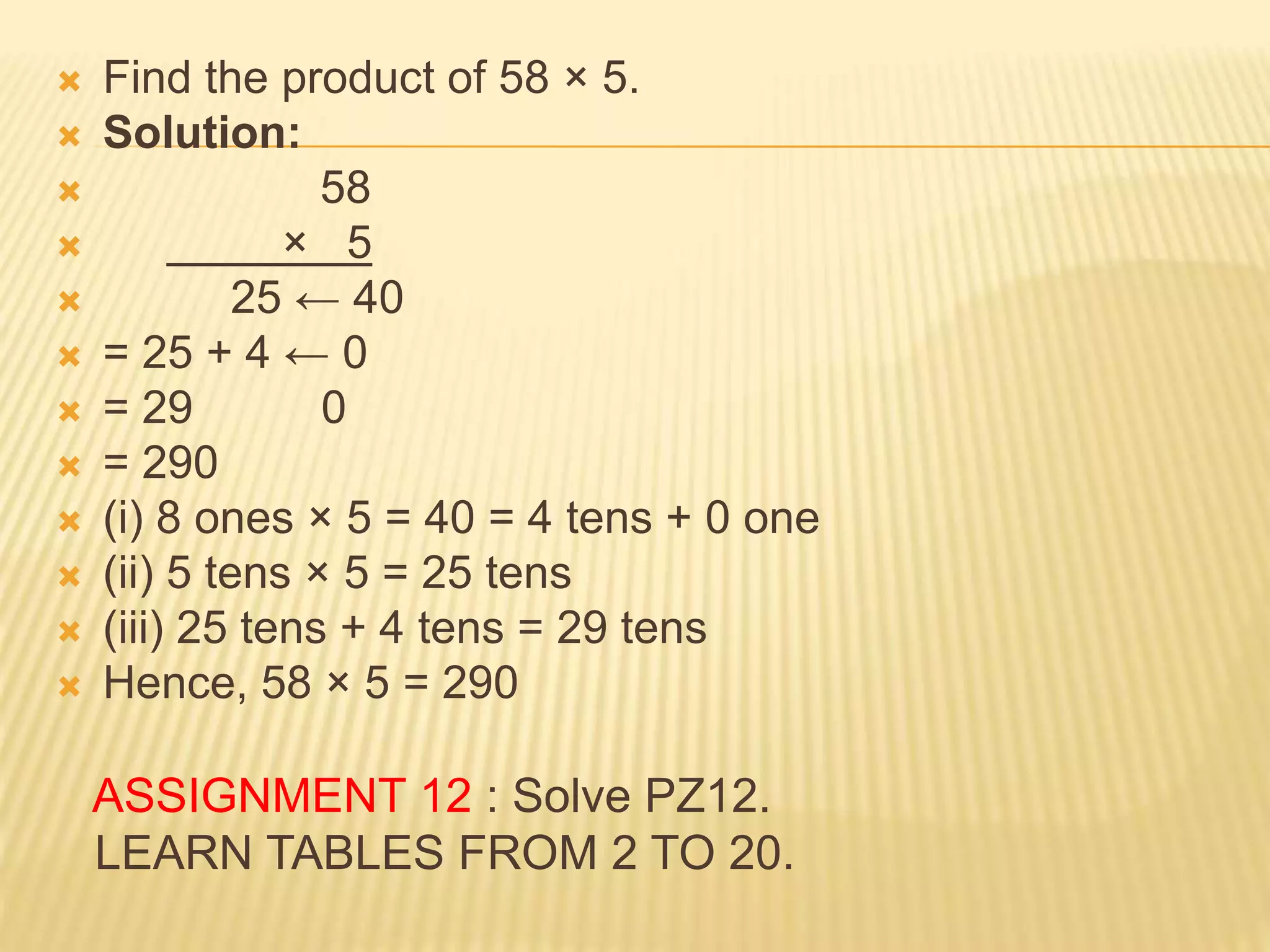
 Find the product of 58 × 5.
 Solution:
 58
 × 5
 25 ← 40
 = 25 + 4 ← 0
 = 29 0
 = 290
 (i) 8 ones × 5 = 40 = 4 tens + 0 one
 (ii) 5 tens × 5 = 25 tens
 (iii) 25 tens + 4 tens = 29 tens
 Hence, 58 × 5 = 290
ASSIGNMENT 12 : Solve PZ12.
LEARN TABLES FROM 2 TO 20.
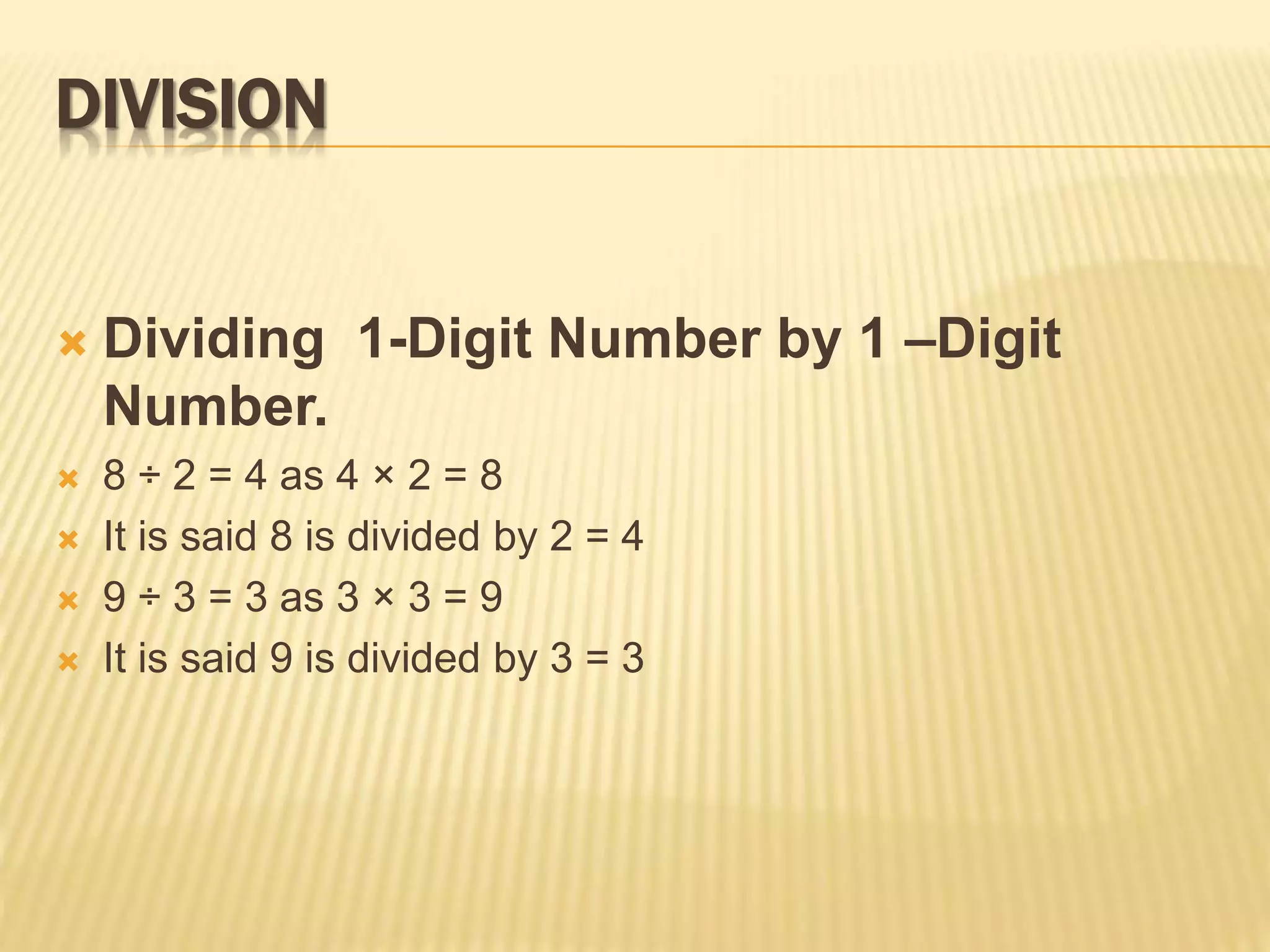
 Dividing 1-Digit Number by 1 –Digit
Number.
 8 ÷ 2 = 4 as 4 × 2 = 8
 It is said 8 is divided by 2 = 4
 9 ÷ 3 = 3 as 3 × 3 = 9
 It is said 9 is divided by 3 = 3
DIVISION
 Dividing 2-Digit Number by 1-Digit Number using
multiplication tables.
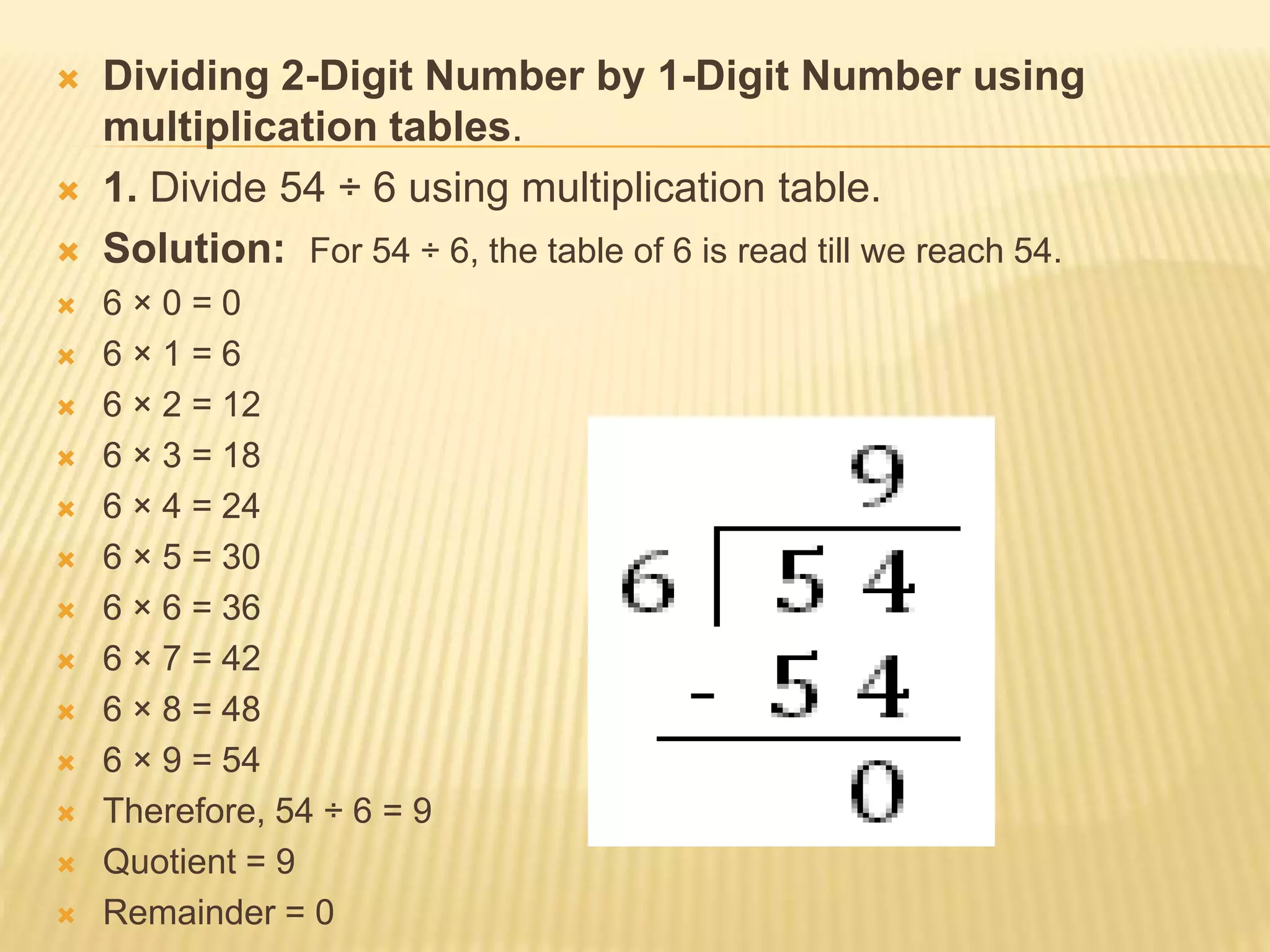
 1. Divide 54 ÷ 6 using multiplication table.
 Solution: For 54 ÷ 6, the table of 6 is read till we reach 54.
 6 × 0 = 0
 6 × 1 = 6
 6 × 2 = 12
 6 × 3 = 18
 6 × 4 = 24
 6 × 5 = 30
 6 × 6 = 36
 6 × 7 = 42
 6 × 8 = 48
 6 × 9 = 54
 Therefore, 54 ÷ 6 = 9
 Quotient = 9
 Remainder = 0
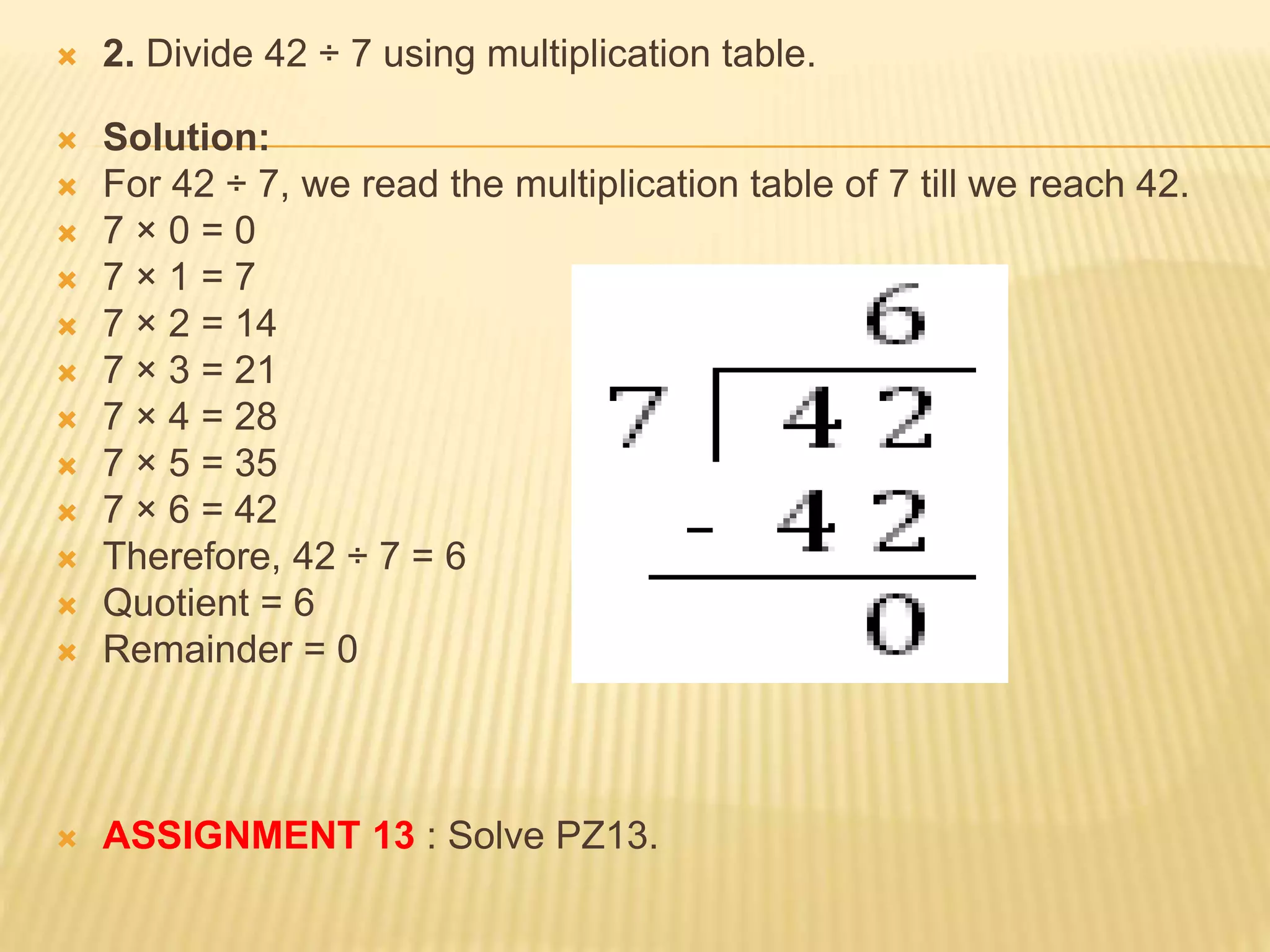
 2. Divide 42 ÷ 7 using multiplication table.
 Solution:
 For 42 ÷ 7, we read the multiplication table of 7 till we reach 42.
 7 × 0 = 0
 7 × 1 = 7
 7 × 2 = 14
 7 × 3 = 21
 7 × 4 = 28
 7 × 5 = 35
 7 × 6 = 42
 Therefore, 42 ÷ 7 = 6
 Quotient = 6
 Remainder = 0
 ASSIGNMENT 13 : Solve PZ13.
THANK YOU !

Class 3 LET US REVISE

  • 1.
  • 2.
    SYLLABUS :  Placevalue and Face value  Numbers on Abacus  Expanded form and Standard form  Before – Between – After  Comparing Numbers  Increasing and Decreasing order  Odd and Even numbers  Ordinal and Cardinal Numbers  Addition ,Subtraction , Multiplication & Division
  • 3.
    Recapitulation Do you remembernumbers up to 999 ?
  • 4.
    NUMBERS AND ITSNUMBER NAMES :  Some examples for writing three-digit numbers in numerals and words:  (i) 255 - Two hundred fifty five  (ii) 309 - Three hundred nine  (iii) 476 - Four hundred seventy six  (iv) 507 - Five hundred seven  (v) 684 – Six hundred eighty four  (vi) 799 – Seven hundred ninety nine  (vi) 813 – Eight hundred thirteen  (vi) 845 – Eight hundred forty five  (vi) 973 – Nine hundred seventy three  (vi) 999 – Nine hundred ninety nine  ASSIGNMENT 1 : Solve PZ 1.
  • 5.
    PLACE, PLACE VALUEAND FACE VALUE :  A number is formed by grouping the digits together.  Each digit has a fixed position called its place.  Each digit has a value depending on its place called the place value of the digit.  The face value of a digit for any place in the given number is the value of the digit itself  Place value of a digit = (face value of the digit) × (value of the place)
  • 6.
    FOR EXAMPLE:  Inthe number 245 , hundreds tens ones The place value of 5 is 5 ones = 5 x 1 = 5 The face value of 5 is 5. The place value of 4 is 4 tens =4 x 10 = 40 The face value of 4 is 4 The place value of 2 is 2 hundreds = 2 x 100 = 200 The face value of 2 is 2.
  • 7.
    FOR EXAMPLE: In anumber 129 : The place value of 9 is 9 × 1 = 9 as 9 is at one’s or unit’s place. The face value of 9 is 9. The place value of 2 is 2 × 10 = 20 as 2 is at ten’s place. The face value of 2 is 2. the place value of 1 is 1 × 100 = 100 as 1 is at hundred’s place. The face value of 1 is 1. ASSIGNMENT 2 : solve PZ2.
  • 8.
    NUMBERS ON ABACUS: What is an abacus ?  An abacus is an instrument with which we can count numbers and understand the place value of each digit in a number.  An abacus has spikes depending upon number of digits in a number.  To count 3 digit number , we use 3 spike abacus .  The spike on left most side is ones place , the second left spike denotes tens place and right most spike denotes hundreds place.
  • 9.
    EXAMPLES SHOWING 3DIGIT NUMBER ON SPIKE ABACUS: Three hundred seventy four •In ones place there are four beads that represents 4; •In tens place there are seven beads that represents 7; •In hundreds place there are three beads that represents 3.
  • 11.
    NOTE :  Torepresent any number on abacus , we use beads on spike on abacus .  To show ‘0’ on the abacus , we do not place any beads on the spike . ASSIGNMENT 3 : solve PZ 3.
  • 12.
    EXPANDED FORM OFA NUMBER :  In expanded form of a number, the number is shown according to the place values of its digits.  This is shown here:  In 385, the place values of the digits are given below: 3 X 100 = 300 3 8 5 5 X 1= 5 8 X 10 = 80 Hence, 385 = 300 + 80 + 5 Thus, 300 + 80 + 5 is the expanded form of 385.
  • 13.
    HERE THERE ARE3 CATEGORIES TO WRITE 3 -DIGIT NUMBERS I.E., NUMBERS IN NUMERALS, NUMBERS IN WORDS AND NUMBERS IN EXPANDED FORM. (i) 136 Number name : one hundred thirty six Expanded form of 136= 100 + 30 + 6 (ii) 403 Number name :Four hundred three Expanded form of 403= 400+ 000 + 3
  • 14.
    Some 3-digit numbersin words and in expanded form are given below:  (i) 476 Number name : four hundred seventy six Expanded form of 476 = 400 + 70 + 6  (ii) 798 Number name : seven hundred ninety eight Expanded form of 798 = 700 + 90 + 8 ASSIGNMENT 4 : SOLVE PZ 4
  • 15.
    BEFORE –BETWEEN –AFTER : Do you remember what we mean by before-between - after numbers?  When we count backward from given number, we get the numbers- before ..  When we count forward from given number, we get the numbers- after...  For example: Which number comes before 180?  Ans : 179 comes before 180.  Which number comes after 180?  Ans : 181 comes after 180.  NOTE : 1. The number that comes before is called predecessor.  2.The number that comes after is called successor.
  • 16.
     Between number: the number that comes in between any two numbers is called between number.  For example :which number comes between 222 and 224?  Ans: 223 is in between 222 and 224. ASSIGNMENT 5 : solve PZ5
  • 17.
  • 18.
    COMPARISON OF NUMBERS:  Rule (i) The number with more digits is greater than the number with lesser digits.  100 > 99 , 100 > 9  Rule (ii) If both the numbers have the same numbers (three) of digits, then the digits on the extreme left are compared.  Case (a) If the third digit from the right (Hundred-place digit) of a number is greater than the third digit from the right (Hundred-place digit) of the other number then the number having the greater third digit from the right, is the greater one.Thus, the number having the greater digit to its extreme left, is the greater one,  913 > 899 , 749 > 698 , 576 > 425  Case (b) If the numbers have the same third digits from the right, then the digits at ten’s place are compared and rules to compare two-digit numbers are considered.  958 > 949 , 876 > 867 , 564 > 559  Case (c) If digits at Hundred-place and ten’s place are equal, the rules to compare single digit numbers are considered.  958 > 956 , 876 > 875 , 634 > 630
  • 19.
    HOW TO COMPARETWO NUMBERS?  Here are some examples for comparison of numbers. Let us follow the rules to compare two numbers while solving the following questions.  1. Which is greater ?  (a) 345 or 94  Solution : The number with more digits is greater than the number with lesser digits. The number 345 has 3 digits. The number 94 has 2 digits.  Hence, 345 > 94 or 94 < 345  (b) 32 or 648  Solution : The number with more digits is greater than the number with lesser digits. The number 32 has 2 digits. The number 648 has 3 digits.  Hence, 32< 648 or 648> 32
  • 20.
     (c) 973and 879 Solution:  If two numbers have equal number of digits then the digits to the extreme left are compared. The one having the greater extreme left digit will be greater.  The digit 9 is greater than 8.  Hence, 973 > 879 or 879 < 973 (d) 541 or 546 Solution :  If two numbers have equal number of digits and the first digit on the extreme left are equal, then their second digit from the extreme left are compared. The number having the greater second left digit is greater and so on.  In 541 and 546, the first left digit 5 and second left digit 4 are equal. But in the one’s place, 1 < 8  Hence, 541< 546 or 546 > 541.  ASSIGNMENT 6 : Solve PZ 6.
  • 21.
    INCREASING AND DESCENDINGORDER : When we arrange numbers from the smallest number to the largest number, then the numbers are arranged in ascending order OR INCREASING ORDER . while arranging numbers from the largest number to the smallest number then the numbers are arranged in descending order. OR DECREASING ORDER.
  • 22.
    EXAMPLES ON ARRANGINGNUMBERS IN INCREASING ORDER:  Note : for writing numbers in increasing and decreasing order , we first compare the numbers  1. Write the following numbers in increasing order:  427; 535; 428; 522. Solution: Count the digits in each number. All are having 3 digit in them . Line up the number accordingly to place value. Begin comparing from the left. In 427 < 428 427 ← smallest number 535 >522 535 ← Largest number The ascending order is 427; 428; 522 ; 535.
  • 23.
     2. Arrangingnumbers in increasing order:  367; 354; 379; 353 Solution:  The digit in the hundreds place in each number is 3.  On comparing the tens place; 367; 354; 379; 353  We find: 379 to be the greatest and 353 to be smallest.  So, the increasing order is 353< 354 < 367 < 379.
  • 24.
    EXAMPLE ON ARRANGINGNUMBERS IN DECREASING ORDER: 3. Write in decreasing order:  325; 605; 285; 571 Solution: Compare digits according to place value.  Decreasing order means arranging numbers from the largest number to the smallest number;  605 > 571 > 325 > 285  ASSIGNMENT 7 : Solve PZ 7.
  • 25.
    EVEN AND ODDNUMBERS  Odd numbers :If the units digit (or ones digit) is 1,3, 5, 7, or 9, then the number is called an odd number.  Even numbers : if the units digit is 0, 2, 4, 6, or 8, then the number is called an even number.  ASSIGNMENT 8 : SOLVE PZ 8.
  • 26.
  • 27.
  • 28.
     There aremany steps in a staircase as shown in the above figure. The given staircase has nine steps, i.e., 1, 2, 3, 4, 5, 6, 7, 8 and 9.  In the process of climbing up the stairs, we term step Number (1) as the first step, step Number (2) as the second step number (3) as the third step, Number (4) as the fourth step, Number (5) as the fifth step, Number (6) as sixth step, Number (7) as seventh step, Number (8) as eighth step and Number (9) as ninth step. These are also expressed as 1ˢᵗ, 2ⁿᵈ, 3ʳᵈ, 4ᵗʰ, 5ᵗʰ, 6ᵗʰ, ………… etc.  Numbers 1, 2, 3, 4, 5, ……, 9, etc., are called cardinal numbers while 1ˢᵗ, 2ⁿᵈ, 3ʳᵈ, 4ᵗʰ, 5ᵗʰ, 6ᵗʰ, ………… etc., are known as ordinal numbers.  The cardinal numbers express the number of objects in a collection while the ordinal number always expresses one object.  ASSIGNMENT 9 : Solve PZ 9.
  • 29.
  • 30.
    ADDITION  1. Withoutcarrying  Adding ones  H T O  1 3 2  + 4 2 5  7  Adding tens  H T O  1 3 2  + 4 2 5  5 7  Adding hundreds  H T O  1 3 2  + 4 2 5  5 5 7
  • 31.
     2. Withcarrying  Adding ones  1  3 7 6  + 8 5 4 0 Add ones i.e., 6 + 4 = 10. Write 0 below in ones column and carrying 1 into the tens column. Adding tens  1 1  3 7 6  + 8 5 4 3 0  Add tens i.e., 1 + 7 + 5 = 13. Write 3 below in tens column and carrying 1 into the hundreds column. Adding hundreds  1  3 7 6  + 8 5 4  1 2 3 0  Add hundreds i.e., 1 + 3 + 8 = 12. Write 12 below.  Similarly add three 3 -digit numbers using the above rules for without and with carrying.
  • 32.
     3. Findthe sum of 5021, 3203 and 1210.  H T O  0 2 1  2 0 3  + 2 1 0  4 3 4 Arrange the numbers in columns and add column wise.  4. Find the sum of 2543, 1893 and 2678.  2 1  H T O  5 4 3  8 9 3  + 6 7 8 2 1 1 4 Arrange the numbers in columns and add column wise. ASSIGNMENT 10 : Solve PZ 10.
  • 33.
    SUBTRACTION 1. Subtract 23from 89 (by placing the numbers in column).  Solution:  Subtract 89 - 23 arrange by placing the numbers in column  T O  8 9  - 2 3  6 6  (i) Given numbers are written in column form.  (ii) Subtraction of digits at one’s place, 9 – 3 = 6 ones.  (iii) Subtraction of digits at ten’s place, 8 – 2 = 6 tens.  (iv) Subtracted sum = 6 tens + 6 ones = 60 + 6 = 66  (v) Therefore, 89 – 23 = 66
  • 34.
     2. Subtract457 from 832.  Solution:  832 – 457  H T O  8 3 2  - 4 5 7  3 7 5  (i) 457 is written under the greater number 832 in column form.  (ii) 2 < 7, so, 1 ten is borrowed from tens. 1 ten or 10 + 2 = 12 ones; 12 ones – 7 ones = 5 ones.  (iii) 3 tens – 1 ten = 2 tens, it is smaller than 5 tens. So, 1 hundred is borrowed from 8 hundred.  1 hundred or 10 tens + 2 tens = 12 tens; 12 tens – 5 tens = 7 tens.  (iv) 8 hundred – 1 hundred = 7 hundred; 7 hundred – 4 hundred = 3 hundred  Therefore, subtracting 3-digit numbers with borrowing 457 from 832 = 375
  • 35.
    MULTIPLICATION  In multiplication,the number being multiplied is called the multiplicand and the number by which it is being multiplied is called the multiplier.  Examples of multiplying one-digit numbers:  1. Multiply 6 by 3.  Solution:  First we need to arrange the numbers in column form.  6  × 3  18  We need to read mentally the multiplication tables of 6 to get 6 times three are 18.  This 18 is written as product. We read it as 6 multiplied by 3 is equal to 18.  Here, 6 is the multiplicand, 3 is multiplier and 18 is the multiple fact of product.  6 and 3 are also called factors of the product 18.
  • 36.
     Examples ofmultiplying 2-digit number by 1-digit number:  1. Multiply 20 by 3  Solution:  20 → 2 tens + 0 ones  × 3 → × 3  6 tens + 0 ones  = 60 + 0  = 60  Therefore, 20 × 3 = 60
  • 37.
     2. Multiply48 by 6 by using short form  Solution:  48  × 6  24 ← 48  = 28 tens 8 ones  = 288  Hence, 48 × 6 = 288  (i) 48 × 6 is written in column from.  (ii) 8 ones are multiplied by 6, i.e., 6 × 8 = 48 ones = 4 tens + 8 ones  8 is written is one’s column and 4 tens is gained.  (iii) Gained 4 is carried to the ten’s column.  (iv) Now 4 tens is multiplied by 6, i.e., 4 tens × 6 = 24 tens  (v) Carried 4 tens is added to 24 tens, i.e., 4 tens + 24 tens = 28 tens
  • 38.
     Find theproduct of 58 × 5.  Solution:  58  × 5  25 ← 40  = 25 + 4 ← 0  = 29 0  = 290  (i) 8 ones × 5 = 40 = 4 tens + 0 one  (ii) 5 tens × 5 = 25 tens  (iii) 25 tens + 4 tens = 29 tens  Hence, 58 × 5 = 290 ASSIGNMENT 12 : Solve PZ12. LEARN TABLES FROM 2 TO 20.
  • 39.
     Dividing 1-DigitNumber by 1 –Digit Number.  8 ÷ 2 = 4 as 4 × 2 = 8  It is said 8 is divided by 2 = 4  9 ÷ 3 = 3 as 3 × 3 = 9  It is said 9 is divided by 3 = 3 DIVISION
  • 40.
     Dividing 2-DigitNumber by 1-Digit Number using multiplication tables.  1. Divide 54 ÷ 6 using multiplication table.  Solution: For 54 ÷ 6, the table of 6 is read till we reach 54.  6 × 0 = 0  6 × 1 = 6  6 × 2 = 12  6 × 3 = 18  6 × 4 = 24  6 × 5 = 30  6 × 6 = 36  6 × 7 = 42  6 × 8 = 48  6 × 9 = 54  Therefore, 54 ÷ 6 = 9  Quotient = 9  Remainder = 0
  • 41.
     2. Divide42 ÷ 7 using multiplication table.  Solution:  For 42 ÷ 7, we read the multiplication table of 7 till we reach 42.  7 × 0 = 0  7 × 1 = 7  7 × 2 = 14  7 × 3 = 21  7 × 4 = 28  7 × 5 = 35  7 × 6 = 42  Therefore, 42 ÷ 7 = 6  Quotient = 6  Remainder = 0  ASSIGNMENT 13 : Solve PZ13.
  • 42.