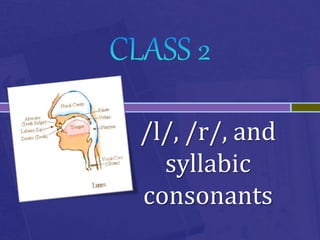
/l/, /r/, and
syllabic
consonants
 Practice some tongue twisters related to the
/l/ and /r/ sounds. 10 minutes
 Listen to the song “she will be loved” by
maroon five and complete the gaps.
 Talk about the /l/ and /r/ sounds. 10
minutes
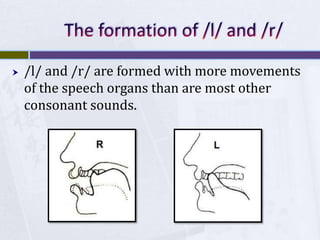
 /l/ and /r/ are formed with more movements
of the speech organs than are most other
consonant sounds.
 A vowel-like consonant produce without
friction.
 Most other consonants are made with the
speech organs in a more or less fixed
position
 Speakers of English normally produce /l/
sound as the tip of the tongue moves to or
away from the tooth ridge.
 The movement that characterizes /l/ is
more extensive when the /l/ follows a vowel
sound than when it precedes a vowel sound
 A large majority of English-speaking people
pronounce it with both sides of the tongue
touching the back part of the tooth ridge
and the back teeth.
 The movements that characterize both /l/
and /r/, especially when they follow a vowel
sound, are produced quite far back in the
mouth.
 When a front vowel is followed by /l/ or /r/,
an intermediary /ə/ is inserted.
 Practice the transcription of words with /l/
and /r/ after front vowels. 20 minutes
- Missing words of the lyric of the song “She
will be loved”
- Activity D, page 120. Homework
 Discuss the results from the transcriptions.
15 minutes
 Make a short conversation using words with
words that contain /l/ and /r/ sounds. 25
minutes

Class 2

  • 1.
  • 2.
     Practice sometongue twisters related to the /l/ and /r/ sounds. 10 minutes  Listen to the song “she will be loved” by maroon five and complete the gaps.  Talk about the /l/ and /r/ sounds. 10 minutes
  • 3.
     /l/ and/r/ are formed with more movements of the speech organs than are most other consonant sounds.
  • 4.
     A vowel-likeconsonant produce without friction.  Most other consonants are made with the speech organs in a more or less fixed position
  • 5.
     Speakers ofEnglish normally produce /l/ sound as the tip of the tongue moves to or away from the tooth ridge.
  • 6.
     The movementthat characterizes /l/ is more extensive when the /l/ follows a vowel sound than when it precedes a vowel sound
  • 7.
     A largemajority of English-speaking people pronounce it with both sides of the tongue touching the back part of the tooth ridge and the back teeth.
  • 8.
     The movementsthat characterize both /l/ and /r/, especially when they follow a vowel sound, are produced quite far back in the mouth.  When a front vowel is followed by /l/ or /r/, an intermediary /ə/ is inserted.
  • 9.
     Practice thetranscription of words with /l/ and /r/ after front vowels. 20 minutes - Missing words of the lyric of the song “She will be loved” - Activity D, page 120. Homework
  • 10.
     Discuss theresults from the transcriptions. 15 minutes  Make a short conversation using words with words that contain /l/ and /r/ sounds. 25 minutes