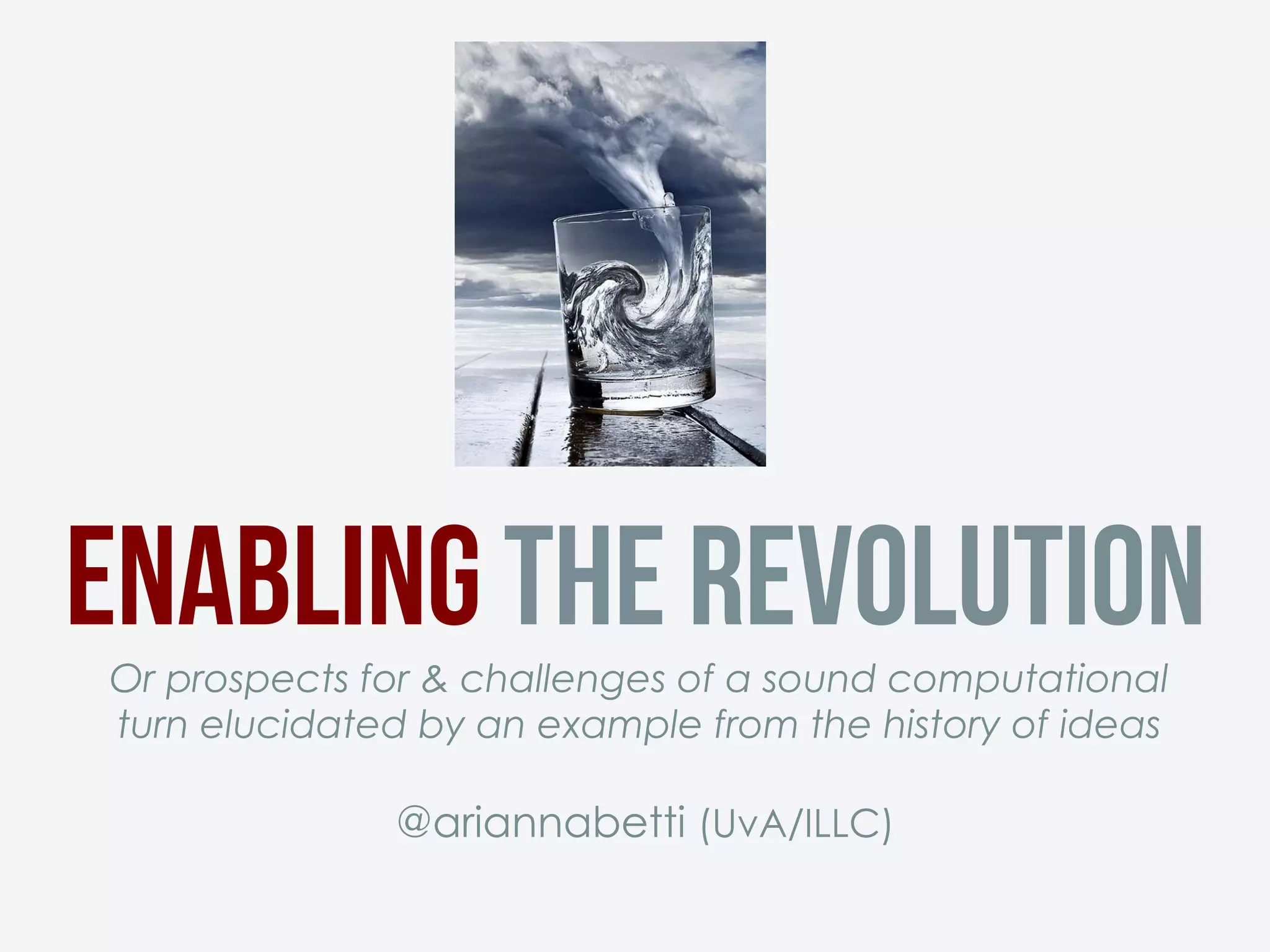
Enabling the RevolutionOr prospects for & challenges of a sound computational
turn elucidated by an example from the history of ideas
@ariannabetti (UvA/ILLC)
Success
Sound methodology
2
Impact
Smart infrastructure
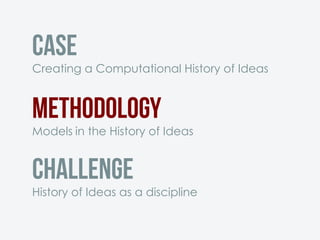
Case
Creating a Computational History of Ideas
Case
Creating a Computational History of Ideas
Methodology
Models in the History of Ideas
Case
Creating a Computational History of Ideas
Methodology
Models in the History of Ideas
Challenge
History of Ideas as a discipline
Case
Creating a Computational History of Ideas
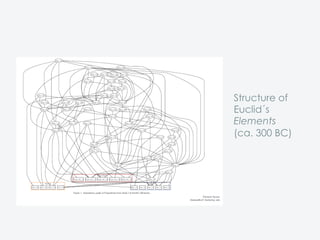
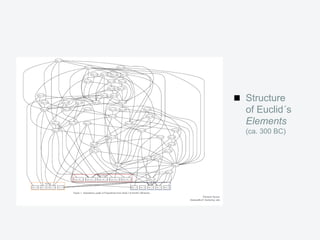
Structure of
Euclid´s
Elements
(ca. 300 BC)
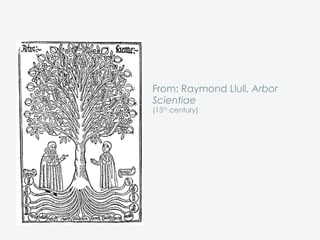
From: Raymond Llull, Arbor
Scientiae
(13th century)
D. Zeller,
Hypothetical
Model of the
Evolution and
Structure of
Science (2007) 
10
Concepts in Motion
¢  The idea of science has changed through
time.
£  When and Where did these changes take
place?
£  Who started disagreeing?
£  Who influenced whom?
Traditionalmethods
one concept,
one author,
one text…
2 0 1 3
30 milliondigitised
books
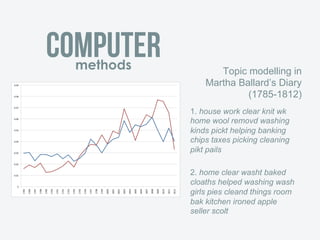
Topic modelling in
Martha Ballard’s Diary
(1785-1812)
1. house work clear knit wk
home wool removd washing
kinds pickt helping banking
chips taxes picking cleaning
pikt pails
2. home clear washt baked
cloaths helped washing wash
girls pies cleand things room
bak kitchen ironed apple
seller scolt
COMPUTERmethods
Methodology
Models in the History of Ideas
Philosopher’s stone?
¢  build a certain well-delimited
amount of interpretation in the
tools from the offset;
¢  work closely with
computational experts to set up
these very tools
¢  build a certain well-delimited
amount of interpretation in the
tools from the offset;
£  make your interpretation
explicit!
£  balance between framing
existing knowledge and
allowing discovery
¢  work closely with
computational experts to set up
these very tools
Philosopher’s stone?
¢  build a certain well-delimited
amount of interpretation in the
tools from the offset;
£  make your interpretation
explicit!
£  balance between framing
existing knowledge and
allowing discovery
˜  For this, use models!
¢  work closely with
computational experts to set up
these very tools
Philosopher’s stone?
go to http://twitter.com/ariannabetti
click on the CLARIAH link
keep the handout open on your screen
"   Structure
of Euclid´s
Elements
(ca. 300 BC)
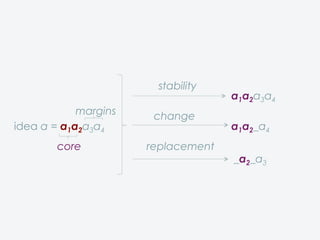
idea a = a1a2a3a4
core
a1a2a3a4
a1a2_a4
_a2_a3
margins
stability
change
replacement
Tarski’s Revolution: A New History
ERC Starting Grant, 2008-2013
¢  History of the methodology of the deductive sciences +
biology (history-of-ideas approach)
£  traced the development of concepts (1740-1940)
˜  mathematical/logical e.g. axiom, consequence /
grounding / explanation, variable, truth, domain
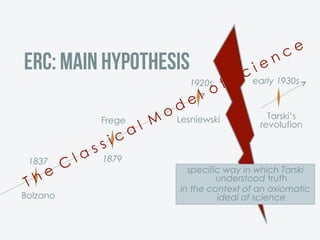
ERC: Main Hypothesis
Bolzano
Frege Tarski’s
revolution
1837 1879
Lesniewski
1920s early 1930s
specific way in which Tarski
understood truth
in the context of an axiomatic
ideal of science
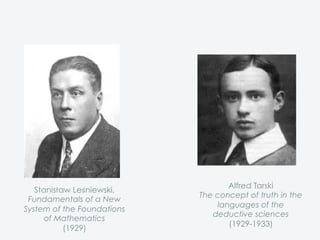
Alfred Tarski
The concept of truth in the
languages of the
deductive sciences
(1929-1933)
Stanisław Leśniewski,
Fundamentals of a New
System of the Foundations
of Mathematics
(1929)
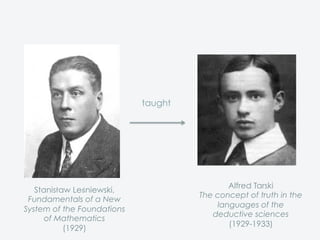
Alfred Tarski
The concept of truth in the
languages of the
deductive sciences
(1929-1933)
Stanisław Leśniewski,
Fundamentals of a New
System of the Foundations
of Mathematics
(1929)
taught
(1)
(2a, b)
(3a, b)
(4)
(5)
[6]
[7]
(1)
(2a, b)
(3a, b)
(4)
(5)
[6]
[7]
Eigentliche Wissenschaft kann nur
diejenige genannt werden,
deren Gewissheit apodiktisch
ist; Erkenntnis, die bloß
empirische Gewissheit
enthalten kann, ist ein nur
uneigentlich so genanntes
Wissen. Dasjenige Ganze der
Erkenntnis, was systematisch ist,
kann schon darum Wissenschaft
heißen und wenn die
Verknüpfung der Erkenntnis in
diesem System ein
Zusammenhang von Gründen
und Folgen ist, sogar rationale
Wissenschaft. (AA 4: 468)
Die “eigentlichen” Wissen-
schaften zerfielen dann in
apriorische Wissenschaften
und in angewandte, in
empirische, aber durchaus
aus a priorischen Prinzipien
“erklärende“ und sich selbst
rechtfertigende. In allen
eigentlichen Wissenschaften
herrschte volkommene , d.i.,
denkbar größte Rationalität
[…]
Einleitung in die Philosophie:
296-297.
Kant 1786 Husserl 1922-23
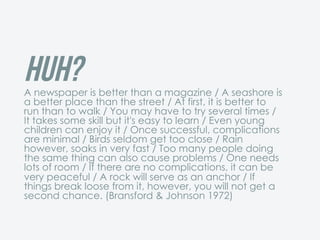
A newspaper is better than a magazine / A seashore is
a better place than the street / At first, it is better to
run than to walk / You may have to try several times /
It takes some skill but it's easy to learn / Even young
children can enjoy it / Once successful, complications
are minimal / Birds seldom get too close / Rain
however, soaks in very fast / Too many people doing
the same thing can also cause problems / One needs
lots of room / If there are no complications, it can be
very peaceful / A rock will serve as an anchor / If
things break loose from it, however, you will not get a
second chance. (Bransford & Johnson 1972)
Huh?A newspaper is better than a magazine / A seashore is
a better place than the street / At first, it is better to
run than to walk / You may have to try several times /
It takes some skill but it's easy to learn / Even young
children can enjoy it / Once successful, complications
are minimal / Birds seldom get too close / Rain
however, soaks in very fast / Too many people doing
the same thing can also cause problems / One needs
lots of room / If there are no complications, it can be
very peaceful / A rock will serve as an anchor / If
things break loose from it, however, you will not get a
second chance. (Bransford & Johnson 1972)
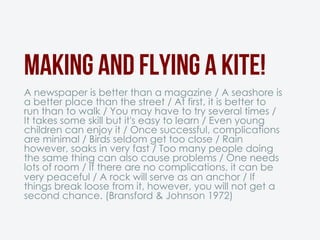
Making and flying a kite!
A newspaper is better than a magazine / A seashore is
a better place than the street / At first, it is better to
run than to walk / You may have to try several times /
It takes some skill but it's easy to learn / Even young
children can enjoy it / Once successful, complications
are minimal / Birds seldom get too close / Rain
however, soaks in very fast / Too many people doing
the same thing can also cause problems / One needs
lots of room / If there are no complications, it can be
very peaceful / A rock will serve as an anchor / If
things break loose from it, however, you will not get a
second chance. (Bransford & Johnson 1972)
Challenge
History of Ideas as a discipline
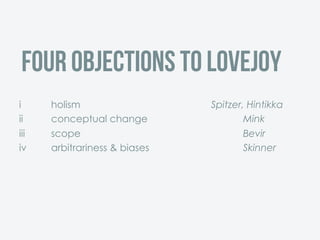
Four Objections to Lovejoy
i holism Spitzer, Hintikka
ii conceptual change Mink
iii scope Bevir
iv arbitrariness & biases Skinner
Success
Sound methodology
33
Impact
Smart infrastructure
http://ticclops.clarin.inl.nl/philostei/
Enabling the RevolutionOr prospects for & challenges of a sound computational
turn elucidated by an example from the history of ideas
@ariannabetti (UvA/ILLC)

Clariah arianna betti_keynote

  • 1.
    Enabling the RevolutionOrprospects for & challenges of a sound computational turn elucidated by an example from the history of ideas @ariannabetti (UvA/ILLC)
  • 2.
  • 3.
  • 4.
    Case Creating a ComputationalHistory of Ideas Methodology Models in the History of Ideas
  • 5.
    Case Creating a ComputationalHistory of Ideas Methodology Models in the History of Ideas Challenge History of Ideas as a discipline
  • 6.
  • 7.
  • 8.
    From: Raymond Llull,Arbor Scientiae (13th century)
  • 9.
    D. Zeller, Hypothetical Model ofthe Evolution and Structure of Science (2007) 
  • 10.
    10 Concepts in Motion ¢ The idea of science has changed through time. £  When and Where did these changes take place? £  Who started disagreeing? £  Who influenced whom?
  • 11.
  • 13.
    2 0 13 30 milliondigitised books
  • 14.
    Topic modelling in MarthaBallard’s Diary (1785-1812) 1. house work clear knit wk home wool removd washing kinds pickt helping banking chips taxes picking cleaning pikt pails 2. home clear washt baked cloaths helped washing wash girls pies cleand things room bak kitchen ironed apple seller scolt COMPUTERmethods
  • 15.
    Methodology Models in theHistory of Ideas
  • 16.
    Philosopher’s stone? ¢  builda certain well-delimited amount of interpretation in the tools from the offset; ¢  work closely with computational experts to set up these very tools
  • 17.
    ¢  build acertain well-delimited amount of interpretation in the tools from the offset; £  make your interpretation explicit! £  balance between framing existing knowledge and allowing discovery ¢  work closely with computational experts to set up these very tools Philosopher’s stone?
  • 18.
    ¢  build acertain well-delimited amount of interpretation in the tools from the offset; £  make your interpretation explicit! £  balance between framing existing knowledge and allowing discovery ˜  For this, use models! ¢  work closely with computational experts to set up these very tools Philosopher’s stone?
  • 19.
    go to http://twitter.com/ariannabetti clickon the CLARIAH link keep the handout open on your screen
  • 20.
    "   Structure ofEuclid´s Elements (ca. 300 BC)
  • 21.
    idea a =a1a2a3a4 core a1a2a3a4 a1a2_a4 _a2_a3 margins stability change replacement
  • 22.
    Tarski’s Revolution: ANew History ERC Starting Grant, 2008-2013 ¢  History of the methodology of the deductive sciences + biology (history-of-ideas approach) £  traced the development of concepts (1740-1940) ˜  mathematical/logical e.g. axiom, consequence / grounding / explanation, variable, truth, domain
  • 23.
    ERC: Main Hypothesis Bolzano FregeTarski’s revolution 1837 1879 Lesniewski 1920s early 1930s specific way in which Tarski understood truth in the context of an axiomatic ideal of science
  • 24.
    Alfred Tarski The conceptof truth in the languages of the deductive sciences (1929-1933) Stanisław Leśniewski, Fundamentals of a New System of the Foundations of Mathematics (1929)
  • 25.
    Alfred Tarski The conceptof truth in the languages of the deductive sciences (1929-1933) Stanisław Leśniewski, Fundamentals of a New System of the Foundations of Mathematics (1929) taught
  • 26.
  • 27.
    Eigentliche Wissenschaft kannnur diejenige genannt werden, deren Gewissheit apodiktisch ist; Erkenntnis, die bloß empirische Gewissheit enthalten kann, ist ein nur uneigentlich so genanntes Wissen. Dasjenige Ganze der Erkenntnis, was systematisch ist, kann schon darum Wissenschaft heißen und wenn die Verknüpfung der Erkenntnis in diesem System ein Zusammenhang von Gründen und Folgen ist, sogar rationale Wissenschaft. (AA 4: 468) Die “eigentlichen” Wissen- schaften zerfielen dann in apriorische Wissenschaften und in angewandte, in empirische, aber durchaus aus a priorischen Prinzipien “erklärende“ und sich selbst rechtfertigende. In allen eigentlichen Wissenschaften herrschte volkommene , d.i., denkbar größte Rationalität […] Einleitung in die Philosophie: 296-297. Kant 1786 Husserl 1922-23
  • 28.
    A newspaper isbetter than a magazine / A seashore is a better place than the street / At first, it is better to run than to walk / You may have to try several times / It takes some skill but it's easy to learn / Even young children can enjoy it / Once successful, complications are minimal / Birds seldom get too close / Rain however, soaks in very fast / Too many people doing the same thing can also cause problems / One needs lots of room / If there are no complications, it can be very peaceful / A rock will serve as an anchor / If things break loose from it, however, you will not get a second chance. (Bransford & Johnson 1972)
  • 29.
    Huh?A newspaper isbetter than a magazine / A seashore is a better place than the street / At first, it is better to run than to walk / You may have to try several times / It takes some skill but it's easy to learn / Even young children can enjoy it / Once successful, complications are minimal / Birds seldom get too close / Rain however, soaks in very fast / Too many people doing the same thing can also cause problems / One needs lots of room / If there are no complications, it can be very peaceful / A rock will serve as an anchor / If things break loose from it, however, you will not get a second chance. (Bransford & Johnson 1972)
  • 30.
    Making and flyinga kite! A newspaper is better than a magazine / A seashore is a better place than the street / At first, it is better to run than to walk / You may have to try several times / It takes some skill but it's easy to learn / Even young children can enjoy it / Once successful, complications are minimal / Birds seldom get too close / Rain however, soaks in very fast / Too many people doing the same thing can also cause problems / One needs lots of room / If there are no complications, it can be very peaceful / A rock will serve as an anchor / If things break loose from it, however, you will not get a second chance. (Bransford & Johnson 1972)
  • 31.
  • 32.
    Four Objections toLovejoy i holism Spitzer, Hintikka ii conceptual change Mink iii scope Bevir iv arbitrariness & biases Skinner
  • 33.
  • 34.
  • 35.
    Enabling the RevolutionOrprospects for & challenges of a sound computational turn elucidated by an example from the history of ideas @ariannabetti (UvA/ILLC)