Empowering for
Independent Learning
Collaborative Learning
The Open University of Sri Lanka
Year 2021
Module Coordinator: MSS Perera
Batch 1- 2
COLLABORATIVE LEARNING
2
Objectives and Learning Outcomes
• Objectives:
• Recognize the importance of collaborative learning in ODL.
• Identify collaborative learning techniques that can be used
effectively.
• Organize and plan group learning activities; identify roles,
responsibilities of group members, with ethical considerations,
motivational and emotional support.
• Achieved through outcomes to:
• Engage in a group learning activity related to a subject, which would make
learners recognize individual and group dynamics required to make it a success.
• Make a reflective learning on the collaborative and experiential learning.
3
Collaborative Learning Vs Peer Learning ?
1.What is Collaborative Learning and What is Peer
Learning?
• Collaborative Learning-Students learn alongside one another
• Peer Learning-Students learn from one another.
4
Who are Peers?
People from similar status who are not professional
teachers, helping each other to learn and learning
themselves by teaching.
Peers do not have power over each other by virtue of
their position or responsibilities.
Peers are fellow learners!!
5
Activity 1-Process of Peer Learning
• Watch the above video and identify what is peer learning and the
importance of peer learning process. As a group, discuss and
present your findings.
https://www.youtube.com/watch?v=uFqGDa6xf54&t=60s
6
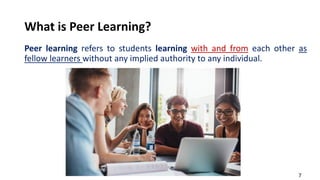
What is Peer Learning?
Peer learning refers to students learning with and from each other as
fellow learners without any implied authority to any individual.
7
Importance of Peer Learning
• Peer learning is becoming an increasingly important part of many
courses, and is being used in a variety of contexts and disciplines in
many countries.
8
Benefits of Peer Learning
• Develop skills in organizing and planning learning activities.
• Working collaboratively with others and sharing knowledge.
• Giving and receiving feedback.
• Opportunity to evaluate their own learning.
• While the emphasis is on the learning process, you may offer emotional
support to a fellow student.
• Self Motivation.
9
Peer Learning
Through peer learning
you move
beyond independent learning to interdependent
(mutual) learning.
10
Peer Group Learning (PGL) is…
A Group of students
with Common Goals and expectations and
with heterogeneous skills,
supporting mutually,
encouraging and assisting each other
for completing course requirements.
11
Some Forms of Peer Learning
• Students following same courses form partnerships to assist each
other with course content.
• Collaborative projects or laboratory work among students.
• Private study groups etc.
12
Responsibilities of Peer Group Learning Members
• Prepare before study team meetings
• Complete assigned tasks
• Attend all meetings on time
• Participate and contribute actively
• Help each other
• Keep connected
13
Interactive Peer Activity -The 'Eye' Test
•How this the following picture sounds to you? Well,
there are 3 hidden creatures in this picture. If You are a
super genius, you can find all of them.
So, as a group, give it a try and post your answers to the
"Submitting responses to the learning activities' tab.
14
15
Interactive Peer Activity -The critical Thinking
Who kidnapped the infant?
16
Appearances are often
Deceptive
Thank You
Empowering for
Independent Learning
Collaborative Learning
The Open University of Sri Lanka
Year 2021
Module Coordinator: MSS Perera
Batch 1- 2
Review of the Session 1
• Collaborative Learning Vs peer Learning
• Peer group learning
• Importance of Peer group learning
• Interactive Group Activity
Session 2
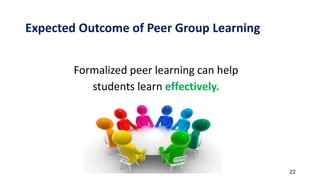
Expected Outcome of Peer Group Learning
Formalized peer learning can help
students learn effectively.
22
Interactive Activity 2- Word
Puzzle
What Would be the answer?
?
)
2
2
(
2
8 


IQ Word Puzzle
Hello Peers,
Can you solve this word puzzle. As it stated, ' Answering any five
means that your IQ is pretty high'. So, don't try to find the answers
directly from Google.
Answers for Interactive Activity 2
Knowledge Sharing and
Management
General knowledge
management Cycle
Peer Group Activity
Peer Group Activity
Case Study: Addressing the Human – Elephant conflict in Sri Lanka
Background
• Elephants in Sri Lanka face an increasingly conflictual relationship with
humans when competing for space and resources.
• The Elephant habitats are shrinking daily and people are encroaching on
the territory of elephants to expand their agricultural lands and habitats
leading for a disastrous human- elephant conflict which has eventually
evolved in the last few decades, when both species inhabit adjacently in
the same area.
• In Sri Lanka, around 100-150 humans were killed by elephants and around
200 elephants were killed by humans each year. This number has been
increasing significantly over the years.
Task
The Young Conservationists Society of Colombo comprises of fulltime
academics, qualified naturalists, animal behavior experts and general
corporate volunteers.
• They have done a study with the support of a private grant received
by the WWF to study and provide solutions to the prevailing and
increasing human-elephant conflict in Sri Lanka.
• A core team has come out with the following concerns and
recommendations to be put forward to the government.
• They have considered areas of impact in Wildlife, Economic
development, rural development, Tourism, Security, Sustainability and
a wider community which is growing in numbers who are sensitive to
the environment.
Concerns and Statistics
• Wild Elephant population in Sri Lanka – 6,872
• Elephant deaths in Sri Lanka (2019) – 361
• Human deaths in Sri Lanka (2019) due to elephants – 96
• There were 18,720 reported damages for crops and other by
elephants in 2019
• 70% of Sri Lanka’s land mass is co-shared by humans and elephants.
Only 12% of the land mass in Sri Lanka is dedicated wildlife
sanctuary. Hence, we need to cohabit with Elephants.
• 1.9M tourists have visited Sri Lanka and 17% (323k) of them have
visited national parks
• There were 145k tickets sold at the Pinnawela Elephant Orphanage
for foreigners in 2019
• Given the above statistics and any other information that you can find
on the subject, as a group develop a mind map detailing out a
solution to the problem.
• The solution may be in the form of recommendations and or
innovations that would help reduce this issue.
• Ensure you cover areas such as key stakeholders ( primary /
secondary), key industries impacted, eco system concerns, impact
on humans, impact on wild life, causes of the conflict, measures to
reduce the conflict etc. in your mind map.
Mind maps
Sample
Click here
Thank You

(Cl) collaborative learning slides

  • 1.
    Empowering for Independent Learning CollaborativeLearning The Open University of Sri Lanka Year 2021 Module Coordinator: MSS Perera Batch 1- 2
  • 2.
  • 3.
    Objectives and LearningOutcomes • Objectives: • Recognize the importance of collaborative learning in ODL. • Identify collaborative learning techniques that can be used effectively. • Organize and plan group learning activities; identify roles, responsibilities of group members, with ethical considerations, motivational and emotional support. • Achieved through outcomes to: • Engage in a group learning activity related to a subject, which would make learners recognize individual and group dynamics required to make it a success. • Make a reflective learning on the collaborative and experiential learning. 3
  • 4.
    Collaborative Learning VsPeer Learning ? 1.What is Collaborative Learning and What is Peer Learning? • Collaborative Learning-Students learn alongside one another • Peer Learning-Students learn from one another. 4
  • 5.
    Who are Peers? Peoplefrom similar status who are not professional teachers, helping each other to learn and learning themselves by teaching. Peers do not have power over each other by virtue of their position or responsibilities. Peers are fellow learners!! 5
  • 6.
    Activity 1-Process ofPeer Learning • Watch the above video and identify what is peer learning and the importance of peer learning process. As a group, discuss and present your findings. https://www.youtube.com/watch?v=uFqGDa6xf54&t=60s 6
  • 7.
    What is PeerLearning? Peer learning refers to students learning with and from each other as fellow learners without any implied authority to any individual. 7
  • 8.
    Importance of PeerLearning • Peer learning is becoming an increasingly important part of many courses, and is being used in a variety of contexts and disciplines in many countries. 8
  • 9.
    Benefits of PeerLearning • Develop skills in organizing and planning learning activities. • Working collaboratively with others and sharing knowledge. • Giving and receiving feedback. • Opportunity to evaluate their own learning. • While the emphasis is on the learning process, you may offer emotional support to a fellow student. • Self Motivation. 9
  • 10.
    Peer Learning Through peerlearning you move beyond independent learning to interdependent (mutual) learning. 10
  • 11.
    Peer Group Learning(PGL) is… A Group of students with Common Goals and expectations and with heterogeneous skills, supporting mutually, encouraging and assisting each other for completing course requirements. 11
  • 12.
    Some Forms ofPeer Learning • Students following same courses form partnerships to assist each other with course content. • Collaborative projects or laboratory work among students. • Private study groups etc. 12
  • 13.
    Responsibilities of PeerGroup Learning Members • Prepare before study team meetings • Complete assigned tasks • Attend all meetings on time • Participate and contribute actively • Help each other • Keep connected 13
  • 14.
    Interactive Peer Activity-The 'Eye' Test •How this the following picture sounds to you? Well, there are 3 hidden creatures in this picture. If You are a super genius, you can find all of them. So, as a group, give it a try and post your answers to the "Submitting responses to the learning activities' tab. 14
  • 15.
  • 16.
    Interactive Peer Activity-The critical Thinking Who kidnapped the infant? 16
  • 17.
  • 18.
  • 19.
    Empowering for Independent Learning CollaborativeLearning The Open University of Sri Lanka Year 2021 Module Coordinator: MSS Perera Batch 1- 2
  • 20.
    Review of theSession 1 • Collaborative Learning Vs peer Learning • Peer group learning • Importance of Peer group learning • Interactive Group Activity
  • 21.
  • 22.
    Expected Outcome ofPeer Group Learning Formalized peer learning can help students learn effectively. 22
  • 23.
  • 24.
    What Would bethe answer? ? ) 2 2 ( 2 8   
  • 25.
    IQ Word Puzzle HelloPeers, Can you solve this word puzzle. As it stated, ' Answering any five means that your IQ is pretty high'. So, don't try to find the answers directly from Google.
  • 27.
  • 28.
  • 29.
  • 30.
  • 31.
    Peer Group Activity CaseStudy: Addressing the Human – Elephant conflict in Sri Lanka Background • Elephants in Sri Lanka face an increasingly conflictual relationship with humans when competing for space and resources. • The Elephant habitats are shrinking daily and people are encroaching on the territory of elephants to expand their agricultural lands and habitats leading for a disastrous human- elephant conflict which has eventually evolved in the last few decades, when both species inhabit adjacently in the same area. • In Sri Lanka, around 100-150 humans were killed by elephants and around 200 elephants were killed by humans each year. This number has been increasing significantly over the years.
  • 32.
    Task The Young ConservationistsSociety of Colombo comprises of fulltime academics, qualified naturalists, animal behavior experts and general corporate volunteers. • They have done a study with the support of a private grant received by the WWF to study and provide solutions to the prevailing and increasing human-elephant conflict in Sri Lanka. • A core team has come out with the following concerns and recommendations to be put forward to the government. • They have considered areas of impact in Wildlife, Economic development, rural development, Tourism, Security, Sustainability and a wider community which is growing in numbers who are sensitive to the environment.
  • 33.
    Concerns and Statistics •Wild Elephant population in Sri Lanka – 6,872 • Elephant deaths in Sri Lanka (2019) – 361 • Human deaths in Sri Lanka (2019) due to elephants – 96 • There were 18,720 reported damages for crops and other by elephants in 2019 • 70% of Sri Lanka’s land mass is co-shared by humans and elephants. Only 12% of the land mass in Sri Lanka is dedicated wildlife sanctuary. Hence, we need to cohabit with Elephants. • 1.9M tourists have visited Sri Lanka and 17% (323k) of them have visited national parks • There were 145k tickets sold at the Pinnawela Elephant Orphanage for foreigners in 2019
  • 34.
    • Given theabove statistics and any other information that you can find on the subject, as a group develop a mind map detailing out a solution to the problem. • The solution may be in the form of recommendations and or innovations that would help reduce this issue. • Ensure you cover areas such as key stakeholders ( primary / secondary), key industries impacted, eco system concerns, impact on humans, impact on wild life, causes of the conflict, measures to reduce the conflict etc. in your mind map.
  • 35.
  • 36.
  • 37.