Civilizations, their nature
and clash possibilities
Rashad Mehbaliyev
MA in Economics, 2nd
year
Political Economy of Nationalism and Globalism
Types and history of conflicts
• Types:
- ideological;
- ethnic;
- economical and etc.
• History:
- wars between kings, emperors, monarchs;
- World War I;
- Cold War and etc.
• Next?
- Cultural conflict!!! [ © Huntington S. P.]
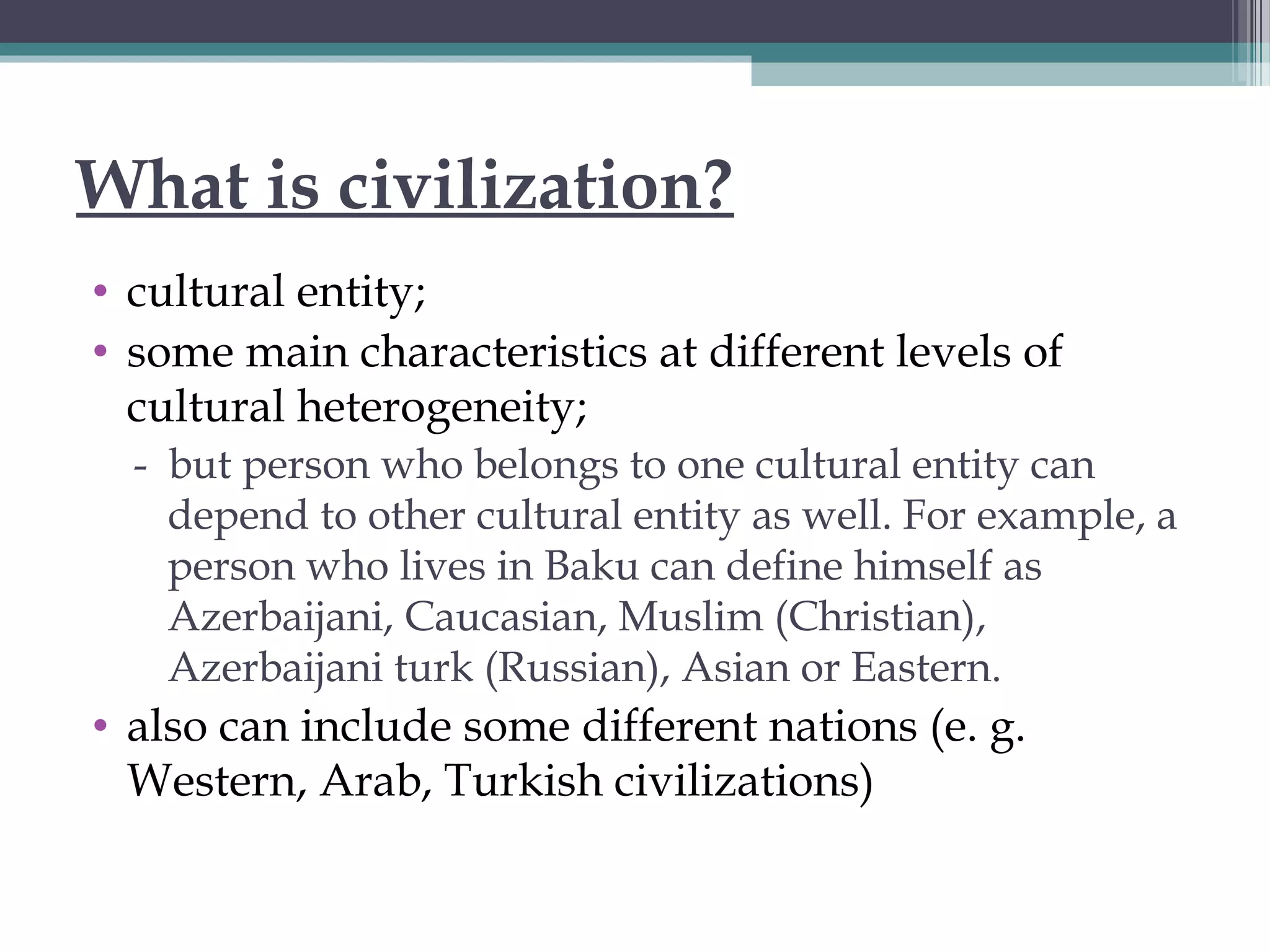
What is civilization?
• cultural entity;
• some main characteristics at different levels of
cultural heterogeneity;
- but person who belongs to one cultural entity can
depend to other cultural entity as well. For example, a
person who lives in Baku can define himself as
Azerbaijani, Caucasian, Muslim (Christian),
Azerbaijani turk (Russian), Asian or Eastern.
• also can include some different nations (e. g.
Western, Arab, Turkish civilizations)
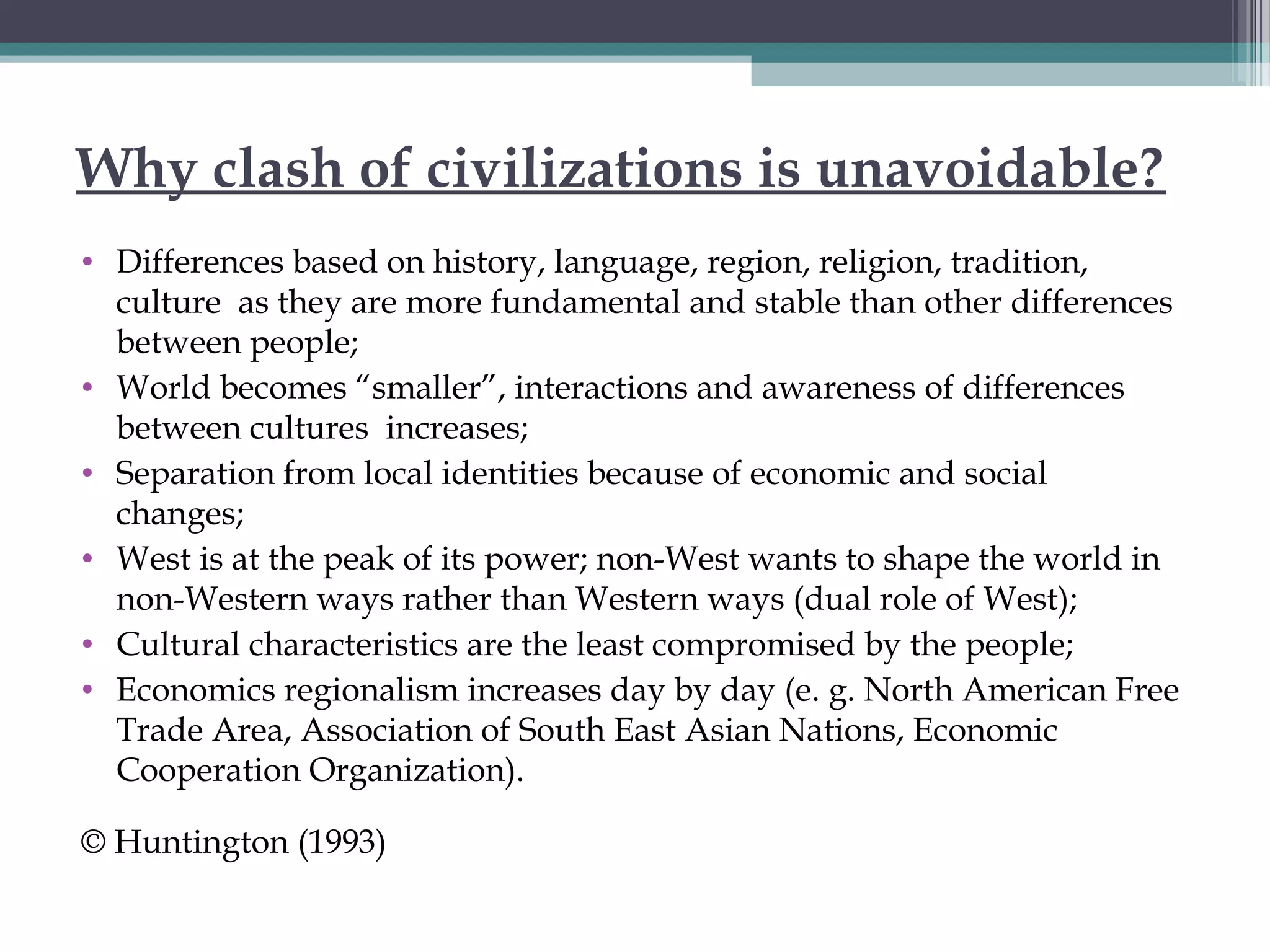
Why clash of civilizations is unavoidable?
• Differences based on history, language, region, religion, tradition,
culture as they are more fundamental and stable than other differences
between people;
• World becomes “smaller”, interactions and awareness of differences
between cultures increases;
• Separation from local identities because of economic and social
changes;
• West is at the peak of its power; non-West wants to shape the world in
non-Western ways rather than Western ways (dual role of West);
• Cultural characteristics are the least compromised by the people;
• Economics regionalism increases day by day (e. g. North American Free
Trade Area, Association of South East Asian Nations, Economic
Cooperation Organization).
© Huntington (1993)
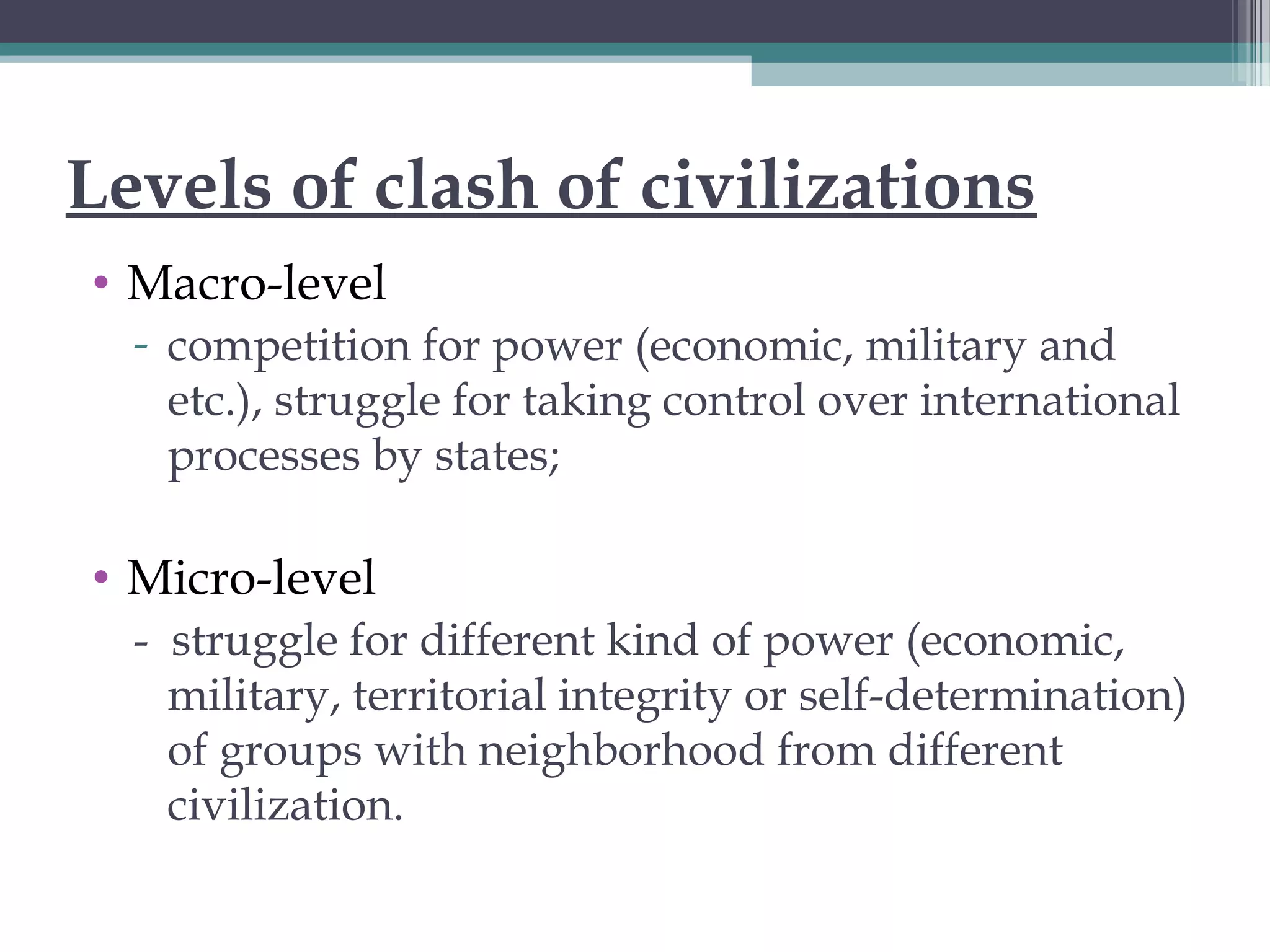
Levels of clash of civilizations
• Macro-level
- competition for power (economic, military and
etc.), struggle for taking control over international
processes by states;
• Micro-level
- struggle for different kind of power (economic,
military, territorial integrity or self-determination)
of groups with neighborhood from different
civilization.
Different fault lines between
civilizations during history (1)
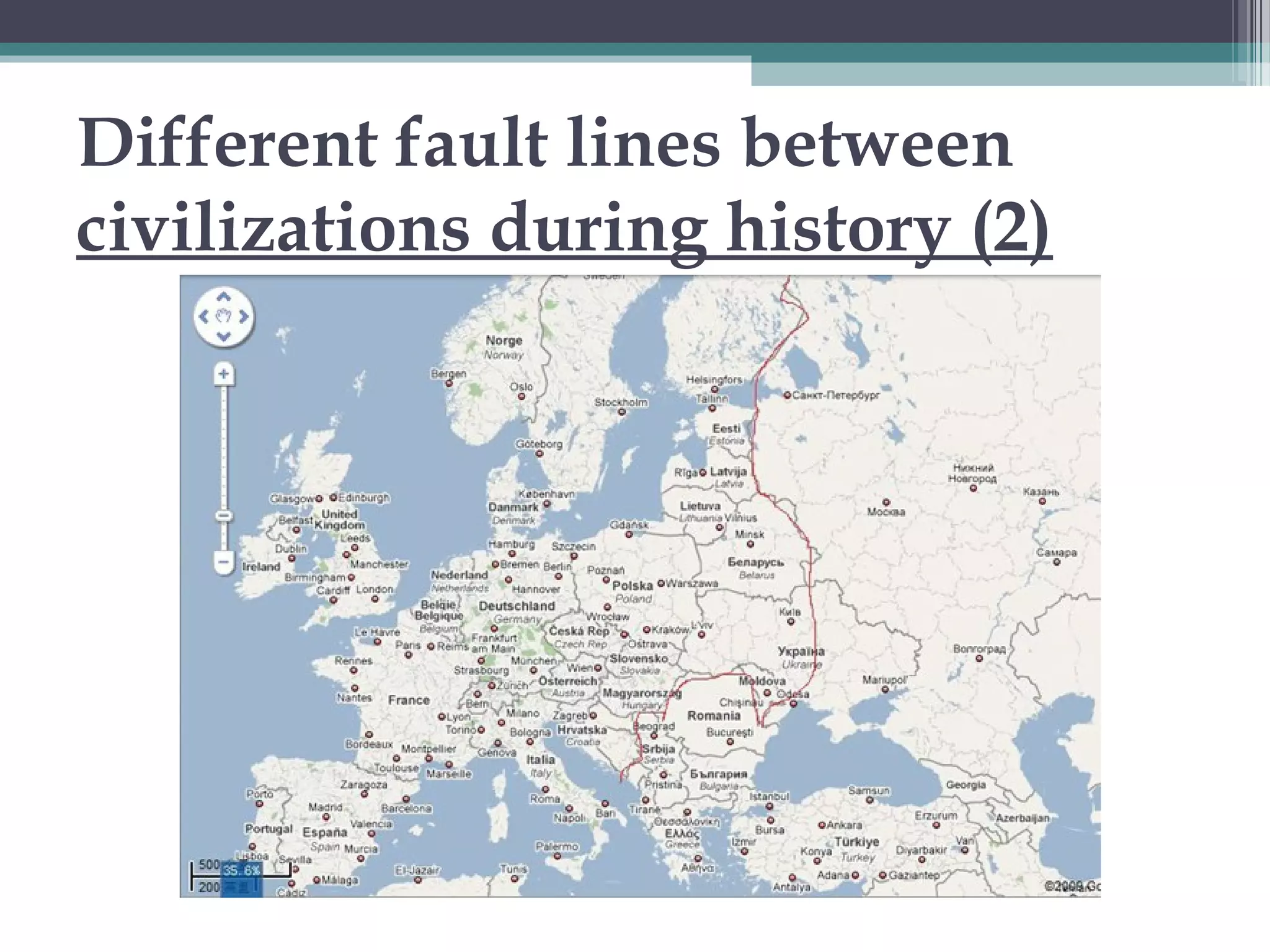
• Cultural divisions of Europe after Cold War:
- Western Christianity;
- Orthodox Christianity and Islam.
• The same for Yugoslavia:
- Croatia and Slovenia;
- The rest of former Yugoslavia.
Different fault lines between
civilizations during history (2)
Different fault lines between
civilizations during history (3)
• Interesting fault line between China and
America which is called “new cold war” by
Deng Xaioping.
• The same for the USA and Japan (which
succeeds to develop by technology using non-
Western ways)
- Interesting point: EU countries also develop, but
these countries have the same basic values,
attitudes with USA, while Japan has different
values and culture.
Demography vs. cultural conflict
• Population growth:
- High in non-Western countries (especially in North Africa);
- Small and even negative in Western countries.
• Increasing migration from non-Western countries to Western
countries makes necessary to create administrative rules in
order decrease immigration, because fertility rate is:
- 1.38 on average for European Union countries;
- more than 2 (sometimes even more than 8) in Islam
nations. If EU does not create administrative rules against
immigration, the majority population in European Union
will be Muslims after just a few decades.
© http://www.youtube.com/watch?v=6-3X5hIFXYU
Supporting participants of conflict
Groups or states belonging to one civilization
that involved in conflict with people from
different civilizations often support participants
of conflict from their civilization:
- Gulf War;
- Armenian-Azerbaijan conflict over Nagorno-
Karabakh and support from Turkey and Russia to
these countries;
- conflict in former Yugoslavia.
Conflicts and violence within the
same civilizations?
Huntington (1993): Yes!
- Russia and Ukraine over Crimea;
- Caucasus;
- Balkan.
References (1)
• Huntington P. Samuel, 1993, “The Clash of Civilizations”,
Foreign Affairs, Vol. 72, No. 3 (summer), pp. 22-49,
http://www.jstor.org/stable/20045621, accessed: 24/10/2010,
09:51
• Senghaas D, 1998, “Review Essay: A Clash of Civilizations, An
Idée Fixe?”, Journal of Peace Research, Vol. 35, No. 1 (Jan., 1998),
pp. 127-132, http://www.jstor.org/stable/425236, accessed:
24/10/2010, 10:07
• Fernandez-Armesto F, 1997, “Reviewed work: The clash of
civilizations. By Samuel P. Huntington”, International Affairs
(Royal Institute of International Affairs 1944-), Vol. 73, No. 3,
Globalization and International Relations (Jul.), pp. 547-548,
http://www.jstor.org/stable/2624272, accessed: 24/10/2010,
10:17
References (2)
• Rosecrance R, 1998, “Reviewed work: The clash of civilizations.
By Samuel P. Huntington”, The American Political Science Review,
Vol. 92, No. 4 (Dec.), pp. 978-980,
http://www.jstor.org/stable/2586367, accessed: 24/10/2010,
10:19
• Jervis R, 1997, “Reviewed work: The clash of civilizations. By
Samuel P. Huntington”, Political Science Quarterly, Vol. 112, No. 2
(summer), pp. 307-308, http://www.jstor.org/stable/2657943,
accessed: 24/10/2010, 10:16
• Marks R, 2000, “Reviewed work: The clash of civilizations. By
Samuel P. Huntington”, Journal of World History, Vol. 11, No. 1
(Spring), pp. 101-104, http://www.jstor.org/stable/20078821,
accessed: 24/10/2010, 10:16
• Muslim Immigration, http://www.youtube.com/watch?v=6-
3X5hIFXYU

Civilizations, their nature and clash possibilities (c) Rashad Mehbaliyev

  • 1.
    Civilizations, their nature andclash possibilities Rashad Mehbaliyev MA in Economics, 2nd year Political Economy of Nationalism and Globalism
  • 2.
    Types and historyof conflicts • Types: - ideological; - ethnic; - economical and etc. • History: - wars between kings, emperors, monarchs; - World War I; - Cold War and etc. • Next? - Cultural conflict!!! [ © Huntington S. P.]
  • 3.
    What is civilization? •cultural entity; • some main characteristics at different levels of cultural heterogeneity; - but person who belongs to one cultural entity can depend to other cultural entity as well. For example, a person who lives in Baku can define himself as Azerbaijani, Caucasian, Muslim (Christian), Azerbaijani turk (Russian), Asian or Eastern. • also can include some different nations (e. g. Western, Arab, Turkish civilizations)
  • 4.
    Why clash ofcivilizations is unavoidable? • Differences based on history, language, region, religion, tradition, culture as they are more fundamental and stable than other differences between people; • World becomes “smaller”, interactions and awareness of differences between cultures increases; • Separation from local identities because of economic and social changes; • West is at the peak of its power; non-West wants to shape the world in non-Western ways rather than Western ways (dual role of West); • Cultural characteristics are the least compromised by the people; • Economics regionalism increases day by day (e. g. North American Free Trade Area, Association of South East Asian Nations, Economic Cooperation Organization). © Huntington (1993)
  • 5.
    Levels of clashof civilizations • Macro-level - competition for power (economic, military and etc.), struggle for taking control over international processes by states; • Micro-level - struggle for different kind of power (economic, military, territorial integrity or self-determination) of groups with neighborhood from different civilization.
  • 6.
    Different fault linesbetween civilizations during history (1) • Cultural divisions of Europe after Cold War: - Western Christianity; - Orthodox Christianity and Islam. • The same for Yugoslavia: - Croatia and Slovenia; - The rest of former Yugoslavia.
  • 7.
    Different fault linesbetween civilizations during history (2)
  • 8.
    Different fault linesbetween civilizations during history (3) • Interesting fault line between China and America which is called “new cold war” by Deng Xaioping. • The same for the USA and Japan (which succeeds to develop by technology using non- Western ways) - Interesting point: EU countries also develop, but these countries have the same basic values, attitudes with USA, while Japan has different values and culture.
  • 9.
    Demography vs. culturalconflict • Population growth: - High in non-Western countries (especially in North Africa); - Small and even negative in Western countries. • Increasing migration from non-Western countries to Western countries makes necessary to create administrative rules in order decrease immigration, because fertility rate is: - 1.38 on average for European Union countries; - more than 2 (sometimes even more than 8) in Islam nations. If EU does not create administrative rules against immigration, the majority population in European Union will be Muslims after just a few decades. © http://www.youtube.com/watch?v=6-3X5hIFXYU
  • 10.
    Supporting participants ofconflict Groups or states belonging to one civilization that involved in conflict with people from different civilizations often support participants of conflict from their civilization: - Gulf War; - Armenian-Azerbaijan conflict over Nagorno- Karabakh and support from Turkey and Russia to these countries; - conflict in former Yugoslavia.
  • 11.
    Conflicts and violencewithin the same civilizations? Huntington (1993): Yes! - Russia and Ukraine over Crimea; - Caucasus; - Balkan.
  • 12.
    References (1) • HuntingtonP. Samuel, 1993, “The Clash of Civilizations”, Foreign Affairs, Vol. 72, No. 3 (summer), pp. 22-49, http://www.jstor.org/stable/20045621, accessed: 24/10/2010, 09:51 • Senghaas D, 1998, “Review Essay: A Clash of Civilizations, An Idée Fixe?”, Journal of Peace Research, Vol. 35, No. 1 (Jan., 1998), pp. 127-132, http://www.jstor.org/stable/425236, accessed: 24/10/2010, 10:07 • Fernandez-Armesto F, 1997, “Reviewed work: The clash of civilizations. By Samuel P. Huntington”, International Affairs (Royal Institute of International Affairs 1944-), Vol. 73, No. 3, Globalization and International Relations (Jul.), pp. 547-548, http://www.jstor.org/stable/2624272, accessed: 24/10/2010, 10:17
  • 13.
    References (2) • RosecranceR, 1998, “Reviewed work: The clash of civilizations. By Samuel P. Huntington”, The American Political Science Review, Vol. 92, No. 4 (Dec.), pp. 978-980, http://www.jstor.org/stable/2586367, accessed: 24/10/2010, 10:19 • Jervis R, 1997, “Reviewed work: The clash of civilizations. By Samuel P. Huntington”, Political Science Quarterly, Vol. 112, No. 2 (summer), pp. 307-308, http://www.jstor.org/stable/2657943, accessed: 24/10/2010, 10:16 • Marks R, 2000, “Reviewed work: The clash of civilizations. By Samuel P. Huntington”, Journal of World History, Vol. 11, No. 1 (Spring), pp. 101-104, http://www.jstor.org/stable/20078821, accessed: 24/10/2010, 10:16 • Muslim Immigration, http://www.youtube.com/watch?v=6- 3X5hIFXYU