Civil War Battles
As you progress through the slides, read the clues, then see if you can
name the battle that is described. Click to the next slide to check your
answer.
1861
It’s Going to Be a Long War
• The Civil War began on April 12 when Confederate artillery fired on
this federal facility in Charleston, SC.
• The “battle” was not really a military contest (there was no resistance
from the federal troops inside the fort), but this act of deliberate
rebellion turned secession from a political question into a military
conflict.
FORT SUMTER
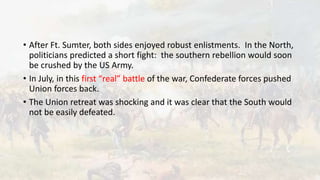
• After Ft. Sumter, both sides enjoyed robust enlistments. In the North,
politicians predicted a short fight: the southern rebellion would soon
be crushed by the US Army.
• In July, in this first “real” battle of the war, Confederate forces pushed
Union forces back.
• The Union retreat was shocking and it was clear that the South would
not be easily defeated.
First Bull Run
First Manassas)
1862
A Tough Year for the Union
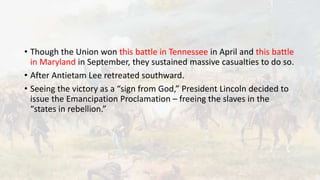
• Though the Union won this battle in Tennessee in April and this battle
in Maryland in September, they sustained massive casualties to do so.
• After Antietam Lee retreated southward.
• Seeing the victory as a “sign from God,” President Lincoln decided to
issue the Emancipation Proclamation – freeing the slaves in the
“states in rebellion.”
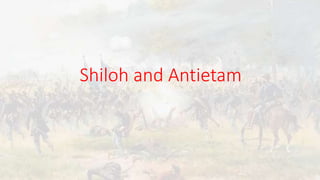
Shiloh and Antietam
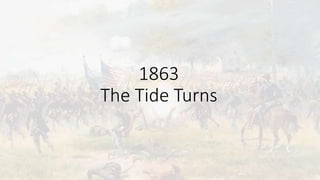
1863
The Tide Turns
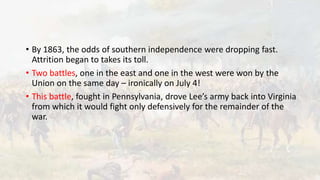
• By 1863, the odds of southern independence were dropping fast.
Attrition began to takes its toll.
• Two battles, one in the east and one in the west were won by the
Union on the same day – ironically on July 4!
• This battle, fought in Pennsylvania, drove Lee’s army back into Virginia
from which it would fight only defensively for the remainder of the
war.
Gettysburg
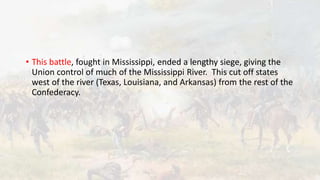
• This battle, fought in Mississippi, ended a lengthy siege, giving the
Union control of much of the Mississippi River. This cut off states
west of the river (Texas, Louisiana, and Arkansas) from the rest of the
Confederacy.
Vicksburg
1864
The End Is Near
• During this event late in 1864, Union forces marched across Georgia,
leaving destruction in their wake.
• The purpose of the campaign was to destroy the South’s ability to
continue the fight…which it did.
• The South never recovered from this devastating invasion.
Sherman’s March to the Sea
1865
The Cause is Lost
• Confederate forces were decimated. Attrition had taken its toll.
• Understanding further resistance to be futile, Confederate General
Robert E. Lee formally surrendered to Union General Ulysses S. Grant
at this place.
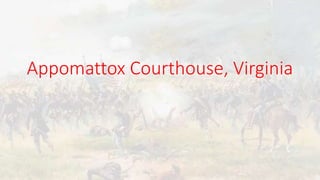
Appomattox Courthouse, Virginia
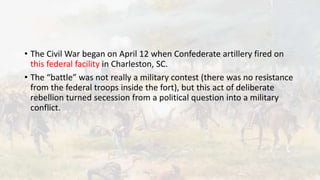
Photo Credit: "Battle of Antietam by Thulstrup" by Thure de
Thulstrup - website of the Old Print Shop, New York City.
Licensed under Public Domain via Commons -
https://commons.wikimedia.org/wiki/File:Battle_of_Antietam_
by_Thulstrup.jpg#/media/File:Battle_of_Antietam_by_Thulstru
p.jpg

Civil War Battles

  • 1.
    Civil War Battles Asyou progress through the slides, read the clues, then see if you can name the battle that is described. Click to the next slide to check your answer.
  • 2.
    1861 It’s Going toBe a Long War
  • 3.
    • The CivilWar began on April 12 when Confederate artillery fired on this federal facility in Charleston, SC. • The “battle” was not really a military contest (there was no resistance from the federal troops inside the fort), but this act of deliberate rebellion turned secession from a political question into a military conflict.
  • 4.
  • 5.
    • After Ft.Sumter, both sides enjoyed robust enlistments. In the North, politicians predicted a short fight: the southern rebellion would soon be crushed by the US Army. • In July, in this first “real” battle of the war, Confederate forces pushed Union forces back. • The Union retreat was shocking and it was clear that the South would not be easily defeated.
  • 6.
  • 7.
    1862 A Tough Yearfor the Union
  • 8.
    • Though theUnion won this battle in Tennessee in April and this battle in Maryland in September, they sustained massive casualties to do so. • After Antietam Lee retreated southward. • Seeing the victory as a “sign from God,” President Lincoln decided to issue the Emancipation Proclamation – freeing the slaves in the “states in rebellion.”
  • 9.
  • 10.
  • 11.
    • By 1863,the odds of southern independence were dropping fast. Attrition began to takes its toll. • Two battles, one in the east and one in the west were won by the Union on the same day – ironically on July 4! • This battle, fought in Pennsylvania, drove Lee’s army back into Virginia from which it would fight only defensively for the remainder of the war.
  • 12.
  • 13.
    • This battle,fought in Mississippi, ended a lengthy siege, giving the Union control of much of the Mississippi River. This cut off states west of the river (Texas, Louisiana, and Arkansas) from the rest of the Confederacy.
  • 14.
  • 15.
  • 16.
    • During thisevent late in 1864, Union forces marched across Georgia, leaving destruction in their wake. • The purpose of the campaign was to destroy the South’s ability to continue the fight…which it did. • The South never recovered from this devastating invasion.
  • 17.
  • 18.
  • 19.
    • Confederate forceswere decimated. Attrition had taken its toll. • Understanding further resistance to be futile, Confederate General Robert E. Lee formally surrendered to Union General Ulysses S. Grant at this place.
  • 20.
  • 21.
    Photo Credit: "Battleof Antietam by Thulstrup" by Thure de Thulstrup - website of the Old Print Shop, New York City. Licensed under Public Domain via Commons - https://commons.wikimedia.org/wiki/File:Battle_of_Antietam_ by_Thulstrup.jpg#/media/File:Battle_of_Antietam_by_Thulstru p.jpg