They are nottypically associated with
lack of access to clean drinking water
or sanitation services
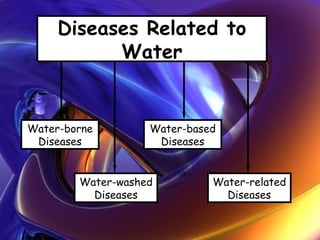
Include dengue, filariasis, malaria,
onchocerciasis, trypanosomiasis and
yellow fever
The Problem
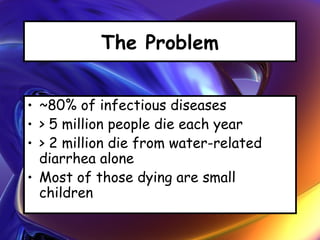
• ~80%of infectious diseases
• > 5 million people die each year
• > 2 million die from water-related
diarrhea alone
• Most of those dying are small
children
16.
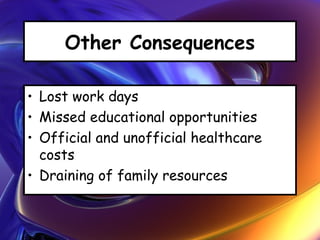
Other Consequences
• Lostwork days
• Missed educational opportunities
• Official and unofficial healthcare
costs
• Draining of family resources
Education Issues
• Hygieneeducation
• Good nutrition
• Improvements in habitation and
general sanitation
• Higher education training in water-
related issues
23.
Global Surveillance
• Publichealth infrastucture
• Standardized surveillance of water-
borne disease outbreaks
• Guidelines must be established for
investigating and reporting water-
borne diseases
General Guidelines
• Avoidcontacting soil that may be
contaminated with human feces.
• Do not defecate outdoors.
• Dispose of diapers properly.
26.
• Wash handswith soap and water
before handling food.
• When traveling to countries where
sanitation and hygiene are poor, avoid
water or food that may be
contaminated.
• Wash, peel or cook all raw vegetables
and fruits before eating.
27.
A Simple Ruleof Thumb
"Boil it, cook it, peel it, or
forget it"
28.
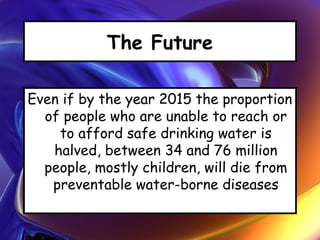
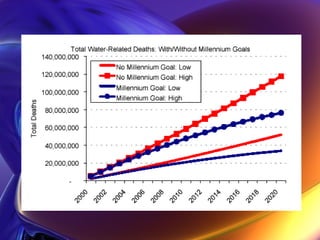
The Future
Even ifby the year 2015 the proportion
of people who are unable to reach or
to afford safe drinking water is
halved, between 34 and 76 million
people, mostly children, will die from
preventable water-borne diseases
30.
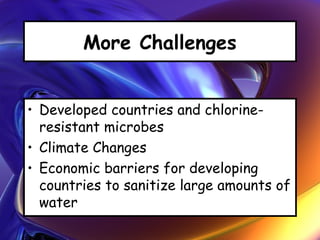
More Challenges
• Developedcountries and chlorine-
resistant microbes
• Climate Changes
• Economic barriers for developing
countries to sanitize large amounts of
water
31.
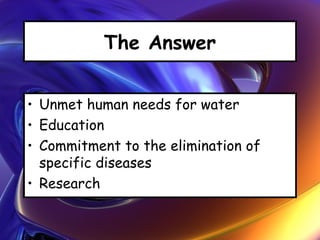
The Answer
• Unmethuman needs for water
• Education
• Commitment to the elimination of
specific diseases
• Research
32.
Climate Change
• Waterscarcity compromises hygiene
• Reduced water pressure increases
risk of back siphoning of
contaminated water
• Floods causing breaching of barriers
between sewage and water systems
33.
• Warming/cooling changesdistribution
of pathogens and vectors
• Increased UV exposure resulting in
increased susceptability to disease
• Increased mutation rates with
unpredictable effects on ecosystems
(pathogen development)
Editor's Notes
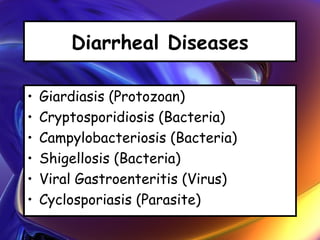
#3 Transmission occurs by drinking contaminated water, particularly contamination by pathogens transmitted from human excreta. These include most of the enteric and diarrheal diseases caused by bacteria and viruses worldwide.
#5 Stomach flu viruses
Cryptosporidiosis-Milkawakee outbreak, the largest recorded waterborne outbreak in US history, affecting 25% of city’s population 1993
Campylobacter is the most common diarrheal illness in the US.
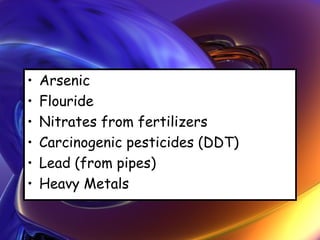
#6 Fertilizers, pesticides, herbicides, or defoliant while treating farmland or spraying fruit trees
#11 Snail (from egg to larvae to cervicariae) and crustacean
#15 >5 million die by unsafe drinking water, lack of sanitation, and insufficient water for hygiene.
At any given time, almost half of the people in developing countries suffer from water-related diseases.
Collectively, they are more lethal than AIDS, according to WHO.
#28 Millennium goal set by the United Nations in 2000
#29 The blue lines show if the millennium goal is met
The red if the millennium goal is not met
#31 Education on hygiene,sanitation, and water quality should be expanded worldwide.
#32 A pipe or tube fashioned or deployed in an inverted U shape and filled until atmospheric pressure is sufficient to force a liquid from a reservoir in one end of the tube over a barrier higher than the reservoir and out the other end.