Sampling and data collection methodes
Areas to be covered:
• Sample and population
• Sampling techniques.
Sampling Techniques
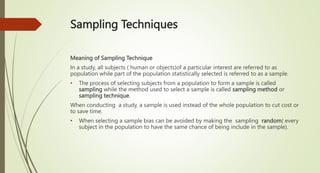
Meaning of Sampling Technique
In a study, all subjects ( human or objects)of a particular interest are referred to as
population while part of the population statistically selected is referred to as a sample.
• The process of selecting subjects from a population to form a sample is called
sampling while the method used to select a sample is called sampling method or
sampling technique.
When conducting a study, a sample is used instead of the whole population to cut cost or
to save time.
• When selecting a sample bias can be avoided by making the sampling random( every
subject in the population to have the same chance of being include in the sample).
Sampling Techniques
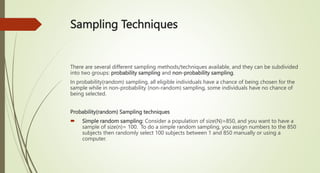
There are several different sampling methods/techniques available, and they can be subdivided
into two groups: probability sampling and non-probability sampling.
In probability(random) sampling, all eligible individuals have a chance of being chosen for the
sample while in non-probability (non-random) sampling, some individuals have no chance of
being selected.
Probability(random) Sampling techniques
 Simple random sampling: Consider a population of size(N)=850, and you want to have a
sample of size(n)= 100. To do a simple random sampling, you assign numbers to the 850
subjects then randomly select 100 subjects between 1 and 850 manually or using a
computer.
Sampling Techniques
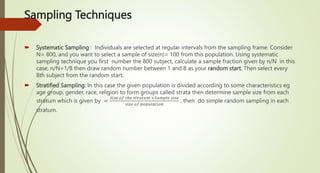
 Systematic Sampling : Individuals are selected at regular intervals from the sampling frame. Consider
N= 800, and you want to select a sample of size(n)= 100 from this population. Using systematic
sampling technique you first number the 800 subject, calculate a sample fraction given by n/N in this
case, n/N=1/8 then draw random number between 1 and 8 as your random start. Then select every
8th subject from the random start.
 Stratified Sampling: In this case the given population is divided according to some characteristics eg
age group, gender, race, religion to form groups called strata then determine sample size from each
stratum which is given by =
𝑆𝑖𝑧𝑒 𝑜𝑓 𝑡ℎ𝑒 𝑠𝑡𝑟𝑎𝑡𝑢𝑚 ×𝑆𝑎𝑚𝑝𝑙𝑒 𝑠𝑖𝑧𝑒
𝑠𝑖𝑧𝑒 𝑜𝑓 𝑝𝑜𝑝𝑢𝑙𝑎𝑡𝑖𝑜𝑛
, then do simple random sampling in each
stratum.
Sampling Techniques
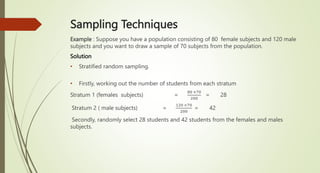
Example : Suppose you have a population consisting of 80 female subjects and 120 male
subjects and you want to draw a sample of 70 subjects from the population.
Solution
• Stratified random sampling.
• Firstly, working out the number of students from each stratum
Stratum 1 (females subjects) =
80 ×70
200
= 28
Stratum 2 ( male subjects) =
120 ×70
200
= 42
Secondly, randomly select 28 students and 42 students from the females and males
subjects.
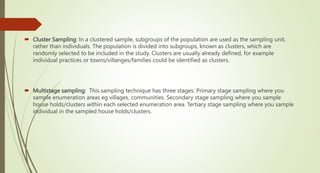
 Cluster Sampling: In a clustered sample, subgroups of the population are used as the sampling unit,
rather than individuals. The population is divided into subgroups, known as clusters, which are
randomly selected to be included in the study. Clusters are usually already defined, for example
individual practices or towns/villanges/families could be identified as clusters.
 Multistage sampling: This sampling technique has three stages: Primary stage sampling where you
sample enumeration areas eg villages, communities. Secondary stage sampling where you sample
house holds/clusters within each selected enumeration area. Tertiary stage sampling where you sample
individual in the sampled house holds/clusters.
Sampling Techniques
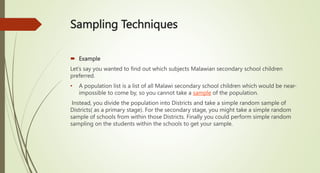
 Example
Let’s say you wanted to find out which subjects Malawian secondary school children
preferred.
• A population list is a list of all Malawi secondary school children which would be near-
impossible to come by, so you cannot take a sample of the population.
Instead, you divide the population into Districts and take a simple random sample of
Districts( as a primary stage). For the secondary stage, you might take a simple random
sample of schools from within those Districts. Finally you could perform simple random
sampling on the students within the schools to get your sample.
Sampling Techniques
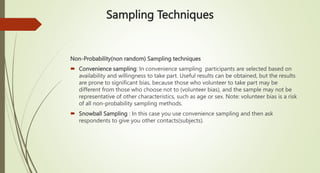
Non-Probability(non random) Sampling techniques
 Convenience sampling: In convenience sampling participants are selected based on
availability and willingness to take part. Useful results can be obtained, but the results
are prone to significant bias, because those who volunteer to take part may be
different from those who choose not to (volunteer bias), and the sample may not be
representative of other characteristics, such as age or sex. Note: volunteer bias is a risk
of all non-probability sampling methods.
 Snowball Sampling : In this case you use convenience sampling and then ask
respondents to give you other contacts(subjects).
Sampling Technique
 Quota Sampling: Researchers can select elements using their knowledge of target traits
and personalities to form strata. Members of various strata can then be chosen to be a part
of the sample as per the researcher’s understanding.
For example, an interviewer might be told to go out and select 20 adult men, 20 adult
women, 10 teenage girls and 10 teenage boys so that they could interview them about their
television viewing. Ideally the quotas chosen would proportionally represent the
characteristics of the underlying population.
 Purposive/Judgement/Selective/subjective sampling: This technique relies on the
judgement of the researcher when choosing who to ask to participate.
This approach is often used in qualitative research eg the media when canvassing the
public for opinions and in.

Civil Engineering statistics and probability

  • 1.
    Sampling and datacollection methodes Areas to be covered: • Sample and population • Sampling techniques.
  • 2.
    Sampling Techniques Meaning ofSampling Technique In a study, all subjects ( human or objects)of a particular interest are referred to as population while part of the population statistically selected is referred to as a sample. • The process of selecting subjects from a population to form a sample is called sampling while the method used to select a sample is called sampling method or sampling technique. When conducting a study, a sample is used instead of the whole population to cut cost or to save time. • When selecting a sample bias can be avoided by making the sampling random( every subject in the population to have the same chance of being include in the sample).
  • 3.
    Sampling Techniques There areseveral different sampling methods/techniques available, and they can be subdivided into two groups: probability sampling and non-probability sampling. In probability(random) sampling, all eligible individuals have a chance of being chosen for the sample while in non-probability (non-random) sampling, some individuals have no chance of being selected. Probability(random) Sampling techniques  Simple random sampling: Consider a population of size(N)=850, and you want to have a sample of size(n)= 100. To do a simple random sampling, you assign numbers to the 850 subjects then randomly select 100 subjects between 1 and 850 manually or using a computer.
  • 4.
    Sampling Techniques  SystematicSampling : Individuals are selected at regular intervals from the sampling frame. Consider N= 800, and you want to select a sample of size(n)= 100 from this population. Using systematic sampling technique you first number the 800 subject, calculate a sample fraction given by n/N in this case, n/N=1/8 then draw random number between 1 and 8 as your random start. Then select every 8th subject from the random start.  Stratified Sampling: In this case the given population is divided according to some characteristics eg age group, gender, race, religion to form groups called strata then determine sample size from each stratum which is given by = 𝑆𝑖𝑧𝑒 𝑜𝑓 𝑡ℎ𝑒 𝑠𝑡𝑟𝑎𝑡𝑢𝑚 ×𝑆𝑎𝑚𝑝𝑙𝑒 𝑠𝑖𝑧𝑒 𝑠𝑖𝑧𝑒 𝑜𝑓 𝑝𝑜𝑝𝑢𝑙𝑎𝑡𝑖𝑜𝑛 , then do simple random sampling in each stratum.
  • 5.
    Sampling Techniques Example :Suppose you have a population consisting of 80 female subjects and 120 male subjects and you want to draw a sample of 70 subjects from the population. Solution • Stratified random sampling. • Firstly, working out the number of students from each stratum Stratum 1 (females subjects) = 80 ×70 200 = 28 Stratum 2 ( male subjects) = 120 ×70 200 = 42 Secondly, randomly select 28 students and 42 students from the females and males subjects.
  • 6.
     Cluster Sampling:In a clustered sample, subgroups of the population are used as the sampling unit, rather than individuals. The population is divided into subgroups, known as clusters, which are randomly selected to be included in the study. Clusters are usually already defined, for example individual practices or towns/villanges/families could be identified as clusters.  Multistage sampling: This sampling technique has three stages: Primary stage sampling where you sample enumeration areas eg villages, communities. Secondary stage sampling where you sample house holds/clusters within each selected enumeration area. Tertiary stage sampling where you sample individual in the sampled house holds/clusters.
  • 7.
    Sampling Techniques  Example Let’ssay you wanted to find out which subjects Malawian secondary school children preferred. • A population list is a list of all Malawi secondary school children which would be near- impossible to come by, so you cannot take a sample of the population. Instead, you divide the population into Districts and take a simple random sample of Districts( as a primary stage). For the secondary stage, you might take a simple random sample of schools from within those Districts. Finally you could perform simple random sampling on the students within the schools to get your sample.
  • 8.
    Sampling Techniques Non-Probability(non random)Sampling techniques  Convenience sampling: In convenience sampling participants are selected based on availability and willingness to take part. Useful results can be obtained, but the results are prone to significant bias, because those who volunteer to take part may be different from those who choose not to (volunteer bias), and the sample may not be representative of other characteristics, such as age or sex. Note: volunteer bias is a risk of all non-probability sampling methods.  Snowball Sampling : In this case you use convenience sampling and then ask respondents to give you other contacts(subjects).
  • 9.
    Sampling Technique  QuotaSampling: Researchers can select elements using their knowledge of target traits and personalities to form strata. Members of various strata can then be chosen to be a part of the sample as per the researcher’s understanding. For example, an interviewer might be told to go out and select 20 adult men, 20 adult women, 10 teenage girls and 10 teenage boys so that they could interview them about their television viewing. Ideally the quotas chosen would proportionally represent the characteristics of the underlying population.  Purposive/Judgement/Selective/subjective sampling: This technique relies on the judgement of the researcher when choosing who to ask to participate. This approach is often used in qualitative research eg the media when canvassing the public for opinions and in.