“How a ‘Citizens’ Guide to the Budget’ can strengthen fiscal transparency and increase public participation”Jon ShieldsInternational Monetary Fund ICGFM Conference Florida May 18, 2011
Outline What is special about a CGB? The context for a CGB: Fiscal transparencyDistinguishing characteristics of a CGB: Information content
Style, format and quality
Dissemination What is a CGB?About 30 countries in recent years have produced at least one CGB, of varying contents and quality.Typically:Self-contained document written in clear and non-technical language.
Published by the Finance Ministry.
Produced at same time as budget is presented to legislature.
Explains budget proposals and economic context. Why do governments publish CGBs?Ensure budget message is understood; broaden informed electorate.Explain countries’ economic problems.Enhance accountability.Counter hostile assessments.Increase buy-in for unpopular policies.
What do CGBs add?Accessibility.
    Snapshot of fiscal position and 	decisions.
    Supplement to technical information 	required for legislatures.
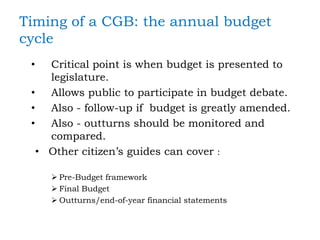
    Insight into specific economic, 	spending or revenue decisions. Timing of a CGB: the annual budget cycle 	Critical point is when budget is presented to             	legislature.
 	Allows public to participate in budget debate.
 	Also - follow-up if  budget is greatly amended.
 	Also - outturns should be monitored and  	compared.
 Other citizen’s guides can cover :
Pre-Budget framework
Final Budget
Outturns/end-of-year financial statementsContext for a CGB – fiscal transparencyA CGB is one instrument to help assure fiscal transparency, viz.:Being open to the public about the structure and functions of government, fiscal policy intentions, and public sector accounts and projections (Kopits and Craig).Public right to know.Promotes accountability; market discipline; lower corruption; good institutions; time-consistent behavior and sustainable     	    policy; macro and micro efficiency; trust; fairness. 	 Fosters better governance, internal decision-making, reform in   public financial management, public expenditure, tax 	 administration, and tax policy, macro-fiscal. Strengthens accessto international financial markets.
IMF Code of Good Practices in Fiscal Transparency – Four PillarsClarity of roles and responsibilities: Structure and functions of government, responsibilities within government, relations between government and the rest of the economyOpen budget processes: Budget preparation, execution, and monitoring; timetable for legislature; realism of estimates and medium-term framework; fiscal sustainability.Public availability of information:Specification of the coverage, detail, and timing of fiscal information to be provided to the public.Assurance of integrity: Quality of fiscal data, internal oversight, and external scrutiny.
FT Code: (1) Clarity of Roles and Responsibilities: 1.1Scope of government. The government sector should be distinguished from the rest of the public sector and from the rest of the economy, and policy and management roles within the public sector should be clear and publicly disclosed.Show all ramifications of central government; QFAs, EBFs, local government relations1.2 Framework for fiscal management. There should be a clear and open legal, regulatory, and administrative framework for fiscal management. 
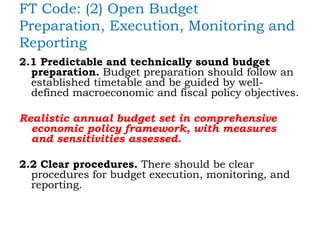
FT Code: (2) Open Budget Preparation, Execution, Monitoring and Reporting 2.1 Predictable and technically sound budget preparation. Budget preparation should follow an established timetable and be guided by well-defined macroeconomic and fiscal policy objectives.Realistic annual budget set in comprehensive economic policy framework, with measures and sensitivities assessed.2.2 Clear procedures. There should be clear procedures for budget execution, monitoring, and reporting.
FT Code: (3) Public Availability of Information 3.1 Comprehensive information. The public should be provided with comprehensive information on past, current, and projected fiscal activity and on major fiscal risks.Full disclosure, as for legislature, coverage, comparability, significance, long-term outlook.3.2 Relevance. Fiscal information should be presented in a way that facilitates policy analysis and promotes accountability.Citizens’ Guide, minimum aggregate data requirements, results3.3. Timeliness. A commitment should be made to the timely publication of fiscal information.
FT Code: (4) Assurances of Integrity4.1 Quality. Fiscal data should meet accepted data quality standards.4.2 Oversight. Fiscal activities should be subject to effective internal oversight and safeguards.4.3 Auditing. Fiscal information should be externally scrutinized.
A Citizens’ Guide – Overall ContentsCommon core of information on the budget proposals and economic context.
Relative emphasis of the topics, and the level of detail, should reflect country circumstances and capacity,particularly:
 pre-existing general level of understanding
 level and quality of media coverage A Citizen’s Guide – Why the budget matters Explain role of budget in public financial    management (and requirements in constitution or budget law).
Describe the budget process, including the roles of the executive branch, in preparing 	the budget and of the legislature in authorising government taxation, borrowing, and expenditure.

Citizens Budget Guide & results - Shield

  • 1.
     “How a ‘Citizens’Guide to the Budget’ can strengthen fiscal transparency and increase public participation”Jon ShieldsInternational Monetary Fund ICGFM Conference Florida May 18, 2011
  • 2.
    Outline What is specialabout a CGB? The context for a CGB: Fiscal transparencyDistinguishing characteristics of a CGB: Information content
  • 3.
  • 4.
    Dissemination What isa CGB?About 30 countries in recent years have produced at least one CGB, of varying contents and quality.Typically:Self-contained document written in clear and non-technical language.
  • 5.
    Published by theFinance Ministry.
  • 6.
    Produced at sametime as budget is presented to legislature.
  • 7.
    Explains budget proposalsand economic context. Why do governments publish CGBs?Ensure budget message is understood; broaden informed electorate.Explain countries’ economic problems.Enhance accountability.Counter hostile assessments.Increase buy-in for unpopular policies.
  • 8.
    What do CGBsadd?Accessibility.
  • 9.
    Snapshot of fiscal position and decisions.
  • 10.
    Supplement to technical information required for legislatures.
  • 11.
    Insight into specific economic, spending or revenue decisions. Timing of a CGB: the annual budget cycle Critical point is when budget is presented to legislature.
  • 12.
    Allows publicto participate in budget debate.
  • 13.
    Also -follow-up if budget is greatly amended.
  • 14.
    Also -outturns should be monitored and compared.
  • 15.
    Other citizen’sguides can cover :
  • 16.
  • 17.
  • 18.
    Outturns/end-of-year financial statementsContextfor a CGB – fiscal transparencyA CGB is one instrument to help assure fiscal transparency, viz.:Being open to the public about the structure and functions of government, fiscal policy intentions, and public sector accounts and projections (Kopits and Craig).Public right to know.Promotes accountability; market discipline; lower corruption; good institutions; time-consistent behavior and sustainable policy; macro and micro efficiency; trust; fairness.  Fosters better governance, internal decision-making, reform in public financial management, public expenditure, tax administration, and tax policy, macro-fiscal. Strengthens accessto international financial markets.
  • 19.
    IMF Code ofGood Practices in Fiscal Transparency – Four PillarsClarity of roles and responsibilities: Structure and functions of government, responsibilities within government, relations between government and the rest of the economyOpen budget processes: Budget preparation, execution, and monitoring; timetable for legislature; realism of estimates and medium-term framework; fiscal sustainability.Public availability of information:Specification of the coverage, detail, and timing of fiscal information to be provided to the public.Assurance of integrity: Quality of fiscal data, internal oversight, and external scrutiny.
  • 20.
    FT Code: (1)Clarity of Roles and Responsibilities: 1.1Scope of government. The government sector should be distinguished from the rest of the public sector and from the rest of the economy, and policy and management roles within the public sector should be clear and publicly disclosed.Show all ramifications of central government; QFAs, EBFs, local government relations1.2 Framework for fiscal management. There should be a clear and open legal, regulatory, and administrative framework for fiscal management. 
  • 21.
    FT Code: (2)Open Budget Preparation, Execution, Monitoring and Reporting 2.1 Predictable and technically sound budget preparation. Budget preparation should follow an established timetable and be guided by well-defined macroeconomic and fiscal policy objectives.Realistic annual budget set in comprehensive economic policy framework, with measures and sensitivities assessed.2.2 Clear procedures. There should be clear procedures for budget execution, monitoring, and reporting.
  • 22.
    FT Code: (3)Public Availability of Information 3.1 Comprehensive information. The public should be provided with comprehensive information on past, current, and projected fiscal activity and on major fiscal risks.Full disclosure, as for legislature, coverage, comparability, significance, long-term outlook.3.2 Relevance. Fiscal information should be presented in a way that facilitates policy analysis and promotes accountability.Citizens’ Guide, minimum aggregate data requirements, results3.3. Timeliness. A commitment should be made to the timely publication of fiscal information.
  • 23.
    FT Code: (4)Assurances of Integrity4.1 Quality. Fiscal data should meet accepted data quality standards.4.2 Oversight. Fiscal activities should be subject to effective internal oversight and safeguards.4.3 Auditing. Fiscal information should be externally scrutinized.
  • 24.
    A Citizens’ Guide– Overall ContentsCommon core of information on the budget proposals and economic context.
  • 25.
    Relative emphasis ofthe topics, and the level of detail, should reflect country circumstances and capacity,particularly:
  • 26.
    pre-existing generallevel of understanding
  • 27.
    level andquality of media coverage A Citizen’s Guide – Why the budget matters Explain role of budget in public financial management (and requirements in constitution or budget law).
  • 28.
    Describe the budgetprocess, including the roles of the executive branch, in preparing the budget and of the legislature in authorising government taxation, borrowing, and expenditure.

Editor's Notes

  • #28 Prior to FMIS Presentation at 3:45 – repeat slide
  • #29 Prior to FMIS Presentation at 3:45 – repeat slide