Citing Your Sources Properly
Rex Curriculum Resource WWW.REX.COM.PH
Citation
After selecting, evaluating, and synthesizing your sources, you must now acknowledge the
authors of information that you will use in your research. This is called citation. It means you
are stating that some information is not yours and that it belongs to someone else. In this way,
it prevents you from committing plagiarism which is stealing, using, and presenting someone
else’s work without recognizing its rightful owner. Besides plagiarism, according to Sankaran
(2016), citations are important for the following reasons:

It serves as a fact-checking tool.

Good citation practice makes you a better writer.

A comprehensive reference list establishes your scientific knowledge.

Careful citation practice builds your credibility as a scientist or scholar.

Citation enables better verification of your work.

It makes you a better researcher.
Along with citations, intellectual honesty refers to the truthfulness with which ideas are
acquired, analyzed, and transmitted (Toledo-Pereyra, 2009). This means that as a researcher,
you are expected to search, know, and share only correct information when you draft your
review of related literature.
Rex Curriculum Resource WWW.REX.COM.PH
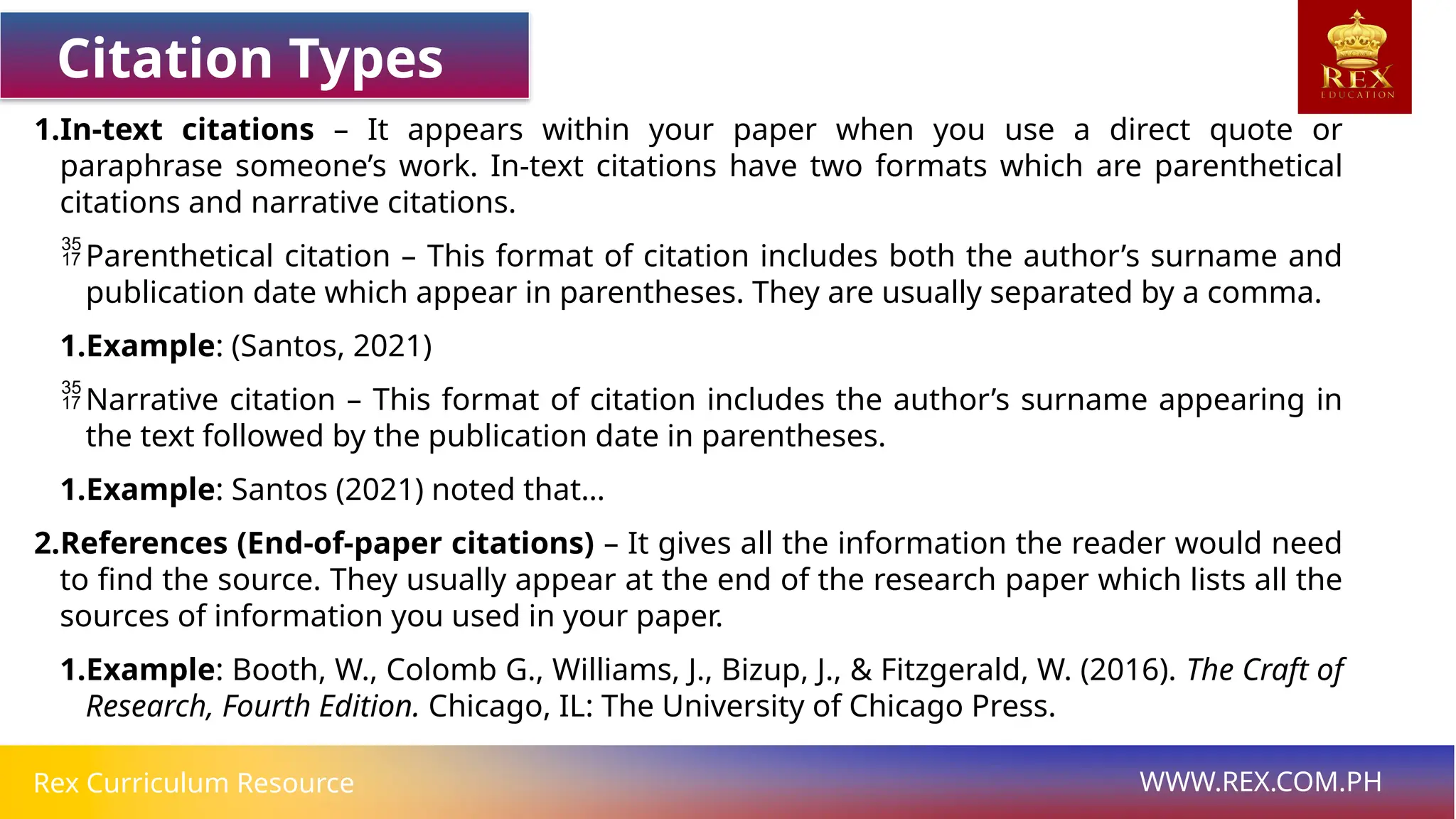
Citation Types
1.In-text citations – It appears within your paper when you use a direct quote or
paraphrase someone’s work. In-text citations have two formats which are parenthetical
citations and narrative citations.
Parenthetical citation – This format of citation includes both the author’s surname and
publication date which appear in parentheses. They are usually separated by a comma.
1.Example: (Santos, 2021)
Narrative citation – This format of citation includes the author’s surname appearing in
the text followed by the publication date in parentheses.
1.Example: Santos (2021) noted that…
2.References (End-of-paper citations) – It gives all the information the reader would need
to find the source. They usually appear at the end of the research paper which lists all the
sources of information you used in your paper.
1.Example: Booth, W., Colomb G., Williams, J., Bizup, J., & Fitzgerald, W. (2016). The Craft of
Research, Fourth Edition. Chicago, IL: The University of Chicago Press.
Rex Curriculum Resource WWW.REX.COM.PH
Parts of a Reference List
Most reference citations have basic elements like:
Authors
Title
Place of Publication, Publisher, Date of Publication, Page Number
Section title, especially if it is a newspaper
URL (Uni`form Resource Locator), if it is from the Internet
It may also include unique identifiers such as:

International Standard Serial Number (ISSN) for books;

Serial Item and Contribution Identifier (SICI); or

International Standard Serial Number (ISSN) for specific volumes, articles, or other parts of
a periodical; and

Digital Object Identifier (DOI) for electronic documents.
Rex Curriculum Resource WWW.REX.COM.PH
Examples
• PR 2023-2024Value_Orientation_of_Pupils_at_the_Eleme.pdf
• PR 2023-2024The_students_values_acquired_at_school.pdf
Rex Curriculum Resource WWW.REX.COM.PH
Citation Styles
A citation style refers to the established rules and conventions of documenting and citing sources.
In addition, some citations differ largely from each other depending on the citation style that you
will incorporate in your research.
Citation Style Comparison Table
American Psychological
Association (APA)
Modern Language
Association (MLA)
Chicago Manual of Style
(CMS)
Field or Discipline Psychology, Nursing,
Education, Social Sciences
English, Humanities Physical Sciences,
Business, History, Fine Arts
In-Text Citation Author-Year-Page Number
(Cruz, 2020, p. 6)
Author-Page Number
(Cruz 6)
Author-Year-Page Number
(Cruz 2020, 6)
Reference List Title References Works Cited Bibliography
Author in Reference List Cruz, R.A. Cruz R. Cruz, Reynaldo Alo
Footnotes and Endnotes Not used Used Occasionally Often used
Title Page Required Not Required Required
Rex Curriculum Resource WWW.REX.COM.PH
Citation Styles
There are still other citation styles like IEEE (The Institute of
Electrical and Electronics Engineers) Style, AMA (American Medical
Association), ASA (American Sociological Association), and those in
other professional fields and disciplines.
Rex Curriculum Resource WWW.REX.COM.PH
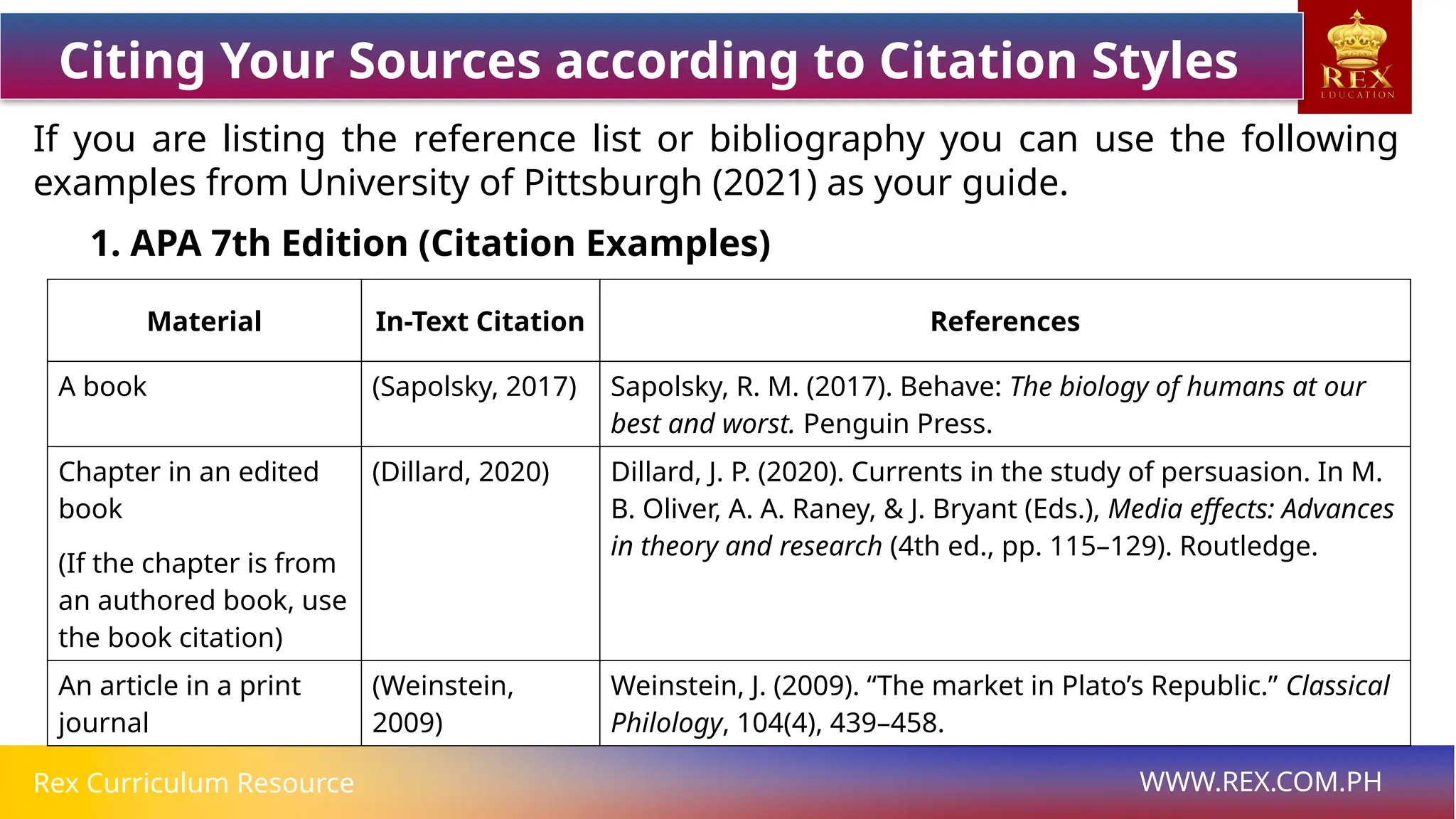
Citing Your Sources according to Citation Styles
If you are listing the reference list or bibliography you can use the following
examples from University of Pittsburgh (2021) as your guide.
1. APA 7th Edition (Citation Examples)
Material In-Text Citation References
A book (Sapolsky, 2017) Sapolsky, R. M. (2017). Behave: The biology of humans at our
best and worst. Penguin Press.
Chapter in an edited
book
(If the chapter is from
an authored book, use
the book citation)
(Dillard, 2020) Dillard, J. P. (2020). Currents in the study of persuasion. In M.
B. Oliver, A. A. Raney, & J. Bryant (Eds.), Media effects: Advances
in theory and research (4th ed., pp. 115–129). Routledge.
An article in a print
journal
(Weinstein,
2009)
Weinstein, J. (2009). “The market in Plato’s Republic.” Classical
Philology, 104(4), 439–458.
Rex Curriculum Resource WWW.REX.COM.PH
Citing Your Sources according to Citation Styles
An article in an
electronic
journal
(Grady, et al.,
2019)
Grady, J. S., Her, M., Moreno, G., Perez, C., & Yelinek, J. (2019).
Emotions in storybooks: A comparison of storybooks that
represent ethnic and racial groups in the United States.
Psychology of Popular Media Culture, 8(3), 207–217.
https://doi.org/10.1037/ppm0000185
A website (Bologna, 2019) Bologna, C. (2019, October 31). Why some people with anxiety
love watching horror movies. HuffPost. Retrieved from
https://www.huffpost.com/entry/anxiety-lovewatching-
horror-movies_l_5d277587e4b02a5a5d57b59e
Rex Curriculum Resource WWW.REX.COM.PH
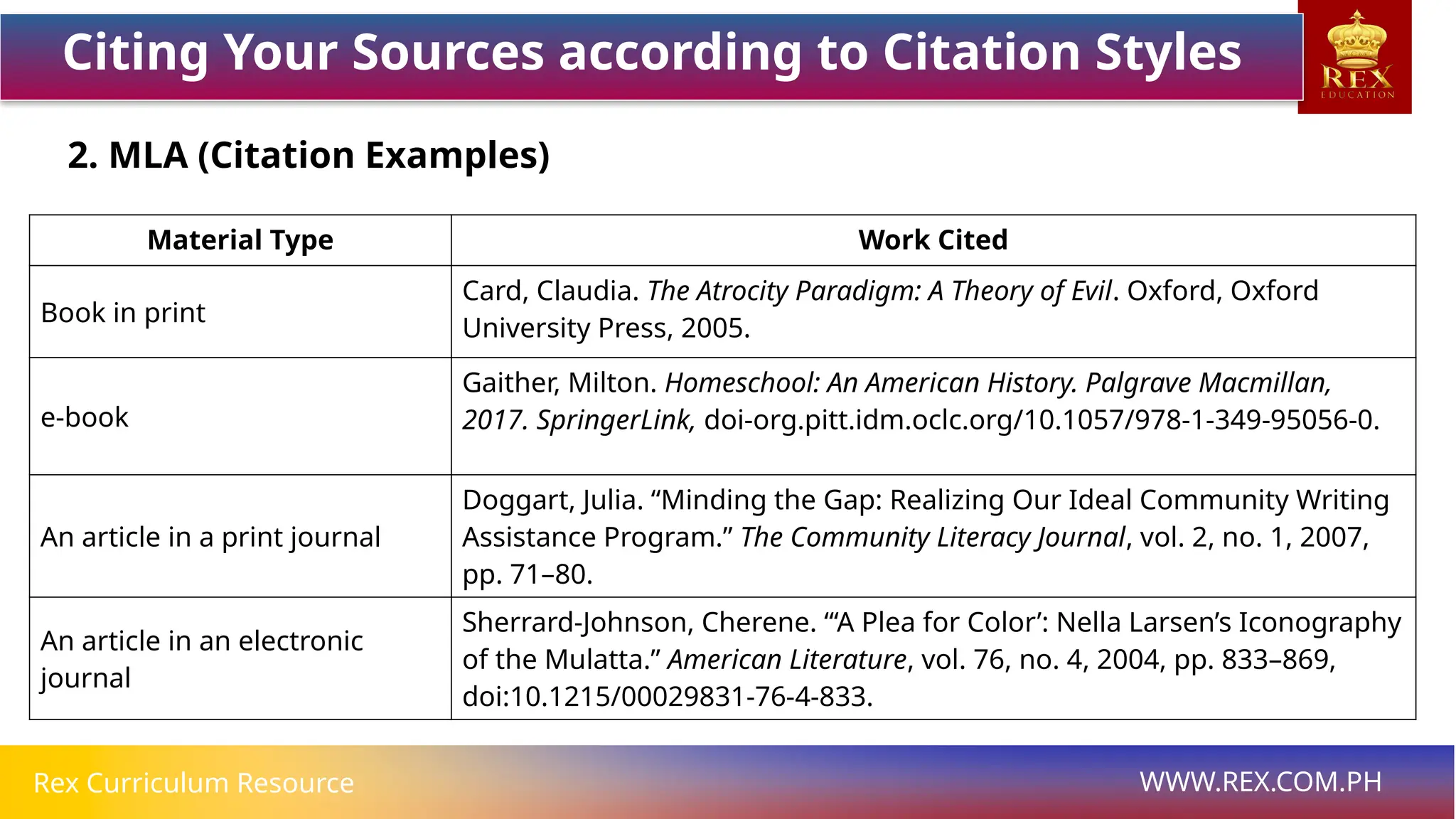
Citing Your Sources according to Citation Styles
2. MLA (Citation Examples)
Material Type Work Cited
Book in print
Card, Claudia. The Atrocity Paradigm: A Theory of Evil. Oxford, Oxford
University Press, 2005.
e-book
Gaither, Milton. Homeschool: An American History. Palgrave Macmillan,
2017. SpringerLink, doi-org.pitt.idm.oclc.org/10.1057/978-1-349-95056-0.
An article in a print journal
Doggart, Julia. “Minding the Gap: Realizing Our Ideal Community Writing
Assistance Program.” The Community Literacy Journal, vol. 2, no. 1, 2007,
pp. 71–80.
An article in an electronic
journal
Sherrard-Johnson, Cherene. “‘A Plea for Color’: Nella Larsen’s Iconography
of the Mulatta.” American Literature, vol. 76, no. 4, 2004, pp. 833–869,
doi:10.1215/00029831-76-4-833.
Rex Curriculum Resource WWW.REX.COM.PH
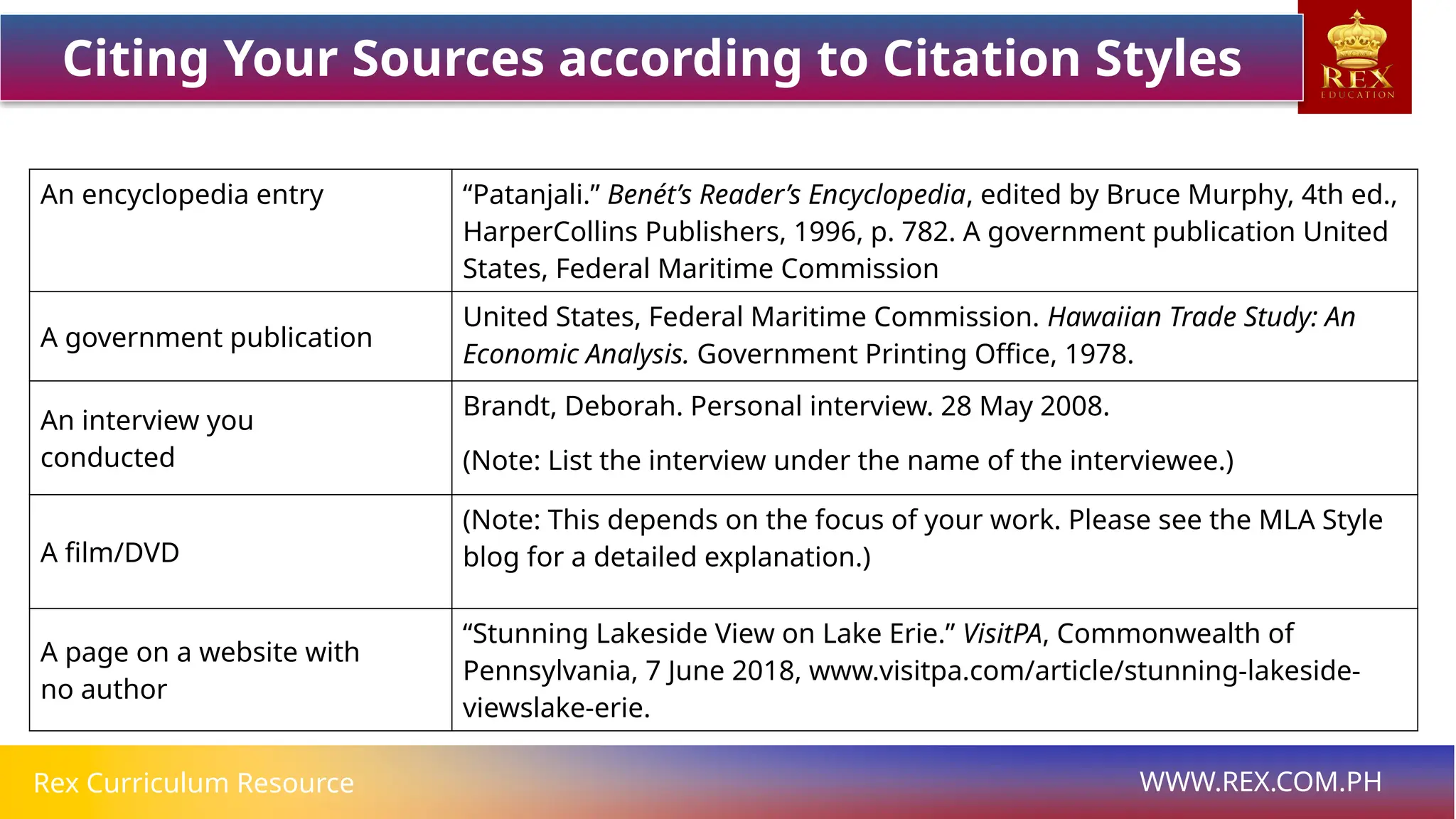
Citing Your Sources according to Citation Styles
An encyclopedia entry “Patanjali.” Benét’s Reader’s Encyclopedia, edited by Bruce Murphy, 4th ed.,
HarperCollins Publishers, 1996, p. 782. A government publication United
States, Federal Maritime Commission
A government publication
United States, Federal Maritime Commission. Hawaiian Trade Study: An
Economic Analysis. Government Printing Office, 1978.
An interview you
conducted
Brandt, Deborah. Personal interview. 28 May 2008.
(Note: List the interview under the name of the interviewee.)
A film/DVD
(Note: This depends on the focus of your work. Please see the MLA Style
blog for a detailed explanation.)
A page on a website with
no author
“Stunning Lakeside View on Lake Erie.” VisitPA, Commonwealth of
Pennsylvania, 7 June 2018, www.visitpa.com/article/stunning-lakeside-
viewslake-erie.
Rex Curriculum Resource WWW.REX.COM.PH
Citing Your Sources according to Citation Styles
A page on a website with
an author
Del Castillo, Inigo. “How Not to Kill Your Houseplants, According to
Botanists.” Apartment Therapy, 29 Jan. 2020,
www.apartmenttherapy.com/houseplanttips-
botanists-36710191
Artwork – from website
Sherald, Amy. Former First Lady, Michelle Obama. 2018. National Portrait
Gallery, npg.si.edu/object/npg_NPG.2018.15.
Rex Curriculum Resource WWW.REX.COM.PH
Citing Your Sources according to Citation Styles
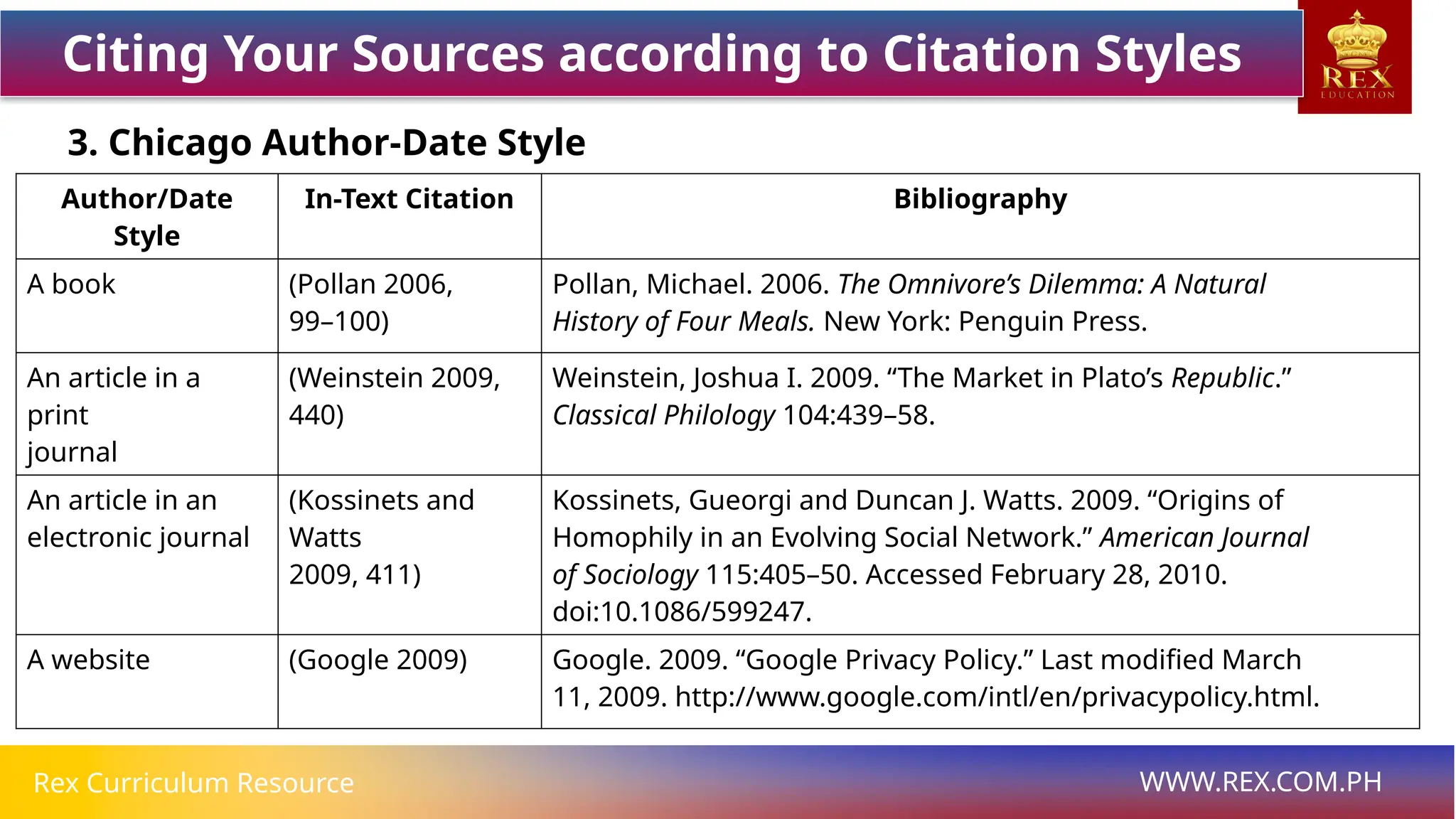
3. Chicago Author-Date Style
Author/Date
Style
In-Text Citation Bibliography
A book (Pollan 2006,
99–100)
Pollan, Michael. 2006. The Omnivore’s Dilemma: A Natural
History of Four Meals. New York: Penguin Press.
An article in a
print
journal
(Weinstein 2009,
440)
Weinstein, Joshua I. 2009. “The Market in Plato’s Republic.”
Classical Philology 104:439–58.
An article in an
electronic journal
(Kossinets and
Watts
2009, 411)
Kossinets, Gueorgi and Duncan J. Watts. 2009. “Origins of
Homophily in an Evolving Social Network.” American Journal
of Sociology 115:405–50. Accessed February 28, 2010.
doi:10.1086/599247.
A website (Google 2009) Google. 2009. “Google Privacy Policy.” Last modified March
11, 2009. http://www.google.com/intl/en/privacypolicy.html.
Rex Curriculum Resource WWW.REX.COM.PH
Ethical Standards in Citing and
Acknowledging Sources
Honesty: A researcher must only use accurate information and data.
He/She should avoid falsifying data and only present what is true.
Objectivity: A researcher must be unbiased in any aspects of the research.
Integrity: A researcher must keep his/her agreement.
Carefulness: Upon collection and analysis of data, the researcher must
avoid making careless errors by examining critically all the data and
information to be presented in the research.
Openness: A researcher must share resources and information to other
researchers to help in creating new research. Also, one must be open to
criticisms and new ideas.
Ethics in research refers to the prescribed guidelines that you must follow for responsible
conduct of research. It is vital because it prevents the researchers from committing severe
errors, inaccuracies, and misconduct during the research process. According to Resnik (2015),
there are several ethical principles that you must remember. These are the following:
Rex Curriculum Resource WWW.REX.COM.PH
Ethical Standards in Citing
and Acknowledging Sources
Respect for Intellectual Property: A researcher must always cite
sources of information properly to avoid plagiarism.
Confidentiality: Participants’ data and personal information
should not be disclosed outside the research setting.
Responsible Publication: The researcher must develop new and
innovative research that will benefit the community besides
personal gains.
Social Responsibility: The research conducted must promote
social welfare where the researcher foresees its impact to society,
addressing problems.
Rex Curriculum Resource WWW.REX.COM.PH
Ethical Standards in Citing and
Acknowledging Sources
Nondiscrimination: To reduce maltreatment of subjects or
participants, the researcher must be aware of his/her
responsibilities. For example, regardless of the participant’s
gender, color, socioeconomic status, or ethnicity, the
researcher must provide equal opportunities to join the study
if they would be useful in your research.
Competence: A researcher must continue to pursue lifelong
learning and education to enhance his/her skills and
knowledge.
Legality: A researcher must always follow existing laws and
policies.
Rex Curriculum Resource WWW.REX.COM.PH
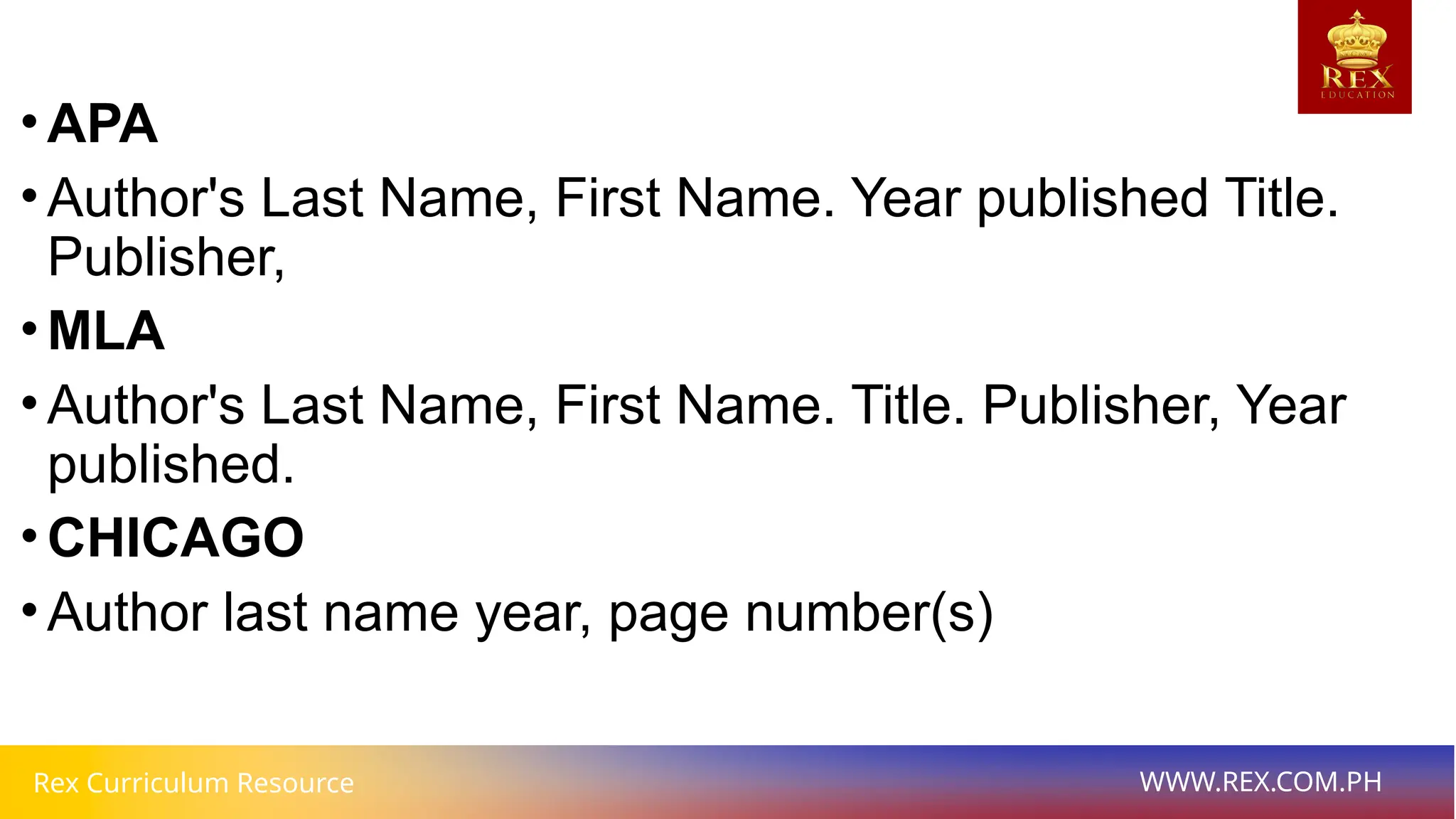
• APA
• Author's Last Name, First Name. Year published Title.
Publisher,
• MLA
• Author's Last Name, First Name. Title. Publisher, Year
published.
• CHICAGO
• Author last name year, page number(s)
Citing+Your+Sources+Properly - Copy.pptx

Citing+Your+Sources+Properly - Copy.pptx

  • 1.
  • 2.
    Rex Curriculum ResourceWWW.REX.COM.PH Citation After selecting, evaluating, and synthesizing your sources, you must now acknowledge the authors of information that you will use in your research. This is called citation. It means you are stating that some information is not yours and that it belongs to someone else. In this way, it prevents you from committing plagiarism which is stealing, using, and presenting someone else’s work without recognizing its rightful owner. Besides plagiarism, according to Sankaran (2016), citations are important for the following reasons:  It serves as a fact-checking tool.  Good citation practice makes you a better writer.  A comprehensive reference list establishes your scientific knowledge.  Careful citation practice builds your credibility as a scientist or scholar.  Citation enables better verification of your work.  It makes you a better researcher. Along with citations, intellectual honesty refers to the truthfulness with which ideas are acquired, analyzed, and transmitted (Toledo-Pereyra, 2009). This means that as a researcher, you are expected to search, know, and share only correct information when you draft your review of related literature.
  • 3.
    Rex Curriculum ResourceWWW.REX.COM.PH Citation Types 1.In-text citations – It appears within your paper when you use a direct quote or paraphrase someone’s work. In-text citations have two formats which are parenthetical citations and narrative citations. Parenthetical citation – This format of citation includes both the author’s surname and publication date which appear in parentheses. They are usually separated by a comma. 1.Example: (Santos, 2021) Narrative citation – This format of citation includes the author’s surname appearing in the text followed by the publication date in parentheses. 1.Example: Santos (2021) noted that… 2.References (End-of-paper citations) – It gives all the information the reader would need to find the source. They usually appear at the end of the research paper which lists all the sources of information you used in your paper. 1.Example: Booth, W., Colomb G., Williams, J., Bizup, J., & Fitzgerald, W. (2016). The Craft of Research, Fourth Edition. Chicago, IL: The University of Chicago Press.
  • 4.
    Rex Curriculum ResourceWWW.REX.COM.PH Parts of a Reference List Most reference citations have basic elements like: Authors Title Place of Publication, Publisher, Date of Publication, Page Number Section title, especially if it is a newspaper URL (Uni`form Resource Locator), if it is from the Internet It may also include unique identifiers such as:  International Standard Serial Number (ISSN) for books;  Serial Item and Contribution Identifier (SICI); or  International Standard Serial Number (ISSN) for specific volumes, articles, or other parts of a periodical; and  Digital Object Identifier (DOI) for electronic documents.
  • 5.
    Rex Curriculum ResourceWWW.REX.COM.PH Examples • PR 2023-2024Value_Orientation_of_Pupils_at_the_Eleme.pdf • PR 2023-2024The_students_values_acquired_at_school.pdf
  • 6.
    Rex Curriculum ResourceWWW.REX.COM.PH Citation Styles A citation style refers to the established rules and conventions of documenting and citing sources. In addition, some citations differ largely from each other depending on the citation style that you will incorporate in your research. Citation Style Comparison Table American Psychological Association (APA) Modern Language Association (MLA) Chicago Manual of Style (CMS) Field or Discipline Psychology, Nursing, Education, Social Sciences English, Humanities Physical Sciences, Business, History, Fine Arts In-Text Citation Author-Year-Page Number (Cruz, 2020, p. 6) Author-Page Number (Cruz 6) Author-Year-Page Number (Cruz 2020, 6) Reference List Title References Works Cited Bibliography Author in Reference List Cruz, R.A. Cruz R. Cruz, Reynaldo Alo Footnotes and Endnotes Not used Used Occasionally Often used Title Page Required Not Required Required
  • 7.
    Rex Curriculum ResourceWWW.REX.COM.PH Citation Styles There are still other citation styles like IEEE (The Institute of Electrical and Electronics Engineers) Style, AMA (American Medical Association), ASA (American Sociological Association), and those in other professional fields and disciplines.
  • 8.
    Rex Curriculum ResourceWWW.REX.COM.PH Citing Your Sources according to Citation Styles If you are listing the reference list or bibliography you can use the following examples from University of Pittsburgh (2021) as your guide. 1. APA 7th Edition (Citation Examples) Material In-Text Citation References A book (Sapolsky, 2017) Sapolsky, R. M. (2017). Behave: The biology of humans at our best and worst. Penguin Press. Chapter in an edited book (If the chapter is from an authored book, use the book citation) (Dillard, 2020) Dillard, J. P. (2020). Currents in the study of persuasion. In M. B. Oliver, A. A. Raney, & J. Bryant (Eds.), Media effects: Advances in theory and research (4th ed., pp. 115–129). Routledge. An article in a print journal (Weinstein, 2009) Weinstein, J. (2009). “The market in Plato’s Republic.” Classical Philology, 104(4), 439–458.
  • 9.
    Rex Curriculum ResourceWWW.REX.COM.PH Citing Your Sources according to Citation Styles An article in an electronic journal (Grady, et al., 2019) Grady, J. S., Her, M., Moreno, G., Perez, C., & Yelinek, J. (2019). Emotions in storybooks: A comparison of storybooks that represent ethnic and racial groups in the United States. Psychology of Popular Media Culture, 8(3), 207–217. https://doi.org/10.1037/ppm0000185 A website (Bologna, 2019) Bologna, C. (2019, October 31). Why some people with anxiety love watching horror movies. HuffPost. Retrieved from https://www.huffpost.com/entry/anxiety-lovewatching- horror-movies_l_5d277587e4b02a5a5d57b59e
  • 10.
    Rex Curriculum ResourceWWW.REX.COM.PH Citing Your Sources according to Citation Styles 2. MLA (Citation Examples) Material Type Work Cited Book in print Card, Claudia. The Atrocity Paradigm: A Theory of Evil. Oxford, Oxford University Press, 2005. e-book Gaither, Milton. Homeschool: An American History. Palgrave Macmillan, 2017. SpringerLink, doi-org.pitt.idm.oclc.org/10.1057/978-1-349-95056-0. An article in a print journal Doggart, Julia. “Minding the Gap: Realizing Our Ideal Community Writing Assistance Program.” The Community Literacy Journal, vol. 2, no. 1, 2007, pp. 71–80. An article in an electronic journal Sherrard-Johnson, Cherene. “‘A Plea for Color’: Nella Larsen’s Iconography of the Mulatta.” American Literature, vol. 76, no. 4, 2004, pp. 833–869, doi:10.1215/00029831-76-4-833.
  • 11.
    Rex Curriculum ResourceWWW.REX.COM.PH Citing Your Sources according to Citation Styles An encyclopedia entry “Patanjali.” Benét’s Reader’s Encyclopedia, edited by Bruce Murphy, 4th ed., HarperCollins Publishers, 1996, p. 782. A government publication United States, Federal Maritime Commission A government publication United States, Federal Maritime Commission. Hawaiian Trade Study: An Economic Analysis. Government Printing Office, 1978. An interview you conducted Brandt, Deborah. Personal interview. 28 May 2008. (Note: List the interview under the name of the interviewee.) A film/DVD (Note: This depends on the focus of your work. Please see the MLA Style blog for a detailed explanation.) A page on a website with no author “Stunning Lakeside View on Lake Erie.” VisitPA, Commonwealth of Pennsylvania, 7 June 2018, www.visitpa.com/article/stunning-lakeside- viewslake-erie.
  • 12.
    Rex Curriculum ResourceWWW.REX.COM.PH Citing Your Sources according to Citation Styles A page on a website with an author Del Castillo, Inigo. “How Not to Kill Your Houseplants, According to Botanists.” Apartment Therapy, 29 Jan. 2020, www.apartmenttherapy.com/houseplanttips- botanists-36710191 Artwork – from website Sherald, Amy. Former First Lady, Michelle Obama. 2018. National Portrait Gallery, npg.si.edu/object/npg_NPG.2018.15.
  • 13.
    Rex Curriculum ResourceWWW.REX.COM.PH Citing Your Sources according to Citation Styles 3. Chicago Author-Date Style Author/Date Style In-Text Citation Bibliography A book (Pollan 2006, 99–100) Pollan, Michael. 2006. The Omnivore’s Dilemma: A Natural History of Four Meals. New York: Penguin Press. An article in a print journal (Weinstein 2009, 440) Weinstein, Joshua I. 2009. “The Market in Plato’s Republic.” Classical Philology 104:439–58. An article in an electronic journal (Kossinets and Watts 2009, 411) Kossinets, Gueorgi and Duncan J. Watts. 2009. “Origins of Homophily in an Evolving Social Network.” American Journal of Sociology 115:405–50. Accessed February 28, 2010. doi:10.1086/599247. A website (Google 2009) Google. 2009. “Google Privacy Policy.” Last modified March 11, 2009. http://www.google.com/intl/en/privacypolicy.html.
  • 14.
    Rex Curriculum ResourceWWW.REX.COM.PH Ethical Standards in Citing and Acknowledging Sources Honesty: A researcher must only use accurate information and data. He/She should avoid falsifying data and only present what is true. Objectivity: A researcher must be unbiased in any aspects of the research. Integrity: A researcher must keep his/her agreement. Carefulness: Upon collection and analysis of data, the researcher must avoid making careless errors by examining critically all the data and information to be presented in the research. Openness: A researcher must share resources and information to other researchers to help in creating new research. Also, one must be open to criticisms and new ideas. Ethics in research refers to the prescribed guidelines that you must follow for responsible conduct of research. It is vital because it prevents the researchers from committing severe errors, inaccuracies, and misconduct during the research process. According to Resnik (2015), there are several ethical principles that you must remember. These are the following:
  • 15.
    Rex Curriculum ResourceWWW.REX.COM.PH Ethical Standards in Citing and Acknowledging Sources Respect for Intellectual Property: A researcher must always cite sources of information properly to avoid plagiarism. Confidentiality: Participants’ data and personal information should not be disclosed outside the research setting. Responsible Publication: The researcher must develop new and innovative research that will benefit the community besides personal gains. Social Responsibility: The research conducted must promote social welfare where the researcher foresees its impact to society, addressing problems.
  • 16.
    Rex Curriculum ResourceWWW.REX.COM.PH Ethical Standards in Citing and Acknowledging Sources Nondiscrimination: To reduce maltreatment of subjects or participants, the researcher must be aware of his/her responsibilities. For example, regardless of the participant’s gender, color, socioeconomic status, or ethnicity, the researcher must provide equal opportunities to join the study if they would be useful in your research. Competence: A researcher must continue to pursue lifelong learning and education to enhance his/her skills and knowledge. Legality: A researcher must always follow existing laws and policies.
  • 17.
    Rex Curriculum ResourceWWW.REX.COM.PH • APA • Author's Last Name, First Name. Year published Title. Publisher, • MLA • Author's Last Name, First Name. Title. Publisher, Year published. • CHICAGO • Author last name year, page number(s)