CITATION & REFERENCE
STYLE
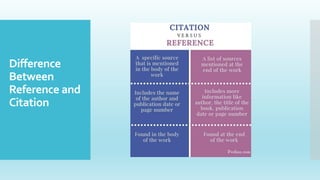
Difference
Between
Reference and
Citation
What is
Reference in
research?
 Referencing allows you to acknowledge the contribution of
other writers and researchers in your work.
 Any university assignments that draw on the ideas, words or
research of other writers must contain citations.
 Referencing is also a way to give credit to the writers from whom
you have borrowed words and ideas.
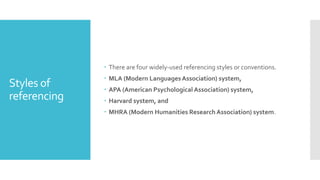
Styles of
referencing
 There are four widely-used referencing styles or conventions.
 MLA (Modern LanguagesAssociation) system,
 APA (American Psychological Association) system,
 Harvard system, and
 MHRA (Modern Humanities Research Association) system.
What is
reference style
in writing?
 A citation style is a set of guidelines on how to cite sources in
your academic writing.
 Need a citation whenever you quote, paraphrase, or summarize a
source to avoid plagiarism.
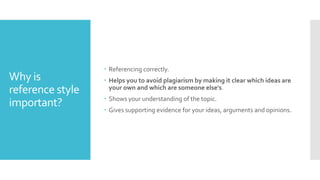
Why is
reference style
important?
 Referencing correctly.
 Helps you to avoid plagiarism by making it clear which ideas are
your own and which are someone else's.
 Shows your understanding of the topic.
 Gives supporting evidence for your ideas, arguments and opinions.
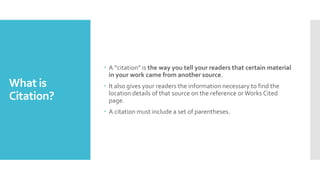
What is
Citation?
 A “citation” is the way you tell your readers that certain material
in your work came from another source.
 It also gives your readers the information necessary to find the
location details of that source on the reference orWorks Cited
page.
 A citation must include a set of parentheses.
What are the
different types
of citation
styles?
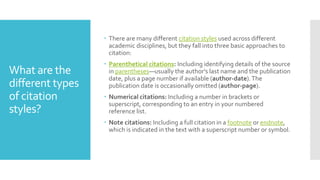
 There are many different citation styles used across different
academic disciplines, but they fall into three basic approaches to
citation:
 Parenthetical citations: Including identifying details of the source
in parentheses—usually the author's last name and the publication
date, plus a page number if available (author-date).The
publication date is occasionally omitted (author-page).
 Numerical citations: Including a number in brackets or
superscript, corresponding to an entry in your numbered
reference list.
 Note citations: Including a full citation in a footnote or endnote,
which is indicated in the text with a superscript number or symbol.
What are the
types of
citations?
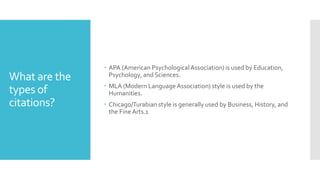
 APA (American PsychologicalAssociation) is used by Education,
Psychology, and Sciences.
 MLA (Modern LanguageAssociation) style is used by the
Humanities.
 Chicago/Turabian style is generally used by Business, History, and
the FineArts.1
What are basic
citations?
 The AUTHOR (or creator) of the work.This may be one person,
many people, a group or an organization.
 TheTITLEOFTHEWORK itself.The article title, the book title, the
video title, etc.
 The PUBLICATION DATE.
What are rules
of citation?
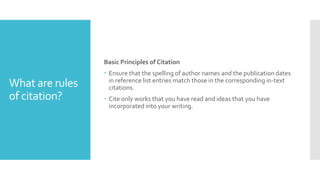
Basic Principles of Citation
 Ensure that the spelling of author names and the publication dates
in reference list entries match those in the corresponding in-text
citations.
 Cite only works that you have read and ideas that you have
incorporated into your writing.
Example
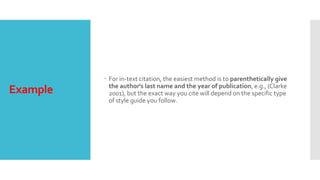
 For in-text citation, the easiest method is to parenthetically give
the author's last name and the year of publication, e.g., (Clarke
2001), but the exact way you cite will depend on the specific type
of style guide you follow.
Thank you
Presented by Rafidah Abd Razak ©

REFERENCE STYLE Lecture STID4054 (1).pptx

  • 1.
  • 2.
  • 3.
    What is Reference in research? Referencing allows you to acknowledge the contribution of other writers and researchers in your work.  Any university assignments that draw on the ideas, words or research of other writers must contain citations.  Referencing is also a way to give credit to the writers from whom you have borrowed words and ideas.
  • 4.
    Styles of referencing  Thereare four widely-used referencing styles or conventions.  MLA (Modern LanguagesAssociation) system,  APA (American Psychological Association) system,  Harvard system, and  MHRA (Modern Humanities Research Association) system.
  • 5.
    What is reference style inwriting?  A citation style is a set of guidelines on how to cite sources in your academic writing.  Need a citation whenever you quote, paraphrase, or summarize a source to avoid plagiarism.
  • 6.
    Why is reference style important? Referencing correctly.  Helps you to avoid plagiarism by making it clear which ideas are your own and which are someone else's.  Shows your understanding of the topic.  Gives supporting evidence for your ideas, arguments and opinions.
  • 7.
    What is Citation?  A“citation” is the way you tell your readers that certain material in your work came from another source.  It also gives your readers the information necessary to find the location details of that source on the reference orWorks Cited page.  A citation must include a set of parentheses.
  • 8.
    What are the differenttypes of citation styles?  There are many different citation styles used across different academic disciplines, but they fall into three basic approaches to citation:  Parenthetical citations: Including identifying details of the source in parentheses—usually the author's last name and the publication date, plus a page number if available (author-date).The publication date is occasionally omitted (author-page).  Numerical citations: Including a number in brackets or superscript, corresponding to an entry in your numbered reference list.  Note citations: Including a full citation in a footnote or endnote, which is indicated in the text with a superscript number or symbol.
  • 9.
    What are the typesof citations?  APA (American PsychologicalAssociation) is used by Education, Psychology, and Sciences.  MLA (Modern LanguageAssociation) style is used by the Humanities.  Chicago/Turabian style is generally used by Business, History, and the FineArts.1
  • 10.
    What are basic citations? The AUTHOR (or creator) of the work.This may be one person, many people, a group or an organization.  TheTITLEOFTHEWORK itself.The article title, the book title, the video title, etc.  The PUBLICATION DATE.
  • 11.
    What are rules ofcitation? Basic Principles of Citation  Ensure that the spelling of author names and the publication dates in reference list entries match those in the corresponding in-text citations.  Cite only works that you have read and ideas that you have incorporated into your writing.
  • 12.
    Example  For in-textcitation, the easiest method is to parenthetically give the author's last name and the year of publication, e.g., (Clarke 2001), but the exact way you cite will depend on the specific type of style guide you follow.
  • 13.
    Thank you Presented byRafidah Abd Razak ©