OBJECTIVES
• Identify importanceof Citations
• Differentiate in-text citations from reference
citations
• Identify different citation style in research
writing
• Evaluate in-text citations and reference citations
• Write a report on how to address difficulties of
students in citing sources
4.
Self-audit
• Tell theclass whether you USUALLY, SOMETIMES,
SELDOM, or NEVER do the following tasks:
1. I cite sources to give credit to the author of a work.
2. I cite sources to reflect the principles of scholarly
writing.
3. I cite sources to help my audience identify the original
source.
4. I use in-text and reference citations.
5. I use the appropriate style guide when I write an
academic paper.
5.
Let’s Learn
• Inacademic community, much attention and effort
is given to attributing something to the right person,
so it is important that credit is given where it is due.
• Purpose for Citing Sources:
1. To give credit to the original author of a work.
(Plagiarism is a serious offense.)
2. To promote scholarly writing (after exhaustive use
of related and existing ideas, arguments, etc. of an
expert)
8.
Forms of Citation
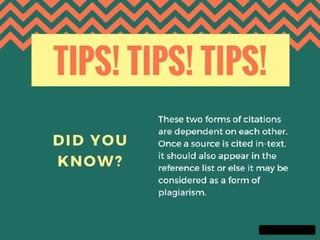
1.In-text citation-requires the writer to cite the
details of the reference used in a certain part of
his/her essay. Its format varies per style.
Ex.: (APA style)
2. Reference citation-refers to the complete
bibliographic entries of all references used by
the writer. This appears in reference list found
at the last part of the paper.
Ex.: (APA style)
10.
Style Guides
• Citationsare governed by rules of style and structure,
which are generally published as style guides or
manuals, such as:
1. The Publication Manual of the American Psychological
Association (APA)
2. The Modern Language Association Style Guide (MLA)
3. Institute of Electrical and Electronic Engineers (IEEE)
4. American Medical Association Manual or Style (AMA)
5. The Chicago Manual of Style
11.
Guidelines in in-textCitation
1. APA, 6th
edition (pp 169-179) Basic Citation Rules
• Follow the author-(latest) year of publication method.
• Although not required, APA encourages us to indicate
the page numbers even in paraphrases or summaries.
• Place the period after the citation when it is at the end
of the sentence.
Ex::
1. According to Sipacio (2014), APA style is required for
business student majors.
2. APA style is applied in the social sciences (Sipacio, 2014).
12.
• For awork with only one author
1. According to Sipacio (2014), APA style is required for
business student majors.
2. APA style is required for business student majors (Sipacio,
2014).
• For two authors, notice in the example the use of “&” when
the citations are inside the parentheses.
1. According to Sipacio and Barrot (2014), APA style is required
for business student majors.
2. APA style is required for Business student majors (Sipacio &
Barrot, 2014)
13.
• For threeto five authors, name all three during the
first citation. Then use the primary author followed by
“et. al.”(which means and other authors) for
subsequent citations.
- First citation:
- According to Sipacio, Barrot and Sanchez (2004), the
APA style is appropriate for the fields of nursing and
education.
- The APA style is appropriate for the fields of nursing
and education (Sipacio, Barrot and Sanchez, 2004).
14.
• Subsequent citation:
-Sipacio, et. al states that in general, the social
sciences employ this citation style (2014)
- In general, the social sciences employ this
citation style (Sipacio, et. al., 2014).
15.
• Direct Quotation
-When you use direct quote with less than 40 words, you are
required to include the page number(s) enclosed in parenthesis.
The page number must be preceded by “p” or “pp” for multiple
pages.
Examples:
1. Sipacio (2014) claimed that “beginners found the APA style guide
too complex” (p.56)
2. According to Sipacio (2014), “beginners found the APA style guide
too complex” (p. 56)
3. He claimed that “beginners found the APA style guide too
complex” (Sipacio, 2014 p. 56) because of several factors.
16.
- When youuse direct quotes with 40 words or
more, you are still required to include the
page number/s. Start your quotation in a new
line with a ½ indentation on the left margin.
There is no need to enclose long quotations in
quotation marks, but the parenthesis citation
should be placed after the period.
17.
Example:
In his article“Poverty in the Philippines: Income, Assets, and Access”, Scheliz
(2005) suggests a list of causes of poverty.
(1) low to moderate economic growth for the past 40 years; (2) low
growth elasticity of poverty reduction; (3) weakness in employment
generation and the quality of jobs generated; (4) failure to fully develop the
agriculture sector; (5) high inflation during crisis periods; (6) high levels of
population growth; (7) high and persistent levels of inequality (incomes and
assets) which dampen the positive impacts of economic expansion; and
(8)recurrent shocks and exposure to risks such as economic crisis, conflicts,
natural disasters, and environmental poverty. (p. 2)
18.
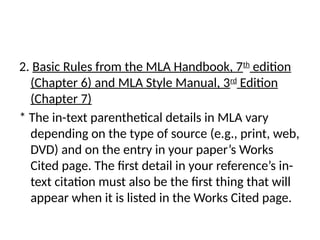
2. Basic Rulesfrom the MLA Handbook, 7th
edition
(Chapter 6) and MLA Style Manual, 3rd
Edition
(Chapter 7)
* The in-text parenthetical details in MLA vary
depending on the type of source (e.g., print, web,
DVD) and on the entry in your paper’s Works
Cited page. The first detail in your reference’s in-
text citation must also be the first thing that will
appear when it is listed in the Works Cited page.
19.
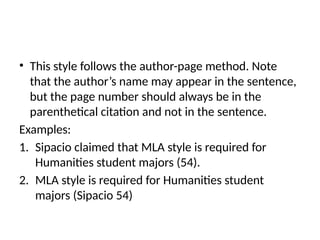
• This stylefollows the author-page method. Note
that the author’s name may appear in the sentence,
but the page number should always be in the
parenthetical citation and not in the sentence.
Examples:
1. Sipacio claimed that MLA style is required for
Humanities student majors (54).
2. MLA style is required for Humanities student
majors (Sipacio 54)
20.
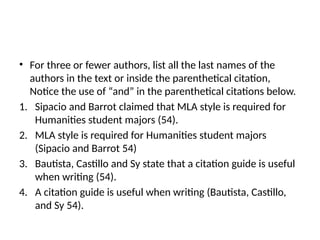
• For threeor fewer authors, list all the last names of the
authors in the text or inside the parenthetical citation,
Notice the use of “and” in the parenthetical citations below.
1. Sipacio and Barrot claimed that MLA style is required for
Humanities student majors (54).
2. MLA style is required for Humanities student majors
(Sipacio and Barrot 54)
3. Bautista, Castillo and Sy state that a citation guide is useful
when writing (54).
4. A citation guide is useful when writing (Bautista, Castillo,
and Sy 54).
21.
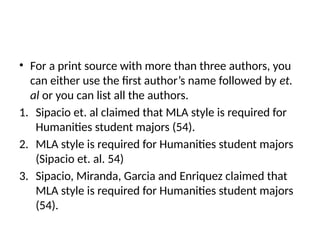
• For aprint source with more than three authors, you
can either use the first author’s name followed by et.
al or you can list all the authors.
1. Sipacio et. al claimed that MLA style is required for
Humanities student majors (54).
2. MLA style is required for Humanities student majors
(Sipacio et. al. 54)
3. Sipacio, Miranda, Garcia and Enriquez claimed that
MLA style is required for Humanities student majors
(54).
22.
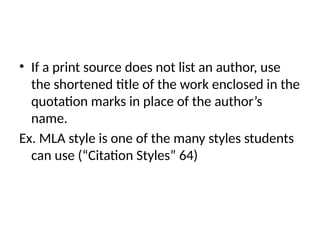
• If aprint source does not list an author, use
the shortened title of the work enclosed in the
quotation marks in place of the author’s
name.
Ex. MLA style is one of the many styles students
can use (“Citation Styles” 64)
23.
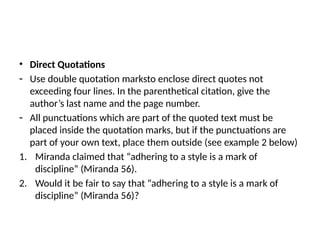
• Direct Quotations
-Use double quotation marksto enclose direct quotes not
exceeding four lines. In the parenthetical citation, give the
author’s last name and the page number.
- All punctuations which are part of the quoted text must be
placed inside the quotation marks, but if the punctuations are
part of your own text, place them outside (see example 2 below)
1. Miranda claimed that “adhering to a style is a mark of
discipline” (Miranda 56).
2. Would it be fair to say that “adhering to a style is a mark of
discipline” (Miranda 56)?
24.
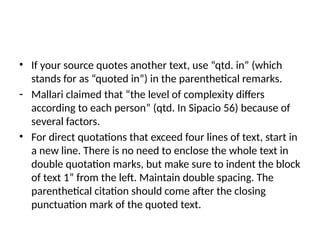
• If yoursource quotes another text, use “qtd. in” (which
stands for as “quoted in”) in the parenthetical remarks.
- Mallari claimed that “the level of complexity differs
according to each person” (qtd. In Sipacio 56) because of
several factors.
• For direct quotations that exceed four lines of text, start in
a new line. There is no need to enclose the whole text in
double quotation marks, but make sure to indent the block
of text 1” from the left. Maintain double spacing. The
parenthetical citation should come after the closing
punctuation mark of the quoted text.
25.
3. IEEE EditorialStyle Manual
* In this style, there is no need to name gthe author,
page number, or date of publication in the in-text
citation. Instead, the references are numbered
according to the order in which they were cited in
the text. The reference numbers which appear in
the text have to be enclosed in brackets.
Ex. (Paragraph 2): Sipacio claimed that IEEE style is
complex [1].
26.
4. AMA Manualof Style 10th
edition, (Section 1, Part 3)
• As with the IEEE editorial style, there is no need to
add the author, date , or year of publication in the
in-text citation. Instead, each reference is assigned a
number according to the order in which it was cited
in the text. The number reference is placed in
superscript after the period in the sentence.
Ex.: AMA style is required for Health Science majors. 1
27.
Guidelines in ReferenceCitations
• 1. APA 6th
edition
• 2. MLA Handbook, 7th
edition
• 3. IEEE Editorial Style Manual, 2014
• 4. AMA Manual of Style, 10th
edition



![3. IEEE Editorial Style Manual
* In this style, there is no need to name gthe author,
page number, or date of publication in the in-text
citation. Instead, the references are numbered
according to the order in which they were cited in
the text. The reference numbers which appear in
the text have to be enclosed in brackets.
Ex. (Paragraph 2): Sipacio claimed that IEEE style is
complex [1].](https://image.slidesharecdn.com/553296399-unit-2-lesson-4-citing-sources-250919133051-d94e9d93/85/553296399-Unit-2-Lesson-4-Citing-Sources-pptx-25-320.jpg)