

Citi is one of the world’s largest financial institutions, operating in all major established and emerging markets. Across these world markets, our employees conduct
an ongoing multi-disciplinary conversation – accessing information, analyzing data, developing insights, and formulating advice. As our premier thought leadership
product, Citi GPS is designed to help our readers navigate the global economy’s most demanding challenges and to anticipate future themes and trends in a fast-changing and
interconnected world. Citi GPS accesses the best elements of our global conversation and harvests the thought leadership of a wide range of senior professionals
across our firm. This is not a research report and does not constitute advice on investments or a solicitations to buy or sell any financial instruments.
For more information on Citi GPS, please visit our website at www.citi.com/citigps.
Citi GPS: Global Perspectives & Solutions
March 2022
METAVERSE AND MONEY
Decrypting the Future
Citi GPS: Global Perspectives & Solutions March 2022
Ronit Ghose, CFA Head of Banking,
FinTech and Digital Assets, Future of
Finance
Citi Global Insights
+44-20-7986-4028 | ronit.ghose@citi.com
Nisha Surendran
Project Manager
ICG Digital Assets, Citi
+44-20-7986-7766 | nisha.surendran@citi.com
Sophia Bantanidis
Future of Finance Analyst
Citi Global Insights
+44-20-7500-9655 | sophia.bantanidis@citi.com
Kaiwan Master
Future of Finance Analyst
Citi Global Insights
+91-22-4277-5037 |
kaiwan.hoshang.master@citi.com
Ronak S Shah
Future of Finance Team
Citi Global Insights
+44-20-7986-3960 | ronak.sharad.shah@citi.com
Puneet Singhvi
Head of Digital Assets
ICG Digital Assets, Citi
+1-212-723-3269 | puneet.singhvi@citi.com
Expert Contributors
Jamie Burke
CEO and Founder
Outlier Ventures
Phil Chen
Founding Partner, Race
Capital
Chief Decentralized
Officer, HTC
Stani Kulechov
CEO and Founder
The Aave Companies
Urszula McCormack
Partner
King & Wood Mallesons
Sandeep Nailwal
Co-Founder
Polygon
Yonatan Raz-Fridman
Founder and CEO
Supersocial
Rebecca Rettig
General Counsel
The Aave Companies
Yat Siu
Co-Founder and
Executive Chairman,
Animoca Brands
Founder and CEO,
Outblaze
Ioana Surpateanu
Web3 and DeFi Investor,
Advisor, and Entrepreneur
Huy Nguyen Trieu
Co-Founder of Centre
for Finance, Technology,
and Entrepreneurship
and CEO of The
Disruptive Group
With thanks to:
Victor Alexiev, Karan Agrawal, William Artingstall, Joseph Ayoub, Matthew Ball,
Anas Bhurtan, Jonathan Bloohn, Victor Georges Marie Jan Du Mesnil Du
Buisson, Ana Duek, Namrate Kanzaria, Richard Lomas, Omid Malekan,
Niall McDermott, Alison McGaughey, Deepak Mehra, Rachael Montgomery,
Gareth Robinson, Ashwin Shirvaikar, Ajit Tripathi, and Jelena Zec.
March 2022 Citi GPS: Global Perspectives & Solutions
© 2022 Citigroup
3
METAVERSE AND MONEY
Decrypting the Future
Have you ever had one of those “aha” lightbulb moments when you realize your
grasp of technology, or lack thereof, showed your age? One of those moments hit
me like a ton of bricks this week when I was asked to create my own avatar for a
presentation in the Metaverse. I did manage to create something functional and
presentable. What I did not do, or should I say could not do, was operate my avatar
— make it walk or interact. Given the speed at which the Metaverse is advancing, I
need to learn this quickly because it was very obvious I was an un-savvy older
person in the Metaverse room.
The Metaverse as a concept has been around for a few decades. However, interest
in the virtual world spiked at the end of 2021 following a rise in sales of non-fungible
tokens (NFTs) as well as announcements from Big Tech players indicating their
interest and investment in the space.
Today, the most popular way to experience the Metaverse is via a video game
played on a virtual reality (VR) headset. But in the report that follows, we discuss
the possibility that the Metaverse is moving towards becoming the next iteration of
the internet, or Web3. This “Open Metaverse” would be community-owned,
community-governed, and a freely interoperable version that ensures privacy by
design.
Users should increasingly be able to access a host of use cases, including
commerce, art, media, advertising, healthcare, and social collaboration. A device-
agnostic Metaverse would be accessible via personal computers, game consoles,
and smartphones, resulting in a large ecosystem. Using this broad definition, the
total addressable market for the Metaverse could be between $8 trillion and $13
trillion by 2030, with total Metaverse users numbering around five billion.
But getting to that market level is going to require infrastructure investment. The
content streaming environment of the Metaverse will likely require a computational
efficiency improvement of over 1,000x today’s levels. Investment will be needed in
areas such as compute, storage, network infrastructure, consumer hardware, and
game development platforms.
The definition of what counts as money in the Open Metaverse is also likely to be
very different from what counts as money in the real world today. Interoperability
and seamless exchange between underlying blockchain technology are critical to
ensure a frictionless user experience. Different forms of cryptocurrency are
expected to dominate, but given the multi-chain trend in the crypto ecosystem,
cryptocurrency will likely coexist with fiat currencies, central bank digital currencies
(CBDCs), and stablecoins.
Finally, if the Metaverse is indeed the new iteration of the internet, it will mostly likely
attract greater scrutiny from global regulators, policymakers, and governments.
Issues such as anti-money laundering rules for exchanges and wallets, the use of
decentralized finance (DeFi), crypto assets, and property rights will all have to be
addressed.
The opportunity for the Metaverse looks exciting, so I’m off to find a seven-year old
to teach me some avatar moves.
Kathleen Boyle, CFA
Managing Editor, Citi GPS
110110010001101101110000100110100101010100010101100111001001000111010101110110010001101101110000
001010110011100100100011101010111011001000110110111000010011010010101010001010110011100100100011
011011011100001001101001010101000101011001110010010001110101011101100100011011011100001001101001
111001001000111010101110110010001101101110000100110100101010100010101100111001001000111010101110
000010011010010101010001010110011100100100011101010111011001000110110111000010011010010101010001
001110101011101100100011011011100001001101001010101000101011001110010010001110101011101100100011
100101010100010101100111001001000111010101110110010001101101110000100110100101010100010101100111
111011001000110110111000010011010010101010001010110011100100100011101010111011001000110110111000
000101011001110010010001110101011101100100011011011100001001101001010101000101011001110010010001
001101101110000100110100101010100010101100111001001000111010101110110010001101101110000100110100
011100100100011101010111011001000110110111000010011010010101010001010110011100100100011101010111
100001001101001010101000101011001110010010001110101011101100100011011011100001001101001010101000
000111010101110110010001110011010010101010001010110011100100100011101010111011001000110110111000
000101011001110010010001110101011101100100011011011100001001101001010101000101011001110010010001
001101101110000100110100101010100010101100111001001000111010101110110010001101101110000100110100
011100100100011101010111011001000110110111000010011010010101010001010110011100100100011101010111
100001001101001010101000101011001110010010001110101011101100100011011011100001001101001010101000
000111010101110110010001101101110000100110100101010100010101100111001001000111010101110110010001
010010101010001010110011100100100011101010111011001000110110111000010011010010101010001010110011
011101100100011011011100001001101001010101000101011001110010010001110101011101100100011011011100
100010101100111001001000111010101110110010001101101110000100110100101010100010101100111001001000
000110110111000010011010010101010001010110011100100100011101010111011001000110110111000010011010
001110010010001110101011101100100011011011100001001101001010101000101011001110010010001110101011
110000100110100101010100010101100111001001000111010101110110010001101101110000100110100101010100
100011101010111011001000110110111000010011010010101010001010110011100100100011101010111011001000
101001010101000101011001110010010001110101011101100100011011011100001001101001010101000101011001
101110110010001101101110000100110100101010100010101100111001001000111010101110110010001101101110
010001010110011100100100011101010100100100011101010111011001000110110111000010011010010101010001
001110101011101100100011011011100001001101001010101000101011001110010010001110101011101100100011
100101010100010101100111001001000111010101110110010001101101110000100110100101010100010101100111
111011001000110110111000010011010010101010001010110011100100100011101010111011001000110110111000
000101011001110010010001110101011101100100011011011100001001101001010101000101011001110010010001
001101101110000100110100101010100010101100111001001000111010101110110010001101101110000100110100
011100100100011101010111011001000110110111000010011010010101010001010110011100100100011101010111
10000100110100101010100010101100111001001000111010
Metaverse — The Next Generation of the Internet
We believe the Metaverse is the next generation of the internet
— combining the physical and digital world in a persistent and
immersive manner — and not purely a Virtual Reality world.
A device-agnostic Metaverse accessible via PCs, game consoles, and
smartphones could result in a very large ecosystem. Based on our
definition, we estimate the total addressable market for the Metaverse
economy could grow to between $8 trillion and $13 trillion by 2030.
THE METAVERSE IS POTENTIALLY AN
$8 TRILLION TO $13 TRILLION OPPORTUNITY
Gaming is viewed as a key Metaverse use case for the next several years due to the immersive and multi-player
experience of the space currently. But we believe that the Metaverse will eventually help us find new enhanced ways to
do all of our current activities, including commerce, entertainment and media, education and training, manufacturing and
enterprise in general. Enterprise use cases of the Metaverse in the coming years will likely include internal collaboration,
client contact, sales and marketing, advertising, events and conferences, engineering and design, and workforce training.
METAVERSE USE CASES
DIGITAL EVENTS/
CONCERTS/TOURISM
SOCIAL
COMMERCE
VIRTUAL CITIES/
PUBLIC SERVICES
SMART
MANUFACTURING
VIRTUAL
ADVERTISING
VIRTUAL SPACES/
COMMUNITIES
DEVELOPER/
CREATOR ECONOMIES
HEALTHCARE EDUCATION
Metaverse: narrow definition Metaverse: broad definition
2030 VR/AR headset users 2030 unique internet users
Totaladdressablemarket estimate Totaladdressablemarketestimate
900mn–1bn 5bn
$1tn–$2tn $8tn–$13tn
© 2022 Citigroup
We believe the Metaverse may be the next generation of the
internet — combining the physical and digital world in a persistent
and immersive manner — and not purely a Virtual Reality world.
A device-agnostic Metaverse accessible via PCs, game consoles, and
smartphones could result in a very large ecosystem. Based on our
definition, we estimate the total addressable market for the Metaverse
economy could grow to between $8 trillion and $13 trillion by 2030.
010011010010101010
110101011101100100
101010100010101100
011001000110110111
101011001110010010
101101110000100110
100100100011101010
001001101001010101
111010101110110010
010101010001010110
101100100011011011
010101100111001001
001001101001010101
111010101110110010
010101010001010110
101100100011011011
010101100111001001
110110111000010011
110010010001110101
000100110100101010
011101010111011001
001010101000101011
110110010001101101
001010110011100100
011011011100001001
111001001000111010
000010011010010101
101011001110010010
101101110000100110
100100100011101010
001001101001010101
111010101110110010
010101010001010110
101100100011011011
In the current state, the internet infrastructure is unsuitable for building a fully-immersive content streaming Metaverse
environment, that enables users to go seamlessly from one experience to another. To make the vision of Metaverse a reality, we
expect significant investment in a confluence of technology. Low latency — the time it takes a data signal to travel from one point
on the internet to another point and then come back — is critical to building a more realistic user experience.
round-trip time latency for
video calling/cloud gaming
latency for multi-player,
complex games
latency required for truly
immersive Metaverse experience
STILL EARLY: METAVERSE INFRASTRUCTURE BUILDING
MONEY IN THE METAVERSE
We expect the next generation of the internet, i.e., the Metaverse, would encapsulate a range of form factors of money, including
the existing/traditional forms of money and also upcoming/digitally-native forms — cryptocurrency, stablecoins, central bank
digital currencies (CBDCs) — that were out of scope in a pre-blockchain virtual world.
In-Game Tokens Cryptocurrency Stablecoins CBDCs Fiat Money (Current)
Examples
Robux, Minecraft,
Linden dollars
Key Use Cases
Gaming
Limitations
Withdrawal Limits,
Centralized
Platform T&C, No
Interoperability
Examples
Bitcoin, Ethereum,
Polygon, etc.
Key Use Cases
Virtual lands, NFTs,
Gaming, DeFi
Limitations
Volatility, Energy
Usage (Proof-
of-Work based),
Anonymity and
AML Concerns
Examples
USDT, USDC, Dai,
BUSD
Key Use Cases
DeFi, International
Payments,
Settlement Currency
for Trading,
Entertainment,
Shopping, Tourism
Limitations
Anonymity and
AML Concerns,
Collateralization
Requirements
Examples
e-CNY, e-Naira,
Sand Dollar
Key Use Cases
Domestic
Payments, Targeted
Subsidies, Public
Affairs, Healthcare,
Tourism
Limitations
Predominant
Domestic Use Case
a Challenge on
Open Metaverse
Examples
USD, GBP, EUR, CNY
Key Use Cases
Traditional
Financial Services,
Credit Cards
for Consumer
Protection-Linked
Use Cases
Limitations
Non-Tokenized,
Account-Based,
Micro-Payments
Tough
75-150ms Sub 30ms Sub 12ms
Citi GPS: Global Perspectives & Solutions March 2022
© 2022 Citigroup
6
Contents
Quick Take 8
Ten Key Takeaways from the Report 8
MetaFi: Finance in the Metaverse — Quick Take 9
MetaFi: DeFi in the Metaverse — Quick Take 10
Why Metaverse? 11
What is the TAM of the Metaverse? Everyone Online? 11
The Metaverse: Historically and Today 14
What Exactly Is the Metaverse and How Will We Use It? 15
External Expert View: Phil Chen on Understanding the
Metaverse 17
Metaverse 101 20
What Is the Metaverse? 20
External Expert View: Jamie Burke on Metaverse 101 23
Embracing the Metaverse with Web3 26
External Expert View: Ioana Surpateanu on Metaverse and
Web3 27
Metaverse Use Cases 28
Gaming in the Metaverse: An Early Start Point? 35
Making the Case for a Progressively Open Metaverse 37
The Metaverse as an Enterprise Play? 38
Building Financial Sector in the Metaverse: A South Korea Case
Study 39
Metaverse-as-a-Service 41
External Expert View: Yonatan Raz-Fridman on the Metaverse
and the Consumer 42
Metaverse Infrastructure: Open vs. Closed 47
Building the Open Metaverse: Apps or Infra? 48
Building Blocks of an Open Metaverse Operating System 49
Identity in the Open Metaverse: Digital Passports and Web3
Access 52
Ownership in the Open Metaverse: DAOs 54
External Expert View: Jamie Burke on the Open Metaverse 56
External Expert View: Phil Chen on Decentralization and Digital
Assets 60
Still Early: The Metaverse Infrastructure Building 62
Technology Challenges to Realizing the Metaverse 68
Moxie’s Criticism of Web3 70
Other Web3 High-Profile Critics 72
Digital Assets and NFTs in the Metaverse 74
Digital Assets and NFTs 74
NFTs Under the Hood 87
External Expert View: Yat Siu on The Sandbox Metaverse 91
External Expert View: Huy Nguyen Trieu on Virtual Real Estate 95
Separating the NFT Hype from the Primitive 98
The Dark Side of the NFT Market: Counterfeits, Rug Pulls, and
Wash-Trading 99
Moxie’s Criticism of NFTs 103
Money and DeFi in the Metaverse 105
Money in the Metaverse 105
Features of Money in the Metaverse 106
Different Form Factors of Money in the Metaverse 107
External Expert View: Ioana Surpateanu on the Metaverse and
Money 110
March 2022 Citi GPS: Global Perspectives & Solutions
© 2022 Citigroup
7
External Expert View: Sandeep Nailwal on Building the Future
Immersive Internet 114
External Expert View: Stani Kulechov on DeFi in the Metaverse 118
Decentralized Finance (DeFi) in the Metaverse 123
How NFTs and DeFi Work Together 128
Key DeFi Use Cases 131
The Dark Side of DeFi 133
Regulatory Developments and Sociopolitical Considerations 135
How Have Regulators, Policymakers, Global Standard-Setters
Reacted? 136
Regulatory Walk Through the Metaverse 140
Crypto Assets: A Fragmented Regulatory Environment 143
Who Owns What in the Metaverse: NFTs and IP 147
Environmental and Social Considerations 152
Political Considerations 158
External Expert View: Urszula McCormack on Who Owns the
Metaverse 161
External Expert View: Rebecca Rettig on DeFi Policy and
Regulations 168
Appendix 172
Ethereum 101 172
DeFi versus Traditional Finance and Centralized Finance 177
Citi GPS: Global Perspectives & Solutions March 2022
© 2022 Citigroup
8
Quick Take
Ten Key Takeaways from the Report
1. What Will We Do in the Metaverse?
The Metaverse may be the next generation of the internet. It would combine the physical and digital worlds in an immersive manner. Use
cases may include everything we use the internet for today with gaming, commerce, art, media, advertising, smart manufacturing, health care,
virtual communities, and social collaboration (including for enterprise and education).
2. How Big Will the Metaverse Be?
We estimate the target addressable market (TAM) for the Metaverse economy could be in the range of $8 trillion to $13 trillion. Expert
contributors to our Citi GPS report indicate a potential range of users of up to five billion, depending on whether we take a broad definition (i.e.,
unique internet users) or just a billion based on a narrower definition (i.e., Virtual Reality/Augmented Reality-device user base).
3. Is the Metaverse the Same as Virtual Reality?
No, the Metaverse is not only Virtual Reality. In the foreseeable future, an immersive internet experience for most users will likely be
accessed via their mobile phones, and only a subset of the Metaverse participants will use VR devices. However, we expect the usability of
Virtual Reality (VR) and Augmented Reality (AR) will improve in the coming years with many consumer hardware manufacturers building on the
2021 holiday season success of the Oculus Quest in the U.S.
4. What Infrastructure Needs to Be Built?
Latency needs to improve, and faster connectivity speeds are needed. With only 25% of the global population expected to have access to 5G by
2025, network bandwidth needs to be increased and delivered. The lags, packet drops, and network unreliability witnessed in today’s world
makes the current state of the infrastructure unsuitable for building an envisioned Metaverse experience.
5. What Does Money Look Like in the Metaverse?
The Metaverse of the future is likely to encompass more digitally-native tokens, but also embed traditional forms of money. Money in the
Metaverse could exist in different forms, i.e., in-game tokens, stablecoins, central bank digital currencies (CBDCs), and cryptocurrencies.
Current payment rails are usually domestic for real time and expensive cross-border payments making them an imperfect fit for a borderless
global Metaverse ecosystem. We expect decentralized finance (DeFi) and existing traditional financial systems to coexist.
6. How Many Metaverses Will There Be?
If most users access the Metaverse via a mobile phone, the operating system (OS) will be the same. Consumer hardware manufacturers will
be portals to the Metaverse and potential gatekeepers. Similar to today, there will likely be a split between a U.S./international and a
China/firewall-based Metaverse. Furthermore, there will also likely be a spectrum based on technology and business model, i.e., Metaverse
centralization versus decentralization.
7. What Do Blockchain and Web3 Have to Do with the Metaverse?
Web3 refers to one conceptual third iteration of the internet and is based on ownership and decentralization, which is facilitated via
blockchain. The so-called “Open Metaverse” is built upon blockchain — mainly the Ethereum chain — and overlaps with Web3. But it is likely
that many Web2 centralized platforms will play an important role in the Metaverse, and even Web3 today relies on elements of centralization.
8. Do Users Want Web3 or Do Investors Want It?
Web3’s goal of a decentralized, democratic internet is an attractive one for some, but implementation questions remain. Most users want
better user interface (UI)/user experience (UX) and superior content, and current Web3 solutions are far behind best-in-class Web2
solutions. Many internet users, including gamers, dislike the financialization of online activity due to the addition of tokens to business
models.
9. What Is the Role of NFTs in the Metaverse?
It is not just about cute collectibles and social media bragging rights. Digital assets, such as non-fungible tokens (NFTs), in the Metaverse
enable a form of sovereign ownership for the users/owners and are tradeable, composable, immutable and mostly interoperable. There has
been an increased interest from gamers, investors, and corporates in the NFT space in recent months. NFTs in the Metaverse are virtual items
stored in a digital wallet that can be taken everywhere within the Metaverse.
10. Are Our Laws and Regulations Ready for the Metaverse?
We have a lot to work out. If the Metaverse(s) is the new iteration of the internet, it will attract great scrutiny from global regulators and
policymakers. All the challenges of the Web2 internet could be magnified in the Metaverse, including content moderation, free speech, and
privacy. In addition, a blockchain-based Metaverse will brush up against still evolving laws around cryptocurrencies and DeFi in many
jurisdictions around the world.
March 2022 Citi GPS: Global Perspectives & Solutions
© 2022 Citigroup
9
MetaFi: Finance in the Metaverse — Quick Take
As the Metaverse develops, a spectrum of financial services will be needed to
support its activities. Metaverse finance (MetaFi) will likely be a combination of
decentralized finance (DeFi), centralized finance (CeFi), and traditional finance
(TradFi), with new products specifically designed to meet the unique needs of the
new ecosystem. From initial capital formation to supporting commerce within the
Metaverse, financial services can play an important role in the evolution.
Figure 1. Financial Services in the Metaverse
Puneet Singhvi
Head of Digital Assets
Citi Institutional Clients Group
Property Rights in the Metaverse
• Specific property rights in the Metaverse may be recognized across
some jurisdictions, for instance, with the non-fungible tokens (NFTs)
providing the digital ownership layer.
• Such property rights would lead to both use and commerce. We
expect MetaFi to help support needs around buying, selling, and
funding these property rights.
Providing Common, Consistent, and Resilient Wallet Infrastructure
• With a myriad of cryptocurrencies, wallets, and associated private-
key management options, financial institutions would be able to
support abstracting away the complexities associated with wallet
management, multi-chain environments, and enable financial flows
in a regulated manner within the Metaverse.
• Institutions would also provide custody services to businesses with
one or more trusted third parties to improve security and resilience,
while providing easier and consistent access.
Payment Rails in the Metaverse
• Fundamental to the economic infrastructure of the Metaverse would
be a seamless and high-transaction throughput financial
infrastructure working across fragmented implementations between
centralized platforms and decentralized instances alike. We expect
24x7, always-on, instant micropayments to be the main mode of
payment in the Metaverse.
• While cryptocurrencies, stablecoins, and central bank digital
currencies (CBDCs) are likely to coexist in the Metaverse, we also
foresee an important role for financial institutions in payments,
especially with on-ramp, off-ramp capabilities, as well as supporting
a myriad of business and consumer use cases.
Liquidity Providers and Automated Market Making
• We expect financial institutions to play a role in providing liquidity to
the markets, including for certain DeFi protocols. Institutional players
may help to provide additional liquidity, facilitate price discovery, and
make the DeFi protocols more resilient.
• We also expect the sheer number of assets available for exchange
will grow exponentially, and strong institutional liquidity will help
stabilize the market and drive additional efficiency.
Financing in the Metaverse
• DeFi, with collateralized lending, yield farming protocols, is expected
to coexist along with TradFi with its unique credit risk management
capabilities in many forms including collateralized loans, assessment
of off-chain and on-chain credit history, crowd funding, and
microfinance.
• We expect it would enable DeFi to operate in its sweet spot, while
TradeFi and CeFi facilitates further capabilities by undertaking off-
chain due-diligence and credit assessment.
NFTs and Digital-Native Assets as Collateral
• Over time, we expect an increasing number of traditional financial
institutions to start working with digital-native assets such as NFTs
and fungible tokens as a means of collateral.
• Mainstream NFTs and tokens are highly volatile, resulting in a large
haircut as collateral, in today’s context. We expect that as the market
evolves, the digital nature of this activity can enable new risk models
and create varying categories of asset baskets.
Source: Citi ICG Digital Assets
Citi GPS: Global Perspectives & Solutions March 2022
© 2022 Citigroup
10
MetaFi: DeFi in the Metaverse — Quick Take
MetaFi is increasingly used as a new term that blends two of the biggest technology
trends around today: the Metaverse and DeFi. Jamie Burke, who helped us with
parts of this report, and his team at Outlier Ventures, note that MetaFi refers to “the
decentralized financial tools of the Metaverse” that will drive the majority of the
growth in DeFi.
Figure 2. Decentralized Finance in the Metaverse
Why DeFi?
A virtual world like the gaming environment Roblox is not open today. To enable openness, there needs to be ownership of digital assets that is
independent of proprietary implementations. This is enabled by blockchains like Ethereum with its market-based standards that allow digital objects to
be owned in a fully portable way across Metaverse implementations. Once property rights are established, it opens up ways of financializing the assets
— by renting, borrowing, and trading similar to how we currently deal with property in the real world. Legacy rails of toady are not yet interoperable with
the open technology and standards of the Metaverse.
Permissionless, Trustless, and Decentralized Services
• We expect the Open Metaverse to be run primarily on
permissionless, trustless, and decentralized systems enabled by
DeFi.
• Primary use cases today include decentralized exchanges (DEXs),
borrowing and lending, staking, and yield farming to name a few.
Over time, we expect DeFi to work with an increasing range of
assets — from traditional financial assets such as stocks and bonds,
to collector’s items and in-game tokens.
Composability in DeFi
• Smart contract applications working as “money Legos” can build on
top of each other in a trustless and permissionless way, leading to
interoperable and composable services.
• Users can swap tokens on decentralized exchanges, deposit these
tokens to a lending protocol to earn yield, or cross the swapped
tokens over into other blockchains using bridges.
• In the context of the Metaverse, composability and interoperability
would enable different virtual worlds and NFTs to build on top of
each other using DeFi protocols for transfer and exchange.
Self-Sovereign Financial Accessibility
• As the popular crypto saying goes, “Not your keys, not your crypto.”
We expect an increasing number of users to self-custody their
cryptocurrency.
• As the front-end user experience of wallets improves, we expect self-
custody and key management in crypto to become progressively
easier, driving mainstream adoption.
• Self-sovereign accessibility combined with single sign-on enabled by
Web3 would allow Metaverse users to seamlessly access virtual
worlds, taking their digital assets with them.
Early Days Yet, Too Complex for the Average User
• Even as we expect increasing self-custody, we also expect the
majority of the population to be more comfortable with an
intermediary abstracting away the complexities of the DeFi
ecosystem.
• The sheer number of tokens and currencies as well as the
management of diverse assets could be too much to handle for the
average user.
• We expect intermediaries would evolve (including current
centralized financial services) that solve these complexities for the
Metaverse user or small business owner.
Interoperability of NFTs and DeFi
• DeFi can help unlock the value in NFTs by means of its use as
collateral for lending, especially for high-value NFTs that today
cannot be unlocked without an outright sale.
• Fractionalization of NFTs also brings in more liquidity through DeFi,
by combining NFTs with tokens that can be traded on DEX-based
(peer-to-peer) liquidity pools. Nesting and wrapping of non-fungible
and fungible tokens opens up new use cases.
Real-World Asset Market
• We expect the overlap of real-world assets and NFTs to power
unique ways of unlocking the potential of NFTs.
• We expect two-way movement here — both in terms of real-world
assets being brought on-chain (e.g., tokenized real-world
mortgages/REITs working with virtual land parcels) and also on-
chain assets being moved to the real world (purchasing NFTs in a
virtual world and redeeming them in the real world as an e-
commerce product).
Source: Citi Global Insights
March 2022 Citi GPS: Global Perspectives & Solutions
© 2022 Citigroup
11
Why Metaverse?
The Metaverse is “a digital space inhabited by digital representations of people and
things.” — Microsoft1
“Just like in 1993 we couldn’t tell how big (the internet) was and what it was exactly,
this thing we are calling the Metaverse is a continuation of that…it is going to be
bigger than anything we have ever known.” — Rev Lebaredian, Vice President,
Simulation Technology at NVIDIA2
Mike Wadhera, the founder of Teleport, noted as early as 2016 that the “Information
Age” was transitioning into the “Experience Age.” The Metaverse represents one
compelling vision of this shift toward experiences. Although it is often associated
with immersive Virtual Reality (VR) and Augmented Reality (AR), VR/AR is not
essential.
The Metaverse may be the next generation of the internet. It could further integrate
our lives into digital platforms. The Metaverse would combine the physical and
digital world in an immersive manner, possibly intermediated via virtual and
augmented reality. And it raises questions around technology, business models, and
society more broadly.
We are in the early days of the journey into the Metaverse economy. Much needs to
be built. We discuss all these themes over the course of this report — with the help
of colleagues and leading external industry experts.
What is the TAM of the Metaverse? Everyone Online?
It is still early to make precise predictions around the size of the total addressable
market (TAM) as a lot depends on the definition we use for the Metaverse. Is it the
next generation of the internet, accessed through mobile devices, but more
immersive? Or is it a Virtual Reality world only accessed through VR devices?
Taking the broad definition of the Metaverse, we believe the user base could be up
to five billion. We get to this forecast using today’s number of unique internet users
and assume the current 4% annual growth rate for unique internet users will
continue. We then cut this by 25% to make an allowance for users without access to
stable 5G, broadband, or Wi-Fi, which are indispensable for a Metaverse
experience. This gives us a TAM of around five billion users.3
Taking a narrower definition, based on VR headsets, we expect the Metaverse TAM
to be only around 200 million to 250 million users by 2030. We expect AR to be
more ubiquitous given its less-invasive user experience compared to VR, and to be
in the range of 700 million to 775 million users. In 2030, we expect the total amount
of VR/AR users to be 900 million to one billion. 4
1
Microsoft, ‘What Is Microsoft’s Metaverse?” YouTube Video, 2:10, November 3, 2021.
2
Bloomberg Intelligence podcast, Omniverse with Nvidia's Rev Lebaredian, February 17,
2022.
3
According to the GSMA’s report The Mobile Economy Report 2022, 5G connections will
surpass 1 billion in 2022 and 2 billion by 2025. By the end of 2025, more than 40% of the
world’s population will live within reach of a 5G network. If the penetration of 5G users in
2030, relative to the total population, is similar to internet users to the total population,
we arrive at a figure of 5.4 billion users.
4
Citi Research "VR/AR: The Next Dimension — Staying Connected Remotely Now a
Reality,” June 24, 2020.
Total Metaverse users could be anywhere
between one billion (VR headset users) to
around five billion (5G/broadband users) by
2030, depending on the interface layer
We estimate the target addressable market
(TAM) for the Metaverse economy could be
in the range of $8 trillion to $13 trillion
Citi GPS: Global Perspectives & Solutions March 2022
© 2022 Citigroup
12
We estimate a target addressable market for the Metaverse economy could be
in the range of $8 trillion to $13 trillion (see Figure 3). A device-agnostic
Metaverse accessible via personal computer (PC), game console, smartphone, etc.,
could result in a very large ecosystem value. Also, the telecom, technology
hardware, and infrastructure upgrades required to host an immersive internet will
result in large capital expenditure spend. In Figure 3, we size the Metaverse
economy based on different potential scenarios.
In our expanded definition of the Metaverse, we consider AR, VR, and persistent
and immersive 3D worlds accessed through multiple devices, including
smartphones, to qualify as the Metaverse. The use cases of the Metaverse will
likely include commerce, social, and gaming, but could also include most activities
that are undertaken digitally today. We discuss the use cases in greater detail in the
next chapter.
Figure 3. Sizing the Metaverse Economy in 2030 ($ trillions)
Metaverse TAM, 2030
($ trillions)
Digital Economy as % of GDP
15% 20% 25% 30%
Metaverse
as % of Digital
10% 1.9 2.6 3.2 3.8
20% 3.8 5.1 6.4 7.7
30% 5.8 7.7 9.6 11.5
40% 7.7 10.2 12.8 15.3
50% 9.6 12.8 16.0 19.2
Assumptions: (1) Global GDP of $127.9 trillion in 2030, based on IMF growth forecasts; (2) Digital as % of GDP in
2025 of 24.3% (Oxford Economics); (3) Metaverse as a % of Digital based on the scenarios above.
Source: IMF, Citi Global Insights
For our TAM calculations, we use a global GDP growth forecast from the
International Monetary Fund (IMF) of 3.5%, which gives an estimated global GDP of
$128 trillion by 2030. We also incorporate a 2017 report from Oxford Economics
which estimated the digital economy would be 24% of global GDP.5
This forecast
attempts to capture the digital component on the economy beyond simply the
information and communications technology (ICT) sector directly.
Based on the U.S. Bureau of Economic Analysis (BEA) pre-pandemic estimate,
digital was 10% of the U.S. economy in 2018. This number is likely higher now due
to accelerated digital adoption during the pandemic. However, the BEA study is
based on a narrow definition of the digital economy, i.e., based on only the ICT
sector, and does not capture the broader digital spillover into non-ICT sectors.
We model Metaverse penetration of the digital economy using the analogy of the
growth of smartphones. Smartphones accounted for about one-third of all mobile
phones around seven years post launch. If the Metaverse is the next generation of
the internet, we assume a similar one-third penetration rate (of the total digital
economy) is possible.
Given our earlier definition of the Metaverse as accessed through
VR/AR/smartphones, we expect 30-40% of digital spend and capital expenditure to
happen through or enable Metaverse-like mediums by 2030. And given the growth
of 5G to include a majority of the world’s smartphones by the end 2030, the portion
of Metaverse-related digital spend could be even higher.
5
Huawei and Oxford Economics, Digital Spillover. Measuring the True Impact of the
Digital Economy, 2017.
March 2022 Citi GPS: Global Perspectives & Solutions
© 2022 Citigroup
13
Our scenario analysis above helps put into context comments from the external
industry experts we have spoken to recently, who we feature in Figure 4 and
throughout this Citi GPS report. They estimate the 2030 Metaverse market could be
up to and above $10 trillion with billions of users (Figure 4).
Note the Metaverse defined narrowly as only VR/AR devices would be at the lower
end of the estimates above (~$1 trillion to $2 trillion). Citi’s Technology research
team previously estimated a $900 billion total addressable market for VR/AR in
2030, which includes hardware, software, and commerce but not infrastructure-
related spend.6
Figure 4. Industry Experts on the Expected Users, Use Cases, and Economic Value of the Metaverse
Ioana Surpateanu, Web3 and DeFi Investor, Adviser, and Entrepreneur, believes the Open Metaverse will
encapsulate composable DeFi protocols and programmable NFTs (with an estimated market value of $800 billion and $30
billion, by 2022, respectively) governed by decentralized autonomous organizations (DAOs). Ioana expects economic value for
the Open Metaverse to be at least $5 trillion by 2030.
Jamie Burke, CEO and Founder of Outlier Ventures believes growth from the unlocking of digital value currently
trapped in siloed platforms (i.e., Oculus) or ecosystems (i.e., Fortnite) will be a significant contributor to the economic value of
the Open Metaverse where social, e-commerce, and retail are likely to be the common use cases.
Phil Chen, Founding Partner of Race Capital and Chief Decentralized Officer at HTC expects the
Metaverse ecosystem to be institutionalized as it reaches a billion users with an economic value of over one trillion dollars (á la
the cryptocurrency ecosystem). The potential market for the Metaverse could range from the current gaming console user-base
(about 200 million users) to the number of mobile phone users (about five billion users).
Sandeep Nailwal, Co-Founder of Polygon (Ethereum Layer-2 chain) believes innovation runs on steroids in
the blockchain space. By 2025, with scalability solutions in place, we will likely experience an accelerated adoption curve with
around 50 million to 100 million blockchain and Web3 users. Further, Sandeep expects gaming, FinTech, identity, social media,
and publishing will be Web3 enabled or at least have bridges to Web3 ecosystem in the next five to 10 years, and these
communities would be governed by DAOs, which in his view could be the next big thing in the Web3 space.
Yat Siu, Co-Founder and Executive Chairman of Animoca Brands and Founder and CEO of
Outblaze expects the Metaverse to be a multi-trillion dollar opportunity in the near term and be multiple times larger every
successive year thereafter. Growth/innovation in the Metaverse is likely to be greater than how open source transformed the
world of software, startups, and economies. DAOs will be larger than companies and many countries. Every aspect of our life will
be affected, much the same way internet affected every industry, individual, and society at large.
Yonatan Raz-Fridman, Founder and CEO of Supersocial expects 80% of the world's population will access the
Metaverse by 2030 via fast internet in a device-agnostic way (e.g., AR, VR, mobile, autonomous vehicles) and the Metaverse-
native generation could have 100 billion avatars. There is significant market potential for commerce, fashion, sports, and
gaming. And he “cautiously estimates” the potential 2030 Metaverse market size to be above $10 trillion.
6
Citi Research ,"VR/AR: The Next Dimension —Staying Connected Remotely Now a
Reality," June 24, 2020.
Citi GPS: Global Perspectives & Solutions March 2022
© 2022 Citigroup
14
The Metaverse: Historically and Today
In the early 2000s, Second Life offered a virtual world for users to hang out together
and buy/sell virtual items to each other without any goals or objectives; depicting a
“proto-Metaverse” in the words of Matthew Ball. However, it failed to see mass
adoption as it was complex, restricted to PC-only, two dimensional, and pre-dated
enabling technologies. By contrast, gaming environments like Roblox (2004) and
Fortnite (2017) boast hundreds of millions of users and offer users goals and
objectives to achieve in a virtual gaming environment.
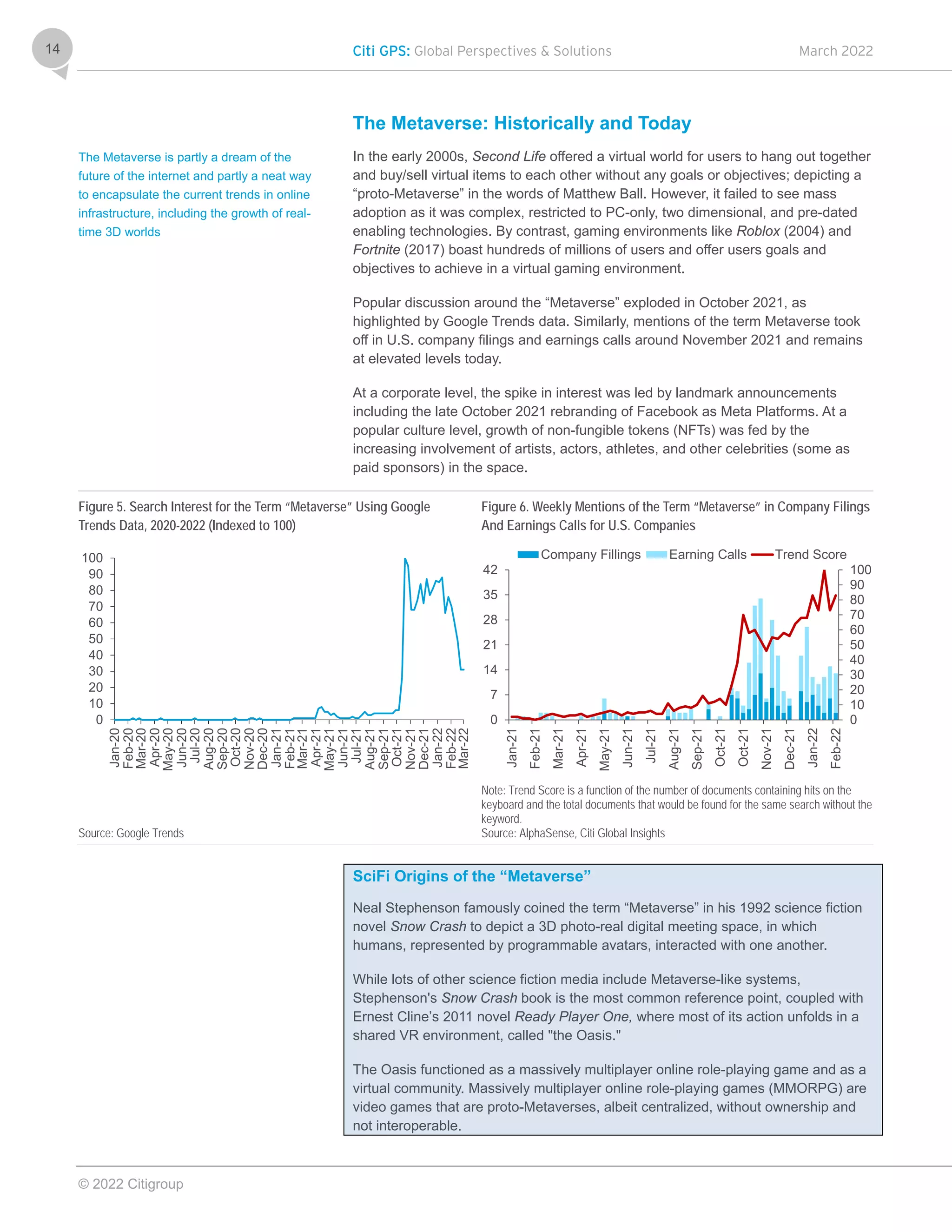
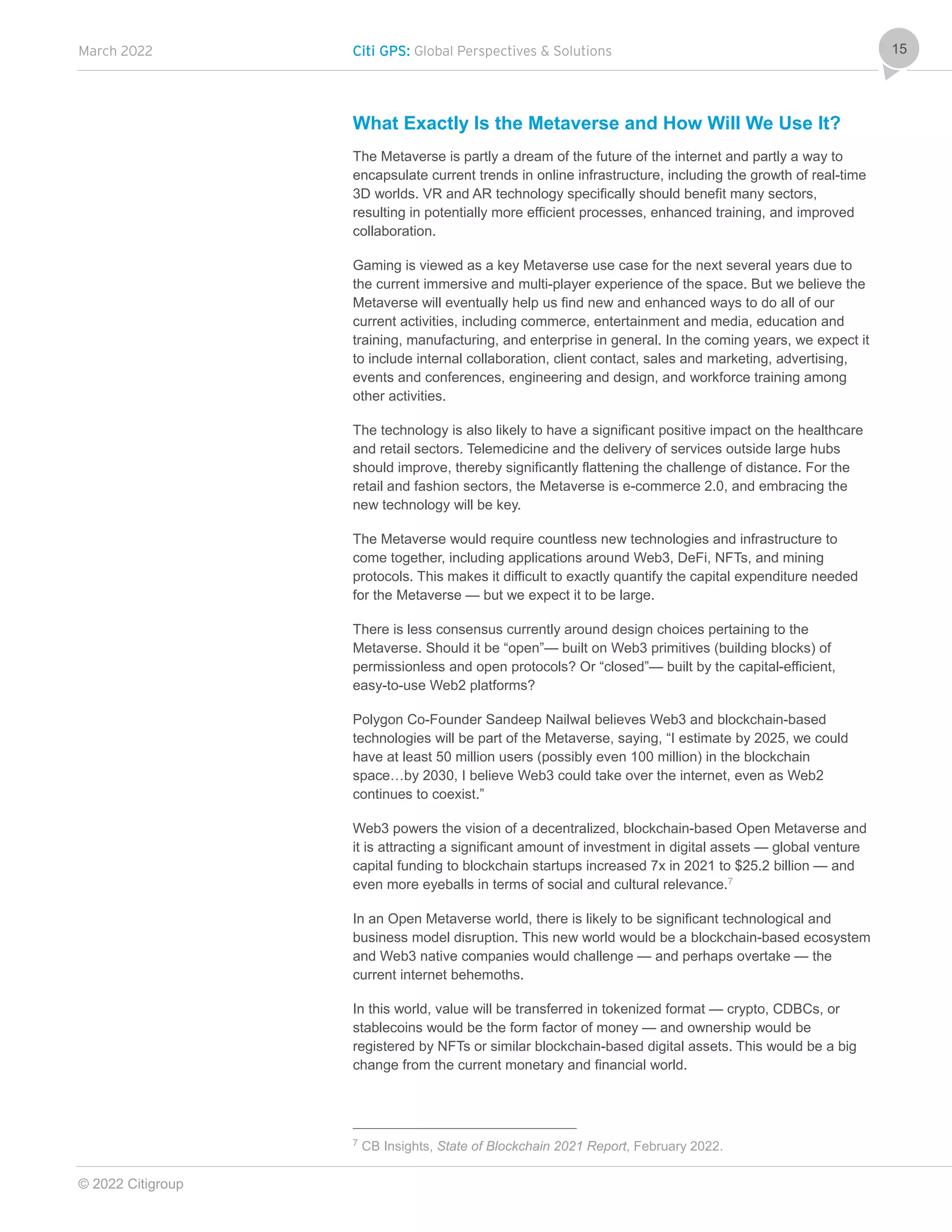
Popular discussion around the “Metaverse” exploded in October 2021, as
highlighted by Google Trends data. Similarly, mentions of the term Metaverse took
off in U.S. company filings and earnings calls around November 2021 and remains
at elevated levels today.
At a corporate level, the spike in interest was led by landmark announcements
including the late October 2021 rebranding of Facebook as Meta Platforms. At a
popular culture level, growth of non-fungible tokens (NFTs) was fed by the
increasing involvement of artists, actors, athletes, and other celebrities (some as
paid sponsors) in the space.
Figure 5. Search Interest for the Term “Metaverse” Using Google
Trends Data, 2020-2022 (Indexed to 100)
Figure 6. Weekly Mentions of the Term “Metaverse” in Company Filings
And Earnings Calls for U.S. Companies
Source: Google Trends
Note: Trend Score is a function of the number of documents containing hits on the
keyboard and the total documents that would be found for the same search without the
keyword.
Source: AlphaSense, Citi Global Insights
SciFi Origins of the “Metaverse”
Neal Stephenson famously coined the term “Metaverse” in his 1992 science fiction
novel Snow Crash to depict a 3D photo-real digital meeting space, in which
humans, represented by programmable avatars, interacted with one another.
While lots of other science fiction media include Metaverse-like systems,
Stephenson's Snow Crash book is the most common reference point, coupled with
Ernest Cline’s 2011 novel Ready Player One, where most of its action unfolds in a
shared VR environment, called "the Oasis."
The Oasis functioned as a massively multiplayer online role-playing game and as a
virtual community. Massively multiplayer online role-playing games (MMORPG) are
video games that are proto-Metaverses, albeit centralized, without ownership and
not interoperable.
0
10
20
30
40
50
60
70
80
90
100
Jan-20
Feb-20
Mar-20
Apr-20
May-20
Jun-20
Jul-20
Aug-20
Sep-20
Oct-20
Nov-20
Dec-20
Jan-21
Feb-21
Mar-21
Apr-21
May-21
Jun-21
Jul-21
Aug-21
Sep-21
Oct-21
Nov-21
Dec-21
Jan-22
Feb-22
Mar-22
0
10
20
30
40
50
60
70
80
90
100
0
7
14
21
28
35
42
Jan-21
Feb-21
Mar-21
Apr-21
May-21
Jun-21
Jul-21
Aug-21
Sep-21
Oct-21
Oct-21
Nov-21
Dec-21
Jan-22
Feb-22
Company Fillings Earning Calls Trend Score
The Metaverse is partly a dream of the
future of the internet and partly a neat way
to encapsulate the current trends in online
infrastructure, including the growth of real-
time 3D worlds
March 2022 Citi GPS: Global Perspectives & Solutions
© 2022 Citigroup
15
What Exactly Is the Metaverse and How Will We Use It?
The Metaverse is partly a dream of the future of the internet and partly a way to
encapsulate current trends in online infrastructure, including the growth of real-time
3D worlds. VR and AR technology specifically should benefit many sectors,
resulting in potentially more efficient processes, enhanced training, and improved
collaboration.
Gaming is viewed as a key Metaverse use case for the next several years due to
the current immersive and multi-player experience of the space. But we believe the
Metaverse will eventually help us find new and enhanced ways to do all of our
current activities, including commerce, entertainment and media, education and
training, manufacturing, and enterprise in general. In the coming years, we expect it
to include internal collaboration, client contact, sales and marketing, advertising,
events and conferences, engineering and design, and workforce training among
other activities.
The technology is also likely to have a significant positive impact on the healthcare
and retail sectors. Telemedicine and the delivery of services outside large hubs
should improve, thereby significantly flattening the challenge of distance. For the
retail and fashion sectors, the Metaverse is e-commerce 2.0, and embracing the
new technology will be key.
The Metaverse would require countless new technologies and infrastructure to
come together, including applications around Web3, DeFi, NFTs, and mining
protocols. This makes it difficult to exactly quantify the capital expenditure needed
for the Metaverse — but we expect it to be large.
There is less consensus currently around design choices pertaining to the
Metaverse. Should it be “open”— built on Web3 primitives (building blocks) of
permissionless and open protocols? Or “closed”— built by the capital-efficient,
easy-to-use Web2 platforms?
Polygon Co-Founder Sandeep Nailwal believes Web3 and blockchain-based
technologies will be part of the Metaverse, saying, “I estimate by 2025, we could
have at least 50 million users (possibly even 100 million) in the blockchain
space…by 2030, I believe Web3 could take over the internet, even as Web2
continues to coexist.”
Web3 powers the vision of a decentralized, blockchain-based Open Metaverse and
it is attracting a significant amount of investment in digital assets — global venture
capital funding to blockchain startups increased 7x in 2021 to $25.2 billion — and
even more eyeballs in terms of social and cultural relevance.7
In an Open Metaverse world, there is likely to be significant technological and
business model disruption. This new world would be a blockchain-based ecosystem
and Web3 native companies would challenge — and perhaps overtake — the
current internet behemoths.
In this world, value will be transferred in tokenized format — crypto, CDBCs, or
stablecoins would be the form factor of money — and ownership would be
registered by NFTs or similar blockchain-based digital assets. This would be a big
change from the current monetary and financial world.
7
CB Insights, State of Blockchain 2021 Report, February 2022.
Citi GPS: Global Perspectives & Solutions March 2022
© 2022 Citigroup
16
But are we anywhere close to a Web3 world? Is the technology ready? Will 5G be
rolled out globally? Are the end-use cases and applications developed? Are
consumers ready? Self-sovereignty, digital ownership, and a borderless world are
all attractive features. But – spoiler alert – we are still very early in the journey, both
technologically and from a user perspective, to a Web3-powered Open Metaverse
world. Critics maintain that it is a mirage. Our thesis: for the foreseeable future,
most of us will live and work in a Web2 or Web2.5 world. We will experience
Web3 via Web2 front-ends.
The next few years will be ones of experimentation, adventure, trial, and error. Many
of us may buy VR headsets, especially during holiday season marketing manias.
But will we use them regularly? Will we get close to using AR or VR devices for as
many hours as our mobile phones?
At the risk of skeuomorphic thinking, we believe mobile phones will continue to
be a gateway to the emerging Metaverse world. And via our phones, most
internet users will have access to Metaverse-like experiences. This could number in
the billions. For the foreseeable future, say up to 2025, Web3 users will likely
number in the millions.
As the technology evolves, we expect policy and regulation will play catch-up. There
is a lot to unpack about the internet age. Join us as we dive deep into all of these
topics in this report.
For the foreseeable future, most of us will
live and work in a Web2 or Web2.5 world —
we will experience Web3 via Web2 front-
ends
We believe mobile phones will continue to
be a gateway to the emerging Metaverse
world
March 2022 Citi GPS: Global Perspectives & Solutions
© 2022 Citigroup
17
External Expert View: Phil Chen on Understanding the
Metaverse
Phil Chen is the Founding Partner of Race Capital and Managing Partner Emeritus
of Presence Capital. As the founding managing partner at Presence Capital, Phil
has invested in over 40 Metaverse-related companies over the past six years. Phil
is also an advisor and Chief Decentralization Officer at HTC.
Q: Let’s start with Metaverse 101 — What is the Metaverse?
A: At a very high level, it is a mash-up of the 3D immersive experience — the
gaming part, the technical part (i.e., “persistence”) and the intersection of Web3
things. My favorite way to think about the Metaverse is how Mark Zuckerberg
described it, as really just internet+ (i.e., internet + 3D, internet + persistence,
internet + VR/AR).
The Metaverse is not a destination, but rather a point-in-time. Just as singularity is
the point in time where artificial intelligence surpasses human intelligence, the
Metaverse is a point in time where people value digital assets more than physical
assets. You can broaden that to digital experiences and digital relationships as well.
Q: How do Web3 and the Metaverse overlap?
A: Web1 refers to the AOLs and emails of this world. Web2, as we know it today, is
about companies like Meta, Google, and others with a lot of interactions, algorithms,
and social media.
Web3 is a reaction to the centralization caused by Web2. Centralization of data is a
fundamental problem not just to technology, but also to society, politics, and religion.
Web3 focuses on decentralization and being open, censorship-resistant, borderless,
and permissionless. In Web3, people should own their data and digital assets.
The original promise of the internet was for it to be open, but in reality we live in
different walled gardens — the internet is quite closed. Big Techs, in a sense, have
created walled gardens as they manage the social data feeds of 3.5 billion people.
They are the only ones with access to the algorithms of what is seen and clicked on.
Q: Define the target addressable market for the Metaverse? How is it likely to
change in the next five to 10 years?
A: If you think of the Metaverse as a rebranding of VR/AR and limit its use cases to
gaming, the VR/AR hardware could reach out to about 200 million users globally.
However, if the Metaverse is widely adopted, just like the mobile phone in today's
age, we are more in the range of five billion worldwide.
In my opinion, the potential market size (based on the number of pieces of
hardware) will likely be bigger than the gaming console market, but not as big as the
mobile phone market. The future of the Metaverse is on multiple devices (i.e.,
internet+). To hit mass market, I estimate we need about a billion users to adopt
Metaverse hardware.
Q: What are the key aspects to look out for in the Metaverse?
A: I think the first thing is NFTs. Today, there are close to 10 different types of NFTs
ranging across music, art, game objects, access, and identity. NFTs can be referred
to as digital primitives as they offer many different applications. It is helpful to think
Phil Chen
Citi GPS: Global Perspectives & Solutions March 2022
© 2022 Citigroup
18
of NFTs similar to websites back in the 2000s, when every company had to have a
website. I believe we will soon start seeing every company doing NFTs.
The second key development to look out for is around cryptocurrency regulations.
There is still quite a lot of debate on how cryptocurrencies such as Bitcoin and
Ethereum should be classified — is it a security, a commodity, or property? I believe
there will be a lot of ancillary/auxiliary effects on how this space is regulated.
Q: What are the building blocks for the Metaverse? How much will it cost?
A: I believe compute power will definitely increase, but the more pertinent question
relates to, “What kinds of things will people do with the Metaverse?” Honestly, we
do not know that yet.
The capital expenditure (capex) requirements in computing can be very high.
Looking at the capex requirements for the Metaverse, we must consider not just the
Metaverse, but also all the applications around artificial intelligence (AI),
autonomous driving, robotics, Web3, DeFi, NFT etc., and include mining protocols
for things like Bitcoin.
Q: What is the likely killer-app / use-case for the Metaverse?
A: Let me illustrate a few interesting use-cases for the Metaverse.
Startup AppliedVR, is pioneering evidence-based, immersive VRx — a new
category of prescription digital therapeutics. The company aims to treat chronic pain
without use of drugs, but instead using VR to focus on the visual cortex and alter
the patient’s focus. The company recently ran a trial on a woman during childbirth at
Cedars-Sinai Medical Center in the U.S., where the procedure was successfully
conducted with a manageable level of pain and without the need for an epidural.
Likewise, Osso VR is a surgical training and assessment platform that gives
medical device companies and healthcare professionals radically better ways to
share, practice, and learn new skills/procedures using immersive 3D technology.
Near-term, I believe the killer Web3 apps will be NFTs and DeFi. I believe we are
likely to see a combination of these gain prominence in 2022.
Q: How important is VR to the Metaverse? Does current generation hardware
pose limitations? Where are major investments being made in the space?
A: I would not classify the Metaverse as purely VR/AR, but it is definitely one strand
of it. For instance, Oculus sold nearly 10 million units in December 2021. This is
surely interesting, but it still represents a niche.
Instead, I believe we need to consider the following: (1) what is the underlying
growth trend in the number of VR/AR hardware units sold, and (2) how much time
are users actually spending on it — is it 15-20 minutes or an hour? Presently, users
spend close to six to eight hours on their mobile phones on a daily basis.
Nearly 80% of the hardware for VR/AR headsets is similar to that for mobile
phones. Given the scale at which mobile phones are manufactured, we can surely
re-use those parts. For the remaining 20%, the most significant hardware
components include optics and technologies such as inside-out tracking and hand-
gesture pattern recognition.
March 2022 Citi GPS: Global Perspectives & Solutions
© 2022 Citigroup
19
Investments are being made in companies building the optics, with a focus on
vergence accommodation, i.e., how can your eyes and lens focus on different
depths of field. Big Techs are also filing several patents around facial recognition
and eye tracking, i.e., how people are feel, think, and react to what they are seeing.
Citi GPS: Global Perspectives & Solutions March 2022
© 2022 Citigroup
20
Metaverse 101
What Is the Metaverse?
The Metaverse is emerging as the next potential big technology platform, attracting
both attention and investments. Yet it is difficult to agree on an exact definition of the
Metaverse. It is partly a dream of what the future of the internet could be and partly
a way to encapsulate the current trends in online infrastructure, including the growth
of real-time 3D worlds.
The Metaverse does not yet have an industry-wide set definition. It can be thought
of as one conceptual next iteration of the internet supporting a collection of real-time
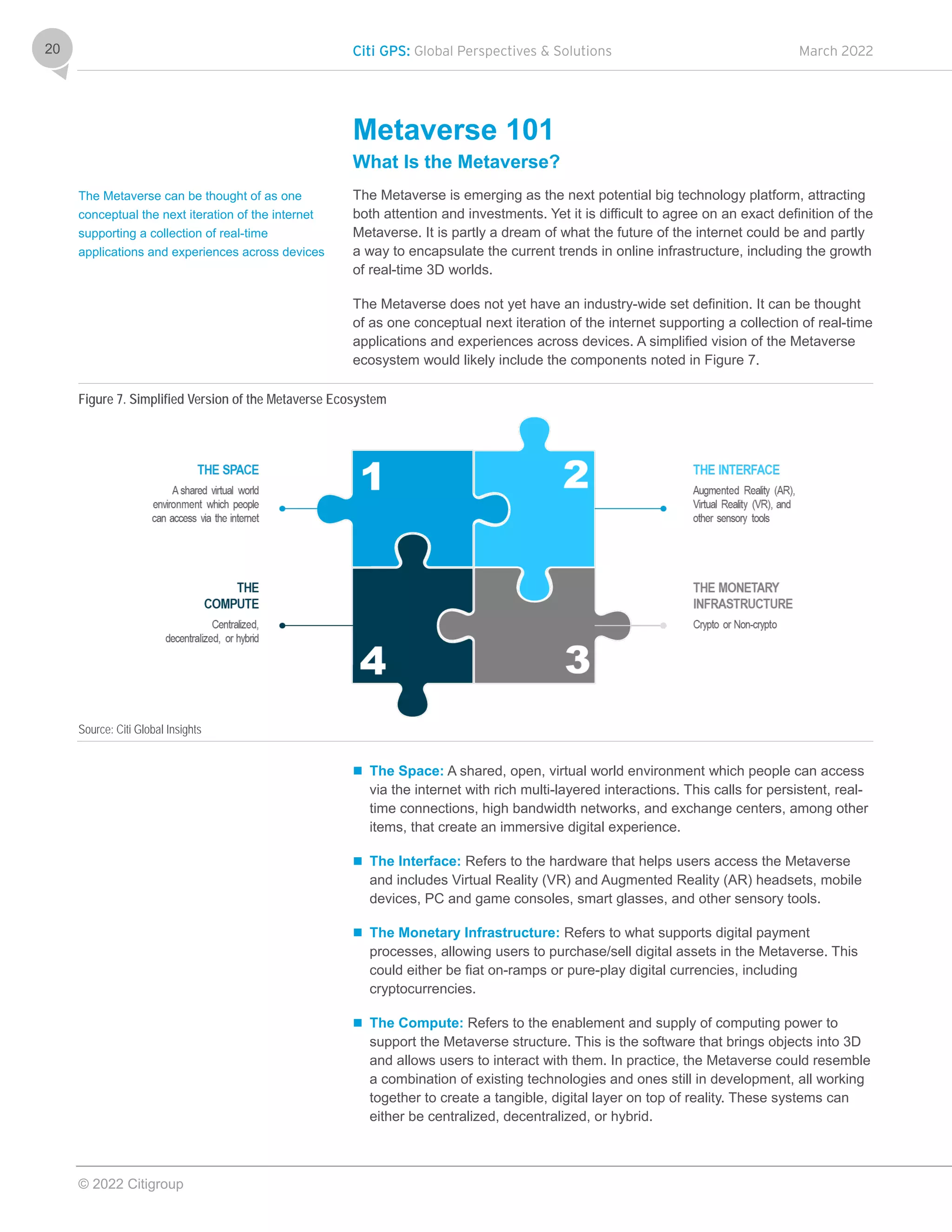
applications and experiences across devices. A simplified vision of the Metaverse
ecosystem would likely include the components noted in Figure 7.
Figure 7. Simplified Version of the Metaverse Ecosystem
Source: Citi Global Insights
 The Space: A shared, open, virtual world environment which people can access
via the internet with rich multi-layered interactions. This calls for persistent, real-
time connections, high bandwidth networks, and exchange centers, among other
items, that create an immersive digital experience.
 The Interface: Refers to the hardware that helps users access the Metaverse
and includes Virtual Reality (VR) and Augmented Reality (AR) headsets, mobile
devices, PC and game consoles, smart glasses, and other sensory tools.
 The Monetary Infrastructure: Refers to what supports digital payment
processes, allowing users to purchase/sell digital assets in the Metaverse. This
could either be fiat on-ramps or pure-play digital currencies, including
cryptocurrencies.
 The Compute: Refers to the enablement and supply of computing power to
support the Metaverse structure. This is the software that brings objects into 3D
and allows users to interact with them. In practice, the Metaverse could resemble
a combination of existing technologies and ones still in development, all working
together to create a tangible, digital layer on top of reality. These systems can
either be centralized, decentralized, or hybrid.
The Metaverse can be thought of as one
conceptual the next iteration of the internet
supporting a collection of real-time
applications and experiences across devices
March 2022 Citi GPS: Global Perspectives & Solutions
© 2022 Citigroup
21
But it is not necessarily that simple. The idea of creating an alternative, digital
world is not new — it has existed for years. Games such as Second Life in the early
2000s created a virtual reality world for users to play in, but failed to see mass
adoption as it was complex, restricted to PC-only, two dimensional, and pre-dated
enabling technologies.
I see the Metaverse not as a destination, but rather as a point in time. Just as
singularity is the point in time where artificial intelligence surpasses human
intelligence; the Metaverse is a point in time where people value digital assets
more than physical assets.
– PHIL CHEN, FOUNDING PARTNER OF RACE CAPITAL, MANAGING PARTNER EMERITUS OF
PRESENCE CAPITAL, CHIEF DECENTRALIZED OFFICER OF HTC
There are competing visions for the Metaverse, most notably one dominated by
closed platforms and Big Techs, and the other built on open protocols leveraging
blockchain. We discuss these aspects more in detail in the chapter titled “Metaverse
Infrastructure: Open vs. Closed.”
In October 2021, Mark Zuckerberg, Chairman and CEO of Meta Platforms, outlined
his intentions to the public for building the Metaverse — a VR construct intended to
supplement the internet, merge virtual life with real life, and create several VR
environments for everyone.
You can think about the Metaverse as an embodied internet, where instead of
just viewing content, you are in it. And you feel present with other people as if
you were in other places, having different experiences that you couldn’t
necessarily do on a 2D app or webpage, like dancing, for example, or different
types of fitness.
– MARK ZUCKERBERG, CEO OF META PLATFORMS
Zuckerberg defines the Metaverse as essentially the internet+ and sees it as the
successor to the mobile internet that offers a virtual world where people can
socialize, work, and play. The Metaverse can be viewed as the next step in the
development of robust, real-time, visualized communication.
However, as is already clear in our discussion so far, the concept of the Metaverse
is a contested one. Definitions differ. As Jamie Burke, the Open Metaverse
proponent, notes, “The beauty of the Metaverse as a narrative or a meme, is the
fact that it can be interpreted in different ways.”
Citi GPS: Global Perspectives & Solutions March 2022
© 2022 Citigroup
22
The Metaverse is effectively an interface layer made up of hardware and
software that makes the physical and virtual worlds indistinguishable from one
another.8
– JAMIE BURKE, FOUNDER AND CEO OF OUTLIER VENTURES
8
Christopher Hamman, “Outlier Ventures CEO Jamie Burke Explains the Metaverse
According to the Polkadot Base Camp,” E-Crypto News, accessed March 18, 2022.
March 2022 Citi GPS: Global Perspectives & Solutions
© 2022 Citigroup
23
External Expert View: Jamie Burke on Metaverse 101
Jamie Burke is the Founder and CEO of Outlier Ventures, Europe's first dedicated
blockchain Venture Capital fund and Accelerator. Jamie and his team have grown a
portfolio of nearly 100 start-ups, facilitated over $130 million in seed funding for their
portfolio companies, and helped to jump start multiple billion-dollar crypto
ecosystems.
Q: What is the Metaverse in your view?
A: The beauty of the Metaverse as a narrative or a meme is the fact that it can be
interpreted in different ways.
Many people get hung up on the belief that in order for the Metaverse to exist, VR
must be fully commoditized and ubiquitous. This means, everyone will need to own
a VR device that they use to connect into a fully-immersive 3D world; or walk
around the High Street with AR glasses.
While this will happen, it is not a pre-requisite for the Metaverse. I would argue the
Metaverse is here and now. The Metaverse is powerful, as it can be thought of as a
contact language between different cultures. It allows people from finance, creative
industries, and technologists to communicate with one another.
I would argue the most important characteristic of the Metaverse is that it is a
universal economic system that enjoys supremacy. I know this might sound a bit
crazy to nation states, but in my opinion, this helps connect the present and the
historical versions of the Metaverse.
If you look at the historical, science fiction-based version of the Metaverse in Snow
Crash or Ready Player One, a single corporation (“Oasis”) tried to take control and
apply a monopoly — isn’t this awfully similar to the Web today? Be it search, social,
or e-commerce, players with centralized platforms tend to be highly monopolistic.
It is important to think of the Metaverse as an economic system — it could be
dystopic (captured by a single corporation or group of corporations) or utopic (a
permissionless environment that prioritizes users and sovereignty of their data
identity and wealth).
In my opinion, you can have immersive hardware, software, and everything else,
but most importantly, it must be an open economic and universal system. The
important questions that need to be asked are: (1) Who can participate in the
Metaverse? (2) Who will be the gatekeepers? and (3) Where does value accrue?
Q: Can you elaborate on the analogy of NFTs being the equivalent of “social
media without a platform?”
A: I see NFTs as a form of atomized socialness.
For instance, you may have bought a CryptoPunk NFT, or some variation of it, or
the newer NFT franchise that offers Profile Pictures (PFPs), e.g., a unique avatar
character. You can then upload these PFPs/NFTs in your profile on social media
platforms to socially signal your affiliation/preference for a particular subject, group,
or community. This results in ascribing a higher premium to the social asset, almost
forming a social currency.
Jamie Burke
Citi GPS: Global Perspectives & Solutions March 2022
© 2022 Citigroup
24
I believe NFTs can be an interesting medium for social signaling and they will
ultimately exist off-platform. As Marshall McLuhan phrased it, "The medium is the
message." In my opinion, it is not important what the context of an NFT is, instead it
is what the NFT represents in the context of innovation and socialness.
Q: What are some of the Metaverse use cases?
A: The biggest use cases for the Metaverse will be in the creator economy. The
explosion of NFTs in 2021 has led to a focus on digital ownership, be it in the form
of art or gaming. Value currently locked in online platforms including social media,
simple 2D art pieces, videos, audio files, or 3D objects could be the NFTs of the
future.
Additionally, we are seeing a convergence of finance, culture, and technology. We
are at a point where the creative industry has the benefit of a direct digital
distribution channel, as well as the financial tooling to take control of the economics
of the relationship with their audience (rather than the platform).
Q: What is driving recent interest in the Metaverse?
A: I believe it is a confluence of factors, including COVID-19, which has led us to be
more digitized. Additionally, we have also seen significant advancement in software
and hardware. For instance, the cost of an Oculus device has seen a drastic
reduction to just a few hundred pounds today, with hardware that is also more
immersive.
Today’s hardware/software also gives us the ability to (1) gain economic exposure
to companies who are developing the space, and (2) value companies early on via
fungible/non-fungible tokens. This was previously limited to venture capitalists,
investors, and corporations in Web1 and Web2.
I see the Metaverse as a single, open economy underpinned by cryptocurrencies,
which are scalable and censorship resistant. This should provide the impetus for
innovations in hardware, software, gaming, entertainment, and media, which are
likely to converge to leverage Web3 technology ahead.
Q: Could you put some numbers around the target addressable market for the
Metaverse, whether decentralized or centralized?
A: In my view, to be part of the Metaverse, you need to be connected to a shared
economic system greater than your own siloed digital economy. While Fortnite is a
great game with lots of users, it is siloed and you cannot transfer economic value in
and out of it. The same is true for the Oculus ecosystem and many others.
Instead, I would primarily focus on things that are connected to a single, shared,
open economic system — e.g., crypto. We could look at the aggregate value of
things such as virtual real estate in Sandbox or play-to-earn games like Axie Infinity.
Q: What key trends should one look for in the space over the coming years?
A: A key trend to watch in the next 12 to 24 months will be the development of
social layers for NFTs (i.e., social experience). At present, while we have created
new NFTs, we do not have any place to consume or experience them. Instead, they
are often merely stored in a wallet or displayed as a profile picture on social media.
March 2022 Citi GPS: Global Perspectives & Solutions
© 2022 Citigroup
25
However, as interest in NFTs grows and the focus on the experience intensifies, we
are likely to see the need for new social and retail layers. These layers would allow
users to experience the NFT, play with it, use it as a 3D object, socialize with
friends, and offer a better retail shopping experience.
For example, the Metaverse could allow companies to take a small group of users
to experience a highly-rendered environment, preserving the quality and integrity of
a branded luxury item. Blockchain-based gaming is likely to be another growth area
in the coming years with NFTs and the Metaverse playing crucial roles.
Citi GPS: Global Perspectives & Solutions March 2022
© 2022 Citigroup
26
Embracing the Metaverse with Web3
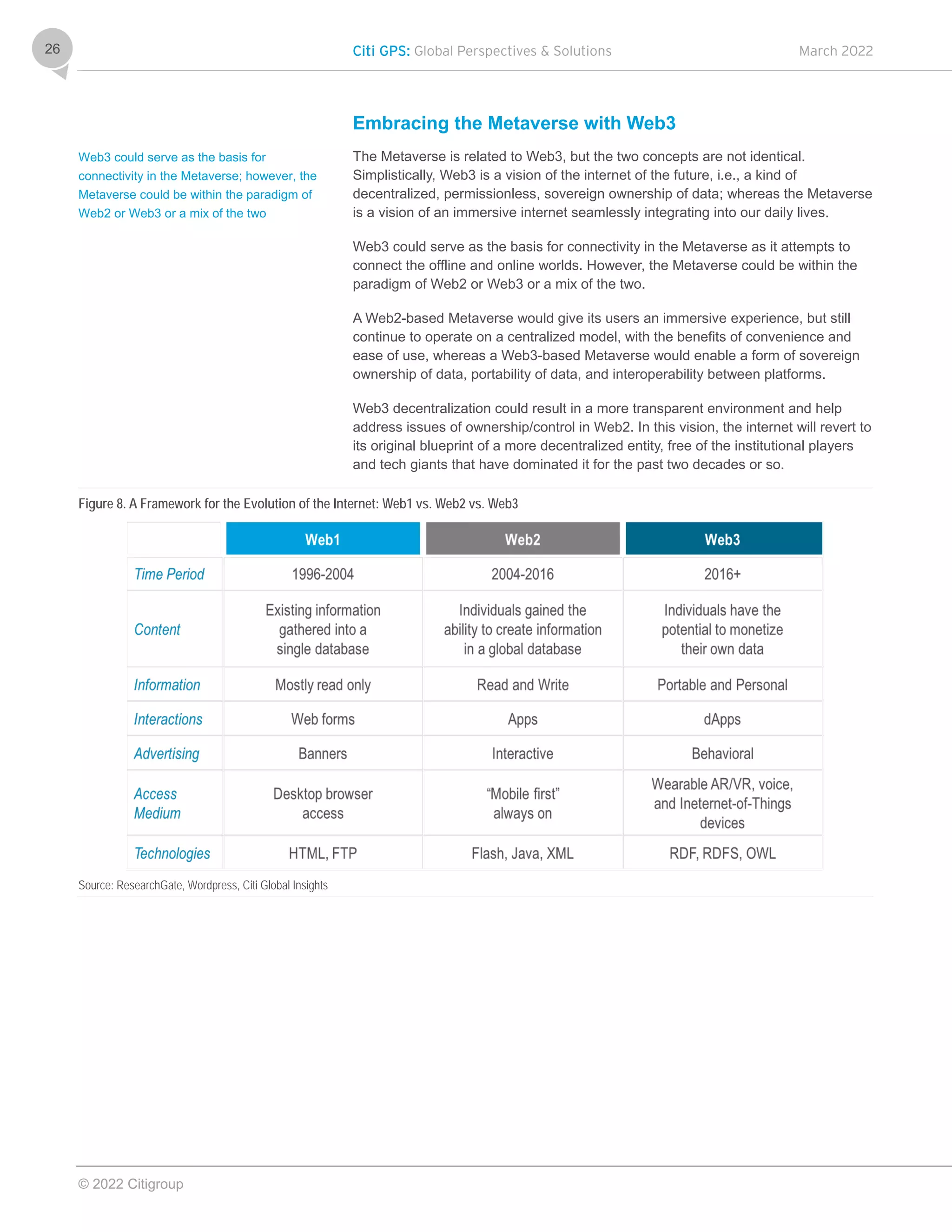
The Metaverse is related to Web3, but the two concepts are not identical.
Simplistically, Web3 is a vision of the internet of the future, i.e., a kind of
decentralized, permissionless, sovereign ownership of data; whereas the Metaverse
is a vision of an immersive internet seamlessly integrating into our daily lives.
Web3 could serve as the basis for connectivity in the Metaverse as it attempts to
connect the offline and online worlds. However, the Metaverse could be within the
paradigm of Web2 or Web3 or a mix of the two.
A Web2-based Metaverse would give its users an immersive experience, but still
continue to operate on a centralized model, with the benefits of convenience and
ease of use, whereas a Web3-based Metaverse would enable a form of sovereign
ownership of data, portability of data, and interoperability between platforms.
Web3 decentralization could result in a more transparent environment and help
address issues of ownership/control in Web2. In this vision, the internet will revert to
its original blueprint of a more decentralized entity, free of the institutional players
and tech giants that have dominated it for the past two decades or so.
Figure 8. A Framework for the Evolution of the Internet: Web1 vs. Web2 vs. Web3
Source: ResearchGate, Wordpress, Citi Global Insights
Web3 could serve as the basis for
connectivity in the Metaverse; however, the
Metaverse could be within the paradigm of
Web2 or Web3 or a mix of the two
March 2022 Citi GPS: Global Perspectives & Solutions
© 2022 Citigroup
27
External Expert View: Ioana Surpateanu on Metaverse and
Web3
Ioana Surpateanu is a Web3 and DeFi investor, adviser, and entrepreneur. She
strategically supports a variety of projects and focuses on various verticals within
the Metaverse as well as DeFi 2.0 protocols. She sits on the Executive Board of the
Multichain Asset Managers Association (MAMA) where she advances DeFi
advocacy and interactions with policymakers and regulators. She is in the process
of creating League of Metas, a women-only Metaverse focus group that will channel
advocacy and education efforts for policymakers interested in this space.
Q: Could you help define the Metaverse?
A: The Metaverse is a shared digital/physical space, instrumented by crypto tokens,
and powered by distributed coordination mechanisms in the form of DAOs
(Decentralized Autonomous Organizations). In a sense, the Metaverse has become
an exponential playground to showcase the power of DAOs.
I believe this is the next phase of the internet and a very tangible implementation of
Web3 technologies. Additionally, it can be thought of as a much-needed mass
onboarding platform for users into cryptocurrencies, beyond an almost exclusive
trading and decentralized finance (DeFi) angle.
Taking a step back, this is not the first time we have witnessed activity in virtual
worlds. If we go back to the early 2000's, Second Life had created a novel form of
escapism via access to virtual worlds.
One of the main reasons Second Life did not scale in 2003, when it was launched,
is because the correct primitives and incentive alignment mechanisms were lacking.
Today we refer to them as the Web3 tech stack, which powers a multitude of
protocols in DeFi and the Metaverse.
By contrast, Web2 platforms, which are often times monopolistic, do not enable any
form of ownership or monetization for their users. You can think of this paradigm as
a neo-communist model, where active users contribute to the value creation and
development of a platform or a product, without any “return on involvement.”
Q: Could you talk about Web3 and what this means for the Metaverse?
A: Web3 has been in development for the past 10 years and it encapsulates a
variety of user-centric decentralized technologies. Via the Metaverse, we have for
the first time a very tangible and easy to explain implementation of those
abstract/nebulous notions of Web3 technologies.
It is still unclear how the Metaverse will be designed and what the overall
ecosystem will evolve into — open, closed, or hybrid models. So far, it has mostly
been designed with user-centricity in mind and it operates in constant progression
towards a full-fledged, open economic system end-state. In order to fulfill that open
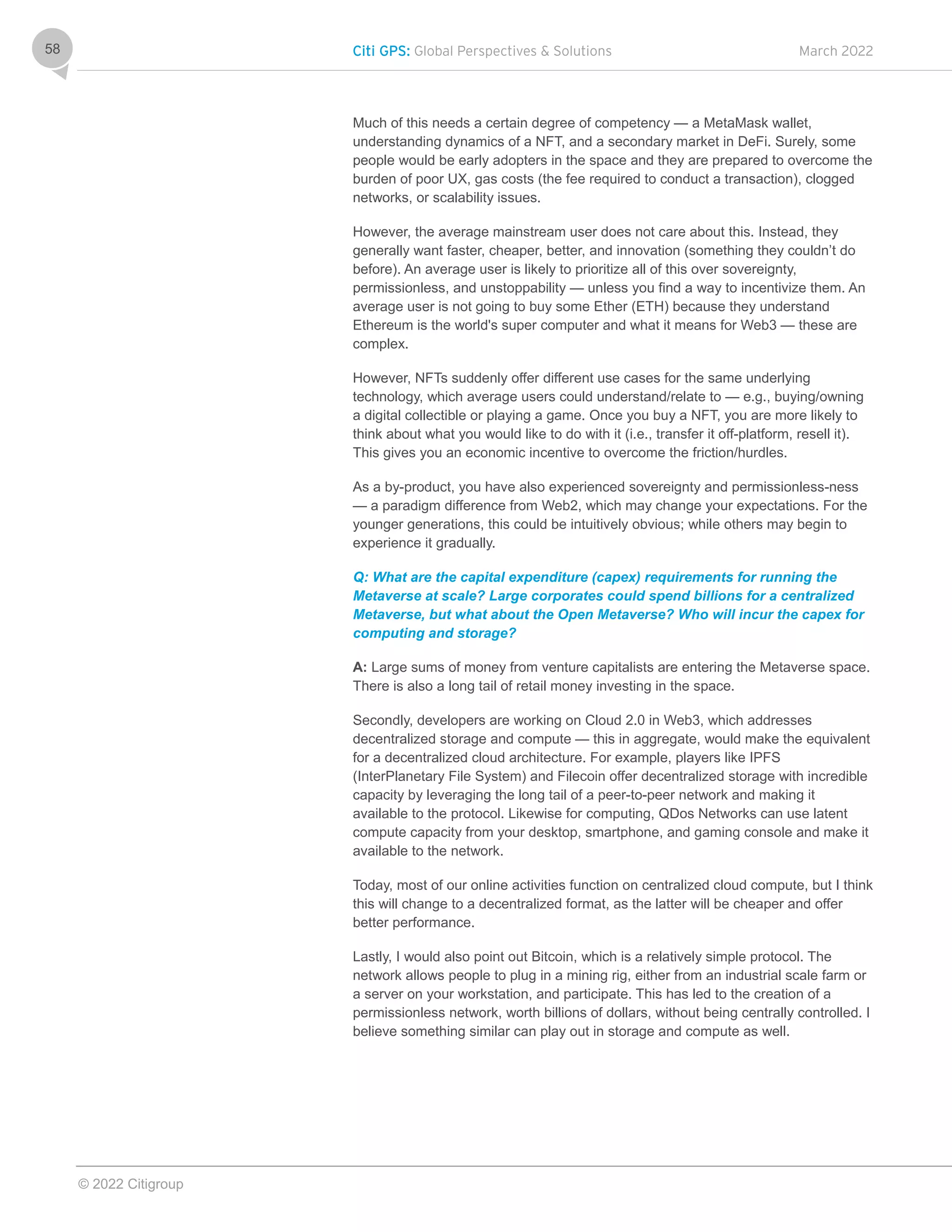
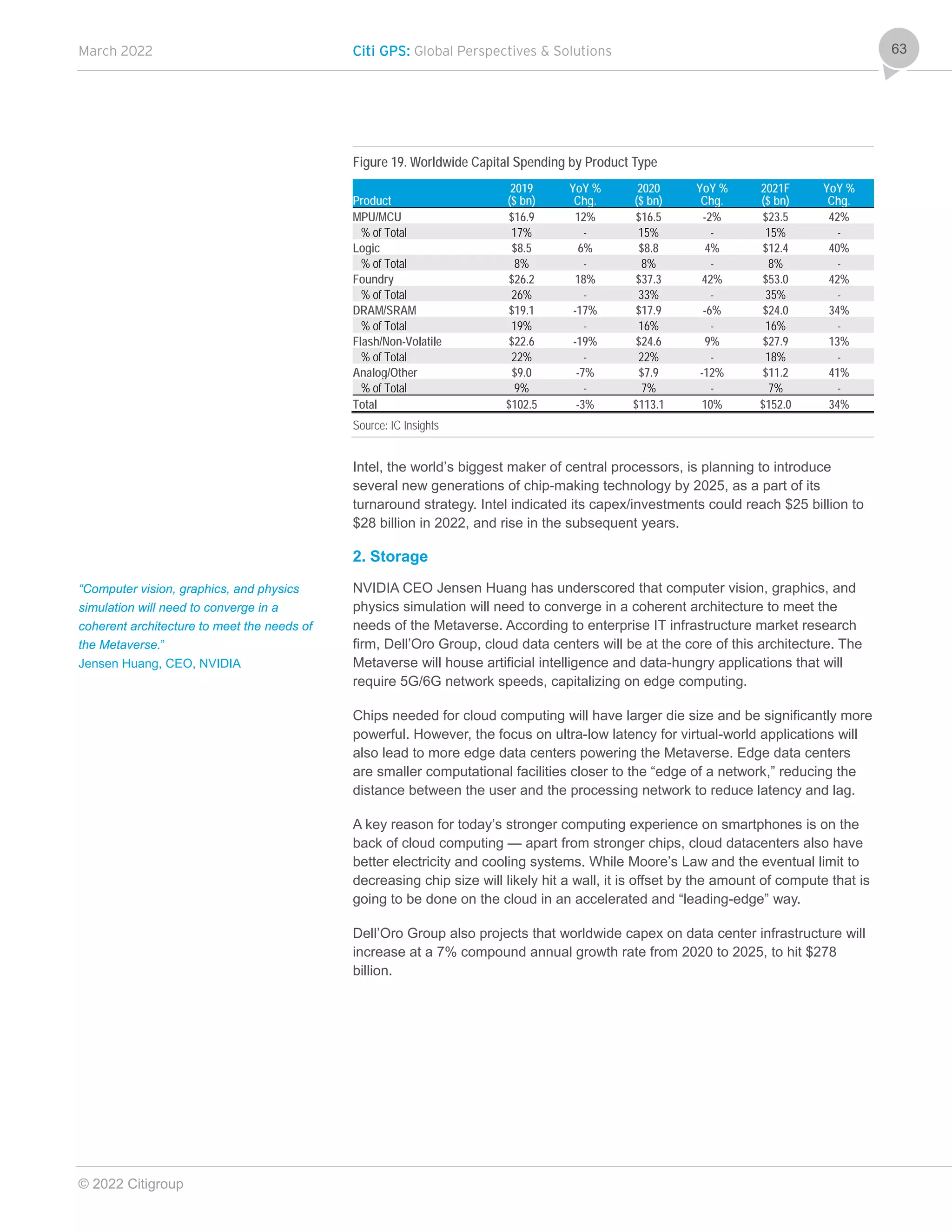
virtual economic ideal, non-fungible tokens (NFTs) come into play as primary and
indispensable tools because they represent digital property in virtual environments.
If you calibrate the correct digital ownership tools and power a new format of the
internet that is owned by the users and developers, the resultant system will equally
be open and accessible. This means full access across the board for participants
who, via these digital ownership instruments, become owners and direct partakers
in the success of a specific platform or protocol. It’s unlikely they would ever go
back to a “simple user of a system” status ever again.
Ioana Surpateanu
Citi GPS: Global Perspectives & Solutions March 2022
© 2022 Citigroup
28
Metaverse Use Cases
We now take a closer look at the plethora of use cases of the Metaverse and take a
deeper dive into gaming and enterprise as they may be key drivers of adoption.
 Developer/Creator Economies, Games: The Metaverse potentially presents
large opportunities for content creators to come up with something unique and
find a niche for themselves. The Metaverse could help build a robust third-party
developer base selling experiences and virtual assets, which could span games,
social media, trading, and NFT marketplaces.
 Virtual Workspaces, Communities: Workspaces could turn virtual, especially
as stakeholders strive to improve remote and hybrid work by creating constant,
digital spaces where users can log in as some form of avatar. Products such as
Facebook's Horizon Workrooms and Microsoft's Mesh for Microsoft Teams make
it possible to hold meetings in virtual reality. Buzz around the Metaverse has also
led to a boom in virtual real estate, including on platforms like The Sandbox, Axie
Infinity, and Decentraland.
Figure 9. Prominent Use Cases for the Metaverse
Source: Citi Global Insights
March 2022 Citi GPS: Global Perspectives & Solutions
© 2022 Citigroup
29
Decentraland is a decentralized social platform built on the Ethereum blockchain,
where users can experience events as well as connect with people. Users enjoy
governance and voting rights over the platform, unlike many other virtual lands
and Web2 social platforms.
The platform has experienced rapid user growth, albeit still in an early stage of
development with 500,000 monthly unique users today versus just 30,000 in
March 2021.
– ADAM DE CATA, HEAD OF PARTNERSHIPS AT DECENTRALAND
 Digital Entertainment Events — Concerts, Tourism, Museums, Fashion
Shows, Sports, Theme Parks and Beyond: The virtual environment could help
host virtual concerts, movie premieres, launch parties, and events spanning
numerous industry verticals as well as offer a marketplace for fan collectibles
(NFTs). We outline key live examples for such digital entertainment events:
– In 2020, rapper Travis Scott performed a virtual concert inside of Fortnite (a
free-to-play cross-platform game developed by Epic Games), which attracted
several million viewers.
– Adoption of the Metaverse could accelerate tourism use cases. For example,
the Korea Tourism Organization in December 2021 released the map for
HAHAHOHO Gyeongju World in the Metaverse, offering visitors a chance to
experience the cultural heritage sites of the Silla Dynasty and other popular
tourist hotspots. The traditional lantern festival is also planned virtually to
attract global citizens.
– In the fashion vertical, shows are being organized in the Metaverse.
Decentraland hosted a four-day digital fashion week (MVFW) in March 2022.
Virtual avatars strutted the virtual runway; virtual pop-up stores, showrooms,
fashion talks, and after parties were also a part of the experience.
– Users will have the opportunity to purchase both digital clothes (to dress their
avatars) and real clothes. We have seen partnerships between digital fashion
brands and retailers to sell digital clothes. For example, digital fashion brand
Republique partnered with the French accessories retailer Monnier Frères.
Citi GPS: Global Perspectives & Solutions March 2022
© 2022 Citigroup
30
Figure 10. Fashion in The Metaverse
Source: Republique and Monnier Frères
– Consumers may experience theme parks in more immersive and personalized
ways in the future. Disney for example is interested in building a theme park in
the Metaverse and registered its patent known as ”virtual world simulator in a
real place,” which received approval in December 2021.9
It is envisioned that
personalized interactive attractions for theme park visitors would be created
using headset-free augmented reality. 3D images and effects will be projected
onto physical spaces and the experience of visiting Disney theme parks will be
tailored to individual users. It remains to be seen if the Metaverse plans will
come to fruition and to what degree this sets a trend for other theme parks.
– Museum experiences in the Metaverse are already in the process of being
built. For example, the online group Pixlr Genesis is aiming to build the
“Louvre of the Metaverse” with NFTs as a way of connecting artists and art
connoisseurs globally and as a way of empowering creators to showcase their
artwork to a wider audience.
– Major sporting events and clubs are starting to tap into the Metaverse to
attract fans. The president of the football club FC Barcelona, Joan Laporta,
announced in his keynote speech at the Mobile World Congress 2022 that the
club will deploy NFTs (the launch date at this stage has not been defined) and
build its own Metaverse as part of its strategy to attract new fans. He said at
the conference, “We want to develop our Metaverse, our NFTs, and all of
these new business [opportunities] that appear in our world.” He explained that
the club will soon be able to offer digital products to members and to fans and
made reference to the club’s players being in the Metaverse — without
providing any detailed plans.
– Tennis is ahead of the game with the Australian Open (AO) already in the
Metaverse. It is the first Grand Slam event to enter this space with the first
minting of the “AO Art Ball NFT” linked to live match data, giving people
globally the opportunity to own a piece of the AO. In addition, there will be a
virtual hosting of the AO in Decentraland so that tennis fans can explore the
Grand Slam from anywhere in the world.
9
Disney Enterprises Inc., U.S. Patent11210843, dated December 28, 2021.
March 2022 Citi GPS: Global Perspectives & Solutions
© 2022 Citigroup
31
The Australian Open prides itself on being one of the most
innovative sports and entertainment events in the world, and
we are delighted that through our expansion into the
Metaverse and Decentraland, more fans can engage with
our sport than ever before.
– CEDRIC CORNELLIS, CHIEF COMMERCIAL OFFICER AT TENNIS AUSTRALIA
 Virtual Advertising: In-platform ads allow users to bring their digital avatar and
become an active participant, offering an immersive experience where they can
interact with real-life physical items as well as digital Metaverse-oriented items.
Brands such as Nike, Vans, Adidas, Gucci, and Burberry, to name a few, are
embracing the new marketing frontier and are active in virtual attire and
accessory sales in multiplayer online games. Several brands are also showing up
in Metaverse environments through digital advertising, mimicking real-life and
blending into gameplay (e.g., billboard ads or branded clothing).
Figure 11. Gucci Has Partnered with ZEPETO (A South Korean Metaverse Platform) to Help
Users Create 3D Avatars of Themselves
Source: Courtesy of Gucci
 Social Commerce and e-commerce: The Metaverse could have a profound
impact on the way we shop. Virtual shopping malls and digitized retail products
could allow users to look at items with friends, talk to company representatives
and influencers about products, as well as digitally try out goods. This could be
the next iteration of commerce, where e-commerce and social media intersect.
Citi GPS: Global Perspectives & Solutions March 2022
© 2022 Citigroup
32
Even without the social media aspect, the Metaverse in combination with
commerce can create new experiences on how consumers shop online and
interact with e-commerce platforms. The fact that we have witnessed technology
and retail giants already starting to deploy the Metaverse for commerce could be
a sign that others will follow suit:
– Amazon is deploying the Metaverse with an augmented reality shopping tool
called “Room Decorator.” The tool allows users to see what furniture and
home decor will look like in one’s own space using a mobile phone/tablet.
– In December 2021, Google also tapped into the Metaverse technology by
launching augmented reality beauty experiences to allow consumers to test
out cosmetic products via their apps before they buy, and without having to try
them on in stores.
 Virtual Cities, Public Services: Sovereign governments, public offices and
central banks are embracing different components of the Web3/Metaverse to
create virtual communication ecosystems for some areas of administration,
including economic, cultural, tourism, education and civic service.
For instance, Seoul, the capital of South Korea, as part of its Seoul Vision 2030
plan, intends to establish a Metaverse platform.10
This is likely to include a virtual
city hall and public service centers, allowing citizens to interact with city officials
for virtual consultations, as well as feature tourism locations. Other cities such as
Dubai in the United Arab Emirates are also exploring the Metaverse.
 Smart Manufacturing: Given the Metaverse's ability to extend use cases
beyond gaming, virtual offices, and e-commerce, among others, the
manufacturing industry is also exploring opportunities with digital twin technology
(virtual representations of real-world physical assets or systems which are
continuously updated), which is core to the industrial Metaverse. By utilizing
simulations, manufacturers could significantly cut down on project costs, time,
and wasted resources.
For example, Boeing is exploring digital twin technology to build airplanes in the
Metaverse.11
Siemens Energy developed a digital twin to offer predictive
maintenance of power plants.12
Meanwhile, Ericsson is building city-scale digital
twins to help study the interplay of 5G cells and the environment for maximum
performance and coverage.13
10
Julie Gaubert, “Seoul to Become the First City to Enter the Metaverse. What Will it
Look Like?” euronews.next, updated November 11, 2021.
11
Eric M. Johnson and Tim Hepher, “Boeing Wants to Build Its Next Airplane in the
‘Metaverse’,” Reuters, December 17. 2021.
12
Richard Kerris, “Siemens Energy Taps NVIDIA to Develop Industrial Digital Twin of
Power Plant in Omniverse,” NIVIDIA blog, November 15, 2021.
13
Richard Kerris, “Ericsson Builds Digital Twins for 5G Networks in NVIDIA Omniverse,”
NVIDIA blog, November 9, 2021.
March 2022 Citi GPS: Global Perspectives & Solutions
© 2022 Citigroup
33
 Healthcare: While surgical procedures already use robotics, complex surgeries
and training may benefit from augmented and virtual reality applications.
However, several clinical trials and use cases will have to be explored in order to
truly understand whether this technology is capable for use in the real world.
Early use cases involving healthcare training are emerging.
– Universities such as the Seoul National University Bundang Hospital
(SNUBH), is already providing training to medical staff in a smart operating
room in the Metaverse. In May 2021, the Asian Society for Cardiovascular and
Thoracic Surgery (ASCVTS) provided lung cancer surgery training to over 200
thoracic surgeons through a Metaverse platform at an online conference. All
the equipment they needed was a head-mounted display.
Figure 12. Healthcare in the Metaverse at Seoul National University Bundang Hospital
Source: Korea Biomedical Review and Seoul National University Bundang Hospital (link)
– Microsoft's Hololens technology has already been explored in non-operative
as well as surgical cases to provide medical care remotely (link). DeHealth
announced the creation of a decentralized Metaverse (an extension of
VR/AR/MR) where doctors can work/interact with each other as well as with
patients in 3D and earn virtual assets.14
In addition to these use cases, we have also seen signs of the Metaverse
hardware in the form of the headsets being equipped with technology to measure
and assess patients’ health. REACT Neuro, for example, has partnered with
PICO Interactive to deploy their virtual reality headsets (Neo 2 Eye) which are
equipped with eye-tracking capabilities to measure brain health.
There are also early studies underway to see to what degree virtual reality and its
ability to distract users from reality and potentially block pain signals from
reaching the brain can be used as an alternative to opioids to manage pain.
14
AIT News Desk, “The World’s First Healthcare Metaverse from DeHealth,”
AITHORITY, December 23, 2021.
Citi GPS: Global Perspectives & Solutions March 2022
© 2022 Citigroup
34
It’s like having a GPS navigator in front of your eyes.
– TIMOTHY WITHAM, M.D., DIRECTOR OF THE JOHNS HOPKINS NEUROSURGERY SPINAL FUSION
LABORATORY (AFTER CONDUCTING THE INSTITUTION’S FIRST-EVER AUGMENTED REALITY
SURGERY IN JUNE 2021)
 Education: Growth of the Metaverse in the education sector could help students
receive an immersive learning experience, as well as enjoy the gamut of other
campus activities online to encourage students' creativity and collaboration. For
instance, authorities in Seoul are currently operating Metaverse-based science
classes for students to explore a virtual exhibition hall called "Gather Town" with
their own avatars.
– In Florida, the Optima Classical Academy, a charter school announced its
intention to establish a school which will be tuition free starting in August 2022.
Oculus headsets will be given to the students so that they can participate in
virtual lessons.
 Recruitment and Training: As more and more people engage with the
Metaverse, particularly people in younger age demographics, we anticipate that
the recruitment industry will adapt and use it as a platform to connect with and to
recruit emerging talent. Recruiters will have to shift their focus and go to where
the talent spends their lives and where they can best engage with such talent.
For recruitment, we are already using a Metaverse platform, Virtual Park, to
interview job candidates and offer them the ability to meet our people and find
out more about our culture, values and opportunities. We’ve seen great success
in using this platform to connect with high school leavers and graduates in
particular and, to date, have welcomed over 17,000 students to PwC’s Virtual
Park.15
– JEREMY DALTON, HEAD OF EXTENDED REALITY (XR) FOR PWC UK
– Samsung Electronics, for example, already conducted recruitment fairs on the
Gather Town Metaverse platform, in which candidates’ avatars can talk to
avatars from human resources (HR) and other members of staff as part of the
recruitment process. Hyundai Motor and Lotte E&C have also conducted job
fairs using the same platform.
– In addition to education for students, the Metaverse also offers opportunities
for corporates to train their new joiners in more engaging ways. Hyundai
Mobis, for example, is conducting inductions and training for new employees
in the Metaverse through their “Metaverse experience” and “untact online trip”
programs. These were designed so that new employees working remotely
could form bonds more easily. According to the firm, the plan is to make “use
of Metaverse contents to add programs for observing major company facilities
such as workspaces, research labs, and driving test centers, to seek various
ways to communicate with the MZ generation at their eye level.”
15
Dominic Bernard, “Recruitment in the Metaverse: Will It Become a (Virtual) Reality?”
HR Magazine, January 13, 2022.
March 2022 Citi GPS: Global Perspectives & Solutions
© 2022 Citigroup
35
 Climate Change: Scientists and researchers conduct experiments using digital
twin technology to model scenarios on virtual representations of the earth.
– NVIDIA, for example, is building a giant Metaverse of the planet Earth through
its NVIDIA Omniverse™, which offers designers a 3D virtual world where
users globally can collaborate on software applications. This digital twin of the
Earth will continuously model, predict, and track climate change in real time so
that scientists can find ways to mitigate its spread.
Gaming in the Metaverse: An Early Start Point?
The gaming industry has played a fundamental role in shaping the Metaverse and it
is likely to continue doing so with immersive elements like 3D avatars, building new
virtual worlds, and observations as a gameplay.
Today, most console and role-playing games have started developing Metaverse-
like experiences into their gaming structure and feature in-game events. Game
developers are increasingly tapping the opportunity to create immersive virtual
experiences by partnering with musicians, movie markets, record labels and other
brands. For instance, Fortnite featured a virtual concert of rapper Travis Scott;
whereas Roblox hosted the Electric Daisy Carnival, an annual dance music festival.
Over the coming decades, the Metaverse has the potential to become a multi-
trillion dollar part of the world economy.
The next three years are going to be critical for all Metaverse aspiring companies
like Epic, Roblox, Microsoft, and Facebook.16
– TIM SWEENEY, CEO OF EPIC GAMES
The gaming industry is growing rapidly and the emergence of new economic
models, such as play-to-earn, coupled with blockchain and the Metaverse could
likely have a significant impact.
Play-to-earn gaming models give gamers ownership over in-game assets and allow
them to increase their value by actively playing the game. These digital assets can
range from cryptocurrencies to in-game resources that are tokenized on the
blockchain. The play-to-earn gaming model could help bridge the gap between
players looking to earn extra income and those interested in playing the game.
16
Sohee Kim, “Metaverse Is a Multitrillion-Dollar Opportunity, Epic CEO Says,”
Bloomberg, November 17, 2021.
Most console and role-playing games have
started to develop Metaverse-like
experiences into their gaming structure and
feature in-game events
Citi GPS: Global Perspectives & Solutions March 2022
© 2022 Citigroup
36
Figure 13. Different Economic Models for Gaming
Source: Citi Global Insights
For example, players in the game Axie Infinity earn Smooth Love Potion (SLP)
tokens, which they can sell to other players in a dedicated marketplace. Players can
also trade digital assets, including land and weapons in the form of NFTs, to other
players. Likewise, Decentraland allows users to trade virtual plots.
The Metaverse could help make gaming more immersive through AR and VR, while
also offering better engagement, virality, and monetization for games. Integration of
e-commerce, NFTs, and other collectibles could also allow users to interact and
support their favorite teams in new ways.
The Metaverse is still in its early phases and is about designing and coding with
early-mover companies and platforms such as Epic Games, Roblox, and The
Sandbox. Others such as Microsoft, which owns Xbox and games like Minecraft,
are also players in the gaming world.
However, it has attracted significant investment. In April 2021, Epic Games raised
$1 billion in private capital funding to support its long-term vision for the Metaverse
and accelerate work around building connected social experiences.
Figure 14. Popular Metaverse Games and Developers
Source: Citi Global Insights
March 2022 Citi GPS: Global Perspectives & Solutions
© 2022 Citigroup
37
Making the Case for a Progressively Open Metaverse
Tim Sweeney, founder of Epic Games, advocates an incremental approach to
opening up the Metaverse from the current framework of closed platforms. He
suggests that current game platforms like Fortnite, Roblox, and Minecraft adopt
more and more open standards, progressively enabling more interoperability.
The benefit of more activity and openness to everybody is much stronger than
any other temporary benefit to any player from having lock-in.
– TIM SWEENEY, FOUNDER OF EPIC GAMES
Sweeney also points that he believes Metcalfe’s law applies in the Metaverse
scenario, where the value of the network is proportional to the square of the number
of network users. With positive-sum payoffs, the whole market grows with more
users jumping in, and all the platforms benefit. This would suggest individual
components of services therefore need to be built without enforcing a “tie-in” to
another service offered by the same platform or game developer. Different game
platforms opening up more of their services would also pave an alternate path
towards getting to, at the minimum, a “semi” Open Metaverse — starting from
established centralized platforms as opposed to a fully closed one.
The principle here is every creator owns their original creations and has the right
to make the profit from them…And it’s great to choose service providers they
choose to work with, without being forced to accept a massive bundle of services
in order to reach the customer base. We want each component of the system to
stand on its own merits and not use dominance or significant market power in
any space to force adoption.
– TIM SWEENEY, FOUNDER OF EPIC GAMES
However, technical interoperability standards are a missing core component of
openness in the Metaverse. To enable portability of assets, different suites of 3D
modelling need to be able to interface each other, and the industry needs
standardized file formats for exchanging data, among other requirements.
From a technology standpoint, this is a big challenge, and a number of leading
game technologists predict that inter-game or virtual world interoperability is a pipe
dream, or at the very least, a long way away.
Once again, you cannot take a 'skin' from one game, drop it into another, and
expect good results — even if they were made in the same engine…
The scales won't match. The rigs won't match. The [level of detail] won't match.
The hitboxes won't match. The shader budgets won't match…
– JULES GLEGG, PRINCIPAL ENGINEER AT RIOT GAMES
Today, technical interoperability standards
are the missing core component of an Open
Metaverse and leading game technologies
believe that achieving inter-game or virtual
world interoperability is a pipe dream
Citi GPS: Global Perspectives & Solutions March 2022
© 2022 Citigroup
38
If you actually want to bring along that t-shirt, you run into a problem that a t-shirt
is made for a specific character…So the fit will be a specific way. It's animated a
specific way. It has physics built in a specific way — again, for that custom size,
for that custom gravity, of the first game. That's not going to translate to the
second game.
– RAMI ISMAIL, GAME MAKER AND CONSULTANT
The Metaverse as an Enterprise Play?
Proponents of the technology often cite the Metaverse’s ability to build shared
virtual spaces for enterprises. The post-pandemic work-from-home environment
could greatly be influenced by VR/AR adoption, dramatically changing the way
colleagues interact and collaborate on projects or attend trainings and meetings.
The Metaverse is here, and it’s not only transforming how we see the world but
how we participate in it — from the factory floor to the meeting room.
It is no longer just looking at a camera view of a factory floor, you can be on the
floor. It's no longer just video conferencing with colleagues, you can be with them
in the same room. It's no longer just playing a game with friends, you can be in
the game with them.17
– SATYA NADELLA, CHAIRMAN AND CEO OF MICROSOFT
Products such as Facebook's Horizon Workrooms and Microsoft's Mesh for
Microsoft Teams, make it possible to hold meetings in a virtual office space. Virtual
campuses also allow onboarding of new employees and can enable existing
employees to personally connect and enjoy social hangouts.
Going forward, every business process will be collaborative, powered by data
and AI, and will bridge the digital and physical worlds.18
– SATYA NADELLA, CHAIRMAN AND CEO OF MICROSOFT
At the 2021 GPU Technology Conference (GTC), NVIDIA showcased Omniverse™,
an enterprise Metaverse that can be used by engineers/designers to generate
physically accurate virtual replicas of buildings, manufacturing lines, and factories,
as well as help run simulations of models in the physical world.
17
Satya Nadella (@satyanadella), Twitter, November 2, 2021; Satya Nadella, Microsoft
Ignite 2021 conference, November 2, 2021.
18
Satya Nadella, Microsoft Ignite 2021 conference, November 2, 2021.
The post-pandemic work-from-home
environment could greatly be influenced by
VR/AR adoption, dramatically changing the
way colleagues collaborate on projects or
attend trainings/meetings
March 2022 Citi GPS: Global Perspectives & Solutions
© 2022 Citigroup
39
A constant theme you’ll see — how Omniverse is used to simulate digital twins of
warehouses, plants and factories, of physical and biological systems, the 5G
edge, robots, self-driving cars, and even avatars.19
– JENSEN HUANG, FOUNDER AND CEO, NVIDIA
Ben Thompson (Founder and Author of Stratechery) and James Allworth (Head of
Innovation at Cloudflare, and Co-host of the Exponent podcast) talk about the
importance of the Metaverse as an enterprise play, offering the next-generation of
video conferencing in the Exponent Podcast Episode 196: Forecasting the
Metaverse.20
Imagine being teleported digitally to a remote location for an interactive shared
experience with your work colleagues, with features such as the ability to:
 Bring your desk, computer & keyboard into the virtual environment
 Sketch out ideas on a virtual whiteboard together with your team
 Share meeting notes and files, and integrate calendars
 Configure the virtual room’s layout to match user needs
 Or, simply hang out and socialize
Ben Thompson believes the first major use cases of virtual reality will be employees
using devices bought for them by their employer, eager to increase collaboration in
a remote-work world. As quality increases, this could offer a superior working
environment. Some employees will be interested in using VR for non-work activities
as well, increasing the market for non-work applications gradually.
While the Metaverse may start slow as the technology still remains nascent,
advancements over time could see more enterprises sign up for Metaverse
platforms and invest in necessary hardware (e.g., VR headsets).
Building Financial Sector in the Metaverse: A South Korea Case Study
South Korea is one of the emerging players in the Metaverse with its strong gaming industry and popular culture
content. We cite some examples below of major financial institutions exploring opportunities to integrate the world of
finance and the virtual space of the Metaverse.
KB Kookmin Bank has developed a pilot virtual financial town (operational since July 2021), which includes (1) a
financial and business center composed of virtual branches, public relations and recruitment booths, and auditoriums;
and (2) a telecommuting center, to facilitate communication and collaboration across telecommuters and office
workers.21
19
Brian Caulfield, “GTC Wrap-Up: NVIDIA CEO outlines Vision for Accelerated
Computing, Data Center Architecture, AI, Robotics, Omniverse Avatars and Digital Twins
in Keynote,”, NVIDIA Blog, November 9, 2021.
20
Ben Thompson and James Allworth, “Episode 196 – Forecasting the Metaverse,”
Exponent (podcast), November 5,2021.
21
Kim Jee-Hee, “Following the Money Takes Finance to the Metaverse,” Korea JoonAng
Daily, July 21, 2021.
While the Metaverse may start slow as the
technology still remains nascent,
advancements over time could see more
and more enterprises sign up for Metaverse
platforms and invest in necessary hardware
Citi GPS: Global Perspectives & Solutions March 2022
© 2022 Citigroup
40
Hana FG and Shinhan FG are also exploring the Metaverse to offer millennials/Gen-Z customers a digital platform
with virtual bank branches, VR-based financial servicing, and financial education.22
Woori Bank has joined a broader community initiative, “Metaverse Alliance,” with over 400 companies collaborating to
create a Metaverse broader than just banking.23
Brokerage firms such as NH Investment & Securities are working on their Metaverse platform, offering services like
investment analysis seminars and games.24
Likewise, Shinhan Card plans to launch prepaid cards for virtual and real-world use.25
Figure 15. Woori FG Metaverse Branch for SME Customers
Source: Woori Financial Group
22
“Hana Bank to Lure Younger Customers with Metaverse Platforms,” Econotimes,
August 6, 2021.
23
“Hanryu Bank joined ‘Metaverse Alliance’, the Korean New Deal Hosted by the
Ministry of Science and Technology, After Samsung Electronics,” CISION, September 7,
2021.
24
Anna J. Park, “Metaverse Becomes New Growth Engine of Financial Industry,” The
Korea Times, August 24, 2021.
25
Kim Jee-Hee, “Following the Money Takes Finance to the Metaverse,” Korea JoonAng
Daily, July 21, 2021.
March 2022 Citi GPS: Global Perspectives & Solutions
© 2022 Citigroup
41
Metaverse-as-a-Service
The Metaverse will require countless new technologies, protocols, companies,
innovations, and discoveries to work. Many companies with existing technological
and network infrastructure might not be capable to build out and offer an immersive
Metaverse-like experience to a large number of users.
Just as the internet has a set of protocols for visual representation, communication,
graphics, and data, the Metaverse would require a broader and resilient set of
standards and protocols that also embrace interoperability. For example, Fortnite
functions across almost all major platforms (e.g., iOS, Android, PlayStation, Xbox),
allowing for multiple identity/account systems and payment methods, pushing
competitors into cooperation (i.e., interoperability) with one another.
Today, Web2 giants (e.g., Apple, Google) use similar technologies, but they are not
designed to transition into one another. Interoperability will be far more important for
building a scalable Metaverse. Metaverse-as-a-Service (MaaS) would enable
companies to use standardized protocols to build their Metaverse campus and
begin offering immersive experiences that help bring people together.
Companies could make the Metaverse possible with private network capabilities,
delivered to any destination on the internet. Plug-and-play Metaverse services
would also offer a high degree of interoperability between experiences. Several Big
Techs are exploring the Metaverse and could help drive mass adoption of virtual
assets in coming years.
Figure 16. Select Big Techs Exploring the Metaverse
Source: Citi Global Institute
Citi GPS: Global Perspectives & Solutions March 2022
© 2022 Citigroup
42
External Expert View: Yonatan Raz-Fridman on the
Metaverse and the Consumer
Yonatan Raz-Fridman is the Founder and CEO of Supersocial, an interactive media
company focused on providing immersive experiences. The company is building
virtual worlds, games, and experiences for the Metaverse, starting with Roblox and
in the future Web3. Prior to Supersocial, Yon co-founded Kano, a consumer tech
company that makes computer kits for play and learning, most recently releasing
the Stem Player in a partnership with Kanye West.
Q: Could you tell us more about Supersocial?
A: The genesis for starting Supersocial goes back to my previous venture, a VR-
related product for play and learning. When COVID-19 hit, I realized that nearly 2.5
billion young people below the age of 18 were in their homes and locked out of
schools. It became abundantly clear to me that the next decade of internet was
likely to be about virtual worlds. The young population already spends the majority
of their time on 3D multi-player games such as Roblox, Minecraft, and Fortnite and
this is only likely to grow to other experiences.
At Supersocial, we want to build a company at the intersection of Disneyland and
Nintendo — offering immersive experiences like an attraction in a theme park, but
occurring virtually, along with iconic content and franchises that companies like
Nintendo have built for several years.
Q: How would you describe the Metaverse?
A: Listening to several thought leaders such as Tim Sweeney (CEO of Epic
Games), Dave Baszucki (CEO of Roblox) and Matthew Ball (co-creator of the
Metaverse Ball Index), I believe the Metaverse is a real-time, persistent, large-scale
3D virtual world that will allow millions of individuals to congregate and spend time
doing things together (e.g., playing games, working, designing, learning, and joining
concerts).
In my opinion, there are a few key elements to consider in the Metaverse. The first
element is immersion. The manifestation of this technology is leading to virtual
environments that are more immersive (i.e., allow you to live the experience) and
allow the user to port oneself seamlessly from one experience to another.
The second is the social element. Imagine being in a place where you can interact
and socialize, not only with a small group of your friends, but also with thousands
(potentially millions) of people in one virtual setup. Imagine going to a concert where
you can be with 20 million to 50 million people.
The third element is expressiveness. Users in the real-time 3D worlds are
represented by avatars, allowing you to express yourself in completely new ways
that you may not want to express in real life. For example, in the Metaverse, I can
be whoever I want and wear whatever I want — things which I may not be
comfortable wearing in the real world. I can even have multiple avatars/identities,
allowing me to express myself in 10x more creative ways in the Metaverse.
Yonatan Raz-Fridman
March 2022 Citi GPS: Global Perspectives & Solutions
© 2022 Citigroup
43
Q: How important are VR/AR devices for the Metaverse experience?
A: I perceive the Metaverse as being device agnostic. The Metaverse is not a
device, just like the internet is not a device. The Metaverse is definitely not a VR
headset, AR glasses, a mobile console, or a game console. Instead, it is the
distribution of 3D, real-time, immersive content across multiple form factors that are
connected to the internet. Users will likely be able to access the Metaverse
experience through VR headsets, game consoles, PCs, mobile phones, and other.
Q: What kind of gateways/entry points are we likely to have for the Metaverse
in the future — is it likely to be primarily mobile phones?
A: In my opinion, over the next five years, the primary access for the Metaverse
experience will still be dominated by iOS/Android mobile devices. However, we are
also likely to see continuing developments and evolutions in game consoles, PCs,
VR headsets, and AR glasses.
Over the longer-term (i.e., 2025-2030), we could see greater integration across
devices, which will likely require more work to be done on the software side. Big
Techs have a good chance at continuing to play a dominant role in the emergence
and access to the Metaverse as they remain in control of a key system — the
mobile app marketplace. However, I believe they will not be the only ones as
companies like NVIDIA, Epic, and Unity continue to build important technologies for
enabling developers to build these 3D persistent worlds.
Additionally, we are also likely to see higher proliferation of next-generation devices
that may be available at lower price points and offer greater capabilities. Computers
(PCs) are likely to be an important gateway for the Metaverse experience. VR
headsets and AR glasses are also likely to start growing. However, smartphones
are likely to be the key remote control through which you access most of the
Metaverse experiences.
As people spend more time remotely, we are also likely to see experiments on the
next consumer interface that will inherit the mobile phone in this decade. Use cases
for devices such as game consoles, PCs, VR/AR devices are likely to grow.
However, it is unlikely to be mass consumed in this decade alone, and I believe a
more realistic target would be the next decade (i.e., 2030-40).
Q: Can you share any estimates on the potential adoption of VR/AR devices in
the coming years?
A: I would not be surprised if VR headsets reach a target of one hundred million
units by 2025 — this seems reasonable. It is unlikely the headsets will significantly
cross this threshold, considering the need for further development to reach the
mass market.
In my opinion, the VR category is comparable to gaming consoles. It will be an
important category that will see significant growth, and there will always be newer
versions, but it is unlikely to be something that three billion people would buy.
Interestingly, I wouldn’t want it to happen as I think it would be a shame to have a
headset on our head through most hours of the day.
Meanwhile, I believe AR glasses are likely to be more interesting due to their unique
form factor that can be used both indoors and outdoors. However, no company has
built anything truly compelling so far. While products such as HoloLens already
exist, enthusiasts anticipate tech companies to offer a better product.
Citi GPS: Global Perspectives & Solutions March 2022
© 2022 Citigroup
44
If done right, the market for AR glasses could grow to a hundred million units within
two to three years of launch, in my opinion. Pricing will play a crucial role in the rate
of adoption, as AR glasses will be an add-on to the mobile phone, and a $1,000
price tag could make them a tougher sale for mass-scale adoption.
To summarize, I believe the VR headset market could grow to 200 million to 300
million units by 2030, possibly 500 million at a stretch. Meanwhile the market for AR
glasses could surpass 500 million, possibly reaching a billion units by 2030, if priced
appropriately. In order to generate mass appeal, I believe both devices will need to
offer a new type of paradigm for consumer interface, and not just be an additive
product for the mobile phone.
Q: Can you estimate the target addressable market for the Metaverse?
A: Before I can give you a rough number, let me unpack how I would think about the
target addressable market (TAM).
Since the Metaverse is likely to be device agnostic, I believe anyone in the real
world would be able to access the Metaverse through fast internet and engage in
the 3D, real-time, immersive virtual worlds. I would estimate that by the end of the
decade, the majority (nearly 80%) of the world's population will be able to access
the Metaverse with the help of faster devices/technology.
Further, I believe people are likely to have multiple identities in the Metaverse.
Maybe as many as 10 avatars per person — e.g., one for sport activities/games,
another for school work, another for music concerts. This, combined with our
previous estimate for 80% of the world's population being able to access the
Metaverse, translates to the potential to interact with over a hundred billion
individuals in the Metaverse in the coming years. Extending these numbers helps us
estimate an industry-agnostic market potential worth a few trillion dollars.
Drawing a parallel with the concept of singularity, termed by Ray Kurzweil, as that
point of time where artificial intelligence surpasses human intelligence. I believe, we
will reach a point of time (around 2030-35), where human beings will potentially
consider their virtual presence (avatars), to be as valuable (if not more) than their
physical/real-life identity.
If we subscribe to this view, it isn’t unimaginable to think of us making significant
investments on the digital presence of our avatars. This could translate to significant
market potential for commerce, fashion, sports, and gaming. I would cautiously
estimate the potential market size to be over $10 trillion by 2030.
Q: Why will people have multiple avatars? Is this the equivalent of having
multiple online profiles today?
A: Interestingly, most of us already have multiple identities. We are not the same
person at home with family as we are with office colleagues or school friends. We
often have different attitudes, personalities, and identities depending on the
environment around us.
Second, technology enables us to do things virtually in a more seamless and
frictionless manner. It allows us to creatively express our personalities, e.g., dress
up to a wedding, sports event, or work. We already do most of this today in our real
life, but the way this will be manifested in the Metaverse will be totally different.
March 2022 Citi GPS: Global Perspectives & Solutions
© 2022 Citigroup
45
We could have two, five, or even 10 avatars for distinct purposes within our
personality and we are likely to treat/invest in each one of them differently. I believe
this transformation is likely to first occur with the younger demographic population.
I also believe part of this is cultural. For example, over the last decade, we have
seen several users in Japan have multiple Twitter accounts. The Metaverse and its
avatars will give us freedom on how we translate our desires and creative
aspirations in a world with limitless possibilities of who we can be.
Q: What in your opinion, needs to happen in order for us to enjoy a
"Metaverse experience" on our mobile devices without VR/AR?
A: In my opinion, first, we need to see an increase in the purchasing power of
customers across developing economies. For instance, the prominent markets for
the Roblox platform, after the U.S., include several emerging markets such as
Brazil, Russia, the Philippines, Thailand, Indonesia, and South Korea. In order for
customers to be able to access more advanced devices, we need to see an
increase in purchasing power across these economies.
Second, accelerated development of infrastructure, including 5G, are fundamental
to enable access to a 3D, real-time, persistent, and immersive Metaverse
experience at large scale. There is surely a lot of work to be done in this regard,
especially in emerging markets across Asia and Africa.
Last, we need to create an ecosystem that enables developers and content creators
to collaborate easily and share their creativity. The Metaverse experiences need to
be built by a diverse population, across different countries, genders, and regions,
rather than be dominated by the developed economies.
Q: Is there a need for interoperability across different Metaverses?
A: I strongly believe that for the Metaverse to truly emerge, as we all want it to be, it
has to be open and interoperable. We already have different types of siloed
platforms that aspire to be a Metaverse in itself. However, if users cannot interact
with the digital assets they carry from one platform to another, then this is not a
Metaverse. Interoperability is critical in my opinion.
For this to happen, I believe consumers need to put pressure on closed platforms,
to make sure the platform shifts to being an Open Metaverse. Eventually, those
platforms that do not shift to an Open Metaverse will become niche and obsolete.
Blockchain will play a key role in the conversation to enable interoperability and an
Open Metaverse. Several technology companies are also likely to play a key role in
the emergence of the Metaverse. The exact role they play, remains to be seen.
Q: What are the likely use cases for the Metaverse in the coming years?
A: Over the next five years, we will see online gaming remain a predominant use
case for the Metaverse. Additionally, more use cases are likely to emerge around
socialization, for events such as fashion shows, music concerts, and sport events.
We are also likely to see consistent growth of Metaverse commerce with users
spending money to purchase NFTs or digital items for their avatars. In my opinion,
consumption of virtual goods is likely to grow over the coming years.
Citi GPS: Global Perspectives & Solutions March 2022
© 2022 Citigroup
46
On the enterprise side, we are likely to see growth of enterprise software as several
industries are keen to experiment with the Metaverse and build industrial
applications. For example, the Omniverse™, built by NVIDIA, has seen traction with
companies building environments where people can come and work together to
build high-end cars or design new concepts.
March 2022 Citi GPS: Global Perspectives & Solutions
© 2022 Citigroup
47
Metaverse Infrastructure: Open vs.
Closed
The Metaverse will require countless new technologies and infrastructure to come
together. And design choices are the topic of much debate — should it be “open”,
built on Web3 primitives (building blocks) of permissionless and open protocols, or
“closed”, built by the capital-efficient, easy-to-use Web2 platforms?
Big Tech is in a virtual arms race to build the next generation of dominant virtual
reality (VR) and augmented reality (AR) platforms, raising concerns among some
that the Metaverse will resemble our Web2 experience of having multiple logins,
platform gatekeepers, user data monetization, and embedded advertising, but with
real-time, immersive VR and AR.
Meta Platform reported a 2021 loss of $10 billion on its Metaverse-related consumer
hardware, software, and content division.26
Mark Zuckerberg, who calls the
Metaverse an “embodied internet,” has been careful to state that Meta’s approach
to building the Metaverse would be responsible and collaborative.
Privacy and safety need to be built into the Metaverse from day one. So do open
standards and interoperability. This will require not just novel technical work —
like supporting crypto and NFT projects in the community — but also new forms
of governance. Most of all, we need to help build ecosystems so that more
people have a stake in the future and can benefit not just as consumers but as
creators.
– MARK ZUCKERBERG, CEO OF META PLATFORMS
Nevertheless, concerns around surveillance and privacy are high. Virtual Reality is
far more invasive than our current 2D internet and has the capability to gather huge
amounts of behavioral data, including body language cues, eye-tracking, and other
biometrics, in the name of “experience enrichment.”
Taken to the extreme, ubiquitous surveillance underpinned by invasive biometric
analytics and profiling would bring to life a dystopian vision of a world outlined in
science fiction novels. The Closed Metaverse could end up with a handful of
corporations owning and controlling the servers, databases, and hardware. This
would likely cause users to lose control of their own private data, be tracked and
targeted with advertisements, and also be at the mercy of de-platforming due to a
centralized platform’s changes to EULAs (End User License Agreements).
There is an alternative, as widely championed by the Web3 community. A
conceptually utopian, community-owned, community-governed, freely interoperable
version. Ensuring “privacy by design,” the Open Metaverse is visualized as a
“massively participatory medium” built by thousands of creators, designers,
developers, and companies.
26
Steve Kovach, “Mark Zuckerberg’s ‘Metaverse’ Business Lost More than $10 Billion
Last Year, and the Losses Keep Growing,” CNBC, February 2, 2022.
The Closed Metaverse would likely
resemble a Web2 experience of having
multiple logins, platform gatekeepers, user
data monetization, and embedded
advertising
The Open Metaverse, on the other hand,
would likely be community-owned,
community-governed, and a freely
interoperable version that ensures privacy
by design
Citi GPS: Global Perspectives & Solutions March 2022
© 2022 Citigroup
48
The proponents of the Open Metaverse promise an interconnected world built on
open standards. The Open Metaverse needs to be a fair economy to enable
different participants in the value chain, including the creators and participants, to
profit from it — not just enrich a few companies that build out the “platforms.”
Just as Web3 has emerged to challenge the ascendency of today’s Web2 mega
platforms, a critique of Web3, a backlash against the backlash, has developed. We
will get to the Web3 critics soon — but first an exploration of what the Open
Metaverse could be.
Building the Open Metaverse: Apps or Infra?
From a relatively decentralized architecture in Web1 where a wide range of
distributed ISPs (Internet Service Providers) hosted static webpages, Web2 saw an
accelerating trend towards centralization. This heavy centralization unlocked new
economic opportunities for winner-takes-all platforms that monetized user data for
advertising revenues. As the popular saying goes, “If you are not paying for it, you
become the product.”
Web3 was a term coined by Gavin Wood, a co-founder of Ethereum. The technical
architecture of Web3 visualizes peer-to-peer, blockchain-based architecture with
decentralized storage, user-hosted identity, and sign-in with wallet functionality.
Web3 is an inclusive set of protocols to provide building blocks for application
makers. These building blocks take the place of traditional Web technologies like
HTTP, AJAX, and MySQL, but present a whole new way of creating applications.
These technologies give the user strong and verifiable guarantees about the
information they are receiving, what information they are giving away, and what
they are paying and what they are receiving in return. By empowering users to
act for themselves within low-barrier markets, we can ensure censorship and
monopolization have fewer places to hide.
– GAVIN WOOD, CO-FOUNDER OF ETHEREUM
To support an Open Metaverse, new infrastructure will need to be built in the
coming years. However, it is likely that applications are built even before the
infrastructure is fully ready, leading to a clunky and awkward user experience (UX)
that feels retrograde from the optimized Web2 UX.
As Dani Grant and Nick Grossman of Union Square Ventures highlight, in the
history of new technology development, infrastructure and app development does
not happen in a sequential process with all infrastructure being built first, followed
by the apps.
Instead, infrastructure and applications evolve in an iterative, cyclical way. The first
few apps are often built on sub-optimal infrastructure. Then the arrival of a wildly
successful breakout app leads to further investment in the underlying technologies,
drawing fresh development efforts into easier-to-build and more-usable apps, and
the virtuous cycle continues (Figure 17).
It is likely that Open Metaverse applications
will be built even before the infrastructure is
fully ready, leading to clunky and awkward
user experience (UX) that feels retrograde
from the optimized Web2 UX
Infrastructure and applications evolve in an
iterative way. The first few apps are often
built on sub-optimal infrastructure, but the
arrival of a wildly successful app leads to
further investments in the underlying
technologies, drawing development efforts
into more user-friendly apps
March 2022 Citi GPS: Global Perspectives & Solutions
© 2022 Citigroup
49
Hence, while there is a lot of criticism (mainly from Web2 fans) of Web3 being built
on centralized architecture in today’s world, it is likely the current centralized
infrastructure only serves as scaffolding until a truly decentralized infrastructure is
built to underlay Web3.
This implies that centralized components would be used, temporarily, for
convenience (e.g., centralized cloud storage services, centralized blockchain tools,
and exchanges), but be swapped out later for decentralized alternatives as the
Web3 ecosystem matures and develops.
It is also likely that a large section of users become habituated to the centralized
systems, and these continue to coexist with their decentralized counterparts,
offering a spectrum of options. The future is not Web3 versus Web2, but likely
coexistence.
Figure 17. Cycle of Evolution of Internet and Web Apps
Source: Union Square Ventures, Citi Global Insights
Building Blocks of an Open Metaverse Operating System
The Open Metaverse is made possible by a convergence of different technologies
— blockchain, self-sovereign identity, and cryptographic primitives around “digital
asset” ownership that was missing in the Web2 world. Without blockchain and
cryptography, guarantees of ownership in a trustless way would be impossible.
Blockchain, self-sovereign identity, and
cryptographic primitives around “digital
asset” ownership are the building blocks of
an Open Metaverse
Citi GPS: Global Perspectives & Solutions March 2022
© 2022 Citigroup
50
CRYPTOGRAPHIC PRIMITIVES
Cryptographic primitives are well-established, low-level cryptographic building
blocks that are used to build cryptographic protocols. Commonly used cryptographic
primitives include one-way hash functions, public key cryptography, and digital
signatures. These primitives are combined and used in various ways to enable
different levels of security guarantees.
Hash Functions: Represent a versatile one-way cryptographic algorithm that maps
an input of any size into a unique output of a fixed length of bits.
Public Key Cryptography: A cryptographic system that uses a pair of keys — a
public key, which may be known to others (e.g., an email id); and a private key,
which may not be known by anyone except the owner (e.g., email password). Data
that is encrypted with the public key can be decrypted only with the corresponding
private key.
Digital Signatures: An electronic-encrypted stamp of authentication on the
message/any digital information, which gives guarantees that the original
message/digital information has not been tampered with since being signed with the
sender’s private key.
In the words of Outlier Ventures, Web3 is a stack for an Open Metaverse. “It is a
paradigm ultimately based on blockchains.”
Open Metaverse OS (Operating System) can be thought as an evolving collection of
highly composable technologies that sits between the hardware, application
software, and the user, which will be used to make aspects of an Open Metaverse
possible globally across several use cases.
Open Metaverse OS can be thought as an
evolving collection of highly composable
technologies that sits between the hardware,
application software, and the user
March 2022 Citi GPS: Global Perspectives & Solutions
© 2022 Citigroup
51
Figure 18. The “Operating System” for the Open Metaverse
Source: Outlier Ventures
According to Outlier Ventures, the Open Metaverse OS is concentrated on the
critical lower layers of the stack — for example, the non-negotiable features such as
user-sovereign identity and assets, in-world economics and bridges into and out of
its economy, 3D modeling toolchains, and rendering stacks to the primarily
centralized world.
We do not anticipate that the entire Metaverse OS will be built by a small number of
centralized players, similar to how the mobile phone OS evolved. We expect that
the OS of the Open Metaverse will likely take a path similar to the evolution of
Linux, organically through a patchwork of different contributors building functionality,
in a truly composable way.
Citi GPS: Global Perspectives & Solutions March 2022
© 2022 Citigroup
52
However, building an OS that works with such a complex distributed system is hard
and will take time to develop, with the apps and the infrastructure coming much
earlier, and there being multiple device-specific or context-specific OS in the interim.
It is, however, likely that early progress on this is made by the big tech firms – but
over time, we expect more decentralization.
Identity in the Open Metaverse: Digital Passports and
Web3 Access
Some of the technologies being built include an “always-available” companion on
the Metaverse, a digital passport (in the context of gaming and social apps), and
digital closet of sorts that will hold a player’s social media, digital property, personal
accounts, and friends. Protected by private keys, these would allow the user to
selectively expose their identity and property for different use cases as they deem
fit, with full self-sovereignty.
This “passport” would enable the player to seamlessly weave in and out of virtual
worlds, taking their digital skins, identities, and property with them. This builds on
the login-free and password-free movement between virtual worlds driven by wallet-
enabled, one-click sign-in, without handing over all of the player’s data to the
platform.
The internet has no user authentication system or identity layer built in. In the
current instance, this has led to a host of authentication solutions and logins,
individually managed by different applications. Social sign-on in Web2 (sign in with
Google, Apple, Facebook, etc.) partly solves this problem, but leaves the control of
identity in the hands of a few big platforms acting as gatekeepers.
Against this backdrop, Web3’s solution to sign-on and login is a new paradigm
driving decentralized authentication, backed by public key cryptography. Users get
assigned public-private key pairs, with the public key generating a unique address
and the private key functioning similar to a password that is used for authentication.
This private key, housed in Web3 wallets, can then be used to connect to Web3
websites and decentralized applications, bringing one’s digital wallet into different
apps for seamless interoperability.
Centralized Finance (CeFi) players are not far behind in providing identity solutions
in the Metaverse. Coinbase, a U.S. cryptocurrency exchange, aims to develop an
"identity on-ramp" into the Metaverse by using Ethereum Name Service (ENS), an
open-source, blockchain-based identity protocol.27
ENS enables users to create a
unique username non-fungible token (NFT) that resolves to a wallet and eventually
allows them to carry a unique ID across different virtual worlds.
SIGN-IN WITH ETHEREUM
Sign-In with Ethereum is a decentralized self-custody user-authentication system
enabled by public key cryptography, crypto wallets, and decentralized naming
system ENS (Ethereum Name Service).
Ethereum Name Service is a protocol for human-readable crypto addresses and
decentralized domain names. It is similar to DNS, i.e., a system that assigns
human-readable domain names to internet protocol (IP) addresses in Web2.
Sign-In with Ethereum, launched in 2021, enables users to use their Ethereum
account and associated ENS name as identifiers across multiple services, including
27
Brian Armstrong and Alex Reeve, “How Coinbase Thinks About the Metaverse,” The
Coinbase Blog, December 16, 2021.
In an Open Metaverse, a digital
passport/digital closet will hold a user's
social media, digital property, and personal
accounts and will be protected by private
keys with full self-sovereignty of their identity
The internet has no user authentication
system or built-in identity layer, leaving the
control of identity in the hands of a few big
platforms acting as gatekeepers
March 2022 Citi GPS: Global Perspectives & Solutions
© 2022 Citigroup
53
off-chain applications. Users can use their Web3 wallet of choice to connect to the
underlying Ethereum accounts and their ENS names to log in to applications.
This sign-on with Ethereum account and supported wallet removes the need to not
only store individual logins and passwords, but also enables native payments
through cryptocurrencies and tokens linked to the wallet without needing separate
credit card details.
A key advantage of decentralized identity is that eventually the user will be able to
decide which pieces of information to share with individual applications, depending
on the use case and specific requirements. It also enables pseudonymous identities
— one user can have different identities for different use cases, linked with different
addresses and ENS names.
Pseudonymous identities would enable the user to have multiple personas —
“avatars” on the Metaverse — complementing real-life behavior where people bring
forth different aspects of their personalities in different social groups. Switching
personas would become as easy as changing digital skins, taking on different
pseudonyms, and being transformed into a new identity.
Even when pseudonymous identities become the norm, it will be possible to verify
the core aspect of one’s identity for specific use cases using decentralized
identifiers, verifiable credentials, and selectively exposing identity details to service
providers.
A key characteristic of the Open Metaverse is “self-sovereignty,” where the user is
expected to have full control/ownership of the data created by them, and
monetization models may be built that put the control of how/when to monetize data
in the user’s hands.
A user would typically hold their unique identifiers and credentials in their ID wallet.
The issuance of some of these credentials is done by trusted authorities, e.g., their
bank, government, or employer. But as these credentials are digitally signed; there
is a way to independently verify the authenticity of these credentials on demand by
the entity requesting verification.
For example, if a user wanted to apply for a mortgage, they could pull credentials
from different sources (e.g., employment records from an employer, home address
from a utility bill, bank statements from a bank) and disclose these selectively as a
“verifiable presentation,” only exposing information needed for the mortgage lender,
who can in turn independently query/verify underlying data from different sources.
The amount of data that would be generated in the Metaverse is massive,
especially as VR technologies collect thousands of petabytes of invasive
physiological data, on top of shopping, engagement, and preferences.
However, in a Closed, or centralized, Metaverse, monetization is expected to follow
familiar patterns of Web2 platforms, primarily centered around advertising, but in a
potentially more invasive way. For instance, cues of hunger observed from
biometrics could trigger pizza adverts in VR headsets.
Social groups in the Metaverse could congregate and engage with experiences
similar to how teenagers use the app Discord today. Discord was built on the
concept of a third place, a place where people congregate or hang out, and branch
out to explore different avenues.
In a Closed, or centralized, Metaverse,
monetization is expected to follow familiar
patterns of Web2 platforms, primarily
centered around advertising, but in a
potentially more invasive way
Citi GPS: Global Perspectives & Solutions March 2022
© 2022 Citigroup
54
It is likely that a user’s experience in the Metaverse has an overarching connectivity
layer that spans multiple virtual worlds that they can step in and out of, as people
create, play, collaborate, and shop with their communities in the Metaverse.
Ownership in the Open Metaverse: DAOs
Decentralized Autonomous Organizations (DAOs) hit the mainstream media in
November 2021 when an internet collective called ConstitutionDAO launched a
mission to buy a rare copy of the U.S. Constitution at a Sotheby’s auction. The DAO
crowdfunded about $47 million in Ether, but lost the bid.
A DAO is a blockchain-based co-operative that is collectively owned by its
members, with rules set and executed through code. As public limited companies
(PLCs) were to the industrial era of the 19th
century, DAOs may be to the 21st
century internet era.
The essential feature of the DAO is that core operating rules are coded into a smart
contract, and automatically applied/enforced. The organizational structure of a DAO
is collectively controlled by members, unlike hierarchical traditional organizations.
DAOs = automation at the center, humans at the edges.
– VITALIK BUTERIN, CO-FOUNDER OF ETHEREUM
DAOs have come a long way from their original instance on Ethereum. The first
DAO launched in 2016 through a crowdfunded token sale, raising $150 million as a
cross between a Kickstarter and a venture capital fund. Although this particular
instance of DAO had an eventful and controversial history given the hard fork on the
Ethereum network, it belied the true power of decentralized organization structure
that is becoming mainstream of late.
The question of whether DAOs are efficient enough to compete with centralized
service providers can be answered by the view that DAOs are very good at
managing treasury globally. I think it really depends on what a DAO is doing,
what the objective is, and what it tries to achieve. In my opinion, DAOs are very
good at governing public goods or infrastructure that have a greater base than
one particular company. But when it comes to actually building something
efficient, perhaps a DAO might not be very suitable. However, we're still in the
early stages. We might see, actually, a very efficient way of building things
through DAOs soon.
– STANI KULECHOV, FOUNDER AND CEO OF THE AAVE COMPANIES
A typical DAO launch has the following steps:
 Smart Contract Creation: A group of developers create smart contracts that run
the DAO. After launch, rules can only be changed through a governance system.
 Funding: The second step is usually the issuance of tokens to raise funds and
giving holders voting rights to participate in the governance framework.
March 2022 Citi GPS: Global Perspectives & Solutions
© 2022 Citigroup
55
 Deployment: Once the DAO is deployed on the blockchain, governance is fully
controlled by the community, with the original creators no longer influencing the
project any more than other stakeholders (though original creators or their
proxies may award themselves token stakes).
 Governance System: Governance of a DAO is typically managed by the token
holders who vote on proposals to facilitate consensus-driven decision making.
It is very early days, and the few prominent use cases of DAOs seem to be around
specified Decentralized Finance (DeFi) protocols or specific near-term projects.
DeFi protocols like Aave and Maker are organized as DAOs. DAOs have
demonstrated that they can be good at specific use cases like community-led
governance and treasury management. However, we are yet to see DAOs take on
hard challenges that centralized institutions solve well.
Citi GPS: Global Perspectives & Solutions March 2022
© 2022 Citigroup
56
External Expert View: Jamie Burke on the Open Metaverse
Jamie Burke is the Founder and CEO of Outlier Ventures, Europe's first dedicated
blockchain venture capital (VC) firm and accelerator. Jamie and his team have
grown a portfolio of nearly 100 startups, facilitated over $130 million in seed funding
for its portfolio companies, and have helped to jump start multiple billion-dollar
crypto ecosystems.
Q: Can you elaborate on centralized versus decentralized Metaverses? As
Web2 platforms pivot to the Metaverse, are both versions likely to coexist or
will decentralized thrive, killing all centralized platforms?
A: At the onset, we must note that Web3 technologies make decentralized
Metaverses possible. Importantly, we now have something that can be digital and
scarce. People often overlook the importance of this innovation, but previously
anything digital, lost all of its value.
One example is a music file. People expect to consume unlimited amounts of music
for the price of an espresso every month. You are essentially just paying for the UX,
rather than the underlying content. This has decimated the music industry and
totally devalued this particular creative asset class.
The innovation of Bitcoins has helped create digital assets that are unique and can
be transferred on a distributed ledger — creating a new form of internet-native
money. NFTs extend this concept further to non-fungible use cases, where
uniqueness and provenance are important.
We are seeing platforms gain economies of scale, primarily from infrastructure, to
the point where it has network effects. Will these platforms remain relevant in the
Metaverse? Certainly in the short-term and probably also in the mid-term. The
question is for the long-term, i.e., a decade plus.
The only way centralized corporations can compete is to form a permissioned
version of the Metaverse, possibly using Central Bank Digital Currencies (CBDCs).
This way, centralized corporations could be a real threat to the Open Metaverse, as
they already have billions of users, are great at building hardware/software, and will
be regulatory friendly.
Q: How is an Open/Web3 Metaverse built? How is it different to what
centralized corporates like Meta Platforms and other corporates plan to do
with the Metaverse?
A: There is no clear distinction between an Open and Closed Metaverse, although
one of the defining characteristics is permissionless. Both versions have their pros
and cons. I am an advocate for permissionless environments, as I believe they are
more innovative and inclusive, albeit there are valid concerns about potential
misuse.
My preference for an Open Metaverse is premised on three key
considerations/challenges with the digital creator economy on a closed platform
today.
First, limited financial inclusion, There are several people creating value on these
platforms, but they are somehow financially excluded from the value creation
process. This is largely due to the way platform economics are split, with content
creators only getting a small percentage of the generated revenues.
Jamie Burke
March 2022 Citi GPS: Global Perspectives & Solutions
© 2022 Citigroup
57
For example, how much of the advertising revenue would a content
creator/musician on YouTube get? Generally not much. A large share of the value
created on these platforms by its users is often captured by the company and its
shareholders. I believe these platforms usually operate on principles of shareholder
supremacy over the user.
The other form of limited financial inclusion refers to the digital value locked on
platforms. For instance, if you are a successful gamer with several unique digital
avatar skins worth a lot of money, can you go to a traditional bank and get a short-
term loan against these assets? Certainly not.
Second, terms and conditions of these platforms are often determined by the
platform alone (i.e., subject to change unilaterally). As a result, content creators face
the risk of demonetization or de-platforming. Rules for participating on these
platforms can be unclear, not consistently applied, or simply not understandable.
Third, Web2 is effectively siloed by design, and platforms make it deliberately hard
or nearly impossible to transfer value off the platform, thereby restricting participants
from either partially or fully cashing out from the digital economy. This structure
often results in strong monopolies/duopolies in the market.
By contrast, Web3 enables users to have full ownership of their data and digital
objects. Use of smart contracts can also help frame a set of fixed rules that define
how you interact with applications on the platform. These rules can be audited and
triggered automatically on the fulfillment of certain criteria. By virtue of their
structure, Web3 also makes it impossible for corporations to create monopolistic
positions.
Q: What does a Metaverse platform look like from a consumer perspective?
Do end-consumers really care about the underlying technology of a platform
or do they only care about the experience?
A: Multiple generations have been conditioned to accept the paradigm of Web2,
i.e., expect a high degree of free personalization, often at the cost of privacy, and
participation in the value creation process.
Additionally, there is also a cultural element — people in different countries/cultures
have varying attitudes to privacy. For instance, users in certain Asian countries have
accepted that the government/platform operators can see everything and users
should not expect sovereignty. This can even be argued for some countries in the
West. Therefore, in my opinion, there is not universal truth.
However, it is important to note that Web3 enables sovereignty (i.e., primarily digital
property rights), permissionless-ness, and the unstoppable nature of crypto.
For instance, if you are looking for a NFT, you could go to Nifty Gateway (an NFT
curation platform primarily for art) to discover a NFT you would like to buy. Then
using your account, you could buy the NFT, paying for it with your debit/credit card
that is linked to fiat. Thereafter, you could just keep the NFT on the Nifty Gateway or
later decide resell it for fiat currency — not touching crypto or Web3 all along.
Alternatively, you could connect to the MetaMask wallet and purchase an NFT,
paying for it either in fiat currency or crypto. Thereafter, this NFT is added to your
MetaMask wallet, which you control (not Nifty Gateway). Under this approach, you
are in control of your digital assets, which you can transfer or resell on another
platform. The entire process is permissionless and you can freely move your assets.
Further, you could even use this asset as collateral in DeFi.
Citi GPS: Global Perspectives & Solutions March 2022
© 2022 Citigroup
58
Much of this needs a certain degree of competency — a MetaMask wallet,
understanding dynamics of a NFT, and a secondary market in DeFi. Surely, some
people would be early adopters in the space and they are prepared to overcome the
burden of poor UX, gas costs (the fee required to conduct a transaction), clogged
networks, or scalability issues.
However, the average mainstream user does not care about this. Instead, they
generally want faster, cheaper, better, and innovation (something they couldn’t do
before). An average user is likely to prioritize all of this over sovereignty,
permissionless, and unstoppability — unless you find a way to incentivize them. An
average user is not going to buy some Ether (ETH) because they understand
Ethereum is the world's super computer and what it means for Web3 — these are
complex.
However, NFTs suddenly offer different use cases for the same underlying
technology, which average users could understand/relate to — e.g., buying/owning
a digital collectible or playing a game. Once you buy a NFT, you are more likely to
think about what you would like to do with it (i.e., transfer it off-platform, resell it).
This gives you an economic incentive to overcome the friction/hurdles.
As a by-product, you have also experienced sovereignty and permissionless-ness
— a paradigm difference from Web2, which may change your expectations. For the
younger generations, this could be intuitively obvious; while others may begin to
experience it gradually.
Q: What are the capital expenditure (capex) requirements for running the
Metaverse at scale? Large corporates could spend billions for a centralized
Metaverse, but what about the Open Metaverse? Who will incur the capex for
computing and storage?
A: Large sums of money from venture capitalists are entering the Metaverse space.
There is also a long tail of retail money investing in the space.
Secondly, developers are working on Cloud 2.0 in Web3, which addresses
decentralized storage and compute — this in aggregate, would make the equivalent
for a decentralized cloud architecture. For example, players like IPFS
(InterPlanetary File System) and Filecoin offer decentralized storage with incredible
capacity by leveraging the long tail of a peer-to-peer network and making it
available to the protocol. Likewise for computing, QDos Networks can use latent
compute capacity from your desktop, smartphone, and gaming console and make it
available to the network.
Today, most of our online activities function on centralized cloud compute, but I think
this will change to a decentralized format, as the latter will be cheaper and offer
better performance.
Lastly, I would also point out Bitcoin, which is a relatively simple protocol. The
network allows people to plug in a mining rig, either from an industrial scale farm or
a server on your workstation, and participate. This has led to the creation of a
permissionless network, worth billions of dollars, without being centrally controlled. I
believe something similar can play out in storage and compute as well.
March 2022 Citi GPS: Global Perspectives & Solutions
© 2022 Citigroup
59
Q: Elaborate on DeFi beyond NFTs. Is there any other primitive we should be
excited about when looking at DeFi in the Metaverse?
A: In my opinion, we should primarily focus on MetaFi and NFTs. There is a need to
better bridge CeFi (Centralized Finance) and DeFi (Decentralized Finance), which I
believe will inevitably happen in the medium to long term. This will help solve for
aspects like counterparty risk in a decentralized setting, possibly through verifiable
claims and zero-knowledge proofs. However, this will take time as regulators need
to develop a detailed understanding of the matter.
Aspects such as fractionalized real estate are also likely to gain prominence in
DeFi, but will require regulatory frameworks/policy, again likely to develop only in
the medium to long term.
In the short to medium term, I believe growth in DeFi will be driven by connecting it
with NFTs for use cases that are already digital. Notably, NFTs are entirely digital
and work in a permissionless environment, thereby not requiring regulatory approval
(except for the on-/off-ramps). Growth is likely to emerge by unlocking digital value,
currently trapped in platforms, and allowing them to be permissionless and peer-to-
peer. This can then be collateralized to borrow/lend against in DeFi.
Q: What are the potential revenue streams around NFTs in the next three to
five years?
A: Gaming is definitely the place to focus on in coming years, as there are already a
few billion users today. Furthermore, despite the industry growing exponentially,
most of its digital value remains trapped in platforms. You have an entire generation
of users with maybe millions of dollars in digital assets that they can’t access.
Today, it is not surprising to find people earning a living via social media — i.e., the
creator economy. It might not be full-time employment and maybe they earn income
by playing one of the play-to-earn games. However, the crucial point is whether this
is considered wealth?
As long as other people recognize the activity/item, a market will form and there will
be value (wealth). After all, markets are derived from the primitive of property rights.
You can have an open, 24x7 capital market, where people can freely borrow/lend,
as long as there are enough people that recognize the item as bearing some value.
This presents a strong opportunity in the context of financial inclusion.
Citi GPS: Global Perspectives & Solutions March 2022
© 2022 Citigroup
60
External Expert View: Phil Chen on Decentralization and
Digital Assets
Phil Chen is the Founding Partner of Race Capital and Managing Partner Emeritus
of Presence Capital. As the founding managing partner at Presence Capital, Phil
has invested in 40+ Metaverse-related companies over the past six years. He is
also an advisor and Chief Decentralization Officer at HTC.
Q: Can you own digital assets when the data is in the centralized cloud?
A: People own and protect their digital assets by way of encryption. It’s where we
get the word cryptocurrency, which is actually just cryptography. This private key
infrastructure technology was invented in the 1970s, and Bitcoin is the best example
of that. Bitcoin is the inventor of being able to own a digital asset.
Today, everyone's computer/server can have a Bitcoin and ledger, and one only
needs a private key to access it — that's the part you need to protect. Private keys
are crucial to all digital ownership. It almost does not matter where the actual "digital
asset" is stored in the public cloud.
In fact, Bitcoin has already demonstrated that you can own a digital asset using the
public/private key infrastructure. Encryption protects property rights and the
blockchain is the guarantor of property rights.
Q: Can digital assets be confiscated?
A: Digital assets are open-sourced, borderless, neutral, censorship resistant, and
permissionless. If you own your private keys and they have not been shared with a
third party, they cannot be confiscated. This is one example of how digital assets
differ from gold or real estate.
However, very few companies build the technologies that empower the user to own
their private keys. Web2 giants such as Apple/Google devices do not allow you to
own your private keys. The Exodus is the only phone that empowers the user to
own their private keys.
One can still confiscate them by physically robbing or by hacking the device.
However, the difference is one hack compromises only one key versus one hack in
centralized servers, where data of hundreds of millions of users could be
lost/compromised. That’s the danger of centralized services.
Q: Can you elaborate on the operating system/technology for the Metaverse?
A: Today, the operating system for the Metaverse is Bitcoin (the internet of money)
and Ethereum (being more programmable). However, there are pain points
associated with the current system, primarily gas fees and scalability issues.
Ethereum is working on switching to a proof-of-stake model, similar to Solana,
Cordano, and other Ethereum-like chains. However, this would lead to
centralization, compromising features such as being open, censorship-resistant,
and permissionless.
In my opinion, Ethereum should continue with proof-of-work in Layer-1 and find
alternative ways of scaling in Layer-2. There are several interesting innovations on
Layer-2 scaling solutions.
Phil Chen
March 2022 Citi GPS: Global Perspectives & Solutions
© 2022 Citigroup
61
Q: Where do you see the future of the Metaverse in the context of
centralization versus decentralization?
A: Centralization suggests surveillance; while decentralization promises a brave
new world, where people get what they want and this turns into anarchy. There are
no clear answers to the debate on centralization versus decentralization.
For example, some opine DAOs (Decentralized Autonomous Organizations) cannot
function effectively and nothing productive can come out of them; while others see
them as the future. Now, adding Bitcoin to the mix, we can add a third view, i.e., one
that is based on the belief/tenet that it must be sovereign.
This leaves us with three spokes: (1) surveillance, (2) anarchy, and (3) sovereignty.
I believe the correct balance does not lie at either extremes, but instead somewhere
between the intersection of these three elements.
Q: Considering Web2 (centralized) and Web3 (decentralized), are Bitcoin,
Ethereum, and Solana the beginning of the end of large, centralized Big
Techs?
A: The underlying question is that of data ownership. Do you want somebody else
to own/manage your data or do you want to manage it yourself? Additionally, one
also needs to consider the profit element — do you want to profit off your data?
Different countries have adopted different approaches to manage this. For example,
gaming and social media have gained significant prominence in China, which has
led the government/policymakers to focus on regulating these aspects.
While Bitcoin, Ethereum, and others are taking a little power away from Big Techs, I
do not believe we are anywhere near the end of Big Tech dominance.
Q: What is the relevance of DAOs in the future of decentralized blockchain?
A: There is a growing interest around DAOs. Applying DAOs to the current
hierarchical corporate structure doesn’t seem to work. However, with Web3 and
DAOs, we are looking at several new possibilities.
There are many ongoing experiments currently looking to widen the scope of DeFi,
including the use of digital assets for lending/borrowing. Likewise, we are also
seeing several experimentations with governance tokens.
We do not truly know what the main applications of DAOs will be in the future.
However we are seeing several experiments to explore how DAOs work in different
contexts.
Q: Decentralized Applications (dApps) and the Web3 world already built out
today are often cited as not being very mobile friendly. Do you agree with this
statement? How do we bridge this gap?
A: I agree dApps are not very mobile friendly today as they tend to be more
laptop/desktop browser centric. This is partly because mobile phones are controlled
by iOS and Android with Apple/Google acting as gatekeepers for Web3 applications.
By contrast, the laptop/desktop category offers relatively more open web browsers.
This also raises a pertinent question on whether the future of mobile operating
systems should be browser-based or app-based.
Citi GPS: Global Perspectives & Solutions March 2022
© 2022 Citigroup
62
Still Early: The Metaverse Infrastructure Building
The Metaverse proponents envisage a fully-immersive content streaming
environment, where users are able to seamlessly go from one experience to
another. This would involve a continuous stream of interconnected data — a
computational efficiency improvement of over 1,000x versus today according to one
senior tech industry executive.28
The exact quantum of computational efficiency, and the path to its achievement, is a
subject of debate. What is not a subject for debate is that computational efficiency
and network bandwidth will need to materially improve to enable travel across
applications, networks, and platforms — in real-time and across the world — in a
peer-to-peer fashion, inside the Metaverse.
The challenge, however, is that the internet was not designed for high-bandwidth,
peer-to-peer communication The lags, packet drops, and network unreliability
witnessed in today’s world would make the current state of infrastructure unsuitable
for building an experience remotely resembling the Metaverse as envisioned.
To make the vision of the Metaverse a reality would need a significant investment in
a confluence of technologies. This investment would need to be orders of
magnitude higher than today’s levels to facilitate the enabling infrastructure for
virtual worlds, to be enhanced by VR and AR. Leading investor and Metaverse
expect Matthew Ball, in his definitive guide, “The Metaverse Primer,” lays out a
framework for the Metaverse, which is a helpful anchor to explore the infrastructure
needs of the Metaverse.29
– Compute (Central Processing Unit (CPU), Graphics Processing Unit (GPU))
– Storage (Data Centers, Cloud, Edge Computing)
– Network Infrastructure (Low Latency, High Bandwidth)
– Consumer Hardware (Headsets, Real World Modelling)
– Game Development Platforms
1. Compute
If network and bandwidth form the nervous system of the Metaverse ferrying
packets of data, then CPUs and GPUs form the brain of the Metaverse. CPUs and
GPUs play complementary roles — in a gameplay environment, the GPU renders
the game world whereas the CPU handles the game logic. In an immersive internet
world, more high-performance chips are needed.
Total capital expenditure (capex) in the semiconductor industry hit $152 billion in
2021 with 35% growth, and strong growth is expected in the coming years.30
Foundry investments are specifically key to driving high-performance computing
that is critical to the Metaverse, given high entry barriers to setting up new foundries
or fabrication plants, and the gestation time for these to go into production.
28
Raja Koduri, “Powering the Metaverse,” Intel, December 14, 2021.
29
Matthew Ball, “The Metaverse Primer,” MatthewBall.vc, June 29, 2021. For more
extensive writings on the Metaverse, please refer to matthewball.vc as well as
information on Matthew’s upcoming book The Metaverse: And How It Will Revolutionize
Everything.
30
Based on data from IC Insights.
An immersive Metaverse with a content
streaming environment would involve a
continuous stream of interconnected data
and a computational efficiency improvement
of potentially over 1,000x today
The lags, packet drops, and network
unreliability witnessed in today’s world would
make the current state of the infrastructure
unsuitable for building an experience
remotely resembling the Metaverse as
envisioned
March 2022 Citi GPS: Global Perspectives & Solutions
© 2022 Citigroup
63
Figure 19. Worldwide Capital Spending by Product Type
Product
2019
($ bn)
YoY %
Chg.
2020
($ bn)
YoY %
Chg.
2021F
($ bn)
YoY %
Chg.
MPU/MCU $16.9 12% $16.5 -2% $23.5 42%
% of Total 17% - 15% - 15% -
Logic $8.5 6% $8.8 4% $12.4 40%
% of Total 8% - 8% - 8% -
Foundry $26.2 18% $37.3 42% $53.0 42%
% of Total 26% - 33% - 35% -
DRAM/SRAM $19.1 -17% $17.9 -6% $24.0 34%
% of Total 19% - 16% - 16% -
Flash/Non-Volatile $22.6 -19% $24.6 9% $27.9 13%
% of Total 22% - 22% - 18% -
Analog/Other $9.0 -7% $7.9 -12% $11.2 41%
% of Total 9% - 7% - 7% -
Total $102.5 -3% $113.1 10% $152.0 34%
Source: IC Insights
Intel, the world’s biggest maker of central processors, is planning to introduce
several new generations of chip-making technology by 2025, as a part of its
turnaround strategy. Intel indicated its capex/investments could reach $25 billion to
$28 billion in 2022, and rise in the subsequent years.
2. Storage
NVIDIA CEO Jensen Huang has underscored that computer vision, graphics, and
physics simulation will need to converge in a coherent architecture to meet the
needs of the Metaverse. According to enterprise IT infrastructure market research
firm, Dell’Oro Group, cloud data centers will be at the core of this architecture. The
Metaverse will house artificial intelligence and data-hungry applications that will
require 5G/6G network speeds, capitalizing on edge computing.
Chips needed for cloud computing will have larger die size and be significantly more
powerful. However, the focus on ultra-low latency for virtual-world applications will
also lead to more edge data centers powering the Metaverse. Edge data centers
are smaller computational facilities closer to the “edge of a network,” reducing the
distance between the user and the processing network to reduce latency and lag.
A key reason for today’s stronger computing experience on smartphones is on the
back of cloud computing — apart from stronger chips, cloud datacenters also have
better electricity and cooling systems. While Moore’s Law and the eventual limit to
decreasing chip size will likely hit a wall, it is offset by the amount of compute that is
going to be done on the cloud in an accelerated and “leading-edge” way.
Dell’Oro Group also projects that worldwide capex on data center infrastructure will
increase at a 7% compound annual growth rate from 2020 to 2025, to hit $278
billion.
“Computer vision, graphics, and physics
simulation will need to converge in a
coherent architecture to meet the needs of
the Metaverse.”
Jensen Huang, CEO, NVIDIA
Citi GPS: Global Perspectives & Solutions March 2022
© 2022 Citigroup
64
Figure 20. From Edge Sensors to the Centralized Cloud: How Computing Infrastructure of the Future Is Likely to Evolve
Source: CB Insights, WinSystems, Citi Global Insights
3. Network Infrastructure
In Part III of “The Metaverse Primer,” Matthew Ball lays out the requirements and
upgrades needed in networking infrastructure to enable the Metaverse.31
The next
generation of internet driving immersive applications needs to improve significantly
on two key areas — bandwidth and latency.
 Bandwidth: The requirement of bandwidth — a measure of how much data can
be transmitted over a unit of time — is higher for the Metaverse than most
internet applications/games. As Ball specifies, many games today embrace a
hybrid model of locally-stored information working together with cloud data
streaming. Storing data locally is not very practical for live immersive
applications, as they require a significant amount of real-time cloud streaming —
on a scale not seen before.
As Ball highlights in his primer, when Fortnite hosted the Travis Scott concert
(which involved seamlessly transporting players from the game’s core map to
other virtual worlds like deep into outer space and the depths of ocean), Epic
Games sent all the game worlds to users days-to-hours before the event via a
standard Fortnite patch. This enabled the game world to load the pre-determined
next set piece in the background.
In contrast to this pre-installed mode, if a user wants to choose which world to go
to from a wide range of destinations, they would need to cloud stream them as
they make real-time decisions. Today’s gamers already struggle with bandwidth
congestion, even when online games send only positional and input data. The
Metaverse will amplify these needs to a different order of magnitude.
31
Matthew Ball, “Networking Metaverse,” MatthewBall.vc, June 29, 2021.
The next generation of internet driving
immersive applications needs to improve
significantly on two key areas — bandwidth
and latency
March 2022 Citi GPS: Global Perspectives & Solutions
© 2022 Citigroup
65
 Latency: Latency is the time it takes a data signal to travel from one point on the
internet to another point and then come back. Low latency is critical to capture
micro-expressions, reduce discomfort with virtual reality (VR) displays, and build
a more realistic user experience. Today’s public internet does not work well for
real-time communication such as games or VR, being troubled by problems like
latency, jitter, and packet loss, among others.
Yet while the Metaverse isn’t a fast-twitch AAA game, its social nature and
desired importance means it will require low latency. Slight facial movements are
incredibly important to human conversation — and we’re incredibly sensitive to
slight mistakes and synchronization issues (hence the uncanny valley problem in
CGI). Social products, too, depend on their ubiquity. Just imagine if FaceTime or
Facebook didn’t work unless your friends or family were within 500 miles, for
example. Or only when you were at home. And if we want to tap into foreign or
at-distance labor in the virtual world, we need considerably more than just
excess bandwidth.
– MATTHEW BALL, THEORIST AND VENTURE CAPITALIST
Sri Iyer, CEO and Founder of game performance monitoring software
GameBench, stated that, “To meet the demands of enthusiasts, the input latency
needs to be less than 133 milliseconds (ms), quickening to less than 83ms for
ultra-gamers, yet the best we can currently serve up is 170 to 180ms, which only
caters to basic performance.”
Reducing the latency of networks is a hard problem to solve. Although data
packets technically travel at the speed of light, fiber optics cable falls around 30%
short of this given transmission loss. As Ball mentions in his primer, copper and
coaxial cables still form a large part of the network infrastructure, especially at
the last mile, and degrade latency further.
Ball showcases players like Subspace are building their own parallel and real-
time internet for gaming and the Metaverse, enabling game developers to deliver
real-time connectivity to their users.
Ball lays out key statistics regarding latency in the networking section of his
primer. He highlights that 5G does help, shaving off 20ms to 40ms off 4G with
promises of latency as low as 1ms; however, this is constrained as it only solves
for the last few hundred meters of data transmission from the cellular towers to
homes, with traditional infrastructure forming the backbone until the towers.
While SpaceX’s Starlink will help bring more people into the Metaverse, it does
not solve for latency given the increased travel distances and potential relaying
across multiple satellites.
4. Consumer Hardware
Consumer hardware plays a critical role in end-user interface and in shaping how
users will experience the Metaverse. Big Techs have been working on Metaverse-
related technology, joining game makers and startups in pursuit of an immersive
digital experience. It is very likely that consumer hardware manufacturers act as
gatekeepers of the Metaverse and collect rents from apps and users.
Consumer hardware plays a critical role in
end-user interface and in shaping how users
will experience the Metaverse
Citi GPS: Global Perspectives & Solutions March 2022
© 2022 Citigroup
66
 VR Headsets
VR headsets are head-mounted devices with integrated displays, stereo sound,
and motion tracking sensors that offer immersive 3D experiences for the wearer.
Today, they are most widely used with video games, but other applications
include simulators and trainers.
Additionally, VR headsets and viewers have also been designed for
smartphones. Unlike headsets with integrated displays, these units are
essentially enclosures which a smartphone can be inserted into (e.g., Samsung
Gear VR). VR content is viewed from the screen of the device itself through
lenses acting as a stereoscope, rather than using dedicated internal displays.
Products such as the Oculus Quest 2, PlayStation VR, and Vive Pro 2 are
popular integrated VR headsets that have advanced over the years, offering
better graphics and computing power. Most VR headsets today can be
categorized into two buckets:
– Tethered: These need an external device such as a PC or gaming console for
processing and are physically connected using cables (e.g., PlayStation VR).
These tend to be more powerful than standalone VR headsets and may even
require external sensors.
– Standalone: These eliminate the need for external devices to handle
processing and any cable connections. The Oculus Quest 2 are amongst the
more popular VR headsets available today, offering great versatility and ease
of use.
VR headsets have steadily been declining in weight and improving in capabilities.
Advancements in technology have helped create realistic visuals, motion
capture, and improved overall performance. As Ball points out, the first Oculus
released in 2016 (Oculus Rift) featured a resolution of 1080x1200 per eye, while
the Oculus Quest 2, released in 2020, offers a resolution of 1832x1920 per eye
(roughly equivalent to 4K).32
In addition to technological advancements, the cost for consumer VR headsets
has also declined over the years and today ranges from $400 to $1,200. China is
emerging as an important VR market, likely due to its high use of mobile internet,
sizeable gaming demographic, and early-adopter culture. According to
International Data Corporation (IDC), China accounted for over half the
commercial and consumer spending on VR/AR worldwide in 2020, and this is
likely to decline to over 36% by 2024 as global adoption picks up. The United
States is likely to be the second-largest region for VR/AR spending.
VR headsets are not hitting mainstream adoption yet. According to data from
IDC, VR headset shipments likely reached 9.36 million in 2021. This could be a
result of the limited customer utility outside of gaming today. VR headsets are
also still clunky and relatively heavy to wear and induce motion sickness in some
users, making them difficult to use for extended periods of time.
32
Matthew Ball, “Hardware and the Metaverse,” MatthewBall.vc, June 29, 2021.
March 2022 Citi GPS: Global Perspectives & Solutions
© 2022 Citigroup
67
 AR Headsets
AR headsets are also head-worn apparatus that allow viewers to see images
superimposed onto the real environment. However, unlike VR headsets, AR
headsets have transparent lenses that allow you to look at your surroundings,
instead of completely replacing your vision with a computer-generated image.
Products such as Microsoft HoloLens 2 offer a look at how augmented realty can
be used to educate, entertain, and enable research.
Having come a long way from Sergey Brin’s original vision for the Google Glass,
Google is also building its AR headset, codenamed Project Iris, using outward-
facing cameras to blend computer graphics with a video feed of the real world,
creating a more immersive, mixed-reality experience. The firm Snap is also in
beta mode on its AR Spectacles.
 Haptic and Sensory Experience Devices
While VR/AR headsets offer visual stimulus, a fully immersive experience would
be incomplete without touch feedback. In late 2021, Meta's Reality Labs,
showcased a prototype for a haptic glove that delivered local haptic feedback to
different areas of the hand to stimulate the feedback of touching an object.
Somnium Space, an Ethereum-based VR world, has developed a haptic suit,
DK1, which includes full-body motion capture and comes with 68 haptic points
capable of simulating a wide variety of experiences like feeling raindrops hit a
user’s body, and feet pounding on pebbled walks on a run.
As haptics and biometric sensory technologies are refined and edge computing is
able to quickly process multiple data streams, more sophisticated interfaces are
likely to emerge.
 Fusion of Smartphones and VR/AR Devices
While VR and AR technologies are expected to play a central role in the
Metaverse, it is expected that users will be able to access the Metaverse from a
wide range of devices.
Smartphones today already feature advanced capabilities with fast CPU/GPU
processing and live radar mapping. Add to it the ubiquity of smartphones, and
one could argue for a future where the Metaverse can be accessed without
VR/AR headsets, instead using just smartphones. After all, we already have a
few billions of these in people's hands, acting as the gateway to today’s internet.
Phil Chen (Founding Partner of Race Capital, Managing Partner Emeritus of
Presence Capital, and Chief Decentralized Officer at HTC) cites about 80% of the
hardware for VR/AR headsets is similar to smartphones, making it easy to reuse
most parts. The remaining 20% is primarily comprised with the optics and
technologies, such as inside-out tracking and hand gesture pattern recognition.
These are areas likely to grow in the coming years as the technology ripens.
5. Game Development Platforms
Game engines are software that provide game creators with the necessary set of
features to build games quickly and efficiently. Instead of having to reinvent the
wheel and create every aspect of their game from scratch, developers build games
with engines that handle things like physics, sound effects, player movement,
managing networking, and multi-platform compatibility.
Citi GPS: Global Perspectives & Solutions March 2022
© 2022 Citigroup
68
Game development engines like Unity and Unreal offer a suite of products that
make creation and development easier and composable for developers. It is
therefore critical that as key “shovels and picks” for building the Metaverse, game
development platforms enable the rails for interoperability to make it easier for
developers to build products that work across different virtual worlds.
NVIDIA’s Omniverse™, which its CEO Jensen Huang calls “Metaverse for
Engineers,” has the ability to render images at high fidelity in a photorealistic
Metaverse. It is designed to obey the laws of physics, gravity, electromagnetism,
and fundamental physical laws that are sacrosanct in the real world. NVIDIA is also
enabling building this infrastructure in a way that is open — using Pixar’s universal
scene description language so that AI agents can go inside and out through
wormholes.
Technology Challenges to Realizing the Metaverse
To realize the true vision of the Metaverse, immense investment would be needed in
hardware, networking, data centers, and processing power, at orders of magnitude
higher than what exists in today’s world.
The Metaverse Connectivity Challenge
Meta Platforms recently highlighted the connectivity challenges and significant
advancements needed in network latency, symmetrical bandwidth, and overall
speed of networks for an open and interoperable Metaverse.33
Network Latency Constraint: Today's latency-sensitive apps, like video
calling/cloud gaming, have a round-trip time latency of 75 ms to 150ms, and multi-
player, complex games can go sub-30ms. However, for the Metaverse to be truly
immersive, graphics need to update much faster, i.e., single to low double-digit
milliseconds. Local real-time rendering could enable this, but necessitate large
downloads for complex scenes, which may be unfeasible. Instead, development of
remote rendering over edge cloud or a hybrid between local and remote rendering
is likely to play a greater role in the future.
Immersive Video-Streaming Gaps: The Metaverse is likely to be accessed via a
head-mounted display, centimeters away from the eye, requiring large resolution
videos, potentially well beyond 4K. This would require substantial improvements in
network throughput and innovations across the hardware and software stack.
It is not feasible to currently quantify the exact capex needed given the industry is in
the early days of capacity building, and all the potential use cases of the Metaverse
are not fully scoped out yet. Nevertheless, the capex needs of the Metaverse are
expected to be highly interrelated with the capex needed for VR, AR, robotics, and
autonomous driving.
33
Dan Rabinovitsj, “The Next Big Connectivity Challenge; Building Metaverse-Ready
Networks,” Tech at Meta, February 27, 2022.
To realize the true vision of the Metaverse,
the investment needed in hardware,
networking, data centers and processing
power is immense
March 2022 Citi GPS: Global Perspectives & Solutions
© 2022 Citigroup
69
We need several orders of magnitude more powerful computing capability,
accessible at much lower latencies across a multitude of device form factors. To
enable these capabilities at scale, the entire plumbing of the internet will need
major upgrades…
Truly persistent and immersive computing, at scale and accessible by billions of
humans in real time, will require even more: a 1,000x increase in computational
efficiency from today’s state of the art.
– RAJA KODURI, SENIOR VICE PRESIDENT AND GENERAL MANAGER OF THE ACCELERATED
COMPUTING SYSTEMS AND GRAPHICS GROUP AT INTEL CORPORATION
According to Intel, the building blocks for the Metaverse could be categorized into
three layers: (1) an intelligence layer (software), (2) a compute layer (processing),
and (3) an operational layer (delivers compute to users).34
For a seamless
experience in the Metaverse, the computing layer would need to undergo serious
advances across key areas of transistors, packaging, and memory.
To realize the Metaverse, advanced computing technology is needed because as
per IEEE (Institute of Electrical and Electronics Engineers), making any advances in
increasing chip density and computing power is unlikely beyond 10 years from now,
although this could be partly offset by the technology architecture choices. The
Metaverse will likely have artificial intelligence and data-hungry applications which
will require 5G/6G network speeds and evolution of computing from cloud to edge.
We have 10 years until silicon size of semiconductors stops shrinking entirely.
That's barely sufficient to produce the needed breakthroughs that will keep
computing going.
– PAOLO GARGINI, AN IEEE LIFE FELLOW AND INTEL VETERAN
5G capabilities will enable a new range of applications (e.g., immersive internet),
but the GSMA expects only 2 billion (25% of global population in 2025) 5G
connections by 2025.35
While edge computing will reduce latency and allow data
localization in cases where data cannot be transferred offshore, challenges around
limited network devices, lack of implementers, and preventing and monitoring
security breaches remain.
To have simultaneous immersive experiences, the Metaverse cannot afford to have
the “sharded” (split into different partitions or shards) implementation of most of
today’s games. It needs a platform that is truly scaled for robust interactions with
millions across the world, without any latency or degradation in experience.
Further, blockchains need to support transaction processing instantaneously, and
different chains need to smoothly interoperate, mirroring a massively parallel
infrastructure supporting multiple chains and virtual worlds.
34
Raja Koduri, “Powering the Metaverse,” Intel, December 14, 2021.
35
GSMA, The Mobile Economy 2022, February 2022.
For a seamless experience in the
Metaverse, the computing layer would need
to undergo serious advances across key
areas
Citi GPS: Global Perspectives & Solutions March 2022
© 2022 Citigroup
70
Moxie’s Criticism of Web3
Matthew Rosenfeld, also known as Moxie Marlinspike, is an American
cryptographer, entrepreneur, and computer security researcher. He is the creator of
the encrypted messaging app Signal, and also the co-author of the Signal Protocol
encryption used by Signal, WhatsApp, Facebook Messenger, and Skype.
In January 2022, Moxie published a blog post titled “My First Impressions of Web3,”
which caused quite a stir in the crypto ecosystem. Here we capture some of the
core points made by Moxie and evaluate them. On Web3, he makes two core
points:
 People do not want to run their own servers, and never will. The premise for
Web1 was that everyone on the internet would be both a publisher and consumer
of content, as well as a publisher and consumer of infrastructure. However,
Moxie emphasizes that people do not want to run their own servers. In fact, even
organizations do not want to run their own servers. Therefore, companies that
offered to do this for others, i.e., cloud businesses, were very successful.
 A protocol moves much more slowly than a platform. If something is truly
decentralized, it becomes very difficult to change, and often remains stuck in
time. Centralized organizations are able to mobilize resources and move as
quickly as possible to get things done. As an example, Moxie notes that even
after 30+ years, email is still unencrypted, whereas WhatsApp went from
unencrypted to full end-to-end encryption in a year.
Given the history of why Web1 became Web2, what seems strange to me about
Web3 is that technologies like Ethereum have been built with many of the same
implicit trappings as Web1. To make these technologies usable, the space is
consolidating around…platforms. Again. People who will run servers for you, and
iterate on the new functionality that emerges. Infura, OpenSea, Coinbase,
Etherscan.
– MATTHEW ROSENFELD, ALSO KNOWN AS MOXIE MARLINSPIKE
We agree there is a lot of truth to both the points above. Most people (and
companies) will not run their own servers. It is easy, more economical, and more
practical to outsource this to companies that can operate servers at scale and are
highly specialized. It is also true that centralized organizations are able to mobilize
resources and people, and get things done quickly.
However, the ethos of open-source development also has had considerable
demonstrated success. For instance, the core protocol of Ethereum is governed by
the community and has navigated the protocol through fundamental changes
including the (ongoing) switch to proof-of-stake, scaling methodologies, and
protocol improvement proposals, amongst others.
What is not to be underestimated is the power a group of volunteers bring to open-
source development, self-selected for both interest and ability to contribute to
projects they choose to work on. Eric S Raymond, in his seminal essay, The
Cathedral and the Bazaar, lays out the success of Linux OS’ approach, i.e.,
“Bazaar” method of development (open-source, self-selection, collaborative
agendas, and approaches) versus the hallowed, centralized, secretive approach of
“Cathedrals,” driven top-down with conventional management and institutional
controls.
March 2022 Citi GPS: Global Perspectives & Solutions
© 2022 Citigroup
71
Linux was the first project to make a conscious and successful effort to use the
entire world as its talent pool. I don't think it's a coincidence that the gestation
period of Linux coincided with the birth of the World Wide Web, and that Linux
left its infancy during the same period in 1993–1994 that saw the takeoff of the
Internet Service Provider (ISP) industry and the explosion of mainstream interest
in the Internet. Linus [Torvald] was the first person who learned how to play by
the new rules that pervasive Internet access made possible.
– ERIC S RAYMOND, SOFTWARE DEVELOPER AND AUTHOR OF THE CATHEDRAL AND THE
BAZAAR
In his experience of experimenting with distributed apps, Moxie makes the following
observations:
 Distributed apps are just normal react websites. The “distributedness” refers
to where the state and logic/permissions for updating the state lives — on the
blockchain instead of “centralized” databases.
 Lack of attention in the crypto world to “client/server interfaces.” Moxie
highlights that in all the focus on distributed trust, leaderless consensus, etc.,
clients cannot participate in those mechanics, only servers can. Blockchains are
designed to be a network of peers, but not designed such that it is really possible
for a mobile device or browser to be one of those peers.
 Further to the point that people do not want to run their own servers, a
decentralized app (dApp) also does not have to run its own node.
Companies have emerged that sell API (application programming interface)
access to an Ethereum node they run as a service, along with analytics and
access to historical transactions. These are centralized services, and a majority
of decentralized applications (dApps) today rely on services like Infura or
Alchemy to interact with the blockchain, and the client APIs do not verify
blockchain state or authenticity of responses.
 A crypto wallet faces similar challenges like dApps. A wallet needs to do
basic things like display balances/recent transactions, showcase NFTs, and more
complex things like construct transactions, and interact with smart contracts.
However, most wallets run on mobile devices or browsers, and neither of these
can interact directly with blockchain, and hence rely on the same centralized
service providers that extend APIs to access blockchain through their nodes.
We see a lot of validity in Moxie’s criticisms above, especially around access and
centralization, but believe the comment that distributed apps could just be react
websites is not accurate. In-browser, one-click, native plug-in to DeFi enabled by
wallet apps like MetaMask and the easy portability of coins, tokens, and NFTs
between dApps are unlike anything seen in Web2 sites.
Blockchain infrastructure is not accessible directly from browser or mobile yet,
although technically an Ethereum node can run on a system as simple as a
Raspberry Pi (a single board computer used by hobbyists). However, a lot of
infrastructure build is still early. We expect that light nodes on Ethereum, which only
store the block headers and not the full chain, will soon bring blockchain to mobile
phones/smaller devices.
Citi GPS: Global Perspectives & Solutions March 2022
© 2022 Citigroup
72
Moxie’s points around centralization are, however, critical, and it is important that
the Web3 ecosystem pays heed to some of the core points. He writes, “Once a
distributed ecosystem centralizes around a platform for convenience, it becomes
the worst of both worlds: centralized control, but still distributed enough to become
mired in time,” (and therefore hard to improve). The temporary scaffolding becomes
permanent.
Moxie emphasizes that his points are not a complaint about platforms like OpenSea
or what they are building, but that we should expect platform consolidation to
happen as an inevitable outcome, given how things are organized and how system
design works in such scenarios.
…it seems like we should take notice that from the very beginning, these technologies
immediately tended towards centralization through platforms in order for them to be
realized, that this has ~zero negatively felt effect on the velocity of the ecosystem, and
that most participants don’t even know or care it’s happening.
This might suggest that decentralization itself is not actually of immediate practical or
pressing importance to the majority of people downstream, that the only amount of
decentralization people want is the minimum amount required for something to exist,
and that if not very consciously accounted for, these forces will push us further from
rather than closer to the ideal.
– MATTHEW ROSENFELD, ALSO KNOWN AS MOXIE MARLINSPIKE
We see a lot of “bazaar”-like ethos at work today — bug bounties, white hat hacks,
the ecosystem coming together collectively to identify and solve problems in
different protocols. But the Web3 ecosystem also needs to be conscious of the risks
around early centralization that Moxie highlights and ensure that the Web3
infrastructure is built with truly decentralized tooling, and not have a disconnect
between the narrative and the reality.
Other Web3 High-Profile Critics
Web3’s goal of a decentralized, democratic internet is a noble one, but how much of
it is really true? Jack Dorsey, the CEO of Block (formerly known as Square) and
former-CEO of Twitter, criticized Web3 as not fully decentralized, arguing it is
ultimately owned by venture capitalists and investors.
You don't own ‘Web3.’ The VCs and their LPs do. It will never escape their
incentives. It's ultimately a centralized entity with a different label. Know what
you're getting into...
– JACK DORSEY, CEO OF BLOCK (FORMERLY KNOWN AS SQUARE) ON TWITTER, DECEMBER 21,
2021
Tesla CEO Elon Musk, also tweeted his views on Web3, writing on December 21,
2021, “Has anyone seen Web3? I can’t find it.”
March 2022 Citi GPS: Global Perspectives & Solutions
© 2022 Citigroup
73
I don’t see someone strapping a frigging screen to their face all day and not
wanting to ever leave. That seems — no way...I currently am unable to see a
compelling Metaverse situation…
– ELON MUSK, BABYLON BEE INTERVIEW, DECEMBER 21, 2021
Video-essayist Dan Olson’s recent takedown on NFTs, titled “Line Goes Up — The
Problem with NFTs” has gone viral. Olson highlights the usual criticism around NFTs
being just web links with no cryptographic verification, royalties being platform-
specific, and the sheer number of scams in the space.
Olson also calls out that NFTs are (1) just another mechanism to create demand for
cryptocurrency building on the “greater fool” theory that benefits early-adopters at
the expense of late-joiners, (2) have no innate value, and (3) the risks of “code
being law.” He also highlights the privacy risks apparent in putting “everything on
the blockchain.”
There is some truth to the basic issues Olson highlights — there is no innate
consumer protection in Web3 as is in the centralized world (no credit card
chargebacks, dispute resolution mechanisms), no “root proof of authenticity” (i.e.,
fraudulent data can be put on the blockchain), and financialization of everything
(making gaming a chore and not for fun).
However, it is also true that a number of issues highlighted are likely attributable to
the Web3 space still being in fairly early and evolving phase. Some of these points,
for instance privacy-concerns, are being addressed by primitives like zero-
knowledge proofs, which separate knowledge (of underlying records, for instance)
from its verification.
Ownership and self-custody are key enablers of Web3 and the Open Metaverse,
where power and control are returned to the user from the centralized platforms of
Web2. However, with this great power comes great responsibility for the user — in
private key custody, identity management, and security challenges, to name a few.
Added to this is the complexity and volatility of managing a multi-currency world,
built on top of different blockchains optimized for different use cases. It is an open
question if all this will be too much to handle for the average user, who is used to
delegating all of this to centralized platforms.
Does the average user care enough about decentralization to resist “centralization
by convenience,” even when the centralized Metaverse platforms likely provide a
much simpler and easier user experience, at least for the next few years?
“NFTs are just another mechanism to create
demand for cryptocurrency building on the
‘“greater fool” theory which benefits early-
adopters.”
– Dan Olson
Citi GPS: Global Perspectives & Solutions March 2022
© 2022 Citigroup
74
Digital Assets and NFTs in the
Metaverse
Twitter handles, domain names, and in-game costumes could all qualify as digital
assets. However, unlike ownership in the physical world, the digital equivalent of
property has been centered around “ownership in platform” or renting — a Fortnite
skin cannot be taken out of the game and traded, Twitter handles can be blocked,
and Instagram followers cannot be ported out to a new platform.
Digital Assets and NFTs
Blockchain primitives change the fundamentals of digital asset ownership by
bringing in:
 Standardization (e.g., the ERC-721 standard, which defines how non-fungible
tokens, or NFTs, are accessed/transferred)
 Interoperability (i.e., which can work with different wallets and exchanges as the
token is recorded on the underlying blockchain)
 Tradability (i.e., which enables auctions on marketplaces enabling liquidity)
 Composability (i.e., which allows open-source apps to build on top of one
another)
 Immutability (i.e., which allows for recording on the blockchain for posterity)
Digital property in the Metaverse likely spans skins, avatars, emotes, NFTs, fungible
tokens, and collectibles, among others. One way to visualize these is as virtual
items stored in a digital wallet or “digital closet” that one can move in the Metaverse.
Combined with the ease of switching pseudonymous identities, this involves
showing a different curated persona with a specific set of music, collectibles,
avatars, and skins from the digital closet with different social groups or game
environments, easily switching identities in a flash.
In 2021, venture capital funding to NFT startups globally grew 130x versus 2020 to
reach $4.8 billion, as investors tend to believe in the promise of NFTs as collectible
assets, drivers of brand equity for companies, and playing a significant role in Web3
and the Metaverse.36
NFTs
NFT is a term used to describe a unique non-fungible digital asset, whose
ownership is recorded on a blockchain. This is a powerful primitive that allows
anyone to create, own, and trade digital assets whose provenance, history of
ownership, and rarity can be easily verified on the blockchain.
Digital art has come a long way from the first image on the blockchain in 2011 — in
Bitcoin block 138725, a tribute to Cyberpunk and cryptographer Len Sassaman —
an image of Sassaman created with ASCII art.
36
CB Insights, State of Blockchain 2021 Report, February 2022.
Blockchain primitives change the
fundamentals of digital asset ownership,
quite unlike "ownership in platform” or
renting in the centralized ecosystems
March 2022 Citi GPS: Global Perspectives & Solutions
© 2022 Citigroup
75
Most goods in the real world are non-fungible, unlike in the digital world, where an
action as simple as “right-click save” could potentially replicate a digital asset,
violating the creator’s intellectual property rights. Although digital tools enabled
creation of more and more products, digital distribution was a threat to intellectual
property rights as it enabled easy replication at zero marginal cost.
Figure 21. NFT Characteristics
Source: Citi Global Insights
We saw this firsthand in the Web1 world, when Napster (a peer-to-peer or P2P file
sharing service) enabled the transfer of music files over the distributed internet at
near zero cost. Hard disk and internet bandwidth costs were already so low that it
enabled a new way of distribution of digital assets, even in the 1990s. Napster was
quickly shut down over copyright infringement, although it had firmly established the
potential of P2P file sharing in the collective consciousness.
NFTs can completely turn this model on its head by tying ownership intrinsically to
the art or music being created such that there is a permanent reference to the
creator and/or original owner, which can preserve aspects of digital ownership
rights.
Digital goods need the same guarantees of permanence, openness, and “non-
fungibility” for them to be counted as intrinsically valuable. As NFTs are recorded on
the blockchain, it adds “permanence” to the item that outlives the creator. NFTs are
created from within smart contracts on the blockchain, by the process of “minting”
— creating an NFT, typically an ERC-721 token, from a digital asset and recording it
on the blockchain.
NFTs usually do not store the digital asset itself on the blockchain (as to do so
would incur storage costs in the thousands/millions of dollars, as every contract in
the Ethereum blockchain must be stored on every full node on the network), but
instead contain a URL that points to the metadata, usually stored on decentralized
file storage such as InterPlanetary File System (IPFS), or Arweave.
NFTs — with permanent reference to the
creator and/or original owner of the digital
art — can preserve aspects of digital
ownership rights
Citi GPS: Global Perspectives & Solutions March 2022
© 2022 Citigroup
76
Figure 22. How Do NFTs Work?
Source: Citi Global Insights
This permanence and openness also enables composability, as builders and
creators can now build on each other’s solutions, without fearing that the underlying
component will disappear from use or be deprecated (where a software component
is no longer considered efficient or safe, usually without completely removing it to
enable legacy use cases). This enables developers to create new solutions that
build on other developers’ work, compounding the creation process.
NFTs broke into the mainstream with CryptoKitties in 2017, which were the first
NFTs to be minted with the ERC-721 NFT standard. The game became so popular
that it temporarily congested the Ethereum network. CryptoKitties allowed players to
purchase, breed, and trade virtual cats with different features with varying levels of
rarity. CryptoPunks, a two-person project inspired by the London cyberpunk
movement, predated CryptoKitties by a few months and had a resurgence of sorts
in 2021, kicking off the 2021 NFT craze along with a few other projects.
NFTs’ permanence and openness enables
composability as creators and developers
can build on each other's solutions creating
compounding the creation process
March 2022 Citi GPS: Global Perspectives & Solutions
© 2022 Citigroup
77
Figure 23. CryptoKitties Figure 24. CryptoPunks
Source: OpenSea Source: OpenSea
Composability of NFTs is best illustrated by the Loot NFT project, which was
created in 2021 by Dom Hofmann, co-founder of the Vine video app. Loot is a
collection of 8,000 (virtual) bags of adventure gear, mintable as NFTs, with each bag
essentially containing a unique list of eight items, with the items only represented by
text phrases like “divine robe” and “silk hood.”
Buyers spent hundreds and thousands of dollars to buy these unique text lists that
they could keep in their crypto wallets. The project not only went viral immediately,
hitting market capitalization of $180 million within five days, but also spurred many
projects to build on top of those few phrases. Certain kinds of items in these lists
were found to be rare within the whole set, and so bags with those lists were very
valuable.
[Loot is] a minimum viable product that anybody can take up and expand upon,
limited only by their collective imaginations. The speed of which builders have
flocked towards Loot has been astounding, incensed by the possibility of building
something altogether.
– DARREN LAU, INVESTOR AT NOT3LAU CAPITAL
Citi GPS: Global Perspectives & Solutions March 2022
© 2022 Citigroup
78
Figure 25. Loot Bags — Unique Lists of Word for Sale
Source: Loot Project
Figure 26 highlights a few composable projects built on top of the original project by
different groups of people. One project involves 8,000 “procedurally-created” realms
to explore, one to unbundle the bag and individually trade and upgrade bag items,
and one for 3D interpretation of entire categories, to name a few.
March 2022 Citi GPS: Global Perspectives & Solutions
© 2022 Citigroup
79
Figure 26. Composable Projects Built on Loot
Source: Loot Project
So if somebody has built a good version of how to solve a certain problem, I’m
just going to reuse that and reuse it again. Maybe I’ll fork it, maybe I’ll improve it
a little bit, maybe I’ll put it to a slightly different system, but essentially at the
fundamental level, each problem only has to be solved once.
– NAVAL RAVIKANT, FOUNDER OF ANGELLIST
Every time an NFT is traded, be it at first minting or on the secondary market, the
new owner and the price paid is recorded indelibly on the blockchain, available for
anyone to view and verify. As Jake Brukhman, founder of cryptocurrency investment
company CoinFund said, “You’re not buying the picture. You’re buying the property
rights to the picture.”
There is, however, a lot of ambiguity about what property rights come with NFT
purchase, and it is not a one-size-fits-all approach, as there are multiple instances
of NFT sales with intellectual property rights being retained by the creator. So the
question then arises as to what the buyer is actually purchasing, is it only the “right-
to-use,” or “virtue signaling” with a digital asset?
There is, however, a lot of ambiguity about
what property rights come with an NFT
purchase — is it only the “right-to-use,” or
“virtue signaling” with a digital asset?
Citi GPS: Global Perspectives & Solutions March 2022
© 2022 Citigroup
80
In the discussion around NFTs, it is critical to note that what is usually recorded on
the blockchain is only a pointer to the metadata of the digital asset that records its
ownership and key parameters, and not the underlying digital asset itself on the
blockchain.
Further, NFTs (or anything stored on the blockchain) only vouch for authenticity and
traceability from the point that the data is recorded on the blockchain. Fraudulent or
counterfeit data can be recorded on the blockchain, and the blockchain makes no
claims about the off-chain authenticity and validity pre-minting.
There is a lot of criticism around the use of Web2 URLs and servers as the
underlying digital asset or metadata file could be easily replaced. This problem is
mitigated by using decentralized file storage like IPFS or Arweave.
Decentralized storage has solutions that work well with immutable data that could
be useful for storing the digital asset. For instance, IPFS links cannot be easily
tampered with or altered to point to different data after they have been created.
NFT Use Cases
We can broadly split NFT use cases into two basic approaches — those with utility
and those primarily used as collectibles, and some as a combination of the two.
Utility-centered NFTs usually open up access to exclusive events, and are starting
to be used by consumer brands for creating marketing buzz or improving loyalty
points; they are also used to capture a “deed of ownership” of real-world assets.
Collectibles are usually seen as speculative investments.
However the most popular use cases of NFTs today span gaming (by volume of
transactions) and art (by value of transactions) (see Figure 29 and Figure 30), but
we are seeing increasingly new use cases across other domains.
Figure 27. Prominent NFT Use Cases
Source: 101 Blockchains, NonFungible.com, Citi Global Insights
NAME SERVICE & DOMAINS
Create unique domains on the
blockchain, which can be bought/sold
SPORTS
Offers licensed digital media of
favourite sport moments, collectibles
SOCIAL TOKENS
Tokens issued by creators/communities
to drive engagement/ownership
COLLECTIBLES
Identify collectibles with unique algorithms
and identities with added value
FASHION & LUXURY
Helps customers verify ownership/authenticity
of luxury items, reducing counterfeit
GAMING
Allows in-game items to be tokenized &
exchanged with peers on marketplaces
DIGITAL ART
NFTs can be used to authenticate
originality/ownership of digital art
VIRTUAL WORLD
Decentralized virtual reality platforms enable
users to monetize virtual land with in-game NFTs
There is a lot of criticism around the use of
Web2 URLs and servers as the underlying
digital asset or metadata file could be easily
replaced. Decentralized storage has
solutions that work well with immutable data
that could be useful for storing the digital
asset.
March 2022 Citi GPS: Global Perspectives & Solutions
© 2022 Citigroup
81
1. Digital Art and Collectibles
NFTs for art exploded into the mainstream in March 2021, with the sale of the digital
art work Everydays: The First 5000 Days by digital artist Mike Winkelmann,
popularly known as Beeple, for $69 million at Christie’s.
Unlike the physical world, where artists do not get a revenue share from secondary
sales, NFTs can be crafted to ensure the artist gets a percentage of subsequent
secondary sales after initial minting. However, it is important to note that despite all
the hype, until mid-2021 there was no standard for royalty payouts for NFTs, and
royalties on secondary sales were primarily limited to the platform the NFTs were
minted on. This has been fixed with EIP-2981 (Ethereum Improvement Proposal -
2981), released in July 2021, which established standards for royalty payouts.
According to nonfungible.com, a total of 16.8 million sale transactions, worth $18.4
billion were witnessed between April 2021 and March 2022.
Cryptoart enthusiasts and investors tend to judge NFTs not by traditional art
standards, but by characteristics such as “dankness,” which captures the potency of
expression and creativity, and usually indicates an exceptionally rare image gone
viral. This helps explain why pictures of bored apes or pudgy penguins are trading
for millions of dollars.
The economy and community built around some of these images and profile
pictures (PFPs) has dragged in prominent influencers, venture capitalists, and
business personalities into its fold (some as paid sponsors). Two projects are
specifically worth calling out within the digital collectibles space:
 CryptoPunks, is a collection of 10,000 pixelated characters built and generated
procedurally from a project in 2017, which exploded into the mainstream in the
last 18 months, with the cheapest “punk” ranging anywhere around $30,000 and
the rarest fetching close to $10 million.
 Bored Ape Yacht Club (BAYC), which is an NFT collection with a fixed supply of
10,000, reported all-time trading volume of $2.6 billion by March 2022. BAYC,
originally launched in April 2021 by a team of pseudonymous developers, sold
out the 10,000 pieces for a price of 0.08 ether, or about $190. However, a
combination of influencer involvement, community strength, and utilities for
members boosted its value to a floor price of about $326,000 in February 2022.
Figure 28. Selected Prominent NFT Sales, 2021
NFTs Price (US$) Price (ETH)
1. Beeple's Everydays: The First 5000 Days $69.3 million -
2. Human One $29.0 million -
3. BAYC and BAKC Bundle $26.2 million* -
4. CryptoPunk #4156 $10.4 million 2,500 ETH
5. COVID Alien $11.7 million -
6. CryptoPunk #7804 $7.56 million 4,200 ETH
7. CryptoPunk #3100 $7.51 million 4,200 ETH
8. Right-click and Save As guy $7.09 million 1,600 ETH
9. Ringers #109 $6.94 million 2,100 ETH
10. CryptoPunk #8857 $6.64 million 2,000 ETH
* 101 BAYC = $24.4 million and 101 BACK = $1.8 million
Source: DappRadar.com, Citi Global Insights
Citi GPS: Global Perspectives & Solutions March 2022
© 2022 Citigroup
82
2. Gaming
Blockchain gaming traces its mainstream origins to CryptoKitties, released by
Dapper Labs in 2017, that enabled players to purchase, breed, and trade virtual
cats with varying genomes and rarity characteristics. Notably, the game has no
goal. By October 2018, CryptoKitties reached the milestone of one million cats
being bred with a volume of 3.2 million transactions on its smart contract.
However, the game that pioneered the “play-to-earn” concept in which players make
money in proportion to time and effort invested in the game was Axie Infinity,
operated by Vietnam-based Sky Mavis. Inspired by the Nintendo franchise
Pokémon, the Axie game has its own ecosystem where players acquire digital pets
called Axies, which are bred, raised, traded, and battled with other players or teams.
The game became so popular that in markets like the Philippines, workers were
supplementing daily income with playing on Axie, especially during the pandemic.
Although interest in Axie Infinity has waned the last few months, it still commands a
market capitalization of close to $2.8 billion as of March 2022.
Although a large section of the traditional gaming community is resistant to micro-
transactions and blockchain adoption in what they see as usurping of “gaming for
fun” by introduction of a for-profit motive, 2021 witnessed over $4.5 billion of
gaming-related NFT trading volume.
Although transaction volume (by number of transactions) in NFTs is primarily driven
by games over the last 12 months, we notice that most of the gaming transaction
value is miniscule. The category Art and Collectibles, by contrast, has a transaction
value an order of magnitude higher than gaming.
Figure 29. Number of NFT Sales by Category (7-Day Moving Average) Figure 30. US$ Spent on Completed NFT Sales by Category (7-Day
Moving Average)
Source: NonFungible.com Source: NonFungible.com
3. Fashion and Luxury: Marketing and Events
Retail, fashion, and luxury brands could potentially be key participants in the
Metaverse. We have seen partnerships between digital fashion brands and retailers
to sell digital clothes, including some restricted to the virtual world only.
Below are examples of some brands already making early moves in the Metaverse.
 Adidas: Recently announced an NFT collection titled “Into the Metaverse,”
comprising virtual wearables that buyers can use in the Metaverse, with physical
clothing to match. All 30,000 NFTs were sold in the span of an afternoon, netting
the company more than $22 million from the NFT sales.
0k
30k
60k
90k
120k
150k
Jan-18
Mar-18
May-18
Jul-18
Sep-18
Nov-18
Jan-19
Mar-19
May-19
Jul-19
Sep-19
Nov-19
Jan-20
Mar-20
May-20
Jul-20
Sep-20
Nov-20
Jan-21
Mar-21
May-21
Jul-21
Sep-21
Nov-21
Jan-22
Mar-22
Gaming Art and Collectibles
$0m
$50m
$100m
$150m
$200m
$250m
Jan-18
Mar-18
May-18
Jul-18
Sep-18
Nov-18
Jan-19
Mar-19
May-19
Jul-19
Sep-19
Nov-19
Jan-20
Mar-20
May-20
Jul-20
Sep-20
Nov-20
Jan-21
Mar-21
May-21
Jul-21
Sep-21
Nov-21
Jan-22
Mar-22
Gaming Art and Collectibles
March 2022 Citi GPS: Global Perspectives & Solutions
© 2022 Citigroup
83
 Balenciaga: Designed four virtual outfits and various accessories for Fortnite
avatars.
 Burberry: Announced a partnership with Mythical Games to launch NFTs in their
flagship player-owned Blankos Block Party blockchain game.
 Gucci: Attracted headlines when a single bag sold for $4,000 through “Gucci
Garden,” a pop-up world on the gaming environment Roblox selling the brand’s
designs.
 Nike: Acquired digital sneaker maker RTFKT Studios. Nike also built an
immersive world, Nikeland in Roblox, featuring Nike buildings, arenas, and fields
where players can compete in mini-games.
 Prada: Together with Adidas, announced a selection of apparel and accessory
pieces carrying the DNA of both partners, available to be minted as NFTs on the
Polygon network.
 Ralph Lauren: Launched its new store in Roblox in December 2021, open 24x7,
and stocked with winter wear in the Metaverse, for under $5.
 Uniqlo: Partnered with Microsoft to sell virtual outfits for Minecraft players.
We are already seeing consumer brands, luxury goods companies, and others
exploring the NFT space, partly due to FOMO (Fear Of Missing Out) on the next big
cultural and marketing trend. Specific use cases for corporates and brands include:
 Creating Marketing “Buzz”: A leading brand could collaborate with street artists
or digital artists to create unique versions of their products for auction; ownership
of the product can then be transferred and evidenced via an NFT token.
 Event-Ticketing and Driving Loyalty: NFTs have practical applications and can
be used to simplify (or improve the security of) existing processes. For example,
a brand could launch a special edition product or an event where an NFT is used
to “gatekeep” access. It can double as a ticket that can be used for admittance
via a QR (“quick response”) code. The ticket might have other material, such as
images or video, that would encourage a consumer to retain it or collect a series,
in order to eventually even sell the series.
4. Virtual Worlds
The year 2021 witnessed a virtual land rush, with leading platforms (e.g., The
Sandbox, Decentraland, Cryptovoxels, and Somnium Space) selling over $100
million worth of virtual land in just one week in November 2021, with over $86
million of it coming from The Sandbox. Although conceptually, these virtual worlds
should be interoperable given they are built on the same underlying blockchain, to
what extent there is true movement of digital assets from one world to another
remains to be seen.
Virtual worlds like Decentraland and The Sandbox are decentralized, virtual land
software applications powered by blockchain, within which users purchase digital
land parcels and build, develop, and sell these.
Citi GPS: Global Perspectives & Solutions March 2022
© 2022 Citigroup
84
There are three layers that enable these virtual land platforms:
 Consensus Layer: Tracks the ownership of land purchases on the blockchain.
 Content Layer: Controls the distribution of the parcels and renders content such
as audio, video, and voice chat.
 Real-Time Layer: Used for peer-to-peer connections.
Virtual real-estate is just starting to emerge and head towards the mainstream, and
we are yet to see a wide array of potential use cases. Barbados launched the first
“virtual embassy” in the Metaverse in Decentraland in November 2021.
[E]-consular services will be a core feature alongside with a virtual teleporter
which will be built in Barbados’ Metaverse Embassy connecting all Metaworlds
as a gesture of diplomatic unification between technology platforms.
– BARBADOS GOVERNMENT, PRESS RELEASE
Investing in digital real estate is still highly speculative, and with users and investors
trying to get early entry into betting on which districts and areas are likely to
appreciate the most.
Figure 31. Top NFT Sales on Decentraland
NFTs Price (US$) Price (MANA)
1. Fashion Street Estate $2.42 million 618,000 MANA
2. Lady Bug (Plaza) $1.32 million 510,000 MANA
3. Official District $1.19 million 425,000 MANA
4. Massive Genesis Plaza $1.08 million 210,000 MANA
5. VentureEstates $1.03 million 300,000 MANA
Note: Decentraland (MANA) is an Ethereum token that powers the Decentraland virtual reality platform.
Source: DappRadar.com, Citi Global Insights
Tokens.com, the majority owner of the Metaverse Group, one of the world’s first
virtual real estate companies, purchased Fashion Street Estate for $2.4 million in
November 2021 and is developing the virtual land parcel it acquired with virtual
towers, fashion tents, and runways. It plans to host the first of its kind virtual fashion
event in March 2022, featuring avatar models, catwalks, pop-up shops, after parties,
and immersive experiences connecting digital to physical fashion.
5. Sports NFTs
Sports NFTs offer fans a chance to acquire licensed digital media of their favorite
sport moments, including limited-edition video clips, player cards, or game-related
artifacts. Sports NFTs caught the collective attention of fans with NBA Top Shots
NFTs, launched in late 2020, by the NBA in partnership with Dapper Labs (of
CryptoKitties fame), clocking in over $700 million sales in less than a year of launch.
Sports NFTs not only bring additional revenue to sports leagues, teams, and
players, but also provide an opportunity to enhance relationships with fans, as well
as design and sell merchandise. Additionally, NFTs could be useful for digital sports
tickets, reducing instances of fakes and black-marketing.
March 2022 Citi GPS: Global Perspectives & Solutions
© 2022 Citigroup
85
According to Deloitte Global, the global sports NFT sector will generate over $2
billion in transactions in 2022, with an estimated four to five million sports fans
globally having purchased or been gifted a sports collectible NFT. Limited edition
video clips of sporting moments or player cards are likely to be the most popular in
this space.
6. Social Tokens
Social tokens are tokens issued by creators and communities to drive engagement
and ownership and are backed by the reputation of a brand, individual, or
community. A social token can represent use cases from permissioned access to
gated private communities to creators offering incentives to fans. In general, social
tokens align participants behind a collective mission related to the community or the
creator.
Celebrity artists and athletes like rapper Lil Yachty, and Grammy-award winning
musician RAC have introduced tokens to give fans a stake in their work. The $RAC
tokens were not purchasable, but only earned retroactively by the most loyal
subscribers.
Social tokens, issued as ERC-20 tokens, are freely transferable and tend to be
listed on decentralized exchanges which gives them a clear value. According to
Outlier Ventures, social tokens could become the norm for digital status signaling,
showing off membership to prestigious groups in a digital-native way, and a
coordination mechanism for political action.
Real-World NFTs
Real-world NFTs are a way of establishing a bridge connecting the Metaverse world
with NFTs with real-world assets. It is a way to tokenize physical property so that it
can be uniquely identified in the digital realm, traded, governed, and owned using
the same primitives driving the crypto economy.
This is a powerful concept that enables use cases from decentralized commerce
(buying a physical asset in the decentralized Metaverse world and redeeming it for
a physical good in the real world), to real-asset backed decentralized finance (DeFi)
loans.
Real-world use cases of NFTs include applications from supply-chain traceability to
confidentiality of healthcare records. NFTs could also be used to confirm
provenance and authenticity of rare goods with an encrypted NFC (near field
communication) tag.
FinTechs are working on solutions that would bring real-world assets into DeFi
markets by making these assets into NFTs. For instance, LoanSnap, a mortgage
lender, uses the Bacon Protocol to convert a mortgage into an NFT, enabling retail
participation in fractional mortgage shares.
Real-World Use Case: Decentralized Commerce
Cryptographic primitives and blockchain have the potential to decentralize
commerce, enabling small- and medium-sized businesses to list, vend, and build
their on-chain credit and reputation. Blockchain-enabled traceability and security
may enable customers to bypass large platforms and go direct to the smaller brand,
similar to the kind of direct-to-consumer infrastructure that Shopify enabled for small
merchants, but decentralized and on-chain.
Real-world NFTs are a way to tokenize
physical property so that it can be uniquely
identified in the digital realm, traded,
governed, and owned, using the same
primitives driving the crypto economy
Cryptographic primitives, blockchain-
enabled traceability, and security will likely
enable customers to bypass large platforms
and go direct to smaller brands
Citi GPS: Global Perspectives & Solutions March 2022
© 2022 Citigroup
86
Now it’s normal for humans to have a digital shadow, such as a LinkedIn or
Twitter profile. And within the next couple of years, it will also be normal for
physical and fashion items to have a digital twin.
– JUSTIN BANON, CO-FOUNDER OF BOSON PROTOCOL
Boson Protocol, one of the early builders in the decentralized commerce
(dCommerce) space, is a protocol that enables the sale of real-world goods and
services as NFTs and is building an infrastructure layer to map these onto the real
world in a trustless way. For example, an NFT of a pair of shoes bought on the
Metaverse would be redeemable for a physical pair in the real world, and vice
versa.
Real-World Use Case: Community, Events, and Investments
Arts DAO represents the largest NFT community in the Middle East, composed of
investors, artists, creators, collectors, and Web3 developers. The community was
formed initially by Kristel Bechara, one of the first NFT artists in the Middle East,
alongside Anas Bhurtun and Danosch Zahedi, the founders of the Crypto Sheikhs
Podcast.
Arts DAO is part NFT fund manager, providing fractional ownership of NFTs for end
investors; and part Y Combinator (YC) for Web3, helping aspiring artists and
creators launch themselves with in the NFT space. Holder of Arts DAO x Kristel
NFTs get access to the NFT fund, community events, and the accelerator.
The key limitation however was community members in Web2 were not able to
‘own’ the network or pool resources together and therefore directly participate in
the financial gains from a community built on these legacy Web2 platforms. The
advent of Ethereum, smart contracts and decentralization in Web3 changed
everything. Members can become ‘token holders’ (which share similarities with
being a company shareholder) by owning underlying assets held by a community
through the tokenization of assets enabled by NFTs.37
– ARTS DAO
37
Arts DAO, “Your Bridge to Wealth Management in the Metaverse,” Medium, February
18, 2022.
Arts DAO
March 2022 Citi GPS: Global Perspectives & Solutions
© 2022 Citigroup
87
Figure 32. Examples of NFTs — Arts DAO Community
Rarest CloneX Bored Ape Yacht Club
Source: Citi Research
CryptoPunk Example of NFT Generative Art Piece Forming Part of Arts DAO Drop
Source: Arts DAO
NFTs Under the Hood
We attempt to look under the hood of an NFT (an ERC-721 token), the smart
contract code, its metadata, and storage of the base image on IPFS (Inter Planetary
File System, a decentralized peer to peer storage system) to help deconstruct how
NFTs work.
Figure 33 shows the listing on NFT marketplace OpenSea of a Bored Ape Yacht
Club (BAYC) NFT, a collection of 10,000 NFT Apes, each with a unique set of traits.
Some traits are rarer, leading to more demand amongst collectors. The Bored Ape
token also gets its owner exclusive access to future collections and other perks as
members of BAYC.
Citi GPS: Global Perspectives & Solutions March 2022
© 2022 Citigroup
88
Figure 33. Under the Hood of a Bored Ape Yacht Club (BAYC) NFT
Source: OpenSea
Programs that implement smart contracts by running on an EVM (Ethereum Virtual
Machine) are commonly written in a high-level programming language called
Solidity. Ethereum Virtual Machine is an abstraction for a computation engine which
acts as a decentralized computer (but in reality is actually thousands of computers
across the world).
ERC-721 is an open standard that describes how to build NFTs on EVM-compatible
blockchains. It is a standard interface for NFTs and has a set of rules which make it
easy to work with NFTs.
 Embedded in the smart contract is a function that defines the URI (Universal
Resource Identifier — a unique sequence of characters that identifies a resource
on the web), as highlighted in location 1 in the example image. This points to the
location where the “Metadata” of the NFT is stored, and could be an http link, i.e.,
a Web2 reference, or as in the image earlier, an IPFS Web3 location.
March 2022 Citi GPS: Global Perspectives & Solutions
© 2022 Citigroup
89
 The Metadata defines the key characteristics of the NFT, such as its name,
description, and location where the NFT’s image is stored. Web3 applications
use the Metadata to index, store, and display the NFT as intended. The Metadata
(in location 2 in the image) gives us the link where the base image is stored.
Metadata can therefore be stored either on centralized/decentralized servers, and
accessed through an http URL or IPFS URL, accordingly. The sequence therefore
goes from the smart contract → Metadata → Image stored on Web2/IPFS servers.
To purchase an NFT from a marketplace like OpenSea, a Web3 wallet like
MetaMask (an in-browser extension) is needed to enable the connection with
supported Web3 sites. Once the specific NFT is selected and “buy” button clicked,
the wallet app displays total estimated cost including gas fees (all Ethereum
transactions incur gas costs to discourage spamming the network). The transaction
then needs to be signed, and gets submitted to be confirmed on the blockchain.
In Figure 34 below, we purchased a CryptoKitty from Dapper Labs’ website, and we
signed the transaction on the MetaMask wallet by clicking “Confirm” in the image
below. Within a few minutes, the transaction gets picked up by one of the miners
mining a block, and gets written to the blockchain.
Figure 34. CryptoKitty NFT
Source: Dapper Labs
Every transaction has a unique transaction hash, which is an identifier and can be
used to access the transaction from the blockchain. We can now verify that the
transaction is confirmed by checking Etherscan, a blockchain explorer (Figure 35).
Citi GPS: Global Perspectives & Solutions March 2022
© 2022 Citigroup
90
Figure 35. Transaction Confirmation
Source: Etherscan
Once purchased, the NFT is now reflected in our wallet and can be used across
Web3 applications or transferred to other addresses.
March 2022 Citi GPS: Global Perspectives & Solutions
© 2022 Citigroup
91
External Expert View: Yat Siu on The Sandbox Metaverse
Yat Siu is the Founder and CEO of Outblaze, a digital services and solutions
company specializing in gaming, cloud technology, and smartphone/tablet software
development. A serial entrepreneur, Yat is also a Founder and Board Director of
mobile games publisher Animoca.
Q: How has the gaming industry evolved over the last 30-40 years? Where are
we today in terms of the interface whether it is blockchain, DeFi, or NFT?
A: I believe we have been trained over the years to enjoy immersive virtual
experiences. As children, many of us have enjoyed video games and we continue to
play them even as we get older. Today 3.2 billion people, out of the 4.6 billion
people that are online, play video games.
More interestingly, you do not just play video games for five to 10 minutes. Instead,
you immerse yourself into the gameplay and tend to play it for several hours in a
day. You also make friendships and purchase virtual items that you believe you
own, for the most part. For instance, when you buy a skin on Fortnite, you do not
think you are renting it, although actually you are. In reality you own nothing. In fact,
today most virtual items have become social status symbols online.
Q: Is the Metaverse just an extension of Web2? What do you define as the real
Metaverse?
A: The paradigm of ownership is the ability to construct, innovate, and create new
products/services on top of the bedrock of other products/services. However, a
challenge we face today in the online world is that we do not own anything — we
are effectively renters. This also means we are effectively building other people’s
platforms and enriching it with our data.
In my opinion, data is amongst the most valuable resource today and is crucial for
the digital world or the Metaverse. I believe this is because data has data gravity,
i.e., it compounds on top of each other to create network effects.
We see this compounding effect in our lives every day. As we talk, learn, study, and
face different life experiences, we create different data sources. However, as human
beings, we have a limit to the number of people we connect with and learn from.
This data when processed using artificial intelligence and deep machine learning
can have a strong compounding network effect, revealing strong insights into
human behavior.
However, most of us give away our data for free every time we use the internet for
activities such as social media, shopping, or gaming. Our data is then sold to us in
the form of advertising. Unfortunately, all of us have been conditioned to think that in
order to use these services, we have to give away our data.
Today, we are living in an age that is digitally colonized by Big Tech platforms. Can
you imagine what would happen to us if we get de-platformed? In the real world,
this is not possible, as you cannot evict someone from their house due to several
legal frameworks. However, in the digital world, this is possible as we are bound by
terms of service.
Therefore, it is my view that ownership cannot exist in any centralized platform that
is a corporate body, as it is owned and controlled by a minority. The minority interest
will always serve to protect its minority interest. Ultimately, all the power resides in
data, which is in a private, centralized database; inaccessible to end-users.
Yat Siu
Citi GPS: Global Perspectives & Solutions March 2022
© 2022 Citigroup
92
Blockchain and Web3 aim to change this, allowing data to be stored in an open
structure that is decentralized and not owned by anyone. This could help facilitate
new innovations and businesses on top of it.
The Metaverse can be thought of as a real country/economy. Studies have shown
that countries with poor/no property rights tend to be very economically distraught;
whereas those with strong property rights tend to flourish. I believe the same holds
true for the Open Metaverse and it has to start with ownership.
Q: How do virtual lands fit into the overall story of the Metaverse?
A: In my opinion, the cost of most things we pay for today, is linked to the prestige,
social status value of the item versus the actual cost of the material. For instance,
when you buy a Nike shoe or a Gucci bag, you are paying not only for the utility
value, but also the network effect, i.e., what other people think of it, social status,
etc.
Moving from the physical world to the virtual world isn’t significantly different. While
we can purchase a big mansion in the middle of nowhere, we often choose to live in
an expensive small apartment, in the center of the town/city. This is because the
network effect is meaningful, as the apartment says something about us and the
community around it.
In the virtual world, platforms such as The Sandbox also have multiple pieces of
real estate. However, owing to the network effects, we tend to perceive certain plots
as more valuable than others, especially if they are in the vicinity of celebrities or in
closer proximity to the center of the town.
Aside from the social status one gets purchasing a plot in the proximity of
celebrities, you also get the attention of people and they might want to know more
about you. Likewise, some people prefer to buy virtual land in mega cities, although
there are several other plots of land available in The Sandbox at cheaper rates.
These decisions are driven by some of the same factors we take into consideration
while purchasing land in the physical world.
Today, we have approximately 200 Metaverse architects/builders in The Sandbox
that are building experiences for other people. In fact some companies in Hong
Kong have as much as 18 full-time staff categorized as Metaverse architects. These
are real jobs and employment around building experiences.
Q: What is a voxel environment? Why is it important in the Metaverse?
A: The visual experience for The Sandbox is reminiscent of an upgraded version of
Minecraft — both of which offer a voxel environment. Minecraft and Roblox are the
two largest games by order of magnitude and are bigger than Fortnite or Call of
Duty. Moreover, these games continue to grow as people create experiences and
construct on top of others, which is possible in a voxel environment.
One can think of voxel like Lego bricks. You can construct a new thing on top of
something else, depending entirely on your creativity. Voxel tools are open source,
easy to use, and allow anyone to design/edit 3D voxel (cube) models. For instance,
using voxel, individuals can design and build a piece of furniture in The Sandbox
that they can then buy/sell to other customers.
March 2022 Citi GPS: Global Perspectives & Solutions
© 2022 Citigroup
93
Q: Can you share some statistics on the sale and purchase of virtual land?
A: In volume terms, we could be trading $200 million to $300 million a day of land
amongst parties. This could be in the form of investments, speculation, or building
new experiences. In fact a lot of game developers are constantly building new
experiences on virtual land.
I would estimate, we currently have about 18,000 land owners and a few million
users experiencing it on The Sandbox. There are several high-net-worth individuals
on these platforms, with an average wallet size of around $150,000 on The
Sandbox.
Q: Does the Metaverse represent a marketing opportunity for brands?
A: Much of the value on platforms such as The Sandbox isn’t just because of the
land they have created. Rather it can be attributed to the experiences users have
created on these platforms.
For instance, brands such as Adidas have built virtual store experiences on
platforms such as The Sandbox with the aim of tapping into an established
customer base. The ultimate objective is to let their audience know more about the
brand and give them an opportunity to purchase virtual items.
Likewise, brands such as Nike have created an entire world of their own with
experiences such as Nikeland on Roblox that are free for anyone to visit. The
Nikeland showroom features a collection of Nike shoes, clothes, and accessories to
personalize the look of your avatar in the virtual environment.
Several brands are also purchasing/selling NFTs in an attempt to signal to their
customers that they are actively present in the Metaverse community.
Q: Can you elaborate on the development cycle of The Sandbox? What
changes are we likely to see in the next rollout?
A: The Sandbox Metaverse Alpha was launched in 2021, and we are launching a
second phase of the Alpha version very soon. I believe the Beta version of the
project is only likely to be launched in a year from now.
An aspect that is likely to change in future rollouts relates to the economies
constructed around people who are building experiences and investing in it. The
Sandbox is a very powerful platform as we have several groups of people building
different experiences on it, whether its entertainment or games.
Q: How do you define scarcity in the virtual world? Is the supply of virtual
land limited?
A: We are not excited about artificial scarcity in the context of land/NFTs. Instead,
we are excited about scarcity when humans build experiences on top of it.
For instance, in the physical world, why are we attached to the place we live in? It
certainly is not due to the plot of land being scarce/valuable. Instead, we have
ancestral history, culture, and memories attached to the property which make it
valuable. Value does not come from artificial scarcity. This is even the case with the
Metaverse.
Citi GPS: Global Perspectives & Solutions March 2022
© 2022 Citigroup
94
We are in the early days of the Metaverse, which partly explains the high price
volatility. Additionally, since we are all virtually connected in the Metaverse, we are
able to develop quicker. Imagine, Hong Kong would have taken decades to grow
from a small fishing island to a busting city with several million people today.
However, in the Metaverse, we are scaling from hundreds of users to millions of
users in a matter of months.
Surely, there are risks associated with virtual lands in the Metaverse. For instance,
what if celebrities sell-off their land in the Metaverse? Would land prices crash? In
my opinion, this is where consensus and ownership are so valuable. If The Sandbox
continues to grow and have ownership, who is protecting The Sandbox? I believe it
is not the company (quasi-government), but rather the owners themselves.
Q: How do you see the Metaverse interface developing from a consumer
products standpoint — i.e., VR/AR headsets, etc.?
A: I would argue we are already in the Metaverse-like experience. Today, most of us
are completely hooked onto our mobile phones. Notice during lunchtime, everyone
is physically present, but their mind space is occupied by their mobile phones. We
are already interfacing in a virtual world for several hours of the day. The Metaverse
does not necessarily have to include VR/AR headsets.
In my opinion, it all boils down to the paradigm of ownership and innovation (the
ability to construct new experiences on top of it). The fact that I own land in The
Sandbox with several million other users, could motivate companies to build a
hardware experience that might elevate the experience we have on The Sandbox.
From a technology standpoint, interfaces to enjoy the Metaverse will improve over
time. For instance, tech companies have innovated new gaming hardware, largely
due to growth of video games. I believe we will see a similar trend in the Metaverse
ecosystem as well, especially since the economic opportunity can be significantly
larger than in video games.
March 2022 Citi GPS: Global Perspectives & Solutions
© 2022 Citigroup
95
External Expert View: Huy Nguyen Trieu on Virtual Real
Estate
Huy Nguyen Trieu is Co-Founder of the Centre for Finance, Technology, and
Entrepreneurship (CFTE), and the CEO of The Disruptive Group — a business
builder and advisory firm in innovation and finance. Previously, Huy was a
Managing Director at Citi. Huy is an industry fellow at Imperial College and was an
associate fellow at Oxford.
Q: What is virtual land in the Metaverse? What are the use cases?
A: There are several different virtual worlds that allow users to do multiple things.
Presently, most of it is gaming, but you can also socialize with people, build a
building, or engage in other creative activities. The largest Metaverse platforms
currently are The Sandbox and Decentraland. However these platforms tend to be
siloed and one cannot move virtual land/digital assets across platforms.
As part of our study at CFTE, we looked at the real estate market in The Sandbox
(report link). The Sandbox offers a virtual space of about 40 km x 40 km, or 160,000
plots of land, which can be bought and sold. Users can then create experiences on
these plots of land, such as build a building or create a game.
Undoubtedly, these are still early days and we are seeing a lot of experimentation.
People are still exploring the use of virtual land for building mansions, conducting
educational classes, and building museums for their NFTs. Virtual lands are also
starting to showcase the same set of features that one would associate with
physical land in the real world — one can buy it, rent it, transfer it, speculate on it, or
invest in it for the long term.
Initial interest has largely been driven by early adopters, pioneers, and fans buying
virtual land. However, we have seen an explosion in activity/prices in the last three
months, with people looking to invest, speculate, and understand more about the
space. This also potentially ties in with the growing interest in the Metaverse and
announcements of the digital future by Mark Zuckerberg.
The Sandbox sees nearly 300 to 500 virtual land transactions daily. These tend to
be in the form of NFTs, which are bought in secondary marketplaces such as
OpenSea or Rarible. Prices have also shot up — while users could buy virtual lands
on The Sandbox for $100 to $200 until a year ago; today they range from $10,000
to $15,000.
Q: Can you highlight the steps that need to be followed to buy virtual land?
A: Once you make the decision to buy a virtual land, you can either execute it via
the primary market or the secondary market. Prices in the primary market tend to be
relatively cheaper, but it is also very difficult to execute the transaction, as these
land parcels tend to be sold within a matter of seconds.
If you are purchasing virtual land from the secondary market, most transactions
tend to occur on marketplaces such as OpenSea. It is important to note that the
currency on these platforms is not U.S. dollars and one cannot use credit cards
directly. Instead, users need to create an ether-based wallet.
Huy Nguyen Trieu
Citi GPS: Global Perspectives & Solutions March 2022
© 2022 Citigroup
96
The marketplaces display all the virtual land plots available for sale on platforms like
The Sandbox. At the time of purchase, buyers need to connect their wallet (e.g.,
MetaMask wallet) directly into the marketplace (e.g., OpenSea). The actual buy/sell
transaction with the transfer of property title occurs directly on the blockchain within
matter of seconds.
However, one also needs to be cautious and not get scammed. Appropriate due
diligence on the land plot being bought/sold is crucial.
Q: From a cultural perspective, are brands interested in virtual real estate?
A: Brands like Nike and Adidas have forayed into the Metaverse with new virtual
spaces. For instance, Nikeland offers an entire world designed for Nike fans to
connect, create, compete, and share experiences on Roblox. Likewise, Adidas
owns real estate on The Sandbox with exclusive digital collectibles.
Artists and social influencers are also buying virtual real estate with the aim of
offering unique experiences to their fans. U.S. hip hop superstar, Snoop Dogg, is
designing his virtual real estate (called Snoopverse) in The Sandbox. An early
access pass even allows users to get involved in the development of the virtual
world, which includes access to new avatars and play-to-earn games.
Q: How do you determine the valuation of a virtual real estate plot on
platforms such as The Sandbox?
A: As part of our study, we analyzed the pricing of several virtual real estate sale
transactions on The Sandbox. We noticed that the most expensive transactions are
in the range of 4-6 ethers (about $15,000 to $20,000) for a plot of land. These
typically tend to be at the center of the virtual town, which is where The Sandbox
started.
Plots owned by social influencers, celebrities, and brands also tend to command a
premium over the rest. For instance, the plot of land owned by Snoop Dogg, and its
neighboring plots, tend to be priced relatively higher.
By contrast, newer plots of land or the ones close to the outskirt boundary of the
virtual town tend to be cheaper. Much like in the real world, distance/proximity plays
a crucial role in determining the value of a plot of land in the virtual world. After all,
people prefer to be close to the center of all the action. Proximity is also important,
as you cannot fly/teleport in the virtual world yet. Instead one needs to walk from
one location to another.
Prices of virtual land on The Sandbox are also closely linked to news flow. For
instance, the announcement of the Alpha version by The Sandbox or Snoop Dogg's
developing a virtual real estate (called Snoopverse) have seen a sharp increase in
transaction volumes and prices for virtual real estate.
March 2022 Citi GPS: Global Perspectives & Solutions
© 2022 Citigroup
97
Q: Is supply of virtual land infinite? What prevents platforms like The
Sandbox from expanding supply of the plots of land?
A: In my opinion, there is nothing that prevents any platform (e.g., The Sandbox)
from doubling the amount of virtual land available. This is surely a risk users need to
understand before purchasing any virtual real estate.
I believe virtual real estate is a highly speculative asset and buyers need to take a
lot of informed assumptions. The potential other risk buyers assume is that the
particular virtual real estate platform will remain dominant in the future. For
example, will users continue to use The Sandbox in the future? This in turn will
potentially drive valuations of virtual real estate.
Citi GPS: Global Perspectives & Solutions March 2022
© 2022 Citigroup
98
Separating the NFT Hype from the Primitive
According to nonfungible.com, the 365 days ending in mid-March 2022 witnessed
16.8 million number of sales, totaling $18.4 billion in value.
However, we need to take the above statistics with a pinch of salt. “Wash trading,”
which is executing a transaction in which the seller is on both sides of a trade, is
rampant in the NFT space (essentially selling the asset to oneself). This practice
artificially inflates the asset’s value and provides a misleading picture of liquidity.
On-chain sales history boosts the success rate of flipping an NFT (buying for a low
price and selling it quickly for a profit).
Further, the NFT market is highly concentrated. As per the 2021 NFT Market Report
from Chainalysis, over 2,000 individual NFT collections on the marketplace
OpenSea have had a secondary sale, but only 250 collections account for 80% of
these secondary sales.
This concentration is not only limited to the collections but is also apparent in the
addresses doing the transactions — 20% of user addresses on OpenSea account
for 80% of secondary NFT sales, while just 5% of all addresses account for 80% of
profits made on secondary sales.
Figure 36. Concentration in Share of NFT Flips vs. Share of Gains from NFT Flips by Address
on OpenSea
Source: Chainalysis
According to the Chainalysis 2021 NFT
Market Report, 20% of user addresses on
OpenSea account for 80% of secondary
NFT sales, while just 5% of all addresses
account for 80% of profits made on
secondary sales
March 2022 Citi GPS: Global Perspectives & Solutions
© 2022 Citigroup
99
Gamers and developers are engaged in a perennial battle over how games are
monetized. Gamers generally want to pay one low price to play a game forever;
developers are forever experimenting with exotic new financing schemes to grow
their profits. Outside of the play-to-earn gaming ecosystem, any game developer
announcing some sort of NFT/crypto integration has faced massive backlash,
leading some to disavow the project.
Matthew Rosenfeld (aka Moxie Marlinspike), former CEO and Co-Founder of Signal
and a well-known cryptographer, was critical of the experience he faced when
creating an NFT. For starters, as specified earlier, NFTs store most of the data off-
chain, use Web2 servers, and rely on centralized intermediaries. He also highlights
that NFTs being traded for thousands and sometimes millions of dollars on popular
NFT marketplaces, link to underlying data that can be easily tampered with.
Instead of storing the data on-chain, NFTs instead contain a URL that points to
the data. What surprised me about the standards was that there’s no hash
commitment for the data located at the URL. Looking at many of the NFTs on
popular marketplaces being sold for tens, hundreds, or millions of dollars that
URL often just points to some VPS running Apache somewhere. Anyone with
access to that machine, anyone who buys that domain name in the future, or
anyone who compromises that machine can change the image, title, description,
etc. for the NFT to whatever they’d like at any time (regardless of whether or not
they ‘own’ the token). There’s nothing in the NFT spec that tells you what the
image ‘should’ be, or even allows you to confirm whether something is the
‘correct’ image.
– MATTHEW ROSENFELD (ALSO KNOWN AS MOXIE MARLINSPIKE), FORMER CEO AND CO-
FOUNDER OF SIGNAL
A recent survey by Game Developers Conference shows 72% of the respondents
consisting of game developers and their studios are not interested in cryptocurrency
as a payment tool and 70% are not interested in developing or working with NFTs.
Respondents shared a generally negative outlook on Metaverse gaming as well.
Even though many companies are now developing VR/AR devices for gamers to
immerse themselves in games, the survey suggests that about one-third of
respondents believe the Metaverse concept will never deliver on its promise.
While flipping digital art is not likely a sustainable way to make a living (yet), the
space is transitioning from raw experimentation to multi-million dollar communities
that drive protocol-driven economics and governance into their design.
The Dark Side of the NFT Market: Counterfeits, Rug Pulls,
and Wash-Trading
According to Chainalysis, a minimum of $44.2 billion worth of cryptocurrency was
sent to ERC-721 and ERC-1155 contracts (NFT standards) in 2021 versus $106
million in 2020. What is masked under the astronomical trading volumes and
surrounding hype is an ugly triad of counterfeits, scams, and wash trading.
While flipping digital art is not likely a
sustainable way to make a living (yet), the
space is transitioning from raw
experimentation to multi-million-dollar
communities that drive protocol-driven
economics/governance into their design
Citi GPS: Global Perspectives & Solutions March 2022
© 2022 Citigroup
100
NFTs have a Counterfeiting Problem
While NFTs are useful to mark and verify authenticity once it has been recorded on
the blockchain, today’s NFT ecosystem makes it very easy to start off with a work
that belongs to someone else and mint that on the blockchain as an NFT. So while
there is an indelible on-chain record that points to that specific work, it could easily
be counterfeit to begin with, and its validity void ab initio.
In January 2022, Aja Trier, an artist, reported her work was stolen 86,000 times and
listed on OpenSea. This explosion of duplication looks likely from bots scraping
artists’ online galleries or keywords on search engines and then creating automated
collections with auto-generated texts.
Traditional artists’ platforms like DeviantArt have introduced machine learning-
based image recognition software that scans public blockchains and third-party
marketplaces for potential plagiarism.
Originally, NFTs submitted to a few of the NFT marketplaces needed to be verified
and pre-approved. However, popular NFT marketplace OpenSea eased this
requirement in March 2021 and also enabled “lazy minting” (where users list NFTs
for sale without writing them to the blockchain and hence do not need to pay gas
fees till the NFT sells, making the sunk cost of counterfeiting negligent).
Figure 37. Counterfeit and Duplication: A Major Drawback of NFTs
Source: DeviantArt, Citi Global Insights
Recently, NFT marketplace Cent (popularized by Twitter Founder Jack Dorsey’s first
tweet selling for over $2.9 million) had reportedly shut down nearly all sales earlier
this year as there was a large spectrum of illegal counterfeiting activity, mainly from
minting of NFTs that did not belong to the creators.
Cent cited the lack of an “industry-wide standard for counteracting bad behavior” as
the reason behind this move. The issue faced by Cent is not an isolated one, with
OpenSea admitting earlier in January that over 80% of the items created with the
shared storefront contract on its platform were plagiarized, fake, or spam.
…we've recently seen misuse of this feature increase exponentially. Over 80% of
the items created with this tool were plagiarized works, fake collections, and
spam.
– OPENSEA
March 2022 Citi GPS: Global Perspectives & Solutions
© 2022 Citigroup
101
To counter this, OpenSea announced it would impose strict limits on its free listing
tool. Rarible, another leading NFT marketplace, has introduced a human-moderated
verification system, encouraging proof of social media accounts (thereby tying
creations to validated identities), which led to a stated 90% drop in fraudulent and
plagiarized NFTs.
Rug Pulls
“Rug pulling” in crypto parlance is when creators of a project hype it up and then
suddenly stop backing the project, and disappear from the ecosystem. This results
in the price of the NFT/tokens falling steeply, leading to massive losses for
unsuspecting buyers and investors who already have a stake in the projects.
Although not restricted to NFTs (common in ERC-20, and also play-to-earn games),
rug pull scams are reported have stolen $2.8 billion worth of crypto assets in 2021,
according to Financial Post.
In January 2022, the creator of a line of limited-edition cartoon ice cream NFTs
called “Frosties” disappeared hours after their 8,888 tokens were sold out. The
creators then closed down their Twitter handle, Discord server, and website, and
also removed their wallet from OpenSea. The creators were estimated to have
earned $1.3 million, moving the funds to an unknown wallet prior to exiting.
Figure 38. First Rug Pull of 2022 Figure 39. Wrapped Frosties: A Revival Project Launched by Victims of
NFT Rug Pull by Frosties' Team
Source: Twitter Source: OpenSea
NFT Wash Trading
“Wash trading” is executing a transaction in which the seller is on both sides of the
trade. Wash trading provides a misleading picture of liquidity and sale price, as all
this information is captured on-chain, a casual NFT buyer could believe that the
history of transactions provide proof of value of the NFT they are buying.
Figure 40 is a Chainalysis Reactor graph that shows the relationship in transaction
history between a specific seller and hundreds of other addresses to which they
have sold NFTs. The address in the middle is Seller 1 — and all the other
addresses on the graph received funds from Seller 1’s main address prior to buying
an NFT from that address.
Surprisingly, the report indicates that Seller 1 does not seem to have profited from
the sale as they spent more on gas fees during the wash trading transactions.
Although this one specific trade does not show profitable results for Seller 1 (as they
probably were not able to lure in a buyer attracted by the transaction history
signaling), wash traders profit from sales to unsuspecting buyers.
Citi GPS: Global Perspectives & Solutions March 2022
© 2022 Citigroup
102
These buyers would have likely relied on past sale history as an indicator of price
support for the NFT, being misled by the buying and selling of NFTs with on-chain
history as an indication of liquidity and demand.
Analyzing the on-chain transaction history of 262 users who have sold to a self-
financed address more than 25 times, the Chainalysis report highlights that the top
110 addresses have made significant profits (see Figure 41).
Figure 40. Chainalysis Reactor Graph Figure 41. NFT Wash Trading
Wash Trader Group
Number of
Addresses
Profits from Wash
Trading
Profitable wash traders 110 $8,875,315
Unprofitable wash traders 152 -$416,984
All 262 $8,458,331
Source: Chainalysis Source: Chainalysis
CryptoSlam, an NFT analytics site, examined a week's worth of blockchain data for
one of the NFT collections "Meebits" on an NFT marketplace called LooksRare and
found that almost all (94%) of more than $2 billion worth of NFTs transacted during
the period were wash traded.38
Phishing in Web3 Waters
Up to an estimated $3 million worth of NFTs were stolen from wallet accounts of
NFT marketplace OpenSea users over a weekend in February 2022. The attack
was a selective one, targeting a few dozen users who were lured by a phishing
email that impersonated OpenSea.
These emails required the NFT holders to click malicious links that pre-approved
transactions that resembled a regular proxy setup in OpenSea that enables gasless
listing. However, the underlying protocol (Wyvern) in this scenario is complex and
the user interface (UI) has not evolved sufficiently to clearly lay out what the user
was signing and approving.
The ecosystem moves quickly, however, and standardization of off-chain signatures
(that would reduce the risk of signing of misleading transactions) is underway.
Regardless, we expect phishing instances to capture unsuspecting users in Web3,
as it happens in Web2 today.
But Web3 brings the additional challenge of self-custody (and therefore no
centralized gatekeeper), probably leading to higher individual losses. It is therefore
very important that users and NFT owners are extremely cautious, not just with
keys, but also with signatures and revoke unwarranted permissions.
38
Lachlan Keller, “Wash Trading in NFT Marketplace LooksRare Can Inflate Prices;
Analysis,” Forkast News, February 4, 2022.
Web3 brings the additional challenge of self-
custody leading to probably higher individual
losses. The users and NFT owners must
remain extremely cautious not just with keys
but also with signatures and revoke
unwarranted permissions
March 2022 Citi GPS: Global Perspectives & Solutions
© 2022 Citigroup
103
While scams abound in the Web3 space today, a key characteristic of blockchain is
traceability of transactions. In February 2022, the identity of the suspected DAO
hacker was released — a key event in Ethereum’s timeline which hard-forked in
2016 following a hacker siphoning off 31% of ETH in circulation, at the time.
Moxie’s Criticism of NFTs
As mentioned earlier, Matthew Rosenfeld, also known as Moxie Marlinspike, and
the creator of the encrypted messaging app Signal, published a blog post titled “My
First Impressions of Web3” in January 2022, which highlighted some of the
challenges and issues.
On NFTs, Moxie lays out the following points:
 Most NFTs do not store the data on-chain as it would be too expensive. Instead,
they only contain a URL that points to the data. The standards do not include a
hash commitment for the data located at the URL, therefore, anyone with access
to the underlying URL could easily swap out the base file. There is nothing in the
NFT specification itself that restricts where the image “should” be, or even allows
to confirm whether something is the “correct” image.
 He also highlights that the most popular wallet app, MetaMask, displays NFTs in
the wallet by making an API call to the NFT marketplace OpenSea. OpenSea is a
centralized platform, and if OpenSea deplatforms a specific NFT, then that NFT
will not show up in the owner’s wallet, despite it being on the blockchain, given
that MetaMask relies on OpenSea’s API.
Regarding the point on NFTs not storing the URL/URI (Universal Resource
Identifier) in the code itself, or restricting what the image should be, we note that
blue-chip projects do include “provenance hash” as part of the smart contract.
Part of the reason why projects do not store the URI in the code itself is to ensure
that NFT minting process is fair and random (by not disclosing which specific image
goes to which specific token prior to minting). Certain sets of features are rarer, and
the randomness in the minting process ensures that all minters stand a fair chance.
Provenance hash solves this paradox of how to retain some anonymity pre-minting
but still make the NFT project trustworthy. A hash is a one-way conversion of any
length of a data to a fixed-length string, and can be conceptually thought of similar
to a “unique fingerprint” of the base data. Hashes cannot be reverse-engineered, so
it is near impossible to start with the hash and figure out the base data. But if there
is a minor change in the base data, the hash will change completely. Therefore
hashes are useful to verify that the underlying data has not been tampered with.
In the case of blue-chip NFT projects like Bored Ape Yacht Club, each image is
hashed, then the entire list of image hashes along with the token IDs are further
hashed to produce a final “provenance” hash, which is then stored on the smart
contract, even prior to minting.
Web3 protocols, like most protocols, are slow to evolve. Moxie highlights that
people are excited about NFT royalties for the way they benefit creators, but
royalties are not specified in ERC-721 and it is too late to change, so platforms like
OpenSea have their own way of configuring royalties. Iterating quickly on
centralized platforms is already outpacing the distributed protocols and
consolidating control into platforms.
Citi GPS: Global Perspectives & Solutions March 2022
© 2022 Citigroup
104
On this point, we note that the Ethereum ecosystem did bring in standardization
around royalties in 2021 by means of Ethereum Improvement Proposal (EIP) 2981,
which allows contracts to signal a royalty amount to be paid to the creator or rights
holder every time the NFT is sold or resold. This would also ensure that royalties
work across marketplaces, unlike earlier. So, protocols do move slower than
platforms, but they can still be reasonably quick and effective.
Moxie’s points around centralization are important for the Web3 ecosystem to factor
in as they build protocols and decentralized applications (dApps). Moxie
emphasizes that his points are not a complaint about platforms like OpenSea or
what they are building, but that platform consolidation is an eventual outcome if
centralized design choices are made for convenience.
Using decentralized and trustless Web3 tooling to ensure that applications built
using them are true to the ethos of Web3 is potentially a critical factor – otherwise,
there is risk of a disconnect between the narratives of Web3 and how it actually
works under the hood.
“Once a distributed ecosystem centralizes
around a platform for convenience, it
becomes the worst of both worlds:
centralized control, but still distributed
enough to become mired in time.”
– Moxie
March 2022 Citi GPS: Global Perspectives & Solutions
© 2022 Citigroup
105
Money and DeFi in the Metaverse
The Bitcoin whitepaper in 2008 aimed to solve the problem that the internet was
built without a native way to transfer money. It outlined a peer-to-peer electronic
cash system that would allow online payments to be sent directly from one party to
another without going through a trusted intermediary.
Money in the Metaverse
The earliest precursor to money in the Metaverse is the gaming ecosystem.
Although multiplayer games popularized the concept of in-game micro-transactions
in the latter part of the first decade of the 2000s, we can trace the history of micro-
transactions to 1990 and the game Double Dragon 3: The Rosetta Stone.
Players now had the chance to spend real world money to better their in-game
situation. It popularized a concept that forms the basis of “free-to-play” game
economics. Fast-forward 30+ years, and we now have gamers and virtual world
users paying for digital skins, virtual land parcels, and loot boxes.
To understand the first instance of what a functioning economy in the Metaverse
looks like, look no further than Second Life. In many ways ahead of its time, Second
Life is a user-created online world, in existence since 2003. It allows people to
create avatars for themselves and have a “second life” of sorts in a virtual world.
It can be viewed as part game, part chat room, and part commerce, and still has a
dedicated user base of a few 100,000 active users. Second Life has had a thriving
and vibrant economy for close to two decades; it had a 2021 GDP of $650 million,
with 345 million transactions of virtual goods, real estate, and services.
With Linden dollars (L$) as the in-world currency, Second Life details the various
ways to make money in the virtual world: buy L$ on the in-house exchange LindeX,
play Linden earning games, get a job buying and selling land, create and sell
content, participate in referrer/affiliate programs, host and perform at events, sell
information, win prizes, fill out surveys, and so on.
We expect the Metaverse of the future would encompass existing forms of money
and also a set of digitally-native primitives, tied to non-fungible tokens (NFTs) and
other tokens, that were out-of-scope for a pre-blockchain virtual world.
One of the key reasons for the introduction of the in-game currency L$, was to
reduce transaction costs. In 2008-09, virtual shoes from Adidas cost 50 L$, roughly
$0.19. If paid directly with U.S. dollars, transaction costs for the purchase will
usually far exceed the price of the goods. By passing traditional payment rails, and
using in-world currencies exclusively, transaction costs were kept low.
The hype cycle and astronomical valuations around NFTs notwithstanding, most
transactions on the Metaverse tend to be for a small value. It is therefore critically
important to ensure that the transactions costs of buying and selling content on the
Metaverse is low.
A constant refrain in the technology world is
that the internet was built without a native
way to transfer money — without a “value
settlement layer”
We expect the Metaverse of the future will
include in-game tokens, traditional money,
and digitally native primitives tied to NFTs
and other tokens
Citi GPS: Global Perspectives & Solutions March 2022
© 2022 Citigroup
106
Features of Money in the Metaverse
1. Decentralized to Centralized: A Spectrum
Linden Labs ensured the Second Life economy was resistant to speculation and
served its primary purpose as an alternate avenue for living in the virtual world. The
popular online game Roblox, a favorite among tweens today, also tightly controls
the exchange rate of its in-game currency Robux into fiat currency.
Most centralized Metaverse-like platforms today apply withdrawal limits, centralized
in-world game monetary policy, and marketplace fees and rents. The centralized in-
game tokens do provide community and branding benefits, but do not have the
interoperability of stablecoins, and are not as borderless as cryptocurrencies.
For the Metaverse to truly function as an alternate economy that is not controlled by
a central entity, it requires formats of money that are truly decentralized, trustless,
and verifiable. These properties are critical given the entire premise of an Open
Metaverse is built on not having centralized intermediaries and arbitrators.
In a centralized Metaverse, we expect the platforms to offer a range of choices —
from the myriad fiat-based options available today, to cryptocurrencies, stablecoins,
and central bank digital currencies (CBDCs). We expect payment service providers
(PSPs) will emerge with new capabilities that will enable seamless interfaces
between the consumer and the platforms.
Wallets like Apple Pay and Google Pay will likely expand the range of supported
payment types to fully integrate options in the decentralized world. This can be done
in a way that abstracts away Web3 complexities the average consumer likely does
not want to contend with. One can think of it as Web2.5 — decentralized finance
(DeFi) at the back enabling the cryptocurrency payment methods and centralized
finance (CeFi) at the front, acting as familiar user interface.
2. Frictionless Micro-Payments with Instant Settlement
For creators and builders, it is important that the Metaverse form of money is easily
accessible, has predictable fees, and is convertible to real-world currencies of
choice. We could foresee a future where streaming packets of money flow in the
opposite direction to streaming content from decentralized Netflix-like apps. Also,
depending on how we define embedded finance, nearly all payment in the
Metaverse could be embedded finance payments.
We expect frictionless payments with instant settlement to be a key requirement of
money in the Metaverse. Further, we expect a large portion of use cases of money
to be for small-value transactions and some for even micropayments — ranging
from a few cents to fractions of cents for certain use cases.
Today, micro-payments on payment rails can be expensive, albeit open-banking and
real-time payment solutions, such as Unified Payment Interface (UPI) in India,
provide effective in-country solutions. CDBCs or stablecoins could also provide
tokenized alternatives better suited as internet-native value transfers.
However, similar to national faster payment rails, CBDCs will have the limiting factor
of being tied to a single currency, unless central banks work together to launch a
multi-currency CBDC. Decentralized crypto is a better fit for the Open Metaverse.
Low-cost blockchains such as Polygon or Solana can provide effective low-cost
payments, albeit crypto fees are linked to network congestion/capacity.
Centralized in-game tokens do provide
community and branding benefits, but do not
have the interoperability of
CBDCs/stablecoins, and are not as
borderless as cryptocurrencies
A large portion of Metaverse money use
cases will likely be for small-value
transactions and some for even
micropayments with instant settlement a key
requirement
CDBCs or stablecoins could provide
tokenized alternatives better suited as
internet-native value transfers
March 2022 Citi GPS: Global Perspectives & Solutions
© 2022 Citigroup
107
Different Form Factors of Money in the Metaverse
The definition of what counts as money in the Open Metaverse is likely to be very
different from what counts as money in the real world today. We expect different
forms of cryptocurrency to dominate, given the inherent multi-chain trend in the
crypto ecosystem, but to coexist with fiat currencies, CBDCs, and stablecoins.
Interoperability and seamless exchange between chains is critical to ensure a
frictionless user experience in the Metaverse, especially in decentralized
implementations. Apart from the likes of Bitcoin and Ethereum, we should expect to
see coexistence of other Layer-1 currencies and stablecoins.
In-Game Tokens: The launch of in-game or community tokens and the tokenomics
surrounding it are key features of decentralized applications. We should expect
every world/platform to launch its own in-game token (e.g., MANA for Decentraland,
SAND for The Sandbox). Although superficially similar to Roblox’s in-game
functioning currency, Robux, there are fundamental differences:
 In-game tokens of decentralized games like Decentraland and The Sandbox
implement the ERC-20 standard, which makes them interoperable, standardized,
and consistent with specified functionality on the Ethereum blockchain, as well as
transparently traceable. The tokens are freely tradeable and exchangeable for
other cryptocurrencies.
 By contrast, in-game currencies of centralized platforms have specific rules
around withdrawals. Roblox specifies that developers can only cash out once a
month and the exchange rate is set by the platform. Further, it is the creators and
game builders (and premium users) who have access to earning Robux.
Figure 42. Top Gaming Tokens by Market Capitalization (as of March 29, 2022)
Name Market
Capitalization
Volume (24-hr) Circulating Supply
Decentraland MANA $5,050m
$507,781,990
1,840,876,568 MANA
(185,101,676 MANA)
Axie Infinity AXS $4,140m
$737,008,742
60,907,500 AXS
(10,843,634 AXS))
The Sandbox SAND $4,091m
$773,401,296
1,149,278,952 SAND
(217,258,393 SAND))
ApeCoin APE $3,981m
$1,196,538,289
277,500,000 APE
(83,408,630 APE))
Gala GALA $1,895m
$1,136,447,709
6,977,205,436 GALA
(4,183,822,994 GALA)
Source: Coinmarketcap, Citi Global Insights
Layer-1s, Layer-2s, and Layer-0s: Public blockchains are categorized in layers,
with Layer-1 denoting the main blockchain (usually with a native coin) and Layer-2
indicating an overlay network or chain that optimizes Layer-1. Layer-0 are
interoperability protocols that allow different blockchains to work together.
2021 witnessed the evolution of Layer-1 chains such as Solana, and Avalanche, as
major competitors to Ethereum’s dominance. Competitive gas fees, fast transaction
speed, and a growing developer ecosystem were key factors contributing to the
emergence of alternate Level-1s.
Interoperability and seamless exchange
between chains are critical to ensure
frictionless user experience in the
Metaverse, especially in decentralized
implementations
As implementations of Metaverse can be
built on different underlying blockchain
technologies, we should expect native
tokens of these Layer-1 chains to be
acceptable forms of money in the Metaverse
Citi GPS: Global Perspectives & Solutions March 2022
© 2022 Citigroup
108
Ethereum Virtual Machine (EVM) compatible chains like Binance Smart Chain
(BSC) and Avalanche provided a familiar but lower-gas fee environment for
developers and users alike to experiment. As implementations of the Metaverse can
be built on different underlying blockchain technologies, we should expect native
tokens of these Layer-1s to be acceptable forms of money in the Metaverse.
We also expect Layer-2 Ethereum solutions like Polygon to continue to see
widespread adoption given the low prevailing gas costs on the Polygon network,
strong user adoption, and the growing developer ecosystem and decentralized
applications already available on Polygon and other Level-2s.
Layer-0 blockchains like Cosmos and Polkadot, which allow for building entire
customized blockchains themselves with cross-chain interoperability, are also
expected to play a key role in bringing forward increasingly specialized chains
optimized for specific use cases.
Stablecoins: Given the high volatility of most cryptocurrencies, stablecoins, with
their relative stability, usually linked to fiat, are already showing promising adoption
as a medium of exchange. We should expect to see stablecoins play a major role in
the Metaverse as a form of money.
Annual stablecoin-adjusted transaction value crossed $5 trillion in 2021, up 370%
over 2020. According to Block Research, aggregate supply of stablecoins grew
340% in 2020, from $5.9 billion at the beginning of 2020 to $26 billion by the end of
2020. Aggregate stablecoin supply jumped to $140 billion by the end of 2021.
While stablecoins like USDC, USDT, and others have been growing significantly,
Diem, the stablecoin of the consortium founded and led by Meta, recently
announced the sale of its technology assets, after a several months-long uphill
regulatory pushback globally.
Figure 43. Total Stablecoin Supply
Source: CoinMetrics, Citi Global Insights
Central Bank Digital Currencies (CBDCs): Retail CBDCs, under consideration by
various central banks across the world, could potentially be used in the Metaverse
akin to private cryptocurrencies and tokens. With governments looking to set up
outposts in the Metaverse for services, it is likely that governmental services on the
Metaverse will be a use case for CBDCs. In November 2021, South Korea’s capital
Seoul became the first city government to join the Metaverse, looking to setup a
“municipal Metaverse.”
0B
20B
40B
60B
80B
100B
120B
140B
160B
2017 2018 2019 2020 2021 2022
USDT USDC BUSD DAI PAX GUSD HUSD USDK
We expect stablecoins play a major role in
the Metaverse as a form of money given
high volatility of most cryptocurrencies
With governments looking to set up outposts
in the Metaverse for various public services,
it is likely CBDCs could potentially be used
in the Metaverse, akin to private crypto
and/or stablecoins
March 2022 Citi GPS: Global Perspectives & Solutions
© 2022 Citigroup
109
CBDCs are centralized by design and at first glance, could seem to be at odds with
the principles driving the decentralized vision of the Metaverse. It remains to be
seen if there is any adoption of CBDCs in the centralized implementations of the
Metaverse as well, given that borderless conceptualization of the Metaverse is at
odds with country-specific digital currencies issued by respective central banks.
Citi GPS: Global Perspectives & Solutions March 2022
© 2022 Citigroup
110
External Expert View: Ioana Surpateanu on the Metaverse
and Money
Ioana Surpateanu is a Web3 and decentralized finance (DeFi) investor, adviser, and
entrepreneur. She strategically supports a variety of projects and focuses on various
verticals within Metaverse as well as DeFi 2.0 protocols. She sits on the Executive
Board of the Multichain Asset Managers Association (MAMA) where she advances
DeFi advocacy and interactions with policymakers and regulators.
Q: Elaborate on centralized versus decentralized Metaverses? As Web2
platforms pivot to the Metaverse, are both versions likely to coexist?
A: In the near term, we will operate within a symbiotic Web2/Web3 model, wherein
user aggregation will occur on Web2 platforms, while the monetization layer will
leverage Web3 primitives. Traditional companies could perceive the Metaverse as a
segment where they can experiment with decentralization — not in a fully-fledged
Decentralized Autonomous Organization (DAO) manner, but via an angle that
allows circumvention of restrictive or rigid regulations.
All future Metaverse segments are likely to be built with user-centricity in mind thus
generating a prevalence of open economic systems. Various risks are obviously
inherent, but we are seeing a plethora of companies entering the Metaverse at an
accelerated pace, and this in itself represents significant validation.
Q: Elaborate on the interconnection of DeFi/non-fungible tokens (NFTs) and
traditional finance (TradFi)? What is the role of traditional financial
institutions in the DeFi/NFT world?
A: The first implementation of DeFi was a reinterpretation of traditional finance with
the aim to eliminate intermediaries and automate processes while democratizing
access for masses of users. DeFi has since metamorphosed into an extremely
sophisticated ecosystem. We are now witnessing an organic stratification of users,
based on prior understanding of financial systems and their intricacies.
The advent of NFTs has generated a paradigm shift, or a restoration of the initial
paradigm, as NFTs are accessible irrespective of prior familiarity with financial
jargon and applications. Various NFT/DeFi symbioses are extremely powerful from
a user onboarding and aggregation perspective. Two main features are extremely
relevant for these symbiotic angles: composability and programmability.
Ioana Surpateanu
March 2022 Citi GPS: Global Perspectives & Solutions
© 2022 Citigroup
111
Composability refers to the ability to combine components and features of
decentralized applications (dApps), in order to alter and upgrade the initial protocol
state via integrations with other elements. Composability could, for instance, allow
collectors to experiment with bundling together different assets to create bespoke
NFT packages. Composability is a core element of DeFi 2.0 applications.
To understand programmability (i.e., programmable ownership), let us take the
example of an NFT created by a content creator. Notably, NFTs enable content
creators to embed a royalty distribution mechanism into the design of the token.
This means, the creator/minter of NFTs will be involved in the economic-lifecycle of
the object for perpetuity, even after the primary sale transaction.
Various permutations between NFTs and DeFi generate infinite possibilities. For
example, you could create NFT indices (basket of companies relevant for the NFT
market) or a Metaverse index (basket of companies that build infrastructure for or
operate in the Metaverse) and make it accessible to both DeFi and TradFi investors.
NFTs can also be fractionalized (turned to a fungible state) enabling integrations
with various DeFi protocols or used as a collateral in DeFi applications.
Internet-related value accrual in the future will mainly occur via tokens. NFTs can
help bring in mass users, who potentially had not been particularly interested in
DeFi applications or crypto use cases beforehand. Growth of play-to-earn games
will also allow more users to earn revenue in a ludic fashion. I expect DeFi to evolve
and expand even further thus becoming a relevant competitor to TradFi.
Q: What does the Metaverse mean for a large incumbent corporation, bank, or
financial institution? Why does it matter for them?
A: For corporations, an extension of their current business into the Metaverse could
be extremely lucrative and easy to design. For instance, a fashion company is able
to create a Metaverse presence by designing a bespoke platform for a digital
fashion collection that will strongly appeal to Gen-Z/Alpha customers. This parallel
can also be extended to gaming, e-sports, and other sectors.
Traditional financial institutions could easily and meaningfully be part of the
Metaverse in several ways. Traditional financial institutions have access to
sophisticated infrastructure to enable use cases including custody, benchmark, and
administrative capabilities. Additionally, banks could also benefit by offering
financial-related services to corporations with a presence in the Metaverse.
Play-to-earn model games (e.g., Axie Infinity) have already established a micro-
economy around themselves in an organic fashion (guilds offering loans to users,
decentralized exchanges for in-game currency/objects to be traded, etc.) Players
will use crypto/DeFi to handle their finances and capitalize on their in-game
earnings. This is yet another market traditional financial institutions would want to
be part of.
Lastly, the Metaverse will need a strong digital identity standard as it powers an
open economic system where decentralized reputation is a sine qua non feature.
Banks, with their perfected know-your-customer (KYC) processes, could play a
crucial role in setting those standards.
Citi GPS: Global Perspectives & Solutions March 2022
© 2022 Citigroup
112
Q: How do we define value and money in the Metaverse, especially in the
decentralized Metaverse?
A: I believe the Metaverse will be populated by both centralized (closed) and
decentralized (open) platforms. The ideal scenario directs towards an Open
Metaverse with cross entity value portability, but the current setting is different from
that reality.
As a result, value is represented by a combination of intra-entity and dApp tokens
(private crypto or in-game tokens), NFTs, and stablecoins. Fiat to Metaverse
onramp infrastructure is attracting considerable investment as it will be relevant for
non-crypto native entities that want to operate in the Metaverse.
I do not believe retail CBDCs in the Metaverse are likely near term. Several central
banks are studying/piloting CBDCs, but it will be long before any central bank in the
Western world will fully roll-out a retail CBDC. There is also the question of how
smooth their implementation would be, given the need for back-end integration
between the central bank and the Metaverse infrastructure.
However, I would not completely discount China. China's clamp-down of crypto is
strategically driven by the need to create momentum for their retail CBDC (digital
yuan). In my opinion, China is likely to primarily use its retail CBDC internally, tied to
its credit scoring system, and potentially add a layer of privacy before expanding it
to the world: sanctioned countries could be an interesting initial use case in China’s
digital yuan external rollout plan.
Q: Will multiple chains coexist in the decentralized Metaverse? How important
is infrastructure that allows for high volume/value and low volume/value?
A: Yes, multiple chains will coexist in the Metaverse. Most Metaverse protocols are
built on top of Ethereum and near term, this reality will not be considerably
challenged. However, other Layer-1 chains (Solana, Binance Smart Chain, and
Terra) as well as Layer-2 chains (Polygon, Arbitrum, and Optimism) are gaining
momentum and prominence in the Metaverse. In addition, cross-chain bridges and
multi-chain ecosystems will contribute to the consolidation of Metaverse
infrastructure thus allowing for more sophisticated use cases.
Q: What are the problems you see in the Metaverse today?
A: Even though problems related to the Metaverse don’t take central stage, they
certainly exist and I could name a few: lack of NFT standards, NFT metadata
storage ambiguities, reliability of NFT rarity calculation models, and even potential
regulatory issues when it comes to free-floating value being ported across the
Metaverse.
The current NFT explosion had certainly not been anticipated, and the subsequent
supporting infrastructure had not been built. As a result, NFT metadata storage
could be an area of concern ahead. Often times, some of this data is stored off-
chain and some of it on-chain or in hybrid formats.
This isn’t necessarily a problem yet, as most people only use NFTs for collecting or
selling them in the secondary market. However, as NFT use cases grow, this could
result in ambiguities related to the liability of third parties hosting that metadata as
well as issues related to what the ownership of an NFT actually represents.
March 2022 Citi GPS: Global Perspectives & Solutions
© 2022 Citigroup
113
In an ideal world, all NFT metadata should be stored on-chain. However, the cost of
doing that on the current predominant chain (Ethereum) would be extremely high.
Moreover, I believe the collaboration between the traditional game developer
community and the crypto community — even though vital — won’t be frictionless.
The current Metaverse exuberance is largely a result of the exponential growth of
blockchain-based gaming. However, traditional game developers opine there isn’t
much quality in the blockchain-based game sector today.
The Open Metaverse parameters rely heavily on composability between traditional
gaming, blockchain gaming, and crypto. I believe tokenomics could play a crucial
and unifying role here as game developers are extremely familiar with in-game
economies and do see the value of network effects and community coordination
mechanisms enabled by crypto tokens.
Irrespective of the end design, the Metaverse represents one of the most exciting
and complex experiments in recent history.
Citi GPS: Global Perspectives & Solutions March 2022
© 2022 Citigroup
114
External Expert View: Sandeep Nailwal on Building the
Future Immersive Internet
Sandeep Nailwal is the Co-Founder of Polygon Technology, a leading blockchain
scalability platform. Sandeep began his career as a software engineer in 2010,
before moving on to become a consultant for Deloitte and the Head of Technology
and Supply Chain for Welspun Group. He has also co-founded ScopeWeaver.com,
a dApp (decentralized application) development company in 2016.
Q: What does Polygon do? What are Layer-2 scaling solutions? How does it
all fit into the Ethereum network?
A: Polygon aims to bring blockchain to mass adoption. In my opinion, one of the
main reasons blockchain has not been able to percolate into our day-to-day lives is
that it is still not ready for global scale, i.e., to serve millions of users.
The blockchain is akin to a processor running code in a decentralized setting. No
single entity is running the code and no changes can be made singly. People have
to coordinate with one another to ensure everybody is in the same state and looking
at the same decision to get into consensus. This introduces a lot of overhead, due
to which, the blockchains are inherently not scalable.
For instance, Ethereum uses a Proof-of-Work model, which now enables just 13
transactions per second (TPS). However, this is done in a very secure and
decentralized manner. I believe for blockchain to reach global scale, one needs the
following two things. First, you could try to scale it at Layer-1. Alternatively you need
to build Layer-2 chains on top of it, where you do the large computations at a much
faster rate and then batch the cryptographic proof back to a secured and
decentralization system.
Over the last four to five years, we have seen several attempts to scale at Layer-1.
However, since it is decentralized, several challenges exist and the network cannot
be sustainably scaled beyond a certain point, in a decentralized way. Many
researchers believe that building on Layer-2 is the way forward.
Under the Polygon approach, you have a base chain with Layer-2 chains on top of
it, which contain all the business activities. All of this is settled and secured by
Ethereum. Taking an analogy from the internet, Ethereum is the transcontinental
optical fiber, which connects the whole world, but each country has their own
subnets (i.e., own chain).
Polygon is a Layer-2 scaling solution, but we do not believe in a single approach.
Instead, we are an aggregator with multiple Layer-2 solutions. We offer solutions
such as Polygon SDK, Polygon Edge (where one can choose to build their own
chains), as well as Polygon PoS, which derives some security from Ethereum. We
also offer other scaling technology, including rollups and validiums.
Q: Elaborate on the inefficiencies of the Ethereum network. How does
Polygon help address these challenges?
A: Ethereum can presently process 13 transactions per second and each
transaction takes a minimum of 15 seconds to confirm on the blockchain. In my
opinion, Ethereum's low transactions per second combined with high gas fees is not
actually an inefficiency, but rather a trade-off one must make depending on the
amount of decentralization, inclusiveness, and security desired on Layer-1.
Sandeep Nailwal
March 2022 Citi GPS: Global Perspectives & Solutions
© 2022 Citigroup
115
Today, nearly 90% of everything you see on the blockchain is on Ethereum,
resulting in assets of around $1 trillion. As a result, the Ethereum core developer
community has to choose the trade-offs very carefully. Admittedly there can be
optimizations, but it is unlikely for any Layer-1 chain to be built for millions of
transactions per second.
According to the scalability trilemma, of the three factors — decentralization,
security, and scale — one can choose only two. Ethereum chooses decentralization
and security. And as a result has to sacrifice on scale. Instead, if one is trying to
scale, they will have to lose a certain extent of decentralization.
By contrast, Polygon PoS chain (one of the popular chains) has a capacity of 900 to
1,000 transactions per second, and is secured by 100 public validators. The gas
fees are also lower (versus Ethereum) by around 1,000 to 10,000 times, depending
on the number of transactions delayed on the chain at a given time. This makes it
extremely effective for games, NFTs (non-fungible tokens), and other DAO
(Decentralized Autonomous Organization) activities.
Polygon has several such chains, where it is possible to scale the number of
transactions per second using Layer-2 protocols. One can think of it as a single
Ethereum layer with multiple chains plugging into it.
Q: How do you see the future of Polygon, especially with Ethereum 2.0?
A: Presently, Ethereum can process 13 TPS. However, with Ethereum moving from
Proof-of-Work to Proof-of-Stake possibly this year, we could see a jump in TPS,
likely to 20 TPS. Further, over the next three to five years, we are also likely to see
shards, i.e., multiple chains on Ethereum (64 chains to be precise). Presently, the
settlement layer is very small and Ethereum is trying to expand this. However, I
believe the scaling of Layer-1 is much more beneficial for Layer-2.
Our interactions with institutions are increasingly digital and Web3 promises to help
bring greater sanity to these executions. Aspects such as smart contracts provide
verified computation on DeFi (decentralized finance) applications. Secondly Web3
can also enable true ownership of assets. At Polygon, we believe we are likely to
see several millions of users join the blockchain and Web3, requiring significantly
higher TPS speeds.
However, even a fully-scaled Ethereum over the next five years is only likely to offer
1,200 TPS. This is clearly insufficient and is likely to choke the entire chain. As a
result, one tends toward solutions on Layer-2 protocols, where individual entities
can have their own chain, whilst still preserving the values/benefits of the
blockchain.
Q: What is Polygon Nightfall? What solutions does it offer for enterprises?
A: Polygon Nightfall is a privacy-focused Rollup being co-developed by Ernst &
Young and Polygon and is particularly focused on the enterprise side. Notably, the
biggest concern for enterprises is around privacy.
In my opinion, if anybody wants to build anything meaningful on the blockchain, they
have to interface with the public blockchain, while still catering to their compliance
requirements. One needs to comply with aspects such as data privacy, Europe’s
General Data Protection Regulation (GDPR), digital identity, know-your-customer
(KYC), and others. These are some of the aspects we are trying to incorporate with
zero-knowledge and optimistic rollups into Nightfall.
Citi GPS: Global Perspectives & Solutions March 2022
© 2022 Citigroup
116
We are already working with several Fortune 100 banks and large tech companies
to enable their solutions on the public blockchain interface while still servicing their
requirements for privacy, compliance, and data control.
In the enterprise space, some of the biggest issues we have to deal with are around
privacy of data. Enterprises are very protective of their business sectors and would
not want it to be revealed. However, most also agree that they need to be in a public
blockchain setting, where users have control over their data, typically using smart
contracts. Other areas of concern for enterprises are KYC and compliance.
Q: Please elaborate on Polygon Studios — what is its primary focus?
A: Blockchain-based gaming has emerged as one of the biggest segments in the
space, presently. Polygon is by far the leader in the gaming space and in order to
retain that position, we need to grow the ecosystem. This is the primary focus of
Polygon Studios.
Most gaming studios are looking to create Web3-enabled games, because they see
the promise of this new business model. Until now, gaming ecosystems acted as a
walled garden, i.e., users can only do things within its walls, unable to monetize
their assets in the external market.
However, with blockchain gaming, platforms like Axie Infinity and OpenSea have
created new economies where assets can be bought or sold across platforms. This
has led to greater composability and created a new revenue model where users can
monetize assets from a game/ecosystem by selling them on external marketplaces.
Polygon Studios is currently working with nearly 500-1,000 games globally. Notably,
Polygon Studios does not develop games itself, rather it is the gaming/NFT arm of
Polygon that helps guide developers to build on Polygon.
Polygon Studios started in July 2021 and we are now a 30 people strong team.
Ryan Wyatt, the former head of YouTube Gaming, has now joined Polygon Studios
as its CEO. We also have several other gaming veterans in the company.
Aside from gaming, we have also seen a lot of brands/enterprises keenly looking at
the NFT space. Brands such as Adidas, Prada, and Dolce & Gabbana have all
launched their NFTs in the past using Polygon. Additionally, prominent Metaverses
such as Decentraland, Somnium Space, The Sandbox, and Bloktopia are on
Polygon.
Q: What is the target addressable market? What is the number of people
playing blockchain games today? How is this likely to grow by 2030?
A: Around mid-2020, when there were no scaling solutions available, the number of
daily active users (DAU) was around 200,000 to 300,000. However, in just 18
months, this number has exploded 10x to 15x fold. We currently have around two to
three million DAUs with gaming probably accounting for the largest share (around
1.5 million users).
In 2020, Ethereum did not have sufficient scale and we were unable to cater to
more than 500,000 users a day. In fact, the moment the number of users reached
about 500,000, Ethereum fees shot up significantly to around $500 a transaction.
March 2022 Citi GPS: Global Perspectives & Solutions
© 2022 Citigroup
117
However, today we have been able to scale up with Layer-1 and Layer-2 solutions,
allowing us to cater to these two to three million users. At the extreme, I believe we
might even be able to cater to five to 10 million users with our existing infrastructure
and all chains running at full capacity.
Looking ahead, I believe we are likely to see extremely fast adoption with DAU
growing exponentially, as long as scalability solutions are available. One of the key
drivers for the rapid growth is financialization of digital assets as seen most
evidently with the play-to-earn gaming model.
I estimate by 2025, we could have at least 50 million users (possibly even 100
million) in the blockchain space, which includes DAOs, games, Bitcoin, and
stablecoin transactions. Further, by 2030, I believe Web3 could take over the
internet, even as Web2 continues to coexist in certain areas.
Q: What are likely to be the big use cases on the blockchain in 2025-20?
A: In my opinion, gaming and finance (FinTech) are likely to be the biggest use
cases in 2025. I am very excited about the prospects of combining FinTech with
Web3 and the potential with DAOs and DeFi. This includes neobanks as well as
lending/borrowing providers. I believe we are likely to see FinTechs adopt a slightly
decentralized approach, where they take fiat money and bring it into DeFi to earn
yields or alternatively take capital from DeFi and deploy it into the real world.
Social needs is another promising area for Web3, including messaging services.
For example, Signal is already using some form of Web3 with end-to-end encryption
and use of shared secret keys.
Lastly, digital identity is an important area for blockchain and we are likely to see big
use cases in this space emerge over the coming years.
Citi GPS: Global Perspectives & Solutions March 2022
© 2022 Citigroup
118
External Expert View: Stani Kulechov on DeFi in the
Metaverse
Stani Kulechov is the Founder and CEO of the Aave Companies, a group of
software development companies that build open-source, blockchain-based
software. To date, the Aave Companies are best known for creating the Aave
Protocol, a decentralized, open source, and non-custodial liquidity protocol which
allows users to supply cryptoassets (and earn interest on them) and borrow
cryptoassets. He is a seasoned entrepreneur with extensive experience developing
technology in the crypto, blockchain, and FinTech space. In 2017, Stani released
ETHLend, one of the first DeFi dApps (decentralized finance decentralized
applications).
Q: Can you briefly explain what Aave does?
A: Aave is an application running 24x7 on the blockchain that allows users to
deposit cryptographic assets and helps them grow in value in a simple, transparent,
and efficient way. The value for users essentially emerges from the interest earned
in the application. Applications running on the blockchain are called protocols, and
they have certain characteristics (e.g., permissionless, non-custodial). Anyone can
access the infrastructure, as it is running on an ongoing basis as long as the
network is.
The Aave protocol was originally deployed on the Ethereum blockchain, but is
currently also on Polygon as well as Avalanche, and the community is also coming
up with multiple other networks. Notably, blockchain is increasingly becoming a
cross-chain infrastructure and it is no longer just about one particular
network/infrastructure, but rather multiple networks/communities.
From a TradFi (traditional finance) perspective, you can think of it as a system in
which you supply the assets and gain interest. However, you can still use those
assets to do things while earning interest (e.g., use as collateral to borrow another
assets).
Q: Can you elaborate on Aave's journey to becoming one of the largest
lending protocols today? What is the competitive advantage?
A: Most protocols and applications in DeFi are built in an open source way. This
means the source code is publically available and can be re-used by making
improvements/changes to it and re-deploying it on another network.
By contrast, companies in traditional finance may gain value from the licenses they
own to operate a unique business model, their strong customer base, or the
infrastructure built for trading/managing funds. In addition, traditional companies
also own a strong brand value that they have built over decades.
In DeFi, the protocol is definitely not your moat. However, the open environment
helps drive rapid innovation, allowing developers to create more efficient, better-
yielding infrastructure. Developers can take inspiration from the work done by
others and build something on top of it that improves the whole ecosystem.
The concept of open source has gained prominence, finding its way outside of
finance and into other industries. For instance, several of Tesla's patents around
self-driving cars are open source.
Stani Kulechov
March 2022 Citi GPS: Global Perspectives & Solutions
© 2022 Citigroup
119
The DeFi industry is still nascent and has been around for only about two years.
However, we have seen an exponential growth in the number of users, from about
5,000 at the beginning, to a few million accounts today.
The Aave Companies is a well-recognized entity that builds very secure smart
contract infrastructure, usable by anyone. Being early to the space also helps us
iterate our products/protocols to a state that is very efficiently usable for the wider
audience. This, in my opinion, is our moat.
Q: What in your view has driven user adoption growth in DeFi?
A: When I first built ETHLend (a decentralized lending platform based on
blockchain), the number of DeFi users were only in a few thousands. Today, the
DeFi infrastructure has evolved substantially from the ETHLend days, which has led
to an exponential jump in the number of DeFi users.
Looking back, the ETHLend application developed by us was a proof of concept.
There was only one protocol then, as against multiple protocols today. Today, we
also have automated market-making protocols, where anyone can supply liquidity
without having a custom market-making strategy.
However, I believe DeFi applications do not grow by themselves, but rather grow
together as an ecosystem. For instance, when the Aave protocol grows,
decentralized exchanges (DEX) or other such infrastructure grow and vice versa.
Ultimately, everything is on the same network and all smart contracts on the
network interact with one another. There are also additional protocols built on top of
base layers, such as the Aave protocol. This interoperability helps drive innovation.
Q: How would you describe DeFi? What is the future roadmap you see for
DeFi and TradFi?
A: I believe DeFi is just a technology, especially when you look at the protocols and
how they work. It is infrastructure that allows us to make more efficient and
transparent economic decisions. Personally, I do not see much difference between
DeFi and TradFi, it is all finance in the purest sense.
While I was building FinTech applications in my early days, I noticed that most of my
work related to the front-end, i.e., user experience. Notably, during that time, most
of banking was still brick-and-mortar, internet banking had just got popular, and
mobile banking was still evolving. FinTechs enjoyed a head-start as they were able
to build quicker/better user experiences versus the larger legacy-based banks.
By contrast, looking at DeFi today, most of our work is focused on improving the
backend of banks. Looking at our payments/settlement infrastructure systems, a
large part of it is still using paper-based agreements. Electronic trading could help
get rid of this, but blockchain/DeFi takes it to a completely new approach.
The possibilities with DeFi can be endless. What if we can change finance, not just
to be efficient, but also make it more transparent with public blockchains? What if
we open up the ecosystem such that it is more composable and we can create
applications on top of applications that can interact with one another by default.
Lastly, DeFi protocols are governed by communities and users, which is in stark
contrast to what we see with businesses in TradFi.
Citi GPS: Global Perspectives & Solutions March 2022
© 2022 Citigroup
120
Q: Can you describe a Decentralized Autonomous Organization, or DAO? How
does it work? What does it mean in practice?
A: The Aave DAO is a group of over 100,000 unique wallet addresses that hold the
AAVE governance token. AAVE allows its holders to make proposals to change the
Aave Protocol or amend parts of the Aave ecosystem, and to vote on those
proposals. In other words, the Aave Protocol’s “treasury” as well as the code base
itself (protocol code) is governed by the Aave DAO.
This means the Aave team, who built the protocol and continues to build all sorts of
Web3 infrastructure, cannot go and change the code in any way. Instead, there is a
formal governance process that one goes through in order to submit an on-chain
proposal and change the actual smart contract code to reflect decisions the
community wants. This helps bring more certainty and ensures no single party
controls the infrastructure.
Q: Can you highlight some pros and cons of a private company versus a
DAO?
A: I believe private/public companies are good at organizing themselves into
business units and optimizing them for profitability. On the other hand, DAOs can
look like a corporation, but there are several unclear parts, especially related to
regulations. For instance, can you sign an agreement before a DAO? What is its
legal entity status? Some might also question whether DAOs are efficient enough to
compete with centralized service providers.
Meanwhile, DAOs are very good at managing treasury globally. They are also very
good at governing public infrastructure for the greater good than versus the interest
of anyone particular company.
Q: What is the purpose for Aave's launch of Web3 social media platform
“Lens”? What does the move to social media mean for the broader DeFi
industry?
A: At the Aave Companies, we are focused on building the initial protocol, much like
a pre-construction company. This applies not only to DeFi, but any meaningful
infrastructure we believe belongs to the users. We believe all user-owned
infrastructure deserves transparency, especially using the blockchain technology.
We believe Web3 is not only about financial value, but rather cultural value and
social value. We see a lot of value in social relationships and the need to reframe
those relationships, such that users have ownership of it.
Looking at social media today, we realize that the space isn’t perfect, as platforms
own the users, their content, and their rights. Instead, we wanted to create a model,
just as in DeFi, where you do not need to trust the platform, but rather different
verticals are actually owned by its users.
As a result, we decided to build the social graph, which allows any social media
application to be built on top of it. This means when you create a new account in a
new social media application, you do not need to build your audience from scratch.
Instead, you already have your audience as it is integrated with the social graph.
The social graph can also be turned into a trust graph in the future, allowing for use
in DeFi, as a reputation facility. Web3 in our opinion, helps bring everything together
from commerce, social media and DeFi.
March 2022 Citi GPS: Global Perspectives & Solutions
© 2022 Citigroup
121
The social graph is presently being tested on Polygon, and we have more
mainstream adoption in mind. The Lens team is also working to build a flagship
application to demonstrate the benefits of the protocol and what can actually be
built.
Q: What is your vision of Web3 and the Metaverse? How do you see this
developing in the coming years? How is Aave going to be part of it?
A: I believe the Metaverse has existed for quite a long time now, and I do not see it
as anything new. Simplistically, the Metaverse is just a virtual place where we can
all gather together with customized avatars and immersive experiences.
The COVID-19 pandemic has put a lot of focus on the Metaverse, which has led it
to become a new online venue for people to play games and socialize. The
Metaverse creates several new opportunities for developers to create new services
(e.g., create a shop, set up a bank, or buy land).
On centralized versus decentralized Metaverse, I believe both versions will coexist
in the future. However, in a centralized Metaverse, developed by a company, the
ownership of IP, the Metaverse look-and-feel, and how people behave/interact are
all set by the company. If you are not part of the company, it is very difficult for an
individual to have a say in how the Metaverse evolves.
In my opinion, decentralization is crucial, as it creates accessibility to the
Metaverse. Users also need to have certainty that if they spend most of their time in
the Metaverse, they can create their own narrative or have a say in things.
Lastly, there are questions related to the Metaverse hardware. I believe those who
own the hardware, will eventually own the Metaverse. This begs the questions —
Can we decentralize hardware? Can we decentralize access to those Metaverses?
Q: Where do you see the DeFi adoption picking up the fastest? What are the
likely mainstream use cases we should expect in the future?
A: In my opinion, a lot of the infrastructure will be behind the scenes. Notably, DeFi
can not only be scaled to a particular user group or financial institution, but rather
allows everybody globally could directly/indirectly use DeFi. Financial service
providers may be key distributors of this technology.
DeFi brings several advantages — for instance, service providers need not have
custody of funds and can still interact in a permissionless nature. It also helps infuse
transparency to the market, such that no individual group of users can arbitrarily
change the code. Rather there is a formal governance process, whereby users
become owners of the protocol by providing liquidity and have a say in the system.
Globally, such an infrastructure makes a lot of sense.
Switching to NFTs, we have seen strong growth in adoption recently, especially with
the focus on the creator economy. However, I believe we are still in the early days.
In my opinion, social media could drive strong adoption and bring in many users.
Q: How big do you think DeFi will be by 2025? How does Aave look in 2025?
A: Total locked value in DeFi protocols is currently at about $100 billion. I would
estimate that in the next few years, this number could well be 10x more. However,
much of this depends on the infrastructure developments and adoption by users.
Citi GPS: Global Perspectives & Solutions March 2022
© 2022 Citigroup
122
Based on the number of inbound questions we get from several financial
institutions, I believe we are likely to see strong institutional adoption in this space,
especially in the Aave Arc market (an institutional-grade version of the Aave
Protocol). Notably Aave Arc uses all the ingredients of DeFi, but is designed to
provide compliance solutions for traditional financial players, with all participating
entities and institutions required to undergo know-your-customer (KYC) verification
prior to engaging with the Aave Arc markets.
March 2022 Citi GPS: Global Perspectives & Solutions
© 2022 Citigroup
123
Decentralized Finance (DeFi) in the Metaverse
Decentralized finance (DeFi) is a blockchain-based alternative financial ecosystem
that does not rely on centralized financial intermediaries such as banks, brokerages,
and exchanges to offer financial products/services. DeFi enables users to transfer,
trade, borrow, and lend cryptocurrency, running on distributed blockchain-based
infrastructure primarily built on the concepts of openness and self-sovereignty.
The core concepts of DeFi — smart contract-linked decentralized applications —
has enabled a host of financial use cases — from borrowing and lending,
stablecoins, staking and yield farming to decentralized exchanges. The users of the
applications interact with each other in a peer-to-peer fashion relying primarily on
“rule by code” rather than on any centralized intermediaries.
In DeFi, a smart contract replaces a financial intermediary, and is programmed to
hold, send, and receive funds based on certain conditions. Once a smart contract is
live, it is immutable and permanent. Smart contracts are also public and auditable,
this openness enables weakly written contracts to come under public scrutiny and
verification.
A decentralized app (dApp), is an application built on decentralized technology, with
transparent auditable code, built on smart contracts, permissionless, and globally
accessible from inception.
Composability in DeFi
One of the key features of DeFi is “composability,” which enables all the different
protocols to capitalize on interoperability and build on each other’s capabilities. For
instance, a user can swap some of their tokens into another on a decentralized
exchange like Uniswap, deposit these swapped tokens to a lending protocol like
Aave and earn yield, or use these swapped tokens to cross over into other
blockchains using bridges.
Just like a software library, smart contracts for different protocols and
applications can easily plug into each other like Lego pieces. In fact, smart
contracts within decentralized finance (DeFi) — which represents one of the
earliest and most vibrant examples of composability — are often referred to as
‘money Legos.’
– LINDA XIE, CO-FOUNDER OF SCALAR CAPITAL
Role of DeFi in the Metaverse
Given that the Open Metaverse is visualized as a permissionless, persistent, virtual
world where people and communities meet, create, and exchange value, it is likely
that the Metaverse is supported by financial infrastructure that encapsulates the
same values of permissionlessness, decentralization, and trustlessness.
While cryptocurrencies, stablecoins, and central bank digital currencies (CBDCs)
are likely to coexist in the Metaverse, we also foresee a role for centralized financial
institutions for payments especially with closed-loop, B2B, and privacy-focused
consumer use cases. Fiat-based payment rails will likely remain important in the
centralized Metaverses.
DeFi enables users to transfer, trade,
borrow, and lend cryptocurrency based on
blockchain-based infrastructure
A smart contract is a self-enforceable digital
representation of a traditional contract. In
essence, they are a collection of
functions/data stored at a specific address
on a blockchain
A key feature of DeFi is “composability,”
which enables all the different protocols to
capitalize on interoperability and build on
each other’s capabilities
Fundamental to the economic infrastructure
of the Metaverse is a seamless and high
transaction-throughput financial
infrastructure
Citi GPS: Global Perspectives & Solutions March 2022
© 2022 Citigroup
124
A seamless and high transaction-throughput financial infrastructure, that works
across fragmented implementations between centralized platforms and
decentralized applications, would be a fundamental foundation to the economic
infrastructure of the Metaverse.
Many DeFi products resemble traditional financial products, delivered in a
permissionless and decentralized way. The decentralized apps, dApps for short,
usually offer an ability to post a collateral, and borrow against it, much like
traditional collateralized loans. Or earn yield or fees for supplying digital assets.
DeFi is good at specific use cases like staking, collateralized loans, and yield
farming, where it brings out the best of a peer-to-peer, trustless, interoperable
ecosystem. There are however a number of use cases that DeFi is yet to solve well,
including non-collateralized transactions.
DeFi in its current form is best suited for investors who hold a lot of assets, who can
use the staked assets as an investment tool, including collateralized borrowing to
unlock liquidity. However, for the majority of users, traditional finance will still be
relevant. DeFi will coexist on a spectrum with traditional and centralized finance.
We expect the following themes will play a central role in adoption of DeFi in the
Metaverse.
1. Self-Sovereign Financial Accessibility to Grow
As the popular refrain in crypto says, “Not your keys, not your crypto.” We expect a
meaningful number of users to self-custody their cryptocurrency. As the front-end
user experience of wallets improves, we expect self-custody and key management
in crypto to get progressively easier, driving mainstream adoption. The power of one
wallet being able to access the entire range of DeFi financial product suites is
completely antithetical to the current user experience in traditional finance through
walled gardens.
2. But Intermediaries Remain to Abstract Away Complexities
Even while we expect self-custody to play an important role, we expect the majority
of the population to be more comfortable with an intermediary abstracting away the
complexities of the DeFi ecosystem. The sheer number of tokens, currencies, and
management of diverse assets could be too much to handle for the average user.
If we take the example of a small merchant accepting payment on the Metaverse,
this would require the merchant to not only accept the currency of choice of the
consumer, but also manage liquidity, long/short positions, and yields across a
basket of currencies. An intermediary can abstract away the complexities.
Visa is working on making it hassle-free for card customers wanting a familiar card-
based user experience to continue to use familiar form factors. Merchants receive
payment in cryptocurrency of their choice, even if the customer uses a different
payment cryptocurrency.
While this goes against the permissionless and trustless basis of the decentralized
world, we expect trust, permission, and decentralization to all exist across a wide
spectrum in the Metaverse. And it will be the users’ choice to decide on which end
of the spectrum they choose to participate in.
The power of one wallet being able to
access entire range of DeFi financial product
suite is completely antithetical to current
user experience in traditional finance
through walled gardens
We expect trust, permission, and
decentralization to exist across a wide
spectrum in the Metaverse
March 2022 Citi GPS: Global Perspectives & Solutions
© 2022 Citigroup
125
3. Investments in the Metaverse
Given the vast variety of digital assets on offer spanning NFTs, social tokens, virtual
land and property, digital luxury goods, and digital art, we expect demand from
users for a systematic approach to planning investment strategies in the Metaverse.
We expect specialized investment firms and funds that focus on select themes. For
example, real estate firms are launching funds that are aimed at investors seeking
to buy virtual land parcels across several “Metaverses” and develop virtual hotels,
stores, and others. We believe more of these investment themes around social
tokens will emerge.
4. Risk Management and Short Selling
Volatility and liquidity risk management, active hedging, and the ability to take both
sides of the market, would be key to a well-functioning financial market, and we
expect new DeFi applications to emerge that enable short selling, improved market
making and price discovery, and synthetics.
Decentralized derivative exchange SynFutures has recently launched NFTures, a
product that lets consumers participate in both sides of the market. This opens new
avenues for investors, as opposed to primarily “buy and hold” strategies on NFTs
(non-fungible tokens), leading to better price discovery.
5. Tokenization of Everything
Blockchain technology has launched a digital-token rush of sorts with a large
section of assets expected to be tokenized progressively. Tokenization opens up
avenues for instant exchange, trading, and settlement of assets that have
historically been hard to exchange real-time.
Traditional assets including stocks, bonds, and other financial assets are expected
to be tokenized soon. We are already seeing use cases of tokenization of music
albums, rare products, and even a person’s time. Tokenization allows digital
representation of all assets, and this opens up new methods of transacting that are
real-time and frictionless.
I believe every company in the world will have a token in its capital structure in
the next five to 10 years. These tokens will be hybrid securities — part
loyalty/member rewards program and part quasi-equity, in that the token will
have a utility within a company’s ecosystem (rewards) and will also have
financial value as the company grows revenues (pass-through dividends).
All consumer-facing businesses will benefit from engaging their customers with a
token — from Starbucks…Netflix, and Disney to small local companies like your
barber, gym and corner bodega.
– JEFF DORMAN, CHIEF INVESTMENT OFFICER AT ARCA
All traditional and new forms of assets
classes are expected to be tokenized in
upcoming years i.e., stocks, bonds, music
albums, rarities, etc.
Citi GPS: Global Perspectives & Solutions March 2022
© 2022 Citigroup
126
6. Automated Market Making
Compared to centralized exchanges where price discovery is enabled by book-
building, automated market marking (AMM) enables real-time price discovery even
for illiquid assets. On AMM platforms, instead of trading between buyers and sellers
as direct counterparties, users trade against liquidity locked inside smart contracts.
Given that there is no book-building process, AMM opens up new avenues for hard-
to-directly exchange asset pairs to now find a market. Anyone can provide liquidity
to the pools by supplying both assets represented in the pool. The AMM protocols
incentivize users to provide liquidity by sharing a portion of the fees provided on the
transaction with the liquidity providers.
Automated market making is likely to drive investors to hold more yield-bearing
assets and reduce the incentive to hold cash, given the possibility of liquidity. Users
will be able to constantly decide on which assets are overvalued/undervalued and
rebalance their portfolio accordingly.
7. DeFi Matrix
Introduced by Balaji Srinivasan, the DeFi Matrix is a paradigm that unlocks the
power of tokenization and automated market making.
Tokenization of all assets leads to a scenario where every asset, by means of its
token, can be held in a universal self-custodial wallet and be exchanged for every
other asset in real-time. Real-time DeFi tradability powered by automated market
marking leads to real-time price discovery even between any illiquid asset pairs,
and this opens-up potentially tremendous opportunities in direct exchange and
value-unlock. Every asset is therefore competing with every other asset in the
world.
The way Balaji Srinivasan describes the DeFi matrix is a giant billion-by-billion table
where the rows and columns represent everything that is tokenizable —
cryptocurrencies, CBDCs, stablecoins, equities, bonds, NFTs, and video game
potions. Each row of asset is tradable for every other asset in the columns of the
matrix. Every existing exchange today — be it a cryptocurrency exchange like
Coinbase, a stock exchange like NASDAQ, or a foreign exchange or a bank — can
be considered sub matrices of this.
Automated market making is likely to drive
investors to hold more yield-bearing assets
and reduce the incentive to hold cash
Real-time DeFi tradability powered by
automated market marking leads to real-
time price discovery even between any
illiquid asset pairs
March 2022 Citi GPS: Global Perspectives & Solutions
© 2022 Citigroup
127
The DeFi matrix may be to the 2020s what the social graph was to the 2010s.
Once every asset can be represented in a digital wallet — Bitcoin and Ethereum,
yes, but also CBDCs [central bank digital currencies], stocks, loans, bonds, etc.
— all these billions of assets will trade against each other every second of every
day around the world.
This table of pairwise trades is what I call the DeFi matrix. Some of the cells in
the DeFi matrix, like BTC/USD, have tremendous liquidity across many order
books. Others, like a recent NFT [non-fungible token] vs. a new token, may only
have what an AMM [Automated Market Maker] can give them. But all financial
markets can be reduced to sub-matrices of the DeFi matrix. The traditional stock
market will be CBDCs vs. crypto equities. The forex market will be CBDCs vs.
CBDCs. And the fiat/crypto markets will be BTC/USDC and the like.
– BALAJI SRINIVASAN, INVESTOR, FORMER CHIEF TECHNOLOGY OFFICER OF COINBASE AND
GENERAL PARTNER AT A16Z
8. Centralized Services on DeFi
In the Metaverse, we expect there are likely to be use cases where centralization is
relevant, and we expect DeFi payment rails to enable access to these services,
coexisting with traditional payment rails like cards/instant payments. One example
could be local municipal governments offering services on the Metaverse that are
paid for in stablecoins. As noted earlier, centralization and decentralization will likely
coexist on a spectrum, although increased regulatory scrutiny on DeFi will also lead
to both blending towards the middle.
9. Micropayments and Streaming Packets of Money in the Metaverse
Micropayments should drive “pay-per-use” content monetization as opposed to
established monetization norms of charging flat fee subscriptions or digital ad-
revenue models.
Payments as small as a tenth of a cent are required to realize the value of the
Metaverse, especially around the new economy of millions of digital goods, each of
which can have a value and a price. Monetizing the vast majority of digital goods is
impossible without the Metaverse enabling the infrastructure for real-time
micropayments. A user can pay $0.50 to unlock a digital item and its features, with
this payment being immediately split between the artists and creators who
contributed to the making of the object.
10. NFTs Central to Near-Term Metaverse DeFi Use Cases
Translating the established DeFi use cases to the Metaverse, we expect NFTs to
play a central role in tapping the potential of DeFi in the Metaverse. DeFi can help
unlock the value in NFTs by means of its use as collateral for lending, especially for
high-value NFTs that today cannot be unlocked without an outright sale.
Fractionalization of NFTs also brings in more liquidity through DeFi, by combining
NFTs with tokens that can be traded on DEX-based (decentralized exchange-
based) liquidity pools. Nesting and wrapping of NFTs with fungible tokens opens up
new avenues and use cases.
Payments as small as tenth of a cent are
required to realize the value of the
Metaverse
DeFi can help unlock the value in NFTs by
means of its use as collateral for lending
Citi GPS: Global Perspectives & Solutions March 2022
© 2022 Citigroup
128
11. Real World NFTs to Open Up More DeFi Avenues
Covered later in this section, we expect the overlap of real-world assets and NFTs
to power unique ways of unlocking NFT’s potential. We expect two way movement
here — both in terms of real world assets being brought on-chain (e.g., tokenized
real world mortgages/REITs or real estate investment trusts) and also on-chain
assets being moved to the real world (purchasing an NFT and redeeming it in the
real world as an e-commerce product).
How NFTs and DeFi Work Together
Basic primitives of composability enable NFTs (non-fungible tokens) and DeFi
(decentralized finance) applications that use fungible ERC-20 tokens to interoperate
unlocking new use cases.
 NFTs as Collateral: NFTs are illiquid compared to fungible tokens, and one of
the first applications of the overlap of DeFi and NFTs is using NFTs as collateral
for DeFi lending. In case the borrower fails to repay the loan, the ownership of
the NFT passes to the lender. It is, however, early days for NFTs as collateral,
given high volatility around most NFT valuations.
 Fractionalization of NFTs (F-NFTs): We expect fractionalization of NFTs to lead
to more flexible use cases outside of owning and trading. Fractionalization of
NFTs is the process of splitting up an NFT (ERC-721 token) into smaller fungible
tokens (ERC-20).
Fractionalized NFTs enable part ownership of an NFT that would otherwise be
prohibitively expensive. It also enables the owner to unlock part of the value in
their NFT without selling it fully. In addition, it leads to greater price discovery, as
NFT markets are highly illiquid, and also enables using the fractional NFT as a
collateral in the loan.
An early example of fractionalization is the “Feisty Doge” NFT. An image of the
Dogecoin meme, Shiba Inu, originally purchased for 13 ETH in June 2021, or
roughly $35,000 at the time, was fractionalized and sold as 100 billion ERC-20
tokens, skyrocketing to a $80 million market cap in a few days, and was labelled
as the most valuable NFT. While questions remain around the intrinsic value in
this example, it is important to note that fractionalization opens up significant use
cases and opportunities to invest in NFTs that would otherwise be unaffordable.
 Nested and Wrapped NFTs: We expect a lot of interesting use cases to evolve
around nested and wrapped NFTs, which involve packaging fungible tokens
within an NFT or wrapping a bunch of NFTs within a fungible token.
DeFi protocol Charged Particles is experimenting with new formats around
“nested NFTs” — this enables a number of fungible tokens being wrapped or
nested within an NFT.
One enterprise use case around nested NFTs could be with vesting of benefits,
where fungible tokens could be issued at time of launch of a product/company,
but wrapped inside an NFT, a “vesting capsule,” and programmatically time-
locked. The vesting capsule then can be traded or used as collateral for loan
among other items.
We expect two-way movement in the real-
world assets and NFTs to power unique
ways of unlocking NFT potentials
Fractionalization of NFTs could lead to more
flexible use cases and enable part
ownership, partial liquidation, greater price
discovery, etc.
March 2022 Citi GPS: Global Perspectives & Solutions
© 2022 Citigroup
129
Nesting of NFTs also allows users to generate programmable yield by depositing
fungible tokens within an NFT. Wrapped NFTs into a fungible asset increases the
liquidity of the NFTs and enables flexible DeFi use cases.
 NFT as Derivatives: According to the thesis in the MetaFi report from Outlier
Ventures, NFTs as derivatives will enable the creation of a range of liquid digital
assets whose value would depend on the value of off-chain assets, in-game
items, and social capital, represented as NFTs and perhaps linked to data
oracles to determine state. This would enable digital artists to create art, create
an NFT derivative, and use it as a collateral to mint synthetic assets.
Another example of DeFi and NFTs working together is Aavegotchis, playable
NFTs that also act as interest-generating piggy banks, created by staking DeFi
tokens directly into the NFT.
 Financing Real-World Asset (RWA) Market: While most of the DeFi apps deal
exclusively with digital assets, there is growing interest in the primitive of
mapping real world non-fungible assets into NFTs.
Financial applications built on public blockchains open up access to borrowing,
lending, and other services; however, there are not many avenues for capitalizing
on real-world assets in the DeFi space.
Centrifuge, one of the leading protocols in the RWA tokenization space, allows
anyone to launch an on-chain credit fund, creating collateral-backed pools of
loans. Centrifuge’s privacy-enabled NFTs are tokenized representations of
individual assets, keeping some of the assets attributes private on a peer-to-peer
(P2P) protocol, while the Centrifuge Chain (a public, decentralized ledger) tracks
the asset ownership.
This would allow small businesses to finance their tokenized real-estate bridge
loans, trade receivables, cargo and freight forwarding invoices, branded
inventory financing, and revenue-based financing using crypto, to name a few.
In December 2021, Aave Protocol, a DeFi lending platform, and Centrifuge
launched the RWA market. This is the first diversified real-world asset market on
the Aave Protocol.
The RWA Market is a much-needed building block not only for protocols such as
Aave, but across DeFi as a whole. Knocking down barriers of entry and making
DeFi accessible to all is part of the Aave Companies’ vision, and we are excited
Centrifuge is working on these solutions.
– STANI KULECHOV, FOUNDER AND CEO OF AAVE COMPANIES
Although it is early days yet, we expect a number of DeFi use cases to launch
around bringing real-world assets on-chain.
Nesting of NFTs also allows users to
generate programmable yield by depositing
fungible tokens within an NFT
Financial applications built on public
blockchains open up access to borrowing,
lending and other services; however, there
are not many avenues for capitalizing on
real-world assets in the DeFi space
Citi GPS: Global Perspectives & Solutions March 2022
© 2022 Citigroup
130
Figure 44. The Aave Protocol
Source: Aave, Citi Global Insights
Over the past 18 months, the number of unique addresses that have used DeFi
applications has grown exponentially — touching 4.4 million as of February 2022.
Although this number is likely an overestimate of the number of unique users in
DeFi (given that one user can and most likely has more than one on-chain address),
it still gives a potentially good indication of the interest and growth in this space.
Total Value Locked (TVL) in DeFi protocols is $200 billion as of March 2022,
according to DeFiLlama. TVL represents the sum of all assets deposited in
decentralized protocols, earning rewards, and tokens.
Figure 45. Total DeFi Users Over Time Figure 46. Gross Value Locked of Smart Contract Platforms
Source: Dune Analytics, Citi Global Insights Source: DeFiLlama, Citi Global Insights
Ethereum accounts for around 55% of the total value locked in DeFi, although the
high gas fees has spurred the adoption of DeFi apps on alternate Layer-1s.
According to a report from early-stage crypto investment firm Electric Capital,
several protocol ecosystems — notably Polkadot, Solana, NEAR, Binance Smart
Chain, Avalanche and Terra — have had faster initial ecosystem growth than
Ethereum.
0
500,000
1,000,000
1,500,000
2,000,000
2,500,000
3,000,000
3,500,000
4,000,000
4,500,000
5,000,000
Dec-17
Mar-18
Jun-18
Sep-18
Dec-18
Mar-19
Jun-19
Sep-19
Dec-19
Mar-20
Jun-20
Sep-20
Dec-20
Mar-21
Jun-21
Sep-21
Dec-21
0
50
100
150
200
250
300
Aug-20
Sep-20
Oct-20
Nov-20
Dec-20
Jan-21
Feb-21
Mar-21
Apr-21
May-21
Jun-21
Jul-21
Aug-21
Sep-21
Oct-21
Nov-21
Dec-21
Jan-22
Feb-22
Mar-22
Ethereum Fantom Terra BSC Avalanche Solana Others
($bn)
March 2022 Citi GPS: Global Perspectives & Solutions
© 2022 Citigroup
131
Figure 47. Growth Rate Outside Top 200 Ecosystems +86%
Source:Electric Capital, Citi Global Insights
Key DeFi Use Cases
Figure 48. DeFi Value Locked by Category (Net)
Source: DeFiLlama, Citi Global Insights
 Lending: One of the core use cases of decentralized finance (DeFi), lending,
witnessed total value locked (TVL) of $46.8 billion in 2021, which reflected a
559.2% growth over 2020. Maker, Compound, and Aave are the top lending
protocols by value locked. Lending pools staked in Maker back the decentralized
stablecoin DAI, whereas in Aave and Compound, lending pools are deployed for
fully collateralized lending.
 Decentralized Exchanges: A decentralized exchange (DEX) is a cryptocurrency
exchange which operates in a fully decentralized way without a central authority.
Decentralized exchanges rely on self-executing smart contracts to facilitate
trading and settlement. Different DEX use different underlying technologies —
some like dYdX and Loopring use conventional order book models, and others
like Uniswap and Curve use emergent liquidity pools.
0
50
100
150
200
250
300
Aug-20
Sep-20
Oct-20
Nov-20
Dec-20
Jan-21
Feb-21
Mar-21
Apr-21
May-21
Jun-21
Jul-21
Aug-21
Sep-21
Oct-21
Nov-21
Dec-21
Jan-22
Feb-22
Mar-22
Ethereum Fantom Terra BSC Avalanche Solana Others
($bn)
Citi GPS: Global Perspectives & Solutions March 2022
© 2022 Citigroup
132
 Automated Market Makers (AMMs): Automated Market Makers aim to allocate
passive liquidity from idle assets of market participants to generate yields.
Leading DEXs that use are automated market making are Uniswap and Curve.
 Perpetuals: Perpetuals are futures contracts that have no expiry or settlement
date but trade closely to the underlying asset price using a funding mechanism.
dYdX is a popular exchange for cryptocurrency derivatives, including perpetuals
with a hybrid infrastructure model.
Figure 49. DeFi Value Locked in Lending Figure 50. DeFi Value Locked in DEXs
Source: DeFiLlama, Citi Global Insights Source: DeFiLlama, Citi Global Insights
DeFi Stack
The DeFi technology stack is composed of the below layers.
 Settlement Layer: Comprises a public blockchain with a native currency. The
most popular settlement layer for DeFi, as noted earlier, is Ethereum, but the
newer chains are gaining fast traction.
 Asset Layer: Specifies the tokens that are DeFi'ned within the ecosystem. In the
case of Ethereum, while ETH, the native token would form a part of the
settlement layer, all the token standards — including ERC-20 (fungible tokens),
and ERC-721 (non-fungible tokens) — will comprise the asset layer.
 Protocol Layer: Enables adequate liquidity and provides standards for specific
use cases such as decentralized exchanges, on-chain asset management, and
derivatives implemented in a highly-interoperable way.
 Application Layer: Houses the user-facing decentralized applications (dApps)
that build on the underlying layers and bring functionality to users. The
application layer is where most DeFi users interact with the whole infrastructure,
through apps like Aave and Uniswap.
 Aggregation Layer: Sits on top of the application layer and consists of
aggregation apps that route and manage interacting with multiple underlying
apps. The role of aggregators becomes especially important due to fragmented
liquidity in various underlying protocols. These also enable users to perform
complex tasks by connecting to several protocols simultaneously.
$0 bn
$5 bn
$10 bn
$15 bn
$20 bn
Jan-20 May-20 Sep-20 Jan-21 May-21 Sep-21 Jan-22
AAVE Anchor Compound
JustLend Venus Others
$0 bn
$10 bn
$20 bn
$30 bn
$40 bn
Jan-20 May-20 Sep-20 Jan-21 May-21 Sep-21 Jan-22
Curve PancakeSwap SushiSwap Balancer
Osmosis VVS Finance SpookySwap Bancor
SUNSwap Others
March 2022 Citi GPS: Global Perspectives & Solutions
© 2022 Citigroup
133
Figure 51. DeFi Stack
Source: Federal Reserve Bank of St Louis, Citi Global Insights
DeFi Protocols: Most Revenue to the User and Not the Platform?
A key statistic around DeFi protocols is that over 80% of the revenues across DeFi
protocols, on average, accrues to the user and not to the protocol (platform-
equivalent in Web2). There are indications that some projects are in customer
acquisition pre-revenue mode, and hence have a much smaller share of protocol
revenue than is to be expected in a long-term steady-state basis.
Figure 52. Annualized DeFi Revenue by Protocol (30-Day Sample)
Note: Latest data as of March 11, 2022.
Source: Crypto Fees, The Block, Citi Global Insights
The Dark Side of DeFi
The peer-to-peer, trustless, and permissionless infrastructure of decentralized
finance (DeFi) opens up new possibilities for financial services on the Metaverse.
However, DeFi is also plagued by challenges and scams, and has a long way to go
in strengthening the security mechanisms for participants so they do not fall victim
to an ever-increasing list of scams and abruptly-dropped projects.
$0.0 bn
$0.2 bn
$0.4 bn
$0.6 bn
$0.8 bn
$1.0 bn
$1.2 bn
Uniswap
SpookySwap
SushiSwap
Trader
Joe
Aave
Compound
Balancer
MakerDAO
Abracadabra.mo
ney
Quickswap
Bancor
Supply-Side Revenue Protocol Revenue
Citi GPS: Global Perspectives & Solutions March 2022
© 2022 Citigroup
134
Taking away the role of centralized intermediaries transfers the onus of self-
protection to every investor and DeFi participant. There are no chargebacks or
cancelled transactions in DeFi – once a transfer of tokens has been effected, the
transaction is almost irreversible.
To validate the security of DeFi protocols would involve the investor demonstrating a
high level of sophistication and awareness of the protocol technique itself, having
familiarity with potential means of scams to be wary against, and undertaking a lot
of due diligence at their own end.
There are hundreds of DeFi protocols live today. Barring the top protocols with well-
audited security measures, communities, and user base, a number of DeFi projects
also have very short shelf lives. There are many high-risk projects and exposure to
“key person risk,” ironic for decentralized projects.
Recently, Yearn Finance, one of the leading aggregator services for DeFi investors
with over $3.5 billion of value locked, witnessed a major drop in token price
following the exit of key players. Andre Cronje, popularly called the “Godfather of
DeFi,” has quit before — his February 2020 blogpost was titled “Building in #DeFi
sucks.”
Some DeFi protocols also promise high short-term yields to attract investors, but
with no underlying sustainable model for such high yields. After the initial surge in
users and the following “pump-and-dump” of tokens, yields normalize, and early
investors migrate leaving for the next “high yield” project.
Yields are kept unsustainably high in the initial stages of a few projects that are
focused on unnaturally driving up demand and these normalize over time. But by
then, early investors have a left looking for the next promising project. Many high-
yielding products are untested by time.
Given a number of developers behind leading DeFi protocols are pseudonymous,
there are also risks from sudden doxxing (revealing the identity). Popular DeFi
protocol Wonderland almost shut down after it was discovered that its core Treasury
Manager had earlier been convicted for fraud.
Overall, while the DeFi ecosystem opens up a world of possibilities for the investor,
the core “buyer beware” approach and absence of recourse and redress
mechanisms puts enormous responsibility on the average user to be aware of the
safety and soundness of the protocol they are interacting with.
Generally, (not specifically DeFi), we notice that early tokenization for decentralized
apps skews product-market fit metrics, where the user is also the investor: Is the
user using the product because they really like it, or because they are expecting the
associated token to go up in value?
March 2022 Citi GPS: Global Perspectives & Solutions
© 2022 Citigroup
135
Regulatory Developments and
Sociopolitical Considerations
In this chapter, we examine key legal questions and regulatory issues surrounding
the Metaverse and the implications for society, politics, and governments. Whatever
form the Metaverse takes, it will likely change the way we live and work, both
digitally and physically.
If the Metaverse is indeed the new iteration of the internet, it will most likely attract
greater scrutiny from global regulators, policymakers, academic institutions, and
governments. A lot of this is still in flux. Key areas of concerns include:
 Content Moderation: Ensuring that no harmful and illegal content enters the
Metaverse and preventing misbehavior in this environment.
 Privacy: Protecting the privacy of the users and data collected.
 Ownership: Establishing the instruments through which one can own something
in the Metaverse and what rights are attached to these.
 Competition and Antitrust: Considering when platforms look to expand their
activities in the Metaverse.
The digital world is a reflection of the way humans operate in the physical world.
In the Metaverse, we see an amplification of risks, value propositions, challenges
and opportunities that warrant an elevation of our legal and regulatory response.
However, this calls for an evolution of the law, rather than completely re-writing it.
– URSZULA MCCORMACK, PARTNER AT KING & WOOD MALLESONS
It is important for any stakeholder operating in the Metaverse to consider the legal
and regulatory environment (both well-established legal frameworks and emerging
regulatory developments) from the outset, as they will play a critical role in shaping
their business strategy.
The Metaverse will most likely attract greater
scrutiny from global regulators,
policymakers, governments, etc. Key areas
of concerns include content moderation,
privacy, ownership, competition and antitrust
Stakeholders operating in the Metaverse will
have to consider established as well as
emerging legal and regulatory frameworks,
as they will be crucial in shaping their
business strategy
Citi GPS: Global Perspectives & Solutions March 2022
© 2022 Citigroup
136
Many people categorize the DeFi space as being unregulated or the ‘Wild West.’
I do not agree with this characterization. DeFi companies are developing
software products, which are covered under consumer protection laws and are
broadly applicable across all geographies with some variation.
I believe the more interesting questions come around regulation and
decentralization. No matter what a company says regarding it being
centralized/decentralized, if you are able to affect user funds, are taking custody
of user assets in any form, or other matters that financial regulators intend to
address, you have to comply with relevant regulations. But if you do not have
those abilities — as is the case for truly decentralized DeFi software —
traditional regulation, which focuses on intermediaries, is not applicable in its
current form.
– REBECCA RETIG, GENERAL COUNSEL AT AAVE COMPANIES
It is the regulators who will determine what governance structure needs to be put in
place, what types of activities are permissible in different jurisdictions, among other
issues. It is regulators who will have to give the green light for certain activities to go
ahead. We have recently witnessed projects wind down due to the lack of regulatory
support.
Despite giving us positive substantive feedback on the design of the network, it
nevertheless became clear from our dialogue with federal regulators that the
project could not move ahead.
– STUART LEVEY, CEO OF DIEM ASSOCIATION
Policymakers have an opportunity to work together with industry participants to
establish a regulatory framework while the Metaverse is in the process of being
created – as opposed to the possible risk of front-running technology and
innovation, by putting in preventative regulations without a full understanding of the
potential risks and opportunities.
Some regulatory areas are still works in progress and in the drafting stage, while
other areas have well established legal principles which we expect will need a more
sophisticated regulatory response to be Metaverse-ready. In this section, we
consider some of the key emerging regulatory and legal issues.
How Have Regulators, Policymakers, Global Standard-
Setters Reacted?
Today, the “Metaverse” is not defined in any rule or regulation at a national level or
by any global standard-setting body, nor is there a set body of law that has been
drafted specifically with the Metaverse in mind. This is to be expected.
Policymakers could work alongside industry
participants to establish a regulatory
framework instead of the possible risk of
front-running technology and innovation by
putting in preventative regulations
March 2022 Citi GPS: Global Perspectives & Solutions
© 2022 Citigroup
137
For starters, there is no industry-wide agreed definition of what the Metaverse
means, and in this report, we present a wide range of views from a broad range of
stakeholders. Definitions are important. They set out the boundaries of what will fall
within regulatory scope and what remains outside the regulatory perimeter.
A logical starting point when mapping out the regulatory landscape is to look where
the word “Metaverse” has been called out specifically. We are starting to see a few
examples already.
A Starting Point: Specific Mentions of the Metaverse
The word “Metaverse” was explicitly used at the final public evidence session of the
Joint Committee on the draft Online Safety Bill (the Bill) in the Houses of Parliament
on November 4, 2021. Nadine Dorries (Member of U.K. Parliament, Secretary of
State for Digital, Culture, Media, and Sport) said about the bill, “I make the point that
this Bill also applies to the Metaverse.” She also confirmed that the Metaverse is
classified as a user-to-user service.
The United Kingdom government published the draft bill on May 12, 2021.
According to the Explanatory Notes relating to the parts and the clauses of the
Online Safety Bill, as introduced in the House of Commons on March 17, 2022, the
Online Safety Bill establishes a new regulatory regime to address illegal and
harmful content online. It impose legal requirements on:
 Providers of internet services which allow users to encounter content generated,
uploaded, or shared by other users (“user-to-user services”).
 Providers of search engines, which enable users to search multiple websites and
databases (“search services”).
 Providers of internet services on which provider pornographic content
(pornographic content that is published by a provider and is not user generated)
is published or displayed.
I believe we heard that they (Meta Platforms) are putting 10,000 or 20,000
engineers onto the Metaverse. Rebranding does not work. When harm is
caused, we are coming after it. Put those 10,000 or 20,000 engineers now on to
abiding by your terms and conditions and removing your harmful algorithms. If
you do not, this Bill will be watertight. I am looking at three to six months for
criminal liability.
– NADINE DORRIES, MEMBER OF U.K. PARLIAMENT, SECRETARY OF STATE FOR DIGITAL,
CULTURE, MEDIA AND SPORT
The comments made by Nadine Dorries indicate that the Metaverse will be in scope
of the legislation, and that there will be consequences for non-compliance. The Bill
was introduced in the House of Commons on March 17, 2022 (the first step in its
passage through Parliament to become law). It has been tightened from earlier
drafts with new offenses added and prosecution or jail time for executives whose
companies fail to cooperate with Ofcom’s information requests brought forward from
two years to two months of the Bill becoming law and thus strengthening penalties
for wrongdoing from the outset.
There is clear indication that the Metaverse
will be in scope of the legislation, and that
there will be consequences of non-
compliance (criminal liability)
Citi GPS: Global Perspectives & Solutions March 2022
© 2022 Citigroup
138
In South Korea, the Communications Commission (the domestic media regulation
agency) announced a new council mandate in January 2022 focused on user
protection in the Metaverse, including sexual harassment targeting minors, violence,
and inclusivity. The council consists of 30 professionals in media, law, technology,
and industrial management.
During a parliamentary sitting in Singapore on January 11, 2022, the Minister for
Communications and Information was asked to comment on the Metaverse
specifically. The Ministry’s response highlights the fine balancing act between risk
and reward, and the importance of international regulatory coordination.
The Ministry observed that technologies such as the Metaverse are at a nascent
stage of development and application, and that they present the potential for both
businesses and people to extend their activities and ownership into the virtual world.
The Ministry also noted that the government is closely studying their characteristics,
attendant implications, and risks:
“For example, the immersive, interactive, decentralized, or anonymity elements of
these technologies have the potential to be harnessed to either strengthen or pose
risks to online safety, consumer protection, privacy, and protection of intellectual
property.”
The Ministry went on to explain that the government “will seek to balance between
promoting economic vitality, preserving social stability, and protecting public security
in the digital domain. International coordination of regulatory approaches to the
Metaverse and associated technologies will also be crucial, given the borderless
nature of these technologies.”
Margrethe Vestager, Executive Vice-President for a Europe Fit for the Digital Age
and Commissioner for Competition at the European Commission (EC), has also
called out the Metaverse and expressed competition concerns in an interview she
did with the online news site POLITICO Europe on January 18, 2022.
“The Metaverse will present new markets and a range of different businesses.
There will be a marketplace where someone may have a dominant position,” and
said. “Things are happening that [the EU needs] to be able to follow.”
On examining emerging digital spaces and the potential abuses of power that could
arise, she goes on to say, “We should start thinking about it now.” Vestager added
that the likely increase in the use of non-fungible tokens (NFTs) within the
Metaverse could also be an area to follow closely.
This is a warning signal of what is to come, namely, scrutiny from competition
regulators and scrutiny of NFTs (more on these tokens below). The fact that NFTs
are called out is understandable given the role they will play in the Metaverse.
Open or Closed Metaverse?
Earlier in the report, we cover two design choices pertaining to the Metaverse,
namely Open, based on blockchain primitives of sovereign identity and ownership,
that are trustless, permissionless, and borderless; and Closed, built by capital-
efficient platform companies that provide convenient user experience. There will be
different regulatory considerations for each as they are being built out.
March 2022 Citi GPS: Global Perspectives & Solutions
© 2022 Citigroup
139
A Closed Metaverse built by platforms already has a vast number of regulations to
follow. These players operate in a mature regulatory environment. Platforms such
as Meta, Microsoft, and Amazon are not only highly regulated entities already, but
also attract further regulation when broadening their horizons/activities.
The existing regulatory frameworks within which platforms already operate will not
go away if they choose to build out their activities in the Metaverse. On the contrary,
we imagine the regulatory intensity will increase given the comments that authorities
have already made on competition, antitrust, and online safety.
There is already a direction of regulatory travel to complement (not replace) activity-
based regulation with the emergence of entity-based rules. We have already
witnessed such moves in the EU, China, and the United States. This could just be
the start.
In the EU for example, the European Commission has proposed the Digital Markets
Act (which is making its way through the legislative process) specifically targeting
technology giants.
Today, it is clear that competition rules alone cannot address all the problems we
are facing with tech giants and their ability to set the rules by engaging in unfair
business practices.
– ANDREAS SCHWAB, LEAD MEMBER OF THE EUROPEAN PARLIAMENT THE DIGITAL MARKETS
ACT
The Digital Markets Act sets out the criteria for identifying large online platforms as
gatekeepers and gives the European Commission the power to carry out market
investigations. The proposed rules are supposed to improve the removal of illegal
content and give users greater control.
Along with existing rules and regulations, this emerging regulatory environment will
have to be considered by any firm seeking to build a closed Metaverse. How will
users transact and move value in a closed Metaverse? Using fiat currency or a
digital form of fiat currency, like a central bank digital currency, or tokens?
Web2 platform companies have a relentless focus on providing superior customer
experiences, and one imagines that this will have a significant role to play when
they decide what payment instrument to integrate and what payment rails to
leverage. If non-fiat currencies are integrated, the regulatory framework is still
emerging.
In an Open Metaverse, the regulatory environment is far less mature (and there is
no rule that refers to the “Open Metaverse” per se). With the Open Metaverse, we
are operating in the sphere of Web3 primitives of permissionless and open
protocols.
We imagine Open Metaverse transactions will use cryptocurrencies and maybe
central bank digital currencies that we will hold in digital wallets, and we will enter
the world of decentralized finance (DeFi) to access financial services.
We believe, the regulatory intensity will
increase given the comments made by
authorities on competition, antitrust and
online safety
Any firm seeking to build a closed
Metaverse, will have to consider emerging
regulatory developments along with existing
rules and regulations
Citi GPS: Global Perspectives & Solutions March 2022
© 2022 Citigroup
140
Regulatory Walk Through the Metaverse
Let us take a brief tour of the activities that can be conducted in the Metaverse, for
example, purchasing digital land or a digital piece of art, to illustrate the range of
regulatory and legal issues that are relevant.
Exchanges & Wallets: Global and Local AML Rules
When looking to make a purchase in the Metaverse, for example buying a piece of
land, one will need to open a digital wallet in which to store the private keys to
facilitate the purchase.
Assume that we make the purchase using cryptocurrency. The exchanges that will
facilitate the on and off ramps, and custodial wallets, need to be regulated for anti-
money laundering (AML) and know-your-customer (KYC), as per global standard
setters.
In October 2021, the Financial Action Task Force (FATF) —the global standard
setter on AML and countering finance of terrorism (CFT) — published guidance that
updated and superseded their 2019 guidance on a risk-based approach for virtual
assets (VAs) and virtual asset service providers (VASPs).
The FATF guidance is an anchor for participating member jurisdictions to implement
in their own laws and thus provides a crystal ball outlook on emerging regulatory
change in the field of AML and CFT. The guidance has six key areas:
1. Clarifies the definitions of VAs and VASPs to make clear that these definitions
are broad.
2. Provides guidance on how the FATF Standards apply to stablecoins.
3. Provides guidance on the risks and tools available to countries to address the
money laundering (ML)/terrorist financing (TF) risks for peer-to-peer
transactions.
4. Provides guidance on the licensing and registration arrangementsof VASPs.
5. Provides guidance on the implementation of the travel rule.
6. Includes principles of information-sharing and cooperation amongst VASP
Supervisors.
It is important to pay a close attention to what is coming out of the FATF, as it sets
the tone on the movement of value and the AML rules that need to be built around
this space. If the Metaverse accepts virtual assets as a form of payment, then the
FATF guidance and how it will be transposed into local law will need to be adhered
to. As it requires local implementation, we anticipate a fragmented regulatory
implementation (as different jurisdictions have different regulatory philosophies).
At an EU-wide level, the 5th Anti-Money Laundering Directive (AMLD5), which
entered into force on July 9, 2018 and gave EU Member States until January 10,
2020 to implement these rules into national legislation, brought certain categories of
virtual currency providers (namely, providers engaged in exchange services
between virtual currencies and fiat currencies and custodian wallet providers) into
scope imposing a range of obligations on them (such as the requirement to perform
customer due diligence checks, ongoing monitoring, and filing of suspicious activity
reports).
It is important to pay close attention to what
is coming out of the FATF, as it sets the
tone on the movement of value and AML
rules that need to be built around this space
As FATF guidance will require local
implementation; we anticipate a fragmented
regulatory framework
March 2022 Citi GPS: Global Perspectives & Solutions
© 2022 Citigroup
141
The 6th Anti-Money Laundering Directive, proposed in July 2021, takes things
further by expanding the scope of the rules obliging all virtual asset service
providers to apply AML/CFT measures to bring it in line with the FATF guidance.
Across the Atlantic, the Financial Crimes Enforcement Network (FinCEN’s) has
been building an AML framework and guidance since 2013 on cryptocurrencies. Its
latest Notice of Proposed Rulemaking from December 2020 requires service
providers to collect KYC information when performing transactions involving
unhosted wallets (wallets not hosted by a financial institution).
The semiannual regulatory agenda released by the Department of the Treasury on
January 31, 2022 includes mention of this rule, which means it is on their “book of
work” for the year ahead. There is no indication if the rule will be implemented or, if
implemented, whether it will be applied in its current form.
In Asia, the Monetary Authority of Singapore (MAS) is introducing changes to its
Payments Services Act 2019 to implement FATF standards. On February 14, 2022,
MAS issued an explanatory brief covering the Financial Services and Markets Bill
and how it will align the scope of digital token services to the standards.
It remains to be seen what additional changes jurisdictions will make locally to
further align their laws to the 2021 standards. It is early days since they were only
released in October 2021.
Accessing the Metaverse Though DeFi: Early Indications from
Policymakers
Extending our example of purchasing a virtual land in the Metaverse one step
further, imagine one does not have enough funds to pay for the land. You could take
out a loan to finance the purchase. However, the traditional financial institutions
such as banks and mortgage providers typically do not provide loans for items in the
virtual world (yet). To finance the purchase, one could look to the world of DeFi.
Earlier in the report, we described in detail what DeFi is and that many DeFi
applications are governed by decentralized autonomous organizations (DAOs).
While the legal systems around them are still evolving, we have one clear example
in the state of Wyoming where they have been allowed to register as limited liability
companies since mid-2021.
I think you can wrap a DAO in a legal entity like an LLC. In the United States,
Wyoming has put out a special law relating to wrapping DAOs as LLCs, or
limited liability companies. There are a number of different new proposals being
put together for DAOs to be trusts or wrapped in trusts in certain different
jurisdictions, most notably, Guernsey.
– REBECCA RETTIG, GENERAL COUNSEL AT AAVE COMPANIES
We also have a very early direction of travel from the Bank of International
Settlements (BIS), urging policymakers to look at the space and outlining possible
entry points for future financial services regulation. These center around the degree
of centralization that occurs in DeFi platforms along with DeFi’s links with the
traditional financial system.
The Bank of International Settlements (BIS)
has urged the policymakers to look at the
DeFi space and outlined possible entry
points for potential regulations
Citi GPS: Global Perspectives & Solutions March 2022
© 2022 Citigroup
142
The authors of the paper “DeFi Risks and the Decentralization Illusion,” published in
the BIS Quarterly Review, note, “[DeFi] platforms have groups of stakeholders that
take and implement decisions, exercising managerial or ownership benefits. These
groups, and the governance protocols on which their interactions are based, are the
natural entry points for policymakers.”
They also warn, “The limited application of anti-money laundering and know-your-
customer (AML/KYC) provisions, together with transaction anonymity, exposes DeFi
to illegal activities and market manipulation.”
We saw these risks crystalize very recently following the Wonderland DeFi protocol
scandal in January 2022 after it emerged that a convict was serving as its treasury
manager. This is certainly an area to watch and see how the regulatory response
will unfold in the future.
Already, the 2021 FATF guidance mentioned above brings creators, owners,
operators, and other persons who maintain control or sufficient influence in DeFi
arrangements under its “VASP” definition, where they are providing or actively
facilitating VASP services (and leaves the door open for countries to consider other
factors as well).
This means that owners/operators falling within the VASP definition will have to
undertake money laundering/terrorism financing risk assessments prior to the
launch or use of the software or platform and take appropriate measures to manage
and mitigate these risks on an ongoing and forward-looking basis as per the 2021
FATF guidance.
This guidance also considers cases where it is not possible to identify a legal or
natural person with control or sufficient influence over a DeFi arrangement. In these
cases, it says that, “countries should consider, where appropriate, any mitigating
actions, where DeFi services operating in this manner are known to them.” An
example of a mitigating action is for countries to consider the option of requiring a
regulated VASP to be involved in the activities related to the DeFi arrangement in
line with the country’s risk-based approach or to consider other mitigations.
Following the publication of the BIS paper and the FATF guidance, policymakers
around the world are in the very early stages of contemplating what action to take. It
is possible that the scams/rug pulls, which have made their way into the DeFi
ecosystem, will give regulators a reason to look at this space more closely.
It is difficult to see what recourse, if any, there will be in the case of decentralized
exchanges that do not have auditing protocols in place making it very easy for any
bad actor (e.g., a bad developer) to create and enlist new tokens.
However, this very characteristic makes these regulations difficult to implement
in the DeFi world, as they do not function in a similar manner. Well-reviewed and
audited smart contracts should do exactly what you want them to do — there is
no scope for subjectivity or judgement.
– REBECCA RETTIG, GENERAL COUNSEL AT AAVE COMPANIES
The FATF's 2021 guidance brings creators,
owners, operators and any person who
maintains control or sufficient influence in
the DeFi protocols under their VASP
definition
We believe there will be a further regulatory
response given DeFi and decentralized
applications are the financial backbone of
Web3, allowing transactions to take place on
a peer-to-peer basis without the need for an
intermediary
March 2022 Citi GPS: Global Perspectives & Solutions
© 2022 Citigroup
143
We believe there will be a further regulatory response given DeFi and decentralized
applications are the financial backbone of Web3, allowing transactions to take place
on a peer-to-peer basis without the need for an intermediary. The BIS indicates that
current rules should be used as a compass as the same risk-same rules principles
should apply to avoid any regulatory arbitrage.
If their recommendations are followed, then a tweaking and an updating of existing
rules will likely take place. We will have to see how these can be implemented by
the private sector and challenges in this process. It may mean the proliferation of
various iterations of draft rules whilst the industry feeds in their views during
regulatory consultations.
Crypto Assets: A Fragmented Regulatory Environment
The regulatory environment on crypto assets has been heating up over the last six
years, and if transactions in the Metaverse happen through the use of crypto assets
(cryptocurrencies or other tokens), then there are a range of rules that need to be
considered — and many are still in the drafting stage.
Broadly speaking, the regulatory treatment of crypto assets will depend on their
economic function and other key attributes to classify the instruments and to
determine what rules apply. Are they used for payments, investment, trading, or as
a utility to access other goods or services?
In some cases, these assets may straddle several categories, or they may change
their function throughout their lifecycle, making their classification and regulatory
treatments challenging.
By way of example, the confusion around how security tokens are to be classified
(and by extension which regulatory body will oversee them) entered into the
spotlight in the United States, with the Congress writing to the SEC Chairman on
September 28, 2018, asking for clarification on how these tokens are to be treated.
There is further complication because what might be classified as a certain token
type in one country and therefore falling within certain rules may not be classified in
the same way by regulators in another country, absent of a globally consistently
applied crypto asset taxonomy.
Global standard-setting bodies such as the Financial Stability Board (FSB), the
Basel Committee on Banking Supervision (BCBS), the Committee on Payments and
Market Infrastructures (CPMI), and the International Organization of Securities
Commissions (IOSCO) are focusing their efforts on key themes when it comes to
crypto assets, including:
 Investor protection
 Market integrity
 Bank exposure to crypto assets
 Monitoring financial stability
Anything issued by these global standard-setting bodies will require local
implementation, which can lead to fragmentation. We have already witnessed
jurisdictions taking very different regulatory approaches, in line with their own
regulatory philosophies, from being restrictive (where certain activities are banned),
to more permissive regimes (where new rules are put in place or existing rules are
amended to provide a framework for what is permissible).
The regulatory treatment of crypto assets
will depend on their economic function and
other key attributes to classify the
instruments and to determine what rules
apply
Citi GPS: Global Perspectives & Solutions March 2022
© 2022 Citigroup
144
Figure 53. Legal Status of Cryptocurrencies Around the World
Source: Citi Global Insights
Often, the more permissive regimes, are not the ones that have no regulation,
but rather ones with welcoming regulations. They provide a simple framework
with modest (and logical) barriers-to-entry and some core requirements that give
the market regulatory certainty. These markets tend to be early in regulating
virtual assets and considering emerging risks and opportunities: many are
actively considering decentralization and the potential recognition of new forms
of legal entity (e.g., DAOs).
– URSZULA MCCORMACK, PARTNER AT KING & WOOD MALLESONS
We highlight a few examples to show the different degree of regulatory intervention
and implications for the Metaverse (note, the list below is not exhaustive and new
developments are taking place regularly):
 In the United States, the regulatory environment is fragmented with
developments taking place at the state and at the federal level. We list examples
below.
– On March 9, 2022, the Biden administration released an Executive Order (EO)
on digital assets, outlining a whole-of-government approach to crypto and
addressing both the risks and the benefits. The EO outlines a coordinated
approach directing various federal agencies to develop policy
recommendations on digital assets addressing six key objectives:
• Protect consumers, investors and businesses
• Protect global financial stability and mitigate systemic risk
• Mitigate illicit finance and national security risks
March 2022 Citi GPS: Global Perspectives & Solutions
© 2022 Citigroup
145
• Reinforce U.S. leadership in the global financial system and economic
competitiveness
• Promote access to safe and affordable financial services
• Support technological advances and responsible innovation
The EO requires several follow-up reports and actions by federal agencies,
many of which are directed at the Department of Treasury, and most of which
have deadlines of 180 days from the issuance of the EO.
– The Board of Governors of the Federal Reserve System (FRB), the Federal
Deposit Insurance Corporation (FDIC), and the Office of the Comptroller of the
Currency (OCC) have set out their joint work map for 2022. This work map
lists the areas they will provide clarity on including whether certain activities
related to crypto assets conducted by banking organizations are legally
permissible, their expectations for safety and soundness, consumer protection,
and compliance with existing laws related to:
• Crypto-asset safekeeping and traditional custody services
• Ancillary custody services
• Facilitation of customer purchases and sales of crypto assets
• Loans collateralized by crypto assets
• Issuance and distribution of stablecoins
• Activities involving the holding of crypto assets on balance sheet
The above-mentioned agencies will also look at bank capital and liquidity
standards and how these apply to crypto asset activities involving U.S.
banking organizations, and they will continue to engage with the BCBS.
– Various interpretive letters have been released by the OCC covering crypto
asset activities and to give guidance to the industry. These letters address
whether banks may provide cryptocurrency custody services, whether they
may hold dollar deposits serving as reserves backing stablecoins in certain
circumstances, whether they may act as notes in distributed ledgers to verify
customer payments, whether they may engage in certain stablecoin activities
to facilitate payment transactions on a distributed ledger), and to give
guidance to the industry.
The last letter (at the time of writing) dated November 18, 2021 clarifies that
the activities addressed in previously issued interpretive letters “are legally
permissible for a bank to engage in, provided the bank can demonstrate, to
the satisfaction of its supervisory office, that it has controls in place to conduct
the activity in a safe and sound manner.”
– We have also witnessed regulatory approaches at the state level. In the state
of New York, a person or a company that engages in virtual currency business
activity will require a license — a “BitLicense.”
Citi GPS: Global Perspectives & Solutions March 2022
© 2022 Citigroup
146
• The State of Wyoming has laws allowing for special purpose depository
institutions — so called SPDIs. These are banks that receive deposits and
conduct other activities incidental to the business of banking including
custody, asset servicing, fiduciary asset management, and related activities.
These SPDIs can focus on digital assets like virtual currencies, digital
securities, and digital customer assets when conducting their activities.
• On February 15, 2022, the Governor of Colorado, Jared Polis, said in an
interview with CNBC that his state will accept cryptocurrency in payment for
state taxes by this summer (the state will not be holding crypto and
payments will be converted to U.S. dollars by an intermediary).
 The U.K. has a banned the sale of crypto derivatives and exchange-traded notes
to retail consumers. The Financial Conduct Authority (FCA) is concerned about
consumer protection and has put the ban in place because it considers these
products to be ill-suited for retail consumers due to the harm they pose. The ban
came into effect on January 6, 2021 with a strong warning that any firm offering
these services to retail consumers is likely to be a scam.
The FCA also decided to extend existing rules on financial promotions (namely,
that they should be fair, clear, and not misleading) to the promotion of crypto
assets so that these are held to the same standards that other financial
promotions on shares and insurance products are held to.
 By contrast, the Monetary Authority of Singapore (MAS) decided to take a more
restrictive approach. Their guidelines published on January 17, 2022 prohibit
cryptocurrency service providers from promoting their services through marketing
and advertising in public areas or through third parties such as social media.
What precedence does this set for the future? Will it also mean that restrictions
will follow for Metaverse-related advertisements (like an advert to buy a plot of
land in the Metaverse) if one can only make the purchase using cryptocurrency?
 On September 15, 2021, the People's Bank of China (PBOC), together with nine
other governmental departments, jointly issued the Notice on Further Preventing
and Handling the Risk of Speculation in Virtual Currency Transactions. The
notice states that virtual currency-related activities (the ban covers multiple
activities) are illegal financial activities and that they are strictly prohibited and
banned by law.
It also stipulates a prohibition on financial institutions and non-bank payment
institutions providing services for virtual currency-related activities. The notice
further says that it is illegal for overseas cryptocurrency exchanges to provide
services to Chinese domestic residents via the internet. Internet companies shall
not provide online business premises and commercial display, marketing,
advertising, paid traffic, or other services for virtual currency-related activities.
Bans will make it difficult for firms integrating these assets in Metaverse
applications. Could the Metaverse in China be CBDC (Central Bank Digital
Currency) enabled?
March 2022 Citi GPS: Global Perspectives & Solutions
© 2022 Citigroup
147
 With regard to taxation on capital gains tax and sticking with our example of the
plot of digital land, what if one buys and sells the land and makes a profit? Would
rules on capital gains tax kick in, and would they be the same as capital gains on
investments or other assets? This would depend on what type of activity the
individual is engaged in. Is it, for example, an activity that is sufficiently active
and profitable over time so as to constitute a trade, in which case it may be taxed
as income? Is it held for investment purposes and sold for profit in which case it
may be considered a capital gain? Any tax would be specific to the
circumstances of the individual and their respective tax jurisdiction.
 An all-new regulatory framework covering a broad range of crypto assets
activities is the approach taken by the European Commission (EC). This is the
Markets in Crypto-Assets Regulation (MICA) and has been proposed to fill in the
gaps where crypto assets are not covered by existing EU financial regulation.
The regulation is not finalized; it is still going through the EU legislative pipeline
and may very well change from its initial form. However, as regulations are
directly applicable within the EU Member States, it will ensure a harmonized level
playing field across the EU and remove fragmentation.
The reforms proposed are wide ranging in terms of what types of crypto assets
are covered (utility tokens, payment tokens, stablecoins, e-money tokens, and
any crypto assets that are not already subject to EU law) and the types of
services that will be regulated (providing custody, operating a crypto trading
platform, exchanging crypto into fiat and crypto into another type of crypto, and
executing crypto asset orders on behalf of third parties, among others).
 In Russia the regulatory position is changing from one end of the spectrum to the
other end at pace. In January 2022 Russia’s central bank (the Bank of Russia)
proposed a cryptocurrency ban as part of a consultation paper. This appears to
have been reversed, according to a news release dated February 8, 2022, and
now work on legislation is underway that would see digital currencies be
regulated and integrated into the country’s financial system.
Given the scope of differences in regulations across jurisdictions, harmonization
of standards is important to ensure a consistent level of balanced risk-based
rules that everybody can understand and implement.
– URSZULA MCCORMACK, PARTNER AT KING & WOOD MALLESONS
Who Owns What in the Metaverse: NFTs and IP
Continuing with our example of buying a piece of land in the Metaverse, it is
important to consider how ownership is demonstrated in the virtual worlds.
A non-fungible token (NFT) is a record of ownership of the unique digital version of
the asset one is purchasing and is based on blockchain primitives, and hence is
borderless. So let us take a look at what global standard setters are doing on NFTs,
using some examples from the U.S. and the EU to set out the main legal issues
around intellectual property (IP).
Citi GPS: Global Perspectives & Solutions March 2022
© 2022 Citigroup
148
The updated Financial Action Task Force (FATF) guidance from 2021 muddies the
waters on how these tokens shall be treated. If they are in scope, which they may
not be, then the guidance opens the door for member jurisdictions to regulate them.
In referring to NFTs, the guidance notes, “Such assets, depending on their
characteristics, are generally not considered to be Vas (virtual assets) under the
FATF definition.”
The guidance goes on to stipulate “However, it is important to consider the nature of
the NFT and its function in practice and not what terminology or marketing terms
are used. This is because the FATF Standards may cover them, regardless of the
terminology used. Some NFTs that on their face do not appear to constitute VAs
may fall under the VA definition if they are to be used for payment or investment
purposes in practice. Other NFTs are digital representations of other financial
assets already covered by the FATF Standards.”
It will be important for any NFT issuer to consider what the token is used for, as this
may bring the token into the scope of the guidance. NFT issuers will then have to
look at how each jurisdiction is implementing the guidance into local law for a
clearer picture.
Further, NFTs may fall within the scope of securities law in the case of a
fractionalized NFTs. In a December 2021 interview CoinDesk’s “First Mover” show,
the U.S. Securities and Exchange Commission (SEC) Commissioner Hester Peirce
urged NFT issuers to be cautious if they decide to sell fractional interests in NFTs or
NFT baskets.
Commissioner Peirce says in the interview, “I think as people have learned, our
definition of security is quite broad, and so people need to be thinking about
potential places where NFTs might run into a securities regulatory regime."
It remains to be seen whether other countries will take a similar approach and
regulate these tokens as securities. They may also be brought into the securities
regulatory fold in Europe under MiCA, which we refer to above.
NFTs also present legal issues around intellectual property and who owns what and
what rights have been purchased or sold. NFT stakeholders will have to look at the
IP rights and contracts that govern the transaction.
In March 2021, auction house Christie’s sold a digital art piece in NFTs titled
Everydays: The First 5000 Days by Beeple for $69 million, bringing NFTs to the
attention of the world stage. While the original digital file is now owned by the
purchaser, the IP rights in the work have not transferred across — they have
remained with the artist. Intellectual property rights, very broadly, are rights granted
to creators and owners of works that are the result of human intellectual activity.
The U.K. government, for example, explains that having the right type of intellectual
property protection helps to stop people from stealing or copying:
 The names of your products or brands
 Your inventions
 The design of look of your products
 Things you write, make, or produce
It will be important for any NFT issuer to
consider what the token is used for, as this
may bring the token into the scope of the
guidance. NFT issuers will then have to look
at how each jurisdiction is implementing the
guidance into local law for a clearer picture
NFTs also present legal issues around
intellectual property and who owns what and
what rights have been purchased or sold.
NFT stakeholders will have to look at the IP
rights and contracts that govern the
transaction
March 2022 Citi GPS: Global Perspectives & Solutions
© 2022 Citigroup
149
From the perspective of an NFT buyer, it will be important to pay close attention to
what terms are set out in the underlying smart contract that forms part of the NFT, or
any separate contractual document or agreement between the NFT buyer and
seller, and not make any assumptions on underlying IP ownership.
From the perspective of an NFT minter, they will have to pay close attention to any
potential trademark infringements and ask themselves whether someone else (a
brand, company) owns the registered trademark that could cover the NFT.
IP, trademarks, and NFTs are already emerging as a battleground area in lawsuits.
They are a wake-up call for conducting solid due diligence on the documentation
that covers what one is buying/selling, the validity of any rights that are purported to
come with it, and above all putting “a Metaverse strategy” in place to protect ones IP
and trademark.
We discuss this a conversation Urszula McCormack, Partner at King & Wood
Mallesons, and cover some high-profile examples (given the parties involved)
below.
 When we think of the movie Pulp Fiction a few iconic scenes, music, and names
come to mind. Quentin Tarantino is one of them. He wrote and directed the film.
Miramax distributed the film and owns the IP. Tarantino is planning to auction off
chapters of the handwritten screenplay for the film as NFTs, and Miramax has
reacted. They are suing Tarantino for breach of contract and violation of their
copyright and trademark rights. Tarantino argues that the film is his creation and
that he may do as he pleases with the screenplay. The lawsuit is ongoing.
Whatever the outcome is, it raises questions on who has the right to create and
action off/sell the NFT in the first place (and it may very well not be the NFT
creator) and what rights do artists have to their content.
 Disputes are also heating up in the world of luxury fashion. The iconic French
luxury fashion house, Hermès, has filed a lawsuit in the New York federal court
against the NFT creator Mason Rothschild for selling digital assets, MetaBirkins
alleging that he is using their federally-registered trademark, that he “rips off”
Hermès’ famous Birkin trademark by adding the generic prefix “meta,” and that
the use of the Birkin trademark misleads consumers and misidentifies source of
goods. They are claiming trademark infringement, trade dress infringement,
trademark dilution, false designation of origin, cybersquatting, injury to their
business reputation, and dilution under federal state law. Rothschild argues that
his artistic activities are protected by the First Amendment on freedom of speech
and that his NFT is his artistic interpretation. Who will win? The case continues.
Will this trigger an influx of trademark filings? Quite possibly.
From the perspective of an NFT buyer, it will
be important to pay close attention to what
terms are set out in the underlying smart
contract that forms part of the NFT. NFT
minters will have to pay close attention to
any potential trademark infringements
Citi GPS: Global Perspectives & Solutions March 2022
© 2022 Citigroup
150
Figure 54. CryptoPunks Figure 55. Bored Ape Yacht Club (BAYC)
Source: OpenSea Source: OpenSea
CryptoPunks are among the most famous NFTs, a collection of 10,000 computer-
generated 24x24 pixel art launched in 2017, predating the ERC-721 NFT standard.
They make a stark contrast to another blue-chip project launched in 2021 — Bored
Ape Yacht Club (BAYC), a collection of 10,000 cartoon apes customized with unique
color schemes, facial expressions and outfits.
With all-time sales of $2.6 billion and $1.35 billion, respectively (as of February
2022), CryptoPunks and BAYC are two of the highest-grossing NFT collections. Yet,
they have vastly different approaches to IP and licensing, and this leads to very
divergent paths to commercial value creation.
We summarize the vastly different approaches to IP and licensing adopted by the
two projects, below. Incidentally, in March 2022, BAYC owner Yuga Labs acquired
the IP of CryptoPunks and Meebits (20,000 unique 3D voxel character collection, a
voxel can be thought of as a 3D-pixel) from Larva Labs.
Now that we own the IP for CryptoPunks and Meebits, here’s what we’re
planning to do with it. As a first step, we will soon be granting CryptoPunks and
Meebits holders the same commercial rights that BAYC and MAYC owners enjoy.
We’re working with our legal teams to draft the new terms and conditions for both
collections, and expect to share these with the community soon.
By handing over these rights, we’re further aligning CryptoPunks and Meebits
with the web3 ethos, and we expect a wide-range of third-party developers and
community creators to incorporate CryptoPunks and Meebits into their web3
projects. We’ll be building the overall brand right alongside them.
– YUGA LABS’ MIRROR.XYS ARTICLE
When CryptoPunks launched in 2017, there was no written license or permissible
terms issued with the NFTs (the initial collection was given away for free, and it was
likely that no one expected each NFT to sell for over $1 million).
March 2022 Citi GPS: Global Perspectives & Solutions
© 2022 Citigroup
151
Prior to the Yuga Labs’ acquisition, it was still unclear as to what content license the
acquirers of CryptoPunks owned. The terms and conditions of the CryptoPunks
page of Larva Labs was glaringly silent on the permissible uses of CryptoPunks.
It was, however, understood that CryptoPunks were covered under the standard
NFT license released by Dapper Labs for CryptoKitties. Under this license, each
owner receives a limited commercial use license for the purpose of commercializing
their own merchandise, capped at $100,000 annually.
By contrast, Yuga Labs, creator of BAYC, gives full commercial license with
unlimited commercialization rights to the owners of the BAYC NFTs. This license
includes a right to make derivative works, thereby maximizing decentralized
collaboration.
Commercial Use. Subject to your continued compliance with these Terms, Yuga
Labs LLC grants you an unlimited, worldwide license to use, copy, and display
the purchased Art for the purpose of creating derivative works based upon the
Art (‘Commercial Use’). Examples of such Commercial Use would e.g., be the
use of the Art to produce and sell merchandise products (T-Shirts etc.) displaying
copies of the Art.
– BORED APE YACHT CLUB WEBSITE
This has led to BAYC increasingly becoming an off-chain brand. Adidas launched its
first NFT project in collaboration with BAYC. People are doing creative things with
their Bored Apes, and this drives up value for the entire collection.
One owner setup a Twitter account and created a backstory for his ape named
Jenkins, turning him into a valet that works for the Yacht club. Jenkins, now has
signed with Creative Artists Agency (which works with the likes of Beyoncé and
other celebrities) for representation across books, film, TV, podcasts, and more.
Jenkins created his own NFT late last year that gives holders access to members-
only website called “The Writer’s Room,” where holders can vote on the creative
direction of the novel.
Universal Music Group has signed a band consisting of three Bored Apes and one
Mutant Ape (another spin-off project of Bored Apes from creator Yuga Labs). Soon
after, record producer Timbaland launched “Ape-In Productions,” a production
company that will develop music and animation for Metaverse applications, and will
work with BAYC NFT owners and collaborators.
There are use cases where owners have used their NFTs for comic book collections
and Bored Apes have made their way to a Times Square billboard and the cover of
Rolling Stone magazine.
Both Bored Apes and CryptoPunks serve as digital identities and symbols of pop
culture. However, the fact that Bored Apes come with full commercial rights has led
to multiple spin-off projects fueling exponential growth in its ecosystem within a year
of launch.
Citi GPS: Global Perspectives & Solutions March 2022
© 2022 Citigroup
152
The copyright debate also fueled expectations that the BAYC project's floor price
will surpass CryptoPunk's floor price. This flip materialized and sustained since
January 2022 (Figure 56). It is important to highlight that when BAYC was launched
and selling for under $500, CryptoPunks were already trading for millions,
highlighting the power of community, commercial rights, and composability of NFTs.
Figure 56. Floor Price of Art and Collectibles NFTs
Source: NFT Price Floor, Citi Global Insights
The difference in commercial rights and IP associated with the CryptoPunk NFT
was leading to heated debate in the community. A well-known CryptoPunk owner
Punk 4156 recently sold CryptoPunk #4156 for over $10 million protesting the
copyright issues. Now however, with the sale of IP to Yuga Labs, and their
announcement to allow full commercialization, it is likely that the CryptoPunks
community would be able to maximize the commercial use cases around the brand.
Environmental and Social Considerations
The social media we know of and consume in today’s Web2 world and the
technology underpinning it has already exposed the harm that it can cause. This
includes mental-health risks from using social media platforms, cyberbullying, the
spreading of misinformation on vital issues (such as the pandemic, elections, etc.),
the poor handling of data, and the list goes on.
The question is, will these be amplified in tomorrow’s Metaverse? Will the
Metaverse bring out the best or the worse in us and in society? The balance can tip
in either direction and this will depend on who will own the Metaverse and how they
will use it (responsibly or not responsibly?), how users decide to interact with the
Metaverse, and what regulatory framework is put in place.
We start with the positive and zoom in on one of the most pressing environmental,
social, and governance (ESG) priorities the world is grappling with: tackling climate
change and reducing carbon emissions. The Metaverse provides tools to connect
with people socially and professionally irrespective of where they are in the world
without having to travel. If this option is exercised and there is indeed a reduction in
travel by heavy CO2 emitting forms of transportation, then by definition there will be
a reduction in carbon footprint.
On the other hand, if cryptocurrencies are used in the Metaverse, then the question
that arises is to what degree are these assets ESG friendly? We set out the
arguments on both sets of the fence.
0
50
100
150
Sep-21 Oct-21 Nov-21 Dec-21 Jan-22 Feb-22 Mar-22
Bored Ape Yacht Club Floor Price ETH CryptoPunks Floor Price ETH
It is important to highlight that when BAYC
was launched and selling for under $500,
CryptoPunks were already trading for
millions, highlighting the power of
community, commercial rights, and
composability of NFTs
Today's social and mental risks from using
Web2 platforms could be amplified in the
Metaverse depending who owns the
Metaverse, how users decide to interact with
the Metaverse, and what regulatory
framework is put in place
March 2022 Citi GPS: Global Perspectives & Solutions
© 2022 Citigroup
153
Taking Bitcoin as an example, its energy consumption is very high. The estimated
energy consumption for Bitcoin surged to 148TWh (terawatt hours) in February
2022, i.e., increasing 32x from the beginning of 2016 (Figure 57), surpassing that of
many large nations.
Figure 57. Estimated Energy Consumption of Bitcoin (TWh, annualized) Figure 58. Bitcoin vs. Countries' Annual Electricity Consumption (TWh)
Note: As of March 11, 2022
Source: CBECI, Citi Global Insights
Note: As of March 11, 2022
Source: CBECI, EIA, Citi Global Insights
Elon Musk, CEO of Tesla has also weighed in and on May 12, 2021 wrote on
Twitter, “Tesla has suspended vehicle purchases using Bitcoin. We are concerned
about rapidly increasing use of fossil fuels for Bitcoin mining and transactions,
especially coal, which has the worst emissions of any fuel. Cryptocurrency is a good
idea on many levels and we believe it has a promising future, but this cannot come
at a great cost to the environment.”
We have argued previously that the energy consumption of Bitcoin (and other
cryptocurrencies) is a feature — not a bug — and that there are ways its
environmental impact could be mitigated. It uses Proof-of-Work consensus
algorithms, which consume a lot of energy related to mining, in contrast to Proof-of-
Stake algorithms, which are far more energy efficient as they rely in the stake that
each node posts to become eligible for voting.
The Financial Stability Board (FSB) in their report titled “Assessment of the Risks to
Financial Stability from Crypto Assets”, dated February 16, 2022, also points out the
high market capitalization of Proof-of-Work-based crypto assets; at about 80% of
the total crypto-asset market capitalization, though some of the largest crypto-
assets have announced their intention to move to Proof-of Stake as stated in the
FSB report.
The environmental impact could be mitigated through using measures to encourage
renewable energy use, higher energy efficiency in mining for Bitcoin and other
Proof-of-Work coins, ways to increase transaction load per unit of energy
consumption, and measures to offset the environmental impact though carbon
futures.
Apart from the environmental impact, crypto has some redeeming “S” credentials in
the ESG agenda. Some characteristics of Bitcoin render it more resistant to certain
forms of seizure relative to other financial assets. Math does not discriminate, so
anyone who wants to access a blockchain network to transfer Bitcoins, dollars, or
any other store of value, is able to do so. Africa is experiencing accelerated
adoption of cryptocurrencies, or private stablecoins, mainly driven by its under-
banked adult population, broken payment rails, and expensive remittances.
0
20
40
60
80
100
120
140
160
Jan-16
Apr-16
Jul-16
Oct-16
Jan-17
Apr-17
Jul-17
Oct-17
Jan-18
Apr-18
Jul-18
Oct-18
Jan-19
Apr-19
Jul-19
Oct-19
Jan-20
Apr-20
Jul-20
Oct-20
Jan-21
Apr-21
Jul-21
Oct-21
Jan-22
152.6 150.6 147.2
131.8 126.2 125.0 124.1 120.6 119.5
Poland
Egypt
Malaysia
Sweden
Bitcoin
Argentina
Norway
Pakistan
United
Arab
Emirates
Citi GPS: Global Perspectives & Solutions March 2022
© 2022 Citigroup
154
On the other side of the “coin,” while cryptocurrencies may initially appear to be
socially inclusive as they are attractive to younger age groups, data from the U.S.,
as part of Bank of International Settlements (BIS) Paper No 951 titled Distrust or
Speculation? The Socioeconomic Drivers of U.S Cryptocurrency Investments,
highlights a high concentration among male educated segments.
Figure 59. Gender and Age Gap Trends in Cryptocurrency Ownership and Knowledge (2014-19)
Source: BIS Working Paper No. 951 Distrust or speculation? the socioeconomic drivers of U.S. cryptocurrency
investments". Material available freely at www.bis.org.
There are of course other social considerations that the Metaverse poses that are
beyond the use of cryptocurrencies. The Metaverse seeks to bring us together with
our friends, families, and colleagues in a more immersive way. It also tries to makes
home working, home schooling, and connecting with friends in remote locations
more fun and potentially more productive.
In the Metaverse world, one will not be consuming the information in this report by
downloading and reading it — instead one would be immersed in it. Would that
make the experience of consuming the information more enjoyable and therefore
lead to more people accessing it? And what does this mean for how people learn
and how people are educated in the future?
Virtual immersive experiences can elevate education. We already witnessed how
the sector had to quickly adapt to virtual modes of learning on the back of the
COVID-19 pandemic with students and teachers getting accustomed to non-face-to-
face education. The Metaverse could take things to the next level and potentially
have a positive impact on how education is experienced. One could argue that the
adjustments to education as a result of the pandemic were the perfect dress
rehearsal for education in the Metaverse.
Let’s say you’re a med student or a doctor. With apps like Osso VR, you can
learn new techniques in surgery firsthand, practicing until you get it right.
– MARNE LEVINE, CHIEF BUSINESS OFFICER AT META PLATFORMS
Practicing skills using highly realistic simulations before testing them out in real life
(where there are real-life consequences if things go wrong) will be a huge benefit for
the education sector. It will be interesting to observe how the sector will evolve over
the next few years and if it becomes a mass adopter of Metaverse applications or if
these will simply be too costly or difficult to integrate.
March 2022 Citi GPS: Global Perspectives & Solutions
© 2022 Citigroup
155
If we do see the sector move into the Metaverse, then metrics around student test
results pre- and post-Metaverse could be a measure of success.
The Metaverse could provide access to a wider pool of people for recreational
activities such as virtual tours of museums, an immersive and virtual theatre, or
other cultural and even luxury experience that perhaps they have not been able to
afford in the past — as these experiences can all be accessed from the comfort of
one’s one home irrespective of where they are located in the world.
As the Metaverse is still a work in progress, it gives society the opportunity to
implement the learnings from mistakes/failings in the real world. Taking diversity and
inclusion as an example — or the lack thereof in many sectors in the real world —
one hopes that digital representations in the Metaverse will include people with
disabilities, women, and the LGBTQ+ community.
When it comes to the Metaverse, I think that there are different types of integrity
questions. One of the big issues that I think people need to think through is right
now there’s a pretty meaningful gender skew, at least in virtual reality, where
there’s a lot more men than women. And in some cases that leads to
harassment.39
– MARK ZUCKERBERG, CEO OF META PLATFORMS
Virtual communities can step in and create diverse skin colors and non-gender
binding clothing for the avatars and avatars with different body shapes. We have
already seen early movements in this space. On January 4, 2022, the digital design
studio Daz 3D created Non-Fungible People, which are avatars promoting diversity.
It’s collection focuses on female and non-binary avatars which can be imported into
games. Door Labs is creating games focused on users with disabilities with a first
collection of wheelchair and disability-related NFTs. The point is the opportunity is
there to build something good with the Metaverse. The question is, what will society
do with this opportunity?
Meta’s Chief Diversity Officer Maxine Williams told Bloomberg in an interview
published on November 4, 2021 that it plans to build the Metaverse using lessons
learned “from the technology that does exist, as we help to build new technology,
which does not yet exist.”
On the flip side there are also many concerns. Reflecting on our earlier comments
on regulation, we are reminded that privacy is referenced as one of the four risk
areas Meta wants to get right in the Metaverse. Privacy issues have been at the
forefront of social media platforms because these platforms rely on an enormous
amount of personal data.
The same will be true for the Metaverse, with one important difference — the
sensitivity of the data collected. The fuel of the Metaverse is data — lots of personal
and sensitive data, which will be collected by the infrastructure that underpins both
the hardware and the software giving those who collect the data a lot of power over
how it will be used.
39
Casey Newton, “Mark in the Metaverse,” The Verge, July 22, 2021.
As the Metaverse is still a work in progress,
it gives society the opportunity to implement
the learnings from mistakes/failings in the
real world
Privacy issues in the Metaverse have been
at the forefront of social media platforms
because these platforms rely on an
enormous amount of personal data
Citi GPS: Global Perspectives & Solutions March 2022
© 2022 Citigroup
156
Users’ facial expressions, movements, voices, and reactions (such as how one
reacts in a game) are all examples of biometric data that will be collected. This data
will give unprecedented insights into user behavior, likes, and dislikes and will
enable those who hold it to create advertisements with laser precision tailored to the
user and thus ultimately controlling what users buy.
In many parts of the world, there are already data protection laws. Europe has one
of the most stringent regimes in place with the General Data Protection Regulation
(GDPR) which acted as an inspiration for many countries when drafting their own
rules such as Brazil, Canada, and the California Consumer Privacy Act in the U.S.
Any firm building something in the Metaverse will have to pay very close attention to
data protection laws (such as for obtaining consent and collecting, storing, and
processing data in a compliant way) beyond the shores of where they are
established and where they do business to account for any extraterritorial provisions
in the rules.
We have also seen countries put data localization laws in place. This is likely to add
another level of complication for interoperability between different Metaverse
platforms and applications, and it is unclear how interoperability will be work in
practice in a country with data localization laws.
The big open question is: are our privacy laws fit for purpose? They were not
drafted with the Metaverse in mind, so they may be tweaked as the Metaverse
evolves. What is more certain is that any firm building something the Metaverse will
have to build a privacy strategy upfront.
Will the Metaverse be a new outlet for cyberbullying, harassment, hate speech, and
other bad behavior and will such harm be experienced more severely than how it is
experienced online today?
Quite possibly. Such misbehavior already exists in both the physical world and in
today’s virtual reality world. According to research conducted by the nonprofit
Center for Countering Digital Hate, abusive behavior occurs in one of every seven
minutes in the game VRChat and includes:
 Minors being exposed to graphic sexual content
 Bullying, sexual harassment, and abuse of other users, including minors
 Minors being groomed to repeat racist slurs and extremist talking points
 Threats of violence and content mocking the 9/11 terror attacks
Any firm building something in the
Metaverse will have to pay very close
attention to data protection laws
Interoperability between different Metaverse
platforms and applications will be
complicated and challenging in countries
with data localization laws
March 2022 Citi GPS: Global Perspectives & Solutions
© 2022 Citigroup
157
When Facebook launched the Metaverse for Oculus just in time for Christmas
shopping, its CEO, Mark Zuckerberg, pledged that privacy and safety is at the
heart of Virtual Reality. But our researchers discovered that, contrary to his
promises, Metaverse is a haven for hate, pornography, and child grooming.
In our study, Metaverse connects users not just to each other but to an array of
predators, exposing them to potentially harmful content every seven minutes on
average. If Metaverse is safe for predators, it’s unsafe for users, especially
children.
Any parent who gifted Facebook’s VR Oculus headset for Christmas needs to be
aware that they are potentially exposing their children to serious danger.
– IMRAN AHMED, CHIEF EXECUTIVE OF THE CENTER FOR COUNTERING DIGITAL HATE
It is not clear what, if any, barriers exist to stop such misbehavior from creeping into
the Metaverse. In fact, there is an argument to be made that it may even increase if
bad actors can conduct activity anonymously without being tracked and traced.
There are already various reports of women being sexually harassed and groped in
the Metaverse. While no actual physical bodily harm will be felt (but in some cases
and depending on the type of technology that a user “wears” to engage in the
Metaverse like haptic vests, we understand that real sensations can be felt), mental
harm will result because unwanted touches, and behaviors can be made to feel real
in a virtual reality environment and the sensory experience is heightened.
What if such misbehavior does occur — what recourse will there be against the
misbehaving avatar/digital persona? This raises a set of questions on how
avatars/digital personas will be treated by the law. Will they be treated as legal
persons? Can they be subjects of lawsuits? Do they have to be assigned a legal
status in order to operate in a safe and compliant way or is there another solution to
hold them accountable and to make them act responsibly?
Tackling misbehavior will require robust measures to be put in place from
tracking/monitoring activity, to reporting problematic activity, removing abusive users
with immediate effect, and controlling so that platforms do not include content that
attacks people based on their gender, sexual orientation, and race.
There are also questions around Metaverse addiction. Can its wide-ranging reach
into all aspects of our lives make it so addictive that we start to disengage from the
real world and from real-life connections with humans?
We highlight the positive aspects of virtual collaboration above, but will it translate
into an ever-increasing decline in human-to-human, face-to-face social interactions?
Will the days of in person dining with friends and colleagues be over, will physical
parties be a thing of the past? Is this a desirable direction travel for society and will
it lead to a society that becomes emotionally numb? And how relevant will the
aspects of the Metaverse be now that many countries are opening up post COVID-
19 with employers calling their employees back into the physical office and
stressing the importance of physical presence. Will some aspects of the Metaverse
just be an upgraded version of video conferencing?
Metaverse could even propagate bad
conduct as activities, if violators remain
anonymous, without mechanisms for
tracking and tracing
Citi GPS: Global Perspectives & Solutions March 2022
© 2022 Citigroup
158
Rules, regulations, and guardrails can only take us so far. Ultimately the question
for society as a whole is to dig deep and ask: to what degree do we want
technology to elevate aspects of our life that happen in the physical world (and that
we have come to “normalize” as experiences in the physical world) into the digital
world? And where do we want the boundaries between physical and digital to lie?
Do we really want virtual holidays in the Metaverse to become the new normal for
how we go on vacation, for example? And what will this mean for real-life
experiences? What value will we place on these in the future when the Metaverse
comes along?
Technological advancements can make many things possible that we cannot even
imagine today, and regulations will play catch-up to these advancements to build in
safeguards and protections. The Metaverse places a huge onus on individuals,
companies, and society to exercise judgement in how to engage with it. It is for
each of us to reflect on what a healthy Metaverse looks like.
Political Considerations
Different Metaverse frameworks can take different shapes. They can be open, or
they can be walled gardens, and they can touch on every aspect of our lives making
them a very powerful tool for whoever builds them.
They are not only a powerful tool for private-sector companies and creators, but
also for politicians and governments. We have started to see some countries and
cities dip their toes into the Metaverse.
In November 2021, Seoul announced plans to set up “Metaverse Seoul” — a virtual
communication ecosystem for all areas of municipal administration including
economics, culture, tourism, and educational. The plan will be completed by 2026
and rolled out in phases. Citizens will be able to meet avatars of public officials,
festivals will be held in the Metaverse for everyone to experience, and Seoul’s
tourist attractions will be virtually created.
Barbados is planning on opening a “virtual embassy” in the Metaverse and has
signed an agreement with the Metaverse platform Decentraland. It is perhaps not
surprising that Barbados is the first country to make this move given it has a friendly
crypto environment. What impacts can we predict? Is the accessing of countries
and cities from the comfort of one’s home the ultimate form of advertising and what
could this lead to? One can imagine that it may attract foreign capital, tourism, and
labor. It is far too early to say, as there are very few examples which that are still in
fruition, but it will certainly be interesting to trace back on the impact as things
develop.
Continuing with the public sector, it is not novel for politicians around the world to
use social media to engage and communicate with voters and the public at large. In
2014, India’s then-candidate for prime minister, Narendra Modi, used a hologram to
appear in multiple campaign rallies at the same time.
More recently in the U.S., the Joe Biden-Kamala Harris campaign tried an in-game
app with the video game Fortnite. The video game was used to put across the
campaign’s message of “Build Back Better with Biden.”
The Metaverse gives political leaders a new channel to reach their voters in a
potentially more immersive way and get their messages across to younger voters in
a way that may appeal to them more. It can be a game-changer for politics, and the
types of campaigns we will experience going forward, potentially impacting type of
voting demographics.
The Metaverse can give political leaders a
new channel to reach their voters in a more
immersive way and get their messages
across to younger voters in a way that may
appeal to them more
It could be a game-changer for politics and
the types of campaigns we will experience
going forward, potentially impacting voting
demographics
March 2022 Citi GPS: Global Perspectives & Solutions
© 2022 Citigroup
159
Will immersive campaigns get more young people voting? They can be a powerful
engagement tool in any politician’s tool book. Imagine for example that the next
U.S. presidential debate takes place in the Metaverse. How could this affect the
election result? Will the candidate that creates the most fun and engaging
experience be the winner, and how will the winning candidate engage with the
Metaverse and the public once they are in power? Further, will we see political
scandals in the Metaverse, and will these have a direct impact on how people vote
for when election season comes around?
The Metaverse with its convening power could bring a wider group of people
together. If the experience is immersive, it will potentially hook more people. If you
have more people coming together in an environment that is more immersive than
today’s digital world, will it be easier for people to bond, and if that is the case, then
what impacts can we anticipate? If more people come together to exchange views
and ideas, will new political ideologies and even political parties form as a result?
Will the technology make it easier for extremists to communicate with each other
and plan attacks more effectively? It is too soon to say, but these questions
underscore the need that the Metaverse cannot be left to develop unchecked.
When any new technological advancement comes along our government
institutions, schools and universities, and religious institutions will be asking
themselves what role they want to play in the Metaverse, and we suspect we will
see more and more institutions announce their own thoughts for the Metaverse.
If the Metaverse lives up to its promise to be the successor of the internet we know
today, then who will build it will be hugely important for the world we live in. As we
think about what different governments around the world are doing with the
Metaverse, it naturally begs the question, could the Metaverse be the next digital
arms race among different countries?
This will come down to who controls the core technology the Metaverse will run on
— artificial intelligence (AI); 5G; the technology in the devices we use to connect to
the Metaverse, whether that is through fancy virtual reality (VR) glasses, VR
headsets, watches, or phones. Winning the race will require big investments in
technology and R&D, patents in how it can be used and moving at speed when it
comes to delivering innovation to market.
China certainly has ambitious plans in place following its July 2017 announcement
of its “New Generation AI Development Plan,” a major program for its domestic
development of AI with the aim of become a world leader by 2030.
The European Commission is determined to make this “Europe’s Digital Decade,”
according to a vision presented in March 2021. It also aims to strengthen its digital
sovereignty and set standards with a clear focus on data, technology, and
infrastructure. Europe has set its own targets by 2030, including 100% online
provision of key public services; 80% of EU citizens using a European digital
identity; and 75% of European enterprises to be using cloud computing, big data,
and AI to name a few.
Citi GPS: Global Perspectives & Solutions March 2022
© 2022 Citigroup
160
In June 2021, President Biden launched the National Artificial Intelligence Research
Resource Task Force, which will develop a roadmap to democratize access to
research tools that promote AI innovation and fuel economic prosperity. Who will be
the winner? Who will lead in the technologies that will build the Metaverse? Will it be
China versus the U.S., or versus the rest of the world? News sources reported that
when speaking on AI in early September 2017, Russian President Vladimir Putin
said, “Whoever becomes the leader in this sphere will become the ruler of the
world.”
It is an area we are watching closely, and while we may not be able to draw any
clear conclusions on who the winner(s) will be, they will certainly have hugely
influential role on our society.
March 2022 Citi GPS: Global Perspectives & Solutions
© 2022 Citigroup
161
External Expert View: Urszula McCormack on Who Owns
the Metaverse
Urszula McCormack, Partner, King & Wood Mallesons, is one of the world's leading
regulatory and digital economy lawyers, with a focus on emerging technologies.
Urszula advises global banks, multilaterals, financial institutions, social media
companies, crypto and payment institutions, and developers on new products, multi-
jurisdictional business strategies, cross-border transactions, compliance, and
licensing. Urszula is especially well known for building global digital ecosystems.
Urszula is a member of multiple advisory bodies and has been appointed to the
Panel of Recognised International Market Experts (P.R.I.M.E.). Urszula is admitted
to practice law in Hong Kong, Australia, and England & Wales.
Q: Do current laws have any relevance in the Metaverse? What are the key
regulatory/legal challenges posed by the Metaverse?
A: The digital world is a reflection of the way humans operate in the physical world.
In the Metaverse, we see an amplification of risks, value propositions, challenges,
and opportunities that warrant an elevation of our legal and regulatory response.
However, this calls for an evolution of the law, rather than a complete re-writing.
When we consider Metaverse applications such as non-fungible tokens (NFTs),
gaming platforms, and digital land, we essentially need to consider intellectual
property (IP) rights. We also need to think about the application of new digital asset
laws, cybercrime and cybersecurity standards, consumer protection rules, data
privacy protection, tax, and competition law. We are seeing the emergence of more
advanced digital equivalence laws to ensure certainty of contracts and help ensure
recourse when things go wrong. Many of the newer iterations of these laws consider
smart contracts and distributed ledgers. Modern data privacy laws are also factoring
in automation and more sophisticated cross-border regulatory regimes.
Looking at the challenge, the first step is to recognize what legal frameworks apply
as we engage with the Metaverse in a trusted way. In the last five to seven years,
we have seen a growing focus on digital assets offering different ways in which we
create, move value, and govern them.
There has been a growing number of legal and regulatory frameworks, principles,
consultations, and discussion papers globally that specifically seek to address
stablecoins, NFTs, peer-to-peer (P2P) transactions, and decentralized finance
(DeFi). These are especially relevant to the Metaverse as they are squarely focused
on the ways in which we transmit value in a digital context.
Good governance around IP is also important, especially considering how often
uncertainties around IP ownership and licensing occur. What am I really getting
when I buy an NFT? How do I enforce those rights? What am I getting if I lease/own
some digital land? These are no longer abstract questions for an elusive few “crypto
natives” — even banks, sporting organizations, and accounting firms are entering
the fray. Certainty about what they own is important and disputes are on the rise.
The Metaverse also poses an open question for how we regulate behavior in an
online or hybrid environment. Digital harms mirror “real world” harms in many ways,
but they can be significantly amplified and can prove very difficult to pursue.
Criminal and civil laws are not perfectly equipped just yet, but increasingly targeted
online harm minimization models are emerging — particularly focused on protecting
minors and integrating trusted digital-identity frameworks.
Urszula McCormack
Citi GPS: Global Perspectives & Solutions March 2022
© 2022 Citigroup
162
Q: Can you elaborate on the role of the Financial Action Task Force (FATF)?
Can you also discuss their recently published paper?
A: The Financial Action Task Force (FATF) is an intergovernmental organization,
headquartered in Paris. Its key objectives are to set standards and promote
effective implementation of legal, regulatory, and operational measures for
combating money laundering, terrorism financing, proliferation financing, and other
related threats to the integrity of the international financial system.
FATF has long played a pivotal role in governing financial services, other "enabling"
services such as legal support, trust, and company services, and the movement of
value. Jurisdictions and sectors with high exposure to money laundering and
terrorism financing, typically have an especially strong need to implement FATF
standards, but ultimately it is a de facto global baseline.
FATF has been looking at virtual assets for several years and has published
multiple papers on the subject — some of its earliest work focused on the evolution
from the gaming world, but this has rapidly expanded. You will now find several
recommendations that form the blueprint for virtual asset service provider (VASP)
laws, which most economies will eventually incorporate.
FATF's latest guidance paper (link) is a refresher of their recommendations with
additional guidance around emerging risk areas including DeFi, P2P, and NFTs. If
you need a crystal ball for where the value component of Metaverse regulation is
headed, this is it.
Q: Blockchain and cryptocurrencies are intrinsically cross-border; whereas
laws tend to be jurisdiction based. How do you get around these challenges?
A: I often hear things like, "No law applies to me as I operate in cyber space." Or,
"it's decentralized, so it's not regulated." Or simply there’s a view that new
technology shouldn’t be regulated because of how broken or non-inclusive existing
laws are perceived to be.
It's interesting to identify when a certain law engages from within a jurisdiction — is
it when someone is physically present on the ground? What if they market to
someone locally, or someone finds them of their own accord? What if they use
“global” platforms? What if someone is only working somewhere locally for a short
time because of COVID restrictions? Many laws go a long way to capturing offshore
activities targeted locally, but most were built in the days of paper-based pitch
decks, little or no internet, no “influencers,” and no global networking platforms. The
reality is that it is difficult to achieve effective enforcement regulation and
supervisory oversight over everything.
But that doesn’t mean no law applies, or that regulators will not pursue you. Even
with decentralized protocols and Decentralized Autonomous Organizations (DAOs)
one needs to think about aspects like: Where are the founders located? Where are
any ongoing developers located? Where are the participants and what are they
doing? Who is building (and where are) any engines? Where are the users? Who is
marketing and where? Who is trading the tokens associated with them? Where can
the law help you?
When we’re working on multi-jurisdictional projects, we do see everything.
Some choose to operate a global platform, domiciled in a far-flung jurisdiction and
ideally regulated nowhere.
March 2022 Citi GPS: Global Perspectives & Solutions
© 2022 Citigroup
163
Others may seek legitimacy as they aim to form partnerships with other regulated
entities (e.g., banks). In this case, companies need to find a jurisdiction of domicile
that is favorable from a regulatory, tax, operational, and reputational perspective.
These companies then typically expand out to other jurisdictions and collect
licenses where required, by setting up local branches and subsidiaries.
We are starting to see a proactive set of rules and regulations around digital activity.
Regulators are also taking an aggressive approach towards investigations and are
requiring proactive blocking mechanisms, if you are not actually intending on
targeting that market. Some others are also adopting additional layers, like more
comprehensive and stringent regulatory models (e.g., mainland China). In practical
terms, we are seeing more developers, exchanges, and service providers adopt an
“allow list” model for where their activities occur, rather than the traditional “block
list.”
Given the scope of differences in regulations across jurisdictions, harmonization of
standards is ultimately important to ensure a consistent level of balanced, risk-
based rules that everybody can understand and implement. It must also be fair,
reasonable, enforceable, and integrative with industry to avoid the creation of
shadow markets.
Q: What legal steps must one consider before buying a piece of virtual land in
the Metaverse?
A: There are a few key steps to consider before purchasing anything. For instance,
where are you holding the relevant asset you will use to purchase the land? Is it a
bank account? Do banking regulations apply?
Alternatively, if it is in a custodial wallet, do we need to transact it into the payment
asset? For example, if you are holding Bitcoin in an exchange wallet and the
platform only accepts Ether or SOL, you need to use an exchange service to
convert your Bitcoin into that payment asset.
One also needs to bear in mind key differentiators across platforms — i.e., is there
a custodial component to it? Some platforms reissue the IP license each time there
is a sale; while others may have a P2P transaction between wallets with
intermediation from the platform linking people together to communicate. Further,
some platforms will hold the actual wallets within a closed ecosystem, while others
may allow holders to transact out of that asset.
While the steps to purchase a digital asset vary based on the model used, it would
still include some kind of wallet, conversion, and the actual payment.
The decision to purchase a digital land would involve a contract. However, digital
land is not real estate and therefore not governed in the same way. Instead we are
purchasing a bundle of rights defined (often very poorly) by the contract.
Another element to consider is that you may not be contracting with a real person,
but instead someone purporting to be a decentralized autonomous organization
(DAO), or a foundation, or a collection of individuals. It’s not silly to consider basic
contractual questions here. Do I have a contract and who is it with? Can I enforce?
What risks do I wear? Metaverse contracts need exactly the same rigor as any
other contract.
Citi GPS: Global Perspectives & Solutions March 2022
© 2022 Citigroup
164
Lastly, regulations around what you buy (digital real estate in this case) vary based
on the local regulatory regime — i.e., is it considered digital property? Can it be
collateralized? "Old fashioned" rules regarding the registration of security collateral,
paying taxes, and accounting for assets will also apply.
Q: Have you seen any Metaverse-related lawsuits or litigation? What do you
see as the key battlegrounds people are likely to fight over?
A: On the top of my list are disputes around what has been bought or sold (i.e., IP
rights). There is often a lot of confusion with regards to the rights people own for a
digital asset. For example, if I sell personal rights to use a digital image (via an
NFT), does it also include a commercial right? Did the NFT sale infringe on
someone else’s rights? Why is the same image being sold again?
Cyber risk and loss of digital assets remain an area of contention. Notably, the
Metaverse is a collection of services and not a single platform. Therefore loss of
digital assets can occur at digital asset exchanges, NFT marketplaces, with
fraudulent actors, or simply peer-to-peer.
Actions in relation to NFTs also include allegations of breach of consumer protection
laws and even securities laws.
Disputes are also rising in relation to social media and other platforms themselves
and what level of responsibility they have for preventing scams, psychological harm,
and other loss scenarios. On the flipside, disputes also arise when de-platforming
occurs.
Additionally, one needs to consider where the Metaverse is headed. At some point,
avatars/robotic forms may perform various tasks for us in the physical world,
perhaps including medical procedures. This will inevitably be an area ripe for
dispute on the road ahead.
Lastly, I would also like to touch upon data protection. Much of the engagement in
the Metaverse relies on digital identities — both formal (e.g., government digital
identity) and informal (e.g., Twitter handles). This includes how identity/user
behavior is tracked through platforms and how it is stored through clouds and
analytical services. We are seeing significant focus on data protection and the
development of trusted frameworks for digital identity. But it’s often very low on the
list for creators, which is troubling. There are some notable exceptions, including
those building privacy-by-design technologies that can also address financial crime
compliance controls.
Q: Some markets tend to be heavily regulated in data privacy/protection (e.g.,
the EU with its GDPR regulations) and we are seeing others follow suit. Are
current data protection rules fit to deal with the Metaverse?
A: Most laws have key foundations that are there to protect people. However, it is
important to understand what and to whom these applications, use cases, and code
of practices relate to and which particular areas need additional guidance, sub-
regulations or even court interpretations (which is a big part of GDPR’s evolution).
Regulators also need to have an ongoing dialogue with the industry and signal how
the principles apply to new applications.
March 2022 Citi GPS: Global Perspectives & Solutions
© 2022 Citigroup
165
Laws often describe principles relating to integrity and ethical conduct. Even in the
regulated zone, anyone who is regulated is subject to fit and proper requirements
that can be interpreted at will. The question is how do we get to that sweet spot of
laws that do not overregulate and are still flexible? I believe this is possible through
a risk-based structured approach.
Often times, the regulatory response to risk, as well as potential technological
solutions, tend to be overlooked. Looking at the risk landscape, it is not always laws
that save the day, but also emerging technologies that come to the fore.
From an organizational perspective, when working with companies on cross-border
data sharing, much of it comes down to the human element of interpreting what
ethical applications look like. Often, you will have questions of judgment involved in
the way in which you share data that roll back to those foundational laws.
Q: Looking at the global regulatory landscape, do you think different
countries will take different regulatory approaches when looking at issues
posed by the Metaverse?
A: Most certainly you will have diversity of market approaches. You already have
different regulatory philosophies, strategies across jurisdictions with a number of
push, and pull factors.
Often, the more permissive regimes, are not the ones without regulation, but rather
ones with welcoming regulations. They provide a simple framework with modest
(and logical) barriers-to-entry and some core requirements that give the market
regulatory certainty. These markets tend to be early in regulating virtual assets and
considering emerging risks and opportunities; many are actively considering
decentralization and the potential recognition of new forms of legal entities (e.g.,
DAOs).
Then you have jurisdictions that prefer to do their own thing either way — e.g., take
a conservative approach but still provide some form of avenue to be able to access
regulatory oversight.
Lastly, you have the super-restrictive economies that have capital flight issues and
existing capital controls with their own political/economic environment. This makes
free transmission of value in different forms particularly problematic.
Interestingly, I find many emerging economies are at the forefront of
good/innovative regulation. For example, a number of emerging (and established)
Asian countries are ahead of the curve on sophisticated digital economy
frameworks. Countries like the Philippines and Indonesia have advanced legal and
regulatory frameworks for virtual asset service providers. Thailand also has
advanced laws on smart contracts and blockchain.
The effort of emerging economies to create digital economy laws often tends to be
underestimated. However, this effort enables these economies to leapfrog the
traditional phases of development other countries have gone through. For example,
banks in emerging economies no longer need to open branches in every island of
an archipelago (unlike their predecessors in the West decades ago). Today, they
can simply leverage the digital economy to widen their reach.
However, like every market, some practices can be difficult to resolve in practice —
for example, paper-based bureaucracies, legacy government systems, internet
accessibility issues, or antiquated underlying processes, can all prove very stubborn
to change.
Citi GPS: Global Perspectives & Solutions March 2022
© 2022 Citigroup
166
Q: What are the legalities an NFT issuer must consider before minting? What
legal due diligence must an NFT investor perform prior to investing?
A: As the issuer, you first need to ascertain what you are doing and whether it is
legal — i.e., is the NFT representative of a diamond, security, or something else.
For instance, if it is an NFT representing a unique type of company share, then it is
still considered the sale of a security. By contrast, if it represents a piece of digital
land, a digital collectible, or a unique artwork that is less likely.
The biggest problem we see is the lack of clarity on the IP license being granted via
an NFT. This can be achieved in several technological ways, including the use of
NFT metadata.
One needs to pay close attention to where you want to sell the NFT. It is important
to work with reputable parties and do your homework, to understand what cut they
are getting, the downstream royalties, and if they respect your rights to be
recognized as the creator of the NFT.
Aspects such as wallet compatibility and choice of technology are also important.
Are you working with a vendor or a co-creator? In the latter, you may not own the IP
at all. Instead, you might have assigned it to somebody else, and then all your
economic value is no longer accruing to you.
From an investor perspective, it is important to understand what you are buying. Is it
valuable? Is it original or a one in 1,000 version of a particular image? Investors
also need to understand marketplace arrangements, potential regulatory triggers,
and private key management.
Q: When does an NFT become a security? Do tokens in a DAO count as a
security?
A: The key things to watch with NFTs are advertised price appreciation, promised
value-adds over time, and fractionalization. That is from a securities law
perspective. You also need to watch out for gambling as it’s a really prevalent
feature of certain parts of the NFT world.
DAOs can be anything from a bundle of smart contracts with users, through to a
formal legal entity. So much will depend on what the DAO is and what it seeks to
do. At a high level, DAO tokens usually relate to governance within that DAO. Often,
these tokens allow users to participate in the decisions made by the collective in
relation to the protocol itself and even how certain assets are deployed. In some
cases, you might have the ability to direct the collective to go off and make
investments or do different things that generate profit. It is possible that the
engagement amounts to a regulated collective investment scheme or investment
contract. It may also not be so decentralized after all, depending on how the
governance tokens are allocated and if there are any “super” governance rights
ascribed to founders or other participants.
In my experience, nothing is as simple as it looks. It is really common to see people
wishing to boost the price or desirability of a particular token by adding additional
functionality or elements of chance to make them more attractive. They might also
leverage the tokens to offer revenue sharing or burn tokens to reduce supply. These
“tokenomics” tools can certainly boost the price, but they also make it much more
likely for something to be classified as a security.
March 2022 Citi GPS: Global Perspectives & Solutions
© 2022 Citigroup
167
Q: What specific actions are needed to build a company in the Metaverse?
A: I believe it has to start by answering these questions: (1) Where are you? (2)
What are you doing? (3) What are your strategies? and (4) What are your priorities?
Then we look at the setup from a regulatory standpoint — are some of the highly
regulated activities actually conducted by the company or should they be carved
out? Getting the regulatory treatment right during the setup is important.
Next, we layer on agreements that stitch multiple entities together — service
contracts, IP rights, tax perspectives, etc. On top of that, we have governance and
compliance. One also needs to make sure that policies around issues like anti-
money laundering (AML)/counter terrorist financing (CTF) and sanctions, privacy,
market surveillance, and insider dealing are in place.
Finally, you need to get your contracts with Metaverse participants, service
providers, and “land” holders right. There are some very average contracts out
there. Many have ridiculous provisions or simply don’t say what will be delivered.
Many are silent on IP or seek to vacuum it up. It may be the Metaverse and
extremely exciting, but contracts still need to work.
Citi GPS: Global Perspectives & Solutions March 2022
© 2022 Citigroup
168
External Expert View: Rebecca Rettig on DeFi Policy and
Regulations
Rebecca Rettig is the General Counsel of the Aave Companies, a group of software
development companies that build open source, blockchain-based software. Prior to
joining the Aave Companies, Rebecca was a partner at Manatt, Phelps & Phillips
LLP in the financial services group, representing blockchain and crypto clients.
Rebecca specializes in advising blockchain and cryptocurrency clients on legal and
regulatory matters with a particular focus on DeFi projects.
Q: What is DeFi? Can you illustrate some use cases?
A: Decentralized finance (DeFi) refers to an open and programmable financial
system built on smart contracts, which allows users to engage in economic activities
without the need to rely on intermediaries. Smart contracts are seen as the
backbone of DeFi, and refer to self-executing computer programs that are stored on
permissionless blockchain and function in a conditional manner. Each protocol on
the DeFi system is made up of numerous smart contracts that speak to one another
and work together.
This differs significantly from traditional financial transactions as smart contracts will
do exactly what the user has coded and may also include a conditional element.
DeFi use cases could include all financial/economic transactions currently
undertaken in the traditional world. This includes automated market makers that
allow you to swap one token for another, and use of digital assets as collateral to
borrow against.
DeFi offers several other benefits. First, transactions on DeFi protocols are publicly
available at all times. This results in a transparent financial system and removes
information asymmetry presently seen in the traditional financial system.
Second, users only interact with the DeFi protocol and do not engage with any
intermediary or third-party, thereby eliminating counterparty risk prevalent in the
traditional financial system.
Finally, DeFi protocols are non-custodial. They never take custody of your assets,
i.e., you maintain control over your own assets.
There is still a lot to be done in the DeFi space, and we are likely to see several new
use cases being developed over the years.
Q: How does the emerging DeFi world interact with the traditional financial
system (TradFi)? Will it be part of the same spectrum or is one going to
replace the other in the coming years?
A: I do not believe DeFi is going to wholly replace TradFi anytime soon. Instead, I
believe DeFi aims to improve and expand upon the existing traditional financial
system. In fact, traditional financial experts are interested in knowing what DeFi
means, how it works, and how it can help offer better yields to their customers.
Most of DeFi is permissionless, which means anyone can get on at any time. DeFi
transactions are also pseudonymous and users only interact though wallet
addresses.
Rebecca Rettig
March 2022 Citi GPS: Global Perspectives & Solutions
© 2022 Citigroup
169
Today, there are several solutions being built out in a crypto-native way that allow
institutions to engage in DeFi. For instance, at Aave Companies, we created the
software behind Aave Arc, which allows institutions to interact with the Aave
Protocol the same way any other user would, but in a separate and “permissioned”
liquidity pool where every user has been verified. The permissioned Aave Arc has
the same features as Aave Protocol and fits within the know-your-customer (KYC)
and anti-money laundering (AML) compliance standards, allowing institutions to
leverage almost all the benefits of DeFi, while remaining aligned with their
compliance requirements.
Q: What are some of the key regulatory developments in the DeFi space?
A: Many people categorize the DeFi space as being unregulated or the “Wild West.”
However, I do not agree with this view. First, DeFi companies are developing
software products, which are covered under consumer protection laws and are
broadly applicable across all geographies with some variation. These laws are
mainly aimed at transparency and DeFi software development companies strive to
clearly explain how the protocols work through their documentation and frequently
asked questions (FAQs).
I believe the more interesting questions come around regulation and
decentralization. No matter what a company says regarding it being
centralized/decentralized, if you are able to affect user funds, are taking custody of
user assets in any form, or other matters that financial regulators intend to address,
you have to comply with relevant regulations.
I believe decentralization can be assessed by looking at three key questions: (1) Is
the technology decentralized? This generally tends to be the case, as blockchains
are inherently intended to be decentralized. (2) Is the protocol governed in a
decentralized manner or is there a council that makes decisions? (3) Is the original
software developer decentralized away from the protocol such that the governance
is real? Generally if answer to all three of the questions above is positive, then the
protocol is decentralized.
The biggest hurdle we currently face is identifying what a company really does and
how we can regulate it in a truly decentralized manner.
Q: What is the regulatory outlook for decentralized ecosystems?
A: In my opinion, policymakers are looking at cryptos, digital assets, and
decentralized ecosystems with the aim to better understand them and craft new
rules/regulations. In a positive development, we are hearing several
pronouncements from policymakers on what could be done to better regulate the
space in recent times.
However, it is also important to maintain a fair balance. You do not want to
overregulate the space, potentially bringing everyone into the regulatory gamut and
turning software developers into financial intermediaries.
Q: Can we apply the existing regulatory framework to DeFi protocols? What
are the challenges?
A: We need to understand that existing regulations are written with the intent of
having an identifiable actor/person, which could refer to any natural person,
corporation, or corporate entity. This makes sense in the traditional financial world
as even corporations act through human and judgement needs to be applied.
Citi GPS: Global Perspectives & Solutions March 2022
© 2022 Citigroup
170
However, this very characteristic makes these regulations difficult to implement in
the DeFi world, as they do not function in a similar manner. A well-reviewed and
audited smart contract will do exactly what you want it to do — they are always
perfect and there is no scope for subjectivity or judgement.
Additionally, traditional financial regulators necessitate intermediaries be aware of
whom they are dealing with at all times, in order to avoid funding terrorism or parties
engaging in counterfeiting or money laundering. This may well be an argument why
traditional financial actors cannot engage with DeFi.
We are seeing the development of new alternatives to address these limitations.
One such alternative is the use of white-labeled wallets, which requires an
intermediary to do the KYC (using traditional or non-traditional data methods) and
hold relevant personal information; while enabling users to maintain their privacy.
In my opinion, we do not need to write new regulations. Instead, policymakers need
to take existing regulations that people feel comfortable with, both from a regulatory
and consumer perspective, and tweak them to apply in the DeFi world.
Q: Can you elaborate on FATF and its updated guidance for a risk-based
approach to virtual assets and virtual asset service providers?
A: In my opinion, the updated Financial Action Task Force (FATF) guidance is still
very broad based and could potentially capture too many people under its gamut. I
am unsure if the new updated guidance can be the standard bearers as they are
very hard to implement. Owing to their nature of being very broad based, there is
also a risk of software developers being categorized as financial intermediaries, if
the regulations are not implemented well.
Q: What is the role of governance tokens in the DeFi ecosystem? Are there
any risks in holding governance tokens?
A: Governance tokens allow holders to make proposals and vote for any changes
related to the protocol. Certain governance tokens also include a delegation
function, which allows you to delegate the power to make proposals or votes using
the token.
Governance tokens are important from a decentralization perspective as they help
diffuse governance, bring in new ideas, and allow people to build a financial system
where they have a stake. This system is significantly different from the centralized
power in a corporate-setup traditional financial system.
I do not believe there are any broad regulation, pronouncement, or risk that
negatively impact the ownership of such tokens, but one needs to assess this on a
country-by-country basis. It is also important to understand the functionality of
specific governance tokens and how are they involved in the project.
Q: Can you elaborate on the legal framework for DAOs?
A: As Decentralized Autonomous Organizations (DAOs) gain prominence and play
a crucial role in the open/transparent financial system, pertinent questions to be
asked include whether DAOs can engage in regular contacts, given they lack any
legal entity.
March 2022 Citi GPS: Global Perspectives & Solutions
© 2022 Citigroup
171
I believe it is possible to wrap a DAO into a legal entity, like a Limited Liability
Company (LLC). For instance, the U.S. state of Wyoming recently passed a law that
formally recognizes DAOs and gives them the same legal power as a limited liability
company. Likewise, a number of new proposals are being put together across
jurisdictions, allowing DAOs to share characteristics with partnerships, corporations,
and trusts. However, there is still a lack of general consensus around the legal
status of DAOs for the time being.
Q: Could you elaborate on privacy consideration, especially since all DeFi
transactions are visible on the blockchain ledger?
A: In my opinion, the privacy of an individual in a DeFi transaction is protected by
pseudonymous wallets. As long as one does not have anything explicit that ties
them to their wallet, nobody can know the transactions was done by a particular
individual.
On the contrary, DeFi transactions potentially offer an enhanced layer of privacy
over the traditional financial system. In the latter, centralized intermediaries can
track every single transaction and possibly even control the way in which one
engages economically and financially in the system.
Citi GPS: Global Perspectives & Solutions March 2022
© 2022 Citigroup
172
Appendix
Much of the Open Metaverse today is built upon Ethereum, including most NFTs
and virtual lands. Given the importance of Ethereum and related blockchains to
building Web3 and the Open Metaverse, we will now dig a bit deeper into Ethereum
in the follow pages.
Ethereum 101
Ethereum is a general-purpose programmable blockchain that enables building
multiple applications on top of it. This is in contrast to Bitcoin, which is a blockchain
optimized for one specific use case, that of peer-to-peer virtual currency.
The general-purpose nature of Ethereum opens up use of its blockchain for various
applications like asset issuance, crowd-funding, domain registration, prediction
markets, voting, NFTs, and potentially many other categories of use cases yet to be
identified.
As described by Gavin Wood, a co-founder of Ethereum at Devcon 1 in 2015,
Ethereum is “a computer, it’s not a very good computer, it’s really slow, it’s really
really expensive…but actually it has got some really interesting properties. It’s the
first global singleton computer that is not localized.”
It can be visualized as a globally distributed virtual computer that works on
thousands of computers across the globe. It is a computer with no reset button, and
therefore it cannot fail, be stopped, or censored. It is ubiquitous, can be freely and
fairly accessed by everyone.
Gavin Wood continued, “What’s the point of having these particular
attributes…Ethereum is a commons for innovation, it is a place where we can all
upload code, upload ideas in terms of human interaction … we don’t need to think
about signing partnership contracts… Ethereum commoditizes trust, it is a platform
for zero-trust computing.”
Key Features of Ethereum
 Ethereum utilizes Turing-Complete programming language. In simple terms,
Turing-completeness means that the language is capable of solving any
computable problem and it will eventually find an answer, although with no
guarantees regarding runtime or memory.
 Fundamental to Ethereum is the concept of accounts, which are its main building
blocks. At its core, an account in Ethereum is an entity with an ether (ETH)
balance that can send transactions on Ethereum. The global “shared-state” of
Ethereum is composed of accounts and represented by their states. Each
account is identified by a 160-bit address.
 Ethereum has two types of accounts:
– User Accounts (called Externally Owned Account), controlled by private keys
– Contract Accounts, controlled by code
Both types of accounts have equal privileges on the Ethereum blockchain. As
Vitalik Buterin, the co-founder of Ethereum puts it “Anything that humans have
the right to do, bots have the right to do.”
March 2022 Citi GPS: Global Perspectives & Solutions
© 2022 Citigroup
173
 Anyone can create an application with any rules by DeFining it as a smart
contract. Almost everything that’s implemented in Ethereum is done through
smart contracts. A smart contract is a piece of program that has scripting code
built into it. It is a testament to Ethereum’s smart contract functionality that the
total value locked in its smart contract platform is over $110 billion (March 2022)
— in diverse use cases ranging from stablecoins to virtual lands.
 Once created, anyone can interact with the application by sending transactions to
that specific contract address.
Ethereum as a State Machine
Similar to Bitcoin, Ethereum maintains a single global state — however, this state is
embodied by a more complex description than in Bitcoin.
In simple terms, the state of the Bitcoin blockchain is the list of balances of accounts
— the unspent transaction outputs (UTXOs), i.e., the amount of Bitcoin that every
person has. In Ethereum, the state is more complex — the state is represented as a
mapping from addresses to account objects. As noted earlier, account objects can
be simple user accounts, or contract accounts.
How Code Execution Works in Ethereum
 A transaction can only be initiated by an Externally Owned Account.
 If the destination of the transaction is another user account, it is a simple transfer
of balance (ether — ETH — the currency of Ethereum blockchain) from one
address to another.
 If the destination of the transaction is an account that has code, then the code at
the destination gets executed.
 Code in Ethereum can do one of the three things:
– Send ETH to other contracts
– Read/write storage on the blockchain
– Call (i.e., start execution of) other contracts on the blockchain
 In the process of running the transaction, if the transaction goes to a contract,
then the contract code gets executed, and the state of the global computer is
updated post the execution.
Given that any complex program could run indefinitely and clog the entire global
computer, Ethereum has an built-in metering system by means of “gas” and “gas
price.” Gas is a fee that is charged for every computational step, and depends on
factors like complexity and storage involved.
Programs will execute until they run out of gas, and in a way that is atomic (implying
that the entire transaction will be reverted if it runs out of gas mid-way). This keeps
malicious or badly written programs from clogging the entire blockchain.
Ethereum Blockchain
At its very core, a blockchain group blocks of transactions and writes them to the
database. At the end of addition of every new block to the chain, we get a new state
of the blockchain. In Figure 60, S[1], S[2] etc., are the different states of the
blockchain after a set of transactions are written to it.
Every full node on the Ethereum blockchain
processes every transaction and stores the
entire state
Citi GPS: Global Perspectives & Solutions March 2022
© 2022 Citigroup
174
Figure 60. The Ethereum Blockchain
Source: Ethereum Whitepaper, Citi Global Insights
Below are the main components of the Ethereum blockchain (and in general, most
public blockchains):
 A peer-to-peer network of nodes that propagate transactions and blocks of
verified transactions.
 Messages, in the form of transactions, representing state transitions.
 A set of consensus rules, governing what constitutes a transaction and what
makes for a valid state transition.
 A state machine that processes transactions according to the consensus rules.
 A chain of cryptographically-secured blocks that act as a journal of all the verified
and accepted state transitions.
 A consensus algorithm that decentralizes control over the blockchain.
 A game-theoretically sound incentive scheme (e.g., Proof-of-Work, Proof-of-
Stake, etc.) to economically secure the state machine.
 Open-source implementation of the above (clients).
An Ethereum client is a software application that implements the Ethereum
specification and communicates over the peer-to-peer network with other Ethereum
clients. Different Ethereum clients interoperate if they comply with the reference
specification and the standardized communication protocols.
Any node on the network that is a “miner” can attempt to create and validate a
block. Miners compete to write the next block (and earn rewards) by racing to solve
a complex computational problem, by “Proof-of-Work”.
Proof-of-Work (or any other reliable consensus mechanism) is a core requirement
of a public, trustless blockchain to ensure that there is a real cost to the miners’
participation, and this incentivizes honest behavior from the miners, thereby
securing the network.
Switch from Proof-of-Work to Proof-of-Stake
Proof-of-Work is highly wasteful. Around 600 trillion hashing computations are being
performed by the Bitcoin network every second, and these ultimately have no
practical or scientific value, other than to evidence that real effort was expended to
ensure there are no easily-enabled malicious attacks.
Tx[0]
PAY
BLOCK
REWARD
S_FINAL
S[n]
APPLY
Tx[n-1]
S[0]
Tx[1]
APPLY S[2]
S[1] APPLY …
March 2022 Citi GPS: Global Perspectives & Solutions
© 2022 Citigroup
175
Proof-of-Stake does away with the computational waste of Proof-of-Work, and
requires nodes to put up money at stake that they stand to lose in case of
misbehavior. The reason Proof-of-Stake could not have preceded Proof-of-Work
was that, before Proof-of-Work enabled cryptocurrencies, there was no prior digital
property that could be staked and securely worked with cryptographic protocols.
While energy efficiency is one of the key drivers for the switch to Proof-of-Stake,
Proof-of-Stake proponents also claim that the economic incentives to play by the
rules are stronger in Proof-of-Stake. If a node validates bad transactions, the
validator faces “slashing” which means that their ether is locked up are burnt (sent
to an unusable wallet address where no one has the key to access).
Proof-of-Stake is also claimed to be more secure than Proof-of-Work. To attack a
Proof-of-Work chain, the attacker needs 51% of computing power of the network,
which is theoretically feasible with the ASIC and GPU-powered mining pools
centralizing mining capacity. To attack a Proof-of-Stake chain, the attacker must
control more than half the coins in the system, which is much harder to achieve.
Recovery from attacks are also much easier in Proof-of-Stake than Proof-of-Work,
as the attackers coins are slashed and automatically destroyed. Proof-of-Stake
therefore can be more decentralized in practice than Proof-of-Work, although there
are concerns that initial staking is likely to be more centralized, and there is a “rich
get richer” effect of compounding stake.
Labeled the “merge,” 2022 is likely to witness the shift of Ethereum consensus from
Proof-of-Work to Proof-of-Stake, where the Beacon chain (the Proof-of-Stake chain)
is to merge with the current Proof-of-Work chain into a single chain. Switching to
Proof-of-Stake could make Ethereum blockchain highly energy efficient with 99.95%
less energy being used post merge.
A switch to Proof-of-Stake also enables more options for Layer-1 scalability through
“sharding” (splitting the blockchain into different shards/parts). Trying to implement
sharding in Proof-of-Work would only reduce the computational power needed to
compromise a portion of the network, therefore, isn’t a feasible scaling solution.
After the merge, Ethereum will introduce sharding, where the base chain will be
broken into 64 separate chains, thereby enabling parallel processing and increasing
capacity 64x. Inclusion of shard chains are scheduled from 2023.
The “merge” is an enormous undertaking — thousands of smart contracts with
billions of locked assets are live on the Ethereum blockchain. There is a small risk
of disgruntled Proof-of-Work miners forking the chain (a “fork” in a blockchain is a
split into two potential paths due to a disagreement or a code change).
Proof-of-Stake is also yet to be battle-tested to the levels Proof-of-Work has.
Potential “stuck” scenarios in the protocol could freeze the chain from making
further progress. There are also concerns about the behavior of the protocol in case
of network partition, potential validation between competitors, among others.
However, moving Ethereum to Proof-of-Stake was the intent from the early days of
the protocol, and the phased and carefully-controlled roll out (testnet, various
clients, and hybrid Proof-of-Work/Proof-of-Stake in parallel) is hoped to ensure a
smooth and successful transition.
Although Ethereum proof-of-stake research started in 2014 (prior to even
Ethereum’s formal launch), solving for the challenges in a Proof-of-Stake model was
highly complex, and hence Proof-of-Stake is not live yet.
Citi GPS: Global Perspectives & Solutions March 2022
© 2022 Citigroup
176
Different kinds of attack vectors due to economic misalignment and security
assumptions related to Proof-of-Stake needed to be solved for. The community also
had to research and make philosophical design choices that solved for hard
distributed network failure challenges like transaction finality and fault tolerance.
However, most of these challenges are now addressed, and in December 2020 the
Beacon Proof-of-Stake chain launched. It currently has over 300,000 validators and
$37 billion staked in it. It has been running in parallel with the main Proof-of-Work
chain, and is also being continuously tested. The “merge” of the chains will also
mark the end of proof-of-work, and is targeted for the second quarter of 2022.
Figure 61. Ethereum Estimated Power Consumption
Note: Bitcoin and Ethereum PoW data taken from Digiconomist.
Source: Ethereum Foundation Blog
Scaling the Ethereum Blockchain
Ethereum currently can handle 15 to 40 transactions per second (TPS), in contrast
to Visa’s 1,700 TPS. With the vast majority of DeFi and NFT value locked in
Ethereum despite the growth of alternate chains, scaling of Ethereum cases is
extremely critical.
The Scalability Trilemma states that there are three properties that a blockchain
aims to have — decentralization, security, and scalability. Simple techniques enable
optimization of only two of the three. It is a trade-off, and Ethereum had prioritized
decentralization and security in its first implementation. However, over the last few
years, the Ethereum core community has been focused on scalability without
sacrificing decentralization and security.
There are two fundamental approaches to scaling the Ethereum blockchain:
 Scaling the Layer-1 Itself: Increasing the transaction capacity of the base chain
by sharding — splitting a blockchain horizontally into multiple shards or chains, to
spread the load.
 Scaling by Layer-2 Solutions: Instead of putting all activity on the base
blockchain directly, users perform the bulk of their activity off-chain in a “Layer-2”
protocol, but still use the decentralized security model of the layer-1 chain.
March 2022 Citi GPS: Global Perspectives & Solutions
© 2022 Citigroup
177
– Three major types of Layer-2 scaling are state channels, plasma, and rollups.
• State channels allow participants to transact multiple times off-chain while
only submitting two on-chain transactions to the Ethereum network.
• A plasma chain is a separate blockchain that is anchored to the main
Ethereum chain and uses fraud proofs to arbitrate disputes.
• Rollups are similar to plasma, with the main difference being plasma keeps
all the transaction data and computation off-chain, while rollups keep some
of the data on the main Ethereum chain
– Layer-2 rollups are important trustless scaling solutions for Ethereum, and at
its core move computation off-chain but keep some transaction data on-chain.
There are different types of rollups depending on the technology adopted.
– Optimistic rollups assume transactions are valid by default and only run
computation, via a fraud proof, in the event of a challenge. Zero-knowledge
rollups run computation off-chain and submit a validity proof to the chain.
With rollups, scalability gains of over 100x are expected to be feasible. However,
rollups in combination with sharding on the base chain are expected to collectively
process as much as 100k TPS in the future. This is the theoretical multi-year
roadmap to scaling Ethereum from current low double-digit TPS to throughput levels
that are fitting of a global computer.
Currently, scaling of Ethereum is delivered by suite of solutions like Polygon, which
has an ecosystem of multiple Ethereum scaling solutions for different use cases.
Polygon PoS chain for instance has a current theoretical capacity of 900-1,000
TPS, relative to 15-40 for Ethereum. Layer-2 scaling capacity is expected to
increase in the future given rollup and other solutions being built and bought.
DeFi versus Traditional Finance and Centralized Finance
The levels of centralization, trustlessness, and underlying technology lead to three
different categorization of players in the financial system.
 Traditional Finance: Regulated conventional banking infrastructure, where a
bank balance is essentially an IOU (I owe you) built on a system of trust and
identity. Banks accept deposits, make loans, and undertake a host of related
regulated activities in the financial system. Participation in the traditional finance
system typically involves transacting using rails and infrastructure that were
largely built prior to the growth of internet, and hence can be slower than some of
the other alternatives in the market.
Citi GPS: Global Perspectives & Solutions March 2022
© 2022 Citigroup
178
Figure 62. Cryptocurrencies vs. Traditional Financial System
Function Service
Crypto Financial System
Traditional
Finance
Decentralized
Finance (DeFi)
Centralized
Finance (CeFi)
Trading
Funds transfer DeFi stablecoins (DAI)
CeFi stablecoins
(USDT, USDC)
Traditional
payment platforms
Asset trading Crypto asset DEX
(Uniswap) Crypto CEX
(Binance, Coinbase)
Exchanges and
OTC brokers
Derivatives trading
Crypto derivatives DEX
(Synthetix, dYdX)
Lending
Secured lending
Crypto decentralized
lending platforms (Aave,
Compound)
Crypto centralized
lending platforms
(BlockFi, Celsius)
Broker-dealers
active in repo and
securities lending
Unsecured lending Crypto credit
delegation (Aave)
Crypto banks
(Silvergate)
Commercial banks
and non-bank
lenders
Investing Investment vehicles Crypto decentralized
portfolios (yearn, Convex)
Crypto funds
(Grayscale)
Investment funds
Source: Bank for International Settlements, Citi Global Insights
 Centralized Finance (CeFi): Centralized Finance is a term that applies to
financial applications that bridge traditional finance and the new world of DeFi.
CeFi is an umbrella term used for applications that involve custody and
centralization, be it through FinTechs or centralized crypto exchanges. For
instance, both Coinbase and PayPal would constitute a part of CeFi. CeFi
applications are also required to comply with AML/KYC regulations and usually
control on-ramp/off-ramp to DeFi.
 Decentralized Finance (DeFi): DeFi, as detailed earlier is completely
decentralized financial applications that permit pseudonymous or anonymous
participation. Typically, DeFi does not have any trusted intermediary in a
transaction, and relies a lot on self-sovereignty with respect to holding funds,
investing, and participating in an always-on, fully-open, permissionless financial
system.
Figure 63. Key Differences Between DeFi and Traditional Finance
Source: Ethereum.org, Citi Global Insights
March 2022 Citi GPS: Global Perspectives & Solutions
© 2022 Citigroup
179
 DeFi Staking: DeFi staking refers to locking up digital tokens/assets through a
smart contract for a set period of time to earn passive income. Different DeFi
platforms vary in the amount of yield they provide on the staked assets.
 Yield Farming: Yield farming refers to lending digital tokens/assets to a protocol
to earn interest, measured as annual percentage yield (APY).
Citi Global Perspectives & Solutions (Citi GPS) is designed to help our clients
navigate the global economy’s most demanding challenges, identify future themes and
trends, and help our clients profit in a fast-changing and interconnected world. Citi GPS
accesses the best elements of our global conversation and harvests the thought
leadership of a wide range of senior professionals across the firm.
All Citi GPS reports are available on our website www.citi.com/citigps
Global Art Market
Disruptions
Pushing Boundaries
March 2022
Women Entrepreneurs
Catalyzing Growth,
Innovation, and Equity
March 2022
Eliminating Poverty
The Importance of a
Multidimensional Approach
February 2022
Global Supply Chains
The Complicated Road Back
to “Normal”
December 2021
Philanthropy and the Global
Economy
Opportunities in a World of
Transition
November 2021
Education: Learning for Life
Why L&D is the Next Frontier
in Global Education
November 2021
Home of the Future
Building for Net Zero
October 2021
Global Carbon Markets
Solving the Emissions Crisis
Before Time Runs Out
October 2021
Disruptive Innovations VIII
Ten More Things to Stop and
Think About
October 2021
Holistic Digital Policy
Nation States Must Lead in
Building Equitable Human-
Centric Digital Economies
October 2021
Biodiversity
The Ecosystem at the Heart
of Business
July 2021
Natural Gas
Powering Up the Energy
Transition
July 2021
Technology at Work v6.0
The Coming of the Post-
Production Society
June 2021
Hard to Abate Sectors &
Emissions
The Toughest Nuts to Crack
May 2021
Future of Money
Crypto, CBDCs and 21st
Century Cash
April 2021
Systemic Risk
Systemic Solutions for an
Interconnected World
April 2021
The Global Art Market and
COVID-19
Innovating and Adapting
December 2020
Bitcoin
At the Tipping Point
March 2021
Financing a Greener Planet
Volume 1
Volume 2
February 2021
Electric Vehicle Transition
February 2021
Investment Themes in 2021
January 2021
Education: Fast Forward to
the Future
October 2020
The Holistic Case for
Investment in Girls
October 2020
Closing the Racial
Inequality Gaps
September 2020
Negative Interest Rates
Where Is the Real Limit to
Cheap Money?
July 2020
ePrivacy & Data Protection
Data Privacy & its Influence
on AI Ethics, Competition &
Tech Evolution
July 2020
Technology at Work v5.0
The New Normal of Remote
Work
June 2020
5G and Mobile Operators
Is Virtual Becoming Real?
April 2020
Closing the Loop on Global
Recycling
Finding a Global Solution to
the Patchwork of Recycling
February 2020
Disruptive Innovations VII
Ten More Things to Stop and
Think About
February 2020
Building a TCFD With Teeth
What the Markets Need to
Price Climate Risk
February 2020
Banking the Next Billion
Digital Financial Inclusion in
Action
January 2020
Experiential Commerce
A Brave New World
January 2020
Investment Themes in 2020
January 2020
Corporate Finance
Priorities 2020
January 2020
Car of the Future v4.0 –
2020 Update
The Race for the Future of
Networked Mobility
January 2020
Citi GPS: Global Perspectives & Solutions March 2022
© 2022 Citigroup
182
If you are visually impaired and would like to speak to a Citi representative regarding the details of the graphics in this
document, please call USA 1-888-800-5008 (TTY: 711), from outside the US +1-210-677-3788
IMPORTANT DISCLOSURES
This communication has been prepared by Citigroup Global Markets Inc. and is distributed by or through its locally authorised affiliates (collectively, the "Firm")
[E6GYB6412478]. This communication is not intended to constitute "research" as that term is defined by applicable regulations. Unless otherwise indicated, any reference to a
research report or research recommendation is not intended to represent the whole report and is not in itself considered a recommendation or research report. The views
expressed by each author herein are his/ her personal views and do not necessarily reflect the views of his/ her employer or any affiliated entity or the other authors, may differ
from the views of other personnel at such entities, and may change without notice.
You should assume the following: The Firm may be the issuer of, or may trade as principal in, the financial instruments referred to in this communication or other related
financial instruments. The author of this communication may have discussed the information contained herein with others within the Firm and the author and such other Firm
personnel may have already acted on the basis of this information (including by trading for the Firm's proprietary accounts or communicating the information contained herein to
other customers of the Firm). The Firm performs or seeks to perform investment banking and other services for the issuer of any such financial instruments. The Firm, the Firm's
personnel (including those with whom the author may have consulted in the preparation of this communication), and other customers of the Firm may be long or short the
financial instruments referred to herein, may have acquired such positions at prices and market conditions that are no longer available, and may have interests different or
adverse to your interests.
This communication is provided for information and discussion purposes only. It does not constitute an offer or solicitation to purchase or sell any financial instruments. The
information contained in this communication is based on generally available information and, although obtained from sources believed by the Firm to be reliable, its accuracy
and completeness is not guaranteed. Certain personnel or business areas of the Firm may have access to or have acquired material non-public information that may have an
impact (positive or negative) on the information contained herein, but that is not available to or known by the author of this communication.
The Firm shall have no liability to the user or to third parties, for the quality, accuracy, timeliness, continued availability or completeness of the data nor for any special, direct,
indirect, incidental or consequential loss or damage which may be sustained because of the use of the information in this communication or otherwise arising in connection with
this communication, provided that this exclusion of liability shall not exclude or limit any liability under any law or regulation applicable to the Firm that may not be excluded or
restricted.
The provision of information is not based on your individual circumstances and should not be relied upon as an assessment of suitability for you of a particular product or
transaction. Even if we possess information as to your objectives in relation to any transaction, series of transactions or trading strategy, this will not be deemed sufficient for
any assessment of suitability for you of any transaction, series of transactions or trading strategy.
The Firm is not acting as your advisor, fiduciary or agent and is not managing your account. The information herein does not constitute investment advice and the Firm makes
no recommendation as to the suitability of any of the products or transactions mentioned. Any trading or investment decisions you take are in reliance on your own analysis and
judgment and/or that of your advisors and not in reliance on us. Therefore, prior to entering into any transaction, you should determine, without reliance on the Firm, the
economic risks or merits, as well as the legal, tax and accounting characteristics and consequences of the transaction and that you are able to assume these risks.
Financial instruments denominated in a foreign currency are subject to exchange rate fluctuations, which may have an adverse effect on the price or value of an investment in
such products. Investments in financial instruments carry significant risk, including the possible loss of the principal amount invested. Investors should obtain advice from their
own tax, financial, legal and other advisors, and only make investment decisions on the basis of the investor's own objectives, experience and resources.
This communication is not intended to forecast or predict future events. Past performance is not a guarantee or indication of future results. Any prices provided herein (other
than those that are identified as being historical) are indicative only and do not represent firm quotes as to either price or size. You should contact your local representative
directly if you are interested in buying or selling any financial instrument, or pursuing any trading strategy, mentioned herein. No liability is accepted by the Firm for any loss
(whether direct, indirect or consequential) that may arise from any use of the information contained herein or derived herefrom.
Although the Firm is affiliated with Citibank, N.A. (together with its subsidiaries and branches worldwide, "Citibank"), you should be aware that none of the other financial
instruments mentioned in this communication (unless expressly stated otherwise) are (i) insured by the Federal Deposit Insurance Corporation or any other governmental
authority, or (ii) deposits or other obligations of, or guaranteed by, Citibank or any other insured depository institution. This communication contains data compilations, writings
and information that are proprietary to the Firm and protected under copyright and other intellectual property laws, and may not be redistributed or otherwise transmitted by you
to any other person for any purpose.
IRS Circular 230 Disclosure: Citi and its employees are not in the business of providing, and do not provide, tax or legal advice to any taxpayer outside of Citi. Any statements
in this Communication to tax matters were not intended or written to be used, and cannot be used or relied upon, by any taxpayer for the purpose of avoiding tax penalties. Any
such taxpayer should seek advice based on the taxpayer’s particular circumstances from an independent tax advisor.
© 2022 Citigroup Global Markets Inc. Member SIPC. All rights reserved. Citi and Citi and Arc Design are trademarks and service marks of Citigroup Inc. or its affiliates and are
used and registered throughout the world.
March 2022 Citi GPS: Global Perspectives & Solutions
© 2022 Citigroup
183
NOW / NEXT
Key Insights regarding the future of the Metaverse
CURRENCY Most centralized Metaverse-like platforms today apply withdrawal limits, centralized
in-world game monetary policy, and marketplace fees and rents. / The definition of
what counts as money in the Open Metaverse is likely to be very different from
today. We expect different forms of cryptocurrency to dominate, but to coexist with
fiat currencies, CBDCs, and stablecoins.
INFRASTRUCTURE Today’s internet was not designed for high-bandwidth, peer-to-peer communication.
The lags, packet drops, and network unreliability in today’s world make the current
state of infrastructure unsuitable for building an experience remotely resembling
the Metaverse as envisioned. / The next generation of internet driving immersive
applications needs to improve significantly in two key areas -----
- bandwidth and
latency.
SOCIAL CHANGE Location, location, location is a mantra in today’s world / Physical location may be
less important in the future. Watching your favorite band perform live from another
country in a virtual concert, runway fashion shows in your living room, and catching
the latest art exhibit at your favorite museum could all be available in the
Metaverse.
Citi GPS: Global Perspectives & Solutions © 2022 Citigroup
www.citi.com/citigps

CITIBANK | METAVERSE AND MONEY

  • 1.
    Citi is oneof the world’s largest financial institutions, operating in all major established and emerging markets. Across these world markets, our employees conduct an ongoing multi-disciplinary conversation – accessing information, analyzing data, developing insights, and formulating advice. As our premier thought leadership product, Citi GPS is designed to help our readers navigate the global economy’s most demanding challenges and to anticipate future themes and trends in a fast-changing and interconnected world. Citi GPS accesses the best elements of our global conversation and harvests the thought leadership of a wide range of senior professionals across our firm. This is not a research report and does not constitute advice on investments or a solicitations to buy or sell any financial instruments. For more information on Citi GPS, please visit our website at www.citi.com/citigps. Citi GPS: Global Perspectives & Solutions March 2022 METAVERSE AND MONEY Decrypting the Future
  • 2.
    Citi GPS: GlobalPerspectives & Solutions March 2022 Ronit Ghose, CFA Head of Banking, FinTech and Digital Assets, Future of Finance Citi Global Insights +44-20-7986-4028 | ronit.ghose@citi.com Nisha Surendran Project Manager ICG Digital Assets, Citi +44-20-7986-7766 | nisha.surendran@citi.com Sophia Bantanidis Future of Finance Analyst Citi Global Insights +44-20-7500-9655 | sophia.bantanidis@citi.com Kaiwan Master Future of Finance Analyst Citi Global Insights +91-22-4277-5037 | kaiwan.hoshang.master@citi.com Ronak S Shah Future of Finance Team Citi Global Insights +44-20-7986-3960 | ronak.sharad.shah@citi.com Puneet Singhvi Head of Digital Assets ICG Digital Assets, Citi +1-212-723-3269 | puneet.singhvi@citi.com Expert Contributors Jamie Burke CEO and Founder Outlier Ventures Phil Chen Founding Partner, Race Capital Chief Decentralized Officer, HTC Stani Kulechov CEO and Founder The Aave Companies Urszula McCormack Partner King & Wood Mallesons Sandeep Nailwal Co-Founder Polygon Yonatan Raz-Fridman Founder and CEO Supersocial Rebecca Rettig General Counsel The Aave Companies Yat Siu Co-Founder and Executive Chairman, Animoca Brands Founder and CEO, Outblaze Ioana Surpateanu Web3 and DeFi Investor, Advisor, and Entrepreneur Huy Nguyen Trieu Co-Founder of Centre for Finance, Technology, and Entrepreneurship and CEO of The Disruptive Group With thanks to: Victor Alexiev, Karan Agrawal, William Artingstall, Joseph Ayoub, Matthew Ball, Anas Bhurtan, Jonathan Bloohn, Victor Georges Marie Jan Du Mesnil Du Buisson, Ana Duek, Namrate Kanzaria, Richard Lomas, Omid Malekan, Niall McDermott, Alison McGaughey, Deepak Mehra, Rachael Montgomery, Gareth Robinson, Ashwin Shirvaikar, Ajit Tripathi, and Jelena Zec.
  • 3.
    March 2022 CitiGPS: Global Perspectives & Solutions © 2022 Citigroup 3 METAVERSE AND MONEY Decrypting the Future Have you ever had one of those “aha” lightbulb moments when you realize your grasp of technology, or lack thereof, showed your age? One of those moments hit me like a ton of bricks this week when I was asked to create my own avatar for a presentation in the Metaverse. I did manage to create something functional and presentable. What I did not do, or should I say could not do, was operate my avatar — make it walk or interact. Given the speed at which the Metaverse is advancing, I need to learn this quickly because it was very obvious I was an un-savvy older person in the Metaverse room. The Metaverse as a concept has been around for a few decades. However, interest in the virtual world spiked at the end of 2021 following a rise in sales of non-fungible tokens (NFTs) as well as announcements from Big Tech players indicating their interest and investment in the space. Today, the most popular way to experience the Metaverse is via a video game played on a virtual reality (VR) headset. But in the report that follows, we discuss the possibility that the Metaverse is moving towards becoming the next iteration of the internet, or Web3. This “Open Metaverse” would be community-owned, community-governed, and a freely interoperable version that ensures privacy by design. Users should increasingly be able to access a host of use cases, including commerce, art, media, advertising, healthcare, and social collaboration. A device- agnostic Metaverse would be accessible via personal computers, game consoles, and smartphones, resulting in a large ecosystem. Using this broad definition, the total addressable market for the Metaverse could be between $8 trillion and $13 trillion by 2030, with total Metaverse users numbering around five billion. But getting to that market level is going to require infrastructure investment. The content streaming environment of the Metaverse will likely require a computational efficiency improvement of over 1,000x today’s levels. Investment will be needed in areas such as compute, storage, network infrastructure, consumer hardware, and game development platforms. The definition of what counts as money in the Open Metaverse is also likely to be very different from what counts as money in the real world today. Interoperability and seamless exchange between underlying blockchain technology are critical to ensure a frictionless user experience. Different forms of cryptocurrency are expected to dominate, but given the multi-chain trend in the crypto ecosystem, cryptocurrency will likely coexist with fiat currencies, central bank digital currencies (CBDCs), and stablecoins. Finally, if the Metaverse is indeed the new iteration of the internet, it will mostly likely attract greater scrutiny from global regulators, policymakers, and governments. Issues such as anti-money laundering rules for exchanges and wallets, the use of decentralized finance (DeFi), crypto assets, and property rights will all have to be addressed. The opportunity for the Metaverse looks exciting, so I’m off to find a seven-year old to teach me some avatar moves. Kathleen Boyle, CFA Managing Editor, Citi GPS
  • 4.
    110110010001101101110000100110100101010100010101100111001001000111010101110110010001101101110000 001010110011100100100011101010111011001000110110111000010011010010101010001010110011100100100011 011011011100001001101001010101000101011001110010010001110101011101100100011011011100001001101001 111001001000111010101110110010001101101110000100110100101010100010101100111001001000111010101110 000010011010010101010001010110011100100100011101010111011001000110110111000010011010010101010001 001110101011101100100011011011100001001101001010101000101011001110010010001110101011101100100011 100101010100010101100111001001000111010101110110010001101101110000100110100101010100010101100111 111011001000110110111000010011010010101010001010110011100100100011101010111011001000110110111000 000101011001110010010001110101011101100100011011011100001001101001010101000101011001110010010001 001101101110000100110100101010100010101100111001001000111010101110110010001101101110000100110100 011100100100011101010111011001000110110111000010011010010101010001010110011100100100011101010111 100001001101001010101000101011001110010010001110101011101100100011011011100001001101001010101000 000111010101110110010001110011010010101010001010110011100100100011101010111011001000110110111000 000101011001110010010001110101011101100100011011011100001001101001010101000101011001110010010001 001101101110000100110100101010100010101100111001001000111010101110110010001101101110000100110100 011100100100011101010111011001000110110111000010011010010101010001010110011100100100011101010111 100001001101001010101000101011001110010010001110101011101100100011011011100001001101001010101000 000111010101110110010001101101110000100110100101010100010101100111001001000111010101110110010001 010010101010001010110011100100100011101010111011001000110110111000010011010010101010001010110011 011101100100011011011100001001101001010101000101011001110010010001110101011101100100011011011100 100010101100111001001000111010101110110010001101101110000100110100101010100010101100111001001000 000110110111000010011010010101010001010110011100100100011101010111011001000110110111000010011010 001110010010001110101011101100100011011011100001001101001010101000101011001110010010001110101011 110000100110100101010100010101100111001001000111010101110110010001101101110000100110100101010100 100011101010111011001000110110111000010011010010101010001010110011100100100011101010111011001000 101001010101000101011001110010010001110101011101100100011011011100001001101001010101000101011001 101110110010001101101110000100110100101010100010101100111001001000111010101110110010001101101110 010001010110011100100100011101010100100100011101010111011001000110110111000010011010010101010001 001110101011101100100011011011100001001101001010101000101011001110010010001110101011101100100011 100101010100010101100111001001000111010101110110010001101101110000100110100101010100010101100111 111011001000110110111000010011010010101010001010110011100100100011101010111011001000110110111000 000101011001110010010001110101011101100100011011011100001001101001010101000101011001110010010001 001101101110000100110100101010100010101100111001001000111010101110110010001101101110000100110100 011100100100011101010111011001000110110111000010011010010101010001010110011100100100011101010111 10000100110100101010100010101100111001001000111010 Metaverse — TheNext Generation of the Internet We believe the Metaverse is the next generation of the internet — combining the physical and digital world in a persistent and immersive manner — and not purely a Virtual Reality world. A device-agnostic Metaverse accessible via PCs, game consoles, and smartphones could result in a very large ecosystem. Based on our definition, we estimate the total addressable market for the Metaverse economy could grow to between $8 trillion and $13 trillion by 2030. THE METAVERSE IS POTENTIALLY AN $8 TRILLION TO $13 TRILLION OPPORTUNITY Gaming is viewed as a key Metaverse use case for the next several years due to the immersive and multi-player experience of the space currently. But we believe that the Metaverse will eventually help us find new enhanced ways to do all of our current activities, including commerce, entertainment and media, education and training, manufacturing and enterprise in general. Enterprise use cases of the Metaverse in the coming years will likely include internal collaboration, client contact, sales and marketing, advertising, events and conferences, engineering and design, and workforce training. METAVERSE USE CASES DIGITAL EVENTS/ CONCERTS/TOURISM SOCIAL COMMERCE VIRTUAL CITIES/ PUBLIC SERVICES SMART MANUFACTURING VIRTUAL ADVERTISING VIRTUAL SPACES/ COMMUNITIES DEVELOPER/ CREATOR ECONOMIES HEALTHCARE EDUCATION Metaverse: narrow definition Metaverse: broad definition 2030 VR/AR headset users 2030 unique internet users Totaladdressablemarket estimate Totaladdressablemarketestimate 900mn–1bn 5bn $1tn–$2tn $8tn–$13tn © 2022 Citigroup We believe the Metaverse may be the next generation of the internet — combining the physical and digital world in a persistent and immersive manner — and not purely a Virtual Reality world. A device-agnostic Metaverse accessible via PCs, game consoles, and smartphones could result in a very large ecosystem. Based on our definition, we estimate the total addressable market for the Metaverse economy could grow to between $8 trillion and $13 trillion by 2030.
  • 5.
    010011010010101010 110101011101100100 101010100010101100 011001000110110111 101011001110010010 101101110000100110 100100100011101010 001001101001010101 111010101110110010 010101010001010110 101100100011011011 010101100111001001 001001101001010101 111010101110110010 010101010001010110 101100100011011011 010101100111001001 110110111000010011 110010010001110101 000100110100101010 011101010111011001 001010101000101011 110110010001101101 001010110011100100 011011011100001001 111001001000111010 000010011010010101 101011001110010010 101101110000100110 100100100011101010 001001101001010101 111010101110110010 010101010001010110 101100100011011011 In the currentstate, the internet infrastructure is unsuitable for building a fully-immersive content streaming Metaverse environment, that enables users to go seamlessly from one experience to another. To make the vision of Metaverse a reality, we expect significant investment in a confluence of technology. Low latency — the time it takes a data signal to travel from one point on the internet to another point and then come back — is critical to building a more realistic user experience. round-trip time latency for video calling/cloud gaming latency for multi-player, complex games latency required for truly immersive Metaverse experience STILL EARLY: METAVERSE INFRASTRUCTURE BUILDING MONEY IN THE METAVERSE We expect the next generation of the internet, i.e., the Metaverse, would encapsulate a range of form factors of money, including the existing/traditional forms of money and also upcoming/digitally-native forms — cryptocurrency, stablecoins, central bank digital currencies (CBDCs) — that were out of scope in a pre-blockchain virtual world. In-Game Tokens Cryptocurrency Stablecoins CBDCs Fiat Money (Current) Examples Robux, Minecraft, Linden dollars Key Use Cases Gaming Limitations Withdrawal Limits, Centralized Platform T&C, No Interoperability Examples Bitcoin, Ethereum, Polygon, etc. Key Use Cases Virtual lands, NFTs, Gaming, DeFi Limitations Volatility, Energy Usage (Proof- of-Work based), Anonymity and AML Concerns Examples USDT, USDC, Dai, BUSD Key Use Cases DeFi, International Payments, Settlement Currency for Trading, Entertainment, Shopping, Tourism Limitations Anonymity and AML Concerns, Collateralization Requirements Examples e-CNY, e-Naira, Sand Dollar Key Use Cases Domestic Payments, Targeted Subsidies, Public Affairs, Healthcare, Tourism Limitations Predominant Domestic Use Case a Challenge on Open Metaverse Examples USD, GBP, EUR, CNY Key Use Cases Traditional Financial Services, Credit Cards for Consumer Protection-Linked Use Cases Limitations Non-Tokenized, Account-Based, Micro-Payments Tough 75-150ms Sub 30ms Sub 12ms
  • 6.
    Citi GPS: GlobalPerspectives & Solutions March 2022 © 2022 Citigroup 6 Contents Quick Take 8 Ten Key Takeaways from the Report 8 MetaFi: Finance in the Metaverse — Quick Take 9 MetaFi: DeFi in the Metaverse — Quick Take 10 Why Metaverse? 11 What is the TAM of the Metaverse? Everyone Online? 11 The Metaverse: Historically and Today 14 What Exactly Is the Metaverse and How Will We Use It? 15 External Expert View: Phil Chen on Understanding the Metaverse 17 Metaverse 101 20 What Is the Metaverse? 20 External Expert View: Jamie Burke on Metaverse 101 23 Embracing the Metaverse with Web3 26 External Expert View: Ioana Surpateanu on Metaverse and Web3 27 Metaverse Use Cases 28 Gaming in the Metaverse: An Early Start Point? 35 Making the Case for a Progressively Open Metaverse 37 The Metaverse as an Enterprise Play? 38 Building Financial Sector in the Metaverse: A South Korea Case Study 39 Metaverse-as-a-Service 41 External Expert View: Yonatan Raz-Fridman on the Metaverse and the Consumer 42 Metaverse Infrastructure: Open vs. Closed 47 Building the Open Metaverse: Apps or Infra? 48 Building Blocks of an Open Metaverse Operating System 49 Identity in the Open Metaverse: Digital Passports and Web3 Access 52 Ownership in the Open Metaverse: DAOs 54 External Expert View: Jamie Burke on the Open Metaverse 56 External Expert View: Phil Chen on Decentralization and Digital Assets 60 Still Early: The Metaverse Infrastructure Building 62 Technology Challenges to Realizing the Metaverse 68 Moxie’s Criticism of Web3 70 Other Web3 High-Profile Critics 72 Digital Assets and NFTs in the Metaverse 74 Digital Assets and NFTs 74 NFTs Under the Hood 87 External Expert View: Yat Siu on The Sandbox Metaverse 91 External Expert View: Huy Nguyen Trieu on Virtual Real Estate 95 Separating the NFT Hype from the Primitive 98 The Dark Side of the NFT Market: Counterfeits, Rug Pulls, and Wash-Trading 99 Moxie’s Criticism of NFTs 103 Money and DeFi in the Metaverse 105 Money in the Metaverse 105 Features of Money in the Metaverse 106 Different Form Factors of Money in the Metaverse 107 External Expert View: Ioana Surpateanu on the Metaverse and Money 110
  • 7.
    March 2022 CitiGPS: Global Perspectives & Solutions © 2022 Citigroup 7 External Expert View: Sandeep Nailwal on Building the Future Immersive Internet 114 External Expert View: Stani Kulechov on DeFi in the Metaverse 118 Decentralized Finance (DeFi) in the Metaverse 123 How NFTs and DeFi Work Together 128 Key DeFi Use Cases 131 The Dark Side of DeFi 133 Regulatory Developments and Sociopolitical Considerations 135 How Have Regulators, Policymakers, Global Standard-Setters Reacted? 136 Regulatory Walk Through the Metaverse 140 Crypto Assets: A Fragmented Regulatory Environment 143 Who Owns What in the Metaverse: NFTs and IP 147 Environmental and Social Considerations 152 Political Considerations 158 External Expert View: Urszula McCormack on Who Owns the Metaverse 161 External Expert View: Rebecca Rettig on DeFi Policy and Regulations 168 Appendix 172 Ethereum 101 172 DeFi versus Traditional Finance and Centralized Finance 177
  • 8.
    Citi GPS: GlobalPerspectives & Solutions March 2022 © 2022 Citigroup 8 Quick Take Ten Key Takeaways from the Report 1. What Will We Do in the Metaverse? The Metaverse may be the next generation of the internet. It would combine the physical and digital worlds in an immersive manner. Use cases may include everything we use the internet for today with gaming, commerce, art, media, advertising, smart manufacturing, health care, virtual communities, and social collaboration (including for enterprise and education). 2. How Big Will the Metaverse Be? We estimate the target addressable market (TAM) for the Metaverse economy could be in the range of $8 trillion to $13 trillion. Expert contributors to our Citi GPS report indicate a potential range of users of up to five billion, depending on whether we take a broad definition (i.e., unique internet users) or just a billion based on a narrower definition (i.e., Virtual Reality/Augmented Reality-device user base). 3. Is the Metaverse the Same as Virtual Reality? No, the Metaverse is not only Virtual Reality. In the foreseeable future, an immersive internet experience for most users will likely be accessed via their mobile phones, and only a subset of the Metaverse participants will use VR devices. However, we expect the usability of Virtual Reality (VR) and Augmented Reality (AR) will improve in the coming years with many consumer hardware manufacturers building on the 2021 holiday season success of the Oculus Quest in the U.S. 4. What Infrastructure Needs to Be Built? Latency needs to improve, and faster connectivity speeds are needed. With only 25% of the global population expected to have access to 5G by 2025, network bandwidth needs to be increased and delivered. The lags, packet drops, and network unreliability witnessed in today’s world makes the current state of the infrastructure unsuitable for building an envisioned Metaverse experience. 5. What Does Money Look Like in the Metaverse? The Metaverse of the future is likely to encompass more digitally-native tokens, but also embed traditional forms of money. Money in the Metaverse could exist in different forms, i.e., in-game tokens, stablecoins, central bank digital currencies (CBDCs), and cryptocurrencies. Current payment rails are usually domestic for real time and expensive cross-border payments making them an imperfect fit for a borderless global Metaverse ecosystem. We expect decentralized finance (DeFi) and existing traditional financial systems to coexist. 6. How Many Metaverses Will There Be? If most users access the Metaverse via a mobile phone, the operating system (OS) will be the same. Consumer hardware manufacturers will be portals to the Metaverse and potential gatekeepers. Similar to today, there will likely be a split between a U.S./international and a China/firewall-based Metaverse. Furthermore, there will also likely be a spectrum based on technology and business model, i.e., Metaverse centralization versus decentralization. 7. What Do Blockchain and Web3 Have to Do with the Metaverse? Web3 refers to one conceptual third iteration of the internet and is based on ownership and decentralization, which is facilitated via blockchain. The so-called “Open Metaverse” is built upon blockchain — mainly the Ethereum chain — and overlaps with Web3. But it is likely that many Web2 centralized platforms will play an important role in the Metaverse, and even Web3 today relies on elements of centralization. 8. Do Users Want Web3 or Do Investors Want It? Web3’s goal of a decentralized, democratic internet is an attractive one for some, but implementation questions remain. Most users want better user interface (UI)/user experience (UX) and superior content, and current Web3 solutions are far behind best-in-class Web2 solutions. Many internet users, including gamers, dislike the financialization of online activity due to the addition of tokens to business models. 9. What Is the Role of NFTs in the Metaverse? It is not just about cute collectibles and social media bragging rights. Digital assets, such as non-fungible tokens (NFTs), in the Metaverse enable a form of sovereign ownership for the users/owners and are tradeable, composable, immutable and mostly interoperable. There has been an increased interest from gamers, investors, and corporates in the NFT space in recent months. NFTs in the Metaverse are virtual items stored in a digital wallet that can be taken everywhere within the Metaverse. 10. Are Our Laws and Regulations Ready for the Metaverse? We have a lot to work out. If the Metaverse(s) is the new iteration of the internet, it will attract great scrutiny from global regulators and policymakers. All the challenges of the Web2 internet could be magnified in the Metaverse, including content moderation, free speech, and privacy. In addition, a blockchain-based Metaverse will brush up against still evolving laws around cryptocurrencies and DeFi in many jurisdictions around the world.
  • 9.
    March 2022 CitiGPS: Global Perspectives & Solutions © 2022 Citigroup 9 MetaFi: Finance in the Metaverse — Quick Take As the Metaverse develops, a spectrum of financial services will be needed to support its activities. Metaverse finance (MetaFi) will likely be a combination of decentralized finance (DeFi), centralized finance (CeFi), and traditional finance (TradFi), with new products specifically designed to meet the unique needs of the new ecosystem. From initial capital formation to supporting commerce within the Metaverse, financial services can play an important role in the evolution. Figure 1. Financial Services in the Metaverse Puneet Singhvi Head of Digital Assets Citi Institutional Clients Group Property Rights in the Metaverse • Specific property rights in the Metaverse may be recognized across some jurisdictions, for instance, with the non-fungible tokens (NFTs) providing the digital ownership layer. • Such property rights would lead to both use and commerce. We expect MetaFi to help support needs around buying, selling, and funding these property rights. Providing Common, Consistent, and Resilient Wallet Infrastructure • With a myriad of cryptocurrencies, wallets, and associated private- key management options, financial institutions would be able to support abstracting away the complexities associated with wallet management, multi-chain environments, and enable financial flows in a regulated manner within the Metaverse. • Institutions would also provide custody services to businesses with one or more trusted third parties to improve security and resilience, while providing easier and consistent access. Payment Rails in the Metaverse • Fundamental to the economic infrastructure of the Metaverse would be a seamless and high-transaction throughput financial infrastructure working across fragmented implementations between centralized platforms and decentralized instances alike. We expect 24x7, always-on, instant micropayments to be the main mode of payment in the Metaverse. • While cryptocurrencies, stablecoins, and central bank digital currencies (CBDCs) are likely to coexist in the Metaverse, we also foresee an important role for financial institutions in payments, especially with on-ramp, off-ramp capabilities, as well as supporting a myriad of business and consumer use cases. Liquidity Providers and Automated Market Making • We expect financial institutions to play a role in providing liquidity to the markets, including for certain DeFi protocols. Institutional players may help to provide additional liquidity, facilitate price discovery, and make the DeFi protocols more resilient. • We also expect the sheer number of assets available for exchange will grow exponentially, and strong institutional liquidity will help stabilize the market and drive additional efficiency. Financing in the Metaverse • DeFi, with collateralized lending, yield farming protocols, is expected to coexist along with TradFi with its unique credit risk management capabilities in many forms including collateralized loans, assessment of off-chain and on-chain credit history, crowd funding, and microfinance. • We expect it would enable DeFi to operate in its sweet spot, while TradeFi and CeFi facilitates further capabilities by undertaking off- chain due-diligence and credit assessment. NFTs and Digital-Native Assets as Collateral • Over time, we expect an increasing number of traditional financial institutions to start working with digital-native assets such as NFTs and fungible tokens as a means of collateral. • Mainstream NFTs and tokens are highly volatile, resulting in a large haircut as collateral, in today’s context. We expect that as the market evolves, the digital nature of this activity can enable new risk models and create varying categories of asset baskets. Source: Citi ICG Digital Assets
  • 10.
    Citi GPS: GlobalPerspectives & Solutions March 2022 © 2022 Citigroup 10 MetaFi: DeFi in the Metaverse — Quick Take MetaFi is increasingly used as a new term that blends two of the biggest technology trends around today: the Metaverse and DeFi. Jamie Burke, who helped us with parts of this report, and his team at Outlier Ventures, note that MetaFi refers to “the decentralized financial tools of the Metaverse” that will drive the majority of the growth in DeFi. Figure 2. Decentralized Finance in the Metaverse Why DeFi? A virtual world like the gaming environment Roblox is not open today. To enable openness, there needs to be ownership of digital assets that is independent of proprietary implementations. This is enabled by blockchains like Ethereum with its market-based standards that allow digital objects to be owned in a fully portable way across Metaverse implementations. Once property rights are established, it opens up ways of financializing the assets — by renting, borrowing, and trading similar to how we currently deal with property in the real world. Legacy rails of toady are not yet interoperable with the open technology and standards of the Metaverse. Permissionless, Trustless, and Decentralized Services • We expect the Open Metaverse to be run primarily on permissionless, trustless, and decentralized systems enabled by DeFi. • Primary use cases today include decentralized exchanges (DEXs), borrowing and lending, staking, and yield farming to name a few. Over time, we expect DeFi to work with an increasing range of assets — from traditional financial assets such as stocks and bonds, to collector’s items and in-game tokens. Composability in DeFi • Smart contract applications working as “money Legos” can build on top of each other in a trustless and permissionless way, leading to interoperable and composable services. • Users can swap tokens on decentralized exchanges, deposit these tokens to a lending protocol to earn yield, or cross the swapped tokens over into other blockchains using bridges. • In the context of the Metaverse, composability and interoperability would enable different virtual worlds and NFTs to build on top of each other using DeFi protocols for transfer and exchange. Self-Sovereign Financial Accessibility • As the popular crypto saying goes, “Not your keys, not your crypto.” We expect an increasing number of users to self-custody their cryptocurrency. • As the front-end user experience of wallets improves, we expect self- custody and key management in crypto to become progressively easier, driving mainstream adoption. • Self-sovereign accessibility combined with single sign-on enabled by Web3 would allow Metaverse users to seamlessly access virtual worlds, taking their digital assets with them. Early Days Yet, Too Complex for the Average User • Even as we expect increasing self-custody, we also expect the majority of the population to be more comfortable with an intermediary abstracting away the complexities of the DeFi ecosystem. • The sheer number of tokens and currencies as well as the management of diverse assets could be too much to handle for the average user. • We expect intermediaries would evolve (including current centralized financial services) that solve these complexities for the Metaverse user or small business owner. Interoperability of NFTs and DeFi • DeFi can help unlock the value in NFTs by means of its use as collateral for lending, especially for high-value NFTs that today cannot be unlocked without an outright sale. • Fractionalization of NFTs also brings in more liquidity through DeFi, by combining NFTs with tokens that can be traded on DEX-based (peer-to-peer) liquidity pools. Nesting and wrapping of non-fungible and fungible tokens opens up new use cases. Real-World Asset Market • We expect the overlap of real-world assets and NFTs to power unique ways of unlocking the potential of NFTs. • We expect two-way movement here — both in terms of real-world assets being brought on-chain (e.g., tokenized real-world mortgages/REITs working with virtual land parcels) and also on- chain assets being moved to the real world (purchasing NFTs in a virtual world and redeeming them in the real world as an e- commerce product). Source: Citi Global Insights
  • 11.
    March 2022 CitiGPS: Global Perspectives & Solutions © 2022 Citigroup 11 Why Metaverse? The Metaverse is “a digital space inhabited by digital representations of people and things.” — Microsoft1 “Just like in 1993 we couldn’t tell how big (the internet) was and what it was exactly, this thing we are calling the Metaverse is a continuation of that…it is going to be bigger than anything we have ever known.” — Rev Lebaredian, Vice President, Simulation Technology at NVIDIA2 Mike Wadhera, the founder of Teleport, noted as early as 2016 that the “Information Age” was transitioning into the “Experience Age.” The Metaverse represents one compelling vision of this shift toward experiences. Although it is often associated with immersive Virtual Reality (VR) and Augmented Reality (AR), VR/AR is not essential. The Metaverse may be the next generation of the internet. It could further integrate our lives into digital platforms. The Metaverse would combine the physical and digital world in an immersive manner, possibly intermediated via virtual and augmented reality. And it raises questions around technology, business models, and society more broadly. We are in the early days of the journey into the Metaverse economy. Much needs to be built. We discuss all these themes over the course of this report — with the help of colleagues and leading external industry experts. What is the TAM of the Metaverse? Everyone Online? It is still early to make precise predictions around the size of the total addressable market (TAM) as a lot depends on the definition we use for the Metaverse. Is it the next generation of the internet, accessed through mobile devices, but more immersive? Or is it a Virtual Reality world only accessed through VR devices? Taking the broad definition of the Metaverse, we believe the user base could be up to five billion. We get to this forecast using today’s number of unique internet users and assume the current 4% annual growth rate for unique internet users will continue. We then cut this by 25% to make an allowance for users without access to stable 5G, broadband, or Wi-Fi, which are indispensable for a Metaverse experience. This gives us a TAM of around five billion users.3 Taking a narrower definition, based on VR headsets, we expect the Metaverse TAM to be only around 200 million to 250 million users by 2030. We expect AR to be more ubiquitous given its less-invasive user experience compared to VR, and to be in the range of 700 million to 775 million users. In 2030, we expect the total amount of VR/AR users to be 900 million to one billion. 4 1 Microsoft, ‘What Is Microsoft’s Metaverse?” YouTube Video, 2:10, November 3, 2021. 2 Bloomberg Intelligence podcast, Omniverse with Nvidia's Rev Lebaredian, February 17, 2022. 3 According to the GSMA’s report The Mobile Economy Report 2022, 5G connections will surpass 1 billion in 2022 and 2 billion by 2025. By the end of 2025, more than 40% of the world’s population will live within reach of a 5G network. If the penetration of 5G users in 2030, relative to the total population, is similar to internet users to the total population, we arrive at a figure of 5.4 billion users. 4 Citi Research "VR/AR: The Next Dimension — Staying Connected Remotely Now a Reality,” June 24, 2020. Total Metaverse users could be anywhere between one billion (VR headset users) to around five billion (5G/broadband users) by 2030, depending on the interface layer We estimate the target addressable market (TAM) for the Metaverse economy could be in the range of $8 trillion to $13 trillion
  • 12.
    Citi GPS: GlobalPerspectives & Solutions March 2022 © 2022 Citigroup 12 We estimate a target addressable market for the Metaverse economy could be in the range of $8 trillion to $13 trillion (see Figure 3). A device-agnostic Metaverse accessible via personal computer (PC), game console, smartphone, etc., could result in a very large ecosystem value. Also, the telecom, technology hardware, and infrastructure upgrades required to host an immersive internet will result in large capital expenditure spend. In Figure 3, we size the Metaverse economy based on different potential scenarios. In our expanded definition of the Metaverse, we consider AR, VR, and persistent and immersive 3D worlds accessed through multiple devices, including smartphones, to qualify as the Metaverse. The use cases of the Metaverse will likely include commerce, social, and gaming, but could also include most activities that are undertaken digitally today. We discuss the use cases in greater detail in the next chapter. Figure 3. Sizing the Metaverse Economy in 2030 ($ trillions) Metaverse TAM, 2030 ($ trillions) Digital Economy as % of GDP 15% 20% 25% 30% Metaverse as % of Digital 10% 1.9 2.6 3.2 3.8 20% 3.8 5.1 6.4 7.7 30% 5.8 7.7 9.6 11.5 40% 7.7 10.2 12.8 15.3 50% 9.6 12.8 16.0 19.2 Assumptions: (1) Global GDP of $127.9 trillion in 2030, based on IMF growth forecasts; (2) Digital as % of GDP in 2025 of 24.3% (Oxford Economics); (3) Metaverse as a % of Digital based on the scenarios above. Source: IMF, Citi Global Insights For our TAM calculations, we use a global GDP growth forecast from the International Monetary Fund (IMF) of 3.5%, which gives an estimated global GDP of $128 trillion by 2030. We also incorporate a 2017 report from Oxford Economics which estimated the digital economy would be 24% of global GDP.5 This forecast attempts to capture the digital component on the economy beyond simply the information and communications technology (ICT) sector directly. Based on the U.S. Bureau of Economic Analysis (BEA) pre-pandemic estimate, digital was 10% of the U.S. economy in 2018. This number is likely higher now due to accelerated digital adoption during the pandemic. However, the BEA study is based on a narrow definition of the digital economy, i.e., based on only the ICT sector, and does not capture the broader digital spillover into non-ICT sectors. We model Metaverse penetration of the digital economy using the analogy of the growth of smartphones. Smartphones accounted for about one-third of all mobile phones around seven years post launch. If the Metaverse is the next generation of the internet, we assume a similar one-third penetration rate (of the total digital economy) is possible. Given our earlier definition of the Metaverse as accessed through VR/AR/smartphones, we expect 30-40% of digital spend and capital expenditure to happen through or enable Metaverse-like mediums by 2030. And given the growth of 5G to include a majority of the world’s smartphones by the end 2030, the portion of Metaverse-related digital spend could be even higher. 5 Huawei and Oxford Economics, Digital Spillover. Measuring the True Impact of the Digital Economy, 2017.
  • 13.
    March 2022 CitiGPS: Global Perspectives & Solutions © 2022 Citigroup 13 Our scenario analysis above helps put into context comments from the external industry experts we have spoken to recently, who we feature in Figure 4 and throughout this Citi GPS report. They estimate the 2030 Metaverse market could be up to and above $10 trillion with billions of users (Figure 4). Note the Metaverse defined narrowly as only VR/AR devices would be at the lower end of the estimates above (~$1 trillion to $2 trillion). Citi’s Technology research team previously estimated a $900 billion total addressable market for VR/AR in 2030, which includes hardware, software, and commerce but not infrastructure- related spend.6 Figure 4. Industry Experts on the Expected Users, Use Cases, and Economic Value of the Metaverse Ioana Surpateanu, Web3 and DeFi Investor, Adviser, and Entrepreneur, believes the Open Metaverse will encapsulate composable DeFi protocols and programmable NFTs (with an estimated market value of $800 billion and $30 billion, by 2022, respectively) governed by decentralized autonomous organizations (DAOs). Ioana expects economic value for the Open Metaverse to be at least $5 trillion by 2030. Jamie Burke, CEO and Founder of Outlier Ventures believes growth from the unlocking of digital value currently trapped in siloed platforms (i.e., Oculus) or ecosystems (i.e., Fortnite) will be a significant contributor to the economic value of the Open Metaverse where social, e-commerce, and retail are likely to be the common use cases. Phil Chen, Founding Partner of Race Capital and Chief Decentralized Officer at HTC expects the Metaverse ecosystem to be institutionalized as it reaches a billion users with an economic value of over one trillion dollars (á la the cryptocurrency ecosystem). The potential market for the Metaverse could range from the current gaming console user-base (about 200 million users) to the number of mobile phone users (about five billion users). Sandeep Nailwal, Co-Founder of Polygon (Ethereum Layer-2 chain) believes innovation runs on steroids in the blockchain space. By 2025, with scalability solutions in place, we will likely experience an accelerated adoption curve with around 50 million to 100 million blockchain and Web3 users. Further, Sandeep expects gaming, FinTech, identity, social media, and publishing will be Web3 enabled or at least have bridges to Web3 ecosystem in the next five to 10 years, and these communities would be governed by DAOs, which in his view could be the next big thing in the Web3 space. Yat Siu, Co-Founder and Executive Chairman of Animoca Brands and Founder and CEO of Outblaze expects the Metaverse to be a multi-trillion dollar opportunity in the near term and be multiple times larger every successive year thereafter. Growth/innovation in the Metaverse is likely to be greater than how open source transformed the world of software, startups, and economies. DAOs will be larger than companies and many countries. Every aspect of our life will be affected, much the same way internet affected every industry, individual, and society at large. Yonatan Raz-Fridman, Founder and CEO of Supersocial expects 80% of the world's population will access the Metaverse by 2030 via fast internet in a device-agnostic way (e.g., AR, VR, mobile, autonomous vehicles) and the Metaverse- native generation could have 100 billion avatars. There is significant market potential for commerce, fashion, sports, and gaming. And he “cautiously estimates” the potential 2030 Metaverse market size to be above $10 trillion. 6 Citi Research ,"VR/AR: The Next Dimension —Staying Connected Remotely Now a Reality," June 24, 2020.
  • 14.
    Citi GPS: GlobalPerspectives & Solutions March 2022 © 2022 Citigroup 14 The Metaverse: Historically and Today In the early 2000s, Second Life offered a virtual world for users to hang out together and buy/sell virtual items to each other without any goals or objectives; depicting a “proto-Metaverse” in the words of Matthew Ball. However, it failed to see mass adoption as it was complex, restricted to PC-only, two dimensional, and pre-dated enabling technologies. By contrast, gaming environments like Roblox (2004) and Fortnite (2017) boast hundreds of millions of users and offer users goals and objectives to achieve in a virtual gaming environment. Popular discussion around the “Metaverse” exploded in October 2021, as highlighted by Google Trends data. Similarly, mentions of the term Metaverse took off in U.S. company filings and earnings calls around November 2021 and remains at elevated levels today. At a corporate level, the spike in interest was led by landmark announcements including the late October 2021 rebranding of Facebook as Meta Platforms. At a popular culture level, growth of non-fungible tokens (NFTs) was fed by the increasing involvement of artists, actors, athletes, and other celebrities (some as paid sponsors) in the space. Figure 5. Search Interest for the Term “Metaverse” Using Google Trends Data, 2020-2022 (Indexed to 100) Figure 6. Weekly Mentions of the Term “Metaverse” in Company Filings And Earnings Calls for U.S. Companies Source: Google Trends Note: Trend Score is a function of the number of documents containing hits on the keyboard and the total documents that would be found for the same search without the keyword. Source: AlphaSense, Citi Global Insights SciFi Origins of the “Metaverse” Neal Stephenson famously coined the term “Metaverse” in his 1992 science fiction novel Snow Crash to depict a 3D photo-real digital meeting space, in which humans, represented by programmable avatars, interacted with one another. While lots of other science fiction media include Metaverse-like systems, Stephenson's Snow Crash book is the most common reference point, coupled with Ernest Cline’s 2011 novel Ready Player One, where most of its action unfolds in a shared VR environment, called "the Oasis." The Oasis functioned as a massively multiplayer online role-playing game and as a virtual community. Massively multiplayer online role-playing games (MMORPG) are video games that are proto-Metaverses, albeit centralized, without ownership and not interoperable. 0 10 20 30 40 50 60 70 80 90 100 Jan-20 Feb-20 Mar-20 Apr-20 May-20 Jun-20 Jul-20 Aug-20 Sep-20 Oct-20 Nov-20 Dec-20 Jan-21 Feb-21 Mar-21 Apr-21 May-21 Jun-21 Jul-21 Aug-21 Sep-21 Oct-21 Nov-21 Dec-21 Jan-22 Feb-22 Mar-22 0 10 20 30 40 50 60 70 80 90 100 0 7 14 21 28 35 42 Jan-21 Feb-21 Mar-21 Apr-21 May-21 Jun-21 Jul-21 Aug-21 Sep-21 Oct-21 Oct-21 Nov-21 Dec-21 Jan-22 Feb-22 Company Fillings Earning Calls Trend Score The Metaverse is partly a dream of the future of the internet and partly a neat way to encapsulate the current trends in online infrastructure, including the growth of real- time 3D worlds
  • 15.
    March 2022 CitiGPS: Global Perspectives & Solutions © 2022 Citigroup 15 What Exactly Is the Metaverse and How Will We Use It? The Metaverse is partly a dream of the future of the internet and partly a way to encapsulate current trends in online infrastructure, including the growth of real-time 3D worlds. VR and AR technology specifically should benefit many sectors, resulting in potentially more efficient processes, enhanced training, and improved collaboration. Gaming is viewed as a key Metaverse use case for the next several years due to the current immersive and multi-player experience of the space. But we believe the Metaverse will eventually help us find new and enhanced ways to do all of our current activities, including commerce, entertainment and media, education and training, manufacturing, and enterprise in general. In the coming years, we expect it to include internal collaboration, client contact, sales and marketing, advertising, events and conferences, engineering and design, and workforce training among other activities. The technology is also likely to have a significant positive impact on the healthcare and retail sectors. Telemedicine and the delivery of services outside large hubs should improve, thereby significantly flattening the challenge of distance. For the retail and fashion sectors, the Metaverse is e-commerce 2.0, and embracing the new technology will be key. The Metaverse would require countless new technologies and infrastructure to come together, including applications around Web3, DeFi, NFTs, and mining protocols. This makes it difficult to exactly quantify the capital expenditure needed for the Metaverse — but we expect it to be large. There is less consensus currently around design choices pertaining to the Metaverse. Should it be “open”— built on Web3 primitives (building blocks) of permissionless and open protocols? Or “closed”— built by the capital-efficient, easy-to-use Web2 platforms? Polygon Co-Founder Sandeep Nailwal believes Web3 and blockchain-based technologies will be part of the Metaverse, saying, “I estimate by 2025, we could have at least 50 million users (possibly even 100 million) in the blockchain space…by 2030, I believe Web3 could take over the internet, even as Web2 continues to coexist.” Web3 powers the vision of a decentralized, blockchain-based Open Metaverse and it is attracting a significant amount of investment in digital assets — global venture capital funding to blockchain startups increased 7x in 2021 to $25.2 billion — and even more eyeballs in terms of social and cultural relevance.7 In an Open Metaverse world, there is likely to be significant technological and business model disruption. This new world would be a blockchain-based ecosystem and Web3 native companies would challenge — and perhaps overtake — the current internet behemoths. In this world, value will be transferred in tokenized format — crypto, CDBCs, or stablecoins would be the form factor of money — and ownership would be registered by NFTs or similar blockchain-based digital assets. This would be a big change from the current monetary and financial world. 7 CB Insights, State of Blockchain 2021 Report, February 2022.
  • 16.
    Citi GPS: GlobalPerspectives & Solutions March 2022 © 2022 Citigroup 16 But are we anywhere close to a Web3 world? Is the technology ready? Will 5G be rolled out globally? Are the end-use cases and applications developed? Are consumers ready? Self-sovereignty, digital ownership, and a borderless world are all attractive features. But – spoiler alert – we are still very early in the journey, both technologically and from a user perspective, to a Web3-powered Open Metaverse world. Critics maintain that it is a mirage. Our thesis: for the foreseeable future, most of us will live and work in a Web2 or Web2.5 world. We will experience Web3 via Web2 front-ends. The next few years will be ones of experimentation, adventure, trial, and error. Many of us may buy VR headsets, especially during holiday season marketing manias. But will we use them regularly? Will we get close to using AR or VR devices for as many hours as our mobile phones? At the risk of skeuomorphic thinking, we believe mobile phones will continue to be a gateway to the emerging Metaverse world. And via our phones, most internet users will have access to Metaverse-like experiences. This could number in the billions. For the foreseeable future, say up to 2025, Web3 users will likely number in the millions. As the technology evolves, we expect policy and regulation will play catch-up. There is a lot to unpack about the internet age. Join us as we dive deep into all of these topics in this report. For the foreseeable future, most of us will live and work in a Web2 or Web2.5 world — we will experience Web3 via Web2 front- ends We believe mobile phones will continue to be a gateway to the emerging Metaverse world
  • 17.
    March 2022 CitiGPS: Global Perspectives & Solutions © 2022 Citigroup 17 External Expert View: Phil Chen on Understanding the Metaverse Phil Chen is the Founding Partner of Race Capital and Managing Partner Emeritus of Presence Capital. As the founding managing partner at Presence Capital, Phil has invested in over 40 Metaverse-related companies over the past six years. Phil is also an advisor and Chief Decentralization Officer at HTC. Q: Let’s start with Metaverse 101 — What is the Metaverse? A: At a very high level, it is a mash-up of the 3D immersive experience — the gaming part, the technical part (i.e., “persistence”) and the intersection of Web3 things. My favorite way to think about the Metaverse is how Mark Zuckerberg described it, as really just internet+ (i.e., internet + 3D, internet + persistence, internet + VR/AR). The Metaverse is not a destination, but rather a point-in-time. Just as singularity is the point in time where artificial intelligence surpasses human intelligence, the Metaverse is a point in time where people value digital assets more than physical assets. You can broaden that to digital experiences and digital relationships as well. Q: How do Web3 and the Metaverse overlap? A: Web1 refers to the AOLs and emails of this world. Web2, as we know it today, is about companies like Meta, Google, and others with a lot of interactions, algorithms, and social media. Web3 is a reaction to the centralization caused by Web2. Centralization of data is a fundamental problem not just to technology, but also to society, politics, and religion. Web3 focuses on decentralization and being open, censorship-resistant, borderless, and permissionless. In Web3, people should own their data and digital assets. The original promise of the internet was for it to be open, but in reality we live in different walled gardens — the internet is quite closed. Big Techs, in a sense, have created walled gardens as they manage the social data feeds of 3.5 billion people. They are the only ones with access to the algorithms of what is seen and clicked on. Q: Define the target addressable market for the Metaverse? How is it likely to change in the next five to 10 years? A: If you think of the Metaverse as a rebranding of VR/AR and limit its use cases to gaming, the VR/AR hardware could reach out to about 200 million users globally. However, if the Metaverse is widely adopted, just like the mobile phone in today's age, we are more in the range of five billion worldwide. In my opinion, the potential market size (based on the number of pieces of hardware) will likely be bigger than the gaming console market, but not as big as the mobile phone market. The future of the Metaverse is on multiple devices (i.e., internet+). To hit mass market, I estimate we need about a billion users to adopt Metaverse hardware. Q: What are the key aspects to look out for in the Metaverse? A: I think the first thing is NFTs. Today, there are close to 10 different types of NFTs ranging across music, art, game objects, access, and identity. NFTs can be referred to as digital primitives as they offer many different applications. It is helpful to think Phil Chen
  • 18.
    Citi GPS: GlobalPerspectives & Solutions March 2022 © 2022 Citigroup 18 of NFTs similar to websites back in the 2000s, when every company had to have a website. I believe we will soon start seeing every company doing NFTs. The second key development to look out for is around cryptocurrency regulations. There is still quite a lot of debate on how cryptocurrencies such as Bitcoin and Ethereum should be classified — is it a security, a commodity, or property? I believe there will be a lot of ancillary/auxiliary effects on how this space is regulated. Q: What are the building blocks for the Metaverse? How much will it cost? A: I believe compute power will definitely increase, but the more pertinent question relates to, “What kinds of things will people do with the Metaverse?” Honestly, we do not know that yet. The capital expenditure (capex) requirements in computing can be very high. Looking at the capex requirements for the Metaverse, we must consider not just the Metaverse, but also all the applications around artificial intelligence (AI), autonomous driving, robotics, Web3, DeFi, NFT etc., and include mining protocols for things like Bitcoin. Q: What is the likely killer-app / use-case for the Metaverse? A: Let me illustrate a few interesting use-cases for the Metaverse. Startup AppliedVR, is pioneering evidence-based, immersive VRx — a new category of prescription digital therapeutics. The company aims to treat chronic pain without use of drugs, but instead using VR to focus on the visual cortex and alter the patient’s focus. The company recently ran a trial on a woman during childbirth at Cedars-Sinai Medical Center in the U.S., where the procedure was successfully conducted with a manageable level of pain and without the need for an epidural. Likewise, Osso VR is a surgical training and assessment platform that gives medical device companies and healthcare professionals radically better ways to share, practice, and learn new skills/procedures using immersive 3D technology. Near-term, I believe the killer Web3 apps will be NFTs and DeFi. I believe we are likely to see a combination of these gain prominence in 2022. Q: How important is VR to the Metaverse? Does current generation hardware pose limitations? Where are major investments being made in the space? A: I would not classify the Metaverse as purely VR/AR, but it is definitely one strand of it. For instance, Oculus sold nearly 10 million units in December 2021. This is surely interesting, but it still represents a niche. Instead, I believe we need to consider the following: (1) what is the underlying growth trend in the number of VR/AR hardware units sold, and (2) how much time are users actually spending on it — is it 15-20 minutes or an hour? Presently, users spend close to six to eight hours on their mobile phones on a daily basis. Nearly 80% of the hardware for VR/AR headsets is similar to that for mobile phones. Given the scale at which mobile phones are manufactured, we can surely re-use those parts. For the remaining 20%, the most significant hardware components include optics and technologies such as inside-out tracking and hand- gesture pattern recognition.
  • 19.
    March 2022 CitiGPS: Global Perspectives & Solutions © 2022 Citigroup 19 Investments are being made in companies building the optics, with a focus on vergence accommodation, i.e., how can your eyes and lens focus on different depths of field. Big Techs are also filing several patents around facial recognition and eye tracking, i.e., how people are feel, think, and react to what they are seeing.
  • 20.
    Citi GPS: GlobalPerspectives & Solutions March 2022 © 2022 Citigroup 20 Metaverse 101 What Is the Metaverse? The Metaverse is emerging as the next potential big technology platform, attracting both attention and investments. Yet it is difficult to agree on an exact definition of the Metaverse. It is partly a dream of what the future of the internet could be and partly a way to encapsulate the current trends in online infrastructure, including the growth of real-time 3D worlds. The Metaverse does not yet have an industry-wide set definition. It can be thought of as one conceptual next iteration of the internet supporting a collection of real-time applications and experiences across devices. A simplified vision of the Metaverse ecosystem would likely include the components noted in Figure 7. Figure 7. Simplified Version of the Metaverse Ecosystem Source: Citi Global Insights  The Space: A shared, open, virtual world environment which people can access via the internet with rich multi-layered interactions. This calls for persistent, real- time connections, high bandwidth networks, and exchange centers, among other items, that create an immersive digital experience.  The Interface: Refers to the hardware that helps users access the Metaverse and includes Virtual Reality (VR) and Augmented Reality (AR) headsets, mobile devices, PC and game consoles, smart glasses, and other sensory tools.  The Monetary Infrastructure: Refers to what supports digital payment processes, allowing users to purchase/sell digital assets in the Metaverse. This could either be fiat on-ramps or pure-play digital currencies, including cryptocurrencies.  The Compute: Refers to the enablement and supply of computing power to support the Metaverse structure. This is the software that brings objects into 3D and allows users to interact with them. In practice, the Metaverse could resemble a combination of existing technologies and ones still in development, all working together to create a tangible, digital layer on top of reality. These systems can either be centralized, decentralized, or hybrid. The Metaverse can be thought of as one conceptual the next iteration of the internet supporting a collection of real-time applications and experiences across devices
  • 21.
    March 2022 CitiGPS: Global Perspectives & Solutions © 2022 Citigroup 21 But it is not necessarily that simple. The idea of creating an alternative, digital world is not new — it has existed for years. Games such as Second Life in the early 2000s created a virtual reality world for users to play in, but failed to see mass adoption as it was complex, restricted to PC-only, two dimensional, and pre-dated enabling technologies. I see the Metaverse not as a destination, but rather as a point in time. Just as singularity is the point in time where artificial intelligence surpasses human intelligence; the Metaverse is a point in time where people value digital assets more than physical assets. – PHIL CHEN, FOUNDING PARTNER OF RACE CAPITAL, MANAGING PARTNER EMERITUS OF PRESENCE CAPITAL, CHIEF DECENTRALIZED OFFICER OF HTC There are competing visions for the Metaverse, most notably one dominated by closed platforms and Big Techs, and the other built on open protocols leveraging blockchain. We discuss these aspects more in detail in the chapter titled “Metaverse Infrastructure: Open vs. Closed.” In October 2021, Mark Zuckerberg, Chairman and CEO of Meta Platforms, outlined his intentions to the public for building the Metaverse — a VR construct intended to supplement the internet, merge virtual life with real life, and create several VR environments for everyone. You can think about the Metaverse as an embodied internet, where instead of just viewing content, you are in it. And you feel present with other people as if you were in other places, having different experiences that you couldn’t necessarily do on a 2D app or webpage, like dancing, for example, or different types of fitness. – MARK ZUCKERBERG, CEO OF META PLATFORMS Zuckerberg defines the Metaverse as essentially the internet+ and sees it as the successor to the mobile internet that offers a virtual world where people can socialize, work, and play. The Metaverse can be viewed as the next step in the development of robust, real-time, visualized communication. However, as is already clear in our discussion so far, the concept of the Metaverse is a contested one. Definitions differ. As Jamie Burke, the Open Metaverse proponent, notes, “The beauty of the Metaverse as a narrative or a meme, is the fact that it can be interpreted in different ways.”
  • 22.
    Citi GPS: GlobalPerspectives & Solutions March 2022 © 2022 Citigroup 22 The Metaverse is effectively an interface layer made up of hardware and software that makes the physical and virtual worlds indistinguishable from one another.8 – JAMIE BURKE, FOUNDER AND CEO OF OUTLIER VENTURES 8 Christopher Hamman, “Outlier Ventures CEO Jamie Burke Explains the Metaverse According to the Polkadot Base Camp,” E-Crypto News, accessed March 18, 2022.
  • 23.
    March 2022 CitiGPS: Global Perspectives & Solutions © 2022 Citigroup 23 External Expert View: Jamie Burke on Metaverse 101 Jamie Burke is the Founder and CEO of Outlier Ventures, Europe's first dedicated blockchain Venture Capital fund and Accelerator. Jamie and his team have grown a portfolio of nearly 100 start-ups, facilitated over $130 million in seed funding for their portfolio companies, and helped to jump start multiple billion-dollar crypto ecosystems. Q: What is the Metaverse in your view? A: The beauty of the Metaverse as a narrative or a meme is the fact that it can be interpreted in different ways. Many people get hung up on the belief that in order for the Metaverse to exist, VR must be fully commoditized and ubiquitous. This means, everyone will need to own a VR device that they use to connect into a fully-immersive 3D world; or walk around the High Street with AR glasses. While this will happen, it is not a pre-requisite for the Metaverse. I would argue the Metaverse is here and now. The Metaverse is powerful, as it can be thought of as a contact language between different cultures. It allows people from finance, creative industries, and technologists to communicate with one another. I would argue the most important characteristic of the Metaverse is that it is a universal economic system that enjoys supremacy. I know this might sound a bit crazy to nation states, but in my opinion, this helps connect the present and the historical versions of the Metaverse. If you look at the historical, science fiction-based version of the Metaverse in Snow Crash or Ready Player One, a single corporation (“Oasis”) tried to take control and apply a monopoly — isn’t this awfully similar to the Web today? Be it search, social, or e-commerce, players with centralized platforms tend to be highly monopolistic. It is important to think of the Metaverse as an economic system — it could be dystopic (captured by a single corporation or group of corporations) or utopic (a permissionless environment that prioritizes users and sovereignty of their data identity and wealth). In my opinion, you can have immersive hardware, software, and everything else, but most importantly, it must be an open economic and universal system. The important questions that need to be asked are: (1) Who can participate in the Metaverse? (2) Who will be the gatekeepers? and (3) Where does value accrue? Q: Can you elaborate on the analogy of NFTs being the equivalent of “social media without a platform?” A: I see NFTs as a form of atomized socialness. For instance, you may have bought a CryptoPunk NFT, or some variation of it, or the newer NFT franchise that offers Profile Pictures (PFPs), e.g., a unique avatar character. You can then upload these PFPs/NFTs in your profile on social media platforms to socially signal your affiliation/preference for a particular subject, group, or community. This results in ascribing a higher premium to the social asset, almost forming a social currency. Jamie Burke
  • 24.
    Citi GPS: GlobalPerspectives & Solutions March 2022 © 2022 Citigroup 24 I believe NFTs can be an interesting medium for social signaling and they will ultimately exist off-platform. As Marshall McLuhan phrased it, "The medium is the message." In my opinion, it is not important what the context of an NFT is, instead it is what the NFT represents in the context of innovation and socialness. Q: What are some of the Metaverse use cases? A: The biggest use cases for the Metaverse will be in the creator economy. The explosion of NFTs in 2021 has led to a focus on digital ownership, be it in the form of art or gaming. Value currently locked in online platforms including social media, simple 2D art pieces, videos, audio files, or 3D objects could be the NFTs of the future. Additionally, we are seeing a convergence of finance, culture, and technology. We are at a point where the creative industry has the benefit of a direct digital distribution channel, as well as the financial tooling to take control of the economics of the relationship with their audience (rather than the platform). Q: What is driving recent interest in the Metaverse? A: I believe it is a confluence of factors, including COVID-19, which has led us to be more digitized. Additionally, we have also seen significant advancement in software and hardware. For instance, the cost of an Oculus device has seen a drastic reduction to just a few hundred pounds today, with hardware that is also more immersive. Today’s hardware/software also gives us the ability to (1) gain economic exposure to companies who are developing the space, and (2) value companies early on via fungible/non-fungible tokens. This was previously limited to venture capitalists, investors, and corporations in Web1 and Web2. I see the Metaverse as a single, open economy underpinned by cryptocurrencies, which are scalable and censorship resistant. This should provide the impetus for innovations in hardware, software, gaming, entertainment, and media, which are likely to converge to leverage Web3 technology ahead. Q: Could you put some numbers around the target addressable market for the Metaverse, whether decentralized or centralized? A: In my view, to be part of the Metaverse, you need to be connected to a shared economic system greater than your own siloed digital economy. While Fortnite is a great game with lots of users, it is siloed and you cannot transfer economic value in and out of it. The same is true for the Oculus ecosystem and many others. Instead, I would primarily focus on things that are connected to a single, shared, open economic system — e.g., crypto. We could look at the aggregate value of things such as virtual real estate in Sandbox or play-to-earn games like Axie Infinity. Q: What key trends should one look for in the space over the coming years? A: A key trend to watch in the next 12 to 24 months will be the development of social layers for NFTs (i.e., social experience). At present, while we have created new NFTs, we do not have any place to consume or experience them. Instead, they are often merely stored in a wallet or displayed as a profile picture on social media.
  • 25.
    March 2022 CitiGPS: Global Perspectives & Solutions © 2022 Citigroup 25 However, as interest in NFTs grows and the focus on the experience intensifies, we are likely to see the need for new social and retail layers. These layers would allow users to experience the NFT, play with it, use it as a 3D object, socialize with friends, and offer a better retail shopping experience. For example, the Metaverse could allow companies to take a small group of users to experience a highly-rendered environment, preserving the quality and integrity of a branded luxury item. Blockchain-based gaming is likely to be another growth area in the coming years with NFTs and the Metaverse playing crucial roles.
  • 26.
    Citi GPS: GlobalPerspectives & Solutions March 2022 © 2022 Citigroup 26 Embracing the Metaverse with Web3 The Metaverse is related to Web3, but the two concepts are not identical. Simplistically, Web3 is a vision of the internet of the future, i.e., a kind of decentralized, permissionless, sovereign ownership of data; whereas the Metaverse is a vision of an immersive internet seamlessly integrating into our daily lives. Web3 could serve as the basis for connectivity in the Metaverse as it attempts to connect the offline and online worlds. However, the Metaverse could be within the paradigm of Web2 or Web3 or a mix of the two. A Web2-based Metaverse would give its users an immersive experience, but still continue to operate on a centralized model, with the benefits of convenience and ease of use, whereas a Web3-based Metaverse would enable a form of sovereign ownership of data, portability of data, and interoperability between platforms. Web3 decentralization could result in a more transparent environment and help address issues of ownership/control in Web2. In this vision, the internet will revert to its original blueprint of a more decentralized entity, free of the institutional players and tech giants that have dominated it for the past two decades or so. Figure 8. A Framework for the Evolution of the Internet: Web1 vs. Web2 vs. Web3 Source: ResearchGate, Wordpress, Citi Global Insights Web3 could serve as the basis for connectivity in the Metaverse; however, the Metaverse could be within the paradigm of Web2 or Web3 or a mix of the two
  • 27.
    March 2022 CitiGPS: Global Perspectives & Solutions © 2022 Citigroup 27 External Expert View: Ioana Surpateanu on Metaverse and Web3 Ioana Surpateanu is a Web3 and DeFi investor, adviser, and entrepreneur. She strategically supports a variety of projects and focuses on various verticals within the Metaverse as well as DeFi 2.0 protocols. She sits on the Executive Board of the Multichain Asset Managers Association (MAMA) where she advances DeFi advocacy and interactions with policymakers and regulators. She is in the process of creating League of Metas, a women-only Metaverse focus group that will channel advocacy and education efforts for policymakers interested in this space. Q: Could you help define the Metaverse? A: The Metaverse is a shared digital/physical space, instrumented by crypto tokens, and powered by distributed coordination mechanisms in the form of DAOs (Decentralized Autonomous Organizations). In a sense, the Metaverse has become an exponential playground to showcase the power of DAOs. I believe this is the next phase of the internet and a very tangible implementation of Web3 technologies. Additionally, it can be thought of as a much-needed mass onboarding platform for users into cryptocurrencies, beyond an almost exclusive trading and decentralized finance (DeFi) angle. Taking a step back, this is not the first time we have witnessed activity in virtual worlds. If we go back to the early 2000's, Second Life had created a novel form of escapism via access to virtual worlds. One of the main reasons Second Life did not scale in 2003, when it was launched, is because the correct primitives and incentive alignment mechanisms were lacking. Today we refer to them as the Web3 tech stack, which powers a multitude of protocols in DeFi and the Metaverse. By contrast, Web2 platforms, which are often times monopolistic, do not enable any form of ownership or monetization for their users. You can think of this paradigm as a neo-communist model, where active users contribute to the value creation and development of a platform or a product, without any “return on involvement.” Q: Could you talk about Web3 and what this means for the Metaverse? A: Web3 has been in development for the past 10 years and it encapsulates a variety of user-centric decentralized technologies. Via the Metaverse, we have for the first time a very tangible and easy to explain implementation of those abstract/nebulous notions of Web3 technologies. It is still unclear how the Metaverse will be designed and what the overall ecosystem will evolve into — open, closed, or hybrid models. So far, it has mostly been designed with user-centricity in mind and it operates in constant progression towards a full-fledged, open economic system end-state. In order to fulfill that open virtual economic ideal, non-fungible tokens (NFTs) come into play as primary and indispensable tools because they represent digital property in virtual environments. If you calibrate the correct digital ownership tools and power a new format of the internet that is owned by the users and developers, the resultant system will equally be open and accessible. This means full access across the board for participants who, via these digital ownership instruments, become owners and direct partakers in the success of a specific platform or protocol. It’s unlikely they would ever go back to a “simple user of a system” status ever again. Ioana Surpateanu
  • 28.
    Citi GPS: GlobalPerspectives & Solutions March 2022 © 2022 Citigroup 28 Metaverse Use Cases We now take a closer look at the plethora of use cases of the Metaverse and take a deeper dive into gaming and enterprise as they may be key drivers of adoption.  Developer/Creator Economies, Games: The Metaverse potentially presents large opportunities for content creators to come up with something unique and find a niche for themselves. The Metaverse could help build a robust third-party developer base selling experiences and virtual assets, which could span games, social media, trading, and NFT marketplaces.  Virtual Workspaces, Communities: Workspaces could turn virtual, especially as stakeholders strive to improve remote and hybrid work by creating constant, digital spaces where users can log in as some form of avatar. Products such as Facebook's Horizon Workrooms and Microsoft's Mesh for Microsoft Teams make it possible to hold meetings in virtual reality. Buzz around the Metaverse has also led to a boom in virtual real estate, including on platforms like The Sandbox, Axie Infinity, and Decentraland. Figure 9. Prominent Use Cases for the Metaverse Source: Citi Global Insights
  • 29.
    March 2022 CitiGPS: Global Perspectives & Solutions © 2022 Citigroup 29 Decentraland is a decentralized social platform built on the Ethereum blockchain, where users can experience events as well as connect with people. Users enjoy governance and voting rights over the platform, unlike many other virtual lands and Web2 social platforms. The platform has experienced rapid user growth, albeit still in an early stage of development with 500,000 monthly unique users today versus just 30,000 in March 2021. – ADAM DE CATA, HEAD OF PARTNERSHIPS AT DECENTRALAND  Digital Entertainment Events — Concerts, Tourism, Museums, Fashion Shows, Sports, Theme Parks and Beyond: The virtual environment could help host virtual concerts, movie premieres, launch parties, and events spanning numerous industry verticals as well as offer a marketplace for fan collectibles (NFTs). We outline key live examples for such digital entertainment events: – In 2020, rapper Travis Scott performed a virtual concert inside of Fortnite (a free-to-play cross-platform game developed by Epic Games), which attracted several million viewers. – Adoption of the Metaverse could accelerate tourism use cases. For example, the Korea Tourism Organization in December 2021 released the map for HAHAHOHO Gyeongju World in the Metaverse, offering visitors a chance to experience the cultural heritage sites of the Silla Dynasty and other popular tourist hotspots. The traditional lantern festival is also planned virtually to attract global citizens. – In the fashion vertical, shows are being organized in the Metaverse. Decentraland hosted a four-day digital fashion week (MVFW) in March 2022. Virtual avatars strutted the virtual runway; virtual pop-up stores, showrooms, fashion talks, and after parties were also a part of the experience. – Users will have the opportunity to purchase both digital clothes (to dress their avatars) and real clothes. We have seen partnerships between digital fashion brands and retailers to sell digital clothes. For example, digital fashion brand Republique partnered with the French accessories retailer Monnier Frères.
  • 30.
    Citi GPS: GlobalPerspectives & Solutions March 2022 © 2022 Citigroup 30 Figure 10. Fashion in The Metaverse Source: Republique and Monnier Frères – Consumers may experience theme parks in more immersive and personalized ways in the future. Disney for example is interested in building a theme park in the Metaverse and registered its patent known as ”virtual world simulator in a real place,” which received approval in December 2021.9 It is envisioned that personalized interactive attractions for theme park visitors would be created using headset-free augmented reality. 3D images and effects will be projected onto physical spaces and the experience of visiting Disney theme parks will be tailored to individual users. It remains to be seen if the Metaverse plans will come to fruition and to what degree this sets a trend for other theme parks. – Museum experiences in the Metaverse are already in the process of being built. For example, the online group Pixlr Genesis is aiming to build the “Louvre of the Metaverse” with NFTs as a way of connecting artists and art connoisseurs globally and as a way of empowering creators to showcase their artwork to a wider audience. – Major sporting events and clubs are starting to tap into the Metaverse to attract fans. The president of the football club FC Barcelona, Joan Laporta, announced in his keynote speech at the Mobile World Congress 2022 that the club will deploy NFTs (the launch date at this stage has not been defined) and build its own Metaverse as part of its strategy to attract new fans. He said at the conference, “We want to develop our Metaverse, our NFTs, and all of these new business [opportunities] that appear in our world.” He explained that the club will soon be able to offer digital products to members and to fans and made reference to the club’s players being in the Metaverse — without providing any detailed plans. – Tennis is ahead of the game with the Australian Open (AO) already in the Metaverse. It is the first Grand Slam event to enter this space with the first minting of the “AO Art Ball NFT” linked to live match data, giving people globally the opportunity to own a piece of the AO. In addition, there will be a virtual hosting of the AO in Decentraland so that tennis fans can explore the Grand Slam from anywhere in the world. 9 Disney Enterprises Inc., U.S. Patent11210843, dated December 28, 2021.
  • 31.
    March 2022 CitiGPS: Global Perspectives & Solutions © 2022 Citigroup 31 The Australian Open prides itself on being one of the most innovative sports and entertainment events in the world, and we are delighted that through our expansion into the Metaverse and Decentraland, more fans can engage with our sport than ever before. – CEDRIC CORNELLIS, CHIEF COMMERCIAL OFFICER AT TENNIS AUSTRALIA  Virtual Advertising: In-platform ads allow users to bring their digital avatar and become an active participant, offering an immersive experience where they can interact with real-life physical items as well as digital Metaverse-oriented items. Brands such as Nike, Vans, Adidas, Gucci, and Burberry, to name a few, are embracing the new marketing frontier and are active in virtual attire and accessory sales in multiplayer online games. Several brands are also showing up in Metaverse environments through digital advertising, mimicking real-life and blending into gameplay (e.g., billboard ads or branded clothing). Figure 11. Gucci Has Partnered with ZEPETO (A South Korean Metaverse Platform) to Help Users Create 3D Avatars of Themselves Source: Courtesy of Gucci  Social Commerce and e-commerce: The Metaverse could have a profound impact on the way we shop. Virtual shopping malls and digitized retail products could allow users to look at items with friends, talk to company representatives and influencers about products, as well as digitally try out goods. This could be the next iteration of commerce, where e-commerce and social media intersect.
  • 32.
    Citi GPS: GlobalPerspectives & Solutions March 2022 © 2022 Citigroup 32 Even without the social media aspect, the Metaverse in combination with commerce can create new experiences on how consumers shop online and interact with e-commerce platforms. The fact that we have witnessed technology and retail giants already starting to deploy the Metaverse for commerce could be a sign that others will follow suit: – Amazon is deploying the Metaverse with an augmented reality shopping tool called “Room Decorator.” The tool allows users to see what furniture and home decor will look like in one’s own space using a mobile phone/tablet. – In December 2021, Google also tapped into the Metaverse technology by launching augmented reality beauty experiences to allow consumers to test out cosmetic products via their apps before they buy, and without having to try them on in stores.  Virtual Cities, Public Services: Sovereign governments, public offices and central banks are embracing different components of the Web3/Metaverse to create virtual communication ecosystems for some areas of administration, including economic, cultural, tourism, education and civic service. For instance, Seoul, the capital of South Korea, as part of its Seoul Vision 2030 plan, intends to establish a Metaverse platform.10 This is likely to include a virtual city hall and public service centers, allowing citizens to interact with city officials for virtual consultations, as well as feature tourism locations. Other cities such as Dubai in the United Arab Emirates are also exploring the Metaverse.  Smart Manufacturing: Given the Metaverse's ability to extend use cases beyond gaming, virtual offices, and e-commerce, among others, the manufacturing industry is also exploring opportunities with digital twin technology (virtual representations of real-world physical assets or systems which are continuously updated), which is core to the industrial Metaverse. By utilizing simulations, manufacturers could significantly cut down on project costs, time, and wasted resources. For example, Boeing is exploring digital twin technology to build airplanes in the Metaverse.11 Siemens Energy developed a digital twin to offer predictive maintenance of power plants.12 Meanwhile, Ericsson is building city-scale digital twins to help study the interplay of 5G cells and the environment for maximum performance and coverage.13 10 Julie Gaubert, “Seoul to Become the First City to Enter the Metaverse. What Will it Look Like?” euronews.next, updated November 11, 2021. 11 Eric M. Johnson and Tim Hepher, “Boeing Wants to Build Its Next Airplane in the ‘Metaverse’,” Reuters, December 17. 2021. 12 Richard Kerris, “Siemens Energy Taps NVIDIA to Develop Industrial Digital Twin of Power Plant in Omniverse,” NIVIDIA blog, November 15, 2021. 13 Richard Kerris, “Ericsson Builds Digital Twins for 5G Networks in NVIDIA Omniverse,” NVIDIA blog, November 9, 2021.
  • 33.
    March 2022 CitiGPS: Global Perspectives & Solutions © 2022 Citigroup 33  Healthcare: While surgical procedures already use robotics, complex surgeries and training may benefit from augmented and virtual reality applications. However, several clinical trials and use cases will have to be explored in order to truly understand whether this technology is capable for use in the real world. Early use cases involving healthcare training are emerging. – Universities such as the Seoul National University Bundang Hospital (SNUBH), is already providing training to medical staff in a smart operating room in the Metaverse. In May 2021, the Asian Society for Cardiovascular and Thoracic Surgery (ASCVTS) provided lung cancer surgery training to over 200 thoracic surgeons through a Metaverse platform at an online conference. All the equipment they needed was a head-mounted display. Figure 12. Healthcare in the Metaverse at Seoul National University Bundang Hospital Source: Korea Biomedical Review and Seoul National University Bundang Hospital (link) – Microsoft's Hololens technology has already been explored in non-operative as well as surgical cases to provide medical care remotely (link). DeHealth announced the creation of a decentralized Metaverse (an extension of VR/AR/MR) where doctors can work/interact with each other as well as with patients in 3D and earn virtual assets.14 In addition to these use cases, we have also seen signs of the Metaverse hardware in the form of the headsets being equipped with technology to measure and assess patients’ health. REACT Neuro, for example, has partnered with PICO Interactive to deploy their virtual reality headsets (Neo 2 Eye) which are equipped with eye-tracking capabilities to measure brain health. There are also early studies underway to see to what degree virtual reality and its ability to distract users from reality and potentially block pain signals from reaching the brain can be used as an alternative to opioids to manage pain. 14 AIT News Desk, “The World’s First Healthcare Metaverse from DeHealth,” AITHORITY, December 23, 2021.
  • 34.
    Citi GPS: GlobalPerspectives & Solutions March 2022 © 2022 Citigroup 34 It’s like having a GPS navigator in front of your eyes. – TIMOTHY WITHAM, M.D., DIRECTOR OF THE JOHNS HOPKINS NEUROSURGERY SPINAL FUSION LABORATORY (AFTER CONDUCTING THE INSTITUTION’S FIRST-EVER AUGMENTED REALITY SURGERY IN JUNE 2021)  Education: Growth of the Metaverse in the education sector could help students receive an immersive learning experience, as well as enjoy the gamut of other campus activities online to encourage students' creativity and collaboration. For instance, authorities in Seoul are currently operating Metaverse-based science classes for students to explore a virtual exhibition hall called "Gather Town" with their own avatars. – In Florida, the Optima Classical Academy, a charter school announced its intention to establish a school which will be tuition free starting in August 2022. Oculus headsets will be given to the students so that they can participate in virtual lessons.  Recruitment and Training: As more and more people engage with the Metaverse, particularly people in younger age demographics, we anticipate that the recruitment industry will adapt and use it as a platform to connect with and to recruit emerging talent. Recruiters will have to shift their focus and go to where the talent spends their lives and where they can best engage with such talent. For recruitment, we are already using a Metaverse platform, Virtual Park, to interview job candidates and offer them the ability to meet our people and find out more about our culture, values and opportunities. We’ve seen great success in using this platform to connect with high school leavers and graduates in particular and, to date, have welcomed over 17,000 students to PwC’s Virtual Park.15 – JEREMY DALTON, HEAD OF EXTENDED REALITY (XR) FOR PWC UK – Samsung Electronics, for example, already conducted recruitment fairs on the Gather Town Metaverse platform, in which candidates’ avatars can talk to avatars from human resources (HR) and other members of staff as part of the recruitment process. Hyundai Motor and Lotte E&C have also conducted job fairs using the same platform. – In addition to education for students, the Metaverse also offers opportunities for corporates to train their new joiners in more engaging ways. Hyundai Mobis, for example, is conducting inductions and training for new employees in the Metaverse through their “Metaverse experience” and “untact online trip” programs. These were designed so that new employees working remotely could form bonds more easily. According to the firm, the plan is to make “use of Metaverse contents to add programs for observing major company facilities such as workspaces, research labs, and driving test centers, to seek various ways to communicate with the MZ generation at their eye level.” 15 Dominic Bernard, “Recruitment in the Metaverse: Will It Become a (Virtual) Reality?” HR Magazine, January 13, 2022.
  • 35.
    March 2022 CitiGPS: Global Perspectives & Solutions © 2022 Citigroup 35  Climate Change: Scientists and researchers conduct experiments using digital twin technology to model scenarios on virtual representations of the earth. – NVIDIA, for example, is building a giant Metaverse of the planet Earth through its NVIDIA Omniverse™, which offers designers a 3D virtual world where users globally can collaborate on software applications. This digital twin of the Earth will continuously model, predict, and track climate change in real time so that scientists can find ways to mitigate its spread. Gaming in the Metaverse: An Early Start Point? The gaming industry has played a fundamental role in shaping the Metaverse and it is likely to continue doing so with immersive elements like 3D avatars, building new virtual worlds, and observations as a gameplay. Today, most console and role-playing games have started developing Metaverse- like experiences into their gaming structure and feature in-game events. Game developers are increasingly tapping the opportunity to create immersive virtual experiences by partnering with musicians, movie markets, record labels and other brands. For instance, Fortnite featured a virtual concert of rapper Travis Scott; whereas Roblox hosted the Electric Daisy Carnival, an annual dance music festival. Over the coming decades, the Metaverse has the potential to become a multi- trillion dollar part of the world economy. The next three years are going to be critical for all Metaverse aspiring companies like Epic, Roblox, Microsoft, and Facebook.16 – TIM SWEENEY, CEO OF EPIC GAMES The gaming industry is growing rapidly and the emergence of new economic models, such as play-to-earn, coupled with blockchain and the Metaverse could likely have a significant impact. Play-to-earn gaming models give gamers ownership over in-game assets and allow them to increase their value by actively playing the game. These digital assets can range from cryptocurrencies to in-game resources that are tokenized on the blockchain. The play-to-earn gaming model could help bridge the gap between players looking to earn extra income and those interested in playing the game. 16 Sohee Kim, “Metaverse Is a Multitrillion-Dollar Opportunity, Epic CEO Says,” Bloomberg, November 17, 2021. Most console and role-playing games have started to develop Metaverse-like experiences into their gaming structure and feature in-game events
  • 36.
    Citi GPS: GlobalPerspectives & Solutions March 2022 © 2022 Citigroup 36 Figure 13. Different Economic Models for Gaming Source: Citi Global Insights For example, players in the game Axie Infinity earn Smooth Love Potion (SLP) tokens, which they can sell to other players in a dedicated marketplace. Players can also trade digital assets, including land and weapons in the form of NFTs, to other players. Likewise, Decentraland allows users to trade virtual plots. The Metaverse could help make gaming more immersive through AR and VR, while also offering better engagement, virality, and monetization for games. Integration of e-commerce, NFTs, and other collectibles could also allow users to interact and support their favorite teams in new ways. The Metaverse is still in its early phases and is about designing and coding with early-mover companies and platforms such as Epic Games, Roblox, and The Sandbox. Others such as Microsoft, which owns Xbox and games like Minecraft, are also players in the gaming world. However, it has attracted significant investment. In April 2021, Epic Games raised $1 billion in private capital funding to support its long-term vision for the Metaverse and accelerate work around building connected social experiences. Figure 14. Popular Metaverse Games and Developers Source: Citi Global Insights
  • 37.
    March 2022 CitiGPS: Global Perspectives & Solutions © 2022 Citigroup 37 Making the Case for a Progressively Open Metaverse Tim Sweeney, founder of Epic Games, advocates an incremental approach to opening up the Metaverse from the current framework of closed platforms. He suggests that current game platforms like Fortnite, Roblox, and Minecraft adopt more and more open standards, progressively enabling more interoperability. The benefit of more activity and openness to everybody is much stronger than any other temporary benefit to any player from having lock-in. – TIM SWEENEY, FOUNDER OF EPIC GAMES Sweeney also points that he believes Metcalfe’s law applies in the Metaverse scenario, where the value of the network is proportional to the square of the number of network users. With positive-sum payoffs, the whole market grows with more users jumping in, and all the platforms benefit. This would suggest individual components of services therefore need to be built without enforcing a “tie-in” to another service offered by the same platform or game developer. Different game platforms opening up more of their services would also pave an alternate path towards getting to, at the minimum, a “semi” Open Metaverse — starting from established centralized platforms as opposed to a fully closed one. The principle here is every creator owns their original creations and has the right to make the profit from them…And it’s great to choose service providers they choose to work with, without being forced to accept a massive bundle of services in order to reach the customer base. We want each component of the system to stand on its own merits and not use dominance or significant market power in any space to force adoption. – TIM SWEENEY, FOUNDER OF EPIC GAMES However, technical interoperability standards are a missing core component of openness in the Metaverse. To enable portability of assets, different suites of 3D modelling need to be able to interface each other, and the industry needs standardized file formats for exchanging data, among other requirements. From a technology standpoint, this is a big challenge, and a number of leading game technologists predict that inter-game or virtual world interoperability is a pipe dream, or at the very least, a long way away. Once again, you cannot take a 'skin' from one game, drop it into another, and expect good results — even if they were made in the same engine… The scales won't match. The rigs won't match. The [level of detail] won't match. The hitboxes won't match. The shader budgets won't match… – JULES GLEGG, PRINCIPAL ENGINEER AT RIOT GAMES Today, technical interoperability standards are the missing core component of an Open Metaverse and leading game technologies believe that achieving inter-game or virtual world interoperability is a pipe dream
  • 38.
    Citi GPS: GlobalPerspectives & Solutions March 2022 © 2022 Citigroup 38 If you actually want to bring along that t-shirt, you run into a problem that a t-shirt is made for a specific character…So the fit will be a specific way. It's animated a specific way. It has physics built in a specific way — again, for that custom size, for that custom gravity, of the first game. That's not going to translate to the second game. – RAMI ISMAIL, GAME MAKER AND CONSULTANT The Metaverse as an Enterprise Play? Proponents of the technology often cite the Metaverse’s ability to build shared virtual spaces for enterprises. The post-pandemic work-from-home environment could greatly be influenced by VR/AR adoption, dramatically changing the way colleagues interact and collaborate on projects or attend trainings and meetings. The Metaverse is here, and it’s not only transforming how we see the world but how we participate in it — from the factory floor to the meeting room. It is no longer just looking at a camera view of a factory floor, you can be on the floor. It's no longer just video conferencing with colleagues, you can be with them in the same room. It's no longer just playing a game with friends, you can be in the game with them.17 – SATYA NADELLA, CHAIRMAN AND CEO OF MICROSOFT Products such as Facebook's Horizon Workrooms and Microsoft's Mesh for Microsoft Teams, make it possible to hold meetings in a virtual office space. Virtual campuses also allow onboarding of new employees and can enable existing employees to personally connect and enjoy social hangouts. Going forward, every business process will be collaborative, powered by data and AI, and will bridge the digital and physical worlds.18 – SATYA NADELLA, CHAIRMAN AND CEO OF MICROSOFT At the 2021 GPU Technology Conference (GTC), NVIDIA showcased Omniverse™, an enterprise Metaverse that can be used by engineers/designers to generate physically accurate virtual replicas of buildings, manufacturing lines, and factories, as well as help run simulations of models in the physical world. 17 Satya Nadella (@satyanadella), Twitter, November 2, 2021; Satya Nadella, Microsoft Ignite 2021 conference, November 2, 2021. 18 Satya Nadella, Microsoft Ignite 2021 conference, November 2, 2021. The post-pandemic work-from-home environment could greatly be influenced by VR/AR adoption, dramatically changing the way colleagues collaborate on projects or attend trainings/meetings
  • 39.
    March 2022 CitiGPS: Global Perspectives & Solutions © 2022 Citigroup 39 A constant theme you’ll see — how Omniverse is used to simulate digital twins of warehouses, plants and factories, of physical and biological systems, the 5G edge, robots, self-driving cars, and even avatars.19 – JENSEN HUANG, FOUNDER AND CEO, NVIDIA Ben Thompson (Founder and Author of Stratechery) and James Allworth (Head of Innovation at Cloudflare, and Co-host of the Exponent podcast) talk about the importance of the Metaverse as an enterprise play, offering the next-generation of video conferencing in the Exponent Podcast Episode 196: Forecasting the Metaverse.20 Imagine being teleported digitally to a remote location for an interactive shared experience with your work colleagues, with features such as the ability to:  Bring your desk, computer & keyboard into the virtual environment  Sketch out ideas on a virtual whiteboard together with your team  Share meeting notes and files, and integrate calendars  Configure the virtual room’s layout to match user needs  Or, simply hang out and socialize Ben Thompson believes the first major use cases of virtual reality will be employees using devices bought for them by their employer, eager to increase collaboration in a remote-work world. As quality increases, this could offer a superior working environment. Some employees will be interested in using VR for non-work activities as well, increasing the market for non-work applications gradually. While the Metaverse may start slow as the technology still remains nascent, advancements over time could see more enterprises sign up for Metaverse platforms and invest in necessary hardware (e.g., VR headsets). Building Financial Sector in the Metaverse: A South Korea Case Study South Korea is one of the emerging players in the Metaverse with its strong gaming industry and popular culture content. We cite some examples below of major financial institutions exploring opportunities to integrate the world of finance and the virtual space of the Metaverse. KB Kookmin Bank has developed a pilot virtual financial town (operational since July 2021), which includes (1) a financial and business center composed of virtual branches, public relations and recruitment booths, and auditoriums; and (2) a telecommuting center, to facilitate communication and collaboration across telecommuters and office workers.21 19 Brian Caulfield, “GTC Wrap-Up: NVIDIA CEO outlines Vision for Accelerated Computing, Data Center Architecture, AI, Robotics, Omniverse Avatars and Digital Twins in Keynote,”, NVIDIA Blog, November 9, 2021. 20 Ben Thompson and James Allworth, “Episode 196 – Forecasting the Metaverse,” Exponent (podcast), November 5,2021. 21 Kim Jee-Hee, “Following the Money Takes Finance to the Metaverse,” Korea JoonAng Daily, July 21, 2021. While the Metaverse may start slow as the technology still remains nascent, advancements over time could see more and more enterprises sign up for Metaverse platforms and invest in necessary hardware
  • 40.
    Citi GPS: GlobalPerspectives & Solutions March 2022 © 2022 Citigroup 40 Hana FG and Shinhan FG are also exploring the Metaverse to offer millennials/Gen-Z customers a digital platform with virtual bank branches, VR-based financial servicing, and financial education.22 Woori Bank has joined a broader community initiative, “Metaverse Alliance,” with over 400 companies collaborating to create a Metaverse broader than just banking.23 Brokerage firms such as NH Investment & Securities are working on their Metaverse platform, offering services like investment analysis seminars and games.24 Likewise, Shinhan Card plans to launch prepaid cards for virtual and real-world use.25 Figure 15. Woori FG Metaverse Branch for SME Customers Source: Woori Financial Group 22 “Hana Bank to Lure Younger Customers with Metaverse Platforms,” Econotimes, August 6, 2021. 23 “Hanryu Bank joined ‘Metaverse Alliance’, the Korean New Deal Hosted by the Ministry of Science and Technology, After Samsung Electronics,” CISION, September 7, 2021. 24 Anna J. Park, “Metaverse Becomes New Growth Engine of Financial Industry,” The Korea Times, August 24, 2021. 25 Kim Jee-Hee, “Following the Money Takes Finance to the Metaverse,” Korea JoonAng Daily, July 21, 2021.
  • 41.
    March 2022 CitiGPS: Global Perspectives & Solutions © 2022 Citigroup 41 Metaverse-as-a-Service The Metaverse will require countless new technologies, protocols, companies, innovations, and discoveries to work. Many companies with existing technological and network infrastructure might not be capable to build out and offer an immersive Metaverse-like experience to a large number of users. Just as the internet has a set of protocols for visual representation, communication, graphics, and data, the Metaverse would require a broader and resilient set of standards and protocols that also embrace interoperability. For example, Fortnite functions across almost all major platforms (e.g., iOS, Android, PlayStation, Xbox), allowing for multiple identity/account systems and payment methods, pushing competitors into cooperation (i.e., interoperability) with one another. Today, Web2 giants (e.g., Apple, Google) use similar technologies, but they are not designed to transition into one another. Interoperability will be far more important for building a scalable Metaverse. Metaverse-as-a-Service (MaaS) would enable companies to use standardized protocols to build their Metaverse campus and begin offering immersive experiences that help bring people together. Companies could make the Metaverse possible with private network capabilities, delivered to any destination on the internet. Plug-and-play Metaverse services would also offer a high degree of interoperability between experiences. Several Big Techs are exploring the Metaverse and could help drive mass adoption of virtual assets in coming years. Figure 16. Select Big Techs Exploring the Metaverse Source: Citi Global Institute
  • 42.
    Citi GPS: GlobalPerspectives & Solutions March 2022 © 2022 Citigroup 42 External Expert View: Yonatan Raz-Fridman on the Metaverse and the Consumer Yonatan Raz-Fridman is the Founder and CEO of Supersocial, an interactive media company focused on providing immersive experiences. The company is building virtual worlds, games, and experiences for the Metaverse, starting with Roblox and in the future Web3. Prior to Supersocial, Yon co-founded Kano, a consumer tech company that makes computer kits for play and learning, most recently releasing the Stem Player in a partnership with Kanye West. Q: Could you tell us more about Supersocial? A: The genesis for starting Supersocial goes back to my previous venture, a VR- related product for play and learning. When COVID-19 hit, I realized that nearly 2.5 billion young people below the age of 18 were in their homes and locked out of schools. It became abundantly clear to me that the next decade of internet was likely to be about virtual worlds. The young population already spends the majority of their time on 3D multi-player games such as Roblox, Minecraft, and Fortnite and this is only likely to grow to other experiences. At Supersocial, we want to build a company at the intersection of Disneyland and Nintendo — offering immersive experiences like an attraction in a theme park, but occurring virtually, along with iconic content and franchises that companies like Nintendo have built for several years. Q: How would you describe the Metaverse? A: Listening to several thought leaders such as Tim Sweeney (CEO of Epic Games), Dave Baszucki (CEO of Roblox) and Matthew Ball (co-creator of the Metaverse Ball Index), I believe the Metaverse is a real-time, persistent, large-scale 3D virtual world that will allow millions of individuals to congregate and spend time doing things together (e.g., playing games, working, designing, learning, and joining concerts). In my opinion, there are a few key elements to consider in the Metaverse. The first element is immersion. The manifestation of this technology is leading to virtual environments that are more immersive (i.e., allow you to live the experience) and allow the user to port oneself seamlessly from one experience to another. The second is the social element. Imagine being in a place where you can interact and socialize, not only with a small group of your friends, but also with thousands (potentially millions) of people in one virtual setup. Imagine going to a concert where you can be with 20 million to 50 million people. The third element is expressiveness. Users in the real-time 3D worlds are represented by avatars, allowing you to express yourself in completely new ways that you may not want to express in real life. For example, in the Metaverse, I can be whoever I want and wear whatever I want — things which I may not be comfortable wearing in the real world. I can even have multiple avatars/identities, allowing me to express myself in 10x more creative ways in the Metaverse. Yonatan Raz-Fridman
  • 43.
    March 2022 CitiGPS: Global Perspectives & Solutions © 2022 Citigroup 43 Q: How important are VR/AR devices for the Metaverse experience? A: I perceive the Metaverse as being device agnostic. The Metaverse is not a device, just like the internet is not a device. The Metaverse is definitely not a VR headset, AR glasses, a mobile console, or a game console. Instead, it is the distribution of 3D, real-time, immersive content across multiple form factors that are connected to the internet. Users will likely be able to access the Metaverse experience through VR headsets, game consoles, PCs, mobile phones, and other. Q: What kind of gateways/entry points are we likely to have for the Metaverse in the future — is it likely to be primarily mobile phones? A: In my opinion, over the next five years, the primary access for the Metaverse experience will still be dominated by iOS/Android mobile devices. However, we are also likely to see continuing developments and evolutions in game consoles, PCs, VR headsets, and AR glasses. Over the longer-term (i.e., 2025-2030), we could see greater integration across devices, which will likely require more work to be done on the software side. Big Techs have a good chance at continuing to play a dominant role in the emergence and access to the Metaverse as they remain in control of a key system — the mobile app marketplace. However, I believe they will not be the only ones as companies like NVIDIA, Epic, and Unity continue to build important technologies for enabling developers to build these 3D persistent worlds. Additionally, we are also likely to see higher proliferation of next-generation devices that may be available at lower price points and offer greater capabilities. Computers (PCs) are likely to be an important gateway for the Metaverse experience. VR headsets and AR glasses are also likely to start growing. However, smartphones are likely to be the key remote control through which you access most of the Metaverse experiences. As people spend more time remotely, we are also likely to see experiments on the next consumer interface that will inherit the mobile phone in this decade. Use cases for devices such as game consoles, PCs, VR/AR devices are likely to grow. However, it is unlikely to be mass consumed in this decade alone, and I believe a more realistic target would be the next decade (i.e., 2030-40). Q: Can you share any estimates on the potential adoption of VR/AR devices in the coming years? A: I would not be surprised if VR headsets reach a target of one hundred million units by 2025 — this seems reasonable. It is unlikely the headsets will significantly cross this threshold, considering the need for further development to reach the mass market. In my opinion, the VR category is comparable to gaming consoles. It will be an important category that will see significant growth, and there will always be newer versions, but it is unlikely to be something that three billion people would buy. Interestingly, I wouldn’t want it to happen as I think it would be a shame to have a headset on our head through most hours of the day. Meanwhile, I believe AR glasses are likely to be more interesting due to their unique form factor that can be used both indoors and outdoors. However, no company has built anything truly compelling so far. While products such as HoloLens already exist, enthusiasts anticipate tech companies to offer a better product.
  • 44.
    Citi GPS: GlobalPerspectives & Solutions March 2022 © 2022 Citigroup 44 If done right, the market for AR glasses could grow to a hundred million units within two to three years of launch, in my opinion. Pricing will play a crucial role in the rate of adoption, as AR glasses will be an add-on to the mobile phone, and a $1,000 price tag could make them a tougher sale for mass-scale adoption. To summarize, I believe the VR headset market could grow to 200 million to 300 million units by 2030, possibly 500 million at a stretch. Meanwhile the market for AR glasses could surpass 500 million, possibly reaching a billion units by 2030, if priced appropriately. In order to generate mass appeal, I believe both devices will need to offer a new type of paradigm for consumer interface, and not just be an additive product for the mobile phone. Q: Can you estimate the target addressable market for the Metaverse? A: Before I can give you a rough number, let me unpack how I would think about the target addressable market (TAM). Since the Metaverse is likely to be device agnostic, I believe anyone in the real world would be able to access the Metaverse through fast internet and engage in the 3D, real-time, immersive virtual worlds. I would estimate that by the end of the decade, the majority (nearly 80%) of the world's population will be able to access the Metaverse with the help of faster devices/technology. Further, I believe people are likely to have multiple identities in the Metaverse. Maybe as many as 10 avatars per person — e.g., one for sport activities/games, another for school work, another for music concerts. This, combined with our previous estimate for 80% of the world's population being able to access the Metaverse, translates to the potential to interact with over a hundred billion individuals in the Metaverse in the coming years. Extending these numbers helps us estimate an industry-agnostic market potential worth a few trillion dollars. Drawing a parallel with the concept of singularity, termed by Ray Kurzweil, as that point of time where artificial intelligence surpasses human intelligence. I believe, we will reach a point of time (around 2030-35), where human beings will potentially consider their virtual presence (avatars), to be as valuable (if not more) than their physical/real-life identity. If we subscribe to this view, it isn’t unimaginable to think of us making significant investments on the digital presence of our avatars. This could translate to significant market potential for commerce, fashion, sports, and gaming. I would cautiously estimate the potential market size to be over $10 trillion by 2030. Q: Why will people have multiple avatars? Is this the equivalent of having multiple online profiles today? A: Interestingly, most of us already have multiple identities. We are not the same person at home with family as we are with office colleagues or school friends. We often have different attitudes, personalities, and identities depending on the environment around us. Second, technology enables us to do things virtually in a more seamless and frictionless manner. It allows us to creatively express our personalities, e.g., dress up to a wedding, sports event, or work. We already do most of this today in our real life, but the way this will be manifested in the Metaverse will be totally different.
  • 45.
    March 2022 CitiGPS: Global Perspectives & Solutions © 2022 Citigroup 45 We could have two, five, or even 10 avatars for distinct purposes within our personality and we are likely to treat/invest in each one of them differently. I believe this transformation is likely to first occur with the younger demographic population. I also believe part of this is cultural. For example, over the last decade, we have seen several users in Japan have multiple Twitter accounts. The Metaverse and its avatars will give us freedom on how we translate our desires and creative aspirations in a world with limitless possibilities of who we can be. Q: What in your opinion, needs to happen in order for us to enjoy a "Metaverse experience" on our mobile devices without VR/AR? A: In my opinion, first, we need to see an increase in the purchasing power of customers across developing economies. For instance, the prominent markets for the Roblox platform, after the U.S., include several emerging markets such as Brazil, Russia, the Philippines, Thailand, Indonesia, and South Korea. In order for customers to be able to access more advanced devices, we need to see an increase in purchasing power across these economies. Second, accelerated development of infrastructure, including 5G, are fundamental to enable access to a 3D, real-time, persistent, and immersive Metaverse experience at large scale. There is surely a lot of work to be done in this regard, especially in emerging markets across Asia and Africa. Last, we need to create an ecosystem that enables developers and content creators to collaborate easily and share their creativity. The Metaverse experiences need to be built by a diverse population, across different countries, genders, and regions, rather than be dominated by the developed economies. Q: Is there a need for interoperability across different Metaverses? A: I strongly believe that for the Metaverse to truly emerge, as we all want it to be, it has to be open and interoperable. We already have different types of siloed platforms that aspire to be a Metaverse in itself. However, if users cannot interact with the digital assets they carry from one platform to another, then this is not a Metaverse. Interoperability is critical in my opinion. For this to happen, I believe consumers need to put pressure on closed platforms, to make sure the platform shifts to being an Open Metaverse. Eventually, those platforms that do not shift to an Open Metaverse will become niche and obsolete. Blockchain will play a key role in the conversation to enable interoperability and an Open Metaverse. Several technology companies are also likely to play a key role in the emergence of the Metaverse. The exact role they play, remains to be seen. Q: What are the likely use cases for the Metaverse in the coming years? A: Over the next five years, we will see online gaming remain a predominant use case for the Metaverse. Additionally, more use cases are likely to emerge around socialization, for events such as fashion shows, music concerts, and sport events. We are also likely to see consistent growth of Metaverse commerce with users spending money to purchase NFTs or digital items for their avatars. In my opinion, consumption of virtual goods is likely to grow over the coming years.
  • 46.
    Citi GPS: GlobalPerspectives & Solutions March 2022 © 2022 Citigroup 46 On the enterprise side, we are likely to see growth of enterprise software as several industries are keen to experiment with the Metaverse and build industrial applications. For example, the Omniverse™, built by NVIDIA, has seen traction with companies building environments where people can come and work together to build high-end cars or design new concepts.
  • 47.
    March 2022 CitiGPS: Global Perspectives & Solutions © 2022 Citigroup 47 Metaverse Infrastructure: Open vs. Closed The Metaverse will require countless new technologies and infrastructure to come together. And design choices are the topic of much debate — should it be “open”, built on Web3 primitives (building blocks) of permissionless and open protocols, or “closed”, built by the capital-efficient, easy-to-use Web2 platforms? Big Tech is in a virtual arms race to build the next generation of dominant virtual reality (VR) and augmented reality (AR) platforms, raising concerns among some that the Metaverse will resemble our Web2 experience of having multiple logins, platform gatekeepers, user data monetization, and embedded advertising, but with real-time, immersive VR and AR. Meta Platform reported a 2021 loss of $10 billion on its Metaverse-related consumer hardware, software, and content division.26 Mark Zuckerberg, who calls the Metaverse an “embodied internet,” has been careful to state that Meta’s approach to building the Metaverse would be responsible and collaborative. Privacy and safety need to be built into the Metaverse from day one. So do open standards and interoperability. This will require not just novel technical work — like supporting crypto and NFT projects in the community — but also new forms of governance. Most of all, we need to help build ecosystems so that more people have a stake in the future and can benefit not just as consumers but as creators. – MARK ZUCKERBERG, CEO OF META PLATFORMS Nevertheless, concerns around surveillance and privacy are high. Virtual Reality is far more invasive than our current 2D internet and has the capability to gather huge amounts of behavioral data, including body language cues, eye-tracking, and other biometrics, in the name of “experience enrichment.” Taken to the extreme, ubiquitous surveillance underpinned by invasive biometric analytics and profiling would bring to life a dystopian vision of a world outlined in science fiction novels. The Closed Metaverse could end up with a handful of corporations owning and controlling the servers, databases, and hardware. This would likely cause users to lose control of their own private data, be tracked and targeted with advertisements, and also be at the mercy of de-platforming due to a centralized platform’s changes to EULAs (End User License Agreements). There is an alternative, as widely championed by the Web3 community. A conceptually utopian, community-owned, community-governed, freely interoperable version. Ensuring “privacy by design,” the Open Metaverse is visualized as a “massively participatory medium” built by thousands of creators, designers, developers, and companies. 26 Steve Kovach, “Mark Zuckerberg’s ‘Metaverse’ Business Lost More than $10 Billion Last Year, and the Losses Keep Growing,” CNBC, February 2, 2022. The Closed Metaverse would likely resemble a Web2 experience of having multiple logins, platform gatekeepers, user data monetization, and embedded advertising The Open Metaverse, on the other hand, would likely be community-owned, community-governed, and a freely interoperable version that ensures privacy by design
  • 48.
    Citi GPS: GlobalPerspectives & Solutions March 2022 © 2022 Citigroup 48 The proponents of the Open Metaverse promise an interconnected world built on open standards. The Open Metaverse needs to be a fair economy to enable different participants in the value chain, including the creators and participants, to profit from it — not just enrich a few companies that build out the “platforms.” Just as Web3 has emerged to challenge the ascendency of today’s Web2 mega platforms, a critique of Web3, a backlash against the backlash, has developed. We will get to the Web3 critics soon — but first an exploration of what the Open Metaverse could be. Building the Open Metaverse: Apps or Infra? From a relatively decentralized architecture in Web1 where a wide range of distributed ISPs (Internet Service Providers) hosted static webpages, Web2 saw an accelerating trend towards centralization. This heavy centralization unlocked new economic opportunities for winner-takes-all platforms that monetized user data for advertising revenues. As the popular saying goes, “If you are not paying for it, you become the product.” Web3 was a term coined by Gavin Wood, a co-founder of Ethereum. The technical architecture of Web3 visualizes peer-to-peer, blockchain-based architecture with decentralized storage, user-hosted identity, and sign-in with wallet functionality. Web3 is an inclusive set of protocols to provide building blocks for application makers. These building blocks take the place of traditional Web technologies like HTTP, AJAX, and MySQL, but present a whole new way of creating applications. These technologies give the user strong and verifiable guarantees about the information they are receiving, what information they are giving away, and what they are paying and what they are receiving in return. By empowering users to act for themselves within low-barrier markets, we can ensure censorship and monopolization have fewer places to hide. – GAVIN WOOD, CO-FOUNDER OF ETHEREUM To support an Open Metaverse, new infrastructure will need to be built in the coming years. However, it is likely that applications are built even before the infrastructure is fully ready, leading to a clunky and awkward user experience (UX) that feels retrograde from the optimized Web2 UX. As Dani Grant and Nick Grossman of Union Square Ventures highlight, in the history of new technology development, infrastructure and app development does not happen in a sequential process with all infrastructure being built first, followed by the apps. Instead, infrastructure and applications evolve in an iterative, cyclical way. The first few apps are often built on sub-optimal infrastructure. Then the arrival of a wildly successful breakout app leads to further investment in the underlying technologies, drawing fresh development efforts into easier-to-build and more-usable apps, and the virtuous cycle continues (Figure 17). It is likely that Open Metaverse applications will be built even before the infrastructure is fully ready, leading to clunky and awkward user experience (UX) that feels retrograde from the optimized Web2 UX Infrastructure and applications evolve in an iterative way. The first few apps are often built on sub-optimal infrastructure, but the arrival of a wildly successful app leads to further investments in the underlying technologies, drawing development efforts into more user-friendly apps
  • 49.
    March 2022 CitiGPS: Global Perspectives & Solutions © 2022 Citigroup 49 Hence, while there is a lot of criticism (mainly from Web2 fans) of Web3 being built on centralized architecture in today’s world, it is likely the current centralized infrastructure only serves as scaffolding until a truly decentralized infrastructure is built to underlay Web3. This implies that centralized components would be used, temporarily, for convenience (e.g., centralized cloud storage services, centralized blockchain tools, and exchanges), but be swapped out later for decentralized alternatives as the Web3 ecosystem matures and develops. It is also likely that a large section of users become habituated to the centralized systems, and these continue to coexist with their decentralized counterparts, offering a spectrum of options. The future is not Web3 versus Web2, but likely coexistence. Figure 17. Cycle of Evolution of Internet and Web Apps Source: Union Square Ventures, Citi Global Insights Building Blocks of an Open Metaverse Operating System The Open Metaverse is made possible by a convergence of different technologies — blockchain, self-sovereign identity, and cryptographic primitives around “digital asset” ownership that was missing in the Web2 world. Without blockchain and cryptography, guarantees of ownership in a trustless way would be impossible. Blockchain, self-sovereign identity, and cryptographic primitives around “digital asset” ownership are the building blocks of an Open Metaverse
  • 50.
    Citi GPS: GlobalPerspectives & Solutions March 2022 © 2022 Citigroup 50 CRYPTOGRAPHIC PRIMITIVES Cryptographic primitives are well-established, low-level cryptographic building blocks that are used to build cryptographic protocols. Commonly used cryptographic primitives include one-way hash functions, public key cryptography, and digital signatures. These primitives are combined and used in various ways to enable different levels of security guarantees. Hash Functions: Represent a versatile one-way cryptographic algorithm that maps an input of any size into a unique output of a fixed length of bits. Public Key Cryptography: A cryptographic system that uses a pair of keys — a public key, which may be known to others (e.g., an email id); and a private key, which may not be known by anyone except the owner (e.g., email password). Data that is encrypted with the public key can be decrypted only with the corresponding private key. Digital Signatures: An electronic-encrypted stamp of authentication on the message/any digital information, which gives guarantees that the original message/digital information has not been tampered with since being signed with the sender’s private key. In the words of Outlier Ventures, Web3 is a stack for an Open Metaverse. “It is a paradigm ultimately based on blockchains.” Open Metaverse OS (Operating System) can be thought as an evolving collection of highly composable technologies that sits between the hardware, application software, and the user, which will be used to make aspects of an Open Metaverse possible globally across several use cases. Open Metaverse OS can be thought as an evolving collection of highly composable technologies that sits between the hardware, application software, and the user
  • 51.
    March 2022 CitiGPS: Global Perspectives & Solutions © 2022 Citigroup 51 Figure 18. The “Operating System” for the Open Metaverse Source: Outlier Ventures According to Outlier Ventures, the Open Metaverse OS is concentrated on the critical lower layers of the stack — for example, the non-negotiable features such as user-sovereign identity and assets, in-world economics and bridges into and out of its economy, 3D modeling toolchains, and rendering stacks to the primarily centralized world. We do not anticipate that the entire Metaverse OS will be built by a small number of centralized players, similar to how the mobile phone OS evolved. We expect that the OS of the Open Metaverse will likely take a path similar to the evolution of Linux, organically through a patchwork of different contributors building functionality, in a truly composable way.
  • 52.
    Citi GPS: GlobalPerspectives & Solutions March 2022 © 2022 Citigroup 52 However, building an OS that works with such a complex distributed system is hard and will take time to develop, with the apps and the infrastructure coming much earlier, and there being multiple device-specific or context-specific OS in the interim. It is, however, likely that early progress on this is made by the big tech firms – but over time, we expect more decentralization. Identity in the Open Metaverse: Digital Passports and Web3 Access Some of the technologies being built include an “always-available” companion on the Metaverse, a digital passport (in the context of gaming and social apps), and digital closet of sorts that will hold a player’s social media, digital property, personal accounts, and friends. Protected by private keys, these would allow the user to selectively expose their identity and property for different use cases as they deem fit, with full self-sovereignty. This “passport” would enable the player to seamlessly weave in and out of virtual worlds, taking their digital skins, identities, and property with them. This builds on the login-free and password-free movement between virtual worlds driven by wallet- enabled, one-click sign-in, without handing over all of the player’s data to the platform. The internet has no user authentication system or identity layer built in. In the current instance, this has led to a host of authentication solutions and logins, individually managed by different applications. Social sign-on in Web2 (sign in with Google, Apple, Facebook, etc.) partly solves this problem, but leaves the control of identity in the hands of a few big platforms acting as gatekeepers. Against this backdrop, Web3’s solution to sign-on and login is a new paradigm driving decentralized authentication, backed by public key cryptography. Users get assigned public-private key pairs, with the public key generating a unique address and the private key functioning similar to a password that is used for authentication. This private key, housed in Web3 wallets, can then be used to connect to Web3 websites and decentralized applications, bringing one’s digital wallet into different apps for seamless interoperability. Centralized Finance (CeFi) players are not far behind in providing identity solutions in the Metaverse. Coinbase, a U.S. cryptocurrency exchange, aims to develop an "identity on-ramp" into the Metaverse by using Ethereum Name Service (ENS), an open-source, blockchain-based identity protocol.27 ENS enables users to create a unique username non-fungible token (NFT) that resolves to a wallet and eventually allows them to carry a unique ID across different virtual worlds. SIGN-IN WITH ETHEREUM Sign-In with Ethereum is a decentralized self-custody user-authentication system enabled by public key cryptography, crypto wallets, and decentralized naming system ENS (Ethereum Name Service). Ethereum Name Service is a protocol for human-readable crypto addresses and decentralized domain names. It is similar to DNS, i.e., a system that assigns human-readable domain names to internet protocol (IP) addresses in Web2. Sign-In with Ethereum, launched in 2021, enables users to use their Ethereum account and associated ENS name as identifiers across multiple services, including 27 Brian Armstrong and Alex Reeve, “How Coinbase Thinks About the Metaverse,” The Coinbase Blog, December 16, 2021. In an Open Metaverse, a digital passport/digital closet will hold a user's social media, digital property, and personal accounts and will be protected by private keys with full self-sovereignty of their identity The internet has no user authentication system or built-in identity layer, leaving the control of identity in the hands of a few big platforms acting as gatekeepers
  • 53.
    March 2022 CitiGPS: Global Perspectives & Solutions © 2022 Citigroup 53 off-chain applications. Users can use their Web3 wallet of choice to connect to the underlying Ethereum accounts and their ENS names to log in to applications. This sign-on with Ethereum account and supported wallet removes the need to not only store individual logins and passwords, but also enables native payments through cryptocurrencies and tokens linked to the wallet without needing separate credit card details. A key advantage of decentralized identity is that eventually the user will be able to decide which pieces of information to share with individual applications, depending on the use case and specific requirements. It also enables pseudonymous identities — one user can have different identities for different use cases, linked with different addresses and ENS names. Pseudonymous identities would enable the user to have multiple personas — “avatars” on the Metaverse — complementing real-life behavior where people bring forth different aspects of their personalities in different social groups. Switching personas would become as easy as changing digital skins, taking on different pseudonyms, and being transformed into a new identity. Even when pseudonymous identities become the norm, it will be possible to verify the core aspect of one’s identity for specific use cases using decentralized identifiers, verifiable credentials, and selectively exposing identity details to service providers. A key characteristic of the Open Metaverse is “self-sovereignty,” where the user is expected to have full control/ownership of the data created by them, and monetization models may be built that put the control of how/when to monetize data in the user’s hands. A user would typically hold their unique identifiers and credentials in their ID wallet. The issuance of some of these credentials is done by trusted authorities, e.g., their bank, government, or employer. But as these credentials are digitally signed; there is a way to independently verify the authenticity of these credentials on demand by the entity requesting verification. For example, if a user wanted to apply for a mortgage, they could pull credentials from different sources (e.g., employment records from an employer, home address from a utility bill, bank statements from a bank) and disclose these selectively as a “verifiable presentation,” only exposing information needed for the mortgage lender, who can in turn independently query/verify underlying data from different sources. The amount of data that would be generated in the Metaverse is massive, especially as VR technologies collect thousands of petabytes of invasive physiological data, on top of shopping, engagement, and preferences. However, in a Closed, or centralized, Metaverse, monetization is expected to follow familiar patterns of Web2 platforms, primarily centered around advertising, but in a potentially more invasive way. For instance, cues of hunger observed from biometrics could trigger pizza adverts in VR headsets. Social groups in the Metaverse could congregate and engage with experiences similar to how teenagers use the app Discord today. Discord was built on the concept of a third place, a place where people congregate or hang out, and branch out to explore different avenues. In a Closed, or centralized, Metaverse, monetization is expected to follow familiar patterns of Web2 platforms, primarily centered around advertising, but in a potentially more invasive way
  • 54.
    Citi GPS: GlobalPerspectives & Solutions March 2022 © 2022 Citigroup 54 It is likely that a user’s experience in the Metaverse has an overarching connectivity layer that spans multiple virtual worlds that they can step in and out of, as people create, play, collaborate, and shop with their communities in the Metaverse. Ownership in the Open Metaverse: DAOs Decentralized Autonomous Organizations (DAOs) hit the mainstream media in November 2021 when an internet collective called ConstitutionDAO launched a mission to buy a rare copy of the U.S. Constitution at a Sotheby’s auction. The DAO crowdfunded about $47 million in Ether, but lost the bid. A DAO is a blockchain-based co-operative that is collectively owned by its members, with rules set and executed through code. As public limited companies (PLCs) were to the industrial era of the 19th century, DAOs may be to the 21st century internet era. The essential feature of the DAO is that core operating rules are coded into a smart contract, and automatically applied/enforced. The organizational structure of a DAO is collectively controlled by members, unlike hierarchical traditional organizations. DAOs = automation at the center, humans at the edges. – VITALIK BUTERIN, CO-FOUNDER OF ETHEREUM DAOs have come a long way from their original instance on Ethereum. The first DAO launched in 2016 through a crowdfunded token sale, raising $150 million as a cross between a Kickstarter and a venture capital fund. Although this particular instance of DAO had an eventful and controversial history given the hard fork on the Ethereum network, it belied the true power of decentralized organization structure that is becoming mainstream of late. The question of whether DAOs are efficient enough to compete with centralized service providers can be answered by the view that DAOs are very good at managing treasury globally. I think it really depends on what a DAO is doing, what the objective is, and what it tries to achieve. In my opinion, DAOs are very good at governing public goods or infrastructure that have a greater base than one particular company. But when it comes to actually building something efficient, perhaps a DAO might not be very suitable. However, we're still in the early stages. We might see, actually, a very efficient way of building things through DAOs soon. – STANI KULECHOV, FOUNDER AND CEO OF THE AAVE COMPANIES A typical DAO launch has the following steps:  Smart Contract Creation: A group of developers create smart contracts that run the DAO. After launch, rules can only be changed through a governance system.  Funding: The second step is usually the issuance of tokens to raise funds and giving holders voting rights to participate in the governance framework.
  • 55.
    March 2022 CitiGPS: Global Perspectives & Solutions © 2022 Citigroup 55  Deployment: Once the DAO is deployed on the blockchain, governance is fully controlled by the community, with the original creators no longer influencing the project any more than other stakeholders (though original creators or their proxies may award themselves token stakes).  Governance System: Governance of a DAO is typically managed by the token holders who vote on proposals to facilitate consensus-driven decision making. It is very early days, and the few prominent use cases of DAOs seem to be around specified Decentralized Finance (DeFi) protocols or specific near-term projects. DeFi protocols like Aave and Maker are organized as DAOs. DAOs have demonstrated that they can be good at specific use cases like community-led governance and treasury management. However, we are yet to see DAOs take on hard challenges that centralized institutions solve well.
  • 56.
    Citi GPS: GlobalPerspectives & Solutions March 2022 © 2022 Citigroup 56 External Expert View: Jamie Burke on the Open Metaverse Jamie Burke is the Founder and CEO of Outlier Ventures, Europe's first dedicated blockchain venture capital (VC) firm and accelerator. Jamie and his team have grown a portfolio of nearly 100 startups, facilitated over $130 million in seed funding for its portfolio companies, and have helped to jump start multiple billion-dollar crypto ecosystems. Q: Can you elaborate on centralized versus decentralized Metaverses? As Web2 platforms pivot to the Metaverse, are both versions likely to coexist or will decentralized thrive, killing all centralized platforms? A: At the onset, we must note that Web3 technologies make decentralized Metaverses possible. Importantly, we now have something that can be digital and scarce. People often overlook the importance of this innovation, but previously anything digital, lost all of its value. One example is a music file. People expect to consume unlimited amounts of music for the price of an espresso every month. You are essentially just paying for the UX, rather than the underlying content. This has decimated the music industry and totally devalued this particular creative asset class. The innovation of Bitcoins has helped create digital assets that are unique and can be transferred on a distributed ledger — creating a new form of internet-native money. NFTs extend this concept further to non-fungible use cases, where uniqueness and provenance are important. We are seeing platforms gain economies of scale, primarily from infrastructure, to the point where it has network effects. Will these platforms remain relevant in the Metaverse? Certainly in the short-term and probably also in the mid-term. The question is for the long-term, i.e., a decade plus. The only way centralized corporations can compete is to form a permissioned version of the Metaverse, possibly using Central Bank Digital Currencies (CBDCs). This way, centralized corporations could be a real threat to the Open Metaverse, as they already have billions of users, are great at building hardware/software, and will be regulatory friendly. Q: How is an Open/Web3 Metaverse built? How is it different to what centralized corporates like Meta Platforms and other corporates plan to do with the Metaverse? A: There is no clear distinction between an Open and Closed Metaverse, although one of the defining characteristics is permissionless. Both versions have their pros and cons. I am an advocate for permissionless environments, as I believe they are more innovative and inclusive, albeit there are valid concerns about potential misuse. My preference for an Open Metaverse is premised on three key considerations/challenges with the digital creator economy on a closed platform today. First, limited financial inclusion, There are several people creating value on these platforms, but they are somehow financially excluded from the value creation process. This is largely due to the way platform economics are split, with content creators only getting a small percentage of the generated revenues. Jamie Burke
  • 57.
    March 2022 CitiGPS: Global Perspectives & Solutions © 2022 Citigroup 57 For example, how much of the advertising revenue would a content creator/musician on YouTube get? Generally not much. A large share of the value created on these platforms by its users is often captured by the company and its shareholders. I believe these platforms usually operate on principles of shareholder supremacy over the user. The other form of limited financial inclusion refers to the digital value locked on platforms. For instance, if you are a successful gamer with several unique digital avatar skins worth a lot of money, can you go to a traditional bank and get a short- term loan against these assets? Certainly not. Second, terms and conditions of these platforms are often determined by the platform alone (i.e., subject to change unilaterally). As a result, content creators face the risk of demonetization or de-platforming. Rules for participating on these platforms can be unclear, not consistently applied, or simply not understandable. Third, Web2 is effectively siloed by design, and platforms make it deliberately hard or nearly impossible to transfer value off the platform, thereby restricting participants from either partially or fully cashing out from the digital economy. This structure often results in strong monopolies/duopolies in the market. By contrast, Web3 enables users to have full ownership of their data and digital objects. Use of smart contracts can also help frame a set of fixed rules that define how you interact with applications on the platform. These rules can be audited and triggered automatically on the fulfillment of certain criteria. By virtue of their structure, Web3 also makes it impossible for corporations to create monopolistic positions. Q: What does a Metaverse platform look like from a consumer perspective? Do end-consumers really care about the underlying technology of a platform or do they only care about the experience? A: Multiple generations have been conditioned to accept the paradigm of Web2, i.e., expect a high degree of free personalization, often at the cost of privacy, and participation in the value creation process. Additionally, there is also a cultural element — people in different countries/cultures have varying attitudes to privacy. For instance, users in certain Asian countries have accepted that the government/platform operators can see everything and users should not expect sovereignty. This can even be argued for some countries in the West. Therefore, in my opinion, there is not universal truth. However, it is important to note that Web3 enables sovereignty (i.e., primarily digital property rights), permissionless-ness, and the unstoppable nature of crypto. For instance, if you are looking for a NFT, you could go to Nifty Gateway (an NFT curation platform primarily for art) to discover a NFT you would like to buy. Then using your account, you could buy the NFT, paying for it with your debit/credit card that is linked to fiat. Thereafter, you could just keep the NFT on the Nifty Gateway or later decide resell it for fiat currency — not touching crypto or Web3 all along. Alternatively, you could connect to the MetaMask wallet and purchase an NFT, paying for it either in fiat currency or crypto. Thereafter, this NFT is added to your MetaMask wallet, which you control (not Nifty Gateway). Under this approach, you are in control of your digital assets, which you can transfer or resell on another platform. The entire process is permissionless and you can freely move your assets. Further, you could even use this asset as collateral in DeFi.
  • 58.
    Citi GPS: GlobalPerspectives & Solutions March 2022 © 2022 Citigroup 58 Much of this needs a certain degree of competency — a MetaMask wallet, understanding dynamics of a NFT, and a secondary market in DeFi. Surely, some people would be early adopters in the space and they are prepared to overcome the burden of poor UX, gas costs (the fee required to conduct a transaction), clogged networks, or scalability issues. However, the average mainstream user does not care about this. Instead, they generally want faster, cheaper, better, and innovation (something they couldn’t do before). An average user is likely to prioritize all of this over sovereignty, permissionless, and unstoppability — unless you find a way to incentivize them. An average user is not going to buy some Ether (ETH) because they understand Ethereum is the world's super computer and what it means for Web3 — these are complex. However, NFTs suddenly offer different use cases for the same underlying technology, which average users could understand/relate to — e.g., buying/owning a digital collectible or playing a game. Once you buy a NFT, you are more likely to think about what you would like to do with it (i.e., transfer it off-platform, resell it). This gives you an economic incentive to overcome the friction/hurdles. As a by-product, you have also experienced sovereignty and permissionless-ness — a paradigm difference from Web2, which may change your expectations. For the younger generations, this could be intuitively obvious; while others may begin to experience it gradually. Q: What are the capital expenditure (capex) requirements for running the Metaverse at scale? Large corporates could spend billions for a centralized Metaverse, but what about the Open Metaverse? Who will incur the capex for computing and storage? A: Large sums of money from venture capitalists are entering the Metaverse space. There is also a long tail of retail money investing in the space. Secondly, developers are working on Cloud 2.0 in Web3, which addresses decentralized storage and compute — this in aggregate, would make the equivalent for a decentralized cloud architecture. For example, players like IPFS (InterPlanetary File System) and Filecoin offer decentralized storage with incredible capacity by leveraging the long tail of a peer-to-peer network and making it available to the protocol. Likewise for computing, QDos Networks can use latent compute capacity from your desktop, smartphone, and gaming console and make it available to the network. Today, most of our online activities function on centralized cloud compute, but I think this will change to a decentralized format, as the latter will be cheaper and offer better performance. Lastly, I would also point out Bitcoin, which is a relatively simple protocol. The network allows people to plug in a mining rig, either from an industrial scale farm or a server on your workstation, and participate. This has led to the creation of a permissionless network, worth billions of dollars, without being centrally controlled. I believe something similar can play out in storage and compute as well.
  • 59.
    March 2022 CitiGPS: Global Perspectives & Solutions © 2022 Citigroup 59 Q: Elaborate on DeFi beyond NFTs. Is there any other primitive we should be excited about when looking at DeFi in the Metaverse? A: In my opinion, we should primarily focus on MetaFi and NFTs. There is a need to better bridge CeFi (Centralized Finance) and DeFi (Decentralized Finance), which I believe will inevitably happen in the medium to long term. This will help solve for aspects like counterparty risk in a decentralized setting, possibly through verifiable claims and zero-knowledge proofs. However, this will take time as regulators need to develop a detailed understanding of the matter. Aspects such as fractionalized real estate are also likely to gain prominence in DeFi, but will require regulatory frameworks/policy, again likely to develop only in the medium to long term. In the short to medium term, I believe growth in DeFi will be driven by connecting it with NFTs for use cases that are already digital. Notably, NFTs are entirely digital and work in a permissionless environment, thereby not requiring regulatory approval (except for the on-/off-ramps). Growth is likely to emerge by unlocking digital value, currently trapped in platforms, and allowing them to be permissionless and peer-to- peer. This can then be collateralized to borrow/lend against in DeFi. Q: What are the potential revenue streams around NFTs in the next three to five years? A: Gaming is definitely the place to focus on in coming years, as there are already a few billion users today. Furthermore, despite the industry growing exponentially, most of its digital value remains trapped in platforms. You have an entire generation of users with maybe millions of dollars in digital assets that they can’t access. Today, it is not surprising to find people earning a living via social media — i.e., the creator economy. It might not be full-time employment and maybe they earn income by playing one of the play-to-earn games. However, the crucial point is whether this is considered wealth? As long as other people recognize the activity/item, a market will form and there will be value (wealth). After all, markets are derived from the primitive of property rights. You can have an open, 24x7 capital market, where people can freely borrow/lend, as long as there are enough people that recognize the item as bearing some value. This presents a strong opportunity in the context of financial inclusion.
  • 60.
    Citi GPS: GlobalPerspectives & Solutions March 2022 © 2022 Citigroup 60 External Expert View: Phil Chen on Decentralization and Digital Assets Phil Chen is the Founding Partner of Race Capital and Managing Partner Emeritus of Presence Capital. As the founding managing partner at Presence Capital, Phil has invested in 40+ Metaverse-related companies over the past six years. He is also an advisor and Chief Decentralization Officer at HTC. Q: Can you own digital assets when the data is in the centralized cloud? A: People own and protect their digital assets by way of encryption. It’s where we get the word cryptocurrency, which is actually just cryptography. This private key infrastructure technology was invented in the 1970s, and Bitcoin is the best example of that. Bitcoin is the inventor of being able to own a digital asset. Today, everyone's computer/server can have a Bitcoin and ledger, and one only needs a private key to access it — that's the part you need to protect. Private keys are crucial to all digital ownership. It almost does not matter where the actual "digital asset" is stored in the public cloud. In fact, Bitcoin has already demonstrated that you can own a digital asset using the public/private key infrastructure. Encryption protects property rights and the blockchain is the guarantor of property rights. Q: Can digital assets be confiscated? A: Digital assets are open-sourced, borderless, neutral, censorship resistant, and permissionless. If you own your private keys and they have not been shared with a third party, they cannot be confiscated. This is one example of how digital assets differ from gold or real estate. However, very few companies build the technologies that empower the user to own their private keys. Web2 giants such as Apple/Google devices do not allow you to own your private keys. The Exodus is the only phone that empowers the user to own their private keys. One can still confiscate them by physically robbing or by hacking the device. However, the difference is one hack compromises only one key versus one hack in centralized servers, where data of hundreds of millions of users could be lost/compromised. That’s the danger of centralized services. Q: Can you elaborate on the operating system/technology for the Metaverse? A: Today, the operating system for the Metaverse is Bitcoin (the internet of money) and Ethereum (being more programmable). However, there are pain points associated with the current system, primarily gas fees and scalability issues. Ethereum is working on switching to a proof-of-stake model, similar to Solana, Cordano, and other Ethereum-like chains. However, this would lead to centralization, compromising features such as being open, censorship-resistant, and permissionless. In my opinion, Ethereum should continue with proof-of-work in Layer-1 and find alternative ways of scaling in Layer-2. There are several interesting innovations on Layer-2 scaling solutions. Phil Chen
  • 61.
    March 2022 CitiGPS: Global Perspectives & Solutions © 2022 Citigroup 61 Q: Where do you see the future of the Metaverse in the context of centralization versus decentralization? A: Centralization suggests surveillance; while decentralization promises a brave new world, where people get what they want and this turns into anarchy. There are no clear answers to the debate on centralization versus decentralization. For example, some opine DAOs (Decentralized Autonomous Organizations) cannot function effectively and nothing productive can come out of them; while others see them as the future. Now, adding Bitcoin to the mix, we can add a third view, i.e., one that is based on the belief/tenet that it must be sovereign. This leaves us with three spokes: (1) surveillance, (2) anarchy, and (3) sovereignty. I believe the correct balance does not lie at either extremes, but instead somewhere between the intersection of these three elements. Q: Considering Web2 (centralized) and Web3 (decentralized), are Bitcoin, Ethereum, and Solana the beginning of the end of large, centralized Big Techs? A: The underlying question is that of data ownership. Do you want somebody else to own/manage your data or do you want to manage it yourself? Additionally, one also needs to consider the profit element — do you want to profit off your data? Different countries have adopted different approaches to manage this. For example, gaming and social media have gained significant prominence in China, which has led the government/policymakers to focus on regulating these aspects. While Bitcoin, Ethereum, and others are taking a little power away from Big Techs, I do not believe we are anywhere near the end of Big Tech dominance. Q: What is the relevance of DAOs in the future of decentralized blockchain? A: There is a growing interest around DAOs. Applying DAOs to the current hierarchical corporate structure doesn’t seem to work. However, with Web3 and DAOs, we are looking at several new possibilities. There are many ongoing experiments currently looking to widen the scope of DeFi, including the use of digital assets for lending/borrowing. Likewise, we are also seeing several experimentations with governance tokens. We do not truly know what the main applications of DAOs will be in the future. However we are seeing several experiments to explore how DAOs work in different contexts. Q: Decentralized Applications (dApps) and the Web3 world already built out today are often cited as not being very mobile friendly. Do you agree with this statement? How do we bridge this gap? A: I agree dApps are not very mobile friendly today as they tend to be more laptop/desktop browser centric. This is partly because mobile phones are controlled by iOS and Android with Apple/Google acting as gatekeepers for Web3 applications. By contrast, the laptop/desktop category offers relatively more open web browsers. This also raises a pertinent question on whether the future of mobile operating systems should be browser-based or app-based.
  • 62.
    Citi GPS: GlobalPerspectives & Solutions March 2022 © 2022 Citigroup 62 Still Early: The Metaverse Infrastructure Building The Metaverse proponents envisage a fully-immersive content streaming environment, where users are able to seamlessly go from one experience to another. This would involve a continuous stream of interconnected data — a computational efficiency improvement of over 1,000x versus today according to one senior tech industry executive.28 The exact quantum of computational efficiency, and the path to its achievement, is a subject of debate. What is not a subject for debate is that computational efficiency and network bandwidth will need to materially improve to enable travel across applications, networks, and platforms — in real-time and across the world — in a peer-to-peer fashion, inside the Metaverse. The challenge, however, is that the internet was not designed for high-bandwidth, peer-to-peer communication The lags, packet drops, and network unreliability witnessed in today’s world would make the current state of infrastructure unsuitable for building an experience remotely resembling the Metaverse as envisioned. To make the vision of the Metaverse a reality would need a significant investment in a confluence of technologies. This investment would need to be orders of magnitude higher than today’s levels to facilitate the enabling infrastructure for virtual worlds, to be enhanced by VR and AR. Leading investor and Metaverse expect Matthew Ball, in his definitive guide, “The Metaverse Primer,” lays out a framework for the Metaverse, which is a helpful anchor to explore the infrastructure needs of the Metaverse.29 – Compute (Central Processing Unit (CPU), Graphics Processing Unit (GPU)) – Storage (Data Centers, Cloud, Edge Computing) – Network Infrastructure (Low Latency, High Bandwidth) – Consumer Hardware (Headsets, Real World Modelling) – Game Development Platforms 1. Compute If network and bandwidth form the nervous system of the Metaverse ferrying packets of data, then CPUs and GPUs form the brain of the Metaverse. CPUs and GPUs play complementary roles — in a gameplay environment, the GPU renders the game world whereas the CPU handles the game logic. In an immersive internet world, more high-performance chips are needed. Total capital expenditure (capex) in the semiconductor industry hit $152 billion in 2021 with 35% growth, and strong growth is expected in the coming years.30 Foundry investments are specifically key to driving high-performance computing that is critical to the Metaverse, given high entry barriers to setting up new foundries or fabrication plants, and the gestation time for these to go into production. 28 Raja Koduri, “Powering the Metaverse,” Intel, December 14, 2021. 29 Matthew Ball, “The Metaverse Primer,” MatthewBall.vc, June 29, 2021. For more extensive writings on the Metaverse, please refer to matthewball.vc as well as information on Matthew’s upcoming book The Metaverse: And How It Will Revolutionize Everything. 30 Based on data from IC Insights. An immersive Metaverse with a content streaming environment would involve a continuous stream of interconnected data and a computational efficiency improvement of potentially over 1,000x today The lags, packet drops, and network unreliability witnessed in today’s world would make the current state of the infrastructure unsuitable for building an experience remotely resembling the Metaverse as envisioned
  • 63.
    March 2022 CitiGPS: Global Perspectives & Solutions © 2022 Citigroup 63 Figure 19. Worldwide Capital Spending by Product Type Product 2019 ($ bn) YoY % Chg. 2020 ($ bn) YoY % Chg. 2021F ($ bn) YoY % Chg. MPU/MCU $16.9 12% $16.5 -2% $23.5 42% % of Total 17% - 15% - 15% - Logic $8.5 6% $8.8 4% $12.4 40% % of Total 8% - 8% - 8% - Foundry $26.2 18% $37.3 42% $53.0 42% % of Total 26% - 33% - 35% - DRAM/SRAM $19.1 -17% $17.9 -6% $24.0 34% % of Total 19% - 16% - 16% - Flash/Non-Volatile $22.6 -19% $24.6 9% $27.9 13% % of Total 22% - 22% - 18% - Analog/Other $9.0 -7% $7.9 -12% $11.2 41% % of Total 9% - 7% - 7% - Total $102.5 -3% $113.1 10% $152.0 34% Source: IC Insights Intel, the world’s biggest maker of central processors, is planning to introduce several new generations of chip-making technology by 2025, as a part of its turnaround strategy. Intel indicated its capex/investments could reach $25 billion to $28 billion in 2022, and rise in the subsequent years. 2. Storage NVIDIA CEO Jensen Huang has underscored that computer vision, graphics, and physics simulation will need to converge in a coherent architecture to meet the needs of the Metaverse. According to enterprise IT infrastructure market research firm, Dell’Oro Group, cloud data centers will be at the core of this architecture. The Metaverse will house artificial intelligence and data-hungry applications that will require 5G/6G network speeds, capitalizing on edge computing. Chips needed for cloud computing will have larger die size and be significantly more powerful. However, the focus on ultra-low latency for virtual-world applications will also lead to more edge data centers powering the Metaverse. Edge data centers are smaller computational facilities closer to the “edge of a network,” reducing the distance between the user and the processing network to reduce latency and lag. A key reason for today’s stronger computing experience on smartphones is on the back of cloud computing — apart from stronger chips, cloud datacenters also have better electricity and cooling systems. While Moore’s Law and the eventual limit to decreasing chip size will likely hit a wall, it is offset by the amount of compute that is going to be done on the cloud in an accelerated and “leading-edge” way. Dell’Oro Group also projects that worldwide capex on data center infrastructure will increase at a 7% compound annual growth rate from 2020 to 2025, to hit $278 billion. “Computer vision, graphics, and physics simulation will need to converge in a coherent architecture to meet the needs of the Metaverse.” Jensen Huang, CEO, NVIDIA
  • 64.
    Citi GPS: GlobalPerspectives & Solutions March 2022 © 2022 Citigroup 64 Figure 20. From Edge Sensors to the Centralized Cloud: How Computing Infrastructure of the Future Is Likely to Evolve Source: CB Insights, WinSystems, Citi Global Insights 3. Network Infrastructure In Part III of “The Metaverse Primer,” Matthew Ball lays out the requirements and upgrades needed in networking infrastructure to enable the Metaverse.31 The next generation of internet driving immersive applications needs to improve significantly on two key areas — bandwidth and latency.  Bandwidth: The requirement of bandwidth — a measure of how much data can be transmitted over a unit of time — is higher for the Metaverse than most internet applications/games. As Ball specifies, many games today embrace a hybrid model of locally-stored information working together with cloud data streaming. Storing data locally is not very practical for live immersive applications, as they require a significant amount of real-time cloud streaming — on a scale not seen before. As Ball highlights in his primer, when Fortnite hosted the Travis Scott concert (which involved seamlessly transporting players from the game’s core map to other virtual worlds like deep into outer space and the depths of ocean), Epic Games sent all the game worlds to users days-to-hours before the event via a standard Fortnite patch. This enabled the game world to load the pre-determined next set piece in the background. In contrast to this pre-installed mode, if a user wants to choose which world to go to from a wide range of destinations, they would need to cloud stream them as they make real-time decisions. Today’s gamers already struggle with bandwidth congestion, even when online games send only positional and input data. The Metaverse will amplify these needs to a different order of magnitude. 31 Matthew Ball, “Networking Metaverse,” MatthewBall.vc, June 29, 2021. The next generation of internet driving immersive applications needs to improve significantly on two key areas — bandwidth and latency
  • 65.
    March 2022 CitiGPS: Global Perspectives & Solutions © 2022 Citigroup 65  Latency: Latency is the time it takes a data signal to travel from one point on the internet to another point and then come back. Low latency is critical to capture micro-expressions, reduce discomfort with virtual reality (VR) displays, and build a more realistic user experience. Today’s public internet does not work well for real-time communication such as games or VR, being troubled by problems like latency, jitter, and packet loss, among others. Yet while the Metaverse isn’t a fast-twitch AAA game, its social nature and desired importance means it will require low latency. Slight facial movements are incredibly important to human conversation — and we’re incredibly sensitive to slight mistakes and synchronization issues (hence the uncanny valley problem in CGI). Social products, too, depend on their ubiquity. Just imagine if FaceTime or Facebook didn’t work unless your friends or family were within 500 miles, for example. Or only when you were at home. And if we want to tap into foreign or at-distance labor in the virtual world, we need considerably more than just excess bandwidth. – MATTHEW BALL, THEORIST AND VENTURE CAPITALIST Sri Iyer, CEO and Founder of game performance monitoring software GameBench, stated that, “To meet the demands of enthusiasts, the input latency needs to be less than 133 milliseconds (ms), quickening to less than 83ms for ultra-gamers, yet the best we can currently serve up is 170 to 180ms, which only caters to basic performance.” Reducing the latency of networks is a hard problem to solve. Although data packets technically travel at the speed of light, fiber optics cable falls around 30% short of this given transmission loss. As Ball mentions in his primer, copper and coaxial cables still form a large part of the network infrastructure, especially at the last mile, and degrade latency further. Ball showcases players like Subspace are building their own parallel and real- time internet for gaming and the Metaverse, enabling game developers to deliver real-time connectivity to their users. Ball lays out key statistics regarding latency in the networking section of his primer. He highlights that 5G does help, shaving off 20ms to 40ms off 4G with promises of latency as low as 1ms; however, this is constrained as it only solves for the last few hundred meters of data transmission from the cellular towers to homes, with traditional infrastructure forming the backbone until the towers. While SpaceX’s Starlink will help bring more people into the Metaverse, it does not solve for latency given the increased travel distances and potential relaying across multiple satellites. 4. Consumer Hardware Consumer hardware plays a critical role in end-user interface and in shaping how users will experience the Metaverse. Big Techs have been working on Metaverse- related technology, joining game makers and startups in pursuit of an immersive digital experience. It is very likely that consumer hardware manufacturers act as gatekeepers of the Metaverse and collect rents from apps and users. Consumer hardware plays a critical role in end-user interface and in shaping how users will experience the Metaverse
  • 66.
    Citi GPS: GlobalPerspectives & Solutions March 2022 © 2022 Citigroup 66  VR Headsets VR headsets are head-mounted devices with integrated displays, stereo sound, and motion tracking sensors that offer immersive 3D experiences for the wearer. Today, they are most widely used with video games, but other applications include simulators and trainers. Additionally, VR headsets and viewers have also been designed for smartphones. Unlike headsets with integrated displays, these units are essentially enclosures which a smartphone can be inserted into (e.g., Samsung Gear VR). VR content is viewed from the screen of the device itself through lenses acting as a stereoscope, rather than using dedicated internal displays. Products such as the Oculus Quest 2, PlayStation VR, and Vive Pro 2 are popular integrated VR headsets that have advanced over the years, offering better graphics and computing power. Most VR headsets today can be categorized into two buckets: – Tethered: These need an external device such as a PC or gaming console for processing and are physically connected using cables (e.g., PlayStation VR). These tend to be more powerful than standalone VR headsets and may even require external sensors. – Standalone: These eliminate the need for external devices to handle processing and any cable connections. The Oculus Quest 2 are amongst the more popular VR headsets available today, offering great versatility and ease of use. VR headsets have steadily been declining in weight and improving in capabilities. Advancements in technology have helped create realistic visuals, motion capture, and improved overall performance. As Ball points out, the first Oculus released in 2016 (Oculus Rift) featured a resolution of 1080x1200 per eye, while the Oculus Quest 2, released in 2020, offers a resolution of 1832x1920 per eye (roughly equivalent to 4K).32 In addition to technological advancements, the cost for consumer VR headsets has also declined over the years and today ranges from $400 to $1,200. China is emerging as an important VR market, likely due to its high use of mobile internet, sizeable gaming demographic, and early-adopter culture. According to International Data Corporation (IDC), China accounted for over half the commercial and consumer spending on VR/AR worldwide in 2020, and this is likely to decline to over 36% by 2024 as global adoption picks up. The United States is likely to be the second-largest region for VR/AR spending. VR headsets are not hitting mainstream adoption yet. According to data from IDC, VR headset shipments likely reached 9.36 million in 2021. This could be a result of the limited customer utility outside of gaming today. VR headsets are also still clunky and relatively heavy to wear and induce motion sickness in some users, making them difficult to use for extended periods of time. 32 Matthew Ball, “Hardware and the Metaverse,” MatthewBall.vc, June 29, 2021.
  • 67.
    March 2022 CitiGPS: Global Perspectives & Solutions © 2022 Citigroup 67  AR Headsets AR headsets are also head-worn apparatus that allow viewers to see images superimposed onto the real environment. However, unlike VR headsets, AR headsets have transparent lenses that allow you to look at your surroundings, instead of completely replacing your vision with a computer-generated image. Products such as Microsoft HoloLens 2 offer a look at how augmented realty can be used to educate, entertain, and enable research. Having come a long way from Sergey Brin’s original vision for the Google Glass, Google is also building its AR headset, codenamed Project Iris, using outward- facing cameras to blend computer graphics with a video feed of the real world, creating a more immersive, mixed-reality experience. The firm Snap is also in beta mode on its AR Spectacles.  Haptic and Sensory Experience Devices While VR/AR headsets offer visual stimulus, a fully immersive experience would be incomplete without touch feedback. In late 2021, Meta's Reality Labs, showcased a prototype for a haptic glove that delivered local haptic feedback to different areas of the hand to stimulate the feedback of touching an object. Somnium Space, an Ethereum-based VR world, has developed a haptic suit, DK1, which includes full-body motion capture and comes with 68 haptic points capable of simulating a wide variety of experiences like feeling raindrops hit a user’s body, and feet pounding on pebbled walks on a run. As haptics and biometric sensory technologies are refined and edge computing is able to quickly process multiple data streams, more sophisticated interfaces are likely to emerge.  Fusion of Smartphones and VR/AR Devices While VR and AR technologies are expected to play a central role in the Metaverse, it is expected that users will be able to access the Metaverse from a wide range of devices. Smartphones today already feature advanced capabilities with fast CPU/GPU processing and live radar mapping. Add to it the ubiquity of smartphones, and one could argue for a future where the Metaverse can be accessed without VR/AR headsets, instead using just smartphones. After all, we already have a few billions of these in people's hands, acting as the gateway to today’s internet. Phil Chen (Founding Partner of Race Capital, Managing Partner Emeritus of Presence Capital, and Chief Decentralized Officer at HTC) cites about 80% of the hardware for VR/AR headsets is similar to smartphones, making it easy to reuse most parts. The remaining 20% is primarily comprised with the optics and technologies, such as inside-out tracking and hand gesture pattern recognition. These are areas likely to grow in the coming years as the technology ripens. 5. Game Development Platforms Game engines are software that provide game creators with the necessary set of features to build games quickly and efficiently. Instead of having to reinvent the wheel and create every aspect of their game from scratch, developers build games with engines that handle things like physics, sound effects, player movement, managing networking, and multi-platform compatibility.
  • 68.
    Citi GPS: GlobalPerspectives & Solutions March 2022 © 2022 Citigroup 68 Game development engines like Unity and Unreal offer a suite of products that make creation and development easier and composable for developers. It is therefore critical that as key “shovels and picks” for building the Metaverse, game development platforms enable the rails for interoperability to make it easier for developers to build products that work across different virtual worlds. NVIDIA’s Omniverse™, which its CEO Jensen Huang calls “Metaverse for Engineers,” has the ability to render images at high fidelity in a photorealistic Metaverse. It is designed to obey the laws of physics, gravity, electromagnetism, and fundamental physical laws that are sacrosanct in the real world. NVIDIA is also enabling building this infrastructure in a way that is open — using Pixar’s universal scene description language so that AI agents can go inside and out through wormholes. Technology Challenges to Realizing the Metaverse To realize the true vision of the Metaverse, immense investment would be needed in hardware, networking, data centers, and processing power, at orders of magnitude higher than what exists in today’s world. The Metaverse Connectivity Challenge Meta Platforms recently highlighted the connectivity challenges and significant advancements needed in network latency, symmetrical bandwidth, and overall speed of networks for an open and interoperable Metaverse.33 Network Latency Constraint: Today's latency-sensitive apps, like video calling/cloud gaming, have a round-trip time latency of 75 ms to 150ms, and multi- player, complex games can go sub-30ms. However, for the Metaverse to be truly immersive, graphics need to update much faster, i.e., single to low double-digit milliseconds. Local real-time rendering could enable this, but necessitate large downloads for complex scenes, which may be unfeasible. Instead, development of remote rendering over edge cloud or a hybrid between local and remote rendering is likely to play a greater role in the future. Immersive Video-Streaming Gaps: The Metaverse is likely to be accessed via a head-mounted display, centimeters away from the eye, requiring large resolution videos, potentially well beyond 4K. This would require substantial improvements in network throughput and innovations across the hardware and software stack. It is not feasible to currently quantify the exact capex needed given the industry is in the early days of capacity building, and all the potential use cases of the Metaverse are not fully scoped out yet. Nevertheless, the capex needs of the Metaverse are expected to be highly interrelated with the capex needed for VR, AR, robotics, and autonomous driving. 33 Dan Rabinovitsj, “The Next Big Connectivity Challenge; Building Metaverse-Ready Networks,” Tech at Meta, February 27, 2022. To realize the true vision of the Metaverse, the investment needed in hardware, networking, data centers and processing power is immense
  • 69.
    March 2022 CitiGPS: Global Perspectives & Solutions © 2022 Citigroup 69 We need several orders of magnitude more powerful computing capability, accessible at much lower latencies across a multitude of device form factors. To enable these capabilities at scale, the entire plumbing of the internet will need major upgrades… Truly persistent and immersive computing, at scale and accessible by billions of humans in real time, will require even more: a 1,000x increase in computational efficiency from today’s state of the art. – RAJA KODURI, SENIOR VICE PRESIDENT AND GENERAL MANAGER OF THE ACCELERATED COMPUTING SYSTEMS AND GRAPHICS GROUP AT INTEL CORPORATION According to Intel, the building blocks for the Metaverse could be categorized into three layers: (1) an intelligence layer (software), (2) a compute layer (processing), and (3) an operational layer (delivers compute to users).34 For a seamless experience in the Metaverse, the computing layer would need to undergo serious advances across key areas of transistors, packaging, and memory. To realize the Metaverse, advanced computing technology is needed because as per IEEE (Institute of Electrical and Electronics Engineers), making any advances in increasing chip density and computing power is unlikely beyond 10 years from now, although this could be partly offset by the technology architecture choices. The Metaverse will likely have artificial intelligence and data-hungry applications which will require 5G/6G network speeds and evolution of computing from cloud to edge. We have 10 years until silicon size of semiconductors stops shrinking entirely. That's barely sufficient to produce the needed breakthroughs that will keep computing going. – PAOLO GARGINI, AN IEEE LIFE FELLOW AND INTEL VETERAN 5G capabilities will enable a new range of applications (e.g., immersive internet), but the GSMA expects only 2 billion (25% of global population in 2025) 5G connections by 2025.35 While edge computing will reduce latency and allow data localization in cases where data cannot be transferred offshore, challenges around limited network devices, lack of implementers, and preventing and monitoring security breaches remain. To have simultaneous immersive experiences, the Metaverse cannot afford to have the “sharded” (split into different partitions or shards) implementation of most of today’s games. It needs a platform that is truly scaled for robust interactions with millions across the world, without any latency or degradation in experience. Further, blockchains need to support transaction processing instantaneously, and different chains need to smoothly interoperate, mirroring a massively parallel infrastructure supporting multiple chains and virtual worlds. 34 Raja Koduri, “Powering the Metaverse,” Intel, December 14, 2021. 35 GSMA, The Mobile Economy 2022, February 2022. For a seamless experience in the Metaverse, the computing layer would need to undergo serious advances across key areas
  • 70.
    Citi GPS: GlobalPerspectives & Solutions March 2022 © 2022 Citigroup 70 Moxie’s Criticism of Web3 Matthew Rosenfeld, also known as Moxie Marlinspike, is an American cryptographer, entrepreneur, and computer security researcher. He is the creator of the encrypted messaging app Signal, and also the co-author of the Signal Protocol encryption used by Signal, WhatsApp, Facebook Messenger, and Skype. In January 2022, Moxie published a blog post titled “My First Impressions of Web3,” which caused quite a stir in the crypto ecosystem. Here we capture some of the core points made by Moxie and evaluate them. On Web3, he makes two core points:  People do not want to run their own servers, and never will. The premise for Web1 was that everyone on the internet would be both a publisher and consumer of content, as well as a publisher and consumer of infrastructure. However, Moxie emphasizes that people do not want to run their own servers. In fact, even organizations do not want to run their own servers. Therefore, companies that offered to do this for others, i.e., cloud businesses, were very successful.  A protocol moves much more slowly than a platform. If something is truly decentralized, it becomes very difficult to change, and often remains stuck in time. Centralized organizations are able to mobilize resources and move as quickly as possible to get things done. As an example, Moxie notes that even after 30+ years, email is still unencrypted, whereas WhatsApp went from unencrypted to full end-to-end encryption in a year. Given the history of why Web1 became Web2, what seems strange to me about Web3 is that technologies like Ethereum have been built with many of the same implicit trappings as Web1. To make these technologies usable, the space is consolidating around…platforms. Again. People who will run servers for you, and iterate on the new functionality that emerges. Infura, OpenSea, Coinbase, Etherscan. – MATTHEW ROSENFELD, ALSO KNOWN AS MOXIE MARLINSPIKE We agree there is a lot of truth to both the points above. Most people (and companies) will not run their own servers. It is easy, more economical, and more practical to outsource this to companies that can operate servers at scale and are highly specialized. It is also true that centralized organizations are able to mobilize resources and people, and get things done quickly. However, the ethos of open-source development also has had considerable demonstrated success. For instance, the core protocol of Ethereum is governed by the community and has navigated the protocol through fundamental changes including the (ongoing) switch to proof-of-stake, scaling methodologies, and protocol improvement proposals, amongst others. What is not to be underestimated is the power a group of volunteers bring to open- source development, self-selected for both interest and ability to contribute to projects they choose to work on. Eric S Raymond, in his seminal essay, The Cathedral and the Bazaar, lays out the success of Linux OS’ approach, i.e., “Bazaar” method of development (open-source, self-selection, collaborative agendas, and approaches) versus the hallowed, centralized, secretive approach of “Cathedrals,” driven top-down with conventional management and institutional controls.
  • 71.
    March 2022 CitiGPS: Global Perspectives & Solutions © 2022 Citigroup 71 Linux was the first project to make a conscious and successful effort to use the entire world as its talent pool. I don't think it's a coincidence that the gestation period of Linux coincided with the birth of the World Wide Web, and that Linux left its infancy during the same period in 1993–1994 that saw the takeoff of the Internet Service Provider (ISP) industry and the explosion of mainstream interest in the Internet. Linus [Torvald] was the first person who learned how to play by the new rules that pervasive Internet access made possible. – ERIC S RAYMOND, SOFTWARE DEVELOPER AND AUTHOR OF THE CATHEDRAL AND THE BAZAAR In his experience of experimenting with distributed apps, Moxie makes the following observations:  Distributed apps are just normal react websites. The “distributedness” refers to where the state and logic/permissions for updating the state lives — on the blockchain instead of “centralized” databases.  Lack of attention in the crypto world to “client/server interfaces.” Moxie highlights that in all the focus on distributed trust, leaderless consensus, etc., clients cannot participate in those mechanics, only servers can. Blockchains are designed to be a network of peers, but not designed such that it is really possible for a mobile device or browser to be one of those peers.  Further to the point that people do not want to run their own servers, a decentralized app (dApp) also does not have to run its own node. Companies have emerged that sell API (application programming interface) access to an Ethereum node they run as a service, along with analytics and access to historical transactions. These are centralized services, and a majority of decentralized applications (dApps) today rely on services like Infura or Alchemy to interact with the blockchain, and the client APIs do not verify blockchain state or authenticity of responses.  A crypto wallet faces similar challenges like dApps. A wallet needs to do basic things like display balances/recent transactions, showcase NFTs, and more complex things like construct transactions, and interact with smart contracts. However, most wallets run on mobile devices or browsers, and neither of these can interact directly with blockchain, and hence rely on the same centralized service providers that extend APIs to access blockchain through their nodes. We see a lot of validity in Moxie’s criticisms above, especially around access and centralization, but believe the comment that distributed apps could just be react websites is not accurate. In-browser, one-click, native plug-in to DeFi enabled by wallet apps like MetaMask and the easy portability of coins, tokens, and NFTs between dApps are unlike anything seen in Web2 sites. Blockchain infrastructure is not accessible directly from browser or mobile yet, although technically an Ethereum node can run on a system as simple as a Raspberry Pi (a single board computer used by hobbyists). However, a lot of infrastructure build is still early. We expect that light nodes on Ethereum, which only store the block headers and not the full chain, will soon bring blockchain to mobile phones/smaller devices.
  • 72.
    Citi GPS: GlobalPerspectives & Solutions March 2022 © 2022 Citigroup 72 Moxie’s points around centralization are, however, critical, and it is important that the Web3 ecosystem pays heed to some of the core points. He writes, “Once a distributed ecosystem centralizes around a platform for convenience, it becomes the worst of both worlds: centralized control, but still distributed enough to become mired in time,” (and therefore hard to improve). The temporary scaffolding becomes permanent. Moxie emphasizes that his points are not a complaint about platforms like OpenSea or what they are building, but that we should expect platform consolidation to happen as an inevitable outcome, given how things are organized and how system design works in such scenarios. …it seems like we should take notice that from the very beginning, these technologies immediately tended towards centralization through platforms in order for them to be realized, that this has ~zero negatively felt effect on the velocity of the ecosystem, and that most participants don’t even know or care it’s happening. This might suggest that decentralization itself is not actually of immediate practical or pressing importance to the majority of people downstream, that the only amount of decentralization people want is the minimum amount required for something to exist, and that if not very consciously accounted for, these forces will push us further from rather than closer to the ideal. – MATTHEW ROSENFELD, ALSO KNOWN AS MOXIE MARLINSPIKE We see a lot of “bazaar”-like ethos at work today — bug bounties, white hat hacks, the ecosystem coming together collectively to identify and solve problems in different protocols. But the Web3 ecosystem also needs to be conscious of the risks around early centralization that Moxie highlights and ensure that the Web3 infrastructure is built with truly decentralized tooling, and not have a disconnect between the narrative and the reality. Other Web3 High-Profile Critics Web3’s goal of a decentralized, democratic internet is a noble one, but how much of it is really true? Jack Dorsey, the CEO of Block (formerly known as Square) and former-CEO of Twitter, criticized Web3 as not fully decentralized, arguing it is ultimately owned by venture capitalists and investors. You don't own ‘Web3.’ The VCs and their LPs do. It will never escape their incentives. It's ultimately a centralized entity with a different label. Know what you're getting into... – JACK DORSEY, CEO OF BLOCK (FORMERLY KNOWN AS SQUARE) ON TWITTER, DECEMBER 21, 2021 Tesla CEO Elon Musk, also tweeted his views on Web3, writing on December 21, 2021, “Has anyone seen Web3? I can’t find it.”
  • 73.
    March 2022 CitiGPS: Global Perspectives & Solutions © 2022 Citigroup 73 I don’t see someone strapping a frigging screen to their face all day and not wanting to ever leave. That seems — no way...I currently am unable to see a compelling Metaverse situation… – ELON MUSK, BABYLON BEE INTERVIEW, DECEMBER 21, 2021 Video-essayist Dan Olson’s recent takedown on NFTs, titled “Line Goes Up — The Problem with NFTs” has gone viral. Olson highlights the usual criticism around NFTs being just web links with no cryptographic verification, royalties being platform- specific, and the sheer number of scams in the space. Olson also calls out that NFTs are (1) just another mechanism to create demand for cryptocurrency building on the “greater fool” theory that benefits early-adopters at the expense of late-joiners, (2) have no innate value, and (3) the risks of “code being law.” He also highlights the privacy risks apparent in putting “everything on the blockchain.” There is some truth to the basic issues Olson highlights — there is no innate consumer protection in Web3 as is in the centralized world (no credit card chargebacks, dispute resolution mechanisms), no “root proof of authenticity” (i.e., fraudulent data can be put on the blockchain), and financialization of everything (making gaming a chore and not for fun). However, it is also true that a number of issues highlighted are likely attributable to the Web3 space still being in fairly early and evolving phase. Some of these points, for instance privacy-concerns, are being addressed by primitives like zero- knowledge proofs, which separate knowledge (of underlying records, for instance) from its verification. Ownership and self-custody are key enablers of Web3 and the Open Metaverse, where power and control are returned to the user from the centralized platforms of Web2. However, with this great power comes great responsibility for the user — in private key custody, identity management, and security challenges, to name a few. Added to this is the complexity and volatility of managing a multi-currency world, built on top of different blockchains optimized for different use cases. It is an open question if all this will be too much to handle for the average user, who is used to delegating all of this to centralized platforms. Does the average user care enough about decentralization to resist “centralization by convenience,” even when the centralized Metaverse platforms likely provide a much simpler and easier user experience, at least for the next few years? “NFTs are just another mechanism to create demand for cryptocurrency building on the ‘“greater fool” theory which benefits early- adopters.” – Dan Olson
  • 74.
    Citi GPS: GlobalPerspectives & Solutions March 2022 © 2022 Citigroup 74 Digital Assets and NFTs in the Metaverse Twitter handles, domain names, and in-game costumes could all qualify as digital assets. However, unlike ownership in the physical world, the digital equivalent of property has been centered around “ownership in platform” or renting — a Fortnite skin cannot be taken out of the game and traded, Twitter handles can be blocked, and Instagram followers cannot be ported out to a new platform. Digital Assets and NFTs Blockchain primitives change the fundamentals of digital asset ownership by bringing in:  Standardization (e.g., the ERC-721 standard, which defines how non-fungible tokens, or NFTs, are accessed/transferred)  Interoperability (i.e., which can work with different wallets and exchanges as the token is recorded on the underlying blockchain)  Tradability (i.e., which enables auctions on marketplaces enabling liquidity)  Composability (i.e., which allows open-source apps to build on top of one another)  Immutability (i.e., which allows for recording on the blockchain for posterity) Digital property in the Metaverse likely spans skins, avatars, emotes, NFTs, fungible tokens, and collectibles, among others. One way to visualize these is as virtual items stored in a digital wallet or “digital closet” that one can move in the Metaverse. Combined with the ease of switching pseudonymous identities, this involves showing a different curated persona with a specific set of music, collectibles, avatars, and skins from the digital closet with different social groups or game environments, easily switching identities in a flash. In 2021, venture capital funding to NFT startups globally grew 130x versus 2020 to reach $4.8 billion, as investors tend to believe in the promise of NFTs as collectible assets, drivers of brand equity for companies, and playing a significant role in Web3 and the Metaverse.36 NFTs NFT is a term used to describe a unique non-fungible digital asset, whose ownership is recorded on a blockchain. This is a powerful primitive that allows anyone to create, own, and trade digital assets whose provenance, history of ownership, and rarity can be easily verified on the blockchain. Digital art has come a long way from the first image on the blockchain in 2011 — in Bitcoin block 138725, a tribute to Cyberpunk and cryptographer Len Sassaman — an image of Sassaman created with ASCII art. 36 CB Insights, State of Blockchain 2021 Report, February 2022. Blockchain primitives change the fundamentals of digital asset ownership, quite unlike "ownership in platform” or renting in the centralized ecosystems
  • 75.
    March 2022 CitiGPS: Global Perspectives & Solutions © 2022 Citigroup 75 Most goods in the real world are non-fungible, unlike in the digital world, where an action as simple as “right-click save” could potentially replicate a digital asset, violating the creator’s intellectual property rights. Although digital tools enabled creation of more and more products, digital distribution was a threat to intellectual property rights as it enabled easy replication at zero marginal cost. Figure 21. NFT Characteristics Source: Citi Global Insights We saw this firsthand in the Web1 world, when Napster (a peer-to-peer or P2P file sharing service) enabled the transfer of music files over the distributed internet at near zero cost. Hard disk and internet bandwidth costs were already so low that it enabled a new way of distribution of digital assets, even in the 1990s. Napster was quickly shut down over copyright infringement, although it had firmly established the potential of P2P file sharing in the collective consciousness. NFTs can completely turn this model on its head by tying ownership intrinsically to the art or music being created such that there is a permanent reference to the creator and/or original owner, which can preserve aspects of digital ownership rights. Digital goods need the same guarantees of permanence, openness, and “non- fungibility” for them to be counted as intrinsically valuable. As NFTs are recorded on the blockchain, it adds “permanence” to the item that outlives the creator. NFTs are created from within smart contracts on the blockchain, by the process of “minting” — creating an NFT, typically an ERC-721 token, from a digital asset and recording it on the blockchain. NFTs usually do not store the digital asset itself on the blockchain (as to do so would incur storage costs in the thousands/millions of dollars, as every contract in the Ethereum blockchain must be stored on every full node on the network), but instead contain a URL that points to the metadata, usually stored on decentralized file storage such as InterPlanetary File System (IPFS), or Arweave. NFTs — with permanent reference to the creator and/or original owner of the digital art — can preserve aspects of digital ownership rights
  • 76.
    Citi GPS: GlobalPerspectives & Solutions March 2022 © 2022 Citigroup 76 Figure 22. How Do NFTs Work? Source: Citi Global Insights This permanence and openness also enables composability, as builders and creators can now build on each other’s solutions, without fearing that the underlying component will disappear from use or be deprecated (where a software component is no longer considered efficient or safe, usually without completely removing it to enable legacy use cases). This enables developers to create new solutions that build on other developers’ work, compounding the creation process. NFTs broke into the mainstream with CryptoKitties in 2017, which were the first NFTs to be minted with the ERC-721 NFT standard. The game became so popular that it temporarily congested the Ethereum network. CryptoKitties allowed players to purchase, breed, and trade virtual cats with different features with varying levels of rarity. CryptoPunks, a two-person project inspired by the London cyberpunk movement, predated CryptoKitties by a few months and had a resurgence of sorts in 2021, kicking off the 2021 NFT craze along with a few other projects. NFTs’ permanence and openness enables composability as creators and developers can build on each other's solutions creating compounding the creation process
  • 77.
    March 2022 CitiGPS: Global Perspectives & Solutions © 2022 Citigroup 77 Figure 23. CryptoKitties Figure 24. CryptoPunks Source: OpenSea Source: OpenSea Composability of NFTs is best illustrated by the Loot NFT project, which was created in 2021 by Dom Hofmann, co-founder of the Vine video app. Loot is a collection of 8,000 (virtual) bags of adventure gear, mintable as NFTs, with each bag essentially containing a unique list of eight items, with the items only represented by text phrases like “divine robe” and “silk hood.” Buyers spent hundreds and thousands of dollars to buy these unique text lists that they could keep in their crypto wallets. The project not only went viral immediately, hitting market capitalization of $180 million within five days, but also spurred many projects to build on top of those few phrases. Certain kinds of items in these lists were found to be rare within the whole set, and so bags with those lists were very valuable. [Loot is] a minimum viable product that anybody can take up and expand upon, limited only by their collective imaginations. The speed of which builders have flocked towards Loot has been astounding, incensed by the possibility of building something altogether. – DARREN LAU, INVESTOR AT NOT3LAU CAPITAL
  • 78.
    Citi GPS: GlobalPerspectives & Solutions March 2022 © 2022 Citigroup 78 Figure 25. Loot Bags — Unique Lists of Word for Sale Source: Loot Project Figure 26 highlights a few composable projects built on top of the original project by different groups of people. One project involves 8,000 “procedurally-created” realms to explore, one to unbundle the bag and individually trade and upgrade bag items, and one for 3D interpretation of entire categories, to name a few.
  • 79.
    March 2022 CitiGPS: Global Perspectives & Solutions © 2022 Citigroup 79 Figure 26. Composable Projects Built on Loot Source: Loot Project So if somebody has built a good version of how to solve a certain problem, I’m just going to reuse that and reuse it again. Maybe I’ll fork it, maybe I’ll improve it a little bit, maybe I’ll put it to a slightly different system, but essentially at the fundamental level, each problem only has to be solved once. – NAVAL RAVIKANT, FOUNDER OF ANGELLIST Every time an NFT is traded, be it at first minting or on the secondary market, the new owner and the price paid is recorded indelibly on the blockchain, available for anyone to view and verify. As Jake Brukhman, founder of cryptocurrency investment company CoinFund said, “You’re not buying the picture. You’re buying the property rights to the picture.” There is, however, a lot of ambiguity about what property rights come with NFT purchase, and it is not a one-size-fits-all approach, as there are multiple instances of NFT sales with intellectual property rights being retained by the creator. So the question then arises as to what the buyer is actually purchasing, is it only the “right- to-use,” or “virtue signaling” with a digital asset? There is, however, a lot of ambiguity about what property rights come with an NFT purchase — is it only the “right-to-use,” or “virtue signaling” with a digital asset?
  • 80.
    Citi GPS: GlobalPerspectives & Solutions March 2022 © 2022 Citigroup 80 In the discussion around NFTs, it is critical to note that what is usually recorded on the blockchain is only a pointer to the metadata of the digital asset that records its ownership and key parameters, and not the underlying digital asset itself on the blockchain. Further, NFTs (or anything stored on the blockchain) only vouch for authenticity and traceability from the point that the data is recorded on the blockchain. Fraudulent or counterfeit data can be recorded on the blockchain, and the blockchain makes no claims about the off-chain authenticity and validity pre-minting. There is a lot of criticism around the use of Web2 URLs and servers as the underlying digital asset or metadata file could be easily replaced. This problem is mitigated by using decentralized file storage like IPFS or Arweave. Decentralized storage has solutions that work well with immutable data that could be useful for storing the digital asset. For instance, IPFS links cannot be easily tampered with or altered to point to different data after they have been created. NFT Use Cases We can broadly split NFT use cases into two basic approaches — those with utility and those primarily used as collectibles, and some as a combination of the two. Utility-centered NFTs usually open up access to exclusive events, and are starting to be used by consumer brands for creating marketing buzz or improving loyalty points; they are also used to capture a “deed of ownership” of real-world assets. Collectibles are usually seen as speculative investments. However the most popular use cases of NFTs today span gaming (by volume of transactions) and art (by value of transactions) (see Figure 29 and Figure 30), but we are seeing increasingly new use cases across other domains. Figure 27. Prominent NFT Use Cases Source: 101 Blockchains, NonFungible.com, Citi Global Insights NAME SERVICE & DOMAINS Create unique domains on the blockchain, which can be bought/sold SPORTS Offers licensed digital media of favourite sport moments, collectibles SOCIAL TOKENS Tokens issued by creators/communities to drive engagement/ownership COLLECTIBLES Identify collectibles with unique algorithms and identities with added value FASHION & LUXURY Helps customers verify ownership/authenticity of luxury items, reducing counterfeit GAMING Allows in-game items to be tokenized & exchanged with peers on marketplaces DIGITAL ART NFTs can be used to authenticate originality/ownership of digital art VIRTUAL WORLD Decentralized virtual reality platforms enable users to monetize virtual land with in-game NFTs There is a lot of criticism around the use of Web2 URLs and servers as the underlying digital asset or metadata file could be easily replaced. Decentralized storage has solutions that work well with immutable data that could be useful for storing the digital asset.
  • 81.
    March 2022 CitiGPS: Global Perspectives & Solutions © 2022 Citigroup 81 1. Digital Art and Collectibles NFTs for art exploded into the mainstream in March 2021, with the sale of the digital art work Everydays: The First 5000 Days by digital artist Mike Winkelmann, popularly known as Beeple, for $69 million at Christie’s. Unlike the physical world, where artists do not get a revenue share from secondary sales, NFTs can be crafted to ensure the artist gets a percentage of subsequent secondary sales after initial minting. However, it is important to note that despite all the hype, until mid-2021 there was no standard for royalty payouts for NFTs, and royalties on secondary sales were primarily limited to the platform the NFTs were minted on. This has been fixed with EIP-2981 (Ethereum Improvement Proposal - 2981), released in July 2021, which established standards for royalty payouts. According to nonfungible.com, a total of 16.8 million sale transactions, worth $18.4 billion were witnessed between April 2021 and March 2022. Cryptoart enthusiasts and investors tend to judge NFTs not by traditional art standards, but by characteristics such as “dankness,” which captures the potency of expression and creativity, and usually indicates an exceptionally rare image gone viral. This helps explain why pictures of bored apes or pudgy penguins are trading for millions of dollars. The economy and community built around some of these images and profile pictures (PFPs) has dragged in prominent influencers, venture capitalists, and business personalities into its fold (some as paid sponsors). Two projects are specifically worth calling out within the digital collectibles space:  CryptoPunks, is a collection of 10,000 pixelated characters built and generated procedurally from a project in 2017, which exploded into the mainstream in the last 18 months, with the cheapest “punk” ranging anywhere around $30,000 and the rarest fetching close to $10 million.  Bored Ape Yacht Club (BAYC), which is an NFT collection with a fixed supply of 10,000, reported all-time trading volume of $2.6 billion by March 2022. BAYC, originally launched in April 2021 by a team of pseudonymous developers, sold out the 10,000 pieces for a price of 0.08 ether, or about $190. However, a combination of influencer involvement, community strength, and utilities for members boosted its value to a floor price of about $326,000 in February 2022. Figure 28. Selected Prominent NFT Sales, 2021 NFTs Price (US$) Price (ETH) 1. Beeple's Everydays: The First 5000 Days $69.3 million - 2. Human One $29.0 million - 3. BAYC and BAKC Bundle $26.2 million* - 4. CryptoPunk #4156 $10.4 million 2,500 ETH 5. COVID Alien $11.7 million - 6. CryptoPunk #7804 $7.56 million 4,200 ETH 7. CryptoPunk #3100 $7.51 million 4,200 ETH 8. Right-click and Save As guy $7.09 million 1,600 ETH 9. Ringers #109 $6.94 million 2,100 ETH 10. CryptoPunk #8857 $6.64 million 2,000 ETH * 101 BAYC = $24.4 million and 101 BACK = $1.8 million Source: DappRadar.com, Citi Global Insights
  • 82.
    Citi GPS: GlobalPerspectives & Solutions March 2022 © 2022 Citigroup 82 2. Gaming Blockchain gaming traces its mainstream origins to CryptoKitties, released by Dapper Labs in 2017, that enabled players to purchase, breed, and trade virtual cats with varying genomes and rarity characteristics. Notably, the game has no goal. By October 2018, CryptoKitties reached the milestone of one million cats being bred with a volume of 3.2 million transactions on its smart contract. However, the game that pioneered the “play-to-earn” concept in which players make money in proportion to time and effort invested in the game was Axie Infinity, operated by Vietnam-based Sky Mavis. Inspired by the Nintendo franchise Pokémon, the Axie game has its own ecosystem where players acquire digital pets called Axies, which are bred, raised, traded, and battled with other players or teams. The game became so popular that in markets like the Philippines, workers were supplementing daily income with playing on Axie, especially during the pandemic. Although interest in Axie Infinity has waned the last few months, it still commands a market capitalization of close to $2.8 billion as of March 2022. Although a large section of the traditional gaming community is resistant to micro- transactions and blockchain adoption in what they see as usurping of “gaming for fun” by introduction of a for-profit motive, 2021 witnessed over $4.5 billion of gaming-related NFT trading volume. Although transaction volume (by number of transactions) in NFTs is primarily driven by games over the last 12 months, we notice that most of the gaming transaction value is miniscule. The category Art and Collectibles, by contrast, has a transaction value an order of magnitude higher than gaming. Figure 29. Number of NFT Sales by Category (7-Day Moving Average) Figure 30. US$ Spent on Completed NFT Sales by Category (7-Day Moving Average) Source: NonFungible.com Source: NonFungible.com 3. Fashion and Luxury: Marketing and Events Retail, fashion, and luxury brands could potentially be key participants in the Metaverse. We have seen partnerships between digital fashion brands and retailers to sell digital clothes, including some restricted to the virtual world only. Below are examples of some brands already making early moves in the Metaverse.  Adidas: Recently announced an NFT collection titled “Into the Metaverse,” comprising virtual wearables that buyers can use in the Metaverse, with physical clothing to match. All 30,000 NFTs were sold in the span of an afternoon, netting the company more than $22 million from the NFT sales. 0k 30k 60k 90k 120k 150k Jan-18 Mar-18 May-18 Jul-18 Sep-18 Nov-18 Jan-19 Mar-19 May-19 Jul-19 Sep-19 Nov-19 Jan-20 Mar-20 May-20 Jul-20 Sep-20 Nov-20 Jan-21 Mar-21 May-21 Jul-21 Sep-21 Nov-21 Jan-22 Mar-22 Gaming Art and Collectibles $0m $50m $100m $150m $200m $250m Jan-18 Mar-18 May-18 Jul-18 Sep-18 Nov-18 Jan-19 Mar-19 May-19 Jul-19 Sep-19 Nov-19 Jan-20 Mar-20 May-20 Jul-20 Sep-20 Nov-20 Jan-21 Mar-21 May-21 Jul-21 Sep-21 Nov-21 Jan-22 Mar-22 Gaming Art and Collectibles
  • 83.
    March 2022 CitiGPS: Global Perspectives & Solutions © 2022 Citigroup 83  Balenciaga: Designed four virtual outfits and various accessories for Fortnite avatars.  Burberry: Announced a partnership with Mythical Games to launch NFTs in their flagship player-owned Blankos Block Party blockchain game.  Gucci: Attracted headlines when a single bag sold for $4,000 through “Gucci Garden,” a pop-up world on the gaming environment Roblox selling the brand’s designs.  Nike: Acquired digital sneaker maker RTFKT Studios. Nike also built an immersive world, Nikeland in Roblox, featuring Nike buildings, arenas, and fields where players can compete in mini-games.  Prada: Together with Adidas, announced a selection of apparel and accessory pieces carrying the DNA of both partners, available to be minted as NFTs on the Polygon network.  Ralph Lauren: Launched its new store in Roblox in December 2021, open 24x7, and stocked with winter wear in the Metaverse, for under $5.  Uniqlo: Partnered with Microsoft to sell virtual outfits for Minecraft players. We are already seeing consumer brands, luxury goods companies, and others exploring the NFT space, partly due to FOMO (Fear Of Missing Out) on the next big cultural and marketing trend. Specific use cases for corporates and brands include:  Creating Marketing “Buzz”: A leading brand could collaborate with street artists or digital artists to create unique versions of their products for auction; ownership of the product can then be transferred and evidenced via an NFT token.  Event-Ticketing and Driving Loyalty: NFTs have practical applications and can be used to simplify (or improve the security of) existing processes. For example, a brand could launch a special edition product or an event where an NFT is used to “gatekeep” access. It can double as a ticket that can be used for admittance via a QR (“quick response”) code. The ticket might have other material, such as images or video, that would encourage a consumer to retain it or collect a series, in order to eventually even sell the series. 4. Virtual Worlds The year 2021 witnessed a virtual land rush, with leading platforms (e.g., The Sandbox, Decentraland, Cryptovoxels, and Somnium Space) selling over $100 million worth of virtual land in just one week in November 2021, with over $86 million of it coming from The Sandbox. Although conceptually, these virtual worlds should be interoperable given they are built on the same underlying blockchain, to what extent there is true movement of digital assets from one world to another remains to be seen. Virtual worlds like Decentraland and The Sandbox are decentralized, virtual land software applications powered by blockchain, within which users purchase digital land parcels and build, develop, and sell these.
  • 84.
    Citi GPS: GlobalPerspectives & Solutions March 2022 © 2022 Citigroup 84 There are three layers that enable these virtual land platforms:  Consensus Layer: Tracks the ownership of land purchases on the blockchain.  Content Layer: Controls the distribution of the parcels and renders content such as audio, video, and voice chat.  Real-Time Layer: Used for peer-to-peer connections. Virtual real-estate is just starting to emerge and head towards the mainstream, and we are yet to see a wide array of potential use cases. Barbados launched the first “virtual embassy” in the Metaverse in Decentraland in November 2021. [E]-consular services will be a core feature alongside with a virtual teleporter which will be built in Barbados’ Metaverse Embassy connecting all Metaworlds as a gesture of diplomatic unification between technology platforms. – BARBADOS GOVERNMENT, PRESS RELEASE Investing in digital real estate is still highly speculative, and with users and investors trying to get early entry into betting on which districts and areas are likely to appreciate the most. Figure 31. Top NFT Sales on Decentraland NFTs Price (US$) Price (MANA) 1. Fashion Street Estate $2.42 million 618,000 MANA 2. Lady Bug (Plaza) $1.32 million 510,000 MANA 3. Official District $1.19 million 425,000 MANA 4. Massive Genesis Plaza $1.08 million 210,000 MANA 5. VentureEstates $1.03 million 300,000 MANA Note: Decentraland (MANA) is an Ethereum token that powers the Decentraland virtual reality platform. Source: DappRadar.com, Citi Global Insights Tokens.com, the majority owner of the Metaverse Group, one of the world’s first virtual real estate companies, purchased Fashion Street Estate for $2.4 million in November 2021 and is developing the virtual land parcel it acquired with virtual towers, fashion tents, and runways. It plans to host the first of its kind virtual fashion event in March 2022, featuring avatar models, catwalks, pop-up shops, after parties, and immersive experiences connecting digital to physical fashion. 5. Sports NFTs Sports NFTs offer fans a chance to acquire licensed digital media of their favorite sport moments, including limited-edition video clips, player cards, or game-related artifacts. Sports NFTs caught the collective attention of fans with NBA Top Shots NFTs, launched in late 2020, by the NBA in partnership with Dapper Labs (of CryptoKitties fame), clocking in over $700 million sales in less than a year of launch. Sports NFTs not only bring additional revenue to sports leagues, teams, and players, but also provide an opportunity to enhance relationships with fans, as well as design and sell merchandise. Additionally, NFTs could be useful for digital sports tickets, reducing instances of fakes and black-marketing.
  • 85.
    March 2022 CitiGPS: Global Perspectives & Solutions © 2022 Citigroup 85 According to Deloitte Global, the global sports NFT sector will generate over $2 billion in transactions in 2022, with an estimated four to five million sports fans globally having purchased or been gifted a sports collectible NFT. Limited edition video clips of sporting moments or player cards are likely to be the most popular in this space. 6. Social Tokens Social tokens are tokens issued by creators and communities to drive engagement and ownership and are backed by the reputation of a brand, individual, or community. A social token can represent use cases from permissioned access to gated private communities to creators offering incentives to fans. In general, social tokens align participants behind a collective mission related to the community or the creator. Celebrity artists and athletes like rapper Lil Yachty, and Grammy-award winning musician RAC have introduced tokens to give fans a stake in their work. The $RAC tokens were not purchasable, but only earned retroactively by the most loyal subscribers. Social tokens, issued as ERC-20 tokens, are freely transferable and tend to be listed on decentralized exchanges which gives them a clear value. According to Outlier Ventures, social tokens could become the norm for digital status signaling, showing off membership to prestigious groups in a digital-native way, and a coordination mechanism for political action. Real-World NFTs Real-world NFTs are a way of establishing a bridge connecting the Metaverse world with NFTs with real-world assets. It is a way to tokenize physical property so that it can be uniquely identified in the digital realm, traded, governed, and owned using the same primitives driving the crypto economy. This is a powerful concept that enables use cases from decentralized commerce (buying a physical asset in the decentralized Metaverse world and redeeming it for a physical good in the real world), to real-asset backed decentralized finance (DeFi) loans. Real-world use cases of NFTs include applications from supply-chain traceability to confidentiality of healthcare records. NFTs could also be used to confirm provenance and authenticity of rare goods with an encrypted NFC (near field communication) tag. FinTechs are working on solutions that would bring real-world assets into DeFi markets by making these assets into NFTs. For instance, LoanSnap, a mortgage lender, uses the Bacon Protocol to convert a mortgage into an NFT, enabling retail participation in fractional mortgage shares. Real-World Use Case: Decentralized Commerce Cryptographic primitives and blockchain have the potential to decentralize commerce, enabling small- and medium-sized businesses to list, vend, and build their on-chain credit and reputation. Blockchain-enabled traceability and security may enable customers to bypass large platforms and go direct to the smaller brand, similar to the kind of direct-to-consumer infrastructure that Shopify enabled for small merchants, but decentralized and on-chain. Real-world NFTs are a way to tokenize physical property so that it can be uniquely identified in the digital realm, traded, governed, and owned, using the same primitives driving the crypto economy Cryptographic primitives, blockchain- enabled traceability, and security will likely enable customers to bypass large platforms and go direct to smaller brands
  • 86.
    Citi GPS: GlobalPerspectives & Solutions March 2022 © 2022 Citigroup 86 Now it’s normal for humans to have a digital shadow, such as a LinkedIn or Twitter profile. And within the next couple of years, it will also be normal for physical and fashion items to have a digital twin. – JUSTIN BANON, CO-FOUNDER OF BOSON PROTOCOL Boson Protocol, one of the early builders in the decentralized commerce (dCommerce) space, is a protocol that enables the sale of real-world goods and services as NFTs and is building an infrastructure layer to map these onto the real world in a trustless way. For example, an NFT of a pair of shoes bought on the Metaverse would be redeemable for a physical pair in the real world, and vice versa. Real-World Use Case: Community, Events, and Investments Arts DAO represents the largest NFT community in the Middle East, composed of investors, artists, creators, collectors, and Web3 developers. The community was formed initially by Kristel Bechara, one of the first NFT artists in the Middle East, alongside Anas Bhurtun and Danosch Zahedi, the founders of the Crypto Sheikhs Podcast. Arts DAO is part NFT fund manager, providing fractional ownership of NFTs for end investors; and part Y Combinator (YC) for Web3, helping aspiring artists and creators launch themselves with in the NFT space. Holder of Arts DAO x Kristel NFTs get access to the NFT fund, community events, and the accelerator. The key limitation however was community members in Web2 were not able to ‘own’ the network or pool resources together and therefore directly participate in the financial gains from a community built on these legacy Web2 platforms. The advent of Ethereum, smart contracts and decentralization in Web3 changed everything. Members can become ‘token holders’ (which share similarities with being a company shareholder) by owning underlying assets held by a community through the tokenization of assets enabled by NFTs.37 – ARTS DAO 37 Arts DAO, “Your Bridge to Wealth Management in the Metaverse,” Medium, February 18, 2022. Arts DAO
  • 87.
    March 2022 CitiGPS: Global Perspectives & Solutions © 2022 Citigroup 87 Figure 32. Examples of NFTs — Arts DAO Community Rarest CloneX Bored Ape Yacht Club Source: Citi Research CryptoPunk Example of NFT Generative Art Piece Forming Part of Arts DAO Drop Source: Arts DAO NFTs Under the Hood We attempt to look under the hood of an NFT (an ERC-721 token), the smart contract code, its metadata, and storage of the base image on IPFS (Inter Planetary File System, a decentralized peer to peer storage system) to help deconstruct how NFTs work. Figure 33 shows the listing on NFT marketplace OpenSea of a Bored Ape Yacht Club (BAYC) NFT, a collection of 10,000 NFT Apes, each with a unique set of traits. Some traits are rarer, leading to more demand amongst collectors. The Bored Ape token also gets its owner exclusive access to future collections and other perks as members of BAYC.
  • 88.
    Citi GPS: GlobalPerspectives & Solutions March 2022 © 2022 Citigroup 88 Figure 33. Under the Hood of a Bored Ape Yacht Club (BAYC) NFT Source: OpenSea Programs that implement smart contracts by running on an EVM (Ethereum Virtual Machine) are commonly written in a high-level programming language called Solidity. Ethereum Virtual Machine is an abstraction for a computation engine which acts as a decentralized computer (but in reality is actually thousands of computers across the world). ERC-721 is an open standard that describes how to build NFTs on EVM-compatible blockchains. It is a standard interface for NFTs and has a set of rules which make it easy to work with NFTs.  Embedded in the smart contract is a function that defines the URI (Universal Resource Identifier — a unique sequence of characters that identifies a resource on the web), as highlighted in location 1 in the example image. This points to the location where the “Metadata” of the NFT is stored, and could be an http link, i.e., a Web2 reference, or as in the image earlier, an IPFS Web3 location.
  • 89.
    March 2022 CitiGPS: Global Perspectives & Solutions © 2022 Citigroup 89  The Metadata defines the key characteristics of the NFT, such as its name, description, and location where the NFT’s image is stored. Web3 applications use the Metadata to index, store, and display the NFT as intended. The Metadata (in location 2 in the image) gives us the link where the base image is stored. Metadata can therefore be stored either on centralized/decentralized servers, and accessed through an http URL or IPFS URL, accordingly. The sequence therefore goes from the smart contract → Metadata → Image stored on Web2/IPFS servers. To purchase an NFT from a marketplace like OpenSea, a Web3 wallet like MetaMask (an in-browser extension) is needed to enable the connection with supported Web3 sites. Once the specific NFT is selected and “buy” button clicked, the wallet app displays total estimated cost including gas fees (all Ethereum transactions incur gas costs to discourage spamming the network). The transaction then needs to be signed, and gets submitted to be confirmed on the blockchain. In Figure 34 below, we purchased a CryptoKitty from Dapper Labs’ website, and we signed the transaction on the MetaMask wallet by clicking “Confirm” in the image below. Within a few minutes, the transaction gets picked up by one of the miners mining a block, and gets written to the blockchain. Figure 34. CryptoKitty NFT Source: Dapper Labs Every transaction has a unique transaction hash, which is an identifier and can be used to access the transaction from the blockchain. We can now verify that the transaction is confirmed by checking Etherscan, a blockchain explorer (Figure 35).
  • 90.
    Citi GPS: GlobalPerspectives & Solutions March 2022 © 2022 Citigroup 90 Figure 35. Transaction Confirmation Source: Etherscan Once purchased, the NFT is now reflected in our wallet and can be used across Web3 applications or transferred to other addresses.
  • 91.
    March 2022 CitiGPS: Global Perspectives & Solutions © 2022 Citigroup 91 External Expert View: Yat Siu on The Sandbox Metaverse Yat Siu is the Founder and CEO of Outblaze, a digital services and solutions company specializing in gaming, cloud technology, and smartphone/tablet software development. A serial entrepreneur, Yat is also a Founder and Board Director of mobile games publisher Animoca. Q: How has the gaming industry evolved over the last 30-40 years? Where are we today in terms of the interface whether it is blockchain, DeFi, or NFT? A: I believe we have been trained over the years to enjoy immersive virtual experiences. As children, many of us have enjoyed video games and we continue to play them even as we get older. Today 3.2 billion people, out of the 4.6 billion people that are online, play video games. More interestingly, you do not just play video games for five to 10 minutes. Instead, you immerse yourself into the gameplay and tend to play it for several hours in a day. You also make friendships and purchase virtual items that you believe you own, for the most part. For instance, when you buy a skin on Fortnite, you do not think you are renting it, although actually you are. In reality you own nothing. In fact, today most virtual items have become social status symbols online. Q: Is the Metaverse just an extension of Web2? What do you define as the real Metaverse? A: The paradigm of ownership is the ability to construct, innovate, and create new products/services on top of the bedrock of other products/services. However, a challenge we face today in the online world is that we do not own anything — we are effectively renters. This also means we are effectively building other people’s platforms and enriching it with our data. In my opinion, data is amongst the most valuable resource today and is crucial for the digital world or the Metaverse. I believe this is because data has data gravity, i.e., it compounds on top of each other to create network effects. We see this compounding effect in our lives every day. As we talk, learn, study, and face different life experiences, we create different data sources. However, as human beings, we have a limit to the number of people we connect with and learn from. This data when processed using artificial intelligence and deep machine learning can have a strong compounding network effect, revealing strong insights into human behavior. However, most of us give away our data for free every time we use the internet for activities such as social media, shopping, or gaming. Our data is then sold to us in the form of advertising. Unfortunately, all of us have been conditioned to think that in order to use these services, we have to give away our data. Today, we are living in an age that is digitally colonized by Big Tech platforms. Can you imagine what would happen to us if we get de-platformed? In the real world, this is not possible, as you cannot evict someone from their house due to several legal frameworks. However, in the digital world, this is possible as we are bound by terms of service. Therefore, it is my view that ownership cannot exist in any centralized platform that is a corporate body, as it is owned and controlled by a minority. The minority interest will always serve to protect its minority interest. Ultimately, all the power resides in data, which is in a private, centralized database; inaccessible to end-users. Yat Siu
  • 92.
    Citi GPS: GlobalPerspectives & Solutions March 2022 © 2022 Citigroup 92 Blockchain and Web3 aim to change this, allowing data to be stored in an open structure that is decentralized and not owned by anyone. This could help facilitate new innovations and businesses on top of it. The Metaverse can be thought of as a real country/economy. Studies have shown that countries with poor/no property rights tend to be very economically distraught; whereas those with strong property rights tend to flourish. I believe the same holds true for the Open Metaverse and it has to start with ownership. Q: How do virtual lands fit into the overall story of the Metaverse? A: In my opinion, the cost of most things we pay for today, is linked to the prestige, social status value of the item versus the actual cost of the material. For instance, when you buy a Nike shoe or a Gucci bag, you are paying not only for the utility value, but also the network effect, i.e., what other people think of it, social status, etc. Moving from the physical world to the virtual world isn’t significantly different. While we can purchase a big mansion in the middle of nowhere, we often choose to live in an expensive small apartment, in the center of the town/city. This is because the network effect is meaningful, as the apartment says something about us and the community around it. In the virtual world, platforms such as The Sandbox also have multiple pieces of real estate. However, owing to the network effects, we tend to perceive certain plots as more valuable than others, especially if they are in the vicinity of celebrities or in closer proximity to the center of the town. Aside from the social status one gets purchasing a plot in the proximity of celebrities, you also get the attention of people and they might want to know more about you. Likewise, some people prefer to buy virtual land in mega cities, although there are several other plots of land available in The Sandbox at cheaper rates. These decisions are driven by some of the same factors we take into consideration while purchasing land in the physical world. Today, we have approximately 200 Metaverse architects/builders in The Sandbox that are building experiences for other people. In fact some companies in Hong Kong have as much as 18 full-time staff categorized as Metaverse architects. These are real jobs and employment around building experiences. Q: What is a voxel environment? Why is it important in the Metaverse? A: The visual experience for The Sandbox is reminiscent of an upgraded version of Minecraft — both of which offer a voxel environment. Minecraft and Roblox are the two largest games by order of magnitude and are bigger than Fortnite or Call of Duty. Moreover, these games continue to grow as people create experiences and construct on top of others, which is possible in a voxel environment. One can think of voxel like Lego bricks. You can construct a new thing on top of something else, depending entirely on your creativity. Voxel tools are open source, easy to use, and allow anyone to design/edit 3D voxel (cube) models. For instance, using voxel, individuals can design and build a piece of furniture in The Sandbox that they can then buy/sell to other customers.
  • 93.
    March 2022 CitiGPS: Global Perspectives & Solutions © 2022 Citigroup 93 Q: Can you share some statistics on the sale and purchase of virtual land? A: In volume terms, we could be trading $200 million to $300 million a day of land amongst parties. This could be in the form of investments, speculation, or building new experiences. In fact a lot of game developers are constantly building new experiences on virtual land. I would estimate, we currently have about 18,000 land owners and a few million users experiencing it on The Sandbox. There are several high-net-worth individuals on these platforms, with an average wallet size of around $150,000 on The Sandbox. Q: Does the Metaverse represent a marketing opportunity for brands? A: Much of the value on platforms such as The Sandbox isn’t just because of the land they have created. Rather it can be attributed to the experiences users have created on these platforms. For instance, brands such as Adidas have built virtual store experiences on platforms such as The Sandbox with the aim of tapping into an established customer base. The ultimate objective is to let their audience know more about the brand and give them an opportunity to purchase virtual items. Likewise, brands such as Nike have created an entire world of their own with experiences such as Nikeland on Roblox that are free for anyone to visit. The Nikeland showroom features a collection of Nike shoes, clothes, and accessories to personalize the look of your avatar in the virtual environment. Several brands are also purchasing/selling NFTs in an attempt to signal to their customers that they are actively present in the Metaverse community. Q: Can you elaborate on the development cycle of The Sandbox? What changes are we likely to see in the next rollout? A: The Sandbox Metaverse Alpha was launched in 2021, and we are launching a second phase of the Alpha version very soon. I believe the Beta version of the project is only likely to be launched in a year from now. An aspect that is likely to change in future rollouts relates to the economies constructed around people who are building experiences and investing in it. The Sandbox is a very powerful platform as we have several groups of people building different experiences on it, whether its entertainment or games. Q: How do you define scarcity in the virtual world? Is the supply of virtual land limited? A: We are not excited about artificial scarcity in the context of land/NFTs. Instead, we are excited about scarcity when humans build experiences on top of it. For instance, in the physical world, why are we attached to the place we live in? It certainly is not due to the plot of land being scarce/valuable. Instead, we have ancestral history, culture, and memories attached to the property which make it valuable. Value does not come from artificial scarcity. This is even the case with the Metaverse.
  • 94.
    Citi GPS: GlobalPerspectives & Solutions March 2022 © 2022 Citigroup 94 We are in the early days of the Metaverse, which partly explains the high price volatility. Additionally, since we are all virtually connected in the Metaverse, we are able to develop quicker. Imagine, Hong Kong would have taken decades to grow from a small fishing island to a busting city with several million people today. However, in the Metaverse, we are scaling from hundreds of users to millions of users in a matter of months. Surely, there are risks associated with virtual lands in the Metaverse. For instance, what if celebrities sell-off their land in the Metaverse? Would land prices crash? In my opinion, this is where consensus and ownership are so valuable. If The Sandbox continues to grow and have ownership, who is protecting The Sandbox? I believe it is not the company (quasi-government), but rather the owners themselves. Q: How do you see the Metaverse interface developing from a consumer products standpoint — i.e., VR/AR headsets, etc.? A: I would argue we are already in the Metaverse-like experience. Today, most of us are completely hooked onto our mobile phones. Notice during lunchtime, everyone is physically present, but their mind space is occupied by their mobile phones. We are already interfacing in a virtual world for several hours of the day. The Metaverse does not necessarily have to include VR/AR headsets. In my opinion, it all boils down to the paradigm of ownership and innovation (the ability to construct new experiences on top of it). The fact that I own land in The Sandbox with several million other users, could motivate companies to build a hardware experience that might elevate the experience we have on The Sandbox. From a technology standpoint, interfaces to enjoy the Metaverse will improve over time. For instance, tech companies have innovated new gaming hardware, largely due to growth of video games. I believe we will see a similar trend in the Metaverse ecosystem as well, especially since the economic opportunity can be significantly larger than in video games.
  • 95.
    March 2022 CitiGPS: Global Perspectives & Solutions © 2022 Citigroup 95 External Expert View: Huy Nguyen Trieu on Virtual Real Estate Huy Nguyen Trieu is Co-Founder of the Centre for Finance, Technology, and Entrepreneurship (CFTE), and the CEO of The Disruptive Group — a business builder and advisory firm in innovation and finance. Previously, Huy was a Managing Director at Citi. Huy is an industry fellow at Imperial College and was an associate fellow at Oxford. Q: What is virtual land in the Metaverse? What are the use cases? A: There are several different virtual worlds that allow users to do multiple things. Presently, most of it is gaming, but you can also socialize with people, build a building, or engage in other creative activities. The largest Metaverse platforms currently are The Sandbox and Decentraland. However these platforms tend to be siloed and one cannot move virtual land/digital assets across platforms. As part of our study at CFTE, we looked at the real estate market in The Sandbox (report link). The Sandbox offers a virtual space of about 40 km x 40 km, or 160,000 plots of land, which can be bought and sold. Users can then create experiences on these plots of land, such as build a building or create a game. Undoubtedly, these are still early days and we are seeing a lot of experimentation. People are still exploring the use of virtual land for building mansions, conducting educational classes, and building museums for their NFTs. Virtual lands are also starting to showcase the same set of features that one would associate with physical land in the real world — one can buy it, rent it, transfer it, speculate on it, or invest in it for the long term. Initial interest has largely been driven by early adopters, pioneers, and fans buying virtual land. However, we have seen an explosion in activity/prices in the last three months, with people looking to invest, speculate, and understand more about the space. This also potentially ties in with the growing interest in the Metaverse and announcements of the digital future by Mark Zuckerberg. The Sandbox sees nearly 300 to 500 virtual land transactions daily. These tend to be in the form of NFTs, which are bought in secondary marketplaces such as OpenSea or Rarible. Prices have also shot up — while users could buy virtual lands on The Sandbox for $100 to $200 until a year ago; today they range from $10,000 to $15,000. Q: Can you highlight the steps that need to be followed to buy virtual land? A: Once you make the decision to buy a virtual land, you can either execute it via the primary market or the secondary market. Prices in the primary market tend to be relatively cheaper, but it is also very difficult to execute the transaction, as these land parcels tend to be sold within a matter of seconds. If you are purchasing virtual land from the secondary market, most transactions tend to occur on marketplaces such as OpenSea. It is important to note that the currency on these platforms is not U.S. dollars and one cannot use credit cards directly. Instead, users need to create an ether-based wallet. Huy Nguyen Trieu
  • 96.
    Citi GPS: GlobalPerspectives & Solutions March 2022 © 2022 Citigroup 96 The marketplaces display all the virtual land plots available for sale on platforms like The Sandbox. At the time of purchase, buyers need to connect their wallet (e.g., MetaMask wallet) directly into the marketplace (e.g., OpenSea). The actual buy/sell transaction with the transfer of property title occurs directly on the blockchain within matter of seconds. However, one also needs to be cautious and not get scammed. Appropriate due diligence on the land plot being bought/sold is crucial. Q: From a cultural perspective, are brands interested in virtual real estate? A: Brands like Nike and Adidas have forayed into the Metaverse with new virtual spaces. For instance, Nikeland offers an entire world designed for Nike fans to connect, create, compete, and share experiences on Roblox. Likewise, Adidas owns real estate on The Sandbox with exclusive digital collectibles. Artists and social influencers are also buying virtual real estate with the aim of offering unique experiences to their fans. U.S. hip hop superstar, Snoop Dogg, is designing his virtual real estate (called Snoopverse) in The Sandbox. An early access pass even allows users to get involved in the development of the virtual world, which includes access to new avatars and play-to-earn games. Q: How do you determine the valuation of a virtual real estate plot on platforms such as The Sandbox? A: As part of our study, we analyzed the pricing of several virtual real estate sale transactions on The Sandbox. We noticed that the most expensive transactions are in the range of 4-6 ethers (about $15,000 to $20,000) for a plot of land. These typically tend to be at the center of the virtual town, which is where The Sandbox started. Plots owned by social influencers, celebrities, and brands also tend to command a premium over the rest. For instance, the plot of land owned by Snoop Dogg, and its neighboring plots, tend to be priced relatively higher. By contrast, newer plots of land or the ones close to the outskirt boundary of the virtual town tend to be cheaper. Much like in the real world, distance/proximity plays a crucial role in determining the value of a plot of land in the virtual world. After all, people prefer to be close to the center of all the action. Proximity is also important, as you cannot fly/teleport in the virtual world yet. Instead one needs to walk from one location to another. Prices of virtual land on The Sandbox are also closely linked to news flow. For instance, the announcement of the Alpha version by The Sandbox or Snoop Dogg's developing a virtual real estate (called Snoopverse) have seen a sharp increase in transaction volumes and prices for virtual real estate.
  • 97.
    March 2022 CitiGPS: Global Perspectives & Solutions © 2022 Citigroup 97 Q: Is supply of virtual land infinite? What prevents platforms like The Sandbox from expanding supply of the plots of land? A: In my opinion, there is nothing that prevents any platform (e.g., The Sandbox) from doubling the amount of virtual land available. This is surely a risk users need to understand before purchasing any virtual real estate. I believe virtual real estate is a highly speculative asset and buyers need to take a lot of informed assumptions. The potential other risk buyers assume is that the particular virtual real estate platform will remain dominant in the future. For example, will users continue to use The Sandbox in the future? This in turn will potentially drive valuations of virtual real estate.
  • 98.
    Citi GPS: GlobalPerspectives & Solutions March 2022 © 2022 Citigroup 98 Separating the NFT Hype from the Primitive According to nonfungible.com, the 365 days ending in mid-March 2022 witnessed 16.8 million number of sales, totaling $18.4 billion in value. However, we need to take the above statistics with a pinch of salt. “Wash trading,” which is executing a transaction in which the seller is on both sides of a trade, is rampant in the NFT space (essentially selling the asset to oneself). This practice artificially inflates the asset’s value and provides a misleading picture of liquidity. On-chain sales history boosts the success rate of flipping an NFT (buying for a low price and selling it quickly for a profit). Further, the NFT market is highly concentrated. As per the 2021 NFT Market Report from Chainalysis, over 2,000 individual NFT collections on the marketplace OpenSea have had a secondary sale, but only 250 collections account for 80% of these secondary sales. This concentration is not only limited to the collections but is also apparent in the addresses doing the transactions — 20% of user addresses on OpenSea account for 80% of secondary NFT sales, while just 5% of all addresses account for 80% of profits made on secondary sales. Figure 36. Concentration in Share of NFT Flips vs. Share of Gains from NFT Flips by Address on OpenSea Source: Chainalysis According to the Chainalysis 2021 NFT Market Report, 20% of user addresses on OpenSea account for 80% of secondary NFT sales, while just 5% of all addresses account for 80% of profits made on secondary sales
  • 99.
    March 2022 CitiGPS: Global Perspectives & Solutions © 2022 Citigroup 99 Gamers and developers are engaged in a perennial battle over how games are monetized. Gamers generally want to pay one low price to play a game forever; developers are forever experimenting with exotic new financing schemes to grow their profits. Outside of the play-to-earn gaming ecosystem, any game developer announcing some sort of NFT/crypto integration has faced massive backlash, leading some to disavow the project. Matthew Rosenfeld (aka Moxie Marlinspike), former CEO and Co-Founder of Signal and a well-known cryptographer, was critical of the experience he faced when creating an NFT. For starters, as specified earlier, NFTs store most of the data off- chain, use Web2 servers, and rely on centralized intermediaries. He also highlights that NFTs being traded for thousands and sometimes millions of dollars on popular NFT marketplaces, link to underlying data that can be easily tampered with. Instead of storing the data on-chain, NFTs instead contain a URL that points to the data. What surprised me about the standards was that there’s no hash commitment for the data located at the URL. Looking at many of the NFTs on popular marketplaces being sold for tens, hundreds, or millions of dollars that URL often just points to some VPS running Apache somewhere. Anyone with access to that machine, anyone who buys that domain name in the future, or anyone who compromises that machine can change the image, title, description, etc. for the NFT to whatever they’d like at any time (regardless of whether or not they ‘own’ the token). There’s nothing in the NFT spec that tells you what the image ‘should’ be, or even allows you to confirm whether something is the ‘correct’ image. – MATTHEW ROSENFELD (ALSO KNOWN AS MOXIE MARLINSPIKE), FORMER CEO AND CO- FOUNDER OF SIGNAL A recent survey by Game Developers Conference shows 72% of the respondents consisting of game developers and their studios are not interested in cryptocurrency as a payment tool and 70% are not interested in developing or working with NFTs. Respondents shared a generally negative outlook on Metaverse gaming as well. Even though many companies are now developing VR/AR devices for gamers to immerse themselves in games, the survey suggests that about one-third of respondents believe the Metaverse concept will never deliver on its promise. While flipping digital art is not likely a sustainable way to make a living (yet), the space is transitioning from raw experimentation to multi-million dollar communities that drive protocol-driven economics and governance into their design. The Dark Side of the NFT Market: Counterfeits, Rug Pulls, and Wash-Trading According to Chainalysis, a minimum of $44.2 billion worth of cryptocurrency was sent to ERC-721 and ERC-1155 contracts (NFT standards) in 2021 versus $106 million in 2020. What is masked under the astronomical trading volumes and surrounding hype is an ugly triad of counterfeits, scams, and wash trading. While flipping digital art is not likely a sustainable way to make a living (yet), the space is transitioning from raw experimentation to multi-million-dollar communities that drive protocol-driven economics/governance into their design
  • 100.
    Citi GPS: GlobalPerspectives & Solutions March 2022 © 2022 Citigroup 100 NFTs have a Counterfeiting Problem While NFTs are useful to mark and verify authenticity once it has been recorded on the blockchain, today’s NFT ecosystem makes it very easy to start off with a work that belongs to someone else and mint that on the blockchain as an NFT. So while there is an indelible on-chain record that points to that specific work, it could easily be counterfeit to begin with, and its validity void ab initio. In January 2022, Aja Trier, an artist, reported her work was stolen 86,000 times and listed on OpenSea. This explosion of duplication looks likely from bots scraping artists’ online galleries or keywords on search engines and then creating automated collections with auto-generated texts. Traditional artists’ platforms like DeviantArt have introduced machine learning- based image recognition software that scans public blockchains and third-party marketplaces for potential plagiarism. Originally, NFTs submitted to a few of the NFT marketplaces needed to be verified and pre-approved. However, popular NFT marketplace OpenSea eased this requirement in March 2021 and also enabled “lazy minting” (where users list NFTs for sale without writing them to the blockchain and hence do not need to pay gas fees till the NFT sells, making the sunk cost of counterfeiting negligent). Figure 37. Counterfeit and Duplication: A Major Drawback of NFTs Source: DeviantArt, Citi Global Insights Recently, NFT marketplace Cent (popularized by Twitter Founder Jack Dorsey’s first tweet selling for over $2.9 million) had reportedly shut down nearly all sales earlier this year as there was a large spectrum of illegal counterfeiting activity, mainly from minting of NFTs that did not belong to the creators. Cent cited the lack of an “industry-wide standard for counteracting bad behavior” as the reason behind this move. The issue faced by Cent is not an isolated one, with OpenSea admitting earlier in January that over 80% of the items created with the shared storefront contract on its platform were plagiarized, fake, or spam. …we've recently seen misuse of this feature increase exponentially. Over 80% of the items created with this tool were plagiarized works, fake collections, and spam. – OPENSEA
  • 101.
    March 2022 CitiGPS: Global Perspectives & Solutions © 2022 Citigroup 101 To counter this, OpenSea announced it would impose strict limits on its free listing tool. Rarible, another leading NFT marketplace, has introduced a human-moderated verification system, encouraging proof of social media accounts (thereby tying creations to validated identities), which led to a stated 90% drop in fraudulent and plagiarized NFTs. Rug Pulls “Rug pulling” in crypto parlance is when creators of a project hype it up and then suddenly stop backing the project, and disappear from the ecosystem. This results in the price of the NFT/tokens falling steeply, leading to massive losses for unsuspecting buyers and investors who already have a stake in the projects. Although not restricted to NFTs (common in ERC-20, and also play-to-earn games), rug pull scams are reported have stolen $2.8 billion worth of crypto assets in 2021, according to Financial Post. In January 2022, the creator of a line of limited-edition cartoon ice cream NFTs called “Frosties” disappeared hours after their 8,888 tokens were sold out. The creators then closed down their Twitter handle, Discord server, and website, and also removed their wallet from OpenSea. The creators were estimated to have earned $1.3 million, moving the funds to an unknown wallet prior to exiting. Figure 38. First Rug Pull of 2022 Figure 39. Wrapped Frosties: A Revival Project Launched by Victims of NFT Rug Pull by Frosties' Team Source: Twitter Source: OpenSea NFT Wash Trading “Wash trading” is executing a transaction in which the seller is on both sides of the trade. Wash trading provides a misleading picture of liquidity and sale price, as all this information is captured on-chain, a casual NFT buyer could believe that the history of transactions provide proof of value of the NFT they are buying. Figure 40 is a Chainalysis Reactor graph that shows the relationship in transaction history between a specific seller and hundreds of other addresses to which they have sold NFTs. The address in the middle is Seller 1 — and all the other addresses on the graph received funds from Seller 1’s main address prior to buying an NFT from that address. Surprisingly, the report indicates that Seller 1 does not seem to have profited from the sale as they spent more on gas fees during the wash trading transactions. Although this one specific trade does not show profitable results for Seller 1 (as they probably were not able to lure in a buyer attracted by the transaction history signaling), wash traders profit from sales to unsuspecting buyers.
  • 102.
    Citi GPS: GlobalPerspectives & Solutions March 2022 © 2022 Citigroup 102 These buyers would have likely relied on past sale history as an indicator of price support for the NFT, being misled by the buying and selling of NFTs with on-chain history as an indication of liquidity and demand. Analyzing the on-chain transaction history of 262 users who have sold to a self- financed address more than 25 times, the Chainalysis report highlights that the top 110 addresses have made significant profits (see Figure 41). Figure 40. Chainalysis Reactor Graph Figure 41. NFT Wash Trading Wash Trader Group Number of Addresses Profits from Wash Trading Profitable wash traders 110 $8,875,315 Unprofitable wash traders 152 -$416,984 All 262 $8,458,331 Source: Chainalysis Source: Chainalysis CryptoSlam, an NFT analytics site, examined a week's worth of blockchain data for one of the NFT collections "Meebits" on an NFT marketplace called LooksRare and found that almost all (94%) of more than $2 billion worth of NFTs transacted during the period were wash traded.38 Phishing in Web3 Waters Up to an estimated $3 million worth of NFTs were stolen from wallet accounts of NFT marketplace OpenSea users over a weekend in February 2022. The attack was a selective one, targeting a few dozen users who were lured by a phishing email that impersonated OpenSea. These emails required the NFT holders to click malicious links that pre-approved transactions that resembled a regular proxy setup in OpenSea that enables gasless listing. However, the underlying protocol (Wyvern) in this scenario is complex and the user interface (UI) has not evolved sufficiently to clearly lay out what the user was signing and approving. The ecosystem moves quickly, however, and standardization of off-chain signatures (that would reduce the risk of signing of misleading transactions) is underway. Regardless, we expect phishing instances to capture unsuspecting users in Web3, as it happens in Web2 today. But Web3 brings the additional challenge of self-custody (and therefore no centralized gatekeeper), probably leading to higher individual losses. It is therefore very important that users and NFT owners are extremely cautious, not just with keys, but also with signatures and revoke unwarranted permissions. 38 Lachlan Keller, “Wash Trading in NFT Marketplace LooksRare Can Inflate Prices; Analysis,” Forkast News, February 4, 2022. Web3 brings the additional challenge of self- custody leading to probably higher individual losses. The users and NFT owners must remain extremely cautious not just with keys but also with signatures and revoke unwarranted permissions
  • 103.
    March 2022 CitiGPS: Global Perspectives & Solutions © 2022 Citigroup 103 While scams abound in the Web3 space today, a key characteristic of blockchain is traceability of transactions. In February 2022, the identity of the suspected DAO hacker was released — a key event in Ethereum’s timeline which hard-forked in 2016 following a hacker siphoning off 31% of ETH in circulation, at the time. Moxie’s Criticism of NFTs As mentioned earlier, Matthew Rosenfeld, also known as Moxie Marlinspike, and the creator of the encrypted messaging app Signal, published a blog post titled “My First Impressions of Web3” in January 2022, which highlighted some of the challenges and issues. On NFTs, Moxie lays out the following points:  Most NFTs do not store the data on-chain as it would be too expensive. Instead, they only contain a URL that points to the data. The standards do not include a hash commitment for the data located at the URL, therefore, anyone with access to the underlying URL could easily swap out the base file. There is nothing in the NFT specification itself that restricts where the image “should” be, or even allows to confirm whether something is the “correct” image.  He also highlights that the most popular wallet app, MetaMask, displays NFTs in the wallet by making an API call to the NFT marketplace OpenSea. OpenSea is a centralized platform, and if OpenSea deplatforms a specific NFT, then that NFT will not show up in the owner’s wallet, despite it being on the blockchain, given that MetaMask relies on OpenSea’s API. Regarding the point on NFTs not storing the URL/URI (Universal Resource Identifier) in the code itself, or restricting what the image should be, we note that blue-chip projects do include “provenance hash” as part of the smart contract. Part of the reason why projects do not store the URI in the code itself is to ensure that NFT minting process is fair and random (by not disclosing which specific image goes to which specific token prior to minting). Certain sets of features are rarer, and the randomness in the minting process ensures that all minters stand a fair chance. Provenance hash solves this paradox of how to retain some anonymity pre-minting but still make the NFT project trustworthy. A hash is a one-way conversion of any length of a data to a fixed-length string, and can be conceptually thought of similar to a “unique fingerprint” of the base data. Hashes cannot be reverse-engineered, so it is near impossible to start with the hash and figure out the base data. But if there is a minor change in the base data, the hash will change completely. Therefore hashes are useful to verify that the underlying data has not been tampered with. In the case of blue-chip NFT projects like Bored Ape Yacht Club, each image is hashed, then the entire list of image hashes along with the token IDs are further hashed to produce a final “provenance” hash, which is then stored on the smart contract, even prior to minting. Web3 protocols, like most protocols, are slow to evolve. Moxie highlights that people are excited about NFT royalties for the way they benefit creators, but royalties are not specified in ERC-721 and it is too late to change, so platforms like OpenSea have their own way of configuring royalties. Iterating quickly on centralized platforms is already outpacing the distributed protocols and consolidating control into platforms.
  • 104.
    Citi GPS: GlobalPerspectives & Solutions March 2022 © 2022 Citigroup 104 On this point, we note that the Ethereum ecosystem did bring in standardization around royalties in 2021 by means of Ethereum Improvement Proposal (EIP) 2981, which allows contracts to signal a royalty amount to be paid to the creator or rights holder every time the NFT is sold or resold. This would also ensure that royalties work across marketplaces, unlike earlier. So, protocols do move slower than platforms, but they can still be reasonably quick and effective. Moxie’s points around centralization are important for the Web3 ecosystem to factor in as they build protocols and decentralized applications (dApps). Moxie emphasizes that his points are not a complaint about platforms like OpenSea or what they are building, but that platform consolidation is an eventual outcome if centralized design choices are made for convenience. Using decentralized and trustless Web3 tooling to ensure that applications built using them are true to the ethos of Web3 is potentially a critical factor – otherwise, there is risk of a disconnect between the narratives of Web3 and how it actually works under the hood. “Once a distributed ecosystem centralizes around a platform for convenience, it becomes the worst of both worlds: centralized control, but still distributed enough to become mired in time.” – Moxie
  • 105.
    March 2022 CitiGPS: Global Perspectives & Solutions © 2022 Citigroup 105 Money and DeFi in the Metaverse The Bitcoin whitepaper in 2008 aimed to solve the problem that the internet was built without a native way to transfer money. It outlined a peer-to-peer electronic cash system that would allow online payments to be sent directly from one party to another without going through a trusted intermediary. Money in the Metaverse The earliest precursor to money in the Metaverse is the gaming ecosystem. Although multiplayer games popularized the concept of in-game micro-transactions in the latter part of the first decade of the 2000s, we can trace the history of micro- transactions to 1990 and the game Double Dragon 3: The Rosetta Stone. Players now had the chance to spend real world money to better their in-game situation. It popularized a concept that forms the basis of “free-to-play” game economics. Fast-forward 30+ years, and we now have gamers and virtual world users paying for digital skins, virtual land parcels, and loot boxes. To understand the first instance of what a functioning economy in the Metaverse looks like, look no further than Second Life. In many ways ahead of its time, Second Life is a user-created online world, in existence since 2003. It allows people to create avatars for themselves and have a “second life” of sorts in a virtual world. It can be viewed as part game, part chat room, and part commerce, and still has a dedicated user base of a few 100,000 active users. Second Life has had a thriving and vibrant economy for close to two decades; it had a 2021 GDP of $650 million, with 345 million transactions of virtual goods, real estate, and services. With Linden dollars (L$) as the in-world currency, Second Life details the various ways to make money in the virtual world: buy L$ on the in-house exchange LindeX, play Linden earning games, get a job buying and selling land, create and sell content, participate in referrer/affiliate programs, host and perform at events, sell information, win prizes, fill out surveys, and so on. We expect the Metaverse of the future would encompass existing forms of money and also a set of digitally-native primitives, tied to non-fungible tokens (NFTs) and other tokens, that were out-of-scope for a pre-blockchain virtual world. One of the key reasons for the introduction of the in-game currency L$, was to reduce transaction costs. In 2008-09, virtual shoes from Adidas cost 50 L$, roughly $0.19. If paid directly with U.S. dollars, transaction costs for the purchase will usually far exceed the price of the goods. By passing traditional payment rails, and using in-world currencies exclusively, transaction costs were kept low. The hype cycle and astronomical valuations around NFTs notwithstanding, most transactions on the Metaverse tend to be for a small value. It is therefore critically important to ensure that the transactions costs of buying and selling content on the Metaverse is low. A constant refrain in the technology world is that the internet was built without a native way to transfer money — without a “value settlement layer” We expect the Metaverse of the future will include in-game tokens, traditional money, and digitally native primitives tied to NFTs and other tokens
  • 106.
    Citi GPS: GlobalPerspectives & Solutions March 2022 © 2022 Citigroup 106 Features of Money in the Metaverse 1. Decentralized to Centralized: A Spectrum Linden Labs ensured the Second Life economy was resistant to speculation and served its primary purpose as an alternate avenue for living in the virtual world. The popular online game Roblox, a favorite among tweens today, also tightly controls the exchange rate of its in-game currency Robux into fiat currency. Most centralized Metaverse-like platforms today apply withdrawal limits, centralized in-world game monetary policy, and marketplace fees and rents. The centralized in- game tokens do provide community and branding benefits, but do not have the interoperability of stablecoins, and are not as borderless as cryptocurrencies. For the Metaverse to truly function as an alternate economy that is not controlled by a central entity, it requires formats of money that are truly decentralized, trustless, and verifiable. These properties are critical given the entire premise of an Open Metaverse is built on not having centralized intermediaries and arbitrators. In a centralized Metaverse, we expect the platforms to offer a range of choices — from the myriad fiat-based options available today, to cryptocurrencies, stablecoins, and central bank digital currencies (CBDCs). We expect payment service providers (PSPs) will emerge with new capabilities that will enable seamless interfaces between the consumer and the platforms. Wallets like Apple Pay and Google Pay will likely expand the range of supported payment types to fully integrate options in the decentralized world. This can be done in a way that abstracts away Web3 complexities the average consumer likely does not want to contend with. One can think of it as Web2.5 — decentralized finance (DeFi) at the back enabling the cryptocurrency payment methods and centralized finance (CeFi) at the front, acting as familiar user interface. 2. Frictionless Micro-Payments with Instant Settlement For creators and builders, it is important that the Metaverse form of money is easily accessible, has predictable fees, and is convertible to real-world currencies of choice. We could foresee a future where streaming packets of money flow in the opposite direction to streaming content from decentralized Netflix-like apps. Also, depending on how we define embedded finance, nearly all payment in the Metaverse could be embedded finance payments. We expect frictionless payments with instant settlement to be a key requirement of money in the Metaverse. Further, we expect a large portion of use cases of money to be for small-value transactions and some for even micropayments — ranging from a few cents to fractions of cents for certain use cases. Today, micro-payments on payment rails can be expensive, albeit open-banking and real-time payment solutions, such as Unified Payment Interface (UPI) in India, provide effective in-country solutions. CDBCs or stablecoins could also provide tokenized alternatives better suited as internet-native value transfers. However, similar to national faster payment rails, CBDCs will have the limiting factor of being tied to a single currency, unless central banks work together to launch a multi-currency CBDC. Decentralized crypto is a better fit for the Open Metaverse. Low-cost blockchains such as Polygon or Solana can provide effective low-cost payments, albeit crypto fees are linked to network congestion/capacity. Centralized in-game tokens do provide community and branding benefits, but do not have the interoperability of CBDCs/stablecoins, and are not as borderless as cryptocurrencies A large portion of Metaverse money use cases will likely be for small-value transactions and some for even micropayments with instant settlement a key requirement CDBCs or stablecoins could provide tokenized alternatives better suited as internet-native value transfers
  • 107.
    March 2022 CitiGPS: Global Perspectives & Solutions © 2022 Citigroup 107 Different Form Factors of Money in the Metaverse The definition of what counts as money in the Open Metaverse is likely to be very different from what counts as money in the real world today. We expect different forms of cryptocurrency to dominate, given the inherent multi-chain trend in the crypto ecosystem, but to coexist with fiat currencies, CBDCs, and stablecoins. Interoperability and seamless exchange between chains is critical to ensure a frictionless user experience in the Metaverse, especially in decentralized implementations. Apart from the likes of Bitcoin and Ethereum, we should expect to see coexistence of other Layer-1 currencies and stablecoins. In-Game Tokens: The launch of in-game or community tokens and the tokenomics surrounding it are key features of decentralized applications. We should expect every world/platform to launch its own in-game token (e.g., MANA for Decentraland, SAND for The Sandbox). Although superficially similar to Roblox’s in-game functioning currency, Robux, there are fundamental differences:  In-game tokens of decentralized games like Decentraland and The Sandbox implement the ERC-20 standard, which makes them interoperable, standardized, and consistent with specified functionality on the Ethereum blockchain, as well as transparently traceable. The tokens are freely tradeable and exchangeable for other cryptocurrencies.  By contrast, in-game currencies of centralized platforms have specific rules around withdrawals. Roblox specifies that developers can only cash out once a month and the exchange rate is set by the platform. Further, it is the creators and game builders (and premium users) who have access to earning Robux. Figure 42. Top Gaming Tokens by Market Capitalization (as of March 29, 2022) Name Market Capitalization Volume (24-hr) Circulating Supply Decentraland MANA $5,050m $507,781,990 1,840,876,568 MANA (185,101,676 MANA) Axie Infinity AXS $4,140m $737,008,742 60,907,500 AXS (10,843,634 AXS)) The Sandbox SAND $4,091m $773,401,296 1,149,278,952 SAND (217,258,393 SAND)) ApeCoin APE $3,981m $1,196,538,289 277,500,000 APE (83,408,630 APE)) Gala GALA $1,895m $1,136,447,709 6,977,205,436 GALA (4,183,822,994 GALA) Source: Coinmarketcap, Citi Global Insights Layer-1s, Layer-2s, and Layer-0s: Public blockchains are categorized in layers, with Layer-1 denoting the main blockchain (usually with a native coin) and Layer-2 indicating an overlay network or chain that optimizes Layer-1. Layer-0 are interoperability protocols that allow different blockchains to work together. 2021 witnessed the evolution of Layer-1 chains such as Solana, and Avalanche, as major competitors to Ethereum’s dominance. Competitive gas fees, fast transaction speed, and a growing developer ecosystem were key factors contributing to the emergence of alternate Level-1s. Interoperability and seamless exchange between chains are critical to ensure frictionless user experience in the Metaverse, especially in decentralized implementations As implementations of Metaverse can be built on different underlying blockchain technologies, we should expect native tokens of these Layer-1 chains to be acceptable forms of money in the Metaverse
  • 108.
    Citi GPS: GlobalPerspectives & Solutions March 2022 © 2022 Citigroup 108 Ethereum Virtual Machine (EVM) compatible chains like Binance Smart Chain (BSC) and Avalanche provided a familiar but lower-gas fee environment for developers and users alike to experiment. As implementations of the Metaverse can be built on different underlying blockchain technologies, we should expect native tokens of these Layer-1s to be acceptable forms of money in the Metaverse. We also expect Layer-2 Ethereum solutions like Polygon to continue to see widespread adoption given the low prevailing gas costs on the Polygon network, strong user adoption, and the growing developer ecosystem and decentralized applications already available on Polygon and other Level-2s. Layer-0 blockchains like Cosmos and Polkadot, which allow for building entire customized blockchains themselves with cross-chain interoperability, are also expected to play a key role in bringing forward increasingly specialized chains optimized for specific use cases. Stablecoins: Given the high volatility of most cryptocurrencies, stablecoins, with their relative stability, usually linked to fiat, are already showing promising adoption as a medium of exchange. We should expect to see stablecoins play a major role in the Metaverse as a form of money. Annual stablecoin-adjusted transaction value crossed $5 trillion in 2021, up 370% over 2020. According to Block Research, aggregate supply of stablecoins grew 340% in 2020, from $5.9 billion at the beginning of 2020 to $26 billion by the end of 2020. Aggregate stablecoin supply jumped to $140 billion by the end of 2021. While stablecoins like USDC, USDT, and others have been growing significantly, Diem, the stablecoin of the consortium founded and led by Meta, recently announced the sale of its technology assets, after a several months-long uphill regulatory pushback globally. Figure 43. Total Stablecoin Supply Source: CoinMetrics, Citi Global Insights Central Bank Digital Currencies (CBDCs): Retail CBDCs, under consideration by various central banks across the world, could potentially be used in the Metaverse akin to private cryptocurrencies and tokens. With governments looking to set up outposts in the Metaverse for services, it is likely that governmental services on the Metaverse will be a use case for CBDCs. In November 2021, South Korea’s capital Seoul became the first city government to join the Metaverse, looking to setup a “municipal Metaverse.” 0B 20B 40B 60B 80B 100B 120B 140B 160B 2017 2018 2019 2020 2021 2022 USDT USDC BUSD DAI PAX GUSD HUSD USDK We expect stablecoins play a major role in the Metaverse as a form of money given high volatility of most cryptocurrencies With governments looking to set up outposts in the Metaverse for various public services, it is likely CBDCs could potentially be used in the Metaverse, akin to private crypto and/or stablecoins
  • 109.
    March 2022 CitiGPS: Global Perspectives & Solutions © 2022 Citigroup 109 CBDCs are centralized by design and at first glance, could seem to be at odds with the principles driving the decentralized vision of the Metaverse. It remains to be seen if there is any adoption of CBDCs in the centralized implementations of the Metaverse as well, given that borderless conceptualization of the Metaverse is at odds with country-specific digital currencies issued by respective central banks.
  • 110.
    Citi GPS: GlobalPerspectives & Solutions March 2022 © 2022 Citigroup 110 External Expert View: Ioana Surpateanu on the Metaverse and Money Ioana Surpateanu is a Web3 and decentralized finance (DeFi) investor, adviser, and entrepreneur. She strategically supports a variety of projects and focuses on various verticals within Metaverse as well as DeFi 2.0 protocols. She sits on the Executive Board of the Multichain Asset Managers Association (MAMA) where she advances DeFi advocacy and interactions with policymakers and regulators. Q: Elaborate on centralized versus decentralized Metaverses? As Web2 platforms pivot to the Metaverse, are both versions likely to coexist? A: In the near term, we will operate within a symbiotic Web2/Web3 model, wherein user aggregation will occur on Web2 platforms, while the monetization layer will leverage Web3 primitives. Traditional companies could perceive the Metaverse as a segment where they can experiment with decentralization — not in a fully-fledged Decentralized Autonomous Organization (DAO) manner, but via an angle that allows circumvention of restrictive or rigid regulations. All future Metaverse segments are likely to be built with user-centricity in mind thus generating a prevalence of open economic systems. Various risks are obviously inherent, but we are seeing a plethora of companies entering the Metaverse at an accelerated pace, and this in itself represents significant validation. Q: Elaborate on the interconnection of DeFi/non-fungible tokens (NFTs) and traditional finance (TradFi)? What is the role of traditional financial institutions in the DeFi/NFT world? A: The first implementation of DeFi was a reinterpretation of traditional finance with the aim to eliminate intermediaries and automate processes while democratizing access for masses of users. DeFi has since metamorphosed into an extremely sophisticated ecosystem. We are now witnessing an organic stratification of users, based on prior understanding of financial systems and their intricacies. The advent of NFTs has generated a paradigm shift, or a restoration of the initial paradigm, as NFTs are accessible irrespective of prior familiarity with financial jargon and applications. Various NFT/DeFi symbioses are extremely powerful from a user onboarding and aggregation perspective. Two main features are extremely relevant for these symbiotic angles: composability and programmability. Ioana Surpateanu
  • 111.
    March 2022 CitiGPS: Global Perspectives & Solutions © 2022 Citigroup 111 Composability refers to the ability to combine components and features of decentralized applications (dApps), in order to alter and upgrade the initial protocol state via integrations with other elements. Composability could, for instance, allow collectors to experiment with bundling together different assets to create bespoke NFT packages. Composability is a core element of DeFi 2.0 applications. To understand programmability (i.e., programmable ownership), let us take the example of an NFT created by a content creator. Notably, NFTs enable content creators to embed a royalty distribution mechanism into the design of the token. This means, the creator/minter of NFTs will be involved in the economic-lifecycle of the object for perpetuity, even after the primary sale transaction. Various permutations between NFTs and DeFi generate infinite possibilities. For example, you could create NFT indices (basket of companies relevant for the NFT market) or a Metaverse index (basket of companies that build infrastructure for or operate in the Metaverse) and make it accessible to both DeFi and TradFi investors. NFTs can also be fractionalized (turned to a fungible state) enabling integrations with various DeFi protocols or used as a collateral in DeFi applications. Internet-related value accrual in the future will mainly occur via tokens. NFTs can help bring in mass users, who potentially had not been particularly interested in DeFi applications or crypto use cases beforehand. Growth of play-to-earn games will also allow more users to earn revenue in a ludic fashion. I expect DeFi to evolve and expand even further thus becoming a relevant competitor to TradFi. Q: What does the Metaverse mean for a large incumbent corporation, bank, or financial institution? Why does it matter for them? A: For corporations, an extension of their current business into the Metaverse could be extremely lucrative and easy to design. For instance, a fashion company is able to create a Metaverse presence by designing a bespoke platform for a digital fashion collection that will strongly appeal to Gen-Z/Alpha customers. This parallel can also be extended to gaming, e-sports, and other sectors. Traditional financial institutions could easily and meaningfully be part of the Metaverse in several ways. Traditional financial institutions have access to sophisticated infrastructure to enable use cases including custody, benchmark, and administrative capabilities. Additionally, banks could also benefit by offering financial-related services to corporations with a presence in the Metaverse. Play-to-earn model games (e.g., Axie Infinity) have already established a micro- economy around themselves in an organic fashion (guilds offering loans to users, decentralized exchanges for in-game currency/objects to be traded, etc.) Players will use crypto/DeFi to handle their finances and capitalize on their in-game earnings. This is yet another market traditional financial institutions would want to be part of. Lastly, the Metaverse will need a strong digital identity standard as it powers an open economic system where decentralized reputation is a sine qua non feature. Banks, with their perfected know-your-customer (KYC) processes, could play a crucial role in setting those standards.
  • 112.
    Citi GPS: GlobalPerspectives & Solutions March 2022 © 2022 Citigroup 112 Q: How do we define value and money in the Metaverse, especially in the decentralized Metaverse? A: I believe the Metaverse will be populated by both centralized (closed) and decentralized (open) platforms. The ideal scenario directs towards an Open Metaverse with cross entity value portability, but the current setting is different from that reality. As a result, value is represented by a combination of intra-entity and dApp tokens (private crypto or in-game tokens), NFTs, and stablecoins. Fiat to Metaverse onramp infrastructure is attracting considerable investment as it will be relevant for non-crypto native entities that want to operate in the Metaverse. I do not believe retail CBDCs in the Metaverse are likely near term. Several central banks are studying/piloting CBDCs, but it will be long before any central bank in the Western world will fully roll-out a retail CBDC. There is also the question of how smooth their implementation would be, given the need for back-end integration between the central bank and the Metaverse infrastructure. However, I would not completely discount China. China's clamp-down of crypto is strategically driven by the need to create momentum for their retail CBDC (digital yuan). In my opinion, China is likely to primarily use its retail CBDC internally, tied to its credit scoring system, and potentially add a layer of privacy before expanding it to the world: sanctioned countries could be an interesting initial use case in China’s digital yuan external rollout plan. Q: Will multiple chains coexist in the decentralized Metaverse? How important is infrastructure that allows for high volume/value and low volume/value? A: Yes, multiple chains will coexist in the Metaverse. Most Metaverse protocols are built on top of Ethereum and near term, this reality will not be considerably challenged. However, other Layer-1 chains (Solana, Binance Smart Chain, and Terra) as well as Layer-2 chains (Polygon, Arbitrum, and Optimism) are gaining momentum and prominence in the Metaverse. In addition, cross-chain bridges and multi-chain ecosystems will contribute to the consolidation of Metaverse infrastructure thus allowing for more sophisticated use cases. Q: What are the problems you see in the Metaverse today? A: Even though problems related to the Metaverse don’t take central stage, they certainly exist and I could name a few: lack of NFT standards, NFT metadata storage ambiguities, reliability of NFT rarity calculation models, and even potential regulatory issues when it comes to free-floating value being ported across the Metaverse. The current NFT explosion had certainly not been anticipated, and the subsequent supporting infrastructure had not been built. As a result, NFT metadata storage could be an area of concern ahead. Often times, some of this data is stored off- chain and some of it on-chain or in hybrid formats. This isn’t necessarily a problem yet, as most people only use NFTs for collecting or selling them in the secondary market. However, as NFT use cases grow, this could result in ambiguities related to the liability of third parties hosting that metadata as well as issues related to what the ownership of an NFT actually represents.
  • 113.
    March 2022 CitiGPS: Global Perspectives & Solutions © 2022 Citigroup 113 In an ideal world, all NFT metadata should be stored on-chain. However, the cost of doing that on the current predominant chain (Ethereum) would be extremely high. Moreover, I believe the collaboration between the traditional game developer community and the crypto community — even though vital — won’t be frictionless. The current Metaverse exuberance is largely a result of the exponential growth of blockchain-based gaming. However, traditional game developers opine there isn’t much quality in the blockchain-based game sector today. The Open Metaverse parameters rely heavily on composability between traditional gaming, blockchain gaming, and crypto. I believe tokenomics could play a crucial and unifying role here as game developers are extremely familiar with in-game economies and do see the value of network effects and community coordination mechanisms enabled by crypto tokens. Irrespective of the end design, the Metaverse represents one of the most exciting and complex experiments in recent history.
  • 114.
    Citi GPS: GlobalPerspectives & Solutions March 2022 © 2022 Citigroup 114 External Expert View: Sandeep Nailwal on Building the Future Immersive Internet Sandeep Nailwal is the Co-Founder of Polygon Technology, a leading blockchain scalability platform. Sandeep began his career as a software engineer in 2010, before moving on to become a consultant for Deloitte and the Head of Technology and Supply Chain for Welspun Group. He has also co-founded ScopeWeaver.com, a dApp (decentralized application) development company in 2016. Q: What does Polygon do? What are Layer-2 scaling solutions? How does it all fit into the Ethereum network? A: Polygon aims to bring blockchain to mass adoption. In my opinion, one of the main reasons blockchain has not been able to percolate into our day-to-day lives is that it is still not ready for global scale, i.e., to serve millions of users. The blockchain is akin to a processor running code in a decentralized setting. No single entity is running the code and no changes can be made singly. People have to coordinate with one another to ensure everybody is in the same state and looking at the same decision to get into consensus. This introduces a lot of overhead, due to which, the blockchains are inherently not scalable. For instance, Ethereum uses a Proof-of-Work model, which now enables just 13 transactions per second (TPS). However, this is done in a very secure and decentralized manner. I believe for blockchain to reach global scale, one needs the following two things. First, you could try to scale it at Layer-1. Alternatively you need to build Layer-2 chains on top of it, where you do the large computations at a much faster rate and then batch the cryptographic proof back to a secured and decentralization system. Over the last four to five years, we have seen several attempts to scale at Layer-1. However, since it is decentralized, several challenges exist and the network cannot be sustainably scaled beyond a certain point, in a decentralized way. Many researchers believe that building on Layer-2 is the way forward. Under the Polygon approach, you have a base chain with Layer-2 chains on top of it, which contain all the business activities. All of this is settled and secured by Ethereum. Taking an analogy from the internet, Ethereum is the transcontinental optical fiber, which connects the whole world, but each country has their own subnets (i.e., own chain). Polygon is a Layer-2 scaling solution, but we do not believe in a single approach. Instead, we are an aggregator with multiple Layer-2 solutions. We offer solutions such as Polygon SDK, Polygon Edge (where one can choose to build their own chains), as well as Polygon PoS, which derives some security from Ethereum. We also offer other scaling technology, including rollups and validiums. Q: Elaborate on the inefficiencies of the Ethereum network. How does Polygon help address these challenges? A: Ethereum can presently process 13 transactions per second and each transaction takes a minimum of 15 seconds to confirm on the blockchain. In my opinion, Ethereum's low transactions per second combined with high gas fees is not actually an inefficiency, but rather a trade-off one must make depending on the amount of decentralization, inclusiveness, and security desired on Layer-1. Sandeep Nailwal
  • 115.
    March 2022 CitiGPS: Global Perspectives & Solutions © 2022 Citigroup 115 Today, nearly 90% of everything you see on the blockchain is on Ethereum, resulting in assets of around $1 trillion. As a result, the Ethereum core developer community has to choose the trade-offs very carefully. Admittedly there can be optimizations, but it is unlikely for any Layer-1 chain to be built for millions of transactions per second. According to the scalability trilemma, of the three factors — decentralization, security, and scale — one can choose only two. Ethereum chooses decentralization and security. And as a result has to sacrifice on scale. Instead, if one is trying to scale, they will have to lose a certain extent of decentralization. By contrast, Polygon PoS chain (one of the popular chains) has a capacity of 900 to 1,000 transactions per second, and is secured by 100 public validators. The gas fees are also lower (versus Ethereum) by around 1,000 to 10,000 times, depending on the number of transactions delayed on the chain at a given time. This makes it extremely effective for games, NFTs (non-fungible tokens), and other DAO (Decentralized Autonomous Organization) activities. Polygon has several such chains, where it is possible to scale the number of transactions per second using Layer-2 protocols. One can think of it as a single Ethereum layer with multiple chains plugging into it. Q: How do you see the future of Polygon, especially with Ethereum 2.0? A: Presently, Ethereum can process 13 TPS. However, with Ethereum moving from Proof-of-Work to Proof-of-Stake possibly this year, we could see a jump in TPS, likely to 20 TPS. Further, over the next three to five years, we are also likely to see shards, i.e., multiple chains on Ethereum (64 chains to be precise). Presently, the settlement layer is very small and Ethereum is trying to expand this. However, I believe the scaling of Layer-1 is much more beneficial for Layer-2. Our interactions with institutions are increasingly digital and Web3 promises to help bring greater sanity to these executions. Aspects such as smart contracts provide verified computation on DeFi (decentralized finance) applications. Secondly Web3 can also enable true ownership of assets. At Polygon, we believe we are likely to see several millions of users join the blockchain and Web3, requiring significantly higher TPS speeds. However, even a fully-scaled Ethereum over the next five years is only likely to offer 1,200 TPS. This is clearly insufficient and is likely to choke the entire chain. As a result, one tends toward solutions on Layer-2 protocols, where individual entities can have their own chain, whilst still preserving the values/benefits of the blockchain. Q: What is Polygon Nightfall? What solutions does it offer for enterprises? A: Polygon Nightfall is a privacy-focused Rollup being co-developed by Ernst & Young and Polygon and is particularly focused on the enterprise side. Notably, the biggest concern for enterprises is around privacy. In my opinion, if anybody wants to build anything meaningful on the blockchain, they have to interface with the public blockchain, while still catering to their compliance requirements. One needs to comply with aspects such as data privacy, Europe’s General Data Protection Regulation (GDPR), digital identity, know-your-customer (KYC), and others. These are some of the aspects we are trying to incorporate with zero-knowledge and optimistic rollups into Nightfall.
  • 116.
    Citi GPS: GlobalPerspectives & Solutions March 2022 © 2022 Citigroup 116 We are already working with several Fortune 100 banks and large tech companies to enable their solutions on the public blockchain interface while still servicing their requirements for privacy, compliance, and data control. In the enterprise space, some of the biggest issues we have to deal with are around privacy of data. Enterprises are very protective of their business sectors and would not want it to be revealed. However, most also agree that they need to be in a public blockchain setting, where users have control over their data, typically using smart contracts. Other areas of concern for enterprises are KYC and compliance. Q: Please elaborate on Polygon Studios — what is its primary focus? A: Blockchain-based gaming has emerged as one of the biggest segments in the space, presently. Polygon is by far the leader in the gaming space and in order to retain that position, we need to grow the ecosystem. This is the primary focus of Polygon Studios. Most gaming studios are looking to create Web3-enabled games, because they see the promise of this new business model. Until now, gaming ecosystems acted as a walled garden, i.e., users can only do things within its walls, unable to monetize their assets in the external market. However, with blockchain gaming, platforms like Axie Infinity and OpenSea have created new economies where assets can be bought or sold across platforms. This has led to greater composability and created a new revenue model where users can monetize assets from a game/ecosystem by selling them on external marketplaces. Polygon Studios is currently working with nearly 500-1,000 games globally. Notably, Polygon Studios does not develop games itself, rather it is the gaming/NFT arm of Polygon that helps guide developers to build on Polygon. Polygon Studios started in July 2021 and we are now a 30 people strong team. Ryan Wyatt, the former head of YouTube Gaming, has now joined Polygon Studios as its CEO. We also have several other gaming veterans in the company. Aside from gaming, we have also seen a lot of brands/enterprises keenly looking at the NFT space. Brands such as Adidas, Prada, and Dolce & Gabbana have all launched their NFTs in the past using Polygon. Additionally, prominent Metaverses such as Decentraland, Somnium Space, The Sandbox, and Bloktopia are on Polygon. Q: What is the target addressable market? What is the number of people playing blockchain games today? How is this likely to grow by 2030? A: Around mid-2020, when there were no scaling solutions available, the number of daily active users (DAU) was around 200,000 to 300,000. However, in just 18 months, this number has exploded 10x to 15x fold. We currently have around two to three million DAUs with gaming probably accounting for the largest share (around 1.5 million users). In 2020, Ethereum did not have sufficient scale and we were unable to cater to more than 500,000 users a day. In fact, the moment the number of users reached about 500,000, Ethereum fees shot up significantly to around $500 a transaction.
  • 117.
    March 2022 CitiGPS: Global Perspectives & Solutions © 2022 Citigroup 117 However, today we have been able to scale up with Layer-1 and Layer-2 solutions, allowing us to cater to these two to three million users. At the extreme, I believe we might even be able to cater to five to 10 million users with our existing infrastructure and all chains running at full capacity. Looking ahead, I believe we are likely to see extremely fast adoption with DAU growing exponentially, as long as scalability solutions are available. One of the key drivers for the rapid growth is financialization of digital assets as seen most evidently with the play-to-earn gaming model. I estimate by 2025, we could have at least 50 million users (possibly even 100 million) in the blockchain space, which includes DAOs, games, Bitcoin, and stablecoin transactions. Further, by 2030, I believe Web3 could take over the internet, even as Web2 continues to coexist in certain areas. Q: What are likely to be the big use cases on the blockchain in 2025-20? A: In my opinion, gaming and finance (FinTech) are likely to be the biggest use cases in 2025. I am very excited about the prospects of combining FinTech with Web3 and the potential with DAOs and DeFi. This includes neobanks as well as lending/borrowing providers. I believe we are likely to see FinTechs adopt a slightly decentralized approach, where they take fiat money and bring it into DeFi to earn yields or alternatively take capital from DeFi and deploy it into the real world. Social needs is another promising area for Web3, including messaging services. For example, Signal is already using some form of Web3 with end-to-end encryption and use of shared secret keys. Lastly, digital identity is an important area for blockchain and we are likely to see big use cases in this space emerge over the coming years.
  • 118.
    Citi GPS: GlobalPerspectives & Solutions March 2022 © 2022 Citigroup 118 External Expert View: Stani Kulechov on DeFi in the Metaverse Stani Kulechov is the Founder and CEO of the Aave Companies, a group of software development companies that build open-source, blockchain-based software. To date, the Aave Companies are best known for creating the Aave Protocol, a decentralized, open source, and non-custodial liquidity protocol which allows users to supply cryptoassets (and earn interest on them) and borrow cryptoassets. He is a seasoned entrepreneur with extensive experience developing technology in the crypto, blockchain, and FinTech space. In 2017, Stani released ETHLend, one of the first DeFi dApps (decentralized finance decentralized applications). Q: Can you briefly explain what Aave does? A: Aave is an application running 24x7 on the blockchain that allows users to deposit cryptographic assets and helps them grow in value in a simple, transparent, and efficient way. The value for users essentially emerges from the interest earned in the application. Applications running on the blockchain are called protocols, and they have certain characteristics (e.g., permissionless, non-custodial). Anyone can access the infrastructure, as it is running on an ongoing basis as long as the network is. The Aave protocol was originally deployed on the Ethereum blockchain, but is currently also on Polygon as well as Avalanche, and the community is also coming up with multiple other networks. Notably, blockchain is increasingly becoming a cross-chain infrastructure and it is no longer just about one particular network/infrastructure, but rather multiple networks/communities. From a TradFi (traditional finance) perspective, you can think of it as a system in which you supply the assets and gain interest. However, you can still use those assets to do things while earning interest (e.g., use as collateral to borrow another assets). Q: Can you elaborate on Aave's journey to becoming one of the largest lending protocols today? What is the competitive advantage? A: Most protocols and applications in DeFi are built in an open source way. This means the source code is publically available and can be re-used by making improvements/changes to it and re-deploying it on another network. By contrast, companies in traditional finance may gain value from the licenses they own to operate a unique business model, their strong customer base, or the infrastructure built for trading/managing funds. In addition, traditional companies also own a strong brand value that they have built over decades. In DeFi, the protocol is definitely not your moat. However, the open environment helps drive rapid innovation, allowing developers to create more efficient, better- yielding infrastructure. Developers can take inspiration from the work done by others and build something on top of it that improves the whole ecosystem. The concept of open source has gained prominence, finding its way outside of finance and into other industries. For instance, several of Tesla's patents around self-driving cars are open source. Stani Kulechov
  • 119.
    March 2022 CitiGPS: Global Perspectives & Solutions © 2022 Citigroup 119 The DeFi industry is still nascent and has been around for only about two years. However, we have seen an exponential growth in the number of users, from about 5,000 at the beginning, to a few million accounts today. The Aave Companies is a well-recognized entity that builds very secure smart contract infrastructure, usable by anyone. Being early to the space also helps us iterate our products/protocols to a state that is very efficiently usable for the wider audience. This, in my opinion, is our moat. Q: What in your view has driven user adoption growth in DeFi? A: When I first built ETHLend (a decentralized lending platform based on blockchain), the number of DeFi users were only in a few thousands. Today, the DeFi infrastructure has evolved substantially from the ETHLend days, which has led to an exponential jump in the number of DeFi users. Looking back, the ETHLend application developed by us was a proof of concept. There was only one protocol then, as against multiple protocols today. Today, we also have automated market-making protocols, where anyone can supply liquidity without having a custom market-making strategy. However, I believe DeFi applications do not grow by themselves, but rather grow together as an ecosystem. For instance, when the Aave protocol grows, decentralized exchanges (DEX) or other such infrastructure grow and vice versa. Ultimately, everything is on the same network and all smart contracts on the network interact with one another. There are also additional protocols built on top of base layers, such as the Aave protocol. This interoperability helps drive innovation. Q: How would you describe DeFi? What is the future roadmap you see for DeFi and TradFi? A: I believe DeFi is just a technology, especially when you look at the protocols and how they work. It is infrastructure that allows us to make more efficient and transparent economic decisions. Personally, I do not see much difference between DeFi and TradFi, it is all finance in the purest sense. While I was building FinTech applications in my early days, I noticed that most of my work related to the front-end, i.e., user experience. Notably, during that time, most of banking was still brick-and-mortar, internet banking had just got popular, and mobile banking was still evolving. FinTechs enjoyed a head-start as they were able to build quicker/better user experiences versus the larger legacy-based banks. By contrast, looking at DeFi today, most of our work is focused on improving the backend of banks. Looking at our payments/settlement infrastructure systems, a large part of it is still using paper-based agreements. Electronic trading could help get rid of this, but blockchain/DeFi takes it to a completely new approach. The possibilities with DeFi can be endless. What if we can change finance, not just to be efficient, but also make it more transparent with public blockchains? What if we open up the ecosystem such that it is more composable and we can create applications on top of applications that can interact with one another by default. Lastly, DeFi protocols are governed by communities and users, which is in stark contrast to what we see with businesses in TradFi.
  • 120.
    Citi GPS: GlobalPerspectives & Solutions March 2022 © 2022 Citigroup 120 Q: Can you describe a Decentralized Autonomous Organization, or DAO? How does it work? What does it mean in practice? A: The Aave DAO is a group of over 100,000 unique wallet addresses that hold the AAVE governance token. AAVE allows its holders to make proposals to change the Aave Protocol or amend parts of the Aave ecosystem, and to vote on those proposals. In other words, the Aave Protocol’s “treasury” as well as the code base itself (protocol code) is governed by the Aave DAO. This means the Aave team, who built the protocol and continues to build all sorts of Web3 infrastructure, cannot go and change the code in any way. Instead, there is a formal governance process that one goes through in order to submit an on-chain proposal and change the actual smart contract code to reflect decisions the community wants. This helps bring more certainty and ensures no single party controls the infrastructure. Q: Can you highlight some pros and cons of a private company versus a DAO? A: I believe private/public companies are good at organizing themselves into business units and optimizing them for profitability. On the other hand, DAOs can look like a corporation, but there are several unclear parts, especially related to regulations. For instance, can you sign an agreement before a DAO? What is its legal entity status? Some might also question whether DAOs are efficient enough to compete with centralized service providers. Meanwhile, DAOs are very good at managing treasury globally. They are also very good at governing public infrastructure for the greater good than versus the interest of anyone particular company. Q: What is the purpose for Aave's launch of Web3 social media platform “Lens”? What does the move to social media mean for the broader DeFi industry? A: At the Aave Companies, we are focused on building the initial protocol, much like a pre-construction company. This applies not only to DeFi, but any meaningful infrastructure we believe belongs to the users. We believe all user-owned infrastructure deserves transparency, especially using the blockchain technology. We believe Web3 is not only about financial value, but rather cultural value and social value. We see a lot of value in social relationships and the need to reframe those relationships, such that users have ownership of it. Looking at social media today, we realize that the space isn’t perfect, as platforms own the users, their content, and their rights. Instead, we wanted to create a model, just as in DeFi, where you do not need to trust the platform, but rather different verticals are actually owned by its users. As a result, we decided to build the social graph, which allows any social media application to be built on top of it. This means when you create a new account in a new social media application, you do not need to build your audience from scratch. Instead, you already have your audience as it is integrated with the social graph. The social graph can also be turned into a trust graph in the future, allowing for use in DeFi, as a reputation facility. Web3 in our opinion, helps bring everything together from commerce, social media and DeFi.
  • 121.
    March 2022 CitiGPS: Global Perspectives & Solutions © 2022 Citigroup 121 The social graph is presently being tested on Polygon, and we have more mainstream adoption in mind. The Lens team is also working to build a flagship application to demonstrate the benefits of the protocol and what can actually be built. Q: What is your vision of Web3 and the Metaverse? How do you see this developing in the coming years? How is Aave going to be part of it? A: I believe the Metaverse has existed for quite a long time now, and I do not see it as anything new. Simplistically, the Metaverse is just a virtual place where we can all gather together with customized avatars and immersive experiences. The COVID-19 pandemic has put a lot of focus on the Metaverse, which has led it to become a new online venue for people to play games and socialize. The Metaverse creates several new opportunities for developers to create new services (e.g., create a shop, set up a bank, or buy land). On centralized versus decentralized Metaverse, I believe both versions will coexist in the future. However, in a centralized Metaverse, developed by a company, the ownership of IP, the Metaverse look-and-feel, and how people behave/interact are all set by the company. If you are not part of the company, it is very difficult for an individual to have a say in how the Metaverse evolves. In my opinion, decentralization is crucial, as it creates accessibility to the Metaverse. Users also need to have certainty that if they spend most of their time in the Metaverse, they can create their own narrative or have a say in things. Lastly, there are questions related to the Metaverse hardware. I believe those who own the hardware, will eventually own the Metaverse. This begs the questions — Can we decentralize hardware? Can we decentralize access to those Metaverses? Q: Where do you see the DeFi adoption picking up the fastest? What are the likely mainstream use cases we should expect in the future? A: In my opinion, a lot of the infrastructure will be behind the scenes. Notably, DeFi can not only be scaled to a particular user group or financial institution, but rather allows everybody globally could directly/indirectly use DeFi. Financial service providers may be key distributors of this technology. DeFi brings several advantages — for instance, service providers need not have custody of funds and can still interact in a permissionless nature. It also helps infuse transparency to the market, such that no individual group of users can arbitrarily change the code. Rather there is a formal governance process, whereby users become owners of the protocol by providing liquidity and have a say in the system. Globally, such an infrastructure makes a lot of sense. Switching to NFTs, we have seen strong growth in adoption recently, especially with the focus on the creator economy. However, I believe we are still in the early days. In my opinion, social media could drive strong adoption and bring in many users. Q: How big do you think DeFi will be by 2025? How does Aave look in 2025? A: Total locked value in DeFi protocols is currently at about $100 billion. I would estimate that in the next few years, this number could well be 10x more. However, much of this depends on the infrastructure developments and adoption by users.
  • 122.
    Citi GPS: GlobalPerspectives & Solutions March 2022 © 2022 Citigroup 122 Based on the number of inbound questions we get from several financial institutions, I believe we are likely to see strong institutional adoption in this space, especially in the Aave Arc market (an institutional-grade version of the Aave Protocol). Notably Aave Arc uses all the ingredients of DeFi, but is designed to provide compliance solutions for traditional financial players, with all participating entities and institutions required to undergo know-your-customer (KYC) verification prior to engaging with the Aave Arc markets.
  • 123.
    March 2022 CitiGPS: Global Perspectives & Solutions © 2022 Citigroup 123 Decentralized Finance (DeFi) in the Metaverse Decentralized finance (DeFi) is a blockchain-based alternative financial ecosystem that does not rely on centralized financial intermediaries such as banks, brokerages, and exchanges to offer financial products/services. DeFi enables users to transfer, trade, borrow, and lend cryptocurrency, running on distributed blockchain-based infrastructure primarily built on the concepts of openness and self-sovereignty. The core concepts of DeFi — smart contract-linked decentralized applications — has enabled a host of financial use cases — from borrowing and lending, stablecoins, staking and yield farming to decentralized exchanges. The users of the applications interact with each other in a peer-to-peer fashion relying primarily on “rule by code” rather than on any centralized intermediaries. In DeFi, a smart contract replaces a financial intermediary, and is programmed to hold, send, and receive funds based on certain conditions. Once a smart contract is live, it is immutable and permanent. Smart contracts are also public and auditable, this openness enables weakly written contracts to come under public scrutiny and verification. A decentralized app (dApp), is an application built on decentralized technology, with transparent auditable code, built on smart contracts, permissionless, and globally accessible from inception. Composability in DeFi One of the key features of DeFi is “composability,” which enables all the different protocols to capitalize on interoperability and build on each other’s capabilities. For instance, a user can swap some of their tokens into another on a decentralized exchange like Uniswap, deposit these swapped tokens to a lending protocol like Aave and earn yield, or use these swapped tokens to cross over into other blockchains using bridges. Just like a software library, smart contracts for different protocols and applications can easily plug into each other like Lego pieces. In fact, smart contracts within decentralized finance (DeFi) — which represents one of the earliest and most vibrant examples of composability — are often referred to as ‘money Legos.’ – LINDA XIE, CO-FOUNDER OF SCALAR CAPITAL Role of DeFi in the Metaverse Given that the Open Metaverse is visualized as a permissionless, persistent, virtual world where people and communities meet, create, and exchange value, it is likely that the Metaverse is supported by financial infrastructure that encapsulates the same values of permissionlessness, decentralization, and trustlessness. While cryptocurrencies, stablecoins, and central bank digital currencies (CBDCs) are likely to coexist in the Metaverse, we also foresee a role for centralized financial institutions for payments especially with closed-loop, B2B, and privacy-focused consumer use cases. Fiat-based payment rails will likely remain important in the centralized Metaverses. DeFi enables users to transfer, trade, borrow, and lend cryptocurrency based on blockchain-based infrastructure A smart contract is a self-enforceable digital representation of a traditional contract. In essence, they are a collection of functions/data stored at a specific address on a blockchain A key feature of DeFi is “composability,” which enables all the different protocols to capitalize on interoperability and build on each other’s capabilities Fundamental to the economic infrastructure of the Metaverse is a seamless and high transaction-throughput financial infrastructure
  • 124.
    Citi GPS: GlobalPerspectives & Solutions March 2022 © 2022 Citigroup 124 A seamless and high transaction-throughput financial infrastructure, that works across fragmented implementations between centralized platforms and decentralized applications, would be a fundamental foundation to the economic infrastructure of the Metaverse. Many DeFi products resemble traditional financial products, delivered in a permissionless and decentralized way. The decentralized apps, dApps for short, usually offer an ability to post a collateral, and borrow against it, much like traditional collateralized loans. Or earn yield or fees for supplying digital assets. DeFi is good at specific use cases like staking, collateralized loans, and yield farming, where it brings out the best of a peer-to-peer, trustless, interoperable ecosystem. There are however a number of use cases that DeFi is yet to solve well, including non-collateralized transactions. DeFi in its current form is best suited for investors who hold a lot of assets, who can use the staked assets as an investment tool, including collateralized borrowing to unlock liquidity. However, for the majority of users, traditional finance will still be relevant. DeFi will coexist on a spectrum with traditional and centralized finance. We expect the following themes will play a central role in adoption of DeFi in the Metaverse. 1. Self-Sovereign Financial Accessibility to Grow As the popular refrain in crypto says, “Not your keys, not your crypto.” We expect a meaningful number of users to self-custody their cryptocurrency. As the front-end user experience of wallets improves, we expect self-custody and key management in crypto to get progressively easier, driving mainstream adoption. The power of one wallet being able to access the entire range of DeFi financial product suites is completely antithetical to the current user experience in traditional finance through walled gardens. 2. But Intermediaries Remain to Abstract Away Complexities Even while we expect self-custody to play an important role, we expect the majority of the population to be more comfortable with an intermediary abstracting away the complexities of the DeFi ecosystem. The sheer number of tokens, currencies, and management of diverse assets could be too much to handle for the average user. If we take the example of a small merchant accepting payment on the Metaverse, this would require the merchant to not only accept the currency of choice of the consumer, but also manage liquidity, long/short positions, and yields across a basket of currencies. An intermediary can abstract away the complexities. Visa is working on making it hassle-free for card customers wanting a familiar card- based user experience to continue to use familiar form factors. Merchants receive payment in cryptocurrency of their choice, even if the customer uses a different payment cryptocurrency. While this goes against the permissionless and trustless basis of the decentralized world, we expect trust, permission, and decentralization to all exist across a wide spectrum in the Metaverse. And it will be the users’ choice to decide on which end of the spectrum they choose to participate in. The power of one wallet being able to access entire range of DeFi financial product suite is completely antithetical to current user experience in traditional finance through walled gardens We expect trust, permission, and decentralization to exist across a wide spectrum in the Metaverse
  • 125.
    March 2022 CitiGPS: Global Perspectives & Solutions © 2022 Citigroup 125 3. Investments in the Metaverse Given the vast variety of digital assets on offer spanning NFTs, social tokens, virtual land and property, digital luxury goods, and digital art, we expect demand from users for a systematic approach to planning investment strategies in the Metaverse. We expect specialized investment firms and funds that focus on select themes. For example, real estate firms are launching funds that are aimed at investors seeking to buy virtual land parcels across several “Metaverses” and develop virtual hotels, stores, and others. We believe more of these investment themes around social tokens will emerge. 4. Risk Management and Short Selling Volatility and liquidity risk management, active hedging, and the ability to take both sides of the market, would be key to a well-functioning financial market, and we expect new DeFi applications to emerge that enable short selling, improved market making and price discovery, and synthetics. Decentralized derivative exchange SynFutures has recently launched NFTures, a product that lets consumers participate in both sides of the market. This opens new avenues for investors, as opposed to primarily “buy and hold” strategies on NFTs (non-fungible tokens), leading to better price discovery. 5. Tokenization of Everything Blockchain technology has launched a digital-token rush of sorts with a large section of assets expected to be tokenized progressively. Tokenization opens up avenues for instant exchange, trading, and settlement of assets that have historically been hard to exchange real-time. Traditional assets including stocks, bonds, and other financial assets are expected to be tokenized soon. We are already seeing use cases of tokenization of music albums, rare products, and even a person’s time. Tokenization allows digital representation of all assets, and this opens up new methods of transacting that are real-time and frictionless. I believe every company in the world will have a token in its capital structure in the next five to 10 years. These tokens will be hybrid securities — part loyalty/member rewards program and part quasi-equity, in that the token will have a utility within a company’s ecosystem (rewards) and will also have financial value as the company grows revenues (pass-through dividends). All consumer-facing businesses will benefit from engaging their customers with a token — from Starbucks…Netflix, and Disney to small local companies like your barber, gym and corner bodega. – JEFF DORMAN, CHIEF INVESTMENT OFFICER AT ARCA All traditional and new forms of assets classes are expected to be tokenized in upcoming years i.e., stocks, bonds, music albums, rarities, etc.
  • 126.
    Citi GPS: GlobalPerspectives & Solutions March 2022 © 2022 Citigroup 126 6. Automated Market Making Compared to centralized exchanges where price discovery is enabled by book- building, automated market marking (AMM) enables real-time price discovery even for illiquid assets. On AMM platforms, instead of trading between buyers and sellers as direct counterparties, users trade against liquidity locked inside smart contracts. Given that there is no book-building process, AMM opens up new avenues for hard- to-directly exchange asset pairs to now find a market. Anyone can provide liquidity to the pools by supplying both assets represented in the pool. The AMM protocols incentivize users to provide liquidity by sharing a portion of the fees provided on the transaction with the liquidity providers. Automated market making is likely to drive investors to hold more yield-bearing assets and reduce the incentive to hold cash, given the possibility of liquidity. Users will be able to constantly decide on which assets are overvalued/undervalued and rebalance their portfolio accordingly. 7. DeFi Matrix Introduced by Balaji Srinivasan, the DeFi Matrix is a paradigm that unlocks the power of tokenization and automated market making. Tokenization of all assets leads to a scenario where every asset, by means of its token, can be held in a universal self-custodial wallet and be exchanged for every other asset in real-time. Real-time DeFi tradability powered by automated market marking leads to real-time price discovery even between any illiquid asset pairs, and this opens-up potentially tremendous opportunities in direct exchange and value-unlock. Every asset is therefore competing with every other asset in the world. The way Balaji Srinivasan describes the DeFi matrix is a giant billion-by-billion table where the rows and columns represent everything that is tokenizable — cryptocurrencies, CBDCs, stablecoins, equities, bonds, NFTs, and video game potions. Each row of asset is tradable for every other asset in the columns of the matrix. Every existing exchange today — be it a cryptocurrency exchange like Coinbase, a stock exchange like NASDAQ, or a foreign exchange or a bank — can be considered sub matrices of this. Automated market making is likely to drive investors to hold more yield-bearing assets and reduce the incentive to hold cash Real-time DeFi tradability powered by automated market marking leads to real- time price discovery even between any illiquid asset pairs
  • 127.
    March 2022 CitiGPS: Global Perspectives & Solutions © 2022 Citigroup 127 The DeFi matrix may be to the 2020s what the social graph was to the 2010s. Once every asset can be represented in a digital wallet — Bitcoin and Ethereum, yes, but also CBDCs [central bank digital currencies], stocks, loans, bonds, etc. — all these billions of assets will trade against each other every second of every day around the world. This table of pairwise trades is what I call the DeFi matrix. Some of the cells in the DeFi matrix, like BTC/USD, have tremendous liquidity across many order books. Others, like a recent NFT [non-fungible token] vs. a new token, may only have what an AMM [Automated Market Maker] can give them. But all financial markets can be reduced to sub-matrices of the DeFi matrix. The traditional stock market will be CBDCs vs. crypto equities. The forex market will be CBDCs vs. CBDCs. And the fiat/crypto markets will be BTC/USDC and the like. – BALAJI SRINIVASAN, INVESTOR, FORMER CHIEF TECHNOLOGY OFFICER OF COINBASE AND GENERAL PARTNER AT A16Z 8. Centralized Services on DeFi In the Metaverse, we expect there are likely to be use cases where centralization is relevant, and we expect DeFi payment rails to enable access to these services, coexisting with traditional payment rails like cards/instant payments. One example could be local municipal governments offering services on the Metaverse that are paid for in stablecoins. As noted earlier, centralization and decentralization will likely coexist on a spectrum, although increased regulatory scrutiny on DeFi will also lead to both blending towards the middle. 9. Micropayments and Streaming Packets of Money in the Metaverse Micropayments should drive “pay-per-use” content monetization as opposed to established monetization norms of charging flat fee subscriptions or digital ad- revenue models. Payments as small as a tenth of a cent are required to realize the value of the Metaverse, especially around the new economy of millions of digital goods, each of which can have a value and a price. Monetizing the vast majority of digital goods is impossible without the Metaverse enabling the infrastructure for real-time micropayments. A user can pay $0.50 to unlock a digital item and its features, with this payment being immediately split between the artists and creators who contributed to the making of the object. 10. NFTs Central to Near-Term Metaverse DeFi Use Cases Translating the established DeFi use cases to the Metaverse, we expect NFTs to play a central role in tapping the potential of DeFi in the Metaverse. DeFi can help unlock the value in NFTs by means of its use as collateral for lending, especially for high-value NFTs that today cannot be unlocked without an outright sale. Fractionalization of NFTs also brings in more liquidity through DeFi, by combining NFTs with tokens that can be traded on DEX-based (decentralized exchange- based) liquidity pools. Nesting and wrapping of NFTs with fungible tokens opens up new avenues and use cases. Payments as small as tenth of a cent are required to realize the value of the Metaverse DeFi can help unlock the value in NFTs by means of its use as collateral for lending
  • 128.
    Citi GPS: GlobalPerspectives & Solutions March 2022 © 2022 Citigroup 128 11. Real World NFTs to Open Up More DeFi Avenues Covered later in this section, we expect the overlap of real-world assets and NFTs to power unique ways of unlocking NFT’s potential. We expect two way movement here — both in terms of real world assets being brought on-chain (e.g., tokenized real world mortgages/REITs or real estate investment trusts) and also on-chain assets being moved to the real world (purchasing an NFT and redeeming it in the real world as an e-commerce product). How NFTs and DeFi Work Together Basic primitives of composability enable NFTs (non-fungible tokens) and DeFi (decentralized finance) applications that use fungible ERC-20 tokens to interoperate unlocking new use cases.  NFTs as Collateral: NFTs are illiquid compared to fungible tokens, and one of the first applications of the overlap of DeFi and NFTs is using NFTs as collateral for DeFi lending. In case the borrower fails to repay the loan, the ownership of the NFT passes to the lender. It is, however, early days for NFTs as collateral, given high volatility around most NFT valuations.  Fractionalization of NFTs (F-NFTs): We expect fractionalization of NFTs to lead to more flexible use cases outside of owning and trading. Fractionalization of NFTs is the process of splitting up an NFT (ERC-721 token) into smaller fungible tokens (ERC-20). Fractionalized NFTs enable part ownership of an NFT that would otherwise be prohibitively expensive. It also enables the owner to unlock part of the value in their NFT without selling it fully. In addition, it leads to greater price discovery, as NFT markets are highly illiquid, and also enables using the fractional NFT as a collateral in the loan. An early example of fractionalization is the “Feisty Doge” NFT. An image of the Dogecoin meme, Shiba Inu, originally purchased for 13 ETH in June 2021, or roughly $35,000 at the time, was fractionalized and sold as 100 billion ERC-20 tokens, skyrocketing to a $80 million market cap in a few days, and was labelled as the most valuable NFT. While questions remain around the intrinsic value in this example, it is important to note that fractionalization opens up significant use cases and opportunities to invest in NFTs that would otherwise be unaffordable.  Nested and Wrapped NFTs: We expect a lot of interesting use cases to evolve around nested and wrapped NFTs, which involve packaging fungible tokens within an NFT or wrapping a bunch of NFTs within a fungible token. DeFi protocol Charged Particles is experimenting with new formats around “nested NFTs” — this enables a number of fungible tokens being wrapped or nested within an NFT. One enterprise use case around nested NFTs could be with vesting of benefits, where fungible tokens could be issued at time of launch of a product/company, but wrapped inside an NFT, a “vesting capsule,” and programmatically time- locked. The vesting capsule then can be traded or used as collateral for loan among other items. We expect two-way movement in the real- world assets and NFTs to power unique ways of unlocking NFT potentials Fractionalization of NFTs could lead to more flexible use cases and enable part ownership, partial liquidation, greater price discovery, etc.
  • 129.
    March 2022 CitiGPS: Global Perspectives & Solutions © 2022 Citigroup 129 Nesting of NFTs also allows users to generate programmable yield by depositing fungible tokens within an NFT. Wrapped NFTs into a fungible asset increases the liquidity of the NFTs and enables flexible DeFi use cases.  NFT as Derivatives: According to the thesis in the MetaFi report from Outlier Ventures, NFTs as derivatives will enable the creation of a range of liquid digital assets whose value would depend on the value of off-chain assets, in-game items, and social capital, represented as NFTs and perhaps linked to data oracles to determine state. This would enable digital artists to create art, create an NFT derivative, and use it as a collateral to mint synthetic assets. Another example of DeFi and NFTs working together is Aavegotchis, playable NFTs that also act as interest-generating piggy banks, created by staking DeFi tokens directly into the NFT.  Financing Real-World Asset (RWA) Market: While most of the DeFi apps deal exclusively with digital assets, there is growing interest in the primitive of mapping real world non-fungible assets into NFTs. Financial applications built on public blockchains open up access to borrowing, lending, and other services; however, there are not many avenues for capitalizing on real-world assets in the DeFi space. Centrifuge, one of the leading protocols in the RWA tokenization space, allows anyone to launch an on-chain credit fund, creating collateral-backed pools of loans. Centrifuge’s privacy-enabled NFTs are tokenized representations of individual assets, keeping some of the assets attributes private on a peer-to-peer (P2P) protocol, while the Centrifuge Chain (a public, decentralized ledger) tracks the asset ownership. This would allow small businesses to finance their tokenized real-estate bridge loans, trade receivables, cargo and freight forwarding invoices, branded inventory financing, and revenue-based financing using crypto, to name a few. In December 2021, Aave Protocol, a DeFi lending platform, and Centrifuge launched the RWA market. This is the first diversified real-world asset market on the Aave Protocol. The RWA Market is a much-needed building block not only for protocols such as Aave, but across DeFi as a whole. Knocking down barriers of entry and making DeFi accessible to all is part of the Aave Companies’ vision, and we are excited Centrifuge is working on these solutions. – STANI KULECHOV, FOUNDER AND CEO OF AAVE COMPANIES Although it is early days yet, we expect a number of DeFi use cases to launch around bringing real-world assets on-chain. Nesting of NFTs also allows users to generate programmable yield by depositing fungible tokens within an NFT Financial applications built on public blockchains open up access to borrowing, lending and other services; however, there are not many avenues for capitalizing on real-world assets in the DeFi space
  • 130.
    Citi GPS: GlobalPerspectives & Solutions March 2022 © 2022 Citigroup 130 Figure 44. The Aave Protocol Source: Aave, Citi Global Insights Over the past 18 months, the number of unique addresses that have used DeFi applications has grown exponentially — touching 4.4 million as of February 2022. Although this number is likely an overestimate of the number of unique users in DeFi (given that one user can and most likely has more than one on-chain address), it still gives a potentially good indication of the interest and growth in this space. Total Value Locked (TVL) in DeFi protocols is $200 billion as of March 2022, according to DeFiLlama. TVL represents the sum of all assets deposited in decentralized protocols, earning rewards, and tokens. Figure 45. Total DeFi Users Over Time Figure 46. Gross Value Locked of Smart Contract Platforms Source: Dune Analytics, Citi Global Insights Source: DeFiLlama, Citi Global Insights Ethereum accounts for around 55% of the total value locked in DeFi, although the high gas fees has spurred the adoption of DeFi apps on alternate Layer-1s. According to a report from early-stage crypto investment firm Electric Capital, several protocol ecosystems — notably Polkadot, Solana, NEAR, Binance Smart Chain, Avalanche and Terra — have had faster initial ecosystem growth than Ethereum. 0 500,000 1,000,000 1,500,000 2,000,000 2,500,000 3,000,000 3,500,000 4,000,000 4,500,000 5,000,000 Dec-17 Mar-18 Jun-18 Sep-18 Dec-18 Mar-19 Jun-19 Sep-19 Dec-19 Mar-20 Jun-20 Sep-20 Dec-20 Mar-21 Jun-21 Sep-21 Dec-21 0 50 100 150 200 250 300 Aug-20 Sep-20 Oct-20 Nov-20 Dec-20 Jan-21 Feb-21 Mar-21 Apr-21 May-21 Jun-21 Jul-21 Aug-21 Sep-21 Oct-21 Nov-21 Dec-21 Jan-22 Feb-22 Mar-22 Ethereum Fantom Terra BSC Avalanche Solana Others ($bn)
  • 131.
    March 2022 CitiGPS: Global Perspectives & Solutions © 2022 Citigroup 131 Figure 47. Growth Rate Outside Top 200 Ecosystems +86% Source:Electric Capital, Citi Global Insights Key DeFi Use Cases Figure 48. DeFi Value Locked by Category (Net) Source: DeFiLlama, Citi Global Insights  Lending: One of the core use cases of decentralized finance (DeFi), lending, witnessed total value locked (TVL) of $46.8 billion in 2021, which reflected a 559.2% growth over 2020. Maker, Compound, and Aave are the top lending protocols by value locked. Lending pools staked in Maker back the decentralized stablecoin DAI, whereas in Aave and Compound, lending pools are deployed for fully collateralized lending.  Decentralized Exchanges: A decentralized exchange (DEX) is a cryptocurrency exchange which operates in a fully decentralized way without a central authority. Decentralized exchanges rely on self-executing smart contracts to facilitate trading and settlement. Different DEX use different underlying technologies — some like dYdX and Loopring use conventional order book models, and others like Uniswap and Curve use emergent liquidity pools. 0 50 100 150 200 250 300 Aug-20 Sep-20 Oct-20 Nov-20 Dec-20 Jan-21 Feb-21 Mar-21 Apr-21 May-21 Jun-21 Jul-21 Aug-21 Sep-21 Oct-21 Nov-21 Dec-21 Jan-22 Feb-22 Mar-22 Ethereum Fantom Terra BSC Avalanche Solana Others ($bn)
  • 132.
    Citi GPS: GlobalPerspectives & Solutions March 2022 © 2022 Citigroup 132  Automated Market Makers (AMMs): Automated Market Makers aim to allocate passive liquidity from idle assets of market participants to generate yields. Leading DEXs that use are automated market making are Uniswap and Curve.  Perpetuals: Perpetuals are futures contracts that have no expiry or settlement date but trade closely to the underlying asset price using a funding mechanism. dYdX is a popular exchange for cryptocurrency derivatives, including perpetuals with a hybrid infrastructure model. Figure 49. DeFi Value Locked in Lending Figure 50. DeFi Value Locked in DEXs Source: DeFiLlama, Citi Global Insights Source: DeFiLlama, Citi Global Insights DeFi Stack The DeFi technology stack is composed of the below layers.  Settlement Layer: Comprises a public blockchain with a native currency. The most popular settlement layer for DeFi, as noted earlier, is Ethereum, but the newer chains are gaining fast traction.  Asset Layer: Specifies the tokens that are DeFi'ned within the ecosystem. In the case of Ethereum, while ETH, the native token would form a part of the settlement layer, all the token standards — including ERC-20 (fungible tokens), and ERC-721 (non-fungible tokens) — will comprise the asset layer.  Protocol Layer: Enables adequate liquidity and provides standards for specific use cases such as decentralized exchanges, on-chain asset management, and derivatives implemented in a highly-interoperable way.  Application Layer: Houses the user-facing decentralized applications (dApps) that build on the underlying layers and bring functionality to users. The application layer is where most DeFi users interact with the whole infrastructure, through apps like Aave and Uniswap.  Aggregation Layer: Sits on top of the application layer and consists of aggregation apps that route and manage interacting with multiple underlying apps. The role of aggregators becomes especially important due to fragmented liquidity in various underlying protocols. These also enable users to perform complex tasks by connecting to several protocols simultaneously. $0 bn $5 bn $10 bn $15 bn $20 bn Jan-20 May-20 Sep-20 Jan-21 May-21 Sep-21 Jan-22 AAVE Anchor Compound JustLend Venus Others $0 bn $10 bn $20 bn $30 bn $40 bn Jan-20 May-20 Sep-20 Jan-21 May-21 Sep-21 Jan-22 Curve PancakeSwap SushiSwap Balancer Osmosis VVS Finance SpookySwap Bancor SUNSwap Others
  • 133.
    March 2022 CitiGPS: Global Perspectives & Solutions © 2022 Citigroup 133 Figure 51. DeFi Stack Source: Federal Reserve Bank of St Louis, Citi Global Insights DeFi Protocols: Most Revenue to the User and Not the Platform? A key statistic around DeFi protocols is that over 80% of the revenues across DeFi protocols, on average, accrues to the user and not to the protocol (platform- equivalent in Web2). There are indications that some projects are in customer acquisition pre-revenue mode, and hence have a much smaller share of protocol revenue than is to be expected in a long-term steady-state basis. Figure 52. Annualized DeFi Revenue by Protocol (30-Day Sample) Note: Latest data as of March 11, 2022. Source: Crypto Fees, The Block, Citi Global Insights The Dark Side of DeFi The peer-to-peer, trustless, and permissionless infrastructure of decentralized finance (DeFi) opens up new possibilities for financial services on the Metaverse. However, DeFi is also plagued by challenges and scams, and has a long way to go in strengthening the security mechanisms for participants so they do not fall victim to an ever-increasing list of scams and abruptly-dropped projects. $0.0 bn $0.2 bn $0.4 bn $0.6 bn $0.8 bn $1.0 bn $1.2 bn Uniswap SpookySwap SushiSwap Trader Joe Aave Compound Balancer MakerDAO Abracadabra.mo ney Quickswap Bancor Supply-Side Revenue Protocol Revenue
  • 134.
    Citi GPS: GlobalPerspectives & Solutions March 2022 © 2022 Citigroup 134 Taking away the role of centralized intermediaries transfers the onus of self- protection to every investor and DeFi participant. There are no chargebacks or cancelled transactions in DeFi – once a transfer of tokens has been effected, the transaction is almost irreversible. To validate the security of DeFi protocols would involve the investor demonstrating a high level of sophistication and awareness of the protocol technique itself, having familiarity with potential means of scams to be wary against, and undertaking a lot of due diligence at their own end. There are hundreds of DeFi protocols live today. Barring the top protocols with well- audited security measures, communities, and user base, a number of DeFi projects also have very short shelf lives. There are many high-risk projects and exposure to “key person risk,” ironic for decentralized projects. Recently, Yearn Finance, one of the leading aggregator services for DeFi investors with over $3.5 billion of value locked, witnessed a major drop in token price following the exit of key players. Andre Cronje, popularly called the “Godfather of DeFi,” has quit before — his February 2020 blogpost was titled “Building in #DeFi sucks.” Some DeFi protocols also promise high short-term yields to attract investors, but with no underlying sustainable model for such high yields. After the initial surge in users and the following “pump-and-dump” of tokens, yields normalize, and early investors migrate leaving for the next “high yield” project. Yields are kept unsustainably high in the initial stages of a few projects that are focused on unnaturally driving up demand and these normalize over time. But by then, early investors have a left looking for the next promising project. Many high- yielding products are untested by time. Given a number of developers behind leading DeFi protocols are pseudonymous, there are also risks from sudden doxxing (revealing the identity). Popular DeFi protocol Wonderland almost shut down after it was discovered that its core Treasury Manager had earlier been convicted for fraud. Overall, while the DeFi ecosystem opens up a world of possibilities for the investor, the core “buyer beware” approach and absence of recourse and redress mechanisms puts enormous responsibility on the average user to be aware of the safety and soundness of the protocol they are interacting with. Generally, (not specifically DeFi), we notice that early tokenization for decentralized apps skews product-market fit metrics, where the user is also the investor: Is the user using the product because they really like it, or because they are expecting the associated token to go up in value?
  • 135.
    March 2022 CitiGPS: Global Perspectives & Solutions © 2022 Citigroup 135 Regulatory Developments and Sociopolitical Considerations In this chapter, we examine key legal questions and regulatory issues surrounding the Metaverse and the implications for society, politics, and governments. Whatever form the Metaverse takes, it will likely change the way we live and work, both digitally and physically. If the Metaverse is indeed the new iteration of the internet, it will most likely attract greater scrutiny from global regulators, policymakers, academic institutions, and governments. A lot of this is still in flux. Key areas of concerns include:  Content Moderation: Ensuring that no harmful and illegal content enters the Metaverse and preventing misbehavior in this environment.  Privacy: Protecting the privacy of the users and data collected.  Ownership: Establishing the instruments through which one can own something in the Metaverse and what rights are attached to these.  Competition and Antitrust: Considering when platforms look to expand their activities in the Metaverse. The digital world is a reflection of the way humans operate in the physical world. In the Metaverse, we see an amplification of risks, value propositions, challenges and opportunities that warrant an elevation of our legal and regulatory response. However, this calls for an evolution of the law, rather than completely re-writing it. – URSZULA MCCORMACK, PARTNER AT KING & WOOD MALLESONS It is important for any stakeholder operating in the Metaverse to consider the legal and regulatory environment (both well-established legal frameworks and emerging regulatory developments) from the outset, as they will play a critical role in shaping their business strategy. The Metaverse will most likely attract greater scrutiny from global regulators, policymakers, governments, etc. Key areas of concerns include content moderation, privacy, ownership, competition and antitrust Stakeholders operating in the Metaverse will have to consider established as well as emerging legal and regulatory frameworks, as they will be crucial in shaping their business strategy
  • 136.
    Citi GPS: GlobalPerspectives & Solutions March 2022 © 2022 Citigroup 136 Many people categorize the DeFi space as being unregulated or the ‘Wild West.’ I do not agree with this characterization. DeFi companies are developing software products, which are covered under consumer protection laws and are broadly applicable across all geographies with some variation. I believe the more interesting questions come around regulation and decentralization. No matter what a company says regarding it being centralized/decentralized, if you are able to affect user funds, are taking custody of user assets in any form, or other matters that financial regulators intend to address, you have to comply with relevant regulations. But if you do not have those abilities — as is the case for truly decentralized DeFi software — traditional regulation, which focuses on intermediaries, is not applicable in its current form. – REBECCA RETIG, GENERAL COUNSEL AT AAVE COMPANIES It is the regulators who will determine what governance structure needs to be put in place, what types of activities are permissible in different jurisdictions, among other issues. It is regulators who will have to give the green light for certain activities to go ahead. We have recently witnessed projects wind down due to the lack of regulatory support. Despite giving us positive substantive feedback on the design of the network, it nevertheless became clear from our dialogue with federal regulators that the project could not move ahead. – STUART LEVEY, CEO OF DIEM ASSOCIATION Policymakers have an opportunity to work together with industry participants to establish a regulatory framework while the Metaverse is in the process of being created – as opposed to the possible risk of front-running technology and innovation, by putting in preventative regulations without a full understanding of the potential risks and opportunities. Some regulatory areas are still works in progress and in the drafting stage, while other areas have well established legal principles which we expect will need a more sophisticated regulatory response to be Metaverse-ready. In this section, we consider some of the key emerging regulatory and legal issues. How Have Regulators, Policymakers, Global Standard- Setters Reacted? Today, the “Metaverse” is not defined in any rule or regulation at a national level or by any global standard-setting body, nor is there a set body of law that has been drafted specifically with the Metaverse in mind. This is to be expected. Policymakers could work alongside industry participants to establish a regulatory framework instead of the possible risk of front-running technology and innovation by putting in preventative regulations
  • 137.
    March 2022 CitiGPS: Global Perspectives & Solutions © 2022 Citigroup 137 For starters, there is no industry-wide agreed definition of what the Metaverse means, and in this report, we present a wide range of views from a broad range of stakeholders. Definitions are important. They set out the boundaries of what will fall within regulatory scope and what remains outside the regulatory perimeter. A logical starting point when mapping out the regulatory landscape is to look where the word “Metaverse” has been called out specifically. We are starting to see a few examples already. A Starting Point: Specific Mentions of the Metaverse The word “Metaverse” was explicitly used at the final public evidence session of the Joint Committee on the draft Online Safety Bill (the Bill) in the Houses of Parliament on November 4, 2021. Nadine Dorries (Member of U.K. Parliament, Secretary of State for Digital, Culture, Media, and Sport) said about the bill, “I make the point that this Bill also applies to the Metaverse.” She also confirmed that the Metaverse is classified as a user-to-user service. The United Kingdom government published the draft bill on May 12, 2021. According to the Explanatory Notes relating to the parts and the clauses of the Online Safety Bill, as introduced in the House of Commons on March 17, 2022, the Online Safety Bill establishes a new regulatory regime to address illegal and harmful content online. It impose legal requirements on:  Providers of internet services which allow users to encounter content generated, uploaded, or shared by other users (“user-to-user services”).  Providers of search engines, which enable users to search multiple websites and databases (“search services”).  Providers of internet services on which provider pornographic content (pornographic content that is published by a provider and is not user generated) is published or displayed. I believe we heard that they (Meta Platforms) are putting 10,000 or 20,000 engineers onto the Metaverse. Rebranding does not work. When harm is caused, we are coming after it. Put those 10,000 or 20,000 engineers now on to abiding by your terms and conditions and removing your harmful algorithms. If you do not, this Bill will be watertight. I am looking at three to six months for criminal liability. – NADINE DORRIES, MEMBER OF U.K. PARLIAMENT, SECRETARY OF STATE FOR DIGITAL, CULTURE, MEDIA AND SPORT The comments made by Nadine Dorries indicate that the Metaverse will be in scope of the legislation, and that there will be consequences for non-compliance. The Bill was introduced in the House of Commons on March 17, 2022 (the first step in its passage through Parliament to become law). It has been tightened from earlier drafts with new offenses added and prosecution or jail time for executives whose companies fail to cooperate with Ofcom’s information requests brought forward from two years to two months of the Bill becoming law and thus strengthening penalties for wrongdoing from the outset. There is clear indication that the Metaverse will be in scope of the legislation, and that there will be consequences of non- compliance (criminal liability)
  • 138.
    Citi GPS: GlobalPerspectives & Solutions March 2022 © 2022 Citigroup 138 In South Korea, the Communications Commission (the domestic media regulation agency) announced a new council mandate in January 2022 focused on user protection in the Metaverse, including sexual harassment targeting minors, violence, and inclusivity. The council consists of 30 professionals in media, law, technology, and industrial management. During a parliamentary sitting in Singapore on January 11, 2022, the Minister for Communications and Information was asked to comment on the Metaverse specifically. The Ministry’s response highlights the fine balancing act between risk and reward, and the importance of international regulatory coordination. The Ministry observed that technologies such as the Metaverse are at a nascent stage of development and application, and that they present the potential for both businesses and people to extend their activities and ownership into the virtual world. The Ministry also noted that the government is closely studying their characteristics, attendant implications, and risks: “For example, the immersive, interactive, decentralized, or anonymity elements of these technologies have the potential to be harnessed to either strengthen or pose risks to online safety, consumer protection, privacy, and protection of intellectual property.” The Ministry went on to explain that the government “will seek to balance between promoting economic vitality, preserving social stability, and protecting public security in the digital domain. International coordination of regulatory approaches to the Metaverse and associated technologies will also be crucial, given the borderless nature of these technologies.” Margrethe Vestager, Executive Vice-President for a Europe Fit for the Digital Age and Commissioner for Competition at the European Commission (EC), has also called out the Metaverse and expressed competition concerns in an interview she did with the online news site POLITICO Europe on January 18, 2022. “The Metaverse will present new markets and a range of different businesses. There will be a marketplace where someone may have a dominant position,” and said. “Things are happening that [the EU needs] to be able to follow.” On examining emerging digital spaces and the potential abuses of power that could arise, she goes on to say, “We should start thinking about it now.” Vestager added that the likely increase in the use of non-fungible tokens (NFTs) within the Metaverse could also be an area to follow closely. This is a warning signal of what is to come, namely, scrutiny from competition regulators and scrutiny of NFTs (more on these tokens below). The fact that NFTs are called out is understandable given the role they will play in the Metaverse. Open or Closed Metaverse? Earlier in the report, we cover two design choices pertaining to the Metaverse, namely Open, based on blockchain primitives of sovereign identity and ownership, that are trustless, permissionless, and borderless; and Closed, built by capital- efficient platform companies that provide convenient user experience. There will be different regulatory considerations for each as they are being built out.
  • 139.
    March 2022 CitiGPS: Global Perspectives & Solutions © 2022 Citigroup 139 A Closed Metaverse built by platforms already has a vast number of regulations to follow. These players operate in a mature regulatory environment. Platforms such as Meta, Microsoft, and Amazon are not only highly regulated entities already, but also attract further regulation when broadening their horizons/activities. The existing regulatory frameworks within which platforms already operate will not go away if they choose to build out their activities in the Metaverse. On the contrary, we imagine the regulatory intensity will increase given the comments that authorities have already made on competition, antitrust, and online safety. There is already a direction of regulatory travel to complement (not replace) activity- based regulation with the emergence of entity-based rules. We have already witnessed such moves in the EU, China, and the United States. This could just be the start. In the EU for example, the European Commission has proposed the Digital Markets Act (which is making its way through the legislative process) specifically targeting technology giants. Today, it is clear that competition rules alone cannot address all the problems we are facing with tech giants and their ability to set the rules by engaging in unfair business practices. – ANDREAS SCHWAB, LEAD MEMBER OF THE EUROPEAN PARLIAMENT THE DIGITAL MARKETS ACT The Digital Markets Act sets out the criteria for identifying large online platforms as gatekeepers and gives the European Commission the power to carry out market investigations. The proposed rules are supposed to improve the removal of illegal content and give users greater control. Along with existing rules and regulations, this emerging regulatory environment will have to be considered by any firm seeking to build a closed Metaverse. How will users transact and move value in a closed Metaverse? Using fiat currency or a digital form of fiat currency, like a central bank digital currency, or tokens? Web2 platform companies have a relentless focus on providing superior customer experiences, and one imagines that this will have a significant role to play when they decide what payment instrument to integrate and what payment rails to leverage. If non-fiat currencies are integrated, the regulatory framework is still emerging. In an Open Metaverse, the regulatory environment is far less mature (and there is no rule that refers to the “Open Metaverse” per se). With the Open Metaverse, we are operating in the sphere of Web3 primitives of permissionless and open protocols. We imagine Open Metaverse transactions will use cryptocurrencies and maybe central bank digital currencies that we will hold in digital wallets, and we will enter the world of decentralized finance (DeFi) to access financial services. We believe, the regulatory intensity will increase given the comments made by authorities on competition, antitrust and online safety Any firm seeking to build a closed Metaverse, will have to consider emerging regulatory developments along with existing rules and regulations
  • 140.
    Citi GPS: GlobalPerspectives & Solutions March 2022 © 2022 Citigroup 140 Regulatory Walk Through the Metaverse Let us take a brief tour of the activities that can be conducted in the Metaverse, for example, purchasing digital land or a digital piece of art, to illustrate the range of regulatory and legal issues that are relevant. Exchanges & Wallets: Global and Local AML Rules When looking to make a purchase in the Metaverse, for example buying a piece of land, one will need to open a digital wallet in which to store the private keys to facilitate the purchase. Assume that we make the purchase using cryptocurrency. The exchanges that will facilitate the on and off ramps, and custodial wallets, need to be regulated for anti- money laundering (AML) and know-your-customer (KYC), as per global standard setters. In October 2021, the Financial Action Task Force (FATF) —the global standard setter on AML and countering finance of terrorism (CFT) — published guidance that updated and superseded their 2019 guidance on a risk-based approach for virtual assets (VAs) and virtual asset service providers (VASPs). The FATF guidance is an anchor for participating member jurisdictions to implement in their own laws and thus provides a crystal ball outlook on emerging regulatory change in the field of AML and CFT. The guidance has six key areas: 1. Clarifies the definitions of VAs and VASPs to make clear that these definitions are broad. 2. Provides guidance on how the FATF Standards apply to stablecoins. 3. Provides guidance on the risks and tools available to countries to address the money laundering (ML)/terrorist financing (TF) risks for peer-to-peer transactions. 4. Provides guidance on the licensing and registration arrangementsof VASPs. 5. Provides guidance on the implementation of the travel rule. 6. Includes principles of information-sharing and cooperation amongst VASP Supervisors. It is important to pay a close attention to what is coming out of the FATF, as it sets the tone on the movement of value and the AML rules that need to be built around this space. If the Metaverse accepts virtual assets as a form of payment, then the FATF guidance and how it will be transposed into local law will need to be adhered to. As it requires local implementation, we anticipate a fragmented regulatory implementation (as different jurisdictions have different regulatory philosophies). At an EU-wide level, the 5th Anti-Money Laundering Directive (AMLD5), which entered into force on July 9, 2018 and gave EU Member States until January 10, 2020 to implement these rules into national legislation, brought certain categories of virtual currency providers (namely, providers engaged in exchange services between virtual currencies and fiat currencies and custodian wallet providers) into scope imposing a range of obligations on them (such as the requirement to perform customer due diligence checks, ongoing monitoring, and filing of suspicious activity reports). It is important to pay close attention to what is coming out of the FATF, as it sets the tone on the movement of value and AML rules that need to be built around this space As FATF guidance will require local implementation; we anticipate a fragmented regulatory framework
  • 141.
    March 2022 CitiGPS: Global Perspectives & Solutions © 2022 Citigroup 141 The 6th Anti-Money Laundering Directive, proposed in July 2021, takes things further by expanding the scope of the rules obliging all virtual asset service providers to apply AML/CFT measures to bring it in line with the FATF guidance. Across the Atlantic, the Financial Crimes Enforcement Network (FinCEN’s) has been building an AML framework and guidance since 2013 on cryptocurrencies. Its latest Notice of Proposed Rulemaking from December 2020 requires service providers to collect KYC information when performing transactions involving unhosted wallets (wallets not hosted by a financial institution). The semiannual regulatory agenda released by the Department of the Treasury on January 31, 2022 includes mention of this rule, which means it is on their “book of work” for the year ahead. There is no indication if the rule will be implemented or, if implemented, whether it will be applied in its current form. In Asia, the Monetary Authority of Singapore (MAS) is introducing changes to its Payments Services Act 2019 to implement FATF standards. On February 14, 2022, MAS issued an explanatory brief covering the Financial Services and Markets Bill and how it will align the scope of digital token services to the standards. It remains to be seen what additional changes jurisdictions will make locally to further align their laws to the 2021 standards. It is early days since they were only released in October 2021. Accessing the Metaverse Though DeFi: Early Indications from Policymakers Extending our example of purchasing a virtual land in the Metaverse one step further, imagine one does not have enough funds to pay for the land. You could take out a loan to finance the purchase. However, the traditional financial institutions such as banks and mortgage providers typically do not provide loans for items in the virtual world (yet). To finance the purchase, one could look to the world of DeFi. Earlier in the report, we described in detail what DeFi is and that many DeFi applications are governed by decentralized autonomous organizations (DAOs). While the legal systems around them are still evolving, we have one clear example in the state of Wyoming where they have been allowed to register as limited liability companies since mid-2021. I think you can wrap a DAO in a legal entity like an LLC. In the United States, Wyoming has put out a special law relating to wrapping DAOs as LLCs, or limited liability companies. There are a number of different new proposals being put together for DAOs to be trusts or wrapped in trusts in certain different jurisdictions, most notably, Guernsey. – REBECCA RETTIG, GENERAL COUNSEL AT AAVE COMPANIES We also have a very early direction of travel from the Bank of International Settlements (BIS), urging policymakers to look at the space and outlining possible entry points for future financial services regulation. These center around the degree of centralization that occurs in DeFi platforms along with DeFi’s links with the traditional financial system. The Bank of International Settlements (BIS) has urged the policymakers to look at the DeFi space and outlined possible entry points for potential regulations
  • 142.
    Citi GPS: GlobalPerspectives & Solutions March 2022 © 2022 Citigroup 142 The authors of the paper “DeFi Risks and the Decentralization Illusion,” published in the BIS Quarterly Review, note, “[DeFi] platforms have groups of stakeholders that take and implement decisions, exercising managerial or ownership benefits. These groups, and the governance protocols on which their interactions are based, are the natural entry points for policymakers.” They also warn, “The limited application of anti-money laundering and know-your- customer (AML/KYC) provisions, together with transaction anonymity, exposes DeFi to illegal activities and market manipulation.” We saw these risks crystalize very recently following the Wonderland DeFi protocol scandal in January 2022 after it emerged that a convict was serving as its treasury manager. This is certainly an area to watch and see how the regulatory response will unfold in the future. Already, the 2021 FATF guidance mentioned above brings creators, owners, operators, and other persons who maintain control or sufficient influence in DeFi arrangements under its “VASP” definition, where they are providing or actively facilitating VASP services (and leaves the door open for countries to consider other factors as well). This means that owners/operators falling within the VASP definition will have to undertake money laundering/terrorism financing risk assessments prior to the launch or use of the software or platform and take appropriate measures to manage and mitigate these risks on an ongoing and forward-looking basis as per the 2021 FATF guidance. This guidance also considers cases where it is not possible to identify a legal or natural person with control or sufficient influence over a DeFi arrangement. In these cases, it says that, “countries should consider, where appropriate, any mitigating actions, where DeFi services operating in this manner are known to them.” An example of a mitigating action is for countries to consider the option of requiring a regulated VASP to be involved in the activities related to the DeFi arrangement in line with the country’s risk-based approach or to consider other mitigations. Following the publication of the BIS paper and the FATF guidance, policymakers around the world are in the very early stages of contemplating what action to take. It is possible that the scams/rug pulls, which have made their way into the DeFi ecosystem, will give regulators a reason to look at this space more closely. It is difficult to see what recourse, if any, there will be in the case of decentralized exchanges that do not have auditing protocols in place making it very easy for any bad actor (e.g., a bad developer) to create and enlist new tokens. However, this very characteristic makes these regulations difficult to implement in the DeFi world, as they do not function in a similar manner. Well-reviewed and audited smart contracts should do exactly what you want them to do — there is no scope for subjectivity or judgement. – REBECCA RETTIG, GENERAL COUNSEL AT AAVE COMPANIES The FATF's 2021 guidance brings creators, owners, operators and any person who maintains control or sufficient influence in the DeFi protocols under their VASP definition We believe there will be a further regulatory response given DeFi and decentralized applications are the financial backbone of Web3, allowing transactions to take place on a peer-to-peer basis without the need for an intermediary
  • 143.
    March 2022 CitiGPS: Global Perspectives & Solutions © 2022 Citigroup 143 We believe there will be a further regulatory response given DeFi and decentralized applications are the financial backbone of Web3, allowing transactions to take place on a peer-to-peer basis without the need for an intermediary. The BIS indicates that current rules should be used as a compass as the same risk-same rules principles should apply to avoid any regulatory arbitrage. If their recommendations are followed, then a tweaking and an updating of existing rules will likely take place. We will have to see how these can be implemented by the private sector and challenges in this process. It may mean the proliferation of various iterations of draft rules whilst the industry feeds in their views during regulatory consultations. Crypto Assets: A Fragmented Regulatory Environment The regulatory environment on crypto assets has been heating up over the last six years, and if transactions in the Metaverse happen through the use of crypto assets (cryptocurrencies or other tokens), then there are a range of rules that need to be considered — and many are still in the drafting stage. Broadly speaking, the regulatory treatment of crypto assets will depend on their economic function and other key attributes to classify the instruments and to determine what rules apply. Are they used for payments, investment, trading, or as a utility to access other goods or services? In some cases, these assets may straddle several categories, or they may change their function throughout their lifecycle, making their classification and regulatory treatments challenging. By way of example, the confusion around how security tokens are to be classified (and by extension which regulatory body will oversee them) entered into the spotlight in the United States, with the Congress writing to the SEC Chairman on September 28, 2018, asking for clarification on how these tokens are to be treated. There is further complication because what might be classified as a certain token type in one country and therefore falling within certain rules may not be classified in the same way by regulators in another country, absent of a globally consistently applied crypto asset taxonomy. Global standard-setting bodies such as the Financial Stability Board (FSB), the Basel Committee on Banking Supervision (BCBS), the Committee on Payments and Market Infrastructures (CPMI), and the International Organization of Securities Commissions (IOSCO) are focusing their efforts on key themes when it comes to crypto assets, including:  Investor protection  Market integrity  Bank exposure to crypto assets  Monitoring financial stability Anything issued by these global standard-setting bodies will require local implementation, which can lead to fragmentation. We have already witnessed jurisdictions taking very different regulatory approaches, in line with their own regulatory philosophies, from being restrictive (where certain activities are banned), to more permissive regimes (where new rules are put in place or existing rules are amended to provide a framework for what is permissible). The regulatory treatment of crypto assets will depend on their economic function and other key attributes to classify the instruments and to determine what rules apply
  • 144.
    Citi GPS: GlobalPerspectives & Solutions March 2022 © 2022 Citigroup 144 Figure 53. Legal Status of Cryptocurrencies Around the World Source: Citi Global Insights Often, the more permissive regimes, are not the ones that have no regulation, but rather ones with welcoming regulations. They provide a simple framework with modest (and logical) barriers-to-entry and some core requirements that give the market regulatory certainty. These markets tend to be early in regulating virtual assets and considering emerging risks and opportunities: many are actively considering decentralization and the potential recognition of new forms of legal entity (e.g., DAOs). – URSZULA MCCORMACK, PARTNER AT KING & WOOD MALLESONS We highlight a few examples to show the different degree of regulatory intervention and implications for the Metaverse (note, the list below is not exhaustive and new developments are taking place regularly):  In the United States, the regulatory environment is fragmented with developments taking place at the state and at the federal level. We list examples below. – On March 9, 2022, the Biden administration released an Executive Order (EO) on digital assets, outlining a whole-of-government approach to crypto and addressing both the risks and the benefits. The EO outlines a coordinated approach directing various federal agencies to develop policy recommendations on digital assets addressing six key objectives: • Protect consumers, investors and businesses • Protect global financial stability and mitigate systemic risk • Mitigate illicit finance and national security risks
  • 145.
    March 2022 CitiGPS: Global Perspectives & Solutions © 2022 Citigroup 145 • Reinforce U.S. leadership in the global financial system and economic competitiveness • Promote access to safe and affordable financial services • Support technological advances and responsible innovation The EO requires several follow-up reports and actions by federal agencies, many of which are directed at the Department of Treasury, and most of which have deadlines of 180 days from the issuance of the EO. – The Board of Governors of the Federal Reserve System (FRB), the Federal Deposit Insurance Corporation (FDIC), and the Office of the Comptroller of the Currency (OCC) have set out their joint work map for 2022. This work map lists the areas they will provide clarity on including whether certain activities related to crypto assets conducted by banking organizations are legally permissible, their expectations for safety and soundness, consumer protection, and compliance with existing laws related to: • Crypto-asset safekeeping and traditional custody services • Ancillary custody services • Facilitation of customer purchases and sales of crypto assets • Loans collateralized by crypto assets • Issuance and distribution of stablecoins • Activities involving the holding of crypto assets on balance sheet The above-mentioned agencies will also look at bank capital and liquidity standards and how these apply to crypto asset activities involving U.S. banking organizations, and they will continue to engage with the BCBS. – Various interpretive letters have been released by the OCC covering crypto asset activities and to give guidance to the industry. These letters address whether banks may provide cryptocurrency custody services, whether they may hold dollar deposits serving as reserves backing stablecoins in certain circumstances, whether they may act as notes in distributed ledgers to verify customer payments, whether they may engage in certain stablecoin activities to facilitate payment transactions on a distributed ledger), and to give guidance to the industry. The last letter (at the time of writing) dated November 18, 2021 clarifies that the activities addressed in previously issued interpretive letters “are legally permissible for a bank to engage in, provided the bank can demonstrate, to the satisfaction of its supervisory office, that it has controls in place to conduct the activity in a safe and sound manner.” – We have also witnessed regulatory approaches at the state level. In the state of New York, a person or a company that engages in virtual currency business activity will require a license — a “BitLicense.”
  • 146.
    Citi GPS: GlobalPerspectives & Solutions March 2022 © 2022 Citigroup 146 • The State of Wyoming has laws allowing for special purpose depository institutions — so called SPDIs. These are banks that receive deposits and conduct other activities incidental to the business of banking including custody, asset servicing, fiduciary asset management, and related activities. These SPDIs can focus on digital assets like virtual currencies, digital securities, and digital customer assets when conducting their activities. • On February 15, 2022, the Governor of Colorado, Jared Polis, said in an interview with CNBC that his state will accept cryptocurrency in payment for state taxes by this summer (the state will not be holding crypto and payments will be converted to U.S. dollars by an intermediary).  The U.K. has a banned the sale of crypto derivatives and exchange-traded notes to retail consumers. The Financial Conduct Authority (FCA) is concerned about consumer protection and has put the ban in place because it considers these products to be ill-suited for retail consumers due to the harm they pose. The ban came into effect on January 6, 2021 with a strong warning that any firm offering these services to retail consumers is likely to be a scam. The FCA also decided to extend existing rules on financial promotions (namely, that they should be fair, clear, and not misleading) to the promotion of crypto assets so that these are held to the same standards that other financial promotions on shares and insurance products are held to.  By contrast, the Monetary Authority of Singapore (MAS) decided to take a more restrictive approach. Their guidelines published on January 17, 2022 prohibit cryptocurrency service providers from promoting their services through marketing and advertising in public areas or through third parties such as social media. What precedence does this set for the future? Will it also mean that restrictions will follow for Metaverse-related advertisements (like an advert to buy a plot of land in the Metaverse) if one can only make the purchase using cryptocurrency?  On September 15, 2021, the People's Bank of China (PBOC), together with nine other governmental departments, jointly issued the Notice on Further Preventing and Handling the Risk of Speculation in Virtual Currency Transactions. The notice states that virtual currency-related activities (the ban covers multiple activities) are illegal financial activities and that they are strictly prohibited and banned by law. It also stipulates a prohibition on financial institutions and non-bank payment institutions providing services for virtual currency-related activities. The notice further says that it is illegal for overseas cryptocurrency exchanges to provide services to Chinese domestic residents via the internet. Internet companies shall not provide online business premises and commercial display, marketing, advertising, paid traffic, or other services for virtual currency-related activities. Bans will make it difficult for firms integrating these assets in Metaverse applications. Could the Metaverse in China be CBDC (Central Bank Digital Currency) enabled?
  • 147.
    March 2022 CitiGPS: Global Perspectives & Solutions © 2022 Citigroup 147  With regard to taxation on capital gains tax and sticking with our example of the plot of digital land, what if one buys and sells the land and makes a profit? Would rules on capital gains tax kick in, and would they be the same as capital gains on investments or other assets? This would depend on what type of activity the individual is engaged in. Is it, for example, an activity that is sufficiently active and profitable over time so as to constitute a trade, in which case it may be taxed as income? Is it held for investment purposes and sold for profit in which case it may be considered a capital gain? Any tax would be specific to the circumstances of the individual and their respective tax jurisdiction.  An all-new regulatory framework covering a broad range of crypto assets activities is the approach taken by the European Commission (EC). This is the Markets in Crypto-Assets Regulation (MICA) and has been proposed to fill in the gaps where crypto assets are not covered by existing EU financial regulation. The regulation is not finalized; it is still going through the EU legislative pipeline and may very well change from its initial form. However, as regulations are directly applicable within the EU Member States, it will ensure a harmonized level playing field across the EU and remove fragmentation. The reforms proposed are wide ranging in terms of what types of crypto assets are covered (utility tokens, payment tokens, stablecoins, e-money tokens, and any crypto assets that are not already subject to EU law) and the types of services that will be regulated (providing custody, operating a crypto trading platform, exchanging crypto into fiat and crypto into another type of crypto, and executing crypto asset orders on behalf of third parties, among others).  In Russia the regulatory position is changing from one end of the spectrum to the other end at pace. In January 2022 Russia’s central bank (the Bank of Russia) proposed a cryptocurrency ban as part of a consultation paper. This appears to have been reversed, according to a news release dated February 8, 2022, and now work on legislation is underway that would see digital currencies be regulated and integrated into the country’s financial system. Given the scope of differences in regulations across jurisdictions, harmonization of standards is important to ensure a consistent level of balanced risk-based rules that everybody can understand and implement. – URSZULA MCCORMACK, PARTNER AT KING & WOOD MALLESONS Who Owns What in the Metaverse: NFTs and IP Continuing with our example of buying a piece of land in the Metaverse, it is important to consider how ownership is demonstrated in the virtual worlds. A non-fungible token (NFT) is a record of ownership of the unique digital version of the asset one is purchasing and is based on blockchain primitives, and hence is borderless. So let us take a look at what global standard setters are doing on NFTs, using some examples from the U.S. and the EU to set out the main legal issues around intellectual property (IP).
  • 148.
    Citi GPS: GlobalPerspectives & Solutions March 2022 © 2022 Citigroup 148 The updated Financial Action Task Force (FATF) guidance from 2021 muddies the waters on how these tokens shall be treated. If they are in scope, which they may not be, then the guidance opens the door for member jurisdictions to regulate them. In referring to NFTs, the guidance notes, “Such assets, depending on their characteristics, are generally not considered to be Vas (virtual assets) under the FATF definition.” The guidance goes on to stipulate “However, it is important to consider the nature of the NFT and its function in practice and not what terminology or marketing terms are used. This is because the FATF Standards may cover them, regardless of the terminology used. Some NFTs that on their face do not appear to constitute VAs may fall under the VA definition if they are to be used for payment or investment purposes in practice. Other NFTs are digital representations of other financial assets already covered by the FATF Standards.” It will be important for any NFT issuer to consider what the token is used for, as this may bring the token into the scope of the guidance. NFT issuers will then have to look at how each jurisdiction is implementing the guidance into local law for a clearer picture. Further, NFTs may fall within the scope of securities law in the case of a fractionalized NFTs. In a December 2021 interview CoinDesk’s “First Mover” show, the U.S. Securities and Exchange Commission (SEC) Commissioner Hester Peirce urged NFT issuers to be cautious if they decide to sell fractional interests in NFTs or NFT baskets. Commissioner Peirce says in the interview, “I think as people have learned, our definition of security is quite broad, and so people need to be thinking about potential places where NFTs might run into a securities regulatory regime." It remains to be seen whether other countries will take a similar approach and regulate these tokens as securities. They may also be brought into the securities regulatory fold in Europe under MiCA, which we refer to above. NFTs also present legal issues around intellectual property and who owns what and what rights have been purchased or sold. NFT stakeholders will have to look at the IP rights and contracts that govern the transaction. In March 2021, auction house Christie’s sold a digital art piece in NFTs titled Everydays: The First 5000 Days by Beeple for $69 million, bringing NFTs to the attention of the world stage. While the original digital file is now owned by the purchaser, the IP rights in the work have not transferred across — they have remained with the artist. Intellectual property rights, very broadly, are rights granted to creators and owners of works that are the result of human intellectual activity. The U.K. government, for example, explains that having the right type of intellectual property protection helps to stop people from stealing or copying:  The names of your products or brands  Your inventions  The design of look of your products  Things you write, make, or produce It will be important for any NFT issuer to consider what the token is used for, as this may bring the token into the scope of the guidance. NFT issuers will then have to look at how each jurisdiction is implementing the guidance into local law for a clearer picture NFTs also present legal issues around intellectual property and who owns what and what rights have been purchased or sold. NFT stakeholders will have to look at the IP rights and contracts that govern the transaction
  • 149.
    March 2022 CitiGPS: Global Perspectives & Solutions © 2022 Citigroup 149 From the perspective of an NFT buyer, it will be important to pay close attention to what terms are set out in the underlying smart contract that forms part of the NFT, or any separate contractual document or agreement between the NFT buyer and seller, and not make any assumptions on underlying IP ownership. From the perspective of an NFT minter, they will have to pay close attention to any potential trademark infringements and ask themselves whether someone else (a brand, company) owns the registered trademark that could cover the NFT. IP, trademarks, and NFTs are already emerging as a battleground area in lawsuits. They are a wake-up call for conducting solid due diligence on the documentation that covers what one is buying/selling, the validity of any rights that are purported to come with it, and above all putting “a Metaverse strategy” in place to protect ones IP and trademark. We discuss this a conversation Urszula McCormack, Partner at King & Wood Mallesons, and cover some high-profile examples (given the parties involved) below.  When we think of the movie Pulp Fiction a few iconic scenes, music, and names come to mind. Quentin Tarantino is one of them. He wrote and directed the film. Miramax distributed the film and owns the IP. Tarantino is planning to auction off chapters of the handwritten screenplay for the film as NFTs, and Miramax has reacted. They are suing Tarantino for breach of contract and violation of their copyright and trademark rights. Tarantino argues that the film is his creation and that he may do as he pleases with the screenplay. The lawsuit is ongoing. Whatever the outcome is, it raises questions on who has the right to create and action off/sell the NFT in the first place (and it may very well not be the NFT creator) and what rights do artists have to their content.  Disputes are also heating up in the world of luxury fashion. The iconic French luxury fashion house, Hermès, has filed a lawsuit in the New York federal court against the NFT creator Mason Rothschild for selling digital assets, MetaBirkins alleging that he is using their federally-registered trademark, that he “rips off” Hermès’ famous Birkin trademark by adding the generic prefix “meta,” and that the use of the Birkin trademark misleads consumers and misidentifies source of goods. They are claiming trademark infringement, trade dress infringement, trademark dilution, false designation of origin, cybersquatting, injury to their business reputation, and dilution under federal state law. Rothschild argues that his artistic activities are protected by the First Amendment on freedom of speech and that his NFT is his artistic interpretation. Who will win? The case continues. Will this trigger an influx of trademark filings? Quite possibly. From the perspective of an NFT buyer, it will be important to pay close attention to what terms are set out in the underlying smart contract that forms part of the NFT. NFT minters will have to pay close attention to any potential trademark infringements
  • 150.
    Citi GPS: GlobalPerspectives & Solutions March 2022 © 2022 Citigroup 150 Figure 54. CryptoPunks Figure 55. Bored Ape Yacht Club (BAYC) Source: OpenSea Source: OpenSea CryptoPunks are among the most famous NFTs, a collection of 10,000 computer- generated 24x24 pixel art launched in 2017, predating the ERC-721 NFT standard. They make a stark contrast to another blue-chip project launched in 2021 — Bored Ape Yacht Club (BAYC), a collection of 10,000 cartoon apes customized with unique color schemes, facial expressions and outfits. With all-time sales of $2.6 billion and $1.35 billion, respectively (as of February 2022), CryptoPunks and BAYC are two of the highest-grossing NFT collections. Yet, they have vastly different approaches to IP and licensing, and this leads to very divergent paths to commercial value creation. We summarize the vastly different approaches to IP and licensing adopted by the two projects, below. Incidentally, in March 2022, BAYC owner Yuga Labs acquired the IP of CryptoPunks and Meebits (20,000 unique 3D voxel character collection, a voxel can be thought of as a 3D-pixel) from Larva Labs. Now that we own the IP for CryptoPunks and Meebits, here’s what we’re planning to do with it. As a first step, we will soon be granting CryptoPunks and Meebits holders the same commercial rights that BAYC and MAYC owners enjoy. We’re working with our legal teams to draft the new terms and conditions for both collections, and expect to share these with the community soon. By handing over these rights, we’re further aligning CryptoPunks and Meebits with the web3 ethos, and we expect a wide-range of third-party developers and community creators to incorporate CryptoPunks and Meebits into their web3 projects. We’ll be building the overall brand right alongside them. – YUGA LABS’ MIRROR.XYS ARTICLE When CryptoPunks launched in 2017, there was no written license or permissible terms issued with the NFTs (the initial collection was given away for free, and it was likely that no one expected each NFT to sell for over $1 million).
  • 151.
    March 2022 CitiGPS: Global Perspectives & Solutions © 2022 Citigroup 151 Prior to the Yuga Labs’ acquisition, it was still unclear as to what content license the acquirers of CryptoPunks owned. The terms and conditions of the CryptoPunks page of Larva Labs was glaringly silent on the permissible uses of CryptoPunks. It was, however, understood that CryptoPunks were covered under the standard NFT license released by Dapper Labs for CryptoKitties. Under this license, each owner receives a limited commercial use license for the purpose of commercializing their own merchandise, capped at $100,000 annually. By contrast, Yuga Labs, creator of BAYC, gives full commercial license with unlimited commercialization rights to the owners of the BAYC NFTs. This license includes a right to make derivative works, thereby maximizing decentralized collaboration. Commercial Use. Subject to your continued compliance with these Terms, Yuga Labs LLC grants you an unlimited, worldwide license to use, copy, and display the purchased Art for the purpose of creating derivative works based upon the Art (‘Commercial Use’). Examples of such Commercial Use would e.g., be the use of the Art to produce and sell merchandise products (T-Shirts etc.) displaying copies of the Art. – BORED APE YACHT CLUB WEBSITE This has led to BAYC increasingly becoming an off-chain brand. Adidas launched its first NFT project in collaboration with BAYC. People are doing creative things with their Bored Apes, and this drives up value for the entire collection. One owner setup a Twitter account and created a backstory for his ape named Jenkins, turning him into a valet that works for the Yacht club. Jenkins, now has signed with Creative Artists Agency (which works with the likes of Beyoncé and other celebrities) for representation across books, film, TV, podcasts, and more. Jenkins created his own NFT late last year that gives holders access to members- only website called “The Writer’s Room,” where holders can vote on the creative direction of the novel. Universal Music Group has signed a band consisting of three Bored Apes and one Mutant Ape (another spin-off project of Bored Apes from creator Yuga Labs). Soon after, record producer Timbaland launched “Ape-In Productions,” a production company that will develop music and animation for Metaverse applications, and will work with BAYC NFT owners and collaborators. There are use cases where owners have used their NFTs for comic book collections and Bored Apes have made their way to a Times Square billboard and the cover of Rolling Stone magazine. Both Bored Apes and CryptoPunks serve as digital identities and symbols of pop culture. However, the fact that Bored Apes come with full commercial rights has led to multiple spin-off projects fueling exponential growth in its ecosystem within a year of launch.
  • 152.
    Citi GPS: GlobalPerspectives & Solutions March 2022 © 2022 Citigroup 152 The copyright debate also fueled expectations that the BAYC project's floor price will surpass CryptoPunk's floor price. This flip materialized and sustained since January 2022 (Figure 56). It is important to highlight that when BAYC was launched and selling for under $500, CryptoPunks were already trading for millions, highlighting the power of community, commercial rights, and composability of NFTs. Figure 56. Floor Price of Art and Collectibles NFTs Source: NFT Price Floor, Citi Global Insights The difference in commercial rights and IP associated with the CryptoPunk NFT was leading to heated debate in the community. A well-known CryptoPunk owner Punk 4156 recently sold CryptoPunk #4156 for over $10 million protesting the copyright issues. Now however, with the sale of IP to Yuga Labs, and their announcement to allow full commercialization, it is likely that the CryptoPunks community would be able to maximize the commercial use cases around the brand. Environmental and Social Considerations The social media we know of and consume in today’s Web2 world and the technology underpinning it has already exposed the harm that it can cause. This includes mental-health risks from using social media platforms, cyberbullying, the spreading of misinformation on vital issues (such as the pandemic, elections, etc.), the poor handling of data, and the list goes on. The question is, will these be amplified in tomorrow’s Metaverse? Will the Metaverse bring out the best or the worse in us and in society? The balance can tip in either direction and this will depend on who will own the Metaverse and how they will use it (responsibly or not responsibly?), how users decide to interact with the Metaverse, and what regulatory framework is put in place. We start with the positive and zoom in on one of the most pressing environmental, social, and governance (ESG) priorities the world is grappling with: tackling climate change and reducing carbon emissions. The Metaverse provides tools to connect with people socially and professionally irrespective of where they are in the world without having to travel. If this option is exercised and there is indeed a reduction in travel by heavy CO2 emitting forms of transportation, then by definition there will be a reduction in carbon footprint. On the other hand, if cryptocurrencies are used in the Metaverse, then the question that arises is to what degree are these assets ESG friendly? We set out the arguments on both sets of the fence. 0 50 100 150 Sep-21 Oct-21 Nov-21 Dec-21 Jan-22 Feb-22 Mar-22 Bored Ape Yacht Club Floor Price ETH CryptoPunks Floor Price ETH It is important to highlight that when BAYC was launched and selling for under $500, CryptoPunks were already trading for millions, highlighting the power of community, commercial rights, and composability of NFTs Today's social and mental risks from using Web2 platforms could be amplified in the Metaverse depending who owns the Metaverse, how users decide to interact with the Metaverse, and what regulatory framework is put in place
  • 153.
    March 2022 CitiGPS: Global Perspectives & Solutions © 2022 Citigroup 153 Taking Bitcoin as an example, its energy consumption is very high. The estimated energy consumption for Bitcoin surged to 148TWh (terawatt hours) in February 2022, i.e., increasing 32x from the beginning of 2016 (Figure 57), surpassing that of many large nations. Figure 57. Estimated Energy Consumption of Bitcoin (TWh, annualized) Figure 58. Bitcoin vs. Countries' Annual Electricity Consumption (TWh) Note: As of March 11, 2022 Source: CBECI, Citi Global Insights Note: As of March 11, 2022 Source: CBECI, EIA, Citi Global Insights Elon Musk, CEO of Tesla has also weighed in and on May 12, 2021 wrote on Twitter, “Tesla has suspended vehicle purchases using Bitcoin. We are concerned about rapidly increasing use of fossil fuels for Bitcoin mining and transactions, especially coal, which has the worst emissions of any fuel. Cryptocurrency is a good idea on many levels and we believe it has a promising future, but this cannot come at a great cost to the environment.” We have argued previously that the energy consumption of Bitcoin (and other cryptocurrencies) is a feature — not a bug — and that there are ways its environmental impact could be mitigated. It uses Proof-of-Work consensus algorithms, which consume a lot of energy related to mining, in contrast to Proof-of- Stake algorithms, which are far more energy efficient as they rely in the stake that each node posts to become eligible for voting. The Financial Stability Board (FSB) in their report titled “Assessment of the Risks to Financial Stability from Crypto Assets”, dated February 16, 2022, also points out the high market capitalization of Proof-of-Work-based crypto assets; at about 80% of the total crypto-asset market capitalization, though some of the largest crypto- assets have announced their intention to move to Proof-of Stake as stated in the FSB report. The environmental impact could be mitigated through using measures to encourage renewable energy use, higher energy efficiency in mining for Bitcoin and other Proof-of-Work coins, ways to increase transaction load per unit of energy consumption, and measures to offset the environmental impact though carbon futures. Apart from the environmental impact, crypto has some redeeming “S” credentials in the ESG agenda. Some characteristics of Bitcoin render it more resistant to certain forms of seizure relative to other financial assets. Math does not discriminate, so anyone who wants to access a blockchain network to transfer Bitcoins, dollars, or any other store of value, is able to do so. Africa is experiencing accelerated adoption of cryptocurrencies, or private stablecoins, mainly driven by its under- banked adult population, broken payment rails, and expensive remittances. 0 20 40 60 80 100 120 140 160 Jan-16 Apr-16 Jul-16 Oct-16 Jan-17 Apr-17 Jul-17 Oct-17 Jan-18 Apr-18 Jul-18 Oct-18 Jan-19 Apr-19 Jul-19 Oct-19 Jan-20 Apr-20 Jul-20 Oct-20 Jan-21 Apr-21 Jul-21 Oct-21 Jan-22 152.6 150.6 147.2 131.8 126.2 125.0 124.1 120.6 119.5 Poland Egypt Malaysia Sweden Bitcoin Argentina Norway Pakistan United Arab Emirates
  • 154.
    Citi GPS: GlobalPerspectives & Solutions March 2022 © 2022 Citigroup 154 On the other side of the “coin,” while cryptocurrencies may initially appear to be socially inclusive as they are attractive to younger age groups, data from the U.S., as part of Bank of International Settlements (BIS) Paper No 951 titled Distrust or Speculation? The Socioeconomic Drivers of U.S Cryptocurrency Investments, highlights a high concentration among male educated segments. Figure 59. Gender and Age Gap Trends in Cryptocurrency Ownership and Knowledge (2014-19) Source: BIS Working Paper No. 951 Distrust or speculation? the socioeconomic drivers of U.S. cryptocurrency investments". Material available freely at www.bis.org. There are of course other social considerations that the Metaverse poses that are beyond the use of cryptocurrencies. The Metaverse seeks to bring us together with our friends, families, and colleagues in a more immersive way. It also tries to makes home working, home schooling, and connecting with friends in remote locations more fun and potentially more productive. In the Metaverse world, one will not be consuming the information in this report by downloading and reading it — instead one would be immersed in it. Would that make the experience of consuming the information more enjoyable and therefore lead to more people accessing it? And what does this mean for how people learn and how people are educated in the future? Virtual immersive experiences can elevate education. We already witnessed how the sector had to quickly adapt to virtual modes of learning on the back of the COVID-19 pandemic with students and teachers getting accustomed to non-face-to- face education. The Metaverse could take things to the next level and potentially have a positive impact on how education is experienced. One could argue that the adjustments to education as a result of the pandemic were the perfect dress rehearsal for education in the Metaverse. Let’s say you’re a med student or a doctor. With apps like Osso VR, you can learn new techniques in surgery firsthand, practicing until you get it right. – MARNE LEVINE, CHIEF BUSINESS OFFICER AT META PLATFORMS Practicing skills using highly realistic simulations before testing them out in real life (where there are real-life consequences if things go wrong) will be a huge benefit for the education sector. It will be interesting to observe how the sector will evolve over the next few years and if it becomes a mass adopter of Metaverse applications or if these will simply be too costly or difficult to integrate.
  • 155.
    March 2022 CitiGPS: Global Perspectives & Solutions © 2022 Citigroup 155 If we do see the sector move into the Metaverse, then metrics around student test results pre- and post-Metaverse could be a measure of success. The Metaverse could provide access to a wider pool of people for recreational activities such as virtual tours of museums, an immersive and virtual theatre, or other cultural and even luxury experience that perhaps they have not been able to afford in the past — as these experiences can all be accessed from the comfort of one’s one home irrespective of where they are located in the world. As the Metaverse is still a work in progress, it gives society the opportunity to implement the learnings from mistakes/failings in the real world. Taking diversity and inclusion as an example — or the lack thereof in many sectors in the real world — one hopes that digital representations in the Metaverse will include people with disabilities, women, and the LGBTQ+ community. When it comes to the Metaverse, I think that there are different types of integrity questions. One of the big issues that I think people need to think through is right now there’s a pretty meaningful gender skew, at least in virtual reality, where there’s a lot more men than women. And in some cases that leads to harassment.39 – MARK ZUCKERBERG, CEO OF META PLATFORMS Virtual communities can step in and create diverse skin colors and non-gender binding clothing for the avatars and avatars with different body shapes. We have already seen early movements in this space. On January 4, 2022, the digital design studio Daz 3D created Non-Fungible People, which are avatars promoting diversity. It’s collection focuses on female and non-binary avatars which can be imported into games. Door Labs is creating games focused on users with disabilities with a first collection of wheelchair and disability-related NFTs. The point is the opportunity is there to build something good with the Metaverse. The question is, what will society do with this opportunity? Meta’s Chief Diversity Officer Maxine Williams told Bloomberg in an interview published on November 4, 2021 that it plans to build the Metaverse using lessons learned “from the technology that does exist, as we help to build new technology, which does not yet exist.” On the flip side there are also many concerns. Reflecting on our earlier comments on regulation, we are reminded that privacy is referenced as one of the four risk areas Meta wants to get right in the Metaverse. Privacy issues have been at the forefront of social media platforms because these platforms rely on an enormous amount of personal data. The same will be true for the Metaverse, with one important difference — the sensitivity of the data collected. The fuel of the Metaverse is data — lots of personal and sensitive data, which will be collected by the infrastructure that underpins both the hardware and the software giving those who collect the data a lot of power over how it will be used. 39 Casey Newton, “Mark in the Metaverse,” The Verge, July 22, 2021. As the Metaverse is still a work in progress, it gives society the opportunity to implement the learnings from mistakes/failings in the real world Privacy issues in the Metaverse have been at the forefront of social media platforms because these platforms rely on an enormous amount of personal data
  • 156.
    Citi GPS: GlobalPerspectives & Solutions March 2022 © 2022 Citigroup 156 Users’ facial expressions, movements, voices, and reactions (such as how one reacts in a game) are all examples of biometric data that will be collected. This data will give unprecedented insights into user behavior, likes, and dislikes and will enable those who hold it to create advertisements with laser precision tailored to the user and thus ultimately controlling what users buy. In many parts of the world, there are already data protection laws. Europe has one of the most stringent regimes in place with the General Data Protection Regulation (GDPR) which acted as an inspiration for many countries when drafting their own rules such as Brazil, Canada, and the California Consumer Privacy Act in the U.S. Any firm building something in the Metaverse will have to pay very close attention to data protection laws (such as for obtaining consent and collecting, storing, and processing data in a compliant way) beyond the shores of where they are established and where they do business to account for any extraterritorial provisions in the rules. We have also seen countries put data localization laws in place. This is likely to add another level of complication for interoperability between different Metaverse platforms and applications, and it is unclear how interoperability will be work in practice in a country with data localization laws. The big open question is: are our privacy laws fit for purpose? They were not drafted with the Metaverse in mind, so they may be tweaked as the Metaverse evolves. What is more certain is that any firm building something the Metaverse will have to build a privacy strategy upfront. Will the Metaverse be a new outlet for cyberbullying, harassment, hate speech, and other bad behavior and will such harm be experienced more severely than how it is experienced online today? Quite possibly. Such misbehavior already exists in both the physical world and in today’s virtual reality world. According to research conducted by the nonprofit Center for Countering Digital Hate, abusive behavior occurs in one of every seven minutes in the game VRChat and includes:  Minors being exposed to graphic sexual content  Bullying, sexual harassment, and abuse of other users, including minors  Minors being groomed to repeat racist slurs and extremist talking points  Threats of violence and content mocking the 9/11 terror attacks Any firm building something in the Metaverse will have to pay very close attention to data protection laws Interoperability between different Metaverse platforms and applications will be complicated and challenging in countries with data localization laws
  • 157.
    March 2022 CitiGPS: Global Perspectives & Solutions © 2022 Citigroup 157 When Facebook launched the Metaverse for Oculus just in time for Christmas shopping, its CEO, Mark Zuckerberg, pledged that privacy and safety is at the heart of Virtual Reality. But our researchers discovered that, contrary to his promises, Metaverse is a haven for hate, pornography, and child grooming. In our study, Metaverse connects users not just to each other but to an array of predators, exposing them to potentially harmful content every seven minutes on average. If Metaverse is safe for predators, it’s unsafe for users, especially children. Any parent who gifted Facebook’s VR Oculus headset for Christmas needs to be aware that they are potentially exposing their children to serious danger. – IMRAN AHMED, CHIEF EXECUTIVE OF THE CENTER FOR COUNTERING DIGITAL HATE It is not clear what, if any, barriers exist to stop such misbehavior from creeping into the Metaverse. In fact, there is an argument to be made that it may even increase if bad actors can conduct activity anonymously without being tracked and traced. There are already various reports of women being sexually harassed and groped in the Metaverse. While no actual physical bodily harm will be felt (but in some cases and depending on the type of technology that a user “wears” to engage in the Metaverse like haptic vests, we understand that real sensations can be felt), mental harm will result because unwanted touches, and behaviors can be made to feel real in a virtual reality environment and the sensory experience is heightened. What if such misbehavior does occur — what recourse will there be against the misbehaving avatar/digital persona? This raises a set of questions on how avatars/digital personas will be treated by the law. Will they be treated as legal persons? Can they be subjects of lawsuits? Do they have to be assigned a legal status in order to operate in a safe and compliant way or is there another solution to hold them accountable and to make them act responsibly? Tackling misbehavior will require robust measures to be put in place from tracking/monitoring activity, to reporting problematic activity, removing abusive users with immediate effect, and controlling so that platforms do not include content that attacks people based on their gender, sexual orientation, and race. There are also questions around Metaverse addiction. Can its wide-ranging reach into all aspects of our lives make it so addictive that we start to disengage from the real world and from real-life connections with humans? We highlight the positive aspects of virtual collaboration above, but will it translate into an ever-increasing decline in human-to-human, face-to-face social interactions? Will the days of in person dining with friends and colleagues be over, will physical parties be a thing of the past? Is this a desirable direction travel for society and will it lead to a society that becomes emotionally numb? And how relevant will the aspects of the Metaverse be now that many countries are opening up post COVID- 19 with employers calling their employees back into the physical office and stressing the importance of physical presence. Will some aspects of the Metaverse just be an upgraded version of video conferencing? Metaverse could even propagate bad conduct as activities, if violators remain anonymous, without mechanisms for tracking and tracing
  • 158.
    Citi GPS: GlobalPerspectives & Solutions March 2022 © 2022 Citigroup 158 Rules, regulations, and guardrails can only take us so far. Ultimately the question for society as a whole is to dig deep and ask: to what degree do we want technology to elevate aspects of our life that happen in the physical world (and that we have come to “normalize” as experiences in the physical world) into the digital world? And where do we want the boundaries between physical and digital to lie? Do we really want virtual holidays in the Metaverse to become the new normal for how we go on vacation, for example? And what will this mean for real-life experiences? What value will we place on these in the future when the Metaverse comes along? Technological advancements can make many things possible that we cannot even imagine today, and regulations will play catch-up to these advancements to build in safeguards and protections. The Metaverse places a huge onus on individuals, companies, and society to exercise judgement in how to engage with it. It is for each of us to reflect on what a healthy Metaverse looks like. Political Considerations Different Metaverse frameworks can take different shapes. They can be open, or they can be walled gardens, and they can touch on every aspect of our lives making them a very powerful tool for whoever builds them. They are not only a powerful tool for private-sector companies and creators, but also for politicians and governments. We have started to see some countries and cities dip their toes into the Metaverse. In November 2021, Seoul announced plans to set up “Metaverse Seoul” — a virtual communication ecosystem for all areas of municipal administration including economics, culture, tourism, and educational. The plan will be completed by 2026 and rolled out in phases. Citizens will be able to meet avatars of public officials, festivals will be held in the Metaverse for everyone to experience, and Seoul’s tourist attractions will be virtually created. Barbados is planning on opening a “virtual embassy” in the Metaverse and has signed an agreement with the Metaverse platform Decentraland. It is perhaps not surprising that Barbados is the first country to make this move given it has a friendly crypto environment. What impacts can we predict? Is the accessing of countries and cities from the comfort of one’s home the ultimate form of advertising and what could this lead to? One can imagine that it may attract foreign capital, tourism, and labor. It is far too early to say, as there are very few examples which that are still in fruition, but it will certainly be interesting to trace back on the impact as things develop. Continuing with the public sector, it is not novel for politicians around the world to use social media to engage and communicate with voters and the public at large. In 2014, India’s then-candidate for prime minister, Narendra Modi, used a hologram to appear in multiple campaign rallies at the same time. More recently in the U.S., the Joe Biden-Kamala Harris campaign tried an in-game app with the video game Fortnite. The video game was used to put across the campaign’s message of “Build Back Better with Biden.” The Metaverse gives political leaders a new channel to reach their voters in a potentially more immersive way and get their messages across to younger voters in a way that may appeal to them more. It can be a game-changer for politics, and the types of campaigns we will experience going forward, potentially impacting type of voting demographics. The Metaverse can give political leaders a new channel to reach their voters in a more immersive way and get their messages across to younger voters in a way that may appeal to them more It could be a game-changer for politics and the types of campaigns we will experience going forward, potentially impacting voting demographics
  • 159.
    March 2022 CitiGPS: Global Perspectives & Solutions © 2022 Citigroup 159 Will immersive campaigns get more young people voting? They can be a powerful engagement tool in any politician’s tool book. Imagine for example that the next U.S. presidential debate takes place in the Metaverse. How could this affect the election result? Will the candidate that creates the most fun and engaging experience be the winner, and how will the winning candidate engage with the Metaverse and the public once they are in power? Further, will we see political scandals in the Metaverse, and will these have a direct impact on how people vote for when election season comes around? The Metaverse with its convening power could bring a wider group of people together. If the experience is immersive, it will potentially hook more people. If you have more people coming together in an environment that is more immersive than today’s digital world, will it be easier for people to bond, and if that is the case, then what impacts can we anticipate? If more people come together to exchange views and ideas, will new political ideologies and even political parties form as a result? Will the technology make it easier for extremists to communicate with each other and plan attacks more effectively? It is too soon to say, but these questions underscore the need that the Metaverse cannot be left to develop unchecked. When any new technological advancement comes along our government institutions, schools and universities, and religious institutions will be asking themselves what role they want to play in the Metaverse, and we suspect we will see more and more institutions announce their own thoughts for the Metaverse. If the Metaverse lives up to its promise to be the successor of the internet we know today, then who will build it will be hugely important for the world we live in. As we think about what different governments around the world are doing with the Metaverse, it naturally begs the question, could the Metaverse be the next digital arms race among different countries? This will come down to who controls the core technology the Metaverse will run on — artificial intelligence (AI); 5G; the technology in the devices we use to connect to the Metaverse, whether that is through fancy virtual reality (VR) glasses, VR headsets, watches, or phones. Winning the race will require big investments in technology and R&D, patents in how it can be used and moving at speed when it comes to delivering innovation to market. China certainly has ambitious plans in place following its July 2017 announcement of its “New Generation AI Development Plan,” a major program for its domestic development of AI with the aim of become a world leader by 2030. The European Commission is determined to make this “Europe’s Digital Decade,” according to a vision presented in March 2021. It also aims to strengthen its digital sovereignty and set standards with a clear focus on data, technology, and infrastructure. Europe has set its own targets by 2030, including 100% online provision of key public services; 80% of EU citizens using a European digital identity; and 75% of European enterprises to be using cloud computing, big data, and AI to name a few.
  • 160.
    Citi GPS: GlobalPerspectives & Solutions March 2022 © 2022 Citigroup 160 In June 2021, President Biden launched the National Artificial Intelligence Research Resource Task Force, which will develop a roadmap to democratize access to research tools that promote AI innovation and fuel economic prosperity. Who will be the winner? Who will lead in the technologies that will build the Metaverse? Will it be China versus the U.S., or versus the rest of the world? News sources reported that when speaking on AI in early September 2017, Russian President Vladimir Putin said, “Whoever becomes the leader in this sphere will become the ruler of the world.” It is an area we are watching closely, and while we may not be able to draw any clear conclusions on who the winner(s) will be, they will certainly have hugely influential role on our society.
  • 161.
    March 2022 CitiGPS: Global Perspectives & Solutions © 2022 Citigroup 161 External Expert View: Urszula McCormack on Who Owns the Metaverse Urszula McCormack, Partner, King & Wood Mallesons, is one of the world's leading regulatory and digital economy lawyers, with a focus on emerging technologies. Urszula advises global banks, multilaterals, financial institutions, social media companies, crypto and payment institutions, and developers on new products, multi- jurisdictional business strategies, cross-border transactions, compliance, and licensing. Urszula is especially well known for building global digital ecosystems. Urszula is a member of multiple advisory bodies and has been appointed to the Panel of Recognised International Market Experts (P.R.I.M.E.). Urszula is admitted to practice law in Hong Kong, Australia, and England & Wales. Q: Do current laws have any relevance in the Metaverse? What are the key regulatory/legal challenges posed by the Metaverse? A: The digital world is a reflection of the way humans operate in the physical world. In the Metaverse, we see an amplification of risks, value propositions, challenges, and opportunities that warrant an elevation of our legal and regulatory response. However, this calls for an evolution of the law, rather than a complete re-writing. When we consider Metaverse applications such as non-fungible tokens (NFTs), gaming platforms, and digital land, we essentially need to consider intellectual property (IP) rights. We also need to think about the application of new digital asset laws, cybercrime and cybersecurity standards, consumer protection rules, data privacy protection, tax, and competition law. We are seeing the emergence of more advanced digital equivalence laws to ensure certainty of contracts and help ensure recourse when things go wrong. Many of the newer iterations of these laws consider smart contracts and distributed ledgers. Modern data privacy laws are also factoring in automation and more sophisticated cross-border regulatory regimes. Looking at the challenge, the first step is to recognize what legal frameworks apply as we engage with the Metaverse in a trusted way. In the last five to seven years, we have seen a growing focus on digital assets offering different ways in which we create, move value, and govern them. There has been a growing number of legal and regulatory frameworks, principles, consultations, and discussion papers globally that specifically seek to address stablecoins, NFTs, peer-to-peer (P2P) transactions, and decentralized finance (DeFi). These are especially relevant to the Metaverse as they are squarely focused on the ways in which we transmit value in a digital context. Good governance around IP is also important, especially considering how often uncertainties around IP ownership and licensing occur. What am I really getting when I buy an NFT? How do I enforce those rights? What am I getting if I lease/own some digital land? These are no longer abstract questions for an elusive few “crypto natives” — even banks, sporting organizations, and accounting firms are entering the fray. Certainty about what they own is important and disputes are on the rise. The Metaverse also poses an open question for how we regulate behavior in an online or hybrid environment. Digital harms mirror “real world” harms in many ways, but they can be significantly amplified and can prove very difficult to pursue. Criminal and civil laws are not perfectly equipped just yet, but increasingly targeted online harm minimization models are emerging — particularly focused on protecting minors and integrating trusted digital-identity frameworks. Urszula McCormack
  • 162.
    Citi GPS: GlobalPerspectives & Solutions March 2022 © 2022 Citigroup 162 Q: Can you elaborate on the role of the Financial Action Task Force (FATF)? Can you also discuss their recently published paper? A: The Financial Action Task Force (FATF) is an intergovernmental organization, headquartered in Paris. Its key objectives are to set standards and promote effective implementation of legal, regulatory, and operational measures for combating money laundering, terrorism financing, proliferation financing, and other related threats to the integrity of the international financial system. FATF has long played a pivotal role in governing financial services, other "enabling" services such as legal support, trust, and company services, and the movement of value. Jurisdictions and sectors with high exposure to money laundering and terrorism financing, typically have an especially strong need to implement FATF standards, but ultimately it is a de facto global baseline. FATF has been looking at virtual assets for several years and has published multiple papers on the subject — some of its earliest work focused on the evolution from the gaming world, but this has rapidly expanded. You will now find several recommendations that form the blueprint for virtual asset service provider (VASP) laws, which most economies will eventually incorporate. FATF's latest guidance paper (link) is a refresher of their recommendations with additional guidance around emerging risk areas including DeFi, P2P, and NFTs. If you need a crystal ball for where the value component of Metaverse regulation is headed, this is it. Q: Blockchain and cryptocurrencies are intrinsically cross-border; whereas laws tend to be jurisdiction based. How do you get around these challenges? A: I often hear things like, "No law applies to me as I operate in cyber space." Or, "it's decentralized, so it's not regulated." Or simply there’s a view that new technology shouldn’t be regulated because of how broken or non-inclusive existing laws are perceived to be. It's interesting to identify when a certain law engages from within a jurisdiction — is it when someone is physically present on the ground? What if they market to someone locally, or someone finds them of their own accord? What if they use “global” platforms? What if someone is only working somewhere locally for a short time because of COVID restrictions? Many laws go a long way to capturing offshore activities targeted locally, but most were built in the days of paper-based pitch decks, little or no internet, no “influencers,” and no global networking platforms. The reality is that it is difficult to achieve effective enforcement regulation and supervisory oversight over everything. But that doesn’t mean no law applies, or that regulators will not pursue you. Even with decentralized protocols and Decentralized Autonomous Organizations (DAOs) one needs to think about aspects like: Where are the founders located? Where are any ongoing developers located? Where are the participants and what are they doing? Who is building (and where are) any engines? Where are the users? Who is marketing and where? Who is trading the tokens associated with them? Where can the law help you? When we’re working on multi-jurisdictional projects, we do see everything. Some choose to operate a global platform, domiciled in a far-flung jurisdiction and ideally regulated nowhere.
  • 163.
    March 2022 CitiGPS: Global Perspectives & Solutions © 2022 Citigroup 163 Others may seek legitimacy as they aim to form partnerships with other regulated entities (e.g., banks). In this case, companies need to find a jurisdiction of domicile that is favorable from a regulatory, tax, operational, and reputational perspective. These companies then typically expand out to other jurisdictions and collect licenses where required, by setting up local branches and subsidiaries. We are starting to see a proactive set of rules and regulations around digital activity. Regulators are also taking an aggressive approach towards investigations and are requiring proactive blocking mechanisms, if you are not actually intending on targeting that market. Some others are also adopting additional layers, like more comprehensive and stringent regulatory models (e.g., mainland China). In practical terms, we are seeing more developers, exchanges, and service providers adopt an “allow list” model for where their activities occur, rather than the traditional “block list.” Given the scope of differences in regulations across jurisdictions, harmonization of standards is ultimately important to ensure a consistent level of balanced, risk- based rules that everybody can understand and implement. It must also be fair, reasonable, enforceable, and integrative with industry to avoid the creation of shadow markets. Q: What legal steps must one consider before buying a piece of virtual land in the Metaverse? A: There are a few key steps to consider before purchasing anything. For instance, where are you holding the relevant asset you will use to purchase the land? Is it a bank account? Do banking regulations apply? Alternatively, if it is in a custodial wallet, do we need to transact it into the payment asset? For example, if you are holding Bitcoin in an exchange wallet and the platform only accepts Ether or SOL, you need to use an exchange service to convert your Bitcoin into that payment asset. One also needs to bear in mind key differentiators across platforms — i.e., is there a custodial component to it? Some platforms reissue the IP license each time there is a sale; while others may have a P2P transaction between wallets with intermediation from the platform linking people together to communicate. Further, some platforms will hold the actual wallets within a closed ecosystem, while others may allow holders to transact out of that asset. While the steps to purchase a digital asset vary based on the model used, it would still include some kind of wallet, conversion, and the actual payment. The decision to purchase a digital land would involve a contract. However, digital land is not real estate and therefore not governed in the same way. Instead we are purchasing a bundle of rights defined (often very poorly) by the contract. Another element to consider is that you may not be contracting with a real person, but instead someone purporting to be a decentralized autonomous organization (DAO), or a foundation, or a collection of individuals. It’s not silly to consider basic contractual questions here. Do I have a contract and who is it with? Can I enforce? What risks do I wear? Metaverse contracts need exactly the same rigor as any other contract.
  • 164.
    Citi GPS: GlobalPerspectives & Solutions March 2022 © 2022 Citigroup 164 Lastly, regulations around what you buy (digital real estate in this case) vary based on the local regulatory regime — i.e., is it considered digital property? Can it be collateralized? "Old fashioned" rules regarding the registration of security collateral, paying taxes, and accounting for assets will also apply. Q: Have you seen any Metaverse-related lawsuits or litigation? What do you see as the key battlegrounds people are likely to fight over? A: On the top of my list are disputes around what has been bought or sold (i.e., IP rights). There is often a lot of confusion with regards to the rights people own for a digital asset. For example, if I sell personal rights to use a digital image (via an NFT), does it also include a commercial right? Did the NFT sale infringe on someone else’s rights? Why is the same image being sold again? Cyber risk and loss of digital assets remain an area of contention. Notably, the Metaverse is a collection of services and not a single platform. Therefore loss of digital assets can occur at digital asset exchanges, NFT marketplaces, with fraudulent actors, or simply peer-to-peer. Actions in relation to NFTs also include allegations of breach of consumer protection laws and even securities laws. Disputes are also rising in relation to social media and other platforms themselves and what level of responsibility they have for preventing scams, psychological harm, and other loss scenarios. On the flipside, disputes also arise when de-platforming occurs. Additionally, one needs to consider where the Metaverse is headed. At some point, avatars/robotic forms may perform various tasks for us in the physical world, perhaps including medical procedures. This will inevitably be an area ripe for dispute on the road ahead. Lastly, I would also like to touch upon data protection. Much of the engagement in the Metaverse relies on digital identities — both formal (e.g., government digital identity) and informal (e.g., Twitter handles). This includes how identity/user behavior is tracked through platforms and how it is stored through clouds and analytical services. We are seeing significant focus on data protection and the development of trusted frameworks for digital identity. But it’s often very low on the list for creators, which is troubling. There are some notable exceptions, including those building privacy-by-design technologies that can also address financial crime compliance controls. Q: Some markets tend to be heavily regulated in data privacy/protection (e.g., the EU with its GDPR regulations) and we are seeing others follow suit. Are current data protection rules fit to deal with the Metaverse? A: Most laws have key foundations that are there to protect people. However, it is important to understand what and to whom these applications, use cases, and code of practices relate to and which particular areas need additional guidance, sub- regulations or even court interpretations (which is a big part of GDPR’s evolution). Regulators also need to have an ongoing dialogue with the industry and signal how the principles apply to new applications.
  • 165.
    March 2022 CitiGPS: Global Perspectives & Solutions © 2022 Citigroup 165 Laws often describe principles relating to integrity and ethical conduct. Even in the regulated zone, anyone who is regulated is subject to fit and proper requirements that can be interpreted at will. The question is how do we get to that sweet spot of laws that do not overregulate and are still flexible? I believe this is possible through a risk-based structured approach. Often times, the regulatory response to risk, as well as potential technological solutions, tend to be overlooked. Looking at the risk landscape, it is not always laws that save the day, but also emerging technologies that come to the fore. From an organizational perspective, when working with companies on cross-border data sharing, much of it comes down to the human element of interpreting what ethical applications look like. Often, you will have questions of judgment involved in the way in which you share data that roll back to those foundational laws. Q: Looking at the global regulatory landscape, do you think different countries will take different regulatory approaches when looking at issues posed by the Metaverse? A: Most certainly you will have diversity of market approaches. You already have different regulatory philosophies, strategies across jurisdictions with a number of push, and pull factors. Often, the more permissive regimes, are not the ones without regulation, but rather ones with welcoming regulations. They provide a simple framework with modest (and logical) barriers-to-entry and some core requirements that give the market regulatory certainty. These markets tend to be early in regulating virtual assets and considering emerging risks and opportunities; many are actively considering decentralization and the potential recognition of new forms of legal entities (e.g., DAOs). Then you have jurisdictions that prefer to do their own thing either way — e.g., take a conservative approach but still provide some form of avenue to be able to access regulatory oversight. Lastly, you have the super-restrictive economies that have capital flight issues and existing capital controls with their own political/economic environment. This makes free transmission of value in different forms particularly problematic. Interestingly, I find many emerging economies are at the forefront of good/innovative regulation. For example, a number of emerging (and established) Asian countries are ahead of the curve on sophisticated digital economy frameworks. Countries like the Philippines and Indonesia have advanced legal and regulatory frameworks for virtual asset service providers. Thailand also has advanced laws on smart contracts and blockchain. The effort of emerging economies to create digital economy laws often tends to be underestimated. However, this effort enables these economies to leapfrog the traditional phases of development other countries have gone through. For example, banks in emerging economies no longer need to open branches in every island of an archipelago (unlike their predecessors in the West decades ago). Today, they can simply leverage the digital economy to widen their reach. However, like every market, some practices can be difficult to resolve in practice — for example, paper-based bureaucracies, legacy government systems, internet accessibility issues, or antiquated underlying processes, can all prove very stubborn to change.
  • 166.
    Citi GPS: GlobalPerspectives & Solutions March 2022 © 2022 Citigroup 166 Q: What are the legalities an NFT issuer must consider before minting? What legal due diligence must an NFT investor perform prior to investing? A: As the issuer, you first need to ascertain what you are doing and whether it is legal — i.e., is the NFT representative of a diamond, security, or something else. For instance, if it is an NFT representing a unique type of company share, then it is still considered the sale of a security. By contrast, if it represents a piece of digital land, a digital collectible, or a unique artwork that is less likely. The biggest problem we see is the lack of clarity on the IP license being granted via an NFT. This can be achieved in several technological ways, including the use of NFT metadata. One needs to pay close attention to where you want to sell the NFT. It is important to work with reputable parties and do your homework, to understand what cut they are getting, the downstream royalties, and if they respect your rights to be recognized as the creator of the NFT. Aspects such as wallet compatibility and choice of technology are also important. Are you working with a vendor or a co-creator? In the latter, you may not own the IP at all. Instead, you might have assigned it to somebody else, and then all your economic value is no longer accruing to you. From an investor perspective, it is important to understand what you are buying. Is it valuable? Is it original or a one in 1,000 version of a particular image? Investors also need to understand marketplace arrangements, potential regulatory triggers, and private key management. Q: When does an NFT become a security? Do tokens in a DAO count as a security? A: The key things to watch with NFTs are advertised price appreciation, promised value-adds over time, and fractionalization. That is from a securities law perspective. You also need to watch out for gambling as it’s a really prevalent feature of certain parts of the NFT world. DAOs can be anything from a bundle of smart contracts with users, through to a formal legal entity. So much will depend on what the DAO is and what it seeks to do. At a high level, DAO tokens usually relate to governance within that DAO. Often, these tokens allow users to participate in the decisions made by the collective in relation to the protocol itself and even how certain assets are deployed. In some cases, you might have the ability to direct the collective to go off and make investments or do different things that generate profit. It is possible that the engagement amounts to a regulated collective investment scheme or investment contract. It may also not be so decentralized after all, depending on how the governance tokens are allocated and if there are any “super” governance rights ascribed to founders or other participants. In my experience, nothing is as simple as it looks. It is really common to see people wishing to boost the price or desirability of a particular token by adding additional functionality or elements of chance to make them more attractive. They might also leverage the tokens to offer revenue sharing or burn tokens to reduce supply. These “tokenomics” tools can certainly boost the price, but they also make it much more likely for something to be classified as a security.
  • 167.
    March 2022 CitiGPS: Global Perspectives & Solutions © 2022 Citigroup 167 Q: What specific actions are needed to build a company in the Metaverse? A: I believe it has to start by answering these questions: (1) Where are you? (2) What are you doing? (3) What are your strategies? and (4) What are your priorities? Then we look at the setup from a regulatory standpoint — are some of the highly regulated activities actually conducted by the company or should they be carved out? Getting the regulatory treatment right during the setup is important. Next, we layer on agreements that stitch multiple entities together — service contracts, IP rights, tax perspectives, etc. On top of that, we have governance and compliance. One also needs to make sure that policies around issues like anti- money laundering (AML)/counter terrorist financing (CTF) and sanctions, privacy, market surveillance, and insider dealing are in place. Finally, you need to get your contracts with Metaverse participants, service providers, and “land” holders right. There are some very average contracts out there. Many have ridiculous provisions or simply don’t say what will be delivered. Many are silent on IP or seek to vacuum it up. It may be the Metaverse and extremely exciting, but contracts still need to work.
  • 168.
    Citi GPS: GlobalPerspectives & Solutions March 2022 © 2022 Citigroup 168 External Expert View: Rebecca Rettig on DeFi Policy and Regulations Rebecca Rettig is the General Counsel of the Aave Companies, a group of software development companies that build open source, blockchain-based software. Prior to joining the Aave Companies, Rebecca was a partner at Manatt, Phelps & Phillips LLP in the financial services group, representing blockchain and crypto clients. Rebecca specializes in advising blockchain and cryptocurrency clients on legal and regulatory matters with a particular focus on DeFi projects. Q: What is DeFi? Can you illustrate some use cases? A: Decentralized finance (DeFi) refers to an open and programmable financial system built on smart contracts, which allows users to engage in economic activities without the need to rely on intermediaries. Smart contracts are seen as the backbone of DeFi, and refer to self-executing computer programs that are stored on permissionless blockchain and function in a conditional manner. Each protocol on the DeFi system is made up of numerous smart contracts that speak to one another and work together. This differs significantly from traditional financial transactions as smart contracts will do exactly what the user has coded and may also include a conditional element. DeFi use cases could include all financial/economic transactions currently undertaken in the traditional world. This includes automated market makers that allow you to swap one token for another, and use of digital assets as collateral to borrow against. DeFi offers several other benefits. First, transactions on DeFi protocols are publicly available at all times. This results in a transparent financial system and removes information asymmetry presently seen in the traditional financial system. Second, users only interact with the DeFi protocol and do not engage with any intermediary or third-party, thereby eliminating counterparty risk prevalent in the traditional financial system. Finally, DeFi protocols are non-custodial. They never take custody of your assets, i.e., you maintain control over your own assets. There is still a lot to be done in the DeFi space, and we are likely to see several new use cases being developed over the years. Q: How does the emerging DeFi world interact with the traditional financial system (TradFi)? Will it be part of the same spectrum or is one going to replace the other in the coming years? A: I do not believe DeFi is going to wholly replace TradFi anytime soon. Instead, I believe DeFi aims to improve and expand upon the existing traditional financial system. In fact, traditional financial experts are interested in knowing what DeFi means, how it works, and how it can help offer better yields to their customers. Most of DeFi is permissionless, which means anyone can get on at any time. DeFi transactions are also pseudonymous and users only interact though wallet addresses. Rebecca Rettig
  • 169.
    March 2022 CitiGPS: Global Perspectives & Solutions © 2022 Citigroup 169 Today, there are several solutions being built out in a crypto-native way that allow institutions to engage in DeFi. For instance, at Aave Companies, we created the software behind Aave Arc, which allows institutions to interact with the Aave Protocol the same way any other user would, but in a separate and “permissioned” liquidity pool where every user has been verified. The permissioned Aave Arc has the same features as Aave Protocol and fits within the know-your-customer (KYC) and anti-money laundering (AML) compliance standards, allowing institutions to leverage almost all the benefits of DeFi, while remaining aligned with their compliance requirements. Q: What are some of the key regulatory developments in the DeFi space? A: Many people categorize the DeFi space as being unregulated or the “Wild West.” However, I do not agree with this view. First, DeFi companies are developing software products, which are covered under consumer protection laws and are broadly applicable across all geographies with some variation. These laws are mainly aimed at transparency and DeFi software development companies strive to clearly explain how the protocols work through their documentation and frequently asked questions (FAQs). I believe the more interesting questions come around regulation and decentralization. No matter what a company says regarding it being centralized/decentralized, if you are able to affect user funds, are taking custody of user assets in any form, or other matters that financial regulators intend to address, you have to comply with relevant regulations. I believe decentralization can be assessed by looking at three key questions: (1) Is the technology decentralized? This generally tends to be the case, as blockchains are inherently intended to be decentralized. (2) Is the protocol governed in a decentralized manner or is there a council that makes decisions? (3) Is the original software developer decentralized away from the protocol such that the governance is real? Generally if answer to all three of the questions above is positive, then the protocol is decentralized. The biggest hurdle we currently face is identifying what a company really does and how we can regulate it in a truly decentralized manner. Q: What is the regulatory outlook for decentralized ecosystems? A: In my opinion, policymakers are looking at cryptos, digital assets, and decentralized ecosystems with the aim to better understand them and craft new rules/regulations. In a positive development, we are hearing several pronouncements from policymakers on what could be done to better regulate the space in recent times. However, it is also important to maintain a fair balance. You do not want to overregulate the space, potentially bringing everyone into the regulatory gamut and turning software developers into financial intermediaries. Q: Can we apply the existing regulatory framework to DeFi protocols? What are the challenges? A: We need to understand that existing regulations are written with the intent of having an identifiable actor/person, which could refer to any natural person, corporation, or corporate entity. This makes sense in the traditional financial world as even corporations act through human and judgement needs to be applied.
  • 170.
    Citi GPS: GlobalPerspectives & Solutions March 2022 © 2022 Citigroup 170 However, this very characteristic makes these regulations difficult to implement in the DeFi world, as they do not function in a similar manner. A well-reviewed and audited smart contract will do exactly what you want it to do — they are always perfect and there is no scope for subjectivity or judgement. Additionally, traditional financial regulators necessitate intermediaries be aware of whom they are dealing with at all times, in order to avoid funding terrorism or parties engaging in counterfeiting or money laundering. This may well be an argument why traditional financial actors cannot engage with DeFi. We are seeing the development of new alternatives to address these limitations. One such alternative is the use of white-labeled wallets, which requires an intermediary to do the KYC (using traditional or non-traditional data methods) and hold relevant personal information; while enabling users to maintain their privacy. In my opinion, we do not need to write new regulations. Instead, policymakers need to take existing regulations that people feel comfortable with, both from a regulatory and consumer perspective, and tweak them to apply in the DeFi world. Q: Can you elaborate on FATF and its updated guidance for a risk-based approach to virtual assets and virtual asset service providers? A: In my opinion, the updated Financial Action Task Force (FATF) guidance is still very broad based and could potentially capture too many people under its gamut. I am unsure if the new updated guidance can be the standard bearers as they are very hard to implement. Owing to their nature of being very broad based, there is also a risk of software developers being categorized as financial intermediaries, if the regulations are not implemented well. Q: What is the role of governance tokens in the DeFi ecosystem? Are there any risks in holding governance tokens? A: Governance tokens allow holders to make proposals and vote for any changes related to the protocol. Certain governance tokens also include a delegation function, which allows you to delegate the power to make proposals or votes using the token. Governance tokens are important from a decentralization perspective as they help diffuse governance, bring in new ideas, and allow people to build a financial system where they have a stake. This system is significantly different from the centralized power in a corporate-setup traditional financial system. I do not believe there are any broad regulation, pronouncement, or risk that negatively impact the ownership of such tokens, but one needs to assess this on a country-by-country basis. It is also important to understand the functionality of specific governance tokens and how are they involved in the project. Q: Can you elaborate on the legal framework for DAOs? A: As Decentralized Autonomous Organizations (DAOs) gain prominence and play a crucial role in the open/transparent financial system, pertinent questions to be asked include whether DAOs can engage in regular contacts, given they lack any legal entity.
  • 171.
    March 2022 CitiGPS: Global Perspectives & Solutions © 2022 Citigroup 171 I believe it is possible to wrap a DAO into a legal entity, like a Limited Liability Company (LLC). For instance, the U.S. state of Wyoming recently passed a law that formally recognizes DAOs and gives them the same legal power as a limited liability company. Likewise, a number of new proposals are being put together across jurisdictions, allowing DAOs to share characteristics with partnerships, corporations, and trusts. However, there is still a lack of general consensus around the legal status of DAOs for the time being. Q: Could you elaborate on privacy consideration, especially since all DeFi transactions are visible on the blockchain ledger? A: In my opinion, the privacy of an individual in a DeFi transaction is protected by pseudonymous wallets. As long as one does not have anything explicit that ties them to their wallet, nobody can know the transactions was done by a particular individual. On the contrary, DeFi transactions potentially offer an enhanced layer of privacy over the traditional financial system. In the latter, centralized intermediaries can track every single transaction and possibly even control the way in which one engages economically and financially in the system.
  • 172.
    Citi GPS: GlobalPerspectives & Solutions March 2022 © 2022 Citigroup 172 Appendix Much of the Open Metaverse today is built upon Ethereum, including most NFTs and virtual lands. Given the importance of Ethereum and related blockchains to building Web3 and the Open Metaverse, we will now dig a bit deeper into Ethereum in the follow pages. Ethereum 101 Ethereum is a general-purpose programmable blockchain that enables building multiple applications on top of it. This is in contrast to Bitcoin, which is a blockchain optimized for one specific use case, that of peer-to-peer virtual currency. The general-purpose nature of Ethereum opens up use of its blockchain for various applications like asset issuance, crowd-funding, domain registration, prediction markets, voting, NFTs, and potentially many other categories of use cases yet to be identified. As described by Gavin Wood, a co-founder of Ethereum at Devcon 1 in 2015, Ethereum is “a computer, it’s not a very good computer, it’s really slow, it’s really really expensive…but actually it has got some really interesting properties. It’s the first global singleton computer that is not localized.” It can be visualized as a globally distributed virtual computer that works on thousands of computers across the globe. It is a computer with no reset button, and therefore it cannot fail, be stopped, or censored. It is ubiquitous, can be freely and fairly accessed by everyone. Gavin Wood continued, “What’s the point of having these particular attributes…Ethereum is a commons for innovation, it is a place where we can all upload code, upload ideas in terms of human interaction … we don’t need to think about signing partnership contracts… Ethereum commoditizes trust, it is a platform for zero-trust computing.” Key Features of Ethereum  Ethereum utilizes Turing-Complete programming language. In simple terms, Turing-completeness means that the language is capable of solving any computable problem and it will eventually find an answer, although with no guarantees regarding runtime or memory.  Fundamental to Ethereum is the concept of accounts, which are its main building blocks. At its core, an account in Ethereum is an entity with an ether (ETH) balance that can send transactions on Ethereum. The global “shared-state” of Ethereum is composed of accounts and represented by their states. Each account is identified by a 160-bit address.  Ethereum has two types of accounts: – User Accounts (called Externally Owned Account), controlled by private keys – Contract Accounts, controlled by code Both types of accounts have equal privileges on the Ethereum blockchain. As Vitalik Buterin, the co-founder of Ethereum puts it “Anything that humans have the right to do, bots have the right to do.”
  • 173.
    March 2022 CitiGPS: Global Perspectives & Solutions © 2022 Citigroup 173  Anyone can create an application with any rules by DeFining it as a smart contract. Almost everything that’s implemented in Ethereum is done through smart contracts. A smart contract is a piece of program that has scripting code built into it. It is a testament to Ethereum’s smart contract functionality that the total value locked in its smart contract platform is over $110 billion (March 2022) — in diverse use cases ranging from stablecoins to virtual lands.  Once created, anyone can interact with the application by sending transactions to that specific contract address. Ethereum as a State Machine Similar to Bitcoin, Ethereum maintains a single global state — however, this state is embodied by a more complex description than in Bitcoin. In simple terms, the state of the Bitcoin blockchain is the list of balances of accounts — the unspent transaction outputs (UTXOs), i.e., the amount of Bitcoin that every person has. In Ethereum, the state is more complex — the state is represented as a mapping from addresses to account objects. As noted earlier, account objects can be simple user accounts, or contract accounts. How Code Execution Works in Ethereum  A transaction can only be initiated by an Externally Owned Account.  If the destination of the transaction is another user account, it is a simple transfer of balance (ether — ETH — the currency of Ethereum blockchain) from one address to another.  If the destination of the transaction is an account that has code, then the code at the destination gets executed.  Code in Ethereum can do one of the three things: – Send ETH to other contracts – Read/write storage on the blockchain – Call (i.e., start execution of) other contracts on the blockchain  In the process of running the transaction, if the transaction goes to a contract, then the contract code gets executed, and the state of the global computer is updated post the execution. Given that any complex program could run indefinitely and clog the entire global computer, Ethereum has an built-in metering system by means of “gas” and “gas price.” Gas is a fee that is charged for every computational step, and depends on factors like complexity and storage involved. Programs will execute until they run out of gas, and in a way that is atomic (implying that the entire transaction will be reverted if it runs out of gas mid-way). This keeps malicious or badly written programs from clogging the entire blockchain. Ethereum Blockchain At its very core, a blockchain group blocks of transactions and writes them to the database. At the end of addition of every new block to the chain, we get a new state of the blockchain. In Figure 60, S[1], S[2] etc., are the different states of the blockchain after a set of transactions are written to it. Every full node on the Ethereum blockchain processes every transaction and stores the entire state
  • 174.
    Citi GPS: GlobalPerspectives & Solutions March 2022 © 2022 Citigroup 174 Figure 60. The Ethereum Blockchain Source: Ethereum Whitepaper, Citi Global Insights Below are the main components of the Ethereum blockchain (and in general, most public blockchains):  A peer-to-peer network of nodes that propagate transactions and blocks of verified transactions.  Messages, in the form of transactions, representing state transitions.  A set of consensus rules, governing what constitutes a transaction and what makes for a valid state transition.  A state machine that processes transactions according to the consensus rules.  A chain of cryptographically-secured blocks that act as a journal of all the verified and accepted state transitions.  A consensus algorithm that decentralizes control over the blockchain.  A game-theoretically sound incentive scheme (e.g., Proof-of-Work, Proof-of- Stake, etc.) to economically secure the state machine.  Open-source implementation of the above (clients). An Ethereum client is a software application that implements the Ethereum specification and communicates over the peer-to-peer network with other Ethereum clients. Different Ethereum clients interoperate if they comply with the reference specification and the standardized communication protocols. Any node on the network that is a “miner” can attempt to create and validate a block. Miners compete to write the next block (and earn rewards) by racing to solve a complex computational problem, by “Proof-of-Work”. Proof-of-Work (or any other reliable consensus mechanism) is a core requirement of a public, trustless blockchain to ensure that there is a real cost to the miners’ participation, and this incentivizes honest behavior from the miners, thereby securing the network. Switch from Proof-of-Work to Proof-of-Stake Proof-of-Work is highly wasteful. Around 600 trillion hashing computations are being performed by the Bitcoin network every second, and these ultimately have no practical or scientific value, other than to evidence that real effort was expended to ensure there are no easily-enabled malicious attacks. Tx[0] PAY BLOCK REWARD S_FINAL S[n] APPLY Tx[n-1] S[0] Tx[1] APPLY S[2] S[1] APPLY …
  • 175.
    March 2022 CitiGPS: Global Perspectives & Solutions © 2022 Citigroup 175 Proof-of-Stake does away with the computational waste of Proof-of-Work, and requires nodes to put up money at stake that they stand to lose in case of misbehavior. The reason Proof-of-Stake could not have preceded Proof-of-Work was that, before Proof-of-Work enabled cryptocurrencies, there was no prior digital property that could be staked and securely worked with cryptographic protocols. While energy efficiency is one of the key drivers for the switch to Proof-of-Stake, Proof-of-Stake proponents also claim that the economic incentives to play by the rules are stronger in Proof-of-Stake. If a node validates bad transactions, the validator faces “slashing” which means that their ether is locked up are burnt (sent to an unusable wallet address where no one has the key to access). Proof-of-Stake is also claimed to be more secure than Proof-of-Work. To attack a Proof-of-Work chain, the attacker needs 51% of computing power of the network, which is theoretically feasible with the ASIC and GPU-powered mining pools centralizing mining capacity. To attack a Proof-of-Stake chain, the attacker must control more than half the coins in the system, which is much harder to achieve. Recovery from attacks are also much easier in Proof-of-Stake than Proof-of-Work, as the attackers coins are slashed and automatically destroyed. Proof-of-Stake therefore can be more decentralized in practice than Proof-of-Work, although there are concerns that initial staking is likely to be more centralized, and there is a “rich get richer” effect of compounding stake. Labeled the “merge,” 2022 is likely to witness the shift of Ethereum consensus from Proof-of-Work to Proof-of-Stake, where the Beacon chain (the Proof-of-Stake chain) is to merge with the current Proof-of-Work chain into a single chain. Switching to Proof-of-Stake could make Ethereum blockchain highly energy efficient with 99.95% less energy being used post merge. A switch to Proof-of-Stake also enables more options for Layer-1 scalability through “sharding” (splitting the blockchain into different shards/parts). Trying to implement sharding in Proof-of-Work would only reduce the computational power needed to compromise a portion of the network, therefore, isn’t a feasible scaling solution. After the merge, Ethereum will introduce sharding, where the base chain will be broken into 64 separate chains, thereby enabling parallel processing and increasing capacity 64x. Inclusion of shard chains are scheduled from 2023. The “merge” is an enormous undertaking — thousands of smart contracts with billions of locked assets are live on the Ethereum blockchain. There is a small risk of disgruntled Proof-of-Work miners forking the chain (a “fork” in a blockchain is a split into two potential paths due to a disagreement or a code change). Proof-of-Stake is also yet to be battle-tested to the levels Proof-of-Work has. Potential “stuck” scenarios in the protocol could freeze the chain from making further progress. There are also concerns about the behavior of the protocol in case of network partition, potential validation between competitors, among others. However, moving Ethereum to Proof-of-Stake was the intent from the early days of the protocol, and the phased and carefully-controlled roll out (testnet, various clients, and hybrid Proof-of-Work/Proof-of-Stake in parallel) is hoped to ensure a smooth and successful transition. Although Ethereum proof-of-stake research started in 2014 (prior to even Ethereum’s formal launch), solving for the challenges in a Proof-of-Stake model was highly complex, and hence Proof-of-Stake is not live yet.
  • 176.
    Citi GPS: GlobalPerspectives & Solutions March 2022 © 2022 Citigroup 176 Different kinds of attack vectors due to economic misalignment and security assumptions related to Proof-of-Stake needed to be solved for. The community also had to research and make philosophical design choices that solved for hard distributed network failure challenges like transaction finality and fault tolerance. However, most of these challenges are now addressed, and in December 2020 the Beacon Proof-of-Stake chain launched. It currently has over 300,000 validators and $37 billion staked in it. It has been running in parallel with the main Proof-of-Work chain, and is also being continuously tested. The “merge” of the chains will also mark the end of proof-of-work, and is targeted for the second quarter of 2022. Figure 61. Ethereum Estimated Power Consumption Note: Bitcoin and Ethereum PoW data taken from Digiconomist. Source: Ethereum Foundation Blog Scaling the Ethereum Blockchain Ethereum currently can handle 15 to 40 transactions per second (TPS), in contrast to Visa’s 1,700 TPS. With the vast majority of DeFi and NFT value locked in Ethereum despite the growth of alternate chains, scaling of Ethereum cases is extremely critical. The Scalability Trilemma states that there are three properties that a blockchain aims to have — decentralization, security, and scalability. Simple techniques enable optimization of only two of the three. It is a trade-off, and Ethereum had prioritized decentralization and security in its first implementation. However, over the last few years, the Ethereum core community has been focused on scalability without sacrificing decentralization and security. There are two fundamental approaches to scaling the Ethereum blockchain:  Scaling the Layer-1 Itself: Increasing the transaction capacity of the base chain by sharding — splitting a blockchain horizontally into multiple shards or chains, to spread the load.  Scaling by Layer-2 Solutions: Instead of putting all activity on the base blockchain directly, users perform the bulk of their activity off-chain in a “Layer-2” protocol, but still use the decentralized security model of the layer-1 chain.
  • 177.
    March 2022 CitiGPS: Global Perspectives & Solutions © 2022 Citigroup 177 – Three major types of Layer-2 scaling are state channels, plasma, and rollups. • State channels allow participants to transact multiple times off-chain while only submitting two on-chain transactions to the Ethereum network. • A plasma chain is a separate blockchain that is anchored to the main Ethereum chain and uses fraud proofs to arbitrate disputes. • Rollups are similar to plasma, with the main difference being plasma keeps all the transaction data and computation off-chain, while rollups keep some of the data on the main Ethereum chain – Layer-2 rollups are important trustless scaling solutions for Ethereum, and at its core move computation off-chain but keep some transaction data on-chain. There are different types of rollups depending on the technology adopted. – Optimistic rollups assume transactions are valid by default and only run computation, via a fraud proof, in the event of a challenge. Zero-knowledge rollups run computation off-chain and submit a validity proof to the chain. With rollups, scalability gains of over 100x are expected to be feasible. However, rollups in combination with sharding on the base chain are expected to collectively process as much as 100k TPS in the future. This is the theoretical multi-year roadmap to scaling Ethereum from current low double-digit TPS to throughput levels that are fitting of a global computer. Currently, scaling of Ethereum is delivered by suite of solutions like Polygon, which has an ecosystem of multiple Ethereum scaling solutions for different use cases. Polygon PoS chain for instance has a current theoretical capacity of 900-1,000 TPS, relative to 15-40 for Ethereum. Layer-2 scaling capacity is expected to increase in the future given rollup and other solutions being built and bought. DeFi versus Traditional Finance and Centralized Finance The levels of centralization, trustlessness, and underlying technology lead to three different categorization of players in the financial system.  Traditional Finance: Regulated conventional banking infrastructure, where a bank balance is essentially an IOU (I owe you) built on a system of trust and identity. Banks accept deposits, make loans, and undertake a host of related regulated activities in the financial system. Participation in the traditional finance system typically involves transacting using rails and infrastructure that were largely built prior to the growth of internet, and hence can be slower than some of the other alternatives in the market.
  • 178.
    Citi GPS: GlobalPerspectives & Solutions March 2022 © 2022 Citigroup 178 Figure 62. Cryptocurrencies vs. Traditional Financial System Function Service Crypto Financial System Traditional Finance Decentralized Finance (DeFi) Centralized Finance (CeFi) Trading Funds transfer DeFi stablecoins (DAI) CeFi stablecoins (USDT, USDC) Traditional payment platforms Asset trading Crypto asset DEX (Uniswap) Crypto CEX (Binance, Coinbase) Exchanges and OTC brokers Derivatives trading Crypto derivatives DEX (Synthetix, dYdX) Lending Secured lending Crypto decentralized lending platforms (Aave, Compound) Crypto centralized lending platforms (BlockFi, Celsius) Broker-dealers active in repo and securities lending Unsecured lending Crypto credit delegation (Aave) Crypto banks (Silvergate) Commercial banks and non-bank lenders Investing Investment vehicles Crypto decentralized portfolios (yearn, Convex) Crypto funds (Grayscale) Investment funds Source: Bank for International Settlements, Citi Global Insights  Centralized Finance (CeFi): Centralized Finance is a term that applies to financial applications that bridge traditional finance and the new world of DeFi. CeFi is an umbrella term used for applications that involve custody and centralization, be it through FinTechs or centralized crypto exchanges. For instance, both Coinbase and PayPal would constitute a part of CeFi. CeFi applications are also required to comply with AML/KYC regulations and usually control on-ramp/off-ramp to DeFi.  Decentralized Finance (DeFi): DeFi, as detailed earlier is completely decentralized financial applications that permit pseudonymous or anonymous participation. Typically, DeFi does not have any trusted intermediary in a transaction, and relies a lot on self-sovereignty with respect to holding funds, investing, and participating in an always-on, fully-open, permissionless financial system. Figure 63. Key Differences Between DeFi and Traditional Finance Source: Ethereum.org, Citi Global Insights
  • 179.
    March 2022 CitiGPS: Global Perspectives & Solutions © 2022 Citigroup 179  DeFi Staking: DeFi staking refers to locking up digital tokens/assets through a smart contract for a set period of time to earn passive income. Different DeFi platforms vary in the amount of yield they provide on the staked assets.  Yield Farming: Yield farming refers to lending digital tokens/assets to a protocol to earn interest, measured as annual percentage yield (APY).
  • 180.
    Citi Global Perspectives& Solutions (Citi GPS) is designed to help our clients navigate the global economy’s most demanding challenges, identify future themes and trends, and help our clients profit in a fast-changing and interconnected world. Citi GPS accesses the best elements of our global conversation and harvests the thought leadership of a wide range of senior professionals across the firm. All Citi GPS reports are available on our website www.citi.com/citigps Global Art Market Disruptions Pushing Boundaries March 2022 Women Entrepreneurs Catalyzing Growth, Innovation, and Equity March 2022 Eliminating Poverty The Importance of a Multidimensional Approach February 2022 Global Supply Chains The Complicated Road Back to “Normal” December 2021 Philanthropy and the Global Economy Opportunities in a World of Transition November 2021 Education: Learning for Life Why L&D is the Next Frontier in Global Education November 2021 Home of the Future Building for Net Zero October 2021 Global Carbon Markets Solving the Emissions Crisis Before Time Runs Out October 2021 Disruptive Innovations VIII Ten More Things to Stop and Think About October 2021 Holistic Digital Policy Nation States Must Lead in Building Equitable Human- Centric Digital Economies October 2021 Biodiversity The Ecosystem at the Heart of Business July 2021 Natural Gas Powering Up the Energy Transition July 2021 Technology at Work v6.0 The Coming of the Post- Production Society June 2021 Hard to Abate Sectors & Emissions The Toughest Nuts to Crack May 2021 Future of Money Crypto, CBDCs and 21st Century Cash April 2021 Systemic Risk Systemic Solutions for an Interconnected World April 2021
  • 181.
    The Global ArtMarket and COVID-19 Innovating and Adapting December 2020 Bitcoin At the Tipping Point March 2021 Financing a Greener Planet Volume 1 Volume 2 February 2021 Electric Vehicle Transition February 2021 Investment Themes in 2021 January 2021 Education: Fast Forward to the Future October 2020 The Holistic Case for Investment in Girls October 2020 Closing the Racial Inequality Gaps September 2020 Negative Interest Rates Where Is the Real Limit to Cheap Money? July 2020 ePrivacy & Data Protection Data Privacy & its Influence on AI Ethics, Competition & Tech Evolution July 2020 Technology at Work v5.0 The New Normal of Remote Work June 2020 5G and Mobile Operators Is Virtual Becoming Real? April 2020 Closing the Loop on Global Recycling Finding a Global Solution to the Patchwork of Recycling February 2020 Disruptive Innovations VII Ten More Things to Stop and Think About February 2020 Building a TCFD With Teeth What the Markets Need to Price Climate Risk February 2020 Banking the Next Billion Digital Financial Inclusion in Action January 2020 Experiential Commerce A Brave New World January 2020 Investment Themes in 2020 January 2020 Corporate Finance Priorities 2020 January 2020 Car of the Future v4.0 – 2020 Update The Race for the Future of Networked Mobility January 2020
  • 182.
    Citi GPS: GlobalPerspectives & Solutions March 2022 © 2022 Citigroup 182 If you are visually impaired and would like to speak to a Citi representative regarding the details of the graphics in this document, please call USA 1-888-800-5008 (TTY: 711), from outside the US +1-210-677-3788 IMPORTANT DISCLOSURES This communication has been prepared by Citigroup Global Markets Inc. and is distributed by or through its locally authorised affiliates (collectively, the "Firm") [E6GYB6412478]. This communication is not intended to constitute "research" as that term is defined by applicable regulations. Unless otherwise indicated, any reference to a research report or research recommendation is not intended to represent the whole report and is not in itself considered a recommendation or research report. The views expressed by each author herein are his/ her personal views and do not necessarily reflect the views of his/ her employer or any affiliated entity or the other authors, may differ from the views of other personnel at such entities, and may change without notice. You should assume the following: The Firm may be the issuer of, or may trade as principal in, the financial instruments referred to in this communication or other related financial instruments. The author of this communication may have discussed the information contained herein with others within the Firm and the author and such other Firm personnel may have already acted on the basis of this information (including by trading for the Firm's proprietary accounts or communicating the information contained herein to other customers of the Firm). The Firm performs or seeks to perform investment banking and other services for the issuer of any such financial instruments. The Firm, the Firm's personnel (including those with whom the author may have consulted in the preparation of this communication), and other customers of the Firm may be long or short the financial instruments referred to herein, may have acquired such positions at prices and market conditions that are no longer available, and may have interests different or adverse to your interests. This communication is provided for information and discussion purposes only. It does not constitute an offer or solicitation to purchase or sell any financial instruments. The information contained in this communication is based on generally available information and, although obtained from sources believed by the Firm to be reliable, its accuracy and completeness is not guaranteed. Certain personnel or business areas of the Firm may have access to or have acquired material non-public information that may have an impact (positive or negative) on the information contained herein, but that is not available to or known by the author of this communication. The Firm shall have no liability to the user or to third parties, for the quality, accuracy, timeliness, continued availability or completeness of the data nor for any special, direct, indirect, incidental or consequential loss or damage which may be sustained because of the use of the information in this communication or otherwise arising in connection with this communication, provided that this exclusion of liability shall not exclude or limit any liability under any law or regulation applicable to the Firm that may not be excluded or restricted. The provision of information is not based on your individual circumstances and should not be relied upon as an assessment of suitability for you of a particular product or transaction. Even if we possess information as to your objectives in relation to any transaction, series of transactions or trading strategy, this will not be deemed sufficient for any assessment of suitability for you of any transaction, series of transactions or trading strategy. The Firm is not acting as your advisor, fiduciary or agent and is not managing your account. The information herein does not constitute investment advice and the Firm makes no recommendation as to the suitability of any of the products or transactions mentioned. Any trading or investment decisions you take are in reliance on your own analysis and judgment and/or that of your advisors and not in reliance on us. Therefore, prior to entering into any transaction, you should determine, without reliance on the Firm, the economic risks or merits, as well as the legal, tax and accounting characteristics and consequences of the transaction and that you are able to assume these risks. Financial instruments denominated in a foreign currency are subject to exchange rate fluctuations, which may have an adverse effect on the price or value of an investment in such products. Investments in financial instruments carry significant risk, including the possible loss of the principal amount invested. Investors should obtain advice from their own tax, financial, legal and other advisors, and only make investment decisions on the basis of the investor's own objectives, experience and resources. This communication is not intended to forecast or predict future events. Past performance is not a guarantee or indication of future results. Any prices provided herein (other than those that are identified as being historical) are indicative only and do not represent firm quotes as to either price or size. You should contact your local representative directly if you are interested in buying or selling any financial instrument, or pursuing any trading strategy, mentioned herein. No liability is accepted by the Firm for any loss (whether direct, indirect or consequential) that may arise from any use of the information contained herein or derived herefrom. Although the Firm is affiliated with Citibank, N.A. (together with its subsidiaries and branches worldwide, "Citibank"), you should be aware that none of the other financial instruments mentioned in this communication (unless expressly stated otherwise) are (i) insured by the Federal Deposit Insurance Corporation or any other governmental authority, or (ii) deposits or other obligations of, or guaranteed by, Citibank or any other insured depository institution. This communication contains data compilations, writings and information that are proprietary to the Firm and protected under copyright and other intellectual property laws, and may not be redistributed or otherwise transmitted by you to any other person for any purpose. IRS Circular 230 Disclosure: Citi and its employees are not in the business of providing, and do not provide, tax or legal advice to any taxpayer outside of Citi. Any statements in this Communication to tax matters were not intended or written to be used, and cannot be used or relied upon, by any taxpayer for the purpose of avoiding tax penalties. Any such taxpayer should seek advice based on the taxpayer’s particular circumstances from an independent tax advisor. © 2022 Citigroup Global Markets Inc. Member SIPC. All rights reserved. Citi and Citi and Arc Design are trademarks and service marks of Citigroup Inc. or its affiliates and are used and registered throughout the world.
  • 183.
    March 2022 CitiGPS: Global Perspectives & Solutions © 2022 Citigroup 183 NOW / NEXT Key Insights regarding the future of the Metaverse CURRENCY Most centralized Metaverse-like platforms today apply withdrawal limits, centralized in-world game monetary policy, and marketplace fees and rents. / The definition of what counts as money in the Open Metaverse is likely to be very different from today. We expect different forms of cryptocurrency to dominate, but to coexist with fiat currencies, CBDCs, and stablecoins. INFRASTRUCTURE Today’s internet was not designed for high-bandwidth, peer-to-peer communication. The lags, packet drops, and network unreliability in today’s world make the current state of infrastructure unsuitable for building an experience remotely resembling the Metaverse as envisioned. / The next generation of internet driving immersive applications needs to improve significantly in two key areas ----- - bandwidth and latency. SOCIAL CHANGE Location, location, location is a mantra in today’s world / Physical location may be less important in the future. Watching your favorite band perform live from another country in a virtual concert, runway fashion shows in your living room, and catching the latest art exhibit at your favorite museum could all be available in the Metaverse.
  • 184.
    Citi GPS: GlobalPerspectives & Solutions © 2022 Citigroup www.citi.com/citigps